Periodically, the Network for Public Education sponsors a conversation with an important voice in education policy. On January 11, I interviewed Josh Cowen, Professor of Education Policy at Michigan State University.
Josh has been an insider in voucher research for almost 20 years. It’s a small club, and he knows the research and the researchers. Josh came to the conclusion that vouchers have been a disaster for the students who leave public schools, supposedly to be “saved” by them.
But he points out that 70-80% of the students who use vouchers were never enrolled in public schools. Many return to the public schools. The political pressure for vouchers comes from politicians and parents seeking a subsidy for students already attending private and religious schools. The claim that they will help “save kids from failing schools” is a hoax to cover up the real purpose of vouchers: to transfer funds to private and religious schools.
The discussion was oversubscribed. Many people who wanted to watch the zoom were turned away. You can watch the recording here. The link is at the bottom of the page.
Josh Cowen of Michigan State University is among the most experienced voucher researchers in the nation. He is a member of the inner circle of voucher researchers and has been for nearly two decades. He began the work believing that vouchers were promising. As the research accumulated over the years and converged, he realized that vouchers harm the students they are meant to help. I have invited Josh to contribute to this blog whenever he wishes.
He writes here about the claim that the offer of vouchers causes public schools to do better, known as “competitive effects.” Nonsense, he writes.
Over the last few months, as I’ve written here in this blog and elsewhere about how recent data and research show incredibly harmful school voucher impacts for kids, one question that some readers have asked me to address has been the issue of so-called “competitive effects” of vouchers and school choice.
The idea comes from economics, and basically holds that competition between two or more providers of a good or service lowers costs and ultimately provides greater value to consumers. In the economics of education world, the idea that school choice policy forces competition onto public schools to improve the “product” of education is summarized as “a rising tide lifts all boats.”
Before I give you the details, here’s the take-home point: academic research does show that the threat of school choice pressures do prompt upticks in public school test score achievements. That’s particularly true for schools that stand to lose financially from voucher enrollment.
Those tend to be the vulnerable schools with respect to both longstanding historical marginalization, and economic health.
So here’s what you should ask yourself: is that really the way we want to spend public dollars to improve academic outcomes?
Here’s what I mean.
Participant vs. Competitive Effects
First, some definitions. If you’re not in the weeds of school choice research or advocacy, it’s important to clarify the difference between participant and competitive effects because researchers and advocates point to both.
Participant effects are the impact of school vouchers on kids who use them to attend private school. Competitive effects are the impact of school vouchers on kids who stay behind in public classrooms.
It’s inarguable that school vouchers have devasting participant effects. Over the last decade, as voucher programs have gotten larger, we’ve seen impacts as high as twice the academic damage that the pandemic caused to test scores.
But as I wrote above, it’s also true that research shows modest, positive competitive impacts. That is to say: vouchers appear to genuinely pressure public schools to drive up test scores. But voucher advocates who point to that outcome rarely talk about academic drops for kids who use vouchers themselves. When they do, they use industry-funded positive research from groups like the Heritage Foundation or the Goldwater Institute to mask what independent analysts have found.
And as I’ve written both for this page and elsewhere, kids who leave public schools for vouchers tend to do so only temporarily. Their parents are what you might call “voucher curious.” They try a private school out, tend to have average academic declines that are as large as anything we’ve seen in the history of education policy research, and then go back to public schools. Thankfully their outcomes do improve after returning to public education. Studying those kids in Milwaukee, my co-authors and I called that return to academic progress “life after vouchers.”But because these are some of the most at-risk kids in our classrooms, these disruptions can cause long-term if not permanent damage.
So I never want to dismiss the children who temporarily move to voucher schools. They’re not lost to us and they need our help too. Which means it’s important not to talk about competitive effects on public schools without always remembering the horrible outcomes for kids who do leave for vouchers.
It’s “Settled:” Direct Investment in Public Education Works
But what if, despite all of that collateral damage vouchers cause, you’re still wondering about competitive impacts? Just as few voucher activists will cite harmful participant effects when advertising competition, most competition studies do not include analysis of which policy alternatives might be better.
Here’s the obvious alternative: simply spending more money on public schools in the first place.
When I was in graduate school in the early 00’s, the prevailing truism on public school spending was that additional increases in funding had limited value. This thinking was driven almost entirely by the remarkable influence of one man, the economist Eric Hanushek, who compared it to simply “throwing money” at a problem—a phrased used more recently by Betsy DeVos, among others.
Just like the research on voucher participant effects has been entirely upended by more recent evidence, that old work on school spending has been retired by more technically sophisticated statistical approaches and more finely grained data. When it comes to education, money matters—how much, and how it’s spent.
Northwestern economist and National Academy of Education member Kirabo Jackson, one of today’s leading authorities on the subject of school spending, describes the debate as “essentially settled:” direct investment in public education has had consistently large impacts on outcomes ranging from test scores, to graduation rates, to adult earnings later in life. Just a few months ago here in Michigan where I write, University of Michigan scholars released a study showing school finance improvements through our state’s equalization reforms even reduced local crime rates.
Remember that every time you see a conservative scholar point to competition as a policy lever to impact public schools. There may be some small short-term benefit on test scores, but it’s not a substitute for direct and sustained investments directly in schools, teachers and kids.
Just Because We Can, Doesn’t Mean We Should
So yes, research does tend to show that if states threaten public schools with the loss of revenue by implementing private school vouchers, public school test scores may improve somewhat.
Does that mean public schools are better off with vouchers? No. It simply means that so long as standardized tests are the coin of the realm for accountability and revenue, reasonable school leaders will have no choice but to react accordingly. It’s almost tautological: public schools need funding, and threatening to reduce their funding with vouchers is going to have some response—whether desirable or not. In states that have bans on reproductive rights for example in a post Roe v. Wade world, I’m sure we’re going to see the number of abortions drop drastically.
Does that mean eliminating Roe was good public health?
As a researcher who’s become a strong advocate for public schools by following the data and following simply the right thing to do, I put little stock in conservative arguments centered around competitive school voucher impacts simply because the same outcome—test scores—shows massive academic declines for kids who actually go to voucher schools. To me it’s the same argument as saying something like “sure this vaccine kills sick people to whom we administer it, but it doesn’t harm a perfectly healthy patient.”
That’s not public health. And it’s not public education either.
Finally a simple comment on identity and policy. I identify as a white male who is married to a woman. The vast majority of school voucher research comes from white men like me. Vouchers originated with a while male economist. I decline to accept the idea implied by school competition that there is something moral about setting low-income children and communities of color—as public schools threatened with voucher-induced funding loss often are serving—against each other to improve outcomes.
Research might show it can work, but just because we can does not mean we should.
Let’s just take the other research-supported route and spend more money on public education, period. One way or another, I don’t think a person needs to be a public school advocate to realize that threatening schools is hardly an optimal role for public policy. Not when there’s a more supportive way available simply by investing in schools as if our children’s lives and futures matter.
My thought: it’s possible to think of many policies that would lead to improved competitive effects, but would be horrible policies. As Josh says, just because you can doesn’t mean you should. Suppose your school or district threatened to horse whip children who misbehave; that would lead to better behavior, but only by inflicting inhumane punishments. Similarly, you could cut truancy by administering harsh punishments on those who are truant. There are all sorts of ways to induce competitive effects.
In the case of vouchers, it involves encouraging students to leave their public school to attend a voucher school where they will get an inferior schooling and likely return to their underfunded public school.
Josh Cowen is a researcher at Michigan State University who has studied vouchers for many years.
Recently he began writing about the failure of vouchers. They don’t “save children,” in fact, children fall behind when they use vouchers.
Join us on January 11 for a video conference with NPE President Diane Ravitch. Diane’s guest will be Josh Cowen, Professor of Education Policy at Michigan State University. Diane and Josh’s conversation will be titled School Privatization and the Education Culture Wars: The Year in Review and the Year Ahead.
Dr. Cowen has been studying school choice, teacher labor markets, and other policies for nearly two decades, and works directly with policymakers, stakeholders and media professionals to understand the consequences of various education reforms.
“Josh has drawn connections to the school culture wars, privatization, voting rights denial, and other hot-button issues,” Diane said.
Josh Cowen, a professor at Michigan State University, has been a voucher researcher for two decades. The more he studied vouchers, the more he realized that they harm children. In this post, he looks at the students who use a voucher, but change their minds and return to public schools.
Cowen writes:
Author: Josh Cowen
We don’t talk enough about children who give up their school vouchers.
One of the many problems with the “Education Freedom” marketing campaign for school privatization—and it’s a problem with the market approach to education more generally—is that schools are anything but products to sample.
Betsy DeVos likes to say that schools shouldn’t be “one size fits all.” She’s conceding more than she knows with that analogy because unlike clothing, or a car you can test drive down at the Ford dealer, there’s a real cost to trying a school on and having it fail to fit.
Study after study has shown how harmful school mobility is for kids, both those who actually move between schools and those whose classrooms are full of peers coming in and out.
“The research literature suggests that changing schools can harm normal child and adolescent development by disrupting relationships with peers and teachers as well as altering a student’s educational program.”
And in the general population of public school children, we know who’s likely to be more mobile. They’re students of color, students from families with lower levels of income, students with special academic needs, and students with housing insecurity.
No one’s saying student mobility isn’t an issue for public schools, but public educators don’t see student churn as a feature instead of a bug. For example, a key element of the federal McKinney-Vento Act designed to help homeless kids is a set of best practices to help kids stay in one single public school even if they can’t remain in one stable home environment.
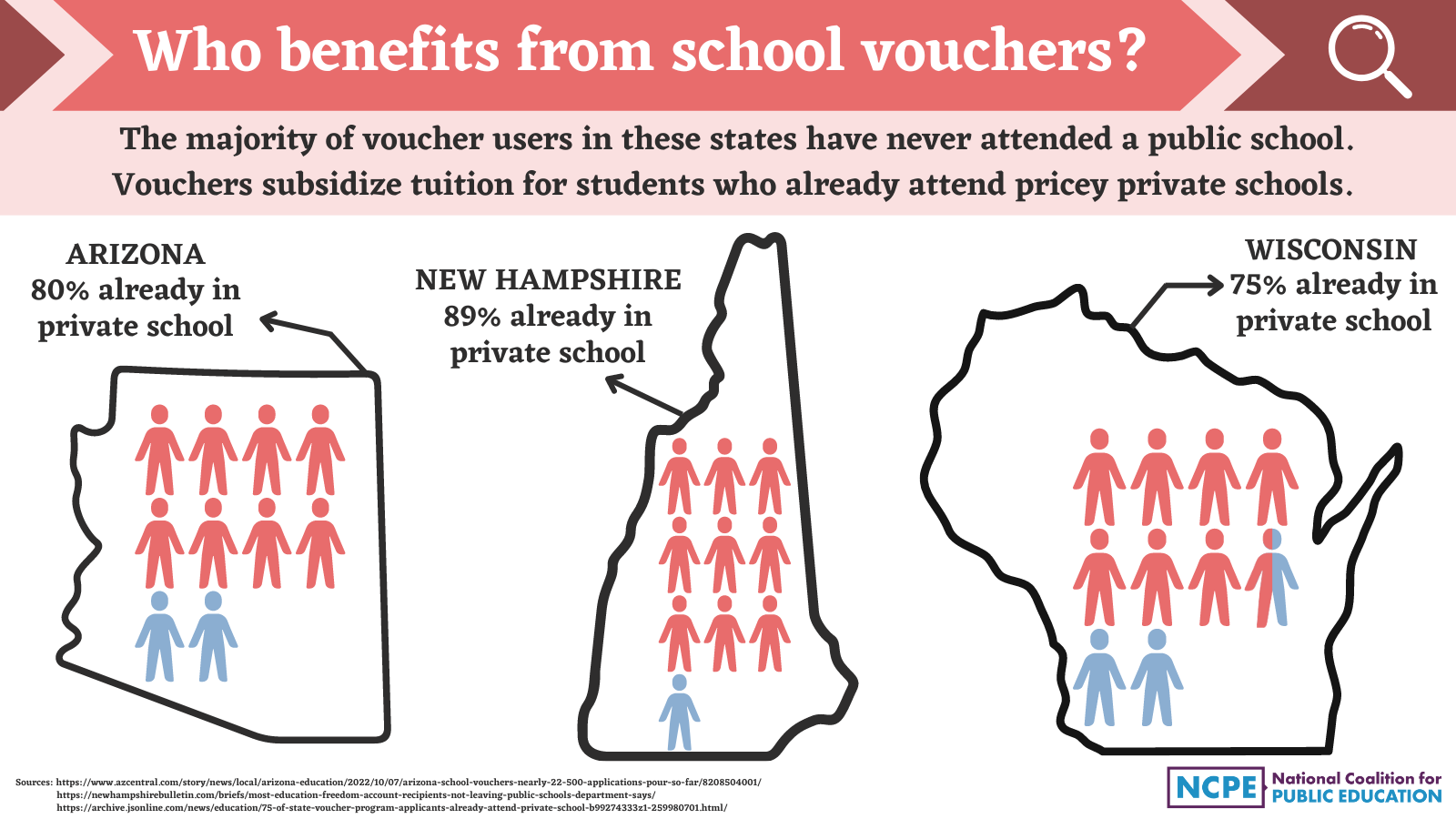
States with large-scale voucher programs are beginning to report out statistics for how many users come from public or private schools each year. And by the way these statistics put a lie to the claim from activists that vouchers are needed for families to choose, because we know from states like Arizona, New Hampshire, and Wisconsin that more than 75% of voucher kids were already in private school without taxpayer support.
But now we need more statistics reported on the mirror image: how many new students give up their vouchers each year. Recent numbers from Florida indicate roughly 60% of new voucher users give the voucher up after just a couple of years.
Think about that number as the voucher equivalent of a public school mobility or drop-out rate—both statistics used by critics to help indict public educational quality.
When I was working on an official evaluation of Milwaukee’s voucher program more than a decade ago, I led two reports on exactly these sorts of children. We found that around 15% of kids gave up their vouchers every year. Meaning that, as in Florida, more than half the kids we were studying left private schools over a short period of time!
Who were those kids? They were more likely to be Black, lower scoring on the state exam, and more likely to be enrolled in schools that had lots of other voucher-using kids (i.e. newer schools that popped up to take tax dollars once the program was created, rather than more established private institutions).
What happened when they left? Well actually that was a bit of good news. In still the only study to track kids over time after giving up their vouchers, we found that they enrolled in Milwaukee Public Schools and then improved substantially after arriving. The shame of it was they had to lose some academic growth in the voucher program before their parents realized it was a poor fit and fixed the problem.
Sometimes though, kids may even want to stay in their private school but the school itself shuts down and they have to move anyway. Voucher activists pushing an entrepreneurial approach to education don’t talk enough about the consequences of failure. For example, in Milwaukee, 41% of private schools that ever took tax dollars eventually shut down.
Imagine what critics of public schools would be saying right now if public schools had a 41 percent failure rate!
We’re not talking about a local Burger King that shuts down and a family has to drive a few extra blocks to get that Whopper they crave from the next closest franchise. Or has to go to Taco Bell or Arby’s instead. We’re talking about potentially major academic and social setbacks for kids.
Finally, there’s one more reason voucher leavers matter—and it’s a bit technical so bear with me. Social scientists prioritize randomized control designs to estimate impacts of policy interventions. And when randomization isn’t possible, we try to find approaches that come close.
The problem that student exits from voucher programs causes for researchers is they create additional hurdles to estimating accurate impacts of those programs. All of the randomized studies of voucher programs have showed similar exit rates to our study in Wisconsin.
And in at least one study of Louisiana vouchers, the authors had to acknowledge that those exits—precisely the students who as in Wisconsin were not doing well in the program—probably caused any positive estimates of the program to be overstated. There are techniques researchers can use to adjust for that error, but no one agrees on exactly the right approach, so it continues to be a problem.
So to summarize: we need to know a lot more about kids who give up their vouchers. Most importantly because the evidence we do have tells us that school mobility is on balance a setback for kids, and we know kids exiting voucher programs are already more likely to be at some form of risk than those who stay.
But we also need to know because as a practical matter, voucher exits can cause analytical hurdles to studies estimating voucher impacts on learning or on educational attainment.
And what that means is that in the future, if voucher supporters trumpet a new study—credible or otherwise—that purports to show positive impacts over time, the very first question we need to ask is: how many kids left the program because it wasn’t working for them?
Based on the data already available, the answer will be another indictment for voucher programs.
Josh Cowen is a veteran voucher researcher, having worked in the field for more than 20 years. He is a professor of education policy at Michigan State University. After two decades as a researcher, he concluded that vouchers are a disaster for the children who use them.
Today, he writes an inside guide to voucher research. All pro-voucher research is actually disguised advocacy for vouchers, especially if it funded or produced by the organizations listed here.
I hope you will share this post with your friends on social media, post blogs about it, and get it into the hands of journalists. The public deserves transparency.
Josh Cowen writes:
The entire base of evidence to support school vouchers comes from a small, interconnected and insular group of research-activists with direct ties to Betsy DeVos, Charles Koch, the Waltons and other privatization financers.
If you stopped reading this post right now, that’s the take-home message right there: the case for vouchers relies entirely on data and evidence contributed by what amounts to industry-funded research and advocacy on behalf of the cause.
But if you’re a journalist, an educator, or just a committed public school supporter (thank you!) and you want the links and the details, read on.
WHO’S WHO IN THE VOUCHER RESEARCH/ADVOCACY WORLD?
If you’re a professional journalist either in the education space or a broader policy/politics issue, you’ve probably heard of some of these people and certainly their institutions before. But you’re busy, you’ve got deadlines to meet and editors to approve your copy, and it’s not always easy to connect some of the important dots in this area.
But they need to be connected. The single most difficult task I’ve found in my writing on school vouchers has been to explain to journalists how the question of whether vouchers “work” for kids is not some obscure academic ivory-tower debate in which both sides have a nuanced, complicated and reasonably well-founded point.
There is credible research on one side—that vouchers are largely a negative force for student outcomes—and politically oriented reports on the other. That’s it.
So the next time you see a press release, or are given a quote, or talk off record to a voucher supporter saying that vouchers work, try this little exercise and see what you find for yourself:
STEP 1: DOES THE RESEARCH COME FROM ONE OF THE FOLLOWING ORGANIZATIONS?
• American Federation for Children: the 501(c)(4) advocacy organization co-founded by Betsy DeVos to lobby for vouchers. DeVos was so close to this group she had to recuse herself as Secretary of Education from contact with the group in her first year in government.
• Cato Institute: A Right-wing advocacy think tank co-founded by Charles Koch (although Koch later sued for lack of direct control of the group).
• EdChoice: Formerly the Friedman Foundation for Educational Choice, named for conservative economist who first proposed vouchers. Enough said.
• ExcelInEd: The advocacy group founded by Jeb Bush to expand vouchers and other conservative education priorities from the model Bush developed while he was governor of Florida.
• Goldwater Institute: A self-described libertarian think tank in Arizona that is chiefly oriented toward litigation on behalf of a number of different conservative policy priorities—most recently school vouchers.
• Harvard University Program on Education Policy and Governance (PEPG): A research center at Harvard run by Professor Paul Peterson, also of the Hoover Institution, and the father of modern-day pro-voucher research.
• Heritage Foundation: the most influential Right-wingthink tank in the country, devoted in part to privatizing schools and exploiting culture wars. Also directly tied to voter suppression efforts, per deep reporting by The New Yorker.
• University of Arkansas Department of Education Reform: A university-based doctoral training department responsible for producing nearly all of the currently active voucher research-advocates working at the institutions above today. This department was founded by a $10 million gift from the Walton Family Foundation in the early 2000s.
STEP 2: IS THE AUTHOR, CO-AUTHOR OR SOURCE FOR BACKGROUND OR ATTRIBUTION ONE OF THE FOLLOWING PEOPLE?
The Original Voucher Research-Advocates
• Jay P. Greene Currently Senior Fellow at Heritage, former founding head of the University of Arkansas Department of Education Reform, received his PhD under Paul E. Peterson.
• Paul E. Peterson Currently Professor at both Harvard and the conservative Hoover Institute at Stanford University, and the primary intellectual force behind the original positive voucher studies of the late 1990s.
Their Students, Colleagues and Acolytes
• Lindsay Burke Currently at the Heritage Foundation and a member of GOP Governor Glenn Youngkin’s transition team.
• Corey DeAngelis Currently Research Director for DeVos’s American Federation for Children group. But so much more: a regular Fox News contributor and active campaigner with far-Right governors like Kari Lake in Arizona and Kim Reynolds in Iowa.
• Greg Forster Currently at EdChoice and a co-blogger with Jay Greene.
• Matthew Ladner Currently at ALEC, EdChoice, Goldwater, and the Charles Koch Institute.
• Martin Lueken Currently a research director at EdChoiceand former PhD student of Jay Greene and Patrick Wolf at University of Arkansas.
• Mike McShane Currently a research director at EdChoiceand former PhD student of Jay Greene and Patrick Wolf at University of Arkansas.
• Neil McCluskey Currently “Director of Education Freedom” at the Cato Institute and a member of the editorial board for the Journal of School Choice—a publication edited by Robert Maranto of the University of Arkansas.
• Patrick Wolf Currently interim-head of the University of Arkansas Department of Education Reform, former colleague of Jay Greene and a former PhD student of Paul Peterson.
Not all of these organizations or individuals occupy the same problematic position. For example, I happen to make a point of reading everything McShane publishes, for example, because I respect his writing and the way he talks about the world even though I fundamentally disagree with his conclusions.
And the University of Arkansas group also includes a robust and insightful group of researchers examining the needs of teachers in the Ozarks and other high-poverty areas. I’m a great admirer of Professor Gema Zamarro and her students, who are doing some very important work on the role that the COVID0-19 pandemic played in teacher workforce conditions.
For that matter, some of what we know about the devasting effects of vouchers in Louisiana actually comes from Patrick Wolf’s reports. I’ve written with him myself on studies like one showing how critical strong oversight is to voucher program performance. Wolf is in fact the only person on the list abovewith a long and commendable history of publishing negative voucher impacts in top academic journals. The point here is not to disparage the individuals but to judge the insular and self-citing base of research that supports vouchers.
The point here is to be critical consumers of this line of research. Think of it this way: no news editor would release a story on an explosive topic going on the say so of a single source. At minimum that editor would require two and usually more sources. The problem for voucher advocacy research is that it is usually the only source for positive voucher impacts available. And it’s been that way for a decade or more.
What’s the take home point? It’s this: not all voucher advocates publish exclusively pro-voucher studies, but all pro-voucher studies come almost exclusively from pro-voucher advocates.
STEP 3: WHO FUNDED THE WORK YOU’RE READING OR THE SOURCE YOU’RE CITING?
The Bradley and Koch Foundations—along with Heritage—are directly involved in Big Lie, election denialism, and voter-suppression funding, as reported by Jane Mayer of the New Yorker in painstaking detail last summer.
The next time you read a report, or talk to a source for attribution, ask first about their funding sources. If they decline to provide those sources, consider declining to report their results or their viewpoint. It is common for philanthropists to request non-disclosure of their donations—that is their right. But it is your right as a reporter, and certainly the right of your readers, to decline to print their material.
Transparency is just the name of the game for credible research. You can see my own research funding right here. You can see that I once upon a time also received grant funding from the Walton Foundation. And from Bloomberg, and the Laura and John Arnold Foundation. My only current active funding comes from the U.S. Department of Education Institute for Education Sciences—awarded to my research team while Betsy DeVos was education secretary!
Do I believe those organizations swayed my earlier research? Of course not. And the advocates above would say the same thing. But I don’t get to decide what to think and neither do they. That’s for the reader to judge, and that can’t happen without full transparency.
WHAT DOES ALL THIS MEAN?
This all may seem like inside baseball. A bunch of current and former voucher researchers arguing about who’s who and what’s what. A bunch of annoying and self-centered PhDs.
But in some sense that’s the entire point.
Whether an educator, reporter, researcher, policymaker or just avid reader of Diane’s blog here, you would be hard-pressed—if not find it absolutely impossible—to find a single study of voucher participant effects (how vouchers impact outcomes) that did not come from one of the few organizations or few individuals listed above, or a handful of others with direct ties to Greene, Peterson, or Arkansas.
That’s a problem, because what that means is that hundreds of millions of dollars, and hundreds of thousands of school children are being affected every day by the advocacy of a small group of people. In many cases advocacy disguised as objective and credible research.
As a counter point, consider this humble list of studies showing far more nuance and at times outright negative results from voucher programs. To create that list, I made a simple rule: no studies from organizations listed in Step 1 above. Notice the variety of names and the diversity of venues and outlets. That’s what a credible research base looks like.
A LITMUS TEST: IS THE PRO-VOUCHER EVIDENCE I’M READING POLITICAL/IDEOLOGICAL?
If at this point you’re still not convinced that the entire structure of pro-voucher research amounts to industry-funded research—think the Sacklers funding research on oxycontin’s addictive properties, or ExxonMobil funding research on fossil fuel environmental effects—there is also this:
Many of the organizations and individuals noted above also contribute to other areas of politically engaged conservative education reform.
Greene even put right in print for you to see that these culture war issues are useful to Right wing activists pushing the privatization of schooling.
In other words, pro-voucher research exists right alongside—and is often published by—the same people and organizations pushing other far-Right education outcomes. You need to know that to have a full picture of what voucher research truly says.
Pro-voucher research is pro-voucher advocacy, and pro-voucher advocacy is part of the larger effort to undermine public education, undermine a more humane approach to tolerating difference and diversity in our schools, and in many cases undermine free embrace of democracy itself.
This post is so important that it is the only one I have scheduled today. Please read it and share it with your friends, your local newspaper, your local radio station, your elected representatives, social media, anyone who cares about the future of our society. This is not a reprint. The author, Josh Cowen, wrote this post for this blog.
Josh Cowen, a professor at Michigan State University, has been studying vouchers for more than 20 years. He has been a member of the teams conducting major studies of vouchers. When I read his article in The Hechinger Report, where he declared that he was convinced that vouchers were disastrous for students who use them, I wanted to know more about him and his experience. I wanted to ask him, “Why did you change your mind?” That’s the question that’s been asked of me hundreds of times. I have a simple answer and a complicated answer: the simple answer is “I was wrong.” The complicated answer is contained in my recent books, starting with The Death and Life of the Great American School System: How Testing and Choice Are Undermining Education.
I invited Josh to explain his views for my blog, and he graciously accepted. I consider this piece to be one of the most important statements I have posted in the decade this blog has been live. Please note two points he makes:
One, vouchers harm the children who leave public schools to use them.
Two, most of the early voucher research was conducted by researchers who were partisan supporters of vouchers.
Josh Cowen writes:
It’ll be a few more days for the final election results to be tallied nationwide, but it seems clear that with midterm wins by voucher supporters in places like Oklahoma, Texas and even Pennsylvania—where even the Democratic gubernatorial victor is on record in cautious favor—voucher opponents are going to have to keep working hard to block public funding of private and religious schools.
School vouchers have devastating effects on student outcomes. Full stop. That’s something even the nation’s voucher advocate-in-chief Betsy DeVos has had to admit, because the data are so stark.
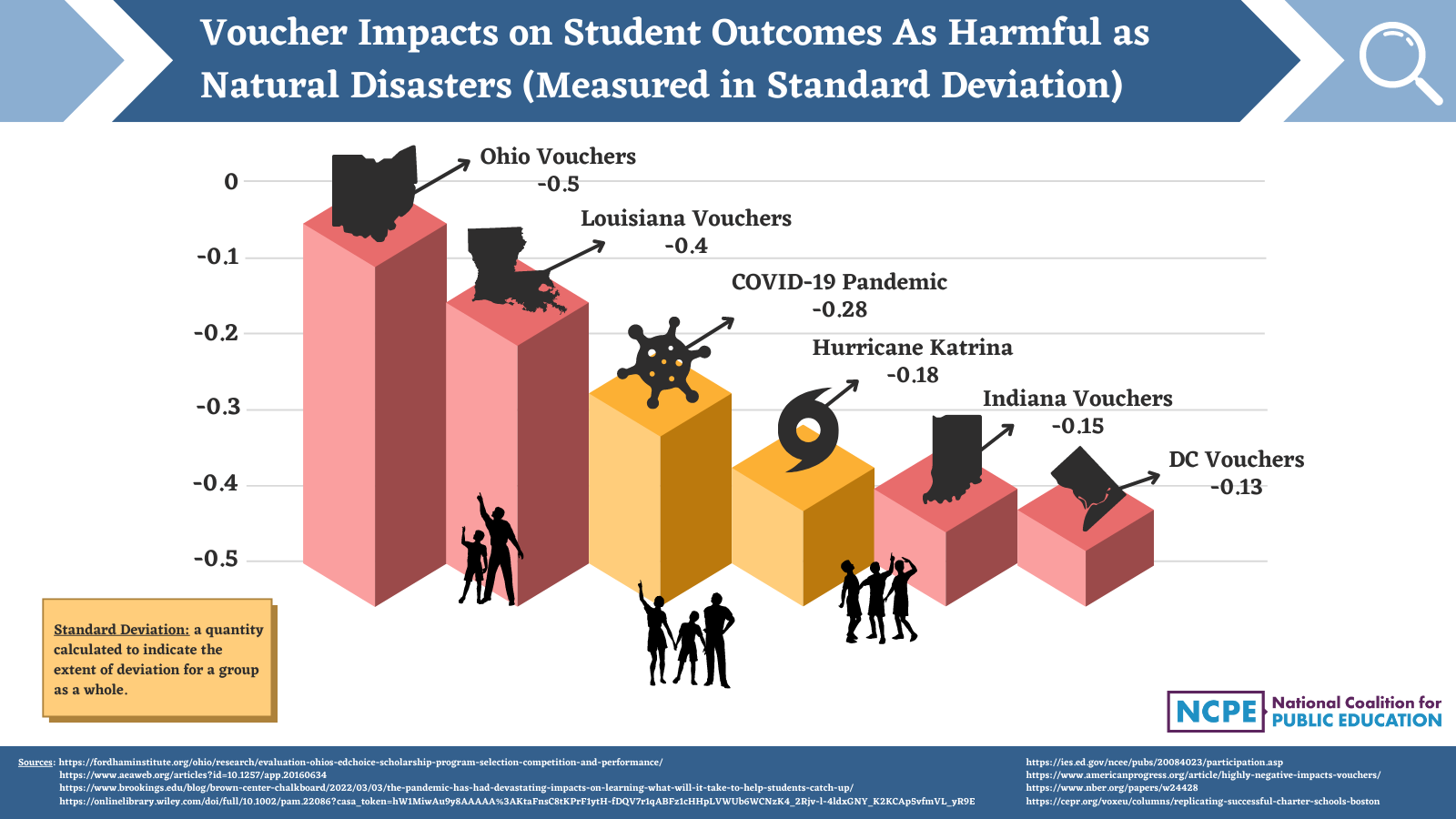
Large-scale independent studies in D.C.,Indiana, Louisiana, and Ohio show that for kids who left public schools, harmful voucher impacts actually meet or exceed what the pandemic did to test scores. That’s also a similar impact in Louisiana to what Hurricane Katrina did to student achievement back in 2005.
Think about that next time you hear a politician or activist claim we need taxpayer support for private schools to offset what the pandemic did to student learning. Here, their cure would in test score terms be quite literally worse than the disease.
There’s another data point you need to know up front: vouchers overwhelmingly fund children who were already in private school without them. In states that have released those numbers—Arizona, New Hampshire, and Wisconsin—we know more than 75% of voucher applicants came from private schools.
The bottom-line: most kids using vouchers didn’t need them to go to private school, and the few kids who actually did use vouchers to transfer sectors schools suffer average test score drops on par with what a once-in-a-generation pandemic did to test scores too.
If you’re a picture person, our friends at the National Coalition for Public Education were kind enough to put their considerable talents into two graphics based on these data I provided to them.
Notice the citations these graphs include. They’re the same as the hyperlinks above. These data come from independent sources and from non-partisan journalists. That’s a critically important part of this story.
And then there’s this, before we get into the details: the same people pushing vouchers are the same people working to undermine fair elections and the right to vote.
None of these are metaphors, and this is not a drill.
So how did we come to this?
1. A Quick History of Voucher Research
First let’s talk about the evidence.
I came into the school voucher research community early. It was around 2001 or so, as a young graduate student assistant for a study of privately funded vouchers led by the conservative professor Paul E. Peterson who was based at both Harvard and the conservative Hoover Institution at Stanford (never heard of Hoover? Think Condoleeza Rice.)
Peterson and his protégé Jay Greene had already done one study of Milwaukee’s publicly funded voucher program, as well as the one in Cleveland that was about to be the subject of the U.S. Supreme Court’s first favorable ruling on voucher funding. That work generally showed positive results for vouchers. As did the research of a young academic named Cecilia Rouse, who is now President Biden’s chief economist.
But they were small programs. What policymakers and researchers call a “pilot phase.” Back then when both parties cared at least nominally about evidence, you wouldn’t expand a program like vouchers without testing it. So those early tests seemed somewhat positive.
The first research I joined was Peterson and team’s next project: multi-site studies in Dayton, New York City, and Washington D.C. Those programs were also pilot-size. And the New York site in particular showed some limited evidence of voucher success. But overall the lead researchers focused as much on things like parental satisfaction and measures of civic engagement as metrics. That work resulted in a book called The Education Gap. You can find my name in the credits if you own a copy. If you don’t own one, don’t waste your money.
No one knew it at the time, but the mixed results documented in The Education Gap were to be the best vouchers were ever going to do—and ever have done since by an academic based team looking at voucher test scores.
Just a short time later in 2005, I joined a new voucher evaluation led by Patrick Wolf, another Peterson protégé and contributor to The Education Gap. Wolf was by then ensconced with Jay Greene at the University of Arkansas Department of Education Reform, a Walton Family-funded academic group that was about to train a new generation of voucher advocates. Most notably Corey DeAngelis, now at Betsy DeVos’s 501(c)4 voucher lobbying group American Federation for Children.
The Milwaukee evaluation, which was officially done for the state of Wisconsin, lasted from 2005-2010. We found no evidence in five years that voucher kids outperformed public school kids. Two exceptions: we found limited evidence that graduation rates and college enrollment were somewhat higher for the voucher kids. We also found that voucher kids improved when the state required private schools to participate in the same No Child Left Behind-style accountability systems as public schools. In particular once voucher schools knew their performance would be made public they—shockingly!—improved their outcomes.
At the same time as the Milwaukee evaluation, Patrick Wolf and other Arkansas colleagues were working on a new evaluation of Washington D.C.’s federally funded voucher program. That study showed no difference in test scores, but large positive graduate results.
That pattern of “no test score benefits, some attainment benefits” has stuck in the research narrative even among voucher skeptics. But as I recently explained in a piece for the Brookings Institution, it’s just that: a narrative. Other studies in New York, Louisiana and Florida all show no real advantages for vouchers on educational attainment.
And certainly nothing to offset the cataclysmic results that began to come out after the early-stage evaluations I just described. The newer D.C.,Indiana, Louisiana, and Ohio studies that took place after 2013 and have showed pandemic and Katrina-sized harm to student test scores are all of at-scale voucher programs.
What do I mean by “at scale?” I mean that despite limited evidence in those pilot programs, vouchers have been steadily expanding across the country, and within states. So those D.C., Indiana Louisiana and Ohio studies represent our best understanding to date of what happens when you expand vouchers beyond the initial test phase. The answer: horrific impacts on student outcomes.
There are a number of reasons this could be, but I tend to argue we need not overthink this. Vouchers just don’t work. The kids who stand to gain from private schooling were and are already there. For the vast majority of kids, they’re better off in public schools. That’s what the latest voucher research shows.
As an example of what I mean: consider that in Wisconsin (which has not had a statewide study since ours ended in 2010), 41% of voucher-receiving schools have opened and then closed and failed since public funding began in the early 1990s.
That’s what happens when policymakers divert tax dollars to private schools: it’s like venture capitalism for education. It’s like Theranos but for private schooling. New providers race to gobble up new taxpayer money, but most of them have no business near kids.
Now, to fully understand why these terrible policies exist and in fact have never spread faster and further than they are today, we need to understand the politics. And to understand the politics, we need to understand the money.
On the one hand it’s pretty simple. Once you understand that the same people pushing vouchers are the same people funding groups that insist Donald Trump won the election and are now organizing a similar “Big Lie” for 2022’s results, you understand a lot. But read on.
2. Funding Vouchers, Funding Election Lies
It’s difficult to tell how much money has been spent to advocate for school vouchers over the years. But we know perhaps the biggest single funder—perhaps even larger than Betsy DeVos herself—is the Lynde and Harry Bradley Foundation. The Bradley Foundation is a little-known group based in Wisconsin and they’ve given tens of millions of dollars to voucher activism over the years.
Bradley not only funds voucher activism, it funds voucher research too. It was a major funder of the Milwaukee evaluation I was part of and described above. I don’t think they directly influenced our results, but generally speaking you don’t want activism and research funding to mix. Think about it this way: should the Sackler family fund research on the addictive properties of oxycontin? Should Exxon fund studies about the existence of climate change?
For me though, the real problem today is that the Bradley Foundation is hardly limiting itself to supporting research and political advocacy for private schooling. As the New Yorker’s Jane Mayer has meticulously documented in her reporting on financing behind Big Lie activism sowing doubts about President Biden’s 2020 victory, the Bradley Foundation is the convening funder around those activities—the “extraordinary force”, in Mayer’s words, funding and coordinating the Big Lie and other efforts to undermine the integrity of democratic elections.
Bradley is not alone. The Heritage Foundation, a right-wing organization known for its pro-voucher advocacy is, according to Mayer, “working with the American Legislative Exchange Council (ALEC)—a corporate-funded nonprofit that generates model laws for state legislators—on ways to impose new voting restrictions.”
In recent months, Heritage has also distributed talking points that under the guise of objective research attack school diversity and inclusion and directly question health care support for LGBTQ children. Heritage has recently released a report-card style rubric rating state laws on a so-called “Education Freedom” index for tax-supported private tuition. That report card includes the extent to which issues like diversity or sexual preference are components of public school teaching curricula.
The author of each of these documents is a Heritage Senior Fellow named Jay P. Greene. The same Jay Greene who while a conservative scholar at the University of Arkansas was co-director of that Bradley-funded voucher project that hired me back in 2005.
Greene is not alone in the Heritage-Bradley nexus. Cleta Mitchell, a lawyer who participated in Donald Trump’s infamous phone call to the Georgia Secretary of State demanding evidence that would overturn the state’s election results, was actively training poll watchers to question voters leading up to the 2022 midterms in places like my own state of Michigan. The night before the election, the New York Times even ran a story about Mitchell’s work in Michigan. The headline read: “Fueled by Falsehoods, a Michigan Group is Ready to Challenge the Vote.”
Mitchell is a known elections conspiracy theorist, according to CNN, and figures prominently in Mayer’s New Yorker reporting on broader election-related organizing. In her spare time Mitchell is on the Board of Directors of—wait for it!—the Lynde and Harry Bradley Foundation. She’s actually an officer on the Board too.
Michigan is important because we have a voucher proposal waiting to go to the state legislature—even though voucher opponent Gretchen Whitmer has won reelection. That proposal, backed by billionaire and privatization advocate Betsy DeVos, exploits a quirk in the state law allowing lame-duck Republicans to pass the voucher plan without the governor’s signature.
The spokesman for the DeVos voucher campaign is a man named Fred Wszolek. Wszolek is also the strategist for a group that tried unsuccessfully to prevent abortion access from becoming enshrined in the Michigan state constitution. And he heads a political action committee (PAC) called Michigan Strong, which has worked to elect now-defeated DeVos-backed GOP gubernatorial candidate Tudor Dixon.
Also working for Dixon was Kyle Olson of the Education Action Group, an entity devoted to right-wing education reform that’s received money from Charles Koch, the DeVos Family and Harry Bradley—he of the Bradley Foundation.
That’s just one example, but you get the idea: the same people working to push school vouchers are the same people working to undermine elections. And in some cases even reproductive rights.
3. So Why Now?
I’ve spent the last six months writing column after column in opinion pages across the country trying to warn ordinary readers who aren’t education lifers about the dangers of vouchers. You can read samples here or here or here or here if you like. There are more than 10 in all.
Because of my long career working in the middle of all these voucher advocates and researchers, I’ve been asked multiple times what changed my mind. Or, more specifically, why am I speaking out today?
I hope the story I’ve told you above answers some of that. But the reality is, I was also doing other things. I had a young family, other research interests, and other professional tasks like editing the country’s premier education policy journal.
Most of all I had a naïve sense that the facts would speak for themselves. Remember, those pandemic-sized voucher failures began appearing back in 2013. I was an associate professor then, newly arrived at Michigan State University after receiving tenure at the University of Kentucky.
To me, after a decade of mixed-at-best results that I outlined here, I assumed that catastrophic results like those in Louisiana—and then confirmed in Indiana, Ohio, and D.C.—would have killed vouchers a thousand times over.
It’s sort of quaint now, that assumption of mine. In my research community, which is centered in the Association for Education Finance and Policy, we talk a lot about using evidence to inform policy. It’s a nice idea, but vouchers are the big, glaring and alarming counterpoint. We have never seen such one-sided, consistently negative research results as we have for school vouchers in the education research community.
And yet they thrive.
To me, the piece to that puzzle is politics. Negative voucher results aren’t the only thing to happen since 2013.
2016 happened. Donald Trump happened. January 6th happened. Dobbs v. Jackson happened.
Voucher advocates are overwhelmingly on one side of those events. And they’ve racked up some wins.
We know voucher programs exist today not for how they might help some kids, but for how they might exclude others. We know private schools taking public money can and often do discriminate against certain children. In Florida for example, one private school barring LGBTQ kids has received $1.6 million so far in taxpayer funding. In Indiana, more than $16 million has gone to schools refusing to admit LGBTQ kids—or even kids with LGBTQ parents!—or about 1 out of every 10 private schools on the taxpayer dime.
I wish I had come around earlier to the level of alarm I’m raising today. Others have even without having to take a kind of road to Damascus like I did.
I’m a tenured full professor now. I’ve had a successful career working hard to bring evidence to public policy. I firmly believe that school vouchers are a fundamental threat not just to student learning, but also to democracy and to human rights.
So on vouchers I’ve come to the same view any number of us would if we stumbled onto a massive fraud in our workplace, or if we saw a young child being bullied simply for being who they are. None of it is okay.
And if you see something, you have to say something.
The more charter schools, the worse the shortage of teachers prepared in university education programs. Those in university programs intend to be career educators, and their numbers are shrinking. Thus concludes a new study from a federal research center created to study choice and its effects.
When Betsy DeVos was Secretary of Education, she awarded $10 million to create the National Center for Research on Education Access and Choice (REACH). The research group is headed by Douglas Harris, and DeVos assumed that he was pro-choice.
While Harris has written papers favorable to choice, he is an independent scholar and follows the data where it leads. In this paper, he and his co-author Mary Penn conclude that charter schools contribute to the teacher shortage.
On its face, the proposition makes sense. If a young person wants to teach, they can get a job in a charter school without a teacher education degree. They can join Teach for America and become a teacher with only weeks of preparation. Or in some states, they can teach with no certification or degrees. Why bother going through the process of professional education and certification when charter schools will hire without any prerequisites?
The summary of the study concludes:
Debates about charter schools center on their immediate effects on students who attend them and how charter schools affect nearby traditional public schools. However, as the charter sector has continued to grow, a broader range of possibly unintended effects become relevant. This study is one of the first to examine the possibility that charter schools affect the teacher pipeline. We focus specifically on how charter schools affect the number of traditionally prepared teachers who receive a bachelor’s in education.
Using data from 290 school districts with at least one commuter college nearby, we analyze the effect on the traditional teacher pipeline from schools of education. We draw the following conclusions:
Increasing district charter school enrollment by 10% decreases the supply of teachers traditionally prepared with a bachelor’s in education by 13.5-15.2% on average.
Charter-driven reductions in the supply of traditionally prepared teachers are most apparent in elementary, special education, and math education degrees.
This is consistent with the fact that charter schools mostly serve elementary grades, express interest in subject matter experts (e.g., math majors), and are less likely to assign students to special education.
These charter-driven reductions are concentrated in metropolitan areas and are largest among Black teachers.
Given how central teachers are to the educational process, any effect on the teacher pipeline is important. The vast majority of U.S. teachers still come from university-based schools of education, and these teachers stay in the profession longer than those who are not traditionally prepared, which makes these declines note worthy. A larger point is that charter schools change the entire schooling market in ways we are only beginning to recognize.
A new study confirms what many critics of the Broad Foundation’s Superintendents’ Academy long suspected. Despite Eli Broad’s boasting, his program had no positive effects on student performance, but the “graduates” expanded privatization by charter schools.
Public-Sector Leadership and Philanthropy: The Case of Broad Superintendents
Thomas S. Dee
Stanford University
Susanna Loeb
Brown University
Ying Shi
Syracuse University
Using a unique panel data set on the 300 larg-est school districts, we examined the impact of Broad superintendents on a broad array of dis-trict outcomes. Our results indicate that the hir-ing of a Broad superintendent had no clear effects on outcomes such as student completion rates, enrollment, the closure of traditional public schools, and per-pupil spending on instruction or on support services. However, one exception to this pattern is particularly notable. We do find evidence that the hiring of a Broad superinten-dent results in a growing charter school sector. Specifically, we find that the hiring of Broad superintendents is associated with a trend toward increased charter school enrollment and a growth in the number of charter schools that extends beyond the short tenure of the typical Broad trainee.
We view the overall implications of these findings as nuanced. On the one hand, this Broad Foundation initiative was successful in placing new leaders with distinctive characteristics and training in a substantial number of U.S. school districts. Yet, we also find that these leaders had unusually short tenures and no clear effects on a variety of district outcomes.
A newly published analysis of how dollars are distributed to schools in the U.S. posits that funding allocation models continue to disadvantage those in low-income communities, despite long-standing evidence that equitable funding is critical to students’ capacity to learn and achieve.
Due to the reliance on local property values to fund schools, property poor districts are prevented from increasing or equalizing school revenue to the level of wealthier districts. This poverty is unequally distributed across racial and ethnic backgrounds. Recent peer-reviewed research has shown that in gentrifying urban communities, as the proportional intensity of white students increases in schools, so do the resulting resources and demands for schools, the authors write.
“Education is a human right and a civil right, but our school finance policies are failing to treat it as such,” Martínez said. “Access to quality education is necessary for communities to thrive. When there are major educational disparities that exist between communities, it impacts everyone. This is demonstrably true if those educational disparities are predicated on community wealth, or race and ethnicity. Policy makers must do more to understand the history of school finance disparity in their community, and take steps to ameliorate its impact.”
Martínez and Vasquez Heilig say in their analysis that, despite countless attempts to reform school finance policy, the U.S. has historically been unable to improve school funding inequity and injustice. Without creating a more equitable system, resolving challenges for marginalized students will continue to be difficult.
“We looked at numerous studies showing increases in funding resulted in greater academic success for marginalized students. For instance, when more resources were put into majority LatinX urban schools, reading and math achievements increased,” Vasquez Heilig said. “Quite simply, money does matter and investing in education early and often matters in the everyday life of a student.”
The authors suggest federal policymakers adopt a framework known as Opportunity to Learn that would put in place a set of minimum standards for equitable learning in U.S. schools. These standards would include well-trained and certified teachers and administrators, timely curriculum and texts, up-to-date facilities and wrap-around services to support neuro-divergent learners and the health, nutrition, housing and family wellness of students. As a civil right, the authors argue for complete and differentiated levels of service for every student and funding that allows for the provision of those services.
After these standards for learning are set, it would enable state policymakers to raise revenue to proper levels of fiscal support for meeting the standards. The authors say this model deviates from past school reform and finance models that have focused on test scores and the need for increased student achievement. They, instead, support a model where success is determined by how policymakers are supporting high-quality educational access and availability in every community, promoting alternatives to the historical resource disparity that has oppressed BIPOC students and families.
“Ultimately, as a civil right, we need to support students through the P-20 pipeline, which includes high school completion and earnings later in life, with the ultimate goal of reducing adult poverty,” Vasquez Heilig said.
If you are like me, your head is spinning about the conflicting signals about New York City’s public schools. The state legislature voted to mandate smaller class sizes, which will cost money, but the City Council voted to cut the schools’ budget.
Leonie Haimson, executive director of Class Size Matters, encourages everyone to fight back. She has spent more than 20 years arguing for reduced class sizes as the most effective reform for schools.
Here is her message:
Dear folks –
Sadly, late Monday night the NYC Council agreedto a city budget that will make at least $215M in cuts directly to schools, by a 44-6 vote. These egregious cuts, the largest since the Great Recession of 2007-2008, were made despite billions more in the city’s reserve fund, an expected city budget surplus of more than $1B next year, and nearly $5B in unspent federal stimulus funds meant for our schools. These cuts will likely cause class sizes to increase and the loss of critical services for kids, who are still recovering from the disruptions caused by more than two years of the pandemic.
There are three things you can do now to help us fight back:
1.Sign our petition to Gov. Hochul, urging her to sign the new state class size bill, S09460/ A10498,as soon as possible, passed by the New York State Legislature on June 3 by a vote of 147 to 2 in the Assembly and 59 to 4 in the State Senate. Once she signs the bill, it will give us a legal avenue to try to reverse or limit the damage of these inexcusable cuts. The petition is co-sponsored by NYC Kids PAC, AQE and the Education Council Consortium.
2. You can also let DOE know directly how you feel about these cuts at the final C4E hearings tonight, Wed. June 15. You can sign up here, starting at 5 PM; the hearings begin at 6 PM. The public comments are required to be summarized, posted and sent to the NY State Education Department to help them decide whether to approve the city’s C4E plan. It goes without saying that “Excellence” will be harder to achieve than ever in our schools, given these devastating cuts. Some additional talking points are here.
3. Please also attend our Annual Skinny Award celebration, on Monday June 27, in which we will honor the state leaders who made the new class size bill possible. You can find out more about our honorees and how to purchase your tickets here. This is the first fundraiser Class Size Matters has held in three years — and we can really use your support. The education leaders who will be there to receive their awards also deserve your thanks.
But don’t forget to sign our petition to Gov. Hochul today! I will be up in Albany tomorrow and will deliver it to her office if there are enough signatures by then.

 Diane Ravitch's blog