Archives for category: Research

This post is so important that it is the only one I have scheduled today. Please read it and share it with your friends, your local newspaper, your local radio station, your elected representatives, social media, anyone who cares about the future of our society. This is not a reprint. The author, Josh Cowen, wrote this post for this blog.

Josh Cowen, a professor at Michigan State University, has been studying vouchers for more than 20 years. He has been a member of the teams conducting major studies of vouchers. When I read his article in The Hechinger Report, where he declared that he was convinced that vouchers were disastrous for students who use them, I wanted to know more about him and his experience. I wanted to ask him, “Why did you change your mind?” That’s the question that’s been asked of me hundreds of times. I have a simple answer and a complicated answer: the simple answer is “I was wrong.” The complicated answer is contained in my recent books, starting with The Death and Life of the Great American School System: How Testing and Choice Are Undermining Education.

I invited Josh to explain his views for my blog, and he graciously accepted. I consider this piece to be one of the most important statements I have posted in the decade this blog has been live. Please note two points he makes:

One, vouchers harm the children who leave public schools to use them.

Two, most of the early voucher research was conducted by researchers who were partisan supporters of vouchers.

Josh Cowen writes:

It’ll be a few more days for the final election results to be tallied nationwide, but it seems clear that with midterm wins by voucher supporters in places like Oklahoma, Texas and even Pennsylvania—where even the Democratic gubernatorial victor is on record in cautious favor—voucher opponents are going to have to keep working hard to block public funding of private and religious schools.

School vouchers have devastating effects on student outcomes. Full stop. That’s something even the nation’s voucher advocate-in-chief Betsy DeVos has had to admit, because the data are so stark.

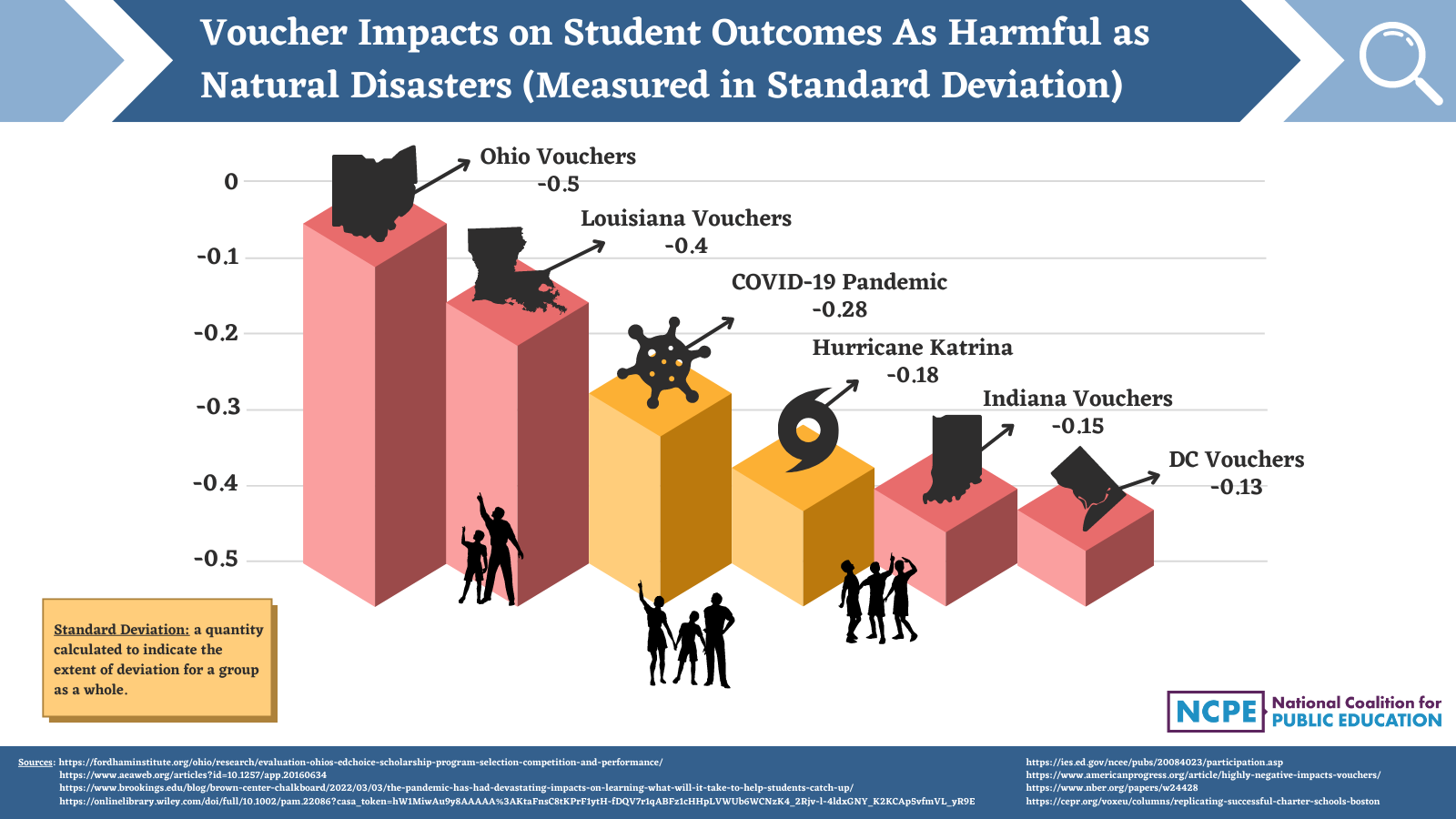
Large-scale independent studies in D.C.,Indiana, Louisiana, and Ohio show that for kids who left public schools, harmful voucher impacts actually meet or exceed what the pandemic did to test scores. That’s also a similar impact in Louisiana to what Hurricane Katrina did to student achievement back in 2005.

Think about that next time you hear a politician or activist claim we need taxpayer support for private schools to offset what the pandemic did to student learning. Here, their cure would in test score terms be quite literally worse than the disease.

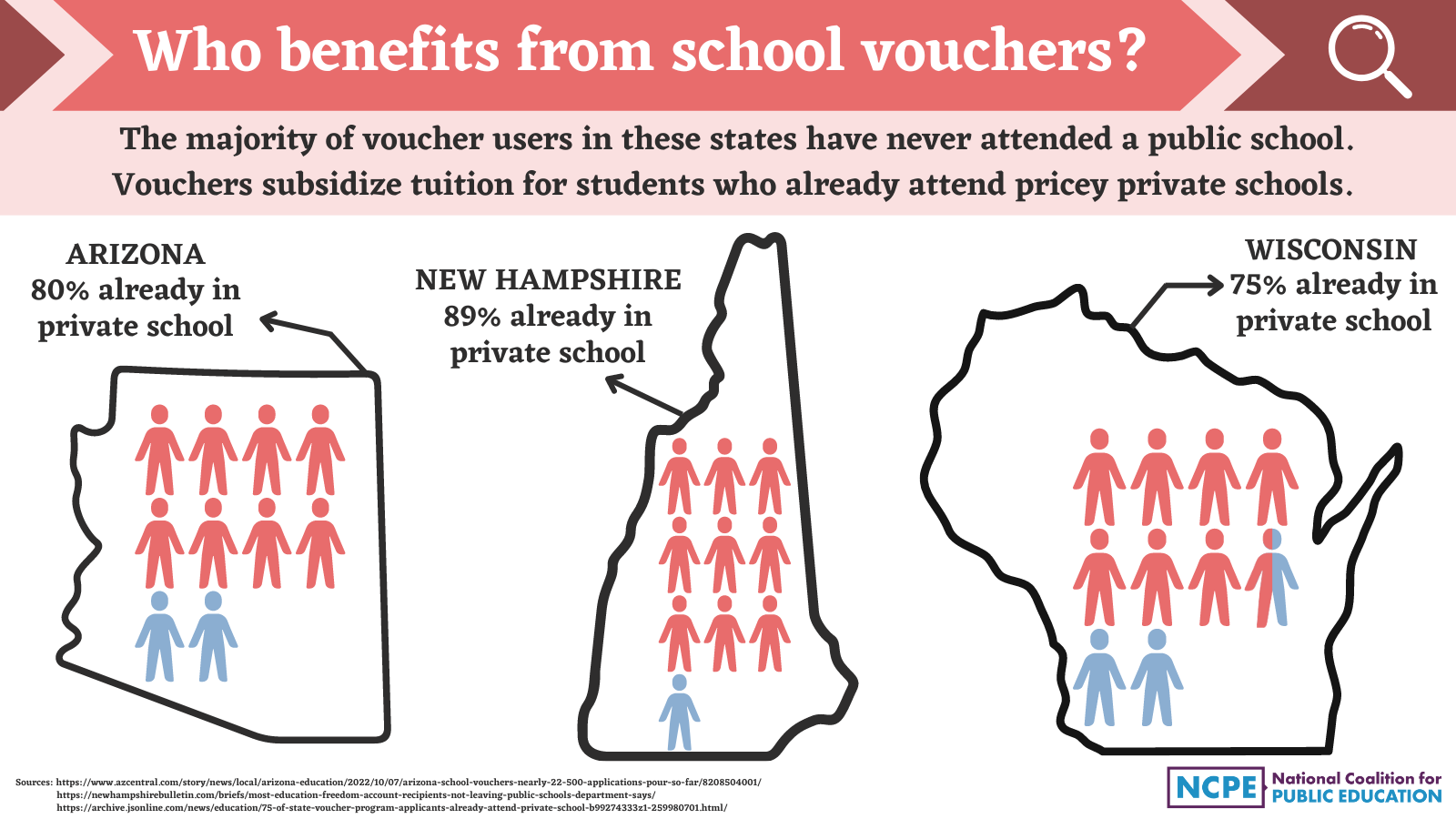
There’s another data point you need to know up front: vouchers overwhelmingly fund children who were already in private school without them. In states that have released those numbers—Arizona, New Hampshire, and Wisconsin—we know more than 75% of voucher applicants came from private schools.

The bottom-line: most kids using vouchers didn’t need them to go to private school, and the few kids who actually did use vouchers to transfer sectors schools suffer average test score drops on par with what a once-in-a-generation pandemic did to test scores too.

If you’re a picture person, our friends at the National Coalition for Public Education were kind enough to put their considerable talents into two graphics based on these data I provided to them.

Notice the citations these graphs include. They’re the same as the hyperlinks above. These data come from independent sources and from non-partisan journalists. That’s a critically important part of this story.

And then there’s this, before we get into the details: the same people pushing vouchers are the same people working to undermine fair elections and the right to vote.

None of these are metaphors, and this is not a drill.

So how did we come to this?

1. A Quick History of Voucher Research

First let’s talk about the evidence.

I came into the school voucher research community early. It was around 2001 or so, as a young graduate student assistant for a study of privately funded vouchers led by the conservative professor Paul E. Peterson who was based at both Harvard and the conservative Hoover Institution at Stanford (never heard of Hoover? Think Condoleeza Rice.)

Peterson and his protégé Jay Greene had already done one study of Milwaukee’s publicly funded voucher program, as well as the one in Cleveland that was about to be the subject of the U.S. Supreme Court’s first favorable ruling on voucher funding. That work generally showed positive results for vouchers. As did the research of a young academic named Cecilia Rouse, who is now President Biden’s chief economist.

But they were small programs. What policymakers and researchers call a “pilot phase.” Back then when both parties cared at least nominally about evidence, you wouldn’t expand a program like vouchers without testing it. So those early tests seemed somewhat positive.

The first research I joined was Peterson and team’s next project: multi-site studies in Dayton, New York City, and Washington D.C. Those programs were also pilot-size. And the New York site in particular showed some limited evidence of voucher success. But overall the lead researchers focused as much on things like parental satisfaction and measures of civic engagement as metrics. That work resulted in a book called The Education Gap. You can find my name in the credits if you own a copy. If you don’t own one, don’t waste your money.

No one knew it at the time, but the mixed results documented in The Education Gap were to be the best vouchers were ever going to do—and ever have done since by an academic based team looking at voucher test scores.

Just a short time later in 2005, I joined a new voucher evaluation led by Patrick Wolf, another Peterson protégé and contributor to The Education Gap. Wolf was by then ensconced with Jay Greene at the University of Arkansas Department of Education Reform, a Walton Family-funded academic group that was about to train a new generation of voucher advocates. Most notably Corey DeAngelis, now at Betsy DeVos’s 501(c)4 voucher lobbying group American Federation for Children.

The Milwaukee evaluation, which was officially done for the state of Wisconsin, lasted from 2005-2010. We found no evidence in five years that voucher kids outperformed public school kids. Two exceptions: we found limited evidence that graduation rates and college enrollment were somewhat higher for the voucher kids. We also found that voucher kids improved when the state required private schools to participate in the same No Child Left Behind-style accountability systems as public schools. In particular once voucher schools knew their performance would be made public they—shockingly!—improved their outcomes.

At the same time as the Milwaukee evaluation, Patrick Wolf and other Arkansas colleagues were working on a new evaluation of Washington D.C.’s federally funded voucher program. That study showed no difference in test scores, but large positive graduate results.

That pattern of “no test score benefits, some attainment benefits” has stuck in the research narrative even among voucher skeptics. But as I recently explained in a piece for the Brookings Institution, it’s just that: a narrative. Other studies in New York, Louisiana and Florida all show no real advantages for vouchers on educational attainment.

And certainly nothing to offset the cataclysmic results that began to come out after the early-stage evaluations I just described. The newer D.C., Indiana, Louisiana, and Ohio studies that took place after 2013 and have showed pandemic and Katrina-sized harm to student test scores are all of at-scale voucher programs.

What do I mean by “at scale?” I mean that despite limited evidence in those pilot programs, vouchers have been steadily expanding across the country, and within states. So those D.C., Indiana Louisiana and Ohio studies represent our best understanding to date of what happens when you expand vouchers beyond the initial test phase. The answer: horrific impacts on student outcomes.

There are a number of reasons this could be, but I tend to argue we need not overthink this. Vouchers just don’t work. The kids who stand to gain from private schooling were and are already there. For the vast majority of kids, they’re better off in public schools. That’s what the latest voucher research shows.

As an example of what I mean: consider that in Wisconsin (which has not had a statewide study since ours ended in 2010), 41% of voucher-receiving schools have opened and then closed and failed since public funding began in the early 1990s.

That’s what happens when policymakers divert tax dollars to private schools: it’s like venture capitalism for education. It’s like Theranos but for private schooling. New providers race to gobble up new taxpayer money, but most of them have no business near kids.

Now, to fully understand why these terrible policies exist and in fact have never spread faster and further than they are today, we need to understand the politics. And to understand the politics, we need to understand the money.

On the one hand it’s pretty simple. Once you understand that the same people pushing vouchers are the same people funding groups that insist Donald Trump won the election and are now organizing a similar “Big Lie” for 2022’s results, you understand a lot. But read on.

2. Funding Vouchers, Funding Election Lies

It’s difficult to tell how much money has been spent to advocate for school vouchers over the years. But we know perhaps the biggest single funder—perhaps even larger than Betsy DeVos herself—is the Lynde and Harry Bradley Foundation. The Bradley Foundation is a little-known group based in Wisconsin and they’ve given tens of millions of dollars to voucher activism over the years.

Bradley not only funds voucher activism, it funds voucher research too. It was a major funder of the Milwaukee evaluation I was part of and described above. I don’t think they directly influenced our results, but generally speaking you don’t want activism and research funding to mix. Think about it this way: should the Sackler family fund research on the addictive properties of oxycontin? Should Exxon fund studies about the existence of climate change?

For me though, the real problem today is that the Bradley Foundation is hardly limiting itself to supporting research and political advocacy for private schooling. As the New Yorker’s Jane Mayer has meticulously documented in her reporting on financing behind Big Lie activism sowing doubts about President Biden’s 2020 victory, the Bradley Foundation is the convening funder around those activities—the “extraordinary force”, in Mayer’s words, funding and coordinating the Big Lie and other efforts to undermine the integrity of democratic elections.

Bradley is not alone. The Heritage Foundation, a right-wing organization known for its pro-voucher advocacy is, according to Mayer, “working with the American Legislative Exchange Council (ALEC)—a corporate-funded nonprofit that generates model laws for state legislators—on ways to impose new voting restrictions.”

In recent months, Heritage has also distributed talking points that under the guise of objective research attack school diversity and inclusion and directly question health care support for LGBTQ children. Heritage has recently released a report-card style rubric rating state laws on a so-called “Education Freedom” index for tax-supported private tuition. That report card includes the extent to which issues like diversity or sexual preference are components of public school teaching curricula.

The author of each of these documents is a Heritage Senior Fellow named Jay P. Greene. The same Jay Greene who while a conservative scholar at the University of Arkansas was co-director of that Bradley-funded voucher project that hired me back in 2005.

Greene is not alone in the Heritage-Bradley nexus. Cleta Mitchell, a lawyer who participated in Donald Trump’s infamous phone call to the Georgia Secretary of State demanding evidence that would overturn the state’s election results, was actively training poll watchers to question voters leading up to the 2022 midterms in places like my own state of Michigan. The night before the election, the New York Times even ran a story about Mitchell’s work in Michigan. The headline read: “Fueled by Falsehoods, a Michigan Group is Ready to Challenge the Vote.”

Mitchell is a known elections conspiracy theorist, according to CNN, and figures prominently in Mayer’s New Yorker reporting on broader election-related organizing. In her spare time Mitchell is on the Board of Directors of—wait for it!—the Lynde and Harry Bradley Foundation. She’s actually an officer on the Board too.

Michigan is important because we have a voucher proposal waiting to go to the state legislature—even though voucher opponent Gretchen Whitmer has won reelection. That proposal, backed by billionaire and privatization advocate Betsy DeVos, exploits a quirk in the state law allowing lame-duck Republicans to pass the voucher plan without the governor’s signature.

The spokesman for the DeVos voucher campaign is a man named Fred Wszolek. Wszolek is also the strategist for a group that tried unsuccessfully to prevent abortion access from becoming enshrined in the Michigan state constitution. And he heads a political action committee (PAC) called Michigan Strong, which has worked to elect now-defeated DeVos-backed GOP gubernatorial candidate Tudor Dixon.

Also working for Dixon was Kyle Olson of the Education Action Group, an entity devoted to right-wing education reform that’s received money from Charles Koch, the DeVos Family and Harry Bradley—he of the Bradley Foundation.

That’s just one example, but you get the idea: the same people working to push school vouchers are the same people working to undermine elections. And in some cases even reproductive rights.

3. So Why Now?


I’ve spent the last six months writing column after column in opinion pages across the country trying to warn ordinary readers who aren’t education lifers about the dangers of vouchers. You can read samples here or here or here or here if you like. There are more than 10 in all.

Because of my long career working in the middle of all these voucher advocates and researchers, I’ve been asked multiple times what changed my mind. Or, more specifically, why am I speaking out today?

I hope the story I’ve told you above answers some of that. But the reality is, I was also doing other things. I had a young family, other research interests, and other professional tasks like editing the country’s premier education policy journal.

Most of all I had a naïve sense that the facts would speak for themselves. Remember, those pandemic-sized voucher failures began appearing back in 2013. I was an associate professor then, newly arrived at Michigan State University after receiving tenure at the University of Kentucky.

To me, after a decade of mixed-at-best results that I outlined here, I assumed that catastrophic results like those in Louisiana—and then confirmed in Indiana, Ohio, and D.C.—would have killed vouchers a thousand times over.

It’s sort of quaint now, that assumption of mine. In my research community, which is centered in the Association for Education Finance and Policy, we talk a lot about using evidence to inform policy. It’s a nice idea, but vouchers are the big, glaring and alarming counterpoint. We have never seen such one-sided, consistently negative research results as we have for school vouchers in the education research community.

And yet they thrive.

To me, the piece to that puzzle is politics. Negative voucher results aren’t the only thing to happen since 2013.

2016 happened. Donald Trump happened. January 6th happened. Dobbs v. Jackson happened.

Voucher advocates are overwhelmingly on one side of those events. And they’ve racked up some wins.

We know voucher programs exist today not for how they might help some kids, but for how they might exclude others. We know private schools taking public money can and often do discriminate against certain children. In Florida for example, one private school barring LGBTQ kids has received $1.6 million so far in taxpayer funding. In Indiana, more than $16 million has gone to schools refusing to admit LGBTQ kids—or even kids with LGBTQ parents!—or about 1 out of every 10 private schools on the taxpayer dime.

I wish I had come around earlier to the level of alarm I’m raising today. Others have even without having to take a kind of road to Damascus like I did.

I’m a tenured full professor now. I’ve had a successful career working hard to bring evidence to public policy. I firmly believe that school vouchers are a fundamental threat not just to student learning, but also to democracy and to human rights.

So on vouchers I’ve come to the same view any number of us would if we stumbled onto a massive fraud in our workplace, or if we saw a young child being bullied simply for being who they are. None of it is okay.

And if you see something, you have to say something.

You can find Josh Cowen on Twitter

@joshcowenMSU

The more charter schools, the worse the shortage of teachers prepared in university education programs. Those in university programs intend to be career educators, and their numbers are shrinking. Thus concludes a new study from a federal research center created to study choice and its effects.

When Betsy DeVos was Secretary of Education, she awarded $10 million to create the National Center for Research on Education Access and Choice (REACH). The research group is headed by Douglas Harris, and DeVos assumed that he was pro-choice.

While Harris has written papers favorable to choice, he is an independent scholar and follows the data where it leads. In this paper, he and his co-author Mary Penn conclude that charter schools contribute to the teacher shortage.

On its face, the proposition makes sense. If a young person wants to teach, they can get a job in a charter school without a teacher education degree. They can join Teach for America and become a teacher with only weeks of preparation. Or in some states, they can teach with no certification or degrees. Why bother going through the process of professional education and certification when charter schools will hire without any prerequisites?

The summary of the study concludes:

Debates about charter schools center on their immediate effects on students who attend them and how charter schools affect nearby traditional public schools. However, as the charter sector has continued to grow, a broader range of possibly unintended effects become relevant. This study is one of the first to examine the possibility that
charter schools affect the teacher pipeline. We focus specifically on how charter schools affect the number of traditionally prepared teachers who receive a bachelor’s in education.

Using data from 290 school districts with at least one commuter college nearby, we analyze the effect on the traditional teacher pipeline from schools of education. We draw the following conclusions:

Increasing district charter school enrollment by 10% decreases the supply of teachers traditionally prepared with a bachelor’s in education by 13.5-15.2% on average.

Charter-driven reductions in the supply of traditionally prepared teachers are most apparent in elementary, special education, and math education degrees.

This is consistent with the fact that charter schools mostly serve elementary grades, express interest in subject matter experts (e.g., math majors), and are less likely to assign students to special education.

These charter-driven reductions are concentrated in metropolitan areas and are largest among Black teachers.

Given how central teachers are to the educational process, any effect on the teacher pipeline is important. The vast majority of U.S. teachers still come from university-based schools of education, and these teachers stay in the profession longer than those who are not traditionally prepared, which makes these declines note worthy. A larger
point is that charter schools change the entire schooling market in ways we are only beginning to recognize.

The National Education Policy Center reviewed the study here.

A new study confirms what many critics of the Broad Foundation’s Superintendents’ Academy long suspected. Despite Eli Broad’s boasting, his program had no positive effects on student performance, but the “graduates” expanded privatization by charter schools.

Educational Evaluation and Policy Analysis

Month 202X, Vol. 8, No. 1, pp. 1 –27

DOI: 10.3102/01623737221113575

https://doi.org/10.3102/016237372211135


Public-Sector Leadership and Philanthropy: The Case of Broad Superintendents

Thomas S. Dee

Stanford University

Susanna Loeb

Brown University

Ying Shi

Syracuse University


Using a unique panel data set on the 300 larg-est school districts, we examined the impact of Broad superintendents on a broad array of dis-trict outcomes. Our results indicate that the hir-ing of a Broad superintendent had no clear effects on outcomes such as student completion rates, enrollment, the closure of traditional public schools, and per-pupil spending on instruction or on support services. However, one exception to this pattern is particularly notable. We do find evidence that the hiring of a Broad superinten-dent results in a growing charter school sector. Specifically, we find that the hiring of Broad superintendents is associated with a trend toward increased charter school enrollment and a growth in the number of charter schools that extends beyond the short tenure of the typical Broad trainee.

We view the overall implications of these findings as nuanced. On the one hand, this Broad Foundation initiative was successful in placing new leaders with distinctive characteristics and training in a substantial number of U.S. school districts. Yet, we also find that these leaders had unusually short tenures and no clear effects on a variety of district outcomes.

A new study by University of Kentucky Dean Julian Vasquez. Heilig and Professor David G. Martinez demonstrates the inequity built into school funding., to the disadvantages of the poorest communities.

A newly published analysis of how dollars are distributed to schools in the U.S. posits that funding allocation models continue to disadvantage those in low-income communities, despite long-standing evidence that equitable funding is critical to students’ capacity to learn and achieve.

The article, authored by University of Kentucky College of Education Dean Julian Vasquez Heilig, Ph.D., and Davíd G. Martínez, Ph.D., an assistant professor at the University of South Carolina, appears in the latest issue of the Minnesota Journal of Law & Inequality.

Due to the reliance on local property values to fund schools, property poor districts are prevented from increasing or equalizing school revenue to the level of wealthier districts. This poverty is unequally distributed across racial and ethnic backgrounds. Recent peer-reviewed research has shown that in gentrifying urban communities, as the proportional intensity of white students increases in schools, so do the resulting resources and demands for schools, the authors write.

“Education is a human right and a civil right, but our school finance policies are failing to treat it as such,” Martínez said. “Access to quality education is necessary for communities to thrive. When there are major educational disparities that exist between communities, it impacts everyone. This is demonstrably true if those educational disparities are predicated on community wealth, or race and ethnicity. Policy makers must do more to understand the history of school finance disparity in their community, and take steps to ameliorate its impact.”

Martínez and Vasquez Heilig say in their analysis that, despite countless attempts to reform school finance policy, the U.S. has historically been unable to improve school funding inequity and injustice. Without creating a more equitable system, resolving challenges for marginalized students will continue to be difficult.

“We looked at numerous studies showing increases in funding resulted in greater academic success for marginalized students. For instance, when more resources were put into majority LatinX urban schools, reading and math achievements increased,” Vasquez Heilig said. “Quite simply, money does matter and investing in education early and often matters in the everyday life of a student.”

The authors suggest federal policymakers adopt a framework known as Opportunity to Learn that would put in place a set of minimum standards for equitable learning in U.S. schools. These standards would include well-trained and certified teachers and administrators, timely curriculum and texts, up-to-date facilities and wrap-around services to support neuro-divergent learners and the health, nutrition, housing and family wellness of students. As a civil right, the authors argue for complete and differentiated levels of service for every student and funding that allows for the provision of those services.

After these standards for learning are set, it would enable state policymakers to raise revenue to proper levels of fiscal support for meeting the standards. The authors say this model deviates from past school reform and finance models that have focused on test scores and the need for increased student achievement. They, instead, support a model where success is determined by how policymakers are supporting high-quality educational access and availability in every community, promoting alternatives to the historical resource disparity that has oppressed BIPOC students and families.

“Ultimately, as a civil right, we need to support students through the P-20 pipeline, which includes high school completion and earnings later in life, with the ultimate goal of reducing adult poverty,” Vasquez Heilig said.

If you are like me, your head is spinning about the conflicting signals about New York City’s public schools. The state legislature voted to mandate smaller class sizes, which will cost money, but the City Council voted to cut the schools’ budget.

Leonie Haimson, executive director of Class Size Matters, encourages everyone to fight back. She has spent more than 20 years arguing for reduced class sizes as the most effective reform for schools.

Here is her message:

Dear folks – 

Sadly, late Monday night the NYC Council agreedto a city budget that will make at least $215M in cuts directly to schools, by a 44-6 vote. These egregious cuts, the largest since the Great Recession of 2007-2008, were made despite billions more in the city’s reserve fund, an expected city budget surplus of more than $1B next year, and nearly $5B in unspent federal stimulus funds meant for our schools. These cuts will likely cause class sizes to increase and the loss of critical services for kids, who are still recovering from the disruptions caused by more than two years of the pandemic.

There are three things you can do now to help us fight back:  

1.Sign our petition to Gov. Hochul, urging her to sign the new state class size bill, S09460A10498,as soon as possible, passed by the New York State Legislature on June 3 by a vote of 147 to 2 in the Assembly and 59 to 4 in the State Senate. Once she signs the bill, it will give us a legal avenue to try to reverse or limit the damage of these inexcusable cuts. The petition is co-sponsored by NYC Kids PAC, AQE and the Education Council Consortium.

2. You can also let DOE know directly how you feel about these cuts at the final C4E hearings tonight, Wed. June 15. You can sign up here, starting at 5 PM; the hearings begin at 6 PM. The public comments are required to be summarized, posted and sent to the NY State Education Department to help them decide whether to approve the city’s C4E plan. It goes without saying that “Excellence” will be harder to achieve than ever in our schools, given these devastating cuts. Some additional talking points are here.

3. Please also attend our Annual Skinny Award celebration, on Monday June 27, in which we will honor the state leaders who made the new class size bill possible.   You can find out more about our honorees and how to purchase your tickets here. This is the first fundraiser Class Size Matters has held in three years — and we can really use your support. The education leaders who will be there to receive their awards also deserve your thanks.

But don’t forget to sign our petition to Gov. Hochul today! I will be up in Albany tomorrow and will deliver it to her office if there are enough signatures by then.

Thanks, Leonie 

Leonie Haimson
Executive Director
Class Size Matters
124 Waverly Pl.
New York, NY 10011
phone: 917-435-9329
leonie@classsizematters.org
www.classsizematters.org
Follow on twitter @leoniehaimson
Subscribe to the Class Size Matters newsletter for regular updates at http://tinyurl.com/kj5y5co
Subscribe to the NYC Education list serv by emailing NYCeducationnews+subscribe@groups.io

Host of “Talk out of School” WBAI radio show and podcast at https://talk-out-of-school.simplecast.com/

An economics and business writer at the New York Times named Peter Coy wrote an article titled “This Company Knows How to Increase Test Scores.” The article celebrates a study of a for-profit company called Bridge International Academies (renamed NewGlobe) that operates a large number of schools in Africa. Coy says the study by various American economists finds that the NewGlobe schools produce remarkable test score gains. What he doesn’t say is even more important. Civil society groups from across Africa and elsewhere urged the World Bank to stop investing in for-profit schools. The World Bank announced three months ago that it would no longer invest in the company praised in this article.

Coy begins:

Some of the world’s most successful educational techniques are being applied today in Kenya, Uganda, Liberia, Nigeria, Rwanda and India, in schools serving poor children that are run or advised by NewGlobe Schools, a company founded by Americans with headquarters in Nairobi, Kenya. These techniques deserve to be applied more widely, including in wealthy nations such as the United States.

A new study led by a Nobel laureate economist, Michael Kremer of the University of Chicago, found that in Kenya, enrolling in schools run by NewGlobe for two years increased test scores by an amount equal to being in school for an additional 0.89 year for primary school pupils, and to being in school an extra 1.48 years for pre-primary pupils. The poorest children improved the most.

The secret of NewGlobe’s success? Standardization. Every lesson is completely scripted and standardized. The teachers are told what to say and they say it. Most of the teachers are not high school graduates; they are not certified. They are paid less than union teachers. Yet the students get higher test scores! A reformer’s dream!

Coy compares these privately-run schools to the large KIPP chain (which, as I understand it, having visited KIPP schools, is not standardized, and whose results are not always as good as regular public schools) and to New York City’s Success Academy, a chain that has very high test scores but also very high student attrition and very high teacher turnover.

Coy writes:

“The test score effects in this study are among the largest observed in the international education literature, particularly for a program that was already operating at scale, exceeding the 99th percentile of treatment effects of large-scale education interventions,” Kremer and his colleagues found.

NewGlobe clearly has built a better mousetrap, but it has taken a while for the world to beat a path to its door. It has encountered multiple obstacles, including from the U.S. Congress, although it is gradually winning followers.

One reason for the slow uptake in the early going was resistance from teacher unions, including the Kenyan National Union of Teachers. During the period studied, NewGlobe paid teachers only one-third to one-fifth of what Kenyan public school teachers were earning. Many of its initial recruits didn’t have teaching certificates. (NewGlobe says it adapted to the government requirements as they changed over time.)

Here is the study. The title: “Can Education Be Standardized?” The authors believe it can and should be.

Here is the abstract:

We examine the impact of enrolling in schools that employ a highly-standardized approach to education, using random variation from a large nationwide scholarship program. Bridge International Academies not only delivers highly detailed lesson guides to teachers using tablet computers, it also standardizes systems for daily teacher monitoring and feedback, school construction, and financial management. At the time of the study, Bridge operated over 400 private schools serving more than 100,000 pupils. It hired teachers with less formal education and ex- perience than public school teachers, paid them less, and had more working hours per week. Enrolling at Bridge for two years increased test scores by 0.89 additional equivalent years of schooling (EYS) for primary school pupils and by 1.48 EYS for pre-primary pupils. These effects are in the 99th percentile of effects found for at-scale programs studied in a recent survey. Enrolling at Bridge reduced both dispersion in test scores and grade repetition. Test score results do not seem to be driven by rote memorization or by income effects of the scholarship.

Here are a few quotes from the Kremer et al study:

Three-quarters of teachers in public and private schools had acquired more than a secondary school education compared to just under one-quarter of teachers in Bridge schools. Relative to public school teachers, Bridge teachers were younger, less experienced, and more likely to be novice (first-year) teachers. On average, their total compensation amounted to between one fifth and one third of the average public school teachers total compensation and approximately the same as teachers in other private schools serving this population. They worked longer hours, including Saturdays...

Subsequent to the period analyzed in our study, Bridge’s parent company NewGlobe reduced the number of private schools operated by Bridge from 405 to 112, and launched a new model in which it primarily acts as a service provider to governments. Under this model, which now accounts for the bulk of students reached by NewGlobe, teacher qualification, compensation, and working conditions follow standard public sector guidelines; governments similarly set curricular, school infrastructure, and child safety standards, and costs of standardization are covered by the state rather than through fees to parents.

Note that Bridge has changed its main model, the one lauded by the Kremer study and Peter Coy. Why is Coy waxing enthusiastic about a model that has been downsized? Bridge dramatically reduced the number of for-profit private schools (where families had trouble paying $5 or more a month, and students were suspended for non-payment of fees). Instead it now has inserted its standardized model into the public sector, where its costs are paid by the government, not families, and it has to meet standards set by the government. But its costs are far beyond what these governments can afford to pay. Coy missed that detail.

Another study of Bridge schools in Liberia was discouraging for Bridge. The condition of the free public schools in Liberia was dismal, which paved the way for outsourcing of schools to private management. About 25% of students in fifth grade could not read a single word in the public schools. It should not be hard to beat that low bar. The study found:

Outsourcing the management of 23 randomly-selected government primary schools in Liberia to Bridge International Academies led to learning gains of 0.35σ after three years, equivalent to reading roughly 2.2 additional words per minute. Beyond learning gains, Bridge increased dropout by more than half and reduced transition to secondary school (overall, Bridge had a -6.53 percentage point effect on the probability of being enrolled in any school after three years). Bridge had no statistically significant impact on corporal punishment and failed to reduced sexual abuse. Overall, any assessment of outsourcing public schools to Bridge must weigh its modest learning gains against its high operating costs and negative effects on access to education via increased dropout.

Bridge raised test scores, but the dropout rate was high, which probably increased test scores. Bridge was too expensive for the Liberian government: in its first year, it cost $640 per year. By year three, the Bridge cost was down to $161 per pupil. The Liberian government’s goal is $50 per pupil per year. This model does not look like the money-maker that its sponsors envisioned.

I first learned about Bridge International Academies when I read an article in the New York Times Magazine called “Can a Tech Start-Up Successfully Educate Children in the Developing World?” An American couple, Shannon May and her husband Jay Kimmelman, along with a third partner, had the audacious idea that a company that provided $5 a month private schools could dramatically disrupt education in Africa while creating a billion-dollar corporation. What was not to like?

Just as titans in Silicon Valley were remaking communication and commerce, Bridge founders promised to revolutionize primary-school education. ‘‘It’s the Tesla of education companies,’’ says Whitney Tilson, a Bridge investor and hedge-fund manager in New York who helped found Teach for America and is a vocal supporter of charter schools.

The Bridge concept — low-cost private schools for the world’s poorest children — has galvanized many of the Western investors and Silicon Valley moguls who learn about the project. Bill Gates, the Omidyar Network, the Chan Zuckerberg Initiative and the World Bank have all invested in the company; Pearson, the multinational textbook-and-assessment company, has done so through a venture-capital fund.

The company’s pitch was tailor-made for the new generation of tech-industry philanthropists, who are impatient to solve the world’s problems and who see unleashing the free market as the best way to create enduring social change.

The basic idea of the Bridge Schools was standardization. The lessons were written by charter school teachers in Cambridge, Massachusetts, then read out loud by Bridge teachers on an e-reader in their classroom. Every teacher taught the same lesson at the same time in the same way, as instructed.

The new study says the concept works. However, it has run into political obstacles. The Bridge idea is opposed not only by teachers’ unions but by every civil society organization in Africa, which opposed the concept of privatizing African public schools. No matter how poorly resourced they are now, they will be destroyed by privatization. If the private companies can”t make money, how long will they stay?

I shared the new Kremer paper with an eminent economist, who responded, in part:

This approach seems crazy to me. Read section 9 of the paper which describes and explains the dramatic downsizing of the endeavor. That section confirms my initial response that the Bridge approach is ultimately likely to do far more harm than good. Shouldn’t young children have an opportunity to learn through play and personal engagement? Moreover, how does the approach deal with the fact that children develop at different rates and have different talents? And why would anyone who cares about children want to teach in such an environment? This is all very scary and disturbing.

Bill Gates and Mark Zuckerberg can’t be pleased to see that the model they funded has been reduced from 405 schools to 112 schools. The pupils it is supposed to serve can’t afford the fees. Nor can the governments in the nations where they are located.

Peter Coy should read more carefully before he touts an experiment that has already failed.

We are told again and again by libertarians that the free market solves all problems.

In Africa, it failed to provide better education at a price that families or governments can afford. Africa desperately needs more money for education, not for profits.

Bridge (NewGlobe) is not a model for American schools or the schools of any other nation.

Standardization is for electrical outlets and machines, not for children, teachers and education.

This part of Capital & Main’s examination of union busting reviews the targeting of academics who study labor by corporate critics. It was written by Jo Constantz.

Many scholars who study the history and economics of organized labor are sympathetic to the union cause. These academics often encounter threats, harassment, and defunding of their research.

It begins:

Throttled by both strong-arm tactics from anti-union interests and a chronic lack of support from universities, the field of labor studies has dwindled in the U.S. in recent years.

Researchers in the field have been the target of legal threats and lawsuits, onerous public records requests and misinformation campaigns from union avoidance consultants, business executives, corporate lawyers and conservative think tanks. It’s one aspect of the business lobby’s relentless war against unions in recent decades, which has seen companies spend more than $340 million a year on consultants to defeat organizing efforts by their employees and helped sink union membership.

Labor studies, an interdisciplinary field in academia that examines workplace issues and worker organizations, reveals working conditions that motivate people to want to join a union. Much of the scholarship has illuminated the central role that labor’s decline has played in exacerbating income inequality. In doing so, the field has aroused the ire of anti-union companies and their allies. The field has never been a major force in academia and many centers have been gradually shuttered due to lack of funding or merged with other departments. Only a handful of universities currently offer a major or minor in labor studies. Faculty are often untenured, vulnerable to layoffs and budget cuts, and they are often not replaced when they retire.

Open the link and read on.

Ethan DeWitt of the New Hampshire Bulletin and NPR reported on the partisan divide surrounding vouchers. Republicans budgeted for 28 students but expect between 1,000-5,000 to enroll. Democrats worry that the cost of vouchers will spin out of control.

Both should worry that the evidence base for the efficacy of vouchers shows high attrition rates and meager or negative academic results. Furthermore, the voucher advocates repeat the big lie that a state grant of $5,000 will give poor kids the same opportunities as rich kids, whose families pay far more for private schools.

During a two-hour event sponsored by the conservative advocacy organization Club for Growth, DeVos and Pompeo applauded New Hampshire’s initiative. And they framed the effort to allow public money to help students attend private schools as essential to closing the country’s achievement gap when compared to other developed countries.

Here is a link to Pompeo’s speech.

“The same chance”? Not so. Saying it doesn’t make it so.

Representative Mel Myers, Democrat and ranking member of the NH House Education Committee, sent me the following comment:

You have to remember that this voucher policy was slipped into the budget with no public hearing on this bill version. Our House Education Committee heard a similar bill which was tabled after a rigorous challenge on the part of the Democratic members of the committee. During the remote hearing, over 1000 signed up and over 800 were in opposition. Our Governor Chris Sununu and Commissioner of Education Frank Edelblut continue their agenda to dismantle NH education which has always ranked in the top five in the nation.


Rep. Mel Myler

Ranking Dem

House Education Committee

Julian Vasquez Heilig, T. Jameson Brewer, and Frank Adamson recently published an analysis of the neoliberal roots of school choice and its spillover into research on school choice.

They begin:

To conceptualize the politics of research on school choice, it is important to first discuss the politics of market- based approaches within the broader purview of public policy. Modern notions of “markets” and “choice” in schooling stem from the libertarian ideas Milton Friedman espoused in the 1950s. As these ideologies escalated in the 1980s under neoliberal theory and Republican orthodoxy, the argument that parents should have choice between competing schools within an education market with little regulation began to crack the public schoolhouse door, allowing an influx of private school vouchers and charter schools.

The ideology of a competitive education market supposes that competition and deregulation are necessary and fundamentally positive forces that will “fix” the “failed” public school sector (Vasquez Heilig, 2013). Mundy and Murphy (2000) argued that to build public support for their approaches, neoliberal proponents focus on three organizing economic rationales: 1) efficiency, 2) the axis of competition- choice- quality, and 3) the apparent scarcity of resources. On the supply side, neoliberals argue that private firms deliver goods and services more efficiently than the government. On the demand side, neoliberals “promote competition as a means to deliver more consumer choice, which theoretically leads to higher quality products” (Adamson & Astrand, 2016, p. 9).

Because school choice is a policy prescription, research and evaluation often follow soon after the policies are implemented. In theory, new reforms should be piloted, researched, and then deter-mined to what extent they can— or should— be scaled. School choice advocates work backward: They conduct multiple experiments on communities in an attempt to justify a policy rooted in ideology rather than empirical evidence. In fact, Lubienski and Weitzel (2010) found that many states passed laws supporting charter school expansion at a faster rate than they could build the schools and faster than the normal research cycle needed to determine their effectiveness. Furthermore, this ideology presupposes the efficiency and effectiveness of educational markets, requiring education to be understood as an individualistic good rather than a public one.

The dichotomy between the concepts of a “public” or a “private” good rests at the center of school choice approaches. The idea of education as a public, or common, good views it through the lens of the collective and, theoretically, ensures equal access and equitable experiences. Conceptions of education as a common good— in the same way we conceptualize, say, police/ fire services, public libraries, and public roads— stem from the understanding that individuals in society share an obligation to one another, and if we collectively focus on improvement, we collectively benefit.

The contrasting view is the ideology rooted in Friedman’s (1955) rugged individualism, with a limited conception of public or common goods. According to Friedman, there is little collective obligation to one another, and a self- interested focus on personal improvement will, theoretically, improve the collective. Note that within this theory, the byproduct of collective improvement is not necessarily a result of a spillover from the individual to the collective; rather, through hyper- individualistic accountability, everyone for him or herself, the improvement of individuals will, taken as a whole, represent the improvement of the masses. The conceptualization of education as an individualistic good— a commodity to be bought, sold, and traded in educational markets— requires a reliance on a theory of meritocracy, whereby success is “attainable” through education and “hard work.” By definition, success is the result of making use of such things. Poverty, then, becomes evidence of poor choices and a failure to pull oneself up by one’s bootstraps rather than an economically produced phenomenon. This myth that associates hard work with morals not only allows for the crass dismissal of systemic poverty and racism endemic in American society, but also informs how we conceive of educational choices within an educational marketplace. School “choice” systems in education further exacerbate individualistic accountability while also reinforcing the façade that success or poverty is a choice between working hard or failing to seize an opportunity. That is, if the choice exists for a “better” education in a charter school or by use of a school voucher, then generational poverty shifts the locus of accountability to the individual and family for failure to take advantage of the choice. Put simply, the presence of additional choices in education redefines public policy failures not as collective ones but as individualistic failures understood through deficit ideologies.

Considering the underlying politics of school choice, it is important to examine the ramifications of neoliberal and collective ideology on market- based school choice research. In this chapter, we point out that ideologically driven, neoliberal organizations push a sector of research suggesting positive findings of school choice models. We begin with a synthesis of the pertinent literature on the conceptions and funding of market- based school choice research. Next, we discuss the role of the production and politics of market- based school choice research in conceptualizing the current educational policy environment. In the third section, we delve into the politics of the use of market- based school choice research, focusing on the community level. We conclude by discussing the implications of how the comingling of ideology, methods, and funding informs the public discourse about market- based school choice and fits into the larger conversation about education reform.

When I served in the George H.W. Bush administration, I was Assistant Secretary for the Office of Educational Research and Improvement.

OERI, as it was then called, had almost no discretionary money. There was very little opportunity for any initiatives, which may have been a good thing at that time. I became very involved in advocacy for national standards, which I now regret. I also spoke up for the national goals (remember them?), most of which were out of reach (like, we will be first in the world in math and science by the year 2000). OERI has since been pretentiously renamed the “Institute for Education Sciences.”

However, there is one thing that I am very proud of. I initiated a statistical review of the history of American education and the best brains in the Office of Research gathered the data to show the progress of education. It was published in 1992.

It is called 120 Years of American Education: A Statistical Portrait.

I still refer to it when writing essays that require historical information about education.

It should have been updated by now, but it has not been.

It is a wonderful resource for scholars and others engaged in research about education.

This is the introduction that I wrote in 1992:

Diane Ravitch Assistant Secretary

As an historian of education, I have been a regular consumer of education statistics from the U.S. Department of Education. For many years, I kept the Department’s telephone number in my address book and computer directory. It did not take long to discover there was one person to whom I should address all my queries: Vance Grant. In my many telephone calls for information, I discovered he is the man who knows what data and statistics have been gathered over the years by the Department of Education. No matter how exotic my question, Dr. Grant could always tell me, without delay, whether the information existed; usually, he produced it himself. When I asked a statistical question, I could often hear the whir of an adding machine in the back- ground, even after the advent of the electronic calculator.

Imagine my surprise, therefore, to find myself in the position of Assistant Secretary of the Office of Educational Research and Improvement (OERI), the very home of the National Center for Education Statistics (NCES). The latter agency is headed by Emerson Elliott, the first presidentially appointed Commissioner of Education Statistics. And imagine my delight when I encountered Vance Grant, face to face, for the first time. The voice on the telephone, always cheerful and confident, belonged to a man employed by the Department or Office of Education since 1955.

Vance Grant, a Senior Education Program Specialist, and Tom Snyder, NCES’ Chief of the Compilations and Special Studies Branch in the Data Development Division, prepared 120 Years of American Education: A Statistical Portrait. They did so enthusiastically, because—like me—they knew it was needed. Historians of education customarily must consult multiple, often disparate, sources to find and collect the information in this one volume. They can never be sure if the data they locate are consistent and reliable. This compilation aggregates all relevant statistics about the history of our educational system in one convenient book. It will, I believe, become a classic, an indispensable volume in every library and on every education scholar’s bookshelf, one that will be periodically updated. Vance Grant’s and Tom Snyder’s careful preparation of this report substantially enriches our knowledge of American education. But collecting these historical data in one volume not only benefits professional historians. As a Nation, we need to develop an historical perspective in analyzing change. Too often, newspapers report important political, economic, or social events without supplying the necessary historical context. We are all now accustomed to reading headlines about the latest test scores. Whether up or down, they invariably overstate the meaning of a single year’s change. And the same short-sightedness often flaws journalistic reports of other major educational trends.

Historical Context

One does not need to be an historian to recognize the tremendous importance of historical context. Each of us should be able to assess events, ideas, and trends with reliable knowledge of what has hap- pened in the past. If we cannot, our ability to understand and make sense of events will be distorted. This volume would become a reference for all who wish to make informed judgments about American education. We must struggle mightily against the contemporary tendency towards presentism, the idea inspired by television journalism that today’s news has no precedent. As we struggle to preserve history, we preserve our human capacity to construct meaning and to reach independent judgment.

In an age when we are awash with information and instantaneous news, it is meaning, understanding, and judgment that are in short supply. This collection of historical statistics about American education provides its readers with the perspective they need to understand how far we have come in our national commitment to education and how far we must still go in pursuit of our ideals.

I especially thank Vance Grant and Tom Snyder for their untiring efforts in assembling this book. Without their dedication, and without Emerson Elliott’s support for the importance of this work, it would never have happened.

Emerson was the career civil servant who directed the National Center for Educational Statistics, which was the heart of the original Department of Education, created in 1867. As I mentioned, in the thirty years since this publication was issued, it has not been updated. What a shame.