I learned to love the USA from a very young age. I was 7 when World War 2 ended, and I remember very well how patriotic everyone was. From my earliest years, I learned to love America because it provided a safe haven for my family at a time when the Jews of Europe were targeted for mass extinction.
I was brought up in the 1940s and 1950s when our public schools taught only about our goodness and greatness, while leaving out the shameful chapters of our history.
Today, we are challenged to believe that one can study those shameful chapters and still love your country. Today, too many politicians—notably Republicans—are censoring textbooks and banning library books, anything that students may read, to ensure that they never encounter the ugly parts of our history or anything that includes references to sex or gender identity. Our schools confront a multi-pronged assault built on racism, bigotry, prudishness, and fear of the Other.
Too many Republicans practice the politics of hate and division. Instead of talking about their plans to improve the economy, they use their time in the public eye to demonize the powerless.
My wish is that we could strive again towards the Founding Fathers’ ideals of freedom, reason, equality, justice, and respect for the right of others to dissent, to practice their own religion, to live as they wish within a context of laws. The Founders enunciated these ideals but did not live up to them. It’s up to us to reclaim their vision.
Our Founding Fathers did not want to create a Christian nation. There are several clauses in the Constitution assuring that no one would have to conform to a state-sponsored religion, no one would have to pass a religious test to qualify for office. Whatever your religion or if you practice no religion, the Constitution protects you.
And yet, today religious zealots speak as if the nation belongs to them. It doesn’t. It belongs to all of us.
The greatest threat to our democracy at this moment is the Supreme Court, which seems intent on reversing every precedent and returning the USA to a time before the New Deal, when the government did not actively protect anyone’s rights. It is beyond my understanding that this Court ruled that one’s sincere religious views—no matter how hateful—gives you license to be a bigot.
Our ability to thrive as a nation depends on our ability to work with and value people who are not the same as us. We may be the most diverse people in the world. We cannot succeed unless everyone believes that this is their nation too and that they too can have a fulfilling life regardless of where they came from and when they arrived.
Whether we can keep our democracy rests on our shoulders. Trump and his passionate base have done their best to undermine the pillars of our democracy by questioning the legitimacy of any election they lose, by insulting the rule of law, and by assailing the free press.
The strength of our democracy depends on all of us to get involved. Join an organization that defends our rights and freedoms. Encourage others to do the same. Run for office. Democracy is not a spectator sport. 2024 may be an election that determines our future. Take action.
Politico reported on the rising significance of “Moms for Liberty” among leading Republicans. “Moms” are known for their advocacy of censorship, book banning, and hatred for public schools.
BATTLE OF THE MOMS — Moms for Liberty is having a busy month.
— And later this week, one of the country’s fastest-growing conservative political outfits will gather its supporters and Republican presidential candidates at a dayslong rally in Philadelphia. A struggle for the hearts, minds and votes of American mothers ahead of the 2024 election is fully underway.
— Former President Donald Trump is set to be the keynote speaker at Moms for Liberty’s “Joyful Warriors” summit. Florida Gov. Ron DeSantis also has a speaking slot. So do former South Carolina Gov. Nikki Haley, former Arkansas Gov. Asa Hutchinson and biotech entrepreneur Vivek Ramaswamy — as well as a Democratic challenger to President Joe Biden: anti-vaccine activist Robert F. Kennedy Jr.
— “This election is, I think, probably the most important election of my lifetime,”Moms for Liberty co-founder Tiffany Justice told your host. “There are a lot of other parents around the country that feel the same way.”
— Moms for Liberty is not the first organization to capitalize on the political moment surrounding schoolchildren and families.
— But the group’s ability to marshal much of the GOP presidential field to its second-ever national conference illustrates the power of a Florida-founded group that has harnessed pandemic-driven rage, social media and culture war politics to skyrocket to conservative stardom. The group now claims 285 chapters in 45 states and a membership that exceeds 115,000 people.
— Its designation as an extremist group has even sparked fierce resistance from conservative politicians, school officials and media outlets while energizing fundraising. “If @Moms4Liberty is a ‘hate group,’ add me to the list,” Haley tweeted this month. Tickets to attend this week’s event are sold out.
— Yet after a June like this one, don’t expect Moms for Liberty to immediately unite around one presidential candidate.
— “American parents and kids are winning if all of these candidates care about the issues that we care about,”Justice said of the organization’s star-studded speaking list. “And we want to make sure we know where they stand.”
What’s needed now is for a group of activists to form a “Moms for Democracy” to stand up for American values of freedom, justice, equality, and the Constitution.
Dana Milbank, a regular columnist for the Washington Post, writes here about the bizarre behavior of House Republicans, who have no agenda other than impeaching Biden, censuring Adam Schiff, and punishing anyone else who doesn’t share their Trump-worship. Marjorie Taylor Greene and Lauren Boebert got into a tiff on the House floor about whose impeachment resolution would be introduced first. Greene reportedly called Boebert a “little bitch,” for being first to offer a Biden impeachment resolution.These petty, vindictive people are our nation’s “leaders.”
Milbank wrote:
A couple of weeks before the midterm elections, Kevin McCarthy assured voters that House Republicans, if given the majority, wouldn’t be so rash as to go on an impeachment binge.
“I think the country doesn’t like impeachment used for political purposes at all,” he told Punchbowl News at the time. “I think the country wants to heal,” he added, and avowed that he didn’t think anybody in the Biden administration merited impeachment proceedings.
The voters gave Republicans a chance, awarded them narrow control of the House. And now Republicans are starting their impeachment binge.
Rep. Lauren Boebert (R-Colo.) rose in the House Tuesday evening after the last vote. “For what purpose does the gentlewoman from Colorado seek recognition?” asked the presiding officer, Rep. Russell Fry (R-S.C.).
The gentlewoman sought recognition to unveil a parliamentary maneuver that would force a vote within 48 hours on H. Res. 503, “Impeaching Joseph R. Biden Jr., president of the United States, for high crimes and misdemeanors.”
No impeachment proceedings. No investigation. No evidence. No crimes. Not so much as parking ticket. Just a willy-nilly, snap vote to impeach the president, because Boebert dislikes Biden’s immigration policies. In her mind, “President Biden has intentionally facilitated a complete and total invasion at the southern border,” she charged on the House floor.
At this, Rep. Marjorie Taylor Greene (R-Ga.) flew into a fit of jealousy because Boebert had thought to use the maneuver (called a “privileged resolution”) to force an impeachment vote before Greene got a vote on her articles of impeachment against Biden. Boebert stole her impeachment articles, Greene whined to reporters, calling Boebert that name that every kindergartner fears: “Copycat.”
Congresswoman Jewish Space Lasers then confronted Boebert on the House floor and called her a “little b—-” who “copied my articles of impeachment,” according to a Daily Beast account that Greene confirmed.
But Boebert was unmoved — because she’s on a mission from God. She filed her impeachment resolution because “I am directed and led by Him … by the spirit of God,” she told the evangelical Victory Channel.
God could not be reached for comment…
McCarthy had tried to stall his caucus’s drive for impeachment by setting House committee chairmen loose to launch a series of overlapping probes into whatever catches their fancy. At least three committees are investigating Hunter Biden. At least three committees are auditioning impeachment articles against Homeland Security Secretary Alejandro Mayorkas. At least three committees are probing imagined “censorship” of social media by the administration. Multiple committees are pursuing fanciful conspiracy theories involving public health officials and the supposed “weaponization” of the FBI, the Justice Department and the rest of the government by the “deep state.” And, of course, the committees investigate anybody — Jack Smith, Alvin Bragg — who investigates Trump.
Exit polls in the midterms showed voters cared most about inflation and abortion, followed by guns, crime and immigration. Yet the House majority just passed a bill to expand access to a common mass-shooting weapon and is now moving tax cuts that would aggravate inflation. There’s talk that House Republicans next month will take up bills further restricting abortion access — that is, if they can find time between impeachment votes.
Since any legislation to impeach the President requires a 2/3 majority in the Senate, this bill is obviously cheap grandstanding. But House Republicans choose to devote their time and energy to such displays of petty vengeance. Pathetic.
Heather Cox Richardson hits it out of the park with this column. Republicans are screaming that Hunter Biden got a slap on the wrist for his crimes, and that the Justice Department went easy on him. But Richardson points out that President Biden left the Trump-appointed U.S. Attorney for Delaware in place, and he prosecuted the case. For those upset about Hunter Biden, when will they demand to know why the Saudis gave Jared Kushner $2 billion six months after he left office?
She writes:
After years of accusations and rumors swirling around Hunter Biden, the 53-year-old son of President Joe Biden, the Department of Justice has reached a tentative deal with the younger Biden: He will plead guilty to two misdemeanor charges of failing to file income tax returns for 2017 and 2018 by the filing date, for which he owed more than $100,000 each year. Biden’s representatives say he has since paid the Internal Revenue Service what he owed. Prosecutors will ask for two years’ probation.
Biden will also admit to the fact that he possessed a firearm as an addict, for which he and prosecutors have agreed he will enter a pretrial diversion agreement that will require that he stay clean for two more years, after which the charge will be removed from his record.
Representative James Comer (R-KY), chair of the House Oversight Committee, promptly accused “the Bidens” of “corruption, influence peddling, and possibly bribery” and called the deal “a slap on the wrist.” Throughout the day, right-wing figures have insisted that the deal is proof that President Biden is using the Justice Department to shield his family and to persecute his enemies.
In fact, Biden worked hard to reestablish the independence of the Justice Department after Trump had used it for personal ends. Trump broke the tradition that FBI directors should serve out their ten-year term—a term chosen to emphasize that the position should not be political—by firing FBI director James Comey when Comey refused to stop the bureau’s investigation of the 2016 Trump campaign’s ties to Russian operatives; Biden tried to reestablish the guardrails around the position when he declined to replace FBI director Christopher Wray, appointed by Trump.
Biden also left in place the U.S. attorney for the District of Delaware—the person overseeing the investigation into Hunter Biden that began in 2018—to make the independence of the investigation clear. That Trump appointee, U.S. Attorney David C. Weiss, is responsible for the deal. Georgetown University policy professor Don Moynihan pointed out that Weiss has been investigating Hunter Biden for five years and “[b]est they could do is tax charges which rarely get this level of attention. If Comer has anything real, the prosecutor would have used it.”
Indeed, rather than going easy on Hunter Biden, there are signs that prosecutors treated him more harshly than is typical for similar crimes. Roger Sollenberger, a senior political writer for the Daily Beast, explained that “Roger Stone and his wife settled a $2 million unpaid taxes civil case with DOJ last year—they weren’t charged criminally, unlike Hunter Biden, so they didn’t even get probation.” Justice reporter for NBC News Ryan Reilly noted that it is very rare for prosecutors to bring the addict in possession of a weapon charge they used against Biden. In the past it has been used to find a charge that will stick or alongside charges concerning violent crime.
As right-wing leaders, including House speaker Kevin McCarthy (R-CA), nonetheless attacked the Justice Department for what they claimed was a “two-tiered justice system” that went easy on Biden, Greg Sargent of the Washington Post noted, “The right doesn’t seem to care about the legal process—they care about the results. Their aim is the destruction of the independence of federal law enforcement in favor of a weaponized justice system, and they will keep creating new pretexts until they get it.”
Trump had his own reaction to the Biden charges, calling them “a massive INTERFERENCE COVERUP & FULL SCALE ELECTION ‘SCAM’ THE LIKES OF WHICH HAS NEVER BEEN SEEN IN OUR COUNTRY BEFORE. A ‘TRAFFIC TICKET,’ & JOE IS ALL CLEANED UP & READY TO GO INTO THE 2024 PRESIDENTIAL ELECTION – AND THIS AS CROOKED DOJ, STATE, & CITY PROSECUTORS, MARXISTS & COMMUNISTS ALL, HIT ME FROM ALL SIDES & ANGELS WITH BULL….! MAKE AMERICA GREAT AGAIN!!!” [sic]
Eric Lipton of the New York Times reported today on the Trump family’s ties to a multibillion-dollar project in Oman. The resort project is backed by the Omani government, which has put up the land for the project and is investing up to a billion dollars to upgrade the infrastructure near the project and to fund the project’s initial phase. It will also take a cut of the profits. A Saudi real estate firm closely allied with the Saudi government brought Trump into the deal. The Trump family will not put any money into the project, but the Omani government has paid the Trump Organization at least $5 million for the use of his name and will pay the Trump Organization to manage a hotel, golf course, and golf club for the next 30 years.
“There is a big wealth concentration in the world, which means that those people will more and more demand more exclusive products and more exclusive projects,” the chief executive of the London-based DarGlobal subsidiary of the Saudi real estate firm said earlier this year. The project is being constructed by migrants paid as little as $340 a month for ten hours a day of grueling work in heat above 100°F, or 38°C.
Tonight news broke that on Friday, Owen Shroyer, who worked alongside Alex Jones at the right-wing conspiracy media site InfoWars, will change his plea for charges associated with the January 6, 2021, attack on the U.S. Capitol to “guilty,” which might signal that he has flipped.
Shroyer was at the so-called “War Room” on January 5 with Trump lawyer Rudy Giuliani, advisors Steve Bannon and Roger Stone, General Michael Flynn, and Christina Bobb, the lawyer who later signed off on Trump’s statement that he had returned all the classified documents in his possession (he had not). Trump’s chief of staff, Mark Meadows, repeatedly expressed interest to his aide Cassidy Hutchinson in joining the people in that command center, but in the end was talked into calling the group rather than going over.
Shroyer was also part of the 47-member “Friends of Stone” encrypted chat group that organized in 2019 to support Trump in the upcoming election and then to keep him in office after he lost in 2020. If Shroyer has, indeed, flipped, he could provide an important window into the upper levels of the attempt to overturn the results of the 2020 presidential election.
Both the New York Times and the Washington Posthave recently reported that several months ago, officials in the Biden administration began indirect talks with Iran in hopes of stopping Iran’s proxy attacks on U.S. forces in Syria, bringing home three Iranian American business executives being held on charges the U.S. considers false—Emad Shargi (detained 2018), Morad Tahbaz (detained 2018), and Siamak Namazi (detained 2015)—and reining in that country’s nuclear weapons development program. In 2018, Trump pulled the U.S. out of the Joint Comprehensive Plan of Action (JCPOA) with Iran that limited Iran’s nuclear research and development. Tehran quickly restarted its uranium enrichment, research and development of advanced centrifuges, and expansion of its stockpile of nuclear fuel. According to Colum Lynch of Foreign Policy, this cut in half the time Iran would need to produce enough weapons-grade fuel to build a nuclear weapon.
Biden yesterday announced a $600 million investment in addressing climate change, with that investment focused on coastal areas and communities around the Great Lakes. Funding for projects, including modernizing electrical grids to make them resilient to extreme weather events, national disasters, and wildfires, comes from the Inflation Reduction Act and the Bipartisan Infrastructure Law.
DeSantis is an advocate of herd immunity, although he was not at the start of the pandemic. To woo the hard-right base of the GOP, he turned Florida into a state that opposed mandates for masks and vaccines. He found a surgeon general who agreed with him. He placed the economy above the lives of Floridians.
Jeff Bryant writes often about education. He lives in North Carolina. In this article, he tries to solve the mystery of why Democratic state legislator Tricia Cotham switched sides and joined the Republican Party, giving them a supermajority in both houses of the General Assembly?
Cotham was a Democrat who had campaigned in promises to oppose school vouchers; to defend LGBT rights; and support abortion rights.
Once she gave the Republicans the decisive vote in the lower house, the Republicans had a veto-proof majority and were in a position to override any veto by Democratic Governor Roy Cooper.
Cotham, the new Republican, reversed her vote on everything she campaigned for or against. She supported Republicans’ efforts to reduce abortion rights; she endorsed school vouchers; and she sided with Republicans in their attack on trans youth.
In other words, she betrayed the people who voted for her and cast her lot with the hard-right Republicans who have aligned themselves with anti-progressive, anti-liberal, anti-Democrat policies.
Why? She said the Democrats were mean to her. She said they ignored her. She said she didn’t get the committee assignments she wanted. Are these good reasons to join forces with a party that has sought to destroy public education, demoralize teachers, and gerrymander the state to protect its advantages?
None of this made sense. A person doesn’t change their fundamental values because of hurt feelings.
Jeff investigated and determined that her decision was transactional. What did she get in exchange for double-crossing her constituents and her colleagues? Read his article to find out.
Paul Cobaugh is a military veteran who retired as a Chief Warrant Officer who worked in special operations in communications and narrative strategies. He writes a blog about national security called “Truths About Threats.”
This is a short TAT. After all, it is the weekend. This morning, a friend posted on LinkedIn, a copy of the letter Jim Jordan sent to AG, Merrick Garland. That is what pushed me to my keyboard before resuming chores. Endless words will be written after the historical indictment of a former president. I will bring you a very different perspective on that indictment that very few will address, as I wade into this national security nightmare the beginning of next week. In the meantime… please consider my brief thoughts below, not for my sake but for all of ours. “All politics are local.”
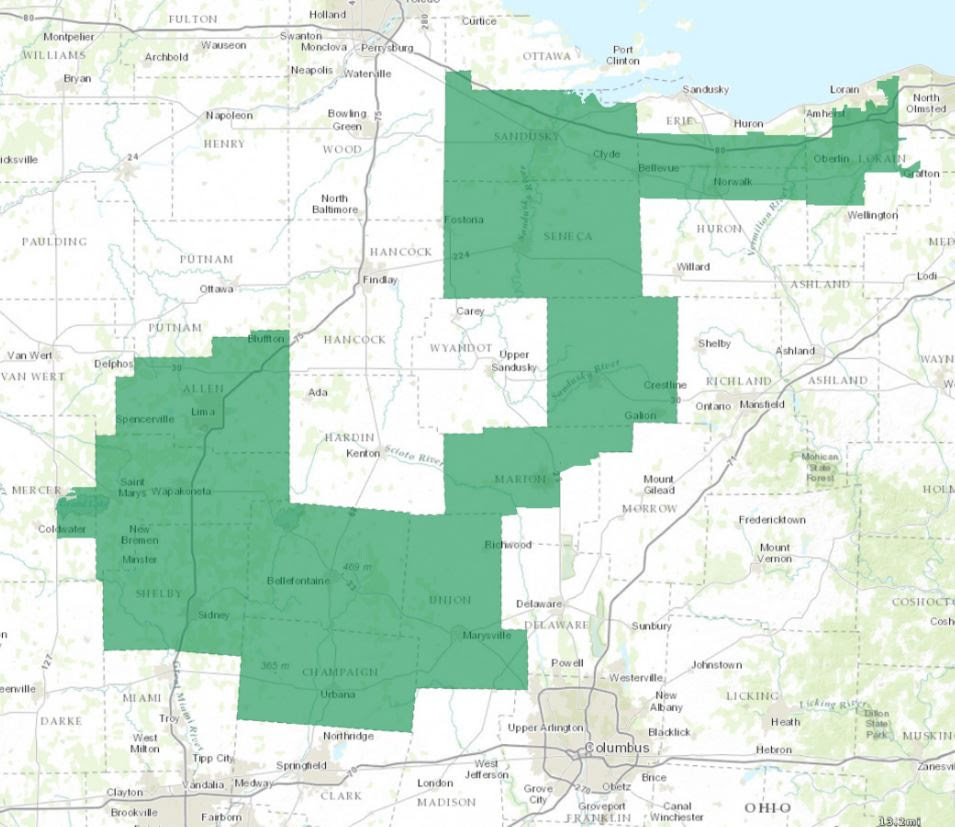
Now Jordan, is the rep of one of the most gerrymandered districts in the country. When I lived in Urbana, Ohio in the late 60’s and early 70’s, our local congressman was exceptionally well liked and respected. Clarence, “Bud” Brown represented what the Republican Party could have been, had they not deviated to scorched earth politics under the leadership and tutelage of Newt Gingrich. America has never been the same since. Don’t see this as an endorsement of the so-called, “other side” but as a statement of clear-eyed facts.
Jim Jordan’s, Ohio 4th Congressional District
This letter by Jordan to the AG, Merrick Garland shows in detail and Jordan’s own hand, the level of false narratives and utter dishonesty that keeps today’s MAGA-controlled GOP afloat. For those who have been warning about this and other indictments based on reality, research, and the opinions of elite experts, this is just another “hail Mary”, mis/ disinformation campaign designed to empower those who’ve proved that they will believe anything, if it suits their political identity. My personal and professional opinion of Jordan sees him as one of the most unethical and dangerous members of Congress.
What I once knew as a community of hardworking mostly rural Ohioans with remarkable grace, compassion and honesty, is now burdened by the weight of being sold snake oil by traitors and conmen who can’t even spell, “American values.” They largely operate on the traitorous narratives of FOX news. Fortunately there is still a solid core of great Americans in my home town but sadly, they are a minority. Even the Trumpists are some of the nicest people you will ever meet. The manipulation of their political identity by unethical, professional influencers, some domestic and some foreign, has resulted in Seditionists like Jordan and his ilk, leading the worst threat to our democracy since the Civil War.
The pain I feel for my hometown, is being played out all across America in small and large towns. The extraordinary work by U.S. Department of Justice, has thrown a hand grenade into their political identity. Now, with DOJ’s meticulously assembled public case being the news of the day, Jordan is launching a full-scale mis and disinformation campaign to support a known traitor. Not one person in Urbana would have tolerated this in my youth, despite being in one of the most reliable Republican Congressional districts in the nation.
Yes, I would also love to scream the words, “I told you so” but that will not heal America. Many Americans who were victimized by foreign and domestic malign influencers, are beginning to realize that they have been badly duped. Give them an open invite back into reality without the derision. They are family, friends and colleagues. Tragically, those who resist reality will likely never recover, because the level of indoctrination that leads to public displays of extremism, more often than not, is like rabies, mostly incurable.
It’s time for all Americans to realize that our fellow citizens are not enemies because they have different beliefs. Our Constitution, based on our founding principles, guarantees our right to our own beliefs, false or not. It’s really up to those who are willing to debate over facts and reality, to heal this nation for America’s sake, not a politcal party. It will be those who adhere to what it means to be a truly patriotic American, left, right or otherwise to put our nation, back on the path of progress, respectability and strength.
Truism: If you vote for honesty, integrity and our true American, founding principles… folks like Jim Jordan would never be in office. However you vote, we can never again allow any extremist movement to have so much say in our government, that they can once again threaten what so many have died to preserve.
The Oklahoma Statewide Virtual Charter School Board voted 3-2 to approve using state funds to support a new Catholic school this week. One of the board members voting “yes” was installed to their post last Friday, according to Tulsa World.
The board’s actions began creating the first religious charter school supported by taxpayer dollars in the United States. The online school, St. Isidore of Seville Catholic Virtual School, will be managed and operated by the Roman Catholic Archdiocese of Oklahoma City and the Diocese of Tulsa.
Oklahoma’s previous Attorney General, John O’Connor, issued a non-binding 15-page opinion in December 2022 suggesting that Oklahoma’s restriction of taxpayer funds from being used for religious schools would most likely be found unconstitutional by the United States Supreme Court.
Education Week reported, “O’Connor had concluded that recent U.S. Supreme Court decisions authorizing the inclusion of religious schools in choice programs such as tax credits for scholarship donations, and tuition assistance meant that the high court would likely not ‘accept the argument that, because charter schools are considered public for various purposes, that a state should be allowed to discriminate against religiously affiliated private participants who wish to establish and operate charter schools.’”
St. Isidore of Seville Catholic Virtual School’s application asked for $2.5 million to serve a potential 500 students in the first year. That will be $2.5 million taken away from public schools to support private religious education.
O’Connor’s successor, Gentner Drummond, withdrew the opinion earlier this year, stating, “Religious liberty is one of our most fundamental freedoms.”
Drummond continued: “It allows us to worship according to our faith, and to be free from any duty that may conflict with our faith. The opinion as issued by my predecessor misuses the concept of religious liberty by employing it as a means to justify state-funded religion.”
While some Christian conservatives, such as Oklahoma’s State Superintendent Ryan Walters, praised the board’s decision, other politicians and faith leaders criticized its actions, characterizing them as unconstitutional and a direct violation of the Establishment Clause.
After the 3-2 vote in favor of funding St. Isidore of Seville Catholic Virtual School, Drummond reiterated his opinion that this decision was improper. “The approval of any publicly funded religious school is contrary to Oklahoma law and not in the best interest of taxpayers,” he said.
“It’s extremely disappointing that board members violated their oath in order to fund religious schools with our tax dollars,” Drummond said. “In doing so, these members have exposed themselves and the State to potential legal action that could be costly.”
Clark Frailey, executive director for Pastors for Oklahoma Kids, commented: “By authorizing a public school that is explicitly affiliated with a particular religion, Oklahoma is endorsing that religion and entangling the government in religious affairs.”
“In addition,” Frailey continued, “the proposed school is to be funded by taxpayer dollars. This clearly misuses public dollars, as it would fund religious indoctrination of children.”
Historically, Oklahoma has been notoriously guilty of using taxpayer dollars to indoctrinate children with religious doctrines. Many times, Good Faith Media has called attention to the misguided and violent actions occurring at Chilocco Indian Agricultural Boarding School.
Thousands of Indigenous children were taken from their families and provided “Christian” education using taxpayer funding. Hiding behind a compassionate mission to educate Indigenous children, the actual objective was to assimilate them into white Protestant doctrines.
While no one suggests the Oklahoma Catholic Diocese is following this model, the dangers of using taxpayer dollars are ominous. Besides taking precious funding away from public education to fund private religious charters, using taxpayer money violates the religious liberty of others not wanting to support religious teachings.
Should taxpayers be forced to support religious teachings contradictory to their belief systems? Will there be any oversight of the use of taxpayer money used at religious schools?
Like public schools, do religious schools have to accept all students or can they discriminate? Will religious schools need curriculum to be approved? If so, who decides? Can any religious sect apply for funding?
Americans United for Separation of Church and State responded, “It’s hard to think of a clearer violation of the religious freedom of Oklahoma taxpayers and public-school families than the state establishing the nation’s first religious public charter school.”
AU went on to point out the unconstitutionality of the action: “State and federal law are clear: Charter schools are public schools that must be secular and open to all students. No public-school family should fear that their child will be required by charter schools to take theology classes or be expelled for failing to conform to religious doctrines. And the government should never force anyone to fund religious education.”
“Funding private religious schools with public dollars violates core legal principles protecting religious freedom for all,” said Amanda Tyler, executive director of BJC (Baptist Joint Committee for Religious Liberty).
Paul Brandeis Raushenbush, CEO of Interfaith Alliance, told The Independent that this would “open the floodgates for taxpayer-funded discrimination.” He added: “Taxpayer money should never be used to fund religious instruction, and it is now up to the state to at least ensure St. Isidore abides by the federal nondiscrimination protections guaranteed in public schools.”
The decision by the Oklahoma Statewide Virtual Charter School Board is clearly a disregard for the democratic principles established by the nation’s founders.
Thomas Jefferson’s words in his letter to the Baptists of Danbury, Connecticut, are as crucial today as they were in 1802: “I contemplate with sovereign reverence that act of the whole American people which declared that their legislature should ‘make no law respecting an establishment of religion, or prohibiting the free exercise thereof,’ thus building a wall of separation between Church & State.”
Monday’s national headline-making vote to give state sanctioning and Oklahoma taxpayer dollars to a Catholic school may have been invalid.
It turns out the state Attorney General’s Office believes that Oklahoma City businessman Brian Bobek is ineligible to serve on the Statewide Virtual Charter School Board until November.
But an email to that effect was not received by the board’s chairman and executive director until after Bobek cast the deciding vote Monday to approve state sponsorship for St. Isidore of Seville Catholic Virtual School.
Long-serving member Barry Beauchamp, a retired school superintendent from Lawton who had been allowed to continue serving after his term expired some months ago, was replaced abruptly on Friday by Oklahoma House Speaker Charles McCall.
Less than half an hour before Monday’s special board meeting began at noon, Deputy Attorney General Niki Batt sent an email to board Chairman Robert Franklin and Executive Director Rebecca Wilkinson saying that because Beauchamp had not vacated his seat, the law that created the Statewide Virtual Charter School Board doesn’t allow Bobek to take over the seat until November.
Franklin said that if Bobek was ineligible, his vote was invalid.
He is also concerned that a lengthy, written statement that Bobek read during Monday’s meeting, which included numerous legal citations, could have influenced the votes of other board members, including Scott Strawn, who was recently appointed to the board by Gov. Kevin Stitt.
Seven Oaks Classical School in Ellettsville received a 5-year extension to its operating charter recently. Well, not that recently. It happened in December 2022. Ellettsville and Monroe County residents may have missed it, though, because the extension was approved nearly 200 miles away.
It was approved by the three-member board of Grace Charters LLC, a nonprofit formed by Grace College and Theological Seminary to authorize charter schools, which are publicly funded and privately operated. The board met on the Grace College campus in Winona Lake, Indiana.
To meet legal requirements for public meetings, a notice was published in the local newspaper: the Warsaw Times-Union, which probably no one in Monroe County reads. One member of the public attended, according to minutes of the meeting: Seven Oaks headmaster Stephen Shipp.
The situation highlights the tension between public and private in Indiana charter schools. The Seven Oaks website says charter schools are “tuition-free, open-enrollment public schools.” But the school’s authorizer, which sets the terms of its operation and is supposed to hold it accountable, is a private, Christian college with no connection to the community where the school operates.
Seven Oaks is part of a network of charter schools aligned with Hillsdale College, a conservative and politically active private college in Michigan. The Hillsdale charter initiative once cast itself as part of a “war” to reclaim America from “100 years of progressivism” in education. Its president, Larry Arnn, led Donald Trump’s 1776 Commission and its promotion of “patriotic history.”
Grace College has also granted a charter to Valor Classical Academy, a Hillsdale-affiliated school that has stalled in its attempts to open in Hamilton or Marion County.
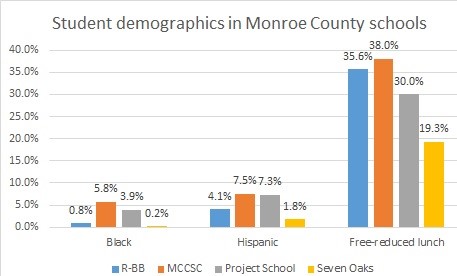
Along with the Hillsdale affiliation, there are other factors that distinguish Seven Oaks from public schools: for example, its demographic profile. Out of more than 500 students, one is Black and nine are Hispanic, according to state data. Fewer than 20% of students would qualify for free or reduced-price meals if they were provided. (The school doesn’t provide transportation or school lunches).
This chart shows the percentage of students who are Black, Hispanic and eligible for free or reduced-price meals in Monroe County public school districts (Monroe County and Richland-Bean Blossom community school corporations) and charter schools (Bloomington Project School and Seven Oaks Classical School).
The 24-page Seven Oaks charter extension reads like a standard agreement, with boilerplate language from state law and recommended practices for authorizing. It spells out the duties of each party, the expectations for the school, and the legal remedies if something goes wrong. An attached accountability plan includes out-of-date references to state assessments and, I’m told, is being revised.
The agreement says Grace College gets to keep 2.5% of the school’s state funding as an authorizer fee. That’s less than the 3% maximum that Indiana allows. In 2023-24, the college will net about $93,000.
Grace initially approved a charter for Seven Oaks in 2016 in one of Indiana’s first examples of what’s called authorizer shopping. The school’s founders applied to the Indiana Charter School Board, but it rejected their application. They reapplied but withdrew after a negative recommendation from the board’s staff. Then they took their plan to Grace College, which said yes to a 7-year charter.
At that time, private colleges could authorize charter schools in closed-door meetings with no public notice. Since 2017, they’ve had to use nonprofit authorizing agencies, such as Grace College’s Grace Charters LLC, that are subject to open-meetings and public-records laws. Even so, it can be hard to keep up. I started asking by email about the Seven Oaks charter extension in March; it took until late May to get copies of the December 2022 board minutes and the school’s extended charter agreement.
Transparency is one issue of having distant authorizers for charter schools, but there are others. The National Association Charter School Authorizers cautions against throwing the door wide open for higher education institutions, or HEIs, to authorize schools, as Indiana has done since 2011.





 Diane Ravitch's blog