The extended shutdown of the Federal government was caused by the Democrats’ efforts to save the Affordable Care Act, known as Obamacare. Unless Republicans agree, the price of subsidies for these policies will soar. Many who can’t afford the health insurance are likely to drop their policy and have none at all.
Republicans have wanted to kill Obamacare for years. Not because it doesn’t work, but because it does. They want to eliminate any Democratic successes. Trump hates Obama and always has. First, because Obama was more popular than Trump, and second, because Obama is Black and more popular even now than Trump.
Andy Spears is a veteran education journalist with a Ph.D. in education policy and a specialization in school finance. He lives in Nashville, but covers the national scene.
Spears writes:
In this post, he reports on an ominous development in Tennessee. A new organization in Tennessee has declared its intention to lure nearly 500,000 students out of public schools and into charter schools and voucher schools. The collapse in funding for public schools is likely to end public schools altogether.
Spears writes:
While state leaders consider expanding the state’s private school coupon program, a new nonprofit takes a bolder approach. A group calling itself Tennessee Leads registered with the Secretary of State as a 501(c)(4) issue advocacy organization with the goal of effectively ending public education in Tennessee by 2031.
The group was registered on October 14th and lists a business address of 95 White Bridge Road in Nashville. This is a nondescript business building in West Nashville.
The Registered Agent for Tennessee Leads is listed as “Tennessee Leads.” The group’s website says an IRS nonprofit application is pending. In short, it is not yet clear who is backing this movement.
However, the group is not shy about its goals.
We support legislation to significantly increase the availability of Education Freedom scholarships, aiming to provide 200,000 scholarships annually by 2031. This initiative is designed to empower parents with more choices for their children’s education.
And:
Our efforts include advocating for the expansion of public charter schools, with a goal to increase student enrollment from 45,000 to 250,000. This initiative seeks to offer diverse educational opportunities and foster innovation in teaching.
If achieved, these two goals combined would take nearly half of all K-12 students in the state out of traditional public schools.
The group doesn’t really say the current model isn’t working – they just say they like “choice.” The state’s current private school coupon scheme (ESA vouchers) has 20,000 students.
Moving that to 200,000 would cost at least $1.5 billion per year and take significant funds from local public schools.
Other states that rapidly expanded school vouchers saw huge budget hits to both state and local government.
[See his post on Indiana vouchers, where the costs rose neatly tenfold in less than a decade. The Indiana voucher is also a coupon for the rich to cash in at private schools. He predicts that Tennessee will be shelling out $1.4 billion a year for well-off kids to attend private schools by 2035.]
He writes that vouchers are a mess in Florida, because thousands of students are “double-dipping,” collecting voucher money while attending public schools.
Florida relies on two official student counts each year — one in October and another in February — to allocate funding to school districts through the Florida Education Finance Program (FEFP). But after the October 2024 Count, major red flags appeared. Nearly 30,000 students (at an estimated cost of almost $250 million) were identified as both receiving a voucher and attending a public school. In some districts, almost all (more than all in one district) of their state funding had been absorbed by voucher payouts.
So, the Tennessee Leads plan would lead to a rapid decrease in state funds available for public schools – or, a significant increase in local property taxes – possibly, both.
It’s also not clear how Tennessee Leads plans to build charter school capacity to house an additional 200,000 students. Unless the plan is to just hand existing public schools over to charter operators – you know, like the failed Achievement School District model.
Oh, and there’s something else.
Tennessee Leads wants all schools to use Direct Instruction at all times for all students.
We advocate for the implementation of Direct Instruction methodologies across all public schools, ensuring that teaching practices are grounded in research and proven to be effective in enhancing student achievement.
Except studies on Direct Instruction suggest the opposite – that it does not improve student learning – in fact, it may be harmful to student academic and social growth. Here’s more from a dissertation submitted by an ETSU student:
No statistically significant results (p = .05) were found between the year before implementation and the year after implementation with the exception of one grade level. Furthermore, no significant differences were found at any grade level between students participating in Corrective Reading and students not participating in Corrective Reading on the 2003-2004 TCAP Terra Nova test.
To be clear, Direct Instruction is highly-scripted learning – down to the pacing, word choice, and more – the “sage on the stage” delivers rote learning models and students are told exactly how to “do” certain things – the “one best way” approach with little room for student discovery.
More on this:
A remarkable body of research over many years has demonstrated that the sort of teaching in which students are provided with answers or shown the correct way to do something — where they’re basically seen as empty receptacles to be filled with facts or skills — tends to be much less effective than some variant of student-centered learning that involves inquiry or discovery, in which students play an active role in constructing meaning for themselves and with one another.
That is: Scripted learning/Direct Instruction is not evidence-based if the evidence you’re looking for is what actually improves student learning.
It holds true not only in STEM subjects, which account for a disproportionate share of the relevant research, but also in reading instruction, where, as one group of investigators reported, “The more a teacher was coded as telling children information, the less [they] grew in reading achievement.”
It holds true when judged by how long students retain knowledge,7 and the effect is even clearer with more ambitious and important educational goals. The more emphasis one places on long-term outcomes, on deep understanding, on the ability to transfer ideas to new situations, or on fostering and maintaining students’ interest in learning, the more direct instruction (DI) comes up short.8
One wonders who, exactly, wants to advance an extreme privatization agenda while also mandating that those students remaining in traditional public schools are subjected to a learning model proven not only not to work, but also shown as likely harmful in many cases. Eventually, an IRS determination letter will be issued, or the Registered Agent will be updated on the Secretary of State’s site. Or, perhaps, the “about us” section will offer some insight into the actors who would end public schools in our state.
On the day after this post appeared, Spears learned that a well-known political consulting firm was behind the proposal for Tennessee Leads. The firm had previously worked for the Tennessee Republican Party and for Governor Bill Lee. He wrote a new post.
It’s not at all clear why Governor Lee and his fellow Republicans are so enamored of charters and vouchers. Tennessee was the first state to win Race to the Top funding from the Obama administration. It collected a grand prize of $500 million. With that big infusion of new funding for “reform,” the public schools should be reformed by now. But obviously they are not.
Worse, Tennessee put $100 million into a bold experiment that was supposed to demonstrate the success of charter schools. The state created the Educational Achievement Authority, hired a star of the charter movement to run it, and gathered the state’s lowest-performing public school into a non-contiguous all-charter district. The EAA promised that these low-scoring schools would join the state’s top schools within five years. Five years passed, and the targeted schools remained at the bottom of the state’s rankings.
In time, the legislature gave up and closed the EAA.
Similarly, the evidence is in in vouchers. In every state that had offered them to all students, the vast majority are scooped up by affluent families whose kids never attended public schools. When public school students took vouchers, they fell far behind their public school peers.
Are Republican leaders immune to reading evidence?
I decided after Zohran Mamdani won the Democratic primary that I would vote for him. I was concerned about his lack of managerial experience, but impressed by his energy, his enthusiasm, his ever-present smile, and his willingness to try bold policies on behalf of working-class and low-income New Yorkers. I was repulsed by the billionaire-funded hate campaign against him as a Muslim.
But at some point before the general election, I wavered. I read article after article about his hard-and-fast views on Israel, the BDS movement, and other third-rail topics. I am not a Zionist but I believe that Israel should not have to justify its right to exist. And I condemn the rightwing cabal in Israel that has supported the genocidal war in Gaza, as well as settler terrorism against Palestinians who live on the West Bank.
I decided not to vote, which I have never done. Voting is a precious right, which I have always exercised.
Then I read this article in the New York Times, in which David Leonhardt interviewed Senator Bernie Sanders, and it resolved all my doubt and hesitation. After reading this, I went to my polling place and very happily voted for Zohran Mamdani.
Of course, I was thrilled to see a Democratic sweep in Virginia, New Jersey, Pennsylvania (where the state GOP proposed to remove three Democratic judges from the state’s Supreme Court), and California, where Prop. 50 passed easily, allowing a redistricting intended to produce an additional 5 Democratic seats in Congress. Prop 50 was a response to the Texas GOP’s redistricting that will eliminate 5 Democratic seats. Joke of the day: California Republicans are suing to block the Prop 50 gerrymandering because it favors one race over another. I didn’t hear similar concerns about gerrymanders by Republicans in Texas, Missouri, and other states that are creating new Republican seats, eliminating Black representation.
The article linked above is a gift article, so you can read it in full without a subscription.
Here is a sample:
David Leonhardt: Senator Bernie Sanders started talking about income inequality nearly 40 years ago.
Archived clip of Bernie Sanders in 1988:In our nation today, we have extreme disparity between the rich and the poor, that elections are bought and sold by people who have huge sums of money.
He railed against oligarchs before Elon Musk made his first million.
Archived clip of Sanders in 1991: To a very great extent, the United States of America today is increasingly becoming an oligarchy.
Sanders started out as a political oddity. But his focus on inequality has made him one of the most influential politicians in America. I wanted to know where he thinks we’re headed next. So I asked him to join me for “America’s Next Story,” a Times Opinion series about the ideas that once held our country together, and those that might do so again.
Senator Bernie Sanders, thank you for being here.
Bernie Sanders: My pleasure….
Leonhardt: OK, let’s get into it. I want to go back to the pre-Trump era and think about the fact that a lot of Democrats during that time — I’m thinking about the Clintons and Obama — felt more positively toward the market economy than you did.
They were positive toward trade. They didn’t worry that much about corporate power. They didn’t pay that much attention to labor unions. And if I’m being totally honest, a lot of people outside of the Democratic Party, like New York Times columnists, had many of those same attitudes.
Sanders: Yes, I recall that. Vaguely, yes. Some of them actually weren’t supportive of my candidacy for president.
Leonhardt: That is fair. I assume you would agree that the consensus has shifted in your direction over the last decade or so?
Sanders: I think that’s fair to say.
Leonhardt: And I’m curious: Why do you think those other Democrats and progressives missed what you saw?
Sanders: In the 1970s — the early ’70s — some of the leaders in the Democratic Party had this brilliant idea. They said: Hey, Republicans are getting all of this money from the wealthy and the corporations. Why don’t we hitch a ride, as well? And they started doing that. Throughout the history of this country — certainly the modern history of this country, from F.D.R. to Truman to Kennedy, even — the Democratic Party was the party of the working class. Period. That’s all your working class. Most people were Democrats.
But from the ’70s on, for a variety of reasons — like the attraction of big money — the party began to pay more attention to the needs of the corporate world and the wealthy rather than working-class people. And I think, in my view, that has been a total disaster, not only politically, but for our country as a whole.
Leonhardt: I agree, certainly, that corporate money played a role within the party. But I also think a lot of people genuinely believed things like trade would help workers. When I think about —
Sanders: Hmm, no.
Leonhardt: You think it’s all about money?
Sanders: No. What I think is, if you talked to working-class people during that period, as I did, if you talked to the union movement during that period, as I did, you said: Guys, do you think it’s a great idea that we have a free-trade agreement with China? No worker in America thought that was a good idea. The corporate world thought it was a good idea. The Washington Post thought it was a great idea. I don’t know what The New York Times thought.
But every one of us who talked to unions, who talked to workers, understood that the result of that would be the collapse of manufacturing in America and the loss of millions of good-paying jobs. Because corporations understood: If I could pay people 30 cents an hour in China, why the hell am I going to pay a worker in America a living wage? We understood that.
Leonhardt: I think that’s fair. I guess I’m interested in why you think that members of the Democratic Party — not workers, but members — and other progressives ignored workers back then but have come more closely to listen to workers. I mean, if you look at the Biden administration’s policy, if you look at the way Senator Schumer talks about his own views shifting, I do think there’s been this meaningful shift in the Democratic Party toward your views. Not all the way.
Sanders: Well, what we will have to see is to what degree people are just seeing where the wind is blowing as to whether or not they mean it.
In my view, working-class Americans did not vote for Donald Trump because they wanted to see the top 1 percent get a trillion dollars in tax breaks. They did not want to see 15 million people, including many of them, being thrown off the health care they had or their health care premiums double, etc. They voted for Trump because he said: I am going to do something. The system is broken. I’m going to do something.
What did the Democrats say? Well, in 13 years, if you’re making $40,000, $48,000, we may be able to help your kid get to college. But if you’re making a penny more, we can’t quite do that. The system is OK — we’re going to nibble around the edges. Trump smashed the system. Of course, everything he’s doing is disastrous. Democrats? Eh, system is OK — let’s nibble around the edges.
Democrats lost the election. All right? They abdicated. They came up with no alternative. Because you know what? They, even today, don’t acknowledge the economic crises facing the working class of this country. Now you tell me, how many Democrats are going around saying: You know what? We have a health care system that is broken, completely. We are the only major country on Earth not to guarantee health care to all people I’ve introduced Medicare for All. You know how many Democrats in the Senate I have on board?
Leonhardt: How many?
Sanders: Fifteen — out of a caucus of 47.
Leonhardt: And you think Medicare for All is both good policy and good politics?
Sanders: Of course, it’s good policy! Health care is a human right! I feel very strongly about that. And I think the function of our health care system should not make the drug companies and the insurance companies phenomenally rich. We guarantee health care to all people — that’s what most Americans think. Where’s the leader?
I think that at a time when we have more income and wealth inequality, you know what the American people think? Maybe we really levy some heavy duty taxes on the billionaire class. I believe that. I think most Americans, including a number of Republicans, believe that. Hmm, not quite so sure where the Democrats are. I believe that you don’t keep funding a war criminal like Netanyahu to starve the children of Gaza. That’s what I believe. It’s what most Americans believe. An overwhelming majority in the Democratic world believes it. Hmm, Democratic leadership, maybe not quite so much.
The point is that, right now, 60 percent of our people have been paycheck to paycheck. I don’t know that the Democratic leadership understands that there are good, decent people out there working as hard as they can, having a hard time paying their rent. Because the cost of housing is off the charts, health care is off the charts, child care is off the charts. The campaign finance system is completely broken. When Musk can spend $270 million to elect Trump, you’ve got a broken system. Our job is to create an economy and a political system that works for working people, not just billionaires.
PLEASE OPEN THE LINK AND READ THE REST OF THIS AMAZING INTERVIEW.
Thom Hartmann explains why the shutdown continues. The Republicans in the Senate have the votes to end it.
He writes:
— The GOP’s dirty little secret exposed, courtesy of Donald Trump: Republicans in the Senate could have ended the shutdown anytime they wanted. Ever since the shutdown started, I’ve been shouting into the wilderness that Senate Majority Leader Republican John Thune (who now holds the position Mitch McConnell held for so long) could reopen the government with the GOP’s so-called “clean continuing resolution” or “clean CR” any time he wanted. All it takes to suspend or even eliminate the filibuster rule — which is neither in the Constitution nor any law, but merely a Senate rule — is 51 votes. Republicans have 53 senators and the Vice President adds a 54th, so it shouldn’t be a particularly heavy lift. I pointed it out on Ali Velshi’s program, and a few days later Congressman Ro Khanna and I discussed it on my program; he went on to point it out over on Fox “News” (the host thought he was discussing reconciliation; they don’t hire the best and the brightest over there). But virtually none of the mainstream media have bothered to point out this simple reality; instead, they go along with the story that Republicans are essentially helpless victims of evil Democrats who are holding the nation hostage. Finally, though, Trump himself let the bomb drop in a posting on his Nazi-infested social media site, writing: “WE are in power, and if we did what we should be doing, it would IMMEDIATELY end this ridiculous, Country destroying ‘SHUT DOWN’… It is now time for the Republicans to play their ‘TRUMP CARD,’ and go for what is called the Nuclear Option — Get rid of the Filibuster, and get rid of it, NOW!” I’ve argued for years that the filibuster helps the GOP and special interests far more than Democrats, and Schumer, et al, should have nuked it years ago when they had the power to do so. Hell, it was originally put into the Senate rules back in the early 19th century to protect against the passage of legislation outlawing slavery! Thune could suspend the filibuster for a single bill or blow it up altogether; either would be an improvement over the status quo. Yes, it would enable Republicans to pass more of their toxic and destructive legislation over the short term, but it would — importantly — also let Americans see the unvarnished consequences of Republican policies. And when Democrats come back into power, they could get a lot more done without the filibuster, including rolling back Citizens United and establishing an absolute right to vote. Let your Republican senators know (202-224-3121) they should take Trump’s advice and end the filibuster!
— Epstein, Rubio, or ego? What’s really behind Trump’s Venezuela madness? What the hell is going on with Trump’s provocations against Venezuela? It sure looks like he’s trying to gin up a war or regime change, neither of which are popular with the American people or consistent with Trump’s outspokenly loud anti-interventionist anti-nation-building campaign rhetoric. And he’s trying to do it the same way he tore down the East Wing of the White House: in secret until it’s such a done deal that nobody can undo it. But why? I’ve posited that — like Reagan and both Bush presidents — he thinks he needs a “little war” to distract us from his crimes, corruption, Epstein, and the weakness of the economy. But it’s also possible that this is being driven by Secretary of State “Lil” Marco Rubio and Secretary of Defense “Whiskey Pete” Hegseth. Rubio rose to political power in Florida by lying for years that his parents were Cuban refugees who fled Castro and communism (in fact, they came to the US in May, 1956, more than 2 years before the Cuban revolution), and has long harbored anti-Latin-communist sentiments. It’s entirely possible that he still nurtures presidential aspirations and thinks taking down Maduro might be his ticket to the GOP nomination in 2028 (assuming there’s an election that year). Hegseth is a dry (?) drunk apparently doped up on testosterone who gets giddy every time he can use the words “lethal” or “kill” in a sentence; it’s a safe bet that he’d be orgasmic over the chance to murder more than just a few dozen people in small boats. Yesterday, the Miami Herald reported: “The Trump Administration has made the decision to attack military installations inside Venezuela and the strikes could come at any moment, sources with knowledge of the situation told the Miami Herald…” Adding to the intrigue, the DOD gave a secret briefing to the Senate Intelligence Committee and — get this — only allowed Republicans into the room. The committee’s senior Democrat, Mark Warner, called the unprecedented decision by Republicans “bullshit” and over in the House, where Democrats were allowed in, Democrat Seth Molton said: “What I heard here today was a tactical brief. I heard no strategy, no end game, no assessment of how they are going to end the flow of drugs into the United States…” Every day it seems more and more evident that this has little to nothing to do with drugs, which raises the question: “Why?” Why take such a chance by attacking a country with mutual defense agreements with Russia and China? Why risk war in our hemisphere? Why put our soldiers, sailors, marines, and airmen at such risk? Is it Epstein? Rubio‘s ambitions? Inquiring minds — and American patriots who care about our military and our reputation around the world — want to know.
— Trump’s new refugee policy: white, wealthy, and welcome. In a major change of a refugee policy that stretches back to the 1920s, the Trump administration has announced that only 7,500 people will be allowed into the US this year, and priority won’t go to Afghans who helped our troops or brown immigrants who’ve served in America’s military. Instead, the entire front of the line will be filled by white South Africans like Elon Musk’s father (who was in Moscow this week for a party with Putin). The white supremacy credentials of the Trump administration — including widespread layoffs of Black employees — are now absolutely impeccable.
— Hispanics not welcome either, unless they worked for one of Trump’s shabby golf motels. Alejandro Juarez illegally crossed the US border 22 years ago, and soon thereafter became one of Trump’s many undocumented workers (like the Poles who built Trump Tower, for example). ICE picked him up a few weeks ago and put him on a deportation flight to Mexico before, apparently, somebody from the Trump organization noticed he was missing. DHS is now frantically trying to find the valued worker and bring him back to the US so he can apply for long-term residency and a work permit. Irony of ironies…
— “Judge Boxwine” Pirro, recently recruited from Fox “News” for a federal judgeship, apparently demanded prosecutors delete the word “mob” to describe a member of the mob that attacked the US Capitol on January 6th. George Orwell famously wrote, “Those who control the present, control the past and those who control the past control the future.” It now appears that we’re falling deeper and deeper into an Orwellian world where Trump redefines the past so he can rewrite the future, much as the remnants of the Confederacy did with their Lost Cause mythology when Reconstruction collapsed in 1877. Pirro won’t explain why the description was excised, nor why the two prosecutors who wrote it into a sentencing recommendation have been relocated, perhaps in anticipation of being fired. But anybody with half a brain can figure this one out…
— Tear gassing trick-or-treaters: Noem’s new definition of American values. Puppy killer Noem refused to pause operations in Chicago so children can trick or treat. What have we become? Brutal is probably a good word, to begin with. In another example of the Trump regime’s frantic efforts to harass, imprison, and deport brown people — and perhaps to gin up an insurrection that could justify suspending elections — Noem denied Illinois Governor Pritzker’s request to hold off on the tear gas and masked terror operations for Halloween. When ICE recently raided a Chicago apartment building, they then trashed multiple apartments, ripping up furniture, smashing windows, breaking and scattering possessions, and removing and carting away phones and laptops. No warrants signed by judges were presented and one ICE thug, when asked about the shivering zip-tied American citizen kids standing in the freezing cold, said, “Fuck the children.” Setting aside the invocation of Epstein (and Trump?) the phrase immediately brings to mind, the brutal sentiment appears to be one embraced by ICE Barbie herself…
— From firebrand to outcast: Marjorie Taylor Greene’s midlife MAGA crisis. What’s happening with MTG? The MAGA firebrand appears to be undergoing some sort of a conversion experience, most recently calling out “pathetic Republican men” who she says are essentially telling her to sit down and shut up. Prior to that, she posted on social media: “Democrats did this with Obamacare 15 yrs ago and Johnson says Republicans have a mystery plan that is yet to be revealed to fix it. But no one knows what it is and we’re told to stay home in our districts.” Either Greene is in trouble politically in her district as she looks at an upcoming primary or next year’s midterm election, or she’s finally figured out that she’s been being played for a sucker by Trump and his Republicans all these years (along with so many others) and is no longer willing to play the game. I’ve invited her on my program for a friendly discussion; we’ll see if she shows up…
Several days ago, Politico wrote about the scurrilous text messages shared by Young Republican leaders. When Vice President jD Vance was asked about the chat, he said in effect, “Boys will be boys.” Other GOP bigwigs had the same reaction. But the people in the chat group were not teenagers. They were adults in their 20s and 30s. The chat included racist, anti-Semitic, misogynistic, homophobic comments. One said “I love Hitler.”
It shows the attitudes that Trump has unleashed and encouraged among the younger generation of Republicans. They knew enough to worry what would happen if their chats ever went public. They knew.
But they also demonstrated what a fraud the Trump administration’s concern about anti-Semitism is. It’s a useful ploy, nothing more. People who actually care about anti-Semitism don’t make jokes about gas chambers.
Here’s an excerpt:
NEW YORK — Leaders of Young Republican groups throughout the country worried what would happen if their Telegram chat ever got leaked, but they kept typing anyway.
They referred to Black people as monkeys and “the watermelon people” and mused about putting their political opponents in gas chambers. They talked about raping their enemies and driving them to suicide and lauded Republicans who they believed support slavery.
William Hendrix, the Kansas Young Republicans’ vice chair, used the words “n–ga” and “n–guh,” variations of a racial slur, more than a dozen times in the chat. Bobby Walker, the vice chair of the New York State Young Republicans at the time, referred to rape as “epic.” Peter Giunta, who at the time was chair of the same organization, wrote in a message sent in June that “everyone that votes no is going to the gas chamber.”
Giunta was referring to an upcoming vote on whether he should become chair of the Young Republican National Federation, the GOP’s 15,000-member political organization for Republicans between 18 and 40 years old.
“Im going to create some of the greatest physiological torture methods known to man. We only want true believers,” he continued….
“Can we fix the showers? Gas chambers don’t fit the Hitler aesthetic,” Joe Maligno, who previously identified himself as the general counsel for the New York State Young Republicans, wrote back.
“I’m ready to watch people burn now,” Annie Kaykaty, New York’s national committee member, said.
The exchange is part of a trove of Telegram chats — obtained by POLITICO and spanning more than seven months of messages among Young Republican leaders in New York, Kansas, Arizona and Vermont. The chat offers an unfiltered look at how a new generation of GOP activists talk when they think no one is listening.
“I’m ready to watch people burn now,” Annie Kaykaty, New York’s national committee member, said.
The exchange is part of a trove of Telegram chats — obtained by POLITICO and spanning more than seven months of messages among Young Republican leaders in New York, Kansas, Arizona and Vermont. The chat offers an unfiltered look at how a new generation of GOP activists talk when they think no one is listening…
Together, the messages reveal a culture where racist, antisemitic and violent rhetoric circulate freely — and where the Trump-era loosening of political norms has made such talk feel less taboo among those positioning themselves as the party’s next leaders…
Mixed into formal conversations about whipping votes, social media strategy and logistics, the members of the chat slung around an array of slurs — which POLITICO is republishing to show how they spoke. Epithets like “f—-t,” “retarded” and “n–ga” appeared more than 251 times combined.
Vice President JD Vance laughed about the exchanges. Just the jokes that “kids” say, although these “boys” were adults.
The vice president suggested the real problem is the idea that an offensive joke can ruin a young person’s life.
“The reality is that kids do stupid things, especially young boys,” Vance said on “The Charlie Kirk Show.” “They tell edgy, offensive jokes. That’s what kids do. And I really don’t want us to grow up in a country where a kid telling a stupid joke — telling a very offensive, stupid joke — is cause to ruin their lives.”
The hateful language has entered the GOP mainstream with no filters. One far-right blogger said the conversation was “tame” compared to the chatter on far-right sites. It’s no longer taboo to admire Nazis, Hitler, and gas chambers.
In the post at 9 a.m. today, two scholars of racism and equity explained that Trump’s scrubbing of museums, national parks, and other federal facilities is an attempt to capture control of the culture and erase the place of Blacks, women, and anyone else who is not a straight white male.
But, as scholar Julian Vasquez Heilig writes here, Trump and his commissariat cannot control the popular culture. In time, we can hope, his mean-spirited efforts to revise history will become a bad joke, a cruel joke, a stupid joke. He and all those who carry out his orders will become a public laughing stock.
Vasquez Heilig writes on his blog Cloaking Inequity:
The Super Bowl has always been more than football. It is a ritual, a spectacle, a national performance. It’s where America tells the world who it thinks it is, and who it wants to be. Which is why the announcement that Bad Bunny will host the halftime show is far more significant than a musical lineup change. It’s a cultural earthquake.
I remember the first time I heard Bad Bunny. It was December 6, 2019, at La Concha Hotel in San Juan. In the downstairs lounge, the beat of reggaetón was shaking the walls, and I pulled out Shazam to figure out what it was. The song was Vete. The room was electric, filled with Puerto Ricans singing every word in Spanish, unapologetically themselves. That night, it hit me: Bad Bunny was not just making music in San Juan, he was celebrating culture. He wasn’t crossing over into the mainstream by adapting; he was dragging the mainstream toward him. He refused to translate, refused to dilute, and now he is everywhere—on playlists, on charts, SNL, in crowded places from San Juan to New York to Madrid.
That’s why his Super Bowl moment matters so much. It is not just a performance, it is the culmination of a global movement that began in places like that basement lounge in Puerto Rico. What felt local then is now universal. Bad Bunny’s rise shows how culture flows upward, from the margins to the center, from overlooked communities to the biggest stage in the world. For millions of us, this is affirmation. For the right wing, it is destabilization. Because when the halftime show belongs to Bad Bunny, it proves that America is no longer just what they imagine it to be. It is bigger, louder, and more diverse than great again nostalgia can contain.
Jay-Z, Kendrick Lamar, and the New Halftime Era
The NFL’s halftime choices haven’t shifted by accident. When the league came under fire for its treatment of Colin Kaepernick and broader criticisms about racial injustice, it needed credibility. Enter Jay-Z and Roc Nation. The NFL tapped him to advise and help curate halftime shows.
The results have been undeniable. Kendrick Lamar’s halftime performance last year was a watershed moment—unapologetically Black, politically charged, and culturally defining. That performance sparked widespread discussion, and even a blog post I wrote about it entitled “TV Off”: What Kendrick Lamar Was Really Saying at the Super Bowl drew more than 100,000 readers in just a few days. Clearly, the hunger to talk about representation and ownership of the halftime stage is real.
Now with Bad Bunny taking the baton, the NFL is making another cultural statement, whether it fully realizes it or not (I think it does). The league’s biggest platform is no longer reserved for the safe, predictable acts of yesterday. It’s becoming a stage where hip hop, reggaeton, and the voices of communities once marginalized are front and center.
Bad Bunny and the Right’s Panic
For decades, the halftime show was dominated by choices that reinforced a narrow image of America: classic rock icons, country stars, or pop acts who wouldn’t ruffle feathers but had wardrobe malfunctions. Bad Bunny shatters that mold. His performance won’t be a side act, it is the show. Spanish won’t be a novelty; it will be central.
This is exactly why the right wing panics. To them, football Sundays and Super Bowls have long been “their” cultural territory. They’ve wrapped the game in patriotic rituals, military flyovers, and moments of silence for conservative heroes. When someone like Bad Bunny steps into the spotlight, it disrupts their monopoly. It forces a new definition of America—one that is multilingual, multicultural, and undeniably Latino. That’s what makes his halftime role so radical: after focusing on the Black experience with Kendrick, this year signals that Latino identity is no longer peripheral. It’s woven into the fabric of America’s biggest stage.
Why ICE Wants to Loom Over the Moment
It might sound absurd that ICE wants to connect itself to the Super Bowl halftime show, but immigration enforcement has always thrived in the shadows of visibility. When Latino joy and success are celebrated so publicly, ICE apparently feels the need to remind America of its terrorizing power.
Bad Bunny performing at the Super Bowl is a triumph of belonging. But ICE’s assaults, raids, arrests, kangaroo courts, and deportations are constant reminders that belonging is conditional on politics. While millions watch a Puerto Rican superstar, ICE agents are throwing mothers and journalists to the ground, spraying pepper liquid into the eyes of Americans who dare to ask questions, arresting elected politicians at the behest of Washington politicians after turning off their body cameras, and authorized by the Supreme Court to detain people simply for looking Latino and poor.
The contradiction is sharp: on the world’s stage, Latino identity is being widely celebrated; on America’s streets, it’s criminalized. ICE doesn’t need to show up at the stadium—it already shows up in our daily life. Its existence ensures that even at moments of cultural triumph, there’s a purposeful shadow of fear and terroristic threats.
Danica Patrick’s Tone-Deaf Criticism
And then, inevitably, a silly critic emerges from the sidelines. This time it’s Danica Patrick, who dismissed Bad Bunny’s hosting role. Her comments were more than unhelpful, they were stupid.
Patrick should know better. She carved her own career by getting along in a male-dominated sport, where every step forward was a battle for representation. She knows the symbolic weight of breaking barriers. For her to turn around and mock or diminish Bad Bunny’s presence is hypocritical at best, willfully ignorant at worst.
Bad Bunny isn’t there to tick a diversity box, he’s there because he is one of the most influential artists alive— maybe THE most. The incredible success of his shows that he did for his most recent album this past summer ONLY in Puerto Rico is proof that the center of American culture is shifting. Criticizing that isn’t just a matter of taste. It’s a refusal to accept reality.
The Lions, Charlie Kirk, and Who Gets Tribute
The battle over cultural ownership in America doesn’t stop at the Super Bowl. It plays out every Sunday on the NFL field. When conservative commentator Charlie Kirk was assassinated, the league encouraged teams to hold moments of silence in his honor. Most complied. But the Detroit Lions, along with a few other teams, did not.
That decision matters. It was a quiet but deliberate act of boundary-setting, a refusal to let every NFL broadcast become a political ritual sanctifying right-wing political ideology. By declining the tribute, the Lions reminded us that not every form of patriotism must come prepackaged with conservative allegiance. It wasn’t loud or defiant. It was subtle and deeply symbolic. Sometimes resistance isn’t what you do, it’s what you decline to perform and participate.
The Lions’ restraint connects to the same cultural realignment symbolized by Bad Bunny’s Super Bowl performance. Both moments reject the idea that American culture belongs to a single tribe. They push back against the notion that sports, music, or patriotism must orbit one political pole. They insist, instead, that culture belongs to everyone, not just the loudest or the angriest voices claiming to defend it.
The Double Standard of Protest
Of course, this tension between culture, power, and dissent has long been visible in the NFL. When Colin Kaepernick knelt during the national anthem to protest police brutality, he was branded a traitor by many of the same voices now demanding “respect” for Charlie Kirk. His silent, dignified act of conscience was recast as an attack on America itself.
The outrage was never really about the flag. It was about control. It was about who is allowed to define what counts as “patriotic.” Kaepernick’s kneeling was an act of moral courage, but it exposed how fragile America’s cultural gatekeepers truly are when confronted with truth. They could not tolerate a protest that revealed their own comfort with injustice and brutality.
Meanwhile, state violence continues daily without the same moral outrage from the right-wing. ICE officers violently throw mothers and journalists to the ground without cause. They pepper-spray citizens in their eyeballs for daring to ask questions in a conversation. They arrest and detain American citizens in raids not for crimes but for looking poor, brown, or foreign. These acts have not provoked right-wing primetime outrage or public boycotts. Their hypocrisy is staggering.
A man kneeling quietly for justice was vilified. Agents brutalizing families are ignored. The problem has never been the method of protest, it has always been their morality. Silence in the face of injustice is acceptable; silence against injustice is not. The Lions’ quiet refusal and Kaepernick’s quiet protest share something profound: both disrupted the script of cultural obedience. Both reminded us that resistance isn’t always loud. Sometimes it’s the refusal to play along.
The Supreme Court’s Enabling Role
And looming behind all of this is the judiciary. Recent Supreme Court rulings have expanded law enforcement’s power, narrowing protections under the Fourth Amendment and giving politicians more leeway to persecute immigrants using federal data. Justice Brett Kavanaugh has been the lead in the right-wing judicial majorities that have handed law enforcement broad authority to stop, question, and detain anyone with minimal cause. Its new rulings have created the legal cover that now makes racial profiling essentially legal.
Racial profiling has happen illegally before and the new legal result empowered by the Supreme Court is the same: citizens living under suspicion, families living in fear, communities targeted not for what they’ve done but for how they look. The Supreme Court has enabled ICE brutality in the same way NFL owners enabled the blackballing of dissent, by creating structures that justify exclusion and violence while insisting neutrality.
The Bigger Picture: Who Owns the Stage?
So what do Bad Bunny, Kendrick Lamar, Jay-Z, Danica Patrick, ICE, the Lions, Charlie Kirk, and Brett Kavanaugh all have in common? They are all part of the “fight, fight, fight” (see new Trump $1 coin) over who gets to define American culture.
The right wing has long claimed the NFL as its territory: its rituals, its tributes, its symbols of patriotism. But culture evolves. It cannot be contained. From Detroit to San Juan to Los Angeles, new voices are shaping the narrative. Bad Bunny’s halftime show, Kendrick’s explosive performance, and even the Lions’ silent refusal all tell the same story: football does not belong exclusively to one political ideology. Neither does America.
The real question is whether we are willing to see that America’s identity is bigger than its old rituals. Are we willing to admit that inclusion is not a threat but a fact? Because culture doesn’t wait for permission. It claims the stage. And this year, that stage will belong to Bad Bunny.
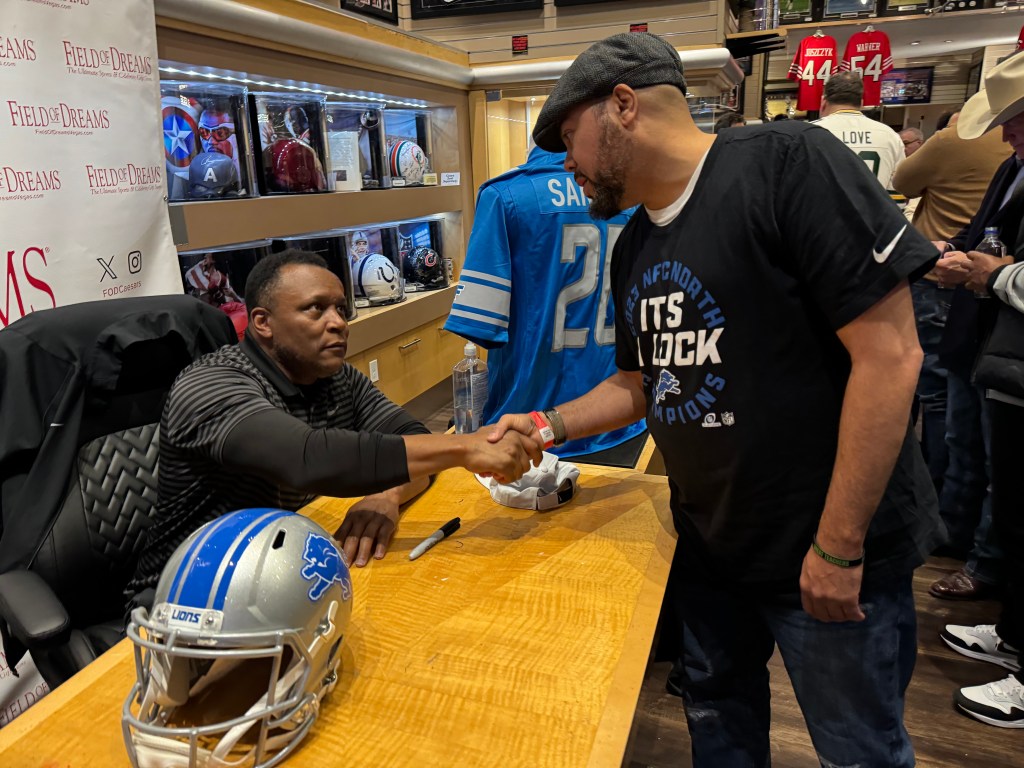
Julian Vasquez Heilig is a professor, writer, and a legit lifelong Detroit Lions fan since 1981. He attended the NFC Championship in San Jose two years ago to support his Cardiac Cats and last year’s playoff loss to the Washington Commanders at Ford Field. He was also at the official Lions partners party during the NFL Draft in Detroit, where he met Robert Porcher and Jason Hanson. Over the years he’s spotted Billy Sims in Times Square, endured the heartbreak of the Lions’ 0–16 season, and treasures his personally autographed Barry Sanders helmet. Beyond education and equity, Julian dabbles in writing about sports, culture, and society.
Thomas Ultican, retired teacher of advanced mathematics and physics in California, has been keeping track of the privatization movement. In this post, he criticizes the Republican Party for its war on public schools. There was a time when Republicans supported their community schools. They provided strong support for bond issues and were active on local school boards. Today, however, Republicans as a party have led privatization efforts, knowing that it is intended to defund their public schools. None of the promises of privatization have panned out. Surely they know that they are destroying not only their own community’s public schools but a foundation stone in our democracy.
Privatization promotes segregation. Public schools bring people from different backgrounds together. As our society grows more polarized, we need public schools to unite us and build community.
Ultican writes:
This year, state legislators have proposed in excess of 110 laws pertaining to public education. Of those laws 85 were centered on privatizing K-12 schools. Republican lawmakers sponsored 83 of the pro-privatization laws. Which begs the question, has the Grand Old Party become the Grifting Oligarchs Party? When did they become radicals out to upend the foundation of American greatness?
The conservative party has a long history of being anti-labor and have always been a hard sell when it came to social spending. However, they historically have supported public education and especially their local schools. It seems the conservative and careful GOP is gone and been replaced by a wild bunch. It is stupefying to see them propose radical ideas like using public money to fund education savings accounts (ESA) with little oversight. Parents are allowed to use ESA funds for private schools (including religious schools), for homeschool expenses or educational experiences like horseback riding lessons.
In this table, ESA indicates tax credit funded voucher programs. There have been 40 bills introduced to create ESA programs plus another 20 bills designed to expand existing ESA programs. Most of 2025’s proposed laws are in progress but the governors of Texas, Tennessee, Idaho and Wyoming have signed and ratified new ESA style laws. In addition, governors in Indiana, South Carolina and New Hampshire signed laws expanding ESA vouchers in their states.
None of the 16 proposals to protect public education or 3 laws to repeal an existing ESA program were signed by a governor or passed by a legislature.
“… the program violates the Wyoming Constitution in two key ways. One for directing public dollars to private enterprises, which the lawsuit says is clearly prohibited. The second for violating the constitution’s mandate that Wyoming provide ‘a complete and uniform system of education.”’
On July 15, District Court Judge Peter Froelicher granted a preliminary injunctionagainst the state’s universal voucher program. He wrote, “The Court finds and concludes Plaintiffs are, therefore, likely to succeed on the merits of their claims that the Act fails when strict scrutiny is applied.” The injunction will remain in effect until the “Plaintiffs’ claims have been fully litigated and decided by this Court.”
Laramie County Court House
Last year, The Utah Education Association sued the state, arguing that the Utah Fits All Scholarship Program violated the constitution. April 21st, District Court Judge Laura Scott ruled that Utah’s $100-million dollar voucher program is unconstitutional. At the end of June, the Utah Supreme Court agreed to hear an appeal of Scott’s ruling. However, the decision seems well founded.
The Montana Legislature, in 2023, established a statewide Education Savings Account (ESA) voucher program. It allows families of students with disabilities to use public funds deposited into personal bank accounts for private educational expenses. In April this year, Montana Quality Education Coalition and Disability Rights Montana brought suit to overturn this program. In July, the Montana Federation of Public Employees and the organization Public Funds Public Schools joined the plaintiffs in the suit. The legal action awaits its day in court.
At the end of June, the Missouri State Teachers Association sued to end the enhanced MOScholars program which began in 2021 funded by a tax credit scheme. This year in order to expand the program; the states legislature added $51-million in tax payer dollars to the scheme. The teachers’ suit claims this is unconstitutional and calls for the $51-million to be eliminated.
Milton Friedman’s EdChoice Legal Advocates joined the state in defending the MOScholars program. Their July 30thmessage said, “On behalf of Missouri families, EdChoice Legal Advocates filed a motion to intervene as defendants in the lawsuit brought by the Missouri National Education Association (MNEA) challenging the state’s expanded Empowerment Scholarship Accounts Program, known as MOScholars.” It is unlikely EdChoice Legal Advocates are representing the wishes of most Missouri families.
In South Carolina, the state Supreme Court ruled in 2024 that its Education Trust Fund Scholarship Program was unconstitutional. The lawsuit was instituted by the state teachers union, parents and the NAACP. The program resumed this year after lawmakers revised it to funnel money from the lottery system instead of the general fund.
The South Carolina effort has been twice ruled unconstitutional for violating prohibitions against using public funds for the direct benefit of private education. Legislators are proposing funneling the money through a fund that then goes to a trustee and then to parents, who then use it for private schools.
Sherry East, president of the South Carolina Education Association stated:
“We just don’t agree, and we think it’s unconstitutional.”
“We’ve already been to court twice. The Supreme Court has ruled twice that it is unconstitutional. So, we don’t understand how they’re trying to do a loophole or a workaround. You know, they’re trying to work around the Constitution, and it’s just a problem.”
The South Carolina fight seems destined to return to the courts but they have vouchers for now.
Last year in Anchorage, Alaska, Superior Court Judge Adolf Zeman concluded that there was no workable way to construe the state statues in a way that does not violate constitutional spending rules. Therefore, the relevant laws “must be stuck down in their entirety.” This was the result of a January 23, 2023 law suit alleging that correspondence program allotments were “being used to reimburse parents for thousands of dollars in private educational institution services using public funds thereby indirectly funding private education in violation … of the Alaska Constitution.” Alaska has many homeschool students in the correspondence program.
Plaintiff’s attorney Scott Kendall believes the changes will not disrupt correspondence programs. He claims:
“What is prevented here is this purchasing from outside vendors that have essentially contorted the correspondence school program into a shadow school voucher program. So that shadow school voucher program that was in violation of the Constitution, as of today, with the stroke of a pen, is dead.”
The Big Problem
GOP legislators are facing a difficult problem with state constitutions prohibiting sending public dollars to private schools. The straight forward solution would be to ask the public to ratify a constitutional amendment. However, voucher programs have never won a popular vote so getting a constitutional change to make vouchers easier to institute is not likely.
Their solutions are Rube Goldberg type laws that create 100% tax credits for contributing to a scholarship fund. A corporation or individual can contribute to these funds and reduce their tax burden by an equal amount. Legislators must pretend that since the state never got the tax dollars it is constitutional. Lawyers who practice bending the law might agree but common sense tells us this is nonsense.
The big problem for the anti-public school Republicans is voucher schools are not popular. They have never once won a public referendum.
The U.S. Department of Education just canceled $36 million in magnet school grants to small high schools in New York City because these schools allow transgender students to use the bathroom that aligns with their gender identity and they allow them to participate in sports.
New York City education officials say they are complying with state and city laws.
The Trump administration says the schools must follow the President’s executive order, not state and local laws.
Isn’t this a classic case of federal control vs. local control?
Didn’t Republicans used to be great defenders of local control?
Jess Piper lives in rural Missouri. She taught high school English for 16 years, then quit to run unsuccessfully for the legislature in Missouri. She is executive director of Blue Missouri and runs a weekly podcast called “Dirt Road Democrats.” She is relentless.
She wrote this post while listening to a biography of Mark Twain:
I am currently listening to Ron Chernow’s Mark Twain biography. The audio version is over 44 hours…Chernow is known for the very long biographies and I love to listen to him while driving across the heartland to speak to rural Democrats.
I spoke to about 130 people in Quincy, IL last Thursday. I drove through Hannibal (Twain’s hometown) on my way to the event, and I had been listening to Chernow’s book for about four hours when I finally arrived at the Machinists Lodge for the Adams County summer cookout.
This was my second time at the Adams County event, and when I arrived, I couldn’t help thinking there’s no way it had been a year since my last visit.
Time marches on, but I didn’t know it would be at such a quick pace.
When I last drove to Quincy, we hadn’t elected the current regime. I was still hopeful that Trump was in the past and we were moving forward. I was sure the country was going to vote for our first woman President because I was constantly in rooms with hundreds of rural Democrats across the country — they were motivated and excited and on the ground doing the work.
We all know how that went.
Adams County Democratic Party Picnic. Quincy, IL. 7/31/25.
When I arrived at the event, there were already several people there, so I decided to change in the back of my car instead of walking in with my bags and hangers and hairspray and makeup. My car has tinted windows, and if I push the front seats all the way up, I have enough room to hide behind the seats and do a quick change.
Superman’s phone booth has nothing on my Mazda.
Before speaking, I sat down to fresh tomatoes and a grilled pork chop and a salad and a piece of chocolate cake. No Diet Coke available, so I was forced to give my body the water I usually avoid.
After the event, a man came up, introduced himself, and said he was at the same event last year as well. He told me something I have been thinking about ever since: he said, “I saw you last year and your message has changed. You were light-hearted last year. You are pointed this year.”
True enough.
Last year, I had hope that we would make progress. This year I hope we won’t devolve into an autocratic police state. I hope I heave healthcare in January after the subsidies dry up. I hope my kids can afford to buy groceries and pay their rent. I hope my grandkids’ schools are funded. I hope my neighbor isn’t deported. I hope concentration camps don’t become a normal experience.
I have hope. I am also paying attention.
I have spoken so often that I almost have an autopilot switch. I rearrange the order at most events so I don’t get stale, and I usually throw in a new story or talking point at each event. I can speak unscripted for about 45 minutes, however, I would never. I am an old teacher, so I watch the audience for cues. I watch to see if I should hit a point even harder or if I should wrap up.
There is nothing as awful as a speaker who has gone on too long. I’d rather be booed than be boring.
Since March or so, I have spoken on the cruelty of ICE and the instances of kidnappings on American streets. I talk about the folks who are disappearing before our eyes. I speak on the ICE “agents” without badges or warrants or marked cars. Thugs covering their faces. Thugs who seem to have unlimited power from a regime who wants to turn the US into a police state.
I speak on my privilege and what people who look like me should do if they encounter their neighbors being kidnapped or harassed…get in the way.
Film the encounter. Ask for badges and warrants. Warn your neighbors if you see ICE. Remind them to not open the door for agents. Narrate your video, focusing on the agents not the detained.
Throw sand in the gears as best you can.
I reflected on my talking points on the drive home the next morning. My sweet host was up with me by 5:45 to let her dogs out and say goodbye and I started the journey home via Highway 36, the Twain bio roaring through my speakers.
A quick stop in Hannibal for a McDonald’s Diet Coke and back to the drive home.
And back to my audiobook. The narrator reminded me of Mark Twain’s newspaper writing in the West. How Twain had used racist rhetoric in both his notebooks and his writings since the beginning, but his attitude was slowly changing after leaving Missouri, a slave state.
Twain is a deeply complex man whose views changed and evolved throughout his life. He was vain and always seeking wealth, but he also fought for the oppressed through humor and satire.
The narrator coming through my speakers told of how offended Twain became at the treatment of Chinese immigrants in California and the constant berating and beating at the hands of both the police and politicians and random men on the streets.
As a reporter in San Francisco, Mark Twain witnessed police standing by while white men attacked a Chinese man for no reason. The narrator told me of Twain’s frustration with police complicity in racial violence perpetrated against Chinese immigrants.
No Californian gentleman or lady ever abuses or opposes a [Chinese person], under any circumstances, an explanation that seems to be much needed in the East. Only the scum of the population do it – they and their children; they, and, naturally and consistently the policeman and politicians likewise, for these are the dust-licking pimps and slaves of the scum…
I like that phrase. I usually call the folks fighting on behalf of the fascists “bootlickers”, but I think Twain’s description may predate the word bootlicker.
Dust-licking pimps and slaves of the scum…it seems very appropriate for the ICE agents I have seen and read about in the news.
ICE is getting closer and closer to my home. I just read of a raid in Lenexa, Kansas at a Mexican restaurant. I watched a video of the incident, and I am proud to say that Lenexa community members did in fact get in the way. They stood with their neighbors and tried to protect people in their community.
Rabbi Moti Rieber is the executive director of Kansas Interfaith Action, and says the raids happen without rhyme or reason.
“Because anyone who is perceived as Latino or African, wherever they are at a Home Depot, at a court hearing, out gardening, picking up their kids or at a restaurant in suburban Johnson County can be set upon by armed thugs, armed gunmen in masks, dragged into a van and disappeared. My friends, fascism in the form of uncontrolled executive power, lawlessness, political persecutions and racist law enforcement is not coming. It is here.”
The Rabbi is right. It’s not coming. It’s here. And we have to be ready to fight back on behalf of the people who are being persecuted by the police state.
The kidnappings are brazen to induce fear, but we have to act in solidarity and without hesitation. We can’t let this stand.
Twain was right in his summation of the dust-licking scum detaining and harming people for the color of their skin in the 1800s. Rabbi Rieber is correct in his description of ICE agents in the present.
As I travel around the center of the country helping to organize rural Democrats, I need you to know they exist. Rural people are also progressive people. There are people in every space in every state standing up for their neighbors and against thugs and fascism and authoritarianism. Against the racism and the disappearings.
Jess Piper lives on a farm in rural Missouri. She taught English literature for 16 years, then decided to run for the legislature even though her district is ruby-red. Since then, she has been organizing, agitating, encouraging Democrats to run for office in every district. It annoys her that Democrats don’t even put up candidates in districts, so many voters have no choice. She was a speaker at the last conference of the Network for Public Education in Columbus, Ohio, and she was wonderful. Oh, yes, she’s a big presence on TikTok.
Have you ever seen a bucket with live crabs in it? It’s fascinating to watch. I’ve seen it a few times when I visited the coast and stood to watch fishermen on the piers.
A fisherman can pull up crabs all day long and leave them in a bucket. He won’t have to babysit the bucket.
The crabs won’t let any of their own escape. As soon as one starts to find a place to pull itself up, another crab will grab it and pull it back down into the bucket. The creatures are stuck there not because there is no way out, but because they won’t let another crab try to get out.
No matter how long you watch in amazement and horror, the crabs are caught in a game that never stops. One crab gets high enough to grab the outer part on the bucket only to be pulled back by the others.
Like a circle of hell…round and round for eternity. Dante style.
It turns out, some people aren’t much better than crabs.
You have likely heard of the crab in the bucket mentality, but if you haven’t, here’s the gist: it’s the mindset of people who try to prevent others from gaining a favorable position, even if attaining such position would not directly impact those trying to stop them.
Every crab for itself. It’s jealousy and envy and spite.
If I can’t have it, neither can you. And if you try to get it, I will pull you back down.
The GOP mindset in two sentences.
It used to be a little less pronounced than it is now — I don’t know many Trump supporters who are happy these days even though they got every thing they’ve ever wanted and more. The crabs in a bucket mentality has only gotten worse.
Bitterness and cruelty are the point. The resentment Republicans show to people who aren’t like them is so ingrained in the party, that I don’t know that I need to expand on that point. They hate with a viciousness that seems to have no bounds.
A Trump supporter yells at counter-protesters outside of the U.S. Supreme Court during the Million MAGA March in Washington. Credit: Caroline Brehman.
Trump supporters, and most Republicans, have a problem with others getting ahead or even making progress. Look at the way the regime is dismantling public education and civil rights and women’s healthcare and even programs for the most oppressed and marginalized groups.
Attacks on public education are meant to keep poor kids off the playing field. The fact that states like Missouri have defunded schools for so many years that 33% of schools are running a 4-day week is evidence. Almost every 4-day week school district is in a defunded rural area.
The fact that my state is now 50th in educational funding while finding millions in taxpayer money to send to private religious schools is another piece of evidence.
If you try to better yourself through education, they will attempt to pull you back down into the bucket.
The crab mentality.
Why would I care if someone is gay and wants to marry? What has that got to do with me or my marriage? Nothing. Why would I ever interfere with the love two other people have for each other? Why would I stand in the way?
I wouldn’t, but many Republicans would. It would seem they think letting others get married keeps them down…in the bucket.
If a person feels they were born the wrong gender and wants to express their own gender differently, why would I have anything to say about that? It’s not my body and it’s not my business. Why would I stand in the way of trans rights or anyone’s ability to get the healthcare that helps them realize their happiness?
I wouldn’t, but many Republicans would. It would seem like letting a trans kid play soccer makes them uncomfortable and keeps them down…in the bucket.
If someone is religious, and it’s not my religion, what would that have to do with me? If they worship in a church or a synagogue or a mosque, why would I have any say about that and how in the world would that impose any restrictions on my own religion or non-religion?
It wouldn’t, but many Republicans think it does. It would seem letting other people make up their own minds about their own faith makes them feel less than and keeps them down…in the bucket.
This mentality is not contained to one party, though. Democrats do it as well.
Ask me how I know…
I ran for office in ‘22. I called the party to ask for help, they told me, “you can’t win.” Okay, I know I am not at all likely to flip a seat that no Democrat has won in three decades, but why is “you can’t win” the first thing the party would tell a rural person standing up in a red district?
I wonder if this quip has caused others to decide against running?
I ran anyway. I ran hard. I did everything I could to at least show up for the people, listen to folks, and make a difference. I raised almost 275K in a ruby red district. That’s nearly unheard of.
I signed up to walk in parades and have booths at fairs. My team knocked over 1,000 doors and we called about that many numbers. We cleaned up the VAN data that had not been recorded for years.
That was work I did for free for the party, but I was getting too much attention and some of the crabs weren’t happy. I needed to be pulled back down into the bucket.
Others might argue that Jess Piper’s energetic state House campaign in northwest Missouri, which has already raised over a quarter million dollars this cycle, is another counterexample showing Democrats’ commitment to branching out beyond the two major metros.
That’s an extraordinary fundraising haul for any rural House candidate, especially a Democrat in an un-winnable district. Piper has leveraged all available social media tools by tweeting, Tik Tok-ing and Instagramming her way to raise more than any other Democratic House candidate.
In fact, the last two fundraising reports show Piper with more cash on hand than the entire House Democratic Campaign Committee.
But, I suspect, instead of deploying a significant portion of her financial haul in large chunks to 4 or 5 swing districts where she could have a decisive impact and help her party gain seats — perhaps even helping position herself to chair the party next cycle — she’ll instead spend it to close her margin from 30 to perhaps 20 points.
See what he did there?
How dare I run in a rural race and expect to win? How dare I circumvent the party’s expectations? How dare I raise money in a red district because it’s not worth it and I can’t win anyway. How dare I not send donor money to the party or to others who might win an easier race in an easier district.
How dare I attempt to get out of the bucket and pull my community out with me?
We can easily recognize the crabs in the other party, but we need to examine what we do as well. We need to step away from jealousy and greed and pride and spite.
We can’t make progress by pulling others down. We can’t win by keeping others from rising above their condition.
Help those pulling themselves up and they will reach back down and help the others still stuck.


 Diane Ravitch's blog