I sent out a bulletin when I learned that the Fifth Circuit Court of Appeals had reversed lower federal courts and approved the Texas law mandating the display of the Ten Commandments in every classroom.
Peter Greene read the opinion and in this post he shows what a lot of malarkey it is. The more than five million children in Texas public schools are attached to many different faiths or to none at all, but the state is promoting only one. The Founding Fatheres would be horrified.
First the court disposes of the Establishment Clause. And boy do they dispose of that.
If you’ve been following the dismantling of the wall between church and state, you may recall that Kennedy v. Bremerton, the case of the coach who wanted to lead prayers on the 50 yard line– a case that SCOTUS decided by actively ignoring facts— put a final stake through the heart of the Lemon Test, a three-pronged test for whether or not someone was violating the Establishment Clause (legal scholars have assured me that Lemon was not really used, anyway, but let’s move on). This new decision makes it a point to dance on Lemon’s grave and then announce the new test of the clause–
In place of Lemon, courts now ask a question rooted in the past: does the law at issue resemble a founding-era religious establishment?
In other words, is the state trying to “establish” a religion the same way that the King of England established the church of England. Colonies in the 1600s achieved religious uniformity through civil power. If we don’t see “laws compelling attendance at the official church; laws controlling doctrine, worship, and governance; laws punishing dissenters; laws exacting religious taxes; and laws deploying churches for public functions,” then there’s no infringement of the Establishment Clause.
The Texas law doesn’t “tell churches or synagogues or mosques what to believe or how to worship” and it doesn’t punish anyone for rejecting the Ten Commandments. It rejects the plaintiffs’ argument that putting the decalogue up in a classroom is inherently coercive. “Not so,” says the glib-ass judges. The law doesn’t require religious observance. So, no Establishment Clause violation, because this law doesn’t all look like the Church of England in the late 1700s.
The plaintiffs had a go at using the historical argument themselves, saying there’s little evidence that schools had a “tradition” of posting the Ten Commandments. But that, says the court, is a whole other thing. The plaintiffs try to argue that “if a practice does not fit within some historical tradition, it violates the Establishment Clause,” but “that does not follow.” See (stay with me here) if something has a root in 18th century tradition, then it is okay, but just because it doesn’t have a root in tradition, that doesn’t mean it’s not okay– so argues the court.
Meanwhile, in states across the country today, simply allowing students to be exposed to a rainbow on a classroom poster is considered too intrusive and might offend some people’s religious beliefs.
Anyway, that’s the new rule according to this court– the state can endorse, publicize, support, pick religious winners and losers, and expose students to as much religion as it wants, as long as it doesn’t start punishing anyone for disagreeing.
The case rested on the idea that being exposed to books with gay characters would disrupt the educational instruction of parents (the decision also rested on misrepresentation of those books as well). But the district court sees something far more sinister. “Those materials were deployed by teachers with lesson plans designed to subvert children’s religiously grounded views on marriage and gender.”
But nobody is making the students recite, believe, or “affirm their divine origin” (a phrase that I think assumes a fact not in evidence), the court believes the plaintiffs didn’t prove that the law “substantially burdens their right to religious exercise.”
There’s lots more (Duncan uses a footnote to take issue with Biery’s “creative” opinion). I’m going to just pick a few moments.
In a concurrence, Oldham argues that maybe the plaintiffs don’t even have standing because this is textbook “offended observer” stuff:
From top to bottom, the idea is that the plaintiffs (1) worry that they will one day see a poster; (2) worry that they might find that poster offensive; so (3) they invoke federal jurisdiction for protection from potential, hypothetical future offenses.
This is, I guess, totally different from being offended that somebody might some day ask you to make a cake for a gay wedding.
The dissent pushes back on some of the legal arguments. Kennedy did not throw out Stone or the Lemon test, and it was plenty clear that it “observed” the “heightened concerns with protecting freedom of conscience from subtle coercive pressure in the elementary and secondary public schools.” The case established a concern about exactly the kind of coercion that SB 10 represents. Put a poster of commandments in front of impressionable children (with the directive that the poster be visible from any place in the room) and you have coercion. And it is true that SCOTUS went out of its way (and far from reality) to argue that the praying coach was praying privately and personally and not exerting any coercion on his players, suggesting it would have been coercive otherwise.
Oh, there are pages and pages of legal argle bargle here, papering over a decision that joins some Texas leaders in saying, “We want to promote our brand of Christianity to be the dominant religion in this state.” And as always, I will argue that this kind of stuff is bad for everyone, that religion is not improved when the state tries to edit sacred texts and commandeer and control expressions of faith.
In that spirit, let’s wrap this up with the opening of Judge Leslie Southwick’s separate dissent.
What is not part of my dissent is a rejection of the importance of searching for faith. Religion, though, is a matter of the mind and the heart. Faith cannot flourish when it is forced. A poem voices my concern and, I humbly offer, that of the First Amendment:
The livid lightnings flashed in the clouds; The leaden thunders crashed.
A worshipper raised his arm.
“Hearken! hearken! The voice of God!”
“Not so,” said a man.
“The voice of God whispers in the heart
So softly
That the soul pauses,
Making no noise,
And strives for these melodies,
Distant, sighing, like faintest breath,
And all the being is still to hear.”
Stephen Crane, The Black Riders and Other Lines, Lines xxxix (1895), reprinted in The Collected Poems of Stephen Crane 41, 41 (Wilson Follett ed., 1930). Like any effective poetry, these lines can give different meaning to different readers at different times. In this opinion, they capture for me that government promotion of religion in every classroom is simulated lightning and thunder, compulsorily seen and heard.
Peter Greene wrote in Forbes about a Democrat-led effort to eliminate the federal voucher program from Trump’s “One Big Ugly Bill,” the one that takes from the poor and gives to the richest. Senator Mark Kelly of Arizona led the opposition to this program. Kelly knows how vouchers have harmed the state budget and public schools in Arizona.
One portion of the President Donald Trump’s “One Big Beautiful Bill” was a federal school voucher program that any state could join. But before that plan can go into effect, a new Senate bill has been proposed that would undo the vouchers entirely.
Senators Mark Kelly (D-AZ), Mazie Hirono (D-HI) and an additional 28 senators have introduced the Keep Public Funds in Public Schools Act. The act would strike IRS Code Section 25, the portion of the IRS code that was inserted to create the federal school voucher program, eliminating that program.
The new voucher program was sold as a tax credit program. It would allow taxpayers to claim a $1,700 tax credit by diverting that payment from the IRS to a scholarship granting organization that would then award at least $1,530 of that donation to a student (the rules governing the program allow SGOs to keep 10% of the donated funds).
Kelly cites his home state of Arizona as a cautionary tale, where taxpayer-funded school vouchers have become costly: “Since 2022, our state’s universal voucher program has diverted and drained money from public schools; last year alone cost Arizona taxpayers nearly $1 billion. Instead of investing in classrooms, special education services, or school safety, lawmakers pushed massive tax giveaways and created a parallel education system that lacks transparency and accountability.”
12News and reporter Craig Harris have run a series of reports showing much of that money has gone to questionable and disallowed purposes, including dirt bikes, custom tires and luxury hotel stays. Choice advocates such as EdChoice have pushed back, but have had difficulty debunking Harris’s results.
“In Arizona, we’ve already seen how universal vouchers are leading to rampant fraud and benefiting people who already had the means to send their kids to private school, while decimating public education for everyone else,” said Kelly.
On X, Secretary of Education Lindas McMahon noted that Kelly surely knows “the Education Freedom Tax Credit does not take a single dollar away from public schools — it brings new, private money into education.”
When Kentucky’s similarly-structured tax credit scholarship program was challenged in court, the state made a similar argument that the program did not use any public taxpayer funds. But when the Kentucky Supreme Court ruled against the program, they rejected that argument. “The money at issue cannot be characterized as simply private funds,” they wrote, “rather it represents the tax liability that the taxpayer would otherwise owe.”
When it comes to granting tax credits, the federal government has one power that states do not. Most states require a balanced budget; the state needs to find a way to cover the money it lost by offering credits rather than collecting on the tax liability. The federal government can just add the uncollected taxes to its deficit tab.
Kelly noted in an interview, “It is a deficit bomb, this federal program.”
The Joint Committee on Taxation, a nonpartisan entity that assists Congress on tax legislation, estimated that the credit could cost $25.9 billion between 2025 and 2034 or around $3 billion to $4 billion a year. That would mean potential income of $300-$400 million for SGOs; several organizations are preparing to launch national SGOs to work with the federal voucher program.
In addition to Kelly and Hirono, the Keep Public Funds in Public Schools Act is cosponsored by Senators Michael Bennet (D-CO), Richard Blumenthal (D-CT), Cory Booker (D-NJ), Lisa Blunt Rochester (D-DE), Chris Coons (D-DE), Tammy Duckworth (D-IL), Dick Durbin (D-IL), John Fetterman (D-PA), Kirsten Gillibrand (D-NY), Martin Heinrich (D-NM), Tim Kaine (D-VA), Andy Kim (D-NJ), Angus King (I-ME), Ben Ray Luján (D-NM), Ed Markey (D-MA), Jeff Merkley (D-OR), Chris Murphy (D-CT), Alex Padilla (D-CA), Jack Reed (D-RI), Bernie Sanders (I-VT), Adam Schiff (D-CA), Chuck Schumer (D-NY), Jeanne Shaheen (D-NH), Tina Smith (D-MN), Chris Van Hollen (D-MD), Elizabeth Warren (D-MA), Peter Welch (D-VT), and Ron Wyden (D-OR).
A group of parents sued Texas to stop a law requiring the display of the Ten Commandments in every public school classroom in the state. They said that the state endorsement of one religion violated their freedom of religion. In a narrow 9-8 vote, the Fifth Circuit Court of Appeals sided with the state, against the parents.
Whose religious freedom will the Supreme Court uphold?
Governor Greg Abbott is determined to tear down the wall of separation between church and state, while doing his best to undermine public schools.
Reminder: the vile Governor Abbott faces an election this November. He has a strong opponent, Gina Rodriguez, who is a legislator, a public school mom, and a passionate advocate for public schools.
A federal appeals court on Tuesday narrowly upheld a Texas law that requires public schools to display posters of the Ten Commandments in classrooms.
By 9-to-8, the U.S. Court of Appeals for the Fifth Circuit ruled that the law does not violate the separation of church and state, reversing two lower courtdecisions. The court also ruled the measure does not restrict parents’ right to direct their children’s religious upbringing.
“Students are neither catechized on the Commandments nor taught to adopt them,” the ruling said. “Nor are teachers commanded to proselytize students who ask about the displays or contradict students who disagree with them.”
Since Gov. Greg Abbott, a Republican, signed a law in 2025 mandating the religious displays, families of various faith backgrounds have challenged it, arguing that the law amounted to state endorsement of religion. The law was passed amid a broader conservative push to infuse Christianity into public schools, and several other Republican-led states have passed similar laws.
The organizations representing the 15 Texas families who filed the lawsuit said in a statement that they were disappointed in the decision and planned to ask the Supreme Court to reverse it.
The Texas law mandates the displays in a “conspicuous” location in each classroom on a typeface visible from anywhere in the room. The posters must be at least 16 inches wide and 20 inches tall and must include the text of a particular version of the Ten Commandments. Schools are not required to purchase the posters, but they must accept donations of them.
In separate rulings last year, two federal judges in the state sided with the challengers, saying the law likely violated the First Amendment. Those rulings effectively blocked the law’s enforcement across 24 Texas school districts, including in Houston and Austin.
But the attorney general, Ken Paxton, had encouraged school districts that had not been blocked to hang the Ten Commandments posters, threatening legal action against those that did not comply.
Erwin Chemerinsky writes on the legal site Cafe that a judge’s ruling upholding the Trump administration’s demand for a list of Jews at U of Penn is “egregiously wrong.”
Chemerinsky is the dean of the law school at UC Berkeley and a constitutional scholar.
He wrote:
A federal judge in Philadelphia was egregiously wrong in upholding an Equal Employment Opportunity Commission subpoena to the University of Pennsylvania that effectively requires it to provide a list of its Jewish faculty and staff. At a time of increasing antisemitic acts, and at a moment when the likes of Nick Fuentes and Candace Owens are expressing vile anti-Jewish hate to massive audiences, it should be unthinkable to ask a university to compile and turn over a list of Jewish people on campus, including their home addresses and phone numbers. The University has appealed and the United States Court of Appeals for the Third Circuit should quickly reverse federal district court Judge Gerald Pappert’s truly insensitive opinion…
The EEOC’s goal is to force the University to create a list, with contact information, of as many Jewish faculty and staff on campus as possible so that the agency can reach out to interview them. It is a fishing expedition by the EEOC with the hope that if it contacts enough Jewish faculty and staff, it might find evidence of antisemitism on campus.
For many reasons, this is unconstitutional; it also is deeply frightening. The Supreme Court has held for almost 70 years, since NAACP v. Alabama in 1958, that requiring organizations to disclose their members violates freedom of association. In that case, the Court held that Alabama violated the First Amendment in requiring that groups like the NAACP disclose their membership lists. Many cases since have reaffirmed this principle. For example, in Americans for Prosperity v. Bonta (2021), the Court declared unconstitutional a California requirement that non-profit groups turn over their list of donors that they already were required to provide to the federal government….
There are also serious privacy concerns in requiring that the University compile and turn over contact information. The district court said the information here—personal home addresses and phone numbers, task-force participation, survey receipt—is not “highly personal.” This is just wrong as a matter of law. In U.S. Department of Defense v. FLRA (1994), the Supreme Court recognized substantial federal employee privacy interests in home addresses. Moreover, a list of home addresses and phone numbers is one thing; a list of home addresses paired with religious identity is another. Similarly, in Kallstrom v. City of Columbus (1998), the United States Court of Appeals for the Sixth Circuit recognized that disclosure of home addresses can threaten personal security when linked to a category that a hostile actor has targeted. Hostile attacks on Jewish victims are at their highest number in decades….
This egregious decision should be reversed on appeal.
Andrew Kirell writes: This morning, Pete Hegseth unloaded on the press again, this time invoking the Bible and likening journalists to the Pharisees, the New Testament figures who opposed Jesus.
Hegseth accused the press of constant negativity despite Trump’s “historic and important success” in Iran. “Sometimes it’s hard to figure out what side some of you are actually on,” he added.
He then launched into a lengthy biblical analogy, describing the Pharisees (and thus journalists) as “self-appointed elites of their time” who “witnessed a literal miracle” yet sought to “explain away the goodness in pursuit of their agenda.” The “legacy, Trump-hating press,” like the Pharisees, he said, is “calibrated only to impugn.”
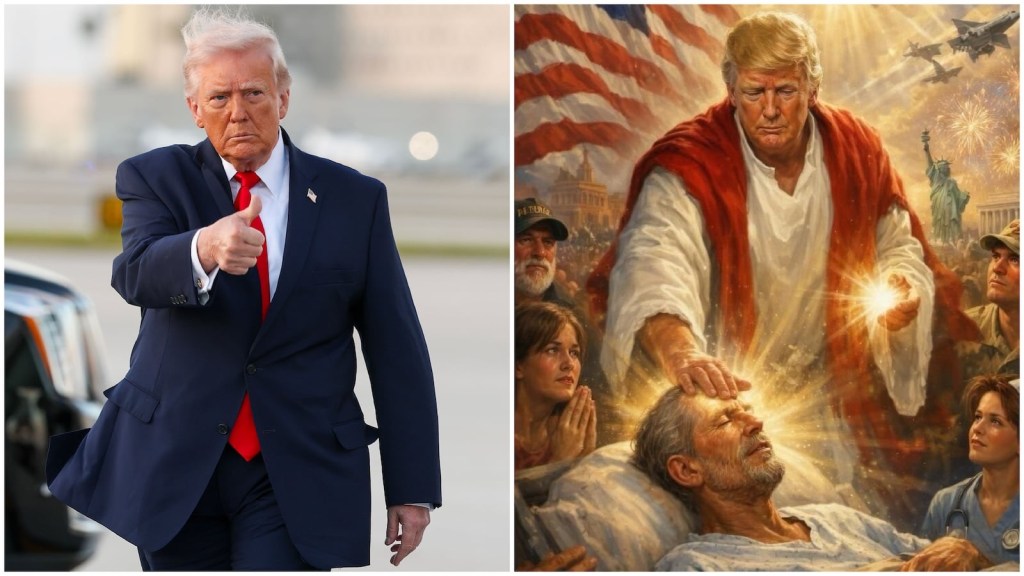
The sermon-like rant stood out, given the recent dust-up over Trump sharing an AI-generated image of himself as Jesus — a post he later deleted and claimed was meant to depict a “doctor.” The White House may have backed away from the religious comparison, but Hegseth’s comments only seem to resurrect it. “So…they are doubling down on Trump being Jesus?” The Bulwark’s Tim Miller wrote.
Stelter’s take
This sentence from Hegseth was the tell: “I just can’t help but notice the endless stream of garbage, the relentlessly negative coverage, you cannot resist pedaling.” He just can’t help himself.
The “holy war” type talk, insinuating that doubting Trump is like doubting Christ, was both deeply offensive and surprisingly insecure.
Gretchen Carlson put it perfectly on X: “As a Christian, how dare you use religion to shame those who simply ask questions.”
As a practical matter, a defense secretary who thinks the press is ignoring US military victories (the press has not done that, but I digress) would provide greater access to service members and share videos from the war zone. There are lots of ways to do that. But Hegseth has been pushing the press out. He’s not even giving fulsome access to MAGA media outlets.
>> Bottom line: Hegseth’s media-bashing hasn’t worked. The polling hasn’t budged. Trump and Hegseth’s messaging is not moving public opinion, which remains broadly opposed to the war.
I first met Vivian Connell in 2012 at a conference for legislators in Raleigh, North Carolina. She was part of a panel of North Carolina teachers who spoke about the challenges and needs of their classrooms. She was brilliant and articulate. I later learned that she was both a lawyer and a teacher. I was impressed by her candor, her insight, her passion, and her deep connection to her students.
That happened to be the same year that the Network for Public Education was founded.
Four years later, the Network decided to hold its annual conference in North Carolina. The decision was controversial because the state legislature (the General Assembly) had just passed a bathroom bill requiring that everyone must use the bathroom aligned with their assigned gender at birth. HB2 was known as Hate Bill 2. Some thought we should avoid North Carolina, others said we should show up.
We decided to stay in North Carolina (had we canceled at the last minute, we would have gone bankrupt), and our decision was reinforced when our dear friends in the state were able to persuade the Reverend William Barber to be our keynote speaker.
Rev. Barber was indeed eloquent, and we were glad we decided to stand by our original decision to meet in Raleigh. Funnily enough, the major hotel we stayed in had three kinds of bathrooms: women’s, men’s, and gender neutral. I wondered if the General Assembly knew. Had it occurred to them that HB 2 was unenforceable unless they had an inspector at every public bathroom to visually inspect either birth certificates or genitalia.
One prominent North Carolinian was missing from our conference: Vivian Connell.
Vivian lived about an hour away but she couldn’t travel. She had ALS, Lou Gehrig’s disease, which causes physical degeneration and has no cure.
At the end of the last session, on April 17, 2016, several of us joined Bertis Downs to pay a visit to Vivian. Bertis is from Georgia; Colleen Wood is from Florida; Phyllis Bush, now deceased from cancer, was from Indiana; and I am from New York.
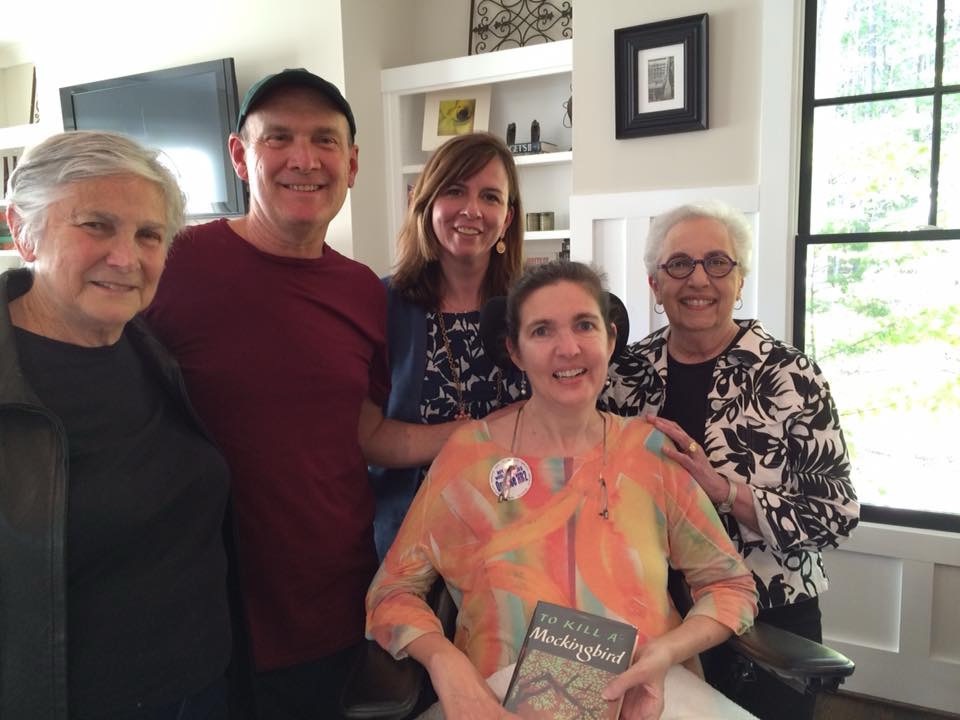
Surrounding Vivian at her home, Mr, Bertis Downs, Colleen Wood and Phylis Bush. Vivian, in her wheelchair, holds a first edition of one of her favorite books.
When we arrived at Vivian’s home, we met her husband Paul, her children Hadley and Hagan, and her aide. Vivian was in a wheelchair. She had no physical mobility and could not speak. She was able to communicate via an amazing device. She “typed” by looking at letters on a computer screen, which then expressed words. A member of our group gave her a first edition of To Kill a Mockingbird, one of her favorite books. Her husband announced that he was taking the kids to see Hamilton, their favorite show (they had memorized the lyrics.)
Soon after she received her diagnosis of ALS, she began writing a blog called “finALS.” When she began, she was still fully mobile. She documented her activities, checking off the items on her bucket list, and describing her deteriorating condition.
What follows is her final blog, which she wrote after we visited. We know that every word was laboriously written in a transfer from her eyes to the machine.
I hope you read it. You wil get a sense of her beautiful soul, which could conquer any obstacle but ALS.
One Last Time
[Prelude: It is June 24th, and I have at last finished my final post for finALS. It is not the masterpiece I dreamed of writing, but I am not a writer, and it is from my heart. This Monday, my medical team, husband and I will explore palliative sedation to manage the terrible choking and gagging that now dominate my waking hours. Some people adapt; some never wake up.
Before I go, I must spotlight my husband, Paul Connell, who has, from the beginning, eschewed any limelight. Never has a spouse been more constant or devoted. And though we each have big personalities that clash, he has never wavered in his devotion or care.
I dedicate all I have accomplished in law school and after my diagnosis to Paul, without whose selflessness, I could have done little.
VRC]
Well, I am back at last.
My doctor has called in hospice and used the phrase “last few months.”
And I have been paralyzed by the composition of this post.
You should all thank my writer friend David Klein that you are not reading my original idea. It involved stories of seeing Ken Burns speak in 2008–a version replete with quotations and commentary, I assure you–of how I wove segments from my beloved TV favorite, Aaron Sorkin’s West Wing, into my teaching (again, with no shortage of inspirational anecdotes) and of how I discovered that the author and star of Hamilton, Lin-Manuel Miranda, shares my love for the show.
But this is not to be an artful feature delineating again the ideals that inspired my teaching or the late-life leap to law school that validated my life’s work and filled the 27 months since I was diagnosed with ALS with wonder and opportunity. And I would love to regale you with the story of my Network for Public Education friends and colleagues visiting my home with both a signed first edition of To Kill a Mockingbird ( I know, right?) and my education policy hero, Diane Ravitch. I want to describe the tears of joy I cried when they left and the tears of joy my family enjoyed when we were gifted tickets to Hamilton! My husband wept because I couldn’t go. I bawled like a baby because they could.
And I want to tell you how my daughter ended up with an older script of Hamilton that Miranda had given to a journalist!
But this is not another post about serendipitous meetings and virtually miraculous joy that have so fully packed my life since I was diagnosed with this heinous, degenerative, and terminal disease.
I have covered my blessings pretty well.
These are to be my final words. Not a lesson from a dying teacher. Not an argument from a dying lawyer.
But one last time to attempt candor and artless honestly about my passions, my regrets, and wishing that this cup could be taken from me.
A LAST LITERARY LESSON
It feels important as well that I not leave anyone thinking too highly of me.
I was blessed to accomplish much I am proud of, mainly because I genuinely bought in to the best ideals of those before me and found the courage to follow my callings–to strive always to do more and do better.
Deepest thanks to my teachers and heroes.
I would be terribly remiss, however, if I failed to share at least a few of my representative fears and failings.
I’ve thought often of Hawthorne’s exhortation in The Scarlet Letter:
“Be true! Be true! Be true! Show freely to the world, if not your worst, yet some trait whereby the worst may be inferred!”
While I will not spend this post mimicking the poor guilty minister’s self-flagellation (you’re welcome), I will be sharing some of my less admirable choices. In retrospect, in fact, I am certain that my shame and regret–my failures–motivated me to keep striving to do better.
A loud conscience is a benefit, I think. At long as it brings about striving to do better rather than paralysis via self-loathing.
I diverge from many of my progressive parent friends because I take to heart that a reasonable and loving authority figure is healthy and character building.
I have no regrets about that aspect of my parenting: I think my kids knew that we rode them because we love them.
And I think this model is more effective when I ride myself equally.
And I encourage you not to procrastinate or ignore an urge to change or do better. Following these feelings brought all the most rewarding experiences of my life. And though I am far from done–though I have more public ( political) and private ( personal) battles to wage and improvements to make, I am out of time. And terribly sad about it.
So emulate the best of the heroes in Hamilton, our flawed founding fathers–yes, many of whom were paternalistic slave owners, but–who genuinely wanted to do better. The tireless work of Diane Ravitch, who once embraced the errant ideology of the failed Bush education mandate, No Child Left Behind (newsflash: many of our most vulnerable populations were “left behind”) but who now is standard-bearer for Valerie Strauss of The Washington Post, hundreds of leading education researchers, and hundreds of thousands of teachers and parents who are committed to the civic imperative of excellence and equity in public education.
And maybe even me: a self-absorbed, working-class only child who grew up oblivious to her privilege, pursuing only middle-class self-interest, but who learned through education and experience to change…
… To strive to be better, and in so doing, lived an adult life that makes it much less difficult to face death.
ON FAITH
I know my redeemer lives.
I did not embrace this belief until I was 28. And it is and has been the greatest gift of my life. I thank G-d for making him/herself real to me.
Every worthwhile accomplishment of my life–especially my love for my students and my passion for justice and tolerance–came from my faith.
My worst failings–especially my impatience, a hardness on others to live up to my (unjustified) expectations, and my intolerance for the intolerant–come from my failures to live out my faith.
I am grateful for forgiving friends and a forgiving G-d.
Regrets: Though I raised my children in church and strove to find churches that reflected the love of Jesus of Nazareth rather than the rules of so much organized religion, I never really prioritized participation in my church communities.
We moved several times when my kids were small, and I never fought hard enough to find the right church–a place that worked for social justice and where I could be confident that any person I invited would feel welcomed and loved for who they were.
For a couple of years, I asked my husband for us to tithe on our net, but I worried too much about birthday parties, vacations, activities, and home lifestyle to put giving first.
No Regrets: I did keep trying though, and about a year before leaving Charlotte, I bit the bullet and began shlepping my family to Warehouse 242, a place where I once saw one of my gay/trans high school students visit, and knew I had made the right decision! And when we moved to Chapel Hill, I at last found United Church of Chapel Hill, an open and affirming church community that focuses on serving “the least of these,” is active in the North Carolina Moral Monday movement for social justice, and actively promotes racial equity.
Despite my failures to live out my faith as I would have hoped, I was gifted lifelong friendship with several teens I led in a small group at a church in Charlotte that was much too legalistic for my comfort. I think I won these friendships because I never lied to the girls. I acknowledged the dissonance they perceived between the Jesus they knew or wanted to know and the legalism of our church and /or the politics of their parents.
Somehow I always respectfully challenged those I believe misrepresented the G-d who made himself real to me.
And for that, no regrets.
I do apologize to those with whom I disagreed, but failed to always love or respect. For example, the three arrogant social conservatives who poisoned my law school class: I held my ground against you in public, but I’m afraid I also referred to you surreptitiously as the unholy trinity.
And Andrew Brown, if you wonder why you practically had to rewrite your Law Review piece in which you demonized homosexuals and their rights as adoptive parents, well, that was me spending over twenty hours to eviscerate your pseudo-academic arguments and discredit your sources.
Oh, and Andrew, if you were my student and had used brackets to skew a quote to dishonestly promote your argument, I would have disciplined you to the outer boundaries of academic protocol.
Did you see what I did there?
I showed you that I enjoy kicking over the moneylenders’ tables in the temple a bit too much.
I think I was called to be a fighter, but I don’t think I always fought with love and humility.
May we all seek truth and justice while simultaneously striving to love our enemies as they are loved.
G-d help us all. S/he loves when we try and shows us unlimited forgiveness. This I know, and for this I am grateful.
ON RACE
It’s been a major issue in my life. And one I hate to leave on the table. Along with money in politics, corporate personhood, and the future of public education.
And so I find myself thinking of Greensboro.
The legendary lunch counter sit-ins.
This North Carolina city is now home to the Racial Equity Institute. My principal at Phoenix Academy, the alternative high school, sagely invested in each of his employees by sending us to the two-day introductory seminar of REI. The main reaction of attendees is “life-changing.” No guilting or emotional manipulation in sight, but two days of systematic realities steeped in history and taught by a diverse and largely dispassionate team. They are not crusading, but if you are interested in the statistics–the outcomes for people of color in health care, financial services, law enforcement, education, and other social structures, then they have the facts.
If you are ready and willing to face the not-so-just realities.
And Greensboro is also the home of my former law school classmate and honors writing scholar, Jessica. She married an African-American man, and they have three of the most beautiful biracial children I have ever seen. And though she has been busy with three children under five, she has come to Chapel Hill and fed me and my family on multiple occasions, and today she drove round-trip from Greensboro so that I could meet her two-month-old daughter before she had to pick up her toddler boys … or be charged a dollar a minute.
When I see the videos of those bad apples in law enforcement dragging black teenage girls in swimsuits to the ground or toppling one out of her school desk, or arresting Sandra Bland, I think of Jessica’s daughter. When I see the statistics and remember the stories of everything from violence to injustice to mere humiliation endured by my former students and my friends, I think of all our citizens of color and the ugly truth of Americans who must raise their children in fear.
And I hurt for white America, too many of whom deny the reality of our country’s latent and simmering injustice to so many people of color.
A child of the Deep South born in 1964 to parents raised on farms and in rental shacks around Vidalia, Georgia, I was lucky.
My parents taught me the right words:
Don’t judge people by skin color.
Everyone should be treated equally.
Don’t use the N-word.
But there were no black kids in my Mississippi elementary school and no black families in my neighborhoods… ever.
And the bulk of my south Georgia relatives never got the N-word memo.
By high school, I was passively non-racist but had never had a non-white friend.
Regrets : My worst memories…
When I was a high school sophomore, some popular girls I longed to befriend me asked me to go out after the football game. We got sundaes at the McDonald’s, and one had a hair in it. And so we circled round to request a replacement. Four privileged white girls in nice clothes carrying their generous allowances and riding in a parent’s new sedan. When we returned to the drive-thru, my new friend spoke into the speaker to the African-American girl at the window: “We need another sundae, and this time, hold the ni–er hair.”
I alone didn’t laugh, but I also didn’t speak up or get out of the car. And I still burn with shame at the memory.
No regrets: Junior year University, I brought my roommate home for Thanksgiving. I did not even think to tell my parents she was black. But when my poor mother said that she was afraid of what the neighbors would think, I stood up.
Dr. Anne Sharp, Dr. Albert Somers, Dr. Zach Kelehear and the wonderful English and Education professors unmasked the systematic racism of our education systems and even our very linguistics.
Never in my teaching career could I say “with liberty and justice for all” without adding “someday, if we all work for it.”
I am proud to have passed these lessons to my students and to reap the harvest of watching them work for a more just society. And of course, the root of the problem is not race alone, but the evil human propensity to divide ourselves by skin color, religion, gender, sexual orientation, social class, and myriad other traits. We declare our own group best or righteous, then marginalize and scapegoat “the other.” And in doing so, we undermine the promises of equality in both our Declaration and Constitution. We also fail to love our brothers as ourselves. As shared before, here is the story of my finest hour. Which I pray will counter the all-too-prevalent voices of evil flourishing in our political, and even religious arenas.
I have celebrated the election of our first biracial president only to witness a stunning political backlash and obstruction. I have witnessed racial attacks on President Obama and even his family. I witnessed the police attacks on black men and women, and the overtly racist slaughter in a Charleston church.
And now I have seen the most openly racist candidate become the GOP nominee for the upcoming presidential election. Ken Burns shares my concerns.
But:
I go with hope.
My children mirror my generational progress. My professors at UNC Law and the leaders in my church are standing up… and long have been. And oh, my amazing law school classmates, at so many centers and organizations, working for true equality for all.
I am so grateful to know them all. And to see Ta-Nehisi Coates win a genius grant. And to see Hamilton become the greatest Broadway sensation with a predominantly non-white cast portraying our crusty white founding fathers.
My hope is that America’s majority culture can admit that it is harder to be a person of color here and that this reality does not comport with our ideals.
For soon after that tipping point, this ugly reality will cease to be part of our identity.
“Someday… If we all work for it.”
ON LAW & POLITICS
I am failing fast: my abilities to swallow and breathe are plummeting. I will therefore need to be succinct and, hopefully compelling in this potentially off-putting yet crucial section.
REGRETS:
In 1981 I told my A.P. English teacher that I was apolitical. Though I doubt I knew that term. I’m sure my arrogance was less articulate.
I believe I made this claim because she asked me a question about politics, and I was far too self-involved to watch even the evening news, and so I could not give a knowledgeable answer to her question.
But I remember her upbraiding, partly because she was right, and partly because this truth haunted me and grew in me for decades.
She called bullshit like only a legendary, scholarly, and terrifying old English teacher who has been setting entitled little snots straight for decades can.
She looked me in the eyes and told me not delude myself. For we are all political. She described how almost all of our choices–where we shop, what we buy, where we live, where we educate our children–are all political actions. The only question, she assured me, was whether these choices would be informed decisions or whether I would be too lazy to become informed.
I am loath to admit how slow I was on this curve.
No regrets: During college, life abroad, graduate school, and almost two decades of teaching, I never forgot the clarion truth of Ms. Braswell’s words. I only wish that I had been more informed and much more civically active sooner.
Two tough truths I learned along the way:
“Washing one’s hands of the conflict between the powerful and the powerless means to side with the powerful, not to be neutral.” ― Paulo Freire
“Allowing the ratio of time we spend enjoying our freedom, wealth, and justice to materially surpass the time we spend preserving those blessings virtually guarantees they will diminish, or even be lost while we are not looking.” – Vivian Connell
When I came to UNC Law in 2010, North Carolina was a moderate state, considered progressive for the South. The Triangle of Raleigh-Durham-Chapel Hill topped lists of best places to live in America.
But then moderates and progressives busy enjoying this status looked away, and paid a disastrous price when dark money flipped our General Assembly to the radical right. It hadn’t happened in a century, but it happened the moment citizens disengaged from civic attentiveness. We have seen national model education programs dismantled, and our voter suppression laws, gerrymandering, and, most recently HB2,”the Bathroom Bill,” have pitted us against federal authorities and made us a national laughingstock.
Of course, these developments are no joke to the poor without health care, to minorities facing all kinds of discrimination, or to public school teachers and advocates who have seen their resources and rankings plummet.
Here are a few of the fights that must be fought when citizens in a democracy cannot be bothered with the work of politics:
It is really this simple: you are political whether you knowingly control the influence you wield or whether you cede your power to others through superficial participation or non-participation.
Informed participation, though. How the hell does one manage it?
Where can one find the truth untainted by special interests?
Obviously, by reading and viewing a variety of sources, some of which do not rely upon special interests for funding.
And if you become frustrated by how “they” have made terrible laws or skewed public policy in a way in which you disapprove, you might want to become one of “them.” I did, and I sought to get to the heart of the democratic process by attending law school.
Now would be a good time to be succinct.
The gravamen of almost every issue demands that we prioritize either our ideals or our economy. And while we need to maintain our economy, there are two essential ways that we have prioritized money to an extent that it is undermining our democracy.
money in politics
quarterly capitalism
Money in politics
Because of a Supreme Court decision called Citizens United–often named along with Dred Scott, Plessy, and Bush v. Gore as the potentially worst Court decision ever–uber-wealthy entities can buy elections.
We must support campaign finance reform so that ideas determine victors. We must find, recruit, and elect representatives who will govern for the greater good. We must recognize and reject empty rhetoric in superficial, soundbite ads.
When one of our most conservative representatives challenged Democratic senator Kay Hagan in 2014, I agreed to act as spokesperson in a $3 million ad buy for the NEA. I loathed the simplistic script because I knew Thom Tillis’s record on education and would have vastly preferred an hour-long, fact-based debate on a website that would not have cost the educators I represented a penny.
But the National Rifle Association outspent the teachers, and Tillis won by roughly a percentage point. I wrote about it for Salon.
I pray that with Citizens United‘s author, Justice Antonin Scalia, deceased and the legion of young Sanders supporters, the coming years will see true campaign finance reform. The reality of special interests and corporations disproportionately deciding ought to horrify anyone who loves this country and the truly democratic ideals for which it stands.
Or consider the words of the inimitable Andy Borowitz.
Quarterly capitalism
My Business Associations class–a course called Corporations at some law schools– enlightened me as to the core legal atrocity that undermines the ability of American companies to contribute to not only our economy but also to the greater good of our society.
Do you wonder why so few corporate officers or companies ever pay for their bad, or virtually fraudulent choices? It’s because our laws protect them from virtually any risk they take. If they can concoct any rationale that their risk was a potential money maker for share holders, then they are protected.
Worst, this singular focus on immediate profit means that corporate leaders face not only disincentive but potential lawsuits should they wish to take a longer and broader view of corporate citizenship. The law prevents them from investing in worker training, more research and development, community betterment, education enhancement, programs to reward and protect their consumer base, or other forward-looking ideas that would enrich all of the corporation’s constituents.
Please listen to this indictment of this system, in which corporate officers decline to consider actions for the long-term benefit of their companies and their constituents–investors, workers, clients, neighbors, and their habitat–if doing so might mean dropping even one penny off their stock price for the quarter.
Thus, we have codified greed and outlawed wisdom.
Our companies should make more than money. They should enrich their communities, workers, business, and society.
Even our Judeo-Christian tradition tells us of a year of jubilee in which debts were forgiven and indentured servants freed. And while I suggest nothing so radical, I insist that we must reform our corporate law AND adhere to financial reforms in Dodd-Frank if we are to retain a robust middle class and remain a society in which business serves people, and not vice versa.
It is funny–not “ha-ha” funny, of course–that I wanted this to be the richest section, a big finale, but it is likely to be the most truncated. I am sleeping more each day and struggling to swallow and breathe during the hours I am awake. And as much as I might write about various policy initiatives, like charter schools, vouchers, merit pay, and especially the insidious philosophy of market-based reform (that would have us apply profit-making principles to the complex, subtle, and sacred art of educating our populace), I want to get to the core.
REGRETS:
I have spent over three hours this morning working with my hospice nurse, my saint of a caregiver husband, my tireless and loyal assistant, to clear my secretions and stop this horrific gagging and choking, so I regret leaving this section for last!
But seriously, folks…
I regret failing to integrate the promotion of civic engagement during the early years of my teaching. It certainly distinguished the final years of my career, and I am grateful to have lived to see so many of my students become teachers, lawyers and activists.
No Regrets:
The hundred-plus emails and messages from students, the tens of visits ( most from Charlotte to Chapel Hill) made by students and even a couple of parents who helped unpack from my move (Jodi Brown) and even execute a plethora of retirement and insurance documents to assure our children’s trust would be the beneficiary (Hallie Hawkins) are major blessings. A couple of weeks ago, two young women visited– including one who feels a profound connection with my daughter, for which I am so delighted – – and when we had a nurse cancel, they cared for me like I was their own mother.
I hope this means that they know I really loved them.
Even when overworked, underpaid, underappreciated, and demeaned by many who genuinely believe that “those who can’t, teach, ” I regret not even one day I spent in the classroom.
Closing comments about education policy:
First, in lieu of embarking upon a treatise on education policy, I’ll let a passionate young history teacher who just marched to Raleigh to practice civil disobedience tell the story in a much more engaging manner.
And if You wish to remain informed about public education and align yourself with one of the most important social movements of the age, follow Diane Ravitch and support The Network for Public Education. They will be on the right side of history.
I am most concerned with all schemes to create “for-profit” charters for K-12 education. A quick Google search of charter school and fraud yields over 1 million results. Which makes sense: as you will remember from our discussion of quarterly capitalism, businesses exist to serve their owners. (If anyone wants to read my rather prescient Law Review note eviscerating corruption in for-profit higher education.
Can any first-rate, moral country exist and thrive without providing its citizenry with quality education?
I want my final commentary to address the purpose of education, a topic which ought be at the heart of every education debate yet which too often parents, businessmen, and the general populace presume to be settled.
But is the goal of education to produce a workforce or enlightenment? Should it indoctrinate children to sustain and succeed within the status quo or to challenge what is and strive ever for progress, even if change is painful?
As a country born of revolution and the Enlightenment, our answer must be the latter. Every educated citizen should have a working understanding of our government, as well as a belief that their civic engagement is essential to maintaining our democracy and that they can make a profound difference in their worlds.
Children in our best schools already come away with this understanding. Unfortunately, many of today’s education reformers are powerful business entities and politicians who would defund the liberal arts.
North Carolina governor Pat McCrory made the following telling remark: Liberal arts Programs, he said, ought to continue, but not receive government subsidies.
Let me translate: If you are wealthy enough to attend a prestigious private university, then you may study whatever you like: anthropology, minority Literature, developing political systems, gender studies, dance. But if not, you ought to be required to study subjects that promote the economic interests of those in power–business, technology, and skill majors. The goal of the education haves can be enrichment; the education have-nots will be herded into a compliant labor force.
Governor McCrory did not mention that his undergraduate degree from a private school is in philosophy.
Or that the majority of U.S. senators majored in the liberal arts. So did the majority of lawyers.
The study of history, Literature and the arts inspires and empowers, and it must remain accessible to all. And all of our public schools must equitably prepare every child to pursue his or her calling, whatever it may be.
And as long as there exist schools in our communities that are not considered good enough for some children, yet which remain the only option for other kids, we must acknowledge that the playing field of the American dream is not level.
And that until it is, we continue to fall short of justice for all.
Finally, most of you will have heard of “the achievement gap”–the disparity in educational outcomes between the predominantly successful students and those who fail to thrive or become functional members of society. Researchers have long (and largely accurately) identified poverty as the key demographic of “failing schools.”
But about a year ago, a Gallup poll found a more specific predictor of academic success: hope. And the miracle of Tangelo Park has born out the truth of this finding.
These poor minority students–kids many middle-class and affluent parents don’t want their kids to have to go to school with–suddenly began graduating at over 95 percent, one of the best in the country. Why?
Because they knew that if they got into college, they could go. It would be paid for. They were given the power to win in a system stacked against them.
They were given hope.
And none of us should rest until every American child has that hope.
GOODBYE
I have arrived at the end time of this disease, and it is horrific as they say. As I struggle not to choke and gag, I do wish that I had fewer regrets. Of course, these wishes that I had been a better wife, mother, and friend are tempered by all the love and mercy with which I have been blessed.
I want to thank the many amazing and generous people who have helped us in too many ways to innumerate. And thank the thousands of you who have read and shared my blog ; I am deeply honored that anyone has found value, comfort, or inspiration in my words.
May G-d bless and keep you all.
As I often told my students, few of us will be a Mother Teresa or a Hitler, but we will each make the world a little better or worse.
May we all strive to make it better. May we engage responsibly in the miraculous gift of our democracy and support public-interest lawyers and entities working for social justice. It feels so much better than following thoughtlessly in consumerism and self-interest.
History has its eyes on us all.
And as for death, I will quote Grandpa Blakeslee from Olive AnnBurns’s novel, Cold Sassy Tree: “Hit’s what you get for living.”
And though ALS is one of the worst demises imaginable, I’ll take the trade.
Love,
Vivian
P. S. I will be listening to the beautiful Gilead, the Harry Potter audio books as well as all my favorite playlists. (As Dumbledore says, “Ah music. A magic beyond all we do.”) My whole family will be listening to Hamilton–and how lucky I was to be alive right now. And I made it through The West Wing and The Newsroom again. Bless all of you who listened and watched with me, especially my patient and loving husband and my wonderful and Sorkin-savvy children! Thanks also kids for sharing Doctor Who. I would not have missed it for the world.
Texas Governor Greg Abbott waged a multimillion dollar campaign to defeat moderate Republicans in the Hogse of Representatives so he could finally get the legislature to pass his voucher bill. He wanted to subsidize private Christian schools and was shocked when Islamic schools wanted their students to get vouchers.
Abbott falsely claimed that public schools were “indoctrinating” students, and he wanted the state to pay for students to go to religious schools, whose explicit purpose is indoctrination.
As usual, the overwhelming majority of voucher applicants had never attended a public school. Most were already enrolled in a religious or private school or were none-schooled.
What would’ve been school-choice proponents’ triumphant publicity tour after the application period closed on Texas’ shiny new voucher program, in mid-March, was instead consumed by catty finger-pointing between two top state officials over who’s to blame for the state seemingly botching its attempt to religiously discriminate against some program participants.
It’s the sort of comedic tragedy that has become all too common in the red empire of Texas: Pass a harmful new policy while prevaricating as to its actual intent, create a pretext to carry out the policy in a clearly discriminatory fashion, invite a costly lawsuit that will ultimately end with the state being forced to comply, muddy the waters over who’s to blame.
While pushing the private-school voucher bill through the state House and Senate last year, Republican legislative hands repeatedly insisted, when presented with various theoretical scenarios, that this near-universal “Texas Education Freedom Accounts” program would be open to any and all types of private schools—of all creeds and persuasions. Religious freedom was to reign supreme. How dare thee even question the universality of this venerable program, Republican legislators inveighed.
In predictable fashion, the Texas GOP—lately in the throes of another virulent anti-Muslim bender—hasn’t quite lived up to that promise. In the lead-up to the official voucher rollout, acting Texas Comptroller Kelly Hancock—who is currently in charge of administering the program and was, at the time, trying to win a primary election to hold onto his appointed post—used the administrative process to effectively block certain Islamic schools from participating by alleging such potential applicants were affiliated with the Council on American-Islamic Relations (CAIR), a national civil rights group akin to the NAACP or LULAC, and the Egypt-based transnational organization the Muslim Brotherhood, each of which the state has deemed a “foreign terrorist organization.” (The rule also sought to block schools affiliated with the darned Chinese Communist Party.) The conflation of CAIR with the Muslim Brotherhood and Palestine’s Hamas is a theory that’s long brewedin the right’s more feverish swamps. (CAIR is suing the State of Texas over this designation.)
In response, a group of Islamic schools and Muslim families went to court over the discriminatory exclusion from the program: “The exclusion is not based on individualized findings of unlawful conduct by any specific school, but rather on categorical presumptions that Islamic schools are suspect and potentially linked to terrorism by virtue of their religious identity and community associations,” the lawsuit read. A federal judge ordered the state to extend its application deadline to allow for these schools to go through the process.
The comptroller’s office has since said that it has accepted all eligible Islamic schools that applied to participate in the program—including Houston’s Quran Academy—but not before Hancock sent a letter critiquing Attorney General Ken Paxton’s handling of the court case and urging Paxton to strip Quran Academy, which the state unsubstantially claims has links to the Muslim Brotherhood, of its ability to operate in the state. In the letter, Hancock—fresh off being blown out in his primary bid to be the duly elected comptroller by ex-state Senator Don Huffines—effectively accused Paxton of being soft on terrorism. “Texas cannot be asleep at the wheel as radical Islam spreads,” Hancock wrote.
Paxton, in the midst of a heated runoff battle with John Cornyn after coming in second in his own primary bid to ascend to the U.S. Senate, took exception to being scolded by the likes of a RINO such as Hancock (i.e., one of the two GOP senators who voted to convict Paxton in his impeachment proceedings in 2023). The still-AG issued a scorched-earth retort, calling the interim comptroller an incompetent never-Trump hack nursing a deep political grudge—and demanding Hancock be fired. (It’s not clear who, if anyone, would have the authority to fire him.)
Paxton then said his office, whose duties include serving as legal counsel for state agencies, would no longer be defending the comptroller in the federal vouchers lawsuit, claiming Hancock’s letter undermined the state’s case and introduced “incendiary” accusations against Quran Academy that had not been entered into evidence in court.
“Never before have I witnessed such a fundamentally unserious person be both an unbelievable embarrassment to the State and put his own interests above Texans,” Paxton wrote. “It would be easy to disregard Kelly Hancock’s letter as nothing more than hotheaded, politically-motivated behavior from someone desperately clinging to relevancy, but it’s far worse than that: His actions hurt my office’s ability to defend the Comptroller’s office in these critical cases.”
For vouchers, there have been some other PR snags as well. For instance, one religious school—Cypress Christian in the Houston area—that hosted a pro-voucher event during Governor Greg Abbott’s promotional tour last year, has itself opted not to participate in the program.
Per the Houston Chronicle, the school’s leader told parents that the institution is “governed exclusively by biblical doctrine and scripture” and that enrolling in the voucher program would inherently result in “ongoing government entanglement.” Many other high-end private schools—where the annual tuition typically far exceeds the standard $10,000 voucher allotment—in the Houston area have also optedagainst participation.
All the while, Abbott—who claims political ownership of both the school voucher program, having succeeded in ramming it through a humbled Texas House, and Kelly Hancock’s comptrollership, an ally whom he plucked from the state Senate to take over the statewide office and launch of the program—was radio silent. The governor, in late March, spent his allotted time at CPAC in Dallas, while Paxton and Hancock traded potshots, droning on about the urgent need to stop the “Talarico takeover of Texas,” referencing the Democrats’ Senate candidate.
Meanwhile, how does the voucher program—which was sold as a tool to allow low-income families to get their kids out of the state’s failing woke indoctrination facilities, known as public schools, and into predominantly Christian private schools—appear to be sizing up with its mission?
It’s certainly succeeded in getting more applications than the $1 billion that the state has initially appropriated can cover, which is about 90,000 spots. Applications had been submitted for about 275,000 students as of late March. But just 25 percent of those—about 60,000—were for students currently enrolled in public schools, according to state comptroller data. (That, per the Texas Center for Voucher Transparency, amounts to about 1 percent of the state’s 5.5 million public school students.)
To be clear, that means the vast majority of the students who are applying for vouchers are already enrolled in private schools, being homeschooled, or entering school for the first time. There were roughly 2,300 schools enrolled in the program so far—though those schools have full discretion in whether or not to accept a voucher recipient. Many of the enrolled schools are parochial Catholic schools or Christian academies. As the Texas Observer has previously reported, dozens of these enrolled schools have policies that restrict admission based on religion and even sexual identity.
The application period closed on March 31, then the process moved on to the next phase in which the state—through its privately contracted voucher vendor—will determine who receives the limited number of vouchers, based on a convoluted, multistep process accounting for family income and other variables.
By that point, it seems assured, some new brouhaha will be consuming the program.
An organization called the Ben Gamla Charter School Foundation wants to open a virtual Jewish religious charter school in Oklahoma.
The story is not as straightforward as it appears.
Behind the Florida-based Ben Gamla charter chain is a for-profit management company called Academica, which derives huge annual profits from its connection to more than 200 charter schools across the nation.
There are fewer than 9,000 Jews in the state of Oklahoma, and they are not clamoring for a Jewish charter school.
The state charter board twice rejected the Ben Gamla application, because a previous appeal for a Catholic online charter school was turned down by Oklahoma state courts, then by a 4-4 decision in the U.S. Supreme Court because Justice Amy Coney Barret recused herself due to her friendship with a lawyer for the religious school.
The Ben Gamla Foundation filed a lawsuit on March 24, claiming that the state law banning public funding for religious schools is unconstitutional religious discrimination.
The lawsuit asks a federal judge to strike down Oklahoma’s ban on religious charter schools, and to order the state to stop denying applicants on the basis of their religious character.
“We’re asking the court to end that blatant religious targeting and allow families to choose schools that are best for them,” Peter Deutsch, a former Democratic congressman in Florida and founder of the National Ben Gamla Jewish Charter School Foundation, said in a statement.
The lawsuit alleges that Oklahoma’s requirement that charter schools be “nonsectarian” is unconstitutional, citing the First Amendment’s Free Exercise Clause and the Fourteenth Amendment’s Equal Protection Clause.
But Jewish organizations in Oklahoma are wary of the Ben Gamla application. A small group of Jews and a rabbi in Tulsa recently asked to join a lawsuit to block the Ben Gamla charter school.
Rabbi Daniel Kaiman, the principal rabbi of Congregation B’nai Emunah in Tulsa, says he opposes the mixing of religion and government because of the potential for abuse. His own children attend a public elementary school in Tulsa.
“I am passionate about Jewish education—indeed, I have dedicated my life to it. Kaiman wrote in a declaration filed with the court. “Children in my congregation, including my own children, receive excellent, privately funded Jewish education through our synagogue and at home in accordance with our community values. But the mixing of religion and government creates opportunities for religious coercion…”
The motion was filed on behalf of the seven by the ACLU, Americans United for Separation of Church and State, the Education Law Center, the Freedom From Religion Foundation and Oklahoma Appleseed.
The Ben Gamla school would under insert religious teaching into all subjects and require all employees to uphold Jewish values in their lives. What any of that means is unclear. How would math, reading, science, and other subjects be taught from a Jewish perspective. What sort of “values” would employees uphold and who would determine whether they did?
The Ben Gamla application is opposed by state Attorney General Gentner Drummond, who is against religious charter schools. But Drummond leaves office in January and might be replaced by a supporter of religious charter schools.
The state charter school board is pro-charter and is not vigorously opposing the Ben Gamla application. In fact, the state charter board retained First Liberty Institute to represent it. It is a conservative Christian legal group that believes that religious charter schools should be legal.
Oklahoma Jews are opposed to Ben Gamla. The Jewish Federation of Greater Oklahoma City sent a statement to the state Attorney General saying that religious charter schools “risk eroding the constitutional safeguards that protect both religious freedom and government neutrality toward religion.”
Ben Gamla’s financial interdependence on the Academica charter chain should alarm Oklahomans as much as the effort to turn public money over to religious schools.
Academica is a very wealthy for-profit charter management organization.
According to Ben Gamla’s strategic plan, Academica will control its budget and finances, facilities and management, human resources, and much more. And, of course, charge a management fee.
Academica manages more than 200 charter schools in at least 22 states. Its biggest chains are Somerset Academy (at least 80 campuses), Mater Academy (40-50 schools), Doral Academy, and Pinecrest Academy.
Academica held more than $115 million in properties in Florida in 2010 and collected $19 million in profit. That’s 16 years ago, the network has vastly expanded, and no one has updated the total value of Academica’s real estate since then or its annual profits.
Academica makes its hefty profits through management fees and “related party transactions.”
This is how a “related party transaction” works:
A real estate LLC controlled by Academica allies buys or builds a school property. The nonprofit charter school, like Ben Gamla or Mater or Somerset, leases the building. The school collects public funds from the state or the city, then pays rent to the LLC. The rent is high, often as much as 20% of all public funding. The management company chooses the services provided, making contracts with its allies.
Academica: The largest EMO is Academica, based in Miami, Florida. Academica’s owner is a real estate developer, Fernando Zulueta, who opened the first charter, Somerset, as part of a housing development he had constructed. He reasoned that his real estate venture would be more attractive to buyers since students would have a school within the development. Using their real estate companies, Fernando and his brother, Ignacio, built what journalist Jessica Bakeman called “an empire of charter schools.”
Over 100 active corporations linked to Fernando Zulueta and his family members are listed as residing at Academica’s Miami headquarters at 6340 Sunset Drive and 6457 Sunset Drive in Miami.39 They include real estate corporations, holding companies, and finance corporations, as well as sub-chains both within and outside of Florida.
Like many other charter schools and chains, Academica cashed in on the COVID Paycheck Protection Program during the pandemic. Individual schools and other nonprofit and for-profit entities related to the chain received in total up to $35.7 million dollars, even though there is no evidence of revenue lost during the pandemic. In fact, during the pandemic, the EMO continued to expand. In total, charter schools cashed in on one billion dollars from the PPP program.
Mater Academy Foundation, Inc., the related non-profit corporation that oversees Academica’s Mater brand of charter schools, acquired a $127.5 million educational facilities lease revenue bond to purchase several facilities from Academica. The South Florida Business Journal detailed the purchase price of several of the facilities and the Academica-affiliated real estate entities that cashed in on the sales, concluding that “the Pandemic Profiteering deal allows Academica to cash out after investing in the development of charter schools, although it will still earn management fees for the schools.”
The connection between Fernando Zuleta’s real estate holdings and his for-profit managed charter schools goes beyond the state of Florida. According to the State Public Charter School Authority, Academica Nevada pays the lease on behalf of the charter school Mater Academy Mountain Vista of Nevada to Stephanie Development LLC. The managingmembers of Stephanie Development are Fernando and Ignacio Zulueta and Robert and Clayton Howell. Robert Howell is the manager of Academica Nevada.
About 18% of all charter students are enrolled in for-profit charter schools, like those of Academica. If Ben Gamla is approved in Oklahoma, that will open new horizons for their expansion.
Be sure to read NPE’s report:
For-Profit Charter Schools Gone Wild—Proof That Greed and Education Don’t Mix
This is bad news indeed. The Trump administration, in its ongoing campaign to harass institutions of higher education in the U.S., demanded a list of Jews from the University of Pennsylvania. The university, as well as Jewish groups, objected.
The Trump regime says it is combatting anti-Semitism on campus and wants to collect evidence. The university believes this is an intrusion into private and personal information.
What reason is there to trust the good faith efforts of the Civil Rights Division of the Department of Justice? Under current leadership, it has tossed aside all efforts to defend the rights of historically marginalized groups. It fights DEI and any programs that are intended to help Blacks, Hispanics, women and LGBT individuals. The leader of the Civil Rights Division, Harmeet Dhillon, has devoted her career to fighting civil rights law.
Frankly, their sudden obsession with anti-Semitism is likely to cause an explosion of anti-Semitism. Maybe that’s their goal.
As a Jew, I say to the Trump regime, “No, thank you.” I don’t want my grandchildren in your census. It stinks.
The Trump administration was within its rights to demand that the University of Pennsylvania turn over information about Jews on campus as part of a federal investigation into discrimination at the school, a federal judge decided Tuesday.
The government’s investigation had united Penn leaders with Jewish students and faculty members as they opposed the Equal Employment Opportunity Commission’s subpoena. Many on campus drew parallels between the government’s approach and methods deployed in Nazi Germany.
But the Trump administration has said that its request was typical for discrimination investigations to seek potential victims and witnesses, and Judge Gerald J. Pappert of Philadelphia’s Federal District Court agreed on Tuesday. He gave Penn until May 1 to comply with the administration’s subpoena, though the ruling appeared unlikely to quell the debates around how the administration has pressured top American universities.
In his ruling, Judge Gerald J. Pappert of Philadelphia’s Federal District Court said Penn “relies on two federal-court opinions which hurt, not help, its position.”
Judge Pappert, an appointee of former President Barack Obama, appeared to hint at the discomfort that the government’s subpoena had prompted and at the accusations that the E.E.O.C. had gone too far with its tactics, especially a demand for information tied to groups “related to the Jewish religion.”