Archives for category: Religion

Kevin Woster, a veteran journalist in South Dakota, explains here why he opposes vouchers, even though he sent his own children to Catholic school and appreciated the education they got there.

He notes that the South Dakota legislature considered vouchers and did not pass them but he is sure that the issue will be back again for debate.

He and his wife made the right decision by sending their children to Catholic schools, but he nonetheless thinks it would be wrong to take public money for private schools.

He believes that public money should not be used to fund private schools.

It’s public money, for public schools. And the commitment and responsibility to provide a free public education isn’t a new idea. It’s a constitutional idea, as in the South Dakota Constitution, which reads in part:

“The stability of a republican form of government depending on the morality and intelligence of the people, it shall be the duty of the Legislature to establish and maintain a general and uniform system of public schools wherein tuition shall be without charge, and equally open to all; and to adopt all suitable means to secure to the people the advantages and opportunities of education.”

And as taxpaying citizens, it’s our duty to support that system of free public schools.

Making your choice with your checkbook, not public money

Just because my first wife, Jaciel, and I decided to send our kids to a Catholic-school system didn’t mean we were absolved of our responsibilities as citizens to support public schools. You don’t stop being a citizen because you decide to become a private-school parent. You are both. You must be both.

It would be wrong, he believes, to weaken the public schools for the benefit of those who have made private choices.

Historian and retired teacher John Thompson describes the confusion and chaos generated in Oklahoma as MAGA Governor Kevin Stitt and the bumbling State Superintendent Ryan Walters continue on their path of privatization and religiosity.

Thompson writes:

Oklahoma Gov. Kevin Stitt and his ally, State School Superintendent Ryan Walters, have histories of double-barreled shotgun-style assaults on both public education and other state government agencies. For instance, Stitt previously pushed out “three highly-regarded leaders” of the Corrections, the Health Care Authority, and the Transportation departments. Recently, as Arnold Hamilton of the Oklahoma Observer protests, “Stitt took aim at another experienced state leader, trying to stampede longtime higher education Chancellor Glen Johnson into retirement. And he hasn’t backed off from his other barrel – demeaning rhetoric to advance privatization.

Similarly, Walters has pushed out many of his staff who administer competitive federal grants. The Oklahoman reported that the lead grant writer, Terri Grissom, who had “secured more than $101.5 million in competitive grants over five years,” resigned and “blew the whistle that Walters’ administration had brought the process of competitive grant applications to a halt. These funds supported a variety of initiatives, but many focused on student mental health and behavioral services.”

Grissom said Walters “blocked her from applying to a student wellness grant,” and Matt Langston, his chief policy advisor “forbade her from seeking any programs with elements of diversity and inclusion, LGBTQ initiatives, social-emotional learning or trauma-informed practices.” Moreover, Oklahoma Watch reported, “Langston emailed employees of the agency, threatening any employee ‘found leaking information to the press’ with immediate termination.” Two other managers were fired and filed lawsuits against Walters and Langston.

In May and June, as Walters’ rhetoric and behavior became even more unhinged, I was told that many Republicans decided to not push back against him because his antics drew attention to him, and away from more silent Republicans. But as Grissom, and Auditor and Inspector Cindy Byrd, revealed the losses of tens of millions of federal funds for schools and Covid responses (for which the governor shared responsibility,) and as school system leaders voiced concerns about not receiving timely notification about larger amounts of federal funding, it seemed more likely (or not impossible) that more Republican legislators would listen to their adult Republican colleagues and hold Walters accountable.

For instance, Auditor and Inspector Byrd, a Republican, “released an audit of how the state handled federal pandemic relief money, specifically expenditures made during fiscal year 2021.” The audit found $12.2 million in CARES costs and about $29 million in the state’s spending of federal COVID-19 relief funds were questionable. And Republican Attorney General Gentnor Drummond is investigating Walters and, perhaps, the Stitt administration regarding misspent federal money.

In response, however, Walters has doubled down on both his assaults on public education services and extremist rhetoric. As the Tulsa World reported, “Walters has been critical of federal funding opportunities that come with strings attached and directed the State Department of Education to pass on grant opportunities that don’t align with ‘Oklahoma values.’” Then, speaking to the Moms for Liberty in Philadelphia, Walters proclaimed, “You are the most patriotic, pro-American group in the country right now.”

And chaos has increased. Shouting and physical contact involving Moms for Liberty and other rightwingers have disrupted district school board and State board meetings, resulting in charges being filed.

Walters has continued to weaponize his calls for censoring curriculum and educators. For instance, the Tulsa Public Schools “was penalized for an August 2021 professional development session on implicit bias for teachers — not students — offered through a third-party vendor.” A year later, its “state accreditation was downgraded in July 2022 over an allegation that it violated a state law commonly referred to as House Bill 1775, which limits classroom discussion on race and gender.”

And as the World now reports, Walters’ latest attack on the Tulsa schools for “assaults” on religious liberty, became a shouting match where Walters pledged to further investigate Tulsa’s accreditation.

This controversy started when a board member, E’Lena Ashley, spoke at a high school graduation ceremony, and asked the audience to join her in prayer:

I pray in the name of Jesus Christ that each one of you would walk forward from this moment in the excellence and love of God, that he would guide you, direct you and draw you to your ultimate goal. In the name of Jesus.

The schools’ students and staff “voiced their concerns [about Ashley] during the citizens’ comment portions” at two Tulsa school board meetings. The Tulsa Board and Superintendent Deborah Gist sent an email “saying that the prayer Ashley made is not allowed under the U.S. Constitution and rulings by the U.S. Supreme Court.”

Walters replied that the email “fundamentally misunderstands religious liberty and religious freedom and attack a duly elected board member for saying a prayer. … It’s outrageous, and we’re not going to stand for that.” And World reported that he “vowed to make an issue of the matter when the school district’s accreditation is up for renewal next week by the Oklahoma State Board of Education.”

Who knows if these extremists’ rhetoric will lead to greater chaos, vituperation and, perhaps, serious violence? Who knows whether such behavior will undermine Walters politically to the point where enough Republicans take action. It must be remembered, however, that Walters’ and Stitt’s words and actions are parts of a national campaign to undermine our governmental institutions. And, most likely, it will take public servants, legal actions, and the public to defend our democracy.
https://www.axios.com/local/indianapolis/2023/07/24/indiana-private-school-vouchers

Texas Governor Greg Abbott wants vouchers. He claims that polls show parents want vouchers. But they don’t, as this article shows. He says he wants “education not indoctrination,” yet advocates public money to fund schools that explicitly indoctrinate students.

He’s annoyed that he has not yet been able to twist enough arms in the Legislature to get them. He even visited private and religious schools to spread the message that parents would get tuition help from the state. But a strong coalition of Democrats and Republicans has returned him down repeatedly.

Two Texas scholars, David DeMatthews and David S. Knight, wrote an opinion piece in The Houston Chronicle explaining that the public wants better-funded public schools, not tuition for kids in private and religious schools.

They wrote:

Governor Abbott will likely call a special session on school vouchers after House Bill 100 failed to pass during the regular legislative session. But we believe a special session should instead be called to improve school safety and teacher retention, not a voucher scheme that runs counter to what Texas families want for their children.

Texas families want safe schools with a stable teacher workforce, especially following the mass shooting in Uvalde and the fact that roughly 50,000 teachers left their positions last year. In a recent statewide poll, 73 percent of Texans identified school safety, teacher pay, curriculum content and public school financing as top priorities.

In the same poll, few Texans viewed vouchers as a priority, although stark differences in opinion emerged between Democrats and Republicans. Only eight percent of Texans prioritized vouchers.

Historically, Americans with children report strong support for public schools when polled. In 2022, 80 percent of parents across the nation were completely or somewhat satisfied with the quality of education their oldest child was receiving, with little change over 20 years.

Unfortunately, some state policymakers continue to push vouchers by attacking public schools. Abbott has overseen the state’s public education system since he took office in 2015, yet only recently has he begun to claim that schools are sites of “indoctrination.”

These attacks likely contribute to Americans’ loss of confidence in public schools. In January 2019, Gallup reported that 50 percent of Democrats and 50 percent of Republicans were satisfied with public schools. By January 2022, Republican support dropped sharply to 30 percent. Democratic support remained stable.

With that background, it’s easy to believe that Texans have grown interested in vouchers. But polls showing that, we believe, are misleading.
For example, a University of Houston poll asked a sample of 1,200 Texans about their support of vouchers. The researchers concluded that 53 percent of respondents supported the policy. Yet a close examination of the data shows that the statistic leaves out approximately 12 percent of respondents — the ones who said that they “don’t know” enough to express an opinion. When the “don’t know” group is added back in, voucher supporters are in the minority.

Polls asking Texans whether they support vouchers are of little value if Texans are unfamiliar with the policy. And to make matters worse, advocacy groups have invested significant resources to mislead the public.

Texans would not support vouchers if they knew the truth. Ask yourself the following questions. What Texan would support vouchers if they knew recent studies found students using vouchers underperformed on standardized tests relative to their public school peers?

What Texan would support vouchers after learning that the cost of Arizona’s voucher program ballooned from $65 million to a projected $900 million in a few years? And that vouchers disproportionately benefited families who were already sending their children to private schools?

State policymakers pushing vouchers are not asking the right questions or presenting adequate evidence. They are being disingenuous.
A special session should focus on school safety and teacher retention, not vouchers. As more families become aware of the harm vouchers cause students, we can’t imagine that most Texans will support them.

David DeMatthews is an associate professor in the Department of Educational Leadership and Policy at the University of Texas.

David S. Knight is an associate professor of education finance and policy at the University of Washington.

Stephen Owens was raised in an evangelical Christian family. He writes a blog call Common Grace, Common Schools. He is the Education director at the Georgia Budget and Policy Institute. He sends his own children to public schools. In this post, he explains why many homeschooling Christians fear public schools. I posted only half the essay. Please open the link to read the other half.

Owens writes:

The Washington Post had an article that feels tailor-made to produce schadenfreude in progressive circles. Titled The revolt of the Christian home-schoolers, the reporter detailed the experiences of a couple that chose to send their kids to public school after rethinking their own upbringing in closed, homeschool Christian communities. White evangelical readers will not be shocked by most of what’s written, as I believe most of us worshipped next to families that tsk-tsked mundane cultural experiences such as Halloween, dating, or public education.

Some folks almost gleefully shared the summary quote from the father, Aaron Beall: “People who think the public schools are indoctrinating don’t know what indoctrination is. We were indoctrinated.” After reading the piece I’m struck by my own ignorance of how many people’s experience with homeschooling is similar to the Beall’s. I’ve encountered dozens of (current and former) homeschool families in the churches I attended, the private school where I worked, and even in the real world! (That last part is a joke—homeschooled children become adults and usually don’t want to be labeled with the mean stereotypes of the schooling any more than those people who went to private or public school). The families I’ve encountered fall on a spectrum ranging from “act typical of any public/private school people” to “believed Song of Solomon was smut” but I’ve yet to meet anyone as extreme in their beliefs as who this article is describing.

Now you might say that the close-knit nature of these communities would explain both the siloed thinking and the reason that people like me haven’t met many of them, and that’s fair. I want to, however, make sure not to paint with too broad of a brush even as I think through some of my own concerns around homeschooling. If you’re considering keeping your children from communal schooling, I’ve framed this post as a series of questions for you.

What are you scared of?

Like the article’s subjects, at the root of many people’s decision to homeschool is the desire to limit exposure. On some level every parent practices guarding the minds of their children—oh that I was more aware of this when I took my then-four-year-old on the Monster Mansion(née Monster Plantation) ride. The tricky part is that just because some things seem scary it doesn’t make them evil.

So what are we scared of? Curriculum? Other people? The story people like those in the WaPo article tell about public schools is that they’re filled with Godless liberals who push students (purposefully or accidentally) into leaving the faith of their parents. Children, by comparison, are treated like clean sponges that will soak up any and all ideas without discrimination. I think the both conceptions are comically far from reality and the second specifically runs counter to scripture.

There are enough public schools in the U.S. that I’m sure you’ll find individual instances of a teacher preaching some faith other than Christianity, but I would bet $1,000,000 there are many more instances of Christian public school teachers influencing students. The teachers (Christian or not) I have met are, to the person, unwilling to use precious minutes of class time trying to evangelize to students—jeopardizing their jobs at the same time.

The pupils of these teachers are also not clean slates waiting to be written upon. The Bible states clearly that we are all born wicked. From that birth we spend the first few years developing rapidly—physically, mentally and spiritually. By the time your child enters kindergarten their brain has already developed 90 percent. They have deep imprints of how to handle stress, joy, want and plenty. The idea that your child’s school teacher will be able to quickly undo what your child has learned in the home makes no sense.

Remember back in the day when vouchers were sold as a way to “save poor kids from failing schools”? Those days are over. The new Republican pitch is “universal vouchers,” vouchers for all, regardless of family income, regardless of whether the students ever attended public schools.

Florida is one of several Republican-led states that have passed universal vouchers. With the new money free-for-all, public schools are hiring marketing directors and communications staff to persuade students to enroll in public schools.

Katherine Kokal of the Palm Beach Post describes how public schools in Palm Beach have responded to the introduction of universal vouchers.

For first time, the Palm Beach County School District will actually need to start convincing parents to send their kids to public school.

That’s because Florida’s expanded school voucher program, which went into effect July 1, opens the door for parents of all incomes to use taxpayer money for tuition at private schools. That money is taken away from the student’s public school district at a cost of about $8,000 per student. In March, Gov. Ron DeSantis signed legislation that removed the previous income and enrollment limits on the program.

The program has left loads of uncertainty in the school district’s budget, but one thing remains clear to school leaders: Public schools need to better “market” themselves if they’re going to compete.

Superintendent Mike Burke announced an idea in the spring to market public schools to families weighing their options. The district launched a kindergarten registration campaign to get Palm Beach County’s youngest students in public school classrooms. Their thinking was that if students start in public school, they’re more likely to stay.

Among the first orders of business for the district’s new chief communications strategist will be expanding its marketing campaign to try to prove to parents considering vouchers that public schools are their best choice.

“I think we’re going to have to dedicate real resources to this beyond our website,” Burke said. “We’ve been competing with charter schools for 20 years. We’ve never competed with private schools.”

New voucher options arrive on Florida’s education scene at a time when public school districts are fighting pressure from fringe candidates, library book bans and new limitations on what teachers can talk about in the classroom.

Coupled with new obligations to pay millions for private school vouchers, some education experts say Florida is eroding its public education system altogether.

“It’s hard not to look at all of this and grieve,” said Joshua Cowen, a professor of education policy at Michigan State University. “Every school has a pitch. What’s different now, particularly in Florida, you’re going to see schools thinking very carefully about how to market themselves vis-à-vis the culture war stuff.”

Not all private schools in Palm Beach County are religious schools, and they’re also separate from charter schools, which are public schools run by private companies.

Palm Beach County is home to 161 private schools registered with the Florida Department of Education as of July 6. Of those schools, 44% are religiously affiliated.

And most accept vouchers.

While 109 private schools accept Family Empowerment Scholarships right now, Burke anticipates that number growing over the next several months.

“I think we’re going to see proliferation of small, ‘mom-and-pop’ private schools,” he said. “Private schools in a strip mall where people think they can turn a profit.”

Please open the link to finish reading the article.

Steven Singer describes the budget mess in Pennsylvania. The legislature is under court order to change state funding for education to make it equitable. But the Republican-dominated State Senate inserted a voucher proposal, encouraged by the support of Democratic Governor Josh Shapiro. And the State House, with a tiny Democratic majority, opposes vouchers.

Singer writes:

How do you stop the other team from making a goal when you aren’t even sure your own team’s goalie will try to block the shot?

Pennsylvania House Democrats find themselves in that uncomfortable position as they refuse to pass a Republican supported 2023-24 budget on time.

The problem? School vouchers.

Democrats generally oppose them and Republicans love them. But in the commonwealth, new Gov. Josh Shapiro, ostensibly a Democrat, has let it be known that he likes vouchers under certain conditions.

So Republicans designed a bill exactly along those lines hoping that if they can get it through both legislative bodies, the Governor will give it his signature. (Under the previous Democratic administration, Gov. Tom Wolf blocked the worst the GOP could throw at him, stopping all kinds of horrible policies from getting through.)

A budget encrusted with voucher giveaways passed the Republican-controlled Senate on Thursday, but the House – where Democrats now hold a slim majority – refused to go along with it.

So Republicans are holding the entire budget hostage. As usual.

In a time when the state is flush with cash from inflation-juiced tax collections and federal pandemic subsidies, legislators still couldn’t pass a budget on time.

And it all comes down to our schizophrenic education policies.

Fact: the Commonwealth shortchanges public school students.

The state Supreme Court said so after an 8 year legal battle.

Now lawmakers in Harrisburg are rushing to fix the problem by tearing public schools apart and giving the pieces to private and parochial schools.

It’s called the Lifeline Scholarship Program – throw a lifeline of $100 million to failing edu-businesses and religious indoctrination centers on the excuse that that will somehow help kids from impoverished neighborhoods.

You could just increase funding at the poorest public schools – but that would make too much sense.

Better to give taxpayer money to private interests with little to no accountability or track record and just hope it works!

During the election, Shapiro admitted he liked the concept of these kinds of vouchers, but back then the only other choice was Doug Mastriano, a raving MAGA insurrectionist Republican. The Democrat could have said he had developed a taste for human flesh and he would have been the better alternative.

This means only the slim Democratic majority is left to uphold public schools over this wrongheaded policy nightmare.

House Democrats swear the bill is destined to fail.

House Majority Leader Matt Bradford, D-Montgomery, put it this way:

“There are not the votes for it. It’s not coming up, and if it comes up, it will be defeated.”

This seems to be the case. Yesterday, the House Rules Committee voted against sending the tuition voucher bill to the full House for a vote. So it is not scheduled for a vote at all.

However, now that the June 30th deadline has been blown, lawmakers probably will try to use this newest school voucher bid as a bargaining chip to get a spending plan – any spending plan – passed. This could drag on for months – it certainly has in the past.

The current voucher iteration is a taxpayer funded tuition subsidy for students attending private schools.

Under this bill, students in the lowest 15% of schools in the commonwealth (as determined by standardized test scores) would be eligible.

So what’s wrong with school vouchers?

Open the link to learn what’s wrong with vouchers and also to see links that you can use to establish that vouchers are a disastrous policy. Most will be used to subsidize kids from well-off families who never attended public schools.

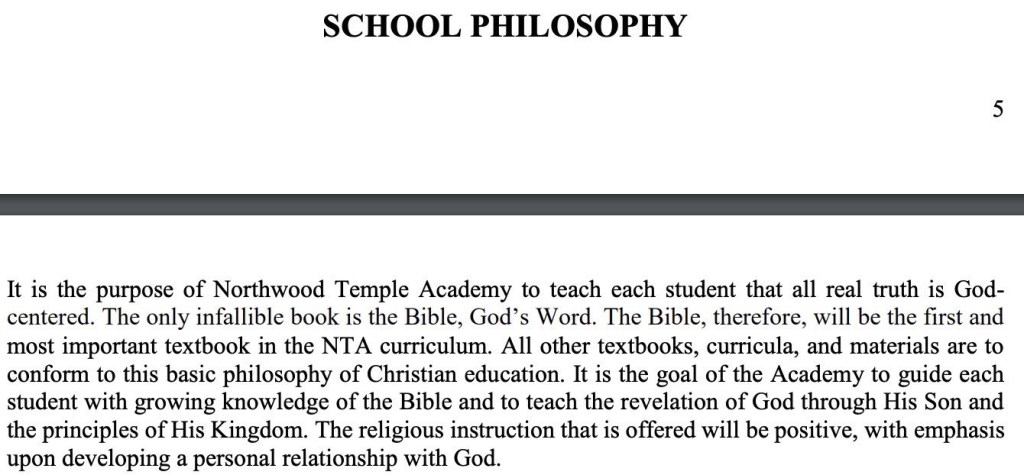
Justin Parmenter, NBCT teacher in North Carolina tweeted that the the state is funding Christian fundamentalist schools with vouchers. He identified on Christian school is not academics but devotion to the words of the Bible.

He tweeted:

Northwood Temple Academy in Fayetteville got more than $1.1 million in NC taxpayer voucher funds this year.

Their school philosophy is “The Bible, therefore, will be the first and most important textbook in the NTA curriculum.”

They should not get public $ #nced #ncga

A reader called Quickwrit posted this comment about the clear intent of the Founding Fathers. Based on the Constitution, the Federalist Papers, and their own writings, the Founding Fathers left no doubt about the role of religion in the new nation. They wanted the government neither to support it or to regulate it, and they wanted everyone to practice their religion without hindrance. They most certainly did not want a “Christian nation” or government subsidy of religion. These are the conditions required for freedom of religion.

Quickwrit wrote:

Freedom from religion

Right in the very First Amendment of our Constitution, our Founding Fathers outlawed religion in American government at any level. Founding Father Thomas Jefferson, primary author of our Declaration of Independence, explained that the Establishment Clause of the First Amendment was written to create “a wall of separation” between our government and any religion. The U.S. Supreme Court holds that the Establishment Clause means that “Neither a state nor the federal government can set up a church. Neither can pass laws which aid one religion or all religions, or prefer one religion over another. Neither can force…a person to go to or to remain away from church against his will or force him to profess a belief or disbelief in any religion.”

Our Founding Fathers also wrote in Article VI of our Constitution that “no religious test shall ever be required as a qualification to any office or public trust under the United States.”

In short, our Constitution was written to remove all religion from our government at any level, while also allowing citizens to practice any religion they want. ANY religion.

Our Founding Fathers refused to even include any mention of God in our Constitution.

Why did our Founding Fathers do this?

George Washington, Thomas Jefferson, Benjamin Franklin and other Founding Fathers and colonists everywhere hated the fact that they had been forced to join the official Christian religion of the British government, the Anglican Church. The penalty for not joining was that the church-controlled British colonial governments would tax their property to the point that would bankrupt them. Our Founding Fathers knew first-hand that a religion-based government led to persecution of anyone who did not share the beliefs of the official government religion. So, they constitutionally banned religion of any kind from every corner of our federal and state governments.

America’s key Founding Fathers — such as George Washington, Thomas Jefferson, and Benjamin Franklin — were NOT CHRISTIANS. They were DEISTS who had been forced to become members of a Christian church. They almost never even used the word “God” but instead used words like “Creator” or “Providence” to refer to what Deists consider to be the Supreme Being.

Thomas Jefferson, whom we honor as the author of our Declaration of Independence, was so greatly angered by the Christian claim that Jesus was God that Benjamin Franklin had to reel him in from publishing a scathing attack on Christianity. So, instead, Jefferson — who admired the social teachings of Jesus — sat down with a New Testament and cut out all references in it to Jesus being God. Then, he published the result as his Bible and it became popular throughout America. The Jefferson non-Christian social Bible also became the official Bible of Congress and for decades was given to each newly-elected member of Congress.

I learned to love the USA from a very young age. I was 7 when World War 2 ended, and I remember very well how patriotic everyone was. From my earliest years, I learned to love America because it provided a safe haven for my family at a time when the Jews of Europe were targeted for mass extinction.

I was brought up in the 1940s and 1950s when our public schools taught only about our goodness and greatness, while leaving out the shameful chapters of our history.

Today, we are challenged to believe that one can study those shameful chapters and still love your country. Today, too many politicians—notably Republicans—are censoring textbooks and banning library books, anything that students may read, to ensure that they never encounter the ugly parts of our history or anything that includes references to sex or gender identity. Our schools confront a multi-pronged assault built on racism, bigotry, prudishness, and fear of the Other.

Too many Republicans practice the politics of hate and division. Instead of talking about their plans to improve the economy, they use their time in the public eye to demonize the powerless.

My wish is that we could strive again towards the Founding Fathers’ ideals of freedom, reason, equality, justice, and respect for the right of others to dissent, to practice their own religion, to live as they wish within a context of laws. The Founders enunciated these ideals but did not live up to them. It’s up to us to reclaim their vision.

Our Founding Fathers did not want to create a Christian nation. There are several clauses in the Constitution assuring that no one would have to conform to a state-sponsored religion, no one would have to pass a religious test to qualify for office. Whatever your religion or if you practice no religion, the Constitution protects you.

And yet, today religious zealots speak as if the nation belongs to them. It doesn’t. It belongs to all of us.

The greatest threat to our democracy at this moment is the Supreme Court, which seems intent on reversing every precedent and returning the USA to a time before the New Deal, when the government did not actively protect anyone’s rights. It is beyond my understanding that this Court ruled that one’s sincere religious views—no matter how hateful—gives you license to be a bigot.

Our ability to thrive as a nation depends on our ability to work with and value people who are not the same as us. We may be the most diverse people in the world. We cannot succeed unless everyone believes that this is their nation too and that they too can have a fulfilling life regardless of where they came from and when they arrived.

Whether we can keep our democracy rests on our shoulders. Trump and his passionate base have done their best to undermine the pillars of our democracy by questioning the legitimacy of any election they lose, by insulting the rule of law, and by assailing the free press.

The strength of our democracy depends on all of us to get involved. Join an organization that defends our rights and freedoms. Encourage others to do the same. Run for office. Democracy is not a spectator sport. 2024 may be an election that determines our future. Take action.