Archives for category: Propaganda

NPR released a new poll showing that, despite the loud mouths attacking public schools, most parents like their public schools and teachers.

They like their schools despite the hundreds of millions, if not billions, invested in promoting school choice, charter schools, vouchers, and privatization.

This poll suggests that Democrats should go after people like Ron DeSantis and other politicians trying to harm a civic institution that most Americans, both Democrats and Republicans, appreciate.

Conservatives used to be known as people resistant to radical change. In decades past, conservatives sought to conserve traditional institutions and make them better. That stance appealed to many Americans who were unsettled by radical ideas, opposed to big-box stores that would wipe out small-town America’s Main Street. Conservatives were also known for opposing government intrusion into personal decisions; what you did in your bedroom was your business, not the state’s. What you and your doctor decided was best for you was your decision, not the state’s.

Chris Rufo is the face of the New Conservatism, who wants to frighten the parents of America into tearing down traditional institutions, especially the public school that they and their family attended.

Rufo became well-known for creating a national panic about “critical race theory,” which he can’t define and doesn’t understand. But he seems to think that schools are controlled by racist pedagogues and sexual perverts. In his facile presentation at Hillsdale College, one of the most conservative institutions of higher education in the nation, he makes clear that America has fallen from its position as a great and holy nation to a slimepit of moral corruption.

He has two great Satans in his story: public schools and the Disney Corporation. The Disney Corporation, in his simple mind, is a haven for perverts and pedophiles, bent on corrupting the youth of the nation.

Rufo asserts, based on no discernible evidence, that the decline and fall of America can be traced to the failed revolution of 1968. The radicals lost, as Nixon was elected that year, but burrowed into the pedagogical and cultural institutions, quietly insinuating their sinister ideas about race and sex into the mainstream, as the nation slept. Rufo’s writings about “critical race theory,” which he claims is embedded in schools, diversity training in corporations, and everywhere else he looked, made him a star on Tucker Carlson’s show, an advisor to the Trump White House, and a fellow at the conservative Manhattan Institute. Benjamin Wallace-Wells wrote a profile of Rufo in The New Yorker and identified him as the man who invented the conflict over critical race theory, which before Rufo was a topic for discussion in law schools.

Before Rufo’s demonization of CRT, it was known among legal scholars as a debate about whether racism was fading away or whether it was systemic because it was structured into law and public policy. I had the personal pleasure of discussing these ideas in the mid-1980s with Derrick Bell, who is generally recognized as the founder of CRT. Bell was then at the Harvard Law School, after working as a lawyer for the NAACP Legal Defense Fund. He reached the conclusion that the Brown Decision of 1954 was inadequate to root out systematic racism.

At the time, I was a centrist in my politics and believed that racism was on its way out. Derrick disagreed. We spoke for hours, he invited me to present a paper at a conference he was organizing, which I did. Contrary to Rufo, I can attest that Derrick Bell was not a Marxist. He was not a radical. He wanted an America where people of different races and backgrounds had decent lives, unmarred by racial barriers. He was thoughtful, gentle, one of the kindest people I’ve ever known. He wanted America to be the land it professed to be. He was a great American.

Was 1968 the turning point, after which the radicals took over our culture and destroyed our founding ideals, as Rufo claims? No, it was not. I was there. He was born in 1984. He’s blowing smoke, making up a fairy-tale that he has spun into a narrative.

In 1968, I turned 30. I had very young children. I was not sympathetic to the hippies or the Weather Underground or the SDS. I hated the Vietnam War, but I was not part of any organized anti-war group. I believed in America and its institutions, and I was firmly opposed to those who wanted to tear them down, as the Left did then and as the Right does now. I worked in the Humphrey campaign in 1968 and organized an event in Manhattan—featuring John Kenneth Galbraith, Arthur Schlesinger Jr., and a long lineup of “liberals for Humphrey”— that was disrupted and ruined by pro-Vietnam Cong activists. That event, on the eve of the 1968 election, convinced me that Nixon would win. (While my event was disrupted, Nixon held a campaign rally a block away, at Madison Square Garden, that was not disrupted.)

1968 was the year that Dr. Martin Luther King, Jr. and Robert Kennedy were assassinated. It was a horrible, depressing year. America seemed to be falling apart.

Did the Weathermen and other radicals begin a long march through the institutions and eventually capture them? That’s ridiculous. Some became professors, but none became college presidents, to my knowledge. Many were ostracized. Some went to prison for violent crimes. Those who played an active political role in 1968 are in their 80s now, if they are alive.

Rufo’s solution to what he sees as the capture of our institutions by racists and pedophiles is surpringly simple: school choice. He hopes everyone will get public money to send their children to private and religious schools, to charter schools, or to home school them. If only we can destroy public schools, he suggests, we can restore America to the values of 1776.

Good old 1776, when most black people were slaves, women had no rights, and the aristocracy made all the decisions. They even enjoyed conjugal rights to use their young female slaves. Those were the good old days, in the very simple mind of Christopher Rufo.

Turning the clock back almost 250 years! Now that’s a radical idea.

There is a sort of hysteria about transgender people that has gripped the minds of (mostly) Republican legislators. They claim that teachers are “grooming” children to be gay or transgender. We used to think of the word “groom” to refer to a male who was getting married and the word “grooming” as a description of one’s manner of dress (“good grooming” or “bad grooming”). Now the word has a sinister connotation, as rightwing zealots like Christopher Rufo and Moms for Liberty accuse the nation’s teachers of conspiring to turn their students gay or transgender.

The Williams Institute at the School of Law at UCLA developed an estimate of the number of transgender people in the U.S. population. The estimate is that transgender people are 0.06%, or about 1.4 million people. Unless my math is off, that is six people out of every 10,000 people identify as transgender.

I have not seen any evidence that children were turned gay or transgender because of what their teachers did in school. It seems to be a decision that is never taken easily or lightly because there is so much social opprobrium attached to being transgender.

The issue has been dormant until recently, when a transgender woman (formerly male) swimmer won national competitions. So, now, the issue has become a matter of “protecting women’s sports.” No one worries about a transgender man (formerly female) competing in men’s sports, but they believe that a transgender woman has biological advantages that make the competition unfair.

I won’t share my views because frankly I am conflicted. The only thing I can say with conviction is that a problem that affects a very tiny number of people has been cynically turned into a culture war issue.

Stephanie Saul is a crack investigative reporter at the New York Times. In this story, she took a close look at Tennessee Governor Bill Lee’s request to ultra conservative Hillsdale College to open 50 charter schools in Tennessee.

She begins:

With only 1,500 students on a small-town campus in southern Michigan, Hillsdale College is far from the power corridors of government and top-ranked universities.

But it has outsize influence in the conservative world, with strong ties to the Washington elite. Republican leaders frequently visit, and Justice Clarence Thomas delivered the 2016 commencement address, calling Hillsdale a “shining city on a hill” for its devotion to “liberty as an antecedent of government, not a benefit from government.”

Now the college is making new efforts to reach beyond its campus, this time with an even younger audience. The college is fighting what it calls “progressive” and “leftist academics” by expanding its footprint in the charter school world, pushing the boundaries on the use of taxpayer money for politically tinged education.

Hillsdale has ambitious plans to add to its network of classical public charter schools, which focus on “the centrality of the Western tradition.” And Gov. Bill Lee of Tennessee recently invited the college to start 50 schools using public funds, including $32 million set aside for charter facilities. Hillsdale’s network currently includes 24 schools in 13 states.

Mr. Lee, a Republican, sees his new charter school expansion as part of an effort to develop what he called “informed patriotism” in Tennessee students.

“For decades, Hillsdale College has been the standard-bearer in quality curriculum and in the responsibility of preserving American liberty,” Mr. Lee told lawmakers recently. “I believe their efforts are a good fit for Tennessee.”

Charter schools, which are publicly funded but privately run, have been more commonly promoted as alternatives to low-performing schools in urban centers. In Tennessee, they have been clustered in the state’s four biggest cities, where like other charters, they have been criticized for siphoning money and students out of more traditional public schools.

Mr. Lee’s plan envisions an expansion into suburban and rural areas where, like many Hillsdale charter schools, they would most likely enroll children who are whiter and more affluent than the average charter school pupil.

In that way, the Hillsdale schools could be something of a publicly funded off-ramp for conservative parents who think their local schools misinterpret history and push a socially progressive agenda on issues from race and diversity to sexuality and gender.

The college has also developed the “1776 Curriculum,” which sets out to portray America as “an exceptionally good country.” During a time when education has become inflamed by divisive cultural debates, Hillsdale has been criticized for its glossy spin on American history as well as its ideological tilt on topics like affirmative action. Educators and historians have also raised questions about other instruction at Hillsdale’s charter schools, citing their negative take on the New Deal and the Great Society and cursory presentation of global warming.

In that way, the Hillsdale schools could be something of a publicly funded off-ramp for conservative parents who think their local schools misinterpret history and push a socially progressive agenda on issues from race and diversity to sexuality and gender.

“I’ve been following charter schools over the last 25 years, and I’ve never seen a governor attempting to use charters in such an overtly political way,” said Bruce Fuller, a professor of education and public policy at the University of California, Berkeley. “You’ve had governors who’ve encouraged the growth of charters to provide more high-quality options for parents, but it’s highly unusual to see a governor deploy the charter mechanism for admittedly political purposes.”

The article goes on at length to describe the Hillsdale curriculum, which is politically conservative , and the demographics of its charter schools, which are disproportionately white.

She adds:

The students [at Atlanta Classical Academy] are selected through a citywide lottery, but the school’s location in affluent Buckhead may deter some applicants. In a city where 73 percent of public school students are Black and 17 percent white, Atlanta Classical Academy is the mirror image: 17 percent Black and 71 percent white, according to a 2020 state report.

Overall, Hillsdale’s charter school racial demographics are close to that of the Atlanta Classical students. That is a departure from charter schools nationally, which are about 30 percent white.

“They’re catering to white families and affluent families,” said Charisse Gulosino, an associate professor of leadership and policy studies at the University of Memphis, whose research has found that students in suburban charter schools do not outperform their public school counterparts.

Not all of Hillsdale’s charter school collaborations have been successful. Hillsdale recently announced it is ending ties with Tallahassee Classical School in Florida.

The school, approved by the state despite local opposition, set out to serve a diverse student body. But two teachers interviewed by The Times said they suspected that the school was trying to jettison low-performing students, a tactic that charter schools have been accused of as a way to increase test scores.

Try to find the full story. It shows how unregulated charter schools can be turned into white flight academies teaching a Trumpian version of history and science.

IZABELLA TABAROVSKY AND EUGENE FINKEL

Statement on Ukraine by scholars of genocide, Nazism and WWII

At this fateful moment we stand united with free, independent and democratic Ukraine and strongly reject the Russian government’s misuse of history to justify its own violence.

(February 28, 2022 / Jewish Journal) As we write this, the horror of war is unfolding in Ukraine. The last time Kyiv was under heavy artillery fire and saw tanks in its streets was during World War II. If anyone should know it, it’s Russian President Vladimir Putin, who is obsessed with the history of that war.

Russian propaganda has painted the Ukrainian state as Nazi and fascist ever since Russian special forces first entered Ukraine in 2014, annexing the Crimea and fomenting the conflict in the Donbas, which has smoldered for eight long years.

It was propaganda in 2014. It remains propaganda today.

This is why we came together: to protest the use of this false and destructive narrative. Among those who have signed the statement below are some of the most accomplished and celebrated scholars of World War II, Nazism, genocide and the Holocaust. If you are a scholar of this history, please consider adding your name to the list. If you are a journalist, you now have a list of experts you can turn to in order to help your readers better understand Russia’s war against Ukraine.

And if you are a consumer of the news, please share the message of this letter widely. There is no Nazi government for Moscow to root out in Kyiv. There has been no genocide of the Russian people in Ukraine. And Russian troops are not on a liberation mission. After the bloody 20th century, we should all have built enough discernment to know that war is not peace, slavery is not freedom and ignorance offers strength only to autocratic megalomaniacs who seek to exploit it for their personal agendas.

Statement by scholars of genocide, Nazism and World War II

Since Feb. 24, 2022, the armed forces of the Russian Federation have been engaged in an unprovoked military aggression against Ukraine. The attack is a continuation of Russia’s annexation of the Crimean peninsula in 2014 and its heavy involvement in the armed conflict in the Donbas region.

The Russian attack came in the wake of accusations by the Russian president, Vladimir Putin, of crimes against humanity and genocide, allegedly committed by the Ukrainian government in the Donbas. Russian propaganda regularly presents the elected leaders of Ukraine as Nazis and fascists oppressing the local ethnic Russian population, which it claims needs to be liberated. President Putin stated that one of the goals of his “special military operation” against Ukraine is the “denazification” of the country.

We are scholars of genocide, the Holocaust and World War II. We spend our careers studying fascism and Nazism, and commemorating their victims. Many of us are actively engaged in combating contemporary heirs to these evil regimes and those who attempt to deny or cast a veil over their crimes.

We strongly reject the Russian government’s cynical abuse of the term genocide, the memory of World War II and the Holocaust, and the equation of the Ukrainian state with the Nazi regime to justify its unprovoked aggression. This rhetoric is factually wrong, morally repugnant and deeply offensive to the memory of millions of victims of Nazism and those who courageously fought against it, including Russian and Ukrainian soldiers of the Red Army.

We do not idealize the Ukrainian state and society. Like any other country, it has right-wing extremists and violent xenophobic groups. Ukraine also ought to better confront the darker chapters of its painful and complicated history. Yet none of this justifies the Russian aggression and the gross mischaracterization of Ukraine. At this fateful moment we stand united with free, independent and democratic Ukraine and strongly reject the Russian government’s misuse of the history of World War II to justify its own violence.

Signatories:

Eugene Finkel, Johns Hopkins University

Izabella Tabarovsky, Washington D.C.

Aliza Luft, University of California-Los Angeles

Teresa Walch, University of North Carolina at Greensboro

Jared McBride, University of California-Los Angeles

Elissa Bemporad, Queens College and CUNY Graduate Center

Andrea Ruggeri, University of Oxford

Steven Seegel, University of Texas at Austin

Jeffrey Kopstein, University of California, Irvine

Francine Hirsch, University of Wisconsin-Madison

Anna Hájková, University of Warwick

Omer Bartov, Brown University

Barbara Kirshenblatt-Gimblett, New York University and POLIN Museum of the History of Polish Jews

Christoph Dieckmann, Frankfurt am Main

Cary Nelson, University of Illinois at Urbana-Champaign

Waitman Wade Beorn, Northumbria University

Jeffrey Herf, University of Maryland

Timothy Snyder, Yale University

Jeffrey Veidlinger, University of Michigan

Hana Kubátová, Charles University

Leslie Waters, University of Texas at El Paso

Norman J.W. Goda, University of Florida

Jazmine Conteras, Goucher College

Laura J. Hilton, Muskingum University

Katarzyna Person, Jewish Historical Institute, Warsaw

Tarik Cyril Amar, Koc University

Sarah Grandke, Neuengamme Concentration Camp Memorial/denk.mal Hannoverscher Bahnhof Hamburg

Jonathan Leader Maynard, King’s College London

Chad Gibbs, College of Charleston

Janine Holc, Loyola University Maryland

Erin Hochman, Southern Methodist University

Edin Hajdarpasic, Loyola University Chicago

David Hirsh, Goldsmiths, University of London

Richard Breitman, American University (Emeritus)

Astrid M. Eckert, Emory University

Anna Holian, Arizona State University

Uma Kumar, University of British Columbia

Frances Tanzer, Clark University

Victoria J. Barnett, US Holocaust Memorial Museum (retired)

David Seymour, City University of London

Jeff Jones, University of North Carolina at Greensboro

András Riedlmayer Harvard University (retired)

Polly Zavadivker, University of Delaware

Aviel Roshwald, Georgetown University

Anne E. Parsons, University of North Carolina at Greensboro

Carole Lemee, Bordeaux University

Scott Denham, Davidson College

Emanuela Grama, Carnegie Mellon University

Christopher R. Browning, University of North Carolina at Chapel Hill (emeritus)

Katrin Paehler, Illinois State University

Raphael Utz, Deutsches Historisches Museum Berlin

Emre Sencer, Knox College

Stefan Ihrig, University of Haifa

Jeff Rutherford, Xavier University

Jason Hall, The University of Haifa

Christian Ingrao, CNRS École des Hautes Études en Sciences Sociales, CESPRA Paris

Hannah Wilson, Nottingham Trent University

Jan Lanicek, University of New South Wales

Edward B. Westermann, Texas A&M University-San Antonio

Maris Rowe-McCulloch, University of Regina

Joanna B. Michlic, University College London

Raul Carstocea, Maynooth University

Dieter Steinert, University of Wolverhampton

Christina Morina, Universität Bielefeld

Abbey Steele, University of Amsterdam

Erika Hughes, University of Portsmouth

Lukasz Krzyzanowski, University of Warsaw

Agnieszka Wierzcholska, German Historical Institute, Paris

Martin Cüppers, University of Stuttgart

Matthew Kupfer, Organized Crime and Corruption Reporting Project

Martin Kragh, Uppsala University

Umit Kurt, Van Leer Institute, Jerusalem

Meron Mendel, Frankfurt University of Applied Science, Anne Frank Center Frankfurt

Nazan Maksudyan, FU Berlin / Centre Marc Bloch

Emanuel-Marius Grec, University of Heidelberg

Khatchig Mouradian, Columbia University

Jan Zbigniew Grabowski, University of Ottawa

Dirk Moses, University of North Carolina, Chapel Hill

Amos Goldberg, Hebrew University of Jerusalem

Amber N. Nickell, Fort Hays State University

Tatjana Tönsmeyer, Wuppertal University

Thomas Kühne, Clark University

Thomas Pegelow Kaplan, Appalachian State University

Amos Morris-Reich, Tel Aviv University

Volha Charnysh, Massachusetts Institute of Technology

Stefan Cristian Ionescu, Northwestern University

Donatello Aramini, Sapienza University, Rome

Ofer Ashkenazi, The Hebrew University of Jerusalem

Roland Clark, University of Liverpool

Mirjam Zadoff, University of Munich & Munich Documentation Centre for the History of National Socialism

John Barruzza, Syracuse University

Cristina A. Bejan, Metropolitan State University of Denver

Isabel Sawkins, University of Exeter

Benjamin Nathans, University of Pennsylvania

Norbert Frei, University of Jena

Stéfanie Prezioso, Université de Lausanne

Olindo De Napoli, Università degli Studi di Napoli Federico II

Eli Nathans, Western University

Eugenia Mihalcea, University of Haifa

Rebekah Klein-Pejšová, Purdue University

Sergei I. Zhuk, Ball State University

Paola S. Salvatori, Scuola Normale Superiore di Pisa – Università degli Studi Roma Tre

Antonio Ferrara, Independent Scholar

Verena Meier, Forschungsstelle Antiziganismus, Ruprecht-Karls-Universität Heidelberg

Frédéric Bonnesoeur, Zentrum für Antisemitismusforschung, TU Berlin

Sara Halpern, St. Olaf College

Irina Nastasa-Matei, University of Bucharest

Michal Aharony, University of Haifa

Michele Sarfatti, Fondazione CDEC Milano

Frank Schumacher, The University of Western Ontario

Thomas Weber, University of Aberdeen

Elizabeth Drummond, Loyola Marymount University

Jennifer Evans, Carleton University

Sayantani Jana, University of Southern California

Gavriel D. Rosenfeld, Fairfield University

Snježana Koren, University of Zagreb

Brunello Mantelli, University of Turin and University of Calabria

Carl Müller-Crepon, University of Oxford

Grzegorz Rossolinski-Liebe, Freie Universität Berlin

Amy Sjoquist, Northwest University

Sebastian Vîrtosu, Universitatea Națională de Arte “G. Enescu”

Stanislao G. Pugliese, Hofstra University

Ronald Grigor Suny, University of Michigan

Antoinette Saxer, University of York

Alon Confino, University of Massachusetts, Amherst

Corry Guttstadt, University of Hamburg

Vadim Altskan, US Holocaust Memorial Museum

Evan B. Bukey, University of Arkansas

Elliot Y Neaman, University of San Francisco

Rebecca Wittmann, University of Toronto Mississauga

Benjamin Rifkin, Hofstra University

Vladimir Tismaneanu, University of Maryland

Walter Reich, George Washington University

Jay Geller, Case Western Reserve University

Atina Grossmann, Cooper Union

Francesco Zavatti, Södertörn University

Eliyana R. Adler, The Pennsylvania State University

Laura María Niewöhner, Bielefeld University

Elena Amaya, University of California-Berkeley

Markus Roth, Fritz Bauer Institut, Frankfurt

Brandon Bloch, University of Wisconsin-Madison

Monica Osborne, The Jewish Journal

Benjamin Hett, Hunter College and the Graduate Center, CUNY

Volker Weiß, Independent Scholar

Manuela Consonni, The Hebrew University of Jerusalem

Svetlana Suveica, University of Regensburg

Izabella Tabarovsky is a researcher with the Wilson Center’s Kennan Institute, focusing on the politics of historical memory in the former Soviet Union.

Evgeny Finkel is a political scientist and historian at Johns Hopkins University.

This article was first published by the Jewish Journal.
Posted on Twitter by @Ve10Ve_Ghost

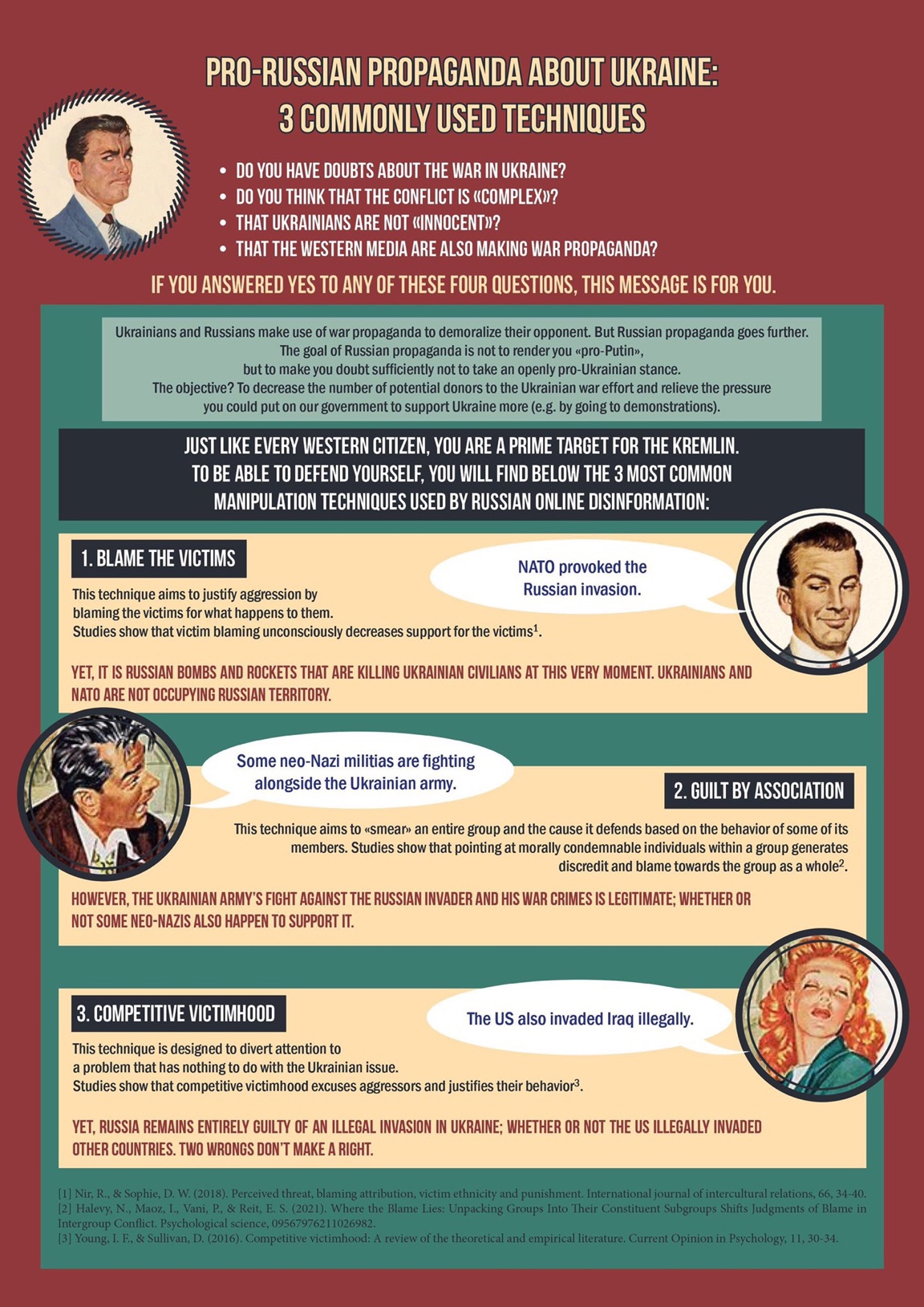
NBC News debunks the conspiracy theorists who have claimed that Russia invaded Ukraine to eliminate biolabs funded by the United States. The main promoters of this claim are QAnon, Tucker Carlson, and the Russian propaganda machine.

It begins:

Russia’s early struggles to push disinformation and propaganda about Ukraine have picked up momentum in recent days, thanks to a variety of debunked conspiracy theories about biological research labs in Ukraine. Much of the false information is flourishing in Russian social media, far-right online spaces and U.S. conservative media, including Tucker Carlson’s show on Fox News.

The theories, which have been boosted by Russian and Chinese officials, come as U.S. officials warn that Russia could be preparing a chemical or biological weapons attack of its own in Ukraine.

Most of the conspiracy theories claim that the U.S. was developing and plotting to release a bioweapon or potentially another coronavirus from “biolabs”’ throughout Ukraine and that Russia invaded to take over the labs. Many of the theories implicate people who are often the targets of far-right conspiracy thinking — including Dr. Anthony Fauci and President Joe Biden — as being behind creating the weaponized diseases in the biolabs.

Disinformation experts said the biolabs theory echoes other Russian propaganda meant to justify its military efforts, which often makes allegations against other countries and populations that reflect similar attacks it plans to make.

Question: If this was the Russian goal, why are they also bombing apartment houses, maternity hospitals, schools, and residential areas? Is all of Ukraine one giant biolab?

Robert Mackey writes in The Intercept that Tucker Carlson and Tulsi Gabbard have become favorites on Russian state television because they praise Putin. The Putin regime loves FOX News.

Carlson’s attacks on Biden and the American government thrills the Russian propagandists.

“These people are so ghoulish,” Carlson said of U.S. officials who provided military aid to Ukraine. “Of course they’re promoting war,” Carlson continued, as his comments were translated into Russian, “not to maintain the democracy that is Ukraine. Ukraine is not a democracy. It has never been a democracy in its history, and it’s not now. It’s a client state of the Biden administration…”

On Wednesday night, just hours before Putin ordered the attack on Ukraine to begin, two excerpts from Carlson’s most recent program were featured in Russian state television’s 8 p.m. and 9 p.m. news broadcasts.

Carlson had started his show Tuesday night with a sarcastic monologue in which he told viewers: “Democrats in Washington have told you it’s your patriotic duty to hate Vladimir Putin. It’s not a suggestion. It’s a mandate. Anything less than hatred for Putin is treason. Many Americans have obeyed this directive. They now dutifully hate Vladimir Putin. Maybe you’re one of them. Hating Putin has become the central purpose of America’s foreign policy. It’s the main thing that we talk about. Entire cable channels are now devoted to it. Very soon, that hatred of Vladimir Putin could bring the United States into a conflict in Eastern Europe.”

Carlson’s comments were so welcome in Moscow that an excerpt from that rant with Russian subtitles was quickly produced by the Russian-language service of RT, the government-funded network formerly known as Russia Today…

Like Carlson, Gabbard sought to blame the U.S. and NATO for supposedly provoking Putin’s attack on Ukraine and suggested that Americans would suffer from higher energy prices if Russia was sanctioned for invading Ukraine…

On Thursday, after Russia launched its military assault on Ukraine, Gabbard posted the video of her comments about sanctions on Twitter and suggested, without evidence, that doing anything to press Putin to stop the invasion of Ukraine could lead to a nuclear war.

Gabbard has transitioned from being a Democratic candidate for President to being a speaker at the Trump-loving Conservative Political Actuon Conference (CPAC).

Rolling Stone wrote about her transformation:

Tulsi Gabbard, the former Hawaii congresswoman who sought the 2020 Democratic nomination for president, is completing her metamorphosis from iconoclast progressive to hardcore conservative by appearing as a featured guest at the Trumpy love-in known as the Conservative Political Action Conference.

CPAC 2022 begins Wednesday in Orlando, where Gabbard will join a roster of GOP loyalists — including Florida Gov. Ron DeSantis, Republican senators Ted Cruz, Rick Scott and Marco Rubio, and Representatives Matt Gaetz, Jim Jordan, Lauren Boebert, Madison Cawthorn and Marjorie Taylor Greene — in building buzz for the star of the circus, former President Donald Trump.

According to the conference agenda, Gabbard will appear at the Friday night “Ronald Reagan Dinner,” where the keynote speaker is the former Fox News star conspiracy theorist Glenn Beck.

Quislings.

Jill Underly is the state superintendent of education in Wisconsin. In this article, she responds to the demands in red states for “parent rights,” which is usually premised on the belief that teachers are “indoctrinating” their students and can’t be trusted.

Superintendent Underly writes:

Dr. Jill Underly is the Wisconsin State Superintendent, and she offers thoughts to parents and teachers facing the current attacks by legislators.

Like you, I know what it means to be involved with my children’s education, and I love it.

But I look at the way politicians talk about parental involvement, and I don’t recognize it. Family engagement isn’t about yelling at school staff or suing your school board if they don’t do exactly as you demand.

It’s also not asking caregivers to homeschool or pay for private tuition if they feel unheard or unseen.

Family engagement is about having a real conversation about – and with – our children.

Like you, I build relationships with my children’s teachers, I reach out when I need to, and they know they can call if they need to.

As a parent, I love my children’s school, and I see the ways our district works to involve all families and the entire community, and how the entire community supports our school.

It’s an exchange, because what matters most to all of us is what we all have in common: our children.

Of course, this isn’t what politicians mean when they talk about protecting parental rights when it comes to children’s education. Rather, they’re talking about micromanaging curriculum and preying on our parental emotions during a traumatic time, all with the ulterior motive of placing suspicion on educators by weaponizing lessons about difficult topics, or by placing blame on schools for a pandemic they did not cause but are nonetheless supporting our children through.

As to my fellow educators, you and I all know that this isn’t the first time that politicians in this state have gone after teachers.

And as a former civics teacher, I know that teaching the history of this nation cannot – and should not – be done without tackling difficult topics.

Families know this and support these opportunities for our schools to engage our children to become critical thinkers and critical consumers of information. We want our students to grow up and be active participants in democracy, and that means they need to know how to examine their past, think critically about their present, and make informed decisions about their future.

I’m tired.

Like you, I’m tired of the pandemic. I’m getting tired of this winter. And I’m really, really tired of politicians pitting parents against teachers when our children are the ones who get hurt in the end.

Because they’re the ones who matter most in this conversation and who matter most for the future of our state. And that conversation – how to best meet the needs of our children and students – is one I’m excited to continue having as a parent and an educator, and to lead as your Wisconsin State Superintendent.

Read the full letter here.

Katherine Stewart has been writing for years about Christian nationalism and its pernicious influence on American society, especially public schools. Her latest book is The Power Worshippers: Inside the Dangerous World of Religious Nationalists.

She wrote this article about the January 6 insurrection for The New York Times:

The most serious attempt to overthrow the American constitutional system since the Civil War would not have been feasible without the influence of America’s Christian nationalist movement. One year later, the movement seems to have learned a lesson: If it tries harder next time, it may well succeed in making the promise of American democracy a relic of the past.

Christian nationalist symbolism was all over the events of Jan. 6, as observers have pointed out. But the movement’s contribution to the effort to overturn the 2020 election and install an unelected president goes much deeper than the activities of a few of its representatives on the day that marks the unsuccessful end (or at least a temporary setback) of an attempted coup.

A critical precondition for Donald Trump’s attempt to retain the presidency against the will of the people was the cultivation of a substantial population of voters prepared to believe his fraudulent claim that the election was stolen — a line of argument Mr. Trump began preparing well before the election, at the first presidential debate.

The role of social and right-wing media in priming the base for the claim that the election was fraudulent is by now well understood. The role of the faith-based messaging sphere is less well appreciated. Pastors, congregations and the religious media are among the most trusted sources of information for many voters. Christian nationalist leaders have established richly funded national organizations and initiatives to exploit this fact. The repeated message that they sought to deliver through these channels is that outside sources of information are simply not credible. The creation of an information bubble, impervious to correction, was the first prerequisite of Mr. Trump’s claim.

The coup attempt also would not have been possible without the unshakable sense of persecution that movement leaders have cultivated among the same base of voters. Christian nationalism today begins with the conviction that conservative Christians are the most oppressed group in American society. Among leaders of the movement, it is a matter of routine to hear talk that they are engaged in a “battle against tyranny,” and that the Bible may soon be outlawed.

A final precondition for the coup attempt was the belief, among the target population, that the legitimacy of the United States government derives from its commitment to a particular religious and cultural heritage, and not from its democratic form. It is astonishing to many that the leaders of the Jan. 6 attack on the constitutional electoral process styled themselves as “patriots.” But it makes a glimmer of sense once you understand that their allegiance is to a belief in blood, earth and religion, rather than to the mere idea of a government “of the people, by the people, for the people.”

Given the movement’s role in laying the groundwork for the coup attempt, its leaders faced a quandary when Mr. Trump began to push his repeatedly disproven claims — and that quandary turned into a test of character on Jan. 6. Would they go along with an attempt to overthrow America’s democratic system?

Some attempted to rewrite the facts about Jan. 6. The former Republican Representative Michele Bachmann suggested the riot was the work of “paid rabble rousers,” while the activist and author Lance Wallnau, who has praised Mr. Trump as “God’s chaos candidate,” blamed “the local antifa mob.” Many leaders, like Charlie Kirk, appeared to endorse Mr. Trump’s claims about a fraudulent election. Others, like Michael Farris, president and chief executive of the religious right legal advocacy group Alliance Defending Freedom, provided indirect but no less valuable support by concern-trolling about supposed “constitutional irregularities” in battleground states.

None appeared willing to condemn Mr. Trump for organizing an attempt to prevent the peaceful transfer of power to President-elect Joe Biden. On the contrary, the Rev. Franklin Graham, writing on Facebook, condemned “these ten” from Mr. Trump’s “own party” who voted to impeach him and mused, “It makes you wonder what the thirty pieces of silver were that Speaker Pelosi promised for this betrayal.”

At Christian nationalist conferences I have been reporting on, I have heard speakers go out of their way to defend and even lionize the Jan. 6 insurrectionists. At the Road to Majority conference, which was held in Central Florida in June 2021, the author and radio host Eric Metaxas said, “The reason I think we are being so persecuted, why the Jan. 6 folks are being persecuted, when you’re over the target like that, oh my.” At that same conference, the political commentator Dinesh D’Souza, in conversation with the religious right strategist Ralph Reed, said, “The people who are really getting shafted right now are the Jan. 6 protesters,” before adding, “We won’t defend our guys even when they’re good guys.” Mr. Reed nodded in response and replied, “I think Donald Trump taught our movement a lot.”

Movement leaders now appear to be working to prime the base for the next attempt to subvert the electoral process. At dozens of conservative churches in swing states this past year, groups of pastors were treated to presentations by an initiative called Faith Wins. Featuring speakers like David Barton, a key figure in the fabrication of Christian nationalist myths about history, and led by Chad Connelly, a Republican political veteran, Faith Wins serves up elections skepticism while demanding that pastors mobilize their flocks to vote “biblical” values. “Every pastor you know needs to make sure 100 percent of the people in their pews are voting, and voting biblical values,” Mr. Connelly told the assembled pastors at a Faith Wins event in Chantilly, Va. in September.

“The church is not a cruise ship, the church is a battleship,” added Byron Foxx, an evangelist touring with Faith Wins. The Faith Wins team also had at its side Hogan Gidley, a deputy press secretary in the Trump White House, who now runs the Center for Election Integrity, an initiative of the America First Policy Institute, a group led in part by former members of the Trump administration. Mr. Gidley informed the gathering that his group is “nonpartisan” — and then went on to mention that in the last election cycle there were “A lot of rogue secretaries of state, a lot of rogue governors.”

He was presumably referring to Brad Raffensperger, the Republican secretary of state of Georgia who earned the ire of Trumpists by rebuffing the former president’s request to find him an additional 11,780 votes. “You saw the stuff in Arizona, you’re going to see more stuff in Wisconsin, these are significant issues, and we can’t be dismissed out of hand anymore, the facts are too glaring,” Mr. Gidley said. In fact, the Republican-backed audit of votes in Arizona’s largest county confirmed that President Biden won Arizona by more votes than previously thought. But the persecution narrative is too politically useful to discard simply because it’s not true.

Even as movement leaders are preparing for a possible restoration of a Trumpist regime — a period they continue to regard as a golden age in retrospect — they are advancing in parallel on closely related fronts. Among the most important of these has to do with public education.

In the panic arising out of the claim that America’s schools are indoctrinating young children in critical race theory, or C.R.T., it isn’t hard to detect the ritualized workings of the same information bubble, persecution complex and sense of entitlement that powered the coup attempt. Whatever you make of the new efforts in state legislatures to impose new “anti-C.R.T.” restrictions on speech and teaching in public schools, the more important consequence is to extend the religious right’s longstanding program to undermine confidence in public education, an effort that religious right leaders see as essential both for the movement’s long-term funding prospects and for its antidemocratic agenda.

Opposition to public education is part of the DNA of America’s religious right. The movement came together in the 1970s not solely around abortion politics, as later mythmakers would have it, but around the outrage of the I.R.S. threatening to take away the tax-exempt status of church-led “segregation academies.” In 1979, Jerry Falwell said he hoped to see the day when there wouldn’t be “any public schools — the churches will have taken them over again and Christians will be running them.”

Today, movement leaders have their eye on the approximately $700 billion that federal, state, and local governments spend yearly on education. The case of Carson v. Makin, which is before the Supreme Court this term and involves a challenge, in Maine, to prohibitions on using state tuition aid to attend religious schools, could force taxpayers to fund sectarian schools no matter how discriminatory their policies or fanatical their teachings. The endgame is to get a chunk of this money with the help either of state legislatures or the Supreme Court, which in its current configuration might well be convinced that religious schools have a right to taxpayer funds.

This longstanding anti-public school agenda is the driving force behind the movement’s effort to orchestrate the anti-C.R.T. campaign. The small explosions of hate detonating in public school boards across the nation are not entirely coming from the grass roots up. The Family Research Council, a Washington, D.C.-based Christian right policy group, recently held an online School Board Boot Camp, a four-hour training session providing instruction on how to run for school boards and against C.R.T. and to recruit others to do so. The Bradley Foundation, Heritage Action for America, and The Manhattan Institute are among those providing support for groups on the forefront of the latest public school culture wars.

A decade ago, the radical aims at the ideological core of the Christian nationalist movement were there to see for anybody who looked. Not many bothered to look, and those who did were often dismissed as alarmist. More important, most Republican Party leaders at the time distanced themselves from theocratic extremists. They avoided the rhetoric of Seven Mountains dominionism, an ideology that calls explicitly for the domination of the seven “peaks” of modern civilization (including government and education) by Christians of the correct, supposedly biblical variety.

What a difference a decade makes. National organizations like the Faith & Freedom Coalition and the Ziklag Group, which bring together prominent Republican leaders with donors and religious right activists, feature “Seven Mountains” workshops and panels at their gatherings. Nationalist leaders and their political dependents in the Republican Party now state quite openly what before they whispered to one another over their prayer breakfasts. Whether the public will take notice remains to be seen.