Archives for category: Privatization

Colorado voters, beware! On the November 5 ballot: an amendment to the State Constitution to protect school choice.

If you want to support public schools and a raid on the state’s treasury by privatizers, defeat it!

This proposed amendment is weird. Ever since the founding of this nation, states have had explicit pledges in their constitution to protect public schools, open to all. Colorado’s state Constitution includes such language as well as language explicitly rejecting public funding for religious schools.

Article 9, Section 2 of the Constitution says:

Section 2.  Establishment and maintenance of public schools. The general assembly shall, as soon as practicable, provide for the establishment and maintenance of a thorough and uniform system of free public schools throughout the state, wherein all residents of the state, between the ages of six and twenty-one years, may be educated gratuitously.

Article 8, Section 7 of the Constitution says:

Section 7.  Aid to private schools, churches, sectarian purpose, forbidden. Neither the general assembly, nor any county, city, town, township, school district or other public corporation, shall ever make any appropriation, or pay from any public fund or moneys whatever, anything in aid of any church or sectarian society, or for any sectarian purpose, or to help support or sustain any school, academy, seminary, college, university or other literary or scientific institution, controlled by any church or sectarian denomination whatsoever; nor shall any grant or donation of land, money or other personal property, ever be made by the state, or any such public corporation to any church, or for any sectarian purpose.

Now, the privatizers want to cancel that language and replace it with language chartering what was previously forbidden.

Mike DeGuire urges Colorado voters to defeat this pernicious amendment.

He writes in the Colorado Times Recorder:

On November 5, 2024, Colorado voters will weigh in on a hot topic in education today: school choice. Amendment 80 would make the concept of “school choice” a guaranteed right in the Colorado constitution. The text of the amendment reads as follows:

(1) PURPOSE AND FINDINGS. THE PEOPLE OF THE STATE OF COLORADO HEREBY FIND AND DECLARE THAT ALL CHILDREN HAVE THE RIGHT TO EQUAL OPPORTUNITY TO ACCESS A QUALITY EDUCATION; THAT PARENTS HAVE THE RIGHT TO DIRECT THE EDUCATION OF THEIR CHILDREN; AND THAT SCHOOL CHOICE INCLUDES NEIGHBORHOOD, CHARTER, PRIVATE, AND HOME SCHOOLS, OPEN ENROLLMENT OPTIONS, AND FUTURE INNOVATIONS IN EDUCATION. (2) EACH K-12 CHILD HAS THE RIGHT TO SCHOOL CHOICE.

According to University of Southern California Professor Guilbert Hentschke, “school choice has become a catch-all label describing many different programs that offer students and their families alternatives to publicly provided schools.” Since school choice covers many options, it can be confusing, and it is often the “subject of fierce debate in various state legislatures across the United States.” The critical distinction to make regarding school choice is often whether it affects public or private schools.

School choice has been the mantra for voucher-systems currently enacted in at least twenty states. School choice with voucher-type legislation entails using taxpayer dollars for education savings accounts, opportunity scholarships, tax credits, or actual vouchers so families can choose any type of  schooling for their child — private, public or home schooling. This idea represents an emphasis on “funding students instead of funding school systems.” 

The focus on school choice has resulted in increased enrollment in charter schools, private schools, and home schooling. At the same time, the school choice movement has also created instability, competition, ideological curricula, resource inequities, increased segregation, loss of community, and reduced funding for public neighborhood schools. In Colorado, of all eligible school-age children, about 76% attend public schools, 15% attend charter schools,  8 percent are in private schools,  and 1% are homeschooled

Advance Colorado is the conservative think tank organization that developed the language for Amendment 80, and they coordinated the expensive signature gathering to secure approval for the measure, originally titled Initiative 138. The backers acknowledge that parents already have the right in state statute to “send their kids to a neighborhood school, charter school, private school, home school, or across district lines.”  

However, Kristi Burton Brown, executive vice president of Advance Colorado, believes that school choice needs to be in the state constitution to guarantee “that legislators in the future can’t attack our rights and take them away.”  She acknowledged that Colorado would be the “first state in the nation to allow voters to put the right to school choice in our state constitution.”  

Michael Fields, president of Advance Colorado, also highlighted the organization’s reason for this measure on X, stating that “out-of-touch legislators are just going to keep going after charter schools. That’s why we need to put school choice in our Colorado Constitution this November.”  

Brown’s and Fields’ comments relate to efforts last April by three Colorado legislators to enact a charter school accountability act, a bill supported by the Colorado Education Association (CEA) and other pro-public education groups. In their report on why they initiated Amendment 80,  Advance Colorado stated that the proposed charter bill would have “destroyed school choice for charters.” 

Advance Colorado’s solution to the “problem” of legislators promoting charter accountability is to put “the right to school choice in the Colorado Constitution” which they assert will give school choice “legal advantages a normal statute does not have.” Over fifty highly paid lobbyists were assigned to kill the charter accountability bill which was publicly opposed by Governor Polis, and was defeated in the House committee

Even though Advance Colorado states its goal is to protect the charter schools from future legislative interference, Amendment 80 encompasses “private and home schooling” options. Including “private schools as a guaranteed right” is a plan promulgated by Americans for Prosperity and other conservative think tanks in several red states where voucher bills have been passed or expanded. Fields said he thinks “parents should be in charge of education,” adding “I think it’s easier when they have resources to send their kid to the school that they want to.” 

The largest lobbying group against the charter accountability bill worked for Americans for Prosperity. Americans for Prosperity (AFP) is an arch-conservative organization funded by the Koch network; one of its goals is to “destabilize and abolish public education.” Michael Fields worked with AFP prior to several other positions he held with conservative organizations.

AFP has been active in Colorado for years promoting vouchers and education savings accounts for families to use for any school of their choice. Last January, AFP joined with the American Legislative Exchange Council (ALEC) and the Heritage Foundation to form the Education Freedom Alliance, an organization that ALEC initiated to promote parents’ rights to have public money to attend a private, charter, home or public school of their choice. Funded with nearly $80 million primarily from the Koch Industries, the Americans for Prosperity political action group has also supported far-right candidates for decades.  

Colorado State board of education members Lisa Escárcega and Kathy Plomer wrote in a September 11 op-ed that Amendment 80 is “not just about school choice.” They cautioned that “Amendment 80, brought by wealthy, in and out-of-state organizations, is part of a nationally coordinated master plan to go around voters in states where voucher proponents have been unsuccessful in passing state voucher laws.” They pointed out that in Colorado, “voters turned down three education voucher ballot initiatives in the 1990s.Voucher and private school proponents then tried the legislative route. The Colorado legislature has turned down any type of voucher or education savings account 18 times just since 2016.”  While the amendment doesn’t mention vouchers, the state board members expressed their concern that “If parents have a right to send their children to private schools, then shouldn’t the state pay for it?”

Using public taxpayer dollars for children to attend private schools or for home schooling is not legal in Colorado, nor is it currently popular. (They can get some indirect support.) Kevin Welner of the National Education Policy Center stated that “it would be hard to persuade voters or politicians that Colorado should join the ranks of states that provide taxpayer subsidies for private schools or homeschooling.”

Even though Fields insists this amendment “is not paving the way for a voucher program in Colorado,” the far-right conservative groups providing the money to promote Amendment 80 have tried to enact vouchers in Colorado for years. 

Vouchers are not necessarily an effective system to improve student learning and according to recent research, they can hinder state budgets significantly. Josh Cowen, senior fellow at the Education Law Center, pointed to decades of evidence showing private school vouchers have led to some of the steepest declines in student achievement on record. He added that measures similar to Amendment 80 passed in Arizona, Florida and Ohio have led to serious budget cuts.

Who is funding this effort to enshrine “school choice” in the state constitution?

In an op-ed about Advance Colorado last year, Colorado Newsline editor Quentin Young wrote that “Coloradans don’t know who’s supplying its money or their true motivations, because nonprofits don’t have to disclose their donors.” Advance Colorado is the same “dark money group” that gathered signatures for Initiative 108, which would have forced over $3 billion in cuts to services to citizens.  

Advance Colorado started as “Unite for Colorado” in 2019, which bankrolled almost every major Republican effort in Colorado in 2020. Unite for Colorado spent over $17 million in 2020 on Republican candidates, and they have “become the most important fundraising entity for conservatives and for Republicans,” said Dick Wadhams, a former chairman of the Colorado GOP. Unite for Colorado changed its name to Advance Colorado Action in 2021 due to questionable conflicts over its spending practices, which are still in litigation.

As a “dark money group,” Advance Colorado receives grants from many sources, most of which are unknown, yet there is evidence that connects Advance Colorado to several conservative organizations. There are also reports that tie the group to Phillip Anschutz, Colorado’s richest billionaire.  According to Cause IQ, between 2020-2023, over $28 million was funneled to Unite Colorado/Advance Colorado from the Colorado Stronger Alliance.

Michael Fields is also the principal director at the Colorado Opportunity Foundation, which received grants from High Hopes and the Bradley Impact Fund. High Hopes has received grants from the Walton Family Foundation. According to historian Nelson Lichtenstein, the Walton Family Foundation is considered “the single largest source of funding for the ‘school choice’ movement and a powerful advocate of charter schools and voucher initiatives.” 

Using public taxpayer dollars for children to attend private schools or for home schooling is not legal in Colorado, nor is it currently popular.

Grants were also funneled between Advance Colorado and several other conservative organizations: Ready Colorado and Colorado Dawn. Ready Colorado supports Amendment 80 and has promoted vouchers in Colorado for years. A board member with Ready Colorado, Luke Ragland served as its President and worked to enact vouchers in Colorado for many years. He is also the Vice-President of the conservative Daniels Fund, which announced in 2023 their goal to fund more opportunities for students to attend “secular or religious private schools, publicly funded charter schools, or “micro-schools’ in Colorado.”

Colorado Dawn was formed in 2021 to “support organizations who further the efforts to educate the public about western values and economics,” and it has received over $3 million from Unite Colorado (Advance Colorado). Tax records from the Colorado Dawn’s 2022 990’s list state Board of Education member Steve Durham as chairman, Senator Paul Lundeen as Vice-chairman, and Michael Fields as Treasurer. Lundeen announced in 2022 his hopes that Colorado would enact a voucher program after the Supreme Court “cleared the way for public dollars in a Maine tuition assistance program to flow to private religious schools.” The Colorado Secretary of State’s office indicates that  Colorado Dawn spent over $1.3 million to collect signatures for Amendment 80.

The following organizations have also announced their support of Amendment 80: the Common Sense Institute, which is tied to the libertarian State Policy Network and the American Legislative Council (ALEC), “the Colorado Catholic Conference, and the Colorado Association of Private Schools.” Given the vast resources of these conservative organizations, groups that oppose this amendment may have an uphill battle to communicate their side of this issue.

On Sept 13, 2024, the CEA announced its opposition to Amendment 80 at a press conference in Denver. A coalition of various representatives from across the state, the National Education Association, and the ACLU described their main reasons for opposing Amendment 80. 

The speakers at the press conference emphasized that the amendment is unnecessary because school choice is already protected in law and has been for 30 years. In addition, they stated that the amendment opens the door to taking money from public schools to fund private schools. Speakers stressed that funding private schools would drain money away from rural public schools, private schools pose significant civil rights concerns, and they don’t belong in the Constitution.

In interviews with Chalkbeat, several education experts weighed in on the wording in Amendment 80, indicating it could create years of “litigation” order to interpret the amendment’s misleading language, which Kristi Burton Brown also acknowledged in her interview with KOA radio.  

Opponents of Amendment 80 also expressed concerns about the cost effects of potential vouchers. CEA President Kevin Vick stated that “Arizona’s voucher program was projected to cost $64 million, and it ballooned to $550 million in year one. In 2024, it’s expected to reach $900 million.” 

 Currently, the following groups are opposing the measure: ACLU of Colorado, AFT Colorado, Colorado Fiscal Institute, CEA, The Colorado Association of School Executives (CASE), AFSCME, Advocates for Public Education Policy, Business and Professional Women of Colorado, Colorado Immigrant Rights Coalition, League of Women Voters Colorado, Soul 2 Soul Sisters, Bell Policy Center, Colorado PTA, One Colorado, United for a New Economy, Colorado Democratic Party, American Association of University Women, Colorado WINS, Colorado AFL-CIO, Stand for Children, and New Era Colorado Action Fund.

Colorado voters will need to decide which rationale they support regarding this school choice amendment. Will they agree with Advance Colorado that a constitutional amendment is necessary to ensure that the legislature will not update current charter school laws? Or will they believe that Colorado does not need to go the route of other states and create a pathway to use public funding for private and home schools? 

************************************

Mike DeGuire, Ph.D., has been a teacher, district level reading coordinator, and a principal in the Denver metro area for most of his education career.

This morning the Network for Public Education released a new study called “Doomed to Fail” that examines charter school closures from 1998-2022. This is the first time that anyone has performed a comprehensive study of charter school failures.

The charter lobby has created a mythology that charter schools are more successful than public schools. As the study shows, the mythology is not true. What parent would choose a school that is likely to close in a few years?

Parents want to know if they can depend on a school being there not only when their children start but also when they finish. Based on a marketplace model with fewer regulations, the charter school sector is far more unstable than local public schools. 

While the fate of each school cannot be predicted, we can show trends.

Doomed to Fail: An analysis of charter school closures from 1998-2022 uses data from the Common Core of Data, the primary database on non-private elementary and secondary education in the United States, to determine charter school closure rates and the number of students affected when closures occur. The report analyzes charter school closures from 2022 to 2024 to determine the reasons why schools close and how much notice families receive. 

Charter schools come with no guarantees. And, as this report shows, in far too many cases, these schools were doomed to fail from the very start.

Here are some of the key findings of the report:

       -By year five, 26% of charter schools have closed

       -By year ten, nearly four in ten charters fail, rising to 55% by year twenty.

       -More than one million students have now been stranded by charter closures

       -Eight states have closure rates that exceed 45%. 

        -The inability to attract and retain students is the primary reason for failures.

     -The second most frequent reason is fraud and gross mismanagement.

     -Forty percent of closures are abrupt, giving insufficient warning.

      -School operators, not authorizers, initiate the majority of closures (blowing a hole in the “accountability” myth.. 

The report includes some pretty startling examples of charter shutdowns during the last two years, exposing corruption, mismanagment, and operators who did not bother to tell parents the school would be closing until just before it happened. There is also a section written by Gary Rubenstein on the failure of the Tennessee Achievement District. The report can be found here and the Executive Summary here.  

Jennifer McCormick was the last elected state superintendent of schools. She switched parties because of the Republicans’ hostility to public schools.

She is running for Governor of Indiana against Senator Mike Braun, who is a far-right Republican. Braun and his running mate, an evangelical extremist, want to get rid of public schools.

The 74 reports:

U.S. Sen. Mike Braun, a conservative Republican, is still ahead in the state’s gubernatorial race but his lead among Indiana voters over Democrat Jennifer McCormick has shrunk in recent weeks.

Polling released this week by the Democratic Governors Association shows Braun just three points in front of McCormick, 44% to 41%. That’s a dropoff from the Sept. 17 results of an Emerson College Polling/The Hill voter survey that had Braun with roughly 45% of the vote and McCormick with 34. Libertarian candidate Donald Rainwater also picked up more support but less dramatically so, going from 5.8% to 8%.

Indiana has not elected a Democratic governor since 2000 and Republican presidential candidate Donald Trump holds a comfortable 14 percentage point lead, 57% to 43%, over Democrat Kamala Harris, according to an ActiVote poll released Tuesday.

If elected to succeed Republican Gov. Eric Holcomb, Braun and his running mate, pastor, podcaster and far-right Christian nationalist Micah Beckwith, have pledged universal school choice for every Indiana family while focusing on parental rights and school safety. 

McCormick, a career educator, was the last person elected to the superintendent of public instruction’s office before it became an appointed position in 2021. She seeks to expand affordable child care, fight what she believes is excessive state-mandated testing and call for an equitable school funding formula. 

She also wants to place limits on the state’s private school voucher initiative: The program grew to encompass more than 70,000 children in 2023-24, a 31% increase from the year before. The state allocated $439 million in tuition grants to private parochial or non-religious schools last year — up from nearly $312 million the year before.

McCormick said the program, which might have been intended for lower-income children, is often utilized by white suburban families and is too expensive. 

“We can’t afford it,” she told The 74, “and it is sucking the resources out of our traditional schools.” 

Braun, 70, wants to expand school choice by removing the $220,000 annual family income cap from the voucher program, known as the Choice Scholarship Program, and doubling the $10 millionallocated to the state’s Education Scholarship Account Program. The program, which has also seen tremendous growth in participation, gives special education students and their siblings funds for tuition and support services. 

Braun did not make himself available for an interview and attempts to reach various supporters were not successful.

“School choice programs put parents in the driver’s seat, allowing them to choose schools that prioritize their children’s needs,” he states in his education plan. “Providing universal school choice will ensure every Hoosier family has the same freedom to choose their best-fit education.”

A former school board member, Braun also wants to create an Indiana Office of School Safety to streamline the efforts of several departments, including the state police — and implement age-appropriate cyber training for students regarding online safety. He said, too, that the state should limit cellphone use on campus. 

Braun wants to increase Indiana’s public teacher base salary — and financially reward educators whose students perform well. 

Keith Gambill, president of the Indiana State Teachers Association, said his group endorsed McCormick, 54, because of her commitment to funding traditional public schools. 

He noted she did not have the group’s endorsement when she initially ran for the state superintendent’s office as a Republican. But, Gambill said, after filling the role and understanding the state’s educational needs, she switched parties and her values more closely aligned with the union’s. 

“She really stood up to members of — at that time — her own party in working toward what was best for our schools,” he said, speaking of her time in office. “And, of course, as soon as they were challenged, they didn’t like that. She realized that if she was going to make a difference in public education, she would have to move in a different direction.”

McCormick aims to secure a minimum base salary of $60,000 for pre-K-12 educators, and adjust veteran teacher salaries to reflect their non-educator peers. She wants to increase academic freedom, safeguard university tenure and protect the ability of teachers unions to collectively bargain for wages and benefits. 

Her running mate, Terry Goodin, a former state representative, was a teacher, assistant principal and public school superintendent at Crothersville Community Schools.

Braun, in his education plan, said he wants schools to notify parents about their child’s request to change their name or use different pronouns on campus. He has denounced gender-affirming surgery for minors and opposes transgender students playing on girls’ sports teams. Braun has the backing of Americans for Prosperity and CPAC — and maintains high ratings from the NRA. 

Braun was endorsed by Trump in 2023 and won his party’s nomination for governor in May after beating out a crowded field of GOP contenders. He acknowledged last month, according to Axios, that Harris’s presence at the top of the presidential ticket has complicated down-ballot races, including his own.

“I think that’s had an impact,” he said, “but I’m going to plow through that because this is a lot about kitchen table issues once you’re starting to run for governor.”

 Jo Napolitano is a senior reporter at The 74.

This story was produced by The 74, a non-profit, independent news organization focused on education in America.

If you are within driving distance of Salisbury, Maryland, please come to hear me talk on Tuesday at 7 pm.

I will be speaking in a lecture series endowed by veteran educator E. Pauline Riall.

Mercedes Schneider is a high school teacher in Louisiana who holds a doctorate in statistics and research methodology. It’s no secret that she is also a devout Christian who takes her faith seriously, so seriously that she doesn’t try to impose it on anyone else. As a veteran teacher, she writes with authority and keen intellect about education.

The following essay by Schneider was posted by the Network for Public Education. To read the full essay, please open the link.

Teacher and scholar Mercedes Schneider takes a look at Project 2025. Reposted with permission.

Schneider writes:

Project 2025 identifies itself as “The Presidential Transition Project,” further described as “an agenda prepared by and for conservatives who will be ready on Day One of the next Administration to save our country”:

The Heritage Foundation is once again facilitating this work, but as our dozens of partners and hundreds of authors will attest, this book is the work of the entire conservative movement.

The next conservative President will enter office on January 20, 2025, with a simple choice: greatness or failure.  It will be a daunting test, but no more so than every other generation of Americans has faced and passed. The Conservative Promise represents the best effort of the conservative movement in 2023—and the next conservative President’s last opportunity to save our republic.

Though the 900+-page document is clearly meant for “the next conservative President,” former president and 2024 Republican presidential candidate, Donald Trump, has publicly attempted to distance himself from the far-right, Heritage-Foundation-steeped governing plan.

In the opening pages of the document, numerous contributors include in their bio sketches connection to the Trump administration. So there’s that.

But one issue that has my attention is that the July 17, 2024, Intercept reports that “Conservative Groups Are Quietly Scurrying Away from Project 2025”:

THE MORE PEOPLE learn about it, the more unpopular and politically toxic Project 2025 has proven to be. This has led the Trump and Vance campaign to attempt to distance itself from the effort. Former Trump adviser Stephen Miller now says he had “zero involvement with Project 2025,” despite appearing in a promotional video. And just today, The Intercept discovered two more conservative groups that have quietly bowed out from the controversial 900-page manifesto — including a national anti-abortion organization.

Miller’s group, America First Legal Foundation, was one of the first organizations to jump ship from the Project 2025 advisory board. Last week, America First Legal asked to be removed from the Project 2025 advisory board webpage. The organization was part of Project 2025 since at least June 2022, when the Heritage Foundation first announced the advisory board’s formation.

America First Legal staff were deeply involved in writing and editing the Project 2025 playbook. Its vice president and general counsel, Gene Hamilton, drafted an entire chapter about the Justice Department, which proposes launching a “campaign” to criminalize mailing abortion pills. In a footnote, Hamilton thanked “the staff at America First Legal Foundation,” who he wrote deserved “special mention for their assistance while juggling other responsibilities.” …

America First Legal did not respond to questions about why it asked to be removed from the Project 2025 advisory board despite its prior participation.

As of Tuesday afternoon, Americans United for Life, an anti-abortion group, and the Mackinac Center for Public Policy, a Michigan think tank, were among the more than 100 groups listed on the Project 2025 website as part of its advisory board. By Wednesday, Americans United for Life and the Mackinac Center had vanished.

Both organizations were relatively recent additions to the Project 2025 coalition. The Heritage Foundation announced they had joined in February 2024, several months after the massive playbook was released.

Neither organization would elaborate as to why it had joined the Project 2025 board in the first place or why it was exiting it now.

The distancing of conservative groups from a plan that has clearly been brought into the public eye reminds me of the 2011 exposure of the American Legislative Exchange Council (ALEC) by the nonprofit watchdog, Common Cause, and subsequent corporate member exodus.

Seems like far-right conservatives have a history of not really wanting the public aware of those conservative plans and schemes.

It should come as no surprise that ALEC is a Project 2025 advisory board member:

Project 2025 is the conservative, American white Evangelical Christian plan for operating government. Below is a “note” from Heritage Foundation’s Project 2025 director, Paul Dans:

Let me offer some excerpts. Not many, for it does not take much reading to realize that the Project 2025 overarching goal is to force all of America into a white Evangelical Christian mold.

A smidge from Heritage Foundation president, Kevin Roberts’, foreword:

PROMISE #1: RESTORE THE FAMILY AS THE CENTERPIECE OF AMERICAN LIFE AND PROTECT OUR CHILDREN. The next conservative President must get to work pursuing the true priority of politics-the well-being of the American family. In many ways, the entire point of centralizing political power is to subvert the family. Its purpose is to replace people’s natural loves and loyalties with unnatu- ral ones. You see this in the popular left-wing aphorism, “Government is simply the name we give to the things we choose to do together.” But in real life, most of the things people “do together” have nothing to do with government. These are
the mediating institutions that serve as the building blocks of any healthy society. Marriage. Family. Work. Church. School. Volunteering. The name real people give to the things we do together is community, not government. Our lives are full of interwoven, overlapping communities, and our individual and collective happiness depends upon them. But the most important community in each of our lives-and
the life of the nation— is the family. Today, the American family is in crisis. Forty percent of all children are born to unmarried mothers, including more than 70 percent of black children. There is no government program that can replace the hole in a child’s soul cut out by the absence of a father. Fatherlessness is one of the principal sources of Ameri- can poverty, crime, mental illness, teen suicide, substance abuse, rejection of the church, and high school dropouts. So many of the problems government programs are designed to solve-but can’t-are ultimately problems created by the crisis of marriage and the family. The world has never seen a thriving, healthy, free, and
prosperous society where most children grow up without their married parents.
If current trends continue, we are heading toward social implosion. Furthermore, the next conservative President must understand that using gov- ernment alone to respond to symptoms of the family crisis is a dead end. Federal power must instead be wielded to reverse the crisis and rescue America’s kids from familial breakdown. The Conservative Promise includes dozens of specific policies
to accomplish this existential task. Some are obvious and long-standing goals like eliminating marriage penalties in federal welfare programs and the tax code and installing work requirements for food stamps. But we must go further. It’s time for policymakers to elevate family authority, formation, and cohesion as their top priority and even use government
power, including through the tax code, to restore the American family. Today the Left is threatening the tax-exempt status of churches and charities that reject woke progressivism. They will soon turn to Christian schools and clubs with the same totalitarian intent. The next conservative President must make the institutions of American civil society hard targets for woke culture warriors. This starts with deleting the terms sexual orientation and gender identity (“SOGI”), diversity, equity, and inclusion (“DEI”), gender, gender equality, gender equity, gender awareness, gender-sensi- tive, abortion, reproductive health, reproductive rights, and any other term used to deprive Americans of their First Amendment rights out of every federal rule, agency regulation, contract, grant, regulation, and piece of legislation that exists. Pornography, manifested today in the omnipresent propagation of transgender ideology and sexualization of children, for instance, is not a political Gordian knot inextricably binding up disparate claims about free speech, property rights, sexual liberation, and child welfare. It has no claim to First Amendment protection. Its purveyors are child predators and misogynistic exploiters of women. Their product is as addictive as any illicit drug and as psychologically destructive as any crime. Pornography should be outlawed. The people who produce and distribute it should be imprisoned. Educators and public librarians who purvey it should be classed as registered sex offenders. And telecommunications and technology firms that facilitate its spread should be shuttered. In our schools, the question of parental authority over their children’s education is a simple one: Schools serve parents, not the other way around. That is, of course, the best argument for universal school choice-a goal all conservatives and con- servative Presidents must pursue. But even before we achieve that long-term goal, parents’ rights as their children’s primary educators should be non-negotiable in American schools. States, cities and counties, school boards, union bosses, principals, and teachers who disagree should be immediately cut off from federal funds. The noxious tenets of “critical race theory” and “gender ideology” should be excised from curricula in every public school in the country. These theories poison our children, who are being taught on the one hand to affirm that the color of their skin fundamentally determines their identity and even their moral status while on the other they are taught to deny the very creatureliness that inheres in being human and consists in accepting the givenness of our nature as men or women.


Schneider continues:

Free the churches, imprison the librarians.

Roberts was in the news for stating that an “ongoing American Revolution” will “remain bloodless if the left allows it to be.” According to The Hill, that comment caused “blowback” for Roberts and the Heritage Foundation.

None of Jesus’ ministry involved any political agenda, much less the government-driven denigration of “other” or the imposing of His will on any human being.

Yet here we are.

Jon Valant, head of the Brown Center at the Brookings Institution, reviewed the education sections of both parties.

He writes:

K-12 education has captured its share of headlines over the last few years. Schools—and, specifically, local school boards—became a lightning rod for anger about the disruption caused by the COVID-19 pandemic. From the first weeks of the pandemic, Republicans accused Democratic leaders of being too slow to reopen schools. That accusation gained potency as evidence mounted that schools hadn’t been the vectors of COVID-19 transmission that experts initially feared. Sensing vulnerability, Democrats became reluctant to engage on K-12 issues, and Republicans such as Glenn Youngkin showed that Democrats wouldn’t put up much of a fight if education became a battlefield for culture war conflicts. The result was a dizzying, maddening stretch where schools were embroiled in controversies over critical race theory and transgender students’ rights when education leaders needed to focus on pandemic recovery.

Now, as memories of the pandemic recede, the politics of education are changing. Democrats are talking more about schools, emboldened by the selection of a former schoolteacher, Tim Walz, as Vice President Harris’s running mate. Republicans, for their part, have harnessed discontent with public schools into an aggressive push for private school voucher programs that threaten America’s public education systems.

The platforms of the Democratic and Republican parties, along with the education-related portions of Project 2025, provide a glimpse of where K-12 education might be headed.

The Democratic platform

The Democrats’ 2024 platform is light on specifics, with more attention to the current administration’s accomplishments and the would-be Harris administration’s support for some broadly defined goals (e.g., reducing chronic absenteeism). To some extent, the lack of specifics stands in contrast to both the Democrats’ 2020 platform—which, for example, pledged a tripling of Title I funds for high-needs schools—and more detailed 2024 proposals for early childhood education (e.g., free, universal pre-K) and higher education (e.g., free community college). 

The 2024 platform does contain relevant, specific ideas outside of its “Education” section. For example, Democrats propose rebates for school districts that purchase electric school buses—an idea grounded in research on the harms of students’ exposure to toxins. They also offer specific proposals to reduce gun violence (amid a scourge of school shootings) and to strengthen civil rights protections for LGBTQ+ children and students of color (frequent targets of culture war attacks).

Notably, some of the platform’s clearest statements on education describe what Democrats oppose. That includes private-school voucher plans and policies hostile to transgender youth that have become increasingly popular among Republican leaders.  

The Republican platform

Republicans’ 2024 platform is also light on policy specifics. The platform has a few ideas that have long been cornerstones of GOP education politics. That includes ending teacher tenure—an idea that would require local or state action and confront fierce opposition from teachers’ unions.

The platform has language about resisting political indoctrination in schools—while seeming to propose some indoctrination of its own. This includes proposals to “support schools that teach America’s Founding Principles and Western Civilization” and “promote Fair and Patriotic Civics Education.” Along similar lines, former President Trump recently described a bewildering plan to create a credentialing body to “certify teachers who embrace patriotic values, support our way of life, and understand that their job is not to indoctrinate children.”

Substantively, the most important part of the Republican education platform might be its support for universal school choice. In about a dozen states, Republicans have recently created or expanded education savings account (ESA) programs that make public funds available to pay for private school or other educational expenses. Critics of these programs—myself included—argue that they violate our basic traditionsbenefit the wealthy at the expense of others, and are not well supported by research.

Project 2025

If the Republican platform is light on policy proposals, Project 2025 certainly is not.

Along with my colleagues Rachel Perera and Katharine Meyer, I recently wrote a more detailed piece that analyzes Project 2025’s education proposalsProject 2025 proposes severe cuts to the resources and protections available to the country’s poorest, most marginalized children. For example, it proposes to eliminate the Head Start program (for young children in poverty), discontinue federal Title I funding (for schools that serve low-income children), and kneecap IDEA (federal legislation that supports students with disabilities). It’s especially harsh on transgender children, with proposals aimed at reorienting civil rights enforcement around “rejecting gender ideology and critical race theory” and stripping Title IX protections from transgender students.

In other words, Project 2025 sets its sights on the programs that serve America’s neediest students. It would essentially terminate the federal government’s long-running role in addressing inequities that arise in locally governed school systems.

Notably, many key Project 2025 proposals would require an unlikely degree of congressional cooperation. This includes some of the highest-profile proposals, such as eliminating the U.S. Department of Education (a vaguely defined idea that’s unlikely to materialize in its most extreme form). Still, a second Trump administration couldenact some Project 2025 proposals unilaterally. That includes rolling back civil rights protections and replacing civil servants in the U.S. Department of Education with political appointees after reinstating Schedule F.

Taking stock

It’s fair to say that Democrats’ plans for federal education policy are modest. Democrats aren’t proposing a markedly stronger role for the federal government. On K-12 education, Democrats remain in a mostly defensive posture as they offer a more “conservative” agenda that protects against the GOP’s increasingly radical efforts.

Just what those GOP plans might be—and just how radical they are—depends on whether the true Trumps X administration plan is the Republican platform, Project 2025, or some combination of the two. That remains to be seen

Having spent years covering charter scandals and seeking accountability for charters, the Network for Public Education realized that it could not compete with the high-powered corporate public relations firms representing the charter school industry. So, we decided, the only way to get accountability is to do it ourselves.

So NPE established the National Center on Charter School Accountability, which will produce reviews of charter school performance.

Here it is:

Peter Greene examines a proposed amendment to the state constitution in Colorado and its whacko implications. He urges voters to say NO.

He writes:

While other states are stumbling over constitutional language that aims public dollars at public schools (e.g. South Carolina and Kentucky), voucher fans in Colorado have proposed a constitutional amendment that comes up for a vote soon. And it is a ridiculously ill-conceived and hastily crafted mess.

The language is simple enough– here’s the whole text, originally known as Initiative 138 and now as Amendment 40. 

SECTION 1. In the constitution of the state of Colorado, add section, 18 to article IX as follows: Section 18. Education – School Choice

(1) PURPOSE AND FINDINGS. THE PEOPLE OF THE STATE OF COLORADO HEREBY FIND AND DECLARE THAT ALL CHILDREN HAVE THE RIGHT TO EQUAL OPPORTUNITY TO ACCESS A QUALITY EDUCATION; THAT PARENTS HAVE THE RIGHT TO DIRECT THE EDUCATION OF THEIR CHILDREN; AND THAT SCHOOL CHOICE INCLUDES NEIGHBORHOOD, CHARTER, PRIVATE, AND HOME SCHOOLS, OPEN ENROLLMENT OPTIONS, AND FUTURE INNOVATIONS IN EDUCATION.

(2) EACH K-12 CHILD HAS THE RIGHT TO SCHOOL CHOICE.

The proposal comes from Advance Colorado, a right wing anti-tax, let’s shrink government until we can drown it in the kitchen sink, kind of outfit. They’re headed up by Michael Fields, who previously headed up the Colorado chapter of the right wing Koch brothers astroturf group Americans for Prosperity, then became AFP’s national education policy leader. Then on to Colorado Rising Action where he kept his interest in education. Back in 2012-14 he spent two whole years as a Teacher For America product in a charter school. 

Advance Colorado was founded in 2020. Their leadership team also includes former state GOP chairwoman Kristi Burton Brown.

The amendment has also drawn support from House Minority Leader Rose Pugliese, who is also a “fellow” with Advance Colorado. The actual filing came from Fields and Suzanne Taheri, a former official with the Secretary of State’s Office, a former candidate, and former Arapahoe County GOP chair.

Why does Colorado, a state that has long offered many forms of school choice, even need this? Supporters of the amendment are arguing that they are trying to enshrine and protect choice, just in case those naughty Democrats tried to roll it back some day (Colorado’s Dems once tossed out the pro-choice, not-really-Democrats Democrats for Education Reform). And though they aren’t saying this part out loud, the amendment would be a great set-up for school vouchers.

The language proposed is, however, strictly bananapants. And I’ll bet you dollars to donuts that the people who would most regret passing this amendment would be those who support it.

Let’s say I want to send my low-achieving, non-Christian child to a top-level Christian school. Let’s further presume that I can’t afford even a fraction of the tuition cost. Does this amendment mean that the school has to accept them, and that the state has to foot the entire tuition bill? Wouldn’t any answer other than yes be denying my constitutional to equal opportunity to access a quality education and my constitutional right to direct my child’s education? Does this mean that to have full access the state must also transport my child anywhere I want them to go to school?

What if East Egg Academy has far more applicants than it has capacity? Must it scratch its entire admissions policy and use a lottery instead? 

The major obstacles to school choice are not state policies. The major obstacles are, and have always been, cost, location, and the school’s own discriminatory policies. Virtually all voucher policies are set up to protect those discriminatory policies. Wouldn’t an amendment like this require those to be wiped out? 

Wouldn’t this language amount to a state takeover of all charter and private schools? 

And that’s not all. Wouldn’t this amendment also allow parents to intrude into every classroom. If I have a constitutional right to direct my child’s education, does that not mean that I can tell my child’s science teacher to stop teaching evolution? Or start teaching evolution? Can I demand a different approach to teaching American history? How about prepositions? And how will a classroom teacher even function if every child in the classroom comes with a parent who has a constitutional right to direct their education?

You can say that’s silly, that “obviously” that’s not what the amendment means. But that’s what it says, at least until some series of bureaucrats and courts decide what exactly “direct the education of their children” means.

Kevin Welner (National Education Policy Center)has it exactly right— “It’s really a ‘full employment for lawyers’ act.”

Supporters say this doesn’t establish a right to public funding of private schools, and I suppose they’re sort of correct in the sense that this does not so much establish a right to public funding of private schools so much as it establishes an obligation for public funding of private schools as well as obliterating private school autonomy. Unless, of course, some judge steps in to find that the language doesn’t mean what it says, which is, I suppose, not impossible.

Nobody on any side of the school choice debate should be voting for this amendment. It’s exactly the kind of lawmaking you get from people who have wrapped meaning in particular rhetoric for so long that they have forgotten that the words of their rhetoric have actual meanings outside the meanings that they have habitually assigned them. Here’s hoping the people of Colorado avoid this really bad idea. 

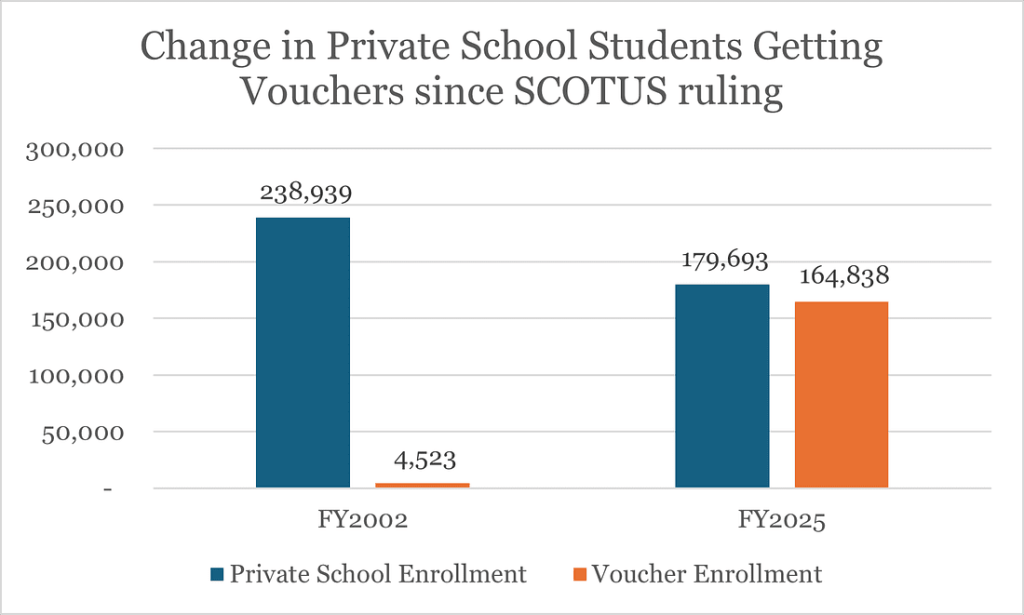
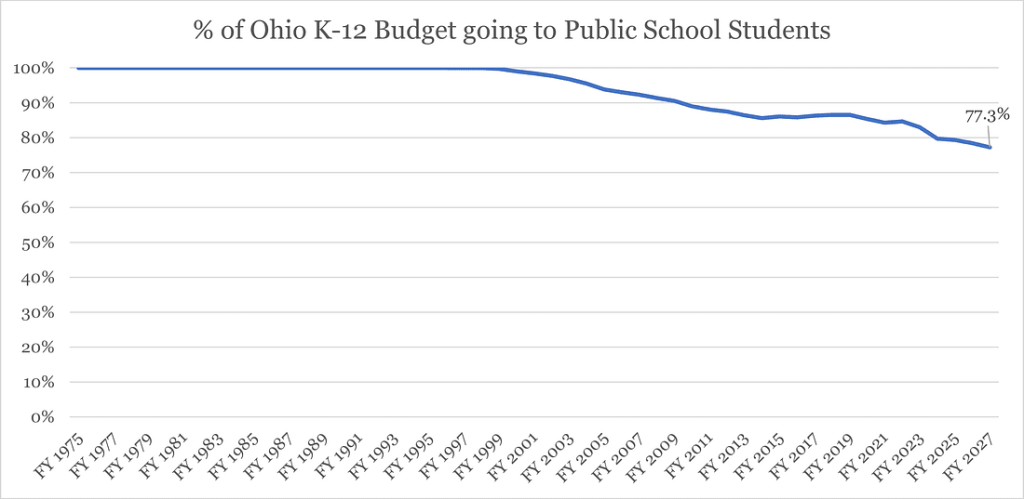
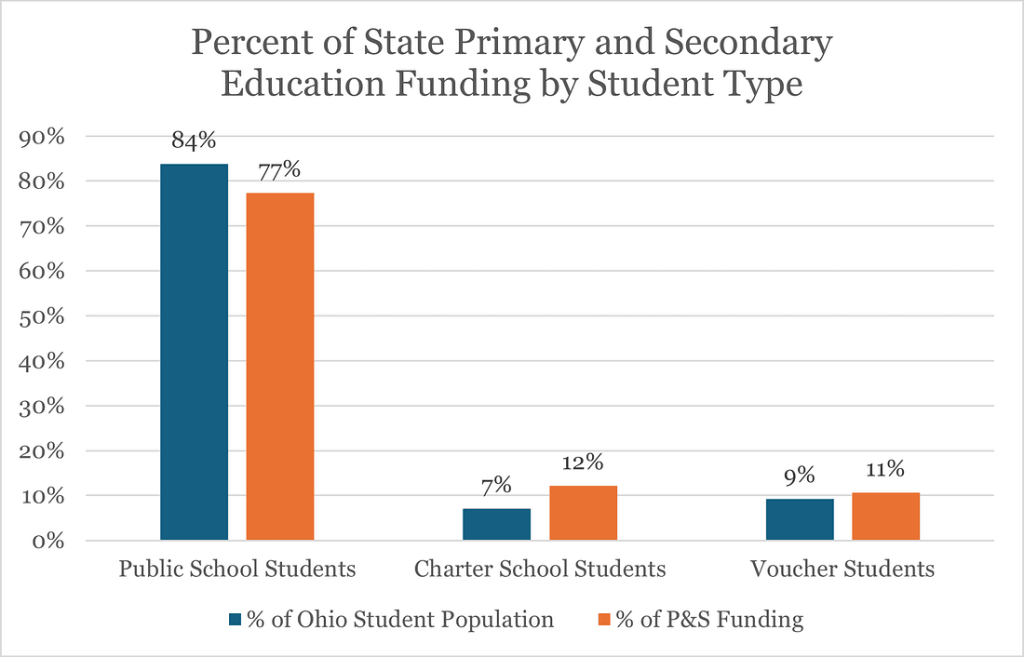
In an unprecedented move that shatters the historic wall of separation between church and state, Ohio has passed legislation to fund the construction and renovation of religious schools. It also directly violates the explicit language of the Ohio state constitution.

ProPublica reports on the latest move to defund public schools and divert money to religious schools.

The state of Ohio is giving taxpayer money to private, religious schools to help them build new buildings and expand their campuses, which is nearly unprecedented in modern U.S. history.

While many states have recently enacted sweeping school voucher programs that give parents taxpayer money to spend on private school tuition for their kids, Ohio has cut out the middleman. Under a bill passed by its Legislature this summer, the state is now providing millions of dollars in grants directly to religious schools, most of them Catholic, to renovate buildings, build classrooms, improve playgrounds and more.

The goal in providing the grants, according to the measure’s chief architect, Matt Huffman, is to increase the capacity of private schools in part so that they can sooner absorb more voucher students.

“The capacity issue is the next big issue on the horizon” for voucher efforts, Huffman, the Ohio Senate president and a Republican, told the Columbus Dispatch.

Huffman did not respond to ProPublica’s requests for comment.

Following Hurricane Katrina and the start of the COVID-19 pandemic, some federal taxpayer dollars went toward repairing and improving private K-12 schools in multiple states. Churches that operate schools often receive government funding for the social services that they offer; some orthodox Jewish schools in New York have relied on significant financial support from the city, The New York Times has found.

But national experts on education funding emphasized that what Ohio is doing is categorically different.

“This is new, dangerous ground, funding new voucher schools,” said Josh Cowen, a senior fellow at the Education Law Center and the author of a new book on the history of billionaire-led voucher efforts. For decades, churches have relied on conservative philanthropy to be able to build their schools, Cowen said, or they’ve held fundraising drives or asked their diocese for help.

They’ve never, until now, been able to build schools expressly on the public dime.

“This breaks through the myth,” said David Pepper, a political writer and the former chairman of the Ohio Democratic Party. Pepper said that courts have long given voucher programs a pass, ruling that they don’t violate the constitutionally mandated separation of church and state because a publicly funded voucher technically passes through the conduit of a parent on the way to a religious school.

With this latest move, though, Ohio is funding the construction of a separate, religious system of education, Pepper said, adding that if no one takes notice, “This will happen in other states — they all learn from each other like laboratories.”

The Ohio Constitution says that the General Assembly “will secure a thorough and efficient system of common schools throughout the state; but no religious or other sect, or sects, shall ever have any exclusive right to, or control of, any part of the school funds of this state.”

Yet Troy McIntosh, executive director of the Ohio Christian Education Network — several of whose schools received the new grants — recently told the Lima News that part of the reason for spending these public dollars on the expansion of private schools is that “we want to make sure that from our perspective, Christian school options are available to any kid who chooses that in the state.”

Ohio started funding vouchers in Cleveland only. They were supposed to “help poor kids escape failing public schools.” Initially, vouchers were only for kids already enrolled in public schools and only for kids from low-income families.

When they were implemented in the 1990s, vouchers in Ohio, like in many places, were limited in scope; they were available only to parents whose children were attending (often underfunded) public schools in Cleveland. The idea was to give those families money that they could then spend on tuition at a hopefully better private school, thus empowering them with what was called school choice.

Over the decades, the state incrementally expanded voucher programs to a wider and wider range of applicants. And last year, legislators and Gov. Mike DeWine extended the most prominent of those programs, called EdChoice, to all Ohio families.

Now, vouchers subsidize the children of families who never attended public schools, including affluent families. They have become a welfare program for families who previously paid their full tuition. As in every other voucher state, most students who take vouchers were already enrolled in private and religious schools.

Encouraged by Americans for Prosperity, a Koch brothers political advocacy group, the Ohio legislature added the religious school funding bill to the state budget.

Led by Huffman, Republicans slipped at least $4 million in grants to private schools into a larger budget bill. There was little debate, in part because budget bills across the country have become too large to deliberate over every detail and, also, Republicans have supermajorities in both chambers in Ohio.

According to an Ohio Legislative Service Commission report, the grants, some of them over a million dollars, then went out to various Catholic schools around the state. ProPublica contacted administrators at each of these schools to ask what they will be using their new taxpayer money on, but they either didn’t answer or said that they didn’t immediately know. (One of the many differences between public and private schools is that the latter do not have to answer questions from the public about their budgets, even if they’re now publicly funded.)

The total grant amount of roughly $4 million this year may seem small, said William L. Phillis, executive director of the Ohio Coalition for Equity & Adequacy of School Funding. But, he noted, Ohio’s voucher program itself started out very small three decades ago, and today it’s a billion-dollar system.

“They get their foot in the door with a few million dollars in infrastructure funding,” Phillis said. “It sets a precedent, and eventually hundreds of millions will be going to private school construction.”

The total grant amount of roughly $4 million this year may seem small, said William L. Phillis, executive director of the Ohio Coalition for Equity & Adequacy of School Funding. But, he noted, Ohio’s voucher program itself started out very small three decades ago, and today it’s a billion-dollar system.

“They get their foot in the door with a few million dollars in infrastructure funding,” Phillis said. “It sets a precedent, and eventually hundreds of millions will be going to private school construction.”

The only statewide evaluation of Ohio’s EdChoice voucher program was published in 2016. The evaluation was funded by the choice advocacy group, The Thomas B. Fordham Foundation. TBF has a special relationship to Ohio Republicans in the legislature because it originated in Ohio and maintains an office in Ohio. It also authorizes charter schools in Ohio.

The evaluation concluded that students who left to use vouchers in a private school performed worse than their peers who remained in public schools.

So, the Republican supermajority has known for at least eight years that vouchers don’t “save” poor kids; in fact, those kids are likely to fall farther behind. Now that the Republicans have adopted universal choice, they know that they are helping kids who are already enrolled in private and religious schools. So now, it’s a logical step to throw in millions more for construction and renovation of voucher schools.

Public Schools First NC posted the following statement about the passage of additional funding for the state’s voucher program. The General Assembly has a veto-proof majority in both houses, thanks to the defection of one Tricia Cotham, who ran as a Democrat who opposed abortion and vouchers, then changed parties. The bill raises voucher spending to over $600 million this year and to nearly $1 billion annually in a decade.

Here is the statement:

This week the House and Senate majority passed House Bill 10 “Require ICE Cooperation & Budget Adjustments” in a process that allowed no adjustments to any part of the bill. The new bill added a number of budget items to the previous bill, including massive increases in North Carolina’s voucher programs

The bill added millions in OS vouchers and ESA+ vouchers, bringing the total for 2024-25 to $616.1 million. The new appropriations were made to ensure that all voucher applicants this year received a voucher regardless of their income. As described in our September 7 newsletter, the majority of OS applicants on the waitlist have incomes too high to have been eligible for vouchers before the income cap was removed this year

In 2024-25, the OS vouchers pay up to $7,468 toward the private school tuition for each student. The voucher amount is tied to state per-pupil funding and increases each year. 

The wealthiest applicants—those making more than $260,000/year for a family of four—will receive $3,360 per child from the state. 

The bill does not increase teacher pay, so veteran teachers in their 15th through 24th years of teaching will receive a raise of only $820 in 2024-25.

The bill also sets out additional increases for both voucher programs through 2032-33 and establishes spending “for each fiscal year thereafter.” The result, as shown in the chart, is a whopping $937.6 million scheduled to be spent in 2033-34 alone. This is stunning and a total disregard for our underfunded public schools.

North Carolina will have spent a total of nearly $9 billion on private school vouchers by 2033-34. Those dollars would have fully funded the Comprehensive Remedial Plan (Leandro) to provide a sound basic education for all public school students—and much more. In November 2022, the North Carolina Supreme Court ordered the legislature to appropriate funds according to the Leandro plan, but legislative leaders are still fighting the ruling. 

Taxpayers may wonder whether the billions spent on private schools are helping students learn. We do know, based on national data, that private schools do not outperform public schools. Taxpayers won’t get answers—at least not yet – about NC students since private schools are not required to publicly report information on student achievement, unlike traditional public schools and charter schools.

Last year’s budget bill required private schools to administer the ACT to 11th grade students whose tuition was at least partially funded by vouchers starting this school year (public school 11th graders already take the ACT). It also required the Superintendent of Public Instruction to recommend a test to be administered in 3rd and 8th grade to both public school students and private school voucher students. There has been no word yet on what test Superintendent Truitt recommended and whether it will be administered this spring. 

Governor Cooper has signaled that he will veto House Bill 10 this week due to the massive voucher increases and other provisions in the bill that he has previously come out against such as the ICE requirement. 

It’s NOT TOO LATE to take action to STOP HB 10!

Legislators will be back in session on October 9. Governor Cooper is expected to veto the bill this week. Legislators will then be asked to vote to override his veto. What can you do to make sure the veto holds?

  • Contact legislators to urge them to reject this voucher expansion.
  • Contact all other elected officials and local business leaders to let them know how harmful the voucher expansion is to communities. They should contact legislators too. 
  • Encourage your local school board to submit a resolution rejecting vouchers (see examples here).
  • Support your local PTA as they advocate for public schools.
  • Sign our petition urging legislators to reject HB 10 and support the VETO.

PSFNC’s Statement on Voucher Expansion

Legislators, when sworn in, pledge to uphold the NC state constitution to provide a free public education. They should not be sending nearly a billion dollars of our tax money to private school vouchers while starving our public schools as they ignore the NC Supreme Court’s ruling to fully fund Leandro. By adding school voucher funding to clear the voucher waitlist of mostly wealthy families, this bill gives our hard earned tax dollars to wealthy families who can afford to pay their own tuition bills. In contrast, salary increases for teachers with 5 or more years of experience were less than $950, which amounts to pay cuts given cost of living increases. 

This bill prioritizes private schools over public schools, urban families over rural families, and wealthy families over our teachers and the nearly 1.4 million children who attend our public schools. Now, with no income limits to determine eligibility and no prior public school attendance required, it has become a handout to wealthy families to underwrite their private school tuition. This is the wrong path for our state. It undermines the social and economic fabric of our state–a state that used to be known nationwide for putting our public schools first- we need to do it again.