Archives for category: Parents

The mainstream media never tires of printing stories about the “miracle” of charter schools. A few days ago, the Washington Post published an article by Eva Moskowitz, leader of the Success Academy charter chain, titled “These schools are the answer to unlocking every child’s potential: Children born into poverty should not be consigned to failing schools.” The article was shameless self-promotion, announcing that she was expanding her brand into Florida.

But much to my surprise, readers were not buying any of her pitch. The comments following the article overwhelmingly criticized charter schools, saying they chose their students, they kicked out those with low scores, they excluded kids with disabilities, they were no better than public schools.

If all those readers get it, why don’t the editors at the mainstream media?

They still cling to the myth of charter success in New Orleans. NOLA has not been great for the students and their parents. But it has been a public relations coup.

Carol Burris, executive director of the Network for Public Education, pulls back the curtain in The Progressive.

Her article: “The ‘Miracle’ of New Orleans School Reform Is Not What It Seems: The city’s all-charter school experiment is a cautionary tale about what happens when democracy is stripped from public education.”

After the hurricane, parents wanted well-resourced community-based public schools. Instead they got charters focused on testing and no/excuses discipline.

The entire “reform” project is based on the practice of “charter churn.” Of 125 charters that have opened since Hurricane Katrina, half have closed and been replaced.

Burris writes:

The truth is that the all-charter experiment in New Orleans was built on the displacement of Black educators, the silencing of parents, and the infusion of foundation dollars with strings attached. As a result, students and families have faced disruption, instability, and hardship as charter schools open and close. Two decades later, the “miracle” is not what it seems. It is instead a cautionary tale about what happens when democracy is stripped from public education and governance is handed over to markets and philanthropies.

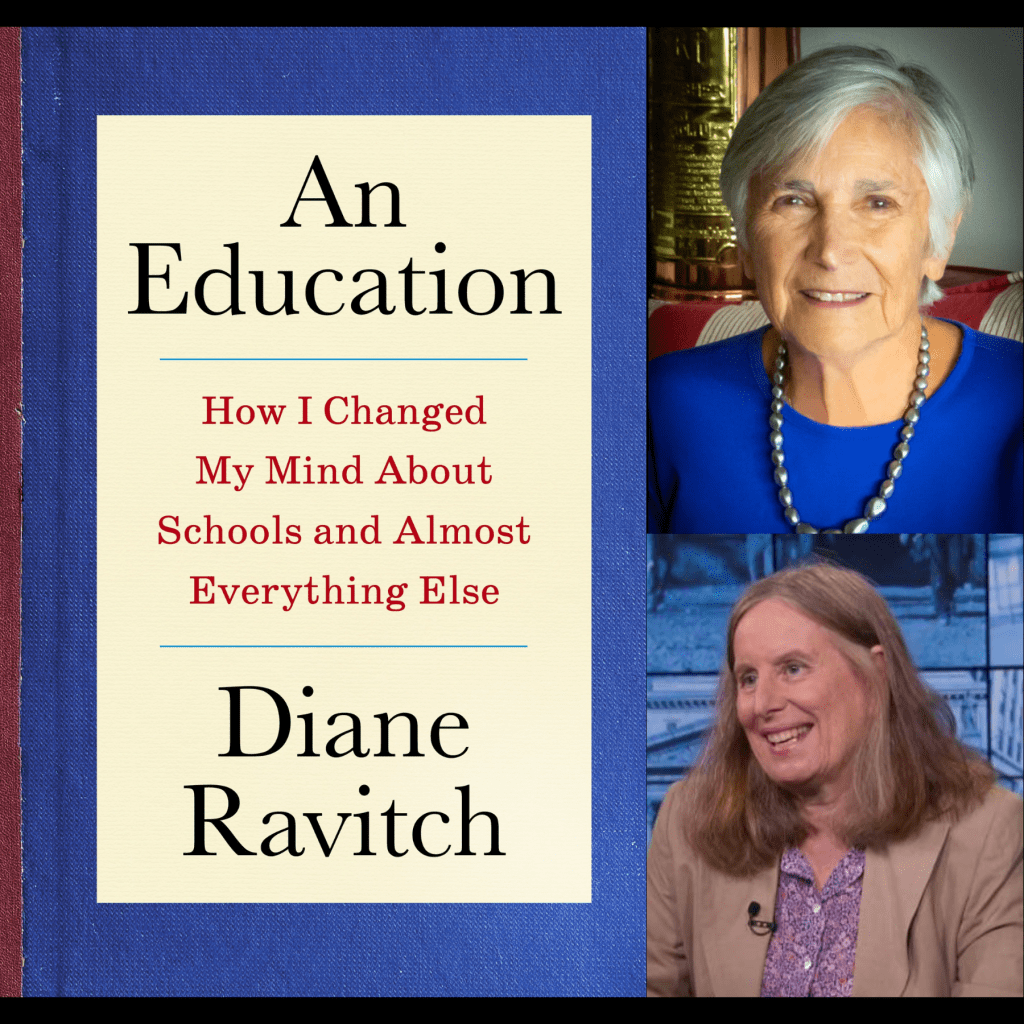
Veteran journalist Eleanor Bader published the very first review of my new book!

It’s a great review!

The official publication date is October 20, but books are now in print and available.

My first appearance to talk about the book will be in my home town: Brooklyn, New York, on October 21 at 6 pm at the Brooklyn Heights branch of the Brooklyn Public Library.

I will have a conversation with the brilliant Leonie Haimson, leader of Class Size Matters.

I’m not traveling to promote the book, but I am doing Zooms. I will be speaking to educators in North Carolina on October 22. To learn more about it, contact Yevonne Brannon of Public Schools First NC at ybrannon@gmail.com.

Jennifer Berkshire writes a blog called The Education Wars, where she explains the latest attacks on public schools by entitled billionaires and their lackeys. In this one, she reviews the revival of the New Orleans “miracle,” you know, the claim that turning almost every public school in the city into a privately run charter schools produced dramatic gains. Not true.

She wrote:

Ten years ago, I wrote a piece about some of the many unintended consequences of New Orleans’ charter school experiment. Wildly at odds with the narrative of success and transformation being peddled by the education reform industry, the story was among my first real attempts to do ‘serious’ journalism, and I’m still really proud of it. (For those of you who don’t know, I got my start chronicling the excesses of education reform on a humorous blog.) I learned a lot working on that story, including that writers have no control over whatever terrible headline gets slapped on their masterpiece… But it was in New Orleans that I really began to understand something essential about education reform. If the vision of what’s on offer is narrower than what the community wants, these top-down efforts to “disrupt” public education are doomed from the start.

The twenty year mark since Hurricane Katrina has ushered in a predictable wave of celebratory accounts of the New Orleans miracle. I recommend giving them a miss and spending some time instead with an eye-opening new book by parent advocate Ashana Bigard. (Full disclosure: Ashana is one of my favorite people in the world, not to mention among the most amazing organizers I’ve ever met.) Called Beyond Resilience, Ashana’s book opens with a scene of a meeting held in the period after the hurricane erased whole neighborhoods, and claimed the lives of some 1,800 people. The purpose of these gatherings, Ashana writes, was to give local parents the opportunity to envision the sort of education future they wanted for their children. 

What they dreamed of was so much more than their children had before, and more than they themselves had had before. Having seen what was offered to children in other places, they wanted that and more for New Orleans’ children.

Among their demands: fully equipped science labs, theater programs, curriculum rich in local history, career and technical education that prepared students for jobs in the trades. The list was long. It was also grounded in the harsh reality of New Orleans’ brutal poverty. Parents asked for kids to be able to bring food home when money was tight, for washers and dryers in every school because so many laundromats had never reopened. And they wanted swim lessons in order to give their kids a fighting chance against the next hurricane.

The enormous gulf between those wishlists, compiled on flip charts and dry erase boards, and what the parents ultimately got is the subject of Beyond Resilience. “What they gave us instead was almost a cartoonish representation of the opposite of everything we had asked for,” writes Ashana. “The charter school operators and organizations that supported charter school reform efforts would listen to parents, guardians and community members, and then create schools that looked more like juvenile jail facilities than schools.”Subscribe

No excuses

I first encountered Ashana through her work as an advocate for students and parents who were caught up in the draconian discipline practices that took root during the early years of the New Orleans charter school experiment. While the rhetoric was all about preparing kids, or ‘scholars’ in charter parlance, for college, Ashana was spending more and more of her time intervening on behalf of kids who were being treated like criminals. There was the boy whose mother couldn’t afford to buy him the shoes that the uniform required, so got suspended and then expelled. There was the five year old who was repeatedly suspended for eating crackers on the bus. And there were the countless students accused of the vague yet sweeping offense known as “disruption of a school process,” who ended up, not just kicked out of school, but arrested. These children, writes Ashana, weren’t treated as human beings,

but as criminals who had already committed crimes and would most definitley commit more crimes if they weren’t guarded and watched every second of the day.

Since I’ve known Ashana, her criticism of the city’s schools has been remarkably consistent. At its core is this belief: a model of schooling centered on harsh discipline is developmentally inappropriate, especially for young kids. Early in the book, she recounts being told by Ben Kleban, a hard-charging charter school CEO who embodied the no-excuses ethos, that his K-2 elementary school was so quiet that “you could hear a pin drop.” Ashana was aghast. These were kids who should be playing, talking and singing. “[H]e went on to tell me that these kids were different.”

These children are different. That was the refrain. These Black children in New Orleans, who had lost everything, who were sleeping in abandonded buildings, grieving the loss of family members, friends, and entire neighborhoods were ‘different’ and therefore didn’t deserve the same developmental considerations as other children their age.

In recent years, Ashana has been part of an effort called Erase the Board that seeks to bring traditional public schools back to New Orleans. The group’s demands echo the ones put forth by those parents and community members so many years ago—schools that are human focused rather than test and discipline centered, music and art classes, trained teachers, and trauma informed practices. But Erase the Board is also challenging a central tenet of the New Orleans model: schools that fail to raise test scores are closed. Of the city’s 75 charter schools, 50 have been closed or reconstituted at some point. While that churn is in large part responsible for producing academic gains, it has also proven deeply unpopular with parents, who hate school closures even when said shuttering is being done for ‘the right reasons.’ 

The constant opening and closing of schools is also highly disruptive to students, Ashana argues. She tells the story of one student who attended twelve different schools: half he was pushed out of over disciplinary infractions, the other half closed. “You have schools closing, teachers moving in and out. Kids need stability and that’s the opposite of what we’ve got. All you’re showing these kids is displacement.” Among Erase the Board’s demands is that failing charter schools be reopened as traditional public schools. “We estimate that, at the rate that charter schools close, we’ll have half our city back in seven years,” says Ashana.

Selling the vision

“‘Never seen before’: How Katrina set off an education revolution,” was the title of the puffed piece that appeared in the Washington Post recently. Penned by a British scribe who used to pen speeches for former UK prime minister David Cameron, aka Baron Cameron of Chipping Norton, it’s the sort of breathless sales pitch that abounded in the first decade after the hurricane. These days, the ‘miracle’ talk is harder to find, in part because so many holes have been poked in the claims of success, as teacher and blogger Gary Rubinstein notes here. And while New Orleans may have ended up with a system ‘never seen before,’ the reality is that the same forces are coming for its charter schools that now threaten all public schools. 

For one, there aren’t enough kids, especially when you consider that the model entails constantly opening new schools. Back in 2022, New Schools for New Orleans, an architect of the all-charter model, warned “that schools citywide were nearing a tipping point in terms of enrolling enough students to pay for a full array of academics and services.” And that was before Louisiana enacted its ginormous new school voucher program. In a system that is entirely focused on test scores, the appeal of attending a private school where kids don’t take tests seems pretty obvious. 

Indeed, at a time when the GOP has largely moved on from charter schools, save for the classical variety, and gone full voucher, the New Orleans experiment—expensive, interventionist, couched in the language of civil rights—feels like a throwback. So too does one of the animating beliefs driving the experiment: that kids in one of the country’s poorest cities could overcome poverty if they all went to college. Hence the frustration in the final puffish piece I’ll mention: edupreneur Ravi Gupta’s lament for the 74: “The Inconvenient Success of New Orleans Schools.” Conservatives aren’t keen on the model’s aggressive intervention, complains Gupta, while Progressives are squeamish about the fact that New Orleans’ success required wiping out the city’s unionized teaching force, which made up much of its Black middle class. 

Gupta implores us to focus on the ‘hard numbers’ and avoid what he calls “the tyranny of the anecdote.” But Ashana Bigard and her powerful new book show exactly why that perspective is so short sighted. Why, if the model is so successful, asks Ashana, does the city require so many alternative schools and programs to catch the kids who ‘fall through the cracks’? Why are there so many ‘opportunity youth,’ kids who aren’t in school or working? Indeed, if you expand the frame beyond the metrics of academic achievement, it’s hard to make the case that life for young people in New Orleans has improved, the conclusion I reached back in 2015. “The math ain’t mathin’,” is how Ashana put it when we spoke recently.

That there’s been so little laudatory coverage of New Orleans’ education revolution “reveals something broken about our politics and media,” insists Gupta. But I think the real reason is much more simple. The reformers who drove the experiment never recovered from the scene that plays out at the start of Ashana’s book, when parents and community members, some of whom had been pushing for reform in the city’s schools long before Katrina, envisioned what education in New Orleans could be. Today, the gap between that vision of possibility for the city’s kids and what was delivered remains a chasm. 

Two decades after hurricane Katrina, Ashana is still fighting for the schools New Orleans’ children deserve. The rebuilding is still happening, she writes in the book’s conclusion.

But it’s not about getting back to what it was—it’s about creating something that never existed: a New Orleans where all of our children can thrive, where our culture is respected and our people are valued, where love and justice aren’t just words but ways of life, where the billions generated by our creativity flow back to strengthen our communities. 

An eternal optimist, Ashana ends on a hopeful note, insisting that “That New Orleans is possible. That future is within our reach.” 

I hope she’s right.

Ashana Bigard is a parent activist in New Orleans. From her perspective as a parent leader and as the parent of a child with special needs, the New Orleans experiment has been a very expensive flop.

She wrote this overview for Public Voices for Public Schools:

Twenty years after Hurricane Katrina, the nation’s most radical education overhaul has produced stunning inequality alongside modest test gains

As I sit in Bricolage Academy’s office, frustrated but trying to remain pleasant, I’m having the same conversation again about my son. He’s on the autism spectrum. He is high performing, extremely quiet, and sweet. Despite his IEP, he wasn’t receiving the required services. The special education coordinator had quit in frustration, the school counselor was cut due to budget issues, and my fifth-grader was falling through the cracks.

I’m not just any parent. I’m an advocate who has worked with the CEO since the school’s creation. I have written for national magazines about our system’s problems and challenged the school’s “diversity by design” narrative. Yet here I was, fighting for basic services. If this is my experience, imagine what average parents face.

The Numbers Don’t Add Up

Twenty years after Hurricane Katrina replaced New Orleans’ traditional public schools with the nation’s first all-charter system, the grand experiment presents a troubling paradox. With half the students and double the funding, the system has achieved modest academic gains while disempowering the communities it promised to serve.

Before Katrina, New Orleans educated over 65,000 students in 126 schools. Today, just 47,667 students attend 70 schools–a 27% enrollment reduction. Yet per-pupil spending has exploded to approximately $17,000-$20,000, significantly above Louisiana’s state average.

“When you have half the students and twice the resources, you should see transformational results,” says Neil Ranu, a civil rights attorney with the Southern Poverty Law Center. “Instead, we see money flowing upward to administrators while classrooms struggle.”

The money trail is revealing. Charter CEOs earn over $200,000 annually, while average teachers make between $44,000-$55,000 if they stay long enough.

The Human Cost

The city’s teacher turnover rate of 28% for new educators doubles that of comparable cities. The displacement began when the state fired the entire education workforce after Katrina, including over 4,000 teachers with an average of 15 years of experience. The teaching force dropped from 71% Black to under 50%.

When ‘Success’ Crumbles

The system’s fragility became apparent at John F. Kennedy High School in spring 2019. On graduation day, 177 students walked across the stage. A month later, state auditors revealed nearly half were ineligible to graduate due to grade changes from F’s to D’s, improper credit recovery, and students taking unsupervised classes at home.

Antonio Travis, director of Black Man Rising, mentored several affected students. “There was shame, self-blame. Many felt they wouldn’t be successful in college.” Families canceled graduation celebrations, uncertain about the future.

The Illusion of Choice

Parents quickly learn that “choice” often means choosing between bad options, especially for children with special needs. At Benjamin Franklin High School, Louisiana’s top-ranked public school, students from minority backgrounds face significant admission barriers. The school serves 39% white students in a city where whites comprise only 10% of public enrollment.

Special Education Crisis

In 2010, ten families sued the state over charter schools admitting too few special-needs students and failing to provide proper services. The resulting federal consent decree remains in effect today, with monitors continuing to find systematic violations, including parents being excluded from meetings, services not being provided, and evaluations being denied.

Right now, Louisiana U.S. District Judge Jay Zainey is currently presiding over the dissolution of the special-needs consent decree related to New Orleans schools. Because New Orleans public schools have no oversight, and no unions to fight to ensure the law is followed, we, as parents of children with special needs, have to fight to get our stories to the judge so hopefully he will keep it in place.

Economic Verdict

For a system serving 84% Black students, the economic impact is devastating. The racial wealth gap has widened dramatically since Katrina. White households now hold 13 times the wealth of Black families–$181,000 versus $18,000 median net worth. New Orleans went from 67% Black to 57%, losing over 120,000 Black residents.

Missing Pieces

Walk through charter schools and notice what’s absent or insufficient. Arts programs have declined; fewer offer pre-kindergarten, and students average 35-minute bus commutes. Basic skills, such as cursive instruction—required by state law for signing legal documents—are often ignored. “The children only learn what’s tested,” observes one advocate. “Everything else gets cut.”

The Honest Assessment

As the 20th anniversary of Katrina approaches,New Orleans offers a sobering lesson. With unprecedented resources and freedom, the charter system produced modest academic gains alongside community economic decline and systematic exclusion of vulnerable students.

“When people ask if they should move out of the city for better education,” says one advocate, “my answer is: if you can afford to move, you should. This system is not built to support our children.”

The comment hangs like an indictment not just of a school system, but of a 20-year experiment that promised everything and delivered prosperity for some, displacement for others, and continued struggle for families who need excellent public education most.


Ashana Bigard is a fifth generation New Orleanian and lifelong resident of the Crescent City. A mother of three, Ashana is a tireless advocate for equity and social justice, especially in her work advocating for children and families in New Orleans and Louisiana. She leads the Education Justice Project of New Orleans, where she organizes and advocates for the rights of students and parents. Ashana is an adult ally advisor to United Students of New Orleans. She also serves as a Community Faculty member with Tulane University’s Center for Public Service.

The Idaho state legislature passed a $50 million plan to subsidize vouchers. The usual arguments for vouchers–choice and competition–don’t apply in a largely rural state. The primary beneficiaries will be wealthy families whose children are already enrolled in private schools. The biggest losers will be rural schools, which desperately need upgrades.

Parents in Idaho are taking their challenge to the state courts, based on the explicit language of the State Constitution. The editorial board of the Idaho Statesman agrees with the parents.

Here is its editorial on the subject:

“(I)t shall be the duty of the legislature of Idaho, to establish and maintain a general, uniform and thorough system of public, free common schools.” — Article IX, Section 1, Idaho Constitution

A coalition of public school advocates announced Wednesday that it is asking the Idaho Supreme Court to rule that a refundable tax credit for families who send their kids to private schools is a violation of the Idaho constitution’s education clause.

We say it’s about time.

And just in time, since House Bill 93, which was passed last legislative session, allows families to start applying for the credits in January.

The law set aside up to $50 million for the tax credits.

We would much rather see that $50 million go toward the public education system, hiring more teachers, more counselors, repairing derelict school buildings and properly funding special education, which has an $80 million shortfall, according to the Office of Performance Evaluations.null

We have enumerated many times before the reasons vouchers for private schools is a terrible idea.

Most voucher schemes in other states started out like Idaho’s — small, limited and targeted. But state after state, the vouchers grew and are blowing holes in state budgets everywhere.

Many of these vouchers go to wealthy families who already have the means to pay for private school, and the vouchers merely subsidize part of the cost of a private school tuition.

The vouchers are open to fraud, waste and abuse.

There’s no accountability built into Idaho’s voucher system.

The Idaho Supreme Court won’t be interested in such policy discussions, but justices will be interested in hearing what we think is a valid constitutional argument.

One word, in particular, provides their best legal challenge: “uniform.”

In essence, by providing a refundable tax credit to families to send their children to a private school, the Legislature is establishing a second school system that isn’t the same as the public education system. It’s not uniform.https://f0fd809050f339b050a5948ada000ea9.safeframe.googlesyndication.com/safeframe/1-0-45/html/container.html?n=0

We are compelled by the testimony Wednesday of one mother who said her children were denied entry to a public school based on their religion. A public school can’t do that.

The argument is not without precedent.

A district court judge in Salt Lake City halted Utah’s education savings account programearlier this year, according to Idaho Education News. The state’s teachers’ union argued that the Utah Constitution bars state dollars from funding an education system that’s not free or open to all students.

The same could be said for Idaho’s voucher scheme.https://f0fd809050f339b050a5948ada000ea9.safeframe.googlesyndication.com/safeframe/1-0-45/html/container.html?n=0

In June, an Ohio state judge struck down that state’s voucher program, ruling that the program created a separate, unfunded, nonpublic system and funneled public money to private religious institutions. That, the judge ruled, violated constitutional mandates to fund a single public school system.

In 2024, the South Carolina Supreme Court struck down a 2023 law that created a private school voucher system. The court said the law illegally funneled state public funds to private schools, which is prohibited by the state constitution. The decision said vouchers undermine the state’s mandate to support public schools for all students.

We find it particularly appropriate that Idaho’s organizers announced this legal challenge on Constitution Day. Yes, it’s referring to the U.S. Constitution, but Idaho legislators should hold Idaho’s Constitution in equally high regard.

How we wish Idaho legislators would honor it all the time, not just when it’s convenient or when they want to change the constitution’s clear meaning to fit their agenda.https://f0fd809050f339b050a5948ada000ea9.safeframe.googlesyndication.com/safeframe/1-0-45/html/container.html?n=0

Where are all of Idaho’s “original meaning,” “not a living document” conservatives in this state when it comes to the state constitution’s education clause?

Because, if you read the Idaho Constitution plainly, vouchers just don’t pass muster.

Let’s hope the Idaho Supreme Court sees it the same way.

Statesman editorials are the opinion of the Idaho Statesman’s editorial board. Board members are opinion editor Scott McIntosh, opinion writer Bryan Clark, editor Chadd Cripe, newsroom editors Dana Oland and Jim Keyser and community members John Hess, Debbie McCormick and Julie Yamamoto

This may be the most important article you will read today.

Richard Rothstein has had a distinguished career as a journalist who writes about social science, most notably, achievement gaps, housing segregation, and the impact of poverty on academic performance. He has long been a fellow at the Economic Policy Institute and before that was education editor of The New York Times.

Rothstein writes here about the origins of the belief that teachers are directly responsible for student academic performance. If students score poorly on tests, goes the theory, it’s because their teachers have low expectations for them. In the case of black students, teachers’ racism is likely to explain their low expectations. From this perspective, No Child Left Behind and Race to the Top made perfect sense. The teachers needed high expectations or needed to be fired.

Rothstein writes:

Social psychologist Robert Rosenthal died at the age of 90 last month. He was best known for his 1968 book, Pygmalion in the Classroom, co-authored by Lenore Jacobson, an elementary school principal in South San Francisco.

No book in the second half of the 20th century did more, unintentionally perhaps, to undermine support for public education, and thus diminish educational opportunities for so many children, especially Black and Hispanic children, to this day. The book and its aftermath put the onus solely on teacher performance when it came to student achievement, disregarding so many critically important socioeconomic factors—at the top of the list, residential segregation.
How did it do that?

The book described an experiment conducted in Ms. Jacobson’s school in 1965. The authors gave pupils an IQ test and then randomly divided the test takers into two groups. They falsely told teachers that results showed that students in one of the groups were poised to dramatically raise their performance in the following year, while the others would not likely demonstrate similar improvement.

At the end of that year, they tested students again and found that the first and second graders in the group that was predicted to improve did so on average, while those in the other group did not. The book, as well as academic articles that Dr. Rosenthal and Ms. Jacobson published, claimed that the experiment showed that teacher expectations had a powerful influence on student achievement, especially of young children. Pupils whose teachers were told were more likely to improve then apparently worked harder to meet their teachers’ faith in them.1

Some psychologists were skeptical, believing that the experimental design was not sufficiently rigorous to support such a revolutionary conclusion. Even the reported results were ambiguous. Teacher expectations had no similar impact on children in grades three through six. Similar experiments elsewhere did not confirm the results even for first and second graders.2

Nonetheless, the book was very influential.
In the decades after Pygmalion, other studies examined teacher expectations. They showed that teachers have greater expectations of higher achieving students but couldn’t determine whether the teacher attitudes helped to cause better pupil performance. Perhaps teachers only developed those expectations after seeing that students were higher achieving.3 Only an experimental study, like Pygmalion, could establish causality, but contemporary ethical standards would often prohibit such experiments, requiring, as they must, lying to teachers about their students’ data.

Minority children in the South San Francisco school where Rosenthal and Jacobson experimented were Mexican-origin, not African American. Yet ignoring how scanty the evidence was, education policymakers concluded from their research that the Black-white gap in test scores at all grade levels resulted from teachers of Black children not expecting their pupils to do well. And that, they reasoned, should be an easy problem to solve—holding teachers accountable for results would force them to abandon the racial stereotypes that were keeping children behind.

The accountability movement grew in intensity during the Bill Clinton administration, while in Texas, Governor George W. Bush implemented a mandatory standardized testing program whose publicized results, he thought, would force teachers to improve by shaming them for the lower scores of their poorer Black and Hispanic pupils.

In 2000, Bush was elected president; his campaign promised to demolish teachers’ “soft bigotry of low expectations.” During his first year in office, he led a bipartisan congressional majority to adopt the “No Child Left Behind Act” that required every state to conduct annual standardized testing in reading and math for pupils in the third through eighth grades. 

Shortly after the bill was signed, I met with the congressional staffer who had been primarily responsible for writing the legislation. She predicted that within two years, the publication of test scores would so embarrass teachers that they would work harder, with the result that racial differences in academic achievement would evaporate entirely.

Nothing of that sort has happened. Although test performance of both Black and white students has improved somewhat, the gap is not much different than it was two decades ago. But the public reputation of our teaching force has continued to deteriorate, as a conclusion spread that failure to equalize test results could be remedied by gimmicks like naming a school’s classrooms for the Ivy League colleges that teachers expected their students to attend.4 

Enthusiasm for charter schools escalated from a belief that operators could choose teachers with higher expectations, yet charter schools have not done any better (and in many cases worse) in closing the gap, once the sector’s ability to select students less likely to fail (and expel students who do) is taken into account.5

In 2008, I taught an education policy course for master’s degree candidates, many of whom had taught for two years in the Teach for America (TFA) program. It placed recent college graduates without teacher credentials in schools for lower-income Black and Hispanic students.

Funded heavily by private philanthropies, TFA embraced the low-expectations theory of below-average performance. Prior to their teaching assignments, TFA corps members were required to attend a summer institute whose curriculum featured a unit entitled “The Power of My Own Expectations” and required them to embrace the “mindset” of “I am totally responsible for the academic achievement of my students.”

None of my master’s degree students claimed that in their two years of teaching, their high expectations actually produced unusually high achievement. But most were so immunized against evidence and experience that they enrolled in a graduate program with the intention of creating new charter schools infused with high expectations. Only a few wondered what had gone wrong with their theory, besides having goals that still weren’t high enough.

Certainly, there are teachers with low expectations and harmful racial stereotypes, and it would be beneficial if those who can’t be trained to improve were removed from the profession. But I’ve visited many schools serving disadvantaged students. Most teachers I observed, white and Black, were dedicated, hard-working, engaged with their students, and frustrated about the social and economic challenges with which children daily came to school. I don’t claim that my observations were representative; I was more likely to be invited to visit schools that took great pride in their efforts, despite conditions they struggled to overcome.

No matter how high their expectations, teachers can’t do much about:

*their pupils’ higher rates of lead poisoning that impact cognitive ability;

*more frequent asthma—the result of living with more pollution, near industrial facilities, in less-well maintained buildings with more vermin in the environment—that may bring them to school drowsy from being awake at night, wheezing;

*neighborhoods without supermarkets that sell fresh and healthy food;

*stress intensified by being stopped and frisked by police without cause, and a discriminatory criminal justice system that disproportionately imprisons their fathers and brothers for trivial offenses;

*frequent moves due to rising rents, or landlords’ failure to keep units in habitable condition;

*absenteeism from a need to stay home to care for younger siblings while parents race from one low-wage job to another;

*poor health from living in neighborhoods with fewer primary care physicians or dentists;

*lower parental education levels that result in less academic support at home, combined with less adequate access to technology, a problem exacerbated since the pandemic;6

*and many other socioeconomic impediments to learning.7

Not every Black child suffers from these deprivations that affect their ability to take full advantage of the education that schools offer. But many do. Concentrating disadvantaged pupils in poorly resourced schools in poorly resourced and segregated neighborhoods overwhelms instructional and support staffs.

Such realities contributed to my conclusion that residential segregation, not low teacher expectations, was the most serious problem faced by U.S. education. It is what led to my recent books, The Color of Law, and its sequel (co-authored by my daughter, Leah Rothstein), Just Action; How to challenge segregation enacted under the Color of Law.

Robert Rosenthal’s Pygmalion theory set the stage for a national willingness to deny educational disparities’ true causes: the unconstitutional and unlawful public policies that imposed racial segregation upon our nation.

Footnotes:

1. Robert Rosenthal and Lenore Jacobson. 1968. Pygmalion in the Classroom: teacher expectation and pupils’ intellectual development. (New York: Holt, Rinehart, and Winston). For a technical summary by the authors, see. Rosenthal and Jacobson, “Pygmalion in the Classroom.” The Urban Review 3, September, 1968: 16-20.

2. See “Pygmalion in the Classroom.” The Urban Review 3, September, 1968, footnote on p. 19.

3. For example, see Thomas L. Good, Natasha Sterzinger, and Alyson Lavigne. 2018. “Expectation Effects: Pygmalion and the initial 20 years of research.” Educational Research and Evaluation 24 (3-5): 99-123.

4. See, for example, Richard Rothstein. 2010. “An overemphasis on teachers.” Commentary, Economic Policy Institute, October 18. 

5. Martin Carnoy, et al. 2005. The Charter School Dust-Up. (Washington, D.C.: The Economic Policy Institute).

6. In early 2020, I wrote that the pandemic would widen the achievement gap. The consequences turned out to be worse than I could have imagined. Teacher expectations had nothing to do with it. Richard Rothstein. 2020. “The Coronavirus Will Explode Achievement Gaps in Education.” Shelterforce.org, April 13.

7. Richard Rothstein. 2004. Class and Schools. Using social, economic, and educational reform to close the black–white achievement gap. (Washington, D.C.: The Economic Policy Institute).

The text of this post was originally published on January 30, 2024 on the Working Economics Blog of the Economic Policy Institute.

Jan Resseger writes here about the injustice of the budget for public schools passed by the Ohio legislature. Firmly in the control of hard-right Republicans, the legislature eagerly funds vouchers and charter schools while underfunding the public schools. As in every other state, the vast majority of Ohio students attend public schools. The only evaluation of the Ohio voucher program showed that most students who used the vouchers were already attending private schools; those who transferred from public schools fell behind the peers they left behind.

Ohio legislators know that vouchers and charters do not increase educational opportunity. They don’t care. Parents of public school students must inform themselves and act to protect their public schools.

She writes:

In the last week of June, two important events happened almost simultaneously in Ohio: A district court in Columbus found the state’s EdChoice voucher program unconstitutional, and the state legislature passed a budget that at the same time shorts the state’s public schools that serve the mass of our state’s children, significantly cuts the state income tax, and increases funding for private school vouchers over the next two years.

We all desperately hope the Vouchers Hurt Ohio lawsuit will save our public schools, but appeals of the case to higher courts will likely take several years, a period when the  new budget’s underfunding of the Fair School Funding Plan, the effect of the income tax cuts and the diversion money to private school vouchers will inevitably continue to diminish the state’s investment in Ohio’s public schools.

In the new budget, the legislature technically phased in a new Fair School Funding Plan—a mathematical formula to ensure that the state will guarantee adequate and equitably distributed state school funding. However, after the House Speaker called the plan unsustainable, the legislature failed fully to fund the new formula’s provisions and thereby ensured the new formula’s ultimate failure before Ohio can even try it out.

The Ohio legislature’s income tax reduction along with lawmakers’ choice to permit continuing growth of publicly funded, universal EdChoice private school tuition vouchers emerges from a philosophy that government’s responsibility is to protect individual parents’ freedom. Solid support for the state’s public schools would instead embody a commitment to what we call the social contract, explained here by economist Joseph Stiglitz:

“A social contract defines the relationship between individuals and societies, much as an actual contract would, outlining the obligations of the parties to the contract and to each other. There is one big difference between the social contract and ordinary contracts. When an actual contract is breached, there are consequences both for the relationship and especially for the breaching party… But when the state violates what it is supposed to do, there is no corresponding mechanism for enforcing the social contract.” The Road to Freedom, p. 86)

Article VI, Section 2 of the Ohio Constitution definesthe state’s responsibility to provide a strong system of public education as part of the social contract: “The General Assembly shall make such provisions, by taxation, or otherwise, as, with the income arising from the school trust fund, will secure a thorough and efficient system of common schools throughout the state; but no religious or other sect, or sects, shall ever have any exclusive right to, or control of, any part of the school funds of this state.”

Here are three ways in which the new state budget undermines Ohio’s public education social contract.

The New Ohio Budget Does Not Commit the State to Equitable and Adequate Public School Funding.

In a new brief, Lawmakers Underfund Ohio Schools by $2.86B in FY26-27; Veto Overrides Risk Another $330M, along with an attached PowerPoint slide presentation, Policy Matters Ohio shows how Ohio’s Fiscal Year 2026-2027 budget undermines the new Fair School Funding Plan just as it is being launched.

The first slide of Policy Matters’ PowerPoint presentation summarizes the impact of the new budget for the state’s public schools: “Ohio lawmakers give a billion-dollar annual tax break to Ohioans earning six figures, underfund (public) schools by $2.86 billion, and leave behind students with the greatest need.”

In Slide 3, Policy Matters compares the amount of public school funding allocated in the new state budget to the amount the new Fair School Funding Plan (FSFP) would have awarded to each school district if the legislature had, as the formula requires it to do, correctly factored in the district’s current costs instead of old cost data from FY 2022. “Under the enacted plan, 74% of Ohio’s school districts will receive less than what the FSFP says they need to meet the costs of an adequate education.”

In a recent Hannah News Service publication, Howard Fleeter, Ohio’s well known school finance expert, explains¹ exactly how the legislature robs school districts of what they had expected under the Fair School Funding Plan: “One of the most important features of the Fair School Funding Plan is its utilization of an inputs-based approach to determining adequacy, which results in a base per-pupil amount which can vary across districts based on the number of students and their distribution across grade levels… In order to not just fully phase in the funding formula but to adequately fund it, the base cost in FY 26 should be based on FY 24 input data and the base cost in FY 27 should be based on FY 25 data.” However, this year the legislature used old, FY 2022 cost data, thereby failing accurately to measure school districts’ costs. In other words, the state should recognize that school district expenses rise year after year due to inflation, and the formula should recognize that school districts have to keep up or risk losing teachers and services.

In Policy Matters’ Slide 5, a bar graph demonstrates that in the new budget, legislators leave farthest behind the school districts serving concentrations of the state’s poorest students. These school districts will fall 107% behind what the FSFP would have brought them in state funding. Their school funding is actually being cut this year.

Part of the loss to school districts serving masses of poor children comes from a recalculation of Disadvantaged Pupil Impact Aid.  Slide 7 explains that the legislature used “direct certification, a process of identifying low-income students by relying on public benefits data that will lead to fewer low-income students being counted in the system and fewer DPIA dollars going to the places that desperately need them.” Why has the legislature chosen to base DPIA on a data set that will, “cut more than $200 million in DPIA funds over the next biennium, from FY 2025 levels of support”?

Slide 7 adds, as a preface to Slide 8, that the new budget, “appears use that money to offset the ‘performance’ supplement which is estimated to cost $215 million over the biennium.”  What is the Performance Supplement? Slide 8 explains: “The Performance Supplement would rely on (each district’s)  state report card data, increasing funding by $13 per student times the number of stars on their state report card or progress report… Report card scores are built on testing performance as well as factors like chronic absenteeism, and the ‘breadth of coursework available in the district.’ ”

Policy Matters Slide 8 clearly identifies the injustice embedded in the Performance Supplement: “Low scores on these indicators should signal to policymakers that the school and the community it serves are devalued, under-resourced, and in need of more help, not less.  It explicitly reverses course on closing opportunity and education gaps, which would help schools improve.” In Slide 8, we also learn that the budget adds a $225 per student Enrollment Growth Supplement for the fastest growing suburban school districts. While the supplement will help meet the costs of serving new students moving to these districts, it is important to remember that these are districts serving wealthier families.

In the brief itself, you can link to your own school district’s profile to see how your district fares under the new budget here.

The New Budget Reduces Ohio’s State Income Tax—Undermining the State’s Capacity to Raise Its Share of Public School Funding.

The Plain Dealer‘s Anna Staver explains: “Lawmakers eliminated the state’s top income tax bracket, collapsing Ohio’s tax structure from two rates to one. It’s the last step in a decade-long push for a flat tax —and this final move amounts to a $1.14 billion cut.”  Signal Ohio‘s Andrew Tobias adds: “That new top tax rate of 2.75% is lower than any surrounding state and lower than any time in the past five decades… About 96% of the $1.1 billion in annual lost revenue… will stay in the pockets of those earning $138,000 or more….” Policy Matters Ohio’s Slide 10 depicts the legislature’s new flat tax diverting a billion dollars of essential state revenue to wealthy individuals and away from the state’s social contract. The new budget exacerbates a long trend of tax slashing in Ohio. Last fall, Policy Matters Ohio’s Bailey Williams tracked two decades of Ohio tax cuts that have progressively reduced Ohio’s capacity to support the needs of the public and to support the system of common schools promised in the Ohio Constitution.

The New Budget Allows Private School Vouchers to Continue Eating Up School Revenue.

In his June 27th On the Money¹ school funding expert Howard Fleeter describes another primary drain on state revenue: private school tuition vouchers will continue to eat up an increasingly large chunk of the new state budget. Fleeter compares the legislature’s investment in public school funding to the legislature’s investment in private school vouchers. Fleeter calculates, “that state foundation funding for Ohio’s traditional school districts—spread across the state’s 609 local school districts—will increase by $281.9 million over the Fiscal Year 2026-2027 biennium compared to current funding levels.” He continues: “Voucher funding is slated to increase by $327.1 million over the FY26-27 biennium…. This increase is $45 million more than the increase slated for the traditional K-12 districts over the biennium, despite the fact that K-12 districts educate roughly 8 times as many students as do private schools.”

In the New Budget, Legislators Shift the Responsibility for Funding Public Schools More Heavily onto Local School Districts.

We continue to hear a lot from our legislators about the danger of rising property taxes, but ironically, by reducing the state’s investment in public education, the legislature itself has made it necessary for school districts to increase reliance on local property taxes or cut programs and teachers. Howard Fleeter concludes¹ that, in the current fiscal year (FY 2025) under the budget that passed two years ago, the state is paying 38.4% of public school funding in Ohio. In the new budget, in which the legislature has failed to update the cost data in the formula, has cut the state income tax, and has kept on letting an uncapped voucher program grow,“the average state share (of total public school funding) will drop to 35.0% in FY 26 and to 32.2% in FY 27….”

When a state violates the social contract by reneging on its responsibility to fund public schools, the funding burden falls more heavily and more inequitably on local school districts.


¹Howard Fleeter, “On The Money,” Hannah News Service, June 27, 2025, (available free in many public library research collections).

Way back in 2014, Secretary of Education Arne Duncan was selling the idea that teachers should be rewarded or punished based on their students’ test scores. That idea, baked into Race to the Top, was a dismal failure. Teachers who taught the neediest kids got low ratings, and teachers in the most advantaged schools got the highest ratings. Bill Gates was similarly infatuated with the idea, and he handed out hundreds of millions of dollars to districts and charter chains to test it. Rigorous evaluation showed it to be demoralizing to teachers with no impact on test scores.

What we should have learned from the experience of Race to the Top is that carrots and sticks applied to teachers do not help students and do not improve education.

It’s parents and home life that have the largest effect on student learning. So said the American Statistical Association in 2014, making a futile attempt to persuade Secretary Duncan that he was on the wrong track.

Susan E. Mayer and Ariel Kalil explain why policymakers should focus on parents and help them become better parents. [Let me add, however, that I disagree with their comments about reading and math proficiency. As I have written many times before, NAEP proficiency is not grade level; it is a high bar, and it’s unlikely that most students would ever score the equivalent of an A.]

They write:

American schoolchildren are performing abysmally in tests of basic skills. Only 36% of fourth-grade students were deemed proficient in national math tests and only 33% were deemed proficient in reading as of 2022, the latest year for which such data is available.

Those numbers are even worse than before the pandemic – 5 percentage points lower in math from 2019 and 2 percentage points lower in reading. And the drop in reading and math proficiency after the pandemic has happened to both economically advantaged and disadvantaged children. Students across the board need help.

There is a tendency to blame schools – and by extension, teachers – for students’ poor performance. The temptation to focus solely on schools, however, is misguided. Parents are the ones who must build the foundation for children’s learning. Yet parenting has long been viewed as a private behavior for which women are presumed to possess unique instincts, leaving parents with little evidence-based guidance on how to develop their children’s skills.

Meanwhile, the political right often favors more accountability for teachers, more charter schools and more vouchers for private schools. The political left often favors more teacher training, reducing class sizes, more equitable distribution of school resources and patience as students recover from the pandemic-related dip in scores.

But it’s parents and family background that make the biggest difference. This is evident because the gap in children’s math and reading test scores is already large at the start of kindergarten, in line with their socioeconomic status, and does not narrow as children progress through schooling.

Many people think that the solution, therefore, is to improve parents’ socioeconomic status, which will in turn improve children’s skills. But the reason that low-income parents parent their children differently than high-income parents is not a causal result of the low income itself. Improving parents’ household income would be laudable for many reasons, but experimental evidence shows that giving parents cash payments after they have a child neither changes parental investments nor changes the child’s skills. [Note from Diane: I disagree. Making cash payments is not the same as improving family socioeconomic status; investing in good jobs, housing, and long-term improvements in SES would make a huge difference.]

Instead, we need to support parents in directly changing what they do. Our experimental research on specific parent behaviors that boost child skills points to the importance of reading and talking to children. Analysis we conducted of the American Time Use Survey shows that on average, however, only 21% of mothers of children ages 3 to 6 report spending daily time reading with their child, only 30% report any daily time playing games with them, and only 11% report daily time dedicated to “listening or talking with” their child.

Worse, many parents are misinformed about how to prepare their young children for school. According to a survey we conducted with 2,000 parents in Chicago, about 25% more parents thought it was essential that children know the alphabet before starting school than thought it was important to spark children’s curiosity.

But this is misguided. Children will eventually learn the alphabet and how to count to 50. Especially for parents with less than a four-year college degree, language interactions with young children – parental storytelling, reading books and asking questions about them – along with math interactions such as playing with shape blocks and reading books about numbers are correlated more strongly with growth in children’s language and math skills than activities such as teaching the alphabet and counting or practicing letter sounds and how to calculate simple sums.

We do a disservice to parents by not redirecting their attention from rote skills, such as memorizing letters, sounds and numbers, to more open-ended inquiry. But researchers are limited as well. We need many more resources devoted to improving high-quality research on understanding precisely what types of parent engagement build the child skills necessary for success in later life. We also need much more research on how to boost parents’ capacity for child skill-building.

But first we must acknowledge that mothers, fathers and other caregivers play a crucial role in building children’s skills. Second, we have to acknowledge that as a nation, we have an interest in what parents do. Children are not just the property of their parents. They are the nation’s future.

Their schooling can only build upon the foundation that parents provide. The United States spends more on education per pupil and less on supporting parents than almost any other wealthy country. The government needs to expand its vision of what it means to support childhood development and invest in helping parents create nurturing learning environments at home in the years before formal schooling begins.

We should signal the value children have for the nation by making work compatible with raising children through family leave, providing access to health care for all children and caretakers and offering free access for children to libraries and museums where they can build a love of learning.

We should also explore new solutions, such as providing digital libraries and utilizing technology in innovative ways to support parents in helping their children learn. Evidence from our recent research shows that this can increase parental reading, boost child language development and close the socioeconomic gap in children’s language skill.

Susan E. Mayer is a professor and a dean emeritus at the University of Chicago Harris School of Public Policy. 

Ariel Kalil is the Daniel Levin Professor at the University of Chicago Harris School of Public Policy. They are the directors of the Behavioral Insights and Parenting Lab at the University of Chicago.

Scott Maxwell, opinion columnist for The Orlando Sentinel, wrote about the unusual public protest against the Legislature’s plan to cut funding for AP classes in public schools. For years, Republicans who run the state have inflicted blow after blow on the public schools, preferring to divert billions of public dollars to private and religious schools. But not this time. This time, the public organized fought back and blocked the latest effort to inflict damage on the state’s public schools.

Maxwell writes:

Chalk one up for the Floridians who are willing to stand up and make themselves heard.
Tallahassee politicians were forced last week to abandon their plans to gut funding for AP classes in public schools after they ran into something they rarely encounter in this state — a wall of public opposition.

GOP lawmakers have been pulling the rug out from under public education for the better part of two decades, driving away teachers, injecting political wars into classrooms and diverting public money to private schools. But their plan to cut funding to AP, IB and dual enrollment programs was a bridge too far.

Why? Because this plan to sabotage public schools would’ve impacted a population beyond the marginalized families that these insulated politicians are usually happy to short-change. Legislators were trying to undercut the college prospects of kids who go to high school in Windermere and Winter Park — the children of parents who normally write campaign checks.

And everyone banded together to object.
“I was getting emails from people asking: ‘What do I do? How do I help? Who do I email?’” said Orange County School Board member Stephanie Vanos. “And before long, we started hearing legislators saying: ‘Please make the parents stop emailing us. Please, just make it stop.’”

My thanks to those of you who did not relent, because this idea was as bone-headed as it was backwards.

Basically, Republican lawmakers in both chambers wanted to cut funding allocated for AP (Advanced Placement), IB (International Baccalaureate), AICE (Advanced International Certificate of Education) and even dual enrollment programs at places like Valencia College for students who want to get ahead.

One of the most nonsensical parts about this attack was that it targeted a program that awarded funding based on students who passed these courses. In other words, one that only paid for successful results.

The politicians were also targeting one of the few things Florida really does well in public schools. While Florida’s scores for the SAT and other tests have plummeted in recent years, Florida’s AP test scores have historically been quite good. The College Board ranked Florida in the Top 5 for passage rate in 2021, largely because of this successful and aggressive funding model.

So Republican lawmakers were attacking something that was both successful and popular, affecting more than 110,000 students.
There was no valid reason for this funding cut, other than trying to make public schools less attractive.

See, AP classes are one of the advantages public schools have over many private schools, especially the fly-by-night voucher ones that hire uncertified teachers and can’t even think about offering classes like AP calculus, Chinese and 3-D art and design.

“These are the programs that are among the most popular in our high schools,” Vanos said. “Families come back to our high schools specifically for these programs.”

So parents and supporters of public education banded together and spoke up.

I sensed a revolt brewing as soon as I published a column on the topic a few weeks ago entitled: “Cutting AP classes would dumb down Florida schools.”

House Republicans had just advanced their defunding plan by a vote of 22-6 in a subcommittee, and I urged anyone who thought this was a rotten idea to let their lawmakers know. Boy, did they.

One reader said she and her sister, a retired teacher, were gathering as many others as possible to get “riled up to action.”

Another said she sent Gov. Ron DeSantis an email that asked him a simple question: “Are you TRYING to drive us out of the Republican Party?”
Conservatives objected alongside liberals.

Seniors alongside teens. I heard from everyone from fired-up retirees in Osceola County to a genuinely perplexed Eagle Scout in Maitland.
Even Florida TV stations that usually pay more attention to car crashes than legislative subcommittees carried stories about Floridians who were up in arms.

Local elected officials noticed the widespread discontent and decided to weigh in as well. Jacksonville’s large and heavily Republican city council voted 16-1 to tell GOP lawmakers to back off their plan to sabotage AP classes.

The pressure ultimately worked. When leaders from both chambers went behind closed doors last week to hash out their final budget proposal, they ditched this latest attack on public schools in quiet, unceremonial fashion.

Imagine for a moment if Floridians used their voices more often.

Not just to protect public education, but to support other issues that the vast majority of Floridians on both sides of the aisle support.
We might not live in a state where more than 20,000 families grappling with special needs are stuck on a years-long waiting list for services.

Or a state that has allowed so much pollution to kill so many manatees that two rounds of federal judges had to step in to tell the state it had to stop allowing the slaughter of the state’s official marine mammal.

It’s often said that we get the government we deserve. But we also get the government we demand.

In this case, Floridians demanded that the politicians take their stinkin’ hands off a successful educational program that has helped countless students get a head start in college, careers and life.

Imagine if we all did that more often.
“Advocacy works,” Vanos said. “It’s all about people power.”

Aaron Tang, a law professor at the University of California, Davis, explains how the U.S. Supreme Court is more dangerous to the future of public schools than Trump’s policies.

He writes in Politico:

The greatest threat to public education in America isn’t Donald Trump.

Yes, he’s moving to dismantle the Department of Education, and yes, he’s trying to restrict what schools can teach about race. But the most dangerous attack on the horizon isn’t coming from the president, it’s coming from the Supreme Court.

This is a particularly disheartening reality because the Supreme Court has often been one of public education’s greatest champions. As far back as 1954, in Brown v. Board of Education, the court described public schooling as “the very foundation of good citizenship” and the “most important function of state and local governments.” Just four years ago, in an 8-1 opinion involving a Snapchatting cheerleader, the court proudly declared that “Public schools are the nurseries of democracy.”

Later this month, however, the court will hear oral argument in a pair of cases with the potential to radically destabilize public schools as we know them. And there is reason to be deeply worried about how the conservative majority will rule.

The first case, Oklahoma Statewide Charter School Board v. Drummond, poses the question of whether the 46 states with charter schools must offer public funds to schools that would teach religious doctrine as truth. The second case, Mahmoud v. Taylor, involves the claim that religious parents should have a right to opt their children out of controversial public school curricula.

Takentogether, Drummond and Mahmoud threaten the twin cornerstones of the American education system that Brown affirmed six decades ago: Since Brown, America’s public schools have operated under a norm of inclusive enrollment, and they’ve offered all children a shared curriculum that reflects the values that communities believe are essential for civic participation and economic success.

If the court tears down these foundational norms, the schools that remain in their wake will be a shell of the democracy-promoting institution the court itself has long lionized — and that healthy majorities of parents continue to support in their local neighborhoods. And although there’s a way to avoid the worst outcome in both cases, the path ahead is uncertain: It will require the court to follow history in an evenhanded manner (in Drummond) and progressives to accept a middle ground (in Mahmoud).

The legal challenges presented in Drummond and Mahmoud did not arise out of thin air. They are part of a long-term conservative movement strategy aimed at eroding public education.

A major component of this strategy has been a consistent call to fund school choice, a broad umbrella term that encompasses various programs such as school vouchers and educational savings accounts that channel taxpayer dollars away from traditional public schools and into private ones. Drummond’s call for a constitutional right to taxpayer-funded religious education can thus be thought of as a major front in Project 2025’s “core principle” of “significantly advanc[ing] education choice.”

Conservatives have likewise sought to brand public schools as purveyors of “woke” ideology rather than facilitators of a shared set of community values. The claim at issue in Mahmoud — a parental right to opt out of curricular choices that some find religiously objectionable — is accordingly another salvo in the broader culture wars, and one in which conservatives are asking the court to grant them a legal trump card.

Ultimately, to a significant cross-section of the Republican Party, public schools are now the “radical, anti-American” enemy. And viewed from that perspective, Drummond and Mahmoud may represent the greatest chance for delivering a knockout blow.

Drummond and Inclusive Enrollment

Technically, the Drummond case is just about Oklahoma. That’s because it arose out of Oklahoma’s refusal to fund a religious charter school named the St. Isidore of Seville Catholic Virtual School. (According to St. Isidore’s handbook, “the traditions and teachings of the Catholic Church and the virtue of Christian living permeate the school day.”)

But make no mistake: It is blue states that have the most to lose in this case. For if St. Isidore has a right to public funding in Oklahoma, that same right would exist for religious charter schools in California and New York — places where, until now, taxpayer funds have never been used to teach religion as truth to K-12 students.

It is hard to overstate how big a sea change this would be. Nonreligious charter schools currently receive more than $26 billion in public funds and educate some four million children. So a ruling in favor of religious charter schools could mean billions of dollars for religious education — a prospect that one Catholic school executive called “game-changing” for how it would enable religious schools to “grow [their] network.”

But the implications are far more than monetary. They strike at the very vision of public schools as places where children come together from all walks of life to learn what the Supreme Court once called the “values on which our society rests.” Bankrolled by taxpayer dollars, Drummond would transform the American education system into a taxpayer-funded mechanism for transmitting each family’s preferred religious tenets.

What is more, religious charter schools will likely argue that they have a further Free Exercise right to restrict enrollment only to adherents of their particular faith (indeed, a religious private school in Maine has already advanced this claim). At the end of that argument is a publicly funded K-12 education system that tribalizes the American people at a time when we need to be doing exactly the opposite: forging bonds of connection across our differences.

Justice Thurgood Marshall once cautioned that “unless our children begin to learn together, there is little hope that our people will ever learn to live together.” If the court rules for the religious charter schools in Drummond, we will come one giant — and regrettable — step closer to the world Marshall feared.

Mahmoud and the Attack on Curriculum

The Mahmoud case emerged out of a 2022 Montgomery County, Maryland, school board policy that introduced a new set of LGBTQ-inclusive storybooks into its pre-K through 12th-grade language arts curriculum. In general, the books aimed at instilling respect and civility for people from different backgrounds. In practice, though, the books led to controversy. One of the books, entitled Pride Puppy, was directed at pre-K students and invited students to search for images of a lip ring and a drag queen.

Montgomery County initially permitted parents to opt their children out of reading these new books. But the district soon changed course, which is what led the Mahmoud family to sue. Their argument was that the Free Exercise Clause grants parents like them the “right to opt their children out of public school instruction that would substantially interfere with their religious development.”

This is a truly difficult case, even for someone who, like me, holds an unyielding commitment to ensuring that all LGBTQ students feel safe at school. But one can hold that commitment while also acknowledging that the choice to force children as young as five years old to read books like Pride Puppy over their parents’ objection is not an obvious one. Indeed, Montgomery County has since removed Pride Puppy from its curriculum — a reasonable concession.

The great danger in this case, though, is not about the parental right to opt 5- and 6-year-olds out of controversial curricula. It’s that a decision recognizing a parental opt-out right would be difficult to contain via a sensible limiting principle. Would parents of middle or high school children enjoy a similar right to opt their children out of any assignment or reading that espouses support for LGBTQ rights? How about a right to opt out of science classes that teach biology or evolution? And what of history classes that some religious parents may find too secular for their liking?

In all of those contexts, lower federal courts had unanimously rejected the contention that simply because a parent finds something to be religiously objectionable, they can excuse their child from a shared curricular goal. Mahmoud could upend that settled consensus and replace it with a world in which public schools are forced to offer bespoke curricula to all different families based on their particular religious commitments.

That’s a recipe for an education system that would certainly teach some values to our children. But this much is for sure: They would no longer be shared ones.

How to Save Public Education at the Court

The plaintiffs in both Drummond and Mahmoud may be optimistic that the 6-3 conservative supermajority will side with them. After all, religious litigants have fared remarkably well at the Supreme Court of late.

But a surprising obstacle exists in the Drummond case — and Maryland officials, if they are smart, may yet have the final word in Mahmoud.

In Drummond, the best argument against the claimed Free Exercise right to taxpayer-funded religious schools comes from the very place that the conservative Supreme Court has lately looked to move the law right on abortion and guns: history and tradition.

As Ethan Hutt, a leading historian of education, and I show in a forthcoming paper, it turns out the denial of funding that St. Isidore complains of today is something that happened routinely during the founding era. Yet no one — no parent, no religious leader, not even a religious school that was denied funds on equal terms with its nonsectarian counterparts — ever filed a lawsuit (much less won one) arguing that the right to Free Exercise demanded otherwise.

This is precisely the historic pattern that the Supreme Court relied on to reject the right to abortion in Dobbs: “When legislators began to [ban abortion in the 19th century], no one, as far as we are aware, argued that [they had] violated a fundamental right.”

If the absence of legal contestation in the face of government action 200 years ago shows that the Constitution’s original meaning does not encompass a claimed right to abortion, it’s hard to see why that logic should differ when the claimed right involves religious school funding. Put simply, the court can be consistently originalist, or it can recognize the religious charter school funding right claimed in Drummond. But it can’t do both.

The legal argument to protect public education is less clear in Mahmoud. But in that case, there is another way to steer clear of a Supreme Court ruling that would imperil evolution, biology, history and LGBTQ-inclusive lessons in the upper grades: Maryland officials can override the Montgomery County policy and extend an opt-out choice to parents of young children like the Mahmouds.

There would be clear precedent for such an action by the state. After New York officials took a similar step to eliminate a policy dispute in a major gun case in 2020, the court dismissed that case as moot — putting off a dangerous ruling for at least the time being.

Of course, doing so would require lawmakers in Maryland to accept parents of young children choosing to withdraw their children from reading controversial LGBTQ-inclusive books. But perhaps lawmakers can see a principled distinction between the desire to make schools a safe space for LGBTQ children — a nonnegotiable, core value — and the desire to use elementary school classrooms as a tool for changing hearts and minds on controversial topics more generally.

In truth, progressives were probably never going to win that battle in kindergarten classrooms, especially with the present political climate. Progress on social attitudes concerning the transgender community was always more likely through the same mechanisms that produced rapid change for the gay and lesbian community — mainstream media, social media and the critical realization that our friends, family and other loved ones are members of these different communities and deserve equal respect.


In the end, the Supreme Court may choose simply to ignore history and tradition in Drummond, where it is inconvenient for a movement conservative cause. And a policy change in Maryland could simply delay the inevitable, as new cases could always be brought advancing

The bigger takeaway, then, is about the war against public education and its likely toll. Public schools were a major part of what made America great. So in seeking public education’s demise, the Drummond and Mahmoud cases could portend staggering consequences: less social tolerance, reduced international competitiveness and continued inequality along economic and racial lines.

But the greatest cost may be for our democracy. After all, the Supreme Court reminded us just four short years ago that public schools are where our democracy is cultivated. That’s why the timing of these cases could not be any worse. In a moment when American democracy is being tested like never before, the court should be the last institution — not the leading one — to dismantle our public schools.