Archives for category: New Hampshire

Gary Rayno of InDepthNH shows how Republican gerrymandering has warped free and fair elections in the state. Its two Senators are Democrats but the state is controlled firmly by Republicans, who redrew the map to make sure that Republicans control the Legislature.

He writes:

The voting is over although the final outcome for control of the House will not be official until the 16 recounts are finished at the end of next week.

The Senate and Executive Council remain firmly in Republican control although the results would have been different had they not been gerrymandering more than they already were 10 years ago.

The redistricting plans approved down party lines for the Senate and Executive Council seats should give Republicans more Senate seats and four safe Executive Council seats for the next decade.

However, the residents of New Hampshire need to be congratulated for setting a non-presidential election year or midterm election record, breaking the one set four years ago….

The voter turnout Tuesday was somewhere near 70 percent of those on the checklist, which the Tuesday before the election had 883,035 names, with 278,681 registered as Democrats, 276,034 as Republicans and 328,320 undeclared….

In the 2018 election, with a greater number of voters on the checklist, the percentage of those who voted was 57.5 percent….

There were several huge issues for Democrats particularly reproductive rights and other fundamental rights like same sex marriage and contraception with the US Supreme Court overturning its earlier Roe Vs Wade decision making abortion a fundamental right.

Another major issue was preserving democracy as it has been in place since the days of Roosevelt’s New Deal, as well as combating misinformation about election frauds and voter suppression.

Republicans focused on the economy and inflation, and what they said was the Democrats’ slide toward socialism and issues like parental rights.

But when the smoke cleared Tuesday night — or almost cleared depending on recounts — Republicans were able to maintain control of the State House from governor to the House, while Democrats had total control of federal offices as they have had for the last six years….

Once again New Hampshire will send Democrats to Washington while Republicans will control the State House.

However, to say Republicans have a mandate would be very misleading as would talk of their policies being popular with New Hampshire voters.

The only clean Republican victory came in the governor’s race where incumbent Gov. Chris Sununu defeated Democrat Tom Sherman by a sizable margin.

In the Executive Council, state Senate and state House races, Democratic candidates received more votes than their Republican counterparts, but will still be in the minority.

Executive Council

All five current members won reelection to maintain the Republican’s 4-1 majority on the council.

This is the council that has refused to fund health contracts for poor families for Planned Parenthood, because four of the councilors reject a Department of Health and Human Services required report the organization and several others that provide abortion services that segregated state money from the money used to provide abortion services.

They have rejected the contracts a number of times along with once routine contracts to teach sex education to at-risk students in Manchester and Claremont. The same councilors have approved the contracts in the past.

The four Republicans also held up federal money to expand the state’s COVID-19 vaccination programs at a critical time when youngsters were about to receive their first shots and elderly their first boosters causing delays in rolling out those programs according to the commissioner of the Department of Health and Human Services.

Yet when you add the votes for the five Republican executive council candidates the total is 301,743, and the total for the five Democratic candidates is 303,238, a difference of 1,495 in favor of the Democrats.

If the five districts were drawn more fairly, the make up of the council should probably be 3-2 in one or the other party’s favor, not 4-1.

To see how badly gerrymandered the Executive Council is look at the 2nd district, which saw incumbent Democrat Cindi Warmington of Concord beat her Republican challenger, former state Sen. Harold French by 24,679 votes 74,107 to 49,428.

In essence, that result indicates 24,678 Democratic votes are wasted and could have gone elsewhere.

If you add up the margin of victory for the four Republican candidates, it is 23,179, or 1,500 less votes than Warmington won by.

If those 24,679 votes were spread in the other four districts, it would be a very different picture.

No wonder Warmington mentioned the gerrymandering in her statement Tuesday about her victory saying “Our outstanding candidates ran the best races possible, but unfortunately couldn’t overcome the effects of deeply gerrymandered districts.”

State Senate

With the new political boundaries in the Senate, there are fewer competitive seats and what would appear to be a consistent 15-9 or 16-8 partisan breakdown favoring Republicans.

Districts were altered to make Republican held districts safer while concentrating more Democrats into fewer districts with few contested seats….

When the election was over, the partisan breakdown was the same as it has been the last two years, 14 Republicans and 10 Democrats….

The Republican votes were 293,304, while Democrats received 299,327 votes, or a difference of 6,023 votes.

Yet Republicans hold a 14-10 advantage in the Senate and some of their leaders touted their hard work and agenda as the reason for the continued control.

But the real reason is the Senate is gerrymandered in a significant way to pack Democrats into a few districts while increasing the number of districts where Republican registrations outnumbers Democratic registrations…

The current plan is much more restrictive for Democrats and more favorable to Republicans.

In the House, the number of votes for Democratic candidates outnumber those for Republicans candidates as well.

The Democratic candidates received 1,089,577 votes or 50.8 percent and the Republicans 1,055,843 or 49.2 percent.

When determined by the 400 seats, Democratic candidates received 482,192 votes or 52.8 percent while the Republican candidates received 432,039 votes or 47.2 percent, again showing the House was gerrymandered.

The trouble with gerrymandering it does not reflect the will of the majority of voters and currently diminishes the value of Democratic votes versus Republican votes.

Gerrymandering disenfranchises partisan groups and prevents them from having a representative who reflects their interests.

And despite a superior court judge ruling there is nothing in law or the state constitution that makes partisan gerrymandering illegal, it truly is minority rule.

And with the state’s gerrymandered districts, it is difficult to see how the current plans adhere to the state constitution’s “free and fair elections” clause.

While it is clear the Republicans gave themselves a significant advantage in redrawing the state’s political boundaries, it should be noted Sununu vetoed two bills that had bipartisan agreement in 2019 and 2020 that would have created an independent redistricting commission to redraw the maps.

The legislature would have had to give final approval.

But the state’s “blue wave” in last week’s election would have been more apparent if an independent commission had drawn the political boundaries instead of special committees controlled by Republicans.

And the results will be apparent for the next two years if not the rest of the decade.

Garry Rayno may be reached at garry.rayno@yahoo.com.
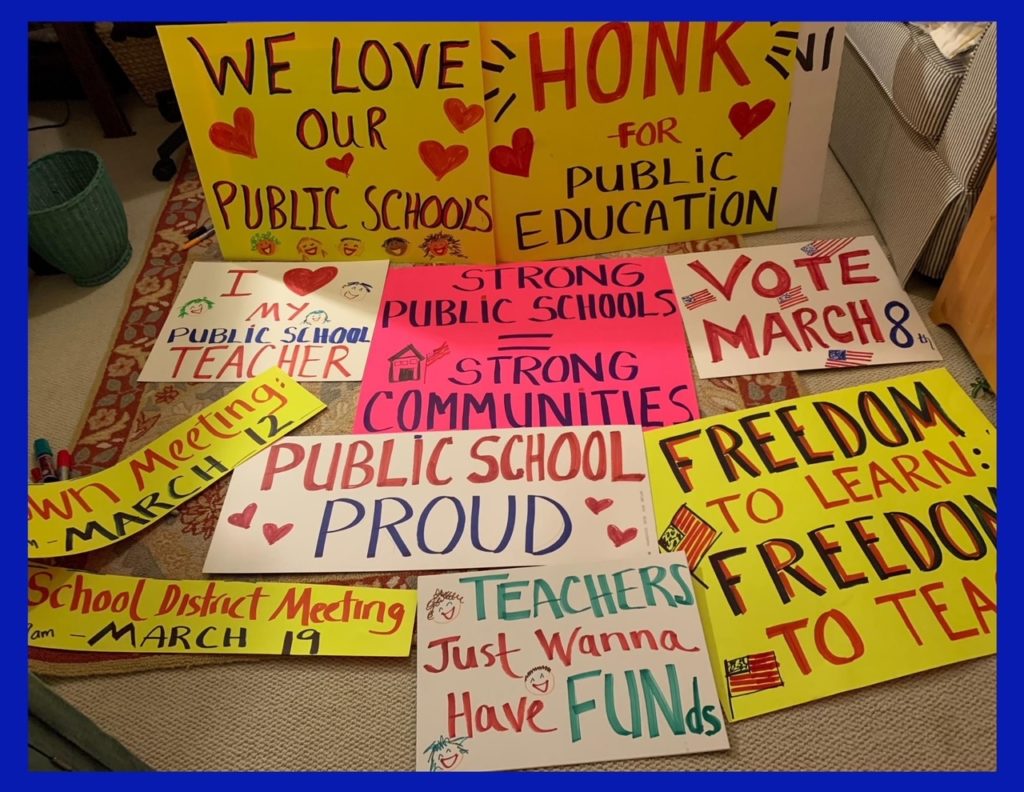
There are three things that privatizers hate: public schools, democracy, and teachers’ unions.

In New Hampshire, the privatizers are on the move.

Jacob Goodwin writes about them in The Progressive:

New Hampshire has a proud tradition of public schools, one that, in some towns, dates back to single-room school houses of early America when students would take horse-drawn sleighs to school in the winter. Our schools—and towns, for that matter—are known for operating largely under “local control,” meaning that school boards are made up of parents and community members and are designed to act as sentinels of democracy, tasked with uplifting the highest civic ideals and aspirations.

Historically, the state has had a limited role in determining how schools are run. Consequently, New Hampshire has provided a minimal amount of school funding. While the concept of local control can be both empowering and a burden of responsibility, students and teachers cannot carry out their important work without adequate funding.

Recently, school privatizers seized curricula as a new front in their pressure campaign against teachers, determined to further squeeze public schools financially. Lacking widespread public support, New Hampshire’s legislature restricted classroom conversations about race and gender in 2021—enacting a law which drew ire for its disproportionate penalties and vague requirements. The confusing act prompted the New Hampshire Department of Justice to issue a statement of guidance, confirming the harsh penalties and doing little to protect teachers from potentially career-ending false accusations. The law has placed additional costs on districts in terms of teacher retention and recruitment, compounding staffing shortages in the profession.

Privatizers advance their damaging agenda by undermining the public confidence in schools. Each teacher that leaves due to the relentless attacks is one less trusted adult for children. And the loss of experienced professionals is a way of further loosening communal ties. Traditional, deliberative decision making of small-town New England is rooted in neighborly relational knowledge, but this is now being undercut. Privatizers only see profits by cutting costs, not the most important thing in schools—the people.

Nationwide, attacking teachers and neighborhood schools has become part of a broader strategy to divert taxpayer money away from public accountability. Profiteering and mismanagement scandals in states like Florida and Pennsylvania warn of the danger of moving decision-making from parent volunteers in the auditorium to executives in corporate board rooms.

Despite the odds, teachers are speaking up for their community schools and mounting legal challenges to unjust laws that seek to erode the essential public good of education. On September 14, the presiding federal judge declared that he would rule on the state’s motion to dismiss a suit brought by a coalition including the state’s largest teachers union within sixty to ninety days. But while the speech-chilling law remains in place, teachers fear stifled classroom discussions and even loss of licensure. And the forces of privatization have continued to stretch the civic fabric of our communities through swiftly changing our state with little public input or oversight.

After failing to pass a stand-alone voucher bill in previous legislative sessions, the state Commissioner of Education shepherded a significant voucher bill through the state legislature and into the budget. He promised that the measure would be limited and require a budget of $130,000 in the first year. In October 2021, however, the voucher law was already costing New Hampshire taxpayers $6.9 million…

Distracting the public from the actual needs of over 90 percent of students who attend public schools is part of the coordinated strategy against local control in New Hampshire. The refusal to address funding adequacy, meaningful mental health support for students, and building maintenance are among the major issues that are seldom addressed.

I was thinking of titling this post “Libertarian Crackpots Take Charge of School Funding in New Hampshire” but decided to bite my tongue.

Garry Rayno, a writer for InDepthNH.org, reports that the Koch-funded plan to defund public schools in New Hampshire is a “success.” Not because most parents want to put their children in private or religious schools, but because the overwhelming majority of students using the new education freedom accounts are already enrolled in nonpublic schools. Thus, public funds are now underwriting private education. At some point, the public schools will shrink to be just one among many choices even though the people of New Hampshire never voted to abandon their community public schools. This is a theft of public dollars for private use.

By GARRY RAYNO, InDepthNH.org 

The new education freedom account program is a success judging by the number of students participating in the first year.

More students are expected to participate in the second year and state education officials predict it will continue to grow into the future.

One of the most expansive school choice programs in the country, it was sold as a way for students and parents to find the best educational avenues to fit their student’s individual learning needs.

That would be wonderful and would fulfill the education department’s long-standing goal of individualized student pathways, but that is not what happened for a majority of students.

Instead the program has increased the state’s education spending while few students changed their learning environment.

The vast majority of students — around 85 percent — participating in the first year, did not attend public schools the year before. Instead they were in private or religious schools, or home schooled, or too young for school.

That does not change the learning environment for that 85 percent of students.

What did change under the program was the parents’ financial obligations, which were reduced thanks to the influx of state taxpayers’ money.

Department of Education Commissioner Frank Edelblut, a program advocate, told lawmakers the first year of freedom accounts would cost the state’s Education Trust Fund about $300,000 and the second year about $3.2 million. Instead the cost was close to $9 million this year.

Why the increase? Edelblut’s estimates were for students leaving traditional public schools to participate in alternative programs, not for those already in other programs applying for state help to cover the costs of private and religious schools, or home schooling.

Essentially most of the state money flowed through the parents to private and religious schools and for homeschooling costs all previously paid for by the parents or religious institutions.

When the program was first debated this term, the nonpartisan Legislative Budget Assistant’s office estimated the state’s exposure could be as high as $70 million if all the students in private or religious schools applied for grants.

The program provides grants to parents of students who earn no more than 300 percent of the federal poverty level or about $80,000 a year for a family of four.

You only have to qualify once, so if the next year your family makes $125,000, you still qualify and if you double that the next year, you still qualify.

Grants range from about $4,500 to $8,000 per student with the average the first year a little under $5,000 per student.

The money can be spent in any number of ways, for tuition, books and instructional programs, supplies, computers, individual instruction on a musical instrument, etc.

The money to pay for the freedom accounts comes from the Education Trust Fund established more than 20 years ago when the state overhauled its funding system after the Claremont II Supreme Court decision saying the then current system of relying on local property taxes with widely varying rates to pay for public education was unconstitutional because it violated the proportional and reasonable clause of the state constitution.

For most of its early years, the trust fund ran a deficit and state general fund money had to be added to meet the state’s education aid obligations.

In recent years the fund has had a surplus including this biennium. The state budget passed last year estimates a $54.4 million surplus at the end of last fiscal year June 30 and a $21 million surplus at the end of the 2023 fiscal year.

The surplus at the end of last fiscal year is much larger than that as the overall state revenue surplus is more than $400 million, but most of that has already been spent through legislation this year such as the $100 million settlement fund for the children abused at the Youth Detention Center.

The law establishing the freedom accounts has a provision if the education fund does not have enough money to cover the cost of the grants, the needed money will be withdrawn from general fund revenue without any action needed from the legislature or the governor.

Such a provision is extremely rare as lawmakers like to be able to determine how general funds are spent.

The number of students participating in the program the first year would probably not be so large if not for the American for Prosperity, an “education organization” funded by the Koch network and other like thinking libertarians who have longed advocated that public education tax money also pay for private and religious schools, homeschooling and charter schools.

The New Hampshire affiliate had a campaign ready to go when the freedom account legislation passed as part of the budget package last year. The group helped parents enroll their students in the program, many who were in private or religious schools or home schooled.

Last week the same organization held an “education fair” for parents to meet representatives of some of the organizations and groups approved to other alternative education programs under the freedom account program.

The fair was promoted by Education Commissioner Frank Edelblut who tweeted a photo from the fair, and the department had a booth there to promote its 603 Moment campaign on social media.

Others touting the fair included members of the House freedom caucus and others in the free state/libertarian wing of the GOP.

The fair is intended to help grow the program, meaning more state money will be drawn from the Education Trust Fund and ultimately the state’s general fund.

This is a well planned operation that only required the state to agree to a school choice program with few guardrails to begin taking the state down the road to greater educational “freedom” and less traditional public education.

The Koch network has recently developed a proposal to “reform” public education with one of its officials calling public education the “low hanging fruit.”

The reform would look a lot like what the freedom account program looks like and would shift resources as it does away from traditional public education to alternative pathways.

As the freedom account program grows, observers of the legislature know what will happen eventually.

As more and more education trust fund money is allocated, there will be pressure to reduce the amount of money going to traditional public education and, depending on which party is in control, to charter schools.

That is how public education becomes the low hanging fruit.

The education commissioner and others talk about the achievement gap between students from well off areas and minority students and those from low-income families.

Edelblut maintains that gap has not changed in 50 years despite numerous efforts on the federal and state level and says that is why education needs to change.

He downplays what the recent education funding commission made the centerpiece of its work, that the achievement gap is due to the resources available to students.

Students from property poor communities perform below students from property wealthy communities.

The economic disparity gap between students from property wealthy and property poor communities is larger now than it was when the Claremont lawsuit was filed 30 years ago.

Proponents of alternative education programs say it is not about spending more money, and the education funding commission said the same thing.

But the commission said the resources needed to be distributed differently, while the advocates for freedom accounts say it is about finding the right fit for a student.

Those advocates are saying the issue is not economic disparity.

Ultimately their goal is to make government smaller and they can accomplish that by disrupting traditional public education with lower cost, less regulated alternative programs.

Eventually traditional education will be small enough to be just one more alternative pathway for students among many.

That is why public education is the low-hanging fruit and freedom accounts are just the beginning.

In 2001, libertarian political scientist Jason Sorens proposed the creation of a “free state.” He appealed to other libertarians to cluster in one small state, where enough of them would be able to eliminate laws and authority and “live free.” That state was New Hampshire, and the libertarians have joined hands with Republicans to impose their agenda on others who don’t share it. Earlier this spring, Free Staters proposed that New Hampshire secede and became an independent nation, but that proposal failed overwhelmingly, in part because enough people realized it was nutty and/or they didn’t want to give up their Social Security.

Dan Barry wrote in The New York Times about an effort by Free Staters in Croydon, New Hampshire, to cut the town’s school budget in half.

As is typical in many towns and cities across the nation, not many people show up for local elections, or in this case, the town meeting. One of the members of the Croydon board of selectmen, Ian Underwood, proposed cutting the town budget for schools by more than half, from $1.7 million to $800,000.

In pamphlets he brought to the meeting, Mr. Underwood asserted that sports, music instruction and other typical school activities were not necessary to participate intelligently in a free government, and that using taxes to pay for them “crosses the boundary between public benefit and private charity.”

The pamphlet did not note that its author was a 1979 graduate of the public high school in Chesterton, Ind., where he starred on the tennis team, ran track, played intramural sports and joined extracurricular activities in math, creative writing, radio and student government. Also: National Honor Society member, National Merit finalist and valedictorian.

One person not completely gobsmacked by Mr. Underwood’s proposal was the school board chairwoman: his wife, Jody Underwood. The Underwoods, who do not have children, moved to Croydon from Pennsylvania in 2007 in part to join the Free State mission; they are now considered a Free State power couple.

Underwood’s radical proposal passed by 20-14. It was a victory for the Free Staters. As the Underwoods did media interviews, they gloated:

Mr. Underwood asked what for him appears to be a fundamental question — “Why is that guy paying for that guy’s kids to be educated?” — and denied that he and his wife were “in cahoots.”

Many people in Croydon were “livid.” They realized this radical act was the result of their indifference.

But they were also chastened. They hadn’t attended the town meeting. They hadn’t fulfilled their democratic obligation. They hadn’t kept informed about the Free State movement. To some observers, they had gotten what they deserved…

From this muddle of anger, confusion and regret, though, a movement was born. It came to be known as We Stand Up for Croydon Students.

Conservatives, liberals and those who shun labels — “an entirely nonpartisan group,” said Ms. Damon, one of the members — began meeting online and in living rooms to undo what they considered a devastating mistake. They researched right-to-know laws, sought advice from nonprofits and contacted the state attorney general’s office to see whether they had any legal options.

They did: Under New Hampshire law, citizens could petition for a special meeting where the budget cut could be overturned — if at least half the town’s voters were present and cast ballots.

Ms. Beaulieu, 44, a project manager for a kitchen and bath store, helped to gather enough signatures for the necessary petition. Once a date in May was set for the special meeting, she and other volunteers spread the word, knocking on doors, conducting phone banks and planting lawn signs…

The crisis in Croydon generated a curious democratic dynamic. Since the law required that at least half the town’s electorate participate in the special meeting’s vote for it to be binding, those trying to overturn the Underwood budget encouraged people to attend, while those hoping to retain it encouraged people to do just the opposite and stay home.

On the chilly Saturday morning of May 7, Croydon residents filed into a spacious building at the local YMCA camp for their special meeting. The We Stand Up contingent needed at least 283 voters.

The turnout: 379.

The vote in favor of overturning the Underwood budget: 377.

The vote against: 2.

The We Stand Up crowd cheered and hugged, leaving Mr. Underwood to vent online with posts titled “Your House Is My A.T.M.” and “Possibly Dumbest Thing I’ve Heard Someone Say, Ever,” and Dr. Underwood to frame the moment as both an impressive voter turnout and a victory for “mob rule.”

“It felt to me like a bunch of woke people came to Croydon,” she said.

What happened in Croydon is a lesson for us all.

Get out and vote.

Do not let the neo-fascists, neo-Confederates, racists, and conspiracy theorists take over.

Fight for democracy or lose it.

What is happening to the America that we swore allegiance to every day in public school? what happened to the America that was “indivisible, with liberty and justice for all”? How did we get a rogue Supreme Court that recklessly demolishes women’s rights, the separation of church and state, gun control, public safety, and efforts by government to prevent climate disasters? Who kidnapped the conservative Republican Party that believed in stability and tradition? From whence came the people who scorn the commonweal and ridicule Constitutional norms?

Former state legislator Jeanne Dietsch has an answer. Connect the dots by looking at what has happened to New Hampshire. The coup failed in Washington, D.C. on January 6, she writes. But it is moving forward in New Hampshire, with many of the same characters and all of the same goals.

If you read one post today, read this.

She writes:

During the last few weeks, US House leaders documented the nearly successful January 6 coup piece by piece, before our eyes. That personal power grab failed. Meanwhile, the steps clinching takeover of our government by radical reactionaries have nearly triumphed. A plan decades in the making. A plan nearly invisible to the ordinary public.


I can barely believe myself how this story weaves from Kansas to Concord to DC to the fields of southern Michigan over the course of six decades. It starts in Witchita. Koch Industries is the largest privately held company in the US, with over $115 billion in revenues, mostly fossil-fuel related. For many years, two of the founders’ sons, Charles and David Koch, each owned 42% of the company.


The younger, David, studied in the engineering department of MIT for 5 years, simultaneous with young John H. Sununu. Both finished their Master’s degrees in 1963.

1980: THE KOCHS SET THEIR GOALS


Seventeen years later, David Koch ran for Vice President of the US on the Libertarian ticket. The campaign was largely funded by Koch interests. The Libertarian platform of 1980, shown below, may look disturbingly familiar to those following news today.

Open her post to read the Koch Libertarian platform of 1980.

Libertarians demanded the abolition of Medicare, Medicaid, Social Security, public schools, aid to children, the Post Office, the Environmental Protection Agency, the Department of Energy, and more.

The infrastructure for achieving that platform was founded two years later. It was called the Federalist Society. It was a plan by a “small but influential group of law professors, lawyers, and judges.” Its goal?

To train members of their professions to believe in “originalism.” Originalists “strictly construe” the Constitution as they believed the Framers designed it way back in 1787. This matched David Koch’s 1980 platform. It would leave corporations free to do whatever profited them most without regard for social costs or regulations. Older Federalist Society members used their influence to advance their followers to higher judgeships.

SUNUNU FAMILY ROLES


Meanwhile, John Sununu became governor of New Hampshire, then Chief of Staff for President George W. Bush. In that role, John thwarted a plan for the US to join the international conference to address climate change in 1989. Actions like this, that benefitted Koch and the rest of the fossil-fuel industry, would become a hallmark of the Sununu family.


In 1993, an executive of Charles and David’s Koch Industries Michigan subsidiary, Guardian Industries, became a founding trustee of the Josiah Bartlett Center for Public Policy [JBC] in NH. Its mission was to advance many of the policies listed on David Koch’s platform of 1980. John Sununu, and later his son James, would chair the JBC board through today. Another of Sununu’s sons, Michael, would become a vocal climate denier and industry consultant. Still another, Senator John E. Sununu, would oppose the Climate Stewardship Act of 2003. But the Sununus were not coup leaders, just complicit.

BUILDING INFRASTRUCTURE FOR THE COUP


But let’s jump back to the Federalist Society. Its mission was succeeding. They were stacking the lower courts.?..Those justices hired young lawyers as clerks. From 1996-97, Thomas employed a Federalist Society clerk named John Eastman.


Twenty-three years later, Eastman would meet secretly with President Donald Trump. He would convince him that Vice President Pence could refuse to accept electoral college ballots on January 6. But back in 1999, Eastman became a senior fellow at the Claremont Institute. “The mission of the Claremont Institute is to restore the principles of the American Founding to their rightful, preeminent authority in our national life.”


Now we’re almost at the secret clubhouse of the coup. The Claremont Institute was run by a fellow regressive named Larry Arnn.(Photo below) In late 1999, Arnn was in the process of replacing the president of Hillsdale College because of a scandal that made national news. Hillsdale promotes conservative family values. Yet its leader was having an affair with his daughter-in-law. She committed suicide. Hillsdale was the central hub for Libertarian radicals so they needed a strong leader to pull them out of the mud.

Please read the rest of this fascinating post. There is one blatant error: she refers to “Clarence Thomas and Stephen Breyer” as Koch justices, but Breyer was a liberal justice appointed by Clinton. She must have meant the crackpot Alito.

Jennifer Berkshire is on a roll. It seems she writes a great article every other day–or is it every day? She has a new article in The Nation about the New Hampshire school board elections. It is titled “How Progressives Won the School Culture War,” but I doubt that the people who won the school board races call themselves “progressives.” I would say they are sane, rational, intelligent citizens who did not want rightwing extremists in charge of their public schools.

She begins:


It wasn’t supposed to turn out this way. For months now, Republican Party leaders have trumpeted their intention to run hard on parent grievances en route to routing the Democrats in the midterms. According to this narrative—partially based on the 2021 elections in Virginia, then endlessly echoed by Democratic pundits—parents frustrated over school shutdowns, Covid restrictions and the focus on race and social justice in schools are the new swing voters, poised to flee the Democratic Party. 

But in New Hampshire, where bitter debates over school masks and “critical race theory” (CRT) have dominated local politics for more than a year, the season of parent rage ended in a stunning sweep of school board elections last week by progressive public school advocates. “It was a complete repudiation of the GOP’s attempt to drive a wedge between parents and schools,” says Zandra Rice Hawkins, executive director of Granite State Progress. Of 30 candidates designated by the group as “pro–public education,” 29 won their races—many in traditionally “red” regions of New Hampshire. Across the state, culture warriors and advocates of school privatization lost to candidates who pledged to protect and support public education.

Instead of resonating with voters, the right’s efforts to weaponize cultural grievances appears to have alienated them. With the GOP poised to make the education culture wars a central focus of its midterm appeal, New Hampshire offers some clear lessons for Democrats.

Michael Boucher chalks up his decision to run for the school board in the southern New Hampshire town of Atkinson to a single word: extremism. Last year, he watched as the debate over local schools grew steadily more rancorous, first over CRT, then masks. Boucher became a regular presence at board meetings, where he noticed that many of the loudest voices weren’t actually from the district. “Suddenly there were all of these groups coming in—the Government Integrity Project, Moms for Liberty, Americans for Prosperity. I realized that if I didn’t step up, one of their people would,” says Boucher.

Boucher, who works as a data analyst for a government contractor, says that he set a goal of talking to as many people in Atkinson as possible about the rising climate of extremism. He found a receptive audience. While the community has long leaned Republican, many voters remain what Boucher calls “classic” GOP. “They want to see tight budgets—but they also want to see opportunities for all kids and a welcoming culture in the schools. There are actually a lot of people who feel that way,” says Boucher. 

He campaigned on the need to teach history honestly against a candidate who ran on opposition to CRT. Boucher won resoundingly, claiming nearly three-quarters of the vote.

And Boucher wasn’t alone. Thirty miles north, in Bow, first-time candidate Angela Brennan, the subject of a Republican mailer calling her “anti-parent” and a “Biden-like progressive,” was the top vote getter in a five-person contest for two seats on the school board.

“All of these attacks on public education really backfired at the local level,” says Molly Cowen, a member of the select board in Exeter, which has also seen acrimonious debates over mask and vaccine mandates and school district diversity policies. In the lead-up to the election, a conservative parents’ PAC spent an estimated $20,000 on mailers making the case that the district’s focus on racial equity had led to a precipitous decline in academic achievement.

Voters in the district, which covers five towns, responded by booting two conservative members off the board and electing a number of pro–public education candidates.

Please open the link and learn how extremism was defeated in New Hampshire.

Tuesday’s school board election in New Hampshire was a triumph for parents and citizens who love their public schools!

This must have shocked Republican Governor Chris Sununu, the Republican-controlled legislature, and State Commissioner Frank Edelblut, who home-schooled his own children and is pushing a sweeping voucher plan for the state.

AfterGlenn Youngkin was elected Governor of Virginia by pandering to parents angry about “critical race theory,” mask mandates, and eager to control what children learned and what books they read, the media bombarded us with stories predicting that Republicans would win next November by running against public schools.

New Hampshire families and citizens said on Election Day, “Not so fast! We love our public schools.”

I Love Public Education Sign Visibility

In first town elections since onslaught of attacks on public education and a honest, accurate education, voters send clear message that they support strong public schools and a honest, accurate education

CONCORD, NH – In race after race across New Hampshire on Town Meeting Day, concerned parents and community members in communities large and small successfully organized to elect pro-public education candidates and reject those seeking to dismantle public education and censor history.

“These results should raise serious doubts about any Republican 2022 election strategy that is built around pitting parents against local public schools and educators,” said Zandra Rice Hawkins, Executive Director of Granite State Progress. “In nearly every school board race, Granite State voters chose out-spoken champions for public education and an honest, accurate, inclusive education. This is a big win for public schools and for our future. These leaders are committed to keeping our public schools strong and making sure every student’s history and experience is valued.”

The results from the election are all the more astounding for record-shattering voter turnout, and for the blatant differences between the candidates on everything from public education, COVID public health measures, and attempts to whitewash American history and censor educators. A priority list of school board results can be found here.

Key examples from around the state:

  • Merrimack Valley School District, home to some of the state’s most vocal anti-vaccine, anti-mask, and classroom censorship activists, experienced a 56% increase in voter turnout from 2019, and supported public education candidates while also defeating a classroom censorship/anti-equity warrant resolution.
  • Bedford experienced a 36% increase in voter turnout and elected pro-public education candidate and teacher Andrea Campbell with 2832 votes, compared to 1293 votes for Sean Monroe, a candidate supported by right-wing organization Defend Our Kids, and 856 for incumbent John Schneller; both of whom supported efforts to censor teachers and ban conversations about race and racism in public schools.
  • Londonderry elected pro-public education candidates Amanda Butcher and Kevin Gray, defeating vocal anti-masker Rachel Killian (seen here harassing school board members during a public meeting). Voters also rejected a warrant resolution to make masks completely optional and the sole decision of parents instead of school leaders and public health experts; a significant decision given Gov. Sununu’s recent decision to ban schools from enacting COVID public health measures like masks.
  • Governor Wentworth School District elected Republican State Rep. Brodie Deschaies over far-right activist Jessica Williams, who believes public schools are indoctrinating students and was arrested at a GWSD school board meeting on September 13, 2021.
  • Weare elected pro-public education candidates William “Bill” Politt and Alyssa Small, and passed full-day kindergarten; and Hollis elected pro-public education candidates Carryl Roy, Krista Whalan, and Holly Babcock.
  • Exeter and SAU 16 elected a full slate of pro-public education and honest education candidates, despite a nearly $20,000 effort by the opposition and months of voter mailings from those who oppose diversity, equity, and inclusion justice efforts in the school districts.

“We are in awe of how our communities have come together to protect and support public education,” said Sarah Robinson, Education Justice Campaign Director for Granite State Progress. “Parents, students, educators, and community leaders have been working for months to organize, recruit strong candidates, and support pro-public education campaigns. Watching the results come in and knowing that so many public education champions are going to be serving in these roles gives us all hope. Our schools have been under constant attack from privatization schemes, neo-Nazi’s, and of course Governor Sununu’s statewide ban on a honest education. We all know that serving on a school board right now is challenging, and we thank these leaders for stepping up for our students. We hope the folks at the State House are paying attention, because this showdown will play out again in November unless they stop the attacks on our public schools.”

The current Republican Party has reverted to the ace card it held in the 1950s: its followers refer to every government program as socialism. SOCIALISM!! This one word is supposed to terrify everyone into fearing that government is about to take away their freedoms. Those politicians who do this should be asked if they are willing to abandon their own right to Social Security and Medicare. One of their favorite targets in recent years is public education. They are trying to persuade the public that their local public schools are socialism. This is nonsense. The following opinion piece by Janet Ward appeared in the Concord Monitor.

A few years ago at a gathering in my town, a fiery speaker said that our government is reaching into our pockets through taxation in order to steal our hard-earned money to pay for programs that are simply giveaways to growing numbers of the “undeserving.” This is not true.

This lie has been created because the former president, the moneyed interests who support him, and the inventors and funders of the “Big Lie” regarding our free and fair 2021 election are painfully aware that the people they wrongly label as the “undeserving” have the right and the power to vote.

Let us be clear. The former president and his supporters are convinced that our democracy itself poses an existential threat to their way of life. They would prefer a plutocracy, a government controlled by the wealthy.

In our democracy, we, you and I, govern ourselves through representation by legitimately elected legislators. Social programs exist because we the people believe that these programs are necessary and appropriate and that such programs, like our public schools, contribute to the common good, to the well-being of our entire society. But an insidious revolution, decades in the making, is bearing terrible fruit.

The long-standing belief that public schools benefit our entire society has been intentionally and successfully undermined through a decades-long strategy organized and executed by such entities as the State Policy Network and the American Legislative Exchange Council (ALEC) which provides templates of legislation to Republican lawmakers in every state to achieve such things as the dismantling of public education. But why target public schools?

Last year the Republican majority in our New Hampshire Legislature voted to approve a school voucher program. It is now legal for public tax dollars to be used to pay for private, religious or home-schooling programs over which we taxpayers have virtually no oversight. When asked why they supported school vouchers, Republican legislators, most of whom had been educated in public schools, said that they believed New Hampshire public school students were being brainwashed by teachers’ unions to believe in socialism. This is not true.

Good government is not socialism. Socialism is a system of government in which the government owns the means of production. Our country is not socialist. It is a capitalist country where individuals or corporations own the means of production and where decisions regarding prices, production and the distribution of goods are based on competition in a free market….

What will happen if Big Lies are allowed to prevail? Our democracy will be destroyed. The perpetrators of these lies will become the governors of our nation, and the dreams of Americans like Jefferson, Madison and Lincoln will die.

The death of our democracy will happen soon, on our watch, unless each of us uses the powerful weapon that our democracy has provided to us — our vote. Remove the liars and manipulators from office. Vote to restore our democracy.

This is good news that few expected.

The New Hampshire legislature, with Republican majorities in both houses and a Republican Governor, tabled a sweeping voucher bill. In hearings, public sentiment was overwhelmingly opposed to vouchers for private schools, religious schools, and home schooling, but Republicans seemed determined to push through their proposal.

The voucher bill was tabled (not passed, put on hold). It could come back for a vote. When I learn more, I will share with you.

This article by a school board member, Janine Lesser, appeared in the Monadnock (NH) Ledger Transcript this morning.

In March 2019, the ConVal School District sued the State of New Hampshire over its ever-decreasing funding. This is the sixth time the state has been sued for avoiding its constitutional mandate to fund an adequate education.

The first lawsuit was in 1993. The New Hampshire Supreme Court struck down state efforts to limit or decrease public school funding in Claremont I, II and III, the 2006 Londonderry, and 2016 Dover cases.

“With recent tweaks to the education funding formula and reductions in funding, many say that towns are at a breaking point. Teacher layoffs, cuts in programming, and even the threat of school closures have pushed the issue…” (Reaching Higher NH, Jan. 7, 2019 “The Big Question for 2019: How Will We Pay for Our Schools?”). And that was three years ago, before COVID. Meanwhile, Gov. Chris Sununu has taken the most-radical approach yet to this decades-long funding deficit. Rather than increase state education funding, as the court instructed, the governor gave large businesses four tax cuts. Meanwhile, he appointed a person with no educational credentials to lead the state’s Department of Education.

Commissioner Frank Edelblut has a master’s degree in divinity and has diverted public funding to non-public schools, mostly religious. When New Hampshire schools faced the pandemic crisis, the commissioner appointed people without experience in school administration to write “guidelines” that came out too late to be of any use to any boards or administrators. The message from the state was clear – you are on your own.

If it weren’t for the financial help from federal relief funds, no district could have survived. But the Department of Education delayed those funds to public schools as long as possible by placing bureaucratic hurdles for district business managers. Meanwhile, Edelblut swiftly sent federal support to non-public schools, barely trying to conceal his disdain for the public school system established by our state’s founders, which has been the great equalizer for Americans since our nation began.  

When thousands of residents signed in against the 2021 Republican EFA voucher bill, the Republican-led legislature hid it in the budget. That let them and the governor establish the most-aggressive voucher program in the United States without further public scrutiny. These “Education Freedom Accounts” have loose limits on eligibility, no government oversight on how taxpayer-funded vouchers are spent and no spending cap. In other states, voucher programs have been rife with fraud. Public school districts, on the other hand, are audited every year and spending is controlled by local taxpayers.

Lack of voucher spending controls became apparent quickly. Edelblut estimated $130,000 for budgeting purposes; the actual cost is now projected at over $7 million, with 10% going to a tiny, unsupervised New Hampshire agency and its Florida financial firm. Why did the budget increase? A Koch-supported lobbying group, Americans for Prosperity, mailed postcards and even canvassed door-to-door to encourage parents to sign up.

Contrary to statements from EFA proponents, such as state Sen. Denise Ricciardi, taxpayers will bear the burden of vouchers. Wealthy communities may expand funding to support all types of schools, but poor towns will have to close schools. New Hampshire now has one of the best public school systems in the nation, but this cannot continue if the state tries to fund ever more schools. Because vouchers are too low to pay most private school tuition, only wealthy families get to choose which school their child attends. If public schools close in poor and rural towns, many children will need to learn remotely, an option that has proven deficient during the forced experiment of the pandemic. 

Meanwhile, thousands of educators and school employees will lose jobs. New Hampshire taxpayers will foot the bill for students’ out-of-state boarding schools and for-profit online schools. In the current session, 175 proposed bills plus 30 retained bills pertain to education, most further eroding communities’ public schools. I differ from Free Staters and the Liberty Caucus promoting these bills. I believe that community is important, and we are stronger when we invest our time and treasure in our community, together.

Our country and communities are at a crossroads. As citizens, we must scrutinize what our governing bodies are deciding in our names. When I questioned Ricciardi about her position on a few of the worst pending bills, I did not receive an answer. 

Through its lawsuit, ConVal has stood up and required the state to pay its constitutional duty to public schools, because local property taxpayers cannot continue to shoulder this unfair system. Sununu’s administration supports vouchers, even though they will cost more, and will fail to provide many children a competitive education for a global economy.

Janine Lesser is a Peterborough representative to the ConVal School Board. She is not writing on behalf of the board.

This is a message from the Network for Public Education Action. New Hampshire Republicans plan to introduce voucher legislation tomorrow, to allow public funds to subsidize students at private and religious schools:

It’s a new year, but the fight is the same. Privatizers are introducing a new voucher variant to infect and collapse state public school systems, and this year the first case is in New Hampshire: HB 607.

Local district vouchers are a new program on top of the statewide voucher program the Legislature forced through budget proceedings at the last minute last year, despite objections from Republicans and Democrats.

This new voucher would give families up to 80% of local tax funding for schools, which could amount to $41,000 per student! These vouchers would have the same lack of oversight as the statewide program, so the opportunities for fraud are tremendous.

Please send your letter today and tell New Hampshire’s policymakers this bill would be an irresponsible, dangerous program for students that would destroy community public schools. Click here to send your email:

Now pick up the phone and call your Representative. You can find them here.

Here is a script you can use:

My name is [your name] and I am calling today to voice my opposition to the new school voucher scheme, HB 607. This irresponsible bill would take money from our public school districts and put it in the hands of private and religious schools as well as homeschoolers. I am asking that [ Representative’s name] oppose this bill and all other voucher bills this session.

This new voucher bill has no income limit for families, allows homeschoolers to take part, thus increasing local tax burdens, and locks in voucher dollar amounts at the highest level by preventing local districts from decreasing voucher amounts even if their funding declines.

Reaching Higher NH noted in their analysis that, “Each superintendent is responsible for calculating their own school district’s local voucher amount, and there is no mechanism for oversight, guidance, or direction from the NH Department of Education or any other public entity. This could leave district leaders, taxpayers, and families applying for the program vulnerable to misinterpretation of the statute’s vague language..”

Our public schools are under assault and the privatizers are not wasting any time. Send your email today.

Read more of Reaching Higher NH’s analysis here: https://reachinghighernh.org/2021/12/17/10-things-to-know-about-hb-607-the-local-school-voucher-program-that-lawmakers-will-vote-on-in-january-and-4-things-we-still-dont-know/

Thanks for all you do,

Carol Burris


Donations to NPE Action (a 501(c)(4)) are not tax deductible, but they are needed to lobby and educate the public about the issues and candidates we support.