Archives for category: Network for Public Education

Tom Ultican had a successful career in the private sector when he made a decision that changed his life: He became a teacher of physics and advanced mathematics in California. After he retired, he became blogging about education. He became one of the most perceptive investigators of the powerful people and dark money behind the organized attacks on public schools.

I am delighted to present his review of my just-published memoir, titled AN EDUCATION: HOW I CHANGED MY MIND ABOUT SCHOOLS AND ALMOST EVERYTHING ELSE (Columbia University Press).

I am posting a portion of his review here. I encourage you to open the link and finish his fine commentary.

He wrote:

An Education; How I Changed My Mind About Schools and Almost Everything Else, is highly recommended especially for the thousands of us who consider her a friend. Diane is a very generous person with both her time and resources. I first met Diane through her blog in 2014, then in person at the 2015 NPE conference in Chicago. It was in this time period that she started posting some of my articles on her blog while simultaneously informing me about who was working to destroy public education. At the time, I did not realize what a privilege this was. Her latest book is an intimate memoir that introduces us to Diane Rose Silverstein of Houston, Texas born July 1, 1938. It tells the story of a Jewish Texan from of large struggling family becoming politically influential and a national treasure.

On a page following the dedication page, she quotes Ralph Waldo Emerson:

“Foolish consistency is the hobgoblin of little minds, adored by little statesmen and philosophers and devines.”

I knew that Diane had made a big change and reversed herself on test based accountability and other school reform agendas driven by conservatives and neoliberals. However, the courage this change took and the depth of her reversal were profoundly illuminated by reading this book.

Although growing up in a Roosevelt supporting family and being a registered Democrat, she became deeply conservative. Diane served on the board of the Thomas B. Fordham foundation, contributed to the Manhattan Institute and was a member of the Koret Task Force with the likes of Eric Hanushek and E. D. Hirsch Jr. Her best friends personally and politically all supported the ideas she abandoned. By reversing herself, she walked away from professional security and long held personal friendships. It was courageously principled but must have been a personally daunting move.

Me and Diane

The best part of “An Education” for me was Diane’s recounting growing up in Houston and going to a segregated public school. Her experience was just so relatable. She liked all the music my oldest sister liked. Cheating was rampant in her school just like mine and like her; I let my classmates copy my work. My rural Idaho school was kind of segregated but that was because only white people and a few Mexican families lived in the community. The Mexican kids were very popular in our school. I never met a Black person until I was a senior in high school and had only seen a few through a car window when vacationing in Kansas City. It was wonderful to find some commonalities.

I had studied engineering, worked in Silicon Valley and pretty much ignored education. But I did hear from Diane and her friends about what a failure public education had become. By 1999, I became tired of hearing about people becoming rich off their stock options, working on the next greatest hard drive or dealing with the atrocious San Jose traffic. I decided to return to San Diego and do something to help public education by enlisting in a master of education program at the University of California San Diego (UCSD).

The UCSD program was oriented toward constructivist education which I really liked. I read books by Alfie Kohn and papers by Lisa Delpit and was ready to revolutionize public education. Then I got to my first job at Bell Jr. High School and discovered that the teachers there were well informed pros with lots of experience. By comparison, I was not nearly as competent as most of them.

It was then that I started to see that I had been bamboozled about how bad public schools were and started looking for like minded people. Two books, David Berliner’s and Eugene Glass’s “50 Myths and Lies that Threaten America’s Public Schools” and Diane Ravitch’s “The Death and Life of the Great American School System” were like water for the thirsty. Soon after that, I found Diane’s blog and joined the Network for Public Education (NPE) along with many other public school advocates.

I saw Diane at the 2015 NPE conference in Chicago’s Drake Hotel. It was an absolutely inspiring event with a keynote by the amazing Yong Zhao. Although we started communicating a little by email, I did not meet Diane personally until NPE 2016 in Raleigh, North Carolina. It was there that the Reverend William Barber gave a truly inspiring speech.
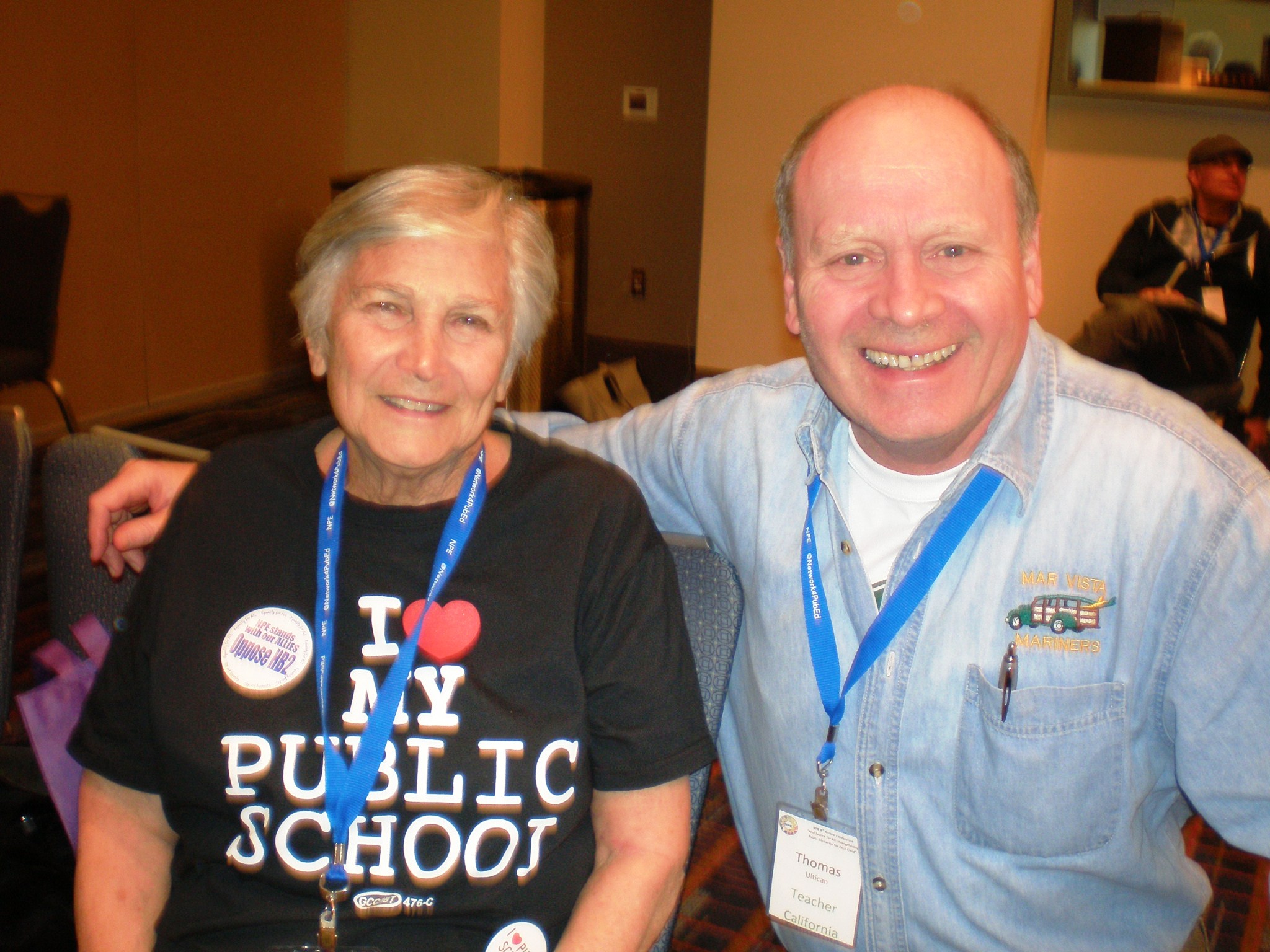
Tom Ultican and Diane Ravitch in Raleigh (by Ultican)

Please open the link and keep reading this excellent review!
Carol Burris, executive director of the Network for Public Education, points out that the once promising charter school industry is now in decline. Fifteen years ago, promoters of charter schools boasted of charter school miracles, of closing achievement gaps and saving poor kids who were “stuck in failing public schools.”

The charter industry lobby won federal funding for charter school expansion. Bill Gates put millions into charters and subsidized a propaganda film to sell the public on the remarkable success of privately run charter schools.

But the miracle dissolved. Some of the “best” charters were selecting their students carefully and/or dropping students who fell behind. Many charters failed. Others folded. Some closed because of low enrollment. Some closed because their owners were corrupt. it’s not a lack of money. The federal government is now pouring $500 million every year into charter growth.

The movement is in decline because the magic is gone.

Carol Burris wrote about the decline of the charter industry in The Progressive:

Thirty years ago, charter schools stood for possibility. At their inception in the 1990s, they were supposed to be nimble, innovative, community-driven alternatives to traditional public schools—labs of experimentation led by teachers and grounded in equity. But in 2025, the movement finds itself at a turning point, not because it succeeded, but because it strayed too far from its original vision.

The first installment of a new report, titled “Charter School Reckoning: Decline, Disillusionment, and Cost,” by the National Center for Charter School Accountability (NCCSA) lays bare a system in decline. Closures are accelerating. Enrollment is stagnating. And beneath the rhetoric of “choice” and “opportunity,” a harsh reality has emerged: a sector in retreat, propped up by unchecked federal funding and powerful lobbying interests.

In the first six months of 2025 alone, fifty charter schools announced their closures. Some disappeared with less than a week’s warning. These schools join more than 160 others that vanished during the previous year. Between school years 2022-23 and 2023-24, the number of charter schools in the United States increased by only eleven. Last September, North Carolina’s Apprentice Academy closed days after opening for the school year. Ohio’s Victory Charter gave families two weeks’ notice. In Minnesota and Texas, charter schools folded before winter break. And last month, just weeks before the new school year was set to begin, yet another charter school in Colorado closed its doors. 

And yet, federal investment in the charter school industry hasn’t skipped a beat. The U.S. Department of Education’s Charter Schools Program (CSP), created in 1994 to provide seed money to start charter schools, began with a modest $4.5 million. It now burns through half a billion taxpayer dollars a year. Much of that money is awarded by private contractors who are paid to review applications who provide minimal vetting. Their decisions are based solely on what’s written in grant applications—inviting exaggerated claims and even fiction. One 2022 federal audit found that nearly half the schools promised by Charter Management Organization grant recipients never materialized.

Even more troubling, many of the charter schools that have opened with the help of CSP funding have collapsed. The NCCSA report notes that of the fifty closures so far in 2025, nearly half had received a combined $102 million in federal start-up and expansion grants, according to a search of U.S. Department of Education and state databases.

So why does the funding from the federal government continue to flow? One reason is a myth that refuses to die: the million-student waitlist to get into charter schools. This talking point, originally peddled in 2013 by the National Alliance for Public Charter Schools, resurfaced in June 2025 by U.S. Education Secretary Linda McMahon during a Senate hearing. But the figurewas debunked more than a decade ago.

The stark truth is that demand for charter schools is often overestimated. Low enrollment is the number one reason charters shut down. A 2024 study by NCCSA and the Network for Public Education found that nearly half of all charter school closures between 2022 and 2024 were due to insufficient enrollment. Of the fifty closures in the first half of 2025, twenty-seven cited low enrollment as the primary cause.

Consider Florida’s Village of Excellence Academy, which closed with just one day’s notice in January 2025. Its enrollment had fallen from 230 in 2020 to just seventy-eight students. The school is not an anomaly. In 2023-24, 12 percent of all charter schools enrolled fewer than 100 students. 

Meanwhile, at the other extreme, mega-charters such as Commonwealth Charter Academy (CCA) in Pennsylvania have student populations that are ballooning beyond reason. CCA, a virtual charter school with students across Pennsylvania, now enrolls more than 23,000 students—making it the largest K-12 school in the country. It spent nearly $9 million on advertising in the 2022-23 school year alone and $196 million on real estate since 2020—for a cyber school that delivers its instruction without the need for brick-and-mortar buildings. But student outcomes are dismal: just 11 percent proficiency in English, 4.7 percent proficiency in math, and a graduation rate far below the state average.

Then there’s Highlands Community Charter in California, a school that billed itself as a second chance for adults but instead became a case study in fraud. According to a state audit, Highlands took more than $180 million in funding to which it was not eligible and spent the money inappropriately. The school paid $80,000 for staff to attend a conference at a luxury hotel in Hawaii. Teachers were also employed without proper credentials, often because there was only one teacher for every fifty-one students. Graduation rates were between 2 and 3 percent. Following the audit, the entire board has resigned in disgrace and the state has requested a $180 million reimbursement.

This is not innovation. It’s exploitation of taxpayers and at-risk students.

And yet, federal dollars continue to pour into this shrinking, scandal-prone industry. Policymakers invoke waitlists that don’t exist. Authorizers, who are supposed to oversee charter schools, look the other way, incentivized by per-pupil funding kickbacks. Taxpayers are footing the bill for schools that fail to open, fail to serve, or fail to survive.

The question is no longer what charter schools were once meant to be. It’s whether the sector can be reformed at all. As Congress considers the next education budget, we urge lawmakers to ask: Why are we funding growth that isn’t happening? Why are we subsidizing failure? It’s time to stop chasing the ghost of what charter schools might have been—and start holding the system accountable for what it has become.

The National Center for Charter School Accountability, which is a project of the Network for Public Education, released the first of a three-part series of a national report on the decline of the charter school sector.

Written by NPE Executive Director Carol Burris, the report will be released in three sections. The first one, Decline, documents the startling halt in charter school growth. Once heralded as the salvation of American education, charter schools are no longer growing. Despite the lack of demand for new charters, the Trump administration recently increased the annual appropriation to the federal Charter Schools Program from $440 million every year to $500 million a year.

The report will be released in three parts: Decline, Disillusionment, and Costs. This is the first part.

Burris begins:

In 1992, City Academy — the nation’s first charter school — opened in St. Paul, Minnesota. Created and led by experienced teachers, it was designed as an alternative school for students struggling in traditional settings. With just 53 students, City Academy embodied the original vision for charter schools: small, teacher-run schools within public districts that tested innovative strategies to reach hard-to-teach kids.

When successful, those strategies would inform and strengthen public education as a whole.

That was the idea supported by American Federation of Teachers President Al Shanker in 1988.

But by the early 1990s, Shanker had become disillusioned. As his wife Edith later explained, “Al became increasingly critical of charter schools as they moved further from their original intent.

He warned that without well-crafted legislation and public oversight, business interests would hijack the charter school concept, ‘whose real aim is to smash public schools.’”

His warning proved prophetic. In the decades since, real estate investors, for-profit management companies, and corporate charter chains have taken over what began as teacher-led experiments. Today, more than fifty charter trade associations—some state-based, others national—lobby aggressively to block charter school oversight and resist any legislative reform. The National Alliance for Public Charter Schools reported over $26.5 million in income in 2023, with more than $28 million in assets. The California Charter Schools Association reported nearly $13 million in revenue that same year. These organizations are not only advocates but powerful lobbyists, intent on protecting all existing charters and promoting unlimited growth.

During the Obama years, federal initiatives like Race to the Top fueled charter expansion with strong bipartisan support. But that coalition has since un-raveled. While Republican enthusiasm for any alternative to public education— charters, vouchers, homeschools — has surged, Democratic support has eroded, particularly as concerns grow over transparency, equity, and privatization.

Today, the charter sector stands at a reckoning point. Growth has slowed.

For-profit models are expanding. The push to create religious charter schools has fractured the movement from within. Meanwhile, charters are now competing not just with public schools and each other, but with a growing network of voucher-funded private schools and publicly subsidized homeschools.

This report, released in three parts — Decline, Disillusionment, and Costs —examines the trajectory of the charter school movement. It contrasts the promise of its early days with its complex, often troubling reality today.

As the charter experiment enters its fourth decade, the question is no longer what charter schools were meant to be — but whether they can still be reformed in order to serve the public good….

Burris questions why the federal government–which claims to be cutting costs and cutting unnecessary programs–continues to send $500 million every year to a sector that is not growing and does not need the money. DOGE eliminated most employees of the U.S. Department of Wducation but left the federal Charter Schools Program untouched.

The charter school sector stands at a critical juncture. Once heralded as a bold experiment in innovation and opportunity, it is now characterized by stagnation, retrenchment, and rising school closures. Between 2022 and 2025, growth has nearly halted, and closures — often sudden and disruptive— are accelerating. Federal investment, rather than adapting to the sector’s shifting realities, has ballooned to half a billion dollars annually, funding schools that never open, quickly fail, or operate with minimal oversight and accountability.

As the data show, under-enrollment is the primary driver of failure. There is no crisis of unmet demand. Hundreds of charter schools, according to NCES data, can’t fill even a single classroom. The frequently cited “million-student waitlist” has been thoroughly debunked, yet continues to be invoked to justify ever-increasing taxpayer support.

Meanwhile, mega-charters and online schools like Commonwealth Charter Academy siphon vast sums of public dollars while delivering dismal academic outcomes. Others, like Highlands Community Charter School, have defrauded taxpayers and exploited students under the guise of second chances.

With enrollment stagnating and oversight failing, taxpayers should ask: Why are we continuing to fund with federal dollars an expansion that isn’t happening? It is time for Congress and the Department of Education to reassess the Charter Schools Program. Federal dollars should no longer subsidize a shrinking and troubled sector. Instead, they must be redirected toward accountable, transparent, and student-centered public education.

Part II of this report, Disillusionment, to be published this fall, will further explain the reasons behind the sector’s decline.

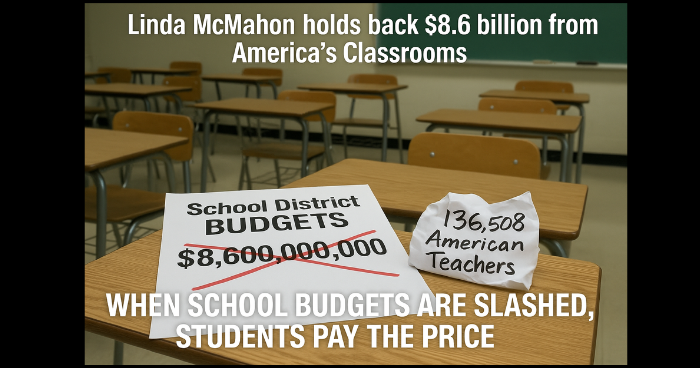
Secretary of Education Linda McMahon has frozen $8.6 billion that Congress appropriated for students this summer. The Administration is supposed to spend the money that Congress authorized and appropriated, not withhold it.

Write Secretary McMahon NOW.

The Network for Public Education urges you to take action!

Open the link and fill out the form to lodge your protest.

#RELEASEFUNDS4SCHOOLS

Just weeks before the school year begins, Secretary of Education Linda McMahon is refusing to release $8.6 billion in federal funds that Congress approved for public schools.

This is more than a funding freeze—it’s a test run for permanent cuts. And unless we act now, our schools will pay the price. Send your letter to Linda McMahon.

2. Email Congress. Even if you’ve written before, send another message.

3. Call the U.S. Department of Education: 1-800-647-8733. Press 5 to report a violation of law regarding the lack of disbursement of approved federal funds by the U.S. Department of Education.  You can leave a message. 

#ReleaseFunds4Schools

TAKE ACTION

FIRST NAME *

LAST NAME *

EMAIL *

STREET ADDRESS *

CITY *

ZIP/POSTAL CODE *

Not in US?

  • Opt in to email updates from Network for Public Education 

Network for Public Education

P.O. Box 227
New York, New York 10156

info@networkforpubliceducation.org
(646) 678-4477

We are a 501 (c)(3). Please make a tax deductible donation to the Network for Public Education.

EIN 35-2532243

Open the link and add your name!!

Secretary of Education Linda McMahon released her budget proposal for next year, and it’s as bad as expected.

Carol Burris, executive director of the Network for Public Education, reviewed the budget and concluded that it shows a reckless disregard for the neediest students and schools and outright hostility towards students who want to go to college.

We know that Trump “loves the uneducated.” Secretary McMahon wants more of them.

Burris sent out the following alert:

Image

Linda McMahon, handpicked by Donald Trump to lead the U.S. Department of Education, has just released the most brutal, calculated, and destructive education budget in the Department’s history.

She proposes eliminating $8.5 billion in Congressionally funded programs—28 in total—abolishing 10 outright and shoving the other 18 into a $2 billion block grant. That’s $4.5 billion less than those 18 programs received last year.

Tell Congress: Stop McMahon From Destroying Our Public Schools

And it gets worse: States are banned from using the block grant to support the following programs funded by Congress:

  • Aid for migrant children whose families move frequently for agricultural work
  • English Language Acquisition grants for emerging English learners
  • Community schools offering wraparound services
  • Grants to improve teacher effectiveness and leadership
  • Innovation and research for school improvement
  • Comprehensive Centers, including those serving students with disabilities
  • Technical assistance for desegregation
  • The Ready to Learn program for young children

These aren’t just budget cuts—they’re targeted strikes

McMahon justifies cutting support for migrant children by falsely claiming the program “encourages ineligible non-citizens to access taxpayer dollars.” That is a lie. Most migrant farmworkers are U.S. citizens or have H-2A visas. They feed this nation with their backbreaking labor.

The attack continues for opportunity for higher education:

  • Pell Grants are slashed by $1,400 on average; the maximum grant drops from $7,395 to $5,710
  • Federal Work-Study loses $1 billion—an 80% cut
  • TRIO programs, which support college-readiness and support for low-income students, veterans, and students with disabilities, are eliminated
  • Campus child care programs for student-parents are defunded

In all, $1.67 billion in student college assistance is gone—wiped out on top of individual Pell grant cuts. 

Send your letter now

And yet, McMahon increased funding for the federal Charter Schools Program to half a billion dollars for a sector that saw an increase of only eleven schools last year. Meanwhile, her allies in Congress are pushing a $5 billion private school and homeschool voucher scheme through the so-called Educational Choice for Children Act (ECCA).

And despite reducing Department staff by 50%, she only cuts the personnel budget by 10%.

This is not budgeting. It is a war on public education.

This is a blueprint for privatization, cruelty, and the systematic dismantling of opportunity for America’s children.

We cannot let it stand.

Raise your voice. Share this letter: https://networkforpubliceducation.org/tell-congress-dont-let-linda-mcmahon-slash-funding-for-children-college-students-and-veterans-to-fund-school-choice/  Call Congress.

Let Congress know that will not sit silently while they dismantle our children’s future.

Thank you for all you do,

Carol Burris

Network for Public Education Executive Director

Denis Smith retired from his position at the Ohio Department of Education, where he oversaw charter schools (which are called “community schools” in Ohio). In this post, he describes what he saw at the Network for Public Education Conference in Columbus, Ohio, in early April.

He wrote:

When It’s About Hands Off! That Also Applies to Public Schools

The Hands Off! demonstrations at the Ohio Statehouse that drew thousands of protestors wasn’t the only gathering of activists last weekend in downtown Columbus. Just a short distance away at the Hyatt Regency Hotel, a smaller but equally passionate gathering of concerned citizens from across the nation came to Ohio’s capital city to attend the Network for Public Education’s National Conference and affirm their support for the common school, the very symbol of democracy in this increasingly divided nation.

That disunion is driven in part by the rapid growth of universal educational vouchers and charter schools, where public funds flow to private and religious schools as well as privately operated charter schools and where public accountability and oversight of taxpayer funds is limited or even absent. In many states, including Ohio, those public funds in the form of vouchers are drawn from the very state budget line item that is earmarked for public schools.

Of particular concern to the conference attendees is the division in communities fueled by vouchers, which have been shown in some states to subsidize private and religious school tuition exceeding 80% of those enrolled. In Ohio, according to research conducted by former Ohio legislator Stephen Dyer, the figure is 91%.Several speakers referred to this situation as “welfare for the rich” and “an entitlement for the wealthy.” 

The research shared at the conference also confirmed the findings of the National Coalition for Public Education that “most recipients of private school vouchers in universal programs are wealthy families whose children never attended public schools in the first place.” So much for the tired Republican rhetoric of vouchers being a lifeline of escape from “failing schools” for poor inner-city children.

Another strong area of concern shared at the NPE event was the growing intrusion of religious organizations like Life Wise Academy which recruit students for release time Bible study during the school day. While attendees were told that school guidelines direct that such activities are to be scheduled during electives and lunch, the programs still conflict with the normal school routine and put a burden on school resources, where time is needed for separating release time students and adjusting the instructional routine because of the arrival and departure of a group within the classroom.

One presenter, concerned about students receiving conflicting information, said that his experience as a science teacher found situations where there was a disconnect between what he termed “Biblical stories and objective facts.” In addition, he shared that a group of LifeWise students missed a solar eclipse because of their time in religious instruction.  

Some Ohio school districts, including Westerville and Worthington in Franklin County, had to amend their policies in the wake of HB 8, which mandated that districts have religious instruction release time policies in place. The district policies had been written as an attempt to lessen the possibility of other religious programs wanting access to students and the further disruption that would cause to the school routine. 

The recent legislative activity about accommodating religious groups like Life Wise is at variance with history, as conference chair and Network for Public Education founder Dr. Diane Ravitch pointed out in her remarks about the founding of Ohio. As part of the Northwest Territory, she noted that Ohio was originally divided into 32 plots, with plot 16, being reserved for a public school. No plot was set aside for a religious school.

Ohio became the first state to be formed from the Northwest Territory, and its provision for public education would become a prototype for the young republic. The common school, an idea central to the founders of the state, would be located such “that local schools would have an income and that the community schoolhouses would be centrally located for all children.”

Unfortunately, the idea of the common school being centrally located in every community is an idea not centrally located within the minds of right-wing Republican legislators. From the information exchanged at the conference, that is the case in the great majority of statehouses, and a matter of great concern for continuing national cohesiveness.

The theme of the NPE National Conference, Public Schools – Where All Students Are Welcome, stands in marked contrast with the exclusionary practices of private and religious schools where, unlike public schools, there are no requirements to accept and enroll every student interested in attending. While these schools are reluctant to accept students who may need additional instructional support, they show no reluctance in accepting state voucher payments.

Texas Rep. Gina Hinojosa. Photo: Texas House of Representatives

Texas State Representative Gina Hinojosa, one of the keynote speakers, told the audience about her experience in fighting Gov. Greg Abbott’s voucher scheme and the double meaning of the term school choice. “School choice is also the school’s choice,” she told the audience, as she estimated that 80% or more of state funds will go to kids who are already enrolled in private and religious schools.

Her battle with the Texas governor, who has defined the passage of voucher legislation in the Lone Star State as his “urgent priority,” is a tale of his alliance with Jeff Yass, a pro-voucher Pennsylvania billionaire who has donated $12 million so far to Abbott’s voucher crusade. 

Hinojosa was scathing in her criticism of Abbott and his fellow Republicans and of a party that once “worshipped at the altar of accountability.” Now, she told the attendees, “they want free cash money, with no strings attached.” 

“Grift, graft, and greed” is the narrative of appropriating public funds for private purposes, Hinojosa believes, a tale of supporting “free taxpayer money with no accountability.”

Minnesota Gov. Tim Walz. Photo: Denis Smith

The NPE conference ended with an address by Minnesota Gov. Tim Walz, the 2024 Democratic Vice-Presidential nominee. With his background as a former teacher and coach, Walz had a strong connect with an audience comprised mostly of educators and public school advocates. His folksy language and sense of humor further endeared him to the conference attendees.

Based on the continuing bad behavior of Jeff Yass and other affluent actors in the voucher and charter wars, greedy bastards is a better descriptor than oligarchs, he observed. From the reaction of the audience and what they heard previously from Gina Hinojosa and other presenters, the language offered by Walz was a more accurate definition of welfare for the wealthy. 

At the end of his remarks, Walz encouraged educators not to despair but to accept their key place in society. “There is a sense that servant leadership comes out of serving in public education.”

Attendees at the NPE conference included educators, school board members, attorneys, legislators, clergy, and policy makers – a cross-section of America. Their presence affirmed a core belief that the public school, open to all, represents the very essence of a democratic society. And there is no debate about whether or notthose schools are under attack by right-wing legislatures intent on rewarding higher-income constituents with tuition support to schools that choose their students as they exercise the “school’s choice.”(As a devotee of the Apostrophe Protection Society, I applaud this distinction.)

So what are we going to do about this? Attendees left the conference with some strong themes.

The choir needs to sing louder.

Hope over fear. Aspiration over despair.

The road to totalitarianism is littered with people who say you’re overreacting.

Who are the leaders of the Democratic Party? They’re out there. On the streets.

It’s not just don’t give up. Be an activist.

As the loudness about the subject of what is more aptly described as “the school’s choice” gets louder,” you can bet that servant leaders like Diane Ravitch, Gina Hinojosa, Tim Walz and others are making a difference in responding to the challenge of servant leadership to ensure that the common school, so central to 19th century communities in the Northwest Territory and beyond, continues to be the choice of every community for defining America and the democracy it represents.


Nancy Flanagan is a retired veteran teacher. Her blogs are always insightful because she sees the issues from the perspective of her long career in the classroom. In this post, she explains why some conferences work and some don’t. She wrote it after returning home from the Network for Public Education conference.

She writes:

I am just back from the Network for Public Education conference, held this year in Columbus, Ohio. Columbus is an eight-hour drive from my house, and we arrived at the same time as ongoing flood warnings. But—as usual—it was well worth the time and effort expended.

For most of my career—35 years—I was a classroom teacher. Garden-variety teachers are lucky to get out of Dodge and attend a conference with their peers maybe once a year. Teachers don’t get airfare for conferences in other states and often end up sharing rides and rooms, splitting pizzas for dinner. They go with the intention of getting many new ideas for their practice toolboxes—lesson plans, subject discipline trends and tips, cool new materials—and to connect with people who do what they do. Be inspired, maybe, or just to commiserate with others who totally get it.

In the real world (meaning: not schools), this is called networking. Also in the real world—there’s comp time for days missed at a weekend conference, and an expense form for reimbursements. Conversely, in schools, lucky teachers get a flat grant to partially compensate for registration, mileage, hotel and meals. In many other schools, nobody goes to a conference, because there’s just not enough money, period.

When you hear teachers complaining about meaningless professional development, it’s often because of that very reason—there’s not enough money to custom-tailor professional learning, so everyone ends up in the auditorium watching a PowerPoint and wishing they were back in their classrooms.

Back in 1993, when Richard Riley was Secretary of Education, his special assistant, Terry Dozier, a former National Teacher of the Year, established the first National Teacher Forum. (In case you’re wondering, the Forums lasted just as long as the Clinton administration, and Riley, were in the WH.) Teachers of the Year from all 50 states attended. The purpose of the conference was to engage these recognized teachers in the decision-making that impacted their practice. In other words, policy.

It was probably the most memorable conference I ever attended. I took nothing home to use in my band classroom, but left with an imaginary soapbox and new ideas about how I could speak out on education issues, engage policymakers, and assign value to my experience as a successful teacher. The National Teacher Forum literally changed my life, over the following decades.

But—the idea that teachers would start speaking out, having their ideas get as much traction as novice legislators’ or Gates-funded researchers, was a hard sell. Education thinkers aren’t in the habit of recognizing teacher wisdom, except on a semi-insulting surface level. In the hierarchy of public education workers, teachers are at the lowest level of the pyramid, subject to legislative whims, accrued data and faulty analyses, and malign forces of privatization.

Which is why it was heartening to see so many teachers (most from Ohio) at the NPE conference. The vibe was big-picture: Saving public education. Debunking current myths about things like AI and silver-bullet reading programs. Discussing how churches are now part of the push to destabilize public schools. New organizations and elected leaders popping up to defend democracy, school by school and state by state.  An accurate history of how public education has been re-shaped by politics. The resurgence of unions as defenders of public education.

Saving public education.  A phrase that has taken on new and urgent meaning, in the last three months. Every single one of the keynote speakers was somewhere between on-point and flat-out inspirational.

Here’s the phrase that kept ringing in my head: We’re in this together.

The last two speakers were AFT President Randi Weingarten and MN Governor Tim Walz. I’ve heard Weingarten speak a dozen times or more, and she’s always articulate and fired-up. But it was Walz, speaking to his people, who made us laugh and cry, and believe that there’s hope in these dark times.

He remarked that his HS government teacher—class of 24 students, very rural school—would never have believed that Tim Walz would one day be a congressman, a successful governor and candidate for Vice-President. It was funny—but also another reason to believe that public schools are pumping out leaders every day, even in dark times.

In an age where we can hear a speaker or transmit handouts digitally—we still need real-time conferences. We need motivation and personal connections. Places where true-blue believers in the power of public education can gather, have a conversation over coffee, hear some provocative ideas and exchange business cards. Network.

Then go home–and fight. 

Last weekend, the Network for Public Education hosted its conference in Columbus, Ohio. Since our first conference in 2013 in Austin, everyone has said “this is the best ever,” and they said it again on April 7.

The attendees included the newly re-elected State Superintendent of Schools in Minnesota, Jill Underly. The Democratic leader of the Texas House Education Committee, Gina Hinojosa. Numerous teachers of the year from many states. Parent leaders from across the nation.

The Phyllis Bush Award for grassroots organizing was won by the Wisconsin Public Education Network, a parent-led group, who have stood firm for their public schools.

The David Award for the individual or group who courageously stands up to powerful forces on behalf of public schools and their students was won by Pastor Charles Johnson of Pastors for Texas Children, whose organization has fought against Governor Greg Abbott and the billionaires who want to impose vouchers, despite their failure everywhere else and the harm they will wreak on rural schools.

The last speaker was Tim Walz, Governor of Minnesota and former Democratic candidate for Vice President in 2024. He was warm, funny, and inspiring.

Nearly 400 educators attended the conference from all across the nation, and everyone stayed to hear Governor Walz, who was wonderful. In time, I will post videos of the main presentations, including his. April 7 was his birthday, and it was too late to get a birthday cake. But two veteran educators left the hotel to find a bakery and returned with a cake.

I introduced Randi Weingarten and reminded the audience that Mike Pompeo had called her “the most dangerous person in the world,” which she should wear as a badge of honor.

Randi gave a rip-roaring speech that brought the audience to its feet. She presented Governor Walz with his birthday cake and everything sang “Happy birthday.”

He was fabulous. He was supposed to slip away at the end of his speech, through a private back door but someone caught up with him and asked for a selfie. Of course, he obliged. Within minutes, it appeared that at least 250 or more people were standing in line for a selfie. He did not leave. He signed autographs and posed for selfies with everyone who wanted one.

He is humble, self-effacing, has a crackling dry wit, and is most definitely a people person.

In the opening session on Friday night, I engaged in a Q & A with Josh Cowen about his recent book: The Privateers: How Billionaires Created a Culture War and Sold School Vouchers. Again, the room was overflowing. Josh was excellent at explaining the terrible results of vouchers and how they turned into a subsidy for wealthy families. Why do politicians continue to promote them. The billionaire money is irresistible.

The panels were fabulous. I participated in one about the close link between public schools and democracy. The room was packed, and we had people lining the walls. A panel led by Derek Black, law professor at the university of South Carolina, and Yohuru Williams, dean of the University of Saint Thomas in St. Paul, talked about the history of Black education, inspired by Derek’s new book Dangerous Learning: The South’s Long War on Black Literacy.

Here is the first report on the conference by Leonie Haimson, including a video clip of Randi presenting the birthday cake to Governor Walz and the audience singing “Happy Birthday” to him.

Public schools are in the crosshairs of the Trump Administration. The fact that they have failed matters not at all to religious zealots and libertarians. The fact that they bust state budgets doesn’t matter. The fact that they are a subsidy for rich families doesn’t matter. Those rich families will vote for the politicians who gave them a gift.

The urgency of standing up for public schools, defending their teachers, protecting their students, and fighting censorship of books and curriculum has never been more important than now.

The Network for Public Education is committed to stand up for kids, teachers, public schools, and communities. .

The Network for Public Education works with scores of state and local grassroots groups that want to protect and strengthen public schools. Almost 90% of out nation’s children attend public schools. We are fighting libertarian billionaires and religious zealots who want to dumb down and indoctrinate our children. Above all, they want to cut their taxes by undereducating our children.

We just added a new partner!

The Network for Public Education congratulates Our Schools Our Democracy (OSOD), a new partner in our work to protect, defend, and improve public schools. Its comprehensive research exposes the harm charter schools do to Texas Public Schools and serves as a blueprint for reforming charter school laws not only in Texas but in every state.

OSOD will focus on fighting school privatization in Texas, with a special emphasis on the impact of charter schools. According to their website, “Texas public schools, governed by locally elected school board members, are the cornerstone of our democracy and the heart of our neighborhoods. However, since state lawmakers first authorized open-enrollment charter schools 30 years ago, unchecked charter expansion has harmed public school districts in every corner of the state.”

Along with the organizational launch is the launch of a comprehensive report: Facing Facts: Charter Schools in Texas. The report presents startling facts on the financial drain of charter schools on public schools, the lack of charter transparency, and the irresponsible practices presently enabled by Texas law. It provides readers with the arguments they need to actively advocate for charter reform.

Please visit their exciting new website here

Register now for this exciting event! Our featured speaker: GOVERNOR TIM WALZ!

Image

We are excited to announce that Minnesota Governor Tim Walz will be a keynote speaker at our conference in Columbus, Ohio, on April 5 and 6.

A former high school social studies teacher and a coach, Governor Walz is one of our nation’s greatest public education advocates.

Don’t wait! Click on the website of the Network for Public Education website to register.