Let us be thankful for the good things in our lives. Our families and friends. Health. Food. The blessings of freedom and democracy, which we must defend every day.
Let us think about those who do not enjoy the blessings of family, friends, good health, shelter, and food.
Do what you can to support those less fortunate than yourself. Lend a helping hand at a local community center or church or synagogue or mosque. Support groups that are helping immigrant families who are living in terror, fearful of being kidnapped by ICE.
Remember that it is not normal to have armed military patrolling the streets of our cities. It is not normal to see masked men pepper spraying fellow citizens in the streets. It is not normal to see armed men chasing people on farms, where they are picking the fruits and vegetables on our Thanksgiving table, tackling them, and whisking them away to unknown detention centers.
We don’t have a crisis of too many immigrants. We have a crisis of a do-nothing Congress that has been unable to pass legislation creating a process for honest, hard-working immigrants to have a legal path to citizenship.
We have a crisis of bigotry, of white nationalists who think they can restore a world of white supremacy that has disappeared. Nope, won’t happen. Twenty percent of our population is Hispanic. About 57-58% is Caucasian. Among children 17 and younger, about 49-50% is Caucasian.
Like it or not, our society is diverse. Banning the word “diversity” doesn’t change reality.
We must, all of us, practice kindness. Gratitude. Generosity of spirit.
This is a gift article, meaning that non-subscribers may open the link.
Traditionally, the Department of Justice is independent of the administration in power.
Trump has broken down all the guardrails that protected the Department from political interference.
Trump selected Pam Bondi as Attorney General to carry out his wishes. He selected his personal defense attorneys as Bondi’s top assistants. Hundreds of career officials were fired. Thousands have left. The ethics officer was fired, because he insisted that the Department abide by ethics rules. The pardons attorney was fired, because Trump wanted to give pardons to friends, like actor Mel Gibson, who wanted his gun rights restored despite his history of domestic violence.
The Justice Department is now completely under the personal control of Trump. It is an instrument of his whims.
In one example, the Department of Justice sued a prestigious law firm for discriminating against white men, even though the law firm is 97% white. Why? The firm has represented Democrats.
The agency responsible for investigating domestic terrorism has been gutted. Civil rights enforcement has turned to attacking racial inequities and defending aggrieved white men.
The New York Times is the one major newspaper that has not bowed to Trump or capitulated to his threats. We sometimes criticize the Times for its efforts to be “on the one hand, on the other,” but this is not one of those articles.
This is a straightforward demonstration of the politicization and gutting of a bedrock protector of our democracy.
This article documents the early stages of fascism.
Judge Karin Immergut was appointed to the bench by President Trump in 2019. But unlike Trump’s appointees to the U.S. Supreme Court, Judge Immergut puts the Constitution and the law above partisanship.
She had previously issued a temporary injunction against sending federal troops to Portland. Today she turned her order into a permanent injunction. She was not convinced that there was a need for federal troops in that all she saw were relatively small and peaceful demonstrations that could be handled by local law enforcement.
The Trump administration will appeal her decision.
The Department of Homeland Security insisted that troops were needed to quell rioting. Judge Immergut was not persuaded.
The New York Times reported:
President Trump overstepped his authority when he sought to deploy National Guard troops to Portland, Ore., to protect the Immigration and Customs Enforcement office there, a federal judge ruled on Friday, issuing a permanent block on troop deployments to the city in response to anti-ICE demonstrations.
Judge Karin J. Immergut of U.S. District Court, who was nominated to the bench by Mr. Trump, had previously issued a preliminary injunction blocking the president’s order federalizing National Guard soldiers in Oregon in a lawsuit that was brought by the States of Oregon and California and the City of Portland.
In her final 106-page ruling, Judge Immergut rejected arguments from government lawyers that protests at the ICE building made it impossible for federal officers to carry out immigration enforcement, represented a rebellion or raised the threat of rebellion. She also found that the attempt to use National Guard soldiers in Oregon had violated the U.S. Constitution’s 10th Amendment, which gives states any powers not expressly assigned to the federal government.
“The evidence demonstrates that these deployments, which were objected to by Oregon’s governor and not requested by the federal officials in charge of protection of the ICE building, exceeded the president’s authority,” she wrote.
Judge J. Michael Luttig was appointed to the Fourth Circuit Court of Appeals in 1991 by President George H.W. Bush, where he served until 2006. He was a prominent conservative jurist, but was repulsed by the Trump regime, especially Trump’s contempt for the Constitution and the rule of law. He became one of the most outspoken critics of Trump. In this post, he criticized the Supreme Court for ignoring death threats to judges who disagreed with Trump.
This week, David French and I have both addressed the death threats on the lives of the federal judges who dare to rule against Donald Trump.
David did so this morning in the chilling piece in the New York Times linked below, and I did so on Tuesday in an hour-long interview with Meghna Chakrabarti of NPR’s On Point, one of the most thoughtful, intelligent interviewers I have ever had the pleasure to talk with.
During my conversation with Meghna, she played on air the actual audio of the death threat made to Federal Judge John McConnell referenced in David’s article. It was bone chilling. When Meghna asked for my reaction to the threat, I first thanked her on behalf of the entire Federal Judiciary for playing the audio for all of America to hear and then said “America is weeping at this moment, Meghna. America is weeping. I wish you could send this audio to the Supreme Court of the United States.”
I went on to say that the unconscionable attacks on the federal courts and individual federal judges by Donald Trump and his Attorney General will not only continue, but will continue to escalate until Chief Justice John Roberts and the Supreme Court of the United States denounce the President and the Attorney General for their unconscionable threats against the nation’s Federal Judiciary.
I explained that up to now, the Chief Justice and the Supreme Court have acquiesced in these assaults on the federal courts, tacitly condoning them, when the Chief Justice and the Court have no higher obligation under the Constitution of the United States of America than to denounce these attacks.
After my interview with Meghna, I forwarded the audio of the death threat to Judge McConnell to a number of the national media, with a note saying simply that “if the national media would saturate the American public with this chilling death threat against Judge McConnell, it could change the course of history.”
David French:
“Have you ever written words that you thought might get you killed? Have you ever written words that you worry might get someone you love killed?
That’s the reality that federal judges are facing across the nation. Our awful era of intimidation and political violence has come for them, and it represents a serious threat to the independence and integrity of the American judiciary.”
Jennifer Rubin was one of the best columnists at The Washington Post. She left soon after Jeff Bezos began meddling into the views of the editorial pages. Rubin was hired by the Post originally to be the newspaper’s conservative voice. But after Trump was elected in 2016, her political views changed. Trump turned her into a keen-eyed liberal.
Rubin launched a wildly successful Substack blog called The Contrarian, which offers essays and conversations by her and other journalists and scholars.
Trump currently is enjoying well-deserved plaudits for bringing about a ceasefire in Gaza and the release of all Israeli hostages.
Trouble lies ahead, however, because under the agreement, Hamas is supposed to disarm and withdraw from governing Gaza. However, Hamas shows no willingness to give up their authority or their weapons. They were videotaped murdering their Palestinian rivals in public. When asked about these public executions, Trump said that Hamas was merely punishing some “very bad gangs.”
Trump very likely brokered a peace deal with two strategies: 1) his personal economic ties to Arab potentates; 2) his threat to Hamas to let Netanyahu do whatever he wanted in Gaza unless they signed the deal.
Rubin wrote in The Contrarian about the implicit messages that the Nobel committee sent to Trump in their awards.
The Nobel Prize Committee announced its annual awards over the last week or so. Aside from the number of winners based at U.S. universities (which have been until now the crown jewel of our education and scientific communities), something else caught my attention: Are the Nobel Prize judges…trolling Donald Trump?
I have no doubt the awards—the culmination of a long and rigorous process—are apolitical and entirely well deserved. However, what the committee said about the prizes and how the winners’ work were described certainly highlight Trump’s ignorance and malevolence. If you are going to shine a light on brilliance and excellence, Trump is going to be left in the dark—and others will notice.
Nobel Committee chair Jørgen Watne Frydnes was explicitly asked about Trump’s clamoring for the Peace Prize. “In the long history of the Nobel Peace Prize, I think this committee has seen many types of campaign, media attention,” Frydnes said. In other words, they are used to getting nagged. He continued: “This committee sits in a room filled with the portraits of all laureates and that room is filled with both courage and integrity. So, we base only our decision on the work and the will of Alfred Nobel.” Hmm. Sounds like Trump fared poorly in comparison to all those men and women esteemed for courage and integrity.
The explanation of the award itself seemed even more pointed. “The Norwegian Nobel Committee has decided to award the Nobel Peace Prize for 2025 to Maria Corina Machado,” the committee explained. “She is receiving the Nobel Peace Prize for her tireless work promoting democratic rights for the people of Venezuela and for her struggle to achieve a just and peaceful transition from dictatorship to democracy.” [Emphasis added here and below.] Democracy surely was front and center (with a notable reminder that it exists in conflict with dictatorship). In fact, democracy was mentioned in more detail and with greater fervor than peace itself.
The statement about Machado read: “As the leader of the democracy movement in Venezuela….” She was credited with leading the opposition demanding “free elections and representative government.” The committee explained:
This is precisely what lies at the heart of democracy: our shared willingness to defend the principles of popular rule, even though we disagree. At a time when democracy is under threat, it is more important than ever to defend this common ground.
The regime she opposed is described in language you would (or will, on Saturday) hear at a No King’s Day rally: “a brutal, authoritarian state,” where the few at the top enrich themselves, where “violent machinery of the state is directed against the country’s own citizens,” battling an opposition “systematically suppressed by means of election rigging, legal prosecution and imprisonment.”
And in case anyone had missed the point:
Democracy is a precondition for lasting peace. However, we live in a world where democracyis in retreat, where more and more authoritarian regimes are challenging norms and resorting to violence. The Venezuelan regime’s rigid hold on power and its repression of the population are not unique in the world. We see the same trends globally: rule of law abused by those in control, free media silenced, critics imprisoned, and societies pushed towards authoritarian rule and militarization. In 2024, more elections were held than ever before, but fewer and fewer are free and fair.
Maybe this was not intended to poke Trump in the eye—and the statement is accurate without any consideration of him—but condemnation of his tactics and outlook are the inevitable result of an award that elevates democracy, the rule of law, fair elections, and a free media. Since Trump antagonizes all those things, the award winners’ opponents sound an awful lot like Trump.
Trump prosecutes his perceived enemies, sets the American military against Americans, blows ships out of the water and murders those on board without due process, bullies the media, and seeks to rig elections. In other words, he embodies all the things Maria Corina Machado and other deserving winners fight against. So long as he continues doing all those things (i.e. so long as he remains Trump), he will continue bearing a disturbing resemblance to the other authoritarians around the globe—and will therefor never receive the award he has so openly whined about deserving. (Buckle up, however. Speaker of the House and go-to sycophant Mike Johnson, instead of working to find a compromise and assist in re-opening our government, is reportedly devoting his time and efforts to getting Trump his prize in 2026. Good luck with that.)
Trump, his lackeys, and his cultish cheering section seem not to understand that “peace” is not simply the absence of war. Conquest also achieves the end of some wars. But that is not what we are after. Peace, rather, requires renunciation of violence in favor of democratic and humanistic values. Only then do you have a lasting peace during which human beings can flourish.
The Peace Prize was not the only award that sounded like an anti-Trump recitation. Consider one of the three Nobel Prize winners for economics: Phillipe Aghion, a French economist and ½ of the winning team with Peter Howitt of Brown University. The Guardian reported:
[He] warned that “dark clouds” were gathering amid increasing barriers to trade and openness fueled by Donald Trump’s trade wars. He also said innovation in green industries, and blocking the rise of giant tech monopolies would be vital to stronger growth in future.
“I’m not welcoming the protectionist wave in the US, and that’s not good for world growth and innovation,” he said.
To be clear, I don’t think he and the other winners received their awards because they sound like a rebuttal to Trump. Rather, Trump is so invariably, deeply, and consistently wrong on economics that anyone recognized for merit invariably will contradict his irrational, ignorant views.
In all likelihood, Nobel folks did not set out to troll Trump. But if you are going to celebrate peace—real peace, and the democracy it depends upon—alongside the keys to economic growth (free trade, scientific discovery, dynamic and free societies), then you are going to find yourself sounding like the retort to MAGA authoritarian, know-nothingism.
This year’s Nobel prize committee wound up illustrating the degree to which Trump is inimical to peace, progress, and prosperity.The committeeshould earn a prize for that.
Someday, somehow, there will be another President of the United States, and his name won’t be Trump. That future President might well be a Democrat. That President might be in a position to exercise unchecked power, thanks to the acquiescence of the current Congress and Supreme Court, which are allowing Trump to exercise the powers of a dictator. The second and third branches of our government have willingly wiped out the separation of powers and ceded their authority to the President.
Congress has voted to give its power of the purse to King Donald. The Supreme Court (the Supine Court) has stood aside and approved of whatever the King wants, regardless of precedent. Justice Thomas said recently that precedent was irrelevant; he is no longer an originalist.
Now comes what might be considered the most important question. May the President send in troops–either the state’s National Guard, the National Guard of other states, or even the regular military–to cities that he believes need to be suppressed?
A Trump-appointed federal judge ruled that he could not. Justice Karin Immergut, appointed by Trump, ruled that Trump could not send troops to Portland, because it is not “war-ravaged,” as he claimed, or in a state of rebellion. In other words, you can’t just make sh-t up to do whatever you want, even if you are the President.
Constitutional lawyer Steve Vladeck, a scholar at the Georgetown University Law Center, noted that Trump’s advisors are claiming that the President doesn’t need approval of the courts before using the troops on American soil. He explains here why the President can’t ignore the judiciary.
Welcome back to “One First,” an (increasingly frequent) newsletter that aims to make the U.S. Supreme Court more accessible to all of us. If you’re not already a subscriber, I hope you’ll consider becoming one (and, if you already are, I hope you’ll consider upgrading to a paid subscription if your circumstances permit):
I wanted to put out a quick issue this morning in light of Judge Karin Immergut’s remarkable ruling yesterday, granting a temporary restraining order against President Trump’s federalization of members of the Oregon National Guard to quell the “violence” in “war-ravaged Portland.” That ruling has prompted a slew of claims this morning from the President’s advisers and outside supporters that federal courts, in general, lack the power to halt domestic deployments of the military.
Before this claim makes it too far, it seems worth helping to educate folks about a key early precedent that, in my view, cuts entirely in the other direction—and that provides powerful evidence, to those who care about such things, that the Founding-era understanding not only tolerated a robust judicial role in such cases, but, for a time, actually required one. That’s not to say Judge Immergut’s specific analysis in this case is correct (although I’m sympathetic); it’s to say that there is nothing categorically inappropriate about federal courts reviewing—and, where necessary, halting—domestic uses of the military while they are ongoing. Indeed, it would be striking if it were otherwise.
***
The modern-day Insurrection Act traces its lineage all the way back to a statute Congress enacted on May 2, 1792—which has often been referred to as the Calling Forth Act or First Militia Act. That statute was designed to carry into effect the Constitution’s grant of power to Congress, in Article I, Section 8, Clause 15, “[t]o provide for calling forth the Militia to execute the Laws of the Union, suppress Insurrections and repel Invasions.”
The idea was that Congress would identify the circumstances in which military power could be used domestically—and would thence delegate that power to the President. As Justice (Robert) Jackson would remind us in his concurring opinion in Youngstown, the Clause’s “limitation on the command power, written at a time when the militia rather than a standing army was contemplated as the military weapon of the Republic, underscores the Constitution’s policy that Congress, not the Executive, should control utilization of the war power as an instrument of domestic policy.”
But how, exactly, should that delegation work? This question was the subject of a rich debate in the Second Congress—one that culminated with the 1792 statute. I’ve summarized that debate elsewhere; for present purposes, the key point is that Congress’s principal concern was not with the last two circumstances in which it was to delegate power to the President (“to suppress Insurrections and repel Invasions”), but with the first circumstance (“to execute the Laws of the Union”). And the way Congress addressed its concerns was to delegate the authority to use the military, but with meaningful procedural checks.
Here’s the full text of section 2 of the act, image first; block quote second, with the key provisions highlighted:
[W]henever the laws of the United States shall be opposed, or the execution thereof obstructed, in any state, by combinations too powerful to be suppressed by the ordinary course of judicial proceedings, or by the powers vested in the marshals by this act, the same being notified to the President of the United States, by an associate justice or the district judge, it shall be lawful for the President of the United States to call forth the militia of such state to suppress such combinations, and to cause the laws to be duly executed. And if the militia of a state, where such combinations may happen, shall refuse, or be insufficient to suppress the same, it shall be lawful for the President, if the legislature of the United States be not in session, to call forth and employ such numbers of the militia of any other state or states most convenient thereto, as may be necessary, and the use of militia, so to be called forth, may be continued, if necessary, until the expiration of thirty days after the commencement of the ensuing session.
In other words, unlike section 1 (which dealt with insurrections and invasions), section 2 imposed two procedural requirements on domestic use of the military to carry out the laws of the union: a district judge or Supreme Court justice had to make the requisite factual findings before the President could do anything;¹ and, if out-of-state militia were used, there was a baked-in sunset.
The 1792 act was written as a temporary experiment. Congress decided to delegate comparable authority on a permanent basis in 1795—and, alas, removed the ex ante judicial review requirement. But there was no suggestion at the time, and I’m unaware of any since, that the provision was eliminated for constitutional reasons—as opposed to Congress’s broader (if, alas, myopic) view that the checks weren’t needed in light of how responsibly President Washington had behaved during the Whiskey Rebellion.
Thus, although there are later examples of courts issuing injunctions against domestic uses of the military (Youngstown itself stands out as a fairly prominent example), the relevant point for present purposes is that there was no Founding-era aversion to a robust judicial role in these cases. The first statute Congress ever enacted on the subject required such a role, and there was no contemporaneous suggestion that the Constitution forbade it.
I am, as regular readers of this newsletter likely know, no great fan of “originalism” as a conclusive methodological approach to constitutional interpretation. Thus, the way that I tend to think about these things, the existence of the judicial review provision in the Calling Forth Act of 1792 is useful evidence of how the Constitution was understood at the time, but nothing more. Rather, the argument for judicial review being available to halt, where necessary, unlawful domestic uses of the military rests on a lot more, in my view, than what some folks believed more than 230 years ago.
But for those who ascribe to the view that we are, today, bound by how the Constitution was understood then, I do not see how one can reconcile the 1792 precedent with any claim that prospective judicial review is categorically precluded when it comes to domestic use of the military. And given current and recent events, such review, if anything, seems more important than ever—whatever its outcome.
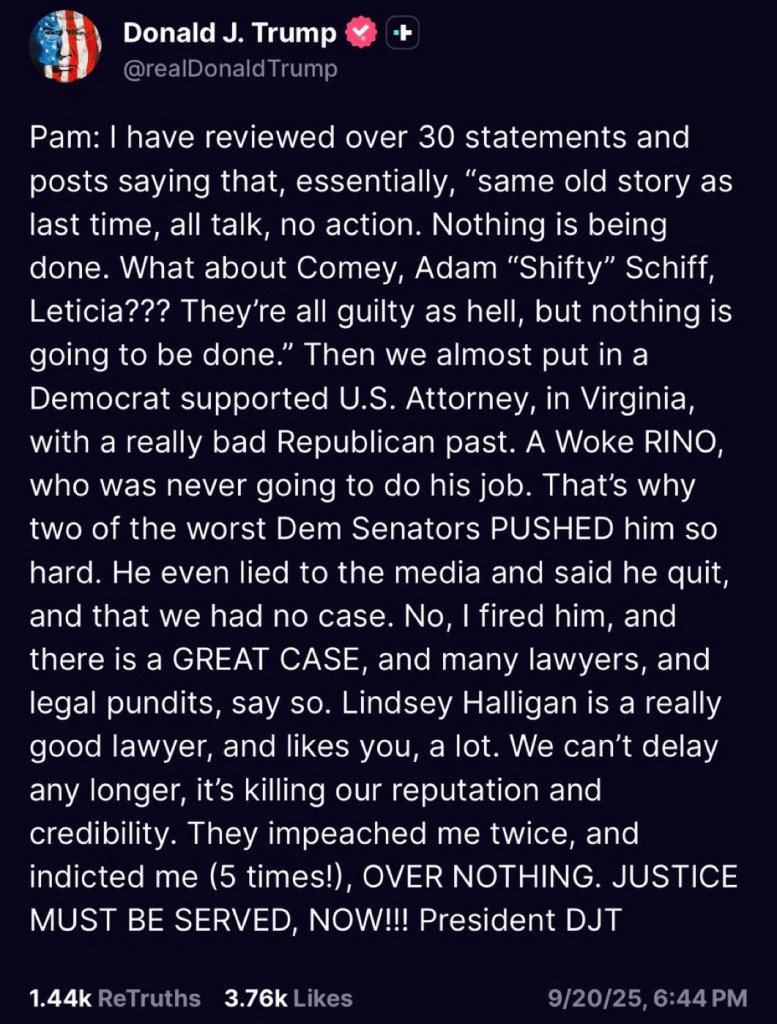
The New Republic tells the shameful story of Trump’s decision to fire Eric Siebert, the U.S. Attorney for the Eastern District of Virginia for his failure to find evidence to indict New York State Attorney General Letitia James.
Trump has said repeatedly that he wants to bring retribution on his enemies. His Attorney General Pam Bondi has protected and obliged him, not only by not releasing the unredacted Epstein files, but by firing any lawyers who worked on Trump investigations while he was out of office.
Trump is determined to prosecute Letitia James, the New York Attorney General, James Comey, and Adam Schiff.
He assigned Erik Siebert, the U.S. Attorney for the Eastern District of Virginia, the job of prosecuting Letitia James. Trump hoped to get her criminally prosecuted for mortgage fraud, for having obtained a mortgage on a vacation home, getting a favorable rate by claiming it as her home. Unfortunately, the case fell apart when evidence emerged that she had not claimed her second home as her primary residence.
Trump was furious at Siebert.
Siebert announced that he had resigned since the President didn’t want him. Trump quickly contradicted him and said Siebert had not resigned, he was fired. Trump promptly announced a replacement, a conservative Republican, Mary “Maggie” Cleary.
Trump is set to remove Erik Siebert, the U.S. attorney for the Eastern District of Virginia, for being faithful to facts, evidence, and guidelines governing good prosecutorial conduct, rather than fully corrupting his office to target Trump’s enemies.
That’s not a rhetorical cheap shot. It’s what Trump is actually doing, per ABC:
President Donald Trump is expected to fire the U.S. attorney for the Eastern District of Virginia after his office was unable to find incriminating evidence of mortgage fraud against New York Attorney General Letitia James, according to sources.
Federal prosecutors in Virginia had uncovered no clear evidence to prove that James had knowingly committed mortgage fraud when she purchased a home in the state in 2023, ABC News first reported earlier this week, but Trump officials pushed U.S. Attorney Erik Siebert to nevertheless bring criminal charges against her, according to sources.
Nixon tried to hide his plots against his enemies. Trump says the quiet parts out loud.
What are they guilty of? Criticizing Trump and–in the case of Schiff and James– trying to hold him accountable.
When I first heard that an American fighter plane had attacked a boat in international waters off Venezuela, my first thought was that there must have been a high-value target on that boat. I waited for the details, but they were never released. Eventually I heard that there were 11 people on the boat. Trump and Secretary of War Hegseth said that they were gang members and they had a boatload of drugs that they were intending to bring to the U.S.
I looked at that video released by the War Department, and I was struck by two anomalies. First, the boat wasn’t large enough to travel from Venezuela to the U.S. But more importantly, could a small boat with 11 people have room for a significant load of drugs? It didn’t seem so.
Where was the evidence that this boat was bringing drugs to the U.S. I never heard it. Secretary Hegseth would clarify the reason for the attack in the boat if he supplied facts and evidence. Does Trump plan to attack other boats and ships that may or may not be carrying a shipment of drugs.
When the Court says Trump is above the law, who speaks for the eleven dead on that boat? Their lives ended not in a battlefield crossfire or a clash between nations, but at the whim of one man emboldened by six justices who declared him untouchable.
Trump simply ordered human beings erased, confident the Court had given him immunity from any consequence and the leaders of his military would obey an illegal order. Eleven souls were sacrificed not just to his cruelty, but to a judicial betrayal that transformed the presidency into a license to kill.
For most of our history, American presidents have at least gone through the motions of cloaking lethal force in some form of legal justification.
Abraham Lincoln suspended habeas corpus during the Civil War but sought Congress’s approval. Franklin Roosevelt went to Congress for Lend-Lease before escalating aid to Britain, and sought a declaration of war against Japan. George W. Bush and Barack Obama leaned heavily on the post-9/11 Authorizations for Use of Military Force to justify everything from Afghanistan to drone strikes in Yemen and Somalia to killing Bin Laden.
The principle has always been that the United States does not simply kill people without some kind of legal process. It may be stretched, it may be abused, but it has been invoked.
What Donald Trump has now done with the strike on a small boat off Venezuela’s coast is to break that tradition in a way that is both lawless and unprecedented. He gave the order to kill eleven human beings with no congressional approval, no international authorization, and no visible evidence justifying it.
This was simply murder on the high seas. And the world knows it….
If America embraces this new Putin-like assertion of America’s power to bomb anybody, anywhere, on the whim of the president, we’ll have abandoned any claim to moral leadership.
Worse, we will have normalized the authoritarian logic that anyone the president labels an enemy can be eliminated without trial, without evidence, without process. We’ll have handed Xi a rationale to attack Taiwan; all he has to do is claim that a non-governmental gang within that nation is importing drugs into China (or something similar).
The international reaction has already been severe. America’s allies are horrified, our adversaries have been emboldened, and human rights groups are openly appalled.
But the real test is here at home. Do we still believe in the principle, famously cited by our second President John Adams, that America is a nation of laws and not of men? Do we still insist that presidents cannot kill at will? If Trump can strike a boat off Venezuela today, what is to stop him from ordering lethal force against dissidents, protesters, or political opponents tomorrow?
Jay Kuo writes a delightful blog called The Status Kuo. He is a lawyer with a sense of humor, and he writes clearly for the public, not for other lawyers.
Trump’s losses in the federal courts continue to pile up, and this week saw a number of critical rulings go against him. Judges from D.C. to Texas to California rejected the Trump regime’s illegal overreach on tariffs, deportations, military law enforcement and even his invocation of the Alien Enemies Act.
Let’s do a legal lightning round to summarize these rulings, any one of which frankly is important enough to have warranted its own stand alone analysis. Today I’ll cover
A major ruling from the Federal Circuit invalidating most of Trump’s “Liberation Day” tariffs;
A long weekend emergency ruling stopping planeloads of unaccompanied children from being deported to Guatemala;
Trump’s big loss after a bench trial in California over his unlawful use of federal troops in that state; and
The Fifth Circuit smackdown of Trump’s invocation of the “Alien Enemies Act” to justify summary deportation of alleged gang members.
Make no mistake: These are big losses that carry major implications for Trump’s plans to isolate the U.S., impose a police state, and conduct mass detentions and deportations.
And if you’re now thinking to yourself, “What does it matter, the Supreme Court will reverse these?” or “Great, but Trump will just disobey the orders,” I want to hit pause and do a reality check. As I’ll explain toward the end of this piece, these arguments, while common and understandable, simply don’t match the facts on the ground….
At this point, Kuo discusses each of the above decisions. You should subscribe to read these analyses.
But these rulings don’t matter! SCOTUS will overrule! Trump will defy!
There’s an understandable tendency to hear about a big court victory for the good guys but then cynically dismiss it, claiming either that the Supreme Court will overturn it, or that the Trump White House will simply ignore the courts’s orders.
I want to encourage readers to not fall into this trap. True, the Supreme Court has intervened in a few cases to lift a few injunctions imposed by lower courts, and that admittedly has been awful to see. But it hasn’t ruled substantively on much of anything yet.
And that has allowed court victories by the good guys to produce some real progress.
For example, the Blue State Attorneys General group has been successful at using lawsuits to claw back huge sums impounded by the White House. This has occurred even while the red states, which failed to challenge the illegal withholdings, were left starved of funds.
In his newsletter today, Robert Hubbell pointed to a chart with data from KFF Health News illustrating how successful lawsuits have spared the blue states from a great deal of the blow to public health infrastructure funding:
This helps show that the Supreme Court hasn’t been able to stop every lawsuit from succeeding. Indeed, many if not most have achieved their goals.
It’s also common to believe that the government is simply refusing to comply with every single court order. This misconception perhaps arose because so much attention was on a pair of lawsuits involving deportations, where the Justice Department and Homeland Security pretty much gave the finger to the courts.
But those are the only instances I’m aware of where court orders have been defied outright. And there are now major consequences for those involved with the plan to show open contempt. Judge Boasberg is now weighing bar disciplinary referrals for the lawyers involved.
In other cases, it is also true that the government has dragged its feet, delayed, deflected, misdirected and sought immediate appellate review of preliminary injunctions. But that is not the same as open defiance. And the courts have gotten much better at holding the government’s feet to the fire, as we just saw with Judge Sooknanan’s order followed by a demand for a series of status updates, all to keep the government on the straight and narrow.
The Department of Justice wants the American public to assume that none of the orders granted by federal judges are being heeded. They want us to believe that they, and not the judiciary, are in control. But this is simply not the case. As we saw this weekend, the Justice Department doesn’t have the appetite for another round of contempt proceedings, and it is even turning planes around when ordered to do so.
Zooming out a bit, we can understand why. The Justice Department is in disarray and demoralized, it has in some instances squandered the crucial “presumption of regularity” that is normally afforded to government functions, and the Trump regime is now losing the lion’s share of the most consequential lower court cases.
Sure, the Supreme Court may eventually weigh in with a set of terrible decisions. But that won’t stop, and hasn’t stopped, resourceful civil rights lawyers from finding new and novel ways to attack the White House’s policies and orders. For example, when SCOTUS found that litigants could not obtain nationwide injunctions against White House directives, plaintiffs adjusted quickly, moving for class certification so that the nationwide part got built into the definition of the class.
And who knows? Maybe even this SCOTUS majority will draw the line somewhere—perhaps by protecting the bright line independence of the Federal Reserve or by telling Trump he can’t order federal troops anywhere he wants for whatever mission he wants.
Until then, every win in the lower courts chips away at the MAGA fascist golem, and maybe with enough blows, we can take the entire monstrosity down.
Forget the economy. Forget inflation. Forget the wars in Ukraine and Gaza. What really animates the sick and sorry Trump administration is medical care for transgender youth. Now, there is an issue that involves the peace and prosperity of the nation–NOT!
My view: it’s none of my business. Issues like abortion and trans rights should be decided among patients, families, and doctors. Not by politicians. Not by me.
The Justice Department is harassing providers of care for young people who are transgender and demanding their personal data.
The Justice Department is demanding that hospitals turn over a wide range of sensitive information related to medical care for young transgender patients, including billing documents, communication with drug manufacturers and data such as patient dates of birth, Social Security numbers and addresses, according to a copy of a subpoena made public in a court filing this week.
The June subpoena to Children’s Hospital of Philadelphia requests emails, Zoom recordings, “every writing or record of whatever type” doctors have made, voicemails and text messages on encrypted platforms dating to January 2020 — before hormone therapy, puberty blockers and gender transition surgery had been banned anywhere in the United States.
About half of states have since passed laws prohibiting all or most gender treatment of minors. The Supreme Court ruled in June that a Tennessee ban did not violate the Constitution.
Attorney General Pam Bondi said last month that the Justice Department had issued more than 20 subpoenas seeking to hold “medical professionals and organizations that mutilated children in the service of a warped ideology” accountable. It is highly unusual for the nation’s chief law enforcement officer to announce such legal activity. Bondi did not identify who received the subpoenas, what information the government sought or what potential law violations it is investigating.
According to seven people familiar with the subpoenas, speaking on the condition of anonymity because they feared retribution, the subpoenas targeted care for patients younger than 19 and went to providers in states that still allow gender care for minors, as well as states where it has been banned. The subpoena, as well as public statements by Bondi’s chief of staff, indicate the federal government is attempting to build cases against medical providers that allege they may have violated civil and criminal statutes while providing care that was legal in their states.
Jacob T. Elberg, a former federal prosecutor specializing in health care fraud, said Bondi’s statement suggests the government “is using its investigative powers to target medical providers based on a disagreement about medical treatment rather than violations of the law.”
Elberg, now a law professor at the Center for Health & Pharmaceutical Law at Seton Hall University, said that the subpoena itself is not wildly broad for a health-care-fraud case. But he noted that under a federal privacy law, the Justice Department must show that any information it demands on patient identities is relevant to a legitimate law enforcement probe.



 Diane Ravitch's blog