Archives for category: Injustice

Heather Cox Richardson wrote today about two concurrent stories: on one hand, Democrats are locked in an internecine battle about their candidate; on the other, the Trump-dominated Supreme Court is shredding the balance of powers and crippling the administrative authority of the federal government.

She writes:

In this morning’s Talking Points Memo, David Kurtz observed that “much of political journalism is divorced from policy and the substance of politics.” It’s all about a horse race, he wrote, while complex questions, competing public interests, and the history of an issue get distilled to “whether it’s good or bad politically.”

Today, he noted, that horse-race coverage means that “[a]n election about whether the United States will continue its two and half century long experiment in representative democracy, where a convicted felon is running to return to the office he tried to seize through extralegal means, where the specter of a new form of fascism looms on the horizon is suddenly consumed by a political death watch for the only person at present standing between democracy and another Trump term in the White House.”

Yesterday, President Joe Biden tried to quell that political death watch by sending a letter to congressional Democrats stating that “despite all the speculation in the press and elsewhere, I am firmly committed to staying in this race, to running this race to the end, and to beating Donald Trump.” He noted that 14 million voters in the Democratic primary chose him, rather than a challenger, adding, “It was their decision to make. Not the press, not the pundits, not the big donors, not any selected group of individuals, no matter how well intentioned…. How can we stand for democracy in our nation if we ignore it in our own party?” 

In an apparent attempt to get beyond the horse-race politics Kurtz identified and to make clear the substance of this election, Biden explained: “We have an historic record of success to run on.” He cited his administration’s creation of more than 15 million jobs, leading to historic unemployment lows; revitalization of American manufacturing; expansion of affordable health care; rebuilding the country’s infrastructure; lowering the cost of prescription drugs; providing student debt relief; and making a historic investment in combating climate change.

That vision, Biden wrote, “soundly beats” that of Trump and the MAGA Republicans, who are “siding with the wealthy and big corporations,” while the Democrats are “siding with the working people of America.” Trump and his people want another $5 trillion in tax cuts for the rich, he noted, and they plan to cut Social Security and Medicare, as well as end the ability of the government to negotiate with pharmaceutical companies to bring drug prices into line with prices in other countries. “We are the ones lowering costs for families,” he wrote, “from health care to prescription drugs to student debt to housing. We are the ones protecting Social Security and Medicare. Everything they’re proposing raises costs for most Americans—except their tax cuts which will go to the rich.” 

He went on to note that the Democrats are “protecting the freedoms of Americans,” while Trump’s people are “taking them away.” He pointed to the right-wing attacks on abortion rights, IVF, contraception, and gay marriage. Biden reiterated that he will sign a law making Roe v. Wade the law of the land if the nation elects a Democratic House and Senate. Finally, he pointed out that Democrats are protecting the rule of law and democracy, while Trump is actively working to destroy both. Trump, he wrote, has proven himself “unfit ever to hold the office of President.” “My fellow Democrats,” Biden wrote, “we have the record, the vision, and the fundamental commitment to America’s freedoms and our Democracy to win.” 

Hours later, the New York Times joined the tabloid New York Post in noting that visitor logs showed that Dr. Kevin Cannard, an expert on Parkinson’s disease, visited the White House eight times between July 2023 and March 2024. After pressing White House press secretary Karine Jean-Pierre for information beyond her statements that Biden is not being, and has not been, treated for Parkinson’s and that he sees a neurologist as part of his annual physical exams, a CBS News White House reporter accused Jean-Pierre of deliberately withholding information. Jean-Pierre pointed out that “personal attacks” are not appropriate from the press corps and that the press team does its best to give the information they have. She said she took offense at the reporter’s tone. 

Last night, White House physician Dr. Kevin O’Connor sent to Jean-Pierre a letter clarifying that the White House Medical Unit serves thousands of patients, many of whom are military personnel with neurological issues related to their service. Cannard was one of the team of specialists that annually examine the president. O’Connor’s office released the results of that examination in a letter dated February 28, he pointed out. It said, “An extremely detailed neurologic exam was again reassuring in that there were no findings which would be consistent with any cerebellar or other central neurological disorder, such as stroke, multiple sclerosis, Parkinson’s or ascending lateral sclerosis, nor are there any signs of cervical myelopathy.” The president does have “peripheral neuropathy in both feet. No motor weakness was detected. He exhibits no tremor, either at rest or with activity.”

As media attention remains focused on Biden, a Supreme Court decision from last week that upends the modern American state and another that overturns the central concept of our democracy have disappeared from public discussion. In Loper Bright Enterprises v. Raimondo, the court overruled the longstanding legal precedent establishing that courts should defer to a government agency’s reasonable interpretation of a law. Instead, it said, judges themselves will decide on the legality of an agency’s actions. 

In Public Notice, Lisa Needham noted that right-wing judges have already blocked Biden administration rules that protect overtime pay for workers, prohibit noncompete clauses for truckers, and prohibit discrimination based on gender identity. As right-wing plaintiffs launch suits challenging rules they dislike, she notes, we should expect to see many more federal judges “deploying junk science and personal opinions to get to their preferred conclusion while ignoring the expertise of agency employees.”

Loper Bright was a slashing blow at the federal regulations that make up the framework of today’s government, but it paled in comparison to the Supreme Court’s decision in Donald J. Trump v. United States. In that stunning decision, the six right-wing justices—three of whom Trump himself appointed—declared that a president is immune from prosecution for crimes committed as part of his “official duties.” 

This astonishing decision overturned the bedrock principle of the United States of America: that no one is above the law. But to be clear, the court did not give this power to Biden. Because it is not clear what official acts are—since no one has ever before made this distinction—it claimed for itself the right to decide what illegal behaviors are official acts and which are not. Since at least one of the justices (Samuel Alito) has flown flags demonstrating support for overthrowing Biden’s government and putting Trump back into office, and the wife of another (Clarence Thomas) worked with those trying to overturn the results of the 2020 presidential election, it seems likely that their decisions will reinforce Trump’s immunity alone. 

An extraordinary effort to use the courts to set up a Trump dictatorship appears largely to have been hidden under the horse race.

And now that this scaffolding is in place, Trump’s team has begun to try to make him look more moderate than he is. On July 5, Trump claimed not to know anything about the extremist Project 2025, which calls for an authoritarian leader to impose Christian nationalism on the United States, despite the fact that his own appointees wrote it, his own political action committee advertised it as his plan, and his name appears in it 312 times. 

Agenda 47, the official Trump campaign website, has offered more information about how he will wield the absolute power he now claims. As Judd Legum pointed out today in Popular Information, a key author of Project 2025, Christian nationalist Russell Vought, has advanced a plan for killing any aspects of government his people dislike, and Trump has adopted that plan, vowing to cancel agencies or laws he dislikes by refusing to spend money Congress appropriates. This is known as “impoundment,” and Congress made it illegal in 1974 after President Richard Nixon used it to try to bend the government to his will. Trump says the 1974 Impoundment Control Act is unconstitutional because it interferes with the power of the presidency. He promised to use it to “crush the Deep State.” First on the chopping block will be the Department of Education.  

The effort to make Trump sound more moderate continued yesterday, when the Republican National Committee released the party’s 2024 platform, in which it tried to fudge the issue of abortion while leaving language that supported a national abortion ban. The New York Timespublished an article reinforcing the idea that Trump is moderating, reporting: “Following Trump’s Lead, Republicans Adopt Platform That Softens Stance on Abortion.” 

In the midst of this political coverage, a key story has been largely overlooked. Not only does the stock market continue to set record highs, but also, as Jim Tankersley of the New York Timesreported, the so-called left-behind counties, distressed after the collapse of manufacturing in them, have “added jobs and new businesses at their fastest pace since Bill Clinton was president.” “That turnaround,” he notes, “has shocked experts.” More than 1,000 counties, mostly in the Southeast and Midwest, that grew at less than half the national rate in terms of both people and income from 2000 to 2016, have surged. From 2016 to 2019—mostly during Trump’s administration—those rural left-behind counties, which make up about 18% of the U.S. population, added 10,000 jobs. In 2023 alone, they added 104,000. 

Tankersley notes that Trump overwhelmingly won the support of voters in these counties, but their circumstances did not improve during his administration. Under Biden, they added jobs five times faster than they did under Trump. Still, voters there appear to continue to back Trump. 

Now that’s a story. Are they backing Trump because they care more about culture wars than their economic security? Or are they ill informed?

Meanwhile, Republicans in the House today passed the Refrigerator Freedom Act and the Stop Unaffordable Dishwasher Standards (SUDS) Act, prohibiting the Secretary of Energy from prescribing or enforcing energy efficiency standards for residential refrigerators, freezers, and dishwashers. 

After noting that the average monthly cost of operating a dishwasher is two to four dollars, and establishing that the people pushing this measure had no idea how much a dishwasher costs, Representative Katie Porter (D-CA) said: “This bill… Congress at its worst. A bunch of people who haven’t unloaded a dishwasher ever telling the American people what dishwashers they should or should not have.” 

The Orlando Sentinel reported that Florida has rejected $259 million in federal funds to feed hungry children. The reasons of the DeSantis administration: we don’t need the money, and besides, it would cost $22 million to administer the program.

TALLAHASSEE– State officials said they passed up millions of dollars in new federal food assistance money because they have more than enough programs to feed Florida’s hungry children this summer.

But advocates for the hungry say the numbers tell a different story.

“The perception put forward by the state is that there is no need for other programs in the state,” said Sky Beard, the Florida director for the non-profit No Kid Hungry organization. “I wish it were true!”

While it’s too late for Florida to change course in time to affect kids this summer, 185 groups that seek to end hunger recently sent a letter to Gov. Ron DeSantis and other state leaders urging Florida to apply for the money by the Aug. 15 deadline for 2025.

“Every summer is a hungry time for kids.” Beard said.

One in five children in Florida are experiencing hunger because their families cannot afford enough groceries to make up for the free meals they got at school during the academic year, according to a recent report by Feeding America, a nationwide network of food banks, pantries and community organizations dedicated to ending hunger.

Fewer than 10% of the 672,324 elementary school children in Florida who get free or reduced-price lunches during the school year receive a summer lunch, says a report by the Food Research and Action Center, a nonprofit organization working to end poverty-related hunger.

Jamelle Bouie is an opinion writer for The New York Times. He writes with exceptional insight and clarity. In this column, he explains the radical, unprecedented nature of the Supreme Court’s decision on presidential immunity. The majority claims to be “originalists,” paying strict attention to the meaning of the words of those who wrote the Constitution, but this decision clearly demonstrates their complete indifference to the original intent of the Framers of the Constitution. The Framers created a strong balance of power among the three branches of the Federal Government; this Court negates those checks and balances.

With this ruling, Trump vs. US, the six member majority of the Supreme Court has shown that they are rank partisans. Their overriding objective was to protect Trump, first, by dragging out their decision as long as possible; second, by remanding the case to a District Court, where it may require months of hearings and appeals to determine which acts are official and which are not; and third, by affirming Trump’s once-absurd claim that the President can do whatever he wants and it’s not illegal.

The Roberts Court is a disgrace.

Jamelle Bouie writes:

In 1977, nearly three years after leaving office in disgrace, President Richard Nixon gave a series of interviews to David Frost, a British journalist. Of their hourslong conversations, only one part would enter history.

“When the president does it,” Nixon told Frost, defending the conduct that ended his presidency, “that means that it is not illegal.” He went on to add that if “the president approves an action because of the national security — or in this case because of a threat to internal peace and order of significant magnitude — then the president’s decision in that instance is one that enables those who carry it out to carry it out without violating a law.” Otherwise, Nixon concluded, “they’re in an impossible position.”

Yesterday, in a 6-3 decision along partisan lines, the Supreme Court affirmed Nixon’s bold assertion of presidential immunity. Ruling on the federal prosecution of Donald Trump for his role in the effort to overturn the results of the 2020 presidential election, Chief Justice John Roberts explained that the president has “absolute immunity” for “official acts” when those acts relate to the core powers of the office.

“We conclude that under our constitutional structure of separated powers, the nature of presidential power requires that a former president have some immunity from criminal prosecution for official acts during his tenure in office,” Roberts writes. “At least with respect to the president’s exercise of his core constitutional powers, this immunity must be absolute. As for his remaining official actions, he is also entitled to immunity.”

The majority divides official conduct from “unofficial conduct,” which is still liable for prosecution. But it doesn’t define the scope of “unofficial conduct” and places strict limits on how courts and prosecutors might try to prove the illegality of a president’s unofficial acts. “In dividing official from unofficial conduct, courts may not inquire into the president’s motives,” Roberts writes. “Such an inquiry would risk exposing even the most obvious instances of official conduct to judicial examination on the mere allegation of improper purpose, thereby intruding on the Article II interests that immunity seeks to protest.” In other words, the why of a president’s actions cannot be held as evidence against him, even if they’re plainly illegitimate.

Roberts tries to apply this new, seemingly extra-constitutional standard to the facts of the case against the former president. He says that the president “has ‘exclusive authority and absolute discretion’ to decide which crimes to investigate and prosecute, including with respect to allegations of election crime” and may “discuss potential investigations and prosecutions” with Justice Department officials, effectively neutering the idea of independent federal law enforcement. Turning to Trump’s attempt to pressure Mike Pence into delaying certification of the Electoral College, Roberts says that this too was an official act.

Having made this distinction between “official” and “unofficial” conduct, Roberts remands the case back to a Federal District Court so that it can re-examine the facts and decide whether any conduct described in the indictment against Trump is prosecutable.

The upshot of this decision is that it will delay the former president’s trial past the election. And if Trump wins he can quash the case, rendering it moot. The conservative majority on the Supreme Court has, in other words, successfully kept the American people from learning in a court of law the truth of Trump’s involvement on Jan. 6.

But more troubling than the court’s interference in the democratic process are the disturbing implications of the majority’s decision, which undermines the foundations of republican government at the same time that it purports to be a strike in defense of the constitutional order.

Presidential immunity from criminal prosecution does not exist in the Constitution, Justice Sonia Sotomayor observes in her dissent. The historical evidence, she writes, “cuts decisively against it.” By definition, the president was bound by law. He was, first and foremost, not a king. He was a servant of the public, and like any other servant, the framers believed he was subject to criminal prosecution if he broke the law.

And while the majority might say here that the president is still subject to criminal prosecution for “unofficial acts,” Sotomayor aptly notes that the chief justice has created a standard that effectively renders nearly every act official if it can be tied in some way, however tenuously, to the president’s core powers.

If the president takes official action whenever he acts in ways that are “not manifestly or palpably beyond his authority” and if “in dividing official from unofficial conduct, courts may not inquire into the president’s motives,” then, Sotomayor writes, “Under that rule, any use of official power for any purpose, even the most corrupt purpose indicated by objective evidence of the most corrupt motives and intent, remains official and immune.”

A president who sells cabinet positions to the highest bidder is immune. A president who directs his I.R.S. to harass and investigate his political rivals is immune. A president who gives his military illegal orders to suppress protesters is immune.

These examples only scratch the surface of allowable conduct under the majority’s decision. “The court,” Sotomayor writes, “effectively creates a law-free zone around the president, upsetting the status quo that has existed since the founding.” When he uses his official powers in any way, she continues, “he now will be insulated from criminal prosecution. Orders the Navy’s SEAL team 6 to assassinate a political rival? Immune. Organizes a military coup to hold onto power? Immune. Takes a bribe in exchange for a pardon? Immune.”

The bottom line, Sotomayor concludes, is that “the relationship between the president and the people he serves has shifted irrevocably. In every use of official power, the president is now a king above the law.”

If the president is a king, then we are subjects, whose lives and livelihoods are only safe insofar as we don’t incur the wrath of the executive. And if we find ourselves outside the light of his favor, then we have find ourselves, in effect, outside the protection of the law.

Roberts says that presidential immunity from criminal prosecution is necessary to preserve the separation of powers and protect the “energy” of the executive. But the aim of the separation of powers was not merely to create exclusive spheres of action for each branch — if this were true, the Senate, which ratifies treaties and confirms executive branch appointments, would not exist in its current form — but to prevent the emergence of unchecked authority. Roberts has reversed this. Now separation of powers requires the absolute power of the executive to act without checks, without balances and without limits.

In their relentless drive to protect a Republican president and secure his power for a future administration, the conservative majority has issued a fundamentally anti-republican opinion. In doing so, it has made a mockery of the American constitutional tradition.

By the end of his time in the White House, Nixon was a disgrace. But to the conservative movement, he was something of a hero — hounded out of office by a merciless liberal establishment. One way to tell the story of the Republican Party after Nixon is as the struggle to build a world in which a future Nixon could act unimpeded by law.

Roberts has done more than score a victory for Trump. He has scored a victory for the conservative legal project of a unitary executive of immense power. Besides Trump, he has vindicated the lawlessness of Republican presidents from Nixon to George W. Bush. The Nixonian theory of presidential power is now enshrined as constitutional law.

This time when the president does it, it really won’t be illegal.

Scott Maxwell is a regular columnist for Tthe Orlando Sentinel. In this article, he discusses the meanest, most heartless, most inhumane law passed by the legislature. How about letting workers have a water and heat break in Florida’s hot, humid climate? Employers don’t want workers to take time off. They prefer to let them struggle under a fiery sun, even if they collapse.

Maxwell writes:

I’ve written a lot of pieces about a lot of cruddy bills in Florida.

But I can’t recall one that generated more universal disgust among readers than the one lawmakers passed a few months ago banning cities and counties from making sure outdoor workers get shade and water on blistering hot days.

Miami-Dade was discussing local regulations that would guarantee roofers, farmworkers and others who toil in Florida’s blistering sun basic things like water breaks, shade and first-aid treatment for heat stroke — the kind of precautions most people with a conscience would provide for their dog.

Yet Florida’s big business lobby didn’t want to be forced to provide any of that. So they got their puppets in the Legislature to pass a law making it illegal for any local government to pass heat-safety regulations. Yes, their target was water and shade.

I described it as “The most shameful law Florida passed this year.” And readers overwhelmingly agreed. The disgust came from Republicans, Democrats and independents all around the state.

“This is so wrong in so many ways,” said reader Ingrid, who noted that, as a homeowner, she offers shade, water, seating and bathrooms to workers painting the outside of her house. “It is the American and right thing to do…”

And multiple conservative and independent readers said this was the kind of bill that made them think the pendulum of one-party power has swung too far. “So often, I no longer support Democratic legislators because I feel they are too far left,” Bruce said. “After reading this, I must vote for them anyway because others are too far to the right.”

But a question I also received over and over was: Why?

Why would lawmakers — most of whom have families and many of whom claim to be people of faith — support a bill that denies guaranteed access to things so fundamental as water and shade?

Well, here’s the remarkable reality: They normally wouldn’t. In fact, they didn’t.

Just two years ago, Republican legislators joined Democrats to unanimously pass a bill out of committee that would’ve guaranteed similar heat-safety protections to workers across the entire state.

At the time, GOP legislators described the heat protections as simply humane. One said it was “heartwarming” to see everyone agree on such a basic concept. The bill’s sponsor, Miami Republican Senator Ana Maria Rodriguez said: “It’s really about health and wellness and making sure people are protected.”

But then, as the Seeking Rents website that tracks the way money influences public policy in Florida recently revealed, the state’s homebuilding and business lobby got involved. And the bill died.

Then this year, the business lobby put the push on steroids. The Florida Chamber of Commerce not only wanted to make sure that no state laws guaranteed workers heat-safety protections; they wanted lawmakers to pass a law that banned counties from doing the same.

The chamber even warned lawmakers that if they didn’t do as instructed, the politicians’ scores would be docked in the business group’s annual “How They Voted” report card. The chamber told lawmakers that their votes on this one issue would be counted twice.

That is how badly the chamber — which is funded by companies like Disney, Publix, U.S. Sugar and Florida Power & Light — wanted to make sure no companies in this state would be subject to local heat-safety regulations.

We’ve all watched ugly politics transpire in Tallahassee. But this was uglier than usual. Veteran Tallahassee journalist Bill Cotterell — who has covered Florida politics for more than half a century — wrote that this was an example of how “the pay-to-play system goes beyond regular back-scratching and turns into cruelty.”

Mark Wilson, the president of the chamber, disagrees. He says readers who are outraged and observers like me and Cotterell don’t understand the issue.

He says the reaction is union-generated “hysteria,” that the chamber is “working to make Florida the safest state in the nation,” that the U.S. division of Occupational Health and Safety Measures already requires companies to protect their workers and that most companies want to do so anyway.

You probably don’t need me to tell you how silly that last argument sounds. If all companies were already doing all these things, they wouldn’t have been so frantically lobbying against them. House Bill 433 bans counties from requiring employers to provide things like “water consumption,” “cooling measures” and “appropriate first-aid measures.”

OSHA does not regulate these things the same way.  Instead, it has something called a “general duty clause” that broadly says employers shall provide a work environment “free from recognized hazards that are causing or are likely to cause death or serious physical harm to his employees.” Its website explicitly says: “OSHA does not have a specific regulation regarding heat stress.”

And while Wilson said OSHA is working on more specific heat-safety provisions, the simple fact is they don’t exist now.

The reality is that businesses in Florida have gotten so used to having their way, they don’t want anyone telling them what to do — even when it has to do with worker safety. And this state has a political majority willing do whatever they’re told, so that they can continue getting endorsements and campaign donations. Even it means opposing basic safety measures they previously supported.

That’s something for you to remember the next time you see a campaign mailer telling you that some politician has an “A-plus” business rating. This is the kind of thing they had to support to earn it.

smaxwell@orlandosentinel.com

Lucien V. Truscott IV explains Justice Clarence Thomas’ devotion to gun owners.

He writes:

Well, I guess somebody has to stand up for the rights of spousal killers, wife beaters, child abusers, and the Second Amendment, and I’ll just bet you can guess who it is.  Today, Supreme Court Justice Clarence Thomas stepped up and took one for the team, voting alone against the 8-1 decision in United States v. Rahimi that bars people from possessing firearms while they are under domestic violence restraining orders.  Not stripping them of the right to own guns, mind you, but only suspending that right under the Second Amendment until such an asshole can get the restraining order straightened out so he can get his guns back. 


Thomas must be spending so much time in the history stacks in the Fairfax County library, where he lives in Virginia, that they’re probably considering buying a cot for him to take naps on during his long hours of study of our laws in the 1700’s and 1800’s, not to mention old English law and a few ancient Greek statutes he quoted in his Bruen gun rights decision.  Perusing the laws that were in existence at the time of our nation’s founding, Thomas wrote in his dissent in today’s case that “Not a single historical regulation justifies the statute at issue.”  The “statute at issue” suspends the right of those under domestic violence restraining orders from possessing guns.


Chief Justice John Roberts appears to be the one who convinced four of the other six gun nuts on the court, all of whom voted to allow bump stock equipped machine guns earlier in the week, to join him in at least temporarily coming to their senses.  Roberts was able to somehow resurrect enough common sense on the court that he got enough votes to rule, as the author of the decision, that “an individual found by a court to pose a credible threat to the physical safety of another may be temporarily disarmed consistent with the Second Amendment.”  I mean, whoop-de-fucking-doo, but I guess we are in the position of taking them when we can get them, right?

The plaintiff in the case, one Zacky Rahimi, is a convicted drug dealer who had beaten his girlfriend to the ground in a parking lot and was dragging her back to his car when a bystander intervened.  Rahimi fired a shot at the bystander, and the girlfriend took that opportunity to escape.  Rahimi called her later and threatened violence – specifically, he said he would “shoot” her – if she told anyone about the incident. The girlfriend asked a Texas court to issue a restraining order and amazingly they agreed, finding that Rahimi had committed “family violence” and suspended his right to possess guns while the restraining order was in effect. 

Rahimi managed to hang onto enough firearms that he was involved in five shootings in the following months, according to the Supreme Court brief filed by the Biden Department of Justice.  Rahimi was charged with illegal possession of a firearm, was convicted in federal court and sentenced to six years in prison.  But Rahimi continued to argue that his rights under the Second Amendment had been violated.  The Fifth Circuit Court of Appeals ruled against Rahimi at his first hearing, but after Justice Thomas wrote the decision in Bruen, ruling that laws restricting firearms had to be rooted in the “history and tradition” of this country, the Fifth Circuit reheard the case and, incredibly, ruled for Rahimi.  Citing the Bruen case a Trump appointee on the court wrote that while the federal law banning people under restraining orders from possessing firearms was “meant to protect vulnerable people in our society…our ancestors would never have accepted” laws against domestic violence.

The decision by the Fifth Circuit Court of Appeals was unanimous, so Rahimi’s right to keep and bear arms under the Second Amendment was restored.

The case was appealed by the DOJ to the Supreme Court, where many legal experts feared it would hit the “history and tradition” brick wall of Thomas’ Bruen decision.  Chief Justice Roberts, however, appeared to back the court away from that decision a bit today.  “Some courts have misunderstood the methodology of our recent Second Amendment cases. These precedents were not meant to suggest a law trapped in amber,” Roberts wrote. “The Second Amendment permits more than just those regulations identical to ones that could be found in 1791.”  Roberts cautioned that if courts hearing gun cases were to consider only laws in existence at the founding of the country, they would find laws dealing with “muskets and sabers.”  Instead, Roberts urged courts that will interpret his decision in the future to consider whether a gun regulation at issue is “relatively similar” to regulations that were in effect closer to the nation’s founding.  “For example,” Roberts wrote, “if laws at the founding regulated firearm use to address particular problems, that will be a strong indicator that contemporary laws imposing similar restrictions for similar reasons fall within a permissible category of regulations.”

In the amazingly dull and nearly impenetrable language of the Supreme Court, that comes as close as we will ever get to a relaxation of the Thomas decision in Bruen, which courts like the Fifth Circuit have interpreted as turning back the clock to the way guns were regulated in 1791, which is to say not at all.

That may be why Thomas was the lone dissenter in the decision today, because it took some of the edges off his celebration of guns-for-everybody in the Bruen decision.  Or maybe Thomas, in his history-stacks-diving on domestic violence laws discovered, as he has before, a favorite old English construction of what husbands and domestic partners are permitted to do to the women in their lives:  the “Rule of Thumb.” 

It’s not like this subject hasn’t been dealt with before.  In January of 1982, the U.S. Commission on Civil Rights issued a report that was entitled “Under the Rule of Thumb:  Battered Women and the Administration of Justice.”  The Commission found that when it came to domestic violence, “American law is built on the British Common Law that condoned wife beating and even prescribed the weapon to be used.  This ‘rule of thumb’ stipulated that a man could only beat his wife with ‘a rod not thicker than his thumb.’” 

The Commission noted that William Blackstone, who “greatly influenced the making of law in the American colonies,” commented thusly on the rule of thumb:  “For as the husband is to answer for her misbehavior, the law thought it reasonable to entrust him with this power of chastisement, in the same moderation that a man is allow to correct his apprentices or children.”

American courts, bless their bleeding hearts, can be said to have taken up the rod passed to them by the Brits.  Have a look at this from an 1864 court in a case of a man who choked his wife:  “The law permits him to use towards his wife such a degree of force, as is necessary to control an unruly temper, and make her behave herself; and unless some permanent injury be inflicted, or there be an excess of violence, or such a degree of cruelty as shows that it is inflicted to gratify his own bad passions, the law will not invade the domestic forum, or go behind the curtain. It prefers to leave the parties to themselves.”  The Civil Rights Commission quoted a Mississippi Supreme Court case from 1824: “Let the husband be permitted to exercise the right of moderate chastisement, in cases of great emergency, and use salutary restraints in every case of misbehaviour, without being subjected to vexatious prosecutions, resulting in the mutual discredit and shame of all parties concerned.”

After an Alabama court had rescinded the right of a man to beat his wife in 1871, a North Carolina court came along and provided some relief to all those poor men who had to deal with those damn recalcitrant women: “If no permanent injury has been inflicted, nor malice, cruelty nor dangerous violence shown by the husband, it is better to draw the curtain, shut out the public gaze, and leave the parties to forget and forgive.”

Thomas, in his dissent that would allow abusive husbands and male partners under court restraining orders to own guns, would appear to smile upon Ye Ole Rule of Thumb as well.  It’s history and tradition, you understand — Thomas’ favorite harkening back to the good old days when a man was allowed to own not only a gun, but a stick big enough to beat his wife with.

Writing in The New Yorker, Jessica Winter deftly connects the spread of vouchers with deep-seated racism, phony culture war issues, and the war on public schools. Winter is an editor at The New Yorker.

She writes:

In October, 2018, on the night of a high-school homecoming dance in Southlake, Texas, a group of white students gathered at a friend’s house for an after-party. At some point, about eight of them piled together on a bed and, with a phone, filmed themselves chanting the N-word. The blurry, seesawing video went viral, and, days later, a special meeting was called by the board of the Carroll Independent School District—“Home of the Dragons”—one of the wealthiest and highest-rated districts in the state. At the meeting, parents of Black children shared painful stories of racist taunts and harassment that their kids had endured in school. Carroll eventually convened a diversity council made up of students, parents, and district staffers to address an evident pattern of racism in Southlake, although it took nearly two years for the group to present its plan of action. It recommended, among other things, hiring more teachers of color, requiring cultural-sensitivity training for all students and teachers, and imposing clearer consequences for racist conduct.

As the NBC reporters Mike Hixenbaugh and Antonia Hylton recounted in the acclaimed podcast “Southlake,” and as Hixenbaugh writes in his new book, “They Came for the Schools: One Town’s Fight Over Race and Identity, and the New War for America’s Classrooms,” Southlake’s long-awaited diversity plan happened to emerge in July, 2020, shortly after the murder of George Floyd by a Minneapolis police officer sparked Black Lives Matter protests against racism and police brutality across the United States. It was also the same month that a journalist named Christopher Rufo published an article in City Journal headlined “Cult Programming in Seattle,” which launched his campaign to make “critical race theory”—an academic discipline that examines how racism is embedded in our legal frameworks and institutions—into a right-wing panic button. A political-action committee called Southlake Families pac sprang up to oppose the Carroll diversity plan; the claim was that it would instill guilt and shame in white children and convince them that they are irredeemably racist. The following year, candidates endorsed by Southlake Families pac swept the local elections for school board, city council, and mayor, with about seventy per cent of the vote—“an even bigger share than the 63 percent of Southlake residents who’d backed Trump in 2020,” Hixenbaugh notes in his book. Some nine hundred other school districts nationwide saw similar anti-C.R.T. campaigns. Southlake, where the anti-woke insurgency had won lavish praise from National Review and Laura Ingraham, was the blueprint.

“Rufo tapped into a particular moment in which white Americans realized that they were white, that whiteness carried heavy historical baggage,” the education journalist Laura Pappano writes in her recent book “School Moms: Parent Activism, Partisan Politics, and the Battle for Public Education,” which also digs into the Southlake controversy. Whiteness could feel like a neutral default mode in many communities because of decades of organized resistance to high-density housing and other zoning measures—the bureaucratic backhoes of suburbanization and white flight. Today, the Carroll school district, though still majority white, has significant numbers of Latino and Asian families, but less than two per cent of the district’s students are Black.

In this last regard, Southlake is not an outlier, owing largely to persistent residential segregation across the U.S. Even in highly diverse metro areas, the average Black student is enrolled in a school that is about seventy-five per cent Black, and white students attend schools with significantly lower levels of poverty. These statistics are dispiriting not least because of ample data showing the educational gains that desegregation makes possible for Black kids. A 2015 analysis of standardized-test scores, for instance, identified a strong connection between school segregation and academic-achievement gaps, owing to concentrated poverty in predominantly Black and Hispanic schools. A well-known longitudinal study found that Black students who attended desegregated schools from kindergarten to high school were more likely to graduate and earn higher wages, and less likely to be incarcerated or experience poverty. Their schools also received twenty per cent more funding and had smaller classroom sizes. As the education reporter Justin Murphy writes in “Your Children Are Very Greatly in Danger: School Segregation in Rochester, New York,” this bevy of findings “lends support to the popular adage among desegregation supporters that ‘green follows white.’ ”

These numbers, of course, don’t necessarily reflect the emotional and psychological toll of being one of a relatively few Black kids in a predominantly white school. Other recent books, including Cara Fitzpatrick’s “The Death of Public School: How Conservatives Won the War Over Education in America” and Laura Meckler’s “Dream Town: Shaker Heights and the Quest for Racial Equity,” have also considered how those costs have been weighed against the moral imperative of desegregation. This is the axial force of a lineage that runs from the monstrous chaos that followed court-ordered integration in the nineteen-fifties and sixties and the busing debacles of the seventies to the racist slurs thrown around at Southlake. As my colleague Louis Menand wrote last year in his review of Rachel Louise Martin’s “A Most Tolerant Little Town: The Explosive Beginning of School Desegregation,” “It was insane to send nine Black teen-agers into Central High School in Little Rock with eighteen hundred white students and no Black teachers. . . . Desegregation was a war. We sent children off to fight it.” To Rufo and his comrades, there was no such war left to be fought; there were only the bitter-enders who hallucinate microaggressions in the wallpaper and whose books need to be banned from school libraries. A mordant irony of Rufo’s imaginary version of critical race theory is that Derrick Bell, the civil-rights attorney and legal scholar who was most closely associated with C.R.T., eventually came to be skeptical about school-integration efforts—not because racism was effectively over or because legally enforced desegregation represented government overreach, as the anti-C.R.T. warriors would hold today, but because it could not be eradicated. In a famous Yale Law Journal article, “Serving Two Masters,” from 1976, Bell cited a coalition of Black community groups in Boston who resisted busing: “We think it neither necessary, nor proper to endure the dislocations of desegregation without reasonable assurances that our children will instructionally profit…”

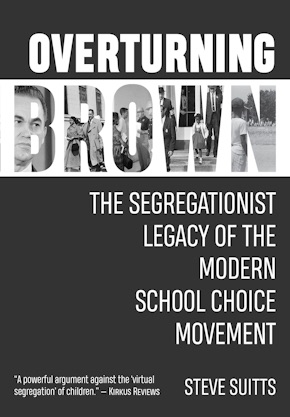
In the years before Brown v. Board of Education was decided, the N.A.A.C.P.—through the brave and innovative work of young lawyers such as Derrick Bell—had brought enough lawsuits against various segregated school districts that some states were moving to privatize their educational systems. As Fitzpatrick notes in “The Death of Public School,” an influential Georgia newspaper owner and former speaker of the state’s House declared, in 1950, “that it would be better to abolish the public schools than to desegregate them.” South Carolina, in 1952, voted 2–1 in a referendum to revoke the right to public education from its state constitution. Around the same time, the Chicago School economist Milton Friedman began making a case for school vouchers, or public money that parents could spend as they pleased in the educational marketplace. White leaders in the South seized on the idea as a means of funding so-called segregation academies. In 1959, a county in Virginia simply closed down its public schools entirely rather than integrate; two years later, it began distributing vouchers—but only to white students, as Black families had refused to set up their own segregated schools.

Despite these disgraceful origins, vouchers remain the handmaiden of conservative calls for “school choice” or “education freedom.” In the run-up to the 2022 midterms, Rufo expanded his triumphant crusade against C.R.T. into a frontal assault on public education itself, which he believed could be replaced with a largely unregulated voucher system. “To get universal school choice, you really need to operate from a premise of universal public-school distrust,” Rufo explained. He had been doing his best to sow that distrust during the previous two years.

Twenty states currently have voucher programs; five states launched universal voucher programs in 2023 alone. But reams of evidence show that vouchers negatively impact educational outcomes, and the money a voucher represents—around eight thousand dollars in Florida, sixty-five hundred in Georgia—is often not nearly enough to cover private-school tuition. In practice, then, vouchers typically act as subsidies for wealthy families who already send their children to private schools; or they pay for sketchy for-profit “microschools,” which have no oversight and where teachers often have few qualifications; or they flow toward homeschooling families. Wherever they end up, they drain the coffers of the public schools. Arizona’s voucher system, which is less than two years old, is projected to cost close to a billion dollars next year. The governor, Katie Hobbs, a Democrat and former social worker, has said that the program “will likely bankrupt the state.”

Back in Texas, Governor Greg Abbott has become the Captain Ahab of school choice—he fanatically pursued a voucher program through multiple special sessions of the state legislature, failed every time to sink the harpoon, and then tried to use the rope to strangle the rest of the education budget, seemingly out of spite. Abbott’s problem is not only that Democrats don’t support vouchers but that they’ve also been rejected by Republican representatives in rural areas, where private options are scarce and where public schools are major local employers and serve as community hubs. (Southlake’s state representative, a Republican with a background in private equity, supports Abbott’s voucher scheme—a bizarre stance to take on behalf of a district that derives much of its prestige, property values, and chauvinism from the élite reputation of its public schools.) White conservatives in Texas and elsewhere were roused to anger and action by Rufo-style hysteria. But many of them may have realized by now that these invented controversies were just the battering ram for a full-scale sacking and looting of public education.

Seventeen high school students in Georgia marked the 70th anniversary of the Brown decision by writing an article calling on the state’s political leaders to fully fund public schools, instead of funding vouchers. They are members of the Georgia Youth Justice Coalition.

They wrote in the Atlanta Journal-Constitution:

As young Georgians, we share the belief that all children should have the freedom to pursue their dreams and that our futures depend on receiving a great education. To get there, we must equip every public school with the resources to deliver a quality education for every child, no matter their color, their ZIP code or how much money their parents make.

Unfortunately, we find ourselves in yet another moment of massive resistance to public education with increasingly aggressive efforts on behalf of the state of Georgia to privatize our public schools and return us to a two-tiered system marked by racial segregation. As public school students in high schools across Georgia, we believe that the 70th anniversary of Brown v. Board of Education is not just a cause for celebration but an invitation to recommit ourselves to the promise of a public education system that affirms an essential truth: Schools separated by race will never be equal.

Even as our country celebrates the anniversary of Brown this month, we know that our state actively worked to obstruct desegregation, which did not meaningfully take place for another 15 years. Seven years after the Supreme Court’s ruling that separating children in public schools on the basis of race was unconstitutional, the Georgia General Assembly revoked its school segregation law in 1961. Another 10 years later, a court-ordered desegregation plan finally took effect — in 1971.

In 2024, educators across Georgia, from Albany to Atlanta, from Valdosta to Vinings, from Dalton to Dublin, and everywhere in between, are working hard to provide students like us with a quality education, empowering us to build a brighter future in Georgia for all. Yet politicians in the Georgia Capitol seem dedicated to resegregating and privatizing our public schools by taking tax dollars meant to support all of the students in our communities and giving it to unaccountable voucher programs that favor the wealthiest few.

The long and shameful history of vouchers is something that politicians who forced them to become law this year don’t want us to know. In many cities, public education funding was funneled to private “segregation academies” where white children received better resources than children of color. Instead of making our public schools stronger and moving us all forward together, these politicians are defunding our public schools by more than $100 million and working to drag us backward to the days when Georgia was still resisting court-ordered desegregation.

We want our leaders to get serious about what works: fully funding our public schools so that we can improve our neighborhood schools. That’s where 1.7 million public school students in Georgia learn and grow, and where we all can have a say. Research all across the country shows that voucher programs will not improve student outcomes in Georgia, but we know what will best serve students.

Young Georgians like us need investments in our public schools so we have the opportunity to learn and thrive. Gov. Brian P. Kemp has $16 billion of unspent public funds — enough to cover the costs of funding our schools and investing in our communities. Georgia has one of the highest overall rates of child poverty in the nation. Yet our state is one of only six states that provides schools with no specific funding to support children living in poverty. By refusing to give our schools what they need, we are setting our schools and our students up for failure.

Politicians brag about Georgia’s teachers being among the highest paid in the South even though they know they have created a crisis around public education that puts our teachers, our parents and students like us in an impossible position. Right now, nearly every school district in Georgia operates with a waiver to avoid adhering to classroom size restrictions because they cannot afford to hire enough teachers. And though the American School Counseling Association recommends a counselor-to-student ratio of 1:250, Georgia mandates a counselor-to-student ratio of 1:450 students. Many schools cannot even meet that ratio because of a lack of funding. All of that is by design because politicians have refused to update Georgia’s school funding formula for nearly 40 years.

This year, as we celebrate 70 years since Brown v. Board of Education, we invite every Georgian to join us in our call for fully funded neighborhood public schools so that every Georgia student has an inviting classroom, a well-rounded curriculum, small class sizes and the freedom to learn.

The writers are members of the Georgia Youth Justice Coalition. Nia G. Batra is a sophomore at Decatur High School. Hunter Buchheit is a senior at Walton High School. Ava Bussey is a senior at Marietta High School. Keara Field is a senior at McDonough High School. Saif Hasan is a junior at Lambert High School. Jessica Huang is a senior at Peachtree Ridge High School. Shivi Mehta is a junior at the Alliance Academy for Innovation. Bryan Nguyen is a senior at the Gwinnett School of Mathematics, Science, and Technology. Rhea Sethi is a senior at North Gwinnett High School. Maariya Sheikh is a senior at Campbell High School. Harrison Tran is a junior at Jenkins High School. Sharmada Venkataramani is a sophomore at South Forsyth High School. Thomas Botero Mendieta is a junior at Archer High School. Kennedy Young is a senior at Campbell High School.

Tim Slekar is a fearless warrior for public schools, teachers, and students. I will be talking to him about Slaying Goliath and the struggle to protect public schools from the depredations of billionaires and zealots.

This Thursday on Civic Media: Dive Back into “Slaying Goliath” with Diane Ravitch

Grab your pencils—BustEDpencils is gearing up for a no-holds-barred revival of Diane Ravitch’s game-changing book, *Slaying Goliath*, live this Thursday on Civic Media. 

Launched into a world on the brink of a pandemic, *Slaying Goliath* hit the shelves with a mission: to arm the defenders of public education against the Goliaths of privatization. But then, COVID-19 overshadowed everything. Despite that, the battles Diane described haven’t paused—they’ve intensified. And this Thursday, we’re bringing these crucial discussions back to the forefront with Diane herself.

This Thursday at 7pm EST on BustEDpencils, we’re not just revisiting a book; we’re reigniting a movement. Diane will dissect the current threats to public education and highlight how *Slaying Goliath* still maps the path to victory for our schools. This isn’t just about reflection—it’s about action.

**It’s time to get real. It’s time to get loud. It’s time to tune in this Thursday at 7 PM EST on Civic Media.**

If you believe that without a robust public education system our democracy is in jeopardy, then join us. Listen in, call in (855-752-4842), and let’s get fired up. We’ve got a fight to win, and Diane Ravitch is leading the charge.

Mark your calendars and fire up Civic Media this Thursday at 7pm Central. 

Barbara Pariente served on the Florida Supreme Court for more than twenty years and is now retired. She was astonished by that court’s recent decision to approve a six-week ban on abortion, because the state constitution explicitly protects privacy rights, which unquestionably—until now—included abortion decisions.

She recently wrote in Slate:

On April 1, the Florida Supreme Court, in a 6–1 ruling, overturned decades of decisions beginning in 1989 that recognized a woman’s right to choose—that is, whether to have an abortion—up to the time of viability.

Anchored in Florida’s own constitutional right to privacy, this critical individual right to abortion had been repeatedly affirmed by the state Supreme Court, which consistently struck down conflicting laws passed by the Legislature.

As explained first in 1989:

Florida’s privacy provision is clearly implicated in a woman’s decision of whether or not to continue her pregnancy. We can conceive of few more personal or private decisions concerning one’s body in the course of a lifetime.

Tellingly, the justices at the time acknowledged that their decision was based not only on U.S. Supreme Court precedent but also on Florida’s own privacy amendment.

I served on the Supreme Court of Florida beginning in 1998 and retired, based on our mandatory retirement requirement, a little more than two decades later. Whether Florida’s Constitution provided a right to privacy that encompassed abortion was never questioned, even by those who would have been deemed the most conservative justices—almost all white men back in 1989!

And strikingly, one of the conservative justices at that time stated: “If the United States Supreme Court were to subsequently recede from Roe v. Wade, this would not diminish the abortion rights now provided by the privacy amendment of the Florida Constitution.” Wow!

In 2017 I authored an opinion holding unconstitutional an additional 24-hour waiting period after a woman chooses to terminate her pregnancy. Pointing out that other medical procedures did not have such requirements, the majority opinion noted, “Women may take as long as they need to make this deeply personal decision,” adding that the additional 24 hours stipulated that the patient make a second, medically unnecessary trip, incurring additional costs and delays. The court applied what is known in constitutional law as a “strict scrutiny” test for fundamental rights.

Interestingly, Justice Charles Canady, who is still on the Florida Supreme Court and who participated in the evisceration of Florida’s privacy amendment last week, did not challenge the central point that abortion is included in an individual’s right to privacy. He dissented, not on substantive grounds but on technical grounds.

So what can explain this 180-degree turn by the current Florida Supreme Court? If I said “politics,” that answer would be insufficient, overly simplistic. Unfortunately, with this court, precedent is precedent until it is not. Perhaps each of the six justices is individually, morally or religiously, opposed to abortion.

Yet, at the same time, and on the same, by a 4–3 majority, the justices—three of whom participated in overturning precedent—voted to allow the proposed constitutional amendment on abortion to be placed on the November ballot. (The dissenters: the three female members of the Supreme Court.) That proposed constitutional amendment:

Amendment to Limit Government Interference With Abortion:

No law shall prohibit, penalize, delay, or restrict abortion before viability or when necessary to protect the patient’s health, as determined by the patient’s healthcare provider. This amendment does not change the Legislature’s constitutional authority to require notification to a parent or guardian before a minor has an abortion. 

For the proposed amendment to pass and become enshrined in the state constitution, 60 percent of Florida voters must vote yes.

In approving the amendment to be placed on the ballot at the same time that it upheld Florida’s abortion bans, the court angered those who support a woman’s right to choose as well as those who are opposed to abortion. Most likely the latter groups embrace the notion that fetuses are human beings and have rights that deserve to be protected. Indeed, Chief Justice Carlos Muñiz, during oral argument on the abortion amendment case, queried the state attorney general on precisely that issue, asking if the constitutional language that defends the rights of all natural persons extends to an unborn child at any stage of pregnancy.

In fact, and most troubling, it was the three recently elevated Gov. Ron DeSantis appointees—all women—who expressed their views that the voters should not be allowed to vote on the amendment because it could impact the rights of the unborn child. Justice Jamie Grosshans, joined by Justice Meredith Sasso, expressed that the amendment was defective because it failed to disclose the potential effect on the rights of the unborn child. Justice Renatha Francis was even more direct writing in her dissent:

The exercise of a “right” to an abortion literally results in a devastating infringement on the right of another person: the right to live. And our Florida Constitution recognizes that “life” is a “basic right” for “[a]ll natural persons.” One must recognize the unborn’s competing right to life and the State’s moral duty to protect that life.

In other words the three dissenting justices would recognize that fetuses are included in who is a “natural person” under Florida’s Constitution.

What should be top of mind days after the dueling decisions? Grave concern for the women of our state who will be in limbo because, following the court’s ruling, a six-week abortion ban—before many women even know they are pregnant—will be allowed to go into effect. We know that these restrictions will disproportionately affect low-income women and those who live in rural communities.

I was thrilled when I learned that the Supreme Court of Florida decided to allow a referendum on abortion this fall. Many people, including me, feared that the Court would throw out the referendum on grounds that the term “viability” is vague, that the referendum should call for a certain number of weeks.

Shouldn’t the public have the right to judge its laws?

But our reader, self-named Democracy, says it’s too soon to celebrate. The Court ‘s decision. It turns out, on close reading, that the Court inserted a barely noticed escape hatch if the referendum passes.

DeSantis appointed five of the seven justices on the Supreme Court.

Democracy wrote:

The Florida Supreme Court didn’t just do a “two-step” on abortion, they did a three-step.

First, the conservative Republican Supremes ruled 6-1 that the state constitution’s privacy protection(s) did NOT apply to abortion. They cited the U.S. Supreme Court’s Dobbs v. Jackson (2022) decision that REJECTED Roe v. Wade’s finding that “the constitutional right to privacy was broad enough to protect an abortion choice made by a ‘woman and her responsible physician.’ “ And, in so doing, the conservative Republican Supremes REJECTED what a previous state Supreme Court had found in interpreting Florida’s 1980 voter-approved Privacy Clause that “few decisions are more personal and intimate, more properly private, or more basic to individual dignity and autonomy, than a woman’s decision … whether to end her pregnancy.”

The conservative majority complained that when voters approved the Privacy Clause, they did not understand it to apply to abortion, an absolutely astounding claim.

As Justice Jorge Labarga wrote in dissent,

“I lament that what the majority has done today supplants Florida voters’ understanding — then and now — that the right of privacy includes the right to an abortion. The majority concludes that the public understanding of the right of privacy did not encompass the right to an abortion. However, the dominance of Roe in the public discourse makes it inconceivable that in 1980, Florida voters did not associate abortion with the right of privacy.” 

Second, the conservative Republican Supremes ruled 4-3 that a constitutional amendment guaranteeing abortion rights CAN be placed on the ballot in Florida in November. The per curiam ballot decision said this:

“We decline to adopt a standard that would effectively vest us with the power to bar an amendment from the ballot because of a supposed ambiguity in the text of the amendment.”

Republican governor Ron DeSantis and Republican Attorney General — who is a Trumper and a seditionist — were opposed to voters deciding the abortion issue. The Amendment to Limit Government Interference with Abortion will need 60 percent of the vote to be passed.

Third, the conservative Florida Supremes hedged their bets. In oral arguments and in writing, several of the justices raised the issue of fetal personhood, questioning how an amendment protecting the right to an abortion would square with the state constitution’s guarantee that all “‘natural persons’ have a right to life and liberty.” The Chief Justice wrote that an abortion protection amendment “would constitutionalize restrictions on the people’s authority to use law to protect an entire class of human beings from private harm.”

Thus, the conservative Republican majority wrote, yes, voters CAN get to decide if they want to pass The Amendment to Limit Government Interference with Abortion amendment, BUT it may well be in direct opposition to “personhood rights as applied to the unborn child.”

And guess who gets to decide THAT question?

As University of California-Davis law professor Mary Ziegler put it,

“They’re saying the constitution may still protect the fetus and unborn child, and that question is still alive.”