Archives for category: Indiana

Andy Spears, veteran journalist based in Tennessee, writes about “reformers” plan to undermine and disrupt public schools in Indianapolis.

Indianapolis appears to be the latest front in the ongoing battle to “disrupt” public education so much that it doesn’t exist anymore. 

Ending Public Schools IS The Goal

WFYI reports on a new governing body created to “bridge” the provision of services between Indianapolis Public Schools (IPS) and the city’s charter school sector.

In an 8-1 decision Wednesday evening, the Indianapolis Local Education Alliance recommended establishing the nine-member corporation. If approved by state lawmakers, this new agency called the Indianapolis Public Education Corporation, would act as a logistical bridge between the district and charter schools, managing unified busing, enrollment, and facility use.

While the IPS School Board will remain intact, the new agency will have significant authority to manage interactions between the Board and charter schools. 

Some see this as the beginning of creating an unaccountable agency to further advance school privatization in the district. 

During public comment, many spoke out against taking any power away from the IPS Board. Some suggested the board should oversee the transportation needs of charter schools. And others painted the ILEA members’ process as undemocratic.

WFYI explains how charter schools work in Indiana:

Charter schools are tuition-free public schools managed privately by nonprofit boards rather than elected officials. These boards operate under contracts granted by one of several authorizers in the state.

A parent representative on the group that reviewed proposals and recommended the new governing agency expressed skepticism:

The recommendation also drew sharp criticism for lacking specifics. Tina Ahlgren, the appointee representing district-managed school parents, cast the sole vote against it.

“I find my biggest reason to vote no is the level of ambiguity in the plan,” Ahlgren said. “I find these recommendations falling into this bizarre zone of simultaneously feeling both too much and not enough, bold in some areas but overly timid in others, with vague promises that the ecosystem will sort itself out.”

The proposal must now be approved by the Indiana General Assembly.

The Indianapolis move comes at a time when national forces are seeking full privatization of public schools, with some in the Trump Administration’s education leadership suggesting public education should all but end within 5-6 years. 

In states like Tennessee, advocacy groups are launching efforts to disrupt public education so much it is effectively a thing of the past.

·And, Indiana is not without its own challenges in maintaining a functioning system of public schools alongside a range of private options.

Indiana Vouchers: Private School Coupons for Wealthy Families

The Indianapolis Star reports:

Indiana’s Choice Scholarship Programallows families to use state dollars that would have followed their child to a traditional public school to instead pay for a private, parochial or nonreligious school.

The state releases this report annually, and for the 2024-25 school year, it showed that the state spent around $497 million on the program, which is an increase of just over $58 million from the previous school year.

Just a few years ago – in 2017 – the Indiana school voucher scheme cost the state $54 million. Now, the year-over-year increase in voucher expenses exceeds what the entire program cost just 8 years ago.
It’s typical in American politics that the party that wins the Presidency usually loses the mid-term elections two years later. The other party picks up seats, sometimes enough seats to dominate one or both Houses, enough to stymie the President’s agenda and enough to hold investigations that embarrass the President.

With Trump’s low standing in the polls, the rising cost of living, the backlash against tariffs, and the evident cruelty of ICE, Republicans have worried about an electoral wipeout in November 2026.

Some clever Republican strategist devised a plan to protect the Republican dominance in the House of Representatives. Simple. Persuade red states to redistrict (gerrymander) their Congressional maps, creating more Republican seats while eliminating Democratic seats. This was out of the ordinary, because states usually redistrict every ten years, after the latest census.

Texas Governor Greg Abbott, a loyal MAGAT, was first to act. He pushed through a new map that split up Democratic districts and created five new Republican seats. The U.S. Supreme Court supported the Trump goal, as usual, and approved the Texas gerrymander.

Governor Gavin Newsom of California was quick to respond. He called a referendum that would redistrict the state and produce five new Democratic seats. Newsom’s new map is being changed in the Supreme Court, but it’s difficult to see the Court approving the Texas gerrymander while rejecting California’s.

The administration began pressuring other red state governors to follow the lead of Texas. Some Democratic states set about redrawing their maps.

And then there was Indiana. NBC News tells the fascinating inside story of how the Trump team alienated key Republicans in that state.

Indiana is a deep-red state with a Republican supermajority in both houses of the legislature. Republicans hold seven Congressional districts, Democrats only two. Trump wanted those two seats.

The Trump operatives thought the state leaders would quickly fall in line. When they didn’t, the Trump operatives decided to unleash their usual tools: bullying, pressure, threats, intimidation, even death threats. At least 14 Republican state senators received death threats.

Jane C. Timm of NBC News wrote the story:

INDIANAPOLIS — As the redistricting battle began to pick up steam in Indiana last month, state Sen. Jean Leising’s grandchildren were receiving odd text messages.

Ads from little-known outside groups had spliced the longtime Republican lawmaker’s image next to prominent Democrats like New York Rep. Alexandria Ocasio-Cortez, Illinois Gov. JB Pritzker and California Gov. Gavin Newsom. Some of the messaging was sloppy, referring to Leising as “him.”

A conservative and supporter of President Donald Trump, Leising, 76, was furious. Following months of conversations with her constituents, she felt they were generally opposed to redrawing Indiana’s congressional map ahead of the 2026 midterm elections — even though such an effort would favor her party and was backed by her president. So in mid-November, she fired off a statement making it official: She wouldn’t support it.

“The negative campaigning just put me over the top,” she said in an interview with 13WTHR in Indianapolis, an NBC News affiliate, at the time. “He may wonder why Indiana is struggling to get on board. Well, it’s probably the antics they used.”

It was a sign of things to come. Ultimately, the months of pressure applied by Trump and his supporters from outside of Indiana to pass a redrawn map that would split up the state’s two Democratic districts backfired. On Thursday, Leising joined a majority of Republicans in the state Senate in voting to sink the map in the face of potential future primary challenges, a flurry of online attacks — and in some cases, violent threats. 

The result was one of the biggest rejections that Trump, who has otherwise largely ruled over the GOP with an iron fist, has faced since returning to office, and it could cost the party in its bid to preserve its narrow House majority….

“You have to know Hoosiers. We can’t be bullied, we don’t like it,” GOP state Sen. Sue Glick said after voting against the map.

Despite intense lobbying by Trump, JD Vance, and Mike Johnston, Republican leaders in the state were not enthusiastic. They resented the pressure.

When Rodric Bray, the leading Republican in the State Senate, warned that there were not enough votes to pass the new map, Trump lashed out at him. He threatened to run an opponent to Bray, but Bray didn’t tremble because he’s not up for re-election until 2028.

Trump wrote on Truth Social:

“In the entire United States of America, Republican or Democrat, only Indiana ‘Republican’ State Senator Rod Bray, a Complete and Total RINO, is opposed to redistricting for purposes of gaining additional Seats in Congress,” Trump wrote in one Truth Social post of the well-liked Republican leader in the Senate. “The Rod Brays of Politics are WEAK and PATHETIC.”

The map passed the Indiana House by The map passed the state House last Friday by a 57-41 vote, with 12 Republicans voting against it.

When the vote shifted to the State Senate, the map was resoundingly defeated, 19-31, with 21 Republicans voting against it.

Trump lost the vote of one State Senator when he called Tim Walz “retards.” The State Senator has a child with Down Syndrome. Others said they would not be bullied.

Jennifer Berkshire has been writing about the politics of education for many years. She has written two books with education historian Jack Schneider, A Wolf at the Schoolhouse Door and The Education Wars. This is the second installment in her excellent series called “Connecting the Dots.” Her Substack blog is called “The Education Wars.”

She writes:

BAs are out, babies are in

The Trump world’s obsession with the declining birthrate doesn’t quite rank with rooting out “DEI,” tariff-ing, or expelling immigrants but it’s up there. In a recent interview, Elon Musk confessed that a fear of the shrinking number of babies keeps him up at night. What does this have to do with education? Everything. Last year, two of the big education ‘thinkers’ at Heritage released a guide to how changes in education policy could increase “the married birthrate”:

Expensive and misguided government interventions in education are, whether intended or not, pushing young people away from getting married and starting families—to the long-term detriment of American society.

What are those government interventions? Things like subsidizing student loans, thereby encouraging young women to go to college. Or requiring teachers, who are mostly women, to have bachelor degrees, thereby encouraging young women to go to college. Of course there is a voucher angle—there always is with these folks. But the key here is that a chorus of influential Trump thinkers like this guy keep telling us that there are too many women on campus, and that policy shifts could get them back into the home where they belong. 

If the administration succeeds in privatizing the government-run Student Loan Program, college will become much more expensive, significantly shrinkign the number of kids who’ll be able to attend. And that seems to be the point, as conservative activist Chris Rufo explained in an interview a few weeks ago.

By spinning off, privatizing and then reforming the student loan programs, I think that you could put the university sector as a whole into a significant recession. And I think that would be a very salutary thing.

So when you hear the rising chorus coming from Trump world that there are too many of the wrong people on the nation’s campuses, recall that an awful lot of these self-styled ‘nationalists’ believe this: “If we want a great nation, we should be preparing young women to become mothers.”

Some people are more equal than others 

I’ve been making the case that both the Department of Education and public education more broadly are especially vulnerable because of the equalizing roles that they play. Of course, education is not our only equalizer. Indeed, all of the institutions and policy mechanisms intended to smooth out the vast chasms between rich and poor are on the chopping block right now. While you were clicking on another bad news story, Trump eviscerated collective bargaining rights for thousands of federal workers. While teachers weren’t affected, a number of red states have been rushing to remedy that, including Utah which just banned collective bargaining for public employees. 

Writer John Ganz describes the unifying thread that connects so much of Trump world as ‘bosses on top,’ the belief that “the authority and power of certain people is the natural order, unquestionable, good.” We got a vivid demonstration of what this looks like in Florida this week as legislators debated whether to roll back (more) child labor protections, allowing kids as young as 14 to work over night. 

Governor Ron DeSantis is busily spinning the bill as about parents rights, but what it’s really about is expanding the power of the boss. The ‘right’ to work overnight while still in school is actually the boss’ right to demand that young employees keep working. Nor is it hard to imagine the long-term consequences of this policy change. Teen workers who labor through the night end up dropping out of school, their futures constrained in every possible way. Here’s how Marilynn Robinson described the rollback of child labor laws in her adopted home state of Iowa: “If these worker-children do not manage to finish high school, they will always be poorer for it in income and status and mobility of every kind.”

Go back one hundred years when the country was in the midst of a fierce debate over child labor, and you’ll hear the same arguments for ‘bosses on top’ that are shaping policy today. At a time when public education was becoming compulsory, conservative industry groups like the National Association of Manufacturers cast their opposition to both child labor laws and universal public education in explicitly bossist terms, as Naomi Oreskes and Erik Conway recount in The Big Myth: How American Business Taught Us to Loathe Government and Love the Free Market:

“They believed that men were inherently unequal: it was right and just for workers to be paid far less than managers and managers far less than owners. They also believed that in a free society some children would naturally enter the workforce. Child labor laws wer (to their minds) socialistic because they enforced erroneous assumptions of equality—for example, that all children should go to school—rather than accepting that some children should work in factories.”

Back to the states

Did you hear the one about how we’re returning education to the states? Back-to-the-states has become a mantra for the Trump Administration on all kinds of favored policy issues, as the New York Times recently pointed out. Of course, education is already a state ‘thing,’ which means that we can look at the states Trump keeps pointing to as models and see how they’re faring. So how are they faring? Not so well, as the education reform group EdTrust lays out here, reviewing both NAEP scores and the track records of these states in supporting low-income students and students of color.

But there are plenty of warning signs beyond test scores. Ohio seems poised to slash funding for public education, even as the state’s voucher program balloons. (And let’s not even get into the just-enacted Senate Bill 1, which limits class discussions of any ‘controversial’ topic and goes hard at campus unions.) But for a glimpse of the future that awaits us, pay attention to another state in my beloved Heartland, and which Trump has repeatedly showered with praise: Indiana.

Now, Indiana happens to be home to one of my favorite economists, Ball State’s Michael Hicks, who has been warning relentlessly that the state’s decision to essentially stop investing in K-12 and public higher education has been an economic disaster. Hoosiers, he pointed out recently, earn less than the typical Californian or New Yorker did in 2005. As the number of kids going to college in Indiana has plummeted, the state now spends more and more money trying to lure bad employers to the state. Here’s how Hicks describes the economic and education policies that Indiana has embraced:

“If a diabolical Bond villain were to craft a set of policies that ensured long-term economic decline in a developed country, it would come in two parts. First, spend enormous sums of money on business incentives that offer a false narrative of economic vibrancy, then cut education spending.”

As for Indiana’s 25-year-long school choice experiment, Hicks concludes that it has been a failure. Why? Because the expansion of school vouchers and charter schools was used to justify spending less on public schools—precisely the policy course that we’re hurtling towards now. Today, Indiana spend less money per student on both K-12 and public higher education than it did in 2008.

GOP-run states have already begun to petition what’s left of the Department of Education for ‘funding flexibility’—the ability to spend Title 1 dollars, which now go to public schools serving low-income and rural students, on private religious education. We shouldn’t be surprised. This is precisely the vision laid out in Project 2025. (Fun fact: the same Heritage thinker who penned the education section of Project 2025 also co-authored the above referenced guide to getting young married ladies to have more babies.)

And just like in Indiana, school privatization will be used to justify reducing the investment in K-12 public education. So when an economist tells us that school choice “risks being Indiana’s single most damaging economic policy of the 21st century,” we should probably listen.

Karen Francisco retired as editorial page editor of the Fort Wayne Journal Gazette. She grew up in Muncie and graduated from Ball State University. She is a fearless advocate for public schools. I invited her to write about what happened in Indiana to turn Republicans against public schools.

She wrote this article for the blog.

The corporate-controlled American Legislative Exchange Council in 2011 rolled out a set of model bills designed to weaken one of its primary targets: public schools. “The Indiana Education Reform Package” was patterned after the destructive legislation pushed through by Indiana’s Republican legislative supermajority and then-Gov. Mitch Daniels.

Indiana has been setting the bar for public-school carnage ever since, quietly advancing a near-universal voucher program and advancing education privatization efforts. But the newly introduced House Bill 1136 is designed to serve as a death blow for public education in Indiana. It would immediately dissolve five school districts, including Indianapolis Public Schools, and effectively set every other district in the state on a path to elimination.

The bill requires the dissolution of districts that have lost more than 50% of students within the district’s boundaries to other schools. The districts’ schools would be converted to charter schools by July 1, 2028. The first schools converted would be those with the lowest test scores.

The legislation cleverly builds on those “education reform” measures designed to cripple public school districts. Ever-changing assessment standards kept the schools chasing arbitrary benchmarks. Sky-high income limits allowed wealthy families to abandon neighborhood schools for parochial and private schools. Inadequate funding and legislation favoring charter schools left districts without the resources needed to serve the at-risk students who are not welcome at voucher or charter schools.

Indianapolis Public Schools, in particular, has been hammered by Republican lawmakers and the city’s Democratic mayors. From an enrollment of nearly 40,000 in 2005, IPS now serves only 21,055 students, having lost thousands of students  to voucher schools, charters and poor-performing “innovation schools.”

Why is Indiana, known for its conservatism, such fertile ground for radical education policy? Blame it on a perfect storm of anti-democratic forces. Out-of-state billionaires like Netflix founder Reed Hastings and the heirs to the Walmart fortune have poured millions of dollars into the state to destroy teacher unions. Powerful Republican lawmakers have built careers off education privatization. Indiana’s strong evangelical community, including its newly elected lieutenant governor, has recognized the potential of expanding Christian Nationalist  influence with taxpayer-supported schools. 

The bigger mystery is why Indiana voters have allowed the continuing destruction of their public schools, electing and re-electing representatives actively working against the voters’ best interests.

I would like to believe House Bill 1136 is the proverbial bridge too far. But 40 years of newspaper experience in Indiana tells me most Hoosiers will show little interest in the imminent threat to two urban school districts and three small rural school corporations. Sadly, race and class play heavenly into opinions about Indiana public schools, and too many Hoosiers will dismiss the danger as “not my problem.”

Elected school boards are the last piece of control Indiana voters exercise over education. Republican lawmakers eliminated the constitutional position of state superintendent of public instruction, and Indiana has always had an unelected state board of education.

House Bill 1136 starts the process of disbanding locally elected school boards, replacing them with boards filled by the governor, local officials and the director of the partisan Indiana Charter School Board.  It’s only a matter of time before every elected school board in the state is eliminated.

Look for the American Legislative Exchange Council to update its 2011 “Indiana Education Reform Package” with this crowning piece of anti-democratic legislation and for ALEC’s disciples to carry it across the nation.

The Indianapolis Public School District is approaching a red zone: the total elimination of public schools. A bill sponsored by a Republican legislator would require the dissolution of the district, the conversion of every public school into a privately-managed charter school, and the replacement of the elected board by an appointed one.

Amelia Pak-Harvey of Chalkbeat Indiana wrote about a recent meeting of the elected school board, where the pressure campaign to privatize the district was discussed.

“This story was originally published by Chalkbeat. Sign up for their newsletters at ckbe.at/newsletters”.

She wrote:

The Indianapolis Public Schools board is strongly opposing a bill that would dissolve the district and force it to convert to charter schools, a proposal that has spurred calls for an organized campaign against it.

The pushback against HB 1136 at the first meeting of the new school board on Tuesday comes as IPS faces the start of yet another legislative session Wednesday that could leave the district more financially strapped and struggling to stay alive.

The bill also became the focus at Tuesday’s meeting, where new board members were sworn in at a historic moment for IPS — for the first time, a board made up entirely of women of color leads a district overseen by its first Black female superintendent.

“This legislation is not student focused, and fails to reflect the community’s input on how they envision their public schools thriving,” board President Angelia Moore said in a statement on behalf of the board at the meeting. “Instead of fostering growth and innovation, HB 1136 risks dismantling the very foundation that supports student success and community collaboration.”

The bill would require Indiana districts to dissolve and transition into charter schools if more than half of students living in the district boundary enroll in a school outside the district. Under the proposal, IPS would dissolve, and 50 of its schools would convert to charters, according to the bill’s latest fiscal impact statement.

Four other districts — Gary Community School Corp., Union School Corp. in east-central Indiana, Tri-Township Consolidated School Corp. in the north, and Cannelton City Schools in the south — would also dissolve.

The bill, proposed by Republican State Rep. Jake Teshka of North Liberty, would also dissolve the IPS’ elected board and replace it with a seven-member board appointed by the governor, the mayor, the president of the city-county council, and the executive director of the Indiana Charter School Board.

IPS to face challenging legislative session

In addition to this bill, a number of other proposals could spell financial ruin for the district, at a time when it faces mounting pressure to share more resources with charter schools. Amid mounting competition from the charter sector, the district has already tried to right-size itself through its Rebuilding Stronger reorganization, which closed several schools last school year and reconfigured grades districtwide this school year.

A new charter advocacy group, the Indiana Charter Innovation Center, will push for charters to receive the same amount of funding from property taxes that traditional districts receive. That would require IPS to give more than the $4 million in property tax revenues it is estimated to give to charters this year, in accordance with a law passed last year.

And incoming Gov. Mike Braun has pushed for capping increases in property taxes, which could further restrict funding for traditional public schools.

IPS grapples annually with competition from Indiana’s strong school choice environment, which state lawmakers have bolstered in previous sessions. The district faces a fiscal cliff once additional property taxes from the 2018 operating referendum expire in 2026. Federal pandemic relief funds have also expired.

“Urban education systems face complex and nuanced challenges that may be unfamiliar to some policymakers,” Moore said at the meeting. “We invite legislators who are genuinely interested in public education to visit our district, gain firsthand insight on our unique mission and vision, and work alongside us to ensure sustainable and meaningful outcomes for students, educators, and families.”

Community members raise opposition to bill

Parents and staff also voiced their opposition to HB 1136 at the meeting Tuesday and called on the board to loudly protest it. Four people spoke against the bill, while three others suggested the board partner with charters, respond to the demand for educational choice, or work with lawmakers to improve the district.

The public support follows a separate call from a group of community leaders who last week called on IPS to consider how to remain operational amid “strong financial headwinds.”

“The legislature has taken notice and seems ready to act if needed,” read the statement from former mayors Bart Peterson and Greg Ballard; former IPS board president Mary Ann Sullivan; and city-county councilors Maggie Lewis, Carlos Perkins, and Leroy Robinson. “It is preferable, however, that any structural changes in IPS are driven locally and to the benefit of our Indianapolis students and community.”

“Rebuilding Stronger shut down schools. The loss this community felt cannot be overstated. Don’t let their loss be in vain,” parent Kristen Phair told the board in between sobs. “I am asking each of you commissioners to take a united stand and be loud in advocating against this bill. Please help us organize. Our families want to organize against this.”

The group urged IPS to share more property tax funding with charter schools.

But Noah Leninger, a teacher at Robert Frost School 106, urged the board not to accept any such compromises.

“More charter schools will not save IPS,” he said. “No matter what they’re called — if we’re honest and we call them charter schools, if we lie to ourselves and our community and call them Innovation Network schools — whatever the name, the rapid and unchecked expansion of these unaccountable grift mills has not gotten IPS out of this mess.”

Board member Gayle Cosby, who beat an opponent backed by political action committees supportive of education reform to return to the board, said that she was encouraged by the crowd. She also scrutinized the often repeated call by charter supporters for IPS to “partner” with charters.

“My definition of partner does not include any entity that is actively seeking to destroy or dissolve our district, as noted in the proposed legislation,” she said.

Board member Nicole Carey said the challenging times will require courage from district leaders.

“To everyone tonight, I want to say stand with us, stay engaged, hold us accountable to this promise of prioritizing the needs of our students,” she said. “It is going to take all of us.”

Jennifer McCormick was the last elected state superintendent of schools. She switched parties because of the Republicans’ hostility to public schools.

She is running for Governor of Indiana against Senator Mike Braun, who is a far-right Republican. Braun and his running mate, an evangelical extremist, want to get rid of public schools.

The 74 reports:

U.S. Sen. Mike Braun, a conservative Republican, is still ahead in the state’s gubernatorial race but his lead among Indiana voters over Democrat Jennifer McCormick has shrunk in recent weeks.

Polling released this week by the Democratic Governors Association shows Braun just three points in front of McCormick, 44% to 41%. That’s a dropoff from the Sept. 17 results of an Emerson College Polling/The Hill voter survey that had Braun with roughly 45% of the vote and McCormick with 34. Libertarian candidate Donald Rainwater also picked up more support but less dramatically so, going from 5.8% to 8%.

Indiana has not elected a Democratic governor since 2000 and Republican presidential candidate Donald Trump holds a comfortable 14 percentage point lead, 57% to 43%, over Democrat Kamala Harris, according to an ActiVote poll released Tuesday.

If elected to succeed Republican Gov. Eric Holcomb, Braun and his running mate, pastor, podcaster and far-right Christian nationalist Micah Beckwith, have pledged universal school choice for every Indiana family while focusing on parental rights and school safety. 

McCormick, a career educator, was the last person elected to the superintendent of public instruction’s office before it became an appointed position in 2021. She seeks to expand affordable child care, fight what she believes is excessive state-mandated testing and call for an equitable school funding formula. 

She also wants to place limits on the state’s private school voucher initiative: The program grew to encompass more than 70,000 children in 2023-24, a 31% increase from the year before. The state allocated $439 million in tuition grants to private parochial or non-religious schools last year — up from nearly $312 million the year before.

McCormick said the program, which might have been intended for lower-income children, is often utilized by white suburban families and is too expensive. 

“We can’t afford it,” she told The 74, “and it is sucking the resources out of our traditional schools.” 

Braun, 70, wants to expand school choice by removing the $220,000 annual family income cap from the voucher program, known as the Choice Scholarship Program, and doubling the $10 millionallocated to the state’s Education Scholarship Account Program. The program, which has also seen tremendous growth in participation, gives special education students and their siblings funds for tuition and support services. 

Braun did not make himself available for an interview and attempts to reach various supporters were not successful.

“School choice programs put parents in the driver’s seat, allowing them to choose schools that prioritize their children’s needs,” he states in his education plan. “Providing universal school choice will ensure every Hoosier family has the same freedom to choose their best-fit education.”

A former school board member, Braun also wants to create an Indiana Office of School Safety to streamline the efforts of several departments, including the state police — and implement age-appropriate cyber training for students regarding online safety. He said, too, that the state should limit cellphone use on campus. 

Braun wants to increase Indiana’s public teacher base salary — and financially reward educators whose students perform well. 

Keith Gambill, president of the Indiana State Teachers Association, said his group endorsed McCormick, 54, because of her commitment to funding traditional public schools. 

He noted she did not have the group’s endorsement when she initially ran for the state superintendent’s office as a Republican. But, Gambill said, after filling the role and understanding the state’s educational needs, she switched parties and her values more closely aligned with the union’s. 

“She really stood up to members of — at that time — her own party in working toward what was best for our schools,” he said, speaking of her time in office. “And, of course, as soon as they were challenged, they didn’t like that. She realized that if she was going to make a difference in public education, she would have to move in a different direction.”

McCormick aims to secure a minimum base salary of $60,000 for pre-K-12 educators, and adjust veteran teacher salaries to reflect their non-educator peers. She wants to increase academic freedom, safeguard university tenure and protect the ability of teachers unions to collectively bargain for wages and benefits. 

Her running mate, Terry Goodin, a former state representative, was a teacher, assistant principal and public school superintendent at Crothersville Community Schools.

Braun, in his education plan, said he wants schools to notify parents about their child’s request to change their name or use different pronouns on campus. He has denounced gender-affirming surgery for minors and opposes transgender students playing on girls’ sports teams. Braun has the backing of Americans for Prosperity and CPAC — and maintains high ratings from the NRA. 

Braun was endorsed by Trump in 2023 and won his party’s nomination for governor in May after beating out a crowded field of GOP contenders. He acknowledged last month, according to Axios, that Harris’s presence at the top of the presidential ticket has complicated down-ballot races, including his own.

“I think that’s had an impact,” he said, “but I’m going to plow through that because this is a lot about kitchen table issues once you’re starting to run for governor.”

 Jo Napolitano is a senior reporter at The 74.

This story was produced by The 74, a non-profit, independent news organization focused on education in America.

Indiana started small with vouchers. They were supposed to “save poor kids from failing schools.” But it was the old camel’s-nose-under-the-tent routine. The real goal of voucher advocates was not to help poor kids escape “failing schools,” but to subsidize upper-middle-class and wealthy families who already had children in private schools.

And although 87% of Indiana’s students are enrolled in public schools, the Republican governor and legislature continue to expand the voucher program.

A new state report described the voucher expansion. Mind you, no one claims that students are getting a better education in nonpublic schools, just that are getting public money to subsidize the costs.

WFYI, the NPR station in Indianapolis, summarized the report:

Enrollment in Indiana’s private-school voucher program surged to 70,095 students in 2023-24. That’s a 31 percent increase compared to the previous year, the largest ever jump in a single year.

The state paid $439 million in tuition grants to private parochial or non-religious schools — 40 percent more than in 2022-23, according to a new state report.

The jump in voucher use comes after nearly every Indiana family became eligible to receive a voucher. A 2023 law repealed most requirements for students, such as previous enrollment in a public school, and it allows upper-income families to use public money to help pay for a private-school education. A family of four making $222,000 qualified for the Choice Scholarship Program in the recent school year.

The program’s expansion is a direct result of the Indiana Statehouse Republican supermajority’s efforts to expand policies that allow families to choose what they believe is the best school, or type of school, for their children.

Researcher R. Joseph Waddington, who studies Indiana’s school choice systems, said the monumental growth is not surprising.

“Without question, a lot of the enrollment growth in the voucher program is a result of that increase in income eligibility,” said Waddington, the director of Program Evaluation and Research at University of Notre Dame. 

The number of families who earn more than $200,000 a year and receive vouchers increased nearly tenfold. The report does not detail how many of these families were already attending a private school and became eligible for a voucher in the past year. 

“But there is growth in other parts of the program as well, even for lower income families,” Waddington said. 

The number of participating families earning less than $100,000 grew by 14 percent from year to year. [Note that the increase for this group was 14%, compared to a ten-fold increase for families earning over $200,000 a year.]

Kindergarten student participation grew by 4 percent — the most of all grades. That increase is directly tied to the repealing of the previous eligibility requirements, according to the report.

This year, 6 percent of all Indiana public and private-school students received a voucher, according to the report. Traditional public schools make up nearly 87 percent of enrollment — about half a percentage point less than the previous year….

As Indiana has expanded its voucher program to more high-income families, critics also contend that the state is paying tuition for students who would have attended private school without a voucher.

The report shows roughly 67.5 percent of students using a voucher have no record of prior attendance at an Indiana public school in 2023-24 — an increase of around almost 4 percentage points from the previous year.

Tom Ultican has noticed a strange phenomenon on billionaire-funded websites, particularly The 74: Praise for the justly-reviled No Child Left Behind.

Teachers hated it because of its warped emphasis on standardized test scores. Students hated it because they were cheated of a real education, they lost civics, the arts, and recess, and the tests assumed more importance than they deserved.

But Ultican writes, Chad Aldeman of The 74 is nostalgic for the good old days of NCLB.

Neoliberals joined with libertarians to “reform”public education. Their tools were big money and propaganda distributed by media outlets like The 74, support by The Walton family (EIN 13-3441466) and Bill Gates (EIN 56-2618866). This year, regular columnist for The 74, Chad Aldeman, is trying to claim that lifting No Child Left Behind (NCLB) school accountability sanctions is responsible for the public school testing “data decline”.

In a recent article in The 74, Aldeman complained of widening achievement gaps in Indiana, but Ultican can’t find the source of Aldeman’s data.

Ultican notes that NCLB interrupted a long period of academic improvement.

From 1970 to 1992, America’s schools showed slow but steady improvement in education-testing outcomes but since the era of standards, testing and accountability, improvement basically stopped. Education, run by billionaires and politicians instead of educators, failed to improve testing outcomes.

Alderman stated in his latest article that it is not just an Indiana problem but that “49 of 50 states, the District of Columbia and 17 out of 20 of the large cities that participated in NAEP … saw a widening of their achievement gap over the last decade.” He did not share which tests showed widened achievement gaps nor which cohorts were compared. NAEP reports on reading scores for 4th and 8th grade do not show a significant change in scoring gaps between Black and White students and comparisons in other ethnic groups also were steady.

After asking what has caused this (non-existent) achievement gap increase, Alderman posited several possible reasons: Common Core state standards (CCSS), per-pupil spending, technology and social media. He said the timing for CCSS fit but did not explain why states where CCSS was never adopted had the same problem. For per-pupil spending, he claimed that more money was getting to classrooms, which defies education-spending reports, making his claim a little shady. For technology and social media, he said other countries with similar problems, did not see testing declines … a declaration made with no evidence cited.

If this decline were real, wouldn’t the privatization of public education be the most likely culprit? Charter schools came first followed by vouchers and more charter schools. Data clearly shows that vouchers harm student-testing performance. Furthermore both charter schools and voucher schools leech money from public education budgets.

He finally made his real point, “I argue that the weakening of school accountability pressures after the No Child Left Behind Act was passed is responsible for a large portion of the drop.” Those of us, who were in classrooms and witnessed the test-and-punish philosophy damage to public education, disagree. How many great public schools were labeled “failures and closed” because they existed in low income zip codes?…

Ultican concludes:

The 74 was founded in 2015 by former CNN news anchor, Campbell Brown, along with Michael Bloomberg’s education advisor, Romy Drucker. Its original funding came from the Dick and Betsy DeVos Family Foundation Walton Family FoundationDoris and Donald Fisher Fund and Bloomberg Philanthropies. Since then, it has been the vehicle for spreading the billionaire message of privatization and undermining public schools.

Some billionaires see the non-sectarian nature of public education as a threat to their dreams of a Christian theocracy. Others are libertarians that oppose free universal public education, believing everyone should pay one’s own way and not steal people’s private properties using taxation. The Neoliberals are convinced that education should be run like a business and react to market forces.

Responding to the mission of The 74, Chad Aldeman’s series of articles, like those of many of his colleagues, are pure propaganda, shaping data to support his neoliberal ideology instead of honestly reporting facts. Unfortunately this kind of fake “journalism” is flooding email boxes and web pages throughout America every day.

Indiana has plunged headlong into privatization of its-once-beloved public schools.

Fortunately, there is a knowledgeable candidate for Governor who has promised to stop the destruction of public education.

Jennifer McCormick is a career educator who began as a special education teacher, then became a language arts teacher, a principal and a district superintendent.

She was elected Indiana State Superintendent of Public Instruction in 2016; she ran as a Republican. She served out her four-year term and switched parties in 2021.

McCormick wrote on Twitter:

Indiana GOP’s school privatization efforts have diverted 1.6B of tax dollars away from public schools, and the majority of communities do not have families and/or private schools participating. As governor, I will champion for Indiana to pause funding school privatization.

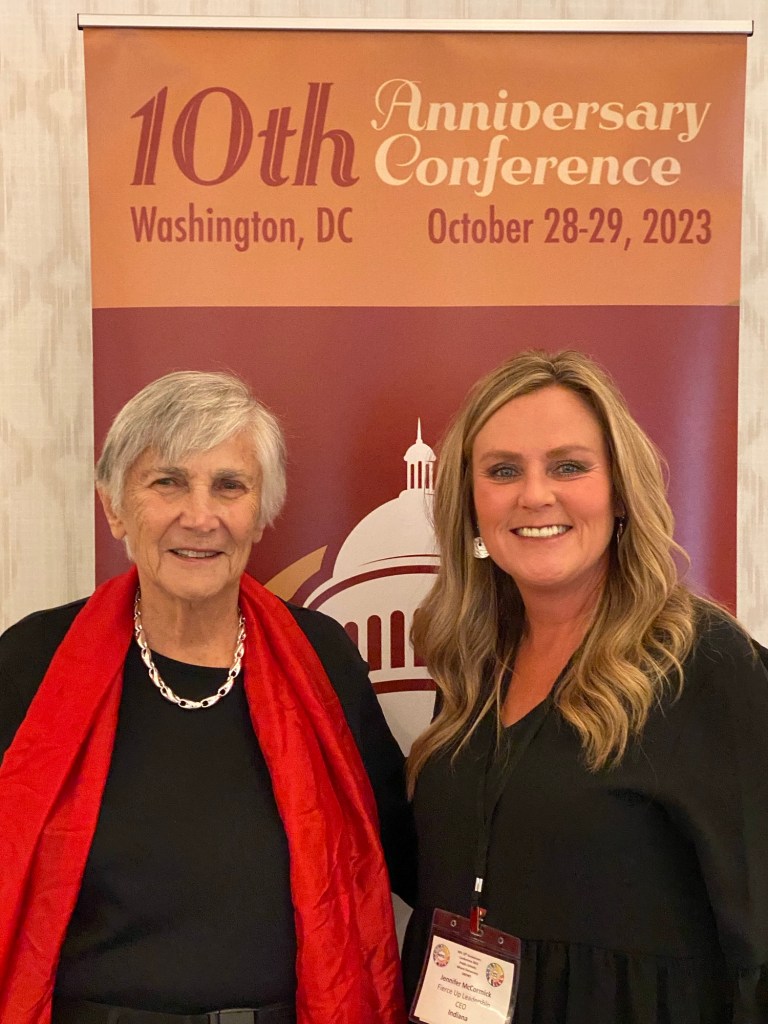
At the NPE conference in D.C. in 2023, JenniferMcCormick and me.

Indiana blogger Steve Hinnefeld writes about what happens when charter schools go shopping for an authorizer. He tells the story of a charter school that has been dropped by a series of authorizers, but picked up by a new one each time. Why would a new authorizer step in to take responsibility for a charter school that has been dropped by others? I’m not sure about how it works in Indiana, but in most states the authorizer gets a set percentage—typically 3%— of state tuition for each student. That adds up to a lot of money.

Hinnefeld writes:

Trine University came to the rescue eight years ago when Thea Bowman Leadership Academy was in danger of losing its charter and being shut down.

Now Trine has revoked the Gary, Indiana, school’s charter, citing academic and governance issues. But another private institution, Calumet College of St. Joseph, has stepped up.

“It’s funny how things have come full circle,” said Lindsay Omlor, executive director of Education One, Trine’s charter-school-authorizing office.

Today’s topic is authorizer shopping, what happens when charter schools jump from one authorizer to another to stay open or find a better deal. Thea Bowman looks to be taking the practice to a new level. It now has its third authorizer in less than a decade.

Back in 2016, the school’s original authorizer, Ball State University, declined to renew its charter, citing management and fiscal issues. The school turned first to the Indiana Charter School Board, which said no. But it found a willing partner in Trine University.

Now Trine has decided it’s done with the school. Its Education One board voted in December to revoke Thea Bowman’s charter. But school officials, perhaps expecting trouble, had already approached Calumet College. The board of CCSJ Charter Authority, the Calumet authorizing entity, approved a new charter in January.

Under a 2015 law intended to discourage authorizer-shopping, the new charter had to be approved by the State Board of Education. That happened Wednesday.

Thea Bowman is an established school that once served over 1,200 students in grades K-12. It now enrolls 840: Over 90% are Black and 75% qualify for free or reduced-price meals. Its proficiency rates on ILEARN, Indiana’s math and English/language arts test, are well below state averages. A 2022-23 review by Education One found it met standards for fiscal matters and school climate but not for academic and organizational performance.

The state board vote followed a hearing at which the executive directors of Education One and CCSJ Charter presented their findings. Two young women, both committed to school choice, charter schools and their view of high-quality authorizing, described Thea Bowman Leadership Academy in starkly different terms.

CCSJ’s Carrie Hutton took issue with Trine’s conclusion that the school was deficient in academics. Its test scores are improving, she said, and they are as good as or better than those at nearby charter schools and the Gary Community Schools district. She said the college will work with school staff to improve curriculum and add internships and college credit opportunities for students.

Her strongest point may have been that the charter school and the college are part of the same northwestern Indiana urban community. Calumet is in Hammond, next door to Gary, while Trine is in Angola, a two-hour drive to the east.

“They are our neighbors, and their graduates are our co-workers and students in our college,” Hutton said.

But Education One’s Omlor said the school has failed to meet performance targets, and governance issues have persisted. “I can confidently say that the school board lacks the capacity to govern a high-quality school that meets our standards,” she said.

She said the school has a 40% teacher turnover rate, and half its teachers are not fully licensed. She also took aim at CCSJ Charter, saying the authority “made many missteps” and failed to communicate and share information.

Open the link to see what happened.