Archives for category: Idaho

This story appeared in Commonweal, a progressive Catholic magazine of distinction. The author, Luke Mayville, has organized thus-far successful resistance to vouchers.

He writes:

Ever since Milton Friedman’s 1955 essay “The Role of Government in Education,” economic libertarians have dreamed of privatizing America’s system of public schools. In place of a school system that is publicly funded, democratically governed, and accessible to all, policy entrepreneurs have sought to transform American education into a commodity—something to be bought and sold in a free market.

In the push to privatize education, the tip of the spear has always been school vouchers—policies that extract funds from public schools in order to subsidize private-school tuition. Milwaukee established the nation’s first voucher program in 1990. In the following twenty-five years, voucher experiments were rolled out in fits and starts, often meeting with stiff public resistance. Voucher advocates gained significant footholds in Ohio, Washington D.C., Indiana, and elsewhere, but lacked the power to fundamentally transform the nation’s public-school system.

The cause has gained unprecedented momentum during the past five years. In their book A Wolf at the School House Door (2020), Jennifer Berkshire and Jack Schneider sounded the alarm about “an increasingly potent network of conservative state and federal elected officials, advocacy groups, and think tanks…backed by deep-pocketed funders,” all of them committed to dismantling public education as an institution. The new assault on public education intensified in the pandemic era, as voucher advocates seized the opportunity of mass school closures to propose—and in many cases enact—sweeping privatization schemes. In states across the country, the voucher agenda went hand in hand with efforts to sow distrust in public education by claiming, usually without evidence, that schools had become centers for critical race theory, “gender ideology,” and other forms of “social-justice indoctrination.” Meanwhile, voucher proponents were energized by landmark decisions of the United States Supreme Court, most notably Espinoza v. Montana in 2020 and Carson v. Makin in 2022, both of which appeared to remove constitutional obstacles to the use of public dollars for private religious education.

The nationally coordinated push to privatize public education is one of the most corrosive developments in American life. While Catholics and members of other faith communities have rightly cherished private parochial education, they, too, have strong reasons to support America’s public schools even if their own children do not attend them. It is an essential feature of the mission of public education to affirm the dignity of every child and to prepare each child to be a full participant in civic and economic life. As Berkshire and Schneider put it, public education “is our collective effort to realize for all young people their full human potential, regardless of circumstance.”

Fortunately, the coordinated attack on public education has met strong resistance from educators, students, parents, and citizens in several states across the country. During the 2023 legislative session here in Idaho, legislators presented a long series of voucher bills. One proposal sought to enact universal “education savings accounts” (ESAs) that would be available to every Idaho family—including the affluent. Other bills proposed tax-credit schemes or more targeted approaches. Every single proposal failed. Remarkably, Idaho remains voucher-free even as the voucher movement has enacted sweeping legislation in Arizona, Florida, West Virginia, Iowa, Arkansas, and elsewhere.

Grassroots organizing has been indispensable in Idaho’s fight against vouchers. A strong coalition of educators, parents, and advocacy organizations—including Reclaim Idaho, an organization I cofounded—has proved to be an effective counterweight to the voucher movement’s deep-pocketed lobbying efforts.

A recent poll by the Idaho Statesman found that public opinion in Idaho is dead set against vouchers, with 63 percent opposed and just 23 percent in support. The mission of organizers has been to translate widespread public opposition into effective political action. To that end, we’ve organized in communities across this vast state and helped citizens become defenders of public schools and sharp critics of voucher schemes. We’ve helped local advocates understand and articulate the arguments against vouchers that resonate most with the public: that vouchers are fiscally reckless, costing far more than advertised; that voucher programs tend to diminish student achievement and discriminate against students with disabilities; and that voucher programs are especially harmful for rural communities where no private-school options exist.

In local efforts to resist vouchers, grassroots organizing can harness the power of personal stories. The voucher movement has attempted to tell their own personalized story by evoking images of poor, marginalized children who’ve been “trapped” in failing public schools. The promise of “school choice” is to give struggling parents the choice to move their children into private schools that better fit their needs. However, as more states adopt voucher programs, the vast majority of voucher funds are flowing not to students who’ve left public schools but to private-school students who were never in public schools to begin with. A total of 89 percent of voucher funds in New Hampshire, 80 percent in Arizona, and 75 percent in Wisconsin have gone to students already enrolled in private schools, and these students disproportionately belong to affluent families living in suburban and urban areas.

The “school choice” story is mostly a fiction, and grassroots organizing can refocus the conversation on personal stories that paint the full picture. When people get organized on the voucher issue, the question can suddenly shift from “Do families deserve more choice?” to “Why would we pull scarce funds from our public schools—especially in rural areas—in order to subsidize tuition for affluent suburban families?” During testimony before the Idaho Senate Education Committee on a bill to create universal ESAs, a public-school supporter named Sheri Hughes phoned in to testify remotely from Challis—a mountain town of 922 people located 190 miles from the state capital. “I know the power and strength of consolidated public money for education, especially in rural Idaho,” Hughes said. She told the committee that her grandfather had served on the Challis school board and helped build the town’s first high school, that her mother—also a school-board member—helped get the high school rebuilt after the 1983 Challis earthquake. “Based on Arizona’s ESA Voucher experience,” Hughes went on, “the money proposed to be removed off the top of Idaho’s education funding budget would take an estimated 17–20 percent of funding away from Challis schools—in an area with no private alternative choices, and where home-school students still access public-school resources for proctoring, band, sports, special ed, and other extracurricular activities.”

Grassroots organizing can also help advocates expose the creative attempts by voucher proponents to present their policy agenda as something less threatening. With the American public skeptical of school vouchers and school privatization more generally, the privatization movement has aggressively sought to rebrand vouchers by means of convoluted policy schemes. Proponents of ESAs claim that they are not proposing vouchers but merely offering families money that can be used for a wide range of education services—including, but not limited to, private-school tuition. Similarly, proponents of “tax-credit scholarships” claim their proposals are distinct from vouchers because they do not directly spend public dollars on private schools but instead award tax credits to individuals who choose to fund private-school scholarships.

Grassroots organizing can expose these policies for what they are: vouchers by another name. In Idaho, we’ve invested time and energy in community meetings across the state where the goal is to share information with local public-education supporters about the mechanics of ESAs, tax-credit scholarships, and other policy schemes. Such meetings have prepared local citizens to speak out forcefully against thinly veiled attempts to siphon funds out of their public schools. Local advocates have written to their legislators, published op-eds and letters to the editor, spoken with friends and neighbors, and—most importantly—many have shown up to testify before the legislature. With so many grassroots advocates raising their voices and telling the truth about these policies, it’s been very difficult for privatizers to maintain the public narrative that they are promoting something other than a repackaged voucher scheme.

Please open the link and finish reading the rest of this excellent article.

Peter Greene reported the story of West Bonner, Idaho, where a far-right, anti-public school group won control of the school board and began to mess with curriculum and books and to hire a totally unqualified superintendent. When two of the extremists were recalled, the unqualified superintendent remained in place. What will the voters do in Bovember, when they have a chance to restore control to people whose chief interest is the students and the schools?

Greene writes:

The saga of the West Bonner School District and its completely unqualified and unlicensed superintendent continues, with more twists and turns and fairly spectacular dysfunction.

The board had hired Branden Durst, a noisy political wanna-be with a checkered past and zero qualifications, to be superintendent. But his highly unusual contract depended on his procurement of an emergency superintendent certification, and the state board decided that A) he met zero of the qualifications and B) they didn’t have the power to do that anyway.

Some of the story echoes other districts where a conservative group managed to commandeer the school board. People simply became complacentabout board elections, not paying attention to what the board was up to, or not bothering to vote because they assumed the reasonable candidates were shoo-ins.

In the case of West Bonner, the Idaho Freedom Foundation, yet another of those far right groups that wants to do away with public schools entirely, pounced. Dropped textbooks and a curriculum replaced with the far right Hillsdale curriculum and a defeated levy to fund things like books and salaries–those were the prelude to installing Durst as superintendent.

Now, you might think that would be the end of the story, but you’d be wrong.

About the time Durst was hired, a recall effort was under way to remove two of the most right wing board members. Despite any number of nasty tricks, the recall succeeded at the beginning of September. Those seats will be filled in November, but in the meantime, Durst and the board have tried some last minute antics, like moving to dissolve the school board at a board meeting scheduled at the last minute for a Friday evening of a three day weekend. It took a court ordered injunction to stop that nonsense.

The recall has created another problem. It leaves three board members, which means all three must be present to conduct business, and one member, the other third of the conservative coalition, decided not to attend last week’s board meeting, which would have been the first since the state board said that there is “no path” for Durst to become credentialled to fill a superintendent spot. But with only two members present, the meeting was canceled for lack of a quorum.

That means, among other things, that Durst is still in the superintendent’s post and that the district, not the state, will have to pay his salary. One would think he can’t be superintendent on account of, you know, being unqualified and uncredentialed, but Durst has other thoughts.

“But, Durst told KREM 2 he still is the superintendent.

“They don’t make the law,” Durst said. “They aren’t the law. How many people could say that? That they don’t have to follow the laws of Idaho.”

The state board’s action, says Durst, was “pretty discriminatory.” Durst says a lot of things, although nothing about what, other than his ideological bent, qualifies him to be a school superintendent.

There’s a lot riding on the next election for West Bonner, but folks are awake and paying attention now. We’ll see what the next chapter holds.

Greene updated the West Bonner story here: the fake superintendent is still in charge.

Vote! Vote!

Steve Berch is a member of the Idaho House of Representatives, one of only 11 Democrats in a body with 70 members. He is serving his third term. His analysis of the attack on public education in Idaho and other states is brilliantly cogent. He understands that privatization is all about the money. This article appeared in the nonprofit IdahoEdNews.org.

Berch describes the playbook of the privatization movement.

Berch writes:

Idaho will spend $2.3 billion on K-12 public education in 2024. There are powerful out-of-state forces who want to get their hands on that money. Some are driven by profit, others by political ideology, religious beliefs, or a combination of interests. They all share one common goal: shift your public schools dollars to the private sector. Here are some of the dots to connect in the “privatizing public education” playbook:

  1. Make public schools look worse than other school choices. The legislature does this by continually underfunding public education. Schools can’t meet parental expectations, accommodate growth, or hire/retain experienced teachers when salaries are not competitive and buildings are falling apart. Idaho has a backlog of over $1 billion in K-12 school building maintenance and we’re still at or near the bottom in per-student investment, even after having a $2.1 billion surplus and a recent budget increase. This makes other school choices look more attractive by comparison.
  2. Undermine confidence in public schools. Propaganda campaigns incite fear and anger against local schools. Parents are bombarded with false claims about porn in libraries, groomers in classrooms, and student indoctrination. Non-stop postings on social media perpetuate these inflammatory accusations. Self-proclaimed “think tanks” funded by third-parties produce official looking reports that create a false perception of legitimacy to these manufactured fears.
  1. Hide the facts. Legislative leaders tried to kill the Office of Performance Evaluations (OPE) – which provides factual, in-depth, unbiased research and analysis to the legislature. The public wouldn’t know about the billion dollar backlog in school building maintenance if OPE didn’t exist. The OPE report that revealed this new information angered political leaders trying to tell a different story. Without facts, false narratives go unchallenged.
  2. Legislative intimidation. New laws are making classrooms a hostile workplace. This includes bills that threaten to sue educators, imprison librarians, fine school districts, muzzle teachers, and empower the Attorney General to aggressively prosecute the targets of these punitive laws. No wonder teachers are leaving Idaho.
  1. Promote “school choice” and “education freedom.” This is clever rhetoric, but it is meaningless since Idahoans already have a myriad of education choices – none of which are going away. It’s not about having choice, but rather having you pay for someone else’s choice. A recent in-depth investigationrevealed a vast network of powerful forces funneling money into Idaho to promote and sell their alternative education choices to the public.
  2. Kill public education with vouchers (deceptively called Education Savings Accounts, or ESAs). An attempt was made earlier this year to convert most of the $2.3 billion public education budget into checks sent to parents to spend however they want – without accountability. This would starve Idaho public schools into oblivion.

The 2023 bill tried to hit a home run and failed. However, the lobbyists behind privatizing public education will be back, fronted by their legislative allies. Expect to see legislation next year that allows public tax dollars to pay for private and religious school tuition in limited amounts and isolated situations.

This is fool’s gold – there is no room for compromise. If the legislature allows just a small amount of public tax dollars to be spent on tuition for any private school, your tax dollars must be made available to all types of private schools and religious schools. Once one bill passes, the flood gates open up to flow your public education dollars to the bottom line profits of private sector businesses.

Your public education tax dollars belong in your public schools, not in their pockets.

While the billionaire-funded CREDO report assured us about the “impressive” but trivial academic results of charter schools, the reality on the ground is that the charter sector is unstable. It’s not unusual for charters to close their doors without warning or to experience graft or financial problems.

The charter in Boise has been afflicted with multiple issues. It had “financial malpractice” issues, it defaulted on its loan, its enrollment declined by more than 50%, and its leader got a better job.

It’s worth repeating that research continually shows the importance of stability in children’s lives. “Stability” is not the word for the Boise charter.

Sadie Dittenber of Idaho Education News reported:

Boise’s Village Leadership Academy will downsize to a smaller facility this year after defaulting on its building loan. The move is the final step in a multi-year plan to get the school’s finances back on track.

In 2019, a third-party report uncovered financial malpractice within the Boise charter, putting the school at risk of closure. But over the past three years, the school has operated on a balanced budget and improved most of its financial outcomes, according to a report given to the Idaho Public Charter School Commission Thursday.

But the school’s current building, located on Fairmeadow Dr. in Boise, is too large and too expensive for the charter to maintain, according to the report. The building was purchased in 2017, in hopes that the school’s student body population would grow to fill the space and pay off the facilities loan. But since 2019, the student population dropped by more than half.

In May, the charter board decided to exit its current loan — an option outlined in a December forbearance agreement between the VLA and its bank — and seek a smaller, more affordable building. The new facility is located on Goldstone Dr. in Meridian. The move could result in a boundaries shift for the school.

“While the building will have some drawbacks, it will continue to allow VLA to be a safe, small, village oriented, Leader in Me school for our Kindergarten through 8th grade students,” wrote school administrator Josh Noteboom in a May email to parents. “We are excited to be working towards the end of our facility challenges, and set the school up for success in the future.”

According to Thursday’s report, the decision ensures “an affordable location for the next 6 years.”

The VLA’s relocation fulfills the first of four renewal conditions set out by the Charter Commission in February.The first condition required the VLA to take action on its financial default by July 1.

I

But with the move comes another shift: Noteboom accepted a position as federal programs director with the State Department of Education, which he’ll begin in July. The current administrator said the transition was unexpected, but he’s honored to be selected.

“I have full confidence in the VLA community to select a new leader to continue the momentum and success we have achieved thus far,” Noteboom wrote in an email to EdNews. “I’ve committed to completing the transition to the new facility over the summer and onboarding new leadership. We have achieved a great milestone with the resolution of the facility issues and VLA is set to continue to thrive.”

ProPublica, in conjunction with the Idaho Statesman, took a close at schools in Idaho, which spends less on education than any other state. Conditions for teaching and learning are terrible, in large part because the state requires a 2/3 majority to pass a bond issue. Does Idaho care about the rising generation? Does it care about its future?

Jan Bayer sank into the couch in the family room of her Bonners Ferry, Idaho, home and stared at her phone, nervously awaiting a call. Her twin teenage daughters were nearby, equally anxious.

It was election night in March 2022, and Bayer, the superintendent of the Boundary County School District in a remote part of Idaho on the Canadian border, had spent months educating voters about a bond that would raise property taxes to replace one of her district’s oldest and most dangerous buildings: Valley View Elementary School. Built just after World War II, the school was falling apart.

The walls were cracked. The pipes were disintegrating. The ceilings were water-stained. The electrical system was maxed out and the insulation was nearly nonexistent. Classrooms froze in the winter and baked in the summer. The roof, part of which had already collapsed once, was nearing the end of its lifespan. Outside, potholes pocked the parking lot and deep splits formed in warped sidewalks. The kindergarten playground, weathered from decades of brutal winters, had turned hazardous; at times, sharp screws protruded from some of the equipment, and kids routinely got splinters from the wooden crossbeams.

Most worrisome to Bayer and her staff: Kindergarten students had to cross a street multiple times a day just to navigate the sprawling six-building campus, a piecemeal attempt to add much-needed classroom space.

The bond promised to fix all that — if voters approved it.

“You’re just honestly praying for a miracle,” Bayer said. “I said a lot of prayers all day long, saying, ‘OK, we can do this. We can do this.’”

At about 8:30 p.m., a call came in from the county clerk. More than 2,000 people voted, and about 54% of them supported the bond, the clerk said. Bayer’s heart sank and she broke into tears. In Idaho, a majority wasn’t enough. The state is one of just two in the nation that require support from two-thirds of voters to pass a bond.

Bayer shared the results with the school board, school staff and the facilities committee. Over the next several hours, she received calls and messages from community members. They told her to keep fighting. So she did. The district put another bond on the ballot in August, and students rallied to support it. On Election Day, the high school football team even stood on the bridge over the Kootenai River and held yellow signs that read “Vote Yes for Kids,” hoping to persuade voters as they drove to the Boundary County Fairgrounds to cast their votes. But the second bond fared worse. Just over 40% of voters backed the new measure, which hit the ballot as residents received a notice that their property assessments were going to rise and voters were worried about tax increases. “It went down in a ball of flames,” Bayer wrote to the school board.

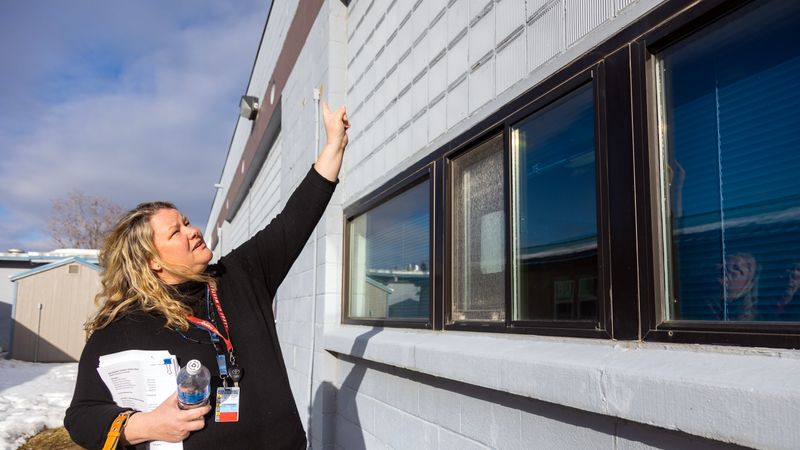
Boundary County School District Superintendent Jan Bayer points out that part of an exterior wall of a school building is made of glass blocks painted blue, which are not efficient for heating and cooling. The rest of the building is made of cinder blocks that came from a naval training station that was decommissioned in the 1940s.

No other state spends less on education per student than Idaho, according to a recent report from the U.S. Census Bureau, which surveys and ranks school finance systems. It also ranks last in the nation in terms of school infrastructure spending per pupil, a state report shows. So over the past several decades, rural districts across the state have faced the same challenge as Bayer: To improve or replace aging — and sometimes dangerous — facilities, they must appeal to local taxpayers and clear some of the nation’s most restrictive thresholds for school funding. Despite urgent needs, most of these efforts fail, an investigation by the Idaho Statesman and ProPublica has found. As a result, students across the state must learn amid dire conditions.

In one Idaho school, the foundation is crumbling. In another, so few bathrooms serve hundreds of kids that students have soiled themselves, according to school officials and local media. And in yet another, a portion of a roof recently failed during off-hours, sending water flooding into a classroom and bathrooms, destroying books and temporarily limiting learning space.

Since 2006, districts have mounted 217 bond attempts to remedy these types of problems and accommodate growing student populations. Had Idaho required only a majority of voters to support the measures — the threshold in most states — 83% of them would have passed. Instead, just 44% were approved, according to an analysis of bond measures and election data by the news organizations.

Please open the link and read this story. It makes you wonder whether the public cares about education and students. People complain about test scores but all too often they are unwilling to pay for an up-to-date school system. Charters and vouchers are a pointless diversion. They guarantee that the public schools attended by most students will be impoverished and under-resources.

The Idaho legislature turned down a voucher expansion that would have subsidized the tuition of rich kids. Behind the voucher defeat was a passionate network of parents determined to keep public dollars in public schools.

Peter Greene reports:

Last year, Idaho’s legislature passed a limited school voucher bill; this year school voucher supporters raised a more expansive proposal that was just defeated by Republicans.

Last year’s Empowering Parents Grant Program used $50 million of American Rescue Plan recovery money to give education vouchers to families. It limited the education savings account (ESA) vouchers to students who were already enrolled in public schools and whose families had an income equal to or less than 250% of the free or reduced lunch cut-off.

That program was established on a modest scale. This year voucher supporters proposed a larger, more universal form.

Senate Bill 1038 included no income limits and no requirements for previously attending public school. In other words, a wealthy family who had always enrolled their children in private school or home school would get $6,000 of taxpayer money, and that money would be pulled from the funding for schools that the students had never attended in the first place; the school’s funding would be reduced, but their operating costs would not.

Like most of the current boilerplate ESA bills, it not only failed to provide for oversight for those funds, but actively barred the state from exercising any oversight or authority over the education providers.

There was a huge price tag involved. While the bill’s sponsors estimated a $45 million price tag for the first year, other estimates suggested that the programwould quickly balloon to over $360 million. That expansion would match the experience of other states like New Hampshire, where the predicted cost of the program quickly grew by 5,800%.

As Senator C, Scott Grow (R-Eagle) put it, “I have absolutely no clue what the dollar amount on this is.”

It’s a huge amount of taxpayer money to be taken out of the public school system and distributed without oversight or accountability, and while conservative lawmakers in some states have not balked at that issue, some Idaho GOP members were not having it. Reported the Idaho Statesman:

“It’s actually against my conservative, Republican perspective to hand this money out with no accountability that these precious tax dollars are being used wisely,” said Sen. Dave Lent, R-Idaho Falls…

Three more voucher bills also failed.

Two GOP representatives, Greg Lanting and Lorei McCann, explained their no votes:

McCann and Lanting both said for every email supporting ESA legislation, they receive five opposing it. Lanting represents the same district as Clow.Rep. Mark Sauter, R-Sandpoint, said voting for the legislation would be equivalent to voting against his constituency.

Republicans have gone stark raving mad. They are terrified that their children might read a book that will turn them gay or transgender or might make them feel bad about racism. of course, their children have access to the internet, where they can see stuff far more sensational than anything in a book.

Somebody has to be punished for the racy books in the libraries.

In Idaho, parents will be able to sue libraries and school districts if they find an inappropriate book on their shelves. The fine would be $10,000 for each time a dangerous book is accessed.

A bill that would allow parents to sue libraries and school districts for allowing books containing material considered “obscene” on their shelves is one step closer to becoming law.

The “Children’s School and Library Protection Act” passed the Idaho House on a 40-30 vote Monday afternoon.

The bill lays out a proposed definition for what it calls material that is “harmful to minors,” including material that contains description or representation of nudity, sexual conduct, sexual excitement or “sado-masochistic abuse.”

The bill also specifically mentions representations of “intimate sexual acts, normal or perverted” along with descriptions of “masturbation, excretory functions, or lewd exhibition of the genitals or genital area.”…

One legislator made a good point:

A representative from Latah County says libraries are not the main place where kids are being exposed to mature content.

“This telephone and this computer has more damage than any library is ever going to have to our children,” Lori McCann (R), representative of Legislative District Six, said.

How many of those voting went home to watch porn on their phone or computer?

Opponents of vouchers have long complained about their cost, their harmful effect on public schools, and their lack of any accountability. State after state has ignored these concerns and authorized vouchers, which mostly underwrite the private school tuition of students who never attended public schools. Vouchers are a transfer of public funds from middle-class and low-income families to affluent families.

Idaho Republicans got it! They rejected a boiler-plate voucher program without income limits that would have paid tuition costs for every child already enrolled in a private school.

The first-year cost was estimated at $45 million, but based on comparisons with states like Florida, the cost would quickly escalate to $363 million a year.

Senate Republicans rejected a bill that would have allowed private school families to claim public education funds.

The bill, from Sens. Tammy Nichols, R-Middleton, and Brian Lenney, R-Nampa, would have created education savings accounts, a voucher-like mechanism that allows families with private school and home-schooled students to draw state funding for tuition, uniforms, tutoring and other education expenses.

Most Senate Republicans opposed the bill. Many said they support education savings accounts but believed the legislation has too many uncertainties, including how much it would cost….

Those opposed said they were concerned the voucher program would siphon limited public school funds. They also said the proposal lacked accountability for a significant amount of taxpayer money. The bill says that it would not grant a government agency authority over private schools.

“It’s actually against my conservative, Republican perspective to hand this money out with no accountability that these precious tax dollars are being used wisely,” said Sen. Dave Lent, R-Idaho Falls.

Read more at: https://www.idahostatesman.com/news/politics-government/state-politics/article272616367.html#storylink=cpy

The Network for Public Education posted this article about the billionaires behind the voucher legislation that recently passed. None of the billionaires live in Idaho.

New post on Network for Public Education.

Kelcie Moseley-Morris: Records show powerful, wealthy funders outside Idaho back school choice campaign

Reporting for the Idaho Capital Sun, Kelcie Moseley-Morris explains how Idaho’s big voucher push is the product of carpetbagger astroturf. What has been presented as a grassroots movement is fueled by other players.

The national special interests groups who have poured millions of dollars into efforts to make education savings account programs a reality in states like Arizona, Utah, Wyoming, Wisconsin and New Hampshire are the same donors who spent hundreds of thousands of dollars during Idaho’s midterm election to ensure school choice-friendly legislators occupied as many seats as possible in the Idaho Legislature, records show.

The American Federation for Children and the State Policy Network are two of those groups that are coordinated and funded by millionaires and billionaires dedicated to conservative policy positions across the U.S. — and now in Idaho. Sen. Tammy Nichols, R-Middleton, introduced an education savings account bill Tuesday for parents to use per-pupil funding from state funds at the institution of their choice.

The Federation is focused on school choice, while State Policy Network’s affiliates also demonstrate opposition to unions, a reduction in public services, opposition to climate change efforts and advocate for school choice.

The State Policy Network’s donors are largely not known to the public, but investigations have determined donors include foundations run by David and Charles Koch and large corporations such as Microsoft, Verizon, GlaxoSmithKline and Kraft Foods.

[One of the players is one of the DeVos family’s favorite charities.]

During the 2022 primary election in Idaho, a group called the American Federation for Children Action Fund gave $200,100 to an entity called the Idaho Federation for Children. It gave the entity another $140,500 in contributions between September and Dec. 28.

It is unclear how much the entity is connected to Idaho. It is not registered as an entity with the Idaho Secretary of State, and campaign finance records do not indicate any Idaho individuals or companies have donated to the PAC. Records show the Idaho Federation for Children’s street address is the same as the American Federation for Children’s offices in Washington, D.C., although the “state” section of the address says “ID” rather than D.C.

The group’s chairman as listed on Idaho’s campaign finance portal is Tommy Schultz, CEO of the D.C.-based organization.

[The piece also quotes Charles Siler, a former conservative operative who became disenchanted with the anti-public school workings. He places this advocacy in a larger context.]

Siler said his job often involved meeting with legislators to persuade them to support a certain policy ideal, which included welfare reform, efforts to fight subsidies for public transportation and ballot access restrictions, along with education programs.

Siler said the policies are aimed at disrupting the political power of regular people.

“It’s all funded by people who have a world view that’s really in opposition to any kind of collective action to resolve inequities in our society,” Siler said. “It’s all about undermining and destroying collective power, because it’s the only opposition that wealthy people actually face.”

Read the full piece here. 

You can view the post at this link : https://networkforpubliceducation.org/blog-content/kelcie-moseley-morris-records-show-powerful-wealthy-funders-outside-idaho-back-school-choice-campaign/

This is a thrilling story, reported by The Intercept.

THE NATIONWIDE CAMPAIGN to stifle discussions of race and gender in public schools through misinformation and bullying suffered a reversal in Idaho on Monday, when a high school senior vocally opposed to book bans and smears against LGBTQ+ youth took a seat on the Boise school board.

The student, Shiva Rajbhandari, was elected to the position by voters in Idaho’s capital last week, defeating an incumbent board member who had refused to reject an endorsement from a local extremist group that has harassed students and pushed to censor local libraries.

Rajbhandari, who turned 18 days before the election, was already well-known in the school district as a student organizer on climate, environmental, voting rights, and gun control issues. But in the closing days of the campaign, his opponent, Steve Schmidt, wasendorsed by the far-right Idaho Liberty Dogs, which in response helped Rajbhandari win the endorsement of Boise’s leading newspaper, the Idaho Statesman.

Rajbhandari, a third-generation Idahoan whose father is from Nepal, was elected to a two-year term with 56 percent of the vote.

In an interview, Rajbhandari told The Intercept that although he had hoped people would vote for him rather than against his opponent — “My campaign was not against Steve Schmidt,” he said — he was nonetheless shocked that Schmidt did not immediately reject the far-right group’s endorsement. “I think that’s what the majority of voters took issue with,” Rajbhandari said.

The Idaho Liberty Dogs, which attacked Rajbhandari on Facebook for being “Pro Masks/Vaccines” and leading protests “which created traffic jams and costed [sic] tax payers money,” spent the summer agitating to have books removed from public libraries in Nampa and Meridian, two cities in the Boise metro area.

But, Rajbhandari said, “that’s the least of what they’ve done. Last year, there was a kid who brought a gun to Boise High, which is my school, and he got suspended and they organized an armed protest outside our school.”

Rajbhandari, who started leading Extinction Rebellion climate protests in Boise when he was 15, is familiar with the group’s tactics. “We used to have climate strikes, like back in ninth grade, and they would come with AR-15s,” he said, bringing rifles to intimidate “a bunch of kids protesting for a livable future.”

So when the Idaho Liberty Dogs called on Boise voters to support Schmidt — and a slate of other candidates for the school board who, ultimately, all lost — Rajbhandari told me he texted his rival to say, “You need to immediately disavow this.”

“This is a hate group,” Rajbhandari says he told Schmidt. “They intimidate teachers, they are a stain on our schools, and their involvement in this election is a stain on your candidacy.” Schmidt, however, refused to clearly reject the group, even after the Idaho Liberty Dogs lashed out at a local rabbi who criticized the endorsement by comparing the rabbi to Hitler and claiming that he harbored “an unrelenting hatred for white Christians.”

While the school board election was a hyperlocal one, Rajbhandari is aware that the forces he is battling operate at the state and national level. “Idaho is at the center of this out-of-state-funded far-right attack to try to undermine schools, with the end goal of actually abolishing public education,” Rajbhandari told me. “There’s a group, they’re called the Idaho Freedom Foundation, and they actually control a lot of the political discourse in our legislature. Their primary goal is to get rid of public education and disburse the money to charter schools or get rid of that funding entirely.”

For his courage and candor, he won the endorsement of The Idaho Statesman.

This is a remarkable young man with a bright future ahead of him. I am happy to add him to the honor roll of this blog.

Read the rest of the story by opening the link. Rajbhandari is a force to be reckoned with. He is a good omen of the bright, dedicated young people who stand up for their teachers and for environmental activism, who fight for gun control and against censorship. Best wishes to him!