We in this nation face many challenges this year, especially with a Presidential election this November.
The country is polarized on many issues, and yet there is so much that binds us together. We should build on these commonalities and remember that we are all Americans, we are all human beings, we want the best for our country and for our children and grandchildren.
Rev. Dr. William Barber was involved in an unfortunate incident in Greenville, North Carolina last Tuesday. He went to the opening of the new film “The Color Purple” and brought his own chair, to accommodate his disability. The movie theater would not permit him to use his own chair, and he was evicted. Dr. Barber was the keynote speaker at the NPE conference a few years ago in Raleigh, North Carolina, and he inspired every one who heard him. He is a man of humility, faith, and courage.
After the news was reported, the AMC theater chain apologized profusely, and the chairman of the AMC chain asked to meet with Dr. Barber to apologize and to discuss how its movie theaters can make changes to meet the needs of people with disabilities.
At the end of the article, Dr. Barber said something that I would like to put up in lights:
Rev. William Barber: “There’s no way to follow Jesus without learning to pay attention to whoever is broken and vulnerable in society,” Barber said. “Because that’s where God shows up.”
Please remember this. Please share it with your friends.
J.B. Pritzker, Governor of Illinois, gave a terrific commencement address at Northwestern University, with a fabulous explanation about how to spot an idiot. He says that idiots are not necessarily stupid. They may be your boss. They may even be elected President.
John Merrow started a challenge to himself in 2011, on his 70th birthday. He set himself the goal of biking 70 miles, one for each year, and raising money for charity. He has done it every year since then. This year he turns 82. Can he bike 82 miles? I’m betting on John!
In a few days, Lord willing, I will turn 82, and that means it’s time for another attempt at biking my age. I began this exercise in putting off the inevitable in 2011, the year I turned 70. I’ve achieved my goal for 12 consecutive years, but the distance increases every year and I get a year older, so, as those financial ads warn, please remember that “past performance is no guarantee of future results.”
As I have in the past, I’m asking you to dig deep for a preferred good cause, which this year is World Central Kitchen, the remarkable charity founded in 2010 by Chef José Andres. WKC, a non-profit, is first to the frontlines–whether it’s Ukraine or countries like Haiti devastated by a natural disaster. WKC provides fresh meals in response to crises, while simultaneously working to build resilient food systems with locally-led solutions. WKC has served more than 250 million nourishing meals around the world. Charity Navigator makes it clear that 100% of your gift, which is 100% tax-deductible, will help WKC provide more meals to those in need.
Here’s an easy way to donate $820, or $82, or $8.20 to World Central Kitchen. Thank you.
Please open the link to finish reading the post.
I have sent several donations to WKC. I will send another to honor John.
It’s the story of a woman who lives in Oklahoma City who loves running marathons and had qualified to run in the 2023 Boston Marathon. Rachel Foster and her husband John own an Italian restaurant where she was the head chef. Five months before the Boston Marathon, they decided to take a night off and go for a ride on their electric scooters.
As they were riding, she had some sort of seizure, accelerated, and fell off her scooter. She had 17 broken bones and a catastrophic brain injury. She underwent brain surgery but didn’t wake up. For 10 days, she showed no consciousness.
The doctors told her husband that she had no brain activity, and that if she regained consciousness, she would likely be in a persistent vegetative state. They said there was no hope.
Her husband regretfully agreed to take her off life support the next day.
But then she opened her eyes.
A nurse ran in, and then the doctor, who instructed Rachel to blink twice if she could hear him. She did. He told her to squeeze his hand and move her feet on command. She did. The doctor turned the ventilator off and asked her to breathe on her own. For the first time since the accident, she did.
When a neurosurgeon who had operated on Rachel visited her hospital room a few weeks later, watching as she interacted with the nurses, he was stunned, John said.
“I looked at him and I said, ‘Isn’t this amazing?’ He went to approach her bed and he said, ‘No, this isn’t amazing. This is a miracle, and nothing that I did and nothing that my team did would cause an outcome like this,’” John recalled
Rachel had no memory of the accident. After a month of rehab, she transferred to the Shepherd Center in Atlanta to continue her rehabilitation. She had to learn how to stand, how to walk, how to balance, There, doctors decided that she needed another round of brain surgery “to restructure her skull and alleviate the discomfort.”
The surgery was a success, and as Rachel embarked on a grueling rehabilitation,she set her sights on aseemingly impossible goal — to run the Boston Marathon in April.She had run nine marathons and had qualified for Boston a second time by finishing the 2022 Oklahoma City Marathon the previous springwith a time of 3:17:15.
From the end of January to the end of March, she was in outpatient therapy, and her goal was to run in the Marathon, then only three weeks away. Her husband constantly encouraged her, cheering her on.
In addition, she had a running partner, 66-year-old Tim Altendorf, some three decades her senior. They had met in the local YMCA in spin class. Tim agreed to enter the Boston Marathon and run with her. They had a father-daughter bond. He understood how much it meant to her to run the Marathon.
When she returned to Oklahoma City, she and Altendorf ran together just once,a fewweeks before the Marathon. The next day, Rachel suffered a groin injury that forced her to modify her trainingand bothered her throughout the race. She also continued to struggle with her vision and coordination, and during the Marathon Altendorf would ask how she was feeling….
After such adversity, running the Marathon felt like redemption. Rachel soaked in the cheers along the way, even as the miles took a toll. But her pace quickened as the roar of the crowd grew andshe saw John jumping up and down onBoylston Street, shouting so loud he lost his voice. Rachel blew him kisses and said she loved him.
As rain fell, Rachel and Altendorf crossed with a time of 5:44:46.
“We held our hands and lifted both of our hands up in the air,” she said. “No matter what craziness has come at us, here we are. We’re finishing together as friends. It was amazing.”
Rachel said it will take time before she is fully recovered. But after finishing a marathon, she feels no task is too daunting.
“I feel so blessed and thankful,” she said. “I feel invincible. I do believe that it was a miracle. Miraculous things have happened and are happening every day.”
Stephen Owens is an evangelical Christian who has thought deeply about the importance of public schools in our society. He has a Ph.D. In education policy from the University of Georgia and is Director of Education at the Georgia Budget and Policy Institute. His blog is called “Common Grace, Common Schools.”
Let’s begin my argument for public schooling by making the familiar strange. There are aspects of public schooling that you do not see in any other facet of American life that need to be evaluated to better understand the institution’s value. Our familiarity with them takes away their novelty, but they are unique nonetheless. I think of us like a child who has Kelly Clarkson as an aunt. Just because she thinks of the singer as “Aunt Kelly” doesn’t mean we all have aunts who can sing like an angel.
Not only are parts of American public schooling unique, but reflect central tenets of the Christian faith. I want to explore three of them in the next few posts: inclusion, equity and accountability.
To put it concisely: I believe in the American cultural and political environment the public school is best situated to offer the highest quality service for all and, most specifically, the poor. I believe this is known, in my faith tradition, as common grace.
Now when I say the “poor” I’m not just talking about those who have more needs than resources, but a more generalized group of people that, for one reason or another, have structural obstacles to academic success. Students with disabilities and children who speak a language other than English at home are two perfect examples. Further, I don’t mean to imply that the state of a family’s bank account should be conflated with a child’s worth. Being “poor” in this sense cannot mean a person has less intrinsic value. The poor in this blog instead denotes a looser title for those children for which a neutral bystander might say, “good for them!” if the child were to perform a task common to the ruling class such as graduating from college.
I believe public schools are most valuable as a tool to lessen human suffering on the poor–one of the primary, and possibly only, ends of good governance—but that is not to say that its benefits end with this group. In fact, with few exceptions, I’m convinced that public schools are a service that have shown to support allpeople groups in our country. Foundational to this belief is the fact that public schools are required to provide services to every single child that arrives.
Inclusion. Public schools (in their current state) are for everyone. The road to the schools I attended in the 90s is paved with hard-fought legal protections for children that the majority culture would rather not teach. Throughout American history school leaders had to be forced to educate women, immigrants, Black people, students with disabilities and undocumented students via government compulsion. Each of these groups had to wait for laws to be changed to gain the advantages that white, rich, Protestant males shared since before our country was founded. This is not ancient history. My mom was a junior in high school when disabled kids got the right to a public education (1975). Undocumented children were guaranteed the same right two years before I was born (1982).
Inclusion, at least by this definition, has required blood, sweat and tears. It would be foolish to assume that inclusion is natural. In fact, inclusion is so unnatural to the way we consider schooling that its inverse remains a feature of excellence in the public mind. Consider elite schools’ relationship to exclusion: the ability to reject applicants based on test scores or income signals quality in a way that other schools could never replicate with performance alone. Post-secondary education is our best example here. Rejection rates for the Ivy Leagues not only “prove” their superiority but create it. For how could Harvard do poorly as a school if they’re allowed to choose to only educate the top seven percent of all those that apply?
It is only the common, or public, school which is left to teach all who enter her doors and, once inside, compelled to provide basic opportunities to each by threat of legal action. Inclusion, since it has been won, can be demanded.
Here I need to be explicit: inclusion is a good thing. Too often advocates for public schools treat inclusion as a burden to bear—“we can’t turn away students like private schools…”—instead of their greatest strength. Inclusion at some level acknowledges dignity in every person; Christians ought to be familiar with the concept via imago dei (the image of God). Early in Genesis the reader learns that God created humans in His image, bearing His likeness. Theologians have explained this concept differentiates humans from any other created thing by our spiritual/moral/missional similarity to the Creator. There is nothing that can remove this distinction, so every person you and I have ever met “looks” like God in some form. I’m convinced that this concept should be celebrated as the starting place for who is allowed where.
Now consider: where else is this the case? Think about your daily life, what physical spaces are compelled to not only accept everyone, but to give them foundational services? The other day a family came into a coffee shop where I was working and just sat. I will admit to being surprised. They didn’t buy anything, just sat on a couch near me while the kids looked at their iPads. I’m so used to private spaces that I did not think those people belonged until they bought something. This belief did not come out of thin air, many of the places that we imagine as public are only available if we have money, genius, status or some other item to trade. Outside of government programs (public parks, public transit, etc.) it’s hard to imagine a comparable institution to public schools besides hospitals. While I believe there are several similarities between schools and hospitals (nurses and teachers have long seen commonalities between how they are treated, for example), two major differences are apparent: 1) hospitals don’t exist in many rural communities and 2) no one has gone into debt because of the services provided by public schools.
I am, as I hope I’ve made clear up to this point, big on inclusion. But what are the public schools forced to include all children to? What occurs in the inner circle that has for generations been open only to the few? The generally-accepted answer to this question, and more broadly the question of “what is the purpose of education” usually falls into two categories–socialization and skill acquisition. When I describe the need for public schools to include all people it is with the latter purpose in mind. Poor children have been historically kept from learning the skills that are needed to earn living wages. A strong school system can help ensure higher wages, better health outcomes and decreased likelihood of entering the criminal justice system. On the path to living wages (and therefore less human suffering) there are few hurdles higher than failing to graduate high school and college.
The need for public education, and the majority-culture’s attempt to restrict it to the few, has a long history in our country. Tunis Campbell, the father of public education in Georgia, recognized a strong education as necessary to support formerly-enslaved people in post-Civil War Georgia. Without the ability to read, Campbell knew that freed men would continue to be subject to, among other racist practices, predatory labor contracts. Rev. Campbell spent the years following Sherman’s march setting up schools for freed people and is as responsible as any person for the state constitution’s inclusion of a right to public education for all children. He believed education sat alongside land ownership, a just court system and community service as necessary keys to a good life for Black Georgians.
Bringing it back to the present, I will put socialization to the side for now and will describe how the very nature of common schools supports poor families more than their richer neighbors. There are many facets of public schooling which we take for granted but that are frankly unbelievable. Every morning a transit system crawls cities, towns and rural counties to pick up any child that arrives to the stop on time and take them to their school. This service is provided at no additional cost to the child’s family whether they live one mile from the building or 30. In a country that tends to require the ownership and maintenance of a personal-transport vessel as the price for admission to society, the school bus itself is a marvel. It’s far from the only one. Health care, multiple meals and career guidance are all things that richer families can pay for but are often out of reach for the poor. In the public school each (via school health clinics, free food and school counseling) are provided part and parcel to poor public school children. If any one of these services were not already a part of schooling in America, it is impossible to imagine them being created and, more importantly, paid for with public funds. It is services like these that do not neatly fit into a definition of schooling but have become a pivotal safety net for struggling families in our nation. To ignore the role of public schools as welfare is convenient but unhelpful.
To ignore the role of public schools as welfare is convenient but unhelpful.
I’d go as far as to say that the true measure of a school is their support for the poor. The brutal truth of schooling in the U.S. is that parental income is strongly predictive of educational outcomes. While we like to imagine a true meritocracy, the real difference is whether your parents have enough money to provide 1) security (food and housing), 2) accountability, 3) targeted support and 4) social capital. So, any time I come across the “conventional wisdom” of the superiority of private schools it sounds like someone bragging that Georgia beat Vanderbilt in football. Duh: Kirby and…whomever is coaching Vandy… are dealing with two qualitatively different pools of players. If we’re really going to provide the measure of a school, look to the services provided to those that the Bible refers to as “the least of these.”
When you compare the test performance of wealthy Americans to other nations it’s clear we are on par with, or outperforming, every other country in the world. What makes our system “mediocre” is our treatment of poor children. Generations of white supremacist policies have ensured that wealth is concentrated in white families. So, the limitations of our public school system cannot be separated from our nation’s original sin. The good news is that income does not have to equal destiny. Research has shown that investment in public schools can and does level the playing field, but the investments have to go to the schools and/or children that need them the most. Another word for this is equity. I will write about equity in the next post.
Historian Heather Cox Richardson reflects on the anniversary of Dr. Martin Luther King’s birthday. We now look on him as a hero, but during his lifetime, he was treated shamefully by many whites, and militant African-Americans scorned him as well, preferring the angry approach of Stokely Carmichael and Malcolm X. Dr. King was principled and fearless. He faced death daily, and he never back down. It is usually forgotten that he was assassinated in Memphis while there to support striking sanitation workers, who were trying to organize a union. He knew that unions offered the best protection for working people. White conservatives who fraudulently praise him now, claiming that racism is a thing of the past and should not be taught or discussed (so that everyone can be judged by “the content of their character, not the color of their skin”), oppose everything he fought and died for.
You hear sometimes that, now that we know the sordid details of the lives of some of our leading figures, America has no heroes left.
When I was writing a book about the Wounded Knee Massacre, where heroism was pretty thin on the ground, I gave that a lot of thought. And I came to believe that heroism is neither being perfect, nor doing something spectacular. In fact, it’s just the opposite: it’s regular, flawed human beings, choosing to put others before themselves, even at great cost, even if no one will ever know, even as they realize the walls might be closing in around them.
It means sitting down the night before D-Day and writing a letter praising the troops and taking all the blame for the next day’s failure upon yourself, in case things went wrong, as General Dwight D. Eisenhower did.
It means writing in your diary that you “still believe that people are really good at heart,” even while you are hiding in an attic from the men who are soon going to kill you, as Anne Frank did.
It means signing your name to the bottom of the Declaration of Independence in bold print, even though you know you are signing your own death warrant should the British capture you, as John Hancock did.
It means defending your people’s right to practice a religion you don’t share, even though you know you are becoming a dangerously visible target, as Sitting Bull did.
Sometimes it just means sitting down, even when you are told to stand up, as Rosa Parks did.
None of those people woke up one morning and said to themselves that they were about to do something heroic. It’s just that, when they had to, they did what was right.
On April 3, 1968, the night before the Reverend Doctor Martin Luther King Jr. was assassinated by a white supremacist, he gave a speech in support of sanitation workers in Memphis, Tennessee. Since 1966, King had tried to broaden the Civil Rights Movement for racial equality into a larger movement for economic justice. He joined the sanitation workers in Memphis, who were on strike after years of bad pay and such dangerous conditions that two men had been crushed to death in garbage compactors.
After his friend Ralph Abernathy introduced him to the crowd, King had something to say about heroes: “As I listened to Ralph Abernathy and his eloquent and generous introduction and then thought about myself, I wondered who he was talking about.”
Dr. King told the audience that, if God had let him choose any era in which to live, he would have chosen the one in which he had landed. “Now, that’s a strange statement to make,” King went on, “because the world is all messed up. The nation is sick. Trouble is in the land; confusion all around…. But I know, somehow, that only when it is dark enough, can you see the stars.” Dr. King said that he felt blessed to live in an era when people had finally woken up and were working together for freedom and economic justice.
He knew he was in danger as he worked for a racially and economically just America. “I don’t know what will happen now. We’ve got some difficult days ahead. But it doesn’t matter…because I’ve been to the mountaintop…. Like anybody, I would like to live a long life…. But I’m not concerned about that now. I just want to do God’s will. And He’s allowed me to go up to the mountain. And I’ve looked over. And I’ve seen the promised land. I may not get there with you. But I want you to know tonight, that we, as a people, will get to the promised land!”
People are wrong to say that we have no heroes left.
Just as they have always been, they are all around us, choosing to do the right thing, no matter what.
Wishing you all a day of peace for Martin Luther King Jr. Day, 2023.
Texas Governor Greg Abbott took pride in sending three bus loads of Venezuelan immigrants from Texas to Washington, D.C. on Christmas Eve. They were sent to the home of Vice-President Harris, where they arrived in bitter cold weather without proper clothing. Men, women, and children.
Is this the spirit of Christmas? Was there no room at the inn in Texas? What was the message of Jesus? What kind of a Christian is Governor Abbott and his buddy Florida Governor Ron DeSantis? Where in the New Testament does it say you should treat the hungry and homeless with contempt and use them as political pawns?
Several busloads of migrants were dropped off at the Washington, D.C., residence of Vice President Kamala Harris on Christmas Eve — apparently the latest in an escalating battle between state officials and the Biden administration over the country’s immigration policy.
A total of three busloads of migrants arrived at the Naval Observatory, where Harris lives, on Saturday evening. The Migrant Solidarity Mutual Aid Network, a local grassroots organization, met the migrants, who were inadequately dressed for the freezing temperature, according to the station.
Amy Fischer, an organizer with the Migrant Solidarity Mutual Aid Network, told NPR’s All Things Considered on Sunday that Abbott’s actions were “rooted in racism and xenophobia.”
“At the end of the day, everybody who arrived here last night was able to get free transportation, on a charter bus, that got them closer to their final destination,” she said.
Fortunately there are people in the sanctuary cities who are feeding the hungry, housing the homeless, and caring for the stranger.
In Abbott’s Texas and DeSantis’ Florida, Christian values have been warped into talking points for rightwing frauds.
I read this obituary in the Boston Globe, and I found myself wishing that more of us could be like Sabina. By her measure, most of us fall short. But let us honor the incredible example she set. She defines the term “force of nature.”
During two decades as an activist, Sabina Carlson Robillard became a significant leader in humanitarian relief efforts as she insisted that the voices of those being assisted should always be the most prominent in every discussion.
“While you’re listening to me, there are 1.5 million conversations happening on the ground, and I’m here to ask you all how we’re listening to them,” she said at a 2010 conference in Boston about her work in Haiti earlier that year after an earthquake killed more than 200,000 people.
She had turned 22 several weeks before that speech and was a seasoned activist. Years earlier in middle school, she began participating in protests and “was already thinking deeply about people who were suffering throughout the world,” said her father, Ken Carlson.
After being diagnosed with clear cell sarcoma four years ago while she was pregnant, Ms. Robillard, who lived in Cambridge, stayed busier than most of her healthiest colleagues.
She worked as a consultant and an operations officer with humanitarian nonprofits, and helped raise her daughter and stepdaughter while being treated for cancer. Ms. Robillard even texted her academic adviser from her Massachusetts General Hospital room the day before she died on Nov. 16, at age 34, to schedule a meeting a few days later with her Tufts doctoral advisory committee.
“In an unassuming way, she changed the course of how lots of money and people engaged in Haiti,” said her friend Jess Laporte of Waterbury, Vt., a Haitian-American climate and racial justice activist who works with nonprofits.
She worked as a consultant and an operations officer with humanitarian nonprofits, and helped raise her daughter and stepdaughter while being treated for cancer. Ms. Robillard even texted her academic adviser from her Massachusetts General Hospital room the day before she died on Nov. 16, at age 34, to schedule a meeting a few days later with her Tufts doctoral advisory committee.
“In an unassuming way, she changed the course of how lots of money and people engaged in Haiti,” said her friend Jess Laporte of Waterbury, Vt., a Haitian-American climate and racial justice activist who works with nonprofits.
Dan Maxwell, a Tufts University professor who was Ms. Robillard’s academic adviser, first met her when she was a Tufts sophomore.
“She was already well known as a force of nature on campus when she was 18 or 19 years old,” he said.
And though more recently she was a doctoral student, he said, “she was also like a colleague, and in many ways a leader the rest of us followed.”
Ms. Robillard was the lead author for a 2021 report, prepared with Teddy Atim and Maxwell, which called on international relief organizations to adopt a “localization” approach — letting local groups and individuals participate in planning and administration, rather than excluding them, as so often was done in the past.
In October, the US Agency for International Development issued a draft “Policy for Localization of Humanitarian Assistance” that cited the Tufts report and drew upon its findings.
“I was certainly happy to see her live long enough to see that kind of high-level validation of her work,” said Maxwell, who added that Ms. Robillard was defined by her sense of certainty in the field and in her writing.
“She had a North Star,” he said. “She knew where she was going, she knew what was right. While she didn’t force people to agree with her, she could be pretty insistent about what was right and what was wrong.”
The correct approach, she often said, was to listen instead of impose an outsider’s view.
After the January 2010 earthquake in Haiti, “what I saw firsthand was how much Haitians wanted to have their voices heard in the response,” Ms. Robillard wrote for the website of CDA Collaborative Learning Projects, an international nonprofit based in Cambridge for which she worked.
Early on, Ms. Robillard channeled her determination into helping others.
“Sabina was always defined by a tremendous sense of empathy,” her father said. “Her empathy was her sixth sense. She always thought of others before herself, even when she was a very, very young child.”
She also was a multi-instrument musician, an accomplished slam poet, and a leader of Amnesty International and gay-straight alliance groups while in high school.
Initially intending to study creative writing at Tufts, Ms. Robillard was soon involved with humanitarian work, spending months away from the university in 2009 to work as an intern with refugees in South Sudan.
She graduated the following year with a bachelor’s degree in community health and peace and justice studies, and subsequently received a master’s in applied community change and peace building. Tufts later honored Ms. Robillard for her humanitarian work.
For the past dozen years, she worked for nonprofits and aid groups including the International Organization for Migration. She was part of the IOM’s response to the Ebola outbreak in Guinea several years ago, and its response to a cholera outbreak in Haiti.
Fluency in French and Haitian Creole made her particularly effective in Haiti, where she had lived in Cite Soleil, a crowded, impoverished part of the Port-au-Prince metropolitan area. And she used her language skills to elevate the voices of those who lived in Haiti.
A presentation at her memorial service featured her quote: “Why isn’t localized humanitarian aid focused on letting communities determine and lead the work in building their own future?”
Among those she met in Haiti was Louino Robillard, a community leader known as Robi, whom she married in Port-au-Prince in December 2012, and with whom she collaborated.
With marriage came additional roles as stepmother to his daughter, Dayana Robillard, and parent to the couple’s 4-year-old daughter, Anacaona.
Discoloration under Ms. Robillard’s left eye, initially thought to be benign, appeared in 2017. While she was pregnant the following year, tests showed it was a malignant tumor, and the cancer later spread to her lungs.
Continuing to work for four years, even during her final full day alive, “Sabina wrote Ana e-mails over the last four years — 356 e-mails, knowing she wasn’t going to be around,” her mother said.
In addition to her parents, husband, stepdaughter, and daughter, all of Cambridge, and her brother, Ms. Robillard leaves her maternal grandmother, Luba Lepidus of Somerville.
Ms. Robillard’s husband will bring her ashes to Pak Nan Ginen, a park and reforestation project they cofounded in Saint-Raphael, Haiti, where he plans to build a memorial. Because Haiti is severely deforested, “she wished to use her ashes as soil to plant trees,” he said.
Chef Jose Andres created an organization called World Central Kitchen that goes wherever there is hunger and feeds people. Their mission right now is to serve food and deliver water to the people on the front lines in Ukraine.
Since the invasion of Ukraine began, WCK teams have provided more than 180 million meals to people in need. However, families still need our support as they head into what will likely be the toughest winter of their lives. By fueling our work, you’re helping us bring hope and comfort to communities across Ukraine—and now, a generous WCK donor is matching all gifts up to $10 million made now through December 31 for Ukraine. Make a donation today to double your impact. HELP US CONTINUE OUR EFFORTS IN UKRAINE
Ground report from José in Kherson
On November 11, after eight long months of occupation, the southern Ukrainian city of Kherson was liberated. Having arrived as soon as we were permitted to enter Kherson, WCK local teams were greeted with hugs and tears of joy while delivering food kits. Several days later, José arrived in Ukraine, keeping his promise of returning to Kherson once it was liberated. Below, José shares a ground report from his trip, detailing the growth of our response since WCK first arrived in the newly liberated city.
Yes, WCK has been able to previously support some local restaurants cooking for neighbors in Kherson and safely delivered food kits to frontline communities in the region…we even delivered a generator and fixed the broken water supply for five nearby villages. But no matter how much we wanted to do more, we were unable to reach so many families who were possibly going hungry because of Russia’s brutal occupation. In Kherson, residents lived without basic necessities, cut off from the rest of Ukraine…so many feared for their lives for eight long months. So when Ukraine’s troops entered Kherson on November 11, our WCK team knew we had to be there immediately next to the people, as soon as it was safe to do so.
When I arrived in Kherson on November 16, our WCK team had been delivering food aid each day, working on how we could increase our support every time we returned to the city. What I saw when I first got to Kherson… people celebrating, children were walking the streets with Ukrainian flags, it was a moment I will never be able to describe. But reality sets in as the day goes on and night falls, and people go home without electricity, food, or water. It’s still dangerous too…earlier in the morning a mine left behind exploded inside the train station. Thankfully no one was hurt. During our distribution we also heard shelling as the frontline is not too far away.
Still, when we were doing our food distribution, people remained calm and didn’t mind standing in the rain. I went around and spoke to families who told me they did not have much food at home. This is how WCK meets the needs. We work with the community and everyday we learn and get better.
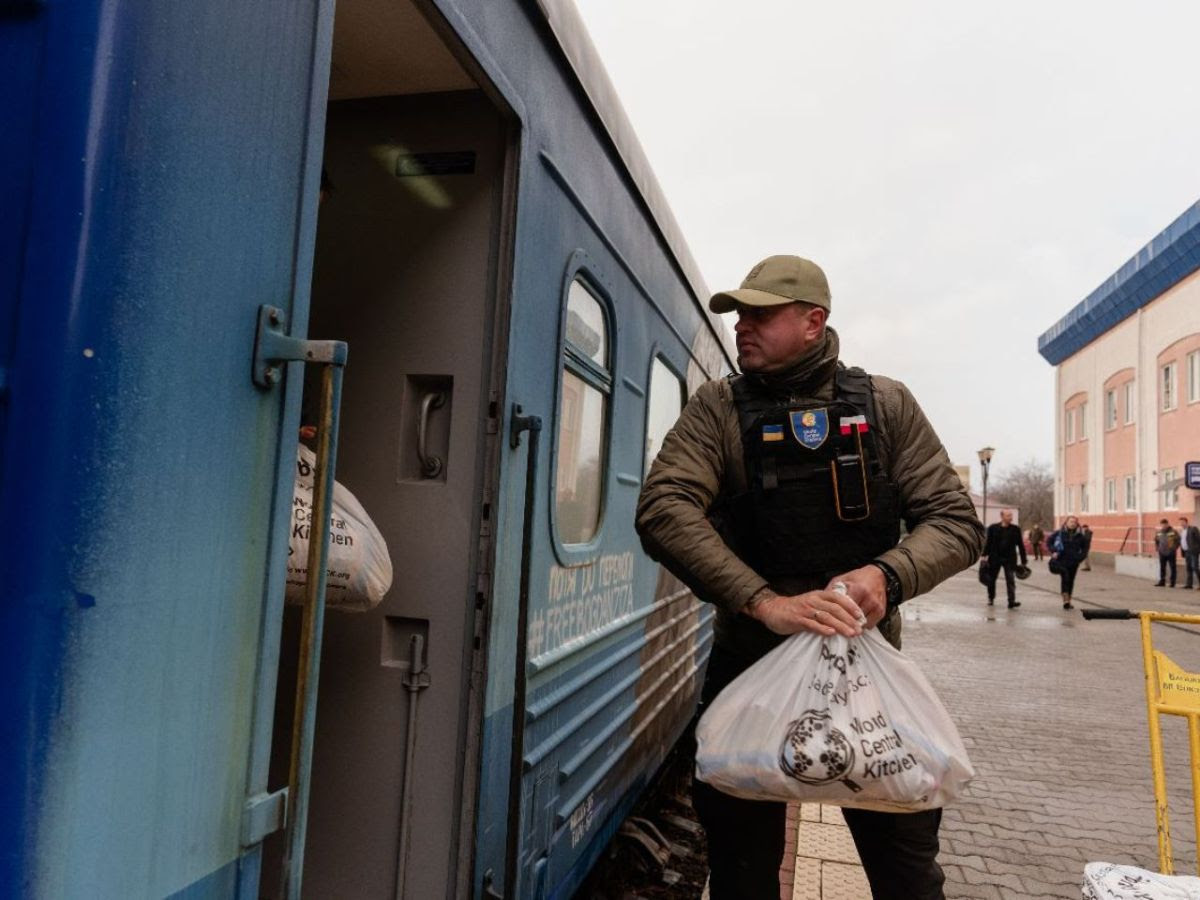
We travel neighborhood by neighborhood, delivering thousands of food kits to families.
Now we’ve been delivering and have been talking to the people, we’re growing our distributions across different neighborhoods to make sure we reach as many families as we can. For residents with gas and able to cook at home, we’re providing 30lb food kits filled with the majority of Ukrainian products. We are also bringing thousands of plates cooked from our WCK Food Truck in Mykolaiv.
WCK’s Food Truck in Mykolaiv has the capacity to cook up to 5,000 meals. Once the food is prepared, we package it for delivery.
It’s been amazing to see how fast our WCK teams in Ukraine have been able to scale and adapt to the challenges of every situation. With safety systems in place, the Relief Team is moving quickly so people are not gathering or staying outdoors for a long time. Delivery has also been difficult because access to Kherson is still limited, roads are destroyed, and rain has made things very muddy, but WCK keeps going no matter what!
Bringing aid to Kherson is challenging—roads are damaged and rain is causing mud.
There is also no water in Kherson and many people are collecting it directly from the Dnipro river. Filling nine large, 5,000 liter barrels, we delivered and installed water distribution sites throughout the city for residents to drink and cook with. In the next few days, we will install more water sites. WCK now has water distribution sites set up across the city, and we’ll keep expanding.
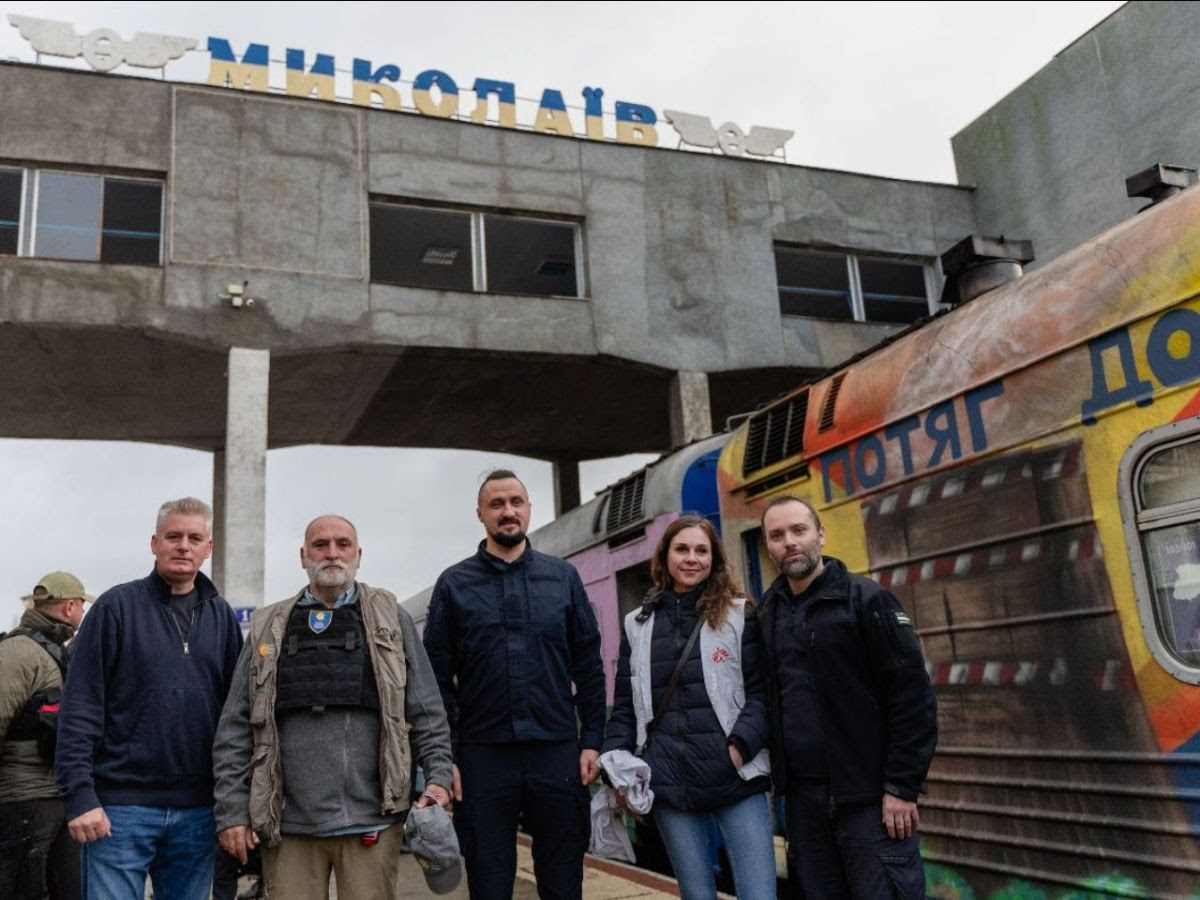
During my trip I also witnessed a special moment in Ukrainian history—the restoration of trains to and from Kherson. As Ukraine continues to fight for freedom and liberty they are sending a powerful message to the world that they can overcome anything. These are trains of hope, connecting Ukraine again.
Throughout our response, WCK has worked closely with our friends at Ukrainian Railways to transport critical supplies across the country, so we were very proud to stand alongside them during this amazing accomplishment. I rode on the first train to Kherson from Mykolaiv with nearly 200 other people. Some were returning home, some were going to see their relatives, but there were also people who simply decided to be there on this beautiful day. And for WCK, we brought along thousands of food kits with us!
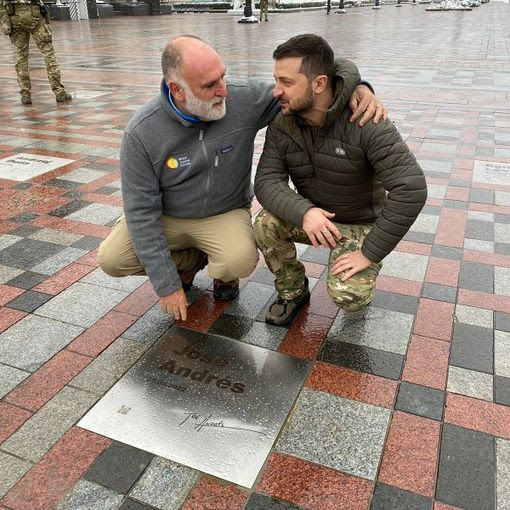
Before I left Ukraine, I took another trainfrom Kherson to Kyiv where I was honored to meet with President Zelenskyy. He presented me with the Order of Merit honor, something that I humbly accepted not for me, but in recognition of the thousands of Ukrainian Food Fighters I get to work with every single day. It is these people who are the heroes behind WCK’s efforts…the people who make the impossible, possible and have been working tirelessly for months under uncertain circumstances to get food to communities in need.
It is why we have been in Ukraine since the very beginning. We know we cannot solve every problem, but the very least WCK can do is make sure that food and water is not another issue people living under attack have to be worried about. We promised the people of Ukraine that as cities become liberated we would be there.
.
So in Kherson, standing shoulder-to-shoulder with WCK teams as they got food and water so fast to families in need, was one of the proudest moments of my life. It is because of WCK Food Fighters and supporters around the world that we are the only large-scale food aid in the city. Together, we will all help Kherson, and other regions around Ukraine, get through the long, hard winter. Thank you for your support and for continuing to believe in our mission.




 Diane Ravitch's blog