Archives for category: For-Profit

A reader who identifies as “Democracy” left a comment here about DeSantis’ war against the College Board’s Advanced Placement (AP) courses. DeSantis manufactured a culture war issue, a familiar tactic for him, but don’t defend the AP exams: They are worthless, says he or she.

Democracy wrote:

While I certainly do not agree with — and am appalled by — the Florida dictate, I hate to see the College Board’s Advanced Placement (AP) program in the bannerhead of this issue because it makes it appear that the AP program is somehow being victimized, and it helps to propagate the AP brand.

It’s important to separate the wheat from the chaff here. The Florida requirement – state law – is part of a larger effort by conservatives (Republicans) across the country to, as USA Today put it, “restrict learning and materials about controversial topics.” Or, in other words, topics that conservatives hate to talk about: racism, misogyny, equality, sedition, tolerance, democracy, reproductive rights, climate change, sex…..

The original law required a cataloging of all books in “a school library media center.” The DeSantis-controlled Florida DOE interpreted that broadly to include classrooms. The Republican legislature amended the law to say that a school library media center is

“any collection of books, ebooks, periodicals, or videos maintained and accessible on the site of a school, including in classrooms.”

As The Sarasota Herald Tribune reported in April of this year,

“The law, governing instructional materials for classes from kindergarten to 12th grade, passed last year and holds school districts responsible for the content of all materials used in a classroom, made available in a school library or included on a reading list. It requires each book in a school library to be certified by a media specialist and for a list of these materials to be available on school websites. The law took effect in January.”

This is incredibly cumbersome, especially for elementary school teachers who have large troves of books for their students. And if it reeks of conservative religious state-imposed censorship, that’s probably because it is. As ABC News (and other media) reported, “Books targeted by conservative groups were overwhelmingly written by or about people of color and LGBTQ people, according to anti-censorship researchers.”

All of this is worrisome. It’s dangerous territory.

But that does not mean that AP is the victim. Nor should it imply that AP is actually educationally beneficial for most students. As I’ve noted here previously, more colleges and universities are either refusing to accept AP test scores for credit, or they are limiting credit awarded only for a score of 5 on an AP test. The reason is that they find most students awarded credit for AP courses are just generally not well-prepared.

Dartmouth no longer gives credit for AP test scores. It found that 90 percent of those who scored a 5 on the AP psychology test failed a Dartmouth Intro to Psych exam. A 2006 MIT faculty report noted “there is ‘a growing body of research’ that students who earn top AP scores and place out of institute introductory courses end up having ‘difficulty’ when taking the next course.” Two years prior, Harvard “conducted a study that found students who are allowed to skip introductory courses because they have passed a supposedly equivalent AP course do worse in subsequent courses than students who took the introductory courses at Harvard.”

In The ToolBox Revisited (2006) Clifford Adelman scolded those who had misrepresented his original ToolBox research by citing the importance of AP “in explaining bachelor’s degree completion. Adelman said, “To put it gently, this is a misreading.” Moreover, in statistically analyzing the factors contributing to the earning of a bachelor’s degree, Adelman found that Advanced Placement did not reach the “threshold level of significance.”

College Board executives often say that if high schools implement AP courses and encourage more students to take them, then (1) more students will be motivated to go to college and (2) high school graduation rates will increase. There are educators who parrot the College Board line. Researchers Kristin Klopfenstein and Kathleen Thomas “conclude that there is no evidence to back up these claims.”

Why do students take AP? Because they’ve been told to. Because they’re “trying to look good” to colleges in the “increasingly high-stakes college admission process,” and because, increasingly, “high schools give extra weight to AP courses when calculating grade-point averages, so it can boost a student’s class rank.” It’s a depraved stupid circle that has swept up parents, guidance counselors, administrators and school boards, teachers, and the general public – not to mention public education reporters – into the misbelief that “AP is better.” It isn’t.

One student who got caught up in the AP hype cycle –– taking 3 AP courses as a junior and 5 as a senior –– and only got credit for one AP course in college, reflected on his AP experience. He said nothing about “rigor” or “trying to be educated” or the quality of instruction, but remarked “if i didn’t take AP classes, it’s likely I wouldn’t have gotten accepted into the college I’m attending next year…If your high school offers them, you pretty much need to take them if you want to get into a competitive school.”

What do students actually learn from taking these “rigorous” AP courses and tests? For many, not much. One student remarked, after taking the World History AP test, “dear jesus… I had hoped to never see ‘DBQ’ ever again, after AP world history… so much hate… so much hate.”

And another added, “I was pretty fond of the DBQ’s, actually, because you didn’t really have to know anything about the subject, you could just make it all up after reading the documents.”

Another AP student related how the “high achievers” in his school approached AP tests: “The majority of high-achieving kids in my buddies' and my AP classes couldn’t have given less of a crap. They showed up for most of the classes, sure, and they did their best to keep up with the grades because they didn’t want their GPAs to drop, but when it came time to take the tests, they drew pictures on the AP Calc, answered just ‘C’ on the AP World History, and would finish sections of the AP Chem in, like, 5 minutes. I had one buddy who took an hour-and-a-half bathroom break during World History. The cops were almost called. They thought he was missing.”

And an AP reader (grader), related this about the types of essays he saw:

“I read AP exams in the past. Most memorable was an exam book with $5 taped to the page inside and the essay just said ‘please, have mercy.’ But I also got an angry breakup letter, a drawing of some astronauts, all kinds of random stuff. I can’t really remember it all… I read so many essays in such compressed time periods that it all blurs together when I try to remember.”

The Florida law is clearly not in the interests of kids and learning. But AP ain’t necessarily all that either.
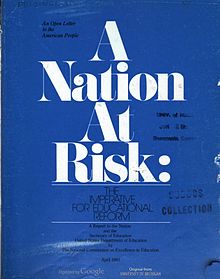

Nancy Bailey criticizes the ongoing campaign to raise academic expectations and academic pressure on children in kindergarten. She traces the origins of this misguided effort on the Reagan-era publication “A Nation at Risk” in 1983.

Although the gloomy claims of that influential document have been repeatedly challenged, even debunked*, it continues to control educational discourse with its assertion that American schools are failing. “A Nation at Risk” led to increased testing, to the passage of George W. Bush’s No Child Left Behind in 2002, to the creation of Barack Obama’s Race to the Top in 2009, to the release of the Common Core standards in 2010.

Despite nearly a quarter century of focus on standards and testing, policymakers refuse to admit that these policies have failed.

And nowhere have they been more destructive than in the early grades, where testing has replaced play. Kindergarten became the new first grade.

But says Bailey, the current Secretary of Education wants to ratchet up the pressure on little kids.

She writes:

In What Happened to Recess and Why are our Children Struggling in Kindergarten, Susan Ohanian writes about a kindergartner in a New York Times article who tells the reporter they would like to sit on the grass and look for ladybugs. Ohanian writes, the child’s school was built very deliberately without a playgroundLollygagging over ladybugs is not permitted for children being trained for the global economy (2002, p.2).   

America recently marked forty years since the Reagan administration’s A Nation at Risk: The Imperative for Educational Reform which blamed schools as being eroded by a rising tide of mediocrity that threatens our very future as a Nation and a people.

Berliner and Biddle dispute this in The Manufactured Crisis: Myths, Fraud, and the Attack on America’s Public Schools. They state that most of these claims were said to reflect “evidence,” although the “evidence” in question either was not presented or appeared in the form of simplistic, misleading generalizations (1995, p. 3)

Still, the report’s premise, that public schools failed, leading us down the workforce path of doom, continues to be perpetuated. When students fail tests, teachers and public schools are blamed, yet few care to examine the obscene expectations placed on the backs of children since A Nation at Risk.

Education Secretary Cardona recently went on a bus tour with the message to Raise the Bar in schools. Raising the bar is defined as setting a high standard, to raise expectations, to set higher goals.

He announced a new U.S. Department of Education program, Kindergarten Sturdy Bridge Learning Community.

This is through New America, whose funders include the Bill and Melinda Gates Foundation, the Waltons, and others who want to privatize public education. Here’s the video, Kindergarten as a “Sturdy Bridge”: Place-Based Investments, describing the plan focusing on PreK to 3rd grade. This involves Reading by 3rd and the Campaign for Grade Level Reading.

Cardona says in the announcement:

Getting kindergarten right has to be top of mind for all of us, because what happens there sets the stage for how a child learns and develops well into their elementary years and beyond. 

Ensuring that kindergarten is a sturdy bridge between the early years and early grades is central to our efforts both to Raise the Bar for academic excellence and to provide all students with a more equitable foundation for educational success. The kindergarten year presents an opportunity to meet the strengths and needs of young learners so they can continue to flourish in the years to come.

Raise the bar? Kindergarten is already the new first grade. What will it be now? Second? Third? Fourth? What’s the rush? How is this developmentally sound? One thing is for sure: there will still be no idle time for children to search for ladybugs.

Few bear the brunt of A Nation at Risk,as do early learners whose schools have been invaded by corporate schemes to force reading and advanced learning earlier than ever expected in the past.

If kindergartners aren’t doing well after all these years of toughness, higher expectations, and an excruciating number of assessments, wouldn’t it seem time to back off, instead of raising the bar higher?

Editor’s note:

*James Harvey and I will discuss the distortions contained in the “Nation at Risk” report at the Network for Public Education conference on Oct. 28-29 in Washington, D.C. James Harvey was a high-level member of the staff that wrote the report. He has written about how the Reagan-era Commissuon in Excellence in Education “cooked the books” to paint a bleak—but false—picture of American public schools. Please register and join us!

Mike Petrilli, president of the Thomas B. Fordham Institute, published an article in the New York Times yesterday in which he lamented the “learning loss” caused by the pandemic and called for a new national effort, like No Child Left Behind, to instill rigor and accountability, which he says will raise test scores. Time to bring back tough love, he wrote.

I have a hard time criticizing Mike Petrilli because I like him. When I was on the board of the Thomas B. Fordham Foundation/Institute, I got to know Mike, and he’s a genuinely good guy. But when I left the board of the TBF Institute in 2009, it was because I no longer shared its beliefs and values. I concluded as early as 2007 that No Child Left Behind was a failure. I wrote an article in the conservative journal EdNext in 2008 about NCLB, saying “End It,” paired with an article by the late John Chubb saying, “Mend It.”TBF sponsored charter schools in Ohio—a move I opposed because think tanks should be evaluating policy, not implementing it; also, during the time I was on the board, the charters sponsored by TBF failed.

By the time I left, I had concluded that the NCLB emphasis on high-stakes standardized testing was a disaster. It caused narrowing the curriculum, gaming the system, cheating, excessive test prep, and squeezed the joy of teaching and learning out of classrooms.

Furthermore, the very idea that Congress and the U.S. Department of Education were stigmatizing schools as failures and closing them was outrageous. I worked in the US ED. There are many very fine career civil servants there, but very few educators. In Congress, the number of experienced educators is tiny. Schools can’t be reformed or fixed by the President, Congress, and the Department of Education.

NCLB and Race to the Top were cut from the same cloth: Contempt for professional educators, indifference to the well-established fact that test scores are highly correlated with family income, and a deep but misguided belief that punishing educators and closing schools were cures for low test scores. Both the law (NCLB) and the program (RTTT) were based on the assumption that rewards and punishments directed at teachers and principals would bring about an educational renaissance. They were wrong. On the day that the Obama administration left office, the U.S. Department of Education quietly released a study acknowledging that Race to the Top, having spent billions on “test-and-punish” strategies, had no significant impact on test scores.

And as icing on the cake, Mike Petrilli wrote an article in 2017 about the latest disappointing NAEP scores, lamenting “a lost decade.” That “lost decade” was 2007-2017, which included a large chunk of NCLB and RTTT. In addition, the Common Core standards, released in 2010, were a huge flop. TBF was paid millions by the Gates Foundation both to evaluate them and to promote them. The NAEP scores remained flat after their introduction. Please, no more Common Core.

I wrote two books about the failure of NCLB and RTTT: The Death and Life of the Great American School System: How Testing and Choice Are Undermining Education (2010) and Reign of Error: The Hoax of the Privatization Movement and the Danger to America’s Public Schools.

Mercedes Schneider and I both wrote posts commending Mike Petrilli in 2019 when he wrote about the “dramatic achievement gains” of the 1990s and early 2000s before NCLB kicked in. He attributed those gains to improving economic conditions for families and declining child poverty rates. I wanted to give him a big kiss for recognizing that students do better in school when they are healthy and well-nourished.

So, what did No Child Left Behind and Race to the Top produce? A series of disasters, such as the Tennessee Achievement School District and Michigan’s Educational Achievement Authority, both gone. A landscape of corporate charter chains, for-profit charters, for-profit online charters, and now vouchers, in which red states commit to pay the tuition of students in religious schools and fly-by-night private schools. A national teacher shortage; a sharp decline in people entering the teaching profession.

Please, no more tough love. No more punishment for students, teachers, principals, and schools. Let bad ideas die.

Rob Rogers created an excellent TikTok video that shows where Chris Rufo fits into the war on public schools. Rufo invented the “critical race theory” hysteria out of whole cloth. He’s proud of his malicious role in “laying siege to the institutions.” Of course, Ron DeSantis appointed him to the board of New College as part of a rightwing takeover of that once highly esteemed liberal arts college that welcomed free-thinkers. To people like DeSantis and Rufo, free thinking is anathema.

To get the full Rufo treatment, watch his speech at Hillsdale College from April 2022.

I try to imagine a world in which everyone thought as Rufo wants them to: ban the artists, the creatives, the innovators, the dissenters, the dreamers, the people who think differently. I don’t want to live in that world. It feels like North Korea.

Thom Hartman explains how Trump managed to devour the Republican Party, leaving nothing but an empty shell, without a platform or a philosophy. The internal collapse of the GOP started half a century ago….

He writes:

The Republican presidential debate wasn’t encouraging: Trump’s hold on the GOP appears stronger than ever. And that’s bad news for America.


In Robert Hubbell’s excellent Today’s Edition Newsletter on Substack, he made the point… that Trump’s relationship to the GOP is like that of one of those parasitic wasps that puts an egg into a caterpillar or spider and when the wasp larvae hatches it eats its host, leaving behind only a husk.


I’d take the metaphor a step farther: there’s a fungus, cordyceps, that infects ants and seizes control of their brains to alter their behavior ooto the fungus’ advantage. Another example is the toxoplasma parasite that’s often spread by cats: when mice are infected with the parasite, they no longer fear the smell of cats (and sometimes even want to play with them!), thus becoming easy prey. Scientists call it “fatal attraction.”


What Trump has done to the GOP is really quite impressive, worthy of either cordyceps or toxoplasma. And, frankly, it’s amazing that they didn’t even see it coming or try to stop him. (More on that in a moment.)


A registered Democrat and donor to the Democratic Party his entire life, Trump appropriated much of Bernie Sanders’ platform in 2016 to ingratiate himself with working class Americans.


He promised universal healthcare “cheaper than Obamacare,” taxes so high on the morbidly rich that “my friends won’t speak to me,” said he would bring America’s factories back home from overseas, and pledged to strengthen and expand Social Security and Medicare.


All, it turns out, were lies, although most in his base believe to this day that he did or nearly did all those things.


Having used Bernie’s policy positions (and a healthy dose of dog-whistle racism, essential for the Republican base) to win office in 2016, he proceeded to step into, take over, and then — like cordyceps or toxoplasma — alter top-to-bottom the behavior of the GOP.


Trump’s no idiot. He saw how the GOP was weakened, first by the Nixon scandals, then by Reagan’s neoliberalism that gutted the middle class, then by Bush and Cheney lying us into two unnecessary and illegal wars. The party was in a state of crisis when the nation elected our country’s first Black president, which gave Trump his opening.


Fifty years earlier, Nixon had injected the first “egg” of racism and white supremacy into the GOP with his “silent majority” and “war on drugs.”
The former was an explicit shout-out to white racists abandoned by the Democrats in 1964/1965 when LBJ pushed through and signed the Civil Rights and Voting Rights Acts, the latter an explicit technique to disrupt the Civil Rights and anti-war movements. Abandoning all subtlety, Nixon called it his “Southern Strategy.”


A decade later, Reagan pulled southern racists even deeper into the GOP by kicking off his 1980 election campaign with a speech about “states’ rights” to an all-white audience at an obscure Mississippi county fair near the site where three Civil Rights workers were brutally slaughtered in June, 1964. While most Americans — and all major American newspapers and TV networks — missed the significance of the event, southerners heard the whistle loud and clear.


Reagan amplified it with his “welfare queen” comments and his sympathy for white people offended by a “strapping young buck” using food stamps to “buy a T-Bone steak,” while “you were waiting in line to buy hamburger.”


With the ground laid by Nixon and Reagan, that singular event of Obama’s presidency gave Trump the lever he needed to inject the larvae of his sociopathy into the moribund GOP.


He began with his claim that Obama wasn’t even a US citizen but had been born in Kenya, as clear a reference to race as his assertion earlier this week that the Black prosecutor Fani Willis and the Black judge Tanya Chutkan are both “Riggers.”


But Trump was only able to finally take over the GOP in 2016 because a group of corrupt politicians and rightwing billionaires got there first, setting up the party’s faithful to believe absurd lies and step into alternate realities.


It started with Nixon claiming he had a “secret plan” to end the Vietnam War when, in fact, he’d reached out to the Vietnamese and scuttled an actual peace treaty that LBJ had negotiated in the summer of 1968.


When President Johnson called Republican Senator Everett Dirksen to tell him about it just days before the election, Dirksen accused Nixon of “treason.”
Reagan then convinced America’s Republican voters that if they’d just cut taxes on the morbidly rich, prosperity would “trickle down” to average middle class people because it would “unleash” the “job creators.”


His cutting the top tax bracket from 74 percent to 27 percent unleashed them, all right: it unleashed them to buy thousands of politicians at both the state and federal level; to flip more radio stations, TV stations, and newspapers hard right; to purchase yachts and mansions around the world, and even to build their own spaceships.


Reagan told Republicans if they stopped enforcing the anti-trust laws that Republicans had fought for in the 1890s and Republican presidents Teddy Roosevelt and Robert Taft had used, prices would drop and America’s small towns would prosper. Instead, the average American family pays $5,000 a year more than citizens of countries that still enforce their anti-monopoly laws and small-town America has been gutted, with literally millions of local retailers and small employers put out of business by Big Box stores.


Reagan sold Republicans (and a few Democrats) on the idea that “free trade” would lower costs for Americans and, to some extent, it did: our stores were quickly filled with cheap, disposable junk. But the price we paid was 50,000+ factories and over 16 million good-paying union jobs moving to Asia and Mexico.


Reagan promised us if we’d just follow Milton Friedman’s advice (when he was secretly being paid off by the real estate lobby) and end rent controls, cut home mortgage subsidies like those through the FHA and VA, and throw our housing markets open to unrestrained speculation and both corporate and foreign ownership, every American could live the American Dream.


Instead, foreign investors and massive hedge funds run by Wall Street billionaires are buying up America’s housing stock and turning it into rental properties, both exploding the price of houses and rents. The clear and measurable result is an epidemic of homelessness and tent cities.
Reagan promised us if we’d just end “oppressive regulations” — designed to keep our food supply safe, our drugs affordable, clean up our air and water, and protect our children from death by firearms — the “magic of the free market” would provide all those things in spades.


Instead, our food supply is filled with chemicals, microplastics, and heavily processed faux foods that have produced two generations of obesity and related metabolic disorders in children along with an explosion of cancer, birth defects, and other once-rare diseases.
Reagan promised us if we’d just stop funding public schools and stop teaching civics and instead direct that money to private for-profit or church-run voucher and charter schools it would grow the levels of literacy, civic engagement, and healthy political dialogue.
Instead, about half of all American adults cannot read a book written at an eighth-grade level, according to the U.S. Department of Education and the National Institute of Literacy. Only 39 percent of Americans can name all three branches of government, leaving our nation vulnerable to racist white nationalists and fascists wanting to transform the democratic experiment our Founders began with our American republic.


The next Republican president, George W. Bush, nakedly lied to America about the “threat” presented by Saddam Hussein and Iraq to justify a war that cost our nation dearly in both blood and treasure, just to enrich the failing Halliburton (former CEO: Dick Cheney) and other oil companies in Bush and Cheney’s orbit.


Bush also pushed through a plan to clear-cut forests he called the “Healthy Forests Initiative,” and a plan to deregulate pollution controls he called the “Clear Skies” legislation.


By 2010, Republican voters were primed to believe pretty much anything party politicians told them. That was the year the billionaires really got busy taking control of the party’s base.


They started by funding the Tea Party, theoretically a response to President Obama’s effort to provide affordable healthcare for all Americans. Tri-cornered hats and bizarre signs saying things like “Keep Your Government Hands Off My Medicare” popped up all over America, as the billionaires’ Astroturf movement rented high-end busses to bring gullible retired boomers to staged media events across the nation.


That morphed into the “freedom agenda,” branding everything in sight with the word. From trashing queer people, to calls for more tax cuts for billionaires, intimidation of teachers and librarians, massive Red-state-by-Red-state voter purges, legalizing open carry of assault weapons, criminalizing abortion, and a campaign to end the teaching of Black History, “freedom” has spread across the GOP.


This week we even learned that the billionaire-funded Freedom Caucus in the House intends to try to crash the US economy just in time for the election (knowing Biden will get the blame) by refusing to fund the government for the 2024 fiscal year.


Republicans have taken their “freedom agenda” to such extremes that they’re actively suppressing dissent to promote it. When a group of moms of children who died or barely survived a mass shooting at the Covenant Elementary School wanted to testify before the Tennessee General Assembly, they were escorted out by state police the Republican leader, Rep. Lowell Russell, had called.


In today’s GOP, fully in the thrall of Donald Trump and his authoritarianism, dissent is not allowed. Just ask Justin Amash or Liz Cheney.


Trump has done his work, and the Republican Party is no longer a legitimate political party. Like a cat with a toxoplasma-infected mouse, he’s eaten the party whole.


It has no platform, no moral compass, and no loyalty to the Constitution or America’s historic ideals. Instead, it does whatever the billionaires who own it tell it to do (with the ability to bribe given them by five Republicans on the Supreme Court who legalized political bribery in Citizens United).


This grift, started by Richard Nixon’s treason and lies and exploited over the years by the morbidly rich, has now so completely absorbed the party that it’s hard to see it returning to the conservative-but-willing-to-compromise entity it was during the Eisenhower presidency. Hell, most Republican voters today don’t even remember Eisenhower, much less venerate him.


As the esteemed Republican activist and constitutional scholar J. Michael Luttig told CNN a few weeks ago:

“A political party is a collection and assemblage of individuals who share a set of beliefs and principles and policy views about the United States of America. Today, there is no such shared set of beliefs and values and principles or even policy views as within the Republican party for America.”

Mourning the loss of the party he was once proud to be part of, Luttig added:

“American democracy simply cannot function without two equally healthy and equally strong political parties. So today, in my view, there is no Republican Party to counter the Democratic Party in the country. And for that reason, American democracy is in grave peril.”

A return to some semblance of normalcy in theGOP is essential to restoring a normal, functioning government to our nation, as Luttig points out. Odds are, however, it’s first going to take a widespread destruction of that party — provoked by huge Democratic wins in 2024 — to come about.

And, given the bizarre spectacle we witnessed in the Republican presidential debate, that can’t come soon enough.

Nancy Bailey, retired teacher, has been blogging for ten years. She reflects on the continuing efforts to destroy public education, based on a false narrative, hubris, and in some cases, the profit motive.

Nancy and I co-authored a book that serves as a glossary about fads and “reforms.”

She begins her new article:

School reform continues to privatize and destroy public schools. August marks ten years since I began blogging. Within that time I have written two books and co-authored a third with Diane Ravitch. I’m proud of all this writing but Losing America’s Schools: The Fight to Reclaim Public Education is the book title that especially stands out today.

Many Americans still don’t understand or value their ownership of public schools, and how they’re losing one of the country’s great democraticinstitutions. Instead of working together to build up local schools, to iron out difficulties, they’re willing to end them.

Thank you for reading my blog, commenting, and for those of you who have written posts. I am amazed at the wonderful educators, parents, students, and policymakers I have met. I have appreciated debate.

Here are some of the main education issues still of concern.

The Arts

School arts programs help children thrive. Those with mental health challenges benefit. Students might find art jobs. Sadly, many poor public schools ditched the arts. Some schools might get Arts Partnerships or entrepreneurships (Hansen, 2019). These programs aren’t always consistent. Public schools must offer well-rounded and fully resourced K-12 arts programs.

Assessment

Assessment is important for teachers to understand students. But high-stakes standardized tests push a narrow, one-size-fits-all agenda used to drive parents to private schools which, on the other extreme, have little accountability. Tests have been harmful to students.

Class Size

Children deserve manageable class sizes, especially for K-3rd grade (STAR Study), and for inclusion andschool safety.

Common Core State Standards

Controversy originally surrounded Common Core State Standards, promoted by the Bill and Melinda Gates Foundation in 2010, but Common Core continues to drive profiteering, especially in online programs.

Stan Karp of Rethinking Schoolssaid CCSS are:

A massively well-financed campaign of billionaires and politically powerful advocacy organizations that seeks to replace our current system of public education which, for all its many flaws, is probably the most democratic institution we have and one that has done far more to address inequality, offers hope, and provide opportunity than the country’s financial, economic, political, and media institutions with a market-based, non-unionized, privately managed system.

Corporations and Politicians

Corporations and politicians continue to work to end public schools and drive teachers out, transferring tax dollars to nonprofit and for-profit entities.

Nancy covers many more topics that have been harmful to public education.

Open the link and read her article in its entirety.

Thom Hartmann is an insightful, incisive journalist and blogger. In this terrifying post, he describes what to expect if the Republican Party wins the presidency.

Please read and react.


Thom Hartmann

So, yeah, let’s take seriously the existential threat a GOP president represents to our nation, the nations of the world, and all life on Earth. The stakes have literally never been higher…

Hartmann writes:

Every day that goes by, even with yesterday’s newest indictment, looks more and more like Donald Trump will be the GOP’s standard bearer in 2024. After all, his popularity stood at 44 percent when NY DA Alvin Bragg indicted him; it then rose to 49 percent when he was indicted in the documents crime; following his conviction for raping E. Jean Caroll it rose to 54 percent among Republicans.

But even if he’s not the candidate, Republican primary voters will demand a candidate with the same affection for Putin and other dictators; the same disdain for racial, religious, and gender minorities; the same abusive attitude toward women and girls; the same faux embrace of Confederate and hillbilly values and hatred of city-dwellers and college graduates; the same cavalier attitude toward guns and fossil fuels.

There’s also the growing possibility that Trump or another MAGA Republican could win the White House. Yesterday, both the New York Times and CNN reported on polls showing that Trump and Biden are right now at a dead heat.

And even if Trump collapses in the polls as the result of the indictments, which is unlikely (Netanyahu is under indictment for bribery and some pretty terrible stuff and he just got re-elected), there are numerous other Republicans who would love to take his place. 

And no matter who it is, if they are MAGA inclined, Trump has shown them where there are levers of power and corruption that are consequential in ways that they never dreamed of before him.

Joe Biden, at 81, faces multiple possible personal scenarios that could pull him out of the race. No Labels and the Green Party’s candidates (presumably Joe Manchin and Cornell West) could pull enough votes from Biden to hand the election to Trump as Jill Stein did in three swing states in 2016 (she pulled more votes in each of those states than Trump’s margin of victory).

The prosecution of Trump (which almost certainly won’t be resolved before the election — and it’s not even remotely possible that appeals would be resolved by then — because of Garland’s dithering for two years) could backfire politically and make him into a popular martyr even with Republicans who disliked him before.

And don’t discount the impact Putin throwing millions of rubles into social media can have: his previous fleet of trolls overwhelming social media helped get Trump elected in 2016 and drove Brits to make the crazy decision to separate from the European Union.

So, it’s important to examine what a second Trump or 2025 MAGA presidency would look like, what effect it would have on America and the world, and how it will impact average Americans. 

Forewarned, after all, is forearmed, and all these predictions are based on past behavior and public statements:

Women make up 51 percent of the American populace but they won’t be spared by a MAGA presidency.

MAGA voters celebrate Trump’s “proof of manhood” through his multiple sexual assaults, from his alleged rape of 13-year-old Katie Johnson (with Jeffrey Epstein) to the adult E. Jean Carroll and more than 20 others. He publicly bragged that he just “grabs them by the…” whenever he wants, and Republicans — including more than half of all white women voters — ran to the polls to mark his name on their ballots.

The MAGA base supports bans on abortion: the white nationalist part of that base is fervent about having more white babies (and middle class white women are the most likely to get abortions when they’re legal, according to these people).

Catholics and evangelicals even support bans on birth control, an issue that’s already been floated by Clarence Thomas on the Supreme Court and in several state legislatures. Fully 195 Republican members of the House of Representatives voted against protecting birth control from state bans. And all of the Republicans on the Court are conservative Catholics (Gorsuch attends his wife’s church, but was raised Catholic).

Additionally, MAGA Republicans support ending no-fault divorce and limiting alimony, putting women back under husband’s thumbs; lowering the marriage age for girls to as low as 12, as Republicans have already attempted in Idaho, Wyoming, Tennessee, Missouri, and Louisiana; and seizing and monitoring the health and doctor’s records of all childbearing-age women to catch early pregnancies so those women can be detained or surveilled “for their own good” (yes, it’s already happened).

The LGBTQ+ community will come under assault in ways not seen for decades.

Like in Germany in 1933, the trans communitywill be the first to come under assault, a process that’s already begun as Red state after Red state enacts laws banning gender-affirming healthcare. Drag queens are already criminalized in multiple states.

Gays and lesbians won’t be far behind; Republicans are already trying to outlaw gay marriage and adoption. Three-quarters of all House Republicans voted against a Democratic bill protecting gay marriage; all but one Republican on the House Appropriations Committee voted for a Republican bill that would allow states to ban gay and lesbian parents from adopting.

Stochastic terrorism against the LGBTQ+ community will explode, and, in a throwback to the 1980s (when Reagan refused to say the word “AIDS” for 8 long years as tens of thousands, including close friends of mine, died) and before, rural law enforcement will often yawn when queer people are assaulted or even murdered.

Terror against racial and religious minorities will become routine.

The last time Trump was president and sanctioned a “very fine people on both sides” climate of hate and bigotry, incidents of lone-wolf terrorism exploded. Jews executed at Pittsburgh’s Tree of Life synagogue; Blacks gunned down in a supermarket in Buffalo and executed at Mother Emmanuel church in Charleston; Hispanics slaughtered in El Paso. All of the killers cited or wrote what were essentially MAGA or MAGA-aligned propaganda instruments as part of their motivation.

When minority communities rise up in indignation and step out into the streets to demand protection from roving bands of street Nazis, armed vigilantes will threaten and even kill them with impunity. As I noted yesterday, Kyle Rittenhouse is now lionized by Republicans and three states have passed into law provisions that hold people who kill protestors with their cars free from prosecution.

American support for democracy around the world will end and Putin will destroy Ukraine.

During his first four years, Trump did everything he could to ridicule and minimize our democratic allies and suck up to strongman dictators around the world.

He tried to blackmail Ukraine’s president and then withheld defensive weapons from that country when Zelenskyy refused to go along.

He told the world that he trusts Putin more than America’s intelligence services. After meeting privately with Putin, he demanded a list of all of America’s spies and their stations around the world; within months, the CIA reported that their assets were being murderedwith an unprecedented speed and efficiency.

He or his son-in-law conveyed top-secret documents to the brutal murderer MBS in Saudi Arabia that enabled him to stage a coup and seize control of that nation, a gift for which the Trump family has already received at least $2.5 billion with more coming every day.

Trump has now said that he will end the Ukraine war “in 24 hours.” His strategy? As Mike Pence (who would know) said, “The only way you’d solve this war in a day is if you gave Vladimir Putin what he wanted.”

Putin’s allies, in fact, have told the press that his main strategy for seizing all of Ukraine is to wait for Trump to re-take the White House (and, of course, he’ll do everything he can to make that happen). And just last week, in Erie, Pennsylvania, Trump came right out and saidthat he’d end all arms support to Ukraine on day one.

Seeing that America will no longer defend democracies, China will take Taiwan and North Korea may well attack South Korea. It could trigger a nuclear World War III, although instead of America being the “bulwark of freedom” as we were in the 1940s, that burden will fall to Europe, Japan, and Australia.

Reagan’s Republican War on Workers will resume and even pick up steam.

The Heritage Foundation already has a 900+ page plan to change the American government, stripping the DOJ, FBI, FCC and the Fed of their independence while ending most union rights and effectively outlawing strikes.

Billionaires will receive more tax cuts, Social Security and Medicare will be fully privatized, and public schools will be replaced with vouchers for private, segregated, religious academies as has already happened under Republican administrations in Arizona and Florida.

The EPA and other regulatory agencies that protect workers, consumers, and the environment will be gutted to the point of impotence in the face of corporate and billionaire assaults.

Efforts to mitigate the climate emergency will be rolled back and fossil fuel extraction and use will explode.

The world just lived through the hottest month in human history; ocean waters off Florida are at the temperature Jacuzzi recommends for their hot tubs; the world’s oceans are dying and winter sea ice isn’t forming in Antarctica.

Right now we humans are adding heat to the atmosphere (because of higher levels of greenhouse gasses) at a rate identical to 345,600 Hiroshima bombs going off in our atmosphere every day: four nuclear bombs per second, every second, minute, and hour of every day.

In response, our planet is screaming at us.

Fossil fuel billionaires and their shills, however, are unconcerned as they continue to fund climate denial nonprofits and Republican politicians who claim it’s all a hoax. They apparently believe their vast wealth will insulate them from the most dire effects.

And they’re probably right: a third of poverty-stricken Bangladesh was underwater this year, as drought, floods, wildfires, heat domes, bomb cyclones, tornadoes, derechos, and typhoons ravaged America with unprecedented ferocity. Increasingly, those without the financial means to withstand weather disasters are killed or wiped out, losing their family homes and often their livelihoods.

Scientists tell us we may have as few as fiveyears, and certainly not more than 20, to end our use of fossil fuels and fully transition to clean renewables. Even within the five-year window it’s technically feasible, but if Trump or another MAGA Republican is elected, civilization-ending weather and the death of much of humanity is virtually assured.

We must wake up America.

So, yeah, let’s take seriously the existential threat a MAGA president represents to our nation, the nations of the world, and all life on Earth. The stakes have literally never been higher.

I never thought I’d see this story in the New York Times: Who Employs Your Doctor? Increasingly, a Private Equity Firm. Until two years ago, my personal physician was a solo practitioner. She retired early, in part because of the burden of dealing with multiple insurance agencies, private and public. Solo practitioners like her are increasingly rare.

Something new has been added to the world of medical providers: private equity firms that are buying up medical practices.

The New York Times reported on this new trend:

In recent years, private equity firms have been gobbling up physician practices to form powerful medical groups across the country, according to a new report released Monday.

In more than a quarter of local markets — in places like Tucson, Ariz.; Columbus, Ohio; and Providence, R.I. — a single private equity firm owned more than 30 percent of practices in a given specialty in 2021. In 13 percent of the markets, the firms owned groups employing more than half the local specialists.

The medical groups were associated with higher prices in their respective markets, particularly when they controlled a dominant share, according to a paper by researchers at the Petris Center at the University of California, Berkeley, and the Washington Center for Equitable Growth, a progressive think tank in Washington, D.C. When a firm controlled more than 30 percent of the market, the cost of care in three specialties — gastroenterology, dermatology, and obstetrics and gynecology — increased by double digits.

Source: Nicholas C. Petris Center on Health Care Markets and Consumer Welfare, University of California, Berkeley; Washington Center for Equitable Growth

The paper, published by the American Antitrust Institute, documented substantial private equity purchases across multiple medical specialties over the last decade. Urology, ophthalmology, cardiology, oncology, radiology and orthopedics have also been major targets for such deals….

The higher prices paid by private insurers contribute to high insurance premiums, and may increase out-of-pocket costs for patients.

Private equity firms, which pool funds from institutional investors and individuals to form investment funds, tend to purchase companies using debt, with an eye to reselling them in a few years. The industry has turned to health care fairly recently, but it has begun purchasing doctors’ practices at a steady clip, combining smaller practices to form larger companies.

When a private equity arm of a Canadian pension fund, OMERS Private Equity, bought Gastro Health, a large gastroenterology medical group, in 2021, it proceeded to acquire nearly a dozen smaller practices, according to the researchers, who say the group is now dominant in markets including the Miami area. The company now operates in seven states, employing over 390 doctors. The researchers saw similar patterns in other markets, where a firm would buy one large practice, then increase its market share by adding nearby smaller practices in the same medical specialty.

Historically, doctors’ practices have been relatively small, and owned by doctors themselves. But that model has been rapidly declining as the business of medicine has become more complex and the insurance companies that negotiate with doctors over prices have become bigger. Nearly 70 percent of all doctors were employed by either a hospital or a corporation in 2021, according to a recent analysis from the Physicians Advocacy Institute.

“We’re seeing a fundamental change in how medicine is being practiced in the U.S.,” said Richard Scheffler, a professor of health economics and public policy at Berkeley and director of the Petris Center.

Hospitals and insurance companies have also bought out many independent physicians’ practices. Optum, an arm of the publicly traded UnitedHealth Group, which also owns one of the nation’s largest insurers, employs roughly 70,000 physicians. Studies have shown that these types of concentrated ownership of doctors in a given market are also associated with higher prices.

Open the article and read on.

I have come to believe that there is one way and one way only that we will eliminate the federal testing mandate, which has had such blood-sucking costs over the years, direct costs and opportunity costs in loss learning, and which has brought about a dramatic devolution in our curricula and pedagogy.

The tests will remain in place until the national teachers’ unions take up the cause of ending them, until they call a national strike to do that. This would take real guts, real leadership. But until the teachers’ unions do that, until they institute a national action to end the testing, they are COMPLICIT IN CHILD ABUSE. I mean that. It’s not hyperbole. The testing is child abuse. It robs kids of large percentages of the time that they could be spending learning. And it robs them of coherent curricula and pedagogy. Instead, they get random exercises on random “skills” from the puerile Gates/Coleman “standards” bullet list and its progeny around the country.

ENOUGH. It’s been an utter failure. It’s been devastating. Time to end it.

https://www.expressnews.com/politics/article/laws-Texas-charter-school-profits-DRAW-Horizon-17723803.php

Just over two years ago, Universal Academy, a Texas charter school with two campuses in the Dallas area, made a surprising move.

In November 2020, a nonprofit foundation formed to support the school bought a luxury horse ranch and equestrian center from former ExxonMobil Chairman Rex Tillerson. The 12-building complex features a show barn “designed with Normandy-style cathedral ceilings,” a 120,000 square foot climate-controlled riding arena and a viewing pavilion with kitchen and bathrooms.

DRAW Academy, center, photographed Thursday, Jan. 19, 2023, in Houston.

RELATED: IDEA Public Schools signed $15M lease for luxury jet despite being under state investigation

Last summer the Texas Education Agency granted Universal Academy permission to create a new elementary campus on the horse property’s manicured grounds. It will offer students riding lessons, according to a brochure, for $9,500.

Sales prices aren’t public in Texas, but the 100-acre property had been listed for $12 million when Tillerson, who also served as secretary of state under former President Donald Trump, bought it in 2009. Because of the foundation’s nonprofit status and its plans to offer equine therapy, the parcel has been removed from the tax rolls.

School board President Janice Blackmon said Universal hopes to use the facility to start a 4H chapter and Western-style horsemanship training, among other programs that take advantage of its rural location. “We’re trying to broaden the students and connect them to their Texas roots,” she said.

Splashy purchases like the horse arena are receiving increasing public scrutiny as charter schools continue to expand aggressively across Texas. Under state law, charter schools are public schools — just owned and managed privately, unlike traditional school districts. 

An analysis by Hearst Newspapers found cases in which charter schools collected valuable real estate at great cost to taxpayers but with a tenuous connection to student learning. In others, administrators own the school facilities and have collected millions from charging rent to the same schools they run.

In Houston, the superintendent and founder of Diversity, Roots and Wings Academy,  or DRAW, owns or controls four facilities used by the school, allowing him to bill millions to schools he oversees. DRAW’s most recent financial report shows signed lease agreements to pay Fernando Donatti, the superintendent, and his companies more than $6.5 million through 2031.

In an email, superintendent Donetti at DRAW said the property transactions were ethical, in the best interest of DRAW’s students and properly reported to state regulators. He said his school was “lucky” he was able to purchase the property because of challenges charters can face finding proper facilities. DRAW Academy, center, photographed Thursday, Jan. 19, 2023, in Houston.Jon Shapley/Staff photographer

Also in the Houston area, at ComQuest Academy Charter High School, the superintendent and her husband also own the company to which the school pays rent.

And Accelerated Learning Academy, a charter school based in Houston, is still trying to get a tax exemption on one of the two condominiums it bought just over a decade ago in upscale neighborhoods in Houston and Dallas. The school claims it has used the condos for storage, despite a nearby 9,600 square foot facility.

The battles between school districts and charter networks have become increasingly pitched, as they are locked in a zero-sum battle for public dollars. 

Last year in Houston, about 45,000 students transferred from the ISD to charter schools, resulting in a loss to the district of a minimum of $276 million. That figure includes only the basic allotment received by the districts, excluding special education funding or other allotments.

In San Antonio, the two largest school districts are Northside ISD and North East ISD. More than 12,000 Northside students transferred to charter schools in the 2021-2022 school year, as did just under 8,000 from North East ISD. That means Northside lost at least $75 million, while North East lost $50 million, using the same basic allotment figures.

Each side cries foul about the other’s perceived advantages: charters are able to operate with less government and public scrutiny, while school districts benefit from zoning boards and can lean on a local tax base for financing. 

Georgina Perez, who served on the State Board of Education from 2017 until this year, noted arrangements such as these would never be permitted at traditional school districts.

“If it can’t be done in (school districts), they probably had a good reason to disallow it,” she said. “So why can it be done with privately managed charter franchises?” 

Lawmaker: ‘Sunshine’ is best cure

The largest charter network in Texas was a catalyst for the increased public scrutiny of charter school spending.

IDEA Public Schools faces state investigation for its spending habits, including purchases of luxury boxes at San Antonio Spurs games, lavish travel expenditures for executives, the acquisition of a boutique hotel in Cameron County for more than $1 million, plans to buy a $15 million private jet and other allegations of irresponsible or improper use of funds. The allegations date back to 2015 and led to the departure of top executives — including CEO and founder Tom Torkelson, who received a $900,000 severance payment.

Over the years lawmakers have steadily tightened rules for charter governance. A 2013 bill included provisions to strengthen nepotism rules; a 2021 law outlawed large severance payments. That bill was sponsored by Rep. Terry Canales, a South Texas Democrat whose district has some of the highest rates of charter school enrollment in the state. 

“There’s a lot of work to be done for the people of Texas when it comes to charter schools,” Canales said. “Sunshine is the best cure for corruption. And the reality is it seems to be sanctioned corruption in charter schools.”

Considering the increased scrutiny, “It’s a myth that charter schools today are unregulated,” said Joe Hoffer, a San Antonio attorney who works on behalf of many charter schools. “Every session, more and more laws get passed.” If anything, he said, charter schools often have to jump through more regulatory hoops than local schools.

Yet acquiring property remains a gray area.