Archives for category: Failure

Jan Resseger is a careful researcher in Ohio who tracks education issues with careful attention to facts, details, and context. In this post, she notes that public schools have become the targets of ideologues in state legislatures and even the U.S. Department of Education. All too often, politicians use the public schools as a punching bag, but know nothing of their work or their accomplishments. werethe fsmiliar with the work and the accomplishments of teachers, she believes, state and federal officials would thank teachers instead disparaging them.

In recent local elections, voters in nearly 2/3 of school districts turned down relatively small property tax increases to fund the schools, usually repairs and physical upgrades. Legislators said this proved that voters are not happy with public schools, but Jan believes the election results reflect the squeeze of inflation and affordability caused by Trump’s policies and by the state’s failure to fund public schools adequately as it continues to expand charters and vouchers. Ohio has a Republican supermajority in both houses of its legislature, and they are eagerly funding charters and vouchers despite disappointing results.

As Jan writes, if the critics were familiar with the daily work of teachers, they would be champions of public schools, not critics.

She writes:

Attacks on the nation’s public schools fill the news. After last week’s May primary election in Ohio, the chair of the Senate Finance Committee reportedly blamed public schools for a statewide property tax revolt: “(T)hrowing money at schools stuck in an old way of thinking won’t solve any problems.”

And at the federal level at the end of April, the U.S. Department of Education, by amending federal guidance, stopped defining public school teachers and administrators as professionals by setting formal regulations that will mean graduate students in education cannot borrow as much money to pay for graduate school as others the Trump administration defines as professionals.  Education Week’s Evie Blad reports that a new federal regulation finalized by the U.S. Department of Education would “exclude education from a list of  ‘professional’ graduate degrees subjected to higher loan limits… The final rule lists the following graduate degrees as ‘professional’: pharmacy, dentistry, veterinary medicine, chiropractic, law, medicine, optometry, osteopathic medicine, podiatry, theology, and clinical psychology.”  The new rule will make it harder for educators to afford graduate school by setting “new limits on federal student loans” for teachers and school administrators seeking advanced degrees to enhance their content knowledge and meet requirements for licensure.

The Department of Education must publish in the Federal Register new rules that are being proposed, and receive public comments prior to making the new rules final.  In the case of redefining graduate programs in education as non-professional, there was considerable pushback from the public. Secretary McMahon’s department ignored the comments.  For K-12 DiveAnna Merod and Ben Unglesbee report: “Commenters told the department that impacted degree programs include master of arts in teaching, master of education, education specialist, master of library sciences, and doctor of education… The department’s final rule said the agency received many public comments calling for including education as a professional degree or to otherwise allow higher borrowing levels for students pursuing advanced education degrees.  In their arguments, commenters cited teacher shortages and the importance of graduate programs for licensure advancement… Additionally commenters noted that career changers who want to enter the profession pursue master’s degrees in education for certification, especially in high-need areas.”

Many of us value public education, but increasingly we take these institutions for granted. While schools are essential to our neighborhoods, our communities and our children, most of us have not been inside a school for years due to lockdowns during our society’s epidemic of gun violence. Constitutional law professor, Derek W. Black recently shared some statistics which ought to remind us why public schools are so essential and at the same time so vulnerable to politics: “(A)s the largest government institution in the United States, public education is an obvious potential target of those aiming to undermine faith in government institutions. Public education is twice the size of the entire federal government. More important, it represents the most extensive and persistent relationship that citizens ever have with government. Public schools educate roughly ninety percent of Americans for more than a decade during their formative years.”

The Attack on Public Schools

The late Mike Rose, who devoted his long career at UCLA to preparing future members of the teaching profession, worried about what has, since the Reagan administration’s 1983 report, A Nation at Risk, been a political attack on the nation’s public schools: “Citizens in a democracy must continually assess the performance of their public institutions. But the quality and language of that evaluation matter. Before we can evaluate, we need to be clear about what it is that we’re evaluating, what the nature of the thing is: its components and intricacies, its goals and purpose…. Neither the sweeping rhetoric of public school failure nor the narrow focus on test scores helps us here.  Both exclude the important, challenging work done daily in schools across the country, thereby limiting the educational vocabulary and imagery available to us. This way of talking about schools constrains the way we frame problems and blinkers our imagination…”   (Why School? 2014 edition, pp 203-204)

Rose responded with a three year series of visits across the United States to the classrooms of excellent teachers identified by academics, by their peers, and by school district leaders. In the book which grew out of his school visits, Possible Lives, Rose described teachers at work and reflected on what school teachers do: “Our national discussion about public schools is despairing and dismissive, and it is shutting down our civic imagination. I visited schools for three and a half years, and what struck me early on—and began to define my journey—was how rarely the kind of intellectual and social richness I was finding was reflected in the public sphere… We hear—daily, it seems—that our students don’t measure up, either to their predecessors in the United States or to their peers in other countries… We are offered, by both entertainment and news media, depictions of schools as mediocre places, where students are vacuous and teachers are not so bright; or as violent and chaotic places, places where order has fled and civility has been lost.  It’s hard to imagine anything good in all this.” (Possible Lives, p. 1)

What do teachers do?

Here instead, however, is what those three years showed Rose about school teachers and the complexity of their work: “To begin, the teachers we spent time with were knowledgeable. They knew subject matter or languages or technologies, which they acquired in a variety of ways: from formal schooling to curriculum-development projects to individual practice and study. In most cases, this acquisition of knowledge was ongoing, developing; they were still learning and their pursuits were a source of excitement and renewal… As one teaches, one’s knowledge plays out in social space, and this is one of the things that makes teaching such a complex activity… The teachers we observed operate with a knowledge of individual students’ lives, of local history and economy, and of social-cultural traditions and practices… A teacher must use these various kind of knowledge—knowledge of subject matter, of practice, of one’s students, of relation—within the institutional confines of mass education. The teachers I visited had, over time, developed ways to act with some effectiveness within these constraints… At heart, the teachers in Possible Lives were able to affirm in a deep and comprehensive way the capability of the students in their classrooms. Thus the high expectations they held for what their students could accomplish… Such affirmation of intellectual and civic potential, particularly within populations that have been historically devalued in our society gives to these teachers’ work a dimension of advocacy, a moral and political purpose.”  (Possible Lives, pp. 418-423)

In a comprehensive 2014 summary, Rose defines what teachers do:  “Some of the teachers I visited were new, and some had taught for decades. Some organized their classrooms with desks in rows, and others turned their rooms into hives of activity. Some were real performers, and some were serious and proper. For all the variation, however, the classrooms shared certain qualities… The classrooms were safe. They provided physical safety…. but there was also safety from insult and diminishment…. Intimately related to safety is respect…. Talking about safety and respect leads to a consideration of authority…. A teacher’s authority came not just with age or with the role, but from multiple sources—knowing the subject, appreciating students’ backgrounds, and providing a safe and respectful space. And even in traditionally run classrooms, authority was distributed…. These classrooms, then, were places of expectation and responsibility…. Overall the students I talked to, from primary-grade children to graduating seniors, had the sense that their teachers had their best interests at heart and their classrooms were good places to be.”

Reacquainting ourselves with Mike Rose’s thinking is one way for us all to consider the complexity of public schools as institutions and the challenges faced by the professionals who spend six or seven hours every day working with our children.  I fear that few of the state legislators and federal officials who deride teachers, who insult teachers by denying their professional status, and who chronically underfund public schools have recently spent much time visiting a public school.
I posted about this very important international study when it was first released in 2023. It is as relevant now as ever. Can we recognize failure and learn from it? Some European countries have. With some exceptions, we have not.

Ed-Tech is a major industry. Its profits are huge. We have allowed the hype and propaganda of the industry to remake schooling. Part of the marketing is the claim that “our public schools are failing.” The answer: buy more of what impairs learning. Or endorse school choice, charters, vouchers, and home schooling, even though there is zero evidence that these privately run schools are as effective as public schools.

Read the report. Reach your own conclusion. Did we dive into screens and laptops because they increased student motivation and effort? Or because we were swept along by the industry propaganda?

Three years ago, UNESCO released a major blockbuster report warning about the dangers of relying too much on education technology. The author of the report was Mark West. The title of the report is An Ed-Tech Tragedy? Educational Technologies and School Closures in the Time of COVID-19.

An alternate linkhttps://teachertaskforce.org/sites/default/files/2023-09/2023_UNESCO_An-ed-tech-tragedy_Educational-technologies-and-school-closures-in-the-time-of-COVID19_EN_.pdf

The puzzle at the heart of the document is the clash between learned experience and the imperatives of greed. We learned during the pandemic about the risks of becoming dependent on ed-technology as the main driver of instruction. As we reflect on the period from March 2020 to now, we can discern the damage that occurred to students when their teachers were replaced by virtual instruction: boredom, learning loss, mental health issues, loneliness, lack of socialization with their peers, lack of personal interaction with teachers. 

Yet with most people believing that the pandemic (or the worst of it) lies in the past, ed-tech corporations are focused on selling more of what has already failed. Why would we want to expand what has demonstrably proved inadequate and harmful to students?

You probably will take a long while to read the full report, but do read the summary and conclusions to whet your appetite. The overview concludes that the global reliance on ed-tech was necessary in the circumstances, but was a tragedy. Children need human teachers. They need people who look them in the eye and encourage them. Education is not a mechanical process; people are not widgets. 

The UNESCO report reviews the global evidence of the harm caused by dependence on ed-tech: 

[The report] exposes the ways unprecedented educational dependence on technology often resulted in unchecked exclusion, staggering inequality, inadvertent harm and the elevation of learning models that place machines and profit before people.

The summary says:

An Ed-Tech Tragedy? documents how widespread school closures and the hard pivot to remote learning with connected technology during the COVID-19 pandemic resulted in numerous unintended and undesirable consequences. 

Although connected technology supported the continuation of education for many learners, many more were left behind. Exclusion soared and inequities widened. Achievement levels fell, even for those with access to distance learning. Educational experiences narrowed. Physical and mental health declined. Privatization accelerated, threatening education’s unique standing as a public good and human right. Invasive surveillance endangered the free and open exchange of ideas and undermined trust. Automation replaced human interactions with machine-mediated experiences. And technology production and disposal placed new strains on the environment. 

Visions that technology could form the backbone of education and supplant school-based learning – in wide circulation at the outset of the health crisis – had promised better outcomes. Ed-tech proponents held that the immense challenges of school closures could be met with technology and that deeper technology integration would transform education for the better. But these high hopes and expectations unraveled when ed-tech was hurriedly deployed to maintain formal education as COVID-19 tore across countries. 

An Ed-Tech Tragedy? recounts this tumultuous period, documenting the actions and decisions taken by governments, schools and technology companies. The publication contrasts the promises of ed-tech with the realities of what ed-tech delivered as a response to school closures that impacted over 1.6 billion learners and stretched intermittently from the beginning of 2020 to the end of 2022. The evidence and analysis highlight trends observed across countries and zoom in on the specificities of local experiences, creating a global mosaic of what students, teachers and families experienced when connected technology was elevated as a singular portal to teaching and learning. 

Aimed at general and specialist audiences alike, this publication shows how the abrupt and deep changes brought about by the recourse to remote digital learning during the pandemic continue to ripple through the education sector even as schools have fully reopened. It questions whether more and faster integration of technology is desirable for learners, teachers and schools and if ed-tech is, as it is often billed, a key ingredient of educational resilience.

An Ed-Tech Tragedy? posits that new principles are needed to forge more humanistic directions for ed-tech development and use. In-person schooling and teaching should be guaranteed even as technologies improve and connectivity becomes more ubiquitous. Governments need to anchor this guarantee in the legal architecture upholding the right to education, especially for young learners. Moreover, future applications of ed-tech must show greater concern for holistic student well-being. While academic learning is central to education, it is not the only component. Ed-tech needs to support the multiple individual and collective purposes of education, from socio-emotional and personal development, to learning to live together, with the planet, as well as with technology. 

In detailing what happened when ed-tech was deployed in response to pandemic school closures, as well as questioning why ed-tech was often elevated as a singular solution, this publication clarifies how the education community can move beyond merely reacting to technological change and instead play a more assertive role steering the digitalization of education towards the more holistic goals of education to shape inclusive, just and sustainable futures. 

The future of education needs to be a humanistic one. The lessons extracted from what is premised here as an ed-tech tragedy illuminate the ways technology can better foster education that teaches and revitalizes human values, strengthens human relationships and upholds human rights.

Ed-tech was supposed to solve a problem but it created other problems.

An Ed-Tech Tragedy? examines the many ways that the hurried embrace of technology solutionism steered responses to a global education challenge directly towards ed-tech. Along the way, the logic of technology solutionism changed understandings of educational problems to be solved. The analysis presented here helps reveal, for example, how technological solutions deployed during school closures took a narrow view of education and focused almost exclusively on furthering the academic progress of students in pared-down curricular subjects. This meant that little attention was paid to other education goals, such as fostering curiosity and inquiry and supporting physical health, mental well-being and social and emotional learning. This analysis also shows how ed-tech, originally cast as a solution to maintain learning continuity in the face of widespread disruptions to schooling, has more recently been positioned as a tool to help reverse learning loss. This ‘loss’, however, grew out of the deficiencies of technology-dependent remote learning to preserve the pace of academic learning that would have been typical without school closures stemming from the pandemic. The problem that ed-tech initially set out to solve morphed from assuring the continuity of learning to remedying lost learning. The way the problem was reframed while maintaining connected technology as the centrepiece of the solution is an example of technology solutionism at work.

Recognizing the chaotic pivot from in-school learning to technology-facilitated distance learning as having a tragic arc provides a forceful rebuttal to a growing consensus that the education sector somehow ‘advanced’, ‘leapfrogged’, ‘catapulted’ or ‘disrupted’ itself to a better future when it deployed technology on a massive scale as an interim measure to confront a crisis. The evidence overwhelmingly points in the opposite direction: education became less accessible, less effective and less engaging when it pivoted away from physical schools and teachers and towards technology exclusively. ‘Tragedy’ in this sense signals regression – a denigration of the status quo,rather than a desired evolution. The narrative that ed-tech should be or must be a central component of ‘building education back better’ warrants new scrutiny after a careful examination of the experiences during the pandemic.

The invocation of tragedy also facilitates awareness that connected technologies, despite their growing reach, power and potential, remain tools in a repertoire of many others to construct stronger, more agile and more flexible education systems that can respond and adapt to disruption. Other tools include strengthened teacher training and support; enhanced school leadership and pedagogical management of schools; curricular renewal; smaller class sizes; and improved physical resources and infrastructure for schools and classrooms. Crises that necessitate the prolonged closure of schools and demand heavy or total reliance on technology have been exceedingly rare historically. Future crises may present entirely different challenges. The trauma of the pandemic has, in many circles, functioned to elevate technology as an almost singular solution to assure educational resilience by providing flexibility in times of disruption. Investments to protect education wrongly shifted away from people and towards machines, digital connections and platforms. This elevation of the technical over the human is contradictory to education’s aim to further human development and cultivate humanistic values. It is human capacity, rather than technological capacity, that is central to ensuring greater resilience of education systems to withstand shocks and manage crises.

Overall, the pandemic is a case study in how technology in its current iterations is not yet a suitable foundation for actualizing the diverse goals that communities assign to education. Expectations that technology may, in time, help further increase the reach, improve the quality and strengthen the agility of education are valid. For now, though, the experiences since early 2020 have shown it to be an alarmingly brittle solution – one incapable of effectively responding to widespread and extended school shutdowns. For far too many students, it was a solution that either never started in earnest or quickly broke down. The sudden shift to ed-tech also accelerated a concerning transfer of authority away from teachers, schools and communities and towards private, for-profit interests. Additionally, the censorship, data extraction, advertising, top-down control, intimidation and surveillance that so often characterize current models of digital transformation have made education less free and, arguably, less capable of facilitating critiques of and positive changes to the status quo. [emphasis added by DR.]

Countries made massive investments to digitalize education through much of the COVID-19 pandemic. But it remains far from clear whether these investments will improve education over the longer term and make it an engine of just, inclusive and sustainable development, especially when compared with conventional school-based and teacher-facilitated education. The digital transformation of education may yet be a force for beneficial change. But the logic of technological solutionism and its associated business models currently steering this transformation, led largely by the commercial technology entities that are remaking so many aspects of society, tend to treat education and knowledge as private commodities and not as global public goods that provide collective as well as individual benefits.

It is hoped that this analysis and its use of tragedy as a metaphor might moderate the discourse and popular view that the pandemic has ‘unshackled’ education systems and ‘launched’ them into desirable futures characterized by greater technology use. Documenting the severity and scope of the many negative consequences of ed-tech responses during the health crisis inverts the triumphalist narratives that accompany many descriptions of technology deployments to address the educational disruption caused by school closures. A critical examination of the assumptions of technology solutionism and a review of the existing evidence provide a corrective and a counterargument to notions that more, deeper and accelerated use of technology is uniformly positive for education…

Throughout the review that follows, considerable evidence illustrates how the rush to distance and remote learning with ed-tech accelerated the privatization of education in many contexts. While some countries and localities managed a shift to digital learning with limited privatization of the educational experience, a defining characteristic of the technology-centric response to the educational disruptions of the pandemic tended to be the elevation of for-profit, private ed-tech companies. In addition to considering the ways reliance on ed-tech impacted educational inclusion, equity and quality, this publication also explores the complex and often symbiotic links between ed-tech and the privatization of education during the pandemic.The rush to distance and remote learning with ed-tech accelerated the privatization of education.

Most such reports tend to summarize the status quo. This one challenges it. It’s time to take stock before the Ed-tech industry takes control of our most precious asset: our children.

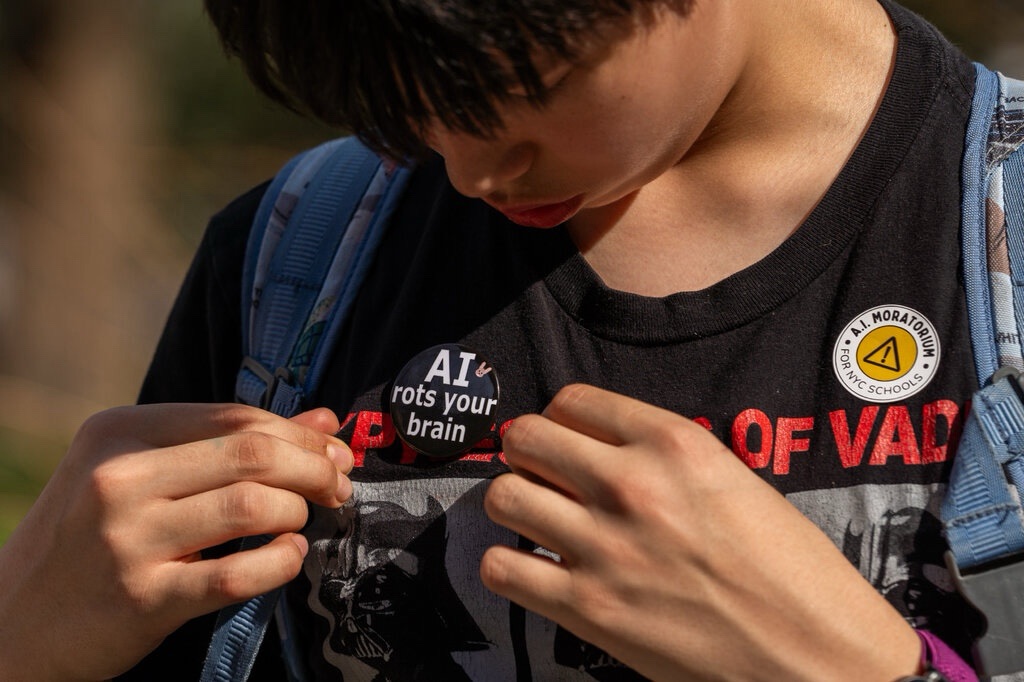
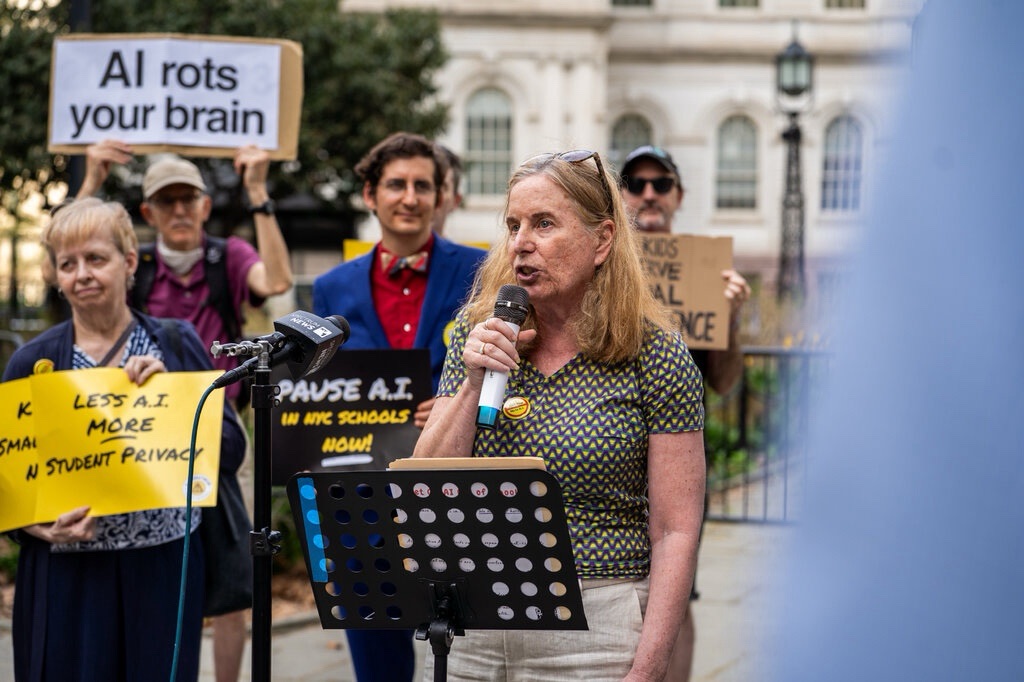
Parents and activists banded together to persuade the New York City Board of Education (aka the Panel on Educational Policy) to reject a proposal to open an AI-themed high school.

Matthew Haag wrote in The New York Times:

In Brooklyn, an artificial intelligence program helps public school students pronounce words. In Queens, high school students ask Google Gemini how to improve their essays. And in the Bronx, students in a robotics lab consult an A.I. tool before building parts on a 3-D printer.

As teachers and students in New York City and across the United States have increasingly embraced artificial intelligence in the classroom, school leaders in the nation’s largest school system were set to make one of their biggest splashes yet — the opening of an A.I.-focused high school in Manhattan next school year.

But on Monday, the new schools chancellor, Kamar Samuels, abruptly halted the creation of the school amid a groundswell of opposition to the rapid adoption of the technology and its potential harms.

In an interview, Mr. Samuels said that he understood the concerns and questions parents have about artificial intelligence in the classroom and its safety and impact on critical thinking. “I want to be able to think about the technology in a very thoughtful way,” Mr. Samuels said.

Despite the decision not to proceed, school leaders in New York City and beyond remain bullish on the future of artificial intelligence in education and its potential benefits. They argue that it could transform teaching and learning, a claim also promoted by companies that sell the tools, and that it would be irresponsible to ignore or restrict the technology.

But New York parents have expressed concern about the artificial intelligence programs used in schools or accessible on students’ computers, as well as the lack of information about the applications and data they collect. Some families recently delivered to Mayor Zohran Mamdani a petition with thousands of signatures calling for a two-year moratorium on generative A.I., such as chatbots.

“The intense outrage among parents in New York City is as great as I’ve seen it on any education issue that I’ve been working on for 25 years,” said Leonie Haimson, an education advocate in New York City and member of the Coalition for an A.I. Moratorium.

Leonie Haimson, a member of the Coalition for an A.I. Moratorium, said that she has witnessed “intense outrage” among New York City parents over A.I. use in schools. Credit…Madison Swart for The New York Times

Under Mr. Samuels’s leadership, the city’s Education Department has started to develop guidelines for how teachers and students should use artificial intelligence. Last month, the school system published its first playbook for A.I., developed in consultation with educators and education technology companies.

The creation of the new high school, known as Next Generation Technology High School and located in the financial district of Manhattan, was expected to be another major step toward the embrace of artificial intelligence in a school system whose decisions, because of its size, often influence other districts. A vote on the creation of the high school by a 22-member education oversight panel was scheduled for Wednesday.

The group’s chairman, Gregory Faulkner, said that he did not believe a single member would have voted in favor of it. Mr. Faulkner said that out of the many emails he received and conversations he had with parents, just a handful of comments were supportive of the school.

“If there’s anything that even has a hint of A.I., there’s strong opposition to it,” Mr. Faulkner said. “People are very nervous about the technology and how it is going to be used.”

Since this is a gift article, feel free to open and finish reading.

Shawgi Tell keeps close watch over the checkered evolution of charter schools. He discovered that Minnesota, the first state to open a charter school, beats every other state when it comes to charter closure and failure.

It bears remembering the reason why almost every state has authorized charter schools. When Arne Duncan announced the Race to the Top competition for a share of $5 billion, every state that applied had to first authorize charter schools. That requirement turbo-charged the growth of charter schools.

He writes:

The first charter school law in the U.S. was passed in Minnesota in 1991. The first charter school in the country, City Academy High School, opened in St. Paul, Minnesota in 1992. Since then charter school laws have been passed in 47 states, Washington DC, Puerto Rico, and Guam.

Over the past 34 years many charter schools have failed and closed in Minnesota. According to a 2025 article titled “More Minnesota charter schools are facing possible termination,” “In 2024 [alone], nine charter schools closed, the most ever. But records show another 10 charter schools could face termination.” It is worth noting here that, like many privately-operated charter schools across the country, most charter schools in Minnesota are highly segregated.

On April 23, 2026, Hoodline featured an article titled: “Charter Shock: AFSA Parents Scramble As Twin Cities Ag‑STEM School Shuts Down.”

What is interesting about this article is that it speaks to the shock, trauma, and abandonment that families and educators always feel when a charter school fails and closes abruptly, which is how charter schools close nine out of ten times. This article also highlights the same reasons that charter schools fail and close every week: declining enrollment, mismanagement, financial malfeasance, and/or poor academic performance.

Hoodline reports that, “The Academy for Sciences and Agriculture (AFSA), a Twin Cities charter serving students from pre-K through 12th grade, will shut its doors at the end of this school year, leaving families in Little Canada and Vadnais Heights scrambling for new schools.” AFSA first opened in 2001 (25 years ago).

The article continues: “Parents say the announcement came out of nowhere. Several told 5 EYEWITNESS NEWS they had little warning. ‘Yes, it was sudden’, parent Kevin Cedeno said, adding that his son is having a hard time with the news.”

It appears that “the school [which focuses on science, the environment, and agriculture] has dealt with declining enrollment since the pandemic.” And like so many other charter schools nationwide, AFSA also experienced “oversight gaps” and problematic “procurement and contracting practices,” according to Hoodline. Conflicts of interest and poor accountability are common in deregulated charter schools operated by unelected private persons.

In related news, Agamim Classical Academy, a K-8 charter school in Edina, Minnesota, founded in 2015, will also be closing its doors in June 2026. Watershed High School, a charter school located in the city of Richfield, Minnesota, will also be closing its doors at the same time. The privately-operated charter school was open for only four years.

Old and new charter schools fail and close every week in America. The proponents of such schools openly and publicly embrace the idea that the “free market” should be the arena in which schools operate, which means that schools are a commodity and susceptible to the chaos, anarchy, and violence of the “free market.” This arrangement is seen by “free market” idealogues as a modern humane way to organize education and other services and social programs. In this setup, nothing is guaranteed and everyone fends for themselves. The right to education is replaced with the notion that education is an opportunity, something you shop for like a consumer. Education is reduced to chance and luck. “Buyer beware” is the only rail guard.

“Choice” and “competition” are some of the buzzwords attached to this outmoded approach to life. Thus, “parents are empowered” to choose which school to send their child to when in fact charter schools actually choose students and parents. This is why so many groups of students are under-enrolled in these “free schools of choice” that are said to be “open to all.” 

Parents are also led to believe that the philosophy of winning and losing is in no way problematic. Thus the notion of a school lottery is openly normalized in the charter school sector, meaning that some students will get into their “school of choice” while others will not. There is no concept of guaranteeing everyone’s basic right to a high-quality, free, fully-funded public education controlled by a public authority worthy of the name. You may or may not get a “good” education. How is this possible in the richest country in the world? Why is education a gamble in the 21st century?

To be sure, privatization creates and exacerbates numerous problems. See here for a detailed discussion of these problems.

According to the Minnesota Department of Education there are 173 charter schools in Minnesota today serving around 70,000 students.

Shawgi Tell (PhD) is author of the book Charter School Report Card. He can be reached at  stell5@naz.eduRead other articles by Shawgi.

This is one of those stories that is hard to believe. But it happened. Experienced FBI agents were purged by the hapless Kash Patel, after Trump put him in charge. This story demonstrates the Patel-ized FBI, which chases crazy rumors but can’t find Savannah Guthrie’s mother.

Will Sommer wrote in The Bulwark:

WHEN THE CONSERVATIVE WEBSITE the Blaze published an article last November accusing a former Capitol Police officer of being the January 6th pipe bomber based on “gait analysis,” most of the public reacted skeptically.

But not the FBI.

Instead, the nation’s foremost law enforcement agency allegedly acted on the information the Blaze had gathered and sent bomb-sniffing dogs, agents in tactical gear, and even a helicopter to that former Capitol Police officer’s home. It was dramatic, terrifying, and wildly unnecessary.

That’s according to a lawsuit filed Tuesday by the former officer, Shauni Kerkhoff—who had defended Congress from the January 6th rioters and later testified in court against some of them.

Kerkhoff’s lawsuit provides startling new allegations about the government’s frantic and largely futile efforts to try to close a case that had generated a wave of wild speculation on the right and befuddled the leadership of the FBI under Director Kash Patel. It also underscores the degree to which conspiracy theories have influenced official government action, even at the highest levels.

The drama actually began shortly before the Blaze published its now-infamous and since-retracted “gait analysis” article. According to Kerkhoff’s lawsuit, the reporter behind the story, Steve Baker, shared his allegations with staffers for Director of National Intelligence Tulsi Gabbard. His findings were based on supposed similarities between Kerkhoff’s style of walking and the bomber’s. Gabbard’s office subsequently drafted a memo identifying Kerkhoff as a possible suspect, CBS News reported.

On November 6, 2025, two days prior to the publication of the story—though one day after Baker had begun publicly teasing his findings on a podcast with the Blaze’s founder, Glenn Beck—Kerkhoff, who had left her job to work in security at the CIA, alleges that she was called in to an office at her job to meet with two FBI agents saying they were interested in “online chatter” about her role in the attempted bombings. Kerkhoff claims in her lawsuit that she was then put on administrative leave from the CIA and asked by the FBI agents to give permission for a few of them to enter the house she shared with her boyfriend to look for a pair of shoes worn by the bomber.

Kerkhoff claims she and boyfriend did not give permission to the agents, but agreed to meet them at the home.

Soon after Kerkhoff arrived at the house, she claims, a “caravan of FBI vehicles descended on their street.” The group included a bomb-disposal truck and an FBI helicopter flying overhead, as well as agents in “full tactical gear” with their guns drawn. Kerkhoff alleges the agents “swept through the house” with bomb-sniffing dogs, “rifled through drawers” and tossed the couple’s belongings on the floor.

Screenshot of a passage from the lawsuit.

“It suddenly occurred to Ms. Kerkhoff that they were not simply looking for a pair of shoes,” the lawsuit reads.

At one point, Kerkhoff claims, she asked a “senior FBI official” on the scene why “online chatter” had prompted the raid. The official, according to her lawsuit, said he was responding to orders from “higher up.”

A spokesperson for the FBI responded that the agency wouldn’t comment on ongoing litigation.

The hours-long search ended at 8 p.m., according to Kerkhoff’s lawsuit. But the ordeal wasn’t over yet. She claims she was then subjected to an hours-long polygraph test at an FBI office, leaving only in the early hours of November 7. A day later, the Blaze formally published its allegations that she was the bomber, prompting Kerkhoff and her boyfriend to hide in their home for fear of their lives, according to the lawsuit.

Baker’s article was promoted by Republicans members of Congress, and prompted Beck to declare it “the biggest scandal” in a century. Yet it quickly fell apart under scrutiny, and was retracted after the FBI arrested suspect Brian Cole Jr. for the attempted bombing in December. Cole has since confessed to planting the bombs, which did not detonate on the day of the riot. His legal team has since tried to argue for his innocence by noting, among other things, that Baker has not backed off his original reporting.

But the Blaze has backed off, even to the point of firing Baker earlier this month. And while he was set to make a podcast appearance with Megyn Kelly, that too was apparently canceled amid fears of defamation suits. Baker, himself a January 6th defendant, told me that Blaze management is “in the fetal position” over the prospect of Kerkhoff’s lawsuit, saying the potentially massive judgment would amount to an “existential threat” to the site.

Kerkhoff returned to her job at the CIA a few weeks later, after establishing an alibi by showing prosecutors video of her playing with her dog at the time of the attempted bombings, according to the lawsuit.

She is now suing the Blaze and its former reporters for six counts of defamation, saying she suffered “reputational harm” and “emotional distress” over the article and related podcast appearances. Kerkhoff doesn’t specify how much money she’s suing for, asking instead for “actual damages in amounts to be proven at trial.” Kerkhoff is represented by heavyweight defamation firm Clare Locke.

What will Kerkhoff win at a trial for defamation and damages? It should be enough to deter others from making wild accusations without evidence.

Rxan Smith writes on his blog about America’s broken prison system. We spend more on prisons than any other nation and have the highest recidivism. Our “get-tough” approach to crime is a failure, and a very costly one.

Smith writes:

Here’s an uncomfortable math problem nobody in Washington wants to do out loud:

America spends $182 billion per year locking people up.

That’s billion. With a B. Every year.

Not to rehabilitate. Not to reduce crime. Not to make you safer.

Just to warehouse human beings in a system so thoroughly designed to fail that two out of every three people released from prison are arrested again within three years.

Our country’s criminal justice system does not offer criminal justice, and it’s barely worthy of being called a system at all.

It’s a revolving door — and somebody built that door on purpose, installed it at taxpayer expense, and charges you rent every time it spins.

Uncomfortable Truth About “Tough on Crime”

For fifty years, American politicians — left, right, and everything in between — have campaigned on being “tough on crime.”

You know what “tough on crime” actually produced?

*The largest incarcerated population on earth: over 2 million people

*A recidivism rate of 67% within 3 years of release

*A $182 billion annual price tag that grows every year

*Communities so stripped of working-age adults that poverty compounds across generations

“Tough on crime” didn’t reduce crime. It industrialized it.

It turned human failure into a growth industry — complete with lobbyists, quarterly earnings calls, and a political class that discovered you can always raise money by scaring people.

Meanwhile, Norway — with its functional approach — runs a prison system with a 20% recidivism rate.

Ours is 67%.

Norway’s isn’t radical. It’s just effective. The difference? They decided prisons should actually produce people who don’t go back.

The Numbers Behind the Nightmare

Let’s get specific, because the specifics are infuriating:

The Scale

*United States incarcerates 655 people per 100,000 — highest rate on earth

*Rwanda is second. We beat Rwanda. Let that land.

*43% of inmates are Black Americans, who represent 13% of the population

*Average cost per inmate: $39,000 per year — more than a year at many state universities

The Recidivism Machine

*67% of released prisoners are rearrested within 3 years

*83% are rearrested within 9 years

*People released with less than $50 in their pocket, a bus ticket, and a criminal record that disqualifies them from housing, jobs, and student loans

*Then we act surprised when they come back

The Private Prison Problem

*Private prison companies manage roughly 8% of inmates but spend millions lobbying for longer sentences, mandatory minimums, and policies that ensure full occupancy

*CoreCivic and GEO Group spent over $25 million on lobbying and political donations between 2000-2020

*They are literally paid to make sure prisons stay full…

What We Got Instead of Rehabilitation

The American philosophy of incarceration rests on three pillars, all of which are broken:

Deterrence: The idea that long sentences scare people away from crime.

Reality: Most crimes are not committed by people weighing a rational cost-benefit analysis. They’re committed by desperate, mentally ill, or addicted people who aren’t doing the math. The death penalty states don’t have lower murder rates. The math doesn’t work.

Incapacitation: Lock them up so they can’t hurt anyone.

Reality: The average sentence ends. People come out. If they come out with zero support, no job prospects, and the same addiction or mental illness that got them there — you haven’t solved the problem, you’ve aged it.

Punishment: They did something wrong; they should suffer.

Reality: Fine. But suffering without any change in behavior just produces someone who suffered. If we want public safety, we need to care about what happens after the punishment ends.

We skipped the part where any of this was supposed to work.

What Rehabilitation Actually Looks Like

Other countries figured this out. We just refused to copy the homework.

The Norwegian Model (No, It’s Not Soft. It’s Smart.)

Halden Prison in Norway has a music studio, a jogging trail, a kitchen where inmates learn to cook, and individual cells with windows. Guards eat lunch with inmates. The focus is on preparing people to live normal lives.

Result: 20% recidivism rate.

The cynical American response: “That’s not punishment.”

The functional response: “Their prisons actually work.”

You want punishment or you want results?

Because right now, we have neither.

What a Real Rehabilitation System Looks Like

Open the link to learn what we should be doing instead of the present failed approach.

In Arizona, the state charter board did the right thing: it planned to close an online charter school with a long record of failure. But the owner of the charter school was a big Republican donor. And he was a multi-millionaire, who had been richly rewarded by his ownership of Primavera. He had a meeting of the minds with the State Superintendent of Schools, Tom Horne. Horne is a strong believer in choice. Suddenly, Primavera’s grades were recalculated and closure of the piggy bank was off the table.

Veteran reporter Craig Harris told the story for Channel 12:

PHOENIX — For more than a year, Arizona’s largest online charter school, Primavera, and its multi-millionaire owner, Damian Creamer, faced the very real possibility of being shut down. 

Plagued by poor academic performance and mounting scrutiny, the State Charter Board had already taken multiple steps toward revoking the school’s charter in 2025.

But in a surprising turn of events, Primavera has been given a lifeline — thanks to an intervention from Republican State Schools Chief Tom Horne.

The decision sparked frustration among board members who had spent months working toward closure.

Longtime board member James Swanson, reflecting the general mood of the 11-member board.

He said the board acted within its authority to hold Primavera accountable after students recorded “D” letter grades for three consecutive years ending in 2024.

Board Chairwoman Jessica Montierth echoed that sentiment after the 9-2 vote, noting the significant time and effort invested in the case. 

“Our authority is based on following through with policy and procedure, and that’s what we have done,” she said, adding that the outcome was difficult to accept given the circumstances.

The controversy surrounding Primavera intensified following a 12News investigation early last year. 

The 12News Investigates report in February 2025 revealed that the school’s owner, Creamer, had paid himself $24 million since 2017.

At the same time, the school consistently underperformed academically as the Charter Board gave Primavera its worst annual rating four times: Falls Far Below Standard. Two times, Primavera got the second-worst rating: Does Not Meet Standard. 

The free-wheeling at Primavera is a byproduct of Arizona’s loosely regulated charter school industry that allows owners to make as much money as possible for years with public funds. 

But in March 2025, the Charter Board formally voted to begin the process of shutting the school down after it received three consecutive annual “D” letter grades.

Creamer, who did not attend Tuesday’s meeting, previously attributed the low grades to administrative errors. 

He argued that Primavera should have been evaluated under alternative school standards rather than traditional ones. 

And he appealed directly to Horne, after having the support of Republican leaders who also lobbied the Charter Board on his behalf. 

“We’re so grateful for Tom Horne,” Creamer, a major GOP donor, said during a press conference in mid-March 2025. “For working with us so that we can correct this administrative error.”

Horne twice that month said he wasn’t going to intervene. 

“My first priority for all public schools is academic success,” Horne said in March 2025. “It is important that charters and district schools alike are held accountable for the quality of education they provide. The Board’s action demonstrates that these are not just words, but actions. Primavera is being held accountable and losing its ability to operate because of poor academic results.”

Horne, however, later allowed Primavera to privately meet with his staff and present new records to his office.

The board accused Horne of taking the “unprecedented steps of retroactively reclassifying Primavera from a traditional school to an alternative school, reopening prior-year data, and allowing the submission of additional information.”

That was key because traditional charter schools are evaluated under higher academic measures, while alternative schools, which typically serve higher-risk or non-traditional student populations, are evaluated with different performance expectations.

It’s unclear when Horne, who is currently in a tight re-election campaign against Treasurer Kimberly Yee for the GOP nomination, made all of the changes. 

But Charter Board officials on Tuesday said Horne’s intervention resulted in the Department of Education indicating the school would have received three Alternative “C” grades instead of three “D” grades under the traditional model. 

The board, in a statement, said this “after-the-fact rewrite of Primavera’s academic performance fundamentally changed the facts underlying the Board’s case long after enforcement had begun, effectively removing the Board’s ability to proceed under its established authority.”

Remember, “it’s all about the kids! No child should be trapped in a failing charter school! Parents know best!”

This is a conversation you should not miss.

With the rapid spread of vouchers, which are busting the budgets of several states and tearing down the wall of separation between church and state, it’s easy to overlook the danger posed by charter schools. Charter schools are a strong step towards vouchers, replacing neighborhood schools with consumerism. Almost 90% of American students attend public schools. We should be funding those schools, not schools operated by private boards and religious groups.

Dr. Shawgi Tell reminds us that charter schools continue to breed corruption and fraud, as they drain resources from public schools. Charter schools are not subject to the same accountability as public schools. They operate under private management, which shields them from the accoubtabilty to which public schools are subject. Without oversight or accountability, bad things happen.

Dr. Tell is a professor of education at Nazareth University in Rochester, New York.

He writes:

Even though they make up only 8% of schools in the country, crimes, scandals, and arrests take place at a robust tempo in the nation’s privately-operated charter schools.

These non-stop wrongdoings usually include fraud, embezzlement, harassment, and a range of sex crimes.

This is not surprising given the weak accountability, transparency, and background checks that have plagued the crisis-prone charter school sector for more than 30 years.

A small sample of headlines from just this year speaks volumes:

·        Cedar Rapids Prep Charter principal terminated this week as second harassment charge is filed (The Gazette, April 3, 2026).

·        Las Vegas charter school assistant principal arrested on child abuse charges (FOX5, March 23, 2026).

·        L.A. charter school teacher accused of assaulting 6-year-old girl (2UrbanGirls, March 21, 2026).

·        Little Elm charter school teacher arrested for child sex crimes (FOX 4, January 30, 2026).

·        $25M swindled by fraudulent charter school recovered for San Diego K-12 students (City News Service, January 30, 2026).

·        Owner of Newark charter school accused of stealing wages from teachers (NBC Bay Area, January 21, 2026).

·        Former New Orleans charter school may have improperly spent more than $600,000, audit says (NOLA, January 21, 2026).

·        Former Midlands charter school teacher arrested for allegedly assaulting student (WIS, January 14, 2026).

·        North Carolina charter school teacher charged with multiple child sex crimes, including against a student (FOX 8, January 3, 2026).

Do such horrible things happen in traditional public schools and private religious schools? Yes they do, but when looking at scale, scope, frequency,  and proportionality, they are considerably more rampant in charter schools, which are deregulated businesses governed by unelected private persons.

The privatization and marketization of education lends itself to such phenomena on a broad scale. Privatization increases corruption and lowers standards across a broad range of operations, roles, and services. Converting public programs and services into capital-centered programs and services usually enriches a handful of people while harming the public interest in the process. When programs and services focused on uplifting people and society are transformed into profit-maximizing entities, the majority suffers.

See here for more examples of charter school crimes and scandals.

Shawgi Tell (PhD) is the author of Charter School Report Card. He can be reached at stell5@naz.edu 

When an education policy is tried and failed, then tried again and continues to fail, that policy may justly beee called “zombie policy.” It survives despite experience..

Tom Ultican, retried teacher of physics and advanced mathematics in California, here describes such a policy. It is called “grade retention,” but is more commonly known as flunking a student because he or she is not “ready” to be promoted with peers. The short-term effect may seem successful: test scores. But the long-term effect on students’ success is typically negative.

Ultican writes:

Twenty-six American states have a mandatory third-grade retention policy for students who do not pass the state’s reading exam and Maryland is set to implement that policy in 2027. According to researchers, this is bad thinking based on intuition not science. Writing for Education Trust, Brittney Davis declared“The research is clear that grade retention is not effective over time, and it is related to many negative academic, social, and emotional outcomes for students — especially students of color who have been retained.”  

Economist Jiee Zhong won her PhD from Texas A&M in 2024 and is now an assistant professor of economics at the University of Miami. Last year, she just finished a very impressive study on the effects of grade retention for Texas third graders. Texas abandoned mandatory third-grade retention in 2009.

Zhong studied outcomes of third-graders from 2002-03, 2003-04 and 2004-05 school years who took the Texas reading exam that carried retention consequences. This large data set allowed her to use a fuzzy regression discontinuity design to extract many results. By 2024, the students studied were all young adults over 26 years of age. She was able to evaluate their education, social and economic outcomes using powerful math techniques.

Zhong concluded:

“I find that third-grade retention significantly reduces annual earnings at age 26 by $3,477 (19%). While temporarily improving test scores, retention increases absenteeism, violent behavior, and juvenile crime, and reduces the likelihood of high school graduation.”

For one outcome, she investigated a group of students who barely passed or barely failed the reading test. She learned that the barely failing students earn $1,682 (11.3%) less at age 23 than the barely passing students. Zhong noted that 64.2% of barely passing students graduated from high school while just 55.1% of the barely failing students graduated. She observed that both of these results were statistically significant at a 5% level.

Zhong also noticed a racial disparity. She reports, “White students experience a sharp 43.8 percentage point decline in high school graduation probability, higher than the reductions for Black (17.6 percentage points) and Hispanic students (0.6 percentage points).”

These results from 2025 add more weight to similar results that previous researchers have reported.

The Retention Illusion

In January 2025, Duke University in Chapel Hill, North Carolina published a linked series of three policy briefs concerning grade retention by Claire Xia and Elizabeth Glennie, Ph.D. The Duke researchers stated, “The majority of published studies and decades of research indicate that there is usually little to be gained, and much harm that may be done through retaining students in grade.”

They also mention the grade retention illusion is held by many community members, administrators and teachers who believe grade retention is helpful and needed. The Duke researchers stated, “The findings that retention is ineffective or even harmful in the long run seem counterintuitive.” This belief is so strong that on the 31st Annual Phi Delta Kappa/Gallop Poll, 72% of the public favor stricter promotion standards even if significantly more students would be held back. Other studies show the public being strongly opposed to social promotion believing low-achieving students will continue to fall farther behind.

Please open the link to finish reading.