The person who is elected President usually says on election night that he will govern on behalf of the American people. He makes a point of obligation to be respectful for all Governors, to send FEMA to any state that has suffered from natural disasters, regardless of whether they vote for him or his rival.
Trump has said frankly that he hates his enemies. He sometimes doesn’t pretend to care about states that did not vote for him.
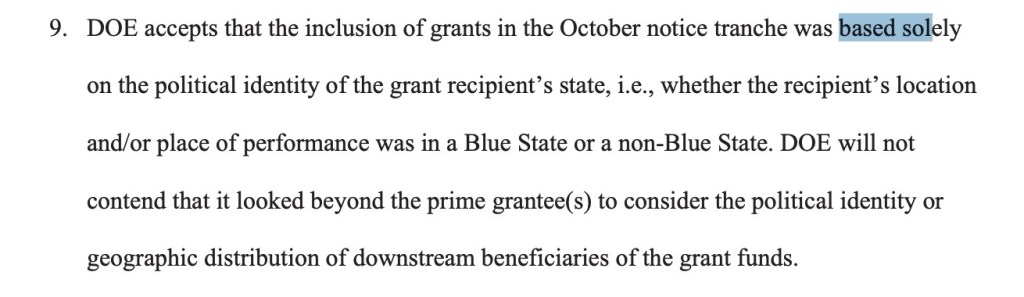
Aaron Parnas of the Parnas Perspective points outthat the Trump administrative made decisions about environmental grants based solely on whether the states supported him in the 2024 elections. This involved billions of dollars in grants.
Parnas wrote:
A major constitutional violation, confirmed in court. The Trump administration admitted in court filings this month that it canceled 284 Biden era clean energy grants worth billions of dollars based solely on whether the recipient state voted for Kamala Harris in 2024 and had two Democratic senators. A lawyer for the Energy Department conceded that none of the terminations were based on any programmatic, statutory, cost reduction, or performance related factor, directly contradicting Energy Secretary Chris Wright’s June congressional testimony that no decisions were made on politics. The Energy Department disputes any contradiction, saying Wright was distinguishing between the review process and the timing of the cancellations, but hundreds of additional grants the department had itself recommended for cancellation were left untouched simply because they sat in states that backed Trump.
Real projects and real money were caught in the fallout. The politically targeted cancellations halted funding for hundreds of energy projects, including electrical grid upgrades in California and Oregon, methane leak reduction efforts in Colorado, and clean hydrogen fuel hubs in California and the Pacific Northwest. The cuts came in October alongside a broader White House push to pressure Democratic lawmakers during a government funding standoff, with Trump publicly threatening to slash what he called Democrat agencies. Some grant recipients have since sued to try to recover their funding, and this is not the first time the Energy Department has admitted politics played a role, since a federal judge already ruled in two earlier cases that more than a dozen grants were improperly canceled for political reasons, though this latest admission is far broader and more detailed.
Democrats say it exposes a dangerous pattern with more to come. Senator Patty Murray and Representative Marcy Kaptur called the cancellations an outright un-American weaponization of government and accused the administration of corruptly abusing its power to punish states over how they voted. The controversy lands as the administration finalizes new rules, expected by October, that would give Trump’s political appointees direct control to review, block, or revoke federal grants across the entire government, worth more than a trillion dollars annually. Budget office director Russell Vought has defended the changes as necessary to ensure democratic control of spending, but critics, including antipoverty groups, scientists, and city leaders, have flooded the government with comments warning the rules would let the administration extend this kind of political targeting far beyond energy grants. Center on Budget and Policy Priorities fellow Devin O’Connor said the willingness to be this blatant in court should be taken as a serious warning about what the new framework could enable nationwide.
For more than a year, Trump has pestered the Smithsonian Museum to remove exhibits that shine attention on despicable episodes and phenomena in American history. Trump wants a patriotic version of American history.
The Smithsonian has rejected his bullying, so Trump ordered the National Park Service to place signs around the Smithsonian museums warning visitors about their bias in favor of accurate history.
Donald Trump on Friday ordered the interior department to display signs in front of the Smithsonian National Museum of American History that accuse the institution of inaccuracy.
The order escalates the Trump’s attacks against the Smithsonian, which he and his allies accuse of politicizing the institution by focusing too much on injustices in American history, instead of more triumphant moments such as the signing of the Declaration of Independence.
The order directs interior secretary Doug Burgum to huddle with the National Park Service and assistant to the president for domestic policy Vince Haley to come up with some temporary signs to install along the National Parks Service-maintained sidewalks and walkways leading into the museum.
Advertisement
The White House did not immediately respond to a request for more details about what these signs would say.
The order says the signs “shall notify visitors that the museum exhibits should be renovated consistent with the findings in the report”. The signs should direct the public to other places where they can get better American history information, the order says.
The same group will also have to produce signs for the public criticizing the Smithsonian for not commemorating sufficiently the Declaration of Independence during the 250th anniversary of its adoption.
The American Historical Association, a group composed of professional historians, praised the Smithsonian Institution’s “commitment to scholarship and accuracy” in a statement earlier this month.
“Historians practice our craft with scholarly integrity according to established standards of evidence, historical inquiry, and professional practice,” the AHA statement reads. “Political interference in professional museum work threatens the accuracy of historical interpretation and erodes public trust in one of our nation’s most important institutions.”
The National Museum of American History declined to comment.
This is a thoughtful essay on a crucial problem: shrinking enrollments in higher education and the budget cuts to meet them. Julian Vasquez Heilig lays out the problem and the typical response. He thinks there is a better way and he describes it.
Heilig is on the faculty of Michigan State University and is a national expert on topics such as diversity, equity and inclusion.
He writes:
The warning signs are no longer theoretical. Schools are closing. Colleges are preparing layoffs. Faculty buyouts are spreading. Academic programs are disappearing. Dorm beds are sitting empty. Classrooms are thinning out. Tax revenue is weakening. State appropriations are uncertain. Consultants are being hired and paid millions to identify “efficiencies.” Boards are quietly discussing mergers and closures. American education is entering a period of deep instability.
This is not only a crisis for presidents and superintendents. It is a crisis for communities. When a school closes, a neighborhood loses more than a building. When a college cuts faculty and staff, a region loses jobs and opportunity. When families question whether education is worth the price, the consequences ripple through local economies and democracy itself.
In this article, I first define the problem. Enrollment pressure, funding instability, demographic change, and political attacks are converging across K-12 and higher education. These pressures are already producing closures and painful restructuring. But this is not only a warning. At the end, I turn to what communities can do through politics, public pressure, local organizing, accountability, and leadership selection before the choices become narrower.
The Warning Signs Are Already Here
At my own institution, public projections suggest new student enrollment could decline somewhere between 3 and 5 percent this year. If those projections hold, that would mark a return to consecutive enrollment declines after the gains achieved during my years as provost. During that period, we reversed an almost decade-long enrollment slide.
That is alarming because this moment was supposed to be the “high water mark” before the demographic cliff. WICHE projects that the total number of high school graduates will peak around 2026 and then decline steadily through 2041. Universities were supposed to be maximizing enrollment now. Instead, some are struggling while the student pool remains historically large.
In many ways, education is being pushed into an arena where resources are shrinking and the odds are being rewritten before many institutions understand the rules.
The Old Survival Strategies Are Running Out
Much of higher education survived the past several years through strategies that are becoming unsustainable. Institutions poured millions into financial aid discounting. They leaned harder into full-pay families. They expanded retention offices and predictive analytics systems. They built student success centers and advising infrastructure. They spent heavily on marketing and enrollment staff.
Ironically, retention and enrollment strategy helped save some institutions from earlier financial pressure. During my time in executive leadership, we understood that higher education had entered a new era of competition. Universities were no longer competing only over prestige. They were competing over affordability and survival.
Financial aid, student success infrastructure, and community partnerships became essential tools. Institutions that moved aggressively like Arizona State and Georgia State often stabilized themselves. Institutions that remained complacent fell further behind.
But even enrollment growth stories now face new threats. Federal research funding is unstable. State appropriations remain uncertain. Inflation is pressuring budgets. Some states like Michigan have seen stronger FAFSA activity. Yet many families are questioning the value of higher education. Political attacks have also weakened public trust while threatening research capacity and institutional autonomy.
Please open the link to read Heilig’s creative proposals for meeting the crisis.
Kelly Edgar taught music in Clark County, Nevada (Las Vegas) for 25 years. She recently wrote this article in The Nevada Independent about the dangers of charter schools.
Charter schools have been touted as the solution to our “failing public schools.” To be fair, the original intention was good. Those who founded the charter school movement envisioned it as a way to collaborate with public schools by finding creative solutions for students who weren’t thriving in traditional educational settings.
But that’s not what’s happening today. Since retiring from the Clark County School District in 2024, I’ve developed my own theory: Between the dismantling of the Department of Education and free market ideologues wanting in on public school tax dollars, it’s now clear that the goal of privatizing education has been decades in the making. And charter schools are the stepping stones to get the job done.
Most people assume that charter schools are public schools because they’re free to attend and publicly funded. However, unlike traditional public schools, many are managed by private, for-profit companies — such as Academica in Nevada — and they filter enrollment via applications and lotteries.
Public education certainly has its challenges. I devoted decades to working inside the system and spent my final years sounding the alarm about overcrowded classrooms, insufficient resources, district leaders with ulterior motives and a lack of teacher autonomy.
According to a July 2026 report by the Network for Public Education, there’s a direct correlation between academic achievement and per-pupil funding. States that support public schools outperform those that do not. So why is Nevada’s education system still ranked 48th in the nation despite “historic education funding” being passed in 2023?
Because you can’t pour water into a leaky bucket and expect it to hold. The funding was a start, but it wasn’t enough to compensate for the fact that Nevada also aggressively redirects public funds toward “private alternatives” such as charter schools. As the Network for Public Education puts it, “Privatization and disinvestment go hand in hand.”
The groundwork for all this was laid when the President Ronald Reagan’s administration, ahead of his 1984 re-election campaign, convinced Americans that we were A Nation at Risk, public schools were to blame and only Reagan could save us. This report simmered with “apocalyptic rhetoric” and the media seized on it like a dog with a bone because nothing grabs attention better than lines such as “the educational foundations of our society are presently being eroded by a rising tide of mediocrity.”
What A Nation at Risk and major news outlets failed to mention, however, was a statistical sleight of hand called Simpson’s paradox. Students weren’t actually doing worse; more students, not just the privileged few, were taking the Scholastic Aptitude Test. In fact, President George Bush’s own commissioned study concluded that on nearly every measure, scores held steady or improved. But those findings were suppressed, and politicians on both sides of the aisle doubled down on the same flawed premise that public schools were failing America.
And when public schools didn’t crumble under those “reforms” as anticipated, the Council for National Policy (CNP), a conservative network, manufactured a new crisis: convincing the American people that teachers are indoctrinating their children with radical, anti-American ideologies.
The impact of this conspiracy on teacher morale has been brutal. We went from being treated as professionals to villains overnight, pouring ourselves into our work just to be disparaged by the media and pundits who would never survive a day in our shoes.
But sadly, breaking us was the point so they could justify defunding public education, sell parents on charter schools and other private alternatives under the guise of “school choice,” and “save” Americans from the crisis they created.
In 2017, the council provided the Trump administration with a blueprint to return education to “free-market private schools, church schools, and home schools as the normative American practice.” This “Education Reform Report” became the foundation of Chapter 11 of Project 2025.
And while we haven’t seen every part of their mandate unfold in Nevada, there are red flags. Clark County schools are seeing their lowest enrollment numbers in decades, with many parents opting for alternatives, citing “lax classroom discipline” and “poorly performing public schools.” One would assume lower enrollment could have been an opportunity for the district to address parents’ concerns by decreasing class sizes and offering more individualized attention. But instead, the district was forced to declare a reduction in force that affects 60 licensed professionals because when students leave, the funding follows the child.
The Clark County School District is not alone. Data indicate that by 2031, public school enrollment is projected to decline nationwide.
This begs the question: If by 2031, more students are enrolled in charter schools, then aren’t charter schools just glorified public schools without the safeguard of public oversight?
That absence of oversight is key when profit is the goal. It’s in the best interests of management companies to keep costs down. This inevitably leads to shrinking school budgets and compromising standards through raising class sizes, lowering pay and hiring less experienced teachers. And our students? Commodities.
Which brings us back to square one. But this time, instead of pulling our children out of one free school to attend another free school, parents will be forced to either pay for private education or send their children to a potentially substandard charter school. As we face rising inflation and artificial intelligence replacing jobs, private school tuition is out of reach for most families.
The paradoxes of “school choice” can’t be ignored. Public schools educate every child who walks through the door, including those who need more trauma-informed care, more expensive interventions or who face severe learning challenges. These are often the same students that the “choice schools” didn’t have room for. Comparing the educational outcomes of a school that accepts every child to one that does not is, frankly, illogical, especially since the system is rigged against us: per-pupil funding follows the child while proposed federal budget cuts gut the very resources our students need most: Title I and Title II funding, Individuals with Disabilities Education Act protections and ample resources for arts education and mental health services.
Healthcare in this country is run for profit, yet we have the highest maternal mortality rate of any high-income nation. We don’t blame doctors or hospitals. We point to the economic disparities built into a broken system. Let’s not repeat the same mistake with our children’s education.
Kelly Edgar taught in the Clark County School District for 25 years, specializing in music education.
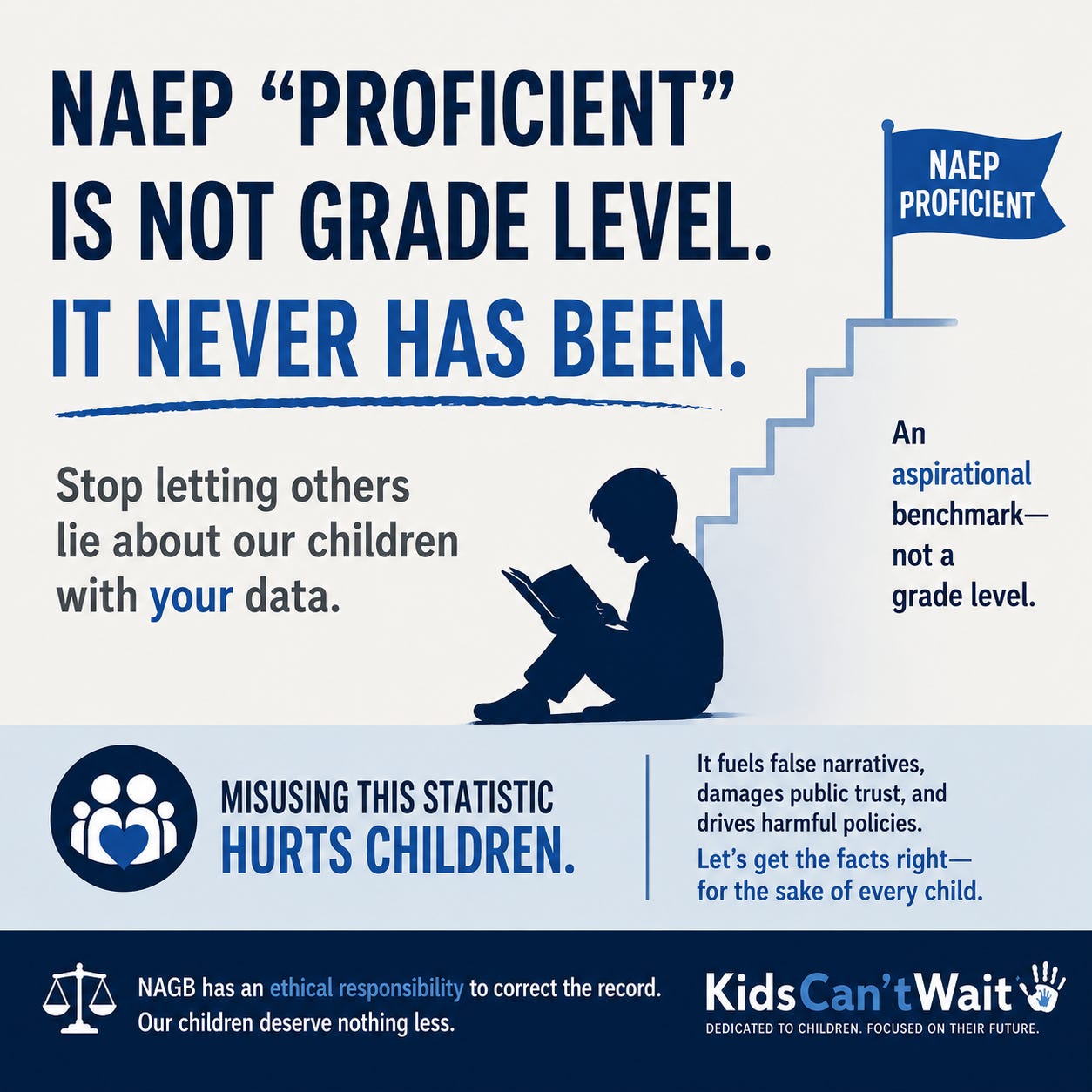
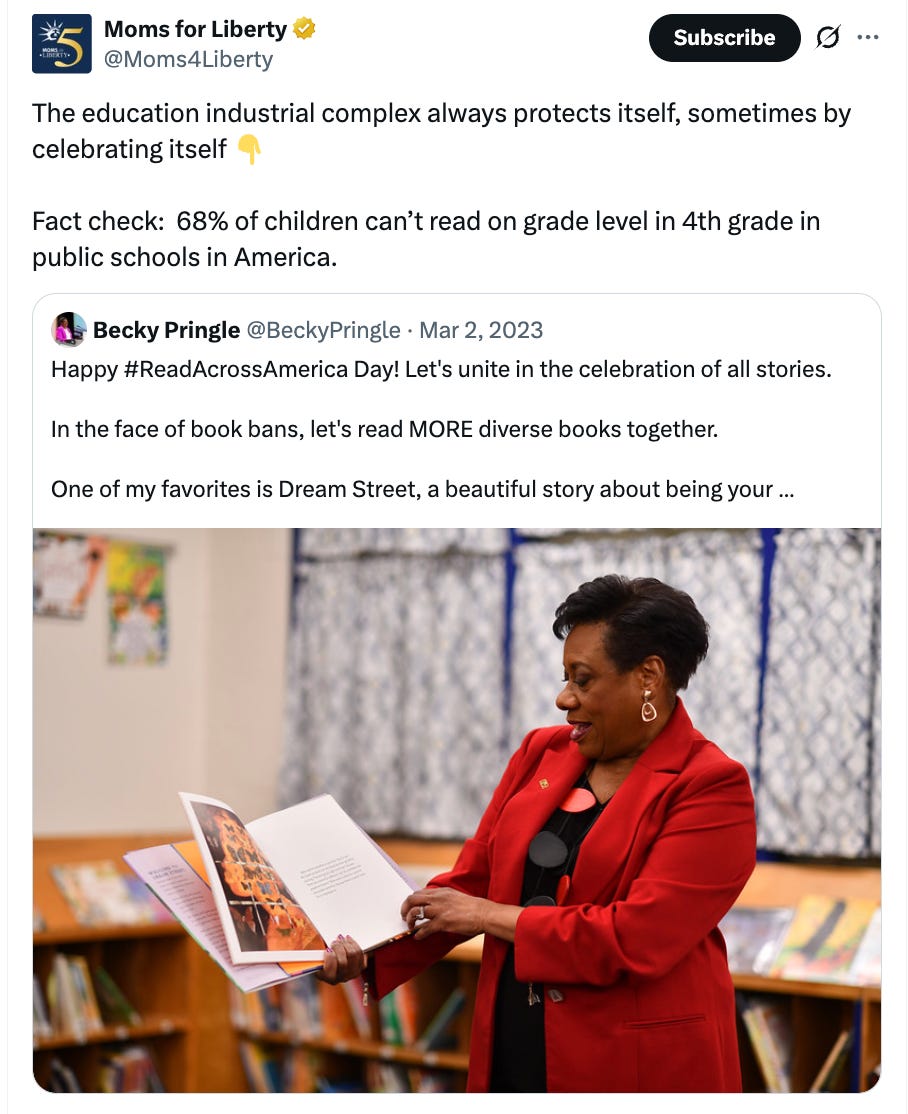
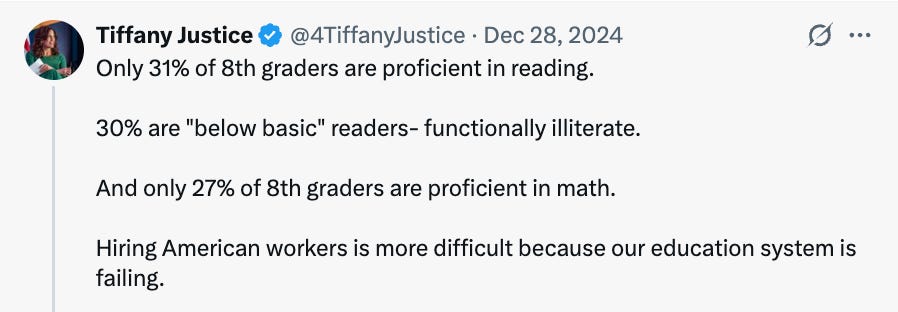
The biggest lie about American school kids is that most are “below grade level.” This lie is repeated so often by prominent figures that it is widely believed. But it’s not true. Those who believe it are wrong. Those who repeat it, knowing it’s not true, are liars.
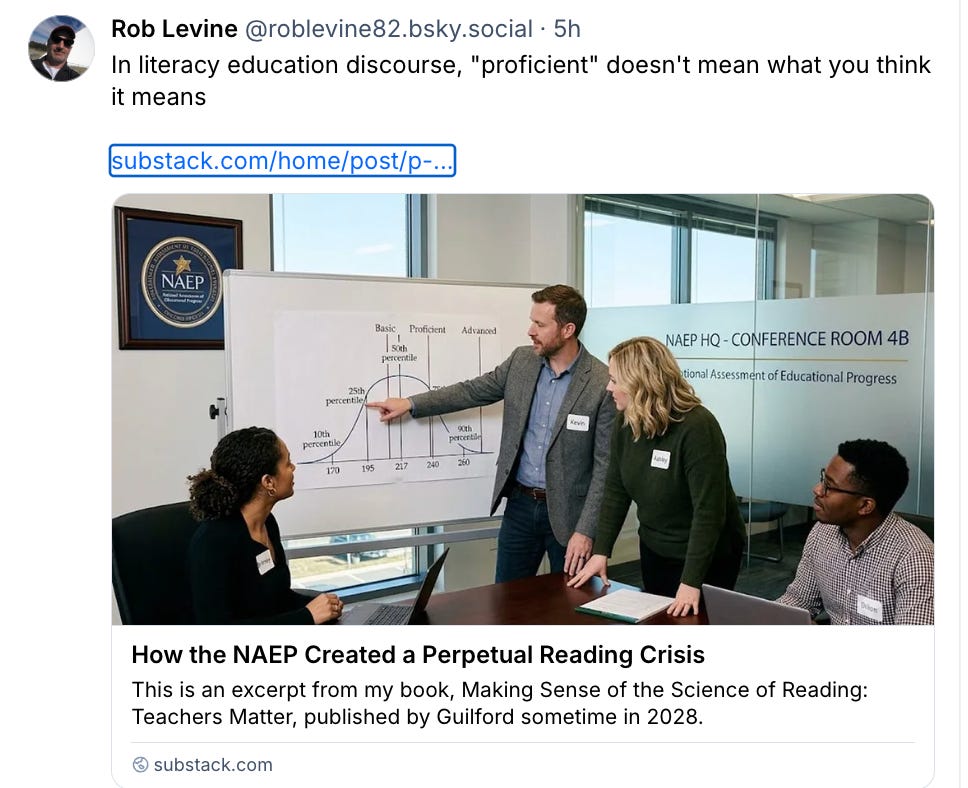
The source of the lie and the confusion is clear: the achievement levels in which NAEP scores are reported. The levels are “advanced,” “proficient,” “basic,” and “below basic.” When the media write about the latest release of NAEP scores, they frequently treat “proficient” as “grade level.”
But “proficient” is NOT “grade level.” It represents solid achievement, a rigorous aspirational goal. “Proficient” is equivalent to a solid A.
Every NAEP report on test scores says clearly in a footnote that “proficiency” is not the same as grade level. For example: “NAEP Proficient does not signify meeting grade-level expectations.” Yet the media and prominent commentators who should know better repeat the lie that most students are below grade level. The fact is that most students will never reach the high bar of “proficient.”
In 2023, as Bruce Lesley points out, Biden’s Secretary of Education–Miguel Cardona–testified to a Congressional committee that only one-third of American students were reading “at grade level.” I was flabbergasted. I couldn’t believe he said something so outrageous. I called Dr. Peggy Carr, who at that time was the Commissioner of Education Statistics. She was as surprised as I was that Secretary Cardona repeated the erroneous statistic. I asked Dr. Carr whether she had ever briefed him on understanding NAEP results; she had not.
I gave her an idea. Propose a change in name for “proficiency.” Change the name to “mastery.” No one would claim that “mastery” was the same as “grade level.” She liked the idea and promised to take it to the board. Whether she did, I don’t know. But nothing changed.
Bruce Lesley wrote this open letter to the National Assessment Governing Board, which oversees NAEP testing. Lesley is president of First Focus on Children and its partner organization First Focus Campaign for Children, bipartisan advocacy organizations dedicated to making children a priority in federal, state, and international policy. He has led both organizations since 2006 and 2009, respectively, building them into recognized national voices on child health, education, early childhood, economic security, budget and tax policy, immigration, children’s rights, and more recently, international child policy.
He wrote:
To the National Assessment Governing Board, the National Center for Education Statistics, and the leadership of the National Assessment of Educational Progress:
Every institution whose work affects children should begin with one question: “Is this good for children?”
By that standard, the National Assessment of Educational Progress (NAEP) has some important issues that deserve to be resolved. First and foremost, your achievement-level labels — “Basic,” “Proficient,” and “Advanced” — are being weaponized against the very children NAEP exists to serve, and you know it, because your own staff has been saying so for twenty-five years.
To be clear, this open letter is not a claim that NAEP’s underlying data is necessarily wrong, and it is not an argument against NAEP. The argument and request is narrower: you have a real and critically important ethical responsibility to correct the public misuse of your own data. NAEP should defend its credibility against those currently diminishing it.
This Week’s House Mark-Up Provides Another Example
On July 15, 2026, the House Education and Workforce Committee marked up a ten-bill package to facilitate the dismantling of the U.S. Department of Education.
In his opening statement, Chairman Tim Walberg (R-MI) argued that “too many children can’t read or do math at grade level,” and used that claim as a central justification for several of the bills. That claim is false.
Chairman Walberg was drawing on NAEP data — the statistic that roughly two-thirds of American fourth-graders do not score “Proficient” in reading, which is wrongly cited as evidence of failing to meet grade-level reading levels. For some, this is done out of confusion and, for others, to promote a political agenda to undermine public schools. In reality, NAEP proficient is aspirational and reflects a standard that is well above grade level.
Unfortunately, during the markup, multiple members of Congress repeated the same error. But again, NAEP Proficient is not grade level. It has never been grade level.
When the public, the press, the administration, and Congress repeatedly miscite this fact, the National Assessment Governing Board (NAGB) must do much more to clarify and correct misstatements about what it means.
The problem is two fold. One part of the problem is that “proficient” is used on many state and local assessments to mean “at grade level,” or what once upon a time would have been called a gentleman’s C; this leads to some honest confusion for some folks. The other part of the problem is folks who are invested in the narrative that public schools are failing and who benefit from the confusion surrounding the term.
Greene adds:
And every time NAEP scores are released, education journalists write piece after piece explaining “proficient” all over again, usually in the wake of some prominent person decrying the large number of students not “at grade level.”
That confusion is NAGB’s responsibility to address, and it has deserved attention for years, but all the more NOW.
This Is Not a Partisan Problem
Chairman Walberg and his colleagues’ misstatements are only the most recent officials to make this mistake (whether unintentionally out of confusion or internationally), and the pattern runs through both political parties.
Secretary Miguel Cardona, testifying before Congress in April 2023 under the Biden Administration, told lawmakers directly that only one-third of students were reading “on Grade level,” treating a NAEP proficiency figure as if it were a grade-level statistic, in nearly identical language.
And Secretary Linda McMahon, in the current Trump Administration, has used more careful wording — noting that nearly 70% of eighth graders are “not proficient” in reading — but has paired that technically accurate phrase with language implying total system failure. A Snopes piece by Rae Deng described this claim as lacking its own level of reading comprehension because, again, it completely mischaracterizes what NAEP’s “proficient” standard means.
Outside advocacy groups have been considerably less careful than any of them.
Corey DeAngelis, a leading advocate for school privatization, vouchers, and against public education, has cited NAEP proficiency figures directly, without qualification, as evidence that public schools are a system-wide “disgrace.”
Greene captures these types of political misuse of NAEP data in this Substack post.
This confusion is intentional by people arguing for both the dismantling of public education and federal investments in children.
Unfortunately, NAGB’s silence has allowed that rhetorical usefulness to go unchecked under Republican and Democratic administrations alike, and it is being used right now, this week, on Capitol Hill to justify eliminating the very agency that funds and safeguards the data NAGB produces.
NAGB’s Own Experts Have Been Saying This for Years
In 2001, Mary Lynne Bourque and Susan Loomis — a staff member and a board member of the National Assessment Governing Board itself — wrote plainly that the Proficient achievement level “does not refer to ‘at grade’ performance,” and that performance at Proficient is not the same as being “proficient” in a subject as any ordinary person would use that word.
Chester “Checker” Finn, Jr., who chaired the panel that adopted the achievement levels in 1992, has been candid that the levels were designed to be aspirational — a description of where students should ideally arrive, not a diagnosis of where most currently stand.
NCES itself has attached a caution to NAEP score reports for years: the Proficient level “does not represent grade level proficiency as determined by other assessment standards.”
If NAEP’s own architects and NAGB’s own website already say this, it is past time to be diligent in correcting the record when people misuse and misstate what it means. It is also on NAGB to stop publishing results in a format that predictably, foreseeably, and repeatedly gets misread as a verdict on grade-level performance, especially when you can see exactly how that misreading gets used again and again.
The clearest confirmation of all of this comes from NCES’s own data. Researchers Gina Cervetti and Kathleen Hinchman mapped every state’s definition of fourth-grade “grade-level” reading proficiency directly onto the NAEP scale and found that, as of the most recent analysis, nearly every state’s own standard for grade-level reading lines up with NAEP’s Basic level, not NAEP’s Proficient level. That means the honest translation of the data runs the opposite direction from how Chairman Walberg and others use it: by the states’ own definitions of grade level, roughly two-thirds of American fourth graders are reading at or above grade level, not below it.
Cervetti and Hinchman are also blunt about what actually is a crisis in the data: not a reading crisis, but an equity crisis. In 2022, only 48% of students eligible for free or reduced-price lunch scored at or above NAEP Basic, compared with 76% of students who were not eligible — a 28-point gap that has persisted, largely unchanged, for decades.
That is a story about generational wealth and unequal access to housing, healthcare, and school resources, not a story about failing classrooms, and NAEP’s own framing continues to let people tell the wrong story with your numbers.
What Education Writers and Researchers Have Been Saying
Diane Ravitch, who served seven years on the National Assessment Governing Board under President Clinton, has called out the confusion between NAEP Proficient and grade level as one of the most damaging and persistent falsehoods in American education discourse, noting that NAEP itself explicitly warns against the equivalence you continue to permit others to make.
Greene has argued that cut scores like “Proficient” function as scaled, curved judgments dressed up as fixed standards — noting that if every child scored above a cut, the establishment reaction would be to declare the cut too easy, not to celebrate the achievement. That is not how a genuine, fixed criterion is supposed to behave, and it is worth NAGB’s honest reckoning.
Mark Weber, a New Jersey teacher and education researcher, has done careful public work mapping state proficiency standards onto the NAEP scale, and his conclusion undercuts a favorite talking point of your critics-turned-allies in this fight: there is no empirical evidence that closing the so-called “honesty gap” between state and NAEP proficiency rates does anything to improve student achievement. If setting state cut scores to match yours were actually the lever for better outcomes, we would expect to see it in the data. We do not. That matters because it means the standard is being imported into state accountability systems on faith, not evidence — exactly the kind of unsupported claim NAGB should be correcting rather than allowing to spread.
The Brookings Institution’s Brown Center on Education Policy has been making this same case for nearly two decades. Tom Loveless, the Brown Center’s longtime director, authored a 2007 report concluding bluntly that NAEP’s cut scores were set too high.
His 2016 Brookings piece, “The NAEP Proficiency Myth,” went further, noting that the achievement levels came under critical review from the U.S. Government Accountability Office, the National Academy of Sciences, and the National Academy of Education shortly after they were adopted — with the National Academy of Sciences review concluding the achievement levels were fundamentally flawed.
Loveless adds:
Advocates of the NAEP proficient standard want it to be for all students. That is ridiculous. Another way to think about it: proficient for today’s eighth graders reflects approximately what the average twelfth grader knew in mathematics in 1990. Someday the average eighth grader may be able to do that level of mathematics. But it won’t be soon, and it won’t be every student.
That is not a stray outside critique. That is respectable experts in the field, writing for decades, about the very categories NASB is still using today without correction.
One Point Should Not Separate “Failing” from “Successful”
NAGB also owes the public an honest accounting of what a cut score actually is. A cut score is a single point on a continuous scale, chosen somewhat arbitrarily by a panel, above which a child is declared “Proficient” and below which the same child, one point lower, is declared “Basic,” which is actually grade level.
Two children who are functionally indistinguishable in what they know and can do are sorted into entirely different public categories — one used as evidence that a school, a state, or a federal agency is failing, the other treated as evidence of success — because of a single point set by a committee, not because of any meaningful difference in the children themselves.
That is not a rounding error. It is the mechanism by which your data gets converted into political ammunition.
If NAGB cannot explain, in terms parents can understand, why the child who scores one point below the line is a different kind of learner than the child one point above it, then the line is doing rhetorical work the data was never built to support.
As the psychiatrist and educator William Glasser warned schools decades ago, chasing a point or two of movement on a test score is precisely the wrong institutional goal — and yet that is the goal NAEP’s cut scores hand every state, district, and school in the country by default.
Researcher Andrew Ho makes a similar point. He has identified proficiency cut scores as arbitrary markers, set through what he calls an “overwrought, judgmental, and ultimately political process,” not derived from any fixed line in human learning.
Ho has also documented a specific illusion that follows from that arbitrariness: because a large cluster of students always sits near the middle of the score distribution, a cut score placed close to that cluster will make small, ordinary shifts in performance look like dramatic gains or losses, purely as an artifact of how many students happen to sit right at the line — not because anything real changed in how much they learned. A researcher with no stake in the politics of this issue is describing the identical mechanism that turns your data into a rhetorical weapon: the closer the line sits to where children actually cluster, the more your data will appear to swing wildly for reasons that have nothing to do with children’s learning.
Criterion-Referenced in Name, Arbitrary in Practice
NAEP describes itself as a criterion-referenced assessment, distinct from norm-referenced tests like the SAT that simply rank students against one another. That distinction matters, and I want to represent it accurately rather than overstate it — NAEP does not “grade on a curve” in the way the SAT’s percentile scoring does.
However, the practical effect on families is not so different as the label suggests. NAEP’s cut scores were set by hand-picked panels making judgment calls about what students “should” know, not derived from an external, agreed-upon standard of competence, and independent evaluators — including a National Academies review in 2017 — have called for stronger evidence connecting NAEP performance levels to any real-world outcome at all.
A test that is criterion-referenced in name but whose criteria were set arbitrarily, and whose results still track family income and race as tightly as any norm-referenced test on the market, produces the same practical harm as the norming bias critics have long raised: it tells us more about a child’s zip code than about a fixed, meaningful standard of what that child knows.
Notably, NAGB has conceded the point this year. The 2026 NAEP reading framework — administered to students for the first time this spring — now explicitly disaggregates racial and ethnic subgroup results by socioeconomic status, on the premise, well documented for decades, that apparent racial differences in test scores largely track socioeconomic differences. That is a welcome and overdue acknowledgment.
But it is also, in effect, NAGB admitting in 2026 what critics have argued for years: that the results have been measuring wealth and family circumstance as much as they measure “proficiency,” all along. If that acknowledgment is real, it should extend backward, to how NAGB talks about every score ever published, not just forward, to a single new breakdown in the data tables.
The Test Itself Is Not Neutral
Even setting the cut scores aside, the content of the test carries its own bias, and NAEP’s own commissioned reviewers have said so. The NAEP Validity Studies Panel — a technical review body NCES itself created and funds — published an analysis by Gerunda Hughes in 2023 documenting that the statistical methods used to build NAEP-style test items can systematically disadvantage the very students the test is supposed to serve fairly.
When an item is answered correctly by nearly every student, it gets treated as a poor “discriminator” between high and low performers and is typically cut from the test in favor of harder items, even though that easy item may represent exactly the content that should be mastered.
In his book, Au cites researchers Kidder and Rosner, who examined more than 300,000 SAT test-takers and the pool of trial questions used to build future exams and found that some trial questions were answered correctly by Black students, or by Latino students, more often than by White students. Those questions were then discarded — not because they were poor measures of the content, but because they failed to reproduce the racial score gap the rest of the test already produced. A question only “counted” as valid if high-scoring test-takers, who are disproportionately White, tended to get it right in pretesting.
My mother has verified the same process when she was asked to be on a panel to evaluate whether the item questions were “fair”. The publishers of the Texas State assessment at the time ran through the questions and kept throwing out questions as biased toward Black or Hispanic children if they scored the same or close to the scores of White children.
In contrast, questions in which there was a substantial gap in favor of White students were not flagged – thus, “norming” the disparity in test score outcomes into subsequent tests. Although my mother repeatedly objected, she was overruled throughout the day and, not surprisingly, never asked back to be a reviewer.
The result, as Au describes it, is a self-reinforcing loop: item selection is calibrated to match existing racial score gaps, which locks those same gaps into every future version of the test, all without anyone ever explicitly considering race in the selection criteria.
NAEP is a different test administered by a different organization, and I am not asserting that NAEP’s item-selection process has been documented to work in the same way. But NAEP uses the same category of item statistics that made this outcome possible on the SAT, and NAGB’s own validity panel has already flagged the risk. Given what is now documented on a test as consequential as the SAT, NAGB owes the public a direct, public answer to a direct question: has anyone checked whether NAEP’s item-selection process does the same thing?
There is also cultural and geographic bias. As the son of an English teacher and a math teacher, it should be no surprise that I did fairly well on standardized tests throughout my life. But I vividly recall a reading passage from the PSAT that focused on nautical issues and the definition of a “flotilla.”
Having grown up in El Paso, Texas, a city located hundreds of miles from any coastline, the passage and vocabulary word were unfamiliar to any of us taking the test in the desert borderlands. On the other hand, we would crush a passage referring to “tortillas.” NAEP’s own reviewers have a name for this: cultural validity, the idea that a test cannot cleanly separate what a child knows from what a child has been exposed to.
Research that NAEP’s own validity panel cites has found that when students are allowed to choose among reading passages on different topics, rather than being assigned a single passage that may be unfamiliar or uninteresting to them, some groups of students — including Black eighth graders and Hispanic twelfth graders in the panel’s own cited study — score much higher. That is evidence that some of what NAEP currently measures is exposure and familiarity, not just reading ability, and it argues for reform in how passages and vocabulary are chosen, not just in how results are labeled.
Again, the validity panel’s report contains proof that this is a design choice, not a fact of nature. In 1972, the psychologist Robert Williams built a test called the Black Intelligence Test of Cultural Hegemony, using vocabulary and content drawn from Black American culture instead of the dominant culture’s frame of reference. When Black and White teenagers took it, Black students substantially outscored White students by substantial margins.
Nothing about the underlying children changed between that test and the SAT. What changed was whose knowledge and cultural fluency the test happened to be built around.
That single fact should end, permanently, any claim that a test’s outcomes reveal some fixed truth about which children “can” or “cannot” read, think, or reason. What these tests reliably measure is often which cultural and economic frame of reference a child was raised in, and how well that frame matches the one test-makers chose to build around — which is another way of describing accumulated wealth, school funding, and generational inequity, not a verdict on a child’s mind.
That is real, and policies that address school finance inequity, child poverty, childhood hunger, and adverse childhood experiences (ACEs) deserve real policy attention. These issues would undoubtedly do more to improve educational outcomes in this country rather than privatization of public schools or the elimination of the Department of Education.
Claims that two-thirds of American children cannot read at grade level are simply false, and their interpretation by policymakers and advocates is harming children. There is an old warning that was popularized by author Mark Twain but attributable to British Prime Minister Benjamin Disraeli about three kinds of falsehood — “lies, damned lies, and statistics.”
In this case, even a true number, presented without its context, can mislead more effectively than an outright fabrication. NAEP’s “proficiency” level is an aspirational one, but the grade-level story built on top of it is doing real harm. NAGB is a position to explain the difference, and the public is not, until you tell them.
The Damage Is Not Abstract: What Gets Tested Is What Gets Taught
This is not a technical quibble.
Every time “below Proficient” gets reported to the public as “can’t read” or “can’t do math,” it becomes ammunition for defunding public schools and for portraying millions of children — disproportionately low-income children and children of color — as failures because of a label your board itself has said should not be read that way.
It also reshapes what happens inside the classroom. When reading and math scores on tests built around NAEP cut points become the metric by which schools, teachers, and even state superintendents are judged, instructional time follows the incentive:
Short, decontextualized passages crowd out real books — my children were taught how to write a brief constructive response (BCR) before they were even taught what a paragraph was.
Science, government, history, the arts, and physical education are pushed to the margins of the elementary school day because they are not tested and therefore not rewarded.
Children end up narrower, not better educated, in the very subjects that make them informed citizens — and NAEP’s own cut-score architecture is a direct contributor to that narrowing, whether or not that was your intent.
NAGB tried a partial fix in 2018, adding the word “NAEP” before each level — “NAEP Proficient” rather than “Proficient” — so people would stop equating your terms with generic ones.
James Harvey, executive director of the National Superintendents Roundtable, was right to call that gesture insufficient at the time. Harvey said:
…the American people should understand that the misleading term “proficient” sets a performance benchmark beyond the reach of most students in the world.
Harvey argued “proficient” should be changed to something like “high” to avoid being “fooled.”
His point has been proven many times, including this week when a sitting congressional committee chairman, citing NAEP-adjacent data to justify eliminating a federal agency, still used the word “grade level” as if it meant what NAEP’s Proficient level does not mean.
The Perverse Incentive NAEP Has Inspired: Grade Retention As Score Manipulation
The clearest evidence that NAEP’s cut scores create perverse incentives and “manufactured” crises, rather than honest information, is what states have started doing in response to them: holding back third-graders who miss an early-literacy cut score, in order to produce a fourth-grade NAEP cohort that looks better on paper.
Education professor and researcher Paul Thomas has documented this closely in states such as Mississippi, where fourth-grade reading gains celebrated as a “Mississippi miracle” tracked closely with a mandatory third-grade retention policy.
A child who is nine years old competing against classmates who are eight will predictably score higher on a test built around the same content; that is a fact about test administration, not about literacy. Furthermore, those same “gains” have been shown to fade by eighth grade, once the retained cohort catches up in age to its peers without having genuinely caught up in learning.
This is worth NAGB’s own honest reckoning, not because the research on retention is unanimous — reasonable analysts, including some closely tied to NAEP’s own governing board, dispute how much of Mississippi’s gain is genuine instructional improvement versus retention’s effect on cohort composition — but because NAEP’s achievement levels are the mechanism creating the incentive either way.
States are not retaining eight-year-olds because it is good for those children. They are retaining them because a single cut score on a single test has been elevated to a measure of whether a state’s education policy is working. The cost of that incentive falls on children: retained students who show a short-term score bump can, over time, experience the opposite of what was intended — greater disengagement, higher rates of dropping out before graduation, and the well-documented psychological toll of being told, at eight or nine years old, that they failed.
William Glasser spent much of his career, in Schools Without Failure, and later in The Quality School, explaining exactly why this backfires. He argued that standardized testing reduces learning to disconnected, memorized facts at the expense of critical thinking and real application — and that the “right answer, wrong answer” format of a multiple-choice test teaches children that education is a hunt for a single predetermined answer rather than a process of genuine understanding.
In the schools Glasser held up as models, closed-book tests were replaced with open-book, collaborative assessments that actually resembled the problems students would face outside school. His deeper claim, grounded in what he called Choice Theory, is that people — including children — are driven by needs for freedom, power, and simple enjoyment in their work, and that using test scores to rank, shame, or coerce students destroys the very motivation that produces quality work in the first place.
Labels matter. When children repeatedly hear that two-thirds of them “cannot read at grade level,” many internalize failure that is not supported by the evidence. Parents lose confidence in neighborhood schools. Teachers become demoralized. Policymakers propose increasingly radical structural changes to fix a crisis that has been inaccurately described.
Glasser also warned explicitly against making small, arbitrary numerical gains — his example was raising a test score by a point or two — the primary institutional goal of a school, insisting instead on building a genuine culture of quality. That is precisely the trap a single-point NAEP cut score sets for states, and it is the trap third-grade retention policies walk students directly into.
That is the opposite of what an assessment meant to serve children should produce, and it deserves your acknowledgment, not your silence.
What We Are Asking You To Do, Now
Issue a direct, public correction each time a federal official misstates NAEP Proficient as “grade level,” the way you would correct any other material misuse of your data. Silence is not neutrality; it is acquiescence in the misuse.
Publish, prominently and alongside every score release, the state-by-state mapping showing that “grade level” as states themselves define it corresponds to NAEP Basic, not NAEP Proficient — the analysis your own data already supports and that outside researchers have had to do on your behalf.
Publish a plain-language document — “What NAEP Proficient Does, and Does Not, Mean” — and require it alongside every score release, every webpage, every press briefing, and every congressional testimony that cites NAEP data. Most of this letter’s argument could be prevented by a single page NAGB.
Stop using “Basic,” “Proficient,” and “Advanced” as headline labels without their NAEP qualifier in every release, chart, and public statement — not as a footnote, but as a mandatory part of the label itself, displayed with the same prominence as the number.
Retire “Basic,” “Proficient,” and “Advanced” altogether in favor of terms that do not already carry a plain-English meaning your data does not support. If the words themselves are the problem, changing a modifier in front of them has not been enough.
Extend the honesty of the 2026 reading framework’s socioeconomic disaggregation backward, not just forward. If you now accept that racial gaps in your data are substantially explained by family socioeconomic status, say so plainly every time a racial achievement gap is reported, and stop letting that gap be cited as evidence of school failure without that context.
Commission and publish the external validity evidence the National Academies asked for in 2017 — a transparent accounting of what your cut scores do and do not predict, so the public can evaluate the standard rather than take your word for its meaning.
Publicly acknowledge the perverse incentive your cut scores have created for third-grade retention policies, and commission independent, longitudinal research — tracking students well past eighth grade, through high school graduation — before any state is permitted to point to NAEP gains as proof that retaining eight-year-olds is good policy.
Act on your own validity panel’s 2023 findings, and answer the question the SAT evidence now raises. Publicly disclose whether NAEP’s item-selection process has ever been audited for the same self-reinforcing bias documented on the SAT — where trial questions that marginalized students answered correctly were discarded for failing to reproduce the existing score gap — and commit to an independent audit if it has not. Explain how tests are “normed” from one year to the next and made comparable in a manner that is understandable to the public.
Kids can’t wait for another year of this same correction being offered and ignored, or for another cohort of eight-year-olds to be held back so a state’s chart can look better. NAGB has the power to end the confusion your own board identified more than two decades ago. Please do so. Kids deserve it.
If you are a long-time reader of this blog, you know that I have a strong friendship with and great respect for the Rev. Charles Foster Johnson, executive director of Pastors for Texas Children. Charlie comes to every conference of the Network for Public Education and is a strong advocate for public schools and the 5.4 million children who attend them. He believes deeply in separation of church and state, as do the 2,000 faith leaders in Texas who are part of Pastors for Texas Children. PTC was deeply involved in the voucher battle, on the side of public schools and church-state separation.
PTC has encouraged the creation of similar groups in other states. One of these groups is in North Carolina. I received this notice and thought some of you might want to participate in their zoom conversation about “Christian nationalism.”
People of Faith for Public Schools
Dear Advocates,
Though it’s still summer, our advocacy doesn’t stop! Have you been hearing about “Christian nationalism” but maybe don’t know quite what it is or why it matters to public education advocacy?
How To End Christian Nationalism Zoom Book Discussion
Pastors for NC Children and Christians Against Christian Nationalism-North Carolina are co-sponsoring a 2 part zoom book discussion of Amanda Tyler’s “How To End Christian Nationalism”.
It will take place on Thursday, July 23 and Thursday, July 30 from 7-8:30pm. July 23 will look at the Introduction and Steps 1-4. July 30 will look at Steps 5-8 and the Conclusion. While we hope you read the book, you are invited to join in even if you haven’t. The discussion will include discussing the steps and how it intersects with our own experiences and life. The discussion will be led by Executive Director Rev. Suzanne Parker Miller.
Thank you to everyone who has made a donation to PNCC’s ministry. WE ARE SO GRATEFUL! Would you consider becoming a monthly donor or make a one time contribution to our goal? Could your church include PNCC in their mission giving? THANK YOU!
Rick Wilson explains why the Senate should refuse to confirm Todd Blanche as Attorney General of the United States. It’s not just that he has covered up the Epstein files and refused to obey the law ordering their release. It’s not just that he personally interviewed Ghislaine Maxwell, after which she was moved to a comfy low-security prison. It’s not just that he negotiated the sweetheart deal to create a slush fund for J6 prisoners and Trump’s disgraced friends. It’s not just that he pledged that Trump and his family would not be audited by the IRS.
The problem is that he is Trump’s personal lawyer, not the champion of justice on behalf of the American people. He will never say no to Trump.
There is a particular species of Washington careerist who convinces himself that the oath he swore was a formality, a bit of throat-clearing before the real work of pleasing the boss begins.
Todd Blanche is an apex predator of that species. He is the man who looked at the Department of Justice, an institution built to stand between raw political power and the citizen, and saw not a sacred trust but a tool to please Donald Trump.
A very large, very expensive tool, with 115,000 employees with guns and badges and legal power that he could hand to Donald Trump like a caddy handing over a nine iron.
Trump has now nominated this man to be Attorney General of the United States, permanently, with the title and the office and the flag behind the desk. So let us be clear about what confirmation would ratify.
Let us catalog the sins.
Start with the original sin, because everything else flows from it. Todd Blanche does not know the difference between his client and his country. When he walks into Main Justice every morning, the man he serves is not the American people. It is the man who signs his continued employment.
Adam Schiff put it with the precision of a former prosecutor: at every turn, Blanche has been unable to put aside his role as Donald Trump’s criminal defense lawyer and represent the American people instead.
This is not a metaphor. Blanche literally was Trump’s criminal defense lawyer, in three of the criminal cases brought against him in 2023 and 2024. He sat at the defense table. He argued for absolute presidential immunity before the Supreme Court, co-authoring the brief that helped birth the monstrous doctrine that a president is a king within the four corners of his office. And then, having done that work, he was installed atop the very department that had prosecuted his client, where he could finish the job from the inside.
The Attorney General’s client is supposed to be an abstraction so large it can be hard to hold in your head: two-thirds of a billion people, but the Constitution and the idea that the law applies without fear or favor.
Blanche traded that abstraction for a man. He knows exactly who he works for. He has never pretended otherwise. That is the whole problem, and it is disqualifying before we get to anything else.
People confirm men like Blanche imagining the damage as prospective, a risk to be managed. It is not prospective. He has been running the building since April 2, when Trump defenestrated Pam Bondi for the crime of trying, and failing, to gin up prosecutions unsupported by facts and law. Blanche’s qualification for the promotion was that he would not make the same mistake.
Under his leadership, more than 16,000 people have walked out of the Department of Justice, including roughly a quarter of its attorneys. Think about that number. Not a purge of the top layer, a hemorrhage of the institution itself, the career prosecutors and agents and staff who are the actual muscle and memory of federal law enforcement.
He fired the people who worked January 6 cases. He fired people who worked the Jack Smith investigations. He moved to vacate the seditious conspiracy convictions of the Proud Boys and Oath Keepers leadership, the men who organized the assault on the Capitol, as though the whole thing had been a misunderstanding.
And then he pointed the emptied-out machine at new targets. The Southern Poverty Law Center got indicted on a theory so thin that federal law enforcement had reportedly known about and been aided by the very informant program Blanche stood at a podium to condemn. A whistleblower alleges one of his enforcers ordered Alabama prosecutors to rush the SPLC indictment through despite doubts about whether the case was any good. This is what a weaponized DOJ looks like from the inside: the case comes first, and the facts get conscripted to serve it.
Nothing captures the man better than the persecution of James Comey. The former FBI director posted a photograph of seashells arranged to spell “86 47” and deleted it. For this, Blanche’s Justice Department indicted him. Twice, actually, because the first grand jury effort was such a legal embarrassment they had to go back for another bite.
Understand what the government is alleging: that a retired official committed a felony threat against the president by arranging shells on a beach. Adam Schiff, who spent six years as a federal prosecutor, said he had never seen a case this weak, and offered that in the future, when some DOJ lawyer proposes bringing something this flimsy, there should be a new name for it. He also named the actual motive without flinching. The case exists, Schiff said, because Comey is a political opponent, because the president called for his prosecution, and because Todd Blanche wants to keep this job.
There it is. The Attorney General of the United States, or the man who wants to be, running a federal prosecution not because a crime occurred but because bringing it is his audition tape. Bondi got fired for not being able to deliver the president’s enemies. Blanche learned the lesson. Comey is the receipt.
The same apparatus has been grinding away at Letitia James, at Schiff himself, at Jerome Powell, the Federal Reserve chair, whom Trump has publicly demanded be prosecuted. The through line is not evidence. The through line is a list of people who made Donald Trump angry.
Reread the Comey section. Retired federal official. Instagram post. Photograph of seashells arranged on a beach to spell “86 47.” Felony indictment. Not one grand jury but two, because the first attempt was such a legal embarrassment they had to go back for a second scoop.
Now the money, because there is always money in this corrupt griftorama era.
Trump had a $10 billion lawsuit against the IRS over the leak of his tax returns. Blanche settled it, and the settlement’s centerpiece was a fund, an “anti-weaponization fund,” to compensate people who claimed the federal government had done them wrong. The total was set at $1.776 billion. They chose that number as a nod to the Declaration of Independence, which tells you everything about the self-mythologizing grandiosity of these goons. They wanted to loot the Treasury and dress it up as a Fourth of July parade.
Who would the fund pay? Blanche was asked, directly, whether Proud Boys and Oath Keepers convicted of beating Capitol Police officers could collect. He would not rule it out. Anybody in this country can apply, he said, and the commission will set the rules, as though he were describing a raffle and not a mechanism to funnel taxpayer money to men who assaulted cops on live television.
Pardoned January 6 defendants lined up to file claims. So did Michael Cohen. Even Trump’s own allies gagged; a Republican congresswoman called it a billion-dollar-plus slush fund to his face.
The backlash got loud enough that Blanche went before a House committee and said the fund was not going forward, period. But watch the hands. Judge Leonie Brinkema asked him to put that in writing, under penalty of perjury, a sworn declaration that the thing was dead in any manner, under any name. He refused. The Justice Department called her request unnecessary and declined to file it. A man who genuinely meant it would sign the paper.
Blanche of course wants the option to bring it back, and the tax provision buried in the settlement, the one that quietly cleared away audits of Trump and his family and his businesses, that part he defended and that part stayed. The slush fund was the misdirection. The immunity was the trick. Fortunately, a Florida judge nuked the immunity case this week, but I suspect Blanche will fight like hell to bring it back.
Gotta protect the client, right, Todd?
And then there is Ghislaine Maxwell, which is where the contempt for the public curdles into something genuinely dark. When the Epstein files became a political inferno that scorched Trump’s own base, Blanche personally proposed, at a White House crisis meeting, that he interview Maxwell himself. The convicted child sex trafficker. Nine hours across two days.
He was not there as a prosecutor. He offered her immunity for the conversation and made no promises about her sentence, which is a strange way to interrogate a witness and a very natural way to conduct a job interview for a pardon. Weeks later, Maxwell was transferred to a lower-security facility, reportedly in violation of standing Bureau of Prisons policy. The Deputy Attorney General of the United States flew to Florida, sat across from a woman convicted of trafficking children, and gave her a 300-page platform to rewrite history and distance Trump from his old friend, never once challenging her court-proven lies.
Epstein’s victims and their families are outraged over this nomination, and rightly so. Even Pam Bondi, in her own testimony, put the Maxwell decision on Blanche.
Blanche is running the largest cover-up in American history, protecting sexual predators and harming their victims…and that alone utterly disqualifies him from becoming A.G. This is the tell. When the choice was between the survivors of the worst crimes imaginable and the political protection of Donald Trump, Blanche chose Trump, and he chose him by cutting a deal with the woman who helped commit those crimes. There is no version of the Attorney General’s oath that permits that. There is only the client.
I’ll repeat it again for the MAGAs in the back: the Attorney General does not work for the president in the way a White House lawyer works for the president. That distance is the entire point. It was built in blood and scandal, hardened after Watergate, when the country learned what happens when the Justice Department becomes the president’s personal enforcer.
The AG is supposed to be able to look at the man who appointed him and say no. To decline the weak case. To refuse the vendetta. To refuse to sign on to lies and oversights, no matter how much complying would help the President. That’s not Blanche, Blanche has inverted every one of those principles. He brings the weak case. He runs the vendetta. He signs on to every lie. He empties the building of everyone with the integrity to object and fills the silence with loyalists. He has taken the one office in American government whose independence is vital for the rule of law, and he has offered it, on his knees, to a man who wants to use it as a weapon.
The Senate is being asked to make this permanent. To take the temporary occupant who has done all of this in a matter of months and hand him the title, the tenure, and the flag. Every senator who votes yes is not voting for a man. They are voting to erase the line between the president’s lawyer and the people’s lawyer, forever, and to reward the man who took the eraser to it with the greatest prize in American law.
Todd Blanche knows exactly who he serves. It’s not the American people.
When Elon Musk started his Department of Governmental Efficiency (DOGE), one of his first targets was USAID, the U.S. Agency for International Development, the agency that sent food, medicine and health workers to the world’s neediest nations.
Musk and his DOGE shut down USAID. On February 3, 2025, Musk boasted on Twitter:
We spent the weekend feeding USAID into the wood chipper. Could [have] gone to some great parties. Did that instead.
Clearly, Musk was very proud of what he did. American farmers complained that they lost $2 billion in sales that had previously been purchased by USAID to ship abroad to needy people.
Immediately, there were dire predictions that people would die without the food and medicine provided by the U.S.
Musk at first ignored the critics, but eventually insisted that no child had died as a result of closing down USAID.
Elon Musk is newly minted as humanity’s first trillionaire, but the world’s richest man seems grumpy. And he definitely is not a fan of mine.
“Kristof is lying through his teeth,” he announced on social media this week.
I got on his nerves for pushing back at his claims that his demolition of the United States Agency for International Development last year did not cost lives. The fracas began after Representative Ro Khanna, a California Democrat, said that Musk had “possibly sentenced to death” a large number of children, and Musk retorted that it was “time to sue this liar.”
“There is not even a single dead child!” Musk protested on social media. I noted that I had met many families of children who had died — and that’s when he concluded that I was lying.
Musk’s assertion that not a single child died is absurd, yet he doubled down: “They cannot cite a single name of someone who died out of the ‘millions’ they falsely claim have died. Not a single name!”
On X, I began to give Musk some names. Let me elaborate:
Jibia was a 10-year-old girl, ranking third out of 58 students in her fourth-grade class in Rwamwanja, Uganda. Aid cuts meant that the local clinic ran out of $2 bed nets to protect from mosquitoes, as well as anti-malaria medicines. Jibia died of malaria last July, her mother told me outside the family home. Medical records confirmed that, and health workers told me that she would have been fine without the aid cuts: Replacing her tattered bed net with a new one could have prevented malaria, and in any case drugs would have helped her to recover promptly.
Yamah Freeman hemorrhaged while pregnant with her third child in her village in Liberia. The United States had provided ambulances to the local hospital, but the aid cuts under Musk and President Trump meant that the ambulances had no fuel. The strongest young men in the village placed her on their shoulders and raced down the path toward town, shouting encouragement to her as they ran, but she bled to death along the way. Her parents and sister told me about this, and I visited her grave.
Achol Deng, 8, had been infected with H.I.V. at birth in South Sudan but had been kept alive by American-provided medicines costing just 12 cents a day. The dismantling of U.S.A.I.D. and the resulting chaos meant that she lost her caseworker and access to medicines, and soon died of an opportunistic infection, health workers told me.
I could keep going. A Boston University researcher estimated that the aid cuts have cost more than 750,000 lives worldwide. A study published in The Lancet, the British medical journal, forecast that at present rates, the aid defunding will cost 9.4 million lives by 2030.
These figures may not be accurate; we just don’t have solid mortality data, and the aid cuts have also reduced data collection. What I can say after visiting numerous impoverished villages is that aid cuts are unquestionably costing the lives of many children.
Some prominent conservatives leaped to the defense of Musk, saying in effect: Why is it our job to save the lives of children in South Sudan? Why don’t rich liberals write checks? Why don’t other countries do more?
Those are fair questions. But if any of us came across an ambulance that had run out of gas with a hemorrhaging woman inside, surely we would happily hand over a $10 bill to save her life.
Until Trump’s second term, American aid cost just 23 cents for every $100 of gross national income and saved a life approximately once every 10 seconds. Seems like a bargain to me. Certainly it appears wiser than spending billions of dollars on a war with Iran.
I say “wiser” because all this is not just about compassion but also about self-interest. Aid money serves national security and protects us from diseases. I’ve noted that the current Ebola outbreak in Africa may have gotten out of control precisely because we cut aid spending in the region.
Yes, other countries should do more, impoverished countries should be less corrupt, and our own aid can be allocated more wisely. But note that some countries in Europe are significantly more generous than America, spending up to 10 times as much on aid as a share of national income as we do.
Should liberals donate more to humanitarian causes? Sure. But compassion isn’t a liberal impulse — it’s a human one. It was evangelicals and Republicans who in 2003 started the single best aid program ever, the President’s Emergency Plan for AIDS Relief, or PEPFAR; it has saved more than 26 million lives so far. Some of the most heroic aid workers I’ve met in dangerous locations have been Christian missionaries, from nuns to doctors; they would dispute the idea that empathy is woke.
It’s reasonable to ask how much we should spend or how we should reform the system. But why would anyone begrudge $2 bed nets or $4 malaria vaccines to save children’s lives?
So let me offer a challenge to Musk: Come with me on a reporting trip to South Sudan or Somalia or Mozambique. Meet starving children whose lives can be easily saved. Hold them. Look into their eyes. Talk to their terrified moms.
You’ll understand that these kids are just like ours, except that they didn’t do as well in the lottery of birth — and that just because we can’t save every child’s life doesn’t mean we should save none of them.
Back in the late 1960s, opponents of the war in Vietnam used to torment President Lyndon B. Johnson by shouting at him,
Hey, hey, LBJ,
How many kids did you kill today?
I can’t think of a word that rhymes with “Musk.” Can you?
Dan Froomkin writes a blog called “Press Watch,” where he keeps tabs on journalism.
In today’s post, he chastises the media for reporting uncritically Trump’s claim that he would impose a 20% toll on ships passing through the Strait of Hormuz.
Both JD Vance and Marco Rubio had previously said that any attempt to put tolls on an international waterway was a violation of international law.
The headline, Froomkin wrote, should have been: “Trump Makes Crackpot Iran Announcement.”
Trump’s claim was ridiculous from the start, but everyone reported it as fact. True, he made the claim, but what he claimed would never happen.
So once again, TACO: Trump Chickened Out!
He wrote:
Well, it’s moot now, with Donald Trump this morning suddenly reversing his big announcement yesterday morning that the U.S. military would be taking over the Strait of Hormuz and demanding a 20 percent toll from ships that pass through it.
As it happens, I was just finishing up a post about how credulous the first-day coverage of his crackpot plan was. And now that I’ve been proven right, I still feel there’s some value in sharing what I found.
In a nutshell, my argument was that everyone – including American political journalists — knew that Trump’s “plan” was never going to happen.
It was a bluff from a mentally unstable man desperate to put the war he started behind him. It was completely unworkable and illegal. It would have put American servicemembers in harm’s way. No one would ever pay it.
It’s wasn’t going anywhere.
But you wouldn’t have known that from the coverage it got from our major news organizations. They treated it like a serious proposal. They gave it big headlines. They engaged in a lot of stenography.
Many news organizations paired the toll threat with Trump’s announcement ordering the resumption of the U.S. blockade of Iranian ports – an actual command that Centcom quickly acknowledged. (Centcom, notably, hasn’t said a peep about any further orders – because there aren’t any.)
One was real, the other was fantasy.
Now that said, if you pored through a number of different news sources yesterday, you could see hints of the real story. That’s because the reporters aren’t stupid. They knew the toll plan was bullshit, they were just too cowardly or lazy to tell you straight up.
If you add them all up, as I will below, you will see how clear it was that the plan was doomed – even though none of the stories, individually, reached that conclusion.
“How would a U.S. toll work?” she asked. “This isn’t exactly clear,” she wrote. “Mr. Trump did not elaborate on how the 20 percent fee would be calculated or how it would be collected.”
In fact, there was no evidence that anyone else in his administration knew anything about it.
“How would a toll affect shipping and markets?” she asked.
For a large tanker carrying two million barrels of oil, for example, the fee could add over $30 million in costs. Consumers would likely face higher prices as a result.
Because of the high cost, some analysts said they doubted whether the fee would come into force.
In a CNN explainer, Elisabeth Buchwald also asked and answered question about the plan, including “Who would foot the bill?”
She spoke to John McCown, a senior fellow at the Center for Maritime Strategy, who told her that the fee will likely be high enough that no party is willing to pay it:
As a general rule of thumb, shippers pay carriers 2%-3% of the value of their goods in fees, according to McCown, former CEO of shipping logistics company Trailer Bridge. A fee around 10 times the size would likely be entirely unaffordable to shippers, he said.
The Associated Press article by Ben Finley, Farnoush Amier, and Konstantin Toropin headlined “Why it’s so difficult for the US to fully reopen the Strait of Hormuz” described a number of serious problems with the plan. Notably, the authors wrote that “restoring oil tanker traffic in the vital Middle East shipping corridor to prewar flows likely will require a much bigger armada of U.S. warships if not tens of thousands of American troops on Iranian soil, experts say.”
Jason H. Campbell, a senior fellow at the Middle East Institute and a former Pentagon official, told the reporters: “It’s very difficult to envision any scenario where you could satisfactorily secure the Strait of Hormuz absent ground forces.” Campbell said that would require tens of thousands of troops who would likely face insurgent attacks.
Relying on warships instead would require “a very large chunk of the U.S. fleet being dedicated to this on an open-ended basis,” Michael Eisenstadt, a former U.S. military analyst, told them.
In fact, Trump abandoned an earlier promise to protect the strait, Clayton Seigle, a nonresident scholar in energy security at the Center for Strategic and International Studies, told them. “Those naval escorts, U.S. warships, larger commitments like boots on the ground never came because I think that the rhetoric got a little ahead of our risk tolerance,” he said. “And when push came to shove, the United States was not ready to deploy its Navy, to deploy its other military forces in the capacity that would be needed to even have a shot at neutralizing those threats.”
Buried in a Wall Street Journal story that was mostly about the blockade being reinstated, Benoit Faucon, Rebecca Feng, and Jared Malsinnoted the Iranian resistance to U.S. control of the strait. They quoted a spokesman for Iran’s armed forces, who said, “We will under no circumstances allow the United States to interfere in the management of the Strait of Hormuz.” The journalists conveyed “the likelihood of a continued standoff over control of the strait.”
Like I said, it’s all moot now. It took Trump all of 25 hours to chicken out — to go from posting this….
The U.S.A. will be, from this point forward, known as “THE GUARDIAN OF THE HORMUZ STRAIT,” but as such, and as a matter of FAIRNESS, will be reimbursed, at the rate of 20% on all cargo shipped, for any and all costs necessary to do the job of providing safety and security to this very volatile section of the World. The process and formation will begin immediately
Based on highly productive conversations with Middle East leadership, I have decided to replace the 20% United States Reimbursement Fee with Trade and Investment Deals that the various Gulf States will be making into the United States.
American journalists would have done everyone a favor – including their own news organizations – if they had said what they knew to be true instead of quoting Trump saying things they knew to be bullshit.
But because of their cowardice and laziness, we had another insane 24-hour news cycle of everyone chasing after whatever Trump said last, no matter how absurd it was. As I wrote in June they should “Stop putting whatever Trump says about Iran in the headlines.”
Will they ever learn?
In the meantime, I urge the journalists who wrote about this yesterday to write something for tomorrow about how Trump cooked up this ridiculous idea and blurted it out, and why, and why he changed his mind so quickly.
They should use this sequence of events to tell the American public the other thing they all know to be true, but are too cowardly and lazy to write about: That Trump is deranged; that he is mentally unfit for duty.
As for why he changed his mind, presumably, someone he trusts told him his plan was crazy and unworkable. Too bad journalists hadn’t done the same.
Two faculty groups filed a federal lawsuit Wednesday to block the Texas Tech University System from implementing its policies on how professors can discuss race, gender and sexual orientation in the classroom.
The suit, which marks a major legal challenge against a Texas university system over increased restrictions on what can be taught, focuses on two memos issued by Texas Tech Chancellor Brandon Creighton in the last academic year.
One memo, sent in December, banned content that advocates for one race or sex as “inherently superior to another” and prohibited faculty from teaching that there are more than two sexes. The second memo, sent in April, ordered universities to cut all academic degrees “centered on” sexual orientation and gender identity.
The two groups, the national American Association of University Professors and its Texas chapter, argue Creighton’s policies violate their First and Fourteenth Amendment rights.
Who is named
The lawsuit names Creighton, a former Republican lawmaker, as a defendant, as well as the nine members of the system’s Board of Regents. Representatives from the Texas Tech University System did not immediately respond to a request for comment.
“This case presents an extraordinary system of censorship in higher education,” the suit reads, “in which professors in the Texas Tech University System are prohibited from teaching the most basic scholarship, while at the same time not fully comprehending the contours of prohibitions that place them under threat of losing their employment and livelihood.”
The groups in the lawsuit say the system’s policies “suppress” professors’ constitutionally protected speech and “obscure documented history, facts and theories.”
In one instance, a law professor was blocked from teaching information about race related to the landmark Supreme Court case Dred Scott v. Sandford, which ruled that Black people were not U.S. citizens, according to the filing. The lawsuit against Texas Tech also says that medical faculty have been instructed to remove content about treating transgender patients and racial minorities. Professors are not named in the filing.
Allegations
The lawsuit argues that Creighton’s policies violate professors’ Fourteenth Amendment rights to due process because its language is “so vague and ambiguous” that they are “unable to discern what is, and is not, permissible.” That ambiguity, the filing says, has led to a chilling of speech.