Archives for category: Ethics

What exactly is Elon Musk’s DOGE team doing? Who are they? This article in The New York Times seeks to answer those questions.

The article was written by Theodore Schleifer, Nicholas Nehamas, Kate Conger, and .

At the end of his third week bulldozing through the federal government, Elon Musk sat down to give Vice President JD Vance a 90-minute briefing on his efforts to dismantle the bureaucracy. Mr. Musk was not alone.

Invited to join him on Thursday morning in Mr. Vance’s stately ceremonial office suite in the Eisenhower Executive Office Building, next to the White House, were a clutch of young aides whose presence at federal agencies has served as a harbinger of the upheaval that would follow them.

Across the federal government, civil servants have witnessed the sudden intrusion in the last two weeks of these young members of the billionaire’s team, labeled the Department of Government Efficiency. As Mr. Musk traipses through Washington, bent on disruption, these aides have emerged as his enforcers, sweeping into agency headquarters with black backpacks and ambitious marching orders.

While Mr. Musk is flanked by some seasoned operatives, his dizzying blitz on the federal bureaucracy is, in practice, largely being carried out by a group of male engineers, including some recent college graduates and at least one as young as 19.

Unlike their 20-something peers in Washington, who are accustomed to doing the unglamorous work ordered up by senior officials, these aides have been empowered to break the system.

Of the roughly 40 people on the team, just under half of them have some previous ties to the billionaire — but many have little government experience, The New York Times found. This account of their background and activities is based on public records, internal government databases and more than 20 people familiar with their roles, who spoke on the condition of anonymity out of fear of retaliation.

Some on the Musk team are former interns at his companies. Others are executives who have served in his employ for as long as two decades. They all appear to have channeled his shoot-first, aim-later approach to reform as they have overwhelmed the bureaucracy.

A 23-year-old who once used artificial intelligence to decode the word “purple” on an Ancient Greek scroll has swiftly gained entree to at least five federal agencies, including the Centers for Medicare and Medicaid Services, where he has been seeking access to sensitive databases. He was part of a group that helped effectively shutter the United States Agency for International Development, joined by the 19-year-old, a onetime Northeastern student who was fired from a data security firm after an investigation into the leaking of internal information, as Bloomberg first reported.

In the past week, his aides have descended upon the Education, Energy, Housing and Urban Development, Health and Human Services, Transportation and Veterans Affairs Departments, along with the National Oceanic and Atmospheric Administration, the Federal Emergency Management Agency and the Consumer Financial Protection Bureau, according to people familiar with their activities.

Mr. Musk has praised his team as talented and relentless, defending its work as crucial to rooting out what he perceives as wasteful spending and left-wing ideology in the federal government.

“Time to confess,” he wrote on X this week. “Media reports saying that @DOGE has some of world’s best software engineers are in fact true.”

Mr. Musk did not respond to a request for comment.

On Friday, Mr. Trump told reporters that he was “very proud of the job that this group of young people, generally young people, but very smart people, they’re doing.

“They’re doing it at my insistence,” he added. “It would be a lot easier not to do it, but we have to take some of these things apart to find the corruption.”

Even as Mr. Musk’s team members upend the government, their identities have been closely held, emerging only piecemeal when the new arrivals press career officials for information and access to agency systems.

The opacity with which they are operating is highly unusual for those working in government. Aside from those conducting classified or intelligence work, the names of public employees are not generally kept secret.

Harrison Fields, a White House spokesman, said the cost-cutting team has gone through the same vetting as other federal employees, but declined to say what the vetting consisted of or whether Mr. Musk’s aides have security clearances.

The Times identified members of Mr. Musk’s initiative through internal emails identifying their roles and interviews with employees across the government who have interacted with them. None of the Musk aides responded to requests for comment.

The secrecy, Musk allies have said, is necessary so the team members do not become targets.

Several of Mr. Musk’s aides have resisted being listed in government databases out of fear of their names leaking out, according to people familiar with the situation. Others have worked to remove information about themselves from the internet, scrubbing résumés and social media accounts.

When their names have been made public by news organizations such as Wired, they have been scrutinized by online sleuths. Mr. Musk has asserted, falsely, that the exposure of their roles is a “crime,” and X has removed some posts and issued suspensions to those who publicize their identities.

One Musk aide whose name surfaced, Marko Elez, a 25-year-old former employee of X, resigned on Thursday, according to a White House official, after The Wall Street Journal revealed that he had made racist posts on X, writing in one message that “you could not pay me to marry outside of my ethnicity.” Mr. Elez, a former employee at both X and xAI, Mr. Musk’s artificial intelligence company, was one of two staff members affiliated with Mr. Musk’s team who had gained access to the Treasury Department’s closely held payment system.

Mr. Elez was among those who had been invited to attend Mr. Musk’s meeting with the vice president before he resigned, according to documents seen by The Times. On Friday, Mr. Musk called for The Journal reporter to be fired and said he was reinstating Mr. Elez, a move that both the president and the vice president said they supported. “We shouldn’t reward journalists who try to destroy people,” Mr. Vance posted on X.

A spokesman for Mr. Vance declined to comment.

Some of Mr. Musk’s top advisers are more seasoned. Senior players include Brad Smith, a health care entrepreneur and an official during President Trump’s first term; Amy Gleason, a former U.S. Digital Service official who has been helping at the Centers for Medicare and Medicaid Services; and Chris Young, a top Republican field operative whom Mr. Musk hired as a political adviserlast year. Others bring extensive private sector backgrounds, including from firms like McKinsey and Morgan Stanley.

But Washington is a town where much is run by twentysomethings. And much of Mr. Musk’s handiwork — gutting federal websites, demanding access to internal systems, sending late-night all-staff emails and asking veteran employees to justify their jobs — is being executed by young aides, some of them pulling all-nighters as they burrow into agencies.

Last week, young representatives of Mr. Musk’s team with backpacks stuffed with a half-dozen laptops and phones arrived at the headquarters of U.S.A.I.D., demanding access to financial and personnel records. On Friday, a dozen stayed into the night, powered by a bulk order of coffee. The next day, the agency’s website went dark.

At the Education Department alone, as many as 16 team members are listed in an employee directory, including Jehn Balajadia, who has effectively served as Mr. Musk’s assistant for years.

At the Office of Personnel Management, the nerve center of the federal government’s human resources operation, a small group of coders on Mr. Musk’s team sometimes sleep in the building overnight. They survive on deliveries of pizza, Mountain Dew, Red Bull and Doritos, working what Mr. Musk has described as 120-hour weeks.

At the General Services Administration, another central hub for Mr. Musk’s aides, beds have been installed on the sixth floor, with a security guard keeping people from entering the area.

While most senior employees wear suits, the aides favor jeans, sneakers and T-shirts, sometimes under a blazer, with one sporting a navy-blue baseball cap with white lettering reading “DOGE.”

The culture clash is evident. Perhaps unsurprisingly, career employees who have worked for decades in the government have bristled at taking orders from the young newcomers. One coder has openly referred to federal workers as “dinosaurs.” Some staff members at the personnel office, in turn, derisively call the young men “Muskrats.”

As they assess the workings of the government, Mr. Musk’s aides have been conducting 15-minute video interviews with federal workers. Some of their questions have been pointed, such as querying employees about whom they would choose to fire from their teams if they had to pick one person. At times, the aides have not turned on their cameras or given their last names, feeding suspicion.

In one video interview heard by The Times, a young team representative who introduced himself by his first name said he was an “adviser” to government leadership and a startup founder. He pressed the interviewee to describe their contributions with “highest impact” and to list any technical “superpowers.”

It is not always clear which employees are formally part of the team. Even the putative head of the department, Steve Davis, a decades-long lieutenant of Mr. Musk who has accompanied the billionaire on his meetings in Washington, has not been formally announced.

Many of Mr. Musk’s aides, including Mr. Davis, hold multiple roles simultaneously, working for one of the team’s central hubs — the personnel office or the General Services Administration — while also maintaining email addresses and offices at other agencies.

Luke Farritor, who won the award for using artificial intelligence to decipher an ancient scroll, joined Mr. Musk’s initiative after dropping out of the University of Nebraska-Lincoln to pursue a fellowship funded by the billionaire PayPal founder Peter Thiel. A former SpaceX intern, Mr. Farritor, in preparation to join the team, started learning COBOL, a coding language considered retrograde in Silicon Valley but common in government.

He and Rachel Riley, a former McKinsey consultant who works closely with Mr. Smith, are now both listed as employees in the Office of the Secretary at the Department of Health and Human Services. This week, they requested access to payment systems at the Medicare agency, according to a document seen by The Times.

Mr. Farritor, who also has email accounts at the General Services Administration, the Education Department and the Centers for Disease Control and Prevention, was at the Energy Department on Wednesday, and has told others that he is getting deployed to additional agencies. He is one of about a half-dozen aides who are holed up in a corner around the G.S.A. administrator’s offices, interviewing tech staff members about their work.

Other figures often on hand include Ethan Shaotran and Edward Coristine, who have been accompanying a top Musk ally, Thomas Shedd, who oversees the agency’s tech division. Mr. Shaotran, a 22-year-old Harvard student, was part of a team that was the runner-up in a hackathon competition run by xAI last year.

Mr. Coristine, 19, graduated from high school in Rye, N.Y., last year, according to a school magazine that noted his outstanding performance on the Advanced Placement exams. Nowadays, he has an email address at the Education Department.

Before joining the government, Mr. Coristine was fired in June 2022 from an internship at Path, an Arizona-based data security company, after “an internal investigation into the leaking of proprietary company information that coincided with his tenure,” the company said in a statement Friday.

One Musk acolyte has leaned into his new status as a Washington celebrity.

Gavin Kliger, a newly minted senior adviser at the personnel office, wrote a Substack post this week titled “Why DOGE: Why I gave up a seven-figure salary to save America” — and asked users to pay a $1,000-per-month subscription fee to read it.

The post behind the paywall appeared to have been left intentionally blank, according to users who saw it.

Mr. Kliger, 25, a software engineer, amplified a message posted on X in December by Nick Fuentes, one of the country’s most prominent young white supremacists, which mocked those who celebrate their interracial families. The post was removed from Mr. Kliger’s page after The Times inquired about it. He did not respond to requests for comment.

Mr. Kliger and Mr. Farritor were among those who obtained access to U.S.A.I.D. websites and tried to get into a secure area at the agency before being turned away by security last week, according to people familiar with the matter. After midnight on Monday, Mr. Kliger sent an email from a U.S.A.I.D. email account informing thousands of staff members that the agency’s headquarters would be closed.

On X, Mr. Kliger has defended cuts to the agency. He also responded to one person who criticized him as “one of the men carrying out Musk’s coup.”

“A ‘coup’ is when a duly elected president wins a democratic election and delivers on campaign promises,” Mr. Kliger wrote on X on Monday. “Got it.”

Reporting was contributed by Maggie Haberman, Mattathias Schwartz, Edward Wong, Erica L. Green, Madeleine Ngo, Zach Montague, Christopher Flavelle, Andrew Duehren, Brad Plumer, Kellen Browning and Aric Toler. Kitty Bennett contributed research.
Many federal government websites went dark after Trump took office. Medical and scientific professionals were concerned when websites containing research were shut down. One reason for the lights out was the Trump administration’s determination to remove any research that contained language that referred to diversity, equity or inclusion and any research that related to sexuality, especially references to transgender or bisexual or any LGBT issues. The Trump administration has stated that there are only two genders–male and female–and that’s it.

The news was reported by The Washington Post:

The Centers for Disease Control and Prevention removed or edited references to transgender people, gender identity and equity from its website Friday, racing to meet a late-afternoon deadline imposed by the federal Office of Personnel Management.

Whole pages about HIV testing for transgender people, guidelines for use of HIV medication and information on supporting LGBTQ+ youth health were no longer available late Friday. The page that lists vaccines recommended by the CDC’s vaccine advisory committee was also no longer available. The vaccine to protect against mpox virus is recommended for groups including transgender, nonbinary or gender-diverse people.

By Saturday, the page of vaccine-specific recommendations was back online, with no mention of the mpox vaccine.

The blog Inside Medicine reported on the pall of censorship by the feds across the scientific community. Its report included the words that triggered the DEI censors.

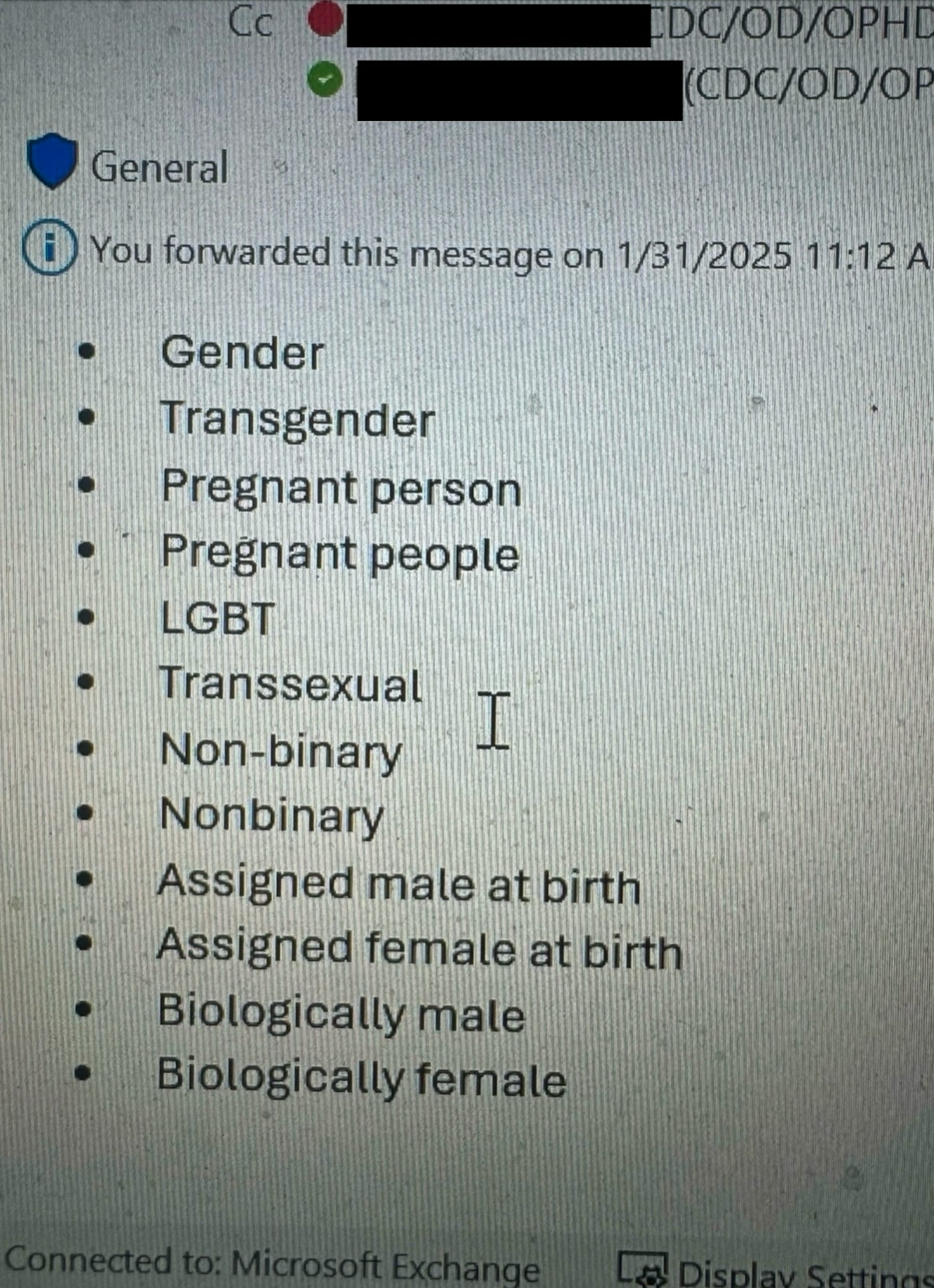
In the order, CDC researchers were instructed to remove references to or mentions of a list of forbidden terms: “Gender, transgender, pregnant person, pregnant people, LGBT, transsexual, non-binary, nonbinary, assigned male at birth, assigned female at birth, biologically male, biologically female,” according to an email sent to CDC employees (see below).”

A screenshot of a CDC email shared with Inside Medicine of a list of terms that must be removed from any CDC-authored manuscript being seriously considered or “in press” (but not yet online or in print) at any medical or scientific journal.

An expansion of an emerging censorship regime at the CDC. 

The policy goes beyond the previously reported pause of the CDC’s own publications, including Morbidity and Mortality Weekly Report (MMWR), which has seen two issues go unreleased since January 16, marking the first publication gap of any kind in approximately 60 years. Emerging infectious Diseases and Preventing Chronic Disease, the CDC’s other major publications, also remain under lock and key, but have not yet been affected because they are monthly releases and both were released as scheduled in January, prior to President Trump’s inauguration. The policy also goes beyond the general communications gag order that already prevents any CDC scientist from submitting any new scientific findings to the public.

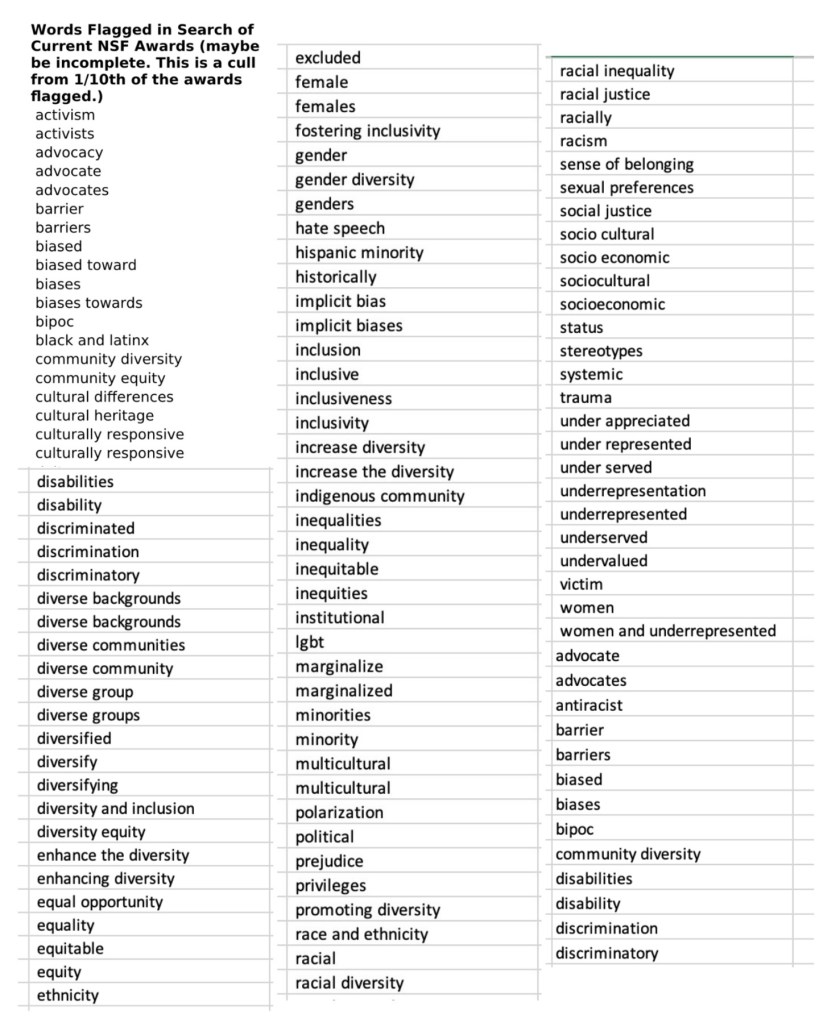
The National Science Foundation was directed to screen papers submitted for funding; it uses a list of words to flag papers that might offend the new administration.Being flagged means that the research needs a closer review to be sure that the topic is inoffensive.

Here is the NSF list:

Judd Legum and Rebecca Crosby of the blog “Popular Information” reported on censorship at the National Secutity Agency.

They wrote:

A memo distributed by NSA leadership to its staff says that on February 10, all NSA websites and internal network pages that contain banned words will be deleted. This is the list of 27 banned words distributed to NSA staff:

Anti-Racism
Racism
Allyship
Bias
DEI
Diversity
Diverse
Confirmation Bias
Equity
Equitableness
Feminism
Gender
Gender Identity
Inclusion
Inclusive
All-Inclusive
Inclusivity
Injustice
Intersectionality
Prejudice
Privilege
Racial Identity
Sexuality
Stereotypes
Pronouns
Transgender
Equality

The memo acknowledges that the list includes many terms that are used by the NSA in contexts that have nothing to do with DEI. For example, the term “privilege” is used by the NSA in the context of “privilege escalation.” In the intelligence world, privilege escalation refers to “techniques that adversaries use to gain higher-level permissions on a system or network.”

DOGE swept into the Institute of Education Sciences at the U.S. Department of Education and, following its advice, the Trump administration canceled $900 million in contracts. Bear in mind, this is the team of 20-somethings who knows a lot about software and coding. It’s unlikely that they know anything about education research.

This is the agency that I ran 30 years ago when I was Assistant Secretary of Education in the first Bush administration. At that time it was called the Office of Education Research and Improvement. I could have suggested some cuts, but certainly not $900 million!

What really bothers me is that this group of kiddies could not possibly know enough to judge the quality of the work they were canceling. Not in a day. Impossible. This was just a slash and burn operation.

ProPublica reported:

The Trump administration has terminated more than $900 million in Education Department contracts, taking away a key source of data on the quality and performance of the nation’s schools.

The cuts were made at the behest of Elon Musk’s cost-cutting crew, the Department of Government Efficiency, and were disclosed on X, the social media platform Musk owns, shortly after ProPublica posed questions to U.S. Department of Education staff about the decision to decimate the agency’s research and statistics arm, the Institute of Education Sciences.

A spokesperson for the department, Madi Biedermann, said that the standardized test known as the nation’s report card, the National Assessment of Educational Progress, would not be affected. Neither would the College Scorecard, which allows people to search for and compare information about colleges, she said.

IES is one of the country’s largest funders of education research, and the slashing of contracts could mean a significant loss of public knowledge about schools. The institute maintains a massive database of education statistics and contracts with scientists and education companies to compile and make data public about schools each year, such as information about school crime and safety and high school science course completion.

Its total annual budget is about $815 million, or roughly 1% of the Education Department’s overall budget of $82 billion this fiscal year. The $900 million in contracts the department is canceling includes multiyear agreements.

Heather Cox Richardson points out that Trump’s desire to cut the federal budgets threatens to undermine cancer research. Cutting cancer research? Yes. Is cancer research a “Marxist radical lunatic” or DEI activity?

Cancer research is important for all of us, regardless of our political views, or lack thereof. Why in the world would Trump want to cut its funding?

Yesterday the National Institutes of Health under the Trump administration announced a new policy that will dramatically change the way the United States funds medical research. Now, when a researcher working at a university receives a federal grant for research, that money includes funds to maintain equipment and facilities and to pay support staff that keep labs functioning. That indirect funding is built into university budgets for funding expensive research labs, and last year reached about 26% of the grant money distributed. Going forward, the administration says it will cap the permitted amount of indirect funding at 15%.

NIH is the nation’s primary agency for research in medicine, health, and behavior. NIH grants are fiercely competitive; only about 20% of applications succeed. When a researcher applies for one, their proposal is evaluated first by a panel of their scholarly peers and then, if it passes that level, an advisory council, which might ask for more information before awarding a grant. Once awarded and accepted, an NIH grant carries strict requirements for reporting and auditing, as well as record retention.

In 2023, NIH distributed about $35 billion through about 50,000 grants to over 300,000 researchers at universities, medical schools, and other research institutions. Every dollar of NIH funding generated about $2.46 in economic activity. For every $100 million of funding, research supported by NIH generates 76 patents, which produce 20% more economic value than other U.S. patents and create opportunities for about $600 million in future research and development.

As Christina Jewett and Sheryl Gay Stolberg of the New York Times explained, the authors of Project 2025 called for the cuts outlined in the new policy, claiming those cuts would “reduce federal taxpayer subsidization of leftist agendas.” Dr. David A. Baltrus of the University of Arizona told Jewett and Stolberg that the new policy is “going to destroy research universities in the short term, and I don’t know after that. They rely on the money. They budget for the money. The universities were making decisions expecting the money to be there.”

Although Baltrus works in agricultural research, focusing on keeping E. coli bacteria out of crops like sprouts and lettuce, cancer research is the top area in which NIH grants are awarded.

Anthropologist Erin Kane figured out what the new NIH policy would mean for states by looking at institutions that received more than $10 million in grants in 2024 and figuring out what percentage of their indirect costs would not be eligible for grant money under the new formula. Six schools in New York won $2.4 billion, including $953 million for indirect costs. The new indirect rate would allow only $220 million for overhead, a loss of $723 million.

States across the country will experience significant losses. Eight Florida schools received about $673 million, $231 million for indirect costs. The new indirect rate would limit that funding to $66 million, a loss of $165 million. Six schools in Ohio received a total of about $700 million; they would lose $194 million. Four schools in Missouri received a total of about $830 million; they would lose $212 million.

Trump has rolled out multiple executive orders that violate the law. He has installed submissive officials in key departments (like Justice) who will defend his law-breaking. The Republicans (who called Joe Biden a dictator) defend Trump’s reign of lawlessness. They have gleefully given Trump their Constitutional powers. Without a peep.

Dans Milbank advises Democrats: Don’t help him. He doesn’t need your vote.

He writes:

So, here’s a shocker: It turns out that, if you elect a felon as president of the United States, he will continue to break laws once he’s in office.

Who knew?

Ultimately, it will be up to the courts to determine which of President Donald Trump’s actions are illegal. But a case can be made — indeed, many cases already have been made in federal courts — that the new administration over the course of the last fortnight has violated each of the following laws. See if you can say them in one breath. In reverse chronological order of first enactment:

The Protecting Americans from Foreign Adversary Controlled Applications Act of 2024. The Administrative Leave Act of 2016. The Federal Information Security Modernization Act of 2014. The Affordable Care Act of 2010. The Foreign Affairs Reform and Restructuring Act of 1998. The Religious Freedom Restoration Act of 1993. The Computer Fraud and Abuse Act of 1986. The Inspector General Act of 1978. The Privacy Act of 1974. The Impoundment Control Act of 1974. The Rehabilitation Act of 1973. The Federal Advisory Committee Act of 1972. The Immigration and Nationality Act of 1952. The Administrative Procedure Act of 1946. The Public Health Service Act 1944. The Antideficiency Act of 1870.

That’s a century and a half of statutes shredded in just over two weeks. And those don’t include the ways in which Trump already appears to be in violation of the Constitution: The First Amendment’s protections of free speech and association; the Fifth Amendment’s guarantee of equal protection and due process; the Eighth Amendment’s prohibition against cruel and unusual punishment; the 14th Amendment’s promise of birthright citizenship; Article I’s spending, presentment, appropriations and bicameralism clauses; Article II’s take-care clause; and the separation of powers generally.

“The Trump administration so far has been the Advent calendar of illegality,” says Norman Eisen, whose group, State Democracy Defenders Action, has been filing lawsuits against the administration. At least seven federal judges appointed by presidents of both political parties have already blocked Trump’s moves to freeze federal funding, end birthright citizenship, extend a dubious buyout offer to government employees and deny treatment to transgender inmates.

Benjamin Wittes, who runs the popular Lawfare publication, predicts that, of the dozens of instances in which Trump is in conflict with existing law, he will ultimately lose 80 percent of the cases when they eventually arrive at the Supreme Court after 18 months or so of litigation. But that’s a long time to wait while the president’s lawlessness causes chaos and suffering. And even if the pro-Trump majority on the Supreme Court hands him a victory only 20 percent of the time, that could still fundamentally reshape the U.S. government, reducing Congress to irrelevance.

Republicans in Congress have for years asserted their Article I authority, and they howled about encroaching dictatorship when President Joe Biden did nothing more nefarious than forgive student-loan debt. (The Supreme Court struck that down.) So what are they doing about Trump usurping the powers of Congress? They’re applauding.

Sen. Thom Tillis, a North Carolina Republican, acknowledged that what Trump and Elon Musk are doing to cut off congressionally mandated funding “runs afoul of the Constitution in the strictest sense.” But, he told reporters this week, that’s “not uncommon” and “nobody should bellyache about that.”

House Speaker Mike Johnson, at a news conference Wednesday, was asked by Fox News’s Chad Pergram about the “inconsistency” of Republicans who are now “ceding Article I powers to the executive branch under Elon Musk.”

“I think there’s a gross overreaction in the media,” Johnson replied, with a forced chuckle. He admitted that what Trump is doing “looks radical,” but went on: “This is not a usurpation of authority in any way. It’s not a power grab. I think they’re doing what we’ve all expected and hoped and asked that they would do.”

These are not the words of a constitutionally designated leader of the legislative branch. These are the words of a Donald Trump handmaiden. And it is time for Democrats to treat him as such.

Democrats have been negotiating in good faith on a deal to fund the government for the rest of fiscal year 2025; the government shuts down in five weeks if funding isn’t extended. There’s no doubt that Rep. Tom Cole (R-Oklahoma), chairman of the House Appropriations Committee, and Sen. Susan Collins (R-Maine), chairwoman of the Senate Appropriations Committee, are also negotiating in good faith.

But the whole thing is not on the level. Trump has shown that he will ignore the spending bills passed by Congress and fund only those programs he supports — the Constitution, and the law, be damned. And Johnson has made clear that this is “what we’ve all expected and hoped and asked that they would do.”

In a letter to his Democratic colleagues this week, House minority leader Hakeem Jeffries said he told House GOP leaders that Trump’s efforts to cut off programs funded by Congress “must be choked off in the upcoming government funding bill, if not sooner.” But even if Democrats extracted from Republicans language in the spending bill that the programs must be funded as Congress specifies, Trump has already made clear that such a law wouldn’t be worth the paper it’s written on. And Johnson made it clear he has no intention of obliging Democrats with such a guarantee anyway; he said at his Wednesday news conference that Jeffries’s letter “laid out the foundation for a government shutdown.”

Clearly, there is no hope of good-faith negotiation with Trump, or with Johnson. Republicans control the House, Senate and White House. Let them pass a 2025 spending bill on their own. Let them raise the debt ceiling on their own. Let them enact Trump’s entire agenda on their own. They have the votes. Democrats ought not give them a single one.

Good parenting uses the idea of “natural consequences”: If your child refuses to wear her coat, let her be cold for the day. Either way, the voters will provide the consequences: FAFO. Trump knows what this means: He posted a picture of himself next to a FAFO sign, to deliver the message to Colombia’s president during their recent deportation standoff.

Democrats, by withholding their votes, will be giving Trump and Johnson some good parenting. Republicans can shut the government down. Or they can enact the sort of devastating cuts to popular programs that they like to talk about. Either way, the voters will provide the natural consequences.


The third week of the Trump presidency has been just as chaotic as the first two. Trump, who won the 2024 election promising to end wars and to put “America First,” now proposes to take over Gaza and to spend American taxpayer dollars to dismantle bombs and make it a “Riviera” on the Mediterranean. (He later clarified that Israel would handle the forced resettlement of the 2 million Palestinians there — “people like Chuck Schumer” — and then cede the Palestinian land to the United States.) The Trump-appointed chairman of the Federal Communications Commission is using his agency to assist Trump in his personal vendetta against CBS News, forcing the network to hand over unedited tapes of an interview with Kamala Harris that are the subject of a lawsuit Trump filed against CBS.

Funding was shut off to some Head Start programs for preschoolers. And the administration, though it isn’t deporting any more migrants than the Obama administration did, stepped up efforts to humiliate them and is now sending deportees to Guantánamo Bay.

Meantime, the world’s wealthiest man runs amok through the federal bureaucracy, and he appears to have access to private records of all Americans and highly classified information such as the identities of CIA operatives. He is reportedly doing this with a group of unvetted men in their early 20s — as well as a 19-year-old heir to a popcorn fortune who recently worked as a camp counselor. Musk, though he seems to be running much of the country, has exempted himself from all government disclosure and ethics requirements. But fear not: If Musk, whose companies get billions of dollars in federal contracts, “comes across a conflict of interest,” said White House press secretary Karoline Leavitt, he will — Scout’s honor — recuse himself. The administration’s attempt to induce federal employees to take a legally dubious buyout came in the form of an email with the same subject line — “fork in the road” — that Musk used to drive Twitter employees to quit.

The South Africa-born Musk, fresh from his encouragement of far-right extremists in Germany, replied “yes” this week to a post on X that said “we should allow more immigration of White South Africans.”

Musk moved to dismiss staff and shut down the U.S. Agency for International Development, which Musk calls “evil.” Maybe that’s because USAID’s inspector general was investigating the activities of Musk’s Starlink in Ukraine. But the administration and its allies rushed to justify the decision — by fabricating propaganda. At the White House, Leavitt told reporters that she was “made aware that USAID has funded media outlets like Politico. I can confirm that more than $8 million … has gone to subsidizing subscriptions.” Trump inflated the fiction further, to suggest “BILLIONS” went to “THE FAKE NEWS MEDIA AS A ‘PAYOFF’ FOR CREATING GOOD STORIES ABOUT THE DEMOCRATS.” In reality, $44,000 of USAID money went to Politico over several years — not from “payoffs” or “subsidies” but from officials subscribing to Politico Pro, as they did throughout the government (hence the $8 million). On Capitol Hill, Johnson provided a different fabrication, crediting Trump and Musk for stopping USAID from funding “transgender operas in Colombia,” “drag shows in Ecuador” and “expanding atheism in Nepal.” But it appears USAID did not fund any of those things.

The willy-nilly cancellation of all foreign aid would end lifesaving programs and various counterterrorism and counternarcotics efforts, dealing a lethal blow to U.S. soft power and driving countries into the arms of China and Russia, while hurting American farmers in the bargain. But it’s not just USAID. Trump and Musk, with their reckless and unfocused attack on federal workers, are raising the likelihood of any number of crises, at home and abroad. Their hollowing-out of the FBI and the Justice Department (with the notable exception of activities targeting Trump critics and migrants) raises the likelihood of a terrorist attack and foreign infiltration, not to mention more crime domestically. Their attempt to drive workers to quit at the CIA and NSA jeopardizes national security. Depleting the ranks of food-safety inspectors and bank regulators poses obvious dangers, as would Trump’s idea of abolishing FEMA. The administration tried to reduce personnel at the FAA — but last week’s plane crash in D.C. suddenly made it discover we need more air traffic controllers.

Yet Republican leaders on Capitol Hill either salute Trump or look the other way. They’re on their way to confirming all of Trump’s nominees, including vaccines opponent Robert F. Kennedy Jr. to run the federal government’s health programs; Tulsi Gabbard, who has a bizarre fondness for Russia, to oversee intelligence; and Kash Patel, Trump’s agent of vengeance, to run the FBI.

Senate Majority Leader John Thune (R-South Dakota) said the sort of thing Trump and Musk are doing to USAID is “probably true of any administration when they come in.” Handmaiden Johnson even welcomed the proposed U.S. takeover of Gaza, saying, contrary to reality, that it was “cheered by, I think, people all around the world.”

A few Republicans are raising objections. Collins doesn’t think Musk’s upending of USAID “satisfies the requirements of the law,” and she pronounces herself “very concerned.” But what’s the senator from Maine going to do about it? Apparently, nothing.

That will have to be up to Democrats. The out-of-power party has been bashed in the news media and by progressives for doing too little to stand up to Trump. Then, when Democratic lawmakers protested outside USAID headquarters, they were criticized for doing too much. “You don’t fight every fight,” Rahm Emanuel told Politico.

In truth, Democrats have almost no ability to stop Trump, but they do have the power, and the obligation, to stand in lockstep opposition to what the president is doing. Some of them might argue that the only way to protect certain programs, and the vulnerable people who need them, is to cut a deal with Trump and Republicans. But Trump has demonstrated abundantly that he will try to use unconstitutional means to kill off those programs regardless of what Congress does.

But if Democrats can’t stop a reckless president from creating unnecessary crises and harming millions of Americans, they certainly don’t need to give a bipartisan veneer to the atrocity. Let Republicans own the consequences of breaking government. Don’t save Trump from himself.

Ezra Klein is a columnist for The New York Times. His podcast is wildly popular. He synthesizes events that seem disparate.

This is one of his best.

He explains succinctly the moment we are in.

An aging, angry, vengeful man is re-elected President. That would be Trump. He is surrounded by people with an agenda, like JD Vance, who is an acolyte of a radical anarchist, Curtis Yarvin. The primary financier for the President is the richest man in the world. That man, of course, is Elon Musk. He gave Trump almost $300 million for his campaign, and that gift buys a lot of gratitude.

Until recently, the public was not aware of Musk’s political views. But now we know. He is a far-right extremist.

Trump gave Musk a mission: Cut the budget. Do the hard things that Congress won’t do because they fear doing anything too unpopular, like cutting Social Security and Medicare.

Right off the bat, Musk sends an email to two million civil servants: retire. Make a decision by February 5. Retire or risk being laid off.

Trump gives Musk carte blanche to do whatever he wants. Musk brings in a team led by inexperienced 20-somethings. They go from department, copying private and personal data.

Musk has billions of dollars in contracts with the government. He can, if he chooses, learn about his competitors’ contracts and personal tax returns. He has the personal information of hundreds of millions of people.

He begins making recommendations for slashing agencies. He hates foreign aid, which he considers “wicked,” even though a large part of it feeds hungry people and cures deadly diseases. Every foreign aid worker is called home. He hates NPR and PBS, and it seems likely that he will terminate their funding. He has many other personal grudges, which are sure to influence his recommendations.

Why are Republicans supporting this handover of responsibility from Trump to Musk? Why are they willingly defending the removal of their own Constitutional responsibilities?

The Constitution gives Congress the power of the purse. Republicans sit back and watch as Musk takes that power. The Constitutiin gives Congress the authority to create and close departments. Why are Republicans silently giving him permission to close down the USAID?

Why are they so enthusiastic about one-man rule? Why have they abandoned the Constitution? Didn’t they take an oath to defend it against all enemies, foreign and domestic?

I am attaching a good article on this subject by David Wallace-Wells.

It is, so far, worse than I feared. Last Friday, at the end of a week in which a vaccine skeptic and sometime conspiracy theorist auditioned to lead the country’s nearly $2 trillion, 80,000-person public health apparatus, much of the Centers for Disease Control and Prevention’s website went dark — its weekly mortality reports, its data sets, certain guidance for clinicians and patients, all taken offline. C.D.C. researchers were ordered to retract a huge raft of their own, already-submitted research. Next to go dark was the website of U.S.A.I.D., which Elon Musk announced that he would be working to shut down entirely, after several staffers resisting agency takeover by the billionaire were abruptly put on leave. (When the agency website later popped back online, it featured an announcement that all overseas personnel would be placed on leave and ordered to return.).

This is after the new administration had already suspended the country’s most successful global-health initiative, PEPFAR, which has saved millions of lives globally. The State Department later issued a PEPFAR waiver, but the program appears to have been rendered effectively inoperative by staff cuts; if the pause holds for even 90 days, it would result in over 135,000 additional children being born with H.I.V. The Famine Early Warning System Network was shut down, too.

Sometime between Jan. 6, 2021 and Nov. 5, 2024, many American liberals came to feel that “the resistance” — the reflexive mobilization against President Trump, after his first victory, on behalf of American institutions — had been embarrassing, pointless or even counterproductive, and that it might have been a touch hysterical to worry in grandiose terms about the threat posed by Trump rule. At the moment, it is hard to see it but hysterically: a blitzkrieg against core functions of the state, operating largely outside the boundaries set by history, precedent, and constitutional law, and designed to reduce the shape and purpose of government power to the whims, and spite, of a single man.

Or perhaps two men. The news about U.S.A.I.D. wasn’t delivered by President Trump, for instance. Instead the case against the agency was mounted on X by Musk, who this weekend called it a “criminal organization” saying that it’s “time for it to die”; the email telling staff that the agency’s headquarters would be closed appeared to come from one of Musk’s 20-something government “efficiency” groupies, who had somehow acquired a U.S.A.I.D. email address. Both the manner and the target of the attack offered the same lesson: that soft power was not real power, at all, and that only the hard kind truly counted.

Musk eventually won access to payment systems at the Treasury Department after a similar fight — after an official protesting the move was seemingly pushed out of the agency. “There are many disturbing aspects of this,” the political scientist Seth Masket wrote over the weekend. “But perhaps the most fundamental is that Elon Musk is not a federal employee, nor has he been appointed by the president nor approved by the Senate to have any leadership role in government.” Indeed, to the extent he enjoys any formal authority, at the moment, it is through a loose executive order broadly understood to authorize the initiative only to upgrade government I.T. systems and protocols. “Musk is a private citizen taking control of established government offices,” Masket went on. “That is not efficiency; that is a coup.” Other relatively sober-minded commentators have called it “ripping out the guts of government.” Still others a “Caesarist assault on the separation of powers” and a “constitutional crisis.”

Is it? Well, T.B.D. Much or all of this will be adjudicated in court, in the coming weeks and months, and maybe, ultimately, overturned or undone. Some initiatives have already been halted in the courts, though it’s nevertheless grim to see researchers celebrating that their ability to gain access to data on respiratory illness has been restored. (Even more so to scroll through the long list of “forbidden words” now being purged from C.D.C. research) And trusting that there remain checks and balances sufficient to block what my colleague Ezra Klein called the president’s longstanding desire to be king — or to block Musk’s effort to rip apart the government of the world’s most powerful country, as he did to Twitter — invests a lot of hope in state attorneys general, federal judges and the Supreme Court, not to mention advocacy groups like the A.C.L.U.

Already, it seems absurd to base expectations for Trump’s second term on the ultimate outcomes of the first, and perhaps unfortunate that so many commentators have spent the last year eye-rolling about “resistance historians” and their hyperbolic warnings. When JD Vance talked about the need to reconstitute the federal government with a program of “de-Baathification,” it sounded extreme enough. But in barely two weeks the “anti-woke” ideological agenda has already become a flimsy pretext for a much more sweeping evisceration of state function.

“This is a five-alarm fire,” Congresswoman Alexandria Ocasio-Cortez wrote this weekend, and on Monday she called on her colleagues to block Trump’s nominations in the Senate in protest. In the days that followed, many of her colleagues in the Democratic coalition found their rhetorical footing somewhat, at least calling out the initiative’s overreach — some of them coalescing around a message of “Fire Elon Musk” — rather than treating it with a mix of soft skepticism and performative sympathy.

But many had spent the transition developing a line of rhetorical attack based on food prices rather than the language of fascism, treating the return of Trumpism as an episode of normal politics rather than exceptional or existential ones, and trying so hard to learn the lessons of the so-called “vibe-shift” that they often sounded less like they were preparing for a fight than for a listening tour. Over the weekend, many appeared genuinely shellshocked.

Who isn’t? Perhaps it is even true that Trump won re-election thanks simply to frustration with immigration and the cost of living, however much that talk of vibes helped inflate the importance of a thin quotidian victory and lend credibility to what might otherwise look more like a hostile takeover of government by a marauding few. But where does all that leave the work of opposition? This is one demoralizing effect of staking a presidential campaign on themes of status-quo continuity, while conceding to many of the other side’s critiques (on immigration, on energy, on crime). You end up, after the election, looking a bit lost.

The war on public health is just one facet of this ugly diamond, but through it you can see both the breadth and the cruelty of the whole assault — and how it often hides behind an alibi of “reform.”

All of a sudden, last Friday, you could not view C.D.C. data about H.I.V., or its guidelines for PrEP, the prophylactic treatment to prevent H.I.V. transmission, or guidelines for other sexually-transmitted diseases. You couldn’t find surveillance data on hepatitis or tuberculosis, either, or the youth-risk behavior survey, or any of the agency’s domestic violence data. If you were a doctor hoping to consult federal guidance about postpartum birth control, that was down too. As was the page devoted to “Safer Food Choices for Pregnant People,” presumably because that last word wasn’t “Women.” Throughout the pandemic, conservative critics of these institutions complained that their messaging was unequivocal and heavy-handed. The new message seems to be: You are on your own.

In the end, this is Robert F. Kennedy Jr.’s message, too — beyond his claims about vaccines and G.M.O.s. The man who will almost certainly assume control of the country’s entire public health apparatus is often described as a late arrival to MAGA, and an unlikely ally — a longtime environmental lawyer and anti-corporate activist who was even considered a potential E.P.A. administrator by Barack Obama. But he nevertheless embodies the broader program, as does the MAHA (Make America Healthy Again) movement for which he serves now as a hood ornament.

In the aftermath of the pandemic emergency, Americans grew increasingly distrustful of many of the country’s institutions of health — it wasn’t just faith in organizations like the C.D.C. and F.D.A. which fell, but trust in nurses, doctors and pharmacists, too. But the administration isn’t proposing reform. Kennedy’s core focus is asking sweeping questions about vaccines and about the food system and environmental contamination. This emphasis represents a paradigm shift, from a social and epidemiological view of illness and disease, emphasizing collective responsibility and mutual aid, to one focused on behavior, diet and lifestyle. Which is to say, personal responsibility — in place of public health, health libertarianism.

This shift is not just the work of Trumpist right, as left-wing critics of Joe Biden’s pandemic policy have long argued. But you could see the dynamic quite clearly at Kennedy’s confirmation hearings. Senator Rand Paul, rather than asking any serious questions of the nominee, instead delivered a long and passionate monologue about the need to question medical orthodoxy and the oppressive weight of that consensus, as he felt it, during the pandemic.

His rant was not without merit: Hepatitis-negative mothers probably wouldn’t need to vaccinate their children against the disease on Day 1 of their lives, as the committee chairman, Bill Cassidy, seemed to acknowledge, and early in the pandemic it might have been useful to communicate a bit more clearly about the striking difference in risk faced by the old and the young, as I was writing as far back as the spring of 2020, too.

But these were not the questions that Kennedy was asking most conspicuously at the height of the Covid emergency — about how we might do better with guidance and communication and trust, or whether we had done enough to communicate the age skew of the disease or the strength of “natural” immunity. Instead, he was focusing on the horrors of the new vaccines. Indeed, fighting to stop their authorization, and any future authorization for any future Covid vaccine, not just for little children or those who’d already survived infection, but for any American of any age and suffering any health condition.

This was in May 2021. The rollout had begun just six months before, but vaccines had already saved, it was estimated, nearly 140,000 American lives. In the years that followed, they would save perhaps three million more. That is to say, if Kennedy had been successful, the pandemic death toll in this country could have been about three times as high.

This attempt at public-health sabotage towers over the new secretary’s meddling in Samoa, which may have contributed to the deaths of dozens by measles in 2019, and it came more recently, concerning millions of American lives. It was also what earned him a spot in the Trump coalition — indeed a starring role. The Covid vaccines were a medical miracle, probably the most consequential American one in several generations. Kennedy did what he could to stop that miracle, which he later called “the deadliest vaccine ever made.” When the country encountered a rampaging novel disease, he told us very clearly, he would have preferred we all faced it naked and alone.

This should be disqualifying. Instead, it proved the opposite. In the name of reform and government overhaul, the new administration is approving and ushering in something much more like destruction, with the president imploring his new health secretary to “go wild” in the role. The admonition does not apply just to Kennedy and public health, or even just to Musk and his initiative. A new generation of libertarians is not letting the country’s crisis of confidence go to waste. On Tuesday, Ted Cruz declared, “Abolish the IRS.” Up first, apparently: the Department of Education.

Texas Governor Greg Abbott is holding hostage the more than five million students in public schools while he demands vouchers for kids who are already enrolled in private and religious schools. Abbott has refused to increase funding for the state’s public schools unless the legislature approves vouchers, most of which will subsidize the affluent.

Last year, the legislature refused to approve vouchers. Since then, Abbott engineered the defeat of several anti-voucher Republicans. He’s hoping to win approval in the current session. Vouchers will pass easily in the state senate. We will see what happens in the House, where rural Republicans stood against vouchers in the past, before Abbott’s purge.

Abbott is playing Reverse Robin Hood. He is stealing from the poor to pay for the rich. Billionaires like Jeff Yass, the richest man jnnOennstlvsnia, and Betsy DeVos of Michigan, are funding his intransigence with millions in campaign contributions.

The Texas Monthly reports that school superintendents are increasing class sizes, laying off teachers, eliminating electives, and doing whatever they can to keep their doors open.

The article says:

Two years ago, during the 2023 legislative session, superintendents of Texas schools were optimistic that state lawmakers would boost public-education funding. After all, soaring inflation was straining the already meager finances of districts across the state, and lawmakers had at their disposal a $32.7 billion budget surplus. Spending some of that money on the urgent educational needs of the state’s children might have seemed like an uncontroversial proposal. 

Instead, the unthinkable happened: Legislators left Austin without putting any significant new money into schools or giving teachers a raise. The consequences have been dire.

Texas’s public schools were already among the most poorly resourced in the country: Our per-student funding is about 27 percent less than the national average. The basic allotment—the minimum amount of funding per student that school districts receive from the state—has been stuck at $6,160 since 2019. That would need to be upped by about $1,400 just to keep pace with rising costs. Public education advocates worry that lawmakers will provide only face-saving increases to the basic allotment in 2025 while diverting billions to private schools.

Many school leaders have had to undertake draconian austerity measures. Nearly 80 percent of districts have reported challenges with budget deficits. Given the stakes, 2025 could be a pivotal year for Texas’s public-education system….

Texas Monthly spoke to a group of superintendents to ask about how they were coping. They all spoke about the budget cuts and unfunded mandates (like requiring the hiring of police officers without providing funding). One superintendent, Jennifer Blaine of Spring Branch, said:

JB, Spring Branch: We don’t have anywhere else to cut. We are cut to the bone. I consolidated everything I could, and I cut everything that I could. If we have to cut further, you’re talking about severely impacting academics in the classroom and, quite frankly, safety and security. Five and a half million kids are in Texas public schools, and I don’t understand how our legislators and our governor don’t see this as a crisis. If we don’t educate these kids to the highest levels and prepare them for postsecondary success, we’re going to crumble as a state. I don’t know where the disconnect is. Education is the great equalizer. But nobody is talking about that, and I think it’s a missed opportunity because this is not going to end well. 

The title of the article in the print edition was  “A Legislature That Will Spend at Least as Much Per Pupil as Louisiana.”

Katherine Long reported in the Wall Street Journal today that a member of Elon Musk’s elite tech squad resigned after some of his deleted tweets surfaced. The tweets portrayed their author as an enthusiast for racism and eugenics.

The 25-year-old employee, Marko Elez, resigned Thursday after The Wall Street Journal asked the White House about his connection to the account.

The deleted profile associated with Elez, who was embedded in the Treasury Department to carry out efficiency measures, advocated repealing the Civil Rights Act and backed a “eugenic immigration policy” in the weeks before President Trump was inaugurated.  

“You could not pay me to marry outside of my ethnicity,” the account wrote on X in September, according to a Wall Street Journal review of archived posts. “Normalize Indian hate,” the account wrote the same month, in reference to a post noting the prevalence of people from India in Silicon Valley.

Elez is a graduate of Rutgers, where he majored in computer science. After college, he worked for Musk at Space X, Starlink, and X.

Musk personally urged people to apply to DOGE on X in December, promising long hours and little pay in exchange for the chance to fundamentally remake the federal government. Some of those who answered the call appear to be young Musk loyalists, steeped in internet culture, who share his worldview.

The account, @nullllptr—a misspelling of a keyword in the C++ programming language—was deleted in December, but hundreds of brash, sometimes-sophomoric posts have been archived.  

The user appeared to have a special dislike for Indian software engineers. “99% of Indian H1Bs will be replaced by slightly smarter LLMs, they’re going back don’t worry guys,” the user posted in December. 

“Just for the record, I was racist before it was cool,” @nullllptr posted in July. 

In June, the user weighed in on the conflict in the Middle East, offering some sympathy for Israel but also posting, “I would not mind at all if Gaza and Israel were both wiped off the face of the Earth.”

We keep hearing how brilliant Musk’s team is, but this guy doesn’t sound brilliant. He sounds like a jerk.

As part of the radical overhaul of the federal government, some 2 million employees were asked to resign and accept a leave with pay if they did. But there is no money appropriated to pay for the offer, and there are multiple lawsuits opposing it. Nor was there any consideration of the value of the employee’s work.

When Elon Musk took charge of Twitter, he made a similar offer and fired 80% of the workforce. He got rid of content moderation teams and opened the platform to Nazis and misinformation. The downside was that he lost every major advertiser, and he’s now suing them for conspiring to hurt Twitter.

The New York Times reported on the final day of the offer:

Some federal employees have a new symbol for their resistance to President Trump’s and Elon Musk’s radical overhaul of the U.S. government: a spoon.

Last week, in an email with the subject line “Fork in the Road,” the administration urged federal workers to consider resigning from their posts and said they would be paid through September — a bid to rapidly shrink the size of the work force.

Union leaders have urged employees not to accept the offer, questioning its legality and legitimacy. And on Wednesday, workers at the Technology Transformation Services, the tech-focused arm of the General Services Administration, made their displeasure with the offer known during an organization-wide meeting with their new leader, a former employee at Mr. Musk’s automaker Tesla, by sharing spoon emojis in an online chat, according to people familiar with the response.

In the meeting, Thomas Shedd, a former Tesla engineer who was appointed to lead technology efforts at the G.S.A., attempted to assuage worries about the deferred resignation plan and told workers to “read as much as you can” about the offer, according to an audio recording provided to The New York Times. He also urged federal workers to review information posted on the website of the Office of Personnel Management.

“Have that context in mind as you think through the decision you have to make in the next 24 to 30 hours,” Mr. Shedd added. “The deferred resignation is the first step in streamlining the federal work force. In-person work will be the next step.”

His assurances did not appear to work. Employees in the tech division rained down spoon emojis in the chat that accompanied the video meeting, which was watched by more than 600 people, according to photos of the chat screen provided to The Times and three people familiar with the reaction. Some employees also added spoon emojis to their statuses on Slack, a workplace communication app.

“Thomas: Whether you mean to or not, you’re playing a role in destroying TTS,” one worker wrote in the chat.

“The culture is the people,” another employee wrote. “Without the people, TTS is NOTHING.”

After Mr. Musk’s $44 billion acquisition of Twitter in 2022, he sent an email with the same subject line — “Fork in the Road” — to the company’s employees, offering them a buyout to leave the company if they didn’t want to participate in his “extremely hardcore” vision.

During the Twitter takeover, employees used the salute emoji as a sign of solidarity with their co-workers and as a goodbye during mass layoffs.

After renaming the social media service as X, Mr. Musk has pushed for severe cuts to the federal government. He shared a post that estimated 5 to 10 percent of the federal work force would take the deferred resignation offer, potentially saving the government $100 billion.

The last date to accept the offer is Feb. 6, according to the email to government workers.