Archives for category: Education Reform

For the past dozen years, the General Assembly of North Carolina has been relentless in its efforts to crush the state’s public schools and their teachers. This period began with the ascendancy of the Tea Party in what was once the most progressive state in the South. Parents, students, and teachers got good news from the State Supreme Court on November 4. The following description of the decision was written by the Center for Educational Equity at Teachers College, Columbia University.

NORTH CAROLINA SUPREME COURT ISSUES BLOCKBUSTER SCHOOL-FUNDING DECISION

On November 4th, in a stunning 227-page decision, the North Carolina Supreme Court ordered the state controller and other state officials to transfer approximately $800 million from state budget reserves to the state educational budgets to fund a comprehensive compliance plan in the long-pending Leandro litigation.  The decision comes after the state legislature refused to appropriate the full amount required to implement the second and third years of the eight-year phase-in of the compliance plan.

The 1997 Leandro case affirmed NC students’ constitutional right to the opportunity for a sound basic education and recognized the duty of the state government to provide adequate funding to guarantee that right to all students. 

In its 4-2 decision on Friday, the state supreme court refused to permit further delay in fully vindicating the state students’ constitutional right. It remanded the case to the trial court to recalculate the exact amount of funds required for the transfer and ordered that the trial court to retain jurisdiction to ensure that the plan is fully implemented in the years to come.

The court stated the significance of the case in potent language:

A quarter-century ago, this Court recognized that the North Carolina Constitution vests in all children of this state the right to the opportunity to receive a sound basic education and that it is the constitutional duty of the State to uphold that right. Leandro v. State , 346 N.C. 336, 345 (1997). … In 2004, we affirmed the trial court’s determination “that the State had failed in its constitutional duty to provide certain students with the opportunity to attain a sound basic education,” and that “the State must act to correct those deficiencies.”… At that still-early stage of the litigation, this Court deferred to the legislative and executive branches to craft and implement a remedy to this failure. 

In the eighteen years since, despite some steps forward and back, the foundational basis for the ruling of Leandro … has remained unchanged: today, as in 2004, far too many North Carolina schoolchildren … are not afforded their constitutional right to the opportunity to a sound basic education. …

Now, this Court must determine whether [the state’s constitutional] duty is a binding obligation or an unenforceable suggestion. We hold the former: the State may not indefinitely violate the constitutional rights of North Carolina schoolchildren without consequence. Our Constitution is the supreme law of the land; it is not optional. In exercising its powers under the Appropriations Clause, the General Assembly must also comply with its duties under the Education Provisions. 

Rejecting the legislature’s separation of powers objections, the court held:

[W]hen inaction by those exercising legislative authority threatens fiscally to undermine the integrity of the judiciary, a court may invoke its inherent power to do what is reasonably necessary for the orderly and efficient administration of justice.”… Although “Article V prohibits the judiciary from taking public monies without statutory authorization [,]” when the exercise of remedial power “necessarily includes safeguarding the constitutional rights of the parties [,] … the court has the inherent authority to direct local authorities to perform that duty. …

For our Constitution to retain its integrity and legitimacy, the fundamental rights enshrined therein must be “guarded and maintained.” When other branches indefinitely abdicate this constitutional obligation, the judiciary must fill the void.

This forceful order reminds us that, at a time when the U.S. Supreme Court seems bent on abolishing or reducing important constitutional guarantees, state courts can play a critical role in upholding and fully enforcing important constitutional rights.

Note: The Center for Educational Equity helped draft the brief, amicus curiae, of the “Professors and Long-Time Practitioners of Constitutional and Educational Law” that was submitted in support of the plaintiffs’ position on this appeal.
With the help of the teachers’ unions, the people of Ohio elected three new members of the state board of education who support public schools. This is great news because the politicians in the State House and the Legislature have been frantically diverting public funds to charter schools and vouchers, as well as endorsing extremist policies on race and gender. The state constitution explicitly authorizes a system of public schools and forbids public funding of religious schools. Ohio’s charter schools are among the lowest-performing in the nation and are lower performing than the state’s public schools. Half of those authorized by the state have closed.


Anti-culture war candidates win three seats on Ohio State Board of Education, with big boost from teachers’ unions

By Laura Hancock, cleveland.com

COLUMBUS, Ohio – Voters elected three candidates to the Ohio State Board of Education on Tuesday who oppose fights over LGBTQ students in bathrooms and attempts to control how American racism is discussed in social studies classes. The Ohio Federation of Teachers and the Ohio Education Association contributed tens of thousands of dollars to help the campaigns of former state senator Teresa Fedor of Toledo, Tom Jackson of Solon and Katie Hofmann of Cincinnati, who each won their races against more conservative candidates. Candidates the unions did not support, including one who ran unopposed, won races in two districts.

The unions were involved in recruiting the three candidates. Fedor and Hofmann are each former teachers and members of OFT. Jackson, a businessman, is a volunteer coach at Solon High School and serves on the Solon City Schools Strategic Planning Team. Their members volunteered to knock on doors and spread the word about the candidates.

They also gave their candidates a big fundraising boost. In addition to writing checks for each candidate’s campaign — OEA gave $13,700 to each candidate’s campaign and the OFT gave $12,000 to Fedor and Jackson and $13,700 to Hofmann — the unions spent at least $100,000 to get them elected through an independent super PAC called Educators for Ohio. The PAC is normally controlled by OEA, but OFT this year was also involved in it, said Melissa Cropper, president of the OFT.

The super PAC spent money only on the three state school board candidates, said Scott DiMauro, president of the OEA. “The three individuals who won those contested races are all strong advocates of public education, they have strong records on that,” DiMauro said. “I would anticipate they would work closely with other members of the state board who have been pushing back on some of those (culture wars) attacks. How everything is going to play out still remains to be seen, because you still have an extremist faction that is pushing some of those resolutions. Some of those members are still there.”

Fedor defeated Sarah McGervey, a Catholic school teacher who talked about parental rights against perceived liberal bias in education and keeping LGBTQ protections out of Title IX. Jackson defeated incumbent Tim Miller and Cierra Lynch Shehorn, who was ran further to the right of Miller. Hofmann defeated conservative incumbent Jenny Kilgore.

Hoffman, Jackson and Fedor vastly outraised their opponents. Kilgore individually raised $5,800 in 2022. Hofmann raised nearly $44,000. Jackson raised $53,000 this year, compared to Miller’s $7,600 and Lynch Shehorn’s $4,800.

Fedor’s and McGervey’s campaign finance reports are more complicated. McGervey ran for the Ohio House in August. After she lost that race she ran for the state board. Her total fundraising haul was $15,000. Fedor was a sitting senator in 2021, the beginning of the two-year funding cycle, and she raised $95,000 during the two-year period.

Other candidates who won but were not supported by the unions include incumbent member John P. Hagan, a conservative on the board, who beat a challenge from Robert R. Fulton. Neither candidate in that race received the unions’ endorsement. Ohio State Board of Education President Charlotte McGuire won reelection unopposed. Ohio Value Voters, a conservative Christian organization, backed the conservative slate of candidates, including Hagan.

As Ohio students fell academically behind from remote learning during the pandemic and Ohio has been without a permanent state superintendent for more than a year, conservatives on the state school board pressed to take on several controversial issues over the last year.

Last year, conservatives on the board successfully overturned an anti-racism resolution that the board had previously passed in the wake of George Floyd’s death. Two members of the state board who voted to overturn the anti-racism measure were defeated Tuesday night: Miller, of Akron, and Kilgore, of Hamilton County. A third supporter of the resolution, Kirsten Hill – who organized a bus from Lorain County to attend the “Stop the Steal” rally on Jan. 6 but said she never entered the U.S. Capitol – opted not to seek reelection.

More recently, conservatives on the board have been pushing a resolution that would urge local school districts to defy Title IX protections for LGBTQ students that are being proposed by President Joe Biden’s administration, potentially putting federal money for free and reduced lunch and special education in jeopardy. The resolution remains under consideration. Board members have spent 10 hours taking public testimony and discussing it since September.

Most of the state school board campaigning and fundraising took place in just the past two months, Cropper said.

“Remember, this election cycle, no one knew what the lines were going to be,” she said. Every 10 years, the boundaries for the Ohio State Board of Education shift when Ohio Senate boundaries are redrawn. Gov. Mike DeWine changed state school board boundaries Jan. 31, a move panned by critics as gerrymandering. DeWine didn’t change the school board map, even as state mapmakers shifted the Senate’s boundaries found to violate the Ohio Constitution, and on July 14, Ohio Secretary of State Frank LaRose notified county boards of election to use the Jan. 31 changes DeWine made. Candidates for the state school board, which are nonpartisan, had to file to run for the seats Aug. 10, which left just a few months to campaign.

“It really was a crunch in trying to get quality candidates to run,” Cropper said. “We had incumbents we know that were not pro-public education, who were in my opinion, pushing these culture war issues at the state board level. And it was just critical to us that we could get them out of there. So we definitely were looking for people who understand public education, who have been engaged in conversations about equity, social-emotional learning, the whole child approach, all the things that are really important to us.”

The whole child approach refers to the state board’s 2019-2024 strategic plan that says the state is concerned with the “whole child,” not just academics but stressors children experience at home that can influence learning. In 2019, the Ohio Department of Education unveiled social-emotional learning standards that aim to help children become successful in their interactions with others, to establish positive relationships, manage their emotions, and make healthy, drug-free choices in life.

“My estimation is that people rejected extremists and the extreme issues that they’re bringing to the table and children are caught in the middle,” Fedor said Wednesday. “I believe this is an overall rejection of using our children as political fodder.” Fedor had the most name recognition among the state school board candidates. In addition to her legislative career, she was on the Democratic gubernatorial ticket this spring with former Cincinnati Mayor John Cranley. Fedor said that as she campaigned, she talked about reducing the number of standardized tests kids have to take. She talked about her own time in the classroom, when she worked an additional part-time job at the Toledo Zoo to make money for classroom materials.

She said she learned that people were horrified that Hill led Ohioans to the Jan. 6 rally. “There was a flood of different ideas and thoughts about what’s going on,” she said. “And they did not support the extremists who are bringing the extreme issues forward. The culture wars in the classrooms have to end so we can get to the business of educating our children with quality public education.”

Billionaires have been pouring millions of dollars into state and local school board races for at least the last dozen years. These elections are often flooded with money from out-of-state billionaires who support expansion of charter schools and invalid ways of evaluating teachers.

It’s great to see the unions step up and support state school board members who care about public schools and teachers and care about issues that matter, rather than divisive conflicts that don’t help anyone. The amount of money spent by the unions was small compared to what the billionaires spend, but it made a difference.

Randi Weingarten, president of the AFT, campaigned across the country for candidates who support public schools and their teachers. She released the following statement:

American Voters Reject Extremism in Win for Democracy and Freedom

WASHINGTON—AFT President Randi Weingarten issued the following statement on the emerging results of the 2022 midterm elections:
“In a year when democracy, freedom, public education, public safety and economic security were on the ballot, voters overwhelmingly rejected MAGA extremism and fear.


“They stood up for who we are as a country. They stood up for democracy and against election deniers. They stood up for the right of women to make decisions about their reproductive health, and against chaos and hate.


“Our country remains deeply divided—and there were many heartbreaking losses. But voters in so many close races elected problem solvers rather than problem makers.


“When public education was on the ballot, public education mainly won. Dynamic, progressive governors who ran on a positive agenda focused on the promise and potential of public schools prevailed. Ballot initiatives in California, Massachusetts and New Mexico passed. Even in Florida, against millions spent by Ron DeSantis, levies boosting funding for schools saw widespread success.


“These results show a deep reservoir of support for public schools and for the sustained investment that parents want to help their kids thrive. And the endorsement of collective bargaining provisions in multiple states and cities comes at a time when the labor movement—including unions representing educators—maintains strong and enduring approval. AFT members—educators, healthcare workers, public employees, and retirees—campaigned relentlessly for what our kids and communities need, and those efforts made a difference.


“The final picture will emerge in the coming days. Still, one thing is already clear: Last night, Americans boldly asserted their rights and freedoms and rallied around the democratic institutions that give our country meaning and hope for the future.”

The more charter schools, the worse the shortage of teachers prepared in university education programs. Those in university programs intend to be career educators, and their numbers are shrinking. Thus concludes a new study from a federal research center created to study choice and its effects.

When Betsy DeVos was Secretary of Education, she awarded $10 million to create the National Center for Research on Education Access and Choice (REACH). The research group is headed by Douglas Harris, and DeVos assumed that he was pro-choice.

While Harris has written papers favorable to choice, he is an independent scholar and follows the data where it leads. In this paper, he and his co-author Mary Penn conclude that charter schools contribute to the teacher shortage.

On its face, the proposition makes sense. If a young person wants to teach, they can get a job in a charter school without a teacher education degree. They can join Teach for America and become a teacher with only weeks of preparation. Or in some states, they can teach with no certification or degrees. Why bother going through the process of professional education and certification when charter schools will hire without any prerequisites?

The summary of the study concludes:

Debates about charter schools center on their immediate effects on students who attend them and how charter schools affect nearby traditional public schools. However, as the charter sector has continued to grow, a broader range of possibly unintended effects become relevant. This study is one of the first to examine the possibility that
charter schools affect the teacher pipeline. We focus specifically on how charter schools affect the number of traditionally prepared teachers who receive a bachelor’s in education.

Using data from 290 school districts with at least one commuter college nearby, we analyze the effect on the traditional teacher pipeline from schools of education. We draw the following conclusions:

Increasing district charter school enrollment by 10% decreases the supply of teachers traditionally prepared with a bachelor’s in education by 13.5-15.2% on average.

Charter-driven reductions in the supply of traditionally prepared teachers are most apparent in elementary, special education, and math education degrees.

This is consistent with the fact that charter schools mostly serve elementary grades, express interest in subject matter experts (e.g., math majors), and are less likely to assign students to special education.

These charter-driven reductions are concentrated in metropolitan areas and are largest among Black teachers.

Given how central teachers are to the educational process, any effect on the teacher pipeline is important. The vast majority of U.S. teachers still come from university-based schools of education, and these teachers stay in the profession longer than those who are not traditionally prepared, which makes these declines note worthy. A larger
point is that charter schools change the entire schooling market in ways we are only beginning to recognize.

The National Education Policy Center reviewed the study here.

Journalist Mark Oppenheimer wrote an opinion article in the New York Times, describing the long history of antiSemitism at elite colleges. Stanford University apologized for its limited enrollment of Jews in the 1950. The apology came at a time when anti-Semitism is surging on college campuses and in society.

But restricting the number of Jews admitted to Ivy League campuses is nothing new. The top Ivy League colleges introduced strict quotas in the 1920s, fearful of being overwhelmed by Jewish students.

To anyone who understands the history of Jewish exclusion on elite campuses, the central findings of a recently released, long-awaited report from Stanford University were no shock. The report confirmed that Stanford admissions officers purposefully limited the enrollment of Jewish students in the 1950s, in part by greatly reducing the number of applicants admitted from heavily Jewish public high schools.

What’s surprising is that these discriminatory measures were, comparatively, so mild and so late to come about. Elite Northeastern schools perfected Jewish exclusion decades before Stanford got in on the act.

In the 1920s, Columbia and Harvard began seeking students from the South and West as a means of limiting the number of students from more Jewish school systems in the Northeast — the very idea of “geographical diversity” was invented to keep out Jews. From 1928 through 1938, Columbia operated Seth Low Junior College, a two-year school in Brooklyn to which Jews were relegated to keep the student body of its Manhattan campus more Protestant. And Yale decided, in 1922, to restrict Jewish enrollment, which it did until the 1960s.

Given that history, and the increase in antisemitism today in the United States, the most noteworthy aspect of the Stanford report is its long list of proposed steps for atonement, or teshuvah, to use the Hebrew word invoked by its authors. The recommendations show noble intentions, but they also reveal the limitations of official university action in fighting what may be the world’s most enduring prejudice.

How universities balance the ethnic compositions of their student bodies is an urgent question right now, as the Supreme Court on Monday heard arguments on two cases challenging affirmative action, at Harvard and the University of North Carolina. In several months, when it rules on the legality of their admissions practices, the court may forbid the use of race or ethnicity as considerations. If so, partisans on both sides will argue about what such a change means for “diversity,” especially the imperative to admit historically underrepresented people of color, like Black and Hispanic Americans.

These fights are nothing new. As the plaintiffs note in their brief on the Harvard case, in 1922 Harvard began to suss out which applicants were Jewish, in part by asking questions like, “What change, if any, has been made since birth in your own name or that of your father? (Explain fully.)” Indeed, as scholars like Jerome Karabel and Robert McCaughey haveshown, the modern college application process, from the form to the interview, were developed to weed out Jews.

Stanford adopted some of this playbook midway through the last century, so its reckoning is welcome. Some of its report’s recommended steps for atonement are symbolic, like issuing an official apology (which Stanford just did). Other steps are more concrete, like better accommodating students who need kosher food or don’t use technology on the Sabbath, and thus can’t use electronic key cards on Saturday. The report recommends paying better attention to the Jewish calendar, so the start of school does not conflict with Jewish holidays — as it did this year, when first-quarter classes started on Rosh Hashana, the Jewish New Year….

Jewish students today are faced with a growing antisemitism that is rooted in widespread ignorance. In September, the Wellesley student newspaper published an editorial that relied on the blatantly antisemitic Mapping Project, a crude website that implies that institutions in Massachusetts including Emerson, Tufts and Harvard, a Boston-area Jewish high school, and even a public school system (Newton) are part of a web of conspiratorial Zionism. (The newspaper later said it did not “endorse” the Mapping Project.) Other institutions, like Northwestern, near Chicago, have seen incidents of swastika graffiti on their campuses.

And this year, students at a Jewish fraternity at California Polytechnic State University in San Luis Obispo told me that fellow students regularly shouted anti-Jewish slurs at them when they walked by the fraternity house. The Cal Poly students told me the hate speech is so common that they don’t even bother to report it.

College campuses are merely reflections of the national mood. The Anti-Defamation Leaguesays there was a 167 percent increase in antisemitic assaults from 2020 to 2021. But given that context, what might address the problem at schools?

Leadership, for one thing — like the kind modeled by Wellesley’s president, Paula Johnson, who condemned the Mapping Project as promoting antisemitism. A renewed focus on the humanities is another part of the solution. As students rush to major in subjects deemed useful — fields like economics and computer science — they are leaving history and philosophy in the dust.

As a college lecturer, most recently for 15 years at Yale, I have been surprised by the gaps in students’ historical knowledge. I’ve had students who thought that President John F. Kennedy had email and that American slavery ended in the 20th century. Some students didn’t realize Holocaust survivors still walk the earth, and many knew nothing of other genocides, from Rwanda to Cambodia.

Paradoxically, ignorance is flourishing at a time when many students seem more interested than ever in history. They are dismayed that their dormitories and classroom buildings are named after slaveholders, and they know that there is something problematic about Christopher Columbus, even if they can’t always say what. These students are ill served by curriculums that have downgraded the study of history, literature and philosophy.

Narrow-mindedness hurts us all, not only Jews. But encouraging and empowering students to discuss the history of Jews — to know anything about Jews — is the one indispensable way for schools to atone for their antisemitic past. I suspect that more Stanford students have learned about antisemitism from their school’s mea culpa than from classes they’ve taken there.

I am a graduate of Wellesley College, and I was very proud when the College’s President Paula Johnson called out the student newspaper for supporting The Mapping Project, an attempt to name and shame Jews who did not follow the newspaper’s politically correct views. Dr. Johnson did not interfere with the publication, but she said forcefully that there’s no room on campus for bigotry.

I met Joy Hofmeister a few years ago, in her capacity as superintendent of public education, and I was impressed by her dedication to public schools, her intellect, and her candor. She was a Republican then, but clearly not supportive of the Republican agenda to privatize public education.

If you live in Oklahoma, please vote for Joy for governor!

Former Republican Rep. J.C. Watts (Okla.) has bucked his party to endorse Democrat Joy Hofmeister in her challenge to Oklahoma Gov. Kevin Stitt (R).

“I was a Republican then, and I’m a Republican now, and, friends, I’m voting for Joy Hofmeister,” Watts says in a new ad.

“All this scandal and corruption is just too much. Joy is a woman of faith and integrity. She’ll always put Oklahoma first. I know Joy personally, and I trust her, and you can too,” the former Oklahoma congressman said.

Hofmeister was elected Oklahoma’s superintendent of public instruction twice as a Republican but swapped parties to register as a Democrat last year before mounting her gubernatorial campaign.

“Conservatives like Congressman Watts see Stitt’s lies about me for what they are — a desperate attempt to maintain power,” Hofmeister wrote on Twitter, sharing the ad.

As a secular Jew, I find it hard to write about the Hasidic community at a time of rising anti-Semitism. But the way they have organized their political power in New York to protect their religious schools is a cautionary tale. They have amassed political power by voting as a bloc. They have used that political clout to gain huge amounts of public money to fund schools that don’t teach English and don’t teach most secular subjects, even though state law requires them to offer an education that is equivalent to a secular school. They ignore the law because they have friends in high places.

The New York Times told the story on Sunday. The Hasidic community is about 200,000, or 1% of the state’s population. Their first priority is to protect their schools. State law says that religious schools, which receive public funding for required services, like transportation and special education, must offer education equivalent to public schools. Recently a state court fined one of thr state’s largest yeshivas $8 million for misusing public funds. The Times previously reported that the 100 of the state’s yeshivas have received more than $1 billion in public funds in the past four years. Most don’t take the state tests but when some did recently, not one student passed the tests. Why? Because they are taught in Yiddish or Hebrew, and many never study history, science or other secular subjects.

The secret of their power was the relationships they cultivated with politicians. Andrew Yang sought their support when he ran for NYC mayor but it was too late: they had already pledged their loyalty to Eric Adams, who won. To win their support means hands off their schools but keep the money flowing. On election night, a Hasidic leader was on the dais with Eric Adams. They previously forged close relationships with Rudy Guiliani and other mayors and governors.

As the Times reported:

During last year’s mayoral primary in New York City, Andrew Yang, then a leading Democratic candidate, made a calculated investment: If he could make meaningful inroads into the Hasidic Jewish community, its bloc of votes could help carry him to victory.

He hired a Hasidic Democratic leader in Brooklyn as his Jewish outreach director. He publicly pledged not to interfere with Hasidic Jewish religious schools, which were being investigated over whether they were providing a basic education. Still, some were not persuaded.

“I told him he might be a very nice person, but I don’t know him,” said Rabbi Moishe Indig, a leader of the Satmar Hasidic group in Williamsburg, Brooklyn. “I said we have a good history with someone who is here for years; we know that he cares for the community. It’s not nice to take an old friend and throw him under the bus.”

That old friend was Eric Adams, then the Brooklyn borough president, who won the primary and became mayor in January. Mr. Adams, like Mr. Yang, has been supportive of the Jewish schools’ independence, saying on the eve of his inauguration that they generally served as the basis for a “well-rounded quality education.”

Particularly disgusting is the Orthodox takeover of school boards in communities in Rockkand County and in New Jersey where their own children do not attend the public schools. The school boards use their power to cut school budgets and to direct public funds to their yeshivas. The children in public schools in these districts suffer the cuts and lack of voice.

Politicians offer services beyond protection of the religious schools.

As mayor, Michael R. Bloomberg once drew more than 10,000 members of the Hasidic community to a rally where they filled six blocks of bleachers. In 2004, he helped bring water from the New York City drinking supply to Kiryas Joel, a village 50 miles outside the city — a project still ongoing.

Mr. de Blasio worked with Orthodox leaders to ease regulations of a circumcision ritual, metzitzah b’peh, that led to numerous babies becoming infected with herpes.

Mr. de Blasio also faced scrutiny in 2019 for acting too slowly to declare a public health emergency in Orthodox communities in Williamsburg, Brooklyn, over a measles outbreak and for not requiring vaccination sooner. The community also resisted vaccination requirements during the coronavirus pandemic, and cases were often higher in their neighborhoods.

In this year’s governor’s race, Mr. Zeldin is enthusiastically courting Hasidic leaders,many of whom are concerned over new state rules requiring private schools to prove they are teaching English and math. Mr. Zeldin, who is Jewish, has defended the schools in his visits to Hasidic areas in Brooklyn and Rockland County, and frequently mentions that his mother once taught at a yeshiva, although it is unclear if it was a Hasidic school.

Many Democratic leaders are also hesitant to criticize yeshivas, or call for greater oversight of them, including Governor Hochul, who said in response to The Times’s investigation that regulating the schools was not her responsibilit

Unfortunately, the otherwise excellent Times article did not mention one of the leading critics of the yeshivas, Naftuli Moster, who organized a group of yeshiva graduates to call attention to the failure of the yeshivas to provide a secular education. Moster was born to a Hasidic family of 17 children. He attended college and then earned a degree in social work. He was keenly aware of the limitations of his yeshiva education. He founded Young Advocates for Fair Education(Yaffed), an advocacy organization dedicated to ensuring that students at Hasidic yeshivas in New York City be given a secular education.

Many Twitter users are fearful for the future of the popular social media site since it was purchased by Elon Musk. He is taking the company private and will be the sole proprietor. He has said he is an absolutist on free speech, which raises questions about whether he will tolerate hate speech, lies, propaganda, anti-vaxxers, disinformation, even Donald Trump, who was permanently banned from Twitter for inciting violence.

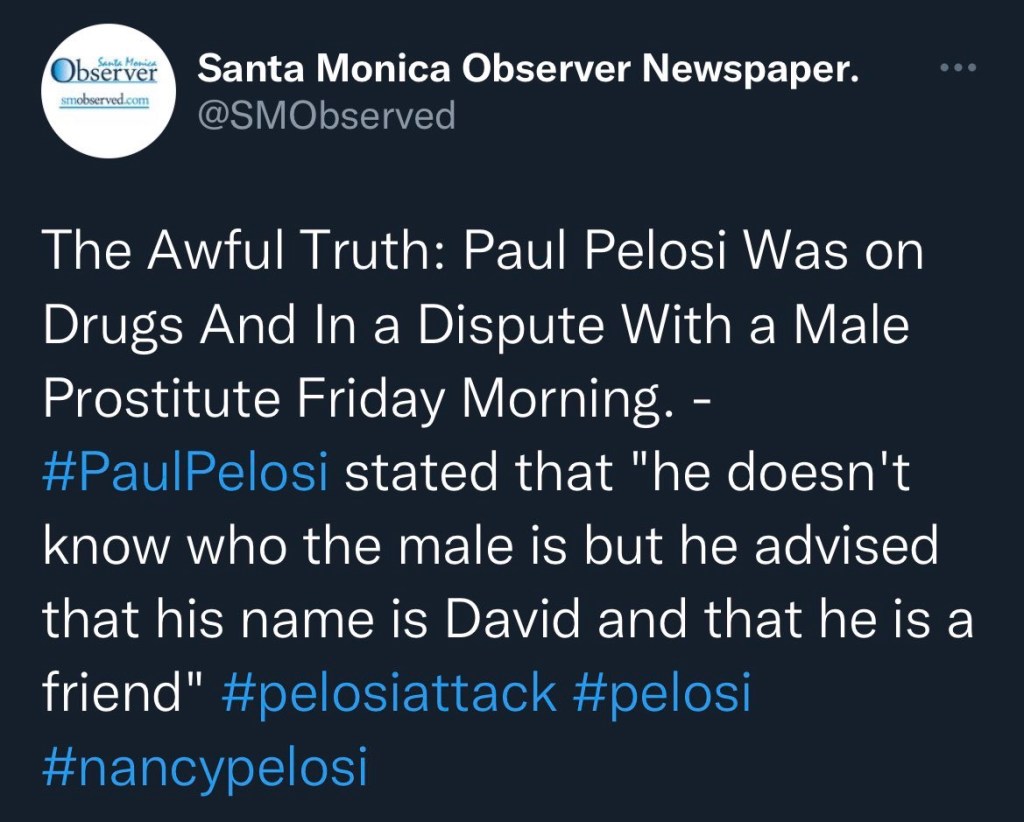
Now, the concern about Musk was stoked when he retweeted gossip from a free weekly (the Santa Monica Observer) that Paul Pelosi was drunk, high on drugs, and got into a fight with a man he picked up at a gay bar.

Musk posted that there was a “tiny possibility” that this was true. As readers began to react with incredulity that the new owner would spread unsubstantiated gossip, Musk deleted his tweet. Musk has 112 million followers on Twitter.

The San Francisco Chronicle wrote:

Musk responded Sunday at 5:15 a.m. Pacific time with a tweet that said, “There is a tiny possibility there might be more to this story than meets the eye,” and posted a link to a baseless, anti-LGBTQ article in the Santa Monica Observer. By 10:30 a.m. Sunday, the message and link had been retweeted more than 30,000 times and liked more than 110,000 times, before being deleted less than an hour later.

Last year, the Los Angeles Times reported that the Santa Monica Observer was “notorious for publishing false news,” and once claimed “that Hillary Clinton had died and that a body double had been sent to debate Donald Trump.”

Axios posted that the Santa Monica Observer is not a trustworthy site.

Why it matters: Musk linked to an article from the Santa Monica Observer, a website known for years for publishing false stories.

  • The site “is anything but trustworthy,” according to an executive at NewsGuard, a company that uses trained journalists to rate news and information sites.
  • The site has a trust score of 44.5 out of 100 points on NewsGuard’s rating scale for trustworthiness, due to repeatedly publishing numerous conspiracy theories and false claims about politics, the pandemic and more.
  • The site gets a red-rating and a warning for readers that says: “Proceed with caution: This website fails to adhere to several basic journalistic standards.”

Responsible people in the media fact-check. Musk didn’t think it was necessary. This does not bode well for the future of Twitter.

We have had our fill of conspiracy theories in the past six years.

It’s awful to think that the sole owner of Twitter will be a dupe for conspiracy theories and gossip and spread them to his millions of readers.

Just for laughs, read this article in The Intercept, which predicts that Elon Musk will regret his purchase of Twitter.

It begins:

ELON MUSK (and his consortium of much smaller investors) now owns Twitter. We need to take seriously the possibility that this will end up being one of the funniest things that’s ever happened.

That’s because as of this moment, it looks like Musk dug a big hole in the forest, carefully filled it with punji sticks and crocodiles, and then jumped in.

Since the two sets of NAEP scores were released recently, commentators have gone into a panic about “learning loss” and used the declines to promote their favorite reform: more of this, less of that. DeSantis even released a press release claiming falsely that Florida’s formula of ignoring the pandemic was just right (California stuck with the CDC guidelines and did at least as well, maybe better, than Florida, but Gavin Newsom did not issue a press release).

Jan Resseger has words of perspective that I sum up as: why are we surprised that learning was disrupted by the pandemic?

My question, having served on the NAEP board for seven years, is why the media and the reform crowd thinks that NAEP scores should go up every year? Why should fourth and eighth graders this year know more than fourth and eighth graders two years ago or four years ago? Isn’t it reasonable to assume that students of the same age and grade are likely to have the same scores? Yet if they do, the media sends out loud lamentations that scores are “flat.” Oh, woe! Surely we want to see a rise in the scores of the lowest scoring students, and a narrowing of gaps, but the media assumes that everyone must increase their scores or the education system is failing. This is nuts. There is little or no relationship between the test scores of students in fourth and eighth grades and the economy of the future.

Jan Resseger writes:

Are the new National Assessment of Educational Progress scores a catastrophic indication that the U.S. public schools have fallen into decline? I don’t think so.

Early this week, the National Center for Education Statistics (NCES) released a large data set from National Assessment of Educational Progress exams administered last spring to 4th and 8th grade students in U.S. public schools. Last month, NCES released scores from tests administered to a smaller group of 4th graders. Both sets of scores show that the COVID pandemic seriously disrupted schooling for the nation’s children and adolescents.

Chalkbeat’s Matt Barnum explainswhat the National Assessment of Educational Progress (NAEP) is: “The National Assessment of Educational Progress (NAEP, pronounced nape) is a test administered by an arm of the U.S. Department of Education. It’s given periodically to a representative subset of American students in math and reading in grades four and eight. Scores are broken down by state and for a select handful of cities, too. The latest results are based on tests given between January and March 2022. The previous test was given in 2019, before the pandemic… Scores from a separate NAEP exam that has been given to 9-year-olds for many decades were previously released in September.”

The NAEP scores released this week were precipitously lower than scores on the NAEP when it was administered in 2019, before COVID—particularly in 8th grade math. The Washington Post’s Laura Meckler reports: “The portion of eighth-graders rated proficient or better in math fell to 27 percent, from 34 percent in 2019… the steepest decline in more than a half century of testing.” (The fact that every year relatively few students reach NAEP’s proficient level overall is because the NAEP “proficient” cut score is set artificially high; it marks what most people would define as “advanced.”)

Some people assume that this year’s drop in NAEP scores signals a reversal of progress, the beginning of a downward spiral. Others are using the scores as evidence for their particular reform or as evidence that their state had a better policy on school closures than other states. Meckler writes: “Partisans on all sides of the education debate seized on the results to advance competing ideas about the way ahead… The test results also offered fodder for those who argue bringing students back to campuses quickly was the right move… ‘We kept schools open in 2020, and today’s NAEP results once again prove we made the right decision,’ Florida Gov. Ron DeSantis (R) said on Twitter. But the data did not establish a connection between back-to-school policies and academic performance. In California, for instance, many public schools were closed well into the 2020-21 school year and some students never saw a classroom that year. But the declines were similar to those in Texas and Florida, where schools were ordered to reopen much sooner.”

In a blog post last month when the first set of 4th grade NAEP scores was released, I shared my own assessment of what had happened. I think the scores released last month and the scores released this week show the same thing. Here is some of what I said in that post.

***

There is no cause for panic. Schooling was utterly disrupted for the nation’s children and adolescents, just as all of our lives were interrupted in so many immeasurable ways. During COVID, while some of us have experienced the catastrophic death of loved ones, all of us have experienced less definable losses—things we cannot name.

I think this year’s NAEP scores—considerably lower than pre-pandemic scores—should be understood as a marker that helps us define the magnitude of the disruption for our children during this time of COVID. The losses are academic, emotional, and social, and they all make learning harder.

Schools shut down and began remote instruction in the spring of 2020, and many stayed online through the first half of last school year. While most public schools were up and running by last spring, there have been a lot of problems—with more absences, fighting and disruption, and overwhelming stress for educators. It is clear from the disparities in the scores released last week among high and low achievers that the disruption meant very different things to different children. It is also evident that the pandemic was a jolting shock to our society’s largest civic institution. It should be no surprise, then, that the attempt to get school back on track was so rocky all through last spring…

While the NAEP is traditionally used to gauge the trajectory of overall educational achievement over time, and while the trajectory has been moderately positive over the decades, the results released last week cannot by any means be interpreted to mean a change of the overall direction of educational achievement.

Education Week’s Sarah Schwartz asked Stanford University professor Sean Reardon (whose research tracks the connection of poverty and race to educational achievement) whether “it will take another 20 years to raise scores once again.” Reardon responded: “That’s the wrong question…. The question is: What’s going to happen for these (9-year-old) kids over the next years of their lives.” Schwartz describes more of Reardon’s response: “Children born now will, hopefully, attend school without the kinds of major, national disruptions that children who were in school during the pandemic faced. Most likely, scores for 9-year-olds, will be back to normal relatively soon, Reardon said. Instead, he said, we should look to future scores for 13-year-olds, which will present a better sense of how much ground these current students have gained.”

Schwartz reports: “Students at all levels lost ground during the past two years, but lower-performing students saw the biggest drops.” The test does not in any way measure the factors that contributed to the drop in scores for students who were already struggling, but the results shouldn’t be surprising. Some children live in families with internet access and enough computers that each of several children in the family could access online instruction simultaneously, while other children’s parents had to drive them to public library or fast food outlet parking lots to find any internet access at all. Some parents had sufficient time at home to supervise children and provide assistance during online instruction, while in other families, older siblings supervised younger siblings while trying to participate themselves in online instruction. Some children and adolescents simply checked out and neglected to log-on.

H. Hurley, a reader of the blog, left the following comment, which places NAEP hysteria into context:

The cherry on the journalistic cup cake related to recent NAEP reporting was an interview by Stephanie Ruhle on her 11:00 pm MSNBC program where she rushed in, of all people, ARNE DUNCAN, to discuss the CRISIS OF THE DROPPING NAEP SCORES. Her URGENCY in her set-up and interview was almost reported as a 3 alarm fire. Poor Arne. He actually tried to calm her reactions. But her hysteria is typical related to student test scores.


Nuts!


It’s obvious to real educators that a pandemic, million COVID deaths, ZOOM schooling, kids alone at home, banning books, masking, vaccing…anti vaccing, limited computer/Internet access, Jan6, school shootings, politics, chaos everywhere….shall we go on?


On top of this craziness, when children are finally returning to school, we TEST. We test & react in horror that children didn’t know the grade level content or skills. Scores dropped….who knew? Who could have predicted that?


ACTUALLY…….Anybody with some sense!
Children living in war, migration, fleeing, homeless, famine, rising fascism, massive crime, poverty, lead poisoning, hunger, job losses, craziness, etc…..are then tested under the WORST CONDITIONS.
Meanwhile, journalists hold up those results as if our children were living under heat lamps in incubators to be educated under the best conditions.


Stop the testing madness, end poverty, stop the political madness, allow families to raise their children with proper wages, fund schools, stop destroying public schools & use the election spending zillion$ on real people for a healthy nation.


My 2¢ worth!