Archives for category: Education Reform

The Secretary of Defense Pete Hegseth invited certain members of Congress to view the video in which U.S. military fired a missile at a boat with 11 men on board, allegedly carrying illegal drugs in international waters. After the first strike, surveillance showed that there were two survivors holding on to the remains of disabled boat and trying to climb on to it. Some of those who saw the video said the two survivors waved at the U.S. aircraft. A second strike killed the two men.

Democrats who saw the video said the two men were unarmed, had no communications devices, and were likely seeking to surrender or asking for help.

Republicans who saw the video said the two men were seeking to flip the boat and continue their mission. Hegseth says the second strike was justified because the men still posed a threat.

Was the second strike necessary or was it a war crime or murder?

George Stephanopoulos interviewed Rep. Adam Smith, ranking Democrat on the House Armed Services Committee.

The ABC interview is worth watching.

The American public should have the opportunity to view the video that members of Congress saw.

If Congressman Smith is right, whoever gave the order to kill the survivors is guilty of a war crime or murder.

If Hegseth and Republicans who saw the video are right, it was necessary to kill the two survivors to prevent them from summoning another boat to rescue them.

Release the video!

If they refuse to show it to the public, they are purposely keeping us in the dark. None of has an informed opinion unless we see the video that was showed to some members of Congress.

I assume that the boat was no longer navigable after sustaining a missile hit. But I may be wrong.

Release the video and let us have an informed discussion.

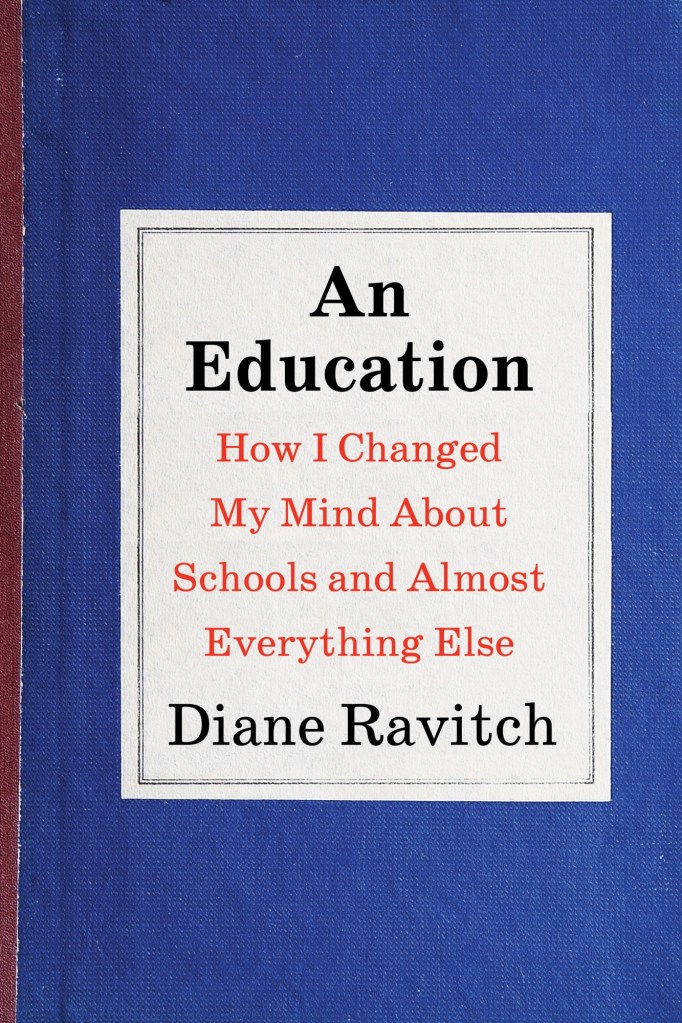
I was interviewed by Brian Lehrer of WNYC, public radio about my latest book, probably my last. He is a great interviewer. He asks good questions, followed by people who called in to disagree with me.

It’s an excellent interview.

I apologize if I’m browbeating you with stuff about my book, but the book is really good; I worked on it for two years; the mainstream media has ignored it; and I think you will enjoy reading it.

In case you haven’t noticed, the title is:

An Education: How I Changed My Mind About Schools And Almost Everything Else (Columbia University Press). You can buy it from Columbia University Press, your local independent bookstore, or Amazon.

Gary Rubinstein is a teacher of mathematics at Stuyvesant High School in NYC and a prominent critic of corporate reform. He started his career as one of the first corps members of Teach for America. After many years inside the reform world, he saw its flaws and became an apostate. Like me. With his superb mathematical skills, he has debunked charter school “miracles,” TFA data, the Tennessee Achievement School District, which did a lot of boasting but failed.

His review is a delight to read.

He writes:

Fifty years after the publication of her first book, ‘The Great School Wars’, author and historian Diane Ravitch has released her long awaited memoirs.  In ‘An Education: How I Changed My Mind About Schools and Almost Everything Else’ Ravitch takes us through her life from her childhood in Houston through the ups and downs of a long and productive life driven by truth and integrity.

What makes this book a ‘must read’ is that it has the three elements that a great autobiography should.  First, her life story is interesting on an objective level.  Anyone picking up the book and reading over the book jacket will know that Ravtich is someone who achieved fame and notoriety through the unlikely passion of the history of Education in America.  But in this book we learn about the sorrow she had to endure between her great triumphs.  So her story, even if it weren’t so well written, would make a very good book.  A second component of a great autobiography is the author’s ability to reflect on 80 plus years of life and find the pivotal moments that changed the course of her life.  But for an autobiography to be ‘great’ it must be infused and brought to life with excellent precise writing.  As ‘An Education’ has all three aspects, this is a book you are going to want to read and then keep to re-read over the years when you are in need of inspiration.

If you have read any of Ravitch’s education books, you know that she is a master of absorbing decades of events and processing them and creating an insightful, and incredibly efficient, thesis which she develops over the course of a book.  As she explains in this book, she learned her craft while writing as a journalist for The Wellesley News and then for The New Leader magazine.  In all her books she exhibits this efficient technique that would make Strunk and White beam.  But, by design, Ravtich’s books on Education are stripped of emotional language.  Those books educate you through a series of well chosen facts that lead you to understand the implications and big moments without having to spell out every detail.  The big question, which this new book answers with an emphatic ‘Yes’ is whether or not her kind of writing can be used to evoke the joy and the sorrow she experienced through her full 87 years of living.

When I started reading this book, I would bookmark interesting passages that show her talent for memoir.  Eventually I realized that I was bookmarking almost every page.  So after the first 50 of so pages, I had to slow down on the bookmarking.  Here are some of my favorite moments (I will try not to give away too much).

Since Ravitch can write a full tale in the span of five or six lines, there are so many interesting stories in this book.  As a writer she reminds me of one of those painters, I don’t know so much about painting to know what this is called – maybe impressionistic? – who, rather than producing a full photographic quality image, instead just does the minimal with the paint and brush to convey the emotion and ideas.  This is something that is very difficult to do yet she makes it look easy.

A few pages later, Ravitch relays an amusing story about how as a teen she found a pearl in an oyster and ended up in the newspaper for it and also got food poisoning from eating the oyster:  “The next day, after the newspaper appeared with a  photograph of me in short shorts, identified by name, strange men began calling the house, asking for me and saying impudent things.  That went on for days, along with the vomiting.  My mother was not amused.”  This is so efficient, not a word wasted and it does convey the absurdity and the humor with a minimal delivery reminiscent of maybe Bob Newhart.

Here’s one I liked:  “The only Sunday school teacher I remember was a strapping guy who discussed Bible stories and the Jewish religion with us.  He told us that when he was our age he had run away with the circus.”  Ah, see how great this is?  In the first sentence she sets up the scene.  And then in just a few words tells us the perfect thing to understand this guy.  No more is needed and no more is said.

Throughout the book, Ravitch takes stories and moments that could easily fill several pages and finds a way to convey them in a few words.  For the reader, this has the effect of injecting all the humor and sometimes the sorrow of these moments directly into our brains without it having to be processed and translated in our minds.

Though these two examples are fun and convey the innocence of childhood, Ravitch is similarly terse in her telling of some of the deepest tragic moments of her life.  When these happen in the book, the descriptions are so efficiently written that, like sometimes when bad things happen in life unexpectedly, we find ourselves pausing and wondering if that really just happened.  The matter of fact telling of memorable moments of life, both big and small, happy and tragic, has a powerful effect on the reader.

The book really gets rolling when Ravitch enters college in 1956 at Wellesley.  In one sense she is a fish out of water and then she eventually completely at home with the lifelong friends she made there.  This was a really fun chapter to read as Ravitch has the first of her many brushes with fame, like her friend Maddy – eventually Madeleine Albright.  Just as always, Ravitch perfectly sets up the matter of fact description of her friend’s background and then, in an instant it is revealed who she became known as. The Madeleine Albright story was less than one page long.

One of my favorite parts was the description about a satirical musical Ravitch and her friends wrote for the Wellesley Junior Show.  It was hilarious.  I kind of want to see the full script but her description of it, as all her descriptions, gave us just enough that we feel like we saw the whole show but forgot some of the missing details.

After college, Ravitch starts domestic life but isn’t quite content.  She then goes on a lifelong quest for love and for purpose.  As she goes through different eras in her life, she meets a new cast of colorful characters, some famous, some not, but always relevant to her story.

In this book we learn how she went from being the wife of an influential New York City figure to the influential Dr. Ravitch the Education guru of this country.  As she rises in the ranks, she finds herself in the company of so many famous people — even several presidents, yet she conveys in her telling of these encounters that, to her, it wasn’t such a big deal.  They are all just people.  Anyone who has gotten the chance to meet her in person and see her interact with so many people who are not famous will see that she treats non famous people like they are special and is always asking them questions rather than talking about herself.

One of the funniest anecdotes in the book is when she inadvertently got Isaac Asimov angry with her over small talk related to word processors.  Again, this is only a few lines, but another interesting adventure in Ravitch’s full life that put her often in the room with all kinds of famous people.

While married to her husband, Diane unexpectedly meets her soulmate who happens to be a woman. In the chapter about the genesis and growth of her relationship, they have now been together for almost 40 years, she is able to convey what it means to finally experience the joy of true love.

In the last chapters of the book we learn about the Washington years in the Department of Education and how that came about and what she tried to accomplish there.  We also learn about what it took to renounce much of her work and to follow the evidence into a more evolved system of beliefs about what can improve education in this country.  She lost a lot of friends and titles in the process but she kept her personal integrity and commitment to the truth.

Throughout the book, the theme is that Ravitch is never just one thing or the other.  Is she a education conservative or an education liberal?  Is she straight or gay?  Is she a southerner or a north easterner?  Is she an introvert or an extrovert?  Is she a socialite or a homebody?  And throughout her life she is sometimes one and sometimes the other.  She is someone who defies categorization.  And though in the subtitle she says she ‘changed her mind about schools and almost everything else’ she never changed her core belief that you don’t just stay in the same place just because you are comfortable there.

And like with her, this book is a lot of different things.  On one level it is an amusing and interesting read about someone whose choices led her on an unlikely adventure ending with her being, in some circles, a huge celebrity.  But it is also an inspirational tale of how having values and staying true to them can help you overcome some of the unfortunate obstacles you have to deal with in life.  And though I doubt it was intended to accomplish something else, I think that for many readers they will want to write down their own memoirs after reading this.  Ravitch makes it look so easy to analyze your life, find the key moments in it and write some succinct prose – though of course it isn’t so easy but still a worthwhile task.

After finishing this book, I had an experience that only a few people were also able to have.  In the acknowledgements in the ‘friends’ section, among sixteen other names, there was my own.  I got a chill seeing this, never expecting it.  But this made me think something else, also a lesson, though maybe unintended from this great book.  This book reminds us of the importance of relationships.  Everyone you know has a story to tell.  Some people’s lives may not have the highs and lows of Diane Ravitch’s but for each person, their joys and sorrows are meaningful to them.  And even if they don’t have the capability to write the way Ravitch can, if they could, you might find yourselves in the acknowledgement page for that friend or family member.  So enjoy the relationships you have while you can and remember that you are an important person in many people’s lives.

So pick up a copy today and take a ride through the ups and downs of a well lived life.  Though she has made a career of writing about education and teaching, through this book she educates and teaches us that if you keep an open mind and are committed to learning and following the facts, you might end up in a comfortable home a long way from where you started.

For the past few months, the U.S. Navy has been blowing up small speed boats in the Caribbean and even in the Pacific. The orders to do this come from the President and the Secretary of Defense. They say they are blowing up boats that are transporting drugs to the U.S. They must do this, say Trump and Hegseth, to protect the American people from the scourge of drugs. They say the boats originate in Venezuela, and Trump has threatened to bomb that country.

How do they know that the boats they destroy are carrying drugs? How do they know that the 80 or so people they killed are drug runners? Where’s the evidence? They won’t say.

An even bigger controversy arose when The Washington Post reported that the first boat to be blown up required two separate strikes, because after the smoke cleared, it was apparent that two men survived the explosion and were clinging to the remains of the smouldering boat. According to the Post, Hegseth had give oral orders to “kill them all.” So the planes came back and killed the two survivors.

The story appalled members of both parties. Trump said he knew nothing about it, Hegseth said the Admiral in charge gave the order, and Hegseth called him a hero.

Congressional hearings might get to the truth. Will the Admiral admit to a war crime to save Hegseth’s skin? According to the laws of war, killing a defenseless survivor who poses no threat is a war crime.

Watch Adam Kinzinger, a military veteran and former member of Congress, explain why this action was a heinous war crime.

Trump’s press secretary Karoline Leavitt defended the second strike because the President is determined to keep drugs out of the U.S.

But by an unfortunate coincidence, the news about the second strike coincided with Trump’s decision to pardon Juan Orlando Hernandez, the former President of Honduras, who had been sentenced to 45 years in prison for his role in bringing 500 tons of cocaine into the U.S. Trump said he was a victim of Biden’s overzealous and unfair prosecution.

But here is how The New York Times described him, in a story written by Santul NerkarAnnie Correal and .

He once boasted that he would “stuff the drugs up the gringos’ noses.” He accepted a $1 million bribe from El Chapo to allow cocaine shipments to pass through Honduras. A man was killed in prison to protect him.

At the federal trial of Juan Orlando Hernández in New York, testimony and evidence showed how the former president maintained Honduras as a bastion of the global drug trade. He orchestrated a vast trafficking conspiracy that prosecutors said raked in millions for cartels while keeping Honduras one of Central America’s poorest, most violent and most corrupt countries.

Last year, Mr. Hernández was convicted on drug trafficking and weapons charges and sentenced to 45 years in prison. It was one of the most sweeping drug-trafficking cases to come before a U.S. court since the trial of the Panamanian strongman Gen. Manuel Noriega three decades before.

Last year, Mr. Hernández was convicted on drug trafficking and weapons charges and sentenced to 45 years in prison. It was one of the most sweeping drug-trafficking cases to come before a U.S. court since the trial of the Panamanian strongman Gen. Manuel Noriega three decades before.

But on Friday, President Trump announced that he would pardon Mr. Hernandez, 57, who he said was a victim of political persecution, though Mr. Trump offered no evidence to support that claim. It would be a head-spinning resolution to a case that for prosecutors was a pinnacle, striking at the heart of a narcostate.

But on Friday, President Trump announced that he would pardon Mr. Hernandez, 57, who he said was a victim of political persecution, though Mr. Trump offered no evidence to support that claim. It would be a head-spinning resolution to a case that for prosecutors was a pinnacle, striking at the heart of a narcostate.

Prosecutors said Mr. Hernández was key to a scheme that lasted more than 20 years and brought more than 500 tons of cocaine into the United States.

What’s the logic? Kill the drug runners who, if they are drug runners, are paid $500 a day. Let the kingpin go free.

Trump is not serious about stopping the flow of drugs into the U.S.

Dr. Edward Johnson is a brilliant systems analyst in Atlanta. He has been a close observer of the Atlanta public schools and their misgovernment as the Board of Education has latched onto the latest reform fad.

He points out that the public school system of the past no longer exists. Some people think that’s a food thing. He does not.

He wrote this observation.

By leading with his “One District …” slogan, and with Atlanta Board of Education meekly following along, APS Superintendent Dr. Johnson contends it is in the best interests of APS to be fragmented, to lack full transparency, to lack efficient and effective accountability, and to disparage the democratic principle that public education should be a public good.


In Georgia, we often hear the terms “school district” and “school system” used interchangeably.


But in the age of charter schools, this linguistic shortcut obscures a deeper truth: the public school system as a public good is no longer a unified system at all.


Before the proliferation of charter schools, an entity like Atlanta Public Schools (APS) governed all public-serving schools within its geographic boundaries.  The terms “APS district” and “APS system” used interchangeably made sense—each described the same coherent, interrelated network of schools sharing the same governance, policy, administration, and purpose.  Today, that coherence does not exist—it has been fragmented.


For example, by choice of Atlanta Board of Education, APS is now a “Charter System,” operating under a performance contract with the state that explicitly excludes independent charter schools.  These schools, though publicly funded, are governed separately and are not subject to APS’s policies, leadership, administration, or community-based governance structures.  They are public in funding, but private in autonomy.


This shift has compressed the expanse of APS as a public school system and as a public good.  APS no longer encompasses all public-serving schools in Atlanta.  And yet, we continue to refer to APS as both a “district” and a “system,” as if nothing has changed.  Well, something has changed.


A system, by definition, implies interrelated parts.  For public school systems, it implies shared accountability, common purpose, and public stewardship.  When schools within a geographic area operate independently—without shared governance or policy—they are not part of the same system.  They may be public-serving, but they are not part of the public school system.


This distinction matters. It matters for transparency, for accountability, and for the democratic principle that public education should be a public good—not a fragmented marketplace of loosely affiliated or wholly independent entities.


Yet, by going along with APS Superintendent Dr. Bryan Johnson’s “One District, with One Goal, for All Students,” board members violate the Oath of Office each of them swore—”In all things pertaining to my said office, I will be governed by the public good and the interests of said [APS] school system.”


By leading with his “One District …” slogan, and with Atlanta Board of Education meekly following along, APS Superintendent Dr. Johnson contends it is in the best interests of APS to be fragmented, to lack full transparency, to lack efficient and effective accountability, and to disparage the democratic principle that public education should be a public good.


Certainly, clearly, it is reasonable to recognize it is not in APS’s best interests that Dr. Bryan Johnson should be its Superintendent.


The Superintendent’s Comprehensive Long Range Facilities Master Plan, given the glossy name APS Forward 2040, Reshaping the Future of Education, will, short-range, compress the expanse of APS even more so, from its current 68 percent being a public school system to about 60 percent.


Then, compounding that long-range, the Superintendent’s Strategic Plan will efficiently and effectively turn APS into a workforce development entity to the exclusion of virtually all possibilities of APS ever becoming a high-quality public school system, where high-quality teaching and learning that readies children for professions and careers from A to Z happens, especially for “Black” children.


Georgia’s legal framework treats each local- and state-authorized charter school as its own “school system.” This semantic sleight of hand allows policymakers to claim that public education is expanding, even as its coherence erodes. But the public deserves clarity. We must stop conflating geographic proximity with systemic unity.


If we are to preserve the integrity of public education, we must reclaim the meaning of “system.” A public school system should be more than a collection of facilities—it should be a community of schools, governed together, accountable together, and committed together to the public good.


Ed Johnson

Advocate for Quality in Public Education

Atlanta GA | (404) 505-8176 | edwjohnson@aol.com


Tom Ultican had a successful career in the private sector when he made a decision that changed his life: He became a teacher of physics and advanced mathematics in California. After he retired, he became blogging about education. He became one of the most perceptive investigators of the powerful people and dark money behind the organized attacks on public schools.

I am delighted to present his review of my just-published memoir, titled AN EDUCATION: HOW I CHANGED MY MIND ABOUT SCHOOLS AND ALMOST EVERYTHING ELSE (Columbia University Press).

I am posting a portion of his review here. I encourage you to open the link and finish his fine commentary.

He wrote:

An Education; How I Changed My Mind About Schools and Almost Everything Else, is highly recommended especially for the thousands of us who consider her a friend. Diane is a very generous person with both her time and resources. I first met Diane through her blog in 2014, then in person at the 2015 NPE conference in Chicago. It was in this time period that she started posting some of my articles on her blog while simultaneously informing me about who was working to destroy public education. At the time, I did not realize what a privilege this was. Her latest book is an intimate memoir that introduces us to Diane Rose Silverstein of Houston, Texas born July 1, 1938. It tells the story of a Jewish Texan from of large struggling family becoming politically influential and a national treasure.

On a page following the dedication page, she quotes Ralph Waldo Emerson:

“Foolish consistency is the hobgoblin of little minds, adored by little statesmen and philosophers and devines.”

I knew that Diane had made a big change and reversed herself on test based accountability and other school reform agendas driven by conservatives and neoliberals. However, the courage this change took and the depth of her reversal were profoundly illuminated by reading this book.

Although growing up in a Roosevelt supporting family and being a registered Democrat, she became deeply conservative. Diane served on the board of the Thomas B. Fordham foundation, contributed to the Manhattan Institute and was a member of the Koret Task Force with the likes of Eric Hanushek and E. D. Hirsch Jr. Her best friends personally and politically all supported the ideas she abandoned. By reversing herself, she walked away from professional security and long held personal friendships. It was courageously principled but must have been a personally daunting move.

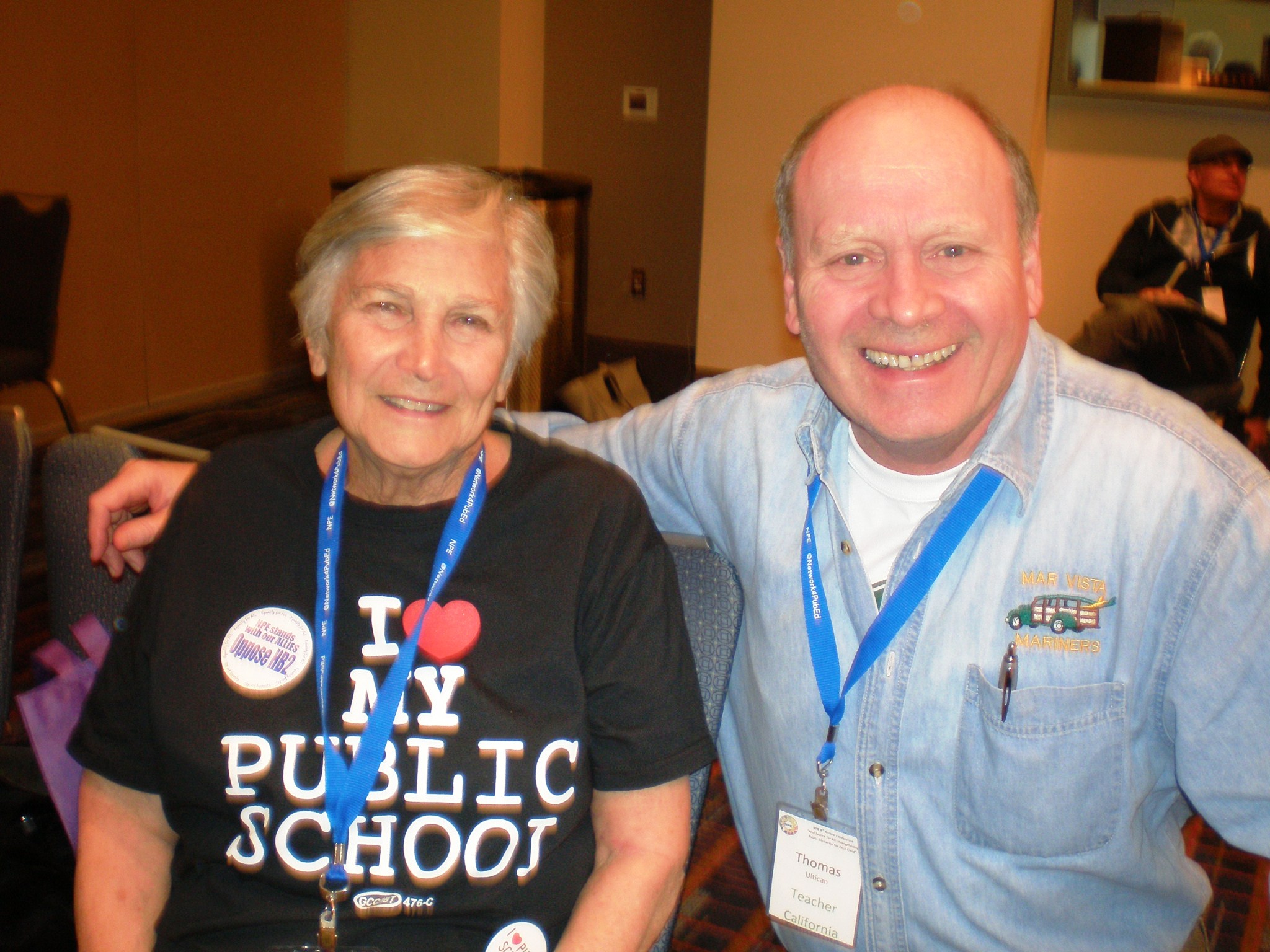
Me and Diane

The best part of “An Education” for me was Diane’s recounting growing up in Houston and going to a segregated public school. Her experience was just so relatable. She liked all the music my oldest sister liked. Cheating was rampant in her school just like mine and like her; I let my classmates copy my work. My rural Idaho school was kind of segregated but that was because only white people and a few Mexican families lived in the community. The Mexican kids were very popular in our school. I never met a Black person until I was a senior in high school and had only seen a few through a car window when vacationing in Kansas City. It was wonderful to find some commonalities.

I had studied engineering, worked in Silicon Valley and pretty much ignored education. But I did hear from Diane and her friends about what a failure public education had become. By 1999, I became tired of hearing about people becoming rich off their stock options, working on the next greatest hard drive or dealing with the atrocious San Jose traffic. I decided to return to San Diego and do something to help public education by enlisting in a master of education program at the University of California San Diego (UCSD).

The UCSD program was oriented toward constructivist education which I really liked. I read books by Alfie Kohn and papers by Lisa Delpit and was ready to revolutionize public education. Then I got to my first job at Bell Jr. High School and discovered that the teachers there were well informed pros with lots of experience. By comparison, I was not nearly as competent as most of them.

It was then that I started to see that I had been bamboozled about how bad public schools were and started looking for like minded people. Two books, David Berliner’s and Eugene Glass’s “50 Myths and Lies that Threaten America’s Public Schools” and Diane Ravitch’s “The Death and Life of the Great American School System” were like water for the thirsty. Soon after that, I found Diane’s blog and joined the Network for Public Education (NPE) along with many other public school advocates.

I saw Diane at the 2015 NPE conference in Chicago’s Drake Hotel. It was an absolutely inspiring event with a keynote by the amazing Yong Zhao. Although we started communicating a little by email, I did not meet Diane personally until NPE 2016 in Raleigh, North Carolina. It was there that the Reverend William Barber gave a truly inspiring speech.

Tom Ultican and Diane Ravitch in Raleigh (by Ultican)

Please open the link and keep reading this excellent review!

The New York Times Sunday Magazine published an article titled “America’s Children Are Unwell. Are Schools Part of the Problem?” It was written by staff member Jia Lynn Yang.

I anticipated that the article would be another lament about test scores, of which there have been many recently. But it wasn’t!

Instead, Yang described the explosion of mental health issues among the nation’s children. And she attributed it largely to the unending pressure to compete for ever higher test scores. EXACTLY!

Yang knows that the changes in school are not the only cause of declining mental health. There are many more culprits, including social media and the pressures of contemporary life. And there is also the possibility that children are being misdiagnosed and overdiagnosed. I can’t help but recall a story from 1994 about an elite private school that received a private $2 million grant to screen children for learning disabilities. Overrun by experts, the program “got out of hand.” Nearly half the children were diagnosed with disabilities, and the program was cancelled.

We live in a stressful world. Children are pressured to succeed, to comply, to compete, to win the approval of their peers, to dress the “right” way, to be and do things by which they will be judged by their peers, by their parents, by the world they inhabit. Some children succeed, many don’t.

Schools these days are doing things to children that add to their stress. They have been doing harmful things to children by federal mandate since 2002.

Besieged by expectations, demands, and pressures, many children are breaking. It’s our fault.

She writes:

One of the more bewildering aspects of the already high-stress endeavor of 21st-century American parenting is that at some point your child is likely to be identified with a psychiatric diagnosis of one kind or another. Many exist in a gray zone that previous generations of parents never encountered.

A diagnosis of attention deficit hyperactivity disorder is practically a rite of passage in American boyhood, with nearly one in four 17-year-old boys bearing the diagnosis. The numbers have only gone up, and vertiginously: One million more children were diagnosed with A.D.H.D. in 2022 than in 2016.

The numbers on autism are so shocking that they are worth repeating. In the early 1980s, one in 2,500 children had an autism diagnosis. That figure is now one in 31.

Nearly 32 percent of adolescents have been diagnosed at some point with anxiety; the median age of “onset” is 6 years old. More than one in 10 adolescents have experienced a major depressive disorder, according to some estimates. New categories materialize. There is now oppositional defiant disorder, in addition to pathological demand avoidance…

The experience of school has changed rapidly in recent generations. Starting in the 1980s, a metrics-obsessed regime took over American education and profoundly altered the expectations placed on children, up and down the class ladder. In fact, it has altered the experience of childhood itself.

This era of policymaking has largely ebbed, with disappointing results. Math and reading levels are at their lowest in decades. The rules put in place by both political parties were well-meaning, but in trying to make more children successful, they also circumscribed more tightly who could be served by school at all.

“What’s happening is, instead of saying, ‘We need to fix the schools,’ the message is, ‘We need to fix the kids,’” said Peter Gray, a research professor at Boston College and the author of “Free to Learn: Why Unleashing the Instinct to Play Will Make Our Children Happier, More Self-Reliant, and Better Students for Life….”

Other books have echoed this critique. I think offhand of the book by Pasi Sahlberg and William Doyle: Let the Children Play: How More Play Will Save Our Schools and Help Children Thrive. This is how they summarize their argument:

“Play is how children explore, discover, fail, succeed, socialize, and flourish. It is a fundamental element of the human condition. It’s the key to giving schoolchildren skills they need to succeed–skills like creativity, innovation, teamwork, focus, resilience, expressiveness, empathy, concentration, and executive function. Expert organizations such as the American Academy of Pediatrics, the National Academy of Sciences, and the Centers for Disease Control agree that play and physical activity are critical foundations of childhood, academics, and future skills–yet politicians are destroying play in childhood education and replacing it with standardization, stress, and forcible physical restraint, which are damaging to learning and corrosive to society.”

There is an organization–Defending the Early Years–that fights for the rights of childhood, that tries to keep academic pressures out of the classrooms of very young children.

But who defends the children in grades 1-12? There are groups of parents in almost every state who oppose the pressures of high-stakes testing, oppose the efforts by tech companies to replace actual experiences with machines and technologies, oppose the interference of politicians to standardize teaching.

One group fights off the tech companies that use personal student data to market their products: The Parent Coalition for Studebt Privacy.

Corporate America now looks to the schools as a source of profit. The schools and students need to be protected from rapacious capitalism, which wants to privatize schools for profit and sell products that monetize instruction.

Yang describes the transformation of the school from the 1980s to the present:

School was not always so central to American childhood. In 1950, less than half of all children attended kindergarten. Only about 50 percent graduated from high school, and without much professional penalty. A person spent fewer years of their life in school, and fewer hours in the day furiously trying to learn. However bored a child might become sitting behind a desk, freedom awaited after the final bell rang, with hours after school to play without the direction of adults.

But as the country’s economy shifted from factories and farms to offices, being a student became a more serious matter. The outcome of your life could depend on it.

During an era of global competition, the country’s leaders also began to see school as a potential venue for national glory, or shame. In 1983, a commission created by Ronald Reagan’s secretary of education, Terrel H. Bell, released a dire report on the state of American schools called “A Nation at Risk.” It warned that “if an unfriendly foreign power had attempted to impose on America the mediocre educational performance that exists today, we might well have viewed it as an act of war.”

Over the next decade, Democratic and Republican governors such as Bill Clinton in Arkansas and Lamar Alexander in Tennessee began molding their states’ schools with new standards of testing and accountability. Schools were treated more like publicly traded companies, with test scores as proxies for profits. Before long, schools had public ratings, so ubiquitous they now appear on real estate listings.

The pressure kept rising. By 2001, 30 states had laws that imposed a system of punishments and rewards for schools based on their test scores. The next year, President George W. Bush’s signature education reform law, No Child Left Behind, made the effort national.

With school funding now on the line, there were unmistakable incentives for children to be diagnosed. Starting in the 1990s, students with autism or A.D.H.D. become newly eligible for added support in the classroom. Getting a child treated, potentially with medication, could help an entire classroom achieve higher scores, especially if the child’s behavior was disruptive to others. And in some parts of the country, children with disabilities were not counted toward a school’s overall marks, a carve-out that could boost scores.

The added metrics may well have compelled more children to receive the support they needed. Either way, educational policymaking yielded a change in diagnoses. In states that added new accountability standards, researchers found a clear rise in A.D.H.D. According to one analysis, the rate of A.D.H.D. diagnoses among children ages 8 to 13 in low-income homes went from 10 percent to 15 percent after the arrival of No Child Left Behind.

The impact of the law on autism diagnoses has been less documented. But there is a great deal of overlap among these disorders. Anywhere from 30 to 80 percent of children diagnosed with autism also have A.D.H.D. Experts have also pointed out that the rise in autism has largely taken place on the more subtle end of the spectrum, where psychiatrists expanded the diagnosis. Students with this profile often need educators who can be eminently flexible in their approach, a tough task when an entire classroom has to focus on narrowly mastering certain testable skills.

The demands on performance in higher grades trickled down into younger and younger ages. In 2009, the Obama administration offered greater funding to schools that adopted new national learning standards called the Common Core. These included an emphasis on reading by the end of kindergarten, even though many early childhood experts believe that not all children are developmentally ready to read at that age.

With each new wave of reforms, the tenor of kindergarten changed. Rote lessons in math and reading crept into classrooms, even though experts say young children learn best through play. Researchers discovered that in the span of about a decade, kindergarten had suddenly become more like first grade.

Preschool was not far behind, as even toddlers were expected to stay still for longer stretches of time to imbibe academic lessons. This again defied the consensus among early childhood experts. Children, parents and teachers struggle through this mismatch daily. In 2005, a study showed that preschoolers were frequently being expelled for misbehavior, and at rates more than three times that of school-age children.

“We’re not aligning the developmental needs of kids with the policies and practices that go on daily with schools,” said Denise Pope, senior lecturer at Stanford University and co-founder of Challenge Success, a nonprofit group that works with schools to improve student well-being.

The pressure to learn more led to a restructuring of the school day itself. Before the 1980s, American children usually had recess breaks throughout the day. By 2016, only eight states required daily recess in elementary schools. And when researchers studied what had become of lunchtime, they learned that children often had just 20 minutes to not only eat but stop to use the bathroom after class, walk to the cafeteria and wait in line for food.

I think about my own time in the public elementary public schools in Houston. We had recess every day. I don’t think it was a matter of state law. Educators then knew that children needed time to play. It was common sense. Today, parent groups organize to persuade legislatures to mandate recess. If they don’t, parents fear, every minute will be spent preparing for tests and taking tests.

They are right. The so-called “reforms” of the past quarter century–No Child Left Behind, high-stakes testing, competition, Race to the Top, punishing or rewarding teachers for their students’ test scores, closing schools and firing staff because of low test scores, the Common Core standards–have made test scores and standardization the heart of schooling.

In a continuing campaign to raise test scores, there are winners and losers. Typically, the winners are children from affluent families, and the losers are the children of not-affluent families. The winners are celebrated, the losers are stigmatized. The social class divide among children is hardened by these practices.

Worse, the pressure on students has caused an increase in anxiety, depression, and boredom. In response, parents seek diagnoses of autism or some other learning disorder so that their children will get more time or attention.

Some parents blame the public schools for the pressure and competition imposed on them by elected officials. They seek alternatives to the public schools, which are obsessed with standardization, testing, and accountability.

Yang points out:

This discontent helps empower the conservative effort to defund the public school system and let parents pick their own schools, with taxpayers covering the tuition. Each child who no longer seems to fit into the country’s education system — and more often than not they are boys — potentially expands the constituency for these ideas. And trust erodes further in the progressive project of a democracy built on giving everyone a free and equal education.

The Democratic Party is unable or unwilling to see the problems they helped create. The Republican Party is quite happy to see the public search for alternatives like charter schools and vouchers, and it has enabled the movement to have taxpayers foot the bill for private and religious schools.

By turning childhood into a thing that can be measured, adults have managed to impose their greatest fears of failure onto the youngest among us. Each child who strays from our standards becomes a potential medical mystery to be solved, with more tests to take, more metrics to assess. The only thing that seems to consistently evade the detectives is the world around that child — the one made by the grown-ups.

Who made that world? Both political parties. Governors. Legislatures. Think tanks. The wealthiest, who believe their financial success proves their superiority. Editorial boards.

Here is the most significant lesson that our elected officials refuse to learn. Their elaborate schemes for testing and measuring children have hurt children and undermined the joy of learning. They have raised the anxiety level of children while corrupting education itself.

Education is not what gets measured on standardized tests. Education is exploration, investigation, insight, observation, wanting to know more, learning to love learning.

Our politicians, prodded by so-called “reformers,” have managed to pollute education while demoralizing teachers and destroying public commitment to public schools.

Our public schools need to be freed from the failed ideas that hurt children. We need a rebirth of sturdy ideas that
Since the day after Thanksgiving is usually a quiet day with not much to do, it seemed like a good day to share this film. It was made in 1991. But it was never released because Donald Trump threatened to sue anyone who showed it. It is titled: “Trump: What’s the Deal?

Rebecca Redelmeier writes in Chalkbeat about passage of a new law in Pennsylvania mandating the use of “evidence-based” reading instruction. By that, they mean that teachers should teach reading by relying on what is called “the science of reading.” This terminology is based on a federal report that was released to the public in 2000, affirming the importance of phonics, the connections of letters and sounds.

The Department of Education spent $6 billion testing the “science of reading” recommendations. The program–Reading First–was abandoned after investigations found conflicts of interest and self-dealing among Department staff who awarded contracts.

When Reading First was evaluated, the results were unimpressive. Students did well in phonics but comprehension levels were unchanged.

Now states are mandating the same approaches that were tested 25 years ago.

Redelmeier wrote:

Pennsylvania will require schools to adopt evidence-based reading curriculum by the 2027-28 school year and institute new literacy instruction training for teachers.

The new requirements come as part of the state’s 2025-26 budget, which Gov. Josh Shapiro signed into law Wednesday, four months past the budget deadline. Literacy instruction and initiatives will get $10 million in the budget. The $50.1 billion budget deal puts $665 million total towards public schools. 

Moments before signing the bill, Shapiro said the budget invests in “something known as structured literacy,” referring to an approach to reading instruction that includes teaching students phonics and phonemic awareness, which research supports as effective.

The approach “puts a renewed emphasis on teaching [kids] to read well and training our teachers to teach reading effectively,” Shapiro said.

Last year, national test scores showed only about 1 in 3 Pennsylvania fourth graders could read at a proficient level. 

Some Pennsylvania school districts previously used reading curriculums that did not follow research-backed methods. In Philadelphia, the school district implemented an evidence-based curriculum last school year. But the rollout has been rocky. Students’ reading scores dippedafter the first year.

The curriculum mandate brings Pennsylvania up to speed with several other states that have passed laws that require literacy instruction to follow the science of reading, a body of research that has found young children need phonics instruction to learn how to read well.

Jan Resseger is a determined and purposeful writer.

On Tuesday, Part 1 of this post explored the Trump Administration’s seizure of the Congressional “power of the purse” as part of a strategy to accomplish the President’s goal of shutting down the U.S. Department of Education by firing hundreds of the Department’s staff who administer and oversee enormous grant programs like Title I and special education programs funded by the 1975 Individuals with Disabilities Education Act, along with many other essential programs that protect students’ rights and fulfill the Department’s mission of ensuring that children across all the states can equitably have a quality public school education. Part 1 also examined how the U.S. Supreme Court has shunted many of the legal challenges filed against Trump administration onto a “shadow docket” of temporary decisions with a long wait for a hearing on their merits and a final ruling by the Supreme Court on their legality.

Today, Part 2 will examine three primary examples of what appear to be the Trump administration’s shameless violation of the core Constitutional principles we have long valued for protecting the rights of children and their teachers in our nation’s system of K-12 public schools.

The First Amendment Protection of Freedom of Speech — Beginning in February and continuing through the year, the Trump administration has been pressuring colleges and universities and K-12 public schools to adopt its own interpretation of the Civil Rights Act of 1964 and the administration’s idiosyncratic interpretation of a 2023 Supreme Court decision in Students for Fair Admissions v. Harvard. While most experts believe that Students for Fair Admissions was a narrowly tailored decision to eliminate affirmative in college admissions, the Trump administration has alleged it also bans all “diversity, equity, and inclusion” programming and policy in K-12 public schools and in higher education.

In August, the NY Times Dana Goldstein ideology the Trump administration has been trying to impose on educational institutions and teachers: “While there is no single definition of D.E.I., the Trump administration has indicated that it considers many common K-12 racial equity efforts to fall under the category and to be illegal. Those include directing tutoring toward struggling students of specific races, such as Black boys; teaching lessons on concepts such as white privilege; and trying to recruit a more racially diverse set of teachers. The administration has also warned colleges that they may not establish scholarship programs or prizes that are intended for students of specific races, or require students to participate in ‘racially charged’ orientation programs… The administration has also argued that because the Supreme Court overturned affirmative action in college admissions in 2023, all racially conscious education programs are illegal.”

Can the Trump administration impose its ideology on educational institutions and get teachers punished or fired if they cover unpleasant parts of our nation’s history? Many experts call this a violation of the First Amendment’s protection of free speech. To define how the First Amendment protects the freedom of speech in educational institutions, Yale Law School professor Justin Driver quotes the words of Supreme Court Justice Robert Jackson in the 1943 Supreme Court decision in West Virginia State Board of Education v. Barnette: “If there is any fixed star in our constitutional constellation, it is that no official, high or petty, can prescribe what shall be orthodox in politics, nationalism, religion, or any other matters of opinion or force citizens to confess by word or act their faith therein.” (Justin Driver, The Schoolhouse Gate, pp. 65-66)

The Vagueness Doctrine — In addition to the violation of the right to freedom of speech, there is another serious legal problem in the Trump administration’s efforts to scrub “diversity, equity, and inclusion” from K-12 public schools and from the policies of the nation’s universities.  Writing for the NY TimesMatthew Purdy explored how the Trump administration’s vague rules, mandates and executive orders are designed to frighten people into complying:

“Federal District Court judges across the country and across the political spectrum…  (have faulted) the administration for using broadly cast executive orders and policies to justify ‘arbitrary and capricious’ actions. Many of these judges have explicitly invoked something called the vagueness doctrine, a concept that for centuries has been foundational to American law. The notion is simple: Unless laws are clearly stated, citizens cannot know precisely what is and is not permitted, handing authorities the power to arbitrarily decide who is in violation of a law or rule. Vagueness has long been seen as a clear divide between democracies run by laws and autocracies run by strongmen….”

The Cornell Law School Legal Information Institute explains how the vagueness doctrine protects due process of law: “Vagueness doctrine rests on the due process clauses of the Fifth and Fourteenth Amendments of the U.S. Constitution. The Supreme Court stated in Winters v New York, that U.S. citizens should not have to speculate the meaning of a law due to its vagueness, the law should be clear on its face.”

Purdy adds that many of Trump’s educational executive orders and the rules being imposed by Linda McMahon’s Department of Education ought to be declared void for vagueness. Without being sure  precisely what steps are required, universities have settled with the administration by making financial deals to protect their research funding; public school administrators have changed bathroom policies for trans students; and teachers have felt afraid to teach honestly about our nation’s history.  Purdy describes “Valerie Wolfson, the 2024 New Hampshire history teacher of the year… whose post-Civil War curriculum includes Reconstruction, the rise of the K.K.K. and the Jim Crow era. ‘I do not know how I could discuss them without creating a risk of being accused of presenting a narrative of the United States as racist,’ she says… None of Donald Trump’s edicts have deployed vagueness as effectively as his attack on D.E.I. …   The line between what is and isn’t allowed may be vague, but the penalty for crossing it is certain. The version cooked up by the Department of Education’s Office for Civil Rights is a textbook case…  The message—and the threat—from the Department of Education was received loud and clear across the country.” (This blog covered Purdy’s article in more detail.)

Birthright Citizenship — One of President Trump’s executive orders stands out in its utter contradiction of the language of the Fourteenth Amendment. In an executive order last January, the President ended birthright citizenship. Birthright citizenship does not, thank goodness, deny any child’s right to public education because a 1982 Supreme Court decision in Plyler v. Doe does protect the right for every child residing in the United States to a free public education.  However without the protection of birthright citizenship, children in this country are denied the protection of virtually all other rights.

In February a Federal District Court judge temporarily stayed Trump’s executive order banning birthright citizenship; the case was appealed; and later on June 27, the U.S. Supreme Court released a final decision. However the Supreme Court Justices twisted the meaning of the case without addressing the core issue of birthright citizenship itself. Instead the justices turned the decision into a ruling on procedure—declaring that local Federal District Courts cannot block the imposition of federal policy nationwide.

For Scotus Blog, Amy Howe explains how today’s Supreme Court abrogated its responsibility by ignoring the core issue in the birthright citizenship case: “(O)n July 23, a divided panel of the U.S. Court of Appeals for the 9th Circuit (had) ruled that the executive order ‘is invalid because it contradicts the plain language of the Fourteenth Amendment’s grant of citizenship to ‘all persons born in the United States and subject to the jurisdiction thereof ‘.”

Responding to the decision of the appeals court, U.S. Solicitor General D. John Sauer failed to ask the justices to fast-track its petition, urging the Supreme Court to review the ruling. Howe adds: “Although Sauer had the option to ask the court to fast-track its petition, he chose not to.  Accordingly, if the justices decide to take the case… it will likely schedule oral arguments for sometime in 2026 and reach a decision at the end of the… term—most likely in late June or early July.”

All three of these serious Constitutional principles remain at issue today in Trump’s attempt to deny the rights of educators and undermine the protection of students’ rights.

Disciplining ourselves to name and and understand what appear to be troubling legal violations by the Trump  administration is an important step toward building the political will for reform.