Archives for category: Education Industry

Last year, Nancy Bailey and I co-authored a glossary of words, terms, and the names of organizations in education today. It is called Edspeak and Doubletalk: A Glossary to Decipher Hypocrisy and Save Public Schooling. Truly, folks, you can’t tell the players without a scorecard, and this book is the scorecard for education policy today.

Nancy has a great eye for how language is used to deceive, and in this post, she warns educators to beware of the infiltration of business language into education. When those terms are used, she says, there is an effort underway to turn parents into customers and promote privatization.

Beware when your superintendent is called a “CEO” instead of a school superintendent. In some districts, the switch covers up the superintendent’s lack of proper education credentials.

Beware “alignment,” which is an effort to standardize curriculum, instruction and testing, and to squelch teacher creativity and autonomy.

Beware “benchmarks” and “data-driven” anything, which fit widgets but not students.

Beware the use of “customers” instead of “parents”:

With privatization, parents are customers who choose the school they want because the school is a business.

When communities are devoted to their public schools, they follow and attend Friday night football games. They attend class plays and cheer for student accomplishments. They visit student art fairs and help with school fundraisers. Public schools can be a source of pride for the community.

Parents and those in the community never used to be called customers because they had ownership of the schools. The schools belonged to them.

Open the link and see many other examples of business language that does not belong in the lexicon of educators.

Parents in Texas got disgusted 15 years ago when the Legislature almost passed a voucher law. They organized the Texas Parent PAC, which is a highly effective voice on behalf of public schools and more than five million students.

The website of Texas Parent PAC has a list of the endorsed candidates, both Democrats and Republicans.

Their guiding principles are a model for parents, grandparents, and civic activists in other states.

I recently heard from Dinah Miller, co-founder and co-chair, who explained the PAC’s origins. She wrote:

Texas Parent PAC formed in 2005 after taxpayer-funded private school vouchers failed to pass the Texas House by only one vote. Five PTA moms called a press conference during PTA Summer Seminar in Austin and announced we were forming a political action committee to elect better talent to the Texas House who would oppose vouchers and support public schools. We recruited Diane Patrick from Arlington who had local and state school board experience to run against hostile Texas House Public Education Committee Chair Kent Grusendorf who had been in office 20 years. We beat Grusendorf in the primary along with others and then knocked off another hostile education committee member in the general election. Those races put us on the map.

From our website: Texas Parent PAC is a bipartisan political action committee for parents, grandparents, parents-to-be, and anyone who supports high quality public education. The PAC has a track record of success, helping to elect over 63 current members of the Texas Legislature, and defeat 23 incumbents who were hostile to public education.

Endorsed candidates reflect traditional mainstream American values that honor and support children and their families, quality public education, strong communities, unlimited opportunities, and maximum citizen participation in our democracy. All endorsed candidates support the Texas Parent PAC Guiding Principles.

Fifteen years later, our volunteers are still fundraising for our endorsed bipartisan candidates for the November 3, 2020 election. Our website is www.txparentpac.com

Sincerely, Your Fan,

Dinah Miller

Co-chair and Co-founder

Texas Parent PAC


Tom Ultican, retired teacher of physics and advanced mathematics, has been studying the spread of the fake “reform” efforts across the nation (aka the Destroy Public Education Movement).

In this post, he reviews the damage done by authoritarian education “leaders” who have robbed students and teachers of the joy of learning while attacking public schools. He names names.

He begins:

For more than two decades, bureaucratic style top down education “reform” has undermined improvement efforts by professional educators. For budding teachers, beginning in college with the study of education and their own personal experience as students, an innate need to better education develops. However, in the modern era, that teacher energy to improve education has been sapped by the desperate fight to save public education from “reformers,” to protect their profession from amateurs and to defend the children in their classrooms from profiteers. 

Genuine advancements in educational practices come from the classroom. Those edicts emanating from government offices or those lavishly financed and promoted by philanthropies are doomed to failure...

Sadly, every business and government sponsored education innovation for the past 40 years has resulted in harm to American schools. Standardized education, standardized testing, charter schools, school choice, vouchers, reading science, math and reading first, common core, value added measures to assess teachers and schools, mandatory third grade retention, computer based credit recovery, turnaround schools, turnaround districts, and more have been foisted on schools. None of these ideas percolated up from the classroom and all are doing harm.

Laura Chapman, intrepid researcher, writes here about the billionaire and corporate money supporting the rating system for schools called GreatSchools. It clearly exists to promote school choice, not community cohesion or civic responsibility. GreatSchools recently announced that it would use “growth scores” to measure school quality, not just test scores, but the difference is miniscule, and the outcome is the same: to promote segregation and school choice by linking “school quality” and test scores.

Laura Chapman writes:

Great Schools is supported by income from Scholastic, Zillow and other advertisers, who pay for packages that can push up their page views or allow them to license the school ratings. The whole website functions as a tool to perpetuate redlining, charter schools, and advocates forf school choice.

Here are the largest financial pushers of the dubious ratings:

Walton Family Foundation, Laura and John Arnold Foundation, Bloomberg Philanthropies, Carnegie Corporation of New York, Einhorn Family Charitable Trust, Leona M. and Harry B. Helmsley Trust, and Bill and Melinda Gates Foundation.

These big funders are offered a display of their logos. Other supporters are: America Achieves, The Charles Hayden Foundation, Charles and Helen Schwab Foundation, Charles and Lynn Schusterman Family Foundation, David and Lucile Packard Foundation, EdChoice, Heising-Simons Foundation, Innovate Public Schools, The Joyce Foundation, Excellent Schools Detroit, The Kern Family Foundation, The Lynde and Harry Bradley Foundation, The Ralph M. Parsons Foundation, and Startup: Education. These are not supporters of public schools.

This website is designed to market an ideology and a rating scheme. The Terms of use policy says: “Some information contained on the website may represent opinion or judgment… GreatSchools does not guarantee the accuracy or completeness of any information on the website. As such, GreatSchools will not be responsible for any errors, inaccuracies, omissions or deficiencies in the information provided on the website. This information is provided “as is,” with no guarantees of completeness, non-infringement, accuracy or timeliness, and without warranties of any kind, express or implied.”

Great Schools also lists “Partners.” Sad to say, the Great Schools website, designed to steer parents away from most public schools has a partnership with the US Department of Education and the US Department of Housing and Urban Development.

“Community Action Partners” are: Choice Matters Oklahoma, Colorado Succeeds, Community Foundation of Atlanta, Delaware Department of Education, Families Empowered, Innovate Public Schools, The Indianapolis Mayor’s Office, and United Way of Central Indiana.

“Partners for Content” include the Yale Center for Emotional Intelligence featuring Yale’s RULER program, a system of direct instruction in: (a) managing emotions by naming them and (b) thinking out loud about degrees of emotional intensity (energy) and pleasantness. Students learn to Recognize, Understand, Label, and Regulate their emotions at about $7,500 per school team.

The second “Content Partner” (believe it or not) is PARCC Partnership for Assessment of Readiness for College and Career. As of the 2019-2020 school year, these tests were only used in Washington DC, Louisiana, Massachusetts, and New Jersey. New Jersey will stop using these tests in 2020-2021.

“Other Partners” are:
–Be a Learning Hero, offers parents a “roadmap” for school readiness and test prep. Key leaders worked for the Bill and Melinda Gates Foundation.

–Common Sense Media is a marketing website offering parents reviews and lists of kid-suitable videos, books, other media.

–Education Cities is a network promoting school choice in 24 cities in cooperation with 31 city based organizations. The network is funded by the Broad Foundation, Michael and Susan Dell Foundation, Bill and Melinda Gates Foundation, and Walton Family foundation.

–National PTA which claims not “to endorse any commercial product or service.” But also says “Companies making a financial contribution to PTA may be entitled to promotional consideration and, in some cases, may have limited use of PTA’s marks and assets.” Deals for members are offered by PTA’s 18 Corporate Alliances.” The National PTA also markets Common Core resources with outdated claims about these “being fully implemented.”

–Understood is devoted to serving families and children with disabilities. It is funded by15 non-profits, not counting these recent supporters: The New Teacher Center, Relay Graduate School of Education, the Achievement Network, and New Visions for Public schools,.

Great Schools also lists Bellwether Education Partners, the Center for Reinventing Public Education, Thomas B Fordham Institute, and Public Impact as “Partners. All promote charter schools as if these are “public.”

Great Schools generates and leases data to “leading real estate, technology and media websites.” Great Schools claims to be “the nation’s leading source of school performance information…. with “more than 55 million unique visitors” last year and “over half of American families with school-age children.”

Great Schools is designed to forward three real estate practices associated with parents seeking a school. The first is block busting—a process designed to promote fear among white home owners or prospective buyers that a neighborhood school brings too many low income racial minorities to the community and devalues its real estate. The second is redlining, illegal, but the practice of denying loans or property insurance to applicants based on the racial makeup of a neighborhood, including school demographics. The third and most common is steering, the real estate practice of directing homebuyers to or away from specific neighborhoods and schools based on the prospective homebuyer’s race color, religion, gender (sex), sexual orientation, disability (handicap), familial status, or national origin.

Great Schools rating schemes for “school quality” are a case study in what Cathy O’Neal has called mathematical intimidation. If you are mathematically inclined, see if you can make sense of the rating schemes available here. https://www.greatschools.org/gk/ratings-methodology/

A new reader to the blog posted her own recipe to describe “reform,” which has an unfortunate habit of failing again and again but being revived by Betsy DeVos and/or Bill Gates and the Walton Family:

Sandy Dixon Forrest Recipe for sucking in public tax money and making obscene profits on the backs of public school teachers and students: FINANCE inappropriate “standards” to be implemented by all teachers, REQUIRE the use of products which financially benefit the creator of the “goals,” SMILE as hired “cheerleaders” tout the benefits of the mandated program, BEAM proudly as profits roll into the companies producing the “magic” solution, CRINGE privately at dismal results, REWRITE the “cheerleader” script, AND THEN…drum roll, please.. BLAME the teachers for disappointing results of the non-educators’ (but obscenely wealthy) magic elixir to cure the problems of all public school students. RESULTS?! The sponsors of this hoax made buckets of money! Wave goodbye to the career teachers; TFA folks are cheaper and more (desperate) cooperative anyway. Don’t worry about the kiddos; just give them a double dose of grit. It’s all good…right?


David R. Taylor is a veteran teacher and blogger. He asks the important question of what to expect the consequences to be for public education if Trump is re-elected.

Very likely, it means four more years of Betsy DeVos and her crusade to destroy public education and shower federal money on charter schools, private schools, and religious schools.

Taylor reviews some of her worst actions, such as favoring predatory lenders and favoring for-profit colleges that rip off students. Such as, abandoning the kids who need her most by downplaying civil rights complaints and stripping transgender students of any protections. Such as, trying to starve her own department of funding.

Between the return of DeVos and a voucher-loving majority on the Supreme Court, public schools are in for a rough ride. We can’t change the composition of the Supreme Court (unless there is a genuine effort to expand it and add balance), but we can vote to make sure Betsy goes back to Michigan and her ten yachts.

The National Center for the Study of Privatization in Education at Teachers College, Columbia University, recently released a major study of segregation and charter schools by Dr. Helen Ladd and Muvzana Turaeva of Duke University.

Dr. Samuel Abrams introduced it here.

The issue of school choice and segregation has been central to education policy debates for decades. In his initial argument for vouchers, published in 1955, Milton Friedman conceded that segregationists stood to employ vouchers to enroll their children in all-white private schools instead of public schools mandated to integrate a year earlier by Brown v. Board of Education. But to Friedman, the answer was not regulation but moral suasion. Friedman’s opinion was rendered technically moot in 1976 by Runyon v. McCrary, which barred private schools from making admissions decisions based on race, yet it nevertheless indicated a fundamental problem with systems of school choice.

With the introduction of charter schools in the early 1990s, commentators raised concerns about school location, inadequate transportation, contracts mandating significant parental involvement, and shared parental proclivities as implicit mechanisms or pathways to segregation. In “Parental Preferences for Charter Schools in North Carolina: Implications for Racial Segregation and Isolation,” Helen F. Ladd and Mavzuna Turaeva add substantially to the literature validating these concerns.

Using data for the nearly 11,000 North Carolina families who transferred their children from traditional public schools to charter schools in 2015-16, Ladd and Turaeva document that the migration of white, though not minority, switchers from traditional public schools to charter schools increased segregation. “We find that by switching to charter schools that are whiter than the traditional public schools they leave behind,” they write, “white switchers contribute to racial segregation across schools.” At the elementary level, 67 percent of white switchers enrolled in charter schools with lower shares of minority students; at the middle-school level, 72 percent of white switchers did so.

To buttress their analysis, Ladd and Turaeva employ a conditional logit model to estimate revealed preferences. To infer parental preferences by race as well as socioeconomic status, Ladd and Turaeva use five criteria to define the value of charter schools for parents: racial composition; proximity; academic achievement; availability of transportation and lunch; and mission. Ladd and Turaeva conclude that with these dimensions considered together, it is clear that white parents disproportionately favored white charter schools and exhibited a pronounced aversion to significantly minority charter schools.

With this working paper, Ladd, a professor emerita of public policy and economics at Duke University, and Turaeva, a doctoral candidate in public policy (with a specialization in economics) at Duke as well as a research associate at the Duke Center for Analysis of Longitudinal Data in Education Research, build on research Ladd did with Charles Clotfelter and John Holbein for an article published by Education Finance and Policy in 2017 on growing segregation across the charter sector in North Carolina from 1999 to 2012. In addition, Ladd and Turaeva’s analysis complements a 2019 NCSPE working paper on charter schools in Kansas City by Patrick Denice, Michael DeArmond, and Matthew Carr, who found a disproportionate number of white students transferring from traditional public schools to new charter schools from 2011 to 2015.

Lucid, rigorous, and supported with eight tables of telling data, this study advances our understanding of school choice and raises important questions about how choice systems should be designed.

Samuel E. Abrams
Director, NCSPE

[intro]

The rise of the Religious Right has coincided with the privatization movement in public schools. While some may feel that this is coincidental, there is reason to believe there is a directly causal relationship between these two factors. Two scholars, from different disciplines, will discuss how their work comes together to help explain the history and current state of efforts to diminish, if not dismantle, the American public education system. Katherine Stewart has written on the rise and increasing power of the Religious Right in her book The Power Worshipers. She will be joined by Diane Ravitch who has written extensively on education and, in her recent book Slaying Goliath, explores the history of the school privatization movement and the efforts to oppose it.

Please note, this is an online event held on the video conference platform, Zoom. Registrants will receive an email with links to join the program.

Link to register: https://18308a.blackbaudhosting.com/18308a/Will-Public-Education-Survive-A-Look-at-the-Threats-to-Education-Systems-from-Privatization–Reli

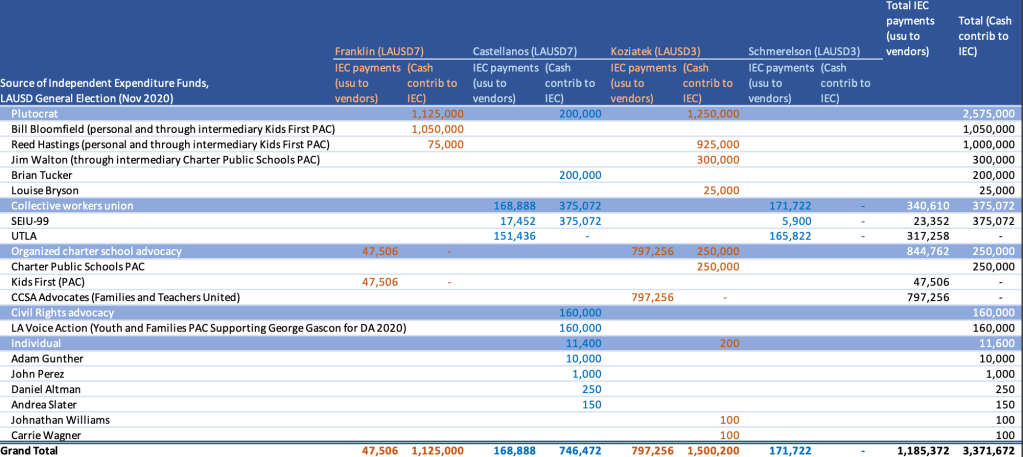
Once again, control of the Los Angeles Unified School Distict school board is up for grabs, and once again the billionaires hope to buy control so they can expand the number of charter schools. The latest financial disclosures show that Reed Hastings of Netflix has contributed $925,000 to try to defeat veteran educator Scott Schmerelson. Billionaire Jim Walton of the Walmart family added another $300,000. The charter lobby is flush with money to buy TV ads and flyers that smear Schmerelson and use vicious anti-Semitic tropes in their attack ads. The charter lobby is angry at Schmerelson for two reasons: 1. He fights fearlessly for the 80% of students in public schools. 2. He released the explosive fact that 80% of Los Angeles’ charter schools have vacancies, not waiting lists. His opponent Marilyn Koziatek has no experience in the public schools; she holds an administrative job in a charter school.

Download the .pdf here.

Note: Sara Roos of Los Angeles (blogger Red Queen in LA) prepared the graph of political expenditures based on public records.

Chalkbeat reports that the rating agency GreatSchools has revised the way it measures school quality. Critics have long complained that its reliance on test scores as the measure of school quality disadvantages schools that enroll children of color and encourages housing segregation by steering white parents to white neighborhoods.

In the future, GreatSchools will rely on test score growth, not just scores alone.

This, of course, puts pressure on teachers and schools to raise test scores. Test scores thus continue to be the single most important criterion of school quality, instead of school climate, experienced teachers, class size, a rich arts program, and other consequential elements.

Matt Barnum writes:

America’s most widely used school rating system is overhauling its approach with a series of changes that will weaken the link between race, poverty, and school scores.

The website GreatSchools is rolling out the changes nationwide Thursday after introducing them for schools in California and Michigan in August. They are part of an effort by the site to make its ratings better reflect how much schools help students learn, rather than things like students’ prior academic achievement and poverty levels that schools don’t control.

“The new system is better because there is more of a focus on learning and growth and what’s actually happening in schools,” GreatSchools CEO Jon Deane said. “We know that’s more important.”

The move comes amid growing scrutiny of GreatSchools’ system of judging schools, including a Chalkbeat investigation that found that its ratings effectively steered families away from schools serving more Black, Hispanic, and low-income students.

GreatSchools says the average school will see only a modest score change. Still, the shifts mean that the tens of millions of people who find the ratings on real estate sites like Zillow will now see a different measure of school quality, potentially affecting enrollment patterns that contribute to school segregation.

Notice how the rating agency conflates test scores with learning. The changes for schools’ rating will indeed be modest because they are still measuring schools by test scores, which are highly correlated with wealth and poverty, special education status, and LEP status.

*sorry about the error in the original headline. I write most posts on my cellphone so I did not see the last words in the heading. My error and my apologies.