Archives for category: Economy

Heather Cox Richardson wrote the following post on May 8 about President Biden’s recent visit to Wisconsin. She compares Biden to FDR. Under Trump, Wisconsin lost jobs. Under Biden, Wisconsin has gained jobs. That’s the heart of the Biden agenda: building a strong middle-class and creating good union jobs.

She writes:

Today, in Racine, Wisconsin, President Joe Biden announced that Microsoft is investing $3.3 billion dollars to build a new data center that will help operate one of the most powerful artificial intelligence systems in the world. It is expected to create 2,300 union construction jobs and employ 2,000 permanent workers. 

Microsoft has also partnered with Gateway Technical College to train and certify 200 students a year to fill new jobs in data and information technology. In addition, Microsoft is working with nearby high schools to train students for future jobs. 

Speaking at Gateway Technical College’s Racine campus, Biden contrasted today’s investment with that made by Trump about the same site in 2018. In that year, Trump went to Wisconsin for the “groundbreaking” of a high-tech campus he claimed would be the “eighth wonder of the world.” 

Under Republican governor Scott Walker, Wisconsin legislators approved a $3 billion subsidy and tax incentive package—ten times larger than any similar previous package in the state—to lure the Taiwan-based Foxconn electronics company. Once built, a new $10 billion campus that would focus on building large liquid-crystal display screens would bring 13,000 jobs to the area, they promised. 

Foxconn built a number of buildings, but the larger plan never materialized, even after taxpayers had been locked into contracts worth hundreds of millions of dollars for upgrading roads, sewer system, electricity, and so on. When voters elected Democrat Tony Evers as governor in 2022, he dropped the tax incentives from $3 billion to $80 million, which depended on the hiring of only 1,454 workers, reflecting the corporation’s current plans. Foxconn dropped its capital investment from $10 billion to $672.8 million.  

In November 2023, Microsoft announced it was buying some of the Foxconn properties in Wisconsin.

Today, Biden noted that rather than bringing jobs to Racine, Trump’s policies meant the city lost 1,000 manufacturing jobs during his term. Wisconsin as a whole lost 83,500. “Racine was once a manufacturing boomtown,” Biden recalled, “all the way through the 1960s, powering companies—invented and manufacturing Windex…portable vacuum cleaners, and so much more, and powered by middle-class jobs.

“And then came trickle-down economics [which] cut taxes for the very wealthy and biggest corporations…. We shipped American jobs overseas because labor was cheaper. We slashed public investment in education and innovation. And the result: We hollowed out the middle class. My predecessor and his administration doubled down on that failed trickle-down economics, along with the [trail] of broken promises.” 

“But that’s not on my watch,” Biden said. “We’re determined to turn it around.” He noted that thanks to the Democrats’ policies, in the past three years, Racine has added nearly 4,000 jobs—hitting a record low unemployment rate—and Wisconsin as a whole has gained 178,000 new jobs. 

The Bipartisan Infrastructure Law, the CHIPS and Science Act, and the Inflation Reduction Act have fueled “a historic boom in rebuilding our roads and bridges, developing and deploying clean energy, [and] revitalizing American manufacturing,” he said. That investment has attracted $866 billion in private-sector investment across the country, creating hundreds of thousands of jobs “building new semiconductor factories, electric vehicles and battery factories…here in America.” 

The Biden administration has been scrupulous about making sure that money from the funds appropriated to rebuild the nation’s infrastructure and manufacturing base has gone to Republican-dominated districts; indeed, Republican-dominated states have gotten the bulk of those investments. “President Biden promised to be the president of all Americans—whether you voted for him or not. And that’s what this agenda is delivering,” White House deputy chief of staff Natalie Quillian told Matt Egan of CNN in February. 

But there is, perhaps, a deeper national strategy behind that investment. Political philosophers studying the rise of authoritarianism note that strongmen rise by appealing to a population that has been dispossessed economically or otherwise. By bringing jobs back to those regions that have lost them over the past several decades and promising “the great comeback story all across…the entire country,” as he did today, Biden is striking at that sense of alienation.

“When folks see a new factory being built here in Wisconsin, people going to work making a really good wage in their hometowns, I hope they feel the pride that I feel,” Biden said. “Pride in their hometowns making a comeback. Pride in knowing we can get big things done in America still.” 

That approach might be gaining traction. Last Friday, when Trump warned the audience of Fox 2 Detroit television that President’s Biden’s policies would cost jobs in Michigan, local host Roop Raj provided a “reality check,” noting that Michigan gained 24,000 jobs between January 2021, when Biden took office, and May 2023.

At Gateway Technical College, Biden thanked Wisconsin governor Tony Evers and Racine mayor Cory Mason, both Democrats, as well as Microsoft president Brad Smith and AFL-CIO president Liz Schuler. 

The picture of Wisconsin state officials working with business and labor leaders, at a public college established in 1911, was an image straight from the Progressive Era, when the state was the birthplace of the so-called Wisconsin Idea. In the earliest years of the twentieth century, when the country reeled under industrial monopolies and labor strikes, Wisconsin governor Robert “Fighting Bob” La Follette and his colleagues advanced the idea that professors, lawmakers, and officials should work together to provide technical expertise to enable the state to mediate a fair relationship between workers and employers. 

In his introduction to the 1912 book explaining the Wisconsin Idea, former president Theodore Roosevelt, a Republican, explained that the Wisconsin Idea turned the ideas of reformers into a workable plan, then set out to put those ideas into practice. Roosevelt approvingly quoted economist Simon Patten, who maintained that the world had adequate resources to feed, clothe, and educate everyone, if only people cared to achieve that end. Quoting Patten, Roosevelt wrote: “The real idealist is a pragmatist and an economist. He demands measurable results and reaches them by means made available by economic efficiency. Only in this way is social progress possible.”

Reformers must be able to envision a better future, Roosevelt wrote, but they must also find a way to turn those ideals into reality. That involved careful study and hard work to develop the machinery to achieve their ends. 

Roosevelt compared people engaged in progressive reform to “that greatest of all democratic reformers, Abraham Lincoln.” Like Lincoln, he wrote, reformers “will be assailed on the one side by the reactionary, and on the other by that type of bubble reformer who is only anxious to go to extremes, and who always gets angry when he is asked what practical results he can show.” “[T]he true reformer,” Roosevelt wrote, “must study hard and work patiently.” 

“It is no easy matter actually to insure, instead of merely talking about, a measurable equality of opportunity for all men,” Roosevelt wrote. “It is no easy matter to make this Republic genuinely an industrial as well as a political democracy. It is no easy matter to secure justice for those who in the past have not received it, and at the same time to see that no injustice is meted out to others in the process. It is no easy matter to keep the balance level and make it evident that we have set our faces like flint against seeing this government turned into either government by a plutocracy, or government by a mob. It is no easy matter to give the public their proper control over corporations and big business, and yet to prevent abuse of that control.”

“All through the Union we need to learn the Wisconsin lesson,” Roosevelt wrote in 1912.

“We’re the United States of America,” President Biden said today, “And there’s nothing beyond our capacity when we work together.”

Go to the post to read her footnotes.

Thom Hartmann is releasing his new book The Hidden History of Monopolies on his blog, one chapter at a time. This one is fascinating. Big business has always opposed labor unions. They drive up wages, meaning less profits.

Thom explains:

When people consider monopolies, or even highly concentrated markets like airlines or pharmaceuticals, generally the only thing they think of is the ability of companies in concentrated markets to set prices wherever they’d like. But there are fully three primary benefits to monopoly or oligopoly, from the monopolists’ point of view.

In addition to setting prices by restricting competition, monopolies can (and typically do) drive down wages so that they end up with a steady supply of cheap labor, and—both by market (selling) control and labor market (workers) control—they send vastly more money flowing to stockholders and senior management than can companies in truly competitive marketplaces.

At its core, though, virtually every aspect of the movement that embraced monopoly (Bork actually wrote about all the “lost” inventions, innovations, and profits that were caused by a lack of monopoly!) boiled down to cheap labor. 

Joe Lyles, writing as Conceptual Guerilla, put up a brilliant analysis of this more than a decade ago titled “Defeat the Right in Three Minutes,” suggesting that quite literally everything we call “conservative” was really about driving down wages. While racial hatred and misogyny also play big roles these days in the “conservative” movement, there’s still a lot of truth to Lyles’s analysis.50

Cheap-labor conservatives don’t want a national health care system, because they want workers to be dependent on their employers and thus willing to accept lower wages.

Cheap-labor conservatives hate the minimum wage and unions because both support wage floors and, over time, raise wages for working people.

Cheap-labor conservatives want women relatively powerless (particularly over their own reproductive functions) so that, as in the era before the 1970s, they’ll work for far less than today’s $.78 to a man’s dollar.

Cheap-labor conservatives go on and on about, as Lyles notes, “morality, virtue, respect for authority, hard work and other ‘values’” so that when workers can’t climb the ladder, society will blame it on the individuals instead of a system rigged to maintain cheap labor.

Cheap-labor conservatives encourage bigotry, fear, and hatred to prevent working people from seeing their commonality of human and economic interests, regardless of race, gender identity, or the urban/rural divide.

America has a long history with the cheap-labor crowd: slavery was the ultimate expression of this “conservative” value system, and under the 13th Amendment, it continues to be legally practiced in the United States in our for-profit prison systems.

The 13th Amendment didn’t actually end slavery in the United States; it merely turned it over to prisons, be they state-run or for-profit corporations. It reads: “Neither slavery nor involuntary servitude, except as a punishment for crime whereof the party shall have been duly convicted, shall exist within the United States.” As a result, the pressure on Congress and state legislatures from for-profit prison corporations to increase criminal penalties to give them more literal slave labor has exploded.

Cheap-labor conservatives, it turns out, are also huge fans of monopoly and oligopoly, in large part because these systems keep wages low. 

There’s a marketplace for labor, just like for everything else, and when a small number of corporations control a large number of employment venues, they can simply keep wages low through that market power. Check out the pay of fast-food workers or flight attendants or nurses back in the 1960s compared with today; every industry that concentrates or consolidates sees wages go down….

Please open the link to finish reading.

Texas is represented by some loathsome public officials (looking at you, Governor Abbott, Lt. Gov. Patrick, and Senator Ted Cruz). They have denounced President Biden in every imaginable way. Yet the Biden administration is sending $16 billion to Texas for clean energy and infrastructure. Texas Republicans voted against the legislation but they will gladly take the dollars and the new jobs. (All the red states are getting funds from Biden’s bills that they opposed, while taking credit for them.) And they will continue to insist that climate change is a hoax.

Chris Tomlinson writes in The Houston Chronicle:

Delivering reliable, affordable and sustainable electricity wouldn’t be difficult if officials in Austin and Washington worked together. The challenges are not technological or economic; they are about setting priorities.

Pablo Vegas, chief executive of the Electric Reliability Council of Texas, promised a new approach to grid planning on Tuesday, promising to better track the growing demand for power from industry.

“We need to accelerate aspects of our planning processes and be able to look further into the future, anticipate what’s coming, because it still takes three to six years to build transmission,” Vegas said.

The Legislature ordered ERCOT to start considering long-term proposals to add load to the grid rather than relying only on finalized plans. The new approach makes demand forecasts look much, much larger but also less reliable because not all proposed projects come to fruition.

President Joe Biden, meanwhile, is offering Texans billions of dollars to fortify the electric grid, reduce electricity bills and cut greenhouse gas emissions. On Thursday, the administration promised to upgrade 100,000 miles of transmission lines.

The Environmental Protection Agency also gave $249.7 million to the Texas Solar For All Coalition and  $156.1 million to the Clean Energy Fund of Texas this week to provide solar energy equipment to low-income communities.

The EPA has also granted $104 million in federal funds to 19 Texas school districts to purchase 288 electric school buses. The EPA grants are part of the $16 billion the federal government has committed to clean energy projects in Texas that have created 23,000 jobs.

The money comes from the Inflation Reduction Act, which Texas Republicans vehemently opposed. The massive investment in energy and manufacturing is intended to grow the economy while fighting climate change.

Past investments led Waaree Energies to invest $1 billion in a solar panel manufacturing facility near Houston, creating 1,500 jobs. San Antonio has committed $30 million to build, with federal help, the largest municipal onsite solar project in Texas. Diligence Offshore Services announced in August it would invest $1.23 billion to open an offshore wind support and manufacturing facility off the coast of Port Arthur.

Climate change, though, is still missing from Vegas’ and ERCOT’s lexicon. He’s happy to talk about the growing electricity demand from artificial intelligence and fossil fuel facilities but never mentions the residential demand during climate change-driven extreme weather. That’s what causes record-setting peaks that can trigger outages.

Nationwide, weather caused 80% of the power outages since 2000, and the frequency of blackouts has doubled in the past decade, according to data collated by research nonprofit Climate Central. Texas experienced the most weather-related outages, and the pace is accelerating.

Improving the grid to meet growing industrial electricity demand is quite different from building a system that can withstand a changing climate. Adding more power generation and transmission lines is not enough when facing stronger hurricanes, larger wildfires, colder winter storms and hotter summers.

ERCOT’s planning will remain flawed until officials start preparing for more polar vortexes like 2021’s Winter Storm Uri, rain events like Hurricane Harvey and heat waves like last summer’s.

Transitioning to clean energy and building resilient generation plants and transmission lines offer huge economic opportunities. BlackRock, the world’s largest financial manager, says the world spent $1.8 trillion on the energy transition in 2023 but will need to spend $4 trillion annually by the mid-2030s.

Vegas never mentions climate change because the Republican elected officials who oversee him call it a hoax. Texas will never chart a strong economic course until we have a governor, lieutenant governor and speaker who recognize the greatest threat yet to human prosperity….

Catherine Rampell, opinion writer for the Washington Post, recently explained the positive effect that immigrants have on our economy. She is not advocating “open borders,” nor am I. She is describing the role that immigrants play in boosting our national well-being. We need more legal immigrants.

She writes:

Don’t want more immigrants in this country? Then tell grandma she can never retire.

As I’ve noted before, immigrants are driving the U.S. economic boom. That is: The United States has escaped recession, hiring growth has exceeded expectation, and inflation has cooled faster than predicted — all largely because immigration has boosted the size of the U.S. labor force. Don’t just take my word for it; ask the Federal Reserve chair or Wall Street economists.

After a stretch of depressed immigration levels — primarily driven by Donald Trump’s hobbling of the legal immigration system — the number of immigrants coming here began to rebound mid-2021. Immigrants are more likely to be working-age than native-born Americans, so their arrivals helped solve a number of problems facing the U.S. economy.

For instance, some of our pandemic-related supply-chain woes were related to worker shortages in critical fields such as construction and food processing. An influx of new workers helped fill those vacancies and unsnarl stuck supply chains. In other cases, immigrants have been willing to take jobs that native-born Americans are unwilling to do, such as the backbreaking work of harvesting potatoes, building homes and caring for the elderly. They’re also filling high-tech positions that Americans cannot do because there are insufficient numbers of us with the necessary skills. And they are creating entirely new job opportunities by launching new businesses — something immigrants do at much higher rates than the native-born.

And then there are the jobs we native-born Americans might theoretically be willing and able to fill, but there simply aren’t enough of us around to fill them. The arithmetic is clear: Boomers are retiring and U.S. birthrates have plummeted. Absent immigration, the U.S. working-age population would be either flat or soon shrinking.

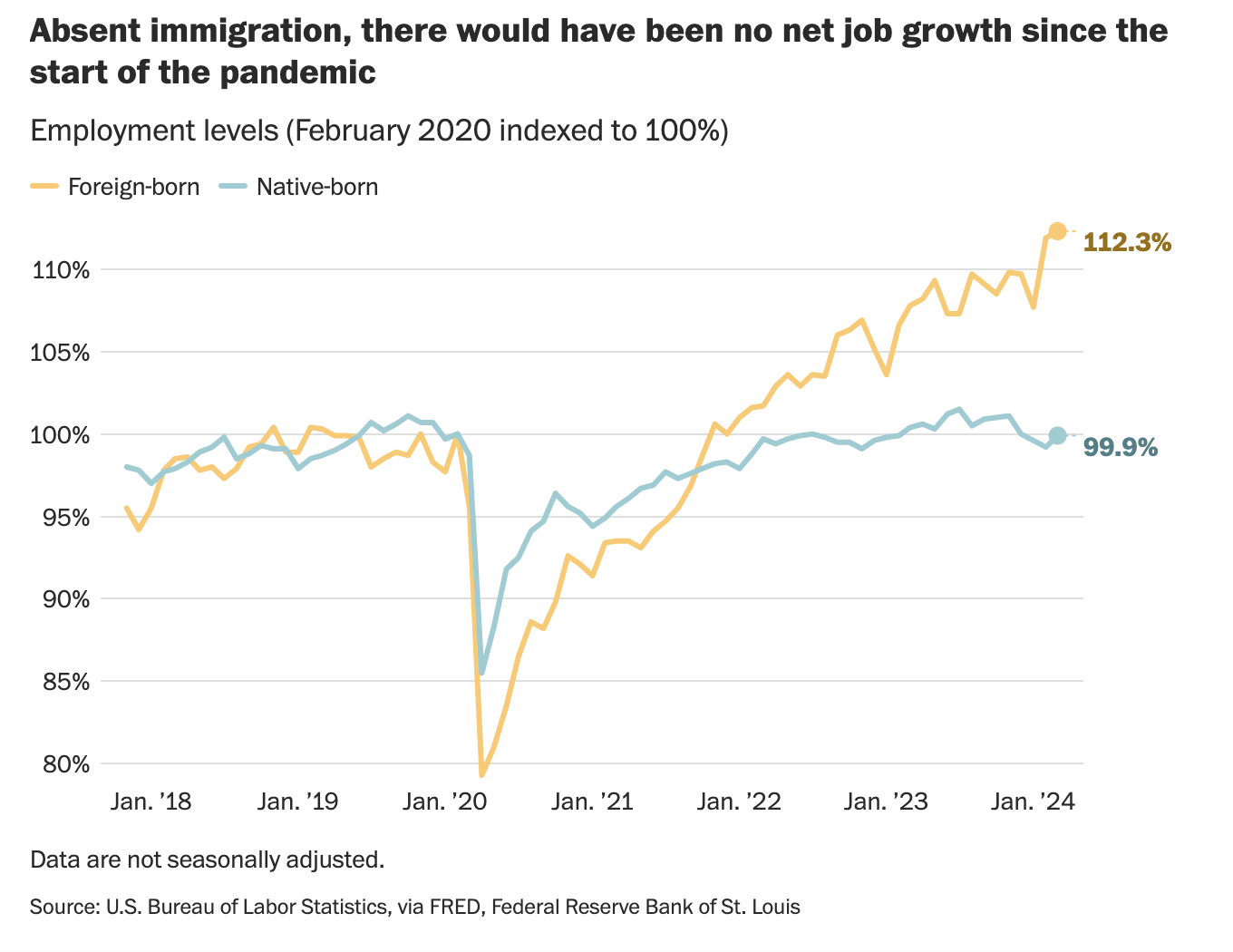
As a result, all of the new job growth since the pandemic, on net, has been due to foreign-born workers. That is, if you stripped away immigrants, there would be no more people employed today than was the case before covid.

On many dimensions, our ability to attract global talent to our shores is a blessing. But this being an election year, and demagogues being demagogues, right-wing pundits and political operatives have worked to darken these bright statistics.

Fox News refers to Bidenomics as a “migrant job fair.” The Republican-aligned Heritage Foundation alleges that “Americans have been completely left behind in this economy,” citing as evidence that fact I just mentioned: that all the net new job growth is accounted for by immigrants.

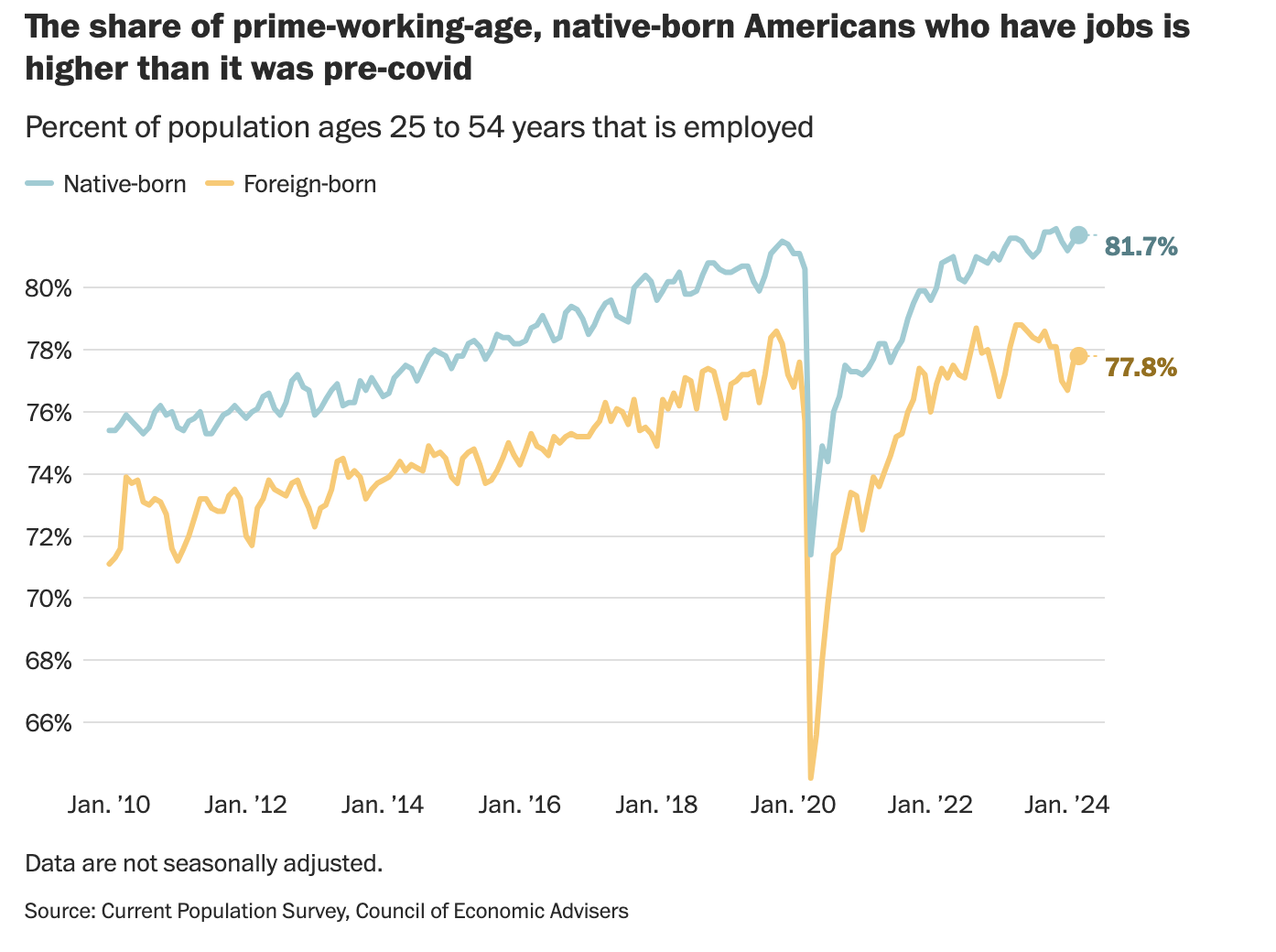
But the labor market is not zero-sum, and native-born workers happen to be doing extraordinarily well, too. In fact, the share of native-born Americans considered “prime working age” (25 to 54 years old, so after traditional college-going years and preretirement) who have jobs is higher than it was pre-pandemic. There just aren’t enough of us, in total, to fill all the jobs that employers are creating as boomers retire.

It’s true that overall, native-born Americans are less likely to be in the workforce today than in years past, but that’s entirely due to aging.
To put a finer point on it, there’s so much demand for workers now that even the most marginal American workers, such as teenagers and people with disabilities, are doing unusually well in the labor market. Ironically, some parts of the country complaining loudest about immigration today are the same places trying to loosen limits on child labor because their worker shortages are so acute.

It’s almost like there’s a simpler, more mutually beneficial solution at hand.

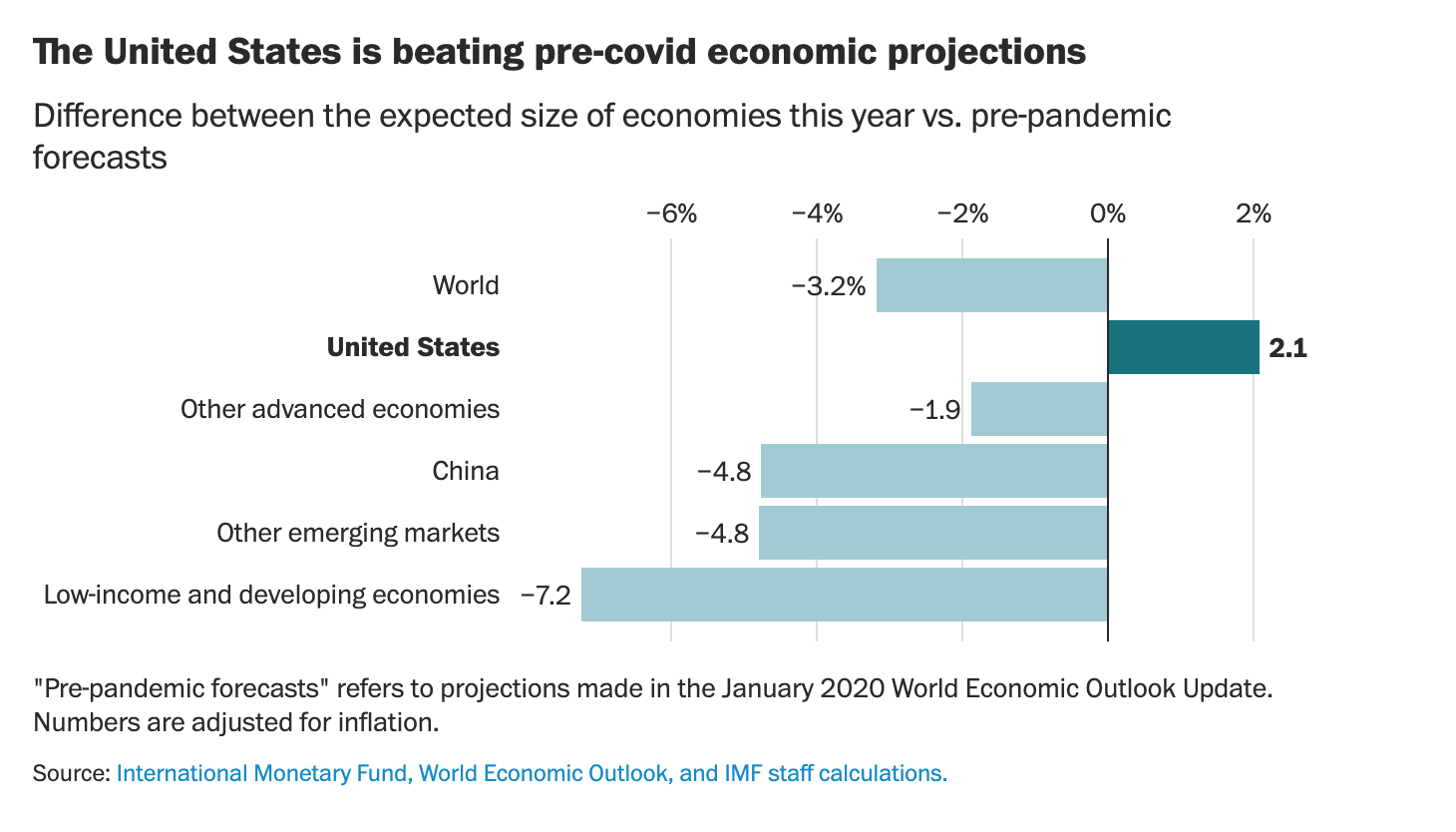
Some other countries would love to have the problems we have — to have so many talented people clamoring to replace retiring boomers (or care for them) and to infuse their economies with new skills, ideas, businesses and drive. The influx of new talent has not only helped us beat recent recession predictions; it’s also helped us best our competitors in Asia and elsewhere, where demographic challenges are dragging on growth. The U.S. economy is one of the only places in the world right now that is doing even better than expected before the pandemic began.

And, if current immigration trends continue — which they might not, depending who wins in November — immigration is likely to boost our fortunes in the years ahead: The Congressional Budget Office recently revised upward its 10-year gross domestic product projections by $7 trillion, attributing the increase to immigration-driven labor force growth. Our longer-term fiscal challenges also look better, since immigrants pay taxes and are much less likely than native-born Americans to (ever) qualify for benefits, including programs such as Medicare and Social Security.

Yet, somehow, the Trumpy right argues that greedy, freeloading immigrants are simultaneously stealing both our jobs and our precious tax dollars. In reality, they’re beefing up both.

Our reader is a retired union worker who follows economic and political news closely. He lives on long Island in New York. He wrote this comment in response to Jonathan V. Last’s article about the media’s insistence on saying that good economic news is “bad for Biden.” His response: “It’s about time!”

Joel wrote:

What we call MSM is owned by very wealthy people whose interests will not be hurt by a Trump re-election. Tax cuts for the wealthy don’t trickle down and never have, but they go into his and their pockets . But even a more benign explanation is that Trump is good for the business of the Washington Post , the New York Times , CNN… All with increased readership and thus advertising sales. Generated by the buffoon.

The jobs report was released on Friday the 5th showing a remarkable stretch of below 4% unemployment not seen since ” we partied like it was 1965″ . Showing millions of more Jobs created on top of all the Jobs recovered since the Covid recession. Jobs recovered in record time for any recovery. After a recession business close employees who were employed have moved on it took from 2010 till 2017 to just recover the Jobs lost in the great recession.

The US has a higher growth rate and lower inflation than almost the entire G20. We have been told by the MSM (not just Right Wing Media ) that the 10s and 10s of millions who either went to work or changed jobs during the recovery, don’t really care about easily getting a Job and changing Jobs for better paying Jobs. Don’t care that the real (inflation adjusted) median wage actually exceeded inflation by a few dollars a week. That most of those raises went to non-supervisory workers. In other words the working class. Not the upper middle class and the wealthy. What they care about we were told was inflation that subsided almost as quickly as it arose. Inflation that was due to supply shortages of Labor and Materials generated by Covid shut downs at home and overseas. By autocrats overseas manipulating oil prices to see an autocrat elected in America. Not due to the typical wage price spirals of the past. Inflation that saw corporations because of the hysteria generated in the media feel free to boost profits by raising prices far and beyond any increase in Labor or material costs.

Laughing in many Corporate Board Rooms that the people have been duped to expect inflation and we are going to give it to them as corporate profits rose to record levels not seen since WW2 and profits still are near record highs. I thought I could sleep after Biden was elected. Garland dispelled that hope quickly. So on Sunday the 7th two days after the employment report , I am up at 4AM. I tuned to CNN . They ran a story I thought was about the fantastic employment report that quickly turned to “but this may not be good for Biden”. And then for the next 8 minutes of perhaps a 10 minute segment diverted to the”oh but inflation”story.

I will say this again !!!! when Reagan declared morning in America inflation was 4.3% not 3.5% as now. Un-employment was still at 7.8% not 3.8% as now . Mortgage rates were at 13% not 7%. Biden compared to the Reagan administration should be declared the second coming by the media.

But it gets worse. As I pointed out by November of 2021 and several times since on this Blog and elsewhere. The media was hyping inflation beyond any reality. The National price of Gas before Putin was $3.21 a gallon as people went back to living their lives after Vaccinations and Oil fields had not fully opened!!!!!. Yet the NY Times , CNN and PBS found people who used a 1000 gallons of milk or Gas a week to highlight the impacts of inflation . Worse the Picture in the NY Times on line was of a station that had to be in the Pacific off the Coast of California with gas at $5.99. As their own writer Niel Irwin pointed out the price of Gas was CHEAPER than it was for 4 whole years from 2011 till 2014 when the Euro crisis tanked oil prices. Pointed out that workers were working significantly fewer hours to fill that tank than in 2011-14 when the National Average never went below $3.60 and went as high as $3.90.

So imagine me waking up two Sundays ago to see the picture on that CNN segment with gas prices at $5.39 a gallon . The National Price was $3.50 . I had paid $303 a gallon in Trumplandia Long Island (Commack ) on the Friday before. I had paid $3.13 a gallon in Hicksville LI to fill my wife’s car the day before the Employment report . I rewound the TV and paused the TV to snap a picture of the $5.39 cent gas on my cell phone. The following Thursday I filled up in Elmont Long Island at an Exxon station cash or credit $3.15. Long Island is not Texas it has new Wind Mills going up , not oil wells and refineries. The inflation report that rattled Wall Street last week was a whopping 3.5% up 2/10ths from its recent lows in December of 2023 . Not exactly historically high and food inflation was 1.2% year over year .

But again the other day Niel Irwin now writing for Axios (?) came to the rescue with an interesting tidbit. This gets a little nerdy. As Krugman points out rents are responsible for 1/3 of the Consumer price index. The US Labor Department computes rents with a factor no or few other Foriegn Economies do “Owner Equivalent Rent”. Something that does not exist in the real world and no body ever actually pays. It is what you would have to pay to rent your own home. If you had to rent it. But I don’t rent my own house I own it (and the mortgage is free and clear ). Neil Irwin pointed out that back in January the BLS changed the way it computes this fictional cost. It added 5% more single family homes and thus 5% fewer less expensive multi family homes and condos to the mix. As detailed in an Email from the Bureau of Labor Statistics that soon got deleted.  Now this may be a perfectly legitimate statistical change from their view point . But it is like declaring Ketchup a vegetable . Forcing you to compare apples to oranges.

Rent increases across the Nation have moderated significantly . “BLS data on rents for new tenants out today(4/17) show they rose just 0.4% over the last four quarters, marking the slowest pace of advance since 2010. The largest and most important component of the consumer price index is likely soon to follow them lower.” Dean Baker WELL MORE BAD NEWS FOR BIDEN

Ohio has experienced population decline but one city is growing: Columbus. Peter Gill of the Columbus Dispatch explains that new immigrants have fueled population growth and the local economy.

He writes:

Kikandi Lukambo has reinvented himself many times in his life.

After war forced him, his parents and siblings to flee their home in the Congo, he became a tailor, catering to the fashionable ladies of Kampala, the Ugandan capital.

Nearly a decade later, in 2015, the U.S. Refugee Admissions Program resettled Lukambo in Columbus. He quickly found a job with a perfume manufacturer, then at a distribution warehouse.

Recently, he founded a transportation business that shuttles other immigrant workers — including people from Somalia, Afghanistan, Syria and elsewhere — to and from their workplaces in Greater Columbus.

Sitting in Kivu Transportation Services’ small office in the Northland neighborhood recently, Lukambo, 37, spoke of his gratitude for the opportunities Ohio has afforded him.

“(Ohio) has a very good reputation of employment,” he said. “We have the best life here.”

Lukambo, who became an American citizen in 2022, also found love locally. Four months ago, he and his fiancée Wedny Dauphin, an immigrant from Haiti, became parents to a baby boy.

Foreign-born people like Lukambo and Dauphin have been essential to Columbus’ population growth and economy in recent years, according to new government data and local economists.  

Because native-born Americans are having fewer children and are moving away from Ohio, the state’s population shrunk by about 13,000 between mid-2020 and mid-2023. But it would have shrunk by about 61,000 more if it weren’t for the flow of immigrants moving in, according to Census Bureau estimates.

In Columbus — Ohio’s fastest-growing metro area— international immigrants accounted for more than half of the population growth over the three years, according to the bureau

This includes everyone from refugees like Lukambo to high-skill workers on H-1B visas, people admitted based on family ties and undocumented individuals. Franklin County’s largest foreign-born groups come from Asia, followed by Africa and then Latin America.

Mark Partridge, an urban economist at Ohio State University, told The Dispatch that population expansion comes with certain growing pains, such as greater demand for housing and public services like schools. 

But he said immigrant-driven population growth is a “first-order factor” benefitting the region’s economy — in contrast to shrinking cities like Youngstown, where relatively few immigrants settle.

“Population growth drives demand for businesses. … And (likewise), population growth (increases) the supply of workers that firms want to hire,” he said.

“It’s easy to scapegoat immigrants. … However, if it wasn’t for immigration in a state that struggles retaining population like Ohio, we would have much faster population loss. Once you start losing population, it’s pretty easy to turn into a vicious cycle downward.”

Lukambo had never driven a car before moving to the U.S. nine years ago. Soon after arrival, he and his brother paid another Congolese refugee $1,000 to teach them how to drive so they could get to work, he said.

While his job at a warehouse provided some stability, Lukambo dreamed of starting his own business. At first, he thought of starting a language school for other immigrants, since he speaks English fluently. But then he realized that very few of his potential students would have a means of transportation to get to class. This insight led him to start the transportation company, which now has contracts with a sawmill in Newark, the refugee resettlement agency Jewish Family Services and elsewhere.

Lukambo and Dauphin drive vans for their company while also working other jobs — Lukambo is a weekend supervisor at a Macy’s warehouse in Groveport, and Dauphin works for Cheryl’s Cookies in Westerville.

“I don’t really take time off,” Lukambo, who works seven days a week, said with a chuckle.

Bill LaFayette, an economist who owns the local consulting firm Regionomics, told The Dispatch that immigrants are good for the economy in part because Columbus-area firms are in desperate need of workers.

“Our employment growth has been somewhat stunted since mid-2022, just because there aren’t enough workers,” LaFayette said. “(Immigrants) tend to be younger than the population as a whole, and they tend to be more likely in the labor force.”

LaFayette said that immigrants are also significantly more likely than native-born people to become entrepreneurs.  

“My guess is that (is because) they have pulled up stakes and moved to a completely different part of the world, and they are inherently risk-takers,” he said.

He pointed to Morse Road as an area with an abundance of immigrant-owned businesses, which he said retain a greater percentage of their sales revenue within the local economy than national chains.

Studies also show that immigrants are a boon to the local tax base.

In 2019, immigrants in the Columbus metro area paid $712.4 million in state and local taxes, according to a study commissioned by the city of Columbus and Franklin County.

And a new study by the U.S. Department of Health and Human Services found that refugees and asylees contribute more on average in tax revenue than they cost in expenditures to federal, state and local governments.

LaFayette said immigrants contribute to the growing demand for affordable housing in Columbus, but this is an inevitable byproduct of economic growth — no matter where workers are coming from.

“Whether you come from Cleveland or Calcutta, you still need a place to live,” he said.

Skeptics of immigration sometimes raise concerns about immigrants taking jobs away from native-born people, but LaFayette said this is not a concern in central Ohio, at least not right now.

“Our unemployment rate’s barely above 3%. … All you’ve got is pretty much frictional unemployment — people going from one job to another,” he said. “We need everybody we can get.”

Another criticism is that even if immigrants do not take jobs away from native-born Americans, by expanding the labor pool, they can drive down wages in certain fields

Partridge, the Ohio State professor, said economists still debate the size of this effect, though most agree it is small. He believes that low-wage workers are most affected, but “it’s not a massive effect.” On the other hand, he said immigrants often come up with innovations or insights that help firms expand into markets abroad — boosting wages for high-skill workers.

As Columbus’ foreign-born population continues to grow, Lukambo hopes to expand his business by partnering with more employers and by offering driving classes for newly arrived immigrants.

“I’m under obligation to help other people — because I don’t like to see people struggling the way I struggled with at the beginning when I came here,” he said.

Lukambo said many of his relatives and friends from his refugee camp in Uganda resettled elsewhere in the U.S. But when they come to visit Columbus, he makes the pitch for them to relocate here — which, increasingly, they accept.

“(Congolese) people used to say, ‘Ohio is like a village. Ohio is not a really good state.’ But with time … a lot of refugees and a lot of immigrants are coming here. … With the economy, you can be at least successful with one job, and you manage your time and you feel like you are having a good life,” he said.

“Ohio is growing.”

Peter Gill covers immigration and new American communities for The Dispatch in partnership with Report for America. You can support work like his with a tax-deductible donation to Report for America here:bit.ly/3fNsGaZ.

pgill@dispatch.com

@pitaarji

Jonathan V. Last writes for The Bulwark, an excellent Never Trumper site. He noticed a curious phenomenon. Whenever there’s good economic news, the mainstream media worries that good economics news is bad news for Biden? What?

He writes:

We’ve reached the ne plus ultra of Here Is Some Good News and Also Why It’s Bad for Biden headline writing. I present to you an April 13 story in the Washington Post by Abha Bhattarai and Tyler Pager. (Don’t click the link yet.)

The piece is about the current economic indicators we’re seeing in the March reports: Job growth, wage growth, consumer spending—all headed in the right direction. The economy is, the piece declares, “booming.”

Now, are you ready for the two headlines the Post gave the piece?


Before I make your head explode, this is the part where I say that you should join Bulwark+ because we don’t do happy talk, but we also don’t pull the type of nonsense where we say “Puppies were spotted at the White House, here’s why that’s bad for Biden.” 

If we want a better media, we have to build it. That’s what we’re doing here and we’d love it if you joined us.

Okay, so back to the Post.

Here’s Headline #1:

And here’s Headline #2:

Here is a real sentence written by a real person at the Washington Post: “The economy’s unfettered strength is becoming more of a political liability for the White House.”

Are you forking kidding me?

We are deep into heads-I-win, tails-you-lose territory. Would it also be a political liability for the White House if, I dunno, we were experiencing deflation and the economy was shrinking? If unemployment was rising? If wage growth was stagnant?

Pray tell, describe the economic conditions which augur political benefits for the Joseph Robinette Biden?


My two complaints:

(1) The piece is wrong on the merits: We have seen a small—but measurable—increase in Biden’s poll numbers over the last month. He is not being harmed by the economy. Or at least, his political prospects are improving, so if the economy is causing him harm, that debit is being overbalanced by something else that’s working in his favor.

(2) The Post isn’t providing analysis, it’s manufacturing a rationalization. As I’ve written before, if you came down from Mars and looked at all of the economic data and had to guess who was winning the election right now, you’d think Biden was on track for a landslide. The fact that he isn’t indicates that something interesting is going on. Instead of investigating that interesting thing, the Post is trying to pretend that everything is normal. Which is what causes them to say, Uhhh, Biden’s not doing so hot. And the economy is great. So . . . here’s why having a great economy is bad for Biden!

1. Oh, who am I kidding: The videotape wouldn’t hurt Trump at all. Sigh.

Dave Wells, research director of the Grand Canyon Institute, a nonpartisan research center in Arizona, released the following statement:

Phoenix —The Grand Canyon Institute expresses deep distress over the implications for women’s health and rights in response to the Arizona Supreme Court’s decision to uphold a territorial-era law from 1864 that bans nearly all abortions. This ruling poses a significant threat to reproductive freedom and will have profound economic consequences for individuals and families across the state.

While the immediate harm will be experienced by women denied access to healthcare, today’s decision will have negative repercussions for all Arizonans. An analysis published in January 2024 by the Institute for Women’s Policy Research (IWPR) sheds light on the ongoing impact of abortion restrictions, highlighting the negative impacts of such policies on economic prosperity in addition to women’s health. Women constitute a considerable segment of the workforce; restrictions on healthcare access harm not only women and their families but also have adverse effects on local economies. 

This research emphasizes, in the two years before Roe was overturned, the economic toll of abortion restrictions (e.g., required ultrasound), estimating an average annual cost of $173 billion to the United States economy due to reduced labor force participation, earnings levels, and increased turnover among women. This figure understates the substantial economic repercussions of post-Roe abortion bans. Arizona already was facing an average annual economic loss of $4.5 billion, equivalent to 1% of the state’s GDP due to its restrictive measures.

If reproductive health restrictions were removed, almost 597,000 additional women would join the nation’s labor force each year. The national GDP would experience an increase of nearly 0.7%, and employed women aged 15 to 44 would collectively earn an extra $4.3 billion annually.

“By allowing a 160-year-old law to take precedence over the 15-week law passed two years ago, the Arizona Supreme Court has condemned pregnant people to healthcare restrictions reminiscent of an era when slavery remained Constitutionally endorsed” states Dave Wells, research director of the Grand Canyon Institute. “The Court’s decision will also have significant economic consequences for the state.  Our previous restrictive abortion laws already result in an economic cost of $4.5 billion annually, this cost will certainly increase going forward and will be felt by all Arizonans.”

The Grand Canyon Institute emphasizes the importance of safeguarding reproductive rights. As an organization deeply committed to advancing evidence-based policymaking, we are actively engaging in research to further understand the detrimental effects of abortion restrictions on the Arizona economy. This is an area of research we are currently prioritizing, recognizing the profound economic implications of restrictive reproductive health policies.

For more information, contact:

Dave Wells, Ph.D., Research Director

602.595.1025, Ext. 2, dwells@azgci.org

The Grand Canyon Institute, a 501(c) 3 nonprofit organization, is a centrist think tank led by a bipartisan group of former state lawmakers, economists, community leaders and academicians. The Grand Canyon Institute serves as an independent voice reflecting a pragmatic approach to addressing economic, fiscal, budgetary and taxation issues confronting Arizona.

The reckoning for Donald Trump’s highly overvalued social media company is coming faster than anyone expected. The stock debuted a few days ago at $70 a share, rose to $78, then dropped into the 60s. Today the stock price plunged after the company reported its losses for 2023. At 3:30 pm, it was selling for $48.07.

Drew Harwell of The Washington Post wrote:

Former president Donald Trump’s social media company said Monday it lost more than $58 million last year, sending its stock plunging roughly 25 percent only days after a highflying public debut valued it at more than $8 billion.
Trump Media & Technology Group, which owns Truth Social, said in a new Securities and Exchange Commission filing Monday that the company generated just over $4 million in revenue last year, including less than $1 million in the last quarter of 2023.


The nosediving share price of the company — which uses the stock ticker DJT, for Trump’s initials — shaved off a quarter of its market value in a single day. It also slashed the value of Trump’s 57 percent ownership in the company by roughly $1 billion, to $3.6 billion.


The new financial figures throw into stark relief the gap between Trump Media’s highly hyped investor-driven valuation on the public stock market and the reality of its business performance.


It also raises questions about the possibility that Trump could use the company as a financial lifeline. Trump cannot sell his shares or use them as collateral for a loan for six months due to a provision in the company’s merger agreement, known as a lockup.

The company’s board could vote to waive that requirement but has yet to do so, the filings state. Cashing out early could sink the stock price further by flooding the market with shares and undermining investor confidence in Trump’s commitment to the brand, financial analysts said.


Trump, who invested no money in Trump Media, was given 78 million shares of the company last week and stands to earn tens of millions more over the next three years if the stock stays above $12 to $17, a filing shows.


Trump Media said in a filing that it expects to incur more “operating losses and negative cash flows” as it works to expand its user base but that it expects its growth will come from Truth Social’s “overall appeal.”


The company said in a filing that its management had “substantial doubt” as of the end of last year that it would have enough money to pay its debts as they come due. The company paid nearly $40 million in interest expenses last year and racked up about $16 million in operating losses.

Anand Giridharadas is a brilliant thinker who has a blog called The Ink. In his latest post, he prints whole sections of Trump’s incendiary campaign speech in Vandalia, Ohio, and gives a close reading to his language. (Something oddly appropriate about the location since Trump is the King of Vandals.)

Anand’s parsing of Trump’s words is incisive. I’m posting only part of it, and Anand has made this post available for free. I urge you to open the link and read it all.

He writes:

Former President Donald Trump’s fascist performance art this past weekend in Vandalia, Ohio, was ostensibly a stump speech for someone else. But you could be forgiven for forgetting that. In what was effectively his first real rally since clinching the GOP nomination, Trump offered a grim vision of America and a patchwork of unhinged tirades against his usual targets. Yet there was more to it than that.

There is little value in fact-checking the former president’s words, given that the great majority of them bore so little relationship to reality that you quickly realize their purpose could only be to destabilize reality altogether. They simply restate dozens of well-worn lies, from birtherism up through the Big Lie, interspersed with a smattering of playground insults, projection, and a stew of misunderstood economic schemes and xenophobic delusions that do the work of standing in for policy ideas. This is a hole of lies that cannot be filled with facts.

But that doesn’t mean the speech wasn’t worth paying attention to. And, being of the reading sort, we suggest there is value in reading the text, not just rage-consuming the viral videos everyone has been rehashing.

We think all Americans need to take Trump’s speech both seriously and literally as the what-you-see-is-what-you’ll-get messaging of a would-be dictator. These are things that are actually being said, in public, by a person who has already occupied the world’s most powerful position and seeks to occupy it again. It’s an advertisement for autocracy that — give it this at least — complies with the notion of truth in advertising. And as Masha Gessen has reminded us, “Rule no. 1 is to listen to and believe the autocrat.”

What we look at below is how Trump’s rhetorical performance works, how it functions. In many of these examples, the “meaning” isn’t important, and that’s why the goal here isn’t to question his command of the facts. He’s making these statements without much pretense to knowing the facts in the first place; rather, he’s looking for maximum emotional impact. He fights entirely on the battleground of emotion, and that, Ruth Ben-Ghiat has reminded us, is pretty much what autocrats have always done. 

Trump’s language here — from stabs in the back to dystopian visions of foreign nations seeking to flood the American body politic with their unwanted criminals — has plenty of precedent in the words of the strongmen of the past and present. He goes out of his way to praise Hungary’s Viktor Orbán, perhaps returning thefavor for Orban’s snub of the sitting U.S. government on his recent visit to the U.S. 

And it’s the fact that this speech follows that well-established playbook that demands we pay attention. His words may be murky. What he plans to do to us is clear.

We’ve made this piece free and open to all. We hope it will make you think about these critical issues in new ways, and give you a glimpse of the posts that go out to our supporting subscribers each week. We encourage you to join our community, and to share our work with yours! And we have a rare special offer to entice you: 20% off forever!

The Victim King

Because I’m being indicted for you and never forget our enemies want to take away my freedom because I will never let them take away your freedom.

I’m being persecuted. I think more than anybody, but who the hell knows? You know, all my life…you’ve heard of Andrew Jackson. He was actually a great general and a very good president. They say that he was persecuted as president more than anybody else. Second was Abraham Lincoln. This is just what they said. This is in the history books. They were brutal. Andrew Jackson’s wife actually died over it, they say, died of a broken heart, but she died over it. He was never quite the same.

But they say Andrew Jackson, they say Abraham Lincoln was second, but he had a, you know, in all fairness, he did have a civil war. So you would think that would cause a problem, right? So you could understand it. But nobody comes close to Trump. 

Elementary school historical analysis aside, this passage is a reminder that, more than anything, Trump relishes playing the role of the Victim King. He’s casting attacks on him as attacks on his subjects, and valiantly stepping into the breach to block the slings and arrows so his loyal supporters won’t suffer. It’s part of the personalization of leadership that’s always been at the center of cults of personality — the devotional, movement-building side of authoritarianism.

The notion that the leader acts as both weapon and human shield is a central rhetorical tool in the arsenal of autocrats. And of course he’s done this better — or maybe just “more” — than anybody. More than Lincoln; more than Jackson. 

Trump’s victimhood here is absolute. He’s devoted himself entirely to protecting his flock. An attack on him is an attack on them; a win for him a win for them.

We dig here more deeply into Trump’s pursuit of absolute power through his performance of weakness.

The Horst Wessel song

And you see the spirit from the hostages, and that’s what they are, is hostages. They’ve been treated terribly and very unfairly. And you know that. And everybody knows that. And we’re going to be working on that soon. The first day we get into office, we’re going to save our country, and we’re going to work with the people to treat those unbelievable patriots, and they were unbelievable patriots and are. You see the spirit, this cheering. They’re cheering while they’re doing that. And they did that in prison. And it’s a disgrace, in my opinion. 

Here Trump returns the favor, in a sense, to his shock troops. The speech opened with a playback of “Justice for All,” the MAGA fundraising release by the “J6 Prison Choir” that interpolates Trump reciting the Pledge of Allegiance over a backing track of the inmates singing “The Star-Spangled Banner.” 

The track is meant as a legal defense effort for the January 6 insurrectionists, but the role it plays here is to define those insurrectionists as true patriots, and to link Trump’s own persecution with that endured by his most devoted followers — the ones who’ve demonstrated their willingness to go into battle on his account. It’s a barter of martyrdoms.

This, as with the rest of the rhetoric here, is a classic authoritarian strategy. If you consider the insurrectionists cast in the role of Sturmabteilung(“SA,” the original paramilitary forces of the Nazi Party) martyr Horst Wessel (Ashli Babbitt specifically, though the group as a whole plays the same part generally here), this patriotic mashup recalls the Nazi anthem.

The Big Lie

I happen to think we won most of the country. You want to know the truth. If the voting…if the voting were real, I actually think we won most of the country.

Central to Trump’s identity is infallibility, and, given that, his mass popularity is without question. Again, this is classic autocratic positioning. Thus his obsessions with ratings, with polls, with casting primary victories that were never in doubt as fantastic triumphs.

Jokes about huge numbers aside (and the speech is rife with riffs on poll results), there is simply no way that he could have lost a legitimate electoral contest, and any such contest he might have lost would be, by definition, illegitimate. One need only look to Vladimir Putin’s “landslide” victory this week for an example of the way elections function in an authoritarian state.

The Big Lie is Trump’s truth, and it’s not just a boast. It’s key to the story he’s trying desperately to sell to the crowd, the story of a guy who can’t lose.

I was asking Jim Jordan about it because he was commenting that we have the largest crowds in the history of politics. Nobody comes close. If Ronald Reagan came to a place called Dayton, Ohio — have you heard of it? If he came to Dayton, Ohio, honestly, J.D., if he had three or 400 people in a ballroom, that would be great. We get 25-30,000 people for a small rally…We had 88,000 people show up in South Carolina.

An addendum: In his bid for recognition as the greatest of all Republicans, Trump is even willing to throw Ronald Reagan under the bus if it helps make the case.

Not even people

They’re very smart, very streetwise. And I would do the same thing. If I had prisons that were teeming with MS-13 and all sorts of people that they’ve got to take care of for the next 50 years, right? Young people, they’re in jail for years. If you call them people, I don’t know if you call them people. In some cases, they’re not people, in my opinion. But I’m not allowed to say that because the radical left says that’s a terrible thing to say…

We have so many people being hurt so badly and being killed. They’re sending their prisoners to see us. They’re sending and they’re bringing them right to the border and they’re dropping them off and we’re allowing them to come in. And these are tougher than anybody we’ve got in the country. These are hardened criminals. And we’ve got hundreds of thousands of them. 

If you take Trump at his word here — and we think you should — the leaders of countries around the world are conspiring to conduct an organized invasion, deploying their criminals to the United States in order to submerge it in violence. On one level, there’s nothing here but racism and xenophobia, but this works on the level of the conspiratorial ideas of mysterious foreign threats to the body politic that have long been part and parcel of the autocrat’s appeal. 

Migrants, in this account, aren’t fleeing refugees or people looking for a better life against all odds, but have been mobilized and directed against the U.S., a superhuman and yet subhuman army, “dropped off” by a shadowy cabal of foreign interests who aren’t content merely to sell us cheaper cars and fentanyl precursors.

Just insert “bankers” or “Jews” or “capitalist roaders” or even “globalists” here and you’re on the right track towards understanding what Trump’s trying to do.

Migrant crime

These are the roughest people you’ve ever seen. You know, now we have a new form of crime. I call it Biden migrant crime, but it’s too long. So let’s just call it migrant crime. We have a new category. You know, you have vicious crimes. You have violent crimes. You have all these. Now we have migrant crimes, and they’re rough. They’re rough. And it’s going to double up. And you see what’s happening. 

You know, throughout the world right now, I don’t know if you know this. Crime is way, way down. You know why? Because they sent us their criminals. That’s why. It’s true. It’s true. They sent, you know, Venezuela is down 66 percent because they sent us their gang members and gangsters. They sent us their drug dealers and their murderers. They’re all coming into our country. And Venezuela now, their crime is down 66 percent.

The supposed statistics here are just a “gish gallop,” in which the speaker simply overwhelms the opponent (or in this case the audience) with a flurry of inaccurate statements, knowing that the very attempt to correct them will both derail any reasonable argument and delay a response until the time has run out.

But this, again, is the story of the alien threat, here described as entering at the behest of their domestic collaborator, Joe Biden. It’s a “stab-in-the-back” accusation (there are several in the speech), in which a leader is identified as a secret traitor, betraying the nation to foreign interests.

The truth is that crime rates are down worldwide, and these statistics are pulled out of the air. The fear people have of the loss of control of the border, and of what it means to be “American” is real, however — even if Trump’s helped in its creation — and that’s what he’s playing to so effectively.

Please open the link and continue reading this insightful exegesis of Trump’s rhetoric. He is a talented orator. So was Hitler.