Archives for category: Economy

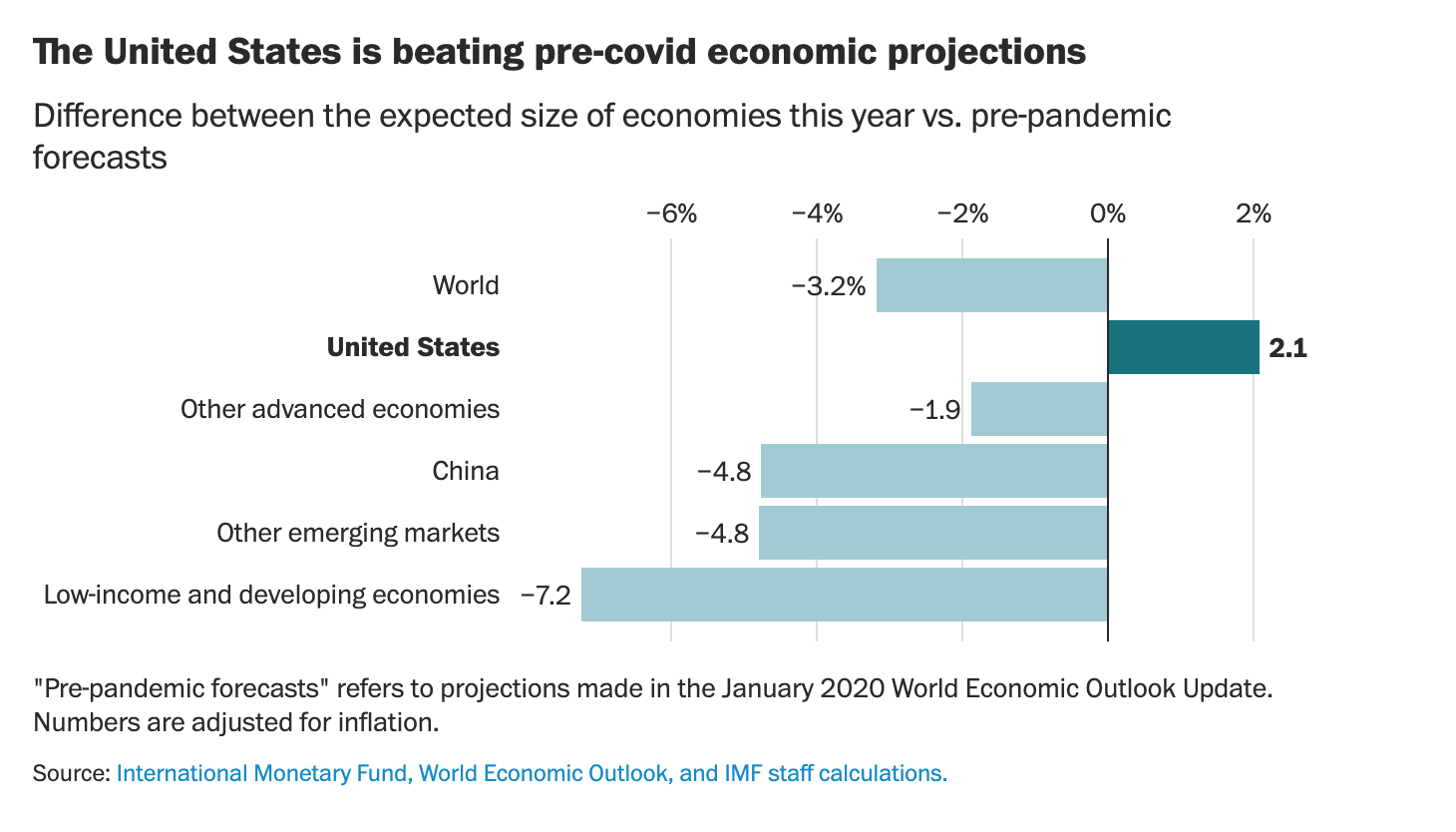
Jonathan V. Last writes for The Bulwark, an excellent Never Trumper site. He noticed a curious phenomenon. Whenever there’s good economic news, the mainstream media worries that good economics news is bad news for Biden? What?

He writes:

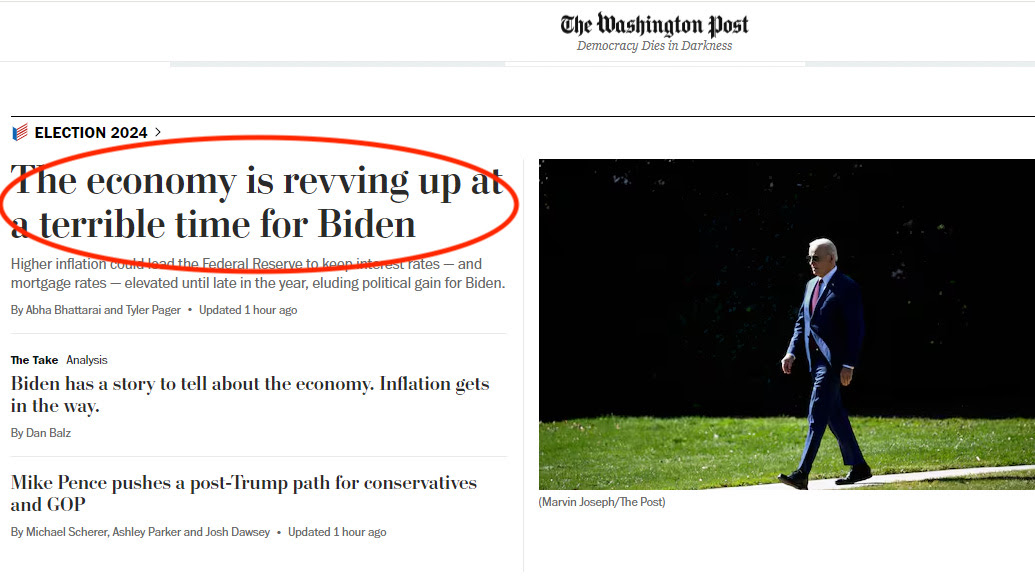
We’ve reached the ne plus ultra of Here Is Some Good News and Also Why It’s Bad for Biden headline writing. I present to you an April 13 story in the Washington Post by Abha Bhattarai and Tyler Pager. (Don’t click the link yet.)

The piece is about the current economic indicators we’re seeing in the March reports: Job growth, wage growth, consumer spending—all headed in the right direction. The economy is, the piece declares, “booming.”

Now, are you ready for the two headlines the Post gave the piece?


Before I make your head explode, this is the part where I say that you should join Bulwark+ because we don’t do happy talk, but we also don’t pull the type of nonsense where we say “Puppies were spotted at the White House, here’s why that’s bad for Biden.” 

If we want a better media, we have to build it. That’s what we’re doing here and we’d love it if you joined us.

Okay, so back to the Post.

Here’s Headline #1:

And here’s Headline #2:

Here is a real sentence written by a real person at the Washington Post: “The economy’s unfettered strength is becoming more of a political liability for the White House.”

Are you forking kidding me?

We are deep into heads-I-win, tails-you-lose territory. Would it also be a political liability for the White House if, I dunno, we were experiencing deflation and the economy was shrinking? If unemployment was rising? If wage growth was stagnant?

Pray tell, describe the economic conditions which augur political benefits for the Joseph Robinette Biden?


My two complaints:

(1) The piece is wrong on the merits: We have seen a small—but measurable—increase in Biden’s poll numbers over the last month. He is not being harmed by the economy. Or at least, his political prospects are improving, so if the economy is causing him harm, that debit is being overbalanced by something else that’s working in his favor.

(2) The Post isn’t providing analysis, it’s manufacturing a rationalization. As I’ve written before, if you came down from Mars and looked at all of the economic data and had to guess who was winning the election right now, you’d think Biden was on track for a landslide. The fact that he isn’t indicates that something interesting is going on. Instead of investigating that interesting thing, the Post is trying to pretend that everything is normal. Which is what causes them to say, Uhhh, Biden’s not doing so hot. And the economy is great. So . . . here’s why having a great economy is bad for Biden!

1. Oh, who am I kidding: The videotape wouldn’t hurt Trump at all. Sigh.

Dave Wells, research director of the Grand Canyon Institute, a nonpartisan research center in Arizona, released the following statement:

Phoenix —The Grand Canyon Institute expresses deep distress over the implications for women’s health and rights in response to the Arizona Supreme Court’s decision to uphold a territorial-era law from 1864 that bans nearly all abortions. This ruling poses a significant threat to reproductive freedom and will have profound economic consequences for individuals and families across the state.

While the immediate harm will be experienced by women denied access to healthcare, today’s decision will have negative repercussions for all Arizonans. An analysis published in January 2024 by the Institute for Women’s Policy Research (IWPR) sheds light on the ongoing impact of abortion restrictions, highlighting the negative impacts of such policies on economic prosperity in addition to women’s health. Women constitute a considerable segment of the workforce; restrictions on healthcare access harm not only women and their families but also have adverse effects on local economies. 

This research emphasizes, in the two years before Roe was overturned, the economic toll of abortion restrictions (e.g., required ultrasound), estimating an average annual cost of $173 billion to the United States economy due to reduced labor force participation, earnings levels, and increased turnover among women. This figure understates the substantial economic repercussions of post-Roe abortion bans. Arizona already was facing an average annual economic loss of $4.5 billion, equivalent to 1% of the state’s GDP due to its restrictive measures.

If reproductive health restrictions were removed, almost 597,000 additional women would join the nation’s labor force each year. The national GDP would experience an increase of nearly 0.7%, and employed women aged 15 to 44 would collectively earn an extra $4.3 billion annually.

“By allowing a 160-year-old law to take precedence over the 15-week law passed two years ago, the Arizona Supreme Court has condemned pregnant people to healthcare restrictions reminiscent of an era when slavery remained Constitutionally endorsed” states Dave Wells, research director of the Grand Canyon Institute. “The Court’s decision will also have significant economic consequences for the state.  Our previous restrictive abortion laws already result in an economic cost of $4.5 billion annually, this cost will certainly increase going forward and will be felt by all Arizonans.”

The Grand Canyon Institute emphasizes the importance of safeguarding reproductive rights. As an organization deeply committed to advancing evidence-based policymaking, we are actively engaging in research to further understand the detrimental effects of abortion restrictions on the Arizona economy. This is an area of research we are currently prioritizing, recognizing the profound economic implications of restrictive reproductive health policies.

For more information, contact:

Dave Wells, Ph.D., Research Director

602.595.1025, Ext. 2, dwells@azgci.org

The Grand Canyon Institute, a 501(c) 3 nonprofit organization, is a centrist think tank led by a bipartisan group of former state lawmakers, economists, community leaders and academicians. The Grand Canyon Institute serves as an independent voice reflecting a pragmatic approach to addressing economic, fiscal, budgetary and taxation issues confronting Arizona.

The reckoning for Donald Trump’s highly overvalued social media company is coming faster than anyone expected. The stock debuted a few days ago at $70 a share, rose to $78, then dropped into the 60s. Today the stock price plunged after the company reported its losses for 2023. At 3:30 pm, it was selling for $48.07.

Drew Harwell of The Washington Post wrote:

Former president Donald Trump’s social media company said Monday it lost more than $58 million last year, sending its stock plunging roughly 25 percent only days after a highflying public debut valued it at more than $8 billion.
Trump Media & Technology Group, which owns Truth Social, said in a new Securities and Exchange Commission filing Monday that the company generated just over $4 million in revenue last year, including less than $1 million in the last quarter of 2023.


The nosediving share price of the company — which uses the stock ticker DJT, for Trump’s initials — shaved off a quarter of its market value in a single day. It also slashed the value of Trump’s 57 percent ownership in the company by roughly $1 billion, to $3.6 billion.


The new financial figures throw into stark relief the gap between Trump Media’s highly hyped investor-driven valuation on the public stock market and the reality of its business performance.


It also raises questions about the possibility that Trump could use the company as a financial lifeline. Trump cannot sell his shares or use them as collateral for a loan for six months due to a provision in the company’s merger agreement, known as a lockup.

The company’s board could vote to waive that requirement but has yet to do so, the filings state. Cashing out early could sink the stock price further by flooding the market with shares and undermining investor confidence in Trump’s commitment to the brand, financial analysts said.


Trump, who invested no money in Trump Media, was given 78 million shares of the company last week and stands to earn tens of millions more over the next three years if the stock stays above $12 to $17, a filing shows.


Trump Media said in a filing that it expects to incur more “operating losses and negative cash flows” as it works to expand its user base but that it expects its growth will come from Truth Social’s “overall appeal.”


The company said in a filing that its management had “substantial doubt” as of the end of last year that it would have enough money to pay its debts as they come due. The company paid nearly $40 million in interest expenses last year and racked up about $16 million in operating losses.

Anand Giridharadas is a brilliant thinker who has a blog called The Ink. In his latest post, he prints whole sections of Trump’s incendiary campaign speech in Vandalia, Ohio, and gives a close reading to his language. (Something oddly appropriate about the location since Trump is the King of Vandals.)

Anand’s parsing of Trump’s words is incisive. I’m posting only part of it, and Anand has made this post available for free. I urge you to open the link and read it all.

He writes:

Former President Donald Trump’s fascist performance art this past weekend in Vandalia, Ohio, was ostensibly a stump speech for someone else. But you could be forgiven for forgetting that. In what was effectively his first real rally since clinching the GOP nomination, Trump offered a grim vision of America and a patchwork of unhinged tirades against his usual targets. Yet there was more to it than that.

There is little value in fact-checking the former president’s words, given that the great majority of them bore so little relationship to reality that you quickly realize their purpose could only be to destabilize reality altogether. They simply restate dozens of well-worn lies, from birtherism up through the Big Lie, interspersed with a smattering of playground insults, projection, and a stew of misunderstood economic schemes and xenophobic delusions that do the work of standing in for policy ideas. This is a hole of lies that cannot be filled with facts.

But that doesn’t mean the speech wasn’t worth paying attention to. And, being of the reading sort, we suggest there is value in reading the text, not just rage-consuming the viral videos everyone has been rehashing.

We think all Americans need to take Trump’s speech both seriously and literally as the what-you-see-is-what-you’ll-get messaging of a would-be dictator. These are things that are actually being said, in public, by a person who has already occupied the world’s most powerful position and seeks to occupy it again. It’s an advertisement for autocracy that — give it this at least — complies with the notion of truth in advertising. And as Masha Gessen has reminded us, “Rule no. 1 is to listen to and believe the autocrat.”

What we look at below is how Trump’s rhetorical performance works, how it functions. In many of these examples, the “meaning” isn’t important, and that’s why the goal here isn’t to question his command of the facts. He’s making these statements without much pretense to knowing the facts in the first place; rather, he’s looking for maximum emotional impact. He fights entirely on the battleground of emotion, and that, Ruth Ben-Ghiat has reminded us, is pretty much what autocrats have always done. 

Trump’s language here — from stabs in the back to dystopian visions of foreign nations seeking to flood the American body politic with their unwanted criminals — has plenty of precedent in the words of the strongmen of the past and present. He goes out of his way to praise Hungary’s Viktor Orbán, perhaps returning thefavor for Orban’s snub of the sitting U.S. government on his recent visit to the U.S. 

And it’s the fact that this speech follows that well-established playbook that demands we pay attention. His words may be murky. What he plans to do to us is clear.

We’ve made this piece free and open to all. We hope it will make you think about these critical issues in new ways, and give you a glimpse of the posts that go out to our supporting subscribers each week. We encourage you to join our community, and to share our work with yours! And we have a rare special offer to entice you: 20% off forever!

The Victim King

Because I’m being indicted for you and never forget our enemies want to take away my freedom because I will never let them take away your freedom.

I’m being persecuted. I think more than anybody, but who the hell knows? You know, all my life…you’ve heard of Andrew Jackson. He was actually a great general and a very good president. They say that he was persecuted as president more than anybody else. Second was Abraham Lincoln. This is just what they said. This is in the history books. They were brutal. Andrew Jackson’s wife actually died over it, they say, died of a broken heart, but she died over it. He was never quite the same.

But they say Andrew Jackson, they say Abraham Lincoln was second, but he had a, you know, in all fairness, he did have a civil war. So you would think that would cause a problem, right? So you could understand it. But nobody comes close to Trump. 

Elementary school historical analysis aside, this passage is a reminder that, more than anything, Trump relishes playing the role of the Victim King. He’s casting attacks on him as attacks on his subjects, and valiantly stepping into the breach to block the slings and arrows so his loyal supporters won’t suffer. It’s part of the personalization of leadership that’s always been at the center of cults of personality — the devotional, movement-building side of authoritarianism.

The notion that the leader acts as both weapon and human shield is a central rhetorical tool in the arsenal of autocrats. And of course he’s done this better — or maybe just “more” — than anybody. More than Lincoln; more than Jackson. 

Trump’s victimhood here is absolute. He’s devoted himself entirely to protecting his flock. An attack on him is an attack on them; a win for him a win for them.

We dig here more deeply into Trump’s pursuit of absolute power through his performance of weakness.

The Horst Wessel song

And you see the spirit from the hostages, and that’s what they are, is hostages. They’ve been treated terribly and very unfairly. And you know that. And everybody knows that. And we’re going to be working on that soon. The first day we get into office, we’re going to save our country, and we’re going to work with the people to treat those unbelievable patriots, and they were unbelievable patriots and are. You see the spirit, this cheering. They’re cheering while they’re doing that. And they did that in prison. And it’s a disgrace, in my opinion. 

Here Trump returns the favor, in a sense, to his shock troops. The speech opened with a playback of “Justice for All,” the MAGA fundraising release by the “J6 Prison Choir” that interpolates Trump reciting the Pledge of Allegiance over a backing track of the inmates singing “The Star-Spangled Banner.” 

The track is meant as a legal defense effort for the January 6 insurrectionists, but the role it plays here is to define those insurrectionists as true patriots, and to link Trump’s own persecution with that endured by his most devoted followers — the ones who’ve demonstrated their willingness to go into battle on his account. It’s a barter of martyrdoms.

This, as with the rest of the rhetoric here, is a classic authoritarian strategy. If you consider the insurrectionists cast in the role of Sturmabteilung(“SA,” the original paramilitary forces of the Nazi Party) martyr Horst Wessel (Ashli Babbitt specifically, though the group as a whole plays the same part generally here), this patriotic mashup recalls the Nazi anthem.

The Big Lie

I happen to think we won most of the country. You want to know the truth. If the voting…if the voting were real, I actually think we won most of the country.

Central to Trump’s identity is infallibility, and, given that, his mass popularity is without question. Again, this is classic autocratic positioning. Thus his obsessions with ratings, with polls, with casting primary victories that were never in doubt as fantastic triumphs.

Jokes about huge numbers aside (and the speech is rife with riffs on poll results), there is simply no way that he could have lost a legitimate electoral contest, and any such contest he might have lost would be, by definition, illegitimate. One need only look to Vladimir Putin’s “landslide” victory this week for an example of the way elections function in an authoritarian state.

The Big Lie is Trump’s truth, and it’s not just a boast. It’s key to the story he’s trying desperately to sell to the crowd, the story of a guy who can’t lose.

I was asking Jim Jordan about it because he was commenting that we have the largest crowds in the history of politics. Nobody comes close. If Ronald Reagan came to a place called Dayton, Ohio — have you heard of it? If he came to Dayton, Ohio, honestly, J.D., if he had three or 400 people in a ballroom, that would be great. We get 25-30,000 people for a small rally…We had 88,000 people show up in South Carolina.

An addendum: In his bid for recognition as the greatest of all Republicans, Trump is even willing to throw Ronald Reagan under the bus if it helps make the case.

Not even people

They’re very smart, very streetwise. And I would do the same thing. If I had prisons that were teeming with MS-13 and all sorts of people that they’ve got to take care of for the next 50 years, right? Young people, they’re in jail for years. If you call them people, I don’t know if you call them people. In some cases, they’re not people, in my opinion. But I’m not allowed to say that because the radical left says that’s a terrible thing to say…

We have so many people being hurt so badly and being killed. They’re sending their prisoners to see us. They’re sending and they’re bringing them right to the border and they’re dropping them off and we’re allowing them to come in. And these are tougher than anybody we’ve got in the country. These are hardened criminals. And we’ve got hundreds of thousands of them. 

If you take Trump at his word here — and we think you should — the leaders of countries around the world are conspiring to conduct an organized invasion, deploying their criminals to the United States in order to submerge it in violence. On one level, there’s nothing here but racism and xenophobia, but this works on the level of the conspiratorial ideas of mysterious foreign threats to the body politic that have long been part and parcel of the autocrat’s appeal. 

Migrants, in this account, aren’t fleeing refugees or people looking for a better life against all odds, but have been mobilized and directed against the U.S., a superhuman and yet subhuman army, “dropped off” by a shadowy cabal of foreign interests who aren’t content merely to sell us cheaper cars and fentanyl precursors.

Just insert “bankers” or “Jews” or “capitalist roaders” or even “globalists” here and you’re on the right track towards understanding what Trump’s trying to do.

Migrant crime

These are the roughest people you’ve ever seen. You know, now we have a new form of crime. I call it Biden migrant crime, but it’s too long. So let’s just call it migrant crime. We have a new category. You know, you have vicious crimes. You have violent crimes. You have all these. Now we have migrant crimes, and they’re rough. They’re rough. And it’s going to double up. And you see what’s happening. 

You know, throughout the world right now, I don’t know if you know this. Crime is way, way down. You know why? Because they sent us their criminals. That’s why. It’s true. It’s true. They sent, you know, Venezuela is down 66 percent because they sent us their gang members and gangsters. They sent us their drug dealers and their murderers. They’re all coming into our country. And Venezuela now, their crime is down 66 percent.

The supposed statistics here are just a “gish gallop,” in which the speaker simply overwhelms the opponent (or in this case the audience) with a flurry of inaccurate statements, knowing that the very attempt to correct them will both derail any reasonable argument and delay a response until the time has run out.

But this, again, is the story of the alien threat, here described as entering at the behest of their domestic collaborator, Joe Biden. It’s a “stab-in-the-back” accusation (there are several in the speech), in which a leader is identified as a secret traitor, betraying the nation to foreign interests.

The truth is that crime rates are down worldwide, and these statistics are pulled out of the air. The fear people have of the loss of control of the border, and of what it means to be “American” is real, however — even if Trump’s helped in its creation — and that’s what he’s playing to so effectively.

Please open the link and continue reading this insightful exegesis of Trump’s rhetoric. He is a talented orator. So was Hitler.
Joel, our reader who often comments on economic issues, is a union electrician, now retired. Here he weighs in on the subject of “good jobs.”

Joel writes:

Most of what Americans call good Jobs never existed. What existed was good Unions which made bad Jobs good. And that only for a brief period of time. From the 1930s thru the 1960s.

In 1906 Upton Sinclair described Meat Packing as “The Jungle.” By the 50s it was a desired job that could let the holder buy a house, go on vacations and send a child to a State School. The blood and stench washed off in the shower after 8 hours. Henry Ford was not a benevolent innovative mogul of American industry who paid his workers more so they could buy his product as the myth goes. The Nazi loving antisemite could not get skilled carriage builders to work on the monotonous assembly lines of his Model T. He had to raise wages.


The assembly line took the skills out of manufacturing. Far easier and cheaper to find a worker able to put the left front wheel on all day than one who can craft a carriage from soup to nuts. Ford after the most violent resistance to Unions was the last Auto maker to be Organized in the 40s after his thugs got featured on the front page of the Detroit Press brutally beating Union organizers. They seem to have missed a roll of film when the Press Photographer handed them his Camera. Having thrown the roll away before being stopped.

Unions grew from 5% of the private sector workforce in the mid to late 1920s before the Great Depression and the NLRA. Grown to between 31 -33% in the early 50s. Which essentially meant most larger firms. And if a firm was not organized there was a Union knocking on the door that forced them to treat Workers with some degree of respect. With better wages benefits and conditions. All this started changing in the late 40s after Taft Hartley eviscerated the NLRA. Almost immediately Corporations started moving Manufacturing to the Anti Union South. Turning the manufacturing Belt of the North into the Rust Belt from Lowell Ma. and Binghamton NY to Milwaukee Wisconsin. A time when Robbie the Robot was only in a Movie and on Lost in Space. That long before Foriegn Competition and out sourcing work. It took 30 years to move the American manufacturing Industry away from the North to the Non Union South. It took 10 years to move much of it out of the country to even lower priced more abusive Countries with no Labor Standards. A different issue was found in Coal mining where strip mining decimated the Unions. Of course the UMW under short sighted and criminal thugs like Tony Boyle had fought the environmentalists opposed to it. No major mine in WV is now Union. The state once the home of the UMW is now Right to Work.

But what about those “White Collar ” Jobs. Jobs that may require a College degree. C.W. Mills in the very early 50s postulated that because the Jobs required selling services and themselves. White collar workers felt more self reliant than Blue. Viewed themselves as individuals with valuable skills that others did not posses. Skills to be marketed to the highest bidder. So who needs a Union. With some disdain he also notes that, that ethos got them lower pay and benefits. An Electrical Engineer often paid less than the Electricians he handed the prints to. Possibly one day acquiring a management position. Most often not.

Through the 60s the presence of strong Unions always knocking on the door was a check on Corporate treatment of White Collar workers. The attitude from the CEO of IBM as he addressed the Public or a Shareholder meeting . “Here at IBM we are a family here to serve our Employees, our Costumers , the Public and our Shareholders.”

As Unions were eviscerated workers Blue and White collar were taken out of the stump speech as well as Costumers and the Public. Jack Welch said in the mid 80s “tell the Unions the Future of GE is in Mexico”. By 2006 IBM was dropping their defined benefit pension for White collar Workers and later taking away the matching 401k, capping it at 5%. The age of shareholder primacy was born as Unions disappeared. Back to under 6% of the private sector workforce.

Chris Tomlinson is a regular opinion writer for The Houston Chronicle. I tuned in to a zoom with him yesterday and learned that he is known for his fierce independence. I signed up for his column and discovered his thoughts about “the immigration crisis,” which Americans tell pollsters these days is the most serious problem facing the nation. Tomlinson thinks both parties have failed to tell the truth, so he did. Trump, in particular, has demagogued the issue with his fear-mongering.

Tomlinson writes:

The two-ring presidential circus performed along Texas’ border on Thursday, injecting cash into the local economy but adding little to the national debate over one of the year’s most consequential issues. 

President Joe Biden met with local officials in Brownsville and blamed Republicans in Congress for blocking new border security spending for political advantage. He correctly stated the broken asylum system encourages desperate people to gamble their life savings for a chance to live in the United States.

“If they get by the first day, they’ve got another five, seven, eight years before they have to do anything because they know (the immigration courts) cannot handle the caseloads quickly, and they’ll be able to stay in this country,” Biden said.

“With the new policies in this bill and the addition of 4,300 additional asylum officers, we’ll be able to reduce that process to less than six months,” he added.

Former President Donald Trump paraded before U.S. flags and uniformed National Guard troops in Eagle Pass. He renewed themes popularized by the Ku Klux Klan a century ago, sowing fear of foreigners and painting his opponent as a friend of dark-skinned criminals.

“They’re coming from jails, and they’re coming from prisons, and they’re coming from mental institutions and they’re coming from insane asylums. And they’re terrorists. They’re being let into our, our country,” Trump said in a rambling, bigoted speech. “It’s not just South America. It’s all over the world. The Congo, very big population coming in from jails from the Congo.”

Immigration is the most critical problem facing the nation, Americans told a recent Gallup poll. The issue was top of mind for 57% of Republicans, 22% of independents and 10% of Democrats.

“A separate question in the survey finds a record-high 55% of U.S. adults, up eight points from last year, saying that ‘large numbers of immigrants entering the United States illegally’ is a critical threat to U.S. vital interests,” Gallup added.

Most voters believe Trump would do a better job on border security, while only 28% of Americans approve of Biden’s immigration policies. Biden is in deep trouble, with only a 38% approval rating and a base already angry over his Middle East policies.

Anyone who’s spent time along the border will tell you most Americans don’t understand what goes on there. For example, asylum seekers are not invading the country; they turn themselves in as quickly as possible. Most of the $29 billion worth of drugs smuggled into the United States crosses at commercial entry points, which are the arterial roads keeping our economy going.

Migrants, documented or not, are critical for our workforce and society. I know people like to draw distinctions between documented and undocumented migrants, but both contribute more to the United States economy than they take. Most undocumented workers would happily pay a fine to get right with the government.

In Houston, immigrants make up almost a quarter of the population and 31% of the workforce, U.S. census data analyzed by the American Immigration Council, the Texas Association of Business and the Center for Houston’s Future found. Immigrants in the Houston statistical area earned $66.5 billion and paid $11.1 billion in federal taxes.

If Trump rounded these people up and deported them, as he promised, the construction, hospitality and hospital services would collapse.

Houston is home to more than 572,000 undocumented migrants whose households earned $13 billion in 2021. Most have fake documents and paid $794.8 million in federal taxes and $595.6 million in state and local taxes, the U.S. Congressional Budget Office reported.

Meanwhile, Biden must come up with a new approach to processing asylum seekers after Congress made it clear they will not help. But he must overcome opposition from within his party and federal courts.

Federal and international law requires the United States to grant asylum to anyone with a well-founded fear of persecution. However, establishing which claims meet that high standard under current policies can take years.

Opinions differ on what he can do without new laws. Seventy-seven Democratic lawmakers sent Biden a letter in January objecting to the deal he offered Republicans. A federal judge in San Diego has forbidden authorities from separating families at the border, and an earlier ruling limits how long Immigration and Customs Enforcement can detain families with children.

Trump’s speech on Thursday was craven but likely effective. Biden’s blame-shifting onto Republicans in Congress is disingenuous and ineffective.

While the campaigns play political games, though, people suffer, something too many overlook.

Award-winning opinion writer Chris Tomlinson writes commentary about money, politics and life in Texas. Sign up for his “Tomlinson’s Take” newsletter at houstonhchronicle.com/tomlinsonnewsletter or expressnews.com/tomlinsonnewsletter.

[Note from Diane: I added the bold emphasis.]

Thom Hartmann has written a new book titled The Hidden History of Monopolies: How Big Business Destroyed the American Dream. He has decided to offer it for free, a chapter at a time, on his blog.

He writes:

Because the Founders set up America to be resistant to the coercive and corruptive influence of monopoly and vested interest, the monopolists didn’t have any direct means of taking over the American government. So, two processes were necessary.

First, they knew that they’d have to take over the government. A large part of that involved the explicit capture of the third branch of government, the federal judiciary (and particularly the Supreme Court), which meant taking and holding the presidency (because the president appoints judges) at all costs, even if it required breaking the law; colluding with foreign governments, monopolies, and oligarchs; and engaging in massive election fraud, all issues addressed in previous Hidden History books.

Second, they knew that if they were going to succeed for any longer than a short time, they’d need popular support. This required two steps: build a monopoly-friendly intellectual and media infrastructure, and then use it to persuade people to distrust the US government.

Lewis Powell’s 1971 memo kicked off the process.

Just a few months before he was nominated by President Richard Nixon to the US Supreme Court, Powell had written a memo to his good friend Eugene Sydnor Jr., the director of the US Chamber of Commerce at the time.32 Powell’s most indelible mark on the nation was not to be his 15-year tenure as a Supreme Court justice but instead that memo, which served as a declaration of war against both democracy and what he saw as an overgrown middle class. It would be a final war, a bellum omnium contra omnes, against everything FDR’s New Deal and LBJ’s Great Society had accomplished.

It wasn’t until September 1972, 10 months after the Senate confirmed Powell, that the public first found out about the Powell memo (the actual written document had the word “Confidential” at the top—a sign that Powell himself hoped it would never see daylight outside of the rarified circles of his rich friends). By then, however, it had already found its way to the desks of CEOs all across the nation and was, with millions in corporate and billionaire money, already being turned into real actions, policies, and institutions.

During its investigation into Powell as part of the nomination process, the FBI never found the memo, but investigative journalist Jack Anderson did, and he exposed it in a September 28, 1972, column in the Washington Post titled, “Powell’s Lesson to Business Aired.” Anderson wrote, “Shortly before his appointment to the Supreme Court, Justice Lewis F. Powell Jr. urged business leaders in a confidential memo to use the courts as a ‘social, economic, and political’ instrument.”33

Pointing out that the memo hadn’t been discovered until after Powell was confirmed by the Senate, Anderson wrote, “Senators . . . never got a chance to ask Powell whether he might use his position on the Supreme Court to put his ideas into practice and to influence the court in behalf of business interests.”34

This was an explosive charge being leveled at the nation’s rookie Supreme Court justice, a man entrusted with interpreting the nation’s laws with complete impartiality. But Anderson was a true investigative journalist and no stranger to taking on American authority or to the consequences of his journalism. He’d exposed scandals from the Truman, Eisenhower, Johnson, Nixon, and Reagan administrations. In his report on the memo, Anderson wrote, “[Powell] recommended a militant political action program, ranging from the courts to the campuses.”35

Powell’s memo was both a direct response to Franklin Roosevelt’s battle cry decades earlier and a response to the tumult of the 1960s. He wrote, “No thoughtful person can question that the American economic system is under broad attack.”36

When Sydnor and the Chamber received the Powell memo, corporations were growing tired of their second-class status in America. The previous 40 years had been a time of great growth and strength for the American economy and America’s middle-class workers—and a time of sure and steady increases of profits for corporations—but CEOs wanted more.

If only they could find a way to wiggle back into the minds of the people (who were just beginning to forget the monopolists’ previous exploits of the 1920s), then they could get their tax cuts back; they could trash the “burdensome” regulations that were keeping the air we breathe, the water we drink, and the food we eat safe; and the banksters among them could inflate another massive economic bubble to make themselves all mind-bogglingly rich. It could, if done right, be a return to the Roaring Twenties.

But how could they do this? How could they persuade Americans to take another shot at what was widely considered a dangerous “free market” ideology and economic framework that had crashed the economy in 1929?

Lewis Powell had an answer, and he reached out to the Chamber of Commerce—the hub of corporate power in America—with a strategy. As Powell wrote, “Strength lies in organization, in careful long-range planning and implementation, in consistency of action over an indefinite period of years, in the scale of financing available only through joint effort, and in the political power available only through united action and national organizations.” Thus, Powell said, “the role of the National Chamber of Commerce is therefore vital.”37

In the nearly 6,000-word memo, Powell called on corporate leaders to launch an economic and ideological assault on college and high school campuses, the media, the courts, and Capitol Hill. The objective was simple: the revival of the royalist-controlled “free market” system. As Powell put it, “[T]he ultimate issue . . . [is the] survival of what we call the free enterprise system, and all that this means for the strength and prosperity of America and the freedom of our people.”

The first front that Powell encouraged the Chamber to focus on was the education system. “[A] priority task of business—and organizations such as the Chamber—is to address the campus origin of this hostility [to big business],” Powell wrote.38

What worried Powell was the new generation of young Americans growing up to resent corporate culture. He believed colleges were filled with “Marxist professors” and that the pro-business agenda of Harding, Coolidge, and Hoover had fallen into disrepute since the Great Depression. He knew that winning this war of economic ideology in America required spoon-feeding the next generation of leaders the doctrines of a free-market theology, from high school all the way through graduate and business school.

At the time, college campuses were rallying points for the progressive activism sweeping the nation as young people demonstrated against poverty, the Vietnam War, and in support of civil rights. Powell proposed a list of ways the Chamber could retake the higher-education system. First, create an army of corporate-friendly think tanks that could influence education. “The Chamber should consider establishing a staff of highly qualified scholars in the social sciences who do believe in the system,” he wrote.39

Then, go after the textbooks. “The staff of scholars,” Powell wrote, “should evaluate social science textbooks, especially in economics, political science and sociology. . . . This would include assurance of fair and factual treatment of our system of government and our enterprise system, its accomplishments, its basic relationship to individual rights and freedoms, and comparisons with the systems of socialism, fascism and communism.”

Powell argued that the civil rights movement and the labor movement were already in the process of rewriting textbooks. “We have seen the civil rights movement insist on re-writing many of the textbooks in our universities and schools. The labor unions likewise insist that textbooks be fair to the viewpoints of organized labor.”41 Powell was concerned that the Chamber of Commerce was not doing enough to stop this growing progressive influence and replace it with a pro-plutocratic perspective.

“Perhaps the most fundamental problem is the imbalance of many faculties,” Powell pointed out. “Correcting this is indeed a long-range and difficult project. Yet, it should be undertaken as a part of an overall program. This would mean the urging of the need for faculty balance upon university administrators and boards of trustees.” As in, the Chamber needed to infiltrate university boards in charge of hiring faculty to make sure that only corporate-friendly professors were hired.

Powell’s recommendations targeted high schools as well. “While the first priority should be at the college level, the trends mentioned above are increasingly evidenced in the high schools. Action programs, tailored to the high schools and similar to those mentioned, should be considered,” he urged.

Next, Powell turned to the media, instructing that “[r]eaching the campus and the secondary schools is vital for the long-term. Reaching the public generally may be more important for the shorter term.” Powell added, “It will . . . be essential to have staff personnel who are thoroughly familiar with the media, and how most effectively to communicate with the public.” He advocated that the same system “applies not merely to so-called educational programs . . . but to the daily ‘news analysis’ which so often includes the most insidious type of criticism of the enterprise system.”

Following Powell’s lead, in 1987 Reagan suspended the Fairness Doctrine (which required radio and TV stations to “program in the public interest,” a phrase that was interpreted by the FCC to mean hourly genuine news on radio and quality prime-time news on TV, plus a chance for “opposing points of view” rebuttals when station owners offered on-air editorials), and then in 1996 President Bill Clinton signed the Telecommunications Act of 1996, which eliminated most media-monopoly ownership rules. That same year, billionaire Rupert Murdoch started Fox News, an enterprise that would lose hundreds of millions in its first few years but would grow into a powerhouse on behalf of the monopolists.

From Reagan’s inauguration speech in 1981 to this day, the single and consistent message heard, read, and seen on conservative media, from magazines to talk radio to Fox, is that government is the cause of our problems, not the solution. “Big government” is consistently—more consistently than any other meme or theme—said to be the very worst thing that could happen to America or its people, and after a few decades, many Americans came to believe it. Reagan scare-mongered from a presidential podium in 1986 that “the nine most terrifying words in the English language are: I’m from the government and I’m here to help.”

Once the bond between people and their government was broken, the next steps were straightforward: Reconfigure the economy to work largely for the corporate and rich, reconfigure the criminal justice system to give white-collar criminals a break while hyper-punishing working-class people of all backgrounds, and reconfigure the electoral systems to ensure that conservatives get reelected.

Then use all of that to push deregulation so that they can quickly consolidate into monopolies or oligopolies.

State legislatures these days tthjnkbthat they should pass laws telling teachers how to teach reading and what to teach in social studies. The latest example comes from Ohio, where the far-right legislature is in the midst of mandating a course on capitalism.

Denis Smith, retired educator, writes:

In case anyone hasn’t noticed, our republic is on fire. And that’s not being hyperbolic.

Incendiary language is now the norm in Congress and across the nation, further fanning the flames of overheated rhetoric in an election year. Indictments pile up against a former president, along with criminal trials looming in multiple jurisdictions. Perhaps even more ominous, jurors, judges, and election workers are being threatened with harm by extremists across our land.

But that’s only the short version of a narrative about a country at the brink, where democracy is threatened by the specter of authoritarianism.

Meanwhile, back in Ohio, the legislature has examined the state of the state and determined that in today’s volatile world, there is a pressing need to modify public school curriculum by teaching … capitalism.

That’s right. Ohio Republicans have decided that teaching about capitalism is more important in troubled times than strengthening student learning opportunities about democracy. Yes, learning about capitalism is more important for Ohio students than the critical need for media literacy and increased research and critical thinking skills in an age of artificial intelligence and fake news.

Add to that the importance of teaching about character and caring about others, a key cornerstone of character education. 

To Republicans, whose former House Speaker and former state party chair are now serving prison sentences, along with their twice-impeached presidential front runner facing 91 felony criminal counts, there appears to be no pressing need for young people to learn more about personal ethics, citizenship, and the importance of character. 

But we probably should know that when it comes to Republicans, caring about the needs of others might be tantamount to socialism.

After the passage of Ohio Senate Bill 17 by a margin of 64-26 on Feb. 7, a measure which calls for the addition of teaching about capitalism in high school financial literacy standards, one Democratic legislator told the Cincinnati Enquirer/USA Today Network that adding capitalism to carefully crafted financial literacy classes only dilutes the amount of content students can learn in this important course of study designed to prepare students for assuming adult roles and functions. 

This bill is one part partisan message, one part ideological warfare and one part a poor fix’ to Ohio’s financial literacy class requirement, said Rep. Joe Miller, D-Lorain, a former social studies teacher who instructed students on the principles of capitalism.

The educator and legislator, now serving his third term in the Ohio House, is quite savvy in knowing the usual lockstep behavior of Republicans, none of whom voted against the bill. An additional observation by Miller might have also been influenced by knowing the tired rhetoric of one of the bill’s co-sponsors in the Ohio Senate, Andrew Brenner, who famously said in 2014 that public education was “socialism” and should be privatized. 

The Enquirer piece continued, saying Miller worried opponents of the bill would be labeled socialists in future campaigns.

With Brenner and Senate President Matt (“we can kind of do what we want”) Huffman, it’s only a matter of time before they use the words socialism and socialist, along with other Republicans, as tired descriptors for the noun Democrat. 

Come to think of it, if the titular head of the Republican Party is constantly complaining about witch hunts, what if we soon find out that the latest supply chain issue generated by the GOP might result in a shortage of witches?  If they do run out of witches, look for socialist hunts in this election year.

My personal view: I hope Congress passes and the President signs a rational and fair immigration bill. Every one who enters the country should enter legally. Once they are admitted, they should be able to get work permits. If they are seeking asylum, their case should be heard by an immigration judge in a matter of weeks or months, not years. I am not an expert on the subject, just a citizen expressing her views.

Catherine Rampell of the Washington Post asks an interesting question: What if the common wisdom about the costs and benefits of immigration is wrong? We have heard incessantly about the dangers of immigration, about “rapists and murderers,” about all the negatives, but we have also seen a rise in child labor, which may be a replacement for immigrant workers.

Rampell writes:

As the economy has improved and consumers have begun recognizing that improvement, Republicans have pivoted to attacking President Biden on a different policy weakness: immigration. After all, virtually everyone — Democrats included — seems to agree the issue is a serious problem.

But what if that premise is wrong? Voters and political strategists have treated our country’s ability to draw immigrants from around the world as a curse; it could be a blessing, if only we could get out of our own way.

Consider a few numbers: Last week, the nonpartisan Congressional Budget Office released updated 10-year economic and budget forecasts. The numbers look significantly better than they did a year earlier, and immigration is a key reason.

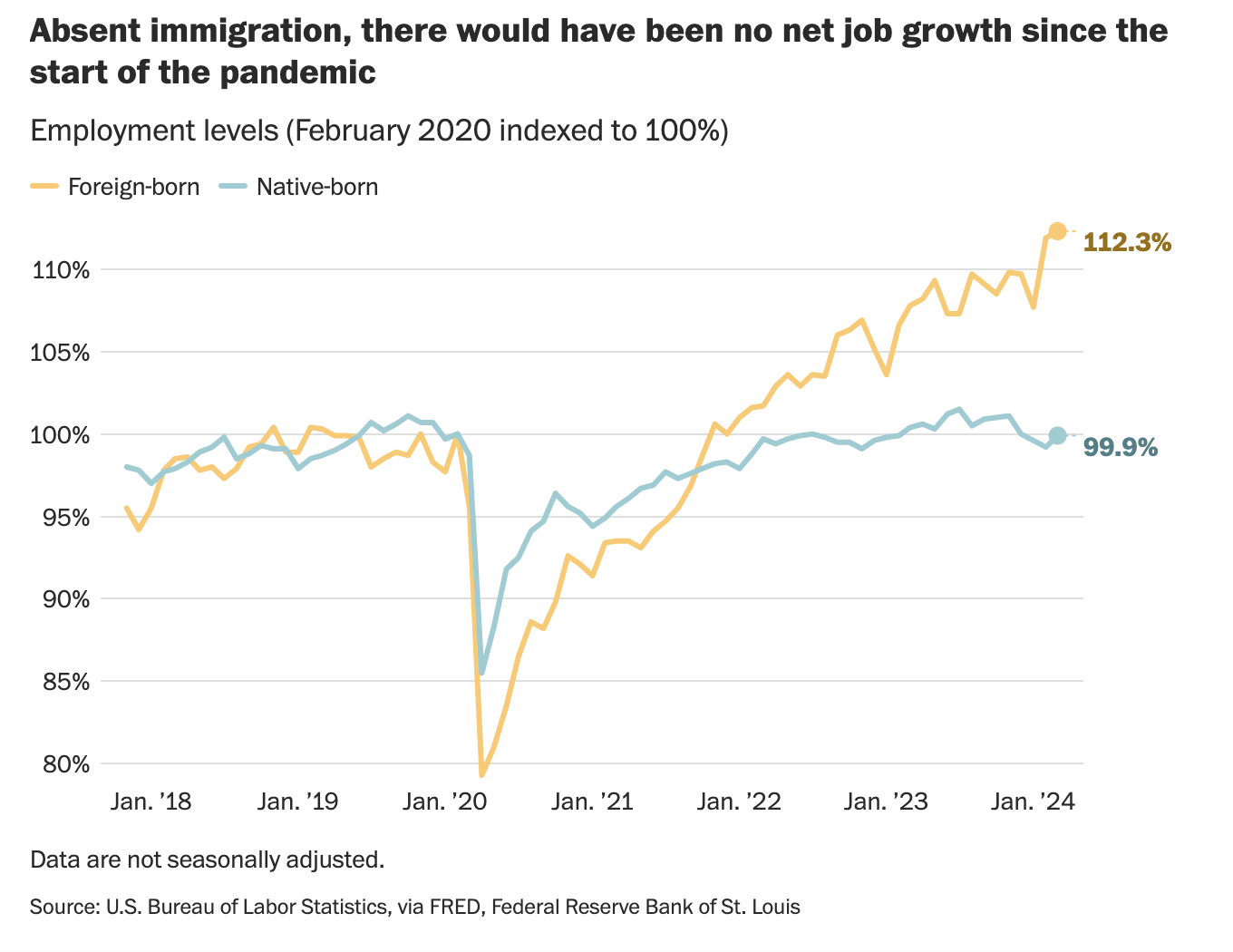
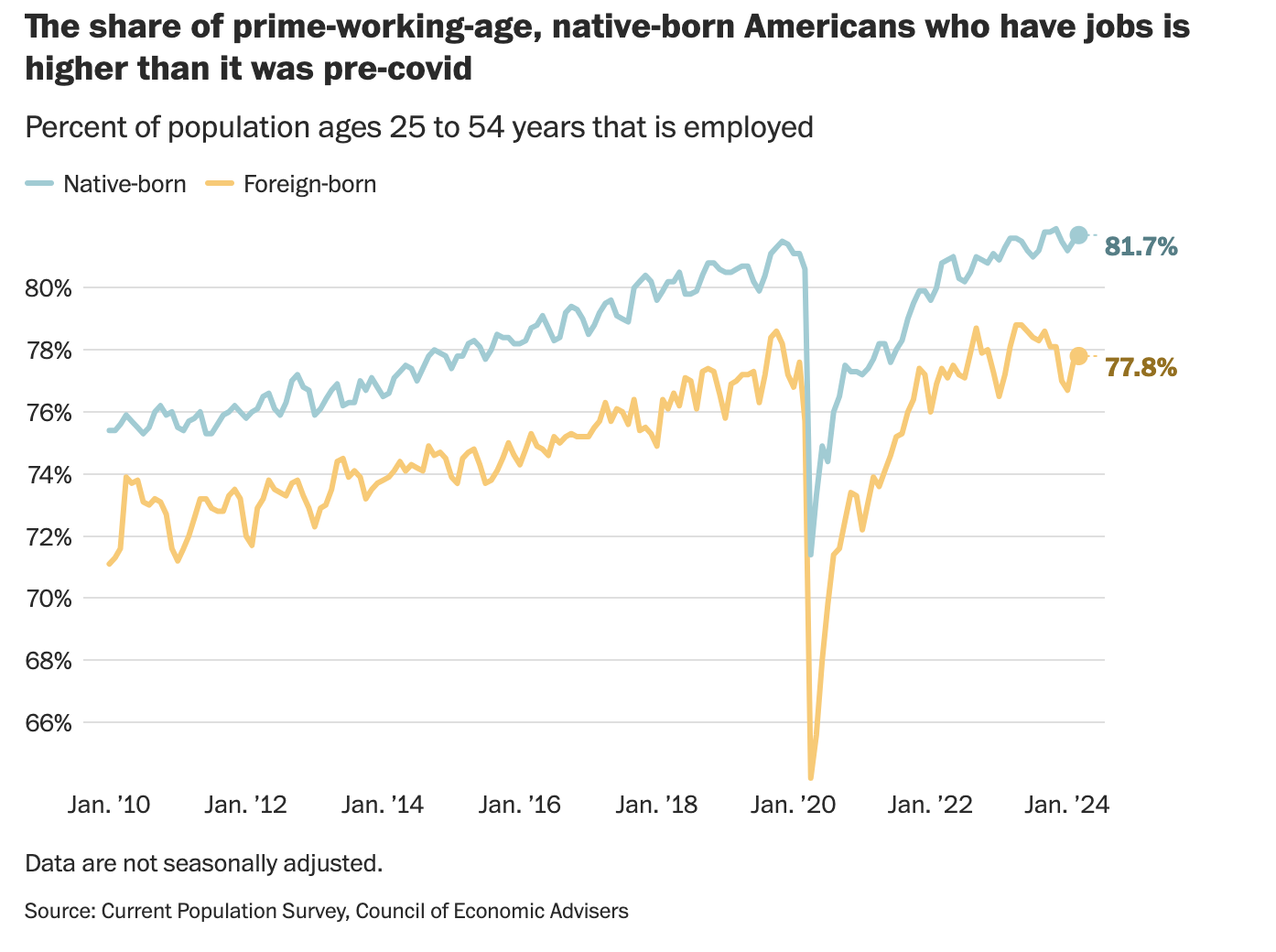
The CBO has now factored in a previously unexpected surge in immigration that began in 2022, which the agency assumes will persist for several years. These immigrants are more likely to work than their native-born counterparts, largely because immigrants skew younger. This infusion of working-age immigrants will more than offset the expected retirement of the aging, native-born population.

This will in turn lead to better economic growth. As CBO Director Phill Swagel wrote in a note accompanying the forecasts: As a result of these immigration-driven revisions to the size of the labor force, “we estimate that, from 2023 to 2034, GDP will be greater by about $7 trillion and revenues will be greater by about $1 trillion than they would have been otherwise.”

Got that? The surprise increase in immigration has led a multitrillion-dollar windfall for both the overall economy and federal tax coffers.

The CBO is hardly the only observer that has highlighted the benefits of the recent influx of foreign-born workers.

As I reported in 2021, “missing” immigrant workers — initially because of pandemic-driven border closures and later because of backlogged immigration agencies — contributed to labor shortages and supply-chain problems. But since then, work-permit approvals and other bureaucratic processes have accelerated. Federal Reserve officialsnoted that this normalization of immigration numbers boosted job growth and helped unwind supply-chain kinks.

Over the long term, Federal Reserve Chair Jerome H. Powell recently said on CBS News’s “60 Minutes,” “the U.S. economy has benefited from immigration. And, frankly, just in the last year a big part of the story of the labor market coming back into better balance is immigration returning to levels that were more typical of the pre-pandemic era.”

A rise in the number of people ready and willing to work is not the only economic benefit. Immigrants are also associated with other positive growth effects, including higher entrepreneurship rates and disproportionate contributions to science, research and innovation.

Consider, too, the national security, humanitarian and religious arguments for providing refuge to persecuted people around the world.

None of this is to diminish the near-term stresses on the U.S. economy that come from poorly managed flows of immigration. These challenges clearly exist, both at the southwest border and in cities such as New York and Chicago, where busloads of asylum seekers are ending up (by choice or otherwise). Absent more resources to manage these inflows and expedite processing either to authorize migrants to work in the United States or to return them to their home countries, this strain will continue.

But there are ways to harness the energies and talents of the “tempest-tost” and patch our tattered immigration system. Some of those tools were built into the bipartisan Senate border bill, which now appears dead.

Instead, GOP lawmakers scaremonger about the foreign-born, characterizing immigration as an invasion. As Rep. Mike Collins (R-Ga.) dog-whistled last week, “Import the 3rd world. Become the 3rd world.”

Alas, the faction working to turn the United States into a developing country is not immigrants but Collins’s own party. It’s Republicans, after all, who have supported the degradation of the rule of law; the return of a would-be dictator; the gutting of public education and health-care systems; the rollback of clean-water standards and other environmental rules; and the relaxation of child labor laws (in lieu of letting immigrants fill open jobs, of course).

America has historically drawn hard-working immigrants from around the world precisely because its people and economy have more often been shielded from such “Third World”-like instability, which Republican politicians now invite in.

Ronald Reagan, the erstwhile leader of the conservative movement, often spoke poignantly of this phenomenon. In one of his last speeches as president, he described the riches that draw immigrants to our shores and how immigrants in turn redouble those riches:

Thanks to each wave of new arrivals to this land of opportunity, we’re a nation forever young, forever bursting with energy and new ideas, and always on the cutting edge, always leading the world to the next frontier. This quality is vital to our future as a nation. If we ever closed the door to new Americans, our leadership in the world would soon be lost.— https://www.reaganlibrary.gov/archives/speech/remarks-presentation-ceremony-presidential-medal-freedom-5

Reagan’s words reflected the poetry of immigration. Since then, the prose — as we’ve seen in the economic numbers, among other metrics — has been pretty compelling, too.

Catherine Rampell is an opinion columnist at The Washington Post. She frequently covers economics, public policy, immigration and politics, with a special emphasis on data-driven journalism. She is also an economic and political commentator for CNN, a special correspondent for the PBS NewsHour and a contributor to Marketplace. She serves on the advisory board for the Journal of Economic Perspectives. Before joining The Post, she wrote about economics and theater for the New York Times. Rampell received the 2021 Online Journalism Award for Commentary and the 2010 Weidenbaum Center Award for Evidence-Based Journalism, and she is a six-time Gerald Loeb Award finalist. She grew up in Florida and graduated Phi Beta Kappa from Princeton University.

Honors and Awards: Weidenbaum Center Award for Evidence-Based Journalism, 2010; Gerald Loeb Award, Finalist, 2011; Gerald Loeb Award, Finalist, 2012; Gerald Loeb Award, Finalist, 2018; Gerald Loeb Award, Finalist, 2019; Gerald Loeb Award, Finalist, 2020; Gerald Loeb Award, Finalist, 2021; Online Journalism Award, 2021

If you are old enough to remember a different America, an America of neighborhood shops, of local bakeries, butchers, drugstores (with a soda fountain), shoe stores, bookstores, and dress shops, you may have wondered why most of them have been replaced by national chain stores and anonymous strip malls. Now we see even neighborhood public schools replaced by national charter chains, some even operated by for-profit corporations. Thom Hartmann explains the roots of this change in his new book The Hidden History of Monopolies: How Big Business Destroyed the American Dream. He is releasing the book a chapter at a time on his blog, which should whet our appetite to buy and read the book. This chapter describes the legal ploy that resulted in crushing local enterprise and creating billionaires.

He writes:

Robert Bork was Richard Nixon’s solicitor general and acting attorney general and had a substantial impact on the thinking in the Reagan White House—so much so that Reagan rewarded his years of hard work on behalf of America’s monopolists with a lifetime appointment to the federal bench in the DC Circuit, frequently a launching pad for the Supreme Court.

In the years following Lewis Powell’s 1971 memo, as numerous “conservative” and “free market” think tanks and publications grew in power and funding, Bork’s ideas gained wide circulation in circles of governance, business, and the law.

In 1977, in the case of Continental T.V., Inc. v. GTE Sylvania, the Supreme Court took up Bork’s idea and, for the first time in a big way, embraced the “welfare of the consumer” and “demonstrable economic effect” doctrines that Bork had been promoting for over a decade.

Neither of those phrases exists in any antitrust law, at least in Bork’s context. Nonetheless, the Supreme Court embraced Bork’s notion that the sole metric by which to judge monopolistic behavior should be prices that consumers pay, rather than the ability of businesses to compete or the political power that a corporation may amass.

When Ronald Reagan entered the White House in 1981, bringing with him Bork’s free market philosophy and a crew from the Chicago School, he ordered the Federal Trade Commission to effectively stop enforcing antitrust laws even within the feeble guidelines that the Supreme Court had written into law in GTE Sylvania.

The result was an explosion of mergers-and-acquisitions activity that continues to this day, as industry after industry concentrated down to two, three, four, or five major players who function as cartels. (A brilliant blow-by-blow cataloging of that decade is found in Barry C. Lynn’s book Cornered: The New Monopoly Capitalism and the Economics of Destruction.)

Bork’s reasoning—that antitrust law should defend only the consumer (through low prices), and not workers, society, democracy, or local communities—has become such conventional wisdom that in the 2014 Supreme Court case of FTC v. Actavis, Chief Justice John Roberts wrote a virtual word-for-word parroting of Bork: “The point of antitrust law is to encourage competitive markets to promote consumer welfare.”

Barak Orbach, professor of law at the University of Arizona, is one of a small number of scholars today who are genuine experts in the field of antitrust law. In a 2014 paper published by the American Bar Association, he wondered if Bork knew he was lying when he wrote that the authors of the Sherman Antitrust Act intended to reduce prices to advance “consumer welfare,” instead of protecting the competitiveness of small and local businesses, and the independence of government at all levels.

His conclusion, in “Was the ‘Crisis in Antitrust’ a Trojan Horse?” was that Bork was probably just blinded by ideology and had never bothered to go back and read the Congressional Record, which, he noted, says nothing of the kind.74

While Bork wrote that “the policy the courts were intended [by the Sherman Antitrust Act] to apply is the maximization of wealth or consumer want satisfaction,” Orbach said, “Members of Congress . . . were determined to take action against the trusts to stop wealth transfers from the public.” So much for that: today the Walton (Walmart) family is the richest in America and one of the richest in the world. They’re worth more than $100 billion, having squirreled away more wealth than the bottom 40% of all Americans. And they spend prodigiously on right-wing political causes, from the national to the local.

Amazon’s Jeff Bezos is now wealthier than any Walton; with a registered net worth of $112 billion, he is the richest single person in the world. Bezos is so rich that when he divorced his wife, MacKenzie Bezos, she received 19.7 million shares of Amazon worth $36.8 billion. She instantly became the world’s third-richest woman, and Jeff Bezos remained the world’s wealthiest man.75 While local newspapers are shutting down or being gobbled up all over the country, Bezos personally purchased the 140-year-old Washington Post in 2013 for $250 million. Now Bezos, like the Walton family, can use his sub- stantial wealth to obtain political ends that protect his wealth and allow Amazon to continue to grow.