Archives for category: Economy

Every so often, someone writes in to say that immigrants are hurting the economy, and in particular, they are taking jobs away from native-born workers. Sometimes they quote economist Paul Krugman, who writes a regular column for The New York Times, to make their point. See, they say, even Paul Krugman agrees with me.

But not so fast. Krugman recently wrote this column, where he takes the opposite view.

He wrote:

On the eve of the 2020 election Donald Trump, in a post on the platform formerly known as Twitter, told voters that “This election is a choice between a TRUMP RECOVERY or a BIDEN DEPRESSION.” Not quite. Since President Biden took office, the United States has gained 15.7 million jobs.

Trump, however, has been dismissing the good news on employment, claiming that all the job gains are going to illegal immigrants. In my most recent column I addressed his further claim that immigration has had a devastating effect on Black workers. (It hasn’t.)

What is true, however, is that a lot of recent employment growth has involved immigrants. But have their job gains come at the expense of the native-born?

No. But how do we know that? And how should we think about the effect of recent immigration on jobs?

Before I present numbers, there are three qualifications to consider.

First, while we have monthly estimates for employment that distinguish between native-born and foreign-born workers (although they don’t separate out the undocumented), these numbers aren’t adjusted for seasonal variation. Rather than try to roll my own seasonal adjustment, I’ll just use 12-month averages, which are good enough for current purposes.

Second, many experts believe that the standard numbers, based on the Current Population Survey, underestimate the recent surge in immigration. I’ll note where this makes a difference, but it doesn’t change the overall picture.

Finally, when you’re looking at recent job growth, it matters what you choose as your starting point. Biden inherited an economy still depressed by the effects of Covid-19, and some of the job growth on his watch reflected a recovery from that depressed state. It arguably makes more sense to compare the current economy with the economy on the eve of Covid. I’ll do it both ways, looking at both job growth since 2020 and job growth from the prepandemic year 2019.

OK, here we go. First, let’s compare average employment in the 12 months ending in June 2024 with employment in 2019 and employment in the pandemic year 2020.

Since 2020 there have been large increases in employment of both native- and foreign-born workers, but much of that reflected recovery from the pandemic slump. Compared with the prepandemic economy, job gains have been much smaller, especially for the native-born. So immigrants have accounted for most job growth — perhaps more than the chart says, if immigration has been understated — although not all of it.

The question, however, is whether the jobs immigrants have taken would have gone to native-born workers if immigration had been lower.

Well, if immigrants were stealing our jobs, we’d expect to see a sharp rise in unemployment among the native-born. We don’t. The unemployment rate among native-born workers is near a historic low.

But some anti-immigrant crusaders argue that unemployment is only low because immigrants have driven native-born Americans entirely out of the labor force; you’re only counted as unemployed if you’re actively seeking a job.

Indeed, the share of native-born adults in the labor force — employed or unemployed — has fallen slightly since 2019.

But this was both predictable and predicted, not because of immigration but as a result of the aging of the native-born population. Congressional Budget Office projections published in January 2020 — when nobody knew that either the pandemic or the immigration surge were coming — had already forecast a decline in the labor force participation rate as baby boomers retired.

So the near stagnation of native-born employment isn’t a demand-side issue, in which people aren’t working because they can’t find jobs. It is instead a supply-side issue, in which people aren’t working because they’ve reached retirement age. We’ve been able to achieve large increases in overall employment only because working-age immigrants have been coming to America. If we didn’t have the immigrants, we wouldn’t have the jobs.

What about the impact of immigration on wages? A few decades ago many economists, myself included, believed that immigrants with low levels of formal education were in effect competing with native-born workers who also lacked degrees. But most labor economists now believe that immigrants don’t do much head-to-head competition with native-born workers; they bring different skills and take different jobs. And the past few years, with elevated immigration, have also been an era of exceptional growth in wages for the worst paid.

So none of these negative claims about the effects of immigration hold up. But are there important positive effects? (Aside from the benefits to the immigrants themselves, which can be really large — I am very glad, for multiple reasons, that my grandparents left the Russian Empire.)

There’s a good although not ironclad case that immigration has helped limit inflation in recent years. Normally, as Jerome Powell, chair of the Federal Reserve, recently noted, immigration is more or less neutral in its effects on inflation: Immigrants expand supply, but they also contribute to demand. In the aftermath of the pandemic, however, the huge sums spent on aid pumped up demand; this burst of demand was easier to accommodate without sustained inflation because immigration made it possible to achieve rapid growth in employment.

In the longer run, the big story is fiscal. Adult immigrants tend to be working age, which means that they will spend years paying taxes before they become eligible for Medicare and Social Security, which constitute a large part of federal spending. And while this point is a bit brutal, undocumented immigrants are especially good for the budget, because they pay payroll taxes (which are collected by employers) without being eligible for future benefits.

So, no, immigrants aren’t taking our jobs. Everything that happens in the economy hurts someone: There are no doubt some places where immigrants have driven up housing costs, or where native-born Americans or legal immigrants have faced increased job competition. But the scare stories don’t match the facts.

To see Krugman’s nifty graphics, taken from the Buteau of Labor Statistics, please open the link.

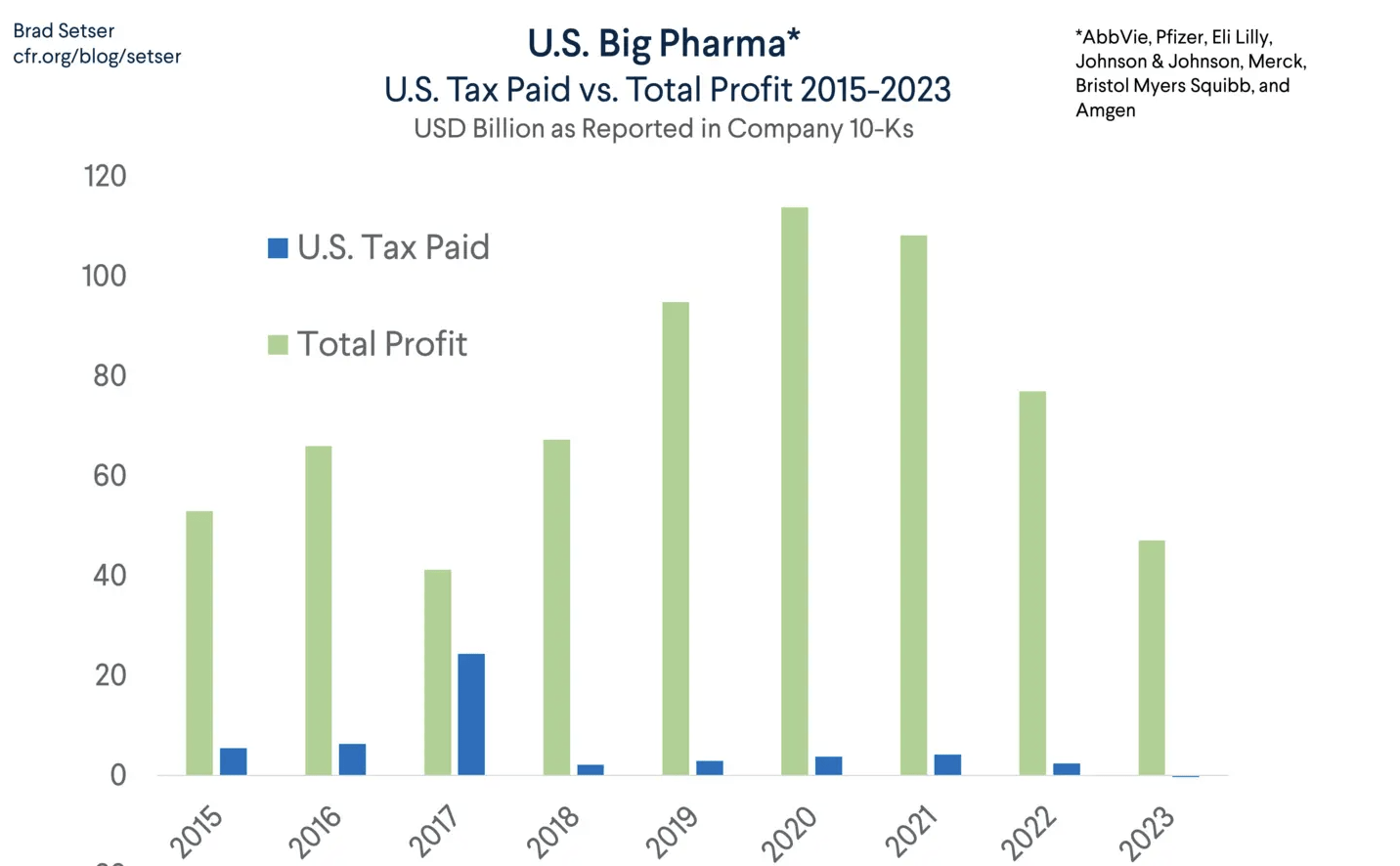
Big Pharma makes big profits in the U.S., but has mastered the accounting trick of paying little or no taxes. Thanks to Trump’s big corporate tax cut in 2017, most of these corporations are able to transfer their profits to other countries where the tax rates are lower.

Although they receive the bulk of revenue from sales in the U.S. and report large overall profits, most large U.S.-based pharmaceutical companies don’t pay any taxes in the country.

A new analysis of corporate taxes paid by the largest U.S. pharma companies by the Council on Foreign Relations found that in 2023, the top seven based on revenue had a combined U.S. tax obligation of (-)$250M.

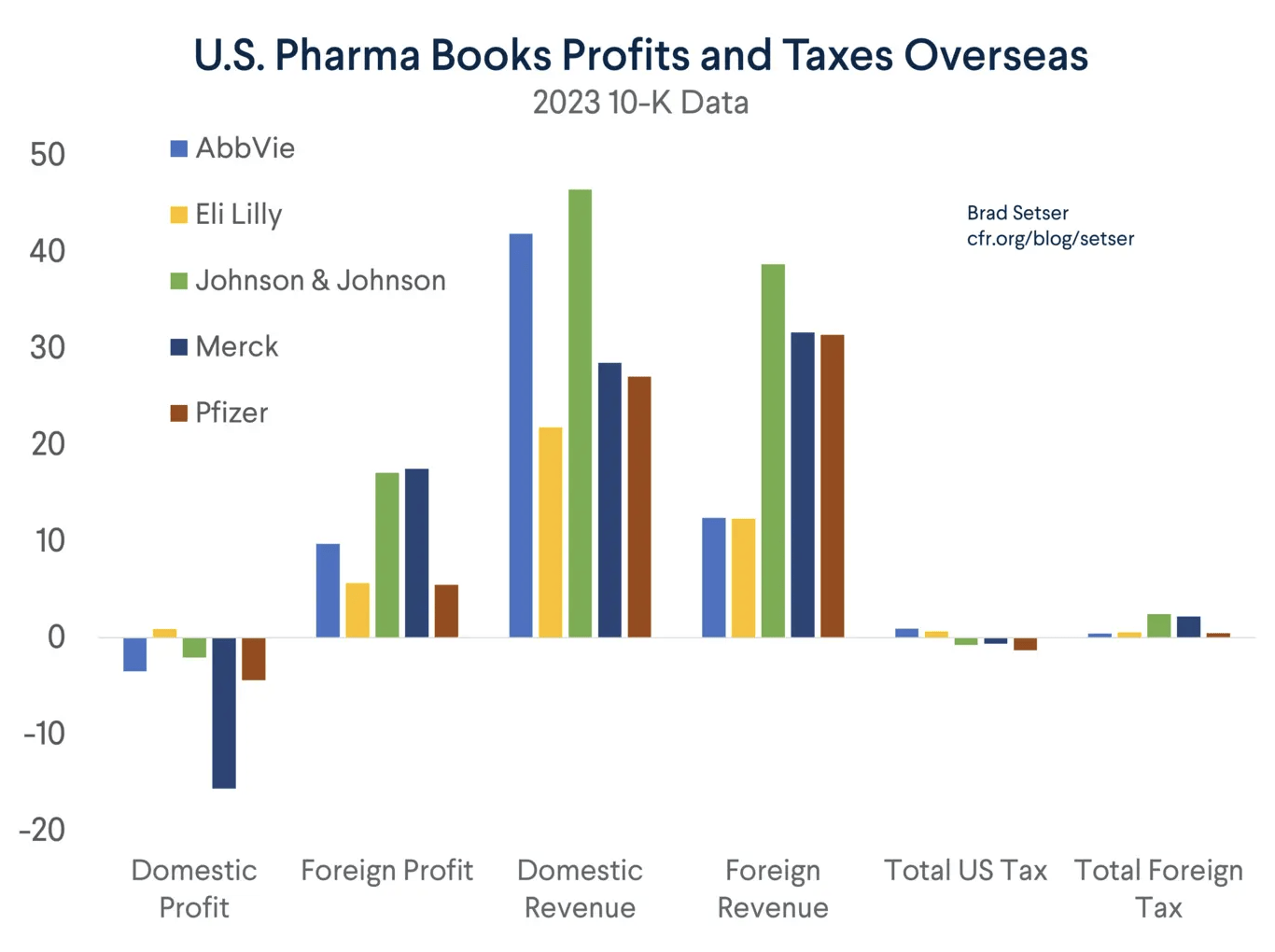
The duo also noted that, based on 10-K filings, many pharmas reported losses in the U.S. in 2023. Among them: Pfizer, $4.4B; AbbVie, $3.5B; Merck, $15.6B; and Johnson & Johnson $2B.

However, Setser and Weilandt estimated that Eli Lilly (LLY) reported a $0.9B U.S. profit.

Gilead Sciences (GILD) is an outlier among large biopharmas. It is the eighth largest U.S. biopharma by revenue, yet reported paying $3B in U.S. taxes in 2023.

Setser and Weilandt explain how pharmas can book U.S. profits overseas to save on paying U.S. taxes. The first reason is the Tax Cuts and Jobs Act of 2017, which the pair say provided for lower taxes on foreign profits than U.S. profits, providing an incentive for companies to book more profits overseas.

Second, since many drugs sold in the U.S. market are actually made abroad, pharma companies decide to book those profits in the country of manufacture.

Finally, many pharmas have moved their intellectual property to wholly owned subsidiaries in locations with more favorable tax rates than the U.S.

Open the link to read the rest of the article.

Sarah Jaffe wrote in The American Prospect about the latest way to extract profit from consumers: surge pricing. It’s not only Uber and Lyft. It’s spreading into every corner of business.

She writes:

The internet nearly exploded this February when Wendy’s CEO Kirk Tanner announced that the fast-food chain intended to embrace “surge pricing,” raising the prices of a burger and a Frosty in line with customer demand.

The company had included a mention of “dynamic pricing” in its fourth-quarter earnings presentation, but clarified after the kerfuffle that the announcement of its new digital menu displays had been “misconstrued in some media reports as an intent to raise prices when demand is highest,” and said that it had “no plans to do that.” Instead, the new system would merely allow Wendy’s to “offer discounts and value offers to our customers more easily.”

The snark, which included Sen. Elizabeth Warren (D-MA), ranged from pure outrage to questions of whether the company would also offer “surge pay” to its low-wage workforce. But it’s not like Wendy’s invented price-gouging. A quarter-century earlier, Coca-Cola’s CEO mused about equipping its vending machines with thermometers, and triggering them to raise the price of a soda on a hot day. People hated that too; we just didn’t have social media then.

Wendy’s and Coke aside, surge pricing is spreading. Since deregulation in the late 1970s, airlines have used a form of it, with flights costing more at short notice or at high-demand times of year. Now, the practice has crept into golf courses, hotel rooms, gyms, pubs, and concert venues. Amazon alters its prices every ten minutes. Like Wendy’s, brick-and-mortar retailers are moving to digital price tags, allowing them to surge at will. Consulting firms like Sauce Pricing promise automatic surge pricing at restaurants to boost revenues. A chain bowling alley called Bowlero charged $418.90for two lanes one day last year. Surge pricing “will eventually be everywhere,” the Financial Times, that chronicler of modern capitalism, said last September.

Customers tend to want to know in advance how much something will cost, and though we’re used to the cost of a gallon of gas, or even a quart of milk or a can of Coke, changing over time, those things tend not to fluctuate rapidly over the course of a day or even an hour. People make a distinction between things you need right away and things you could wait for; between luxury items, like market-price lobster at the hottest restaurant in town, and something we all know is cheap and easy, like a Wendy’s cheeseburger.

As companies gather more data available on consumer preferences, the process of algorithmically adjusting prices rapidly based on supply and demand will get easier, affecting all sorts of goods and services we’ve grown to count on. And there’s a case study in how this affects not only consumers but the workers who serve them. You encounter it every time you hit up your phone to find a way home.

IN RECENT YEARS, “SURGE PRICING” has been mostly associated with rideshare companies like Uber and Lyft. It was one of Uber’s earliest sources of bad press, even back when the tech press mostly penned breathless paeans to genius founder-disruptors. Uber took advantage of dysfunctional taxi systems in cities like Washington, D.C., to win goodwill, according to Kafui Attoh, associate professor of urban studies at the City University of New York’s School of Labor and Urban Studies and co-author of Disrupting D.C.: The Rise of Uber and the Fall of the City.

The pricing system was justified as a way to encourage drivers to come out at peak times by offering them more money, something that a regulated taxi system could not offer. It worked, ostensibly, by some combination of three incentives: reducing demand for rides because fewer people could afford the higher price; offering drivers a higher rate if they hit the road; and getting already-working drivers to head to the high-rate zone.

But regulated taxi systems at least offered a steady price that users could count on, whereas Uber’s sudden price spikes turned a short ride home into a luxury good. Uber spokespeople would suggest that riders simply wait for prices to fall again, but anyone who’s ever been stranded at closing time or missed the last subway knows that waiting sometimes isn’t an option.

Please keep reading by opening the link.

Dan Rather is gobsmacked by the short memories of the delegates at the RNC. How could they have wiped their memories of the insurrection of January 6? How could they take pride in nominating a convicted felon? How could they opine for the Trump economy when Biden’s economy has been so successful? How could they endorse a man who still insists that he won in 2020 without a scintilla of evidence? Sore loser.

He writes:

At their convention in Milwaukee, Republicans see themselves as celebrating what they are convinced is going to be not only a win in November, but an overwhelming one. Among delegates and others on the convention floor and around the hall, there is much chatter about an “avalanche” building. 

This, as they have nominated for president a man who tried to overthrow our government.

Their hope is that a majority of voters will simply forget all Donald Trump has done to help himself and hurt this country. That strikes many Americans as falling in the narrow space between revolting and appalling. 

And my goodness, the lies are flying fast and furious at the Republican fantasy convention. This glitzed-up affair is full of speeches that don’t even come close to the truth. Here’s how bad it is: Some major news organizations (although unfortunately not all) are fact-checking the speeches live, calling out the lies in real time. 

But it’s more than that. Republicans must believe Americans are in a mood to forgive and forget. To forgive the insurrection of January 6 and forget the fact that the former president kept top-secret documents strewn about Mar-a-Lago like last month’s junk mail, among many other indiscretions.

How much airtime and how many column inches will be devoted this week to what the previous president has done to harm our democracy? My guess is almost none. Instead there will be a celebration, one devoid of context. It will be an anointing without proper perspective and analysis. And there will be misleading speech after misleading speech. 

Tip of the Stetson to The Washington Post and The New York Times, whose fact-checkers are calling out a myriad of false claims. MSNBC is doing the same in real time. CNN is airing a fact-checking segment after the convention coverage. Unsurprisingly, Fox “News” is airing live speeches unchallenged and unchecked.

So far, the speeches have been riddled with stunning yet emphatically stated lies. Trump, the liar-in-chief, is getting a run for his money in the telling of tales. Over two days, the Post’s fact-checkers have found that convention speakers have made false claims about border crossings, gas prices, fentanyl, tax cuts, Vice President Kamala Harris, peace during Trump’s presidency, voting by migrants, energy independence, the relative wealth of young Americans, and Easter Sunday.

The lies and misinformation are meant to rile and to scare. Texas Senator Ted Cruz actually said this out loud from the convention podium: “Americans are dying, murdered, assaulted, raped by illegal immigrants that the Democrats have released.”

And then there’s the old chestnut, election denialism. According to the Post, 62 convention speakers have previously questioned President Biden’s 2020 election win. 

Nikki Haley and Ron DeSantis have capitulated, forgiving Trump for his miserable and untruthful treatment of them when they were running against him. They both gave speeches endorsing him on Tuesday night.

And don’t forget House Speaker Mike Johnson’s claim that the Republican Party is “the law and order team,” as it nominates a convicted felon.

It is no secret that the political nominating conventions lost their significance decades ago. Today, they are nothing more than hour upon hour of campaign advertising, which makes them a great place to court undecided voters. This MAGA convention will be hard-pressed to appeal to middle-of-the-roaders. Republicans can no longer claim to be the party of Lincoln or even of Reagan. It is wholly the party of Trump and his MAGA extremist followers. Their newly anointed vice presidential candidate, JD Vance, is even more extreme on issues like gun control and abortion than Trump.

Vance and the convention speakers are talking some about America’s need for unity, and that’s good, if they actually mean it. But after only two days, they seem to have abandoned the calls for unity and reverted back to the MAGA talking points. Against the backdrop of Republicans celebrating in Milwaukee, let’s hope that most of the rest of the country gives itself a gut check on Trump’s record and the reality of what his victory in November would mean.

Watch President Biden’s Detroit rally tonight. Biden spoke for about 30-40 minutes, and he was outstanding. He touted the economic record of his administration, and he described his agenda for his first 100 days in his second administration.

He also described the dangerous agenda of Trump’s Project 2025. He said “Trump is a loser!”

Number #1 on his agenda would be signing legislation to make Roe v. Wade the law of the land. He promised to promote good union jobs. He pledged to protect healthcare, Medicare, and Social Security. He said he would revive the Child Tax Credit, which cut child poverty in half before Republicans blocked its renewal. There was more.

He made clear that his goal was to strengthen the middle class.

President Biden was vigorous, passionate, and articulate. The crowd was fired up.

Biden is in it to win it.

John Thompson, retired teacher in Oklahoma, writes here about the environmental crisis in his state, propelled by greed.

He writes:

Oklahoma City is again in the national news. On one hand, it was ranked 16th in the nation in the U.S. News & World Report’s “Best Places to Live” in 2024-2025. On the other hand, The International Classification of Functioning, Disability and Health’s, (ICF) Climate Center just projected how Oklahoma City’s “temperature will change by mid-century under a moderate warming scenario.” 

From 1981 to 2010, the average annual days in Oklahoma City where heat put a strain on electric transformers was 10. This was due to “blistering daytime highs along with sultry nighttime lows, depriving electrical equipment of a chance to cool down.” By the midcentury (2036 to 2065) it is projected to reach 45 days. Also, Tulsa is expected to reach 44 days and Altus 65 days of heat waves. 

It also estimated that Phoenix, which is in the news for its current heat wave, “will endure an estimated 126 days each year with heat that reduces transformers’ performance, the analysis found. A power outage during a heat wave would kill thousands of people in the city, according to a peer-reviewed study published last year.”

Of course, the stress that heat waves dump on transformers is just an indicator of the predicted effects of a 350% increase in heat waves in Oklahoma City, and worse increases across the world. The distress imposed on infrastructure should be seen as a symptom of the devastation that humans, and other living beings will face.

The national press has also reported on possible ways that Oklahoma (and other places) could respond to global warming. In an editorial in the Tulsa WorldPhilip-Michael Weiner explained, “If we want to have a more stable climate in the future, we need to remove a lot of the carbon already in the air.” He adds, “Our elected representatives must not miss the chance to help Oklahoma become a global leader in carbon removal.”

Weiner explains that Oklahoma is “well-situated to become a global leader in carbon removal and reap meaningful economic benefits for our state.” He cites “Oklahoma’s geo-workers, technology, and resources, [and] vast geologic capacity, subsurface geology, needed for carbon storage.” And Weiner adds that, “Exxon Mobil Corp. estimates there will be a $4 trillion market by 2050 for capturing carbon dioxide and storing it underground.”

But that leads to another concern. Yes, given our failure to adequately tackle the proven threat of climate change, we must invest heavily in a range of efforts to decarbonize our atmosphere. And that will require major commitments from corporations, especially oil and gas companies, as well as government programs. But, we wouldn’t be facing such an existential threat if oil and gas companies, especially Exxon, had not hid their research which confirmed the findings of scientists who nearly convinced the H.W. Bush administration that carbon dioxide emissions needed to be quickly and massively cut. As the Guardian noted, their study:

Made clear that Exxon’s scientists were uncannily accurate in their projections from the 1970s onwards, predicting an upward curve of global temperatures and carbon dioxide emissions that is close to matching what actually occurred as the world heated up at a pace not seen in millions of years.

But they borrowed the tactics of the tobacco industry, which knowingly lied about the deadly dangers of their product. And then Exxon “continued its disinformation campaign for another half century.”

Yes, there has been reporting on Oklahomans seeking to apply technologies developed for fracking in order to cut greenhouses gases. But the bigger stories have focused on Oklahoma oil billionaire Harold Hamm, who pledges, “We’re going to be on oil and gas for the next hundred years,” It was Hamm who organized the “energy round table” at former President Trump’s private club where he promised “to eliminate Mr. Biden’s new climate rules intended to accelerate the nation’s transition to electric vehicles, and to push a ‘drill, baby, drill’ agenda aimed at opening up more public lands to oil and gas exploration.”

The New York Times reported that sources:

Asked not to be identified in order to discuss the private event.  Attendees included executives from ExxonMobil, EQT Corporation and the American Petroleum Institute, which lobbies for the oil industry.

One would think that the new predictions regarding global warming in Oklahoma City, and elsewhere, would convince the Chamber of Commerce and political leaders to immediately make de-carbonization a #1 priority. And it should be clear that the Hamm/Trump agenda – pushed by oil industry lobbyists – would devastate our planet. Somehow, we have to come together and hope businessmen will value stakeholders as well a shareholders, and place mankind over short-term corporate profits for a very few.  

By the way, as I was about to complete this post, United Nation’s World Meteorological Organization (WMO) said:

There is now an 80% chance that at least one of the next five years will mark the first calendar year with an average temperature that temporarily exceeds 1.5C above pre-industrial levels – up from a 66% chance last year.

As Reuters reports, “scientists warn of more extreme and irreversible impacts” if the 1.5C threshold is passed. So, “U.N. Secretary-General António Guterres called for urgent action to avert ‘climate hell.”” And I would add, Oklahomans and other Americans must double down on our abilities to fight global warming. But it is too late to make a difference in saving our planet if we don’t resist Exxon, Harold Hamm, Donald Trump, and others who are promoting the economics of destruction.

Heather Cox Richardson wrote the following post on May 8 about President Biden’s recent visit to Wisconsin. She compares Biden to FDR. Under Trump, Wisconsin lost jobs. Under Biden, Wisconsin has gained jobs. That’s the heart of the Biden agenda: building a strong middle-class and creating good union jobs.

She writes:

Today, in Racine, Wisconsin, President Joe Biden announced that Microsoft is investing $3.3 billion dollars to build a new data center that will help operate one of the most powerful artificial intelligence systems in the world. It is expected to create 2,300 union construction jobs and employ 2,000 permanent workers. 

Microsoft has also partnered with Gateway Technical College to train and certify 200 students a year to fill new jobs in data and information technology. In addition, Microsoft is working with nearby high schools to train students for future jobs. 

Speaking at Gateway Technical College’s Racine campus, Biden contrasted today’s investment with that made by Trump about the same site in 2018. In that year, Trump went to Wisconsin for the “groundbreaking” of a high-tech campus he claimed would be the “eighth wonder of the world.” 

Under Republican governor Scott Walker, Wisconsin legislators approved a $3 billion subsidy and tax incentive package—ten times larger than any similar previous package in the state—to lure the Taiwan-based Foxconn electronics company. Once built, a new $10 billion campus that would focus on building large liquid-crystal display screens would bring 13,000 jobs to the area, they promised. 

Foxconn built a number of buildings, but the larger plan never materialized, even after taxpayers had been locked into contracts worth hundreds of millions of dollars for upgrading roads, sewer system, electricity, and so on. When voters elected Democrat Tony Evers as governor in 2022, he dropped the tax incentives from $3 billion to $80 million, which depended on the hiring of only 1,454 workers, reflecting the corporation’s current plans. Foxconn dropped its capital investment from $10 billion to $672.8 million.  

In November 2023, Microsoft announced it was buying some of the Foxconn properties in Wisconsin.

Today, Biden noted that rather than bringing jobs to Racine, Trump’s policies meant the city lost 1,000 manufacturing jobs during his term. Wisconsin as a whole lost 83,500. “Racine was once a manufacturing boomtown,” Biden recalled, “all the way through the 1960s, powering companies—invented and manufacturing Windex…portable vacuum cleaners, and so much more, and powered by middle-class jobs.

“And then came trickle-down economics [which] cut taxes for the very wealthy and biggest corporations…. We shipped American jobs overseas because labor was cheaper. We slashed public investment in education and innovation. And the result: We hollowed out the middle class. My predecessor and his administration doubled down on that failed trickle-down economics, along with the [trail] of broken promises.” 

“But that’s not on my watch,” Biden said. “We’re determined to turn it around.” He noted that thanks to the Democrats’ policies, in the past three years, Racine has added nearly 4,000 jobs—hitting a record low unemployment rate—and Wisconsin as a whole has gained 178,000 new jobs. 

The Bipartisan Infrastructure Law, the CHIPS and Science Act, and the Inflation Reduction Act have fueled “a historic boom in rebuilding our roads and bridges, developing and deploying clean energy, [and] revitalizing American manufacturing,” he said. That investment has attracted $866 billion in private-sector investment across the country, creating hundreds of thousands of jobs “building new semiconductor factories, electric vehicles and battery factories…here in America.” 

The Biden administration has been scrupulous about making sure that money from the funds appropriated to rebuild the nation’s infrastructure and manufacturing base has gone to Republican-dominated districts; indeed, Republican-dominated states have gotten the bulk of those investments. “President Biden promised to be the president of all Americans—whether you voted for him or not. And that’s what this agenda is delivering,” White House deputy chief of staff Natalie Quillian told Matt Egan of CNN in February. 

But there is, perhaps, a deeper national strategy behind that investment. Political philosophers studying the rise of authoritarianism note that strongmen rise by appealing to a population that has been dispossessed economically or otherwise. By bringing jobs back to those regions that have lost them over the past several decades and promising “the great comeback story all across…the entire country,” as he did today, Biden is striking at that sense of alienation.

“When folks see a new factory being built here in Wisconsin, people going to work making a really good wage in their hometowns, I hope they feel the pride that I feel,” Biden said. “Pride in their hometowns making a comeback. Pride in knowing we can get big things done in America still.” 

That approach might be gaining traction. Last Friday, when Trump warned the audience of Fox 2 Detroit television that President’s Biden’s policies would cost jobs in Michigan, local host Roop Raj provided a “reality check,” noting that Michigan gained 24,000 jobs between January 2021, when Biden took office, and May 2023.

At Gateway Technical College, Biden thanked Wisconsin governor Tony Evers and Racine mayor Cory Mason, both Democrats, as well as Microsoft president Brad Smith and AFL-CIO president Liz Schuler. 

The picture of Wisconsin state officials working with business and labor leaders, at a public college established in 1911, was an image straight from the Progressive Era, when the state was the birthplace of the so-called Wisconsin Idea. In the earliest years of the twentieth century, when the country reeled under industrial monopolies and labor strikes, Wisconsin governor Robert “Fighting Bob” La Follette and his colleagues advanced the idea that professors, lawmakers, and officials should work together to provide technical expertise to enable the state to mediate a fair relationship between workers and employers. 

In his introduction to the 1912 book explaining the Wisconsin Idea, former president Theodore Roosevelt, a Republican, explained that the Wisconsin Idea turned the ideas of reformers into a workable plan, then set out to put those ideas into practice. Roosevelt approvingly quoted economist Simon Patten, who maintained that the world had adequate resources to feed, clothe, and educate everyone, if only people cared to achieve that end. Quoting Patten, Roosevelt wrote: “The real idealist is a pragmatist and an economist. He demands measurable results and reaches them by means made available by economic efficiency. Only in this way is social progress possible.”

Reformers must be able to envision a better future, Roosevelt wrote, but they must also find a way to turn those ideals into reality. That involved careful study and hard work to develop the machinery to achieve their ends. 

Roosevelt compared people engaged in progressive reform to “that greatest of all democratic reformers, Abraham Lincoln.” Like Lincoln, he wrote, reformers “will be assailed on the one side by the reactionary, and on the other by that type of bubble reformer who is only anxious to go to extremes, and who always gets angry when he is asked what practical results he can show.” “[T]he true reformer,” Roosevelt wrote, “must study hard and work patiently.” 

“It is no easy matter actually to insure, instead of merely talking about, a measurable equality of opportunity for all men,” Roosevelt wrote. “It is no easy matter to make this Republic genuinely an industrial as well as a political democracy. It is no easy matter to secure justice for those who in the past have not received it, and at the same time to see that no injustice is meted out to others in the process. It is no easy matter to keep the balance level and make it evident that we have set our faces like flint against seeing this government turned into either government by a plutocracy, or government by a mob. It is no easy matter to give the public their proper control over corporations and big business, and yet to prevent abuse of that control.”

“All through the Union we need to learn the Wisconsin lesson,” Roosevelt wrote in 1912.

“We’re the United States of America,” President Biden said today, “And there’s nothing beyond our capacity when we work together.”

Go to the post to read her footnotes.

Thom Hartmann is releasing his new book The Hidden History of Monopolies on his blog, one chapter at a time. This one is fascinating. Big business has always opposed labor unions. They drive up wages, meaning less profits.

Thom explains:

When people consider monopolies, or even highly concentrated markets like airlines or pharmaceuticals, generally the only thing they think of is the ability of companies in concentrated markets to set prices wherever they’d like. But there are fully three primary benefits to monopoly or oligopoly, from the monopolists’ point of view.

In addition to setting prices by restricting competition, monopolies can (and typically do) drive down wages so that they end up with a steady supply of cheap labor, and—both by market (selling) control and labor market (workers) control—they send vastly more money flowing to stockholders and senior management than can companies in truly competitive marketplaces.

At its core, though, virtually every aspect of the movement that embraced monopoly (Bork actually wrote about all the “lost” inventions, innovations, and profits that were caused by a lack of monopoly!) boiled down to cheap labor. 

Joe Lyles, writing as Conceptual Guerilla, put up a brilliant analysis of this more than a decade ago titled “Defeat the Right in Three Minutes,” suggesting that quite literally everything we call “conservative” was really about driving down wages. While racial hatred and misogyny also play big roles these days in the “conservative” movement, there’s still a lot of truth to Lyles’s analysis.50

Cheap-labor conservatives don’t want a national health care system, because they want workers to be dependent on their employers and thus willing to accept lower wages.

Cheap-labor conservatives hate the minimum wage and unions because both support wage floors and, over time, raise wages for working people.

Cheap-labor conservatives want women relatively powerless (particularly over their own reproductive functions) so that, as in the era before the 1970s, they’ll work for far less than today’s $.78 to a man’s dollar.

Cheap-labor conservatives go on and on about, as Lyles notes, “morality, virtue, respect for authority, hard work and other ‘values’” so that when workers can’t climb the ladder, society will blame it on the individuals instead of a system rigged to maintain cheap labor.

Cheap-labor conservatives encourage bigotry, fear, and hatred to prevent working people from seeing their commonality of human and economic interests, regardless of race, gender identity, or the urban/rural divide.

America has a long history with the cheap-labor crowd: slavery was the ultimate expression of this “conservative” value system, and under the 13th Amendment, it continues to be legally practiced in the United States in our for-profit prison systems.

The 13th Amendment didn’t actually end slavery in the United States; it merely turned it over to prisons, be they state-run or for-profit corporations. It reads: “Neither slavery nor involuntary servitude, except as a punishment for crime whereof the party shall have been duly convicted, shall exist within the United States.” As a result, the pressure on Congress and state legislatures from for-profit prison corporations to increase criminal penalties to give them more literal slave labor has exploded.

Cheap-labor conservatives, it turns out, are also huge fans of monopoly and oligopoly, in large part because these systems keep wages low. 

There’s a marketplace for labor, just like for everything else, and when a small number of corporations control a large number of employment venues, they can simply keep wages low through that market power. Check out the pay of fast-food workers or flight attendants or nurses back in the 1960s compared with today; every industry that concentrates or consolidates sees wages go down….

Please open the link to finish reading.

Texas is represented by some loathsome public officials (looking at you, Governor Abbott, Lt. Gov. Patrick, and Senator Ted Cruz). They have denounced President Biden in every imaginable way. Yet the Biden administration is sending $16 billion to Texas for clean energy and infrastructure. Texas Republicans voted against the legislation but they will gladly take the dollars and the new jobs. (All the red states are getting funds from Biden’s bills that they opposed, while taking credit for them.) And they will continue to insist that climate change is a hoax.

Chris Tomlinson writes in The Houston Chronicle:

Delivering reliable, affordable and sustainable electricity wouldn’t be difficult if officials in Austin and Washington worked together. The challenges are not technological or economic; they are about setting priorities.

Pablo Vegas, chief executive of the Electric Reliability Council of Texas, promised a new approach to grid planning on Tuesday, promising to better track the growing demand for power from industry.

“We need to accelerate aspects of our planning processes and be able to look further into the future, anticipate what’s coming, because it still takes three to six years to build transmission,” Vegas said.

The Legislature ordered ERCOT to start considering long-term proposals to add load to the grid rather than relying only on finalized plans. The new approach makes demand forecasts look much, much larger but also less reliable because not all proposed projects come to fruition.

President Joe Biden, meanwhile, is offering Texans billions of dollars to fortify the electric grid, reduce electricity bills and cut greenhouse gas emissions. On Thursday, the administration promised to upgrade 100,000 miles of transmission lines.

The Environmental Protection Agency also gave $249.7 million to the Texas Solar For All Coalition and  $156.1 million to the Clean Energy Fund of Texas this week to provide solar energy equipment to low-income communities.

The EPA has also granted $104 million in federal funds to 19 Texas school districts to purchase 288 electric school buses. The EPA grants are part of the $16 billion the federal government has committed to clean energy projects in Texas that have created 23,000 jobs.

The money comes from the Inflation Reduction Act, which Texas Republicans vehemently opposed. The massive investment in energy and manufacturing is intended to grow the economy while fighting climate change.

Past investments led Waaree Energies to invest $1 billion in a solar panel manufacturing facility near Houston, creating 1,500 jobs. San Antonio has committed $30 million to build, with federal help, the largest municipal onsite solar project in Texas. Diligence Offshore Services announced in August it would invest $1.23 billion to open an offshore wind support and manufacturing facility off the coast of Port Arthur.

Climate change, though, is still missing from Vegas’ and ERCOT’s lexicon. He’s happy to talk about the growing electricity demand from artificial intelligence and fossil fuel facilities but never mentions the residential demand during climate change-driven extreme weather. That’s what causes record-setting peaks that can trigger outages.

Nationwide, weather caused 80% of the power outages since 2000, and the frequency of blackouts has doubled in the past decade, according to data collated by research nonprofit Climate Central. Texas experienced the most weather-related outages, and the pace is accelerating.

Improving the grid to meet growing industrial electricity demand is quite different from building a system that can withstand a changing climate. Adding more power generation and transmission lines is not enough when facing stronger hurricanes, larger wildfires, colder winter storms and hotter summers.

ERCOT’s planning will remain flawed until officials start preparing for more polar vortexes like 2021’s Winter Storm Uri, rain events like Hurricane Harvey and heat waves like last summer’s.

Transitioning to clean energy and building resilient generation plants and transmission lines offer huge economic opportunities. BlackRock, the world’s largest financial manager, says the world spent $1.8 trillion on the energy transition in 2023 but will need to spend $4 trillion annually by the mid-2030s.

Vegas never mentions climate change because the Republican elected officials who oversee him call it a hoax. Texas will never chart a strong economic course until we have a governor, lieutenant governor and speaker who recognize the greatest threat yet to human prosperity….

Catherine Rampell, opinion writer for the Washington Post, recently explained the positive effect that immigrants have on our economy. She is not advocating “open borders,” nor am I. She is describing the role that immigrants play in boosting our national well-being. We need more legal immigrants.

She writes:

Don’t want more immigrants in this country? Then tell grandma she can never retire.

As I’ve noted before, immigrants are driving the U.S. economic boom. That is: The United States has escaped recession, hiring growth has exceeded expectation, and inflation has cooled faster than predicted — all largely because immigration has boosted the size of the U.S. labor force. Don’t just take my word for it; ask the Federal Reserve chair or Wall Street economists.

After a stretch of depressed immigration levels — primarily driven by Donald Trump’s hobbling of the legal immigration system — the number of immigrants coming here began to rebound mid-2021. Immigrants are more likely to be working-age than native-born Americans, so their arrivals helped solve a number of problems facing the U.S. economy.

For instance, some of our pandemic-related supply-chain woes were related to worker shortages in critical fields such as construction and food processing. An influx of new workers helped fill those vacancies and unsnarl stuck supply chains. In other cases, immigrants have been willing to take jobs that native-born Americans are unwilling to do, such as the backbreaking work of harvesting potatoes, building homes and caring for the elderly. They’re also filling high-tech positions that Americans cannot do because there are insufficient numbers of us with the necessary skills. And they are creating entirely new job opportunities by launching new businesses — something immigrants do at much higher rates than the native-born.

And then there are the jobs we native-born Americans might theoretically be willing and able to fill, but there simply aren’t enough of us around to fill them. The arithmetic is clear: Boomers are retiring and U.S. birthrates have plummeted. Absent immigration, the U.S. working-age population would be either flat or soon shrinking.

As a result, all of the new job growth since the pandemic, on net, has been due to foreign-born workers. That is, if you stripped away immigrants, there would be no more people employed today than was the case before covid.

On many dimensions, our ability to attract global talent to our shores is a blessing. But this being an election year, and demagogues being demagogues, right-wing pundits and political operatives have worked to darken these bright statistics.

Fox News refers to Bidenomics as a “migrant job fair.” The Republican-aligned Heritage Foundation alleges that “Americans have been completely left behind in this economy,” citing as evidence that fact I just mentioned: that all the net new job growth is accounted for by immigrants.

But the labor market is not zero-sum, and native-born workers happen to be doing extraordinarily well, too. In fact, the share of native-born Americans considered “prime working age” (25 to 54 years old, so after traditional college-going years and preretirement) who have jobs is higher than it was pre-pandemic. There just aren’t enough of us, in total, to fill all the jobs that employers are creating as boomers retire.

It’s true that overall, native-born Americans are less likely to be in the workforce today than in years past, but that’s entirely due to aging.
To put a finer point on it, there’s so much demand for workers now that even the most marginal American workers, such as teenagers and people with disabilities, are doing unusually well in the labor market. Ironically, some parts of the country complaining loudest about immigration today are the same places trying to loosen limits on child labor because their worker shortages are so acute.

It’s almost like there’s a simpler, more mutually beneficial solution at hand.

Some other countries would love to have the problems we have — to have so many talented people clamoring to replace retiring boomers (or care for them) and to infuse their economies with new skills, ideas, businesses and drive. The influx of new talent has not only helped us beat recent recession predictions; it’s also helped us best our competitors in Asia and elsewhere, where demographic challenges are dragging on growth. The U.S. economy is one of the only places in the world right now that is doing even better than expected before the pandemic began.

And, if current immigration trends continue — which they might not, depending who wins in November — immigration is likely to boost our fortunes in the years ahead: The Congressional Budget Office recently revised upward its 10-year gross domestic product projections by $7 trillion, attributing the increase to immigration-driven labor force growth. Our longer-term fiscal challenges also look better, since immigrants pay taxes and are much less likely than native-born Americans to (ever) qualify for benefits, including programs such as Medicare and Social Security.

Yet, somehow, the Trumpy right argues that greedy, freeloading immigrants are simultaneously stealing both our jobs and our precious tax dollars. In reality, they’re beefing up both.