Archives for category: Democracy

Michigan is in track to make record investments in the quality of life for children and schools.

My friend Mitchell Robinson, a member of the State board of education, shared the following good news:

The State of Michigan passed a third consecutive historic education budget last night—and did so with bipartisan support, meaning the changes included in this budget can go into effect immediately.

It’s amazing to see what a state education budget can look like when you have pro-education legislators in charge–and teachers chairing the House and Senate Education Committees and the Senate Appropriations Subcommittee on PreK-12.

The budget includes:

•universal school meals

•foundation allowance increase of 5% — the largest in state history

•fully funded special education programs

•expanded Pre-K programs

•student teacher stipends for K-12

The budget also appropriates $11 million to a K-5 Music Education Pilot Program that provides funding to school districts that currently do not have elementary music instruction to hire certified music teachers.

Budgets are about more than dollars—they are moral documents; and in Michigan we are showing that we value our children, our families, and our future by directing funding to programs and initiatives that strengthen our schools and communities.

edbudget2023.jpeg

John Thompson writes here about the negative consequences of shallow reporting on NAEP data. Reporters are sensitive to whether scores are up or down, but tend to ignore contextual factors that may play a role in student performance.

He writes:

Despite the problems with education metrics, the decline in the nation’s 2022 math and reading scores on the National Assessment of Educational Progress (NAEP) test is worrisome – if we look at the big picture. 

As Diane Ravitch explained, the decline in scores during the pandemic was a “duh” moment. Rather than publishing panicky headlines, these predictable drops in scores should be seen in the broader context of the decade of declines which followed the implementation of rushed and simplistic corporate school reforms. And, as we should have done previously, we must acknowledge what reformers should have previously understood – meaningful increases in learning require inter-connected, holistic team efforts, as opposed to metric-driven instructional shortcuts.    

And we should also listen to Peggy Carr, commissioner of the National Center for Education Statistics (NCES), which administers the tests. “The new data, she said, ‘reinforces the fact that recovery is going to take some time.” Carr and other experts also warn that the “academic decline is part of a broader picture that includes worsening school climate and student mental health.”

For example, “Oklahoma NAEP results reflect pandemic-fueled decline in math and reading scores.” Eighth grade reading in Oklahoma (which reopened schools more quickly than most states) declined by 7 points, compared to a three-point average national decline. Our Eighth grade math scores declined by 12 points, compared to a nationwide decline of eight points. And the state’s and the nation’s “plunge” in history scores has been worse.

But the story behind those numbers is complicated. So, before we can understand the mixed messages of short- and long-term NAEP findings, we how they have often been misrepresented by the non-education press.

Chalkbeat properly quoted Peggy Carr, “There is nothing in this data that tells us there is a measurable difference between states and districts based solely on how long schools were closed.” And Education Week appropriately explained that all but the top-performing students saw declines, but the biggest drops were for the lowest-performing students, who were more likely to have parents who were “essential workers” who were disproportionately exposed to Covid, who were more likely to live in multi-generational households, and had the least access to medical care. Moreover, it further explained, “Reading scores for students in cities (where schools tended to be slower to reopen) stayed constant, as did reading scores for students in the West of the country.”

Yes, Covid closures led to an unprecedented decline in test scores, but many commentators should look more deeply at public relations spin dating back to the Reagan administration that inappropriately used NAEP test scores when arguing that public schools are broken. They stressed low levels of “proficiency” claiming that it correlated with grade level. And Jan Resseger explained:

A common error among journalists, critics, and pundits who misunderstand the achievement levels of the National Assessment of Educational Progress (NAEP). “Proficient” on NAEP is not grade level. “Proficient” on NAEP represents A level work, at worst an A-. Would you be upset to learn that “only” 40% of 8th graders are at A level in math and “only” 1/3 scored an A in reading?

On the other hand, the admittedly unprecedented (but expected) fall in NAEP scores during Covid followed a decade of stagnating or declining NAEP scores. Moreover, the recent release of falling history scores should lead to an open discussion about why the U.S. History scores have declined by 9% since 2014.

And Chalkbeat stresses the need for conversations about the last two years, when “nearly every state has considered a bill that would limit how teachers can discuss racism and sexism in their classrooms, and 18 states have bans or other restrictions in place, according to a tracker compiled by Education Week.”  For reasons I explain later, I’m especially impressed with its recommendation regarding the need for “weaving the (historical) material into other places in their (classrooms’) schedule.”

I began teaching History at John Marshall H.S. in the early 1990s during the crack and gangs crisis and after the standardized testing of the 1980s peaked. For the next 1-1/2 decades, outcomes improved at Marshall and in the nation as a whole. Marshall had serious problems, but I couldn’t believe how many great teachers it had. We had the autonomy necessary to teach in a holistic inter-connected, cross-disciplinary manner. When I saw students carrying copies of Ralph Ellison’s The Invisible Man, I had the freedom to deviate from the curriculum schedule, and teach about Ellison’s childhood in Oklahoma City, and how it informed his novel. We took fieldtrips to the Capitol, and had regular classroom visits by legislators and local leaders. And we watched excellent programs on OETA (which our Gov. Kevin Stitt recently tried to defund.).

Rather than teach to the test, I’d post the day’s State Standards, and History in the News topic. Students would drop by before class to peek at the day’s History in the News question. They quickly learned how to “weave” historical narratives into contemporary issues. 

Marshall improved more than any other OKCPS neighborhood high school until the No Child Left Behind Act of 2001’s and Race to the Top’s test-driven mandates became dominant. By the time I retired in 2010, my students who came from the poorest neighborhoods complained that they had been robbed of an education. When guest teaching up to 2020, I saw young teachers who wanted to offer culturally meaningful instruction but it was hard for educators and students to do something that they rarely saw in a 21st century classroom.

Getting back to the type of solutions discussed in Chalkbeat and Education Week, Education Watch’s Jennifer Palmer wrote a hopeful piece about a pilot program at F.D. Moon Middle School. It uses “a social studies curriculum built on encouraging students to engage in civil discourse and celebrate American ideals while also examining darker chapters of history.” The program was created by iCivics, founded by retired U.S. Supreme Court Justice Sandra Day O’Connor. Its U.S. History curriculum is “based on the Roadmap to Educating for American Democracy, a joint project with iCivics, Harvard, Tufts and Arizona State universities.”

Palmer witnessed the energy displayed by Beatrice Mitchell’s 8th grade social studies class. All of them “passed the U.S. naturalization test, a new graduation requirement starting this school year.” This stands in contrast to a recent survey which “found just 1 in 3 adults can pass the exam … Oklahoma’s passing rate was even lower at 1 in 4 adults.”

It is unclear whether this nonpartisan program will clash with the Oklahoma Board of Education’s special report on “diversity, equity and inclusion programs at the request of State Superintendent Ryan Walters.” As Palmer noted, “Walters, a former history teacher, claimed such programs are ‘Marxist at its core.’” At any rate, it’s not just history that must be woven into other subjects. If we hope to teach critical thinking and 21st century skills, schools must abandon their test-driven silos, and teach students to be independent thinkers who listen, and learn how to learn. And, holistic instruction must be restored, as one part of serving each whole child. A first step, however, should be the non-education press shifting from alarmist headlines to meaningful solutions reported in the education press.

Lisa Haver is a retired teacher in Philadelphia and a tireless advocate for the kids and teachers of that city. She writes here about the undemocratic methods of tha Philadelphia school board, which prefers to operate without transparency.

She wrote the following report with Lynda Rubin on behalf of the Alliance for Philadelphia Public Schools.

The board’s speaker suppression policies are now doing double duty: not just to keep members of the community from speaking but to keep them out of the room altogether. A guard at the door to the auditorium told Lynda Rubin she could go in because she was on the speaker list but barred Lisa Haver because she wasn’t. Haver had tried to sign up but was told by the board that she would not be one of the 30 chosen speakers. She told the guard he could arrest her but that she was going in. Last month some APPS members were detained downstairs because they were not on the list…

Board Denies Charter Reapplication
In the end, the board voted 7-2 to deny the re-application submitted by Global Leadership Academy to operate a high school in the Logan section of North Philadelphia. But that was after a lengthy deliberation session in which some board members, bordering on groveling, expressed their regret at having to deny GLA. BM Sarah Ashley Andrews declared her allegiance to GLA CEO Naomi Booker, who makes approximately $450,000 annually to oversee one school, advising her, “Don’t be defeated.” BM Lam, on the other hand, challenged the statements of praise for GLA’s program. She cited the 1% Math achievement rate and poor attendance at the GLA schools. Most board comments centered around the contents of the application, not the increased stranded costs to the district or how another charter school in Logan would affect the neighborhood’s public schools. The entire process, from Charter Schools Office Director Peng Chao’s presentation and subsequent Q & A session, to the board’s final vote on Item 78, took almost an hour.

Not What Democracy Looks Like
President Streater began the voting session, at 10:37 pm, by quickly rattling off the numbers of the items remaining on the agenda after the vote on Item 78 and the withdrawal of six other items. He instructed the board that all 71 items would be included in one roll call vote. As the individual board members began to enumerate their No votes and abstentions before the vote, Lisa Haver stood up to object. After the vote concluded, and General Counsel Lynn Rauch read the tally, Streater allowed her to come to the mic. Haver objected to the board’s voting on 71 items, for contracts totalling almost half a billion dollars, in one roll call vote, calling the process “shameful”. She also reminded the board that members who abstain from a vote because of a potential conflict must clearly identify the conflict. Streater did not respond. BM Cecelia Thompson, a longtime community advocate herself, said later, “I agree with Ms. Haver.” Thompson said that taxpayers do have a right to know how their money is being spent. Hopefully Thompson will refuse to participate at the next meeting and demand that each item be deliberated and voted on separately.

This is not just a procedural question. We tallied 29 items on the agenda that do not include a provision for any bidding process. The board is passing items for no-bid contracts after barring the public from speaking on most of them, attempting to keep people out of the room, conducting little to no public deliberation on them, and voting on all of them in one vote.

We wrote to the board after the April incident, pointing out that they had only set up 82 chairs in an auditorium that seats 240 people. Thus, the same people who were denied the right to speak now no longer have the right to be present. Did the board not want APPS to witness its voting to spend over $500 million in taxpayer money on 78 official items? Or voting on a charter application that would cost the district hundreds of millions over the next five years? A governmental body not accountable to the public can become tyrannical and dictatorial. We need an elected school board.

In response to APPS’ letter to the board after the April action meeting, Streater defended the practice by citing the board’s need for “efficiency”. Neither the City’s Home Rule Charter nor the board’s own mission statement mandates efficiency. The board promises community engagement and transparency, then conducts its business in a hurried and secretive manner.

Among the contracts passed with little to no deliberation:
Items 73 and 74: $40 million for new Reading and Math curricula, which, according to teachers familiar with the programs, replaces book-centered programs with online programs for every student in every grade from pre-K through 12th. Why does the board and the Watlington administration want to do this? Do children need more on-screen time? Many parents are limiting screen time for health issues and because of the built-in tracking system.

When will democracy come to the city that is the cradle of democracy?

Peter Greene looks into the Koch-funded voucher lobby in West Virginia and finds a fairly accurate portrayal of the dystopian future that lies ahead.

First, he details the background of the leaders of the voucher lobby. All have long-time connections to rightwing causes. Most were hired to push West Virginia’s expansive voucher plan, which passed in 2021.

If ever there was a state that needs a strong public school system, it’s West Virginia. But with big Koch money, the Koch puppets will make that impossible.

Instead of good public schools, West Virginians will have the “freedom” to find a good education on their own!

After identifying the staff and board, Greene writes:

So we’ve got the picture now– Cardinal Institute for West Virginia Policy (which belongs to the State Policy Network) is a Koch organization.

Cardinal Institute is all for the usual Koch version of liberty. They are pushing a West Virginia Miracle, and the four pillars are “Economic Freedom, Labor Freedom, Education Freedom, and Montani Semper Liberi – a culture of freedom.” They would like to promote “limited government, economic freedom, and personal responsibility.” They’ve got a podcast– “Forgotten America.” And they promise a “new paradigm”–

An “island” of poverty in the wealthiest country the world, West Virginia’s brighter future depends on a new paradigm – a new way of looking at the world with new ideas and a philosophy built on innovation, human flourishing, and a recognition that freedom is the greatest alleviator of poverty the world has ever seen. Ours is a philosophy built on the entrepreneur, the tinkerer in the garage, and the idea that small government means more room for people to create and build their own futures.

It’s a curious pitch in a state that is not exactly known for government overreach. West Virginia is a state with a history of labor struggles and a history of state government that exerts its power mostly to aid guys like Charles Koch. Regular people have always had plenty of room in this state that is renowned for its poverty— worst healthworst education levelsworst employment, and geography that makes it hard for basic infrastructure like roads and water and electricity and internet to reach some citizens. (And at least one community gutted by the departure of its WVU college campus–but hey, they’re free now.) It’s hard to imagine that any of these problems would be solved by less government, but libertarians gotta libertarian.

So what does Ballangee say about Mount Everest?

In his Education Next piece, Ballangee comes close to honesty about the larger goals of his particular arm of the school voucher movement. 

There is a common misconception among education reform advocates that passing universal choice legislation is akin to summiting Mount Everest. Upon universal choice’s enactment into law, it is done. Time to exhale and pop the champagne, for the mountain has been scaled.

In other words, voucher laws are not the end game. Simply making a voucher program available is not enough.

Next, the program has to be pushed and promoted. There will be a urge, then a steady growth “as families become aware of the program and hear from neighbors, fellow church attendees, and other connections about their new options” (just in case you had doubts about voucher ties to religion). Nut awareness must be built and PR must be provided to popularize the program.

Failure for an education choice program does not often come in the form of mistakes, fraud, or incompetence. More frequently, the problems are apathy and ignorance.

I don’t know. There’s an awful lot of fraud and incompetence in the school choice world. Nor am I sure how the lack of interest in a choice program is not the same thing as a lack of market demand. But of course modern marketing means creating a demand for your product. So, Ballangee asserts, somebody will need to work on that.

Someone will also need to build/attract a supply of educational “providers.” “Help private schools sign up,” he says, skipping over the question of why a successful private school would want to sign up. Somebody has to reach out to edupreneurs and get them signed up, too. Basically, be an education broker.

Now that choicers need to spend less time lobbying legislators, “the nexus of a successful program [he means a privatizing program, not an educational program] will shift somewhat from legislative considerations, lobbying, and bill design towards family outreach and relationship cultivation, specific government agency relationships, and broad marketing campaigns.”

Also, you’ll have to prepare for those “legions of entities” looking to “besmirch” the program (public education establishment, unions, union-friendly media). 

And this–

You have to figure out how – not if – to help the families about to embark on this journey for the first time…

You must figure out how to manage each “case” not only for the sake of the family and child but also for the overall health of the program.

There will be grandparents who have never used a computer now asked to upload a birth certificate on their grandchild’s behalf. There will be parents with limited education who know only one thing when it comes to navigating this fresh bureaucratic concoction: “my child needs something different.” Be sympathetic, but, more importantly, develop competence.

Learn the law and accompanying statutes backwards and forwards or find someone who does. You must have a path or contact for families to use. “I don’t know the answer, but I know someone who might” will become one of the most useful phrases in your reform handbook.

In short, Ballengee is outlining all the new business opportunities available on the mountaintop voucher peak. The only one he left out was the booming business in K-12 education loans for all those parents for whom state’s voucher won’t cover the cost of their education provider. Not only will government stop providing public education, but there are many opportunities to make a buck or ten in the newly free and unregulated marketplace of education stuff.

The Koch mountaintop

Because here’s what “freedom” means on Koch mountain– you are free to try to get to the top if you can, and I am free to ignore any of your problems (unless you pay me to help you), because the dream remains a world in which I have no responsibility to my fellow travelers on the earth (and certainly don’t have to pay taxes to provide services for Those People). 

Ballangee isn’t going to have any discussion of how well vouchers work as far as education goes (hint: not very well). But that’s okay, because, as he says, “education choice is good and a moral necessity.” I’m of the opinion that guaranteeing each child a decent education is the moral necessity, and, as always, I question the assumption that “education choice” must somehow involve the free market, one of the great unexamined assumptions of the modern choicer movement. Are choice and freedom important values in life? Damn right they are–which is why we as a society bear a responsibility for getting every child an education that will help them freely access more choices.

In the end, Ballengee’s mountain is one that Ayn Rand would probably approve of.

Though the last few steps up the mountain are the steepest and most difficult, they are also closest to what we are looking for when we embark on our journey: helping children find their own path to their own personal summit.

In other words, I’ve got my summit, Jack. Go find your own. 

“Helping” I suppose could mean choice advocates just helping out of the goodness of their hearts (though their hearts, bless them, don’t know much about actual education). But I suspect that help will be provided, for a price (or a cut of your voucher), to those who can find it and access it while navigating a sprawling unregulated complicated marketplace. It’s funny, because another thing we could do is collect all the experts in delivering education under one roof, where they’d be easy to find. And we could pay them with public tax dollars, and recruit and hire them with the understanding that they are there to help students climb their own personal mountain. But then some of us would have to pay taxes to fund it, and they might not be willing to make it all about christianist ideas. 

So instead, Koch-trained folks imagine a mountain, an Everest. By the way, do you know what Everest looks like these days? It’s a crowded mess of wealthy, resource-rich tourists who are hiring someone else to guide them. Well, that’s Everest.

The peak of the school voucher mountain looks a lot like wealthy, well-resourced folks looking down at the folks struggling on the slopes of other mountains and saying, “Well, don’t they look free. I wonder if they’ll make it.”

Paul Bonner is a retired public school leader.

He has an idea for the Democratic Party that would resonate with the 90% of Americans who went to public schools and whose children attend public schools.

Here’s an ad I would run if I were a PAC supporting the Democratic Party:

Narrator: (As numerous images of schools, students, and teachers engaged in learning are shown across the screen)

“In the early twentieth century the United States of America reinforced a universal commitment to Public Schools. This resulted in an economic powerhouse that generated more wealth than at any time in the history of the world. The alumni of these schools led Democratic governments in the defeat of tyranny in World War II and resulted in the establishment of universities that are the envy of the world. Industry and finance thrived. Yes, the public schools did this.”

(Pan to politicians advocating privatization and attacking teachers)

“Today, there are those who would like to pretend that the public schools have been a failure. That government efforts to educate our children could never produce the work force that would result from subsidies for private efforts. They are wrong!”

(Show closed charter buildings and parents seeking help for their children)

“Any implementation of vouchers has resulted in subsidies for those who already attend private schools, charters have not outperformed public schools academically, and closing public schools with unfulfilled promises of better results has resulted in decimated communities.”


(Pan to schools and parents who are engaged with their public schools in the myriad of ways this happens every day).

The only way to improve educational opportunity in America is to vigorously fund our Public Schools. To support teachers through greater resources, district support, and higher pay. To provide facilities that are equally great in all communities. America has thrived through our support of public schools. We as citizens, need to recommit to Public Schools with our purse and our fervor.”

“If the come for me in the morning, they’ll come for you at night.” I heard that phrase recently and eventually found it attributed to Angela Davis. I was never in her fan club, but the statement is profound, not unlike the famous quote “First they came for the trade unionists, but I was not a trade unionists so I didn’t care.” Translation: when anyone’s freedom is curtailed, we are all endangered.

It’s easy for hateful politicians like Ron DeSantis to target trans kids and deny them the treatment recommended by their doctors, because transgender people are a tiny number and have few defenders. Drag queens are also a target for those who want to restrict freedom because they too are a tiny minority without a political constituency to defend them.

Closet fascists experienced a setback in Florida, when a federal judge put a temporary block on the state’s law meant to make drag queens disappear. Drag queens are performers; their acts are meant to entertain. Drag has been on the stage for hundreds of years, maybe longer.

A federal judge on Friday temporarily blocked a Florida law that he says is aimed at limiting the rights of drag performers.


U.S. District Judge Gregory Presnell of Orlando wrote in his order that “this statute is specifically designed to suppress the speech of drag queen performers.”


“In the words of the bill’s sponsor in the House, State Representative Randy Fine: “…HB 1423…will protect our children by ending the gateway propaganda to this evil — ‘Drag Queen Story Time,’” Presnell’s ruling said.


Fine, a Republican from Brevard County, declined to comment.

The court battle was initiated by the Hamburger Mary’s restaurant in Orlando over a law that contains penalties for any venue allowing children into a sexually explicit “adult live performance.” The law includes potential first-degree misdemeanor charges for violators.


“Of course, it’s constitutional to prevent the sexualization of children by limiting access to adult live performances,” said Jeremy Redfern, a spokesman for Gov. Ron DeSantis, who signed the law in May. “We believe the judge’s opinion is dead wrong and look forward to prevailing on appeal.”

Hamburger Mary’s filed a lawsuit in May against DeSantis, the state, and Melanie Griffin, secretary of Florida’s Department of Business and Professional Regulation. DeSantis and the state have since been dropped as defendants, with Griffin remaining.


The downtown restaurant’s lawsuit argued the law would have a “chilling effect on the First Amendment rights of the citizens of Florida.”

Hamburger Mary’s, which opened in 2008, has hosted drag performances that include bingo, trivia and comedy. After the law was signed, the restaurant restricted children from drag shows and then lost 20% of its bookings, according to the lawsuit.


Presnell’s order prevents the state agency from enforcing the law pending the outcome of a trial. He also denied the state’s motion to dismiss the lawsuit.

Congressman Adam Schiff replied in the House chamber to the vote to censure him for his role in investigating Trump, including his leadership of the first Trump impeachment trial. The House voted 213-209 to censure him. Watch his five-minute speech. He was censured for doing his job as a member of a Congress.

As Jay Kuo explains in this post, censure is rare, administered for financial or ethical improprieties. A censure vote against Schiff was taken twice. The first time it failed, because 20 Republicans opposed it (some may have thought it was a dumb idea, but most were bothered because it would have fined Schiff $16 million for daring to lead the charge against Trump). The second vote passed for two reasons: 1) the $16 million fine was dropped, and 2) Trump threatened to primary any Republican who opposed it. Trump still terrifies House Republicans.

Schiff is running for the Senate in California. After watching his speech, I went to his website and contributed to his campaign.

ProPublica broke a story today about Justice Samuel Alito’s breach of ethics. Actually, the U.S. Supreme Court has no ethics code. Ethics codes are for the little people, to paraphrase businesswoman Leona Helmsley, who once said that “taxes are for the little people.”

Writers at ProPublica emailed questions to Justice Alito on Friday. Instead of answering, Justice Alito took the unusual step of responding in an op-ed article in the Wall Street Journal, which took the unusual step of publishing it.

The ProPublica article begins:

In early July 2008, Samuel Alito stood on a riverbank in a remote corner of Alaska. The Supreme Court justice was on vacation at a luxury fishing lodge that charged more than $1,000 a day, and after catching a king salmon nearly the size of his leg, Alito posed for a picture. To his left, a man stood beaming: Paul Singer, a hedge fund billionaire who has repeatedly asked the Supreme Court to rule in his favor in high-stakes business disputes.

Singer was more than a fellow angler. He flew Alito to Alaska on a private jet. If the justice chartered the plane himself, the cost could have exceeded $100,000 one way.

In the years that followed, Singer’s hedge fund came before the court at least 10 times in cases where his role was often covered by the legal press and mainstream media. In 2014, the court agreed to resolve a key issue in a decade-long battle between Singer’s hedge fund and the nation of Argentina. Alito did not recuse himself from the case and voted with the 7-1 majority in Singer’s favor. The hedge fund was ultimately paid $2.4 billion.

Alito did not report the 2008 fishing trip on his annual financial disclosures. By failing to disclose the private jet flight Singer provided, Alito appears to have violated a federal law that requires justicesto disclose most gifts, according to ethics law experts.

Experts said they could not identify an instance of a justice ruling on a case after receiving an expensive gift paid for by one of the parties.

“If you were good friends, what were you doing ruling on his case?” said Charles Geyh, an Indiana University law professor and leading expert on recusals. “And if you weren’t good friends, what were you doing accepting this?” referring to the flight on the private jet.

Justices are almost entirely left to police themselves on ethical issues, with few restrictions on what gifts they can accept. When a potential conflict arises, the sole arbiter of whether a justice should step away from a case is the justice him or herself.

ProPublica’s investigation sheds new light on how luxury travel has given prominent political donors — including one who has had cases before the Supreme Court — intimate access to the most powerful judges in the country. Another wealthy businessman provided expensive vacations to two members of the high court, ProPublica found. On his Alaska trip, Alito stayed at a commercial fishing lodge owned by this businessman, who was also a major conservative donor. Three years before, that same businessman flew Justice Antonin Scalia, who died in 2016, on a private jet to Alaska and paid the bill for his stay.

Such trips would be unheard of for the vast majority of federal workers, who are generally barred from taking even modest gifts.

Leonard Leo, the longtime leader of the conservative Federalist Society, attended and helped organize the Alaska fishing vacation. Leo invited Singer to join, according to a person familiar with the trip, and asked Singer if he and Alito could fly on the billionaire’s jet. Leo had recently played an important role in the justice’s confirmation to the court. Singer and the lodge owner were both major donors to Leo’s political groups.

ProPublica’s examination of Alito’s and Scalia’s travel drew on trip planning emails, Alaska fishing licenses, and interviews with dozens of people including private jet pilots, fishing guides, former high-level employees of both Singer and the lodge owner, and other guests on the trips.

ProPublica sent Alito a list of detailed questions last week, and on Tuesday, the Supreme Court’s head spokeswoman told ProPublica that Alito would not be commenting. Several hours later, The Wall Street Journal published an op-ed by Alitoresponding to ProPublica’s questions about the trip.

Alito said that when Singer’s companies came before the court, the justice was unaware of the billionaire’s connection to the cases. He said he recalled speaking to Singer on “no more than a handful of occasions,” and they never discussed Singer’s business or issues before the court.

Alito said that he was invited to fly on Singer’s plane shortly before the trip and that the seat “would have otherwise been vacant.” He defended his failure to report the trip to the public, writing that justices “commonly interpreted” the disclosure requirements to not include “accommodations and transportation for social events.”

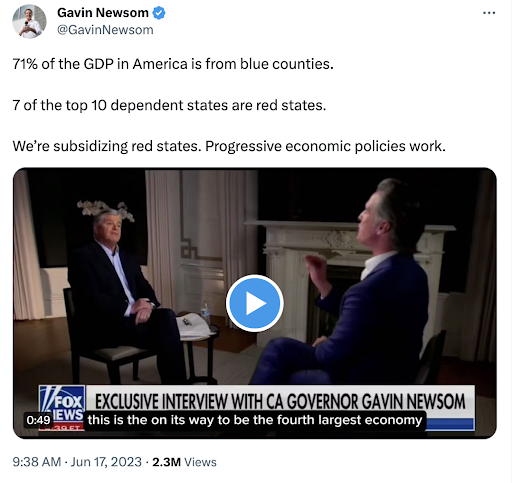
California Governor Gavin Newsom recently had a debate with FOX host Sean Hannity, where he schooled him on the issues.

Gavin just sent out this newsletter:

Dear Diane,

Want the truth? Here’s the truth:

Tweet from Gavin Newsom: Red States vs. Blue States by the numbers

But that is not all.

8 of the 10 states with the highest murder rates are red and gun deaths are almost 2x as high in red states.

The Supreme Court has stripped women of their liberty and let red states replace it with mandated birth.

They ban books, silence teachers and make it harder to vote in red states.

The reason Republicans like Ron DeSantis are fanning the flames of culture wars is to distract from the fact that Florida has higher murder rates, worse education and worse health care outcomes than states like California.

That’s the truth.

– Gavin

The state takeover of the Houston Independent School Board involved firing the elected school board, replacing them with a state-picked board, and hiring a new superintendent who was never a teacher but is a military man, a Broadie, and a failure as Dallas superintendent.

The new school board held its first meeting and set up only 35 seats for the public. The room holds 310 people. Everyone else was shunted to a room where they could watch the meeting on a screen. One man who registered to speak was handcuffed when he insisted on entering the room where the board was neeting.

The board unanimously agreed that superintendent Mije Miles should be allowed to serve even though his state license had lapsed in 2018.

This meeting exemplified the state’s contempt for public schools, and its complete indifference to the public, which has a stake in public schools. The public schools belong to the public, not to Republican politicians in Austin.