Jess Piper is a Democratic activist in rural Missouri. She is a fierce advocate for rural communities and public schools. She lives on a farm where she and her husband raise hogs and chickens. She blogs, she makes videos for TikTok, she tweets, she hosts a podcast called Dirt Road Democrats and is executive director of Blue Missouri. She taught American literature for 16 years. She often writes about the absurdity of vouchers and school choice. In this post, she goes to towns in her district to gather signatures to restore abortion rights in Missouri..
I live at the tippy top of NWMO on a small 7 acre farm in a 125 year old farmhouse with a few dogs, a couple cows, a gaggle of kids and grandkids, and a miniature donkey. Everyone perks up when I mention the donkey…he’s 36 inches high and his name is Augustus.
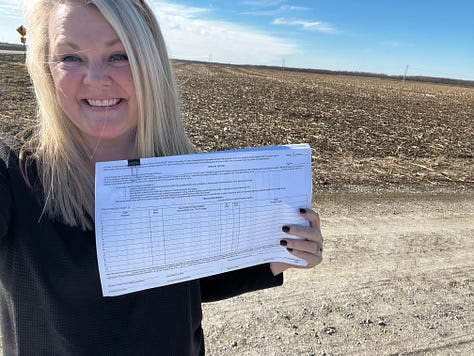
I drive across the state often these days and I am usually headed to a small town and this week was no different—I visited Chillicothe (the home of sliced bread), Carrolton, and Marceline and you’ll never guess why. I was getting rural folks and their Bible groups to sign the petition to restore abortion rights in Missouri.
Dirt Road organizing.
Missouri is in the process of putting abortion on the ballot and I have the petition—I have to tell you it’s kind of hard to get a petition, so I was excited to get them and also overwhelmed. I have to get this out to rural folks, and it’s not as easy as it would seem.
First, there is the opposition to the petition—the Missouri Right to Life (Right to force others to gestate and deliver) has a literal snitch line to report folks accepting signatures. Now, I have no idea what they plan to do if they find us accepting signatures. I was raised to take care of myself and they shouldn’t mess with me, and I’m not the least bit intimidated, but I don’t want them to harass other rural folks who are signing quietly.
Second, folks have written off my congressional district—even some progressives who need signatures on a ballot initiative. They assume that we are too red to get enough signatures, so what’s the point, right? I’ll tell you the point: it creates excitement and solidarity in rural spaces. It acts to uplift us living in among MAGA extremists. It gives us hope.
Chillicothe was my first stop, and it is a pretty big town at over 9K folks. Chilli is also known for having a “patriot” group who have been successful in putting their extremists on the local health board — they also regularly object to school library books. Folks were on long text chains to get others to the event. I was able to gather about 30 signatures on a Tuesday at 9am.
I was directing folks to the petition and how to fill it in correctly. One woman filled it out, stood up, and started texting. She told me, “I’m reminding my Bible group to come sign.”
Wait…what?
The second place I drove was Carrolton, with a population of about 3,400. Still not tiny, but small. I sat in the basement of the library for almost 2 hours with…wait for it…a local pastor. A woman pastor. She signed the petition and then stayed the length of the signing event and visited with every single person who came in. Several folks attended her church or a neighboring church.
Are you seeing a theme here?
My last stop of the day was in Marceline, population 2,100. I sat in the fire station with a local Dem organizer and we accepted signatures a few feet from the active train crossing. I met with a local candidate running for state house and again, folks signed, stood up, texted friends and relatives and their church community, and then headed back out to their farms and rural life.
This is why I organize in rural spaces across the state. This is why I drive 5 or 6 or 10 hours to meet with rural folks. They matter—we matter.
When we cede ground because it’s too red, because it’s too evangelical, because it’s too far of a drive, we create a self-fulfilling prophecy. It’s become more red, more uncontested. When we tell rural folks that their votes and signatures don’t matter because there aren’t enough of them, they agree and stop showing up. When we say Democrats and progressives support everyone, yet fail to have a presence in rural spaces, they notice…they know it’s a lie.
We can’t win Missouri if we avoid rural parts of the state. Missouri is 1/3 rural…33% of the state is outstate.
I’m here and so are thousands of my friends. If state-level organizers will remember us, we can bring sanity back to the entire state.
Yesterday the right-wing-dominated Supreme Court decided to step in and rescue Donald Trump’s presidential aspirations, agreeing to hear his claim of broad immunity and to delay his federal trial on charges of election interference stemming from his involvement in the January 6 insurrection. But it’s much worse than that. We agree with Timothy Snyder that this is no simple stalling tactic. By taking up the question of whether a single American citizen is above the law — simply by entertaining a question that shouldn’t be — the right-wing justices are undermining the legitimacy of the Court itself, and the very notion of a nation of laws.
The Supreme Court is attempting to end its own life as an institution above politics. If it has been doing moving in this direction for some time, this week it came to a head.
This can only be read as a blow to democracy itself. With this stay now in place, it’s unlikely that any trial could be concluded by (and even more likely that it will be delayed entirely until after) Election Day. Of course, at that point, should Trump win re-election, the case would not move forward at all: the Justice Department would be unlikely to pursue a case against a newly elected president, and of course in his second term Trump could stop the proceedings entirely. Which, of course, is the plan.
Heather Cox Richardson put the Alabama court decision declaring embryos to be children into historical context. The Founders did not want the nation to be controlled by theocrats. They understood the importance of separating church and state. That separation was and is important for the protection of the church from the state and for the protection of the state from the church.
She writes:
The Alabama Supreme Court on February 16, 2024, decided that cells awaiting implantation for in vitro fertilization are children and that the accidental destruction of such an embryo falls under the state’s Wrongful Death of a Minor Act. In an opinion concurring with the ruling, Chief Justice Tom Parker declared that the people of Alabama have adopted the “theologically based view of the sanctity of life” and said that “human life cannot be wrongfully destroyed without incurring the wrath of a holy God.”
Payton Armstrong of media watchdog Media Matters for America reported today that on the same day the Alabama decision came down, an interview Parker did on the program of a self-proclaimed “prophet” and Q-Anon conspiracy theorist appeared. In it, Parker claimed that “God created government” and called it “heartbreaking” that “we have let it go into the possession of others.”
Parker referred to the “Seven Mountain Mandate,” a theory that appeared in 1975, which claims that Christians must take over the “seven mountains” of U.S. life: religion, family, education, media, entertainment, business…and government. He told his interviewer that “we’ve abandoned those Seven Mountains and they’ve been occupied by the other side.” God “is calling and equipping people to step back into these mountains right now,” he said.
While Republicans are split on the decision about embryos after a number of hospitals have ended their popular IVF programs out of fear of prosecution, others, like Republican presidential candidate Nikki Haley agreed that “embryos, to me, are babies.”
House speaker Mike Johnson (R-LA) identifies himself as a Christian, has argued that the United States is a Christian nation, and has called for “biblically sanctioned government.” At a retreat of Republican leaders this weekend, as the country is grappling with both the need to support Ukraine and the need to fund the government, he tried to rally the attendees with what some called a “sermon” arguing that the Republican Party needed to save the country from its lack of morality.
As Charles Blow of the New York Times put it: “If you don’t think this country is sliding toward theocracy, you’re not paying attention.”
In the United States, theocracy and authoritarianism go hand in hand.
The framers of the Constitution quite deliberately excluded religion from the U.S. Constitution. As a young man, James Madison, the key thinker behind the Constitution, had seen his home state of Virginia arrest itinerant preachers for undermining the established church in the state. He came to believe that men had a right to the free exercise of religion.
In 1785, in a “Memorial and Remonstrance against Religious Assessments,” he explained that what was at stake was not just religion, but also representative government itself. The establishment of one religion over others attacked a fundamental human right—an unalienable right—of conscience. If lawmakers could destroy the right of freedom of conscience, they could destroy all other unalienable rights. Those in charge of government could throw representative government out the window and make themselves tyrants.
In order to make sure men had the right of conscience, the framers added the First Amendment to the Constitution. It read: “Congress shall make no law respecting an establishment of religion, or prohibiting the free exercise thereof….”
Madison was right to link religion and representative government. In the early years of the nation, Americans zealously guarded the wall between the two. They strictly limited the power of the federal government to reflect religion, refusing even to permit the government to stop delivery of the U.S. mails on Sunday out of concern that Jews and Christians did not share the same Sabbath, and the government could not choose one over the other. The Constitution, a congressional report noted, gave Congress no authority “to inquire and determine what part of time, or whether any has been set apart by the Almighty for religious exercises.”
But the Civil War marked a change. As early as the 1830s, southern white enslavers relied on religious justification for their hierarchical system that rested on white supremacy. God, they argued, had made Black Americans for enslavement and women for marriage, and society must recognize those facts.
A character in an 1836 novel written by a Virginia gentleman explained to a younger man that God had given everyone a place in society. Women and Black people were at the bottom, “subordinate” to white men by design. “All women live by marriage,” he said. “It is their only duty.” Trying to make them equal was a cruelty. “For my part,” the older man said, “I am well pleased with the established order of the universe. I see…subordination everywhere. And when I find the subordinate content…and recognizing his place…as that to which he properly belongs, I am content to leave him there.”
The Confederacy rejected the idea of popular government, maintaining instead that a few Americans should make the rules for the majority. As historian Gaines Foster explained in his 2002 book Moral Reconstruction, which explores the nineteenth-century relationship between government and morality, it was the Confederacy, not the U.S. government, that sought to align the state with God. A nation was more than the “aggregation of individuals,” one Presbyterian minister preached, it was “a sort of person before God,” and the government must purge that nation of sins.
Confederates not only invoked “the favor and guidance of Almighty God” in their Constitution, they established as their motto “Deo vindice,” or “God will vindicate.”
The United States, in contrast, was recentering democracy during the war, and it rejected the alignment of the federal government with a religious vision. When reformers in the United States tried to change the preamble of the U.S. Constitution to read, “We, the people of the United States, humbly acknowledging Almighty God as the sources of all authority and power in civil government, the Lord Jesus Christ, as the Ruler among nations, and His revealed will as of supreme authority, in order to constitute a Christian government, and in order to form a more perfect union,” the House Committee on the Judiciary concluded that “the Constitution of the United States does not recognize a Supreme Being.”
That defense of democracy—the will of the majority—continued to hold religious extremists at bay.
Reformers continued to try to add a Christian amendment to the Constitution, Foster explains, and in March 1896 once again got so far as the House Committee on the Judiciary. One reformer stressed that turning the Constitution into a Christian document would provide a source of authority for the government that, he implied, it lacked when it simply relied on a voting majority. A religious amendment “asks the Bible to decide moral issues in political life; not all moral questions, but simply those that have become political questions.”
Opponents recognized this attempt as a revolutionary attack that would dissolve the separation of church and state, and hand power to a religious minority. One reformer said that Congress had no right to enact laws that were not in “harmony with the justice of God” and that the voice of the people should prevail only when it was “right.” Congressmen then asked who would decide what was right, and what would happen if the majority was wrong. Would the Supreme Court turn into an interpreter of the Bible?
The committee set the proposal aside.
Now, once again, we are watching a minority trying to impose its will on the majority, with leaders like House speaker Johnson noting that “I try to do every day what my constituents want. But sometimes what your constituents want does not line up with the principles God gave us for government. And you have to have conviction enough to stand [up] to your own people….”
Dan Rather analyzed Trump’s primary wins and spots signs that he is vulnerable because his well-defined base is limited. Due to his extremism, he is not able to have a big tent that would attract independents and even dissident Democrats. Even more telling is that Trump is not unifying the Republican Party. As soon as Trump won the South Carolina, he proclaimed that he had never seen the Republican Party more united. As Rather explains, that’s not really true.
He writes:
NBC’s “Meet The Press” this morning characterized Donald Trump’s South Carolina primary victory as “delivering a crushing blow to [Nikki] Haley in her home state on Saturday, trouncing her by 20 points with nearly 60 percent of the vote. The former president dominated nearly every key group.”
While he did indeed win handily, a deep dive into the numbers provides some interesting context.
The part of the story missing from many news reports is that Trump is slipping from his 2020 numbers. His support is strongest among his MAGA base, which pollsters put at no more than 33% of the electorate. Clearly, he will need more than MAGA to win the White House again.
President Biden won the South Carolina Democratic primary with 96.2% of the vote. Trump, who is essentially an incumbent up against a novice at running for national office, could not muster even 60% of his party’s vote. Exit polls from Saturday night should have GOP leaders nervous.
The makeup of South Carolina’s Republican voters does not mirror the country. They are heavily weighted with hard-right “conservatives,” older, white, male, evangelical election deniers. Trump won overwhelmingly among them. But Haley won among independents, moderates, and those who care about foreign policy. And that’s the crux of it.
To win the presidency again, Trump will need to bring all Republicans into the tent. Gallop estimates that 41% of the electorate identifies as Republican. Then it gets really tough. He has to convince a large number of independents and Democrats to vote for him. But how?
Not by favoring a 16-week national abortion ban
Not by threatening to pull out of NATO
Not by defunding Ukraine and supporting Putin’s invasion
Not by promising “ultimate and absolute revenge” against his political opponents
Not by refusing to accept the results of elections he’s lost
Not by promising to be a dictator on day one of his second term
Not by saying things like: “These are the stakes of this election. Our country is being destroyed, and the only thing standing between you and its obliteration is me.”
Trump is winning primaries while underperforming. Dan Pfeiffer, a former adviser to President Obama and current host of “Pod Save America,” writes: “You cannot win the White House with the coalition that Trump is getting in these primaries. He must expand his coalition, persuade people who aren’t already on board and get beyond the Big Lie-believing MAGA base. Through three primary contests, Trump has gained no ground.”
Polls also indicate a majority of voters in swing states would be unwilling to vote for Trump if he’s convicted of a crime. That could happen as soon as April or May.
As Axios writes: “If America were dominated by old, white, election-denying Christians who didn’t go to college, former President Trump would win the general election in as big of a landslide as his sweep of the first four GOP contests.” Fortunately, it is not. America is a rich tapestry of heritages, races, and creeds. Immigrants have long been one of our strengths.
But the likely GOP nominee continues to feed fears about immigration using language tailored to his MAGA base. “They’re coming from Asia, they’re coming from the Middle East, coming from all over the world, coming from Africa, and we’re not going to stand for it … They’re destroying our country,” Trump said Saturday at CPAC, a conference of extreme-right Trump supporters.
“No, Mr. Trump, they’re not,” is the answer of many Americans. There is strong public opinion that what is tearing our country apart is the divisiveness and rancor that comes from Trump, the Republican Party, and their right-wing media machine.
The mainstream press may begin to offer more of this context and perspective as we get deeper into the presidential campaign. One of the things Steady was created to do was offer reasoned context and perspective to news stories. This writing is an example.
Trump remains a real and present threat to win the presidency again in November. But that is not assured. Not nearly, as a deep analysis of early primary results indicates.
There is still a long way to go and many rivers to cross for both major candidates.
John Thompson, historian in Oklahoma, chronicles the always interesting events in the Sooner State. He asks in this post about the role of the media in covering extremism and gross stupidity.
Since I wrote about the “Strange Irresponsible Behavior” of Oklahoma’s Republican extremists, I’ve been conversing with neighbors, reporters, and politicians, wrestling with the ways the press should be handling this issue. Will we look back on such weird stories as just “wacky” distractions from the legislative issues that reporters should be covering in a conventional manner? Or will these seemingly nutty narratives come to dwarf in terms of historical significance the narratives that the press typically focuses on? When, for instance, Gov. Kevin Stitt speaks out of both sides of his mouth about “a potential ‘force-on-force’ conflict between the South and the Biden Administration,” and joining other governors to “send our National Guard to help and to support the efforts of Governor Abbott,” was he implicitly supporting those who are calling for a civil war?
Shouldn’t the press follow the lead of The Independent and ask Stitt what he meant when he called “the clash between Texas authorities and the federal government a ‘powder keg of tension?’” So, should Stitt reveal what he meant when saying, “We certainly stand with Texas on the right to defend themselves.” And, surely the press should seek clarification as to what Stitt meant regarding the National Guard when saying, “I think they would be in a difficult situation: to protect their homeland or to follow what Biden’s saying,” and then promising that Oklahoma, along with other states, “would send our National Guard to help and to support the efforts of Governor Abbott.”
Fortunately, the rally for supporting Abbott didn’t attract the 700,000 or more persons that were sought, and didn’t respond to the Texas Proud Boys’ call for followers to “grab your guns” to stop “brown immigrant invaders.” But, the Washington Post explains, “Whether the rallies erupt or fizzle, extremism researchers say, the consequences will outlast the weekend.” Shouldn’t Stitt be pressured to comment on that appraisal? I certainly believe reporters need to explicitly ask whether saving our democracy must be our top priority.
Who knows? Had those questions been asked, maybe the press could have followed up by asking Stitt which side he would support if Vladimir Putin accepts Trump’s invitation to attack NATO?
A first step toward that goal would be to read Jill Lepore’s The Deadline, and wrestle with what would have happened if Dorothy Thompson hadn’t started the originally atypical coverage of Adolf Hitler, or if Edward R. Murrow hadn’t challenged Joe McCarthy. Lepore, the historian who writes for the New Yorker, further cited the “Golden Age” of the press in the 1960s and 70s which was started when David Halberstam ignored charges of liberal bias and reached “the high mark” of journalism when “interpretation replaced transmission, and adversarialism replaced deference,” even though it meant a writer could no longer “shake hands the next day with the man whom he had just written about.”
Led by the New York Times, the Washington Post, and a few other institutions, the national press now focuses more on the interpretation of MAGA antics. It would be more risky for local journalists to place irrational assertions and legislative actions into a broader context, but since our democracy is in jeopardy, its time to move beyond coverage of routine bills as they move out of committee.
After a conversation on that subject, I got into my car and listened to NPR’s coverage of the Taylor Swift Super Bowl stories – which seemed to be the model for how reporters should cover rightwing absurdities. It began, “Swift’s popularity is being twisted into a threat by a contingent of far-right, Donald Trump-supporting conservatives who have started circulating conspiracy theories about the singer, the Super Bowl, and the 2024 election.” Supposedly, “the NFL had ‘RIGGED’ a Chiefs victory” so “Swift comes out at the halftime show and ‘endorses’ Joe Biden with Kelce at midfield.”
NPR then placed this obviously false narrative in the context of Fox news, and “Jack Posobiec, who pushed the baseless Pizzagate conspiracy theory.” It further explained how such memes can endanger women’s health.
On the other hand, who knows? Maybe Swift would have led a halftime coup for Biden if the press hadn’t blown the whistle?
Seriously, why can’t all types of news outlets routinely interrogate legislative sponsors about such lies, pushing them to go on record or publicly refuse to answer questions about where did they learn about furries and the reason for wanting to use animal control to keep them out of school. Or, why the “Common Sense Freedom of Press Control Act” should “require criminal background checks of every member of the news media;” the “licensing of journalists through the Oklahoma Corporation Commission;” the completion of a “propaganda free” training course by PragerU; and a $1 million liability insurance policy; and quarterly drug tests.
When legislators defend corporal punishment of disabled students because it’s the will of God, and requiring the teaching of creationism in classes where evolution is taught, they should have to explain the sources of their legislation, and why they think they are constitutional. Similarly, why would a legislator seek to ban “no-fault divorce,” even though the vast majority of the state’s divorces are based on that law. If every such bill would receive such scrutiny, wouldn’t the public become better prepared to vote for or against political leaders who won’t take a stand opposing the MAGA-driven divisiveness?
Or, conversely, if these bills are dismissed as merely “wacky” and allowed to spread, what will happen to the trust required for a democracy to function?
Thom Hartmann connects the dots: the Republican Party is now controlled by Vladimir Putin. The Republicans do only what is in the interest of Putin. His goal, as it was in 2016 and 2020, is to get Trump elected. Trump is subservient to Putin. Trump wants to block American aid to Putin. So does House Speaker Mike Johnson, who called a two-week recess as Ukrainian forces are running out of ammunition. How do you define GOP these days? Guardians of Putin? Goons of Putin? Other ideas?
Thom Hartmann
There’s little doubt that Russian President Vladimir Putin has succeeded in achieving near-total control over the Republican Party. They’re gutting aid to Ukraine (and have been for over a year), working to kneecap our economy, whipping up hatred among Americans against each other, promoting civil war, and openly embracing replacing American democracy with authoritarian autocracy.
Putin has declared war on queer people, proclaimed Russia a “Christian nation,” and shut down all the media he called “fake news.” Check, check, check.
Over the past two years, as America was using Russia’s terrorist attacks on Ukraine to degrade the power and influence of Russia’s military, Putin was using social media, Republican politicians, and rightwing American commentators to get Republican politicians on his side and thus kill off US aid to Ukraine.
The war in Gaza is making it even easier, with Putin-aligned politicians like Senator Josh Hawley (R-MO) tweeting: “Any funding for Ukraine should be redirected to Israel immediately.”
Most recently, the three-year “Biden bribery” hysteria Republicans in the House have been running — including thousands of hits on Fox “News” and all over rightwing hate radio — turns out to have been a Russian intelligence operation originally designed to help Trump win the 2020 election. The Russian spy who’d been feeding this phony info to “Gym” Jordan and James “Gomer Pyle” Comer is now in jail.
Russia’s battlefield, in other words, has now shifted from Ukraine to the US political system and our homes via radio, TV, and the internet, all in the hopes of ending US aid to the democracy they’ve brutally attacked.
And the momentum is following that shift: Russia is close to having the upper hand in Ukraine because of Putin’s ability — via Trump and Johnson — to get Republican politicians to mouth his talking points and propaganda.
Now, with Speaker “Moscow Mike” Johnson shutting down the House of Representatives so nobody can offer a discharge petition that would force a vote on Ukraine aid (and aid for Palestinian refugees, Taiwan, and our southern border), it’s becoming more and more clear that Vladimir Putin is running the Republican party via his well-paid stooge, Donald Trump.
I say “well paid” because Donald Trump would have been reduced to homelessness in the early 1990s if it weren’t for Russian money, as both of his sons have said at different times. He’d burned through all of his father’s estate, even stealing a large part of it from his siblings. He’d lost or hidden almost two billion dollars running a casino.
As Michael Hirsch noted for Foreign Policymagazine:
“By the early 1990s he had burned through his portion of his father Fred’s fortune with a series of reckless business decisions. Two of his businesses had declared bankruptcy, the Trump Taj Mahal Casino in Atlantic City and the Plaza Hotel in New York, and the money pit that was the Trump Shuttle went out of business in 1992. Trump companies would ultimately declare Chapter 11 bankruptcy two more times.”
He’d been forced to repeatedly declare bankruptcy — sticking American banks for over a billion dollars in unpaid bills — after draining his businesses of free cash and stashing the money in places he hoped nobody would ever find.
No American bank would touch him, and property developers in New York were waiting for his entire little empire to collapse. Instead, a desperate Trump reached out to foreign dictators and mobsters, who were more than happy to supply funds to an influential New York businessman…for a price to be paid in the future.
He sold over $100 million worth of condos to more than sixty Russian citizens during that era, and partnered with professional criminals and money launderers to raise money for Trump properties in Azerbaijan and Panama. According to Trump himself, he sold $40 to $50 million worth of apartments to the Saudis.
He then partnered with a former high Soviet official, Tevfik Arif, and a Russian businessman, Felix Sater, who’d been found guilty of running a “huge stock-fraud scheme involving the Russian mafia.”
As the founders of Fusion GPS wrote for The New York Times in 2018:
“The Trump family’s business entanglements are of more than historical significance. Americans need to be sure that major foreign policy decisions are made in the national interest — not because of foreign ties forged by the president’s business ventures.”
Thus, when it came time to run for president, Trump had to pay the price. He and the people around him were inundated with offers of “help” from Russians, most associated directly with Putin or the Russian mafia.
Trump’s campaign manager, Paul Manafort, had been paid millions by Putin’s oligarchs and ran Trump’s campaign for free. Reporters found over a dozen connections between Russia and the Trump campaign, and during the 2016 campaign Trump was secretly negotiating a deal to open a Trump tower in Moscow. Trump’s son and his lawyer met with Putin’s agents in Trump Tower.
Putin’s personal troll army, the Internet Research Agency (IRA) based out of St. Petersburg but operating worldwide, began a major campaign in 2016 to get Trump elected president.
Manafort fed Russian intelligence raw data from internal Republican polling that identified a few hundred thousand individuals in a half-dozen or so swing states the GOP thought could be persuaded to vote for Trump (or against Hillary), and the IRA immediately went to work, reaching out to them via mostly Facebook.
Mueller’s report and multiple journalistic investigations have noted that the most common message out of Russia then was directed at Democratic-leaning voters and was, essentially, “both parties are the same so it’s a waste of time to vote.”
A report from Texas-based cybersecurity company New Knowledge, working with researchers at Columbia University, concluded, as reported by The New York Times:
“‘The most prolific I.R.A. efforts on Facebook and Instagram specifically targeted black American communities and appear to have been focused on developing black audiences and recruiting black Americans as assets,’ the report says. Using Gmail accounts with American-sounding names, the Russians recruited and sometimes paid unwitting American activists of all races to stage rallies and spread content, but there was a disproportionate pursuit of African-Americans, it concludes.
“The report says that while ‘other distinct ethnic and religious groups were the focus of one or two Facebook Pages or Instagram accounts, the black community was targeted extensively by dozens.’ In some cases, Facebook ads were targeted at users who had shown interest in particular topics, including black history, the Black Panther Party and Malcolm X. The most popular of the Russian Instagram accounts was @blackstagram, with 303,663 followers.
“A Senate inquiry has concluded that a Russian fake-news campaign targeted ‘no single group… more than African-Americans.’ …
“Thousands of Twitter, Facebook, Instagram and You Tube accounts created by the St. Petersburg-based Internet Research Agency (IRA) were aimed at harming Hillary Clinton’s campaign and supporting Donald Trump, the committee concludes.
“More than 66% of Facebook adverts posted by the Russian troll farm contained a term related to race.
“African-American community voters were discouraged from voting, and from supporting Hillary Clinton.”
Between the information compiled by Oxford Analytica and the details passed along from the GOP to Prigozhin via Manafort, a mere margin of 43,000 votes across a handful of swing states —all mictotargeted by Russia — handed the electoral college to Trump, even though he lost the nationwide vote to Hillary Clinton by almost 3 million ballots.
So now Trump has succeeded in making the entire GOP a party to his long-term debt to Putin and his oligarchs. “Moscow Mike” Johnson has blocked any aid to Ukraine for over a year; the last congressional appropriation for foreign aid was passed in 2022, when Nancy Pelosi ran the House.
Meanwhile, under Trump’s and Putin’s direction, Republicans in Congress are doing everything they can to damage the people of the United States.
They believe it will help them in the 2024 election if they can ruin the US economy while convincing American voters that our system of government is so corrupt (“deep state”) that we should consider replacing democracy with an autocratic strongman form of government like Putin’s Russia. Tucker Carlson is even suggesting that Russia is a better place to live than the US.
They revel in pitting racial, religious, and gender groups against each other while embracing a form of fascism that pretends to be grounded in Christianity, all while welcoming Putin’s social media trolls who are promoting these divisions.
Republican-aligned think tanks are working on Project 2025, a naked attempt to consolidate power in the White House to support a strongman president who can override the will of the people, privatize Social Security and Medicare, shut down our public school system, fully criminalize abortion and homosexuality (Sam Alito called for something like that this week), and abandon our democratic allies in favor of a realignment with Russia, China, and North Korea.
Trump got us here by openly playing to the fears and prejudices of white people who are freaked out by the rapid post-1964 “browning” of America. Putin jumped in to help amplify the message a thousandfold with his social media trolls, who are posting thousands of times a day as you read these words.
Now that Putin largely controls the GOP, today’s question is how far Republicans are willing to go in their campaign to bring the USA to her knees on behalf of Putin and Trump.
— When Congress comes back into session next week, will they take up Ukraine aid?
— Will they continue their opposition to comprehensive immigration and border reform?
— Will they keep pushing to privatize Social Security with their new “commission”?
— Will they work as hard to kneecap Taiwan on behalf of President Xi as they have Ukraine on behalf of Putin?
— Will they continue to quote Russian Intelligence propaganda in their effort to smear President Biden?
— Instead of just 7 Republicans going to Moscow to “celebrate” the Fourth of July, will the entire party move their event to that city like the NRA did? Or to Budapest, like CPAC did?
Or will the GOP suddenly start listening to the rational voices left in their party, the Mitt Romneys and Liz Cheneys who still believe in democracy (even if they want to gut the social safety net and turn loose the polluters)?
The Network for Public Education released a report card today grading the states on their support for democratically-governed public schools. Which states rank highest in supporting their public schools? Open the report to find out.
Measuring Each State’s Commitment to Democratically Governed Schools
EXECUTIVE SUMMARY
Neighborhood public schools remain the first choice of the overwhelming majority of Ameri- can families. Despite their popularity, schools, which are embedded in communities and gov- erned by elected neighbors, have been the target of an unrelenting attack from the extreme right. This has resulted in some state legislatures and governors defunding and castigating public schools while funding alternative models of K-12 education.
This 2024 report, Public Schooling in America: Measuring Each State’s Commitment to Democratically Governed Schools, examines these trends, reporting on each state’s commit- ment to supporting its public schools and the children who attend them.
What We Measure
We measure the extent of privatization in each state and whether charter and voucher laws promote or discourage equity, responsibility, transparency, and accountability. We also rate them on the strength of the guardrails they place on voucher and charter systems to protect students and taxpayers from discrimination, corruption and fraud.
Recognizing that part of the anti-public school strategy is to defund public schools, we rate states on how responsibly they finance their public schools through adequate and equitable funding and by providing living wage salaries for teachers.
As the homeschool movement grows and becomes commercialized and publicly funded, homeschooling laws deserve public scrutiny. Therefore, we rate states on laws that protect children whose families homeschool.
Finally, we include a new expansive category, freedom to teach and learn, which rewards states that reject book bans, and the use of unqualified teachers, intolerance of LGBTQ stu- dents, corporal punishment, and other factors that impinge on teachers’ and students’ rights.
Paul Bowers used to be the education reporter for the Charleston News & Courier. I contacted him when I was trying to understand some issues that he wrote about. Paul left his newspaper job (I think someone in the local power elite complained about his honest reporting on the privatizers). After he left, he started a blog called Brutal South. Now he works as communications director for the South Carolina ACLU. As you can imagine, he’s always busy, always pushing back against book bans, attacks on voting rights, and more.
In this post, he wrestles with his Christian faith. He’s covered so many Christian faith leaders who espouse hateful views that he has had to question his own views. He feels sure that the Jesus he believes in would not agree with them.
I urge you to read the post. I’m quoting just the beginning and the ending.
He writes:
On weekday mornings the coffee shop is clustered with pods of the men. The men are holding forth — loudly — about the virtues of intermittent fasting, the meaning of the Egyptian plagues, and the Bible’s clear teaching on matters of human sexuality.
I used to be part of the pods, but now I sit alone. I eavesdrop. Some days when I listen to them reading from their Bible commentaries I hear an encouraging word, and I miss the feeling of spiritual fellowship. Most days I hear nonsense and remember why I’m in no hurry to return to church.
Last year the great Mississippi songwriter Andrew Bryant released one of my favorite albums, Prodigal, building on the theme that he’s “like the prodigal who never left at all.” He still lives in Mississippi; I still live in South Carolina. When he sings about living on the far side of the creek from the faith community that raised him, I understand him to mean it’s a walkable distance, a permeable barrier. I find myself similarly situated.
I’ve left two churches in my adult life, a theologically conservative one by choice and a theologically progressive one because its leaders left and the congregation ceased meeting. I still see people from both churches often. My family and I never intend to leave our town, so this will likely be the case for the rest of our lives….
I don’t have Christian fellowship anymore, but I do have solidarity. They’re not the same thing.
It would be fair for you to ask if I still believe in God at all. I do, though I would no longer try to convince you one way or the other. I find myself in the position the writer John Jeremiah Sullivan described once: “My problem is not that I dream I’m in hell … It isn’t that I feel psychologically harmed. It isn’t even that I feel like a sucker for having bought it all. It’s that I love Jesus Christ.”
I do love Jesus, and I love the people I know who follow him. Lately I’ve seen Christians with the ash of mortification on their foreheads giving benedictions to the frightened families of trans kids; pledging to fight our Christian governor’s labor union-bashing tactics to the gates of hell; and speaking out against the death penalty — our modern crucifixion — even for people who murdered their family members.
Nietzsche called the way of Jesus “slave morality” and he wasn’t completely wrong, but I think he misread the faith of enslaved people. If the gospel narrative is true then I want to be on the side of Jesus and not the Roman empire, of Moses and not Pharaoh, of Harriet Tubman and not Robert E. Lee. I want to walk justly and love my enemies and fight for liberation always. I’m with the crucified people, as Ignacio Ellacuría put it. There are nonreligious people following this path just as well as the faithful, but for better or worse I will always have a religious impulse in me. A part of me will always seek the Spirit even if it never comes.
This coming Friday I’ll speak at an event hosted by faith leaders in Greenville, focused on how we can carry out the sacred work of hospitality by fighting for housing justice. We pursue this work in the heart of so-called Trump Country, in the shadow of the Moral Majority, amid the ferment of white Christian nationalism and even Christian fascism. We walk as believers, against other believers, ostensibly praying to the same god.
Heather Cox Richardson brings us back to that terrible day two years ago when Vladimir Putin sent Russian troops into Ukraine. He expected the government to collapse within a matter of days or weeks. Yet Ukraine stands. Entire cities, such as Mariupol, have been obliterated. The inhabitants of towns such as Bucha were subjected to murders, rapes, and torture. Yet Ukraine stands. Europe supports Ukraine because they fear what Putin will do next. Will he storm Poland or Lithuania? The extreme right wing of the GOP has turned against funding Ukraine because Trump, their cult leader, is opposed. As usual, he will do thing to offend his very good friend Putin.
Richardson wrote:
Two years ago today, Ukraine president Volodymyr Zelensky made a passionate plea to the people of Russia, begging them to avoid war. He gave the speech in Russian, his own primary language, and, reminding Russians of their shared border and history, told them to “listen to the voice of reason”: Ukrainians want peace.
“You’ve been told I’m going to bomb Donbass,” he said. “Bomb what? The Donetsk stadium where the locals and I cheered for our team at Euro 2012? The bar where we drank when they lost? Luhansk, where my best friend’s mom lives?” Zelensky tried to make the human cost of this conflict clear. Observers lauded the speech and contrasted its statesmanship with the ramblings in which Putin had recently engaged.
And yet Zelensky’s speech stood only as a marker. Early the next day, Russian president Vladimir Putin launched a “special military operation” involving dozens of missile strikes on Ukrainian cities before dawn. He claimed in a statement that was transparently false that he needed to defend the people in the “new republics” within Ukraine that he had recognized two days before from “persecution and genocide by the Kyiv regime.” He called for “demilitarization” of Ukraine, demanding that soldiers lay down their weapons and saying that any bloodshed would be on their hands.
Putin called for the murder of Ukrainian leaders in the executive branch and parliament and intended to seize or kill those involved in the 2014 Maidan Revolution, which sought to turn the country away from Russia and toward a democratic government within Europe, and which itself prompted a Russian invasion. He planned for his troops to seize Ukraine’s electric, heating, and financial systems so the people would have to do as he wished. The operation was intended to be lightning fast.
But rather than collapsing, Ukrainians held firm. The day after Russia invaded, Zelensky and his cabinet recorded a video in Kyiv. “We are all here,” he said. “Our soldiers are here. The citizens are here, and we are here. We will defend our independence…. Glory to Ukraine!” When the United States offered the next day to transport Zelensky outside the country, where he could lead a government in exile, he responded:
“The fight is here; I need ammunition, not a ride.”
That statement echoes powerfully two years later as Ukraine continues to stand against Russia’s invasion but now quite literally needs ammunition, as MAGA Republicans in Congress are refusing to take up a $95 billion national security supplemental measure that would provide aid to Ukraine.
Instead, Republicans spent the day insisting that they do not oppose in vitro fertilization, the popular reproductive healthcare measure that the Alabama Supreme Court last Friday endangered by deciding that a fertilized human egg was a child—what they called an “extrauterine” child—and that people can be held legally responsible for destroying them. Since the decision, Alabama healthcare centers have halted their IVF programs out of fear of prosecution for their handling of embryos.
Republicans who oppose abortion have embraced the idea that life begins at conception, an argument that leads naturally to the definition of IVF embryos as children. But this presents an enormous problem for Republicans, whose antiabortion stance is already creating warning signs for 2024. Today a memo from the National Republican Senatorial Committee (NRSC) noted that 86% of the people they polled support increased, not reduced, access to IVF procedures.
The good news for the Republicans is that their frantic defense of IVF means that the media has largely stopped talking about the news of just two days ago, the fact that the man whose testimony congressional Republicans relied on to launch an impeachment process against President Joe Biden turned out to be working with Russian operatives. House leaders have quietly deleted from their House Impeachment website the Russian disinformation that previously was central to their case against Biden.
But today, as Republican House members remain on vacation, President Biden announced new sanctions against Russia, and Senate majority leader Chuck Schumer (D-NY) was in Ukraine, where he challenged House speaker Mike Johnson (R-LA) to pass the national security supplemental bill. “The weight of history is on his shoulders,” Schumer told reporters in Lviv. “If he turns his back on history, he will regret it in future years.”
“Two years,” Ukraine president Zelensky wrote today. “We are all here…. Together with representatives of Algeria, Argentina, Armenia, Australia, Austria, Azerbaijan, Belgium, Bosnia and Herzegovina, Brazil, Canada, Chile, China, Colombia, Croatia, Cyprus, Czechia, Egypt, Estonia, the EU, Finland, France, Georgia, Germany, Greece, Guatemala, the Holy See, Hungary, Iceland, India, Indonesia, Ireland, Italy, Japan, Kazakhstan, the Republic of Korea, Kuwait, Latvia, Lithuania, Luxembourg, Malta, Moldova, Montenegro, the Netherlands, New Zealand, North Macedonia, Norway, Pakistan, Peru, the Philippines, Poland, Portugal, Qatar, Romania, Saudi Arabia, Slovakia, Slovenia, South Africa, Spain, Sudan, Sweden, Switzerland, Tajikistan, Thailand, Türkiye, the UAE, the United Kingdom, the USA, Viet Nam, as well as international organisations….”
Michael Hiltzik of the Los Angeles Times reports on Elon Musk’s latest foray into disrupting the lives of other people. He’s suing to destroy the National Labor Relations Board because it is weighing in on his company’s decision to fire some workers.
We are witnessing the accelerated rollback of the New Deal and the past nine decades of progressive reforms.
He writes:
Few business leaders have taken to heart more than Elon Musk the old lawyer’s saw that if you don’t have the facts or the law on your side at trial, pound the table.
Musk has truculently flouted regulatory standards of all varieties as the guiding spirit of companies such as Twitter, Tesla and SpaceX — keeping factories open despite pandemic shutdown orders, allegedly committing securities fraud by issuing misleading tweets about his investment plans and ignoring government safety recommendations for self-driving automotive technologies.
Now he’s trying what may be his most audacious flip-off to regulators yet:
Faced with an accusation by the National Labor Relations Board that SpaceX improperly fired nine employees in 2022, among other illegal acts, the company, which is controlled by Musk, filed a lawsuit in federal court in Texas to declare the NLRB’s action — indeed, the board itself — unconstitutional.
Now he’s trying what may be his most audacious flip-off to regulators yet:
Faced with an accusation by the National Labor Relations Board that SpaceX improperly fired nine employees in 2022, among other illegal acts, the company, which is controlled by Musk, filed a lawsuit in federal court in Texas to declare the NLRB’s action — indeed, the board itself — unconstitutional.
There’s more to it than that, however. The SpaceX lawsuit takes direct aim at the very enforcement structure of the NLRB, through which appointed administrative law judges weigh unfair labor practice charges laid against employers and recommend penalties to be imposed by the board itself.
The company’s argument is that because the judges are largely immune from being fired other than “for good cause,” their role in enforcement deprives accused parties of their constitutional right to trial by jury.
It also asserts that the board’s power to act as judge and jury in employment cases and the members’ immunity from being removed by the president violates the separation of powers principle in the Constitution. In sum, SpaceX claims that it’s being held “subject to unlawful proceedings before an unconstitutionally structured agency.”
More such claims are in the offing from businesses facing regulatory scrutiny. According to a transcript obtained by Bloomberg, grocery chain Trader Joe’s made the same argument at a Jan. 16 NLRB hearing on charges that it engaged in illegal union-busting by retaliating against unionization advocates among its workers.
What are these companies up to? The SpaceX claims are unusual, but they’re not unique in recent regulatory litigation. Similar claims have been brought against the Securities and Exchange Commission and the Consumer Financial Protection Bureau.
“This is an effort by a group of lawyers who are foes of the administrative state and the New Deal-era legislation that created the NLRB and the SEC to essentially end enforcement of those statutes,” says Catherine Fisk, an employment and labor law authority at UC Berkeley law school.
Unable to challenge the laws themselves — they’ve been upheld by Supreme Court decisions dating back to the 1930s — or the regulations directly, Fisk told me, “they’re arguing that the administrative structure is in some part unconstitutional.”
Before delving into the details of the SpaceX lawsuit, let’s examine the NLRB’s enforcement case. The agency says SpaceX illegally fired the nine workers for circulating an open lettercomplaining about Musk’s “repeated conduct of issuing inappropriate, disparaging, sexually charged comments on Twitter,” which he owns. The silence of SpaceX management about Musk’s conduct, the letter said, allowed a “culture of sexism, harassment and discrimination” to “pervade … the workplace.”
The NLRB filed a formal complaint against SpaceX on Jan. 3, encompassing not only the firings but charges that it illegally interrogated workers and conducted illegal surveillance of their activities. The agency scheduled a hearing on the charges before an administrative law judge for March 5 in Los Angeles.
The very next day, SpaceX filed its lawsuit.
By some measures, SpaceX’s response to the NLRB charges might be interpreted as overkill. Even if it’s found to have committed all the violations, the consequences are meager. The NLRB can’t levy monetary fines.
It can order back pay and reinstatement for workers who have been wrongly discharged, but those wouldn’t make much of a dent in the finances of a company that was reported to have brought in $8 billion in revenue last year from government and commercial contracts.
Moreover, SpaceX hasn’t yet come before an administrative law judge over the NLRB charges, much less having them voted on by the full board. Its lawsuit, then, looks like a shot across the NLRB’s bow. The company asks the trial judge in Texas to block the NLRB’s case against it, declare that the NLRB’s structure is unconstitutional, and permanently prohibit the agency from pursuing unfair labor practice charges via administrative law judges.
That points to the conclusion that this case, and others like it, aim to exploit the veer to the right seen throughout the federal judiciary generally and the Supreme Court in particular.
This variety of attack on regulations went out of fashion in the 1930s, Fisk observes. The Supreme Court, which had overturned a sheaf of New Deal initiatives as well as state minimum wage laws, turned back to the middle in the face of rising public disdain and the court-packing scheme of Franklin Roosevelt.
FDR ultimately abandoned his proposal, but after 1936 the court ceased ruling against the New Deal — upholding the National Labor Relations Act, which created the NLRB, in 1937.
“For 85 years, those arguments weren’t made,” Fisk says, “because lawyers knew that they would get nowhere with them — they might even get sanctioned. The Supreme Court signaled that it was up to Congress to design regulatory structures.”
But today’s Supreme Court isn’t your great-grandfather’s Supreme Court. “The Supreme Court has given lawyers reason to think that they might be able to invalidate part or all of these statutes as being unconstitutional.”
As recently as last week, a majority of justices appeared ready to overturn or at least pare back the so-called Chevron doctrine, the nearly 40-year-old principle that courts should defer to agencies’ interpretations of their governing laws as long as those interpretations aren’t plainly unreasonable.
Overturning the doctrine, as industry litigants urged the court to do during oral arguments Jan. 17, could sap regulatory agencies’ ability to base their rule-making on expert advice.
Although Congress could theoretically overcome any regulatory problems created by an adverse court ruling by amending the laws in question, that’s not a good bet given the profound dysfunction reigning these days on Capitol Hill. The industries will have achieved their goals for years into the future.
That brings us to Musk’s litigation strategy. SpaceX filed its lawsuit against the NLRB not in Southern California, where the company is headquartered, or Washington, D.C., where the NLRB maintains its main office, but in federal court in Brownsville, Texas, a judicial outpost on the Mexican border. This reflects the practice of filing anti-government lawsuits in remote federal courtrooms in Texas, where plaintiffs have a good chance of drawing a right-wing judge.
On the face of it, that tactic may have failed in this case, because the Brownsville court has two judges, one of whom was appointed by Donald Trump and the other by Barack Obama, and the SpaceX case was assigned to Rolando Olvera, who was Obama’s appointee.
SpaceX, however, is playing a longer game. Any appeal from the Texas federal court would go to the extremely conservative U.S. 5th Circuit Court of Appeals, which I’ve described in the past as “the hackiest of hack-ridden federal courts.”
The New Orleans-based appellate court upheld Texas’ malevolent SB 8 antiabortion law in 2022, for example, after which the Supreme Court allowed the law to go into effect.
Last year it partially endorsed a ruling by federal Judge Matthew Kacsmaryk of Texas narrowing access to the abortion drug mifepristone. Kacsmaryk’s ruling was based on a tendentious and long-abandoned reading of an antique 1873 law, but that was enough for the issue to come before the Supreme Court, which has the case on its docket this year.
More to the point, the 5th Circuit has implicitly endorsed the practice of challenging regulations by taking aim at the constitutionality of regulatory agencies. It did so in a case targeting the Consumer Financial Protection Bureau brought by the payday lending industry, which has long been in the CFPB’s crosshairs.
A 5th Circuit panel composed of three Trump-appointed judges ruled the bureau’s funding mechanism unconstitutional; the government appealed that ruling to the Supreme Court, which heard oral arguments on Oct. 3 but hasn’t yet ruled….
The NLRB has called foul on SpaceX’s choice of venue, calling the company’s rationale for filing in Brownsville “less than paper thin.” The allegedly unlawful conduct of SpaceX took place entirely at the company’s headquarters in the Southern California enclave of Hawthorne, and nothing actually happened in Texas. The government has asked Olvera to transfer the case to federal court in Los Angeles, but he hasn’t yet ruled.
Put it all together, and the SpaceX lawsuit bears watching.
As I’ve written before, conservative federal judges, many of them appointed by Trump, have the power to move the country to the far right for decades to come, eroding reproductive health care, eviscerating gun control laws and making life more difficult for ordinary Americans depending on the federal government to protect their rights. Elon Musk, pursuing his own personal interests, is urging them to keep at it.



 Diane Ravitch's blog