Archives for category: Democracy

Rachel Maddow often manages to come up with a very different take on the news as compared to other talk show hosts. She is fascinated with history, so she often takes her viewers down new paths.

When she was trying to figure out JD Vance, she discovered two of the men who influenced his views. One is a podcaster named “Jack Murphy,” whose real name is John Goldman. He is known for racism, misogyny, and his association with the alt-right. He is very big on the idea of women’s submission to men. He even wrote a book about it.

The other is a man named Curtis Yarvin, a podcaster who is known for his anti-democratic, anti-egalitarian views.

Watch this segment.

Mercedes Schneider is a high school teacher in Louisiana who holds a doctorate in statistics and research methodology. It’s no secret that she is also a devout Christian who takes her faith seriously, so seriously that she doesn’t try to impose it on anyone else. As a veteran teacher, she writes with authority and keen intellect about education.

The following essay by Schneider was posted by the Network for Public Education. To read the full essay, please open the link.

Teacher and scholar Mercedes Schneider takes a look at Project 2025. Reposted with permission.

Schneider writes:

Project 2025 identifies itself as “The Presidential Transition Project,” further described as “an agenda prepared by and for conservatives who will be ready on Day One of the next Administration to save our country”:

The Heritage Foundation is once again facilitating this work, but as our dozens of partners and hundreds of authors will attest, this book is the work of the entire conservative movement.

The next conservative President will enter office on January 20, 2025, with a simple choice: greatness or failure.  It will be a daunting test, but no more so than every other generation of Americans has faced and passed. The Conservative Promise represents the best effort of the conservative movement in 2023—and the next conservative President’s last opportunity to save our republic.

Though the 900+-page document is clearly meant for “the next conservative President,” former president and 2024 Republican presidential candidate, Donald Trump, has publicly attempted to distance himself from the far-right, Heritage-Foundation-steeped governing plan.

In the opening pages of the document, numerous contributors include in their bio sketches connection to the Trump administration. So there’s that.

But one issue that has my attention is that the July 17, 2024, Intercept reports that “Conservative Groups Are Quietly Scurrying Away from Project 2025”:

THE MORE PEOPLE learn about it, the more unpopular and politically toxic Project 2025 has proven to be. This has led the Trump and Vance campaign to attempt to distance itself from the effort. Former Trump adviser Stephen Miller now says he had “zero involvement with Project 2025,” despite appearing in a promotional video. And just today, The Intercept discovered two more conservative groups that have quietly bowed out from the controversial 900-page manifesto — including a national anti-abortion organization.

Miller’s group, America First Legal Foundation, was one of the first organizations to jump ship from the Project 2025 advisory board. Last week, America First Legal asked to be removed from the Project 2025 advisory board webpage. The organization was part of Project 2025 since at least June 2022, when the Heritage Foundation first announced the advisory board’s formation.

America First Legal staff were deeply involved in writing and editing the Project 2025 playbook. Its vice president and general counsel, Gene Hamilton, drafted an entire chapter about the Justice Department, which proposes launching a “campaign” to criminalize mailing abortion pills. In a footnote, Hamilton thanked “the staff at America First Legal Foundation,” who he wrote deserved “special mention for their assistance while juggling other responsibilities.” …

America First Legal did not respond to questions about why it asked to be removed from the Project 2025 advisory board despite its prior participation.

As of Tuesday afternoon, Americans United for Life, an anti-abortion group, and the Mackinac Center for Public Policy, a Michigan think tank, were among the more than 100 groups listed on the Project 2025 website as part of its advisory board. By Wednesday, Americans United for Life and the Mackinac Center had vanished.

Both organizations were relatively recent additions to the Project 2025 coalition. The Heritage Foundation announced they had joined in February 2024, several months after the massive playbook was released.

Neither organization would elaborate as to why it had joined the Project 2025 board in the first place or why it was exiting it now.

The distancing of conservative groups from a plan that has clearly been brought into the public eye reminds me of the 2011 exposure of the American Legislative Exchange Council (ALEC) by the nonprofit watchdog, Common Cause, and subsequent corporate member exodus.

Seems like far-right conservatives have a history of not really wanting the public aware of those conservative plans and schemes.

It should come as no surprise that ALEC is a Project 2025 advisory board member:

Project 2025 is the conservative, American white Evangelical Christian plan for operating government. Below is a “note” from Heritage Foundation’s Project 2025 director, Paul Dans:

Let me offer some excerpts. Not many, for it does not take much reading to realize that the Project 2025 overarching goal is to force all of America into a white Evangelical Christian mold.

A smidge from Heritage Foundation president, Kevin Roberts’, foreword:

PROMISE #1: RESTORE THE FAMILY AS THE CENTERPIECE OF AMERICAN LIFE AND PROTECT OUR CHILDREN. The next conservative President must get to work pursuing the true priority of politics-the well-being of the American family. In many ways, the entire point of centralizing political power is to subvert the family. Its purpose is to replace people’s natural loves and loyalties with unnatu- ral ones. You see this in the popular left-wing aphorism, “Government is simply the name we give to the things we choose to do together.” But in real life, most of the things people “do together” have nothing to do with government. These are
the mediating institutions that serve as the building blocks of any healthy society. Marriage. Family. Work. Church. School. Volunteering. The name real people give to the things we do together is community, not government. Our lives are full of interwoven, overlapping communities, and our individual and collective happiness depends upon them. But the most important community in each of our lives-and
the life of the nation— is the family. Today, the American family is in crisis. Forty percent of all children are born to unmarried mothers, including more than 70 percent of black children. There is no government program that can replace the hole in a child’s soul cut out by the absence of a father. Fatherlessness is one of the principal sources of Ameri- can poverty, crime, mental illness, teen suicide, substance abuse, rejection of the church, and high school dropouts. So many of the problems government programs are designed to solve-but can’t-are ultimately problems created by the crisis of marriage and the family. The world has never seen a thriving, healthy, free, and
prosperous society where most children grow up without their married parents.
If current trends continue, we are heading toward social implosion. Furthermore, the next conservative President must understand that using gov- ernment alone to respond to symptoms of the family crisis is a dead end. Federal power must instead be wielded to reverse the crisis and rescue America’s kids from familial breakdown. The Conservative Promise includes dozens of specific policies
to accomplish this existential task. Some are obvious and long-standing goals like eliminating marriage penalties in federal welfare programs and the tax code and installing work requirements for food stamps. But we must go further. It’s time for policymakers to elevate family authority, formation, and cohesion as their top priority and even use government
power, including through the tax code, to restore the American family. Today the Left is threatening the tax-exempt status of churches and charities that reject woke progressivism. They will soon turn to Christian schools and clubs with the same totalitarian intent. The next conservative President must make the institutions of American civil society hard targets for woke culture warriors. This starts with deleting the terms sexual orientation and gender identity (“SOGI”), diversity, equity, and inclusion (“DEI”), gender, gender equality, gender equity, gender awareness, gender-sensi- tive, abortion, reproductive health, reproductive rights, and any other term used to deprive Americans of their First Amendment rights out of every federal rule, agency regulation, contract, grant, regulation, and piece of legislation that exists. Pornography, manifested today in the omnipresent propagation of transgender ideology and sexualization of children, for instance, is not a political Gordian knot inextricably binding up disparate claims about free speech, property rights, sexual liberation, and child welfare. It has no claim to First Amendment protection. Its purveyors are child predators and misogynistic exploiters of women. Their product is as addictive as any illicit drug and as psychologically destructive as any crime. Pornography should be outlawed. The people who produce and distribute it should be imprisoned. Educators and public librarians who purvey it should be classed as registered sex offenders. And telecommunications and technology firms that facilitate its spread should be shuttered. In our schools, the question of parental authority over their children’s education is a simple one: Schools serve parents, not the other way around. That is, of course, the best argument for universal school choice-a goal all conservatives and con- servative Presidents must pursue. But even before we achieve that long-term goal, parents’ rights as their children’s primary educators should be non-negotiable in American schools. States, cities and counties, school boards, union bosses, principals, and teachers who disagree should be immediately cut off from federal funds. The noxious tenets of “critical race theory” and “gender ideology” should be excised from curricula in every public school in the country. These theories poison our children, who are being taught on the one hand to affirm that the color of their skin fundamentally determines their identity and even their moral status while on the other they are taught to deny the very creatureliness that inheres in being human and consists in accepting the givenness of our nature as men or women.


Schneider continues:

Free the churches, imprison the librarians.

Roberts was in the news for stating that an “ongoing American Revolution” will “remain bloodless if the left allows it to be.” According to The Hill, that comment caused “blowback” for Roberts and the Heritage Foundation.

None of Jesus’ ministry involved any political agenda, much less the government-driven denigration of “other” or the imposing of His will on any human being.

Yet here we are.

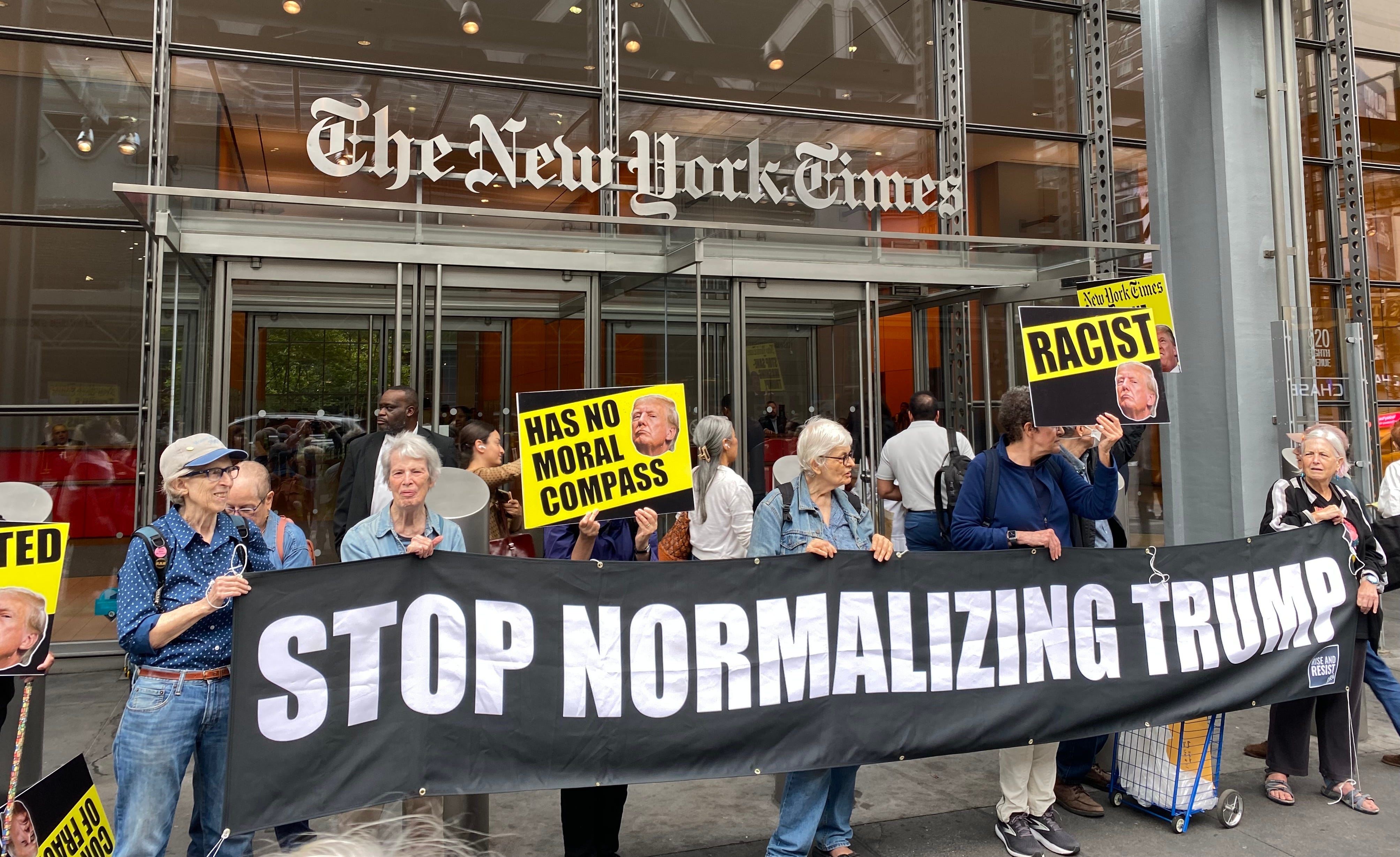
Bloggers are quick to report on Trump’s latest mistakes, lies, gaffes, outrages, and mental confusion, but a large swathe of the media reports on his speeches without pointing out his lies, threats, and incoherence. A group called the Media and Democracy Project decided to bring their complaints directly to the nation’s most influential newspaper, The New York Times.

THE GOOD NEWS

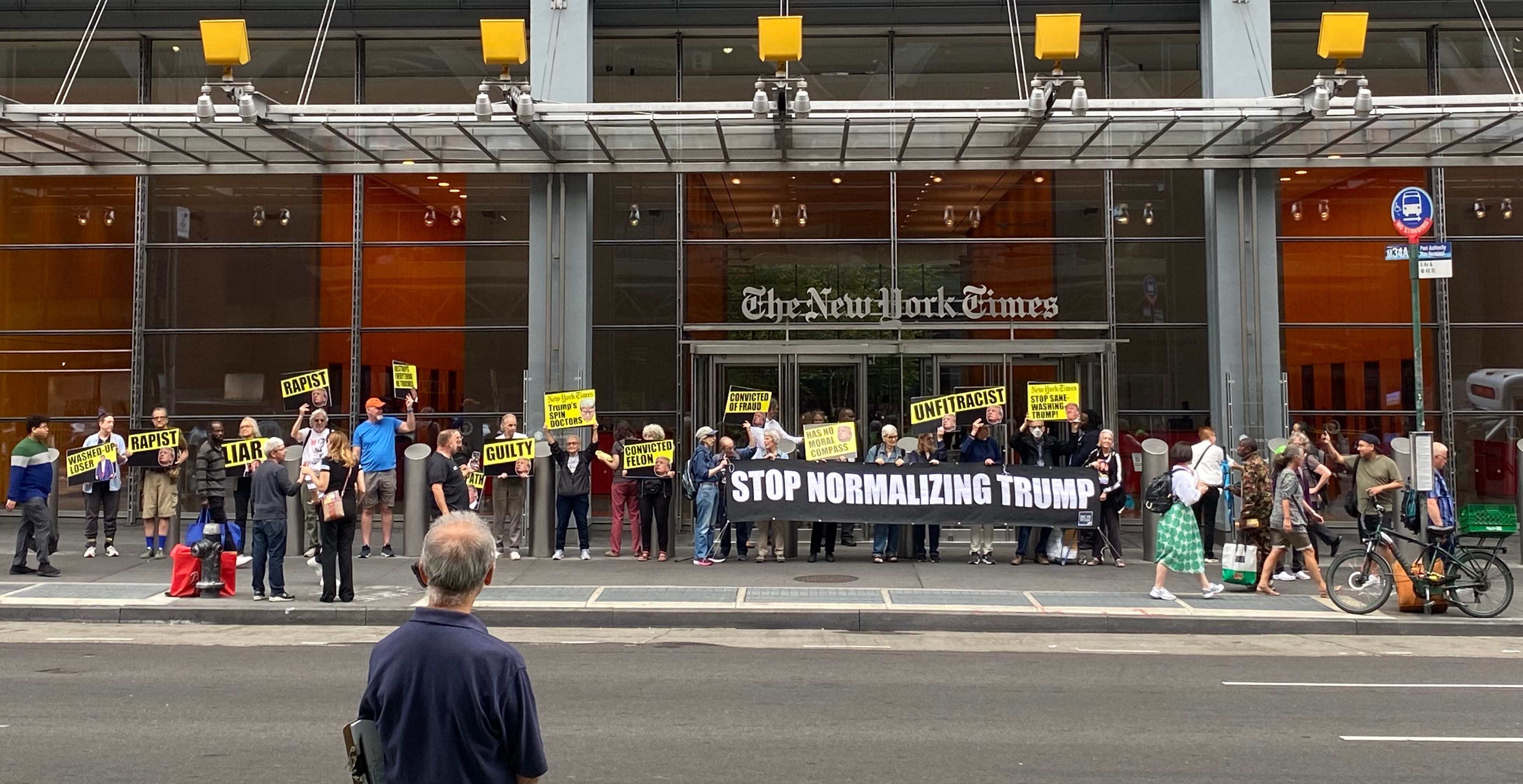
Members of Media and Democracy Project joined Rise and Resist’s protest outside the New York Times offices in Manhattan on September 18th, 2024

Peaceful Protest Outside The Times

The New York Times is the most powerful news organization in the United States. The narratives created by its editors and journalists have a cascading effect; the rest of the political press internalizes the Times’ agenda and then spits out its priorities and frames to the wider masses. The editorial decisions made on 8th Avenue in New York have a real impact on Americans’ understanding of the stakes of the upcoming elections and the future of our democracy.

An increasing number of regular people are joining media critics in pointing out that the Times is failing catastrophically with its election coverage, in what feels like their leadership willfully ceding to abnormalcy. This month, Times publisher A.G. Sulzberger wrote an exhaustive chronicle of worldwide threats to press freedoms, yet still drew the conclusion that he mustn’t direct his staff to accurately contextualize, or warn of, the threat to democracy here at home.

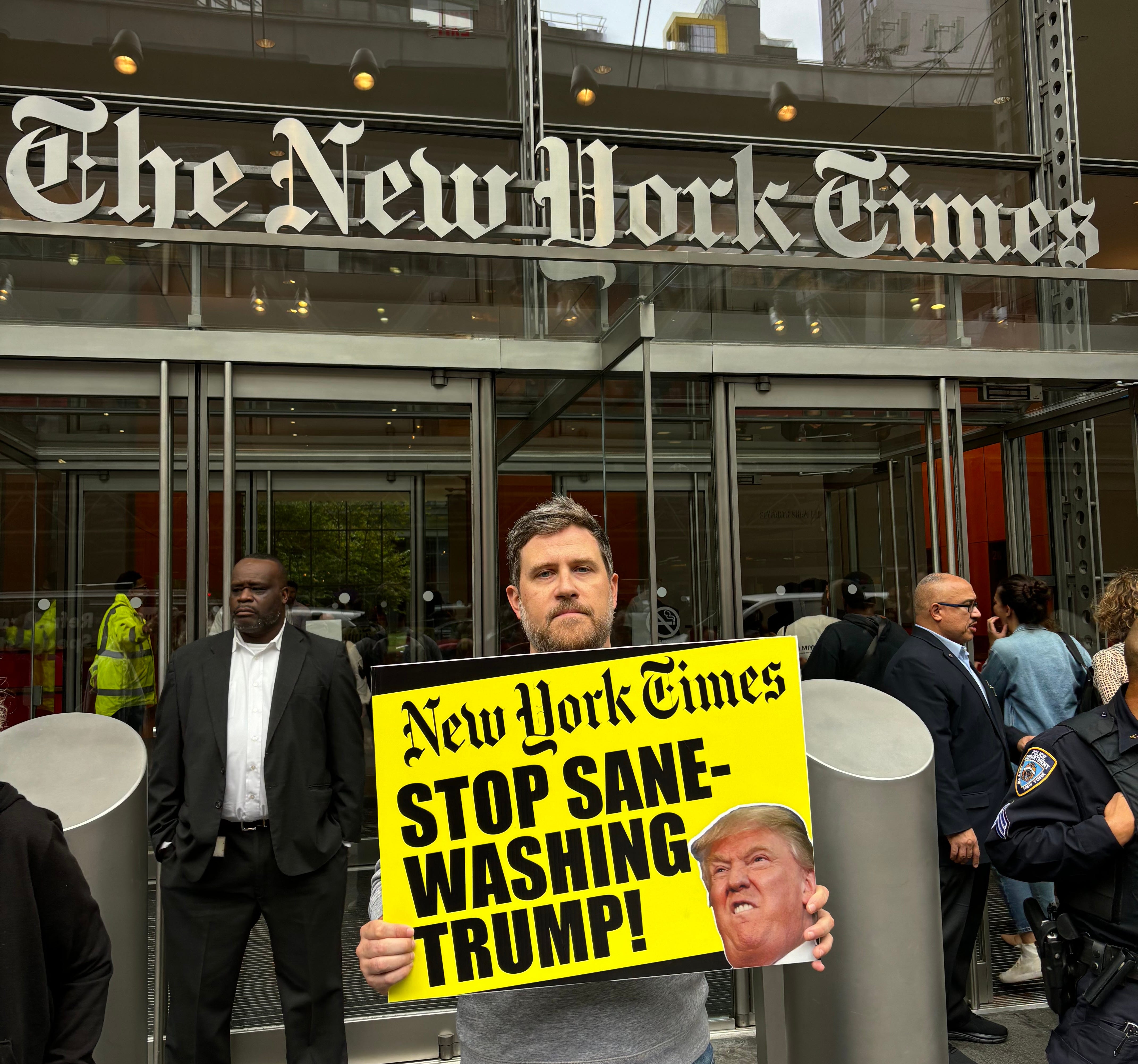
Yours truly protesting outside the New York Times offices in Manhattan on September 18th, 2024

By failing to join the fight and act as partisans for democracy, Sulzberger and the Times are failing in their critical role to accurately inform American citizens. Drew Magary recently commented in SFGATE that the “Times cares more about its place in the power structure than in actually affecting that power structure.” Magary’s piece goes further to say no one should care what the Times says anymore and we should all ignore its political coverage. His righteous dismissal is a response to the Times’ efforts to reject criticism, both internal and external.

Members of Media and Democracy Project joined Rise and Resist’s protest outside the New York Times offices in Manhattan on September 18th, 2024

When A.G. Sulzberger’s father eliminated the Public Editor position in 2017, he assured his readership that they were now the most important critics. Dan Froomkin chronicled this for his Press Watch website:

At the time, Sulzberger wrote in a memo to the newsroom that “our followers on social media and our readers across the internet have come together to collectively serve as a modern watchdog, more vigilant and forceful than one person could ever be. Our responsibility is to empower all of those watchdogs, and to listen to them, rather than to channel their voice through a single office.”

The charade of newsroom responsiveness to outside criticism did not last long. Only a few years later, Times chief Dean Baquet was completely dismissive of “followers on social media,” saying “I could care less about the unnuanced voices on Twitter. That doesn’t mean I don’t care about what our readers think, but I don’t pay as much attention to Twitter as Twitter might want me to.”

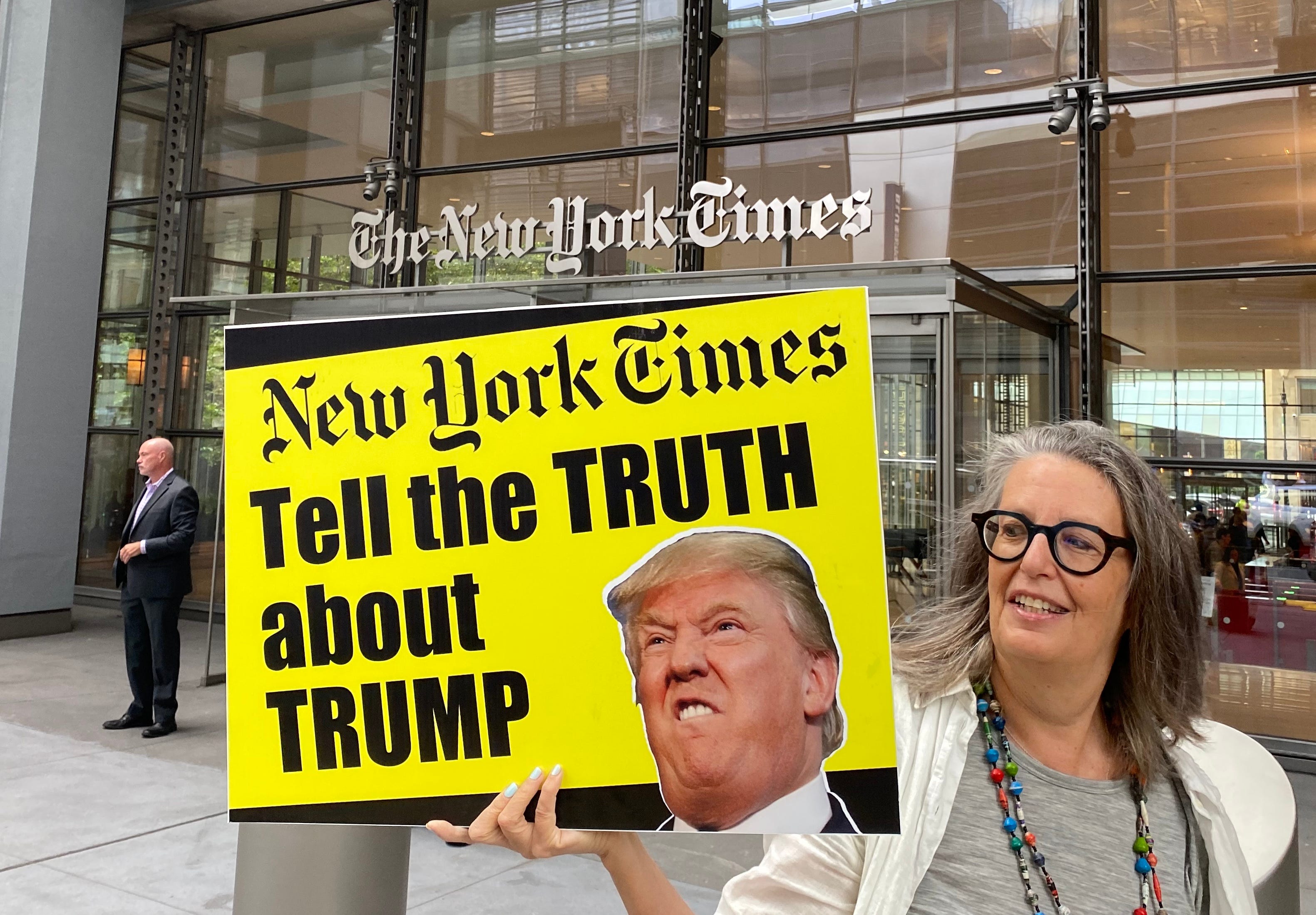
Members of Media and Democracy Project joined Rise and Resist’s protest outside the New York Times offices in Manhattan on September 18th, 2024

We’ve explored all manner of tactics to get the Times to improve its coverage and regain its credibility, including calling on them in January to reinstate the position of Public Editor. We have not heard back as of the writing of this piece. 

While some, like Magary, believe it’s no longer worth anyone’s energy trying to effect change at the Times, we disagree. A workplace is not a monolith and there are many employees there who disagree with the Times’ normalizing coverage of the Trump/MAGA threat to democracy. We want to aid those workers by facilitating a culture of dissent. 

Members of Media and Democracy Project joined Rise and Resist’s protest outside the New York Times offices in Manhattan on September 18th, 2024

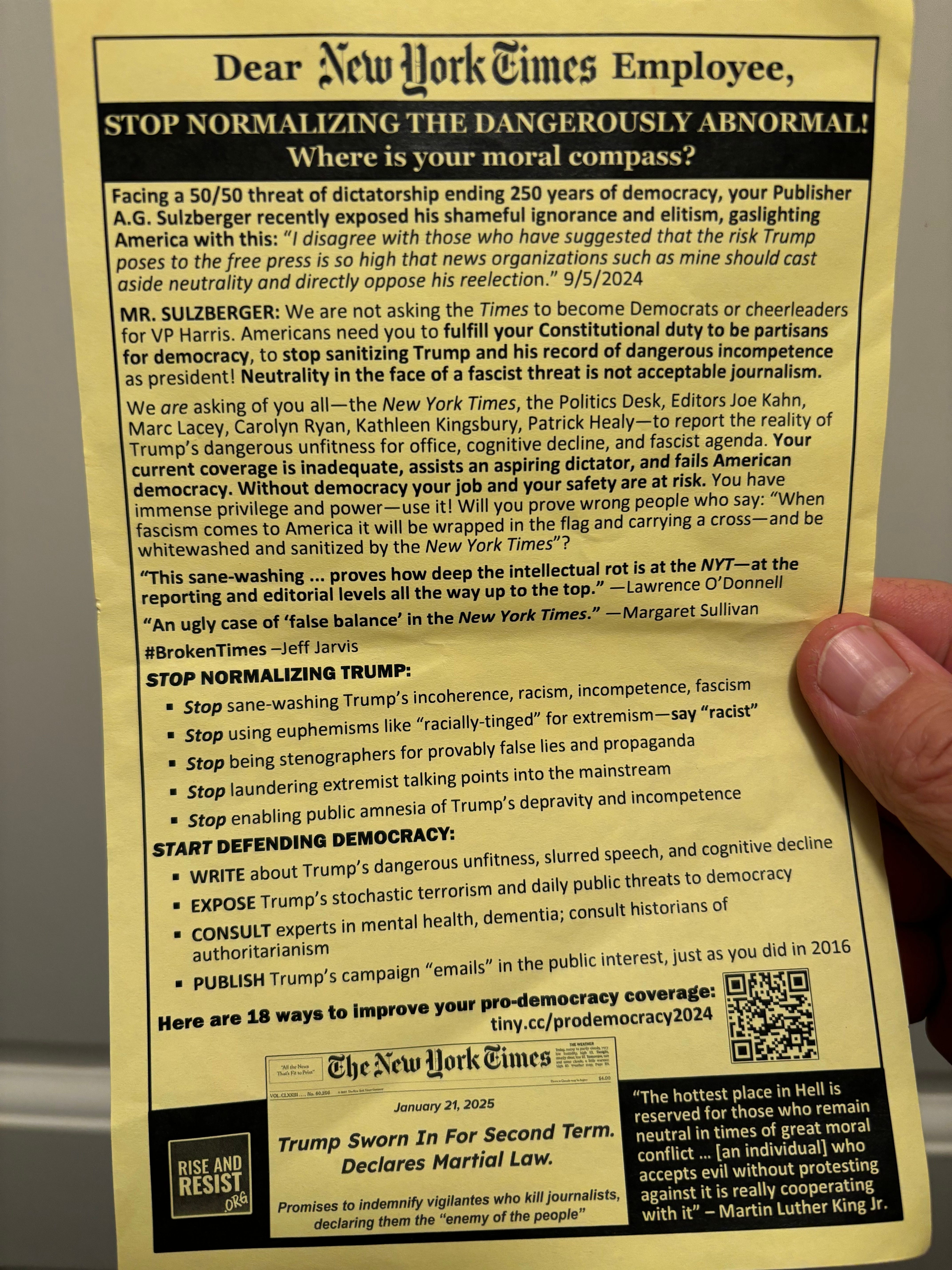
On September 18th, we joined a peaceful protest outside the Times building organized by Rise and Resist, a New York City-based direct action group. Flyers with criticisms of A.G. Sulzberger and senior editors were handed to employees entering the building with the goal of inspiring the humans who power the New York Times to activate their moral core and advocate for a change in political coverage. 

The flyer that was handed out to Timesemployees

No more excuses can be made for the upper management’s normalizing and sanewashing of the most manifestly unfit person ever to run for president. It is unlikely that the Times’ HR department would approve a person like Trump for any position in their building. So why are the powerful people who run the Times deceiving America about his fitness to take a job leading us all?

General Stanley McChrystal, a much-decorated leader of the U.S. military, endorsed Kamala Harris for President. General McChrystal is retired. His endorsement appeared in The New York Times.

He wrote:

Some deeply consequential decisions are starkly simple. That is how I view our upcoming presidential election. And that is why I have already cast my ballot for character — and voted for Vice President Kamala Harris.

As a citizen, veteran and voter, I was not comfortable with many of the policy recommendations that Democrats offered at their convention in Chicago or those Republicans articulated in Milwaukee. My views tend more toward the center of the political spectrum. And although I have opinions on high-profile issues, like abortion, gun safety and immigration, that’s not why I made my decision.

Political narratives and policies matter, but they didn’t govern my choice. I find it easy to be attracted to, or repelled by, proposals on taxes, education and countless other issues. But I believe that events and geopolitical and economic forces will, like strong tides, move policymakers where they ultimately must go. In practice, few administrations travel the course they campaigned on. Circumstances change. Our president, therefore, must be more than a policymaker or a malleable reflection of the public’s passions. She or he must lead — and that takes character.

Character is the ultimate measure of leadership for those who seek the highest office in our land. The American revolutionary Thomas Paine is said to have written, “Reputation is what men and women think of us; character is what God and angels know of us.” Regardless of what a person says, character is ultimately laid bare in his or her actions. So I pay attention to what a leader does.

History has shown us that the office of the presidency unfailingly reveals the occupant’s character. Moments of disappointment and crisis — like Jimmy Carter’s acceptance of responsibility for the failed 1980 Iran hostage rescue mission, John F. Kennedy’s navigation of the terrifying 13-day confrontation over Soviet missiles in Cuba and Abraham Lincoln’s courageous issuance of the Emancipation Proclamation — said little about policy but much about character.

And we’ve seen both sides of the coin: Failures of character, such as those of Richard Nixon and his vice president Spiro Agnew, dishonor and potentially threaten our republic. Character will dictate whether we stand by our NATO allies and against Vladimir Putin’s continued aggression. Character will dictate whether we have a commander in chief who honors and respects the men and women who serve in uniform.

Fortunately, neither candidate in this pivotal election is unknown to us. We’ve had years to watch both closely.

Each of us must seriously contemplate our choice and apply the values we hope to find in our president, our nation and ourselves. Uncritically accepting the thinking of others or being swayed by the roar of social media crowds is a mistake. To turn a blind eye toward or make excuses for weak character from someone we propose to confer awesome power and responsibility on is to abrogate our role as citizens. We will get — and deserve — what we elect.

I’ve thought deeply about my choice and considered what I’ve seen and heard and what I owe my three granddaughters. I’ve concluded that it isn’t political slogans or cultural tribalism; it is the best president my vote might help select. So I have cast my vote for character, and that vote is for Vice President Kamala Harris.

Ms. Harris has the strength, the temperament and, importantly, the values to serve as commander in chief. When she sits down with world leaders like President Volodymyr Zelensky of Ukraine, representing the United States on the global stage, I have no doubt that she is working in our national interest, not her own.

I would urge others to vote as I have. But whatever decision you make, let it be thoughtfully considered, carefully reached and yours alone. We’ll all have to live with it.

Most people would promptly respond to the question that is the title of this post: NO! the First Amendment was written to protect the people against government over-reach. The very question is absurd on its face. Yet Republican Attorneys General have argued that the First Amendment protects their right to ban books. No, no, no, a million times NO!

Chris Tomlinson, a columnist for The Houston Chronicle, wrote about the case:

Book banners in Llano County and Florida’s attorney general will try to convince a federal appeals court Tuesday that the First Amendment grants elected officials the unlimited right to remove books from public libraries.

Conservatives will turn freedom of speech on its head by arguing that politicians are expressing themselves when they ban books, and therefore, the Constitution protects book bans. In a perverse twist, they will make this argument during Banned Books Week, the time of year when writers defend the right to share ideas.

The Little v. Llano case will undoubtedly go to the U.S. Supreme Court. Seventeen Republican state attorneys general have joined Ken Paxton in defending the Llano County Commissioners Court’s order to remove 17 books from the public library. Not the school library, mind you, but the library system for all residents.

The banned books include the award-winning “They Called Themselves the K.K.K: The Birth of an American Terrorist Group,” by Susan Campbell Bartoletti, “Caste” by Isabel Wilkerson, and “It’s Perfectly Normal: Changing Bodies, Growing Up, Sex and Sexual Health,” by Robie Harris.

Llano is not alone. Texas has led the nation in book bans, according to PEN America, a nonprofit freedom of speech group of which I am a member.

Historically, the U.S. Supreme Court has held that the First Amendment severely limits the power of government to control speech and other forms of expression. Governments are not allowed to ban books based solely on their viewpoint; there must be a public safety issue.

Llano County residents sued in federal court last year to have the books returned. U.S. District Judge Robert Pitman found that Llano officials only banned the books because they disagreed with the content and determined the commissioners had no compelling government interest to remove them. He ordered all the books restored to library shelves.

The county appealed to the 5th U.S. Circuit Court of Appeals, which split in a preliminary decision. The full 17-judge court will hear arguments Tuesday.

The 18 Republican attorneys general who have joined the case want the judges to accept a new interpretation of the First Amendment, one first pushed in Florida. They argue government officials have free speech rights, and the court must protect them as much as a librarian’s, a writer’s or a reader’s civil liberties.

“The county’s decisions over which books to offer its patrons in its public libraries, at its own expense, are its own speech,” the states argued in a court filing last month. “The government does not violate anyone’s free speech rights merely by speaking — no matter what it chooses to say or not to say.”

If Little v. Llano makes it to the Supreme Court, and the justices agree with this argument, they will hobble the foundation of our democracy: the free exchange of ideas. The flip side of the freedom to write is the freedom to read. One is useless without the other.

Libraries play a crucial role in a free society. They are repositories not only of history and entertainment but of accumulated knowledge and new ideas. Books are expensive, and libraries make them available to the entire community.

Public libraries are, by definition, government entities financed with taxpayer dollars. In a free society, they must be nonpartisan and contain a wide range of content absent political litmus tests. A conservative victory for Llano would turn politicians into thought police.

The conservative activists who complained about the Llano library books relied on a list of 850 titles published by former state Rep. Matt Krause, a Fort Worth Republican, in 2021. Krause focused on books about racismLGBTQ issues or anything else that “might make students feel discomfort, guilt, anguish.”

Krause was among the state lawmakers who limited how teachers can discuss slavery and discrimination against African Americans because it might make descendants of slaveholders uncomfortable. Possessing “The 1619 Project” is now a firing offense at Texas public schools.

Where does it end if politicians have a free speech right to ban books? We know politicians try to outdo each other with ideological purity tests. Activists on the left and right will draft lists of authorized and prohibited books, and libraries will have to restock their shelves after every election.

As for those who argue libraries are full of pornography, I say poppycock. The American Library Association and professional librarians follow well-considered procedures in choosing what titles to carry, and one person’s taste should not determine what a library buys.

If politicians do end up determining what we can find at the library, you’ll have fellow Texans to thank.

Tom Armbuster writes in the Bulletin of Atomic Scientists about a little-noticed feature of Project 2025, the agenda for a second Trump administration prepared by the Heritage Foundation. The 900-page document calls for a resumption of nuclear testing. Armbruster is deeply knowledgeable about the horrible after-effects of atomic testing, whether in the open air or underwater.

Armbruster was US Ambassador to the Republic of the Marshall Islands, where several nuclear tests were conducted, which poisoned people, the land and the sea.

He writes:

There are few places more peaceful than a Pacific island. At 6:45 am on a March morning in 1954, that peace was shattered by the largest nuclear test in American history: Operation Bravo.

The Bravo test was a thousand times more powerful than the Hiroshima bomb. Now, 70 years later, Project 2025 is proposing a resumption of testing. That should alarm every military service member, downwinder, Pacific Islander, and taxpayer.

As US Ambassador to the Republic of the Marshall Islands, I joined in the solemn observance of “Remembrance Day,” the Marshallese national holiday that pays tribute every March 1 to those who lost their homeland, fell victim to cancer, or were otherwise affected by the Bravo shockwave and fallout.

The shorthand for the 67 nuclear tests from 1946 to 1958, including two undersea tests that wiped out rich Pacific marine life, is the “Nuclear Legacy.” It would be more accurate to call it the “Nuclear Wound.” The tests on Bikini, Enewetak, and Kwajalein wounded the land and the ocean, the people—both Marshallese and American servicemen—and the relationship between our two countries. Healing is marked in decades, if not centuries.

We’ve had the nuclear tiger by the tail for a long time. No leader of any country would want their legacy to be the use of such indiscriminate and destructive weapons. When I joined the Foreign Service from Hawaii, Ronald Reagan was President. A chance for nuclear disarmament came and went with his summit with Soviet leader Mikhail Gorbachev in Reykjavik. Today, the Soviet Union is gone but nuclear weapons are still here. We’ve made progress, but Reagan’s vision of a nuclear-free world remains out of reach. Until we achieve that goal, maintaining a test ban is in everyone’s interest. It is part of the legacy we leave our children.

It is simply incomprehensible that the people who created Project 2025 would advocate a return to one of the most destructive practices in our history.

Billy Townsend writes a blog where he exposes public corruption in Florida. In this post, he tries to understand why his friends and neighbors will vote for Trump.

He begins:

Choosing — yet again — to inflict a deteriorating, revenge-obsessed, 78-year-old Capitol lynch mob inciting felon sex abuser and his horde of MAGA freaks on your friends, loved ones, neighbors, fellow citizens, and communities means inflicting — yet again — a deteriorating, revenge-obsessed, 78-year-old Capitol lynch mob inciting felon sex abuser and his horde of MAGA freaks on your friends, loved ones, neighbors, fellow citizens, and communities. 

I am surrounded in Lakeland, Florida these days by folks who have made this choice multiple times already, who pretend they’re in downcast denial about the self-evident facts of making that choice yet again, especially post January 6th. They’re pretending to believe that choosing to make a MAGA dictatorship and give it the nuclear codes and Department of Justice does not meanmaking a MAGA dictatorship and giving it the nuclear codes and Department of Justice….

What I most value about elections is that they force clear, unambiguous choices. The MAGA Freak dictatorship choice before us is the clearest and most obviously one-sided choice in the history of American self-government. Everyone knows this. The fact that the vote will be close on something so obvious says more about Americans than it does about the choice we face. MAGA doesn’t even have a fake economic or border argument to make. 

I mean, at the most elemental level, I would be proud to call Kamala Harris friend, aunt, wife, mother, boss, co-worker Kiwanis Club president, mayor, minister. I would be disgusted and embarrassed to call the deteriorating 78-year-old MAGA dictator friend, uncle, husband, father, boss, Kiwanis Club president, mayor, minister. 

Timothy Snyder is the Richard C. Levin Professor of History at Yale University. He specializes in the history of Central and Eastern Europe, the Soviet Union, and the Holocaust.

He wrote this as he was flying from Europe to the U.S. Since the Russian invasion of Ukraine, Snyder has been an outspoken champion of that beleaguered nation. He has used his deep knowledge of history to debunk Putin’s justifications for invading his neighbor. He has even raised money to buy defense weapons for Ukraine when the Republican Congress dithered for months before passing an aid package.

Snyder writes:

Words make their way through the world with us, changing their senses as we change our lives.  Think for example of the word “launch.”

Today and in days to come I will “launch” my book On Freedom, in the sense of the word all of my publishing friends like to use.  They want to book to “launch,” to soar, to do well.  In this spirit I talked to Tom Sutcliffe of the BBC in London this morning, and I am hoping to speak to Rachel Maddow of MSNBC tonight.  And no doubt throughout this long day, which begins in Europe and ends in the United States, I will say “launch” several times myself.

I am returning from Ukraine. My first true conversation about On Freedom this month was a week ago in Kharkiv, a major city in northeastern Ukraine, close to the Russian border and to the front.  The Literary Museum there had invited me for a presentation at an underground site.  It was a lovely place, with a bar that made me the coffee that I needed after a long trip, and a crowd of people invited to talk about freedom (we could not announce the event for safety reasons, which I regret). In a sense, this Kharkiv discussion was the real launch of the book.

We were underground, though, because of another kind of launch, the unmetaphorical kind, not the literary launch but the literal launch — of Russian missiles.

Kharkiv, Budynok “Slovo”.

The Russians seemed close to taking Kharkiv at the beginning of the war.  There was intense combat in Saltivka, a district of the city home to about 600,000 people.  Major buildings in the city center of Kharkiv are still in ruins. The Ukrainians held the Russians back, but Russia itself remains close.  A missile fired from Russia can reach Kharkiv before people have a chance to get underground.  That, in Kharkiv, is what a “launch” too often means.

The difference in the sense of a word can help us to catch the difference in reality.  In Kharkiv, the drones and the bombs and the missiles are a normal part of the day.  People want to talk about books, they want to go to restaurants and movies, they want to live their lives, and they do, despite it all.

Those of us beyond war zones catch all of this, if at all, indirectly, through media.  We do not hear the sirens and we do not have to go underground.  We do not have to check social media to see if friends and family are alive. The word “launch” retains a kind of innocence.

This is not about countries being different, but about situations being difference.  Kharkiv in normal times is a major literary city. In the 2020s, before the Russian full-scale invasion, Kharkiv was a center of Ukrainian book production.  Before February 2022 there were plenty of launches, in the literary sense, in Kharkiv. And there are still some now!

Genocide is not only about killing people, but about eliminating a culture, making it untenable by destroying the institutions that transmit it.  Thus Russia burns books, steals museum artifacts, and bombs archives, libraries, and publishing houses.  Russia deliberately destroyed the publishing houses in Kharkiv, including where one of my own books was being printed.  One sort of launch would seem to obliterate the other.  But, to the Ukrainians’ credit, only for a time.  The book publishing industry, like a number of others, picked up in other places. The public book culture in Ukraine, expressed in new stores and cafes, is defiant.

I was thinking of “launches” in Kyiv, a couple of days after the Kharkiv visit, as I pretaped an interview about the book.  For me it was the end of a long day, spent beginning (“launching”) a big history project.  The first conference had gone well, and we had a press conference complete with a Viking sword, a Byzantine cross, and Scythian and Trypillian vessels kindly loaned by the national museum.  Ukrainian colleagues on the stage had spoken of the importance of cooperation and listening in our grand cooperative project.  I was in a good mood when I went to a side room to tape the interview.

At around the time the interview began, a missile was launched from Russia, aimed at Kyiv.   The air raid sirens began outside the window.  An air raid siren can mean different forms of attack, some more rapid and some less so.  Drones can cause terrible damage and kill large numbers of people, but they are not very fast.  If a missile is in the air, on the other hand, you have to move right away.  Since there was in fact a missile bearing down on Kyiv, I explained this to the interviewer and hastened to the stairs.  I learned that Ukrainian air defense had destroyed the missile as I reached the staircase.

This was all completely normal.  The Russians launched a number of very large strikes last week with missiles and drones.  Ukrainian air defense is excellent — when the Ukrainians are given the tools, they protect their people extremely well, and Kyiv is where their limited equipment is concentrated.  We picked up the interview as soon as I could re-establish the connection.

One sort of “launch” had been briefly interrupted by another, my literary book launch by a literal missile launch.  This was an infinitesimally tiny taste of the interruption tens of millions of Ukrainians face all the time from Russia’s senseless war, which changes the shapes of lives even when it does not end them.  Russia launches these attacks on civilians all the time, almost every day.  The point is not only to kill people and destroy civilian architecture but to instill a certain view of life.  Nothing good ever happens. Be afraid at all times.  Undertake nothing new yourselves.  Give up.

But people do start new projects in Ukraine.  Ukrainian writers have been productive during this war, including writers serving in the armed forces. Serhiy Zhadan, an extraordinary Kharkiv poet and novelist, has just published a book. I was able to have three discussions with him in two cities. One day there will be a collection of Ukrainian war poetry in translation, and it will be astounding. Ukrainians launch cultural projects one after the other, even if the word seems odd just now.  I took part in two such launches in just one week: the big history project in Kyiv, called Ukrainian History Global Initiative; and a new cultural institution in Lviv, INDEX, which is based around recording war experience from multiple methods and multiple perspectives.  The Literary Museum in Kharkiv has an interesting new (partly interactive) exhibition by K. Zorkin.

When we can meet, we can gather the senses of words from the settings.  I am grateful to all my friends and colleagues and hosts in Ukraine.  Without the time in Ukraine On Freedom would be a different and poorer book. And so, much as I am happy to be speaking about the book today in the UK and the US, it seems right that there was something like a launch in Kharkiv first. 

When we cannot meet, we still have the words.  We can follow the senses of the word “launch,” from the rougher to the gentler and back, along an arc that perhaps leads to some understanding.

TS, 16 September 2024

In Kharkiv, September 2024, in conversation with Volodymyr Yermolenko

Johaan Neem is a historian at Western Washington University. He recently published a thoughtful essay about the crisis of our time, the fateful election before us. Will voters return to power a man who has made known his contempt for our Constitution and for the norms of democracy? Neem likens our present dilemma to the “exclusion crisis” in England in the late 1670s and early 1680s. King Charles II sought to turn England into an absolutist state; he canceled laws passed by Parliament and oust local officials who displeased him. Neem suggests that that the U.S. is experiencing a comparable crisis when the question before us is how to resist a tyrannical government that came to power legitimately.

Neem writes:

Today, America is roiled with its own Exclusion Crisis. We too face the very real possibility that in this fall’s election a legal succession could bring to power an executive who has demonstrated his willingness to undermine our Constitution. To draw the parallel is not to propose armed resistance but to force us to reckon with the dreadful gravity of this moment: We may be about to hold an election which will render our Constitution invalid. 

We should not confuse reasonable differences between the two parties and their policies with threats to the Constitution itself. In a democratic republic, open disagreement is a sign of civic health. Regardless of one’s partisan loyalties and policy preferences, however, the evidence is clear that Donald Trump poses a threat to the republic. Like Locke before us, we must consider how to respond should an empowered political leader unknit our order.

There have been many articles and books examining Trump’s authoritarian tendencies and his admiration for authoritarian leaders around the world. The largest threats he poses to the Constitution are not his policies but his efforts to undermine the rule of law by embracing violence as a political tool. Numerous high-ranking officials from the Trump Administration have made clear that, but for their resistance, as president, Trump would have undermined the Constitution during his first term. He has joked that he’ll be a dictator on the first day of his second term, but there’s nothing funny about it. If re-elected, he has promised to unleash all the force of the United States Justice Department against his political opponents, from Gen. Mark A. Milley to President Biden and Vice President Harris, and to bypass the judicial system by using military tribunals. We should take his word for it. 

Trump’s violence — his penchant for it, for inciting it, and valorizing it — should terrify us most of all. He encouraged and then celebrated the efforts of his supporters on January 6 to undermine an election and threaten the safety of America’s elected officials. At the heart of the American system is the freedom of elected legislatures. That freedom itself emerged out of conflicts between Parliament and King — and between colonial assemblies and royal governors — during the 17th and 18th centuries. The consent of the governed depends ultimately on free elections and the capability of the people’s elected representatives to deliberate the public good. Trump is committed to undermining legislative freedom. Both Republican Senator Mitt Romney and former Representative Liz Cheney have revealed that members of Congress were afraid to vote to impeach President Trump — even when they believed that he had committed impeachable offenses — because they worried that his supporters would threaten their families’ safety. When legislators are not free to deliberate and vote, the Constitution is already dead. 

Fear kills freedom. Fear is the point. 

This is an excerpt. Please open the link to finish reading the essay.

It’s strange indeed that a lifelong playboy who spent his time developing fast-buck schemes, operating casinos, and attending professional wrestling matches has the ability to intimidate and control an entire political party with threats of violence.

Carl Cohn is one of my personal heroes of American education. He served as superintendent in Long Beach and in San Diego, also as a member of the state board of education. Currently he is Professor Emeritus and Senior Research Fellow at Claremont Graduate University. I first met him when I was researching my book The Death and life of the Great American School System: How Testing and Choice Are Undermining Education. At the time, I was studying the San Diego schools as the site where corporate reform had its first try-out. Carl was brought in by the school board to put the district back together after nearly a decade of disruptive and punitive reforms. What I remember most from our candid, off-the-record conversation was his advice: the most important connection between the superintendent and teachers is trust. He subsequently published an essay about trust for “Education Week,” and I quoted him in my book.

Carl Cohn wrote this essay for School Administrator magazine.

Last summer, I attended a raucous school board meeting in Orange County, Calif., where a conservative school board majority had fired a popular superintendent, started remov-
ing books from libraries, banning
LGBTQ+ symbols and considering a new parental notification policy that would, in effect, restrict the protected rights of certain students under both state and federal law.

After sitting in a crowded room with adult culture warriors going back and forth for several hours with heated exchanges, I was struck by the bravery of a young transgender high school student who had the courage to go to the podium to address her elected school board with the following request: “I just want to feel safe at school. Please make that happen!”

Fast forward to the March 5 Super Tuesday primary elections here in California, one that was characterized by historically low turnout, which usually gives prominence to the voting habits of older, whiter and more conservative voters.

A new progressive coalition of parents, teachers, organized labor and community members successfully recalled two of the conservative members of the school board majority there and recently appointed progressive replacements for them. The other two members of the previous conservative majority are up for re-election on the November ballot.


A Hopeful trend


This outcome caught the political pundits and experts by surprise. The 25,000-student Orange Unified School District in Orange, Calif., sits in the heart of historic Ronald Reagan country, which is trending purple rather than solidly red in high-turnout elections. It was not seen as a likely place to launch the progressive pushback against the culture wars that have dominated public school debates at the local level, starting with the COVID-19 pandemic shutdowns.


Evidence of this hopeful new trend is emerg- ing in school district elections around the country, including the critical battleground states that are the key to the upcoming November presidential election outcome.


The emerging evidence from Bucks County and Reading in Pennsylvania, Clarksville in Ten- nessee, Lexington in Kentucky, Middletown in Ohio, Plattsmouth in Nebraska, suburban New Jersey and other parts of the country suggests that new coalitions of parents and allies are say- ing emphatically that the interests of all K-12 school children should be the main agenda rather than this recent proxy for the adult culture wars. The latter often creates real-time chaos and dis- ruption in public school districts.

Most of these conservative school board agen- das in the past four years generally have flown under the seemingly common-sense banner of something called “parental rights,” which suggests that a majority of parents absolutely know what is best when it comes to policymaking at their local public schools. Who could possibly disagree with such a valid notion?


I would argue that anyone who has studied the legitimate history of the United States would disagree vehemently because the sad truth is that parental rights often have been used in America to take away the rights of certain children under the guise that parents know best under all circumstances.


Did those Louisiana parents know best when they tried to deny an education to six-year-old Ruby Bridges back in 1960? The mob that yelled at that innocent young black girl was argu-
ing absurdly that parents know best under all circumstances.


Or in liberal-learning California and Mas- sachusetts in the late 1970s when school board members declared that parents in Boston and Los Angeles’ San Fernando Valley should control who attends the public schools there?
Consider the fact the civil rights division of the U.S. Department of Education has logged a record number of complaints this past year, con- firming that the rights of vulnerable students are under systematic assault throughout our nation.

Communities push back


Writing for The Christian Science Monitor, reporter Courtney Martin describes the rust-belt community of Middletown, Ohio, made famous by Senator J.D. Vance’s 2016 best-selling memoir “Hillbilly Elegy,” as an emerging success story in fighting back against the school culture wars that dominate so many communities in America.

The school district’s first Black superintendent, Marlon Styles, rather than getting defensive, decided to engage with the parents and commu- nity members who criticized his emphasis on cul- turally responsive approaches to school discipline, reducing inequality and full-on embrace of equity.


Styles sat down with the Middletown Area Ministerial Alliance and began a dialogue, listen- ing and learning tour that was critical to reas- suring the respected faith leaders that the school district he headed had not adopted policies inconsistent with the family values they all shared and supported.


Unlike Middletown’s rust-belt status, the Pennridge School District of Bucks County, Pa.,
is a suburban middle-class community just north of Philadelphia, where a progressive alliance suc- cessfully ousted a 5-4 Moms for Liberty school board majority last November 2023 that was determined to adopt a curriculum from conservative Hillsdale College along with banning policies on diversity, equity and inclusion, Pride flags and books with questionable content.


This is yet another example of a community of voters putting the brakes on efforts to adopt extremist policies at the local school board level. As in other communities, these progressive forces do not have the monetary resources that often give a huge advantage to their better-funded conservative opponents.


One of the more interesting progressive groups fighting back against the conservative parental rights groups has emerged in suburban New Jer- sey. It calls itself SWEEP, or Suburban Women Engaged, Empowered and Pissed. Its members often work with Districts for Democracy, the New Jersey Public Education Coalition and Action Together New Jersey to push back against well- funded conservative alliances.


While open discrimination against LBGTQ+ students through forced outing policies is often the galvanizing force in many of the emerging
progressive pushback efforts, book banning is another significant issue drawing the ire of voters in some communities.


The Omaha World-Herald reported on the suc- cessful recall earlier this year of a newly elected school board member in the small community
of Plattsmouth, Neb., about 20 miles south of Omaha, who argued that about 50 books needed
to be immediately removed from school libraries based on her objections to their adult content.
In addition, the board member argued, “People that voted for me should have been very well
informed on who I was and what I was going to do.” Her book removal campaign led to a grass- roots coalition of parents, students and commu- nity members who came together to recall her from the school board after she served on the board for only a single year.


PEN America, a free speech organization, is tracking a record number of book bans in U.S. school districts, encompassing 23 states and more than 4,000 books removed in the first five months of 2024. It’s no surprise Florida leads the nation in book bans with 3,135 removed in 11 school districts during the fall 2023 semester.


On a personal note, I volunteered in the same 1st-grade classroom for 20-plus years at Colin Powell School in the Long Beach Unified School District, which I headed for 10 years as super- intendent. In spring 2023, at the start of the baseball season, I read my 1st graders a book that is banned in Duval County, Florida’s fourth largest school system. It’s a delightful children’s book by author Jonah Winter titled Roberto Clemente, Pride of the Pittsburgh Pirates. It captures the iconic story of the great Puerto Rican baseball player and humanitarian who died when his plane crashed while transporting relief supplies to earthquake victims in Nicaragua on New Year’s Eve in 1972. My 1st graders loved the story of this Caribbean island hero.


Before reading it to my students, I searched for what the objectionable content might be. The only thing I could find was a single sentence that referenced the fact “White sports writers called him lazy when he first came up to the Pirates from the minor leagues.” As most sports fans know, sports writers of all colors are sometimes wrong about future Hall of Famers.


Alaska’s Matanuska-Susitna Borough School District, with 19,000 students about 40 miles north of Anchorage, is the center of the most recent book banning controversy to come under federal court scrutiny with a lawsuit brought by
the ACLU and the Northern Justice Project last
fall, according to Alaska Public Media.

The plaintiffs, representing students and par-
ents, are arguing that the school district’s removal of 50-plus books that citizens had complained about is unconstitutional and violates the free speech rights of students. A ruling from a U.S. District Court judge is expected later this year on the plaintiffs’ request for an injunction halting the school district’s removal of the books in question.


A policy under consideration in Wyoming’s largest school district, Laramie County School District 1, would ban any book containing “sexu- ally explicit content” in elementary schools and discourage their use in junior high and high schools, according to news coverage in the Cow- boy State Daily.


The battle there is joined by the Cheyenne chapter of Moms for Liberty on one side and the Wyoming Family Alliance for Freedom on the other. Both sides are gearing up for battle as the school board considers final adoption of this strict policy.


Students First


This past spring, I moderated a panel discussion in Sacramento, Calif., on the embattled political landscape of public schools in California. The
speakers included the dynamic executive direc- tor of our statewide administrators association, a heroic new member of our state legislature and a 17-year-old high school senior who was about to graduate from Chaparral High School in the Temecula Valley Unified School District. The latter is a district whose board, endorsed by an evangelical church, has embraced the notion that the public schools are “the devil’s playground.”

The brilliance of the public school student leader, about to go off to college, stole the show as she confidently articulated what she had learned from outstanding teachers who had exposed her to an honest history of our country and diverse literature that inspires. Proudly sitting in the front row of this large hotel ballroom and cheering her on was her mother, who pointed out that caring and dedicated teachers presenting the truth was what she wanted and demanded from her local public school district. This student and her parent are part of the progressive One Temecula Valley PAC that recently recalled the church-sponsored school board president there.

As we examine the extraordinary stakes in
this fall’s election, school leaders would do well to remember that satisfied students and parents are the best allies and advocates that we could possibly have in the fight to defeat extremists and their blatantly false narratives about America’s public schools.


CARL COHN, a retired superintendent, is professor emeritus and senior research fellow at Claremont Graduate University in Claremont, Calif.


Marlon Styles, former superintendent in Middletown, Ohio, convened members of the faith community to recon- cile differing points of view.