Archives for category: Democracy

Chris Tomlinson is a star opinion writer for The Houston Chronicle. His reflections on Jimmy Carter are worth reading. He knew President Carter well.

My first big assignment as a journalist was covering President Jimmy Carter’s 1995 visit to Rwanda, a doomed mission that brought him little acclaim.

Carter didn’t fight disease, promote democracy or negotiate peace to make headlines. He did the work quietly and diligently to make the world a better place. His life was a master class in a leadership style firmly out of fashion but will hopefully return.

I was in my third month as the Associated Press and Voice of America stringer in Kigali, Rwanda’s capital. A civil war between an ethno-fascist Hutu government and rebels from the Tutsi minority had culminated in the 1994 genocide that slaughtered 1 million people, most of them Tutsi civilians, in 100 days.

The Tutsi-led rebels drove the Hutu leadership and 1.2 million of their followers into neighboring Zaire, rnow known as Democratic Republic of the Congo. Insurgents from the Zairian refugee camps were still killing 300 people a week in Rwanda more than a year later.

I trailed Carter through Rwanda and the Zairian refugee camps. His Secret Service detail was minimal, yet he moved through these dangerous places with a confidence, kindness and humility that only comes from tremendous inner strength.

He spoke to political leaders, genocide victims, refugees and me with the same courtesy and respect. He knew Mobutu would probably never agree to a peace deal, but unlike most famous people, he didn’t allow the likelihood of failure to stop him from trying.

Carter wanted to negotiate a deal between the new Tutsi-led Rwandan government and Zaire’s dictator Mobutu Sese Seko, whose murderous misrule had made him a pariah.

“These leaders know that I’m their last chance to rejoin the international community,” Carter told me while driving to a church where the skeletons of the dead were displayed as a genocide memorial. He laughed and added, “If Jimmy Carter gives up on you, there’s no one else coming.”

Carter met with Mobutu, and he agreed to a summit with the Rwanda foreign minister. Diplomats knew Mobutu had cancer and hoped he might cut a deal to boost his legacy.

Carter’s staff asked me to join the trip to Mobutu’s palace in Gbadolite, Zaire. I watched Mobutu turn the summit into a farce. Eighteen months later, Rwanda overthrew him, installed a new president and forced the refugees home. The old dictator died in exile. Carter kept lobbying for world peace.

I saw the former president many more times over my 11 years in Africa. His foundation, the Carter Center, monitored elections and fought preventable diseases like river blindnessguinea worm and other neglected tropical diseases. Carter’s work saved tens of millions of people from suffering, but he never made a big deal out of it.

No one can accomplish so much without steely determination. Too often, I hear people describe Carter as the weak and bumbling caricature that President Ronald Reagan created to win the 1980 election. Folks should stop confusing courtesy for weakness.

After the Watergate scandal and the Vietnam debacle, Carter, in 1976, offered an alternative to Richard Nixon’s imperial presidency. He practiced what has become known as servant leadership, the theory that a leader’s primary duty is ensuring subordinates have the tools they need to accomplish their mission.

In the Army, my brigade commander instilled servant leadership in me when I joined his staff as a newly minted sergeant in 1986. He explained that junior enlisted members did not serve me because I outranked them; my rank meant I was responsible for their success, and the colonel promised to hold me accountable if they failed.

The term servant leadership is hackneyed, but it captures valuable techniques that have caught on in the business world. It emphasizes listening, empathy, persuasion, stewardship and community building while discouraging egotism and authoritarianism.

The greater good comes first, not any individual.

While president, Carter rejected much of the pomp at the White House. His speeches focused on addressing problems, not promoting himself. Despite attending the U.S. Naval Academy and serving in the nuclear navy, he was never a warrior-king style leader, which American voters tend to favor.

Humility does not do well in the current culture, where conspicuousness is valued. Politicians must constantly self-promote while denigrating their rivals. Compromise is considered a failure, and vulgarity is considered clever.

The strongest people I’ve encountered in the most difficult places don’t puff up their chests. They don’t need others to bow before them. People with inner strength don’t use cruelty to prove their power.

Here’s hoping kindness makes a comeback, courtesy becomes cool, and strength is demonstrated by lifting people up, not knocking them down.

The Indianapolis Public School District is approaching a red zone: the total elimination of public schools. A bill sponsored by a Republican legislator would require the dissolution of the district, the conversion of every public school into a privately-managed charter school, and the replacement of the elected board by an appointed one.

Amelia Pak-Harvey of Chalkbeat Indiana wrote about a recent meeting of the elected school board, where the pressure campaign to privatize the district was discussed.

“This story was originally published by Chalkbeat. Sign up for their newsletters at ckbe.at/newsletters”.

She wrote:

The Indianapolis Public Schools board is strongly opposing a bill that would dissolve the district and force it to convert to charter schools, a proposal that has spurred calls for an organized campaign against it.

The pushback against HB 1136 at the first meeting of the new school board on Tuesday comes as IPS faces the start of yet another legislative session Wednesday that could leave the district more financially strapped and struggling to stay alive.

The bill also became the focus at Tuesday’s meeting, where new board members were sworn in at a historic moment for IPS — for the first time, a board made up entirely of women of color leads a district overseen by its first Black female superintendent.

“This legislation is not student focused, and fails to reflect the community’s input on how they envision their public schools thriving,” board President Angelia Moore said in a statement on behalf of the board at the meeting. “Instead of fostering growth and innovation, HB 1136 risks dismantling the very foundation that supports student success and community collaboration.”

The bill would require Indiana districts to dissolve and transition into charter schools if more than half of students living in the district boundary enroll in a school outside the district. Under the proposal, IPS would dissolve, and 50 of its schools would convert to charters, according to the bill’s latest fiscal impact statement.

Four other districts — Gary Community School Corp., Union School Corp. in east-central Indiana, Tri-Township Consolidated School Corp. in the north, and Cannelton City Schools in the south — would also dissolve.

The bill, proposed by Republican State Rep. Jake Teshka of North Liberty, would also dissolve the IPS’ elected board and replace it with a seven-member board appointed by the governor, the mayor, the president of the city-county council, and the executive director of the Indiana Charter School Board.

IPS to face challenging legislative session

In addition to this bill, a number of other proposals could spell financial ruin for the district, at a time when it faces mounting pressure to share more resources with charter schools. Amid mounting competition from the charter sector, the district has already tried to right-size itself through its Rebuilding Stronger reorganization, which closed several schools last school year and reconfigured grades districtwide this school year.

A new charter advocacy group, the Indiana Charter Innovation Center, will push for charters to receive the same amount of funding from property taxes that traditional districts receive. That would require IPS to give more than the $4 million in property tax revenues it is estimated to give to charters this year, in accordance with a law passed last year.

And incoming Gov. Mike Braun has pushed for capping increases in property taxes, which could further restrict funding for traditional public schools.

IPS grapples annually with competition from Indiana’s strong school choice environment, which state lawmakers have bolstered in previous sessions. The district faces a fiscal cliff once additional property taxes from the 2018 operating referendum expire in 2026. Federal pandemic relief funds have also expired.

“Urban education systems face complex and nuanced challenges that may be unfamiliar to some policymakers,” Moore said at the meeting. “We invite legislators who are genuinely interested in public education to visit our district, gain firsthand insight on our unique mission and vision, and work alongside us to ensure sustainable and meaningful outcomes for students, educators, and families.”

Community members raise opposition to bill

Parents and staff also voiced their opposition to HB 1136 at the meeting Tuesday and called on the board to loudly protest it. Four people spoke against the bill, while three others suggested the board partner with charters, respond to the demand for educational choice, or work with lawmakers to improve the district.

The public support follows a separate call from a group of community leaders who last week called on IPS to consider how to remain operational amid “strong financial headwinds.”

“The legislature has taken notice and seems ready to act if needed,” read the statement from former mayors Bart Peterson and Greg Ballard; former IPS board president Mary Ann Sullivan; and city-county councilors Maggie Lewis, Carlos Perkins, and Leroy Robinson. “It is preferable, however, that any structural changes in IPS are driven locally and to the benefit of our Indianapolis students and community.”

“Rebuilding Stronger shut down schools. The loss this community felt cannot be overstated. Don’t let their loss be in vain,” parent Kristen Phair told the board in between sobs. “I am asking each of you commissioners to take a united stand and be loud in advocating against this bill. Please help us organize. Our families want to organize against this.”

The group urged IPS to share more property tax funding with charter schools.

But Noah Leninger, a teacher at Robert Frost School 106, urged the board not to accept any such compromises.

“More charter schools will not save IPS,” he said. “No matter what they’re called — if we’re honest and we call them charter schools, if we lie to ourselves and our community and call them Innovation Network schools — whatever the name, the rapid and unchecked expansion of these unaccountable grift mills has not gotten IPS out of this mess.”

Board member Gayle Cosby, who beat an opponent backed by political action committees supportive of education reform to return to the board, said that she was encouraged by the crowd. She also scrutinized the often repeated call by charter supporters for IPS to “partner” with charters.

“My definition of partner does not include any entity that is actively seeking to destroy or dissolve our district, as noted in the proposed legislation,” she said.

Board member Nicole Carey said the challenging times will require courage from district leaders.

“To everyone tonight, I want to say stand with us, stay engaged, hold us accountable to this promise of prioritizing the needs of our students,” she said. “It is going to take all of us.”

Yesterday was a day jam-packed with news, which Heather Cox Richardson puts into perspective. We can look forward to–or dread– four years of non-stop lying and bragging and insulting and threatening by Convicted Felon Trump. Among other crazy things he said yesterday, he claimed that Hezbollah terrorists were part of the Jan 6 mob that stormed the U.S. Capitol. Were they carrying Trump banners? Will he pardon them?

She writes:

Today, President Joe Biden signed proclamations that create the Chuckwalla National Monument and the Sáttítla Highlands National Monument, protecting 848,000 acres (about 3,430 square kilometers) of land in southern California’s Eastern Coachella Valley. Under the 1906 Antiquities Act, the president can designate national monuments to protect areas of “scientific, cultural, ecological, and historic importance.”

Yesterday, Biden protected the East Coast, the West Coast, the eastern Gulf of Mexico, and Alaska’s Northern Bering Sea—an area that makes up about 625 million acres or 2.5 million square kilometers—from oil and natural gas drilling. While there is currently little interest among oil companies in drilling in those areas, the new designation will protect them into the future. Noting that nearly 40% of Americans live in coastal communities, Biden said the minimal fossil fuel potential was not worth the risks that drilling would bring to the fishing and tourist industries and to environmental and public health.

The White House noted that Biden and Vice President Kamala Harris have “conserved more lands and waters”—more than 670 million acres of them—and have “deployed more clean energy, and made more progress in cutting climate pollution and advancing environmental justice than any previous administration.” At the same time, oil and gas production is at an all-time high, demonstrating that land protection and energy production can coexist.

While oil executives blasted Biden’s proclamation protecting the coastal waters, Democratic lawmakers on the newly protected coasts cheered his action, recognizing that oil spills devastate the tourism and fishing on which their constituents depend: the 2010 Deepwater Horizon oil spill in the Gulf of Mexico, for example, killed 11 people, closed 32,000 square miles (82,880 square kilometers) of the Gulf of Mexico to fishing, and has cost more than $65 billion in compensation alone.

Biden protected the oceans under the 1953 Outer Continental Shelf Lands Act, which enables presidents to withdraw federal waters from future oil and gas leasing and development but does not say that future presidents can revoke that protection to put those waters back into development, meaning that Trump—who similarly protected coastal waters when he was president—will have a hard time overturning Biden’s action.

Nonetheless, Trump’s spokesperson Karoline Leavitt called Biden’s decision “disgraceful” and claimed it was “designed to exact political revenge on the American people who gave President Trump a mandate to increase drilling and lower gas prices. Rest assured, Joe Biden will fail, and we will drill, baby, drill.”

Journalist Wes Siler, who writes about the outdoors, environment, and the law, notes that there is a major effort underway among Republicans to privatize public lands to benefit oil and gas industries, as well as other extractive industries, just as Project 2025 outlined. Melinda Taylor, senior lecturer at the University of Texas at Austin Law School, told Bloomberg Law in November: “Project 2025 is a ‘wish list’ for the oil and gas and mining industries and private developers. It promotes opening up more of our federal land to energy development, rolling back protections on federal lands, and selling off more land to private developers.”

In September, Siler wrote in Outside that politicians in Utah have designed a lawsuit to put in front of the Supreme Court. It argues that all the land in Utah currently in the hands of the Bureau of Land Management—18.5 million acres—should be transferred to the control of the state of Utah.

Those eager to get their hands on the land use the word “unappropriated lands” from the 1862 Homestead Act to claim that the federal government is holding the land “without any designated purpose.”

But, as Siler notes, in 2023, BLM-managed land supported 783,000 jobs and produced $201 billion in economic output, and in Utah alone the use of BLM land created more than 36,000 jobs and $6.7 billion in economic output as more than 15 million people visited the state’s public lands. Utah realized hundreds of millions of dollars in taxes on that activity, and while it’s true that states cannot tax federal government lands—as lawmakers say—the government pays the state in lieu of taxes: $128.7 million in 2021.

Transferring that land to the state would sacrifice these funds, and because the state constitution requires the state both to balance its budget and to realize profits from state land, that transfer would facilitate the land’s sale to private interests.

Twelve states have now joined Utah’s lawsuit, arguing that federal control of “unappropriated” land within states impinges on state sovereignty, and they are asking the Supreme Court to take up the case as part of its original jurisdiction. As Siler noted in a May article in Outside, Chief Justice John Roberts has expressed an eagerness to revisit the legality of the Antiquities Act the presidents use to protect land—as Biden did today—suggesting he would be willing to side with the states against the federal government. Project 2025 also calls for Congress to repeal the Antiquities Act.

In Wes Siler’s Newsletter yesterday, Siler noted that the new rules package adopted for the 119th Congress makes it easier to transfer public lands to state control. The rules strip away the need to justify the cost of such a transfer and to offset it with budget cuts or increased revenue elsewhere.

In a press conference today, Trump said he would rescind Biden’s policies and “put it back on day one,” and complained that the 625 million acres Biden protected feels “like the whole ocean,” although the Pacific Ocean alone is almost 38 billion acres more than Biden protected.

Also today, Trump announced that a developer from Dubai, DAMAC Properties, will invest at least $20 billion in the U.S. to create new data centers that support artificial intelligence and cloud services. Trump claimed that the company’s chief executive officer, Hussain Sajwani, is investing in the U.S. “because of the fact that he was very inspired by the election,” but DAMAC has been connected to Trump for a while.

Sajwani attended Trump’s first inauguration, and a company tied to chair and current board member of DAMAC Farooq Arjomand paid $600,000 to the key witness for the House Republicans seeking to dig up dirt on President Biden. That man was Alexander Smirnov, who in December 2024 pleaded guilty to lying to the FBI when he claimed Biden had taken bribes from the Ukrainian company Burisma.

Data centers are notoriously high users of energy. They consume 10 to 50 times as much energy per floor space as does a typical commercial office building, which might have something to do with why Trump’s team is so eager to increase American energy production even as it is already at an all-time high. Trump has promised companies that invest a billion or more dollars in the U.S. that they will get expedited approvals and permits, including those covering environmental concerns.

But if the larger story of this moment is the plunder of our public resources for private interests, Trump’s press conference in general seemed to have a different theme. It was what CNN perhaps euphemistically called “wide ranging,” as he abandoned his “America First” isolationism to suggest using force against China as well as U.S. allies Denmark, Panama, Mexico, and Canada, which would destabilize the globe by rejecting the central principle of the North Atlantic Treaty Organization (NATO) that countries must respect each other’s sovereignty. He wildly suggested that the Iran-backed Lebanese paramilitary group Hezbollah was part of the January 6, 2021, attack on the U.S. Capitol and that his people were part of the negotiations for the return of the Israeli hostages.

Trump’s performance was reminiscent of his off-the-wall press conferences during the worst of the coronavirus pandemic, which tanked his popularity enough to get his team to stop him from doing them. Trump might have chosen to speak today to keep attention away from the arrival of the casket carrying former president Jimmy Carter to Washington, D.C., where it was transported by horse-drawn caisson to the Capitol, where Carter will lie in state in the Rotunda until his Thursday funeral at Washington National Cathedral. The snow and frigid weather were not enough to keep mourners away, and Trump has already expressed frustration that Carter’s death will mean that flags will be at half-staff for his own inauguration.

But he also might have been trying to demonstrate that the transition from Biden’s administration to his own is taking his time and energy in order to add heft to the argument his lawyers made yesterday. They demanded that Attorney General Merrick Garland prevent the public release of special counsel Jack Smith’s report about his investigation into Trump’s attempt to overturn the results of the 2020 presidential election because making Trump respond to the media frenzy the report will stir up would take his attention away from the presidential transition.

Trump managed to defang most of the legal cases against him by being elected president, but he apparently still fears the release of Smith’s report. Today, Judge Aileen Cannon, whom he appointed to the bench and who dismissed the charges against Trump in his retention of classified documents, issued an order preventing the Department of Justice from releasing the report. Constitutional law professor Laurence Tribe noted that the order “has no legal basis and ought to be reversed quickly—but these days nobody can be confident that law will matter.”

The presidential immunity on which Trump apparently is relying has also failed to protect him from being sentenced in the election interference case in which a Manhattan jury found him guilty of 34 felonies. In Civil Discourse, legal analyst Joyce White Vance explained that Trump wants to stop the sentencing process because it triggers a thirty-day period for Trump to appeal. “Once the appeal is concluded,” she explains, “the conviction is final.” Trump was apparently hoping to hold off that process and buy four years to come up with a way out of a permanent designation as a felon.It didn’t work. Today, appeals court judge Ellen Gesmer rejected his attempt to stop the sentencing. It will go forward on Friday as planned.

Bloomberg.com reported that the 500 richest people in the world have $10 trillion in wealth.

The biggest winners were leaders of the tech industry. Elon Musk is the richest man in the world, with a fortune exceeding $400 billion.

The world’s 500 richest people got vastly richer in 2024, with Elon Musk, Mark Zuckerberg and Jensen Huang leading the group of billionaires to a new milestone: A combined $10 trillion net worth.

An indomitable rally in US technology stocks played a key role in turbocharging the trio’s wealth, as well as the fortunes of Larry Ellison, Jeff Bezos, Michael Dell and Google co-founders Larry Page and Sergey Brin. The eight tech titans alone gained more than $600 billion this year, 43% of the $1.5 trillion increase among the 500 richest people tracked by the Bloomberg Billionaires Index.

But consider this: The United States is considered the richest country in the world, and yet 37.9 million (11.5%) of its residents live in poverty.

The tech bros could pool their excess billions and end poverty in America. Imagine if each of the top 500 contributed $1 billion to a fund to end poverty. What’s $1 billion to someone with $10 billion or $50 billion or $400 billion. Pocket change.

Another thought: as the richest grew richer, homelessness soared. The Boston Globe reported on the homelessness statistics for every state.

Homelessness is on the rise across the country, including in Massachusetts, which had the third largest increase among all states in 2024.

The number of people experiencing homelessness across the nation rose 18.1 percent between 2023 and 2024, according to new data from the federal housing agency’s annual report to Congress. In New England, the data showed diverging trends, with two states, Massachusetts and Rhode Island, reporting steep increases, while two others, Maine and New Hampshire, had smaller homeless populations.

In Massachusetts, the homeless population increased by 53 percent, to about 29,300 in 2024, from just over 19,100 the year before. That’s nearly three times the national rate, and behind only Illinois and Hawaii. Massachusetts is unusual among states in that it has a right-to-shelter law, so the majority of homeless families had a place to sleep indoors in a state-sponsored facility.

In New York State, where I live, 158,000 people are homeless, a 53% increase from 2023 to 2024.

In California, 187,000 are homeless, an increase of 3%.

During the pandemic, the Biden administration expanded the child tax credit, and child poverty plummeted. But Republicans refused to renew the higher payments proposed by Biden, and child poverty rate more than doubled from 5.2% in 2021 to 12.4% in 2022, according to the US Census Bureau.

I recommend to you a book called The Spirit Level: Why Greater Equality Makes Societies Stronger. It was written by British sociologists Richard Wilkinson and Kate Pickett. The more equality, the happier people are. Extreme inequality contributes to envy, rage, and despair.

Again, the fabulously wealthy tech bros could end poverty in America. But I’m not holding my breath. They are too engaged in competing to see who can amass the biggest fortune.

Four years ago, I used to follow Trump on Twitter, just to know what has doing and saying. I recall the famous tweet when he said “Come to DC on January 6. Will be wild!”

And MAGA did not let him down. They came ready for action. Some were armed, some had bear spray.

David Pepper wants everyone to read what Trump said to his mob of fanatics that morning. Open the link and never forget.

The stability of our government, the durability of our Constitution was on the line. Trump did his best to tear down the government and the Constitution that day. All because the man-baby is a sore loser.

Carol Burris, executive director of the Network for Public Education, writes in The Progressive about the hidden purpose of “school choice.” It’s not to educate children better; it’s not to save money. It’s to destroy your child’s right to a free public education.

She begins:

In 2017, PBS released School Inc., a rightwing billionaire-funded documentary created by the late Andrew Coulson, a conservative author and former director of the libertarian Cato Institute’s Center for Educational FreedomSchool Inc. showcased Coulson’s theory that for-profit schooling, funded by parents without government involvement, is the best delivery model for education. In a review for the long-running Answer Sheet blog in The Washington Post, the education historian Diane Ravitch and I criticized Coulson’s romanticization of the era of American schooling before public education, during which children were homeschooled, church-schooled, or taught by private tutors—except for the poor, who, if they were lucky, were trained in charity schools.  

The “school choice movement,” which Coulson’s documentary promoted, has always been a classic bait-and-switch swindle: Charter schools were the bait for vouchers, and vouchers the lure for public acceptance of market-based schooling. While narrow debates about accountability, taxpayer costs, and the public funding of religious schools raise important concerns, the gravest threat posed by the school choice movement is its ultimate objective: putting an end to public responsibility for education. 

This goal is not a secret. The libertarian right has openly dreamed of ending public education for the past seventy years—the economist Milton Friedman advocated for school choice as early as 1955, and his acolytes have continued to do so ever since.

 And they have made extraordinary progress. During the past few years, the traditional voucher model championed by the right has morphed into the Education Savings Account (ESA). In exchange for promising not to enroll their child in public schools, parents receive funds to “shop” for services, including private school tuition, tutoring, and luxury purchases, including trips to Disney World, televisions, and waterskiing lessons. Nearly all recent state ESA programs have either no or high-income caps, and few have sensible protections. 

The libertarian right embraces this flagrant waste because it helps them achieve their ultimate objective of shifting all of the responsibility and costs to families. By approving universal ESA programs, they are creating a vested interest among middle and upper-income families in pay-as-you-go education. Frivolous spending is tolerated because it aligns with Friedman and Coulson’s objective of putting parents in charge of education without government responsibility or concern. 

The America First Policy Institute, where Trump’s Secretary of Education nominee Linda McMahonserves as board chair, states in its recent policy agenda that “the authority for educating children rests with parents.” As public responsibility for schooling shifts to parents, educational subsidies will be gradually reduced until Friedman and Coulson’s dream of a fully for-profit marketplace that competes for students is achieved.

Please open the link to finish reading this important article.

Today is the fourth anniversary of the worst act of insurrection in our nation’s history. Urged on by President Donald Trump, who insisted that he actually won the election of 2020, a large mob stormed the United States Capitol in hopes of stopping the certification of the election of Joe Biden.

To be clear, Trump is a world-class liar and a very sore loser. He simply refused to admit that he lost the election, fair and square. Biden won the electoral vote and the popular vote. Trump’s lawyer challenged the voting results in multiple states. They filed more than 60 lawsuits, appealed twice to the U.S. Supreme Court, and lost every time. They lost in courts where the judge was appointed by Trump, as well as by other Presidents.

Still, he refused to concede his loss. He spent the past four years claiming that he had been cheated, even though he never produced a scintilla of evidence to support his lies. Several of his lawyers were disciplined or disbarred. His personal lawyer Rudy Giuliani was disbarred and also fined $148 million for defaming two election workers in Georgia. Although he had declared that he is bankrupt, Giuliani continues to turn over his assets to the women he defamed. Trump cannot pardon civil judgments, so Giuliani is likely to lose not only his law license but all of his assets.

Yet Trump survived, having persuaded his faithful base that he had been cheated in 2020, despite his lack of evidence and multiple indictments and convictions.

History will say this about Trump:

He was the first President who refused to participate in the peaceful transfer of power to the winner of the election.

He was the first President to inspire an insurrection against the government.

He will be the first convicted felon ever to serve as President.

His insurrection and his name will live forever in infamy.

Quite an ignominious legacy.

To read an excellent article by Robert Reich on the same topic, open this link.

Another editorial cartoonist, Darrin Bell, weighed in to compare the difference between the fearless media of the 1970s and the careful media today. And just as important, he compares how social media has changed the expectations of readers.

Bell writes:

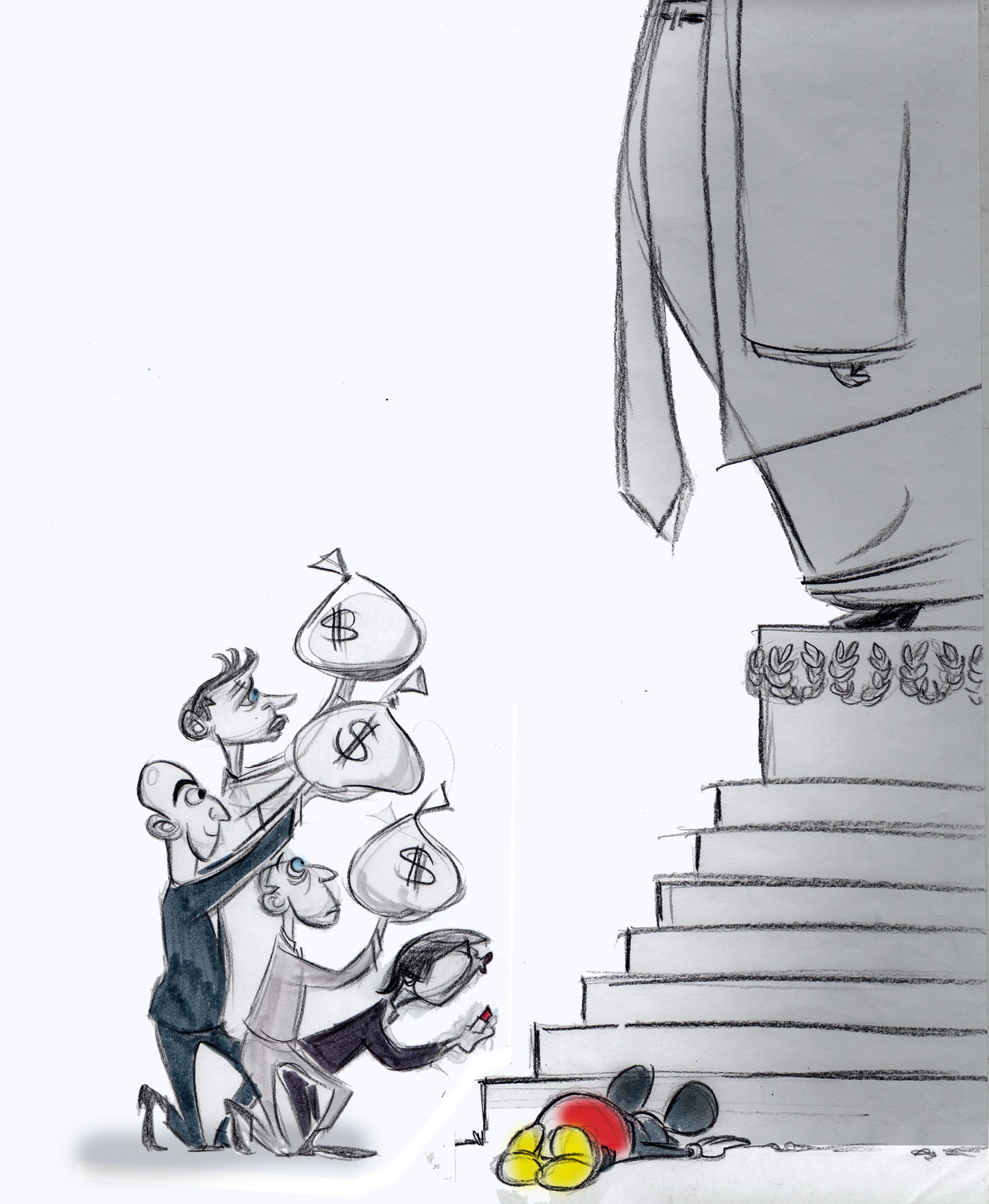
Ann Telnaes is a brilliant, Pulitzer Prize-winning editorial cartoonist for the Washington Post, and I’m proud to know her. Yesterday, she posted to her Substack that after The Post rejected this rough sketch, she resigned in protest:

I’ve spoken on a couple panels about editorial cartooning alongside Ann Telnaes. The first one was at a 2017 (or was it 2016?) convention in Columbus Ohio. The second was years later at the University of Virginia. 

In 2017, I told that audience how I broke into the industry through perseverance, by making myself stand out, and by proving myself to opinion page editors and to the newspaper syndicates. I felt such pride in recounting that story. But in 2023, it hit differently. As I opened my mouth to speak to students who don’t remember a time before social media, suddenly I felt that this generation was more likely to interpret my “inspirational” tale as one of how I groveled for years before gatekeepers. 

The obsolete origin story

Instead, I told the UVA students that my origin story was now obsolete. It’s not a road map they should follow anymore. I advised them to avoid newspapers altogether and reach readers directly through services such as Substack. I surprised myself. I wasn’t sure why I said that.

So I kept talking, and discovered why as I spoke. I’d been harboring frustration that, until then, I’d managed to suppress. 

Before I was born, the Washington Post’s reporters (and their cartoonist, Herblock) led the coverage that brought down Richard Nixon. That’s when the right wing began playing a long game, with the goal of neutering the Media. By 2023, they’d convinced most Americans that pretty much any media not owned by right wing ideologues were just cogs in a liberal conspiracy machine. 

The press is the only industry the Constitution specifically protects. But when I spoke to those UVA students, I could not tell them that newspapers were fulfilling the function the Founders had intended them to fulfill. The Founders had a lot of lousy ideas, but enshrining the press as the main line of defense against creeping authoritarianism wasn’t one of them.

I’d won a Pulitzer a few years earlier for work attacking police brutality, Trump’s malevolence, and systemic racism. But by 2023, those themes had become a tough sell – even to newspapers that had kept a running tally of Donald Trump’s lies throughout his wretched presidency. Papers seemed to want something less strident. Something less opinionated, on the Opinionpages.

I didn’t know whether to consider that a function of fear, or to chalk it up to editors simply being tired of all the existential dread, who just wanted to lighten things up. I’m not sure the distinction matters, to me. All the President’s Men was my first inkling of what journalism was supposed to be. Paul Conrad’s LA Times editorial cartoons were brutal and brilliant, especially to a kid like me in the 1980s. 

David Shipley’s response

David Shipley, the Post’s editorial pages editor, disagreed with Ann’s interpretation of events. He told the New York Times “Not every editorial judgment is a reflection of a malign force…” and “My decision was guided by the fact that we had just published a column on the same topic as the cartoon and had already scheduled another column — this one a satire — for publication. The only bias was against repetition.”

I’ve seen my work run alongside columns that dealt with the same issues before. It’s common. And a satirical column is not a replacement for an editorial cartoon. I don’t believe David Shipley considered something I’ve always found to be the case: different readers read different things.Some stick to earnest columns. Some dive straight into satirical columns. But others – especially young people like I was in the 1980s – only open the opinion page for the editorial cartoons. Editorial cartoons are an introduction to journalism, for young people and for those whose eyes gloss over when they see paragraph after paragraph of prose. Covering the same matter with three different types of journalism is not redundant, it’s reach-out.

Open the link to finish reading this provocative essay.

Ann Tolnaes is a brilliant cartoonist who resigned from The Washington Post when her latest cartoon was cancelled. It depicted the media and tech oligarchs bowing and scraping to Trump, including the owner of The Washington Post, Jeff Bezos.

The editor of the opinion section said he killed the cartoon because the paper had run a story on the same topic, and the cartoon was repetitious. I found that hard to believe because cartoons typically comment on stories in the news; they don’t break news.

He also said she had been invited to return. We will see what happens. The whole episode was widely publicized and is a stain on the newspaper’s reputation, especially since Jeff Bezos intervened and canceled the paper’s endorsement of Kamala Harris in the closing days of the campaign.

For another telling of this important story, read the article by Mike Peterson in The Daily Cartoonist about the controversy and about Ann Tolnaes’s importance. He reprints several of her cartoons, explains how to order a book of her cartoons (bypassing Amazon), and suggests we show our support by subscribing to her Substack blog. I just subscribed.

Thanks to reader John Ogozalek for directing me to this insightful commentary.

Ann Telnaes, editorial cartoonist for the Washington Post since 2008, quit her job after one of her cartoons was censored by higher-ups. The cartoon at issue depicted tech and media billionaires paying obeisance and money to Donald Trump. The cartoon included portrayals of Mark Zuckerberg (META), Sam Altman (AI), Patrick Soon-Shiong (Los Angeles Times), and Jeff Bezos, owner of the Washington Post. And, of course, Disney, which settled with Trump for $15 million rather than defend George Stephanopoulos in court. Each has given Trump $1 million or more to underwrite his inauguration. If Telnaes had waited a day, she would have added Tim Cook, CEO of Apple, to her list of suck-ups and sycophants.

The motto of the Washington Post is: “Democracy dies in darkness.” Conservative (but anti-Trump) lawyer George Conway wrote on BlueSky:

I guess the new slogan for the Washington Post ought to be:

“Newspapers die in cowardice.”

Ann Telnaes’ resignation is an act of courage that should inspire all of us to stand by our principles.

Telnaes wrote about her decision to resign on her Substack blog:

I’ve worked for the Washington Post since 2008 as an editorial cartoonist. I have had editorial feedback and productive conversations—and some differences—about cartoons I have submitted for publication, but in all that time I’ve never had a cartoon killed because of who or what I chose to aim my pen at. Until now.

The cartoon that was killed criticizes the billionaire tech and media chief executives who have been doing their best to curry favor with incoming President-elect Trump. There have been multiple articles recently about these men with lucrative government contracts and an interest in eliminating regulations making their way to Mar-a-lago. The group in the cartoon included Mark Zuckerberg/Facebook & Meta founder and CEO, Sam Altman/AI CEO, Patrick Soon-Shiong/LA Times publisher, the Walt Disney Company/ABC News, and Jeff Bezos/Washington Post owner. 

While it isn’t uncommon for editorial page editors to object to visual metaphors within a cartoon if it strikes that editor as unclear or isn’t correctly conveying the message intended by the cartoonist, such editorial criticism was not the case regarding this cartoon. To be clear, there have been instances where sketches have been rejected or revisions requested, but never because of the point of view inherent in the cartoon’s commentary. That’s a game changer…and dangerous for a free press.

(rough of cartoon killed)

Over the years I have watched my overseas colleagues risk their livelihoods and sometimes even their lives to expose injustices and hold their countries’ leaders accountable. As a member of the Advisory board for the Geneva based Freedom Cartoonists Foundation and a former board member of Cartoonists Rights, I believe that editorial cartoonists are vital for civic debate and have an essential role in journalism. 

There will be people who say, “Hey, you work for a company and that company has the right to expect employees to adhere to what’s good for the company”. That’s true except we’re talking about news organizations that have public obligations and who are obliged to nurture a free press in a democracy. Owners of such press organizations are responsible for safeguarding that free press— and trying to get in the good graces of an autocrat-in-waiting will only result in undermining that free press.

As an editorial cartoonist, my job is to hold powerful people and institutions accountable. For the first time, my editor prevented me from doing that critical job. So I have decided to leave the Post. I doubt my decision will cause much of a stir and that it will be dismissed because I’m just a cartoonist. But I will not stop holding truth to power through my cartooning, because as they say, “Democracy dies in darkness”.

Thank you for reading this.