Veteran teacher Nancy Flanagan was asked by a candidate for advice about education policy. Nancy wrote a list of ten ideas that she thought would be useful guideposts. She now updates her guide for legislators.
She writes (and I summarize):
#1. You don’t know education just because you went to school…
#2. Plan to pay many non-photo op visits to lots of schools…
#3. Take the tests that kids have to take…
#4.Be picky about what you read, listen to, and believe…
#10. Honor our democratic foundations. Public education is the most democratic of our institutions, one of our best ideas as Americans. Public schools may be tattered and behind the technological curve, but systematically destroying the infrastructure of public education is profoundly selfish and immoral. Don’t be that legislator.
This is a thoughtful and thoughtful-provoking post. She updates it.
Kimberlé Williams Crenshaw is a professor of law at Columbia and UCLA and one of the leading figures in the field of critical race studies. She wrote the following article for the Los Angeles Times, where she demonstrates that the new laws banning the study of systemic racism simultaneously ban Dr. King’s views of America’s racial problems, which were not solved by passing civil rights laws. The furor over CRT shows that racism remains a powerful force today. Critics of CRT maintain illogically that teaching the history of racism is racist, that uncomfortable facts must not be taught at all, and that history must be scrubbed clean of divisive realities. As Crenshaw points out, King would have fought the current effort to cleanse U.S. history; his own words and works cannot be taught.
For the first time, we’re observing the Rev. Martin Luther King Jr. holiday under new laws in multiple states that ban the instruction of “divisive” interpretations of our racial past. The assaults have given new weapons to an enduring faction in American society that has long resisted the reckoning that his life’s work demanded.
In King’s day, this faction was known as the “Massive Resistance,” an effort to organize and frustrate the Supreme Court’s 1954 Brown vs. Board of Education ruling and efforts to build multiracial classrooms. Today, this faction is known as the “anti-CRT” effort, which seeks to proscribe race-related curricula, books or trainings that offer a discomforting view of our past and its current implications.
Teachers, public officials and students are in a particularly unsustainable bind. They’re charged with honoring King as a figure while disavowing the ideas that he lived and died to advance. They’re being asked not merely to defer King’s dream of racial equality but to decommission it altogether.
King would likely take bitter note of the all-too-familiar dynamics behind today’s backlash. After the 2020 global movement for racial justice in the United States and beyond in the wake of the savage police killing of George Floyd, legislatures in 32 states have relied on what is patently a lie — that antiracism is antiwhite — to fuel the antidemocratic crusade against what they call “critical race theory.”
For more than 30 years, scholars have employed critical race theory as an analytical tool. The right has rebranded it as the new racism, as wokeness run amok, as a threat to innocent schoolchildren and as a stalking-horse for the demise of “Western civilization” itself. The theory has become the target of coordinated efforts to stigmatize and erase generations of antiracist knowledge, advocacy and history. The objective is both to disappear antiracism’s history and to deny its contemporary salience.
King himself is a prime casualty in this effort. Apostles of the McCarthyite crackdown on critical race theory have exploited him as a mouthpiece for their cause, reducing him to a solitary, decontextualized line from the “I Have a Dream” speech about a future in which his four children were to be judged not “by the color of their skin, but by the content of their character.”
Some use King’s words to erase his deeds and those of millions more who rose up to “make good the promises” since Reconstruction. In Tennessee, for example, the Moms for Liberty sought to ban Frances E. Ruffin’s children’s book “Martin Luther King Jr. and the March on Washington” by framing its descriptions of segregation and the violence meted out against King and others as traumatizing and racist. The Moms argue that Ruffin’s portrayal of white racism against people of color “will sow the seeds of racial strife, neo-racism, neo-segregation, and is an affront” to King’s ideals. This reveals precisely what comes of a persistent and willful ignorance of King’s legacy.
The sheer power on display to turn King against himself — a process that has been underway since the first day this holiday was celebrated — is a grim reflection of the way opponents have long subjected antiracist thinking and activism to distortion, misappropriation and redefinition. The brazen casting of critical race theory as the contemporary villain following 2020’s racial reckoning is no surprise.
The King holiday and Black History Month are an excellent opportunity — perhaps the only opportunity — to course-correct, contest and redirect the misconceptions about King’s legacy and its interface with critical race theory. Recovering the real King begins by freeing his image from the clutches of those seeking to substitute truthful education with a saccharine narrative built on illusions, delusions and lies.
Dr. King was an “inconvenient truth teller.” His insistence on the urgency of racial justice put him at odds with moderate whites in the South, and his denunciation of imperialism put him at odds with allies more narrowly focused on the freedom struggle within U.S. borders.
For telling these truths, in life, King was often criticized rather than celebrated. At the time of his death, polls showed that most white people held an unfavorable view of him. The FBI, under J. Edgar Hoover, framed him as a national security threat. Some Black leaders were hardly convinced of his tactics — his civil disobedience was too radical for some, his nonviolence too accommodationist for others. But for King, the demands for racial justice were not to be won through a popularity contest or by painting a comforting picture of the U.S. social order. Nor was King’s an identity-obsessed demand for recognition. He offered a clear-eyed assessment of a would-be democracy in a state of disrepair. Confronting it at its source was the only way forward.
It’s no accident that the firestorm over critical race theory has singed King’s message: King was, in fact, a critical race theorist before there was a name for it. A core observation of the theory is the recognition that the promise of liberation extends beyond the elimination of formal segregation and individual-level prejudice. Critical race theory explores how racial inequality was historically structured into the fabric of the republic, reinforced by law, insulated by the founding Constitution and embedded into the infrastructure of American society. Similarly, King observed in 1967 that “the doctrine of white supremacy was embedded in every textbook and preached in practically every pulpit,” entrenched as “a structural part of the culture.”
Accordingly, King’s appeal in the March on Washington in 1963 was grounded in the assertion that the promise of a fully inclusive American democracy — one that lived up to its oft-stated ideals — required creative confrontation with a republic out of step with its promises. He rebuffed those who found fault in the tensions created by placing our norms and our realities in sharp relief.
King famously wrote a letter rejecting the counsel of white moderate allies who argued for a gradualist accommodation to the prioritized sensibilities of those who didn’t experience the sting of segregation. As a father, he conveyed the anguish of his own children, who couldn’t understand why they weren’t allowed into the Funtown amusement park, which barred Black visitors, while the joy of white children was privileged. He argued elsewhere that “justice for black people cannot be achieved without radical changes in the structure of our society.”
King centered the promise of equal access to the ballot — now under concerted assault — at the heart of his prophetic mission. He fought to win passage of both the Civil Rights Act and the Voting Rights Act, and he understood that the provisions of each law were part and parcel of the same struggle for true and lasting racial justice. While he hailed the landmark voting reform as “a great step forward in removing all of the remaining obstacles to the right to vote,” he also insisted that the vote be used to “rid the American body politic of racism.” King would instantly recognize the mutually reinforcing objectives of denying the ballot, an indispensable instrument of reform, while also silencing the substantive case for reform by whitewashing the country’s racial past.
Contrary to countless assertions from the right, King did not endorse colorblindness. It wasn’t the remedy for dismantling the ugly realities that white supremacy had produced. Like today’s critical race theorists, King understood that American racism was systemic and demanded systemic remedies. He was forthright in acknowledging that anti-Black racism “was not a consequence of superficial prejudice but was systemic.” Throughout his career, King set his sights on institutional-level change, calling for solutions built on the race-conscious analysis of inequalities across our society.
King invoked a “bank of justice” to be mobilized against the many structures of racial oppression to ultimately realize “the security of justice” for all Americans. This commitment explicitly extended to the mode of race-conscious practice that now goes by the name of affirmative action.
When questioned whether he would support such outlays, King bluntly replied, “I do indeed,” and went on to explain: “Can any fair-minded citizen deny that the Negro has been deprived? Few people reflect that for two centuries the Negro was enslaved and robbed of any wages — potential accrued wealth which would have been the legacy of his descendants. All of America’s wealth today could not adequately compensate its Negroes for his centuries of exploitation and humiliation.”
Much of King’s legacy may never be taught in public schools, if this manufactured panic that demands critical thinking about racism be expunged from curricula and libraries continues. In North Dakota, for example, King’s understanding of structural racism would contradict the state’s newly minted edict that racism cannot be taught as anything more than an individual’s prejudice and bias. His understanding of the historical debt created by centuries of uncompensated labor flies directly in the face of Oklahoma’s prohibition of material suggesting that current generations bear any responsibility for the actions of their ancestors.
Not only did King clearly recognize that antiracism must address built-in headwinds that unnecessarily disadvantage some groups over others, but so does, incidentally, the Supreme Court, as seen in its many rulings. Yet an instructor seeking to explain King’s expansive vision of justice or a professor highlighting legal cases about institutional discrimination will be in jeopardy if they teach these ideas in some states that have adopted such laws.
King’s ideas could also fall under efforts in states such as Oklahoma or Texas that forbid the use of classroom materials that might create guilt or discomfort in public school students. King’s description of a social order in need of repair would trigger complaints that current generations are made to feel responsible for the sins of our past. New Hampshire, meanwhile, has proposed legislation forbidding antiracist critiques of the nation’s founding and history.
Indeed, under most of these laws, King’s concrete work and documented analysis of racism’s enduring legacy in American society would be suspect. In his final speech, on the eve of his death, he said he might not get to the promised land with us. This prophecy would rest uneasily in curricula that sanction assumptions that we haven’t already become that society that King dreamed we would one day be.
This imposition of a fairy-tale account of America makes King’s sacrifice utterly illegible. It is a memory-holed vision of the past better suited to George Orwell’s dystopian reveries than to a nation seeking to redeem its promise of genuine, expansive and democratic self-rule.
Nationwide, lawmakers are legislating that our schools and workplaces turn away from King’s mandate to make good on the country’s broken promises, and wallow instead in the wages of this ignorance. It is an ignorance that grows out of an earlier effort to impose an approved orthodoxy about the American past. One of the enduring consequences of the United Daughters of the Confederacy’s textbook campaigns was the persistence of Confederate propaganda and Lost Cause mythology masquerading as the truth about the history of the Civil War and its aftermath. The United Daughters ensured that millions of children inherited a view of America’s past grossly warped by the whitewashing of slavery and the violent Redemption, when white Southerners called for a return to white supremacy, that followed Reconstruction. The democratic crisis we face today is an unrecognizable spasm from that past, illegible in part because our educational system and national myths have not overcome these past manipulations to embrace this history.
To truly honor King’s memory, then, we must defeat the faction that facilitated the U.S. Capitol riot, put democracy on life support, and continues to demand that critical interrogation of its past be censored by law. King implored that we put our bodies on the line to face the organized forces of white reaction in his day — and it’s clear that he’d be fighting in exactly the same way to preserve his prophetic legacy in our own day, when the right to equal education, to vote freely and to realize true cross-racial justice are once more under bitter attack.
Reclaiming his legacy is to realize that there is no daylight between a truly democratic society and a racially just one.
Advocates for fair funding for public schools in New York have pursued a remedy from the state for years. They finally won a big increase in the budget, but were shocked to discover that almost the entire increase in funding will be diverted to charter schools, which enroll 14% of the state’s students. Either coincidentally or not, Governor Hochul’s election campaign is heavily funded by charter school advocates from the financial industry.
CHARTER SCHOOL FUNDING INCREASE WIPES OUT STATE FORMULA AID BOOST FOR NYC DISTRICT SCHOOLS
February 2, 2022
In testimony on Governor Kathy Hochul’s FY23 Executive Budget, Education Law Center warned New York lawmakers that a proposed increase in state aid to charter schools in New York City will nearly offset the aid increase to district schools under lawmakers’ promised phase-in to reach full funding of the State’s Foundation Aid Formula.
Last year, after over a decade of resistance, New York elected officials committed to fully funding the Foundation Aid Formula enacted in 2007, with a three-year phase-in. After Andrew Cuomo’s resignation, Governor Hochul declared her intention to fulfill this commitment. Her administration also reached a settlement agreement with the plaintiffs in NYSER v. State, a school funding lawsuit by public school parents in New York City and Schenectady, which conditions ultimate dismissal of the case on reaching full formula funding by 2024. The Governor’s proposed FY23 budget provides for a $1.6 billion increase in Foundation Aid, as required to meet the planned phase-in.
In testimony on the proposed FY23 State Budget, ELC underscored to legislators that the Governor’s proposed 4.7% increase in state aid to New York City charter schools will effectively negate the phase-in of formula funding to the City’s district schools. If the Governor’s proposed budget is enacted, New York City charter schools would receive an increase of $300 million this year, while the City’s district schools will be allocated an increase of approximately $345 million in Foundation Aid. Under state law, New York City is the only district that receives no transitional state aid to offset what the district is required to pay in charter school tuition.
“The math is simple and shocking,” said ELC senior attorney Wendy Lecker. “The increase in tuition payments to charter schools, which enroll just 14% of New York City students, will consume the entire increase in Foundation Aid intended for the almost one million City students enrolled in district schools. Even worse, the City is also mandated by state law to provide space or pay rent for charter schools.”
The ELC testimony also calls out the Executive Budget’s failure to make any additional investments in New York’s preschool program. In a May 2021 ruling, in the “Small Cities” school funding case, a New York Appellate Court recognized preschool as an essential element of a sound basic education guaranteed students under the State Constitution.
It is undisputed that high quality preschool provides a host of academic and life benefits, such as decreased placement in special education, decreased suspension rates, higher educational attainment, higher income, and decreased contact with the criminal justice system. Yet, tens of thousands of four-year-olds across New York lack access to any preschool classes, let alone a high-quality program. ELC is urging the Legislature to invest an additional $500 million to help ensure all four-year-olds access to this essential resource.
ELC also pressed the New York Legislature to maintain and strengthen the Contracts for Excellence (C4E) Law. This law was enacted in 2007 to ensure that struggling school districts receiving additional Foundation Aid would spend those funds on programs proven to improve student outcomes. As districts across the state finally receive these long-awaited increases in funding, it is crucial to have a strong framework for directing the funding to essential resources, including class size reduction in New York City district schools.
Sustained grassroots advocacy – coupled with strategic litigation – has moved New York to make important strides toward providing all students, including students of color, the essential resources required for a constitutional sound basic education. Lawmakers must revise Governor Hochul’s proposed budget to ensure the equitable distribution of increased funding, especially in New York City.
A reader who identifies as Quickwrit posted the following comment about the filibuster. For most of our history, debates in the Senate could be used to delay consideration of a bill, even to kill it. But the filibuster was not written into law until 1917.
Our Founding Fathers would agree that “contemptible” aptly describes Manchin, Sinema, and each of the other Democrats who oppose ending the filibuster because our Founding Fathers during the 1787 Constitutional Convention flatly rejected the idea of allowing a minority to block the will of the majority by filibustering — that’s because our well-read Founding Fathers knew how the practice of the filibuster in the Roman Senate had eventually brought down the Roman Republic by allowing a minority of reactionary senators to block the will of the majority of Romans in a process that ultimately led to one-person rule by dictatorial emperors.
Founding Father and President James Madison whom we revere as “The Father of the Constitution” disgustedly called the filibuster extortion, pointing out that “In all cases where justice or the general good might require new laws to be passed…the fundamental [majority rule] principle of free government would be reversed. It would no longer be the majority that would rule: The power would be transferred to the minority…to extort.”
Alexander Hamilton angrily denounced the filibuster, declaring that “To give a minority a negative upon the majority is…to subject the sense of the greater number to that of the lesser…[resulting in] contemptible compromises of the public good.”
Two words of our Founding Fathers that stand out in regard to how they felt about the filibuster are: “EXTORT” and “CONTEMPTIBLE”.
Anyone who supports the filibuster betrays our Founding Fathers and the majority-rule system of government that they established in our Constitution.
As Sens. Kyrsten Sinema (D-Ariz.) and Joe Manchin (D-W.Va.) defend the filibuster and block voting rights legislation, corporate media keeps repeating the lie that the two are doing so because they care deeply about Senate rules and tradition. By doing so, news outlets are refusing to admit the obvious: Sinema and Manchin are just the latest of the Senate’s many corrupt puppets who want to help corporate lobbyists preserve their legislative kill switch.
Amid the high-concept discourse about voting rights, historical precedent, and The Greatest Deliberative Body In The World™, big business has been telegraphing what the filibuster actually is. It is not about democracy or minority rights or any other maudlin subplot from a West Wing episode — it is about something much more raw and ugly. It is about giving capital veto power over the economy, as the most powerful corporate lobby group in Washington effectively admits.Tip Jar
Indeed, the U.S. Chamber of Commerce has publicly opposed filibuster reform for this very reason. Last year, the organization gloated to its members that the rule would prevent Democrats from passing a minimum wage hike or legislation to make it easier for workers to form a union.
Stephen Sawchuk wrote in Education Week about the ways that public controversy about “critical race theory” is affecting the drafting and revision of state history standards. He looks closely at three states that revised their history standards in 2021: Louisiana, New Mexico, and South Dakota.
For months, GOP officials and FOX news kept up a steady and alarming drumbeat, falsely claiming that public schools were indoctrinating white students to hate America and to be ashamed of their race. This weird notion was suddenly discovered in the last year of the Trump regime, when beating up on public schools became a cultural wedge issue. The governor’s race in Virginia showed that the campaign against CRT was effective in rousing people’s fears.
As Sawchuk shows, the effort to twist U.S. history to leave out anything bad that happened in the past is working its way into state standards. Message from the GOP, FOX News, and Chris Rufo: Teach lies about U.S. history!
He writes:
Spiked drafts. Allegations of political interference. Confusing terminology. And thousands of angry comments: The volatile debate over how to teach about America’s racist past is wreaking havoc on states’ processes for deciding what students will learn about history and social studies.
In state after state, commentators and politicians contended that proposed expectations for social studies embedded “critical race theory”—even as the educators sitting on the panels writing the new standards defended them for providing an honest, if sometimes challenging, view of America.
Education Week reviewed hundreds of standards and thousands of pages of public comment relating to the standards-writing processes in South Dakota, Louisiana, and New Mexico, all of which took up revisions in 2021, and interviewed writers, educators, and state officials. Across the three states, we found:
None of the three states’ drafts mentioned the term critical race theory, but in written comments, people attacked dozens of standards in Louisiana’s and New Mexico’s drafts for purportedly embedding it.
In South Dakota, state officials removed about 20 references to Native Americans from the draft submitted by the standards-writing panel—then scotched the draft altogether.
The critiques about CRT in Louisiana led the writers to recast some standards and to delete others. And public comment protocols in Louisiana were changed out of fear for the writers’ physical safety.
The teaching method of having students take civic action to address classroom and local problems—an approach some conservatives contend is indoctrination—was mysteriously cut from both Louisiana’s and South Dakota’s drafts.
About 1 in 10 of some 2,900 pages of comments on the New Mexico standards referenced CRT, often citing language in the draft about “social justice,” “group identity,” and “critical consciousness.” Those terms also attracted confusion from district leaders wondering how those tenets should be taught.
The findings illustrate how the fallout from the confusing and often misleading debate about CRT stands to alter history education in U.S. schools through subtle—but material—changes to day-to-day teaching expectations.
“Standards provide teachers with cover to teach hard things—controversial things,” noted Lynn Walters-Rauenhorst, an instructor and student-teaching supervisor at the University of New Orleans, who was among the writers of Louisiana’s draft. “If we don’t have standards that support deep inquiry about things that may not be the easy topics to cover, then teachers aren’t going to do it.”
And the discord stands as another testament to how the country’s polarization has affected K-12 policymaking at large.
“The uncivil discourse centering around these issues is detrimental not only to the process, but really, it’s also detrimental to these embedded ideas in our constitutional democracy of compromise, of listening to each other, not always agreeing,” said Tammy Waller, the director for K-12 social studies at the Arizona education department.
Arizonans, she noted, faced some controversies over topics like civil rights and the LGBTQ movement when completing the state’s 2018 social studies revisions, but ultimately officials were able to complete a set everyone could live with. That is getting harder.
“In the past I feel like we could have disagreements, and even really intense disagreements, but in the end, it wasn’t a zero-sum game,” Waller said. “We felt like we had something bigger that we were responsible for.”
Those are important stories. But states’ revisions to history standards have attracted far less attention, even though they stand to affect millions more students.
That question is especially relevant for K-12 students, who are now 54 percent Asian, Black, Latino, and Native American. Where—and how—are these students reflected in this complex story? What does their inclusion or erasure mean for their understanding of who they are as Americans? To what extent should K-12 teaching reflect academic scholarship, which has produced increasingly rich insights over the past three decades about cultural history, especially the experiences of women, Black Americans, and immigrants?
States update teaching standards—the key guide for the content and skills that teachers must cover—about once every seven years. Teachers are legally and professionally obligated to cover these standards, which are usually drafted by panels of teachers, content experts, and lay people. The public also offers feedback before final versions are adopted by state boards of education. …Read more
To illustrate these complex issues, take one representative standard currently under debate in Louisiana in grade 7. The standard, a broad one, directs teachers to explain events and ideas in U.S. history between 1789 and 1877, “including, but not limited to, the Whiskey Rebellion, Indian Removal Act, Fugitive Slavery [sic] Act, Reconstruction amendments.”
As currently written, the standard highlights uneven progress towards true participation in the American democratic experiment. But several commentators in the state suggested replacing those examples with touchstones emphasizing expansion and enfranchisement, though mainly of white Americans: “Jacksonian democracy, Texan independence, Manifest Destiny, and Reconstruction,” they wrote.
“Teachers are not going to stick their neck out to teach something they think they ethically should talk about, but isn’t going to be assessed,” said Walters-Rauenhorst. “There’s no upside for them.”
EdWeek selected the three states—Louisiana, South Dakota, and New Mexico—for analysis because all three issued at least one draft set of standards in 2021, and received public feedback on that draft.
Other states in the beginning of rewriting their standards are already starting to see the same sort of contention. Minnesota, midway through its own process, has faced tensions over an ethnic-studies portion of its standards; in Mississippi, legislators filed a bill in November to outlaw critical race theory just weeks before the state education department posted a history draft for review….
LOUISIANA: A CRT Reckoning Awaits
One by one, the commentators stood up at a June public meeting, one of three that the standards-writing committee held to present updates. And one by one, they condemned the state’s draft history standards for purportedly including critical race theory or indoctrinating students.
A typical example: “There is no reason to make students feel guilty,” one speaker said. “We should teach the good things about this country.”
Another: “If you want to continue to talk about slavery, [you should] go to China now…”
Now it’s unclear what will happen to the draft, which is set to be taken up by the state board of education in March.
“I went to law school; I learned critical race theory in law school; I have a Ph.D. This is not something we use in K-12,” said Belinda Cambre, a social studies instructor at a lab school located at Louisiana State University who contributed to the draft. “Really the whole issue saddened me more than anything else, that it could be so weaponized to turn people against talk of diversity.”
The criticism took its toll. Even before the Louisiana department opened up an online public-comment portal, the writers had made significant changes in response to the bruising June feedback.
Some revisions reframed a standard in a more optimistic way: One in the high school civics course originally called for students to “examine issues of inequity in the United States with respect to traditionally marginalized groups.” In its rewritten form, it calls on them to “analyze the progression and expansion of civil rights, liberties, social and economic equality, and opportunities for groups experiencing discrimination.”
By far, the most substantive revision to the draft was the deletion of one of the overarching skills for students—meant to be embedded across the grade levels and courses—called “taking informed action.”
Louisiana’s board-appointed State Superintendent Cade Brumley, a former social studies teacher, wrote in a July op-ed that the standards should strike a balance between critique and patriotism, but should not include critical race theory, which he defined as “suggest[ing] America was intentionally founded on racism, oppression, supremacy.” By October, he said that he could not recommend the draft as written.
Jim Sleeper is a lecturer in political science at Yale and an author. He wrote the following post in 2018, when the horrors of the Trump regime were fresh. It is still relevant.
Donald J. Trump isn’t a Nazi, although his father came close. It’s true that historical analogies between Trump’s policies and Hitler’s are often facile, and sometimes dangerously misleading. But here’s one that I’m not inclined to shrug off.
During a long stay in Berlin in 2009, I went often to the Grunewald railway station to have my coffee. It’s a picturesque little station, built in the 1899, fronted by a cobblestone square and surrounded by splendid, well-preserved villas of that period.
It’s also the point from which more than 50,000 Berlin Jews were shipped to concentration camps, a few hundred a week, from 1942 to 1945. At the station’s Track 17, a steel strip along the platform edge records, in raised letters, each week’s shipment of several hundred “Juden” to Theresienstadt, Minsk, Riga, Kaunas, Łódź and, later, directly to Auschwitz and other death camps.
It’s hard for most Americans, especially those of us whose parents fought in World War II, to imagine that people who boarded the trains had no idea of what lay ahead. Yet, although Jews had been vilified and some attacked on the streets since 1938, some things remained unthinkable to Berlin Jews, most of whom had been middle-class, law-abiding citizens since birth. They showed up at station on the appointed dates, children and luggage in tow, for what they’d been told would be deportation to resettlement and work centers. At worst, they expected something like what Japanese-Americans experienced in internment camps on our own West Coast during the same war.
Under the watchful eyes of German police, they took their seats in ordinary passenger coaches for many of these departures. Only later, far beyond Berlin, were they transferred to box cars. Some time after that, postcards they hadn’t written were sent to relatives or acquaintances whom they’d listed with the authorities, assuring them that all was well in their new locations.
One day in April of 2009, as I sipped my coffee at the Grunewald station alongside retirees in their 70s and near a beer-garden where younger Germans also overlooked the square, three police cars swept in and officers leapt out, commanding us, “Don’t Move.” Then approximately 45 young military officers in formal parade dress descended from a tourist bus. Their uniforms were attractive, but alien—clearly not German. As they milled about, one of the men seated near me asked a police officer, “Was is das?”
“Israelischen,” he answered. They were Israeli army officers.
A silence descended upon the square like nothing I’d ever felt, so thick you could have cut it with a knife. Not another word was spoken, but I thought that I sensed three dimensions in the quiet all around me. The first was straight out of Close Encounters of the Third Kind: “They’re here. They’ve come.” The second was of admiration, or at least respect, for these vibrant young officers, stunning negations of the image of “Juden” that some of these older men must have remembered from their infancy. The third dimension, I sensed from the tightened body language around me, carried a flicker of resentment at having to be reminded, instead of being left to sip one’s coffee in peace.
A black car with tinted windows ascended a ramp toward Track 17. The Israeli officers fell into formation and followed. They’d come to lay a wreath on Track 17 on Yom Ha’Shoah—Holocaust Remembrance Day. Ironically, I hadn’t remembered the day myself.
I recount this now because some Americans remind me of Berlin Jews who didn’t think the unthinkable when they should have. After watching the Trump administration tear apart weeping parents and children—on the initiative of its senior policy adviser, Stephen Miller, who’s Jewish—I’m thinking that although Trump has now found it politically expedient to halt the practice, more than a few of my fellow Americans were thinking, “Well, they deserve it, unlike me, a law-abiding citizen, and a veteran.”
Those Berlin Jews had been law-abiding citizens, too, at least until 1935, and more than a few were military veterans: Some 12,000 of the Jews who had served in the German military had fallen in World War I. In an irony beyond ironies, it was a Jewish lieutenant, Hugo Gutmann, who secured an Iron Cross, First Class, for a 29-year-old corporal under his command, Adolph Hitler.
We now know that German veterans of that war, Jews and non-Jews alike, were lied to and sent into harm’s way for no good reason. So were soldiers in the Nazi Wehrmacht 25 years later, whom my father, a corporal in the U.S. Army Combat Engineers, was ordered to supervise as prisoners as his 277th battalion clanked across northern Germany, because he spoke Yiddish, which is closely related to German.
He did it with mix of grief and revulsion. One day, when his battalion commandeered a Nazi-friendly baron’s estate in the town of Hohne, my father and others scouted a cottage behind the mansion and found a white-haired, well-spoken man who said he was a caretaker but whom the G.I.’s suspected was closer to the missing baron. As some of them prodded him down the hill toward the mansion, jabbing him roughly with their rifle barrels, my father said, suddenly, almost instinctively, “Cut that out.”
“Why? You should enjoy this Sleeper, you’re a Jew.”
“Cut it out, I said.” He had no illusions about Nazism. But he was a young American, emancipated from his ancestors’ European hell, and he thought he was fighting for a world better than one in which the tables of unjust power are merely turned, a world where justice—dare one say, “due process”?—is stronger than revenge.
Watching the fires that Trump is stoking week in, week out, I wonder when his supporters and enablers will see that the unthinkable could happen to them. I’m not inclined to alarmism, but what if, a couple of years from now, veterans who say they fought for an America where people are free to speak their minds decide to speak their own minds in ways Trump doesn’t like? How far might this admirer of Vladimir Putin go against Americans he thinks are his enemies? He’s already said that he wants to tighten libel laws; his ICE agents have developed arrest-and-detention tactics that a craven Congress would let him expand with the stroke of a pen; municipal police forces are more militarized than ever before.
Yes, historical analogies are risky. But, sipping coffee overlooking the Grunewald station’s charming cobblestone square, you’d never imagine what happened there if you hadn’t been told.
Mercedes Schneider writes that it is literally impossible to ban a book that is easily available on the Internet. The school board of McMinn County, Tennessee, voted unanimously to ban a Pulitzer-prize winning graphic novel about the Holocaust called MAUS.
But, she points out, students can find it for free on the Internet.
Furthermore, banning a book is a sure fire way to motivate students to want to read it. They might want to see for themselves the awful words “God Damn” or see nude mice.
Schneider writes:
If parents want to control what their children read, they might consider refocusing their school-district, book-banning attention toward controlling content on their children’s iPhones, iPads, and other electronic devices. As of this writing, three of Art Speigelman’s Maus book series are rated, 2, 3, and 7 on Amazon’s best sellers…
In response to the ban, a Knoxville, Tennessee, comic book store is giving away free copies of Maus to students who wish to read the book.
As it stands, readers can also do what my colleague’s son did with Orwell’s Nineteen Eighty-four: Read it online for free. Here’s the first in the series: Maus: A Survivor’s Tale (1986).
(Note that the above text is available on Internet Archive, which is involved in a June 2020 lawsuit brought forth by several publishers. Internet Archive maintains it offers the books under “fair use.”)
Book bans backfire: they increase sales. And they encourage students to seek them out and read them. School boards should not embarrass themselves by acting as censors.
Yesterday, Christopher Tackett (@cjtackett) tweeted that the book purge has begun in his district.
He wrote:
Today in Granbury ISD, at the High School library, they came with a hand cart and carried away multiple boxes of books tagged with “Krause’s List”.
They can do this because the board voted 7-0 on Monday to change district policy allowing books to be removed prior to a review.
He wrote that students, parents, and teachers protested to the school board but their voices were ignored. The superintendent pushed for the purge and ridiculed the opponents as “gaslighters and radicals.”
Some excellent comments from outside Texas. This one from Hugh G. Merriman:
The parallels are chilling…
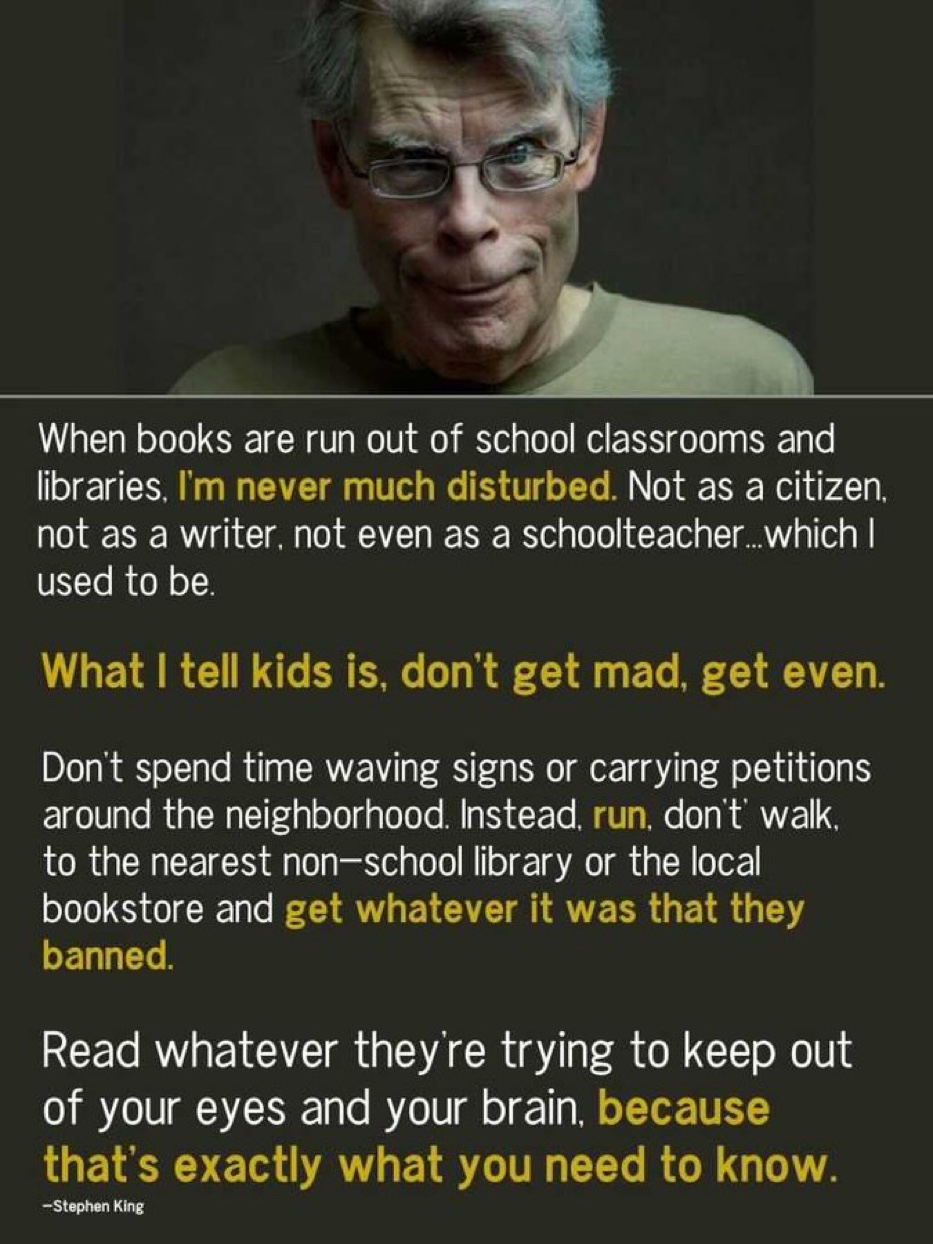
And this advice, quoted from Stephen King:
I disagree with the opening line in the King quote. I am very much disturbed when books are banned from schools and school libraries. Next, they will pull them from the public library, and not many students can afford to buy the banned books. Protest, wave signs, speak up. Be loud. Make noise.
The Holocaust is personal to me. My mother and grandmother left Balti, Bessarabia, and arrived in the United States in 1917. My grandfather came before the war. Most of the family stayed in Europe. My father’s parents came in the 19th century from Lomza, Poland. Most of their family stayed in Poland.
Not one member of my family survived the war. All perished in the Holocaust.
Inappropriate comparisons to the Holocaust are common and undermine its significance. Just today, Robert F. Kennedy, Jr., apologized on Twitter for comparing the effort to vaccinate people to the Holocaust. An incredibly vicious comparison since vaccines save lives; no one’s family is being burned in a furnace because of getting vaccinated.
A message from the Anti-Defamation League.
Soon after the reunification of Germany, ADL organized a leadership mission to a united Germany. One of our most significant meetings was with Dr. Rita Süssmuth, then-head of the Bundestag (Germany’s House of Representatives). One member of our group asked her about teaching young Germans about the Holocaust.
Her answer is even more relevant today than it was then.
She said that one can’t talk about that horror in the same way to the young generation as speaking to their parents or grandparents. They are too far removed from the events of World War II. What is necessary, she reasoned, are creative approaches to make the history relevant and visceral.
Süssmuth’s comment comes to mind as we observe International Holocaust Remembrance Day on Jan. 27, which is also the anniversary of the liberation of the Nazi concentration camp Auschwitz-Birkenau. There is no doubt that more than 80 years after World War II, a variety of factors are coming together posing challenges to Holocaust memory, but all the news in this arena is not bad. It’s a good time to take stock.
The negatives are abundant. First, as is often discussed, a major instrument for educating young people — the living testimony of survivors — is diminishing rapidly as most survivors are gone. One hears over and over again that a survivor speaking about his or her experience before a classroom or school assembly has awakened the students as to what the Holocaust was all about and why they should care about it.
And ADL’s Global 100 Survey several years ago found that only 54 percent of people worldwide had ever heard of the Holocaust and 32 percent thought it was greatly exaggerated or a myth.
Third, the meaning of the Holocaust is undermined seemingly every day by its trivialization through inappropriate analogies. In the hyper-political and polarized world we live in, exacerbated by social media, it seems that everything one doesn’t like is compared to the Nazis or the Holocaust.
And, of course, one of the most egregious comparisons — often meant to undermine the significance of Holocaust memory — is equating Israeli treatment of the Palestinians to the Nazi treatment of Jews. In other words, so the warped logic goes: The world had its Holocaust, now “the Jews have their own.”
Fourth, Holocaust denial continues to have a life of its own and has found a particular lifeline as extreme right groups look for respectability. There is no doubt that historically the association of the murder of six million Jews with Nazism and fascism has been the major obstacle for decades for such groups to gain legitimacy in political circles. Denying or at least diminishing the Holocaust can open a pathway for revival for extreme right groups who until now have been largely excluded from a role in democratic societies.
This is a powerful combination of factors. There is, however, the other side, where a good deal of progress has been made in Holocaust awareness and acknowledgement.
In the early days, it was Jews and Israelis who were the leaders in educating about the Holocaust. Israel, as a home for the largest number of survivors, invested in the matter with Yad Vashem,Yom HaShoah and the Eichmann trial. Over the last few decades, however, we have seen growing involvement of other governments and broader societies in this project. This is a good development.
So, the U.N., often seen as hostile to the Jewish people because of its many anti-Israel stances, has incorporated two important Holocaust-related elements into its programming and policies. The first is that of today, International Holocaust Remembrance Day, which produces annual programs, statements and recollections and keeps the attention of the international community on this genocide for one day.
Another cross-country effort, initiated by Sweden, is the International Holocaust Remembrance Alliance, which, in effect, builds on the U.N. initiative to implement educational processes about the Holocaust in participating countries. Recently, its participants met in Malmo, Sweden to discuss practical ways to move forward on Holocaust education and combatting antisemitism. And, of course, many Holocaust museums have cropped up across the U.S. and Europe, the most important the U.S. Holocaust Memorial Museum, which attracts large numbers of visitors, most of whom are not Jewish.
And then there are the many efforts by non-governmental organizations, two of particular significance being the Shoah Foundation’s vital interview project of survivors and ADL’s Echoes and Reflections public school education curriculum and program on the Holocaust.
These and many others try to live up to Süssmuth’s plea for creativity in connecting young people to the Holocaust. Holocaust knowledge and awareness are clearly more important than ever because of the passage of time, the surge of antisemitism, the loss of shame about antisemitism as the Holocaust is more distant, and the rise in extremism of all kinds and the efforts to legitimize fascism.
Examples are the use of artifacts, photographs and testimony to encourage students to present their own questions about those events; real time questions and responses from Holocaust survivors using hours of pre-recorded video footage; and the use of local U.S. news sources during the period of Nazi rule and how events were seen from an American perspective. Holocaust awareness and acknowledgement are clearly more important today than ever.
Governor Youngkin invited parents to report the names of teachers who are violating the state’s vague and ill-defined law banning the teaching of “divisive concepts,” critical race theory, and anything else any parents object to.
Peter Greene describes the creative responses of respondents. Responses to an email address can come from anywhere, not just Virginia. You too can write to Youngkin’s Stasi.
Anyone can send their reports to the tip line email:
helpeducation@governor.virginia.gov
Greene writes:
But of course you know what else happened next. The tip line has apparently been hit with a variety of reports, like a complaint that Albus Dumbledor “was teaching that full blooded wizards discriminated against mudbloods.” Some of this has been goaded on Twitter by folks like human rights lawyer Qasim Rasgid. And John Legend correctly pointed out that under the guidelines of the decree, Black parents could legitimately complain about Black history being silenced (because, as sometimes escapes the notice of anti-CRT warriors, some parents are Black). Ditto for LGBTQ parents.
Greene also includes a useful list of questions to answer if you write the Governor: like, “who was your favorite teacher and what did they teach?”


 Diane Ravitch's blog