Archives for category: Democracy

The New York Post, the flagship of Rupert Murdoch’s media empire lambasted Donald Trump for his failure to stop the assault on the U.S. Capitol on January 6, 2021. The 1/6 Committee is making a difference! Just think. If Trump’s theory that the Vice-President can decide the election, then Al Gore could have thrown out Florida’s votes in 2000 and declared himself President. And in 2024, Kamala Harris can choose the next President.

The New York Post editorial board wrote:

As his followers stormed the Capitol, calling on his vice president to be hanged, President Donald Trump sat in his private dining room, watching TV, doing nothing.

For three hours, seven minutes.

There has been much debate over whether Trump’s rally speech on Jan. 6, 2021, constituted “incitement.” That’s somewhat of a red herring. What matters more — and has become crystal clear in recent days — is that Trump didn’t lift a finger to stop the violence that followed.

And he was the only person who could stop what was happening. He was the only one the crowd was listening to. It was incitement by silence.

Trump only wanted one thing during that infamous afternoon: to pressure Vice President Mike Pence to decertify the election of Joe Biden.

He thought the violence of his loyal followers would make Pence crack, or delay the vote altogether.

To his eternal shame, as appalled aides implored him to publicly call on his followers to go home, he instead further fanned the flames by tweeting: “Mike Pence didn’t have the courage to do what should have been done to protect our Country and our Constitution.”

His only focus was to find any means — damn the consequences — to block the peaceful transfer of power.

It’s up to the Justice Department to decide if this is a crime. But as a matter of principle, as a matter of character, Trump has proven himself unworthy to be this country’s chief executive again.

In case you misssed it, Heather Cox Richardson describes the highlights of the July 21 hearing of the Jan 6 Commission. The House GOP continues to ridicule the hearings as partisan, but so far almost everyone who testified is a Republican. The two who testified last night were working directly for Trump.

Highlight of the hearing: Senator Josh Hawley running to escape away from the mob he encouraged with his fist in the air. Sprinting, really. The hashtag that quickly appeared on Twitter: #JoshHawleyIsABitch. And this is the guy running on a “platform” of reviving masculinity.

When the chips are down, Josh Hawley runs away.

Then there is the fact that there are no White House logs that day; the White House photographer was told not to take pictures of the most important day of Trump’s term; the Secret Service deleted text messages.

Funniest moment of the hearings: Trump recording a video on January 7, stumbling over the words. Tells them to delete the word “yesterday.” It’s too hard for him.

Most inspiring: the two Republicans on the committee, Cheney and Kinzinger, willing to sacrifice their political careers for matters of principle and respect for the Constitution.

Lloyd Lofthouse, author, former Marine, and former teacher, explains what it means to be woke. Some Republican politicians—notably Ron DeSantis— are trying to suppress “wokeness.”

Lloyd writes:

Anyone that attacks what’s known as “woke ideology” is supporting zombie thinking and belongs to a fascist cult of ignorance.

Wokeness means someone that is highly literate, well educated, well read, is a life long learner, questions claims and uses critical thinking, problem solving and rational logic to find out if there is any truth to what these fascist zombies are shouting.

Question: Are you woke?

Bob Shepherd, polymath and educator, predicts the truly extraordinary goal of the far-right extremist Supreme Court. It mainly consists of dismantling the federal government’s powers. This was proclaimed by Steve Bannon in 2016 before the Trump election. In this rightwing dream, all federal laws protecting civil rights, women’s rights, climate change, etc. would disappear.

Shepherd writes:

Let me be as clear about this as I can be. My reading of what the Extreme Court has been up to is NOT that it means to do away with the doctrine of stare decisis. No. It means to establish, with Dobbs v Jackson Women’s Health and West Virginia v. EPA, in this term, and with Moore v. Harper in the next term a new set of precedents designed to fulfil the conservative goals of a) shrinking the federal government down to a size at which it can be drowned in a bathtub and b) turning over power to state governments, many of which will be de facto theocracies under the new legal order. Dobbs provides a template or boilerplate for eliminating whole bodies of federal law and regulation related to unenumerated rights and with these these agencies and departments that do that regulation and enforcement. WV v. EPA is a template or boilerplate for eliminating government agencies or departments (or parts of these) that promulgate regulations pursuant to Congressional legislation on the basis of an argument that Congress can’t turn such decision-making over to Executive Branch agencies or departments because the Constitution insists that these are legislative matters. The idea, again, is to shrink the power and authority of the federal administrative state in full knowledge the fact that Congress,being divided, will not step into these various roles (will not, for example, agree on real climate change). And again, the effect of that will be, with the federal executive and legislature and courts all out of the picture, to turn all this power back to the states. And, finally, Moore will enable the court to rule that the feds cannot pass legislation to protect voting rights because determination of how voting is to be conducted is entirely up to state legislatures under this extremist reading of the Constitution. Again, the effect will be to eliminate federal power and agencies/departments and turn this all over to the states.

All this is revolutionary and is meant to be. It’s the fulfillment of a dream that conservatives in America have had for a long, long time. They have long believed in state’s rights, in the federal government being a monster not envisioned by the founders. This Extreme Court is simply making good on that.

And, btw, as with the various coup methods undertaken by Trump and his team, this has all been discussed on Steve Bannon’s War Room podcast (or whatever he wants to call it). He recently devoted much of a program to this very topic: the ways in which work is underway to completely “dismantle the administrative state.”

Former Governor Jim Hunt, a Democrat, is one of the most respected figures in North Carolina on the subject of education. As teacher Justin Parmenter explains in this post, Governor Hunt was a true education reformer who cared about students, teachers, and public schools.

Parmenter writes:

Among others, those initiatives include beginning the Smart Start Pre-K program, putting a full-time teaching assistant in every grade 1-3 classroom, establishing the North Carolina School of Science and Mathematics, and creating the National Board for Professional Teaching Standards (as a personal aside I’d like to add that I am grateful and proud to have been a National Board Certified Teacher since 2006).

Under Hunt’s leadership, teacher pay in North Carolina rose to 19th nationwide, coming within about $2000 of the national average during the 2001-02 school year. The state currently ranks 39th.

Since 2010, North Carolina has been controlled by Tea Party zealots in the legislature, who devoutly believe in charters and vouchers.

Many educators were surprised when Governor Hunt agreed to join a panel that was planning to change the compensation of teachers and tie it to test scores. Perhaps Governor Hunt thought he could steer the group towards sensible solutions, like raising teacher pay to the national average.

But he announced he was quitting the coalition. He must have realized that the state commissioner and her minions were wedded to merit pay.

Parmenter writes:

Governor Jim Hunt has withdrawn as honorary co-chair of the UpliftEd Coalition, a group which will promote a controversial plan to do away with experience-based teacher compensation and replace it with a system of merit pay.

The Pathways to Excellence proposal, currently being worked on by the Professional Educator Preparation and Standards Commission (PEPSC), has proven deeply unpopular with North Carolina educators since it became public earlier this year.

Governor Hunt called on the coalition to draw upon the knowledge of teachers and listen to them.

That’s a novel idea! They are probably listening to the business community, which always complains that teachers are overpaid.

I would recommend that they read my book Reign of Error, in which I thoroughly debunk merit pay. It has been tried again and again for a century, and it has never worked. It’s one of those zombie ideas that never works and never dies.

A reader who calls him/herself Quickwrit explains why the Supreme Court’s recent decision on abortion is wrong.

The Bible is silent on abortion:

The 9th Amendment gives Clarence Thomas the constitutional right to live in an interracial marriage and gives women the constitutional right to abortion: The 9th Amendment says that rights do not have to be stated in the Constitution in order to be rights: “The enumeration in the Constitution of certain rights shall not be construed to deny or disparage others retained by the people.”

Americans have long claimed to right to and the practice of abortion. Benjamin Franklin, key Founding Father of America, shaper and signer of our Constitution, published a handbook titled “The American Instructor” that featured a long, detailed section on do-it-yourself abortion and conception prevention. The book was very popular throughout America and the prevention of and termination of pregnancies was widely practiced throughout America, especially in rural areas where an unwanted pregnancy could mean financial ruin in those days.

The current Supreme Court ruling on abortion not only violates the 9th Amendment, it violates the religious rights of many citizens: The Bible gives commandments on a very, very long list of more than 600 laws on everything from divorce to gluttony — yet the Bible says nothing about abortion. Why is that? If abortion was even as important as gluttony, it would have been mentioned in the Bible.

But,the Bible is silent on abortion: Out of more than 600 laws of Moses, which includes the 10 Commandments, NONE — not one — comments on abortion. In fact, the Mosaic law in Exodus 21:22-25 clearly shows that causing the abortion of a fetus is NOT MURDER. Exodus 21:22-25 says that if a woman has a miscarriage as the result of an altercation with a man, the man who caused miscarriage should only pay a fine that is to be determined by the woman’s husband, but if the woman dies, the man is to be executed: “If a man strives with a woman with child, so that her fruit depart from her, and yet there is no harm to the woman, he shall be punished according to what the woman’s husband determines and he shall pay as the judges determine. And if the woman dies, then it shall be life for life, Eye for eye, tooth for tooth.” Ex. 21:22-25. So, the Bible orders the death penalty for murder of a human being — the mother — but not for the death of a fetus, indicating that the fetus is not yet a human being.

There are Christian denominations that allow abortion in most instances; these denominations include the United Church of Christ and the Presbyterian Church USA. The United Methodist Church and Episcopal churches allow abortion in cases of medical necessity, and the United Universalist Association also allows abortion.

Most of the opposition to abortion comes from fundamentalist and evangelical Christians who believe that a full-fledged human being is created at the instant of conception. In short — it is a religious BELIEF and religious beliefs cannot be recognized by the government under the Establishment Clause of the First Amendment of our Constitution. Moreover, the belief that a fetus is a human person, complete with a soul, is a Christian interpretation of the Jewish Bible — the Old Testament. But, Jewish scholars whose ancestors wrote the Old Testament and who know best what the words mean say that is a wrong interpretation of their writings.

Christians largely base their view that a fetus is a complete human being and that abortion is murder on the Jewish Bible’s Psalm 139: “You knit me together in my mother’s womb…You watched me as I was being formed in utter seclusion as I was woven together in the dark of the womb. You saw me before I was born.”

Who better to translate the meaning of Psalm 139 than the Jews who wrote it? And Jewish scholars point out that Psalm 139 merely describes the development of a fetus and does not mean that the fetus has a soul and is a person. In fact, the Jewish Talmud explains that for the first 40 days of a woman’s pregnancy, the fetus is considered “mere fluid” and is just part of the mother’s body, like an appendix or liver. Only after the fetus’s head emerges from the womb at birth is the baby considered a “nefesh” – Hebrew for “soul” or “spirit” – a human person.

I am not pro-abortion — I am PRO-CONSTITUTIONAL RIGHTS, and until a fetus is in its 24th week of development the mother has the unquestionable constitutional right to decide what happens to the fetus. After the 24th week, society may have a legitimate legal interest in the fetus. What that interest is, to what extent it reaches, and how to encode that interest into law isn’t easy and will require a great deal of debate in society in general and in Congress, not the states, because it is a national constitutional right that is being dealt with.

THE COURT BENDS THE FACTS: The University of London scientist whose research is cited by the Supreme Court in its ruling to take away abortion rights says that his research has been misinterpreted by Justice Alito and the Supreme Court’s activist conservative majority. Neuroscientist Dr. Giandomenico Iannetti says that the Court is ABSOLUTELY WRONG to say that his research shows that a fetus can feel pain when it is less than 24 weeks of development. “My results by no means imply that,” Dr. Iannetti declares. “I feel they were used in a clever way to make a point.” And Dr. John Wood, molecular neurobiologist at the University, points out that all serious scientists agree that a fetus can NOT feel pain until at least 24 weeks “and perhaps not even then.” Dr. Vania Apkarian, head of the Center for Transitional Pain Research at Chicago’s Feinberg School of Medicine, says that the medical evidence on a fetus not feeling pain before 24 weeks or longer has not changed in 50 years and remains “irrefutable”.

LIFE OF WOE: In its 1973 Roe v. Wade ruling upholding abortion rights, the Supreme Court set “viability” — the point at which a fetus can survive outside of the womb — as the dividing line after which some restrictions can be imposed on abortion rights. The pending ruling by current activist conservative majority on the Court will do away with the concept of viability, yet even with all of today’s medical miracles to keep a prematurely born or aborted fetus alive, of all the tens of thousands of cases, 90% OF FETUSES BORN AT 22 WEEKS DO NOT SURVIVE, and data shows that the majority of those that manage to be kept alive live the rest of their lives with a combination of BIRTH DEFECTS that include mental impairment, cerebral palsy, breathing problems, blindness, deafness, and other disorders that often require frequent hospitalizations during their lifetimes.

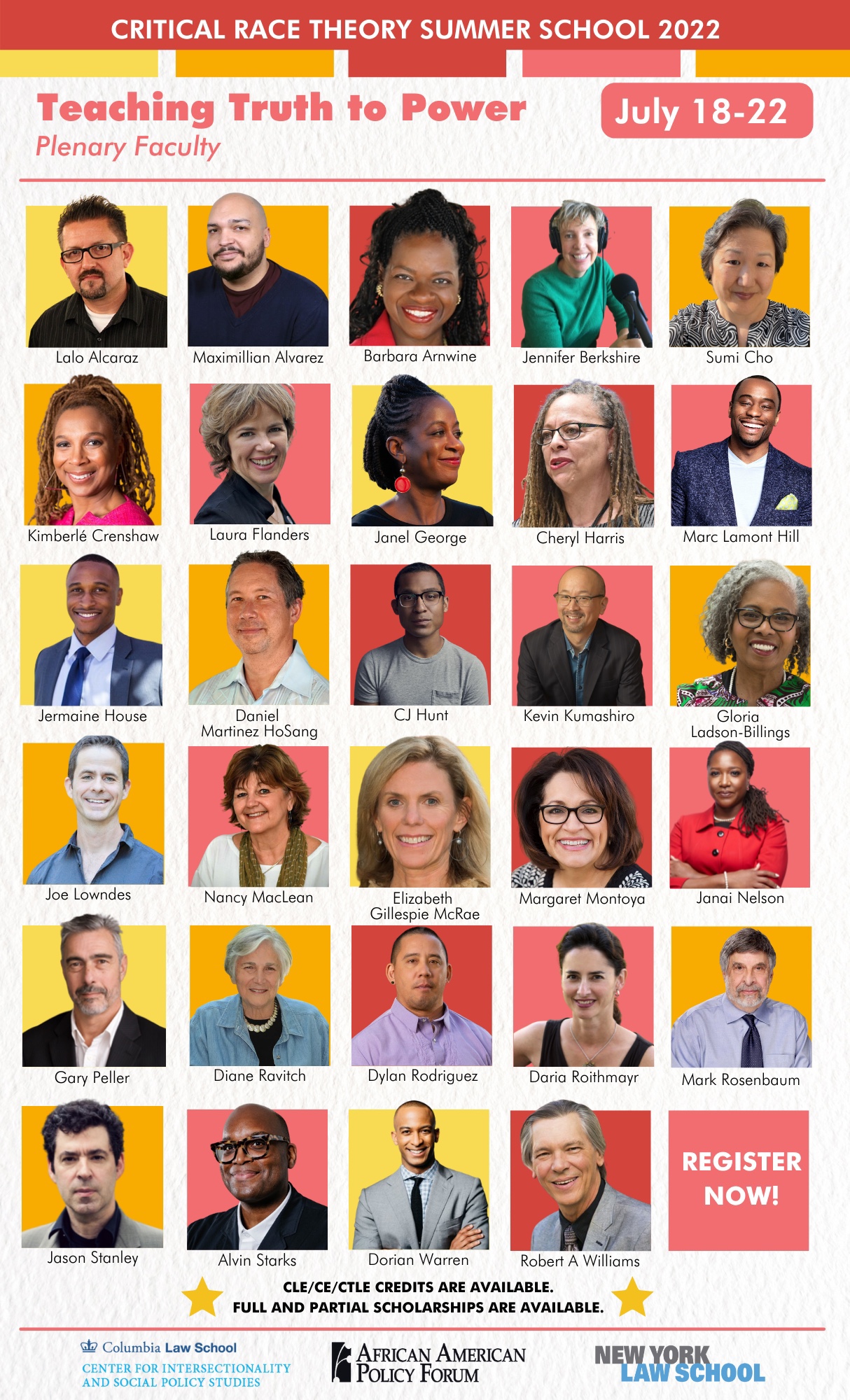
I will be a participant in a summer school program on Critical Race Theory. You are invited to sign up. I am part of the panel on July 20.

Greetings Friends and Colleagues, 

The African American Policy Forum is so excited to be Teaching Truth to Power this year at Critical Race Theory Summer School! It is crucial that we prepare racial justice advocates to defend the right to teach truth in classrooms. This powerful and urgent program runs July 18 to July 22, 2022. 

Seats are limited, so register here today! Events will be held daily between 1 p.m. to 6 p.m. ET throughout the week. Be sure to sign up for our listserv so that you don’t miss any updates. 

CRT Summer School 2022 will include a variety of plenaries, breakout sessions, and networking opportunities aimed to inform, activate, and inspire. We’re inviting parents, educators, students, social workers, legal practitioners, media professionals and concerned community members from all walks of life, because there is something for anyone to learn from the sheer breadth of options available this year! 

Daily Plenary Sessions

July 18 – Everyday CRT: A Commonsense Framework for Racial Liberation

July 19 – Public Schools, Private Agendas: How the Assault on Racial Justice Undermines Education

July 20 – Strange Bedfellows: The Left/Right Convergence that Enabled the Normalization of White Nationalism

July 21 – Define, Do Not Defend: How to Resist the Disinformation Campaign Against CRT

July 22 – Transforming a Moment to a Movement: Building A New Coalition to Secure our Multiracial Democracy

Discounts and Purchase Orders

Group sales (registration in increments of ten and five) are available and yield a 25% discount. For Purchase Orders please contact crt@aapf.org for more information.

Individual recipients of this email are eligible for a 10% discount using the following code during check-out: TSICAF-992000-IWANJ.

Full and partial scholarships are available. For more information visit our website: www.aapf.org/crtsummerschool.

On Demand Content

Great news! This year, all CRT Summer School content will be available to all registrants after the close of the event until Labor Day. You can watch anything you missed or revisit your favorites to ensure that you are a prepared racial justice advocate ready to defend the right to teach truth in schools.

We hope to see you at CRT-SS 2022! Please also share this email with your network – friends, colleagues, and constituents.

Onward,

African American Policy Forum

#TruthBeTold

In 2001, libertarian political scientist Jason Sorens proposed the creation of a “free state.” He appealed to other libertarians to cluster in one small state, where enough of them would be able to eliminate laws and authority and “live free.” That state was New Hampshire, and the libertarians have joined hands with Republicans to impose their agenda on others who don’t share it. Earlier this spring, Free Staters proposed that New Hampshire secede and became an independent nation, but that proposal failed overwhelmingly, in part because enough people realized it was nutty and/or they didn’t want to give up their Social Security.

Dan Barry wrote in The New York Times about an effort by Free Staters in Croydon, New Hampshire, to cut the town’s school budget in half.

As is typical in many towns and cities across the nation, not many people show up for local elections, or in this case, the town meeting. One of the members of the Croydon board of selectmen, Ian Underwood, proposed cutting the town budget for schools by more than half, from $1.7 million to $800,000.

In pamphlets he brought to the meeting, Mr. Underwood asserted that sports, music instruction and other typical school activities were not necessary to participate intelligently in a free government, and that using taxes to pay for them “crosses the boundary between public benefit and private charity.”

The pamphlet did not note that its author was a 1979 graduate of the public high school in Chesterton, Ind., where he starred on the tennis team, ran track, played intramural sports and joined extracurricular activities in math, creative writing, radio and student government. Also: National Honor Society member, National Merit finalist and valedictorian.

One person not completely gobsmacked by Mr. Underwood’s proposal was the school board chairwoman: his wife, Jody Underwood. The Underwoods, who do not have children, moved to Croydon from Pennsylvania in 2007 in part to join the Free State mission; they are now considered a Free State power couple.

Underwood’s radical proposal passed by 20-14. It was a victory for the Free Staters. As the Underwoods did media interviews, they gloated:

Mr. Underwood asked what for him appears to be a fundamental question — “Why is that guy paying for that guy’s kids to be educated?” — and denied that he and his wife were “in cahoots.”

Many people in Croydon were “livid.” They realized this radical act was the result of their indifference.

But they were also chastened. They hadn’t attended the town meeting. They hadn’t fulfilled their democratic obligation. They hadn’t kept informed about the Free State movement. To some observers, they had gotten what they deserved…

From this muddle of anger, confusion and regret, though, a movement was born. It came to be known as We Stand Up for Croydon Students.

Conservatives, liberals and those who shun labels — “an entirely nonpartisan group,” said Ms. Damon, one of the members — began meeting online and in living rooms to undo what they considered a devastating mistake. They researched right-to-know laws, sought advice from nonprofits and contacted the state attorney general’s office to see whether they had any legal options.

They did: Under New Hampshire law, citizens could petition for a special meeting where the budget cut could be overturned — if at least half the town’s voters were present and cast ballots.

Ms. Beaulieu, 44, a project manager for a kitchen and bath store, helped to gather enough signatures for the necessary petition. Once a date in May was set for the special meeting, she and other volunteers spread the word, knocking on doors, conducting phone banks and planting lawn signs…

The crisis in Croydon generated a curious democratic dynamic. Since the law required that at least half the town’s electorate participate in the special meeting’s vote for it to be binding, those trying to overturn the Underwood budget encouraged people to attend, while those hoping to retain it encouraged people to do just the opposite and stay home.

On the chilly Saturday morning of May 7, Croydon residents filed into a spacious building at the local YMCA camp for their special meeting. The We Stand Up contingent needed at least 283 voters.

The turnout: 379.

The vote in favor of overturning the Underwood budget: 377.

The vote against: 2.

The We Stand Up crowd cheered and hugged, leaving Mr. Underwood to vent online with posts titled “Your House Is My A.T.M.” and “Possibly Dumbest Thing I’ve Heard Someone Say, Ever,” and Dr. Underwood to frame the moment as both an impressive voter turnout and a victory for “mob rule.”

“It felt to me like a bunch of woke people came to Croydon,” she said.

What happened in Croydon is a lesson for us all.

Get out and vote.

Do not let the neo-fascists, neo-Confederates, racists, and conspiracy theorists take over.

Fight for democracy or lose it.

Dana Milbank is a wonderful columnist for the Washington Post. He writes here about the death of state decisis, the legal principal of respecting precedent. The six-person majority on the Supreme Court have thrown away precedent. They are drunk with power. They are free to do whatever they want with no restraint, and they are rolling back decades of social progress. They are not conservatives. They are radicals.

Milbank writes:

Now begins the era of stare indecisis.
Respect for precedent — known by the Latin stare decisis, “to stand by things decided” — had been a centuries-old cornerstone of the rule of law, necessary so “the scale of justice” doesn’t “waver with every new judge’s opinion,” as the 18th-century legal philosopher William Blackstone wrote.


But — et tu, Alito? — the Supreme Court’s radical right put the knife in stare decisis in its decision overturning Roe v. Wade and destroying 50 years of precedent upon precedent.

The dissenting justices wrote that “the majority abandons stare decisis,” an act that “threatens to upend bedrock legal doctrines,” “creates profound legal instability” and “calls into question this Court’s commitment to legal principle.”


The majority protested that it didn’t abandon stare decisis — then explained why it did: “Stare decisis is not an inexorable command. … Stare decisis is not a straitjacket.”


The burial of stare decisis leaves us, ipso facto, with a void: Which Latin phrase best describes the legal doctrine of this new era, in which judges rule by whim, not precedent? Well, thank your lucky stares, because my classics consultant, Vanessa (she asked that her surname not be used in order to speak Latin frankly), has many options.


Labels such as “judicial modesty,” “judicial restraint” and “originalism” were trashed along with stare decisis. For this radical majority to claim “restraint” now would be the very definition of stare mendaciis — to stand by lies. Other better labels for the court majority’s new philosophy are stare deviis (to stand by inconsistent things), or perhaps stare fetore (to stand by a foul odor), in honor of the question Justice Sonia Sotomayor posed during oral arguments: “Will this institution survive the stench that this creates?”

But maybe most accurate is stare sodalitate — to stand by your political party. To the Romans, this meant either “electioneering gang” or “religious fraternity,” apt descriptions both of this court’s right wing.


There are other potential principles being thrown about. This week’s Jan. 6 committee hearing revealed that President Donald Trump, upon receiving displeasing information (such as his attorney general’s refusal to bless his election lies), would hurl his meal at the wall. This would be stare cibo iacto — to stand by thrown food (although other scholars use stare vasis fractis — to stand by broken dishes).


The Republican Party, even now, remains steadfastly loyal to Trump, adhering to something called the Wynette Doctrine, stare homine tuo — stand by your man.


Sen. Susan Collins (R-Maine) is claiming she was deceived by Justices Brett Kavanaugh and Neil Gorsuch into thinking they wouldn’t overturn Roe — an instance of stare credulitate, to stand by gullibility.


At a Trump rally, Rep. Mary Miller (R-Ill.) practiced stare hominibus albis — to stand by White people — when she called the abortion decision a “victory for White life.” (She said she misspoke, although the crowd cheered.)


Congressional candidate Yesli Vega, the GOP nominee to replace Rep. Abigail Spanberger (D-Va.) said “it wouldn’t surprise me” if it were difficult for a woman to get pregnant from rape, “because it’s not something that’s happening organically,” according to an Axios recording. That’s called stare rapina legitima — to stand by legitimate rape — affirming the precedent set by Senate candidate Todd Akin (R-Mo.), who said in 2012: “If it’s a legitimate rape, the female body has ways to try to shut that whole thing down.”

Texas Attorney General Ken Paxton is reviving the doctrine of stare contra pedicandum (to stand against sodomy) by saying he would defend a 1973 anti-sodomy law struck down two decades ago. Justice Clarence Thomas has invited challenges to that decision, as well as others protecting same-sex marriage and contraception.


Texts show that Thomas’s wife, Ginni, meanwhile, urged the Trump White House to “release the Kraken” of false election-fraud allegations — a philosophy known as stare monstris, to stand by sea monsters.


The court’s right-wing majority might also share the belief of Rep. Lauren Boebert (R-Colo.) who said she’s “tired of this separation of church and state junk,” which she said came from a “stinking letter” by Thomas Jefferson, not the Constitution. Demonstrating stare templo — to stand by the church — Boebert decreed that “the church is supposed to direct the government.”


Another creed comes from Sen. Ted Cruz (R-Tex.) who attacked Elmo because Sesame Street encouraged coronavirus vaccination. That’s stare contra pupas — stand against Muppets.


The court’s recent rulings invite many other Latin descriptors: stare atrocitate (to stand by cruelty), stare decuriatione (to stand by intimidation), stare deminutione capitis (to stand by the loss of liberties). But ultimately a court that has abandoned precedent stands for nothing (stare nullis) except for the raw exercise of power — stare imperio. And that leads to one place: stare ruina, to stand by destruction.

The New York Times brings news that is not new to anyone who reads this blog. A movement is rising to revive Christian domination of public and private life, and it is a movement fueled by racists. It is specifically opposed to the separation of church and state, and it seeks to destroy public education, ban abortion, censor teaching about race and racism, as well as gender and sexuality.

This movement was behind Trump’s election and used this irreligious man as their instrument to gain power and control of the Supreme Court.

The article begins:

Three weeks before he won the Republican nomination for Pennsylvania governor, Doug Mastriano stood beside a three-foot-tall painted eagle statue and declared the power of God.

“Any free people in the house here? Did Jesus set you free?” he asked, revving up the dozens before him on a Saturday afternoon at a Gettysburg roadside hotel.

Mr. Mastriano, a state senator, retired Army colonel and prominent figure in former President Donald J. Trump’s futile efforts to overturn the state’s 2020 election results, was addressing a far-right conference that mixed Christian beliefs with conspiracy theories, called Patriots Arise. Instead of focusing on issues like taxes, gas prices or abortion policy, he wove a story about what he saw as the true Christian identity of the nation, and how it was time, together, for Christians to reclaim political power.

The separation of church and state was a “myth,” he said. “In November we are going to take our state back, my God will make it so.”

Mastriano, the Republican candidate for Governor of Pennsylvania, participated in the January 6 Insurrection.

Mr. Mastriano’s ascension in Pennsylvania is perhaps the most prominent example of right-wing candidates for public office who explicitly aim to promote Christian power in America. The religious right has long supported conservative causes, but this current wave seeks more: a nation that actively prioritizes their particular set of Christian beliefs and far-right views and that more openly embraces Christianity as a bedrock identity.

Many dismiss the historic American principle of the separation of church and state. They say they do not advocate a theocracy, but argue for a foundational role for their faith in government. Their rise coincides with significant backing among like-minded grass-roots supporters, especially as some voters and politicians blend their Christian faith with election fraud conspiracy theories, QAnon ideology, gun rights and lingering anger over Covid-related restrictions.

Their presence reveals a fringe pushing into the mainstream.

“The church is supposed to direct the government, the government is not supposed to direct the church,” Representative Lauren Boebert, a Republican representing the western part of Colorado, said recently at Cornerstone Christian Center, a church near Aspen. “I’m tired of this separation of church and state junk.” Congregants rose to their feet in applause.

Some states may become inhospitable for non-Christians and for Christians who don’t believe in compelling everyone else to worship their way.

The Founding Fathers most certainly believed in separating church and state. They most certainly wanted a secular, non-religious state. They were well aware of the carnage in Europe that resulted from religious wars and persecution. This new nation was meant to be free of state-sponsored religion.

Those who now seek to obliterate the separation of church and state and to impose their religion on others are rejecting the inheritance and wisdom of the Founding Fathers.