Archives for category: Democracy

Dana Milbank is my favorite columnist at the Washington Post. In this column, he responds to the Texas GOP platform, which proposes that the state secede from the US and become a sovereign nation. Milbank says. “Good riddance!” As a native Texan, I’m ashamed for my state, ashamed that it’s been taken over by theocrats and dumbbells.

The Lone Star State does not have the best track record as a sovereign power. The Republic of Texas survived only 10 years from independence to annexation by the United States in 1845. Texas seceded during the Civil War — and, with the rest of the Confederacy, was crushed.


But, as the saying goes: If at first you don’t secede, try, try again. The Texas GOP now wants the state to vote on declaring independence.


And the United States should let Texas go! Better yet, let’s offer Texas a severance package that includes Oklahoma to sweeten secession — the Sooner the better.

Over the weekend, while many Americans were celebrating the 167th anniversary of Juneteenth (when Union Gen. Gordon Granger, in Galveston, Tex., delivered the order abolishing slavery) the Texas Republican Party voted on a platform declaring that federal laws it dislikes “should be ignored, opposed, refused, and nullified.”


The proposed platform (it’s expected to be approved when votes are tallied) adds: “Texas retains the right to secede from the United States, and the Texas Legislature should be called upon to pass a referendum consistent thereto.” It wants the secession referendum “in the 2023 general election for the people of Texas to determine whether or not the State of Texas should reassert its status as an independent nation.”


Yee-haw!


Of course, protections would have to be negotiated for parts of Texas that wish to remain on Team Normal. Dallas, Houston, Austin, San Antonio and parts of South Texas would remain in the United States, and they will need guaranteed safe passage to New Orleans or Santa Fe, along with regular airlifts of sustainable produce, accurate textbooks and contraceptives.

But consider the benefits to the rest of the country: Two fewer Republican senators, two dozen fewer Republican members of the House, annual savings of $83 billion in defense funds that Texas gets. And the best reason? The Texas GOP has so little regard for the Constitution that it is calling for a “Convention of the States” to effectively rewrite it — and so little regard for the United States that it wishes to leave.


In democracy’s place, the Republican Party, which enjoys one-party rule in Texas, is effectively proposing a church state. If you liked Crusader states and Muslim caliphates, you’ll love the Confederate Theocracy of Texas.


The Texas GOP platform gives us a good idea what such a paradise for Christian nationalists would look like. Texas would officially declare that “homosexuality is an abnormal lifestyle choice.” It would redefine marriage as a “covenant only between one biological man and one biological woman,” and it would “nullify” any court rulings to the contrary. (The gay Log Cabin Republicans were banned from setting up a booth at the convention.) It would fill schools with “prayer, the Bible, and the Ten Commandments” but ban “the teaching of sex education.” It would abolish all abortions and require students to “learn about the Humanity of the Preborn Child.”


The Texas Theocracy, which maintains that President Biden “was not legitimately elected,” would keep only traces of democracy. It wants the Voting Rights Act of 1965 “repealed,” and it would rewrite the state constitution to empower minority rule by small, rural (and White) counties. It would rescind voters’ right to elect senators and the Constitution’s guarantee of birthright citizenship.

The Texas Theocracy would probably be broke; it wants to abolish the federal income tax, “Axe the Property Tax” and do away with the estate tax and various business taxes. Yet it is planning a hawkish foreign policy! The platform argues that Texas is currently “under an active invasion” and should take “any and all appropriate measures the sovereign state defines as necessary to defend” itself. It imagines attacks by a “One World Government, or The Great Reset” — an internet-born conspiracy belief — and proposes “withdrawal from the current United Nations.” The Theocracy would put the “wild” back in the West, abolishing the minimum wage, environmental and banking regulations, and “red-flag” laws or waiting periods to prevent dangerous people from buying guns.

Above all, the Confederate Theocracy of Texas would be defined by thought police. It would penalize “woke corporations” and businesses that disagree with the theocracy over abortion, race, trans rights and the “inalienable right to refuse vaccination.”

Government programs would be stripped of “education involving race.” Evolution and climate change “shall be taught as challengeable scientific theories subject to change.” There would be a “complete repeal of the hate crime laws.” The Texas Revolution “shall not be ‘reimagined’” in a way the theocracy finds “disrespectful.” Confederate monuments “shall be protected,” “plaques honoring the Confederate widows” restored, and lessons on “the tyrannical history of socialism” required.

In their platform, the Texas Republicans invoked “God” or the “Creator” 18 times and “sovereignty” or sovereign power 24 times. And the word “democracy”? Only once — in reference to China.

I hope you can read the comments. Readers suggest other states that should secede with Texas.

Arizona Republican candidates are running as die-hard supporters of Trump’s Big Lie that the 2020 election was stolen. They laugh at the 1/6 Conmisssion and ignore the many Republicans who testified that Trump knew he lost the election but decided to destroy democracy rather than admit he lost.

Is stupidity contagious? Or is it gullibility?

Tens of millions of people have watched the first two Congressional hearings probing the insurrection at the U.S. Capitol last year, but several of Arizona’s Republican candidates for governor were not among those viewers.

The GOP candidates largely dismissed the hearings as political theater and wouldn’t answer a question from The Arizona Republic about former President Donald Trump’s role in the riot.

Meanwhile, their Democratic opponents seized on the chance to call out their conservative competitors as complicit in the false claims of election fraud that fueled the violence at the U.S. Capitol on Jan. 6, 2021.

“The hearing is a stark reminder of the lengths at which they will go to attack America.”

“I watched the Jan. 6 hearing because right here in Arizona we face dangerous threats from candidates like Kari Lake who continue to spread conspiracy theories and lies to try to undermine our democracy,” Secretary of State and Democratic candidate for governor Katie Hobbs said.

Lake: ‘I think it’s a waste of time’

Lake, a leading Republican candidate and former Fox 10 news anchor, did not respond to questions for this article. During her campaign, Lake has championed the unproven claims the election was corrupt, and that insurrectionists were held without charges or were welcomed into the Capitol by police.

Lake said in an interview on the conservative channel Newsmax that she would not watch the Jan. 6 hearings, which she dismissed as an effort by Democrats, mainstream Republicans and the media to discredit Trump.

“So this is their effort to try to make Donald Trump and his followers go away forever and it’s not going to work,” Lake said in that interview Friday. “This is theater. They’ve obviously been spinning and splicing and taking different video clips, removing the pertinent parts that would put the truth out there and trying to tell a story that spreads their lies. So I’m not going to be watching it. I think it’s a waste of time.”

The New York Times created a 17-minute video showing conversations and actions among the leaders of the odious Proud Boys as they directed the mob on 1/6/21. The PB referred to the other members of the mob as “normies,” people who were naively swept up in their efforts to storm and capture the U.S. Capitol and stop the certification of the election.

It is a dramatic video of those who nearly carried out a coup intended to keep Trump in power.

A recent poll shows that most Republicans believe that the insurrection was the work of Antifa and other enemies of Trump. If that were true, Trump would have sent in the National Guard at once. Anyone who believes that Antifa was running the riot is delusional.

The video reminds us how close we came to a coup.

The state board of education in Massachusetts, dominated by “reformers” is itching to take control of the Boston public school district. State takeovers have consistently failed. Failure never deters “reformers.”

Dear families, students, educators and community partners,

[Español aqui. Todos están invitados a unirnos para el foro comunitario y la protesta en DESE]  

The Receivership issue is heating up again. Yesterday, Commissioner Riley recommended that the Board vote to declare BPS an “underperforming district.” See the BTU bulletin here for more information. You are invited to join us for two events:

1) We are holding an EMERGENCY Town Hall this Sunday, June 26 from 7:00pm to 8:00pm to discuss what Commissioner Riley’s new proposal to declare BPS “underperforming” is and what would happen to BPS if the Board votes to do so. This will be a public town hall, and we encourage you to invite fellow families and students. Sign up now.

2) This Tuesday, June 28th, we will gather at 8 am outside the DESE headquarters (75 Pleasant St. in Malden) to rally against state takeover and for a BTU contract now. At 8:30am we’ll enter the meeting to watch public testimonies when the board meeting begins at 9am. RSVP at bit.ly/Rally628. There’s garage parking right next to Malden, easy Orange Line access, or if you’d like to take the bus with us from the BTU, email Daphne (dsoto@btu.org) to reserve your seat.

In solidarity,

Ari + the BTU

Sent via ActionNetwork.org. To update your email address, change your name or address, or to stop receiving emails from Boston Teachers Union, please click here.

Blogger Robert Hubbell brings clarity and reason to the abortion debate. The Court’s decision overturns a precedent that had been in place for 49 years. Both Justices Gorsuch and Kavanaugh pledged to Senators that they would not overturn roe. They lied. What now?

Hubbell writes:

There is much to discuss after the Supreme Court’s brutal ruling in Dobbs v Jackson Women’s Health, but the most important question is, “What are we going to do about it?” We have several effective paths forward and must pursue all simultaneously.

First, Alito claims he is returning the decision of reproductive freedom “to the people and their state representatives.” Let’s ignore (for the moment) Alito’s smoldering bad faith and thinly veiled contempt for the rights of women. We need to flip state legislatures to repeal antiabortion legislation and capture statewide executive offices that can veto legislation abortion bans. While this path is not an answer in every state, it can make a difference in states where the GOP margin of control is thin.

Second, we must demand that Congress pass legislation codifying Roe. That means gaining a 54-seat majority in the Senate, carving out an exception to the filibuster, and retaining control of the House. Will national legislation be challenged? Sure! Will the Supreme Court invalidate it? Possibly, but it is worth the effort.

Will national legislation be challenged? Sure! Will the Supreme Court invalidate it? Possibly, but it is worth the effort.

Third, we must break the Supreme Court. Democrats should expand the Court to thirteen justices. This path also requires holding the House, gaining a 54-seat majority in the Senate, and carving out an exception to the filibuster. Expanding the Court requires only a majority vote in both chambers of Congress and signing of the bill by the president. Will Republicans expand the Court to nineteen? Maybe. But what Republicans might do in the future shouldn’t deter us now. Will tit-for-tat expansions of the Court undermine its legitimacy? It is far too late for that.

Fourth, reproductive choice must be on the ballot in every race. Republicans have finally achieved what they wanted—no right to abortion and no exceptions for rape or incest. We must make every Republican running for every office in the land own the GOP position on abortion in its ugliest manifestation. The outcome in Dobbs is opposed by a strong majority of Americans and should provide a basis for a sweeping Democratic victory in 2022.

Finally, the right to same-sex marriage, same-sex relations, contraception, and other privacy-based rights must be on the ballot in every race. Justice Clarence Thomas’s concurrence declared war on those rights and invited reactionary legislatures to pass laws to serve as test cases. We would be foolish to assume that the other members of the reactionary majority will not follow his lead, given a chance.

None of these approaches will be easy or provide a complete answer. Readers have already sent emails that preemptively identify the problems with some of these approaches and dismiss their chances of success. But these are the paths available to us. We can choose to pursue them or do nothing. We must pursue them relentlessly until we have regained control of every branch of government, including the Supreme Court. Only then can we reverse the ruling in Dobbs and preserve other liberties grounded in the same right to privacy that supported reproductive rights for a half-century.

We are the majority, and American democracy presumes majority rule while protecting the rights of the minority. Republicans are attempting to reverse that presumption by seeking to impose permanent minority rule with no protection for the rights of the majority. That cannot stand. It will not stand. But it is up to us to restore the natural balance to democracy. It is not enough that we vote with greater passion or conviction. We must motivate those who did not believe this day would not come or who were not paying attention. We can do that—if we act with greater passion, conviction, and urgency.

The ruling.

Alito’s final decision is a judicial insult. In a single blow, he has demoted American women to second-class citizens. It is filled with venom and contempt in addressing a contentious issue on which people of good faith can disagree. He refers to physicians as abortionists when they seek to save a woman’s life or terminate a pregnancy forced on a teenager by a rapist. He misrepresents, minimizes, and dismisses the burdens and risks of pregnancy. He substitutes his Catholic dogma for judicial analysis.

Alito’s final version of his opinion changed little from the draft leaked last month. As such, it retains the dishonesty and intellectual sophistry of the “deeply rooted tradition” analysis contained in the draft—an analysis that deliberately misrepresents the American tradition relating to abortion. See Aaron Tang in The Los Angeles Times, Op-Ed: The Supreme Court flunks abortion history.

But most ominously, Alito’s “deeply rooted” analysis signals Alito’s intent to attack other privacy-based rights, such as same-sex marriage. Alito dissented in the Court’s decision recognizing same-sex marriage, Obergefell v. Hodges. Alito wrote in Obergefell, as follows:

          To prevent five unelected Justices from imposing their personal vision of liberty upon the American people, the Court has held that “liberty” under the Due Process Clause should be understood to protect only those rights that are ‘deeply rooted in this Nation’ s history and tradition.’ And it is beyond dispute that the right to same-sex marriage is not among those rights.

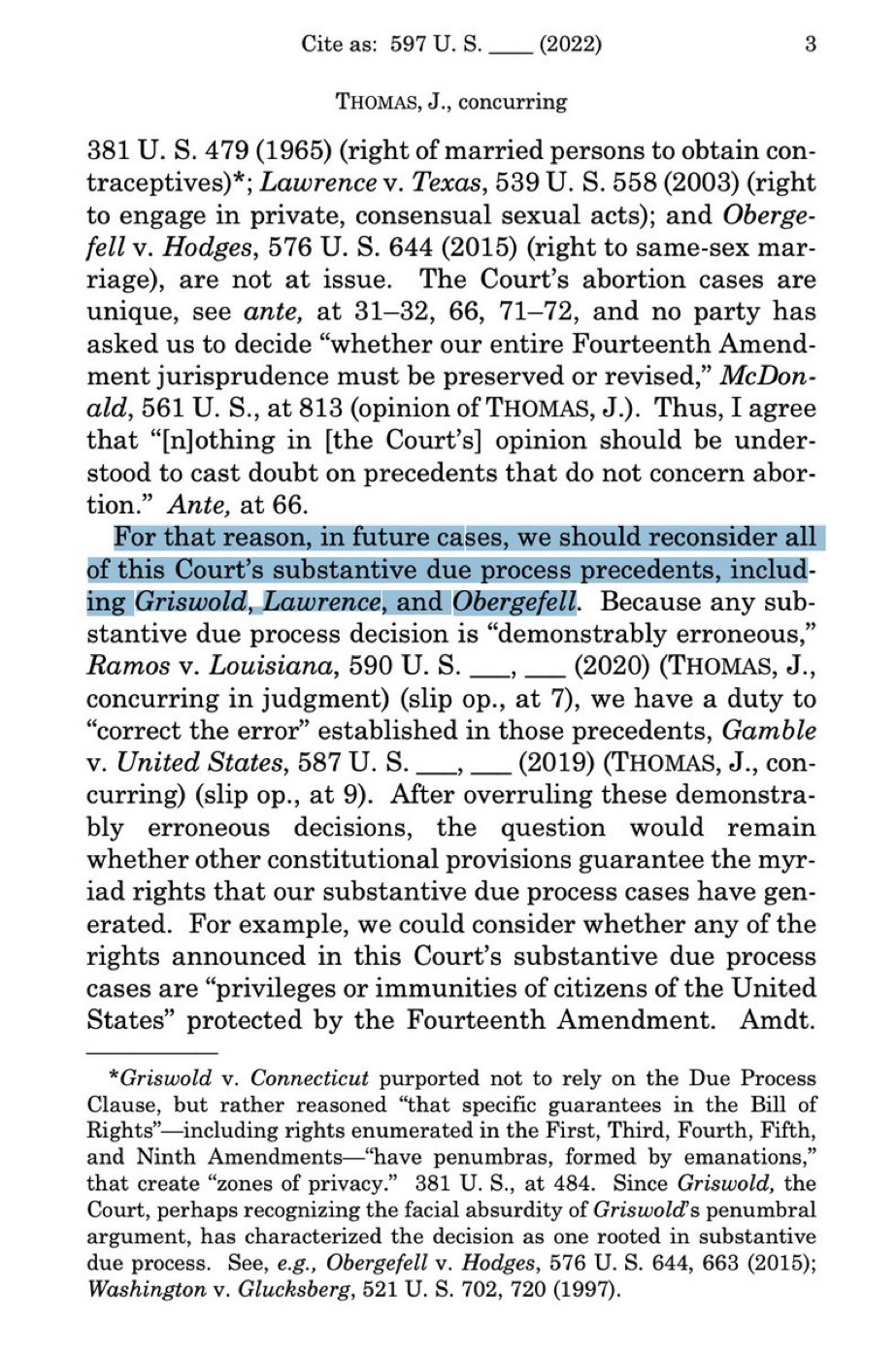
There it is: Alito’s analysis in overruling Roe v. Wade does not stop with reproductive rights. It reaches to same-sex marriage. He said so in his dissent in Obergefell. And Justice Thomas made that explicit in his concurrence in Dobbs:

          In future cases, we should reconsider all of this Court’s substantive due process precedents, including Griswold, Lawrence, and Obergefell.

Griswold recognized the right to use contraceptives of choice; Lawrence recognized the right to enter into a same-sex relationships; and Obergefell recognized the right of same-sex couples to marry. Justice Thomas notably omitted a right based on “substantive due process precedents”—the right of members of different “races” to marry, a right first granted in Loving v. Virginia in 1967. If the Court reverses Loving v. Virginia, Thomas’s marriage to Ginny Thomas would be illegal in some states.

For a longer discussion of the threat to other rights, see Mark Joseph Stern in Slate, The Supreme Court decision overruling Roe v. Wade puts marriage equality in immediate jeopardy.

It will take weeks to understand the implications of Justice Alito’s decision, but a good place to start is with Ian Millhiser’s analysis in Vox, The Roe v. Wade abortion decision, explained.

Finally, for a discussion of self-inflicted damage to the Court’s legitimacy, see Dahlia Lithwick, in Slate, Roe v. Wade overturned: The Supreme Court will pay for abortion decision.

The corruption and illegitimacy of the Supreme Court.

As currently constituted, the Supreme Court is illegitimate and corrupt. It is illegitimate because two justices appointed by Trump resulted from norm-busting “rules” made up by Mitch McConnell on the fly. Gorsuch sits in a seat stolen from an Obama appointee, and Barrett sits in a seat that belonged to the incoming president.

The Court is corrupt because Gorsuch, Kavanaugh, and Barrett lied to the Senate about their pre-determined intent to overrule Roe v. Wade. And it is corrupt because Justice Thomas has refused to recuse himself from cases in which his wife assisted in an attempted coup.

The trust of the American public in the Court has plummeted to an all-time low of 25%. It will decline further if the January 6th Committee proves that Ginny Thomas funneled information about Court deliberations to John Eastman. It will fall further if the Committee demonstrates that Justice Thomas knew of and condoned his wife’s insurrectionist activities.

Jennifer Rubin succinctly summarizes the death blow to the Court’s legitimacy in her column in WaPo, The Supreme Court eviscerates abortion rights and its own legitimacy. Per Rubin,

The hypocrisy and intellectual dishonesty of the court’s right-wing justices lead to the conclusion that they have simply appointed themselves super-legislators free to impose a view of the United States as a White, Christian and male-dominated society despite the values, beliefs and choices of a majority of 330 million modern Americans.

The court’s decision may result in women’s deaths. But it has certainly killed off what is left of the court’s credibility. And for that, there is no solution in sight.

Concluding Thoughts.

On a day like today, it does not feel right to end on an optimistic note. Rather, we should acknowledge the anger, frustration, fear, and grief that tens of millions of women in America are feeling after the ruling. There will be a time to rally and rejoin the fight for the dignity and equality of women—a fight we will win.

But today, we should acknowledge what women have lost and give them the time and space to absorb and recover from a once-in-a-generation shock. As they do, everyone in their lives should let them know we are at their side every step of the way. Walk along in silence and listen. Nothing can be “fixed” today, but we can begin the long journey back in the coming days.

Justice Clarence Thomas warns us which other decisions are likely to fall, under the reign of the authoritarian Trump Court: the right of married couples to buy contraceptives; the decriminalization of consensual gay sex in the privacy of one’s home; and gay marriage. Notice he left out the Loving decision, which made interracial marriages legal. Was that to protect his own marriage?

As expected, the US Supreme Court overturned Roe v. Wade, which stood for half a century as a guarantee of women’s reproductive rights. About half or more states have already passed or are about to pass laws banning abortions, even for women who were victims of rape or incest, even for women whose life is in danger. The “right to life” so prized by anti-abortion activists does not include the life of the woman.

As was not quite so expected, the Supreme Court gutted the Miranda rights of people who are arrested. Police may fail to tell prisoners of their legal rights, including their right to remain silent.

The Trump Court is remaking and redefining the law in a radical way. There is nothing “conservative” about their willingness to toss out precedent. There is something very radical about the jackhammer they are using to change social and legal norms.

Women will die because of the Court’s decision to throw out Roe, which several of them pledged in public not to do. The old coat hanger routine and the unlicensed abortionists will return. Women who can afford to flee to a state where abortion is available will do so. Those who can self-medicate with Internet anti-abortion drugs will do so, although some states are trying to ban Internet abortion drugs (will they open every package to every woman of child-bearing age?).

The Court’s decision on New York’s gun law is terrifying. Be prepared to see armed men (and women, don’t forget Congresswoman Lauren Bobert) strolling through your neighborhood or shopping malls. If the six justices actually think that open carry is a fine idea, why won’t they permit it in their own courtroom?

Make no mistake: the current majority on the Supreme Court is not conservative; it is radical, in its reckless disregard for precedent and the safety of citizens.

The Court is not libertarian; its decisions require millions of people to abide by their cramped view of the way things ought to be. The state must fund religious schools, no matter how bigoted and discriminatory they are, if the state funds any private schools. States and cities must not protect their public by enacting laws that prevent them from openly carrying a deadly weapon.

We can expect even more intrusive decisions, valuing property rights over human rights, corporate rights over workers’ rights.

We will be living with this narrow-minded, bossy, intrusive Court for many years. My generation has failed. I look to the enlightened young people, the product of America’s much-maligned public schools, to reverse course in the future and preserve this fragile experiment in democracy from the ideologues who seek to destroy it.

For an insightful assessment of how the Supreme Court’s decision on abortion will affect women in Texas, read this article in The Texas Monthly.

An excerpt:

An excerpt: As trigger laws go into effect around the country, Texans seeking surgical abortions will likely find themselves in either Kansas or New Mexico, the two nearest states where the procedure will remain legal—though both have a limited number of clinics, which is likely to make scheduling an appointment difficult. Kansas has four clinics, which currently serve 530,000 potential patients of reproductive age. Now the state’s clinics will be the nearest alternative for 7.7 million such patients, according to theGuttmacher Institute, a nonprofit group that researches reproductive health. New Mexico, which has seven clinics, will be the nearest option for 1.9 million potential patients, the vast majority of whom will be Texans.

What about abortion pills?

Medication abortions, which are nonsurgical and administered by taking a two-dose regimen of pills that terminate a pregnancy, are currently illegal in Texas after the seventh week of pregnancy; after HB 1280 goes into effect on July 24, medication abortions, which are currently the most common type of abortions in Texas, are included in the total ban on the procedure in the state.

As of last December, Texas law also forbids the shipment of pills that induce an abortion “by courier, delivery, or mail service.” It’s unclear how Texas officials plan to enforce this law, as many U.S. and international organizations offer the pills by mail, or whether those who seek care after a self-administered abortion could face criminal charges under HB 1280, depending on how the law is applied.

Legislators see the Supreme Court ruling as a green light to outlaw abortion and criminalize anyone who performs one. The penalties are as stiff as murder.

Charles P. Pierce is a super writer who is smart and insightful, especially when he writes about education. He writes regularly for Esquire. In this post, he slices and dices the absurdity of the Carson vs. Makin ruling that compels Maine to pay tuition for students at evangelical Christian schools that openly discriminate against students, families, and teachers who do not share their religious views. The six justices in the majority are certainly not Originalists. Their decision overturns a key principle embedded in the Constitution, which prohibits the state from sponsoring or “establishing” religion.

He writes:

It’s been a big week for Christian nationalism in our politics. In the case of Carson v. Makin, which involved a Maine law that forbade public money to go to religious schools, the Supreme Court ruled that the Establishment Clause of the United States Constitution is…unconstitutional. The Court’s carefully engineered conservative majority has been heading in this direction, finding anti-religious—primarily anti-Christian—discrimination in laws deliberately written to be religiously neutral. This was a pole-vault over that line, and one that conceivably could threaten public education as a whole. Writing for the majority, Chief Justice John Roberts said:

This case concerns two families that live in SAUs that neither maintain their own secondary schools nor contract with any nearby secondary school. Petitioners David and Amy Carson reside in Glenburn, Maine. When this litigation commenced, the Carsons’ daughter attended high school at Bangor Christian Schools (BCS), which was founded in 1970 as a ministry of Bangor Baptist Church. The Carsons sent their daughter to BCS because of the school’s high academic standards and because the school’s Christian worldview aligns with their sincerely held religious beliefs.

Translation: the school discriminates against LGBTQ citizens. Here, from a brief filed in this case, is what Bangor Christian Schools are up to.

BCS believes that a student who is homosexual or identifies as a gender other than on his or her original birth certificate would not be able to sign the agreement governing codes of conduct that BCS requires as a condition of admission.

If a student was openly gay and regularly communicated that fact to his or her classmates, “that would fall under an immoral activity” under BCS’ Statement of Faith and if “there was no change in the student’s position” after counseling, the student would not be allowed to continue attending BCS.

BCS does not believe there is any way to separate the religious instruction from the academic instruction – religious instruction is “completely intertwined and there is no way for a student to succeed if he or she is resistant to the sectarian instruction.”

One of the objectives in the ninth-grade social studies class is to “[r]efute the teachings of the Islamic religion with the truth of God’s Word.”

Shrug, says John Roberts. Pay up, suckers.Me? I am planning to open a taxpayer-funded madrassa out in the woods somewhere. I’ll keep you advised.

Open the link. The post has an interesting take on Herschel Walker and on Arizona official Rusty Bower’s view that the Constitution was divinely inspired.

To no one’s surprise, the ultra-conservative Supreme Court ruled in favor of funding religious schools in states that fund other private schools. Whereas the Supreme Court has long issued rulings forbidding any state support for religious schools, the current Supreme Court has signaled its willingness to rule in favor of equal treatment of religious schools. Brick by brick, this Supreme Court is dismantling the “wall of separation” (Thomas Jefferson’s phrase) between church and state.

David Savage of the Los Angeles Times reports:

WASHINGTON — 

The Supreme Court on Tuesday extended its support for religious schools, ruling that parents who send their children to such institutions have a right to tuition aid if the state provides it to other similar private schools. 

The 6-3 decision in the Carson vs. Makin case from Maine could open the door to including religious schools among the charter schools that are privately run but publicly financed. 

In the past, the high court had said that giving public funds to church schools violated the 1st Amendment’s ban on an “establishment of religion.” 

But in the past five years, the court’s conservative majority has flipped the equation and ruled it is unconstitutional discrimination to deny public funds to church schools simply because they are religious.

Maine has an unusual subsidy program because many of its small towns do not have a high school. In such cases, students may enroll in a private school or in another public high school, and the state pays their tuition.

Since 1980, however, the state has not extended these subsidies to students in church schools, apparently fearing it would be unconstitutional to do so.

The court majority said that was a mistake. 

Among the six conservative justices in the majority, all of them attended Catholic schools except for Justice Samuel A. Alito Jr., who went to public elementary and secondary schools in New Jersey. 

The conservative justices in recent years have cast aside the principle of church-state separation and argued it grew from an anti-Catholic bias in the late 19th and early 20th centuries.

“It was an open secret that ‘sectarian’ was code for ‘Catholic,’” Chief Justice John G. Roberts Jr. wrote in 2020, describing the common state laws that prohibit sending tax money to schools affiliated with a church. These restrictions were “born of bigotry” and “arose at a time of pervasive hostility to the Catholic Church and to Catholics in general,” he said in Espinoza vs. Montana

The 1st Amendment forbids laws “respecting an establishment of religion,” which had been seen as barring the government from subsidizing religion. But Justices Clarence Thomas and Neil M. Gorsuch have disagreed.

“The modern view which presumes that states must remain … virtually silent on matters of religion is fundamentally incorrect,” Thomas wrote in an earlier school case. “Properly understood, the Establishment Clause does not prohibit states from favoring religion.”

Notre Dame law professor Nicole Garnett, a former Thomas clerk, predicted last year there will be a move “in the near future to permit religious charter schools,” either through the courts or the states.

If these “charter school programs are properly considered programs of private school choice,” they can take advantage of the court’s ruling forbidding the exclusion of religious schools, she said.

My comment as an historian who has studied church-state issues:

The Court is right that there was a strong anti-Catholic bias in American society throughout the nineteenth century. The so-called Blaine amendments found in many state constitutions were animated in large part by a desire to block public funding of Catholic schools. As I showed in my book “The Great School Wars,” a history of the New York City schools, the Catholic Church eagerly sought public funding in the 1840s.

But the ban on funding religious schools that has been in place nationally for more than a century applied to all religious schools, not just to Catholic schools. Schools run by Protestants, Catholics, Jews, Muslims, and other religious faiths were ineligible for public funding. This view was reinforced repeatedly by the Supreme Court in numerous rulings. The common understanding, upheld by the Court, was that public funds should not be used to indoctrinate public funds into the belief system of any religious faith.

Public schools exist to promote public purposes: literacy and judgment needed to vote, to serve on juries, to participate in civic life, to sustain a democratic polity. Religious schools exist to teach and perpetuate–and yes, to indoctrinate–the faith of adherents. Religious believers do not want to support the schools of other faiths. But under this ruling, all religious faiths will be entitled to public funding in any state that funds any private schools.

Maine should end its policy of “tuitioning” and limit public funds to public schools. Other states that subsidize any private schools should stop doing so. The path on which SCOTUS has embarked will end in publicly funding schools for every religion, of which there are scores. It threatens the principle of the common school, supported by the public and open to all children.

The next step, as the article suggests, will be religious charter schools, scooping up public funds with no accountability, no oversight, and no adherence to anti-discrimination laws. Is it not unjust to expect the public to pay for schools where their own children are ineligible to attend because of their own religion?

Betsy DeVos and Charles Koch must be celebrating right now.

Mike Deshotels is a retired educator in Louisiana, who blogs at “Louisiana Educator.” He wrote the following post about the now well-established all-charter district.

The state of Louisiana took over most public schools in New Orleans after the devastation caused by Hurricane Katrina in 2005. It turned them over to charter operators, who were expected to get better academic results than the underfunded public schools. The city’s experienced teachers, mostly African-American, like their students, were fired and replaced by inexperienced Teach for America recruits. Philanthropies and the federal government poured billions into the district to help privatization succeed.

Other states, impressed by the promises of privatization, pushed for more charter schools, and some for vouchers, like Arizona, North Carolina, Florida, and Ohio. Michigan created the Education Achievement Authority (which failed), Tennessee created the Achievement School District, which boldly promised dramatic increases in test scores. It failed too. Still others, like Oklahoma, Nevada, and Texas, encouraged privatization and rapid expansion of charter schools.

Billionaires like Michael Bloomberg, Bill Gates, Charles Koch, Betsy DeVos, and the Waltons continue to fund the charter idea, as does the federal government, whose Charter Schools Program doles out $440 million annually to open or expand charter schools (many of which will fail or never open).

For the billionaires and the charter lobby, New Orleans was the shining star of the corporate reform movement, promising huge academic gains by firing teachers, closing public schools, and privatizing low-performing schools. New Orleans is the foundational myth of the charter movement.

Mike Deshotels shows here that the New Orleans “miracle” was and is a vast mirage. Fully a decade ago, in a dissent to a report by the Council on Foreign Relations that endorsed privatization of public schools, Linda Darling-Hammond wrote that “New Orleans remains the lowest-ranked district in the low-performing state of Louisiana.” Billions of dollars later, New Orleans continues to be the lowest performing school district in the lowest performing state.

Here is an excerpt from Mike Deshotels’ post:

This recently released report by the Louisiana Pelican Policy Institute, a business funded “good government” group has produced a dashboard that compares the most recent data on all public-school systems in Louisiana. It provides a way for us to compare expenditures and results in public schools. We can now get a good idea about whether the school reforms in New Orleans have lived up to their promises.

It is important to note that not all public schools in New Orleans at the time of takeover had been deemed to be failures. Even though the Orleans public school system, as a whole, fell into the bottom quartile of public school systems in the state based on academic achievement, there was a group of public schools in New Orleans that were performing well, even before 2006. Several highly selective schools had been producing high academic achievement and great college prep results. So approximately one-fourth of the Orleans schools were left intact because of acceptable results. Those schools, even though now converted into charters, continue to be selective in the students they serve and continue to produce exemplary results. But there is still a major problem with the state test scores of the other three-fourths – the reformed takeover schools.

The recent study shows that taken as a whole, the New Orleans all charter system is still ranking in the bottom quartile of all public-school systems in the state. This is in a state that performs near the bottom of all states on national testing and college preparedness. For example, the new dashboard reveals that for the four academic subjects of math, reading, science and social studies, only 18% of all New Orleans public school students are now rated proficient or better. (I averaged the results of the 4 academic subjects)

In the key subjects of math and reading, Orleans performs at the 24th percentile compared to all other state school systems. This is approximately the same as the Orleans school system performed before Katrina!

What about efficiency in the use of per pupil dollars? Has the new business-oriented model resulted in more efficient use of tax and grant dollars?

One thing that the all-charter system has been successful in doing is attracting a generous flow of charitable foundation money to these new experimental schools. A sizable portion of per pupil dollars in the reformed Orleans public system come from charitable and foundation grants. So the reformed all charter school system is certainly well funded.

The Pelican Policy Institute study has provided a rough measure of how the school money in Orleans is now allocated. Total per pupil funding of the New Orleans system now adds up to $24,434 per student. For Louisiana, this is lavish funding by any measure. The state average per pupil funding is now $11,755, less than half the per pupil amount for New Orleans. How do the New Orleans schools allocate their per pupil funding compared to all other public schools? According to the Pelican Policy dashboard, New Orleans now spends 23% of all its funding on administration and 36% on classroom instruction. (Salaries of the Charter managers are not published as far as I know) The state average for other systems in Louisiana is 8% for administration and 56% for the classrooms. (All non-charter public-school administrators and teacher salary schedules are public records)

Did the increased funding allow the reformed Orleans school system to hire a better quality of teachers? The state auditor recently found that more than half of the Orleans teachers are not certified as teachers. In addition, most of the teachers now employed in Orleans are Caucasian while 90% of the students are African American. This ignores studies that show that children learn better from real role models of their own ethnic type. So much for the new business approach.

Finally, on average, the other school systems in the state have 31% of students achieving proficiency in the 4 basic subjects tested. This compares to 18% achieving proficiency in the new reformed Orleans system.