Archives for category: Data

The Parent Coalition for Student Privacy urges you to write a letter on behalf of your child or everyone’s children to the Federal Trade Commission. The deadline is November 21.

Right now, the Federal Trade Commission is collecting comments from the public about how their oversight of the use of personal data by commercial enterprises can be improved. As you know, many parents are rightly concerned that too many vendors that collect personal student data at the behest of schools and districts have recklessly allowed that data to breach, and/or have used it for advertising, sale, or other commercial purposes. The comment period to the FTC has been extended through this Monday, Nov. 21, 2022, and we encourage all parents to submit comments by the end of that day.

Since the pandemic, the risky use of digital programs and apps in schools has soared. Most of these programs are operated and owned by for-profit companies who have been collecting personal student data without parental consent, sufficient oversight, restrictions, and/or security protections. As a result, the number of student data breaches has exploded.

This is in part because the existing data security provisions in federal law are weak or non-existent. The Children’s Online Privacy Protection Act, or COPPA, only requires “reasonable” security without the FTC having defined that term, while FERPA does not specify any security standards at all. And too many vendors are using personal data to target ads to students or their families, and/or to build new programs and services around, which are clearly commercial and not educational purposes.

We encourage you to submit your comments here; no later than this Monday at 11:59 pm. Let the FTC know that they should use all their authority to ensure that student data is safe and secure and used ONLY for educational purposes. A sample email is below, but please edit it any way you like. MOST important is for you to add any examples of when your children’s data was breached or improperly used. Please also share any such experiences with us, to aid us in our work going forward, by emailing us atinfo@studentprivacymatters.org

A sample email message is below. Thanks!

______

To the FTC:

I am a parent and am very concerned about how the number of student data breaches has skyrocketed in recent years, through hacking, ransomware, and other cybersecurity events. Moreover, too often school vendors are also using and abusing student data for commercial uses. I urge you to require enforceable contracts that require encryption, as well as other strong security standards for the collection, disclosure, and use of student data. Also, these contracts must prohibit vendors from accessing or using any data they do not need for the purposes of carrying out their contracted services, and the information they do collect should be deleted as soon as possible, preferably at the conclusion of each school year or at the very least, when students graduate or leave the district.

I also urge you to strongly prohibit the use of student data for any commercial purpose, including allowing vendors to sell it, to use it to target ads, and/or to use it to develop new products or services.

Yours sincerely [ add your name here].

And have a great Thanksgiving!

Leonie Haimson & Cassie Creswell, co-chairs
Parent Coalition for Student Privacy
124 Waverly Pl.
New York, NY 10011
info@studentprivacymatters.org
www.studentprivacymatters.org
Follow @parents4privacy
Subscribe to Parent Coalition for Student Privacy newsletter at https://www.studentprivacymatters.org/join-us

This is good news. In multiple ways, the US News & World Report rankings of schools, colleges, and graduate schools are misleading. Harvard Law School and Yale Law School certainly don’t need to have the blessing of US News. I’m hoping that other schools and universities refuse to be ranked by an invalid and useless measure.

CNN reports:

Yale and Harvard law schools, two of the premier law schools in the country, announced they are parting ways with U.S. News & World Report’s rankings of best law schools. The schools are bowing out after criticizing the publication’s methodology, arguing that the list actively perpetuates disparities in law schools. Given the elite status of Yale and Harvard, the move is significant and could signal a greater shift away from college rankings. For years, policymakers and those working in higher education have dismissed the rankings, though they are still referenced by potential students and their families. The decisions have been met with praise, but some questioned whether the move, if followed by other schools, would make it more difficult for the average person to choose to which colleges to apply.

The New York Times:

Colleges and universities have been critical of the U.S. News ranking system for decades, saying that it was unreliable and skewed educational priorities, but they had rarely taken action to thwart it, and every year almost always submitted their data for judgment on their various undergraduate and graduate programs.

Now both Yale and Harvard law schools have announced that they will no longer cooperate. In two separate letters posted on their websites, the law school deans excoriated U.S. News for using a methodology that they said devalued the efforts of schools like their own to recruit poor and working-class students, provide financial aid based on need and encourage students to go into low-paid public service law after graduation.

Peter Greene wants to save time for all organizations that react to the latest NAEP scores. His press release works whether scores are up, down, or flat.

He writes:

It’s time once again to greet the release of another set of data from the NAEP testing machine, which means everyone is warming up their Hot Take generator. But if, like me, you’re getting tired of writing a response to the latest NAEPery, here’s a handy news release that will let you mad lib your way to NAEPy wisdom.


The new scores from the National Assessment of Education Progress (NAEP), known as The Nation’s Report Card, have been released, providing important data about [insert your preferred education policy area]. The recent crisis in [select your favorite policy-adjacent crisis] has clearly created a burgeoning issue of [select whatever Bad Thing you feel will most scare your audience in the direction of your preferred policy].

Says [head of your organization], “The new scores provide important evidence that now is the time for [insert whatever policy action your group always supports]. Clearly the [rise/drop/stagnation] in scores among [whichever subgroup cherry picking best suits your point] proves exactly what we have been arguing for [however long you’ve been at this.]”

[Insert paragraph of data carefully selected and crunched for your purposes. Add a graph if you like. People really dig graphs.]

“This is a clear indication,” says [your favorite go-to education expert], “that it is long past time to [do that thing your organization has been trying to get people to do for years]. Clearly [our preferred solution] is needed.” [Insert further sales pitch here as needed.]

You can expand on this if you wish, but make sure that you definitely do not–

* provide context for the data that you include

* offer perspective from NAEP’s many critics

* absolutely never ever reference the fact that the NAEP folks are extraordinarily clear that folks should not try to suggest a causal relationship between scores and anything else.

As always, the main lesson of NAEP is that contrary to the expectations of so many policy wonks, cold hard data does not actually solve a thing.

The NAEP remains a data-rich Rorschach test that tells us far more about the people interpreting the data than it does about the people from whom the data was collected. Button up your overcoat, prepare for greater-than-usual pearl-clutching and solution-pitching from all the folks who still think the pandemic shutdown is a great opportunity to do [whatever it is they have already been trying to do].

Remember how voucher advocates claim that vouchers will “save” poor kids from “failing public schools”? T’aint so.

Stephen Dyer compared the progress of Ohio students in voucher schools to those in public schools. Guess what? The longer students are enrolled in voucher schools, the farther behind they fall.

He writes:

One thing you’d expect to hear a lot from voucher proponents is that students taking private school tuition subsidies do better the longer they’re in the private schools taxpayers are paying.

I mean, assuming these “choices” are so vastly superior to “failing” public schools, right?

Yet you never hear that argument. Now I know why: according to state test data, the longer students take vouchers, the worse they do on state tests — in some cases a lotworse. Especially in high school.

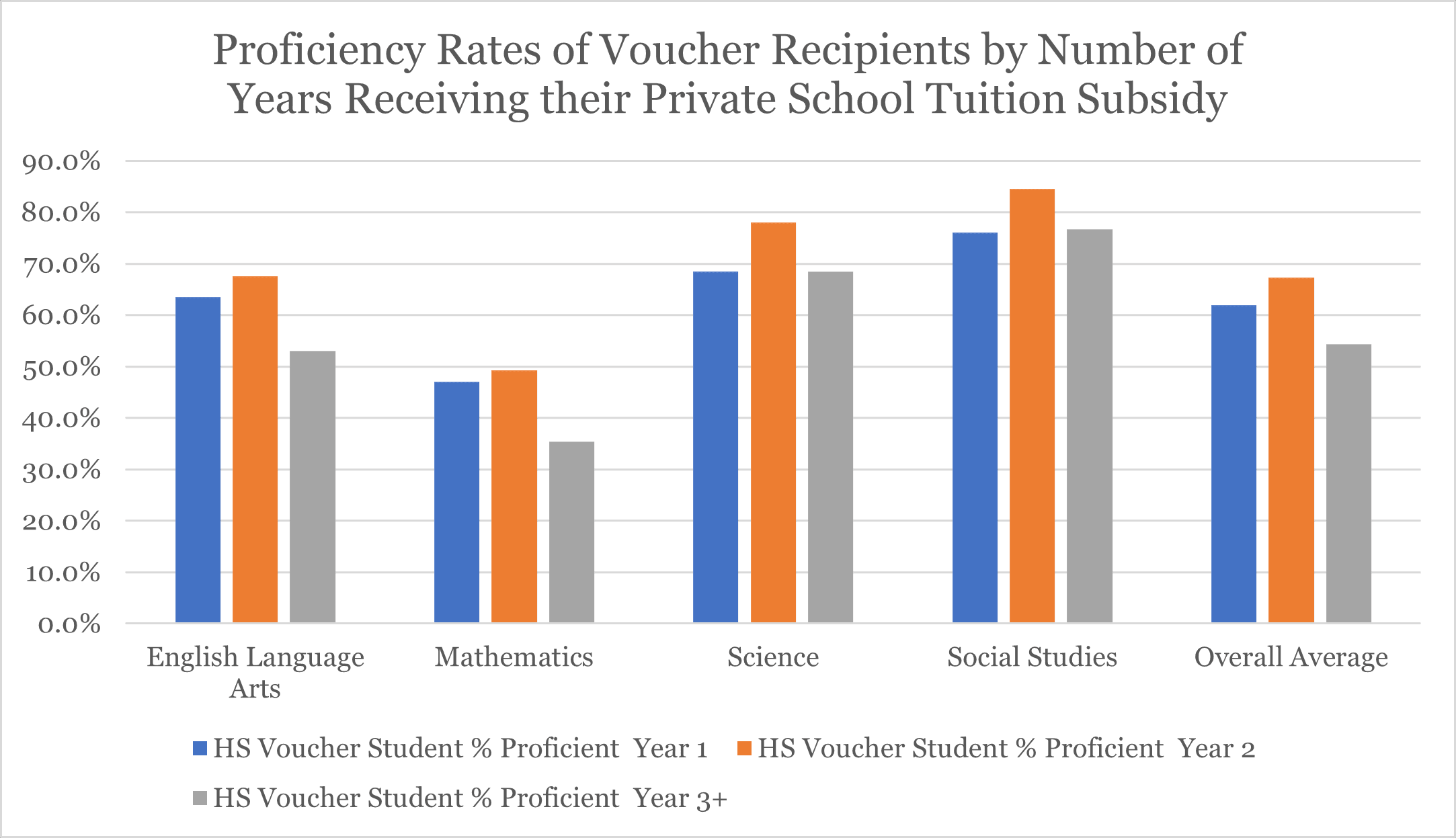
Here is how students perform on state High School proficiency rates, depending on how long they’ve been taking vouchers. You can see pretty clearly that especially in English and Math, students do markedly worse if they’ve been taking vouchers for 3 plus years than they do if they’ve only been taking it for a year.

This provides some pretty compelling evidence that students taking vouchers are better prepared by public schools, but once they enter the private system, that success wanes. Only in Social Studies is there an increase, but it’s only a 0.9% increase. Math drops by nearly 1/4. Overall, there’s, on average, a 12.1% drop in proficiency rates the longer a high school student takes a voucher….

Let me put it simply:

  • Generally, Voucher students do worse on state tests the longer they take vouchers.
  • The Black-White achievement gap is much greater among voucher students than public school students.
  • Private Schools that accept Vouchers take a Whiter population of students than the districts from whence the students come.

I just have one simple question: How is it again that Vouchers provide “better” opportunities for students of color who are being “failed” by public schools, as voucher proponents continuously claim?

Because Ohio data sure suggest that students of color are best served by their local public schools, not the private schools who are more reluctant to take them, even with significant taxpayer-funded tuition subsidies.

Stephen Dyer, a former state legislator in Ohio, writes a blog that tracks funding and privatization in Ohio. It’s called “10th Period.” He relies on state data to tell the truth about the failure of charters and vouchers. Here is the latest data on charter schools.

Dyer’s summary:

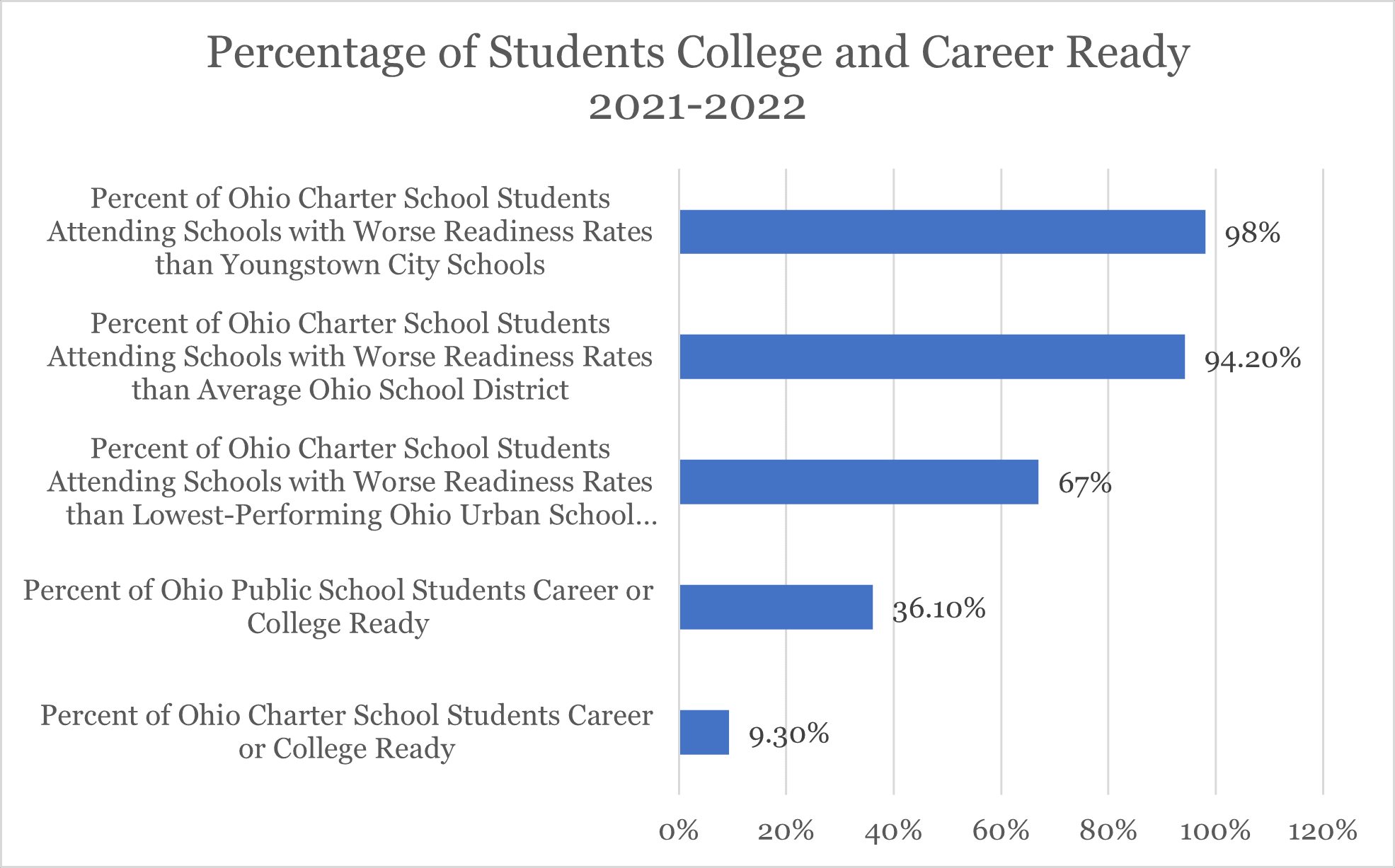
98 Percent of Ohio Charter School Graduates are Less Prepared for Post-Graduate World Than Students in Youngstown City Schools

Dayton is the lowest performing major urban district. Yet 2 out of 3 Ohio charter schools are less prepared than Dayton students

Ohio’s new report card has revealed something extremely troubling about Ohio’s Charter Schools. On a new measure called “Students in the 4-year Graduation Cohort who Completed a Pathway and are Prepared for College or Career Success”, only 9 percent of Ohio’s potential Charter School graduates met those qualifications. More than 36 percent of Ohio’s public school district students met those qualifications.

(Data Note: These data only examine students who could graduate high school, not whetherthey graduated high school. Public School Districts graduated 91.4 percent of their potential 121,968 graduates. Charter Schools only graduated 65 percent of their 4,657 potential graduates — a lower rate than any Ohio Public School District.)

Of the 43 Ohio Charter Schools with enough students to count in this College and Career Readiness measure, 18 schools had zero — that’s right, not a single student —who qualified as college or career ready. That means that 3 out of every 25 Ohio charter school graduates attended a school where not a single potential graduate was considered college or career ready.

But it gets worse.

More than 54 percent of Youngstown City School potential graduates are college or career ready. Only one Ohio Charter School — Dayton Early College Academy — has a higher rate.

That means that 98 percent of potential Ohio Charter School graduates are less prepared for post-high school lives than Youngstown City Schools’ potential graduates. Remember that Youngstown was seen as such a “failed” school district that the state created a new law to take over the district — in large part so more Charter Schools could open there.

Yet that district’s students are more likely to be prepared for post-high school lives than 98 percent of the 4,657 students potential graduating Ohio’s Charter Schools.

But wait. It gets worse.

The lowest-performing major urban school district in Ohio — Dayton — only had 5.7 percent of its students qualify as career or college ready.

Not good.

But before all you pro-charter school/voucher people scream “School Choice, Now!”, an astonishing 2 out of every 3 potential Ohio Charter School graduates attend schools with worse post-graduate preparation measures than Dayton.

Dayton is the home of the Thomas B. Fordham Institute and has been a hotbed of charter and voucher activity for 25 years. It’s not like school choice hasn’t been tried in Dayton.

And it ain’t working.

More Ohio students in all schools need to be career and college ready than they currently are. Full stop.

But what’s clear is that the best place for that to happen is in Ohio’s local public schools, not in Ohio Charter Schools.

I’d also like to use some space to bring up the Ohio Virtual Academy (OHVA) — the ECOT-sized online school. OHVA was paid to educate 14,530 students last year — more students than ECOT ever was paid to educate.

Yet they are just as bad as ECOT at preparing their students for the post-graduate world. An astonishing 87 of 1,820 potential OHVA grads were considered college or career ready. That 4.8 percent rate is lower than all but one Ohio school district — New Miami Local in Butler County, which only had 1 of 44 potential graduates considered college or career ready.

There’s more. If you want to follow the terrible results of privatization in Ohio, subscribe to Stephen Dyer’s blog.

Now here is a surprise: Paul Petersen, editor of the conservative journal Education Next and leader of Harvard’s Program on Education Policy and Governance, published an article with his postdoctoral student M. Danish Shakeel demonstrating the steady and impressive progress of American public schools over the past half century.

They write:

Contrary to what you may have heard, average student achievement has been increasing for half a century. Across 7 million tests taken by U.S. students born between 1954 and 2007, math scores have grown by 95 percent of a standard deviation, or nearly four years’ worth of learning. Reading scores have grown by 20 percent of a standard deviation per decade during that time, nearly one year’s worth of learning.

When we examine differences by student race, ethnicity, and socioeconomic status, longstanding assumptions about educational inequality start to falter. Black, Hispanic, and Asian students are improving far more quickly than their white classmates in elementary, middle, and high school. In elementary school, for example, reading scores for white students have grown by 9 percent of a standard deviation each decade, compared to 28 percent for Asian students, 19 percent for Black students, and 13 percent for Hispanic students. Students from low socioeconomic backgrounds also are progressing more quickly than their more advantaged peers in elementary and middle school. And for the most part, growth rates have remained steady throughout the past five decades.

Conventional wisdom downplays student progress and laments increasing achievement gaps between the have and have-nots. But as of 2017, steady growth was evident in reading and especially in math. While the seismic disruptions to young people’s development and education due to the Covid-19 pandemic have placed schools and communities in distress, the successes of the past may give educators confidence that today’s challenges can be overcome.

This article contradicts the foundation of the rightwing-conservative narrative that “our schools are failing,” which is the rationale for school choice and harsh treatment of teachers.

As Petersen and Shakeel show, the conventional wisdom among the “blow up public education” sect is wrong. Public schools are not failing. They are succeeding.

I made the same argument in my book Reign of Error. I showed that test scores and graduation rates for all groups are at an all-time high.

But more importantly, Paul Petersen made the same assertions in 1983, when he was the staff director for a Twentieth Century Fund commission on education. I was a member of the commission, as was Albert Shanker of the AFT, Dean Patricia A. Graham of the Harvard Graduate School of Education, and other luminaries.

The commission issued a report called “Making the Grade,” which lamented the woeful state of the schools. But our staff director Paul Petersen insisted that the commission was wrong in its dire conclusion and wrote a separate statement, expressing his dissent, in which he defended the schools.

I have served on many commissions and task forces but that was the only time that the staff director dissented from the group for whom he worked.

Paul Petersen was right in 1983.

He is right now.

Our public schools are not failing.

They have been a great success.

The attacks on them by Christian nationalists, billionaires, Catholic champions of vouchers, racists, extremists, and zealots for school choice is completely unjustified.

Their attack on the schools is an attack on our democracy.

It should end now.

Virginia’s new education leader avoids the press and the public, but she is accessible to rightwing think tanks. She recently spoke at the American Engerprise Institute, where she outlined her goal for the state’s students: job readiness. Aimee Guidera comes from the Gates-funded Data Quality Campaign. She did not speak about preparing students for citizenship in a democracy. She did not speak about imbuing students with a love of learning. She focused only on meeting the needs of employers.

Virginia NPR reported on her appearance:

Virginia’s top education official says the state is “resting on our laurels” when it comes to educating public school students.

In a forum hosted by a conservative think tank last month, Secretary of Education Aimee Guidera said her top goal is preparing students for the job market.

“We are reorienting everything to how is education geared towards preparing people for the jobs of today and of tomorrow,” she said.

Guidera has kept a low profile since Gov. Glenn Youngkin named her to be Virginia’s education secretary in December. But in a forum hosted by the American Enterprise Institute, Guidera laid out her plans in more detail.

The former CEO of the Data Quality Campaign, an education reform group, pushed back on claims the administration was attempting to censor history. She said her team would push past “culture wars,” which Youngkin’s critics say were fermented by the governor.

Instead, she said she plans on focusing on meeting three “benchmarks”: creating students that are ready for “family-supporting jobs” and who are civically engaged, recruiting and retaining employers attracted by the commonwealth’s talent pool and growing the state economy.

Leonie Haimson is a New York-based education activist who has two passions: reducing class size and protecting student privacy. She is co-founder of the Parent Coalition for Student Privacy. She writes today in Valerie Strauss’s “Answer Sheet” about legislation that threatens the privacy of every college student. Do your part to stop this invasion of privacy by writing your member of Congress. Use the link to contact your representatives.

Haimson writes:

With practically no public notice and no public hearings, the House of Representatives passed the College Transparency Act (CTA) on Feb. 4, 2022, by slipping it into a much larger unrelated bill called the America Competes Act, intended to better position the United States to compete with China. The bill is now slated to go to conference with the Senate…

The CTA would authorize the federal government to create a comprehensive data system that would include the personal information of every student enrolled in college or another higher education institution, and track them through their entire lives, by collecting their names, age, grades, test scores, attendance, race and ethnicity, gender, and economic status, directly from their colleges, along with other highly sensitive information pertaining to their disabilities and/or “status as a confined or incarcerated individual.”

Then, as they move through life, this data would be “matched” with their personal data from the other federal agencies, including the Census Bureau, the Department of Defense, Veterans Affairs, and the Social Security Administration.

No student would be allowed to opt out of this database, and there are no provisions for their data ever to be deleted. Instead, this bill would essentially allow the federal government to create a perpetual surveillance system, vulnerable to breaches and abuse.

This bill would overturn the legal ban on the federal government’s collection of personal student data, otherwise known as a “student unit record” system. The ban was established as a privacy safeguard in the Higher Education Opportunity Act of 2008, which “prohibits the creation or maintenance of a federal database of personally identifiable student information.”

Yet the federal creation of cradle-to-grave tracking system has been among the top priorities of the Gates Foundation and many of the groups they fund for years. In September 2016, Dan Greenstein, then the director of the foundation’s postsecondary division, told Politico that “[c]losely tracking student-level data remains at the top of the foundation’s list — something the foundation says can be accomplished by working around the federal government, which is banned from tracking students as they move through college,” although he hoped that “collective efforts could also work as a ‘lever’ to push Congress to reconsider the federal ban.”

The report that the foundation put out at the same time, entitled “Postsecondary Success Advocacy Priorities,” showed clearly that their goal was to overturn this prohibition and allow the federal government to directly collect this data for all children, starting at birth. This report has since been scrubbed from their website but is archived on the Wayback Machine here.

It says in part:


GOAL: Support the development of a comprehensive national data infrastructure that enables the secure and consistent collection and reporting of key performance metrics for all students in all institutions [emphasis theirs]. These data are essential for supporting the change needed to close persistent attainment gaps and produce an educated and diverse workforce with career-relevant credentials for the 21st century.

BACKGROUND: In this era of escalating costs and uncertain outcomes, it is important that prospective students, policymakers, and the public have answers to commonsense questions about whether and which colleges offer value: a quality education at an affordable price.

The Gates report included a chart that revealed the overarching and comprehensive nature of the infrastructure it envisioned, in which all “entities” would share their data, including “institutions/providers” before children even entered school, followed by state K-12 systems, colleges, and federal agencies such as the IRS, the Social Security Administration, the Department of Labor, the Department of Defense, etc. Together, this data would be fed into a “National Postsecondary Data System.”

The year before, the Commission on Evidence-Based Policymaking (CEP) had been established by Congress, with the stated goal to consider “whether a federal clearinghouse should be created for government survey and administrative data.” The commission first held hearings in Washington, D.C., on October 21, 2016, where many Gates-funded groups, including New America Foundation, Data Quality Campaign, Education Trust and Young Invincibles, testified in favor of weakening or overturning the ban on the federal collection of personal data.

The organization that I co-chair and co-founded, the Parent Coalition for Student Privacy, submitted comments to the commission, co-signed by the American Civil Liberties Union, the Network for Public Education, and other organizations, strongly opposing the overturning of the ban, noting that the potential risks to privacy were enormous from such a huge, centralized, comprehensive system.

According to the commission’s final report:
The Commission heard many substantive comments about the student unit record ban and received more feedback on the issue than on any other single topic within the Commission’s scope. Nearly two-thirds of the comments received in response to the Commission’s Request for Comments raised concerns about student records, with the majority of those comments in opposition to overturning the student unit record ban or otherwise enabling the Federal government to compile records about individual students.
Nevertheless, the commission recommended that the “Congress and the president should consider repealing current bans and limiting future bans on the collection and use of data for evidence building.”


In the meantime, it recommended the creation of a “National Secure Data Service to facilitate access to data for evidence building while ensuring privacy and transparency in how those data are used. … to temporarily link existing data and provide secure access to those data for exclusively statistical purposes in connection with approved projects. The National Secure Data Service will do this without creating a data clearinghouse or warehouse.”

In any case, in May 2017, a bipartisan group of senators, including Elizabeth Warren (D-Mass.) and Orrin G. Hatch (who was a Republican lawmaker from Utah at the time), introduced the College Transparency Act, which would overturn the ban on the federal collection of student data, and instead enable the government to track the employment and outcomes of college students throughout their lives.

Similar legislation was soon introduced in the House. As the reporter from Inside Higher Ed pointed out at the time: “While the bill has support from some Democrats and Republicans alike, its passage remains in doubt because opposition to a federal data system remains on the right and the left, based on privacy concerns and philosophical differences over the role of the federal government in higher ed.”

And while the CTA was resubmitted annually, there was little action by Congress during the intervening years. Nevertheless, the Gates Foundation and its allies kept pushing this idea, and last May, in yet another report, they again promoted the idea of a “federal student-level data network (SLDN) that provides disaggregated information about all students’ pathways and post-college outcomes, including employment, earnings, and loan repayment outcomes.”

With little warning, a few weeks ago, the CTA suddenly reappeared, at the last minute folded into the America Competes Act (ACA), although the ACA was an essentially unrelated bill focused on increasing the competitiveness of the United States with China. Even reporters who had in the past written about the CTA were not alerted in advance. The Parent Coalition for Student Privacy heard about it from a D.C. insider two days before its passage, and rushed out a news release the day before, with quotes from several different advocacy groups in opposition, as well as Rep. Jamaal Bowman (D-N.Y.).

As Rep. Bowman pointed out:

We have been down this road before and know how people’s personal data can be abused. Under the Trump Administration we saw this play out in the form of ICE stakeouts in our communities that put people in danger of being deported, separated from their families, and having their lives completely destroyed from one day to the next. The College Transparency Act raises serious concerns about how the data of our students can be used and abused.”

The next day, the bill passed the House by a vote of 238-193, with only a few Democrats opposed, including Bowman and two of his colleagues in the Congressional Progressive Caucus, Rep. Alexandria Ocasio-Cortez (D-N.Y.) and Cori Bush (D-Mo.).
The bill will now go to conference with the Senate. The Senate passed its version of the legislation, known as the U.S. Innovation and Competition Act (USICA), S.1260, last summer. And though the Senate version did not include the College Transparency Act, “supporters of the bill are very hopeful it will be approved by the conference committee that will review differences between the two bills,” according to a recent article.

On March 14, our student privacy coalition released a letter — co-signed by several other national privacy, consumer, education and parent groups — urging Congress not to pass this bill. As our letter pointed out, the bill would authorize the federal government to not only collect a huge amount of personal information, but also add to this nearly any other kind of data in the future, as long as the Department of Education thought it “necessary to ensure that the postsecondary data system fulfills [its] purposes,” although those purposes are not clearly defined.

And we once again emphasized how the risks of such a surveillance system outweighed the potential benefits by far:

Although the CTA’s supporters maintain that creating this massive federal system holds value for prospective students, history shows clearly how this sort of data collection has been used to target and violate the civil rights of our most vulnerable and marginalized individuals and communities. We have also learned that whatever guardrails exist to protect student privacy and anonymity in the current bill could easily be amended in the aftermath of a national crisis, like 9/11, so the CTA data could be used to target current and former students simply because they are a member of a disfavored racial, ethnic, religious, or other vulnerable group. Whatever the value of such a system in terms of promoting accountability for higher education institutions may be, such benefits must be pursued through far less invasive means that do not threaten core American rights and values.

Surely, there are many less intrusive options that could be used to analyze and evaluate higher education outcomes, by using data sampling and use of aggregate data. The existing federal College Scorecard has been enhanced via the collection of aggregate, non-personally identifiable data drawn from colleges, and could be further strengthened by including aggregate data on part-time students, as well as data related to transfer students, contributed by the National Student Clearinghouse, an independent, non-governmental group. This would obviate any need for the federal government to collect and amass personal data from students and follow them throughout their lives.

Such a data system would not only be vulnerable to breaches, but also could have unanticipated negative consequences, by discouraging colleges from accepting the highest-need students to boost their ratings, and/or cause them to discourage their students from entering into careers that have great social value, but lower than average salaries, like teaching.

Please use this link to write your members of Congress and urge them to reject this Orwellian legislation.

Mercedes Schneider digs into the background of Virginia’s new Secretary of Education. She is a data collector, not an educator. On the good side, she is conservative but apparently not an anti-CRT warrior:

On December 20, 2021, Virginia Governor-elect Glenn Youngkin announced that his choice for state education secretary is “education consultant” Aimee Guidera. In the ABC8News in which I read Youngkin’s choice, political analyst Rich Meagher commented, “We don’t know a lot about this nominee just yet in part because she is not a political operative. She is a data scientist.”

We don’t know much about this nominee, but let’s unequivocally label her a *data scientist* and not just a data collector.

The ABC8News article does identify Guidera as “founder and former chief executive of the Data Quality Campaign (DQC), a leading voice advocating for improving the use of data to increase student achievement,” a statement that reads more like the pro-data-collection sales pitch than perhaps the article author realizes.

Guidera holds no degree in data collection and analysis or statistics and research. According to her Linkedin bio, Guidera’s bachelors of arts is from Princeton’s Woodrow Wilson School of Public and International Affairs (public policy), and her masters is in public policy from Harvard’s John F. Kennedy School of Government. Nevertheless, since she founded and operated a data collection organization, Guidera is cloaked in presumed credibility as a student data expert.

For those who are sketchy about founder Guidera and her DQC, allow me to offer information from several posts I have published between 2013 and 2017 concerning DQC, DQC’s controlling nonprofit, Education Trust, and her connection to Common Core and ubiqitous Gates funding, among other market-based, ed-reform connections. Then, readers can decide whether they believe “education consultant” Guidera to be more “data scientist” or just a well-funded, well-positioned data collector.

As for me, I’m going with “well-funded, well-positioned data collector.”

In the rest of the post, Mercedes (who has a doctorate in statistics, unlike Guidera) reviews the Data Quality Campaign. Open the link and read all about it.

Chicago Mayor Lori Lightfoot selected Pedro Martinez, Superintendent of the San Antonio School District, as the Windy City’s public schools.

Martinez is a “reformer.” In San Antonio, he was known for his obsession with data and commitment to opening charter schools. He is a graduate of the tattered Broad Superintendents Academy. He is chairman of Jeb Bush’s Chiefs for Change. Chiefs for Change brings together superintendents who share the test-and-punish ideas of the failed corporate reform movement (closing low-scoring schools, opening charter schools, relying on high-stakes testing, evaluating teachers by test scores, collecting data about everything, distrust of unions, etc.).

Martinez is a graduate of the Chicago Public Schools. He holds an M.B.A. from DePaul University and a bachelor’s degree from the University of Illinois at Urbana-Champaign. And, of course, he is a graduate of the Broad Superintendents Academy. He worked for Arne Duncan as Chief Financial Officer when Arne was Superintendent in Chicago. He was “Superintendent-in-Residence” for the Nevada Department of Education. Prior to that, he was superintendent for the 64,000-student Washoe County School District, covering the Reno, Nevada area.

Like Arne, Martinez was never a teacher or principal.