Archives for category: Data

At the start of the second Trump administration, Trump unilaterally created a fake “Department of Government Efficiency,” led by Elon Musk. Only Congress can create or eliminate Departments. According to the Constitution, the House of Representatives is responsible for funding and defunding the federal government.

Trump ignored the Constitution and Congress and let Musk and his team ransack the Federal Government, fire thousands of civil servants, and close agencies at will. DOGE decisions were made not by experts but by Musk and his team, most of whom were young men in their 20s, even a teenagers. From their point of view, their greatest accomplishment was to copy massive amounts of personally identifiable data from the Treasury Department and the Social Security Administration.

While DOGE slashed and burned agencies and Departments with abandon, the cruelest cut of all was the near-total elimination of foreign aid. Millions of people in impoverished countries relied on U.S. AID for food, medicine, and medical care. The aid is gone. Hundreds of thousands of people died. If you say it in the active tense, Trump and Musk murdered “hundreds of thousands of people” whose lives depended on US AID. The food aid was more than a humanitarian impulse: American farmers lost at least $2 billion that was used to pay them to supply food for US AID.

Matt Johnson wrote for MS NOW:

“We spent the weekend feeding USAID into the wood chipper,” Elon Musk boasted in February, shortly after President Donald Trump gave him permission to hack his way through the federal government. As a “special government employee” with no oversight running the “temporary organization,” the Department of Government Efficiency, or DOGE, Musk destroyed the 64-year-old humanitarian agency in a matter of days, abruptly halting deliveries of lifesaving medicine, emergency food aid and many other forms of support to the poorest people on the planet. This was done in the name of DOGE’s mission to “maximize governmental efficiency and productivity.”

Musk claimed that DOGE would slash government spending by “at least $2 trillion,” but it ended up saving a microscopic fraction of that figure. Now that DOGE has been disbanded, Musk claims “We were a little bit successful” — but admits that he wouldn’t do it again

Musk tried his hand at government, shrugged and moved on. The same can’t be said for the people who are dead and dying thanks to the DOGE-led onslaught on the U.S. Agency for International Development. “No one has died as [a] result of a brief pause to do a sanity check on foreign aid funding,” Musk declared in March. According to models created by Boston University epidemiologist Brooke Nichols, hundreds of thousands of people have in fact died as a result of eliminated and disrupted aid. 

It’s impossible to calculate the ultimate human toll of shuttering USAID. The U.S. was responsible for 40% of the total foreign aid tracked by the United Nations in 2024, and much of the infrastructure that delivered this aid has now been destroyed. Beyond the frozen payments for active aid projects, partner organizations have closed, supply chains for medicine and food deliveries have been severed and staff who administered and monitored programs have been fired. Early warning systems for starvation and infectious diseases have shut down. 

The individual stories are harrowing. A South Sudanese child with HIV died from pneumonia because he didn’t receive the medication necessary to sustain his immune system. People participating in studies were abandonedwith experimental drugs in their systems and medical devices in their bodies. Cases of acute malnutrition at refugee camps have surged

In the MAGAverse, none of this is true because USAID was never an aid organization to begin with. Mike Benz, a right-wing influencer who has accused the agency of being a terror organization and subverting governments around the world, was a big influence on Musk’s assault on USAID, which Benz called the “Terror Titanic.” Like Musk before him, Benz has now been appointed as a special government employee to investigate his allegations that USAID was a massive covert influence operation and front for the CIA. 

Benz’s campaign is just the latest example of MAGA propaganda using USAID as a convenient political scapegoat. DOGE viewed the takeover of USAID as an opportunity to find instances of “viral waste,” which could be broadcast to the American people as a justification for its other cost-cutting efforts. One example cited by White House Press Secretary Karoline Leavitt was the “50 million taxpayer dollars that went out the door to fund condoms in Gaza.” Trump later declared that the money had been “sent to Gaza to buy condoms for Hamas.” 

There was just one problem: The money was actually for family planning in a province of Mozambique called Gaza….

This is not the full article. Open the link to read the rest.

Every so often, I read a story about education that is truly annoying. The most recent one is in The Atlantic. It was written by Idrees Kahloon, a staff writer at the magazine. It is titled “America is Sliding Toward Illiteracy.” The subtitle is “Declining standards and low expectations are destroying American education.”

As a historian of American education, I have read the same story hundreds of times. In the 19th century, these warnings that children were not learning anything in school were commonplace. The cry of “crisis in the schools” appeared frequently in every decade of the 20th century. We are only 25 years into this century, and similar views appear in the popular press regularly.

Long ago, attacks on the schools were intended to produce more funding for them, or higher standards for those entering teaching..

Now they serve the purposes of those pushing privatization of public schools, those who are promoting vouchers, charters, homeschooling, and every other way of destroying public schools.

Test scores have fallen! The culprit? Smart phones! Social media! Low expectations! Low standards! Bad teachers! Bad Schools!

George W. Bush’s No Child Left Behind law of 2002 raised standards and expectations but it raised them absurdly high, to a literally unreachable goal. A rebellion formed among those who didn’t think it possible that “all students” would reach “proficiency” by 2014.

NCLB required that all students would be “proficient,” not just at grade level, by 2014. By NAEP standards, “proficient” does not mean grade level. It means “A” performance. In no other nation in the world are all students rated “proficient” on the NAEP scale. Nor has any district or state ever reached that goal.

But the Cassandras of American education have monopolized the podium for many years, wailing that we will be an impoverished third-world country if test scores don’t rise dramatically.

Think about it. The biggest explosion of doom-and-gloom was caused by the Reagan-era report called “A Nation at Risk” in 1983. It flatly predicted that our economy was imperiled by a “rising tide of mediocrity.” But what has happened since 1983? Our economy is booming, we have not been eclipsed by other nations. We continue to be a land of innovation, creativity, scientific and medical pre-eminence.

How is our nation’s success possible, given the cry for more than 40 years that our schools are hobbling our economy and compromising our future?

Instead of complaining about our schools and lambasting them nonstop, the critics should be complaining about poverty and inequality. These are the root causes of poor student outcomes.

If the critics are worried about our future, they should shout out against Trump’s orders to withhold funding for research in science and medicine. If they really wanted great schools, they would stop diverting public funds to nonpublic schools and homeschoolers–where there are low or no standards for teachers– and make sure that every student has certified, experienced teachers, small classes, and the amenities available in every school that are typically available only in wealthy suburban districts.

No, our kids are not sliding into stupidity. If you don’t agree, I dare you to take an eighth grade math test and release your scores. You will be surprised.

The greatest generation sits in our public high schools today, unless our government continues to impose moronic policies of choice and competition that have failed for the past thirty-five years.

What happens when government data are politicized? What happens when a President fires the professionals who report the data and replace them with his loyalists?

Jack Hassard, a retired professor of science education at Georgia State University, knows what happens. Hassard followed Trump’s behavior in his first term and wrote a book called The Trump Files.

The problem with Trump has accelerated now that he is surrounded by a well-organized cabal of far-right extremists who are turning him into a dictator.

Dear Jack,1

I was eight the last time the numbers were real.

Every Friday, my mother would check the Bureau of Labor Statistics dashboard. She did this the way some families checked the weather. She was quiet and anxious, with a hand on the mouse and a furrow in her brow. The numbers told her how many people had lost work that week. They showed how fast prices were rising. The data revealed whether the rent hikes were outpacing wages again. It was her way of listening for distant thunder. Today, nevertheless, the BLS dashboard is not updating information because of the Republican led government shutdown.

The dashboard went dark the spring Trump returned to power. At first we thought it was just another funding fight, like the ones that had knocked websites offline before. But weeks passed, and the updates never came back. My mother kept refreshing the page for months, like a ritual for a ghost.

By the end of that summer, more pages were vanishing. Climate dashboards froze mid-storm season. Food insecurity surveys were “postponed indefinitely.” Vaccine data disappeared without explanation. By winter, it was as if the country had decided to stop looking at itself in the mirror.

They called it austerity. They said it was about cutting “red tape” and “freeing the agencies from bloated bureaucracy.” But everyone could feel the chill. It wasn’t just numbers that were being cut. It was the nerves that told us where the pain was.


We didn’t realize it at the time. This was how the silence began. It began not with censorship in the usual sense but with a subtraction of knowledge.

When the data stopped, arguments stopped making sense. People clung to whatever numbers their preferred networks fed them, like castaways grabbing driftwood. One station would say unemployment was rising; another insisted we were in a “golden age.” Both cited “official sources,” but the sources were gone, hollowed out or replaced by Trump’s loyalists.

At school, the teachers tried to explain inflation, but the charts they used were months out of date. Some parents started printing memes as evidence. Others stopped trusting the schools entirely.

Looking back, it’s astonishing how quickly civic discourse disintegrated once the shared factual floor cracked. We had thought democracy died in coups or riots. Instead, it died in data voids—quiet gaps that widened into abysses.


My father used to call it “the silence before the storm.” Storms were his touchstone for everything. He said the scariest part wasn’t the wind or the rain. It was the moment the air went unnaturally still. You realized the warning systems had failed.

That silence descended over our public life. When pollution monitoring sites shut down, a chemical spill in Savannah went undetected for weeks. By the time the numbers surfaced through a university backchannel, children were already sick. When the food insecurity survey was cut, hunger surged invisibly. Relief programs couldn’t track where the need was worst.

And when climate data went dark, the storms didn’t stop. They just stopped being predictable. The year the NOAA dashboards froze was the year the Atlantic hurricanes changed course mid-season. Thousands died inland, where no one expected them.

The silence didn’t come from ignorance. It came from a deliberate decision to turn off the lights.


I know you study this era, Jack, so you know the official explanations: budget cuts, “efficiency reforms,” sovereignty rhetoric. But those were just alibis. Trump understood something that too many defenders of democracy underestimated: data is power. Whoever controls the ability to measure reality controls the terms of debate.

His war on data wasn’t chaotic—it was methodical. Fire the agency heads who produce inconvenient statistics. Defund the surveys that expose inequality. Gut the climate monitors that contradict your conspiracies. Let loyal media amplify your alternate “facts.” Over time, the shared reality collapses, and the strongman narrative becomes the only stable frame left.

The Trump administration is canceling the federal government’s annual report on hunger, the Wall Street Journal reports.

Why? The administration says the data gets “politicized.” I think that means that lobbyists for the poor use the data to seek more funding for programs to feed people who are hungry.

The data, which is collected each December and analyzed by the U.S. Agriculture Department, measures food insecurity across states and demographic groups. 

The data has been collected every year since the mid-1990s, and is widely used by federal, state and local policymakers to make funding decisions for food-assistance programs, and to evaluate how well those programs work.  

The decision to discontinue the survey for 2025 was announced in meetings with USDA employees this past week by an administrator for the Economic Research Service, an arm of the Agriculture Department, according to people present at the meetings….

“This nonstatutory report became overly politicized and upon subsequent review, was unnecessary to carry out the work of the Department,” USDA spokesman Alec Varsamis said. 

He added that the 2024 report will be released on Oct. 22, but the 2025 report has been discontinued…

Employees inside the USDA as well as economists outside the agency who work closely with the data reacted with shock and anger as word spread about the cancellation. 

“For the past 30 years, the USDA food insecurity measure has provided insight into the extent that American families have been able to cover their food needs,” said Colleen Heflin, a professor at Syracuse University, who has been studying the data since its inception, and learned of the study’s cancellation from contacts inside USDA. “Not having this measure for 2025 is particularly troubling given the current rise in inflation and deterioration of labor market conditions, two conditions known to increase food insecurity.”

The administration has criticized government data related to the job market, saying it had been used as a political weapon. President Trump recently fired the head of the Bureau of Labor Statistics after a particularly poor jobs report. He accused her of manipulating the numbers to make him look bad, which economists have refuted…

The decision to end the USDA data collection comes at a time when more Americans are struggling to get enough to eat. Food banks have seen requests for assistance from households rise over the past few years, driven by the end of pandemic aid programs and the impact of inflation on grocery prices. 

In 2023, the USDA reported that an estimated 13.8 million children lived in households that struggled to get enough food at times, the highest number in nearly a decade, according to the most recent USDA survey. Data from 2024 is set to be released next month. 

Ignorance is bliss.

Last week, the Bureau of Labor Statistics reported the number of new jobs created in the past month–73,000. The BLS lowered its estimates of new jobs created in the previous two months by 258,000.

The sections of the BLS report that outraged Trump said:

Total nonfarm payroll employment changed little in July (+73,000) and has shown little change 
since April, the U.S. Bureau of Labor Statistics (BLS) reported today. The unemployment rate,
at 4.2 percent, also changed little in July. Employment continued to trend up in health care
and in social assistance. Federal government continued to lose jobs...

Revisions for May and June were larger than normal. The change in total nonfarm payroll employment
for May was revised down by 125,000, from +144,000 to +19,000, and the change for June was revised
down by 133,000, from +147,000 to +14,000. With these revisions, employment in May and June
combined is 258,000 lower than previously reported. (Monthly revisions result from additional
reports received from businesses and government agencies since the last published estimates and
from the recalculation of seasonal factors.)

Trump was furious. The revisions meant that the labor force grew not by 291,000 new jobs, but by only 33,000 jobs. He insisted that the numbers were “rigged,” and he announced that they had been rigged for political reasons, to make him look bad. He fired the Commissioner of the Bureau of Labor Statistics, Erika McEntarfer, accusing her of chicanery. She had worked for the BLS for 20 years.

The message that was sent to all agencies was that Trump wants only good news. Numerous commentators wondered if any government data could be trusted during Trump’s tenure.

Gene Sperling posted this tweet. Sperling was a senior economic advisor to both President Clinton and President Obama.

@GenebSperling:

For anyone who spends even a split second taking even 1% of the Administration’s explanation for firing the BLS commissioner seriously, read the words of Bill Beach, the former Trump-appointed BLS commissioner:

“These numbers are constructed by hundreds of people. They’re finalized by about 40 people. These 40 people are very professional people who have served under Republicans and Democrats.

And the commissioner does not see these numbers until the Wednesday prior to the release on Friday. By that time, the numbers are completely set into the IT system. They have been programmed. They are simply reported to the commissioner, so the commissioner can on Thursday brief the president’s economic team.

The commissioner doesn’t have any hand or any influence or any way of even knowing the data until they’re completely done. That’s true of the unemployment rate. That’s true of the jobs numbers.”

I was going to post this but then I saw this brilliant article in The New York Times by Peter Baker, the Times‘ chief White House correspondent. He put Trump’s latest effort to control the jobs data into a broad perspective. Trump wants to control the news, the arts and culture, and history. He is a deeply insecure man. He wants the world to believe that he’s the most amazing person who ever lived and superior to all past presidents. Deep down he knows he’s in over his head. He has surrounded himself with sycophants and blocks out any news that disrupts his fantasy of greatness.

In an article titled “Trump’s Efforts to Control Information Echo an Authoritarian Playbook, Baker writes:

An old rule in Washington holds that you are entitled to your own opinions but you are not entitled to your own facts. President Trump seems determined to prove that wrong.

Don’t like an intelligence report that contradicts your view? Go after the analysts. Don’t like cost estimates for your tax plan? Invent your own. Don’t like a predecessor’s climate policies? Scrub government websites of underlying data. Don’t like a museum exhibit that cites your impeachments? Delete any mention of them.

Mr. Trump’s war on facts reached new heights on Friday when he angrily fired the Labor Department official in charge of compiling statistics on employment in America because he did not like the latest jobs report showing that the economy isn’t doing as well as he claims it is. Mr. Trump declared that her numbers were “phony.” His proof? It was “my opinion.” And the story he told supposedly proving she was politically biased? It had no basis in fact itself.

The message, however, was unmistakable: Government officials who deal in data now fear they have to toe the line or risk losing their jobs. Career scientists, longtime intelligence analysts and nonpartisan statisticians who serve every president regardless of political party with neutral information on countless matters, such as weather patterns and vaccine efficacy, now face pressure as never before to conform to the alternative reality enforced by the president and his team.

Mr. Trump has never been especially wedded to facts, routinely making up his own numbersrepeating falsehoods and conspiracy theories even after they are debunked and denigrating the very concept of independent fact-checking. But his efforts since reclaiming the White House to make the rest of government adopt his versions of the truth have gone further than in his first term and increasingly remind scholars of the way authoritarian leaders in other countries have sought to control information.

“Democracy can’t realistically exist without reliable epistemic infrastructure,” said Michael Patrick Lynch, author of the recently published “On Truth in Politics” and a professor at the University of Connecticut.

“Anti-democratic, authoritarian leaders know this,” he said. “That is why they will seize every opportunity to control sources of information. As Bacon taught us, knowledge is power. But preventing or controlling access to knowledge is also power.”

The British philosopher Francis Bacon published his meditations on truth and nature more than four centuries before Mr. Trump arrived in Washington, but history is filled with examples of leaders seeking to stifle unwelcome information. The Soviets falsified data to make their economy look stronger than it was. The Chinese have long been suspected of doing the same. Just three years ago, Turkey’s autocratic leader fired his government’s statistics chief after a report documented rocketing inflation.

Mr. Trump’s advisers defended his decision to fire the Labor Department official, saying he was only seeking accuracy, and they released a list of recent job estimates that were later revised. While revisions of job creation estimates are normal, they argued without evidence that recent ones indicated a problem.

The bureau’s “data has been historically inaccurate and led by a totally incompetent individual,” Taylor Rogers, a White House spokesman, said on Saturday. “President Trump believes businesses, households and policymakers deserve accurate data when making major policy decisions, and he will restore America’s trust in this key data.”

Mr. Trump has spent a lifetime trying to impose his facts on others, whether it be claiming that Trump Tower has 10 more floors than it actually has or insisting that he was richer than he actually was. He went so far as to sue the journalist Timothy L. O’Brien for $5 billion for reporting that Mr. Trump’s net worth was less than he maintained it was. The future president testified in that case that he determined his net worth based in part on “my own feelings.” (The suit was dismissed.)

His fast-and-loose approach to numbers and facts finally caught up with him last year when he was found liable for fraud in a civil case in which a judge found that he used his annual financial statements to defraud lenders and ordered him to pay what has now exceeded $500 million with interest. Mr. Trump has appealed the ruling.

During his first term as president, Mr. Trump chastised the National Park Service for not backing up his off-the-top-of-his-head estimate of the crowd size at his inauguration. He used a Sharpie pen to alter a map to argue that he was right to predict that a hurricane might hit Alabama, and federal weather forecasters were rebuked for saying it would not.

Most explosively, he pressured Justice Department officials to falsely declare that the 2020 election was corrupt and therefore stolen from him even after they told him there was no evidence of widespread voter fraud.

This second term, however, has seen Mr. Trump go further to force his facts on the government and get rid of those standing in the way. After just six months of his return to office, the Union of Concerned Scientists, a nonprofit advocacy group, counted 402 of what it called “attacks on federal science,” nearly double its count from the entire first term.

Gretchen T. Goldman, president of the union and a former science adviser to President Joseph R. Biden Jr., said federal agencies like the Bureau of Labor Statistics, whose director was fired by Mr. Trump on Friday, are meant to operate more independently to avoid the politicization of data collection and reporting.

“Firing the top statistical official sends a clear signal to others across the government that you are expected to compromise scientific integrity to appease the president,” she said. “This puts us in dangerous territory far from an accountable and reality-based government.”

Mr. Trump’s team has aggressively sought to steer information emerging from the federal government since January if it contradicted the president. The top aide to Tulsi Gabbard, Mr. Trump’s director of national intelligence, ordered intelligence analysts to rewrite an assessment on the Venezuelan government’s relationship with the gang Tren de Aragua that undermined the president’s claims. Ms. Gabbard later fired two intelligence officialsbecause she said they opposed Mr. Trump.

Mr. Trump and his allies assailed the nonpartisan Congressional Budget Office for projecting that his tax and spending legislation would add trillions of dollars to the national debt and offered his own numbers instead.

“I predict we will do 3, 4, or even 5 times the amount they purposefully ‘allotted’ to us,” he said, referring to growth expected to be stimulated by tax cuts, which he insisted would “cost us no money.” Mr. Trump called the budget office “Democrat inspired and ‘controlled,’” even though it is nonpartisan and Republicans have majorities in both chambers of Congress.

In recent days, Mr. Trump has sought to rewrite the history of the 2016 election when, according to multiple intelligence reports and investigations, including by Republicans, Russia intervened in the campaign with the goal of helping him beat Hillary Clinton. Ms. Gabbard released documents that she claimed showed that in fact President Barack Obama orchestrated a “yearslong coup and treasonous conspiracy” against Mr. Trump, even though the documents she released did not prove that.

Federal officials have gotten the hint. Throughout the government, officials have sought to remove references to topics like “diversity” that might offend Mr. Trump or his team and to revise presentation of history that might in his view cast the country in a negative light. After Mr. Trump ordered the National Park Service to remove or cover up exhibits at its 433 sites across the country that “inappropriately disparage Americans,” employees have flagged displays on slavery, climate change and Native Americans for possible deletion.

Just last week, the Smithsonian Institution confirmed that it had removed Mr. Trump from an exhibit on impeachment at the National Museum of American History, despite the fact that he is the only president to have been impeached twice. The exhibit was changed to say that “only three presidents have seriously faced removal,” referring to Andrew Johnson, Richard M. Nixon and Bill Clinton — with no mention of Mr. Trump.

The Smithsonian, which has been under pressure from Mr. Trump to eliminate “anti-American ideology,” as he put it in an executive order, said in a statement that it had made the change after reviewing the “Limits of Presidential Power” section of the exhibit, which also includes sections on Congress, the Supreme Court and public opinion.

Because the other sections had not been updated since 2008, the Smithsonian said it decided to revert the impeachment section back to its 2008 version, even though it now presents a false account of history. After The Washington Post and other outlets reported about the change, the Smithsonian on Saturday said the exhibit would be “updated in the coming weeks to reflect all impeachment proceedings in our nation’s history.”

The president’s decision to fire Erika McEntarfer, the commissioner of the Bureau of Labor Statistics, came just hours after her office issued its monthly report showing that job growth in July was just half as much as last year’s average. The bureau also revised downward the estimated job creation of the two previous months.

Mr. Trump erupted at the news and ordered her dismissed, claiming on social media that the numbers were “RIGGED in order to make the Republicans, and ME, look bad.” He offered no proof but just said it was “my opinion.”

Both Democrats and Republicans criticized the move, including Mr. Trump’s labor statistics chief in his first term, William W. Beach, who wrote on social media that it was “totally groundless” and “sets a dangerous precedent.”

Speaking with reporters before heading to his New Jersey golf club for the weekend, Mr. Trump asserted bias on the part of Dr. McEntarfer, who was appointed by Mr. Biden and confirmed by a large bipartisan vote in the Senate, including Vice President JD Vance, then a senator. The example Mr. Trump offered as evidence was flatly untrue.

“Days before the election, she came out with these beautiful numbers for Kamala,” Mr. Trump said, referring to his opponent, Vice President Kamala Harris. “Then right after the election — I think on the 15th, Nov. 15 — she had an eight or nine hundred thousand-dollar massive reduction.” What he meant was that the bureau revised downward its estimate of how many jobs had been created by 800,000 or 900,000 only after the election so as not to hurt Ms. Harris’s chances of victory.

Except that it actually happened the exact opposite way. Dr. McEntarfer’s bureau revised the number of jobs created downward by 818,000 in August 2024 — before the election, not after it. And the monthly report her bureau released just days before the election was not helpful to Ms. Harris but instead showed that job creation had stalled. The White House offered no comment when asked about the president’s false account.

“It’s a post-factual world that Trump is looking for, and he’s got these sycophants working for him that don’t challenge him on facts,” said Barbara Comstock, a former Republican congresswoman from Virginia.

But firing the messenger, she said, will not make the economy any better. “The reality is the economy is worse, and he can’t keep saying it’s better,” she said. “Joe Biden learned that; people still experience the experience they have, no matter how much” you tell them otherwise.

Paul L. Thomas was a high school teacher in South Carolina for nearly twenty years, then became an English professor at Furman University, a small liberal arts college in South Carolina. He is a clear thinker and a straight talker.

He wrote this article for The Washington Post. He tackles one of my pet peeves: the misuse and abuse of NAEP proficiency levels. Politicians and pundits like to use NAEP “proficiency” to mean”grade level.” There is always a “crisis” because most students do not score “proficient.” Of course not! NAEP proficient is not grade level! NAEP publications warn readers not to make that error. NAEP proficient is equivalent to an A. If most students were rated that high, the media would complain that the tests were too easy. NAEP Basic is akin to grade level.

He writes:

After her controversial appointment, U.S. Education Secretary Linda McMahon posted this apparently uncontroversial claim on social media: “When 70% of 8th graders in the U.S. can’t read proficiently, it’s not the students who are failing — it’s the education system that’s failing them.”

Americans are used to hearing about the nation’s reading crisis. In 2018, journalist Emily Hanford popularized the current “crisis” in her article “Hard Words,” writing, “More than 60 percent of American fourth-graders are not proficient readers, according to the National Assessment of Educational Progress, and it’s been that way since testing began in the 1990s.”

Five years later, New York Times columnist Nicholas Kristof repeated that statistic: “One of the most bearish statistics for the future of the United States is this: Two-thirds of fourth graders in the United States are not proficient in reading.”

Each of these statements about student reading achievement, though probably well-meaning, is misleading if not outright false. There is no reading crisis in the U.S. But there are major discrepancies between how the federal government and states define reading proficiency.

At the center of this confusion is the National Assessment of Educational Progress, a congressionally mandated assessment of student performance known also as the “nation’s report card.” The NAEP has three achievement levels: “basic,” “proficient” and “advanced.”

The disconnect lies with the second benchmark, “proficient.” According to the NAEP, students performing “at or above the NAEP Proficient level … demonstrate solid academic performance and competency over challenging subject matter.” But this statement includes a significant clarification: “The NAEP Proficient achievement level does not represent grade level proficiency as determined by other assessment standards (e.g., state or district assessments).”

In almost every state, “grade level” proficiency on state testing correlates with the NAEP’s “basic” level; in 2022, 45 states set their standard for reading proficiency in the NAEP’s “basic” range. Therefore, it is inaccurate to say that nearly two-thirds of fourth-graders are not capable readers.

The NAEP has been a key mechanism for holding states accountable for student achievement for over 30 years. Yet, educators have expressed doubt over the assessment’s utility. In 2004, an analysis by the American Federation of Teachers raised concerns about the NAEP’s achievement levels: “The proficient level on NAEP for grade 4 and 8 reading is set at almost the 70th percentile,” the union wrote. “It would not be unreasonable to think that the proficiency levels on NAEP represent a standard of achievement that is more commonly associated with fairly advanced students.”

The NAEP has set unrealistic goals for student achievement, fueling alarm about a reading crisis in the United States that is overblown. The common misreading of NAEP data has allowed the country to ignore what is urgent: addressing the opportunity gap that negatively impacts Black and Brown students, impoverished students, multilingual learners, and students with disabilities.

To redirect our focus to these vulnerable populations, the departments of education at both the federal and state levels should adopt a unified set of achievement terms among the NAEP and state-level testing. For over three decades, one-third of students have been below NAEP “basic” — a figure that is concerning but does not constitute a widespread reading crisis. The government’s challenge will be to provide clearer data — instead of hyperbolic rhetoric — to determine a reasonable threshold for grade-level proficiency.

What’s more, federal and state governments should consider redesigning achievement terms altogether. Identifying strengths and weaknesses in student reading would be better served by achievement levels determined by age, such as “below age level,” “age level” and “above age level.”

Age-level proficiency might be more accurate for policy and classroom instruction. As an example, we can look to Britain, where phonics instruction has been policy since 2006. Annual phonics assessments show score increases by birth month, suggesting the key role of age development in reading achievement.

In the United States, only the NAEP Long-Term Trend Assessment is age-based. Testing by age avoids having the sample of students corrupted by harmful policies such as grade retention, which removes the lowest-performing students from the test pool and then reintroduces them when they are older. Grade retention is punitive: It is disproportionately applied to students of color, students in poverty, multilingual learners and students with disabilities — the exact students most likely to struggle as readers.

Some evidence suggests that grade retention correlates with higher test scores. In a study of U.S. reading policy, education researchers John Westall and Amy Cummings concluded states that mandated third-grade retention based on state testing saw increases in reading scores.

However, the pair acknowledge that these were short-term benefits: For example, third-grade retention states such as Mississippi and Florida had exceptional NAEP reading scores among fourth-graders but scores fell back into the bottom 25 percent of all states among eighth-graders.

The researchers also caution that the available data does not prove whether test score increases are the result of grade retention or other state-sponsored learning interventions, such as high-dosage tutoring. Without stronger evidence, states might be tempted to trade higher test scores for punishing vulnerable students, all without permanent improvement in reading proficiency.

Hyperbole about a reading crisis ultimately fails the students who need education policy grounded in more credible evidence. Reforming achievement levels nationwide might be one step toward a more accurate and useful story about reading proficiency.

The article has many links. Rather than copying each one by hand, tedious process, I invite you to open the link and read the article.

As I was writing up this article, Mike Petrilli sent me the following graph from the 2024 NAEP. There was a decline in the scores of White, Black, and Hispanic fourth grade students “above basic.”

70% of White fourth-graders scored at or above grade level.

About 48% of Hispanics did.

About 43% of Blacks did.

The decline started before the pandemic. Was it the Common Core? Social media? Something else?

Should we be concerned? Yes. Should we use “crisis” language? What should we do?

Reduce class sizes so teachers can give more time to students who need it.

Do what is necessary to raise the prestige of the teaching profession: higher salaries, greater autonomy in the classroom. Legislators should stop telling teachers how to teach, stop assigning them grades, stop micromanaging the classroom.

The German data company Datapulse released a report showing the vast and growing power of billionaires in the U.S. The report confirms your and my suspicions about the rigging of our economy and our politics. Surely it’s no surprise that Trump’s Cabinet is packed with billionaires. Guess who they are looking out for? Not you.

They cheered on Elon Musk’s ignominious DOGS as they slashed vital government programs. They didn’t complain when Musk closed USAID, causing the ultimate deaths of millions of children and parents because of the halt in US food, medicine and health clinics.

They are thrilled to see Trump send in the troops to halt protests against ICE tactics.

A democracy is supposed to be of the people, for the people, by the people. We are rapidly devolving into an autocratic regime where the rich run the show.

Here is what Datapulse found:

The report, “The Rich Aren’t Just Getting Richer—They’re Running the Show” moves beyond familiar headlines to provide fresh, specific data points on wealth, power, and policy.

Key findings include:

  • The Myth of “Tax Flight”: Contrary to popular narratives, the mega-rich are not fleeing high-tax states. Our data shows that California and New York, states with progressive tax codes, are home to 40% of all U.S. billionaires.
  • Explosive Growth: The number of U.S. billionaires has nearly tripled since 2007, growing from 329 to 877 today. This trajectory is unique to America; China’s billionaire class, by comparison, is stalling.
  • The Rise of the Billionaire Political Class: In the post-Citizens United era, the top 10 political donors, all billionaires, contributed over $420 million in the 2024 cycle alone, directly translating wealth into political influence.
  • Policy for the Few: The study analyzes the direct impact of billionaire-backed policy, such as the House’s 2025 “Big Beautiful Bill,” which could see billionaires gain over $390,000 in annual after-tax income while households earning under $51,000 see their incomes shrink.
  • Concentrated Wealth: Tech and Finance now account for nearly half of all U.S. billionaires, with tech titans alone commanding 37% of total billionaire wealth.

The full study with all 10 interactive charts is available here:
https://www.datapulse.de/en/billionaires-usa/ 

This data provides a new lens through which to view the intersection of wealth and power in America.

The report was compiled by Datapulse.


https://www.datapulse.de/en/
(+49) 30-75437064

The Grand Canyon Institute has been tracking the growth and cost of vouchers and charter schools in Arizona for several years. The vast majority of students who take vouchers (almost 3/4). But this year, a larger share were drawn from district schools and charter schools.

The report contains a number of excellent graphics. Open the lin to see them.

This is the Grand Canyon Institute release:

FOR IMMEDIATE RELEASE

Cost of Universal ESA Vouchers

Contact: Dave Wells, Research Director, dwells@azgci.org or 602.595.1025 ex. 2.

Summary of Findings

  • 73% of Universal ESA voucher enrollees have never attended district or charter schools (including adjustments for students entering Kindergarten).
  • In FY2025, however, net new Universal ESA voucher enrollees primarily came from charter and district schools.
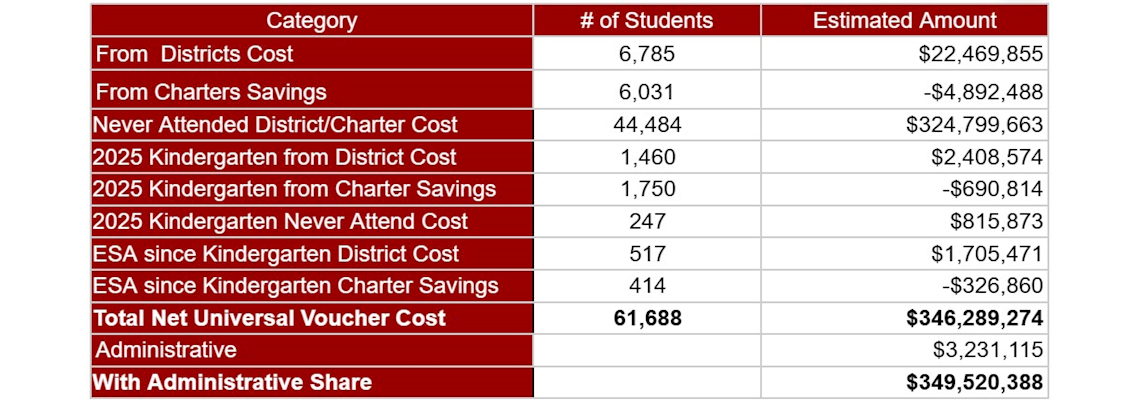
  • While the total cost of the overall ESA program in FY2025 is expected to be $872 million, the net cost after adjusting for where students would have otherwise attended is $350 million for those in the universal ESA voucher program. This represents a slight increase from the $332 million estimated by the Grand Canyon Institute last year.

The Grand Canyon Institute (GCI) estimates a $350 million net cost to the state’s General Fund in FY2025 (July 2024-June 2025) for the universal component of Arizona’s Empowerment Scholarship Account (ESA) voucher program based on a student’s school of origin. This represents a slight increase over the estimated FY2024 cost of $332 million. The estimate assumes basic student funding weights. 

The Joint Legislative  Budget Committee currently estimates the total annual cost of the ESA program to be $872 million, which includes the original targeted program and the universal component. Because student-level data on the universal program is not separated out by the Arizona Dept. of Education, GCI must estimate the origin of universal program enrollees. GCI’s estimate reflects the net cost the state would have incurred if the universal ESA voucher program did not exist. Almost every single child in the original targeted program had to attend a district or charter school for at least 45 days before enrolling in the program. GCI uses historical data on where the targeted students had come from previously, dating back to FY2017, along with current data on where all ESA students have left district or charter schools to estimate the distribution of students across district and charter schools for the original targeted program and the remainder are allocated to the universal program. 


In FY2025, the net growth in the universal ESA vouchers was 7,660 of the total enrollment of 61,688. GCI estimates that 73% of ESA universal voucher recipients never attended a district or charter school, slightly lower than the rate of 80% in FY2025. This includes estimates for kindergarten students using ESA universal vouchers. 

The primary driver of the change in FY2025 was a significant increase in the portion of net new enrollees from district and charter schools. GCI examined the marginal changes since last year and estimates that nearly half the net gain in universal participants of 7,660 from FY2024Q2 to FY2025Q2 came via Kindergarten. Analyzing changes in the portion of students previously attending a district or charter school, GCI estimates that less than 10% never attended (or would have never attended for Kindergarten) while half came from charter schools and just over 40% came from districts.

This change helped lessen the growth of the net cost of the program. GCI presumes that Kindergarten students do not have a record of prior attendance but would mirror the same distribution.  Given that charter school enrollment is about one-fourth of district enrollment, charter schools have been significantly disproportionately impacted by the Universal ESA program.

Despite the change in FY2025, the majority of participants in the universal ESA program never attended a district or charter school should be self-evident. For FY2025, the Quarter 3 Executive and Legislative ESA report identifies that of the total 87,602 students enrolled in the ESA voucher program (targeted and universal), regardless of when they first enrolled, only 33,942 students  moved from charter or district schools to an ESA. Virtually all targeted participants must first enroll in a district or charter school first. The universal program does not require prior attendance. 

Access the full report here.

The Grand Canyon Institute, a 501(c) 3 nonprofit organization, is a centrist think tank led by a bipartisan group of former state lawmakers, economists, community leaders and academicians. The Grand Canyon Institute serves as an independent voice reflecting a pragmatic approach to addressing economic, fiscal, budgetary and taxation issues confronting Arizona.

Elon Musk left Washington, where he enjoyed the exalted status of being Trump’s brain. He returned to Texas, his new home. Where he launched into a Twitter tirade against Trump.

But he left behind a still large contingent of DOGS (Department of Governmental Subsistence).

Who are they?

ProPublica has been tracking them.

In an effort launched shortly after DOGE’s creation, ProPublica has now identified more than 100 private-sector executives, engineers and investors from Silicon Valley, big American banks and tech startups enlisted to help President Donald Trump dramatically downsize the U.S. government.

While Elon Musk has departed the Department of Government Efficiency, the world’s richest man is leaving a network of acolytes embedded inside nearly every federal agency.

At least 38 DOGE members currently work or have worked for businesses run by Musk, ProPublica found in an examination of their resumes and other records. At least nine have invested in Musk companies or own stock in them, a review of available financial disclosure forms shows.

ProPublica found that at least 23 DOGE officials are making cuts at federal agencies that regulate the industries that employed them, potentially posing significant conflicts of interest. One DOGE member tasked with overseeing mass layoffs at the Consumer Financial Protection Bureau, for instance, did so while owning stock in companies the agency regulated.

At least 12 remain, on paper, employees or advisers of the companies they worked at before DOGE, a review of financial disclosure forms shows. And at least nine continue to receive corporate benefits from their private-sector employers, including health insurance, stock vesting plans or retirement savings programs. These employment agreements could create a situation in which a DOGE staffer would be shaping federal policies that affect their employer.

The people behind DOGE are largely men in their 20s and 30s, most of whom bring no government experience to the task. Many of them previously worked in finance.

ProPublica’s list — the largest of its kind by any news organization — allows readers to gain a comprehensive understanding of the backgrounds of the people assigned to one of the Trump administration’s signature efforts. It comes at a crucial moment, as some of the first-generation DOGE members are leaving the government and a new crop is joining.

“Even though Elon Musk and some of his top officials are shifting their attention to other issues, I see no indication that the DOGE team members who remain will slow down their work to test the legal and ethical boundaries of using technology in the name of improving government services,” said Elizabeth Laird, a director at the nonprofit Center for Democracy & Technology.

While the Trump administration asserts it is the most transparent in history, DOGE operates shrouded by the shadows of bureaucracy.

Many of its staffers have deleted their public profiles, have wiped the internet of their professional backgrounds or were encouraged by leadership not to discuss their work with friends. At the behest of the Trump administration, the Supreme Court halted a court order Friday that would have required DOGE to turn over information to a government watchdog — challenging whether the group will ever be subject to public records requests. The Trump administration has banned DOGE staffers from speaking publicly without approval.

To cast a light on this secretive group, ProPublica began reporting in February on Musk’s influence inside the Trump administration, cataloging who was part of DOGE and how associates of the billionaire tech mogul were taking up senior posts across agencies. Our DOGE tracker, the first such list published by media outlets, is the culmination of hundreds of conversations with sources across government.

Today, we are adding 23 staffers to our tracker, taking the total to 109. They are spread throughout the government, from the Department of Defense to the General Services Administration to the Securities and Exchange Commission.

Open the link to see the list of DOGGIES.

By any measure, Musk failed.

First, he said he would cut $2 trillion from the federal budget. Then, he said he would cut $1 trillion.

Then, he dropped his target to $165 billion.

Even that number is disputed because federal courts keep ruling that DOGS firings should be nullified and workers should return to their jobs. Other “savings” were canceled out by the costs of benefits. By some measures, the DOGS game may have cost money, not saved it.

One thing is certain: the federal deficit will grow after Trump’s first year in office, thanks to tax cuts for the top 1%.

Catherine Rampell is an opinion writer for The Washington Post who writes often about economics. She focuses here on the expansion of data collection by the Trump administration, even as it ceases to collect anonymous data about health trends. What worries me is the invasion of privacy by the DOGE team, who scooped up personally identifiable data from the IRS and Social Security about everyone, including you and me. Why did they want it? What will they do to it?

She writes:

It’s rarely comforting to appear on a government “list,” even (or perhaps especially) when compiled in the name of public safety.

It was alarming in the 1940s, when the U.S. government collected the names of Japanese Americans for internment. Likewise in the 1950s, when the House Un-American Activities Committee catalogued communists. And it’s just as troubling now, as the Trump administration assembles registries of Jewish academics and Americans with developmental disabilities.

Yes, these are real things that happened this past week, the latest examples of the White House’s abuse of confidential data.

Last week, faculty and staff at Barnard College received unsolicited texts asking them whether they were Jewish. Employees were stunned by the messages, which many initially dismissed as spam.

Turns out the messages came from the Trump administration. Barnard, which is affiliated with Columbia University, had agreed to share faculty members’ private contact info to aid in President Donald Trump’s pseudo-crusade against antisemitism.

Ah, yes, a far-right president asking Jews to register as Jewish, in the name of protecting the Jews, after he has repeatedly accused Jews of being “disloyal.” What could go wrong?

The same day, National Institutes of Health Director Jay Bhattacharya announced a “disease registry” of people with autism, to be compiled from confidential private and government health records, apparently without its subjects’ awareness or consent. This is part of Health and Human Services Secretary Robert F. Kennedy Jr.’s vendetta against vaccines, which he has said cause autism despite abundant research concluding otherwise.

This, too, is disturbing given authoritarian governments’ history of compiling lists of citizens branded mentally or physically deficient. If that historical analogue seems excessive, note that Bhattacharya’s announcement came just a week after Kennedy delivered inflammatory remarks lamenting that kids with autism will never lead productive lives. They “will never pay taxes, they’ll never hold a job,” he said, adding they’ll never play baseball or go on a date, either.

This all happened during Autism Acceptance Month, established to counter exactly these kinds of stigmatizing stereotypes. Kennedy’s comments and the subsequent “registry” set off a wave of fear in the autism advocacy community and earned condemnation from scientists.

Obviously, advocates want more research and support for those with autism. They have been asking for more help at least since 1965 (when what is now called the Autism Society of America was founded in my grandparents’ living room). But few in this community trust political appointees hostile to scientific research — or a president who has publicly mocked people with disabilities — to use an autism “registry” responsibly.

(An unnamed HHS official later walked back Bhattacharya’s comments, saying the department was not creating a “registry,” per se, just a “real-world data platform” that “will link existing datasets to support research into causes of autism and insights into improved treatment strategies.” Okay.)

These are hardly the administration’s only abuses of federal data. It has been deleting reams of statistical records, including demographic data on transgender Americans. It has also been exploiting other private administrative records for political purposes.

For example, the Internal Revenue Service — in an effort to persuade people to pay their taxes — spent decades assuring people that their records are confidential, regardless of immigration status. The agency is in fact legally prohibited from sharing tax records, even with other government agencies, except under very limited circumstances specified by Congress. Lawmakers set these limits in response to Richard M. Nixon’s abuse of private tax data to target personal enemies.

Trump torched these precedents and promises. After a series of top IRS officials resigned, the agency has now agreed to turn over confidential records to help Immigration and Customs Enforcement locate and deport some 7 million undocumented immigrants.

The move, which also has troubling historical echoes, is being challenged in court. But, in the meantime, tax collections will likely fall. Undocumented immigrant workers had been paying an estimated $66 billion in federal taxes annually, but they now have even more reason to stay off the books.

This and other DOGE infiltrations of confidential records are likely to discourage public cooperation on other sensitive government data collection efforts. Think research on mental health issues or public safety assessments on domestic violence.

But that might be a feature, not a bug, for this administration. Chilling federal survey participation and degrading data quality were arguably deliberate objectives in Trump’s first term, when he tried to cram a question about citizenship into the 2020 Census. The question was expected to depress response rates and help Republicans game the congressional redistricting process.

Courts ultimately blocked Trump’s plans. That’s what it will take to stop ongoing White House abuses, too: not scrapping critical government records, but championing the rule of law.

Ultimately, the government must be able to collect and integrate high-quality data — to administer social programs efficiently, help the economy function and understand the reality we live in so voters can hold public officials accountable. None of this is possible if Americans fear ending up on some vindictive commissar’s “list.”