Archives for category: Citizenship

Darcie Cimarusti served on the school board of Highland Park, New Jersey, from 2013 to 2022. She is the communications director of the Network for Public Education. This article appeared in the Bedford Gazette.

She writes:

I have been a local school board member since my daughters, now 11th-graders, were in second-grade. In that time, I have been involved in education policy discussions at the local, state and national levels on issues related to the rights of LGBTQ+ students, standardized testing and the privatization of public education. The rise of the so-called “parental rights” movement in public education has been one of the thorniest, most perplexing issues I have encountered.

There is no doubt that parents play a crucial role in the education of their children. Who would dare argue that they don’t? But in the face of the anti-critical race theory, anti-LGBTQ+, anti-social emotional learning, anti-diversity equity and inclusion juggernaut unleashed by heavily funded, right-leaning astroturf parent groups such as Moms for Liberty, it has become imperative that we have an honest discussion about how much say parents should have in what is (or is not) taught in our public schools.

My district, unlike many, is racially, ethnically and socioeconomically diverse, with 31 languages spoken in the homes of our students. Educating such a diverse student body presents many challenges and requires a nuanced approach to policy and practice that ensures all students have equal opportunities to learn, thrive and grow. While it is easy for school leaders to say they embrace diversity, equity and inclusion, it’s far too challenging to implement policies promoting those principles.

I have spent my time on the school board helping to develop systems that ensure decisions are made collaboratively and with as many voices at the decision-making table as possible. This means making space not only for administrators, teachers, parents and students but also ensuring that historically marginalized groups are represented.

Decisions that affect students should never be based on the whims of those with the most privilege or power and indeed not on who has the loudest voice in the room.

However, the latter has become the hallmark of parental rights activists. They attend meeting after meeting, berating, shouting down and even making death threats against school board members. During the pandemic, battles over masks erupted at podiums at far too many school board meetings across the country and quickly morphed into demands to ban books, censor curriculum and muzzle “woke” teachers that parents accused of “grooming” their children.

In the 2022 midterm elections, parental rights activists were on the ballot in numerous states. With the support and endorsement of Moms for Liberty, they ran campaigns to become school board members in districts in red, blue and purple states. Moms for Liberty operates county chapters that aim to serve as watchdogs “over all 13,000 school districts.” Chapters empower parents to “defend their parental rights” and “identify, recruit & train liberty-minded parents to run for school boards.”

The “anti-woke” agenda espoused by Moms for Liberty endorsed school board candidates who had the greatest successes in Florida, where Gov. Ron DeSantis proudly declared the state being “where woke goes to die.” But in many other parts of the country, parental rights candidates lost their elections, with even conservative political operatives acknowledging that many of their campaigns were “too hyperbolic.”

Chaos has already erupted in several districts where they succeeded and won board majorities, with newly formed, inexperienced boards firing superintendents or forcing them to resign. One board voted to ban the teaching of critical race theory just hours after being sworn in.

After a decade of experience as a school board member, there’s one thing I can say for sure: The majority of parents, teachers and community members do not respond well to instability and disruption in their local public schools. When school boards run amok and rash decisions make headlines, communities work quickly to restore calm. If parental rights school board majorities continue to govern recklessly, they will undoubtedly face a backlash from voters.

Creating and implementing sound school policies and practices that respect and affirm all students requires collaboration. It does not allow for the divisive, polarizing rhetoric and impetuous, rash decision-making that have become the calling cards of the so-called parental rights movement.

Jan Resseger, as always wise and compassionate, reviews the impact of the billionaire-funded culture wars on children and families. The particular focus on erasing the histories of children of color and demonizing LGBT families is harmful to them.

She writes:

Conversations about public schooling have been utterly sidetracked this year by fights about Critical Race Theory, “Don’t say gay!” laws, and whether somebody is “grooming” children at school? Where did these culture wars come from?

A NY Times analysis earlier this week tracks book banning in public schools as part of an epidemic of culture war disruption: “Traditionally, debates over what books are appropriate for school libraries have taken place between a concerned parent and a librarian or administrator, and resulted in a single title or a few books being re-evaluated, and either removed or returned to shelves. But recently, the issue has been supercharged by a rapidly growing and increasingly influential constellation of conservative groups. The organizations frequently describe themselves as defending parental rights. Some are new, and others are longstanding, but with a recent focus on books. Some work at the district and state level, others have national reach. And over the past two years or so, they have grown vastly more organized, interconnected, well funded — and effective. The groups have pursued their goals by becoming heavily involved in local and state politics, where Republican efforts have largely outmatched liberal organizations in many states for years.”

The reporters track research from PEN America: “(T)here are at least 50 groups across the country working to remove books they object to from libraries. Some have seen explosive growth recently: Of the 300 chapters that PEN tracked, 73 percent were formed after 2020. The growth comes, in part, from the rise of ‘parental rights’ organizations during the pandemic. Formed to fight COVID restrictions in schools, some groups adopted a broader conservative agenda focused on opposing instruction on race, gender and sexuality, and on removing books they regard as inappropriate.”

How is the culture war uproar affecting public schools? In a recent newsletter, the National Education Policy Center (NEPC) trackedresearch concluding: “Preparing students to participate in civil and respectful ways in our diverse democracy has long been a core mission of public schools.” Today, “U.S. high schools are struggling to fulfill this mission as they increasingly encounter hyper-partisan efforts. Those efforts have sought to spread misinformation, to encourage harassment of LGBTQ+ students, and to limit opportunities for productively discussing controversial topics. Such challenges are particularly pervasive in politically diverse areas where one party does not dominate.” The researchers surveyed 682 public high school principals and subsequently followed up by interviewing 32 of those principals. NEPC reports:

  1. “Public schools increasingly are targets of political conflict. Nearly half of principals (45 percent) reported that the amount of conflict in their community was higher during the 2021-2022 school year than it was pre-pandemic… Teaching about race and racism was the area where principals were most likely to report challenges from community members, followed closely by LGBTQ+ content.”
  2. “Political conflict undermines the practice of respectful dialogue. A majority of high school principals report that students have made demeaning or hateful remarks toward classmates for expressing either liberal or conservative views and that strong differences of political opinion among students have created more contentious classroom environments.”
  3. “Conflict makes it harder to address misinformation. Misinformation—much of it tied to partisan organizations and causes—makes it more challenging to encourage productive and civil dialogue. After all, it is difficult to develop a shared sense of how to move forward when different people are working from different sets of ‘facts.’ Nearly two thirds of principals (64 percent) say parents or community members have challenged information used by teachers at their schools. The share of principals saying parents or community members challenged teachers’ use of information three or more times nearly doubled between 2018 and 2022.”
  4. “Conflict leads to declines in support for teaching about race, racism, and racial and ethnic diversity. High schools increasingly struggle to teach students about the full spectrum of American experiences and histories, especially when it comes to issues related to racism and race… ‘My superintendent told me in no uncertain terms that I could not address issues of race and bias etc. with students or staff this year,’ said a principal in a red community in Minnesota. ‘We could not address the deeper learning.'”
  5. “Principals report sizable growth in harassment of LGBTQ+ youth. The survey results also suggest that schools are increasingly facing challenges related to teaching students to treat one another with dignity and respect… Fewer than half of principals said school board members or district leaders made statements or acted to promote policies and practices that protected LGBTQ+ student rights.”

“Parents’ rights” are the rallying cry for many of today’s culture warriors who want to protect the dominant culture and shield their children from uncomfortable controversy. But in a recent and very personal Washington Post column, “When Children Ask About Race and Sex, We Have No Choice But to Answer,” Danielle Allen, a political theorist and the Director of the Edmond and Lily Safra Center for Ethics at Harvard University, and an African American mother, explains the point of view of many other parents and children. Allen examines why it is so urgently important for teachers to be able to respond to children’s own observations and questions when the students themselves initiate conversation about the same fraught subjects the NEPC researchers describe organized parents trying to ban from the schools.

Allen describes a conversation her own two-year-old daughter launched about race, while the child sat in seat of the grocery store cart as they were in the midst of shopping. The child declared, “Mommy, I think it’s not good to be Black.”

Allen reflects upon what her toddler had already observed about race in America: “My daughter’s statement was a question. Its subtext went like this: ‘I’ve noticed something, Mommy. It seems like it’s not good to be Black. But can that be right? You’re Black. I love you. How can these things fit together? And what does this mean for me?'”

Allen continues: “What I can assure you of is that even before any of our kids, of any racial or ethnic background, get to school, every Black family in the United States is having to teach its children about race and the history of enslavement and stories of overcoming that have played out generation after generation. The same must be true for kids raised in LGBTQ families, with regard to the history and contemporary experience of gender and sexuality… This means that the only way you can keep knowledge and questions about these histories, experiences and perspectives out of the school curriculum in early grades is to keep Black people or members of LGBTQ families out of school.”

Or, according to NEPC’s research, many school districts are enrolling Black and Brown children and children from LGBTQ families while the school districts may be imposing policies to silence such children, to make their realities invisible to other students, and to refuse to help them answer their own hard questions.

Public schools are required by law to serve all the children whatever their race, ethnicity, religion, or sexual orientation. It is not the business of school board members, school superintendents, school principals, or teachers to cater to any one group of parents’ rights advocates, no matter how well organized or well funded is their lobby.

Here, writing for The Progressive, is retired high school teacher, Peter Greene, who understands educators’ obligation to protect the interests of all the students who fill our nation’s public school classrooms: “Schools must balance the needs and concerns of all of their many stakeholders. Parents absolutely have rights when it comes to public schools, but so do non-parents, taxpayers and other community stakeholders. It’s up to the school district to balance all of these concerns, while also depending on the professional judgment of its trained personnel. It is a tricky balance to maintain, requiring nuance and sensitivity. It is correct to argue that ‘schoolchildren are not mere creatures of the state.’ But framing the issue as parents versus school has served some folks with a very specific agenda.”

Every important race for the House, the Senate, even some Governors’ races are a dead heat.

If you haven’t voted yet, do it now.

Stand in line for as long as it takes to uphold our democratic system of government.

Many years ago, I read in a book about political philosophy that the great strength of a Constitutional democracy is that the losing side knows they can try again next time. They take their loss in stride, shake hands with the winner, and vow to do better next time.

The thesis behind this scenario is that losers graciously concede. They know that they will not be imprisoned or murdered. At worst, they will be remorseful and brood over what they could have done better.

Our system of government depends on gracious losers and magnanimous winners.

When Al Gore lost the presidency by 537 votes in Florida, he pursued his legal remedies to the Supreme Court. When he lost there, he conceded.

When Hillary Clinton won the popular vote in 2016 but lost the electoral vote, she promptly conceded.

Trump is the first president who lost—decisively—but refused to concede. He pursued all legal remedies for two years and lost in every case. Yet he still lies to his followers and complains about election fraud when none has been found.

He is a whiner, a spoiler, a sore loser. He would destroy our electoral system of government rather than admit he lost.

Stand up for our democratic system by standing in line as long as you have to. Don’t let the Big Liar prevail over our Constitution.

Many of the contested seats for the House and the Senate are very close. I stopped watching the polls a week or so ago, and I no longer believe in them. They are often wrong, and they tend to depress the vote if your candidate is either far ahead or far behind. Ignore the polls and get out and vote if you haven’t done so already.

I voted last week, but I’m still biting my nails. It’s unbelievable to me that some of the Republican candidates are in the running, even though they spout the Big Lie, praise the insurrectionists who tried to overturn the peaceful transition of power, and in some cases have said they won’t concede if they lose. They don’t believe in our system of government.

Are we in a period of national madness? Call it the Trump Effect. His Attorney General told him he had lost; his White House Counsel told him he had lost. A parade of decent, responsible people who worked for him told him he had lost.

But he’s a sore loser. Even though every legal challenge his representatives filed was thrown out of court, including twice by the Supreme Court, he found flaky attorneys to stoke his huge ego.

Trump spoke to a largely Hispanic audience in Miami yesterday, where he said “The socialist, communist and Marxist direction of the radical Democratic Party is one of the biggest reasons that Hispanic Americans are joining our movement by the millions and millions and millions,” Trump said. The crowd cheered him and chanted, “We love you.”

The question before us in tomorrow’s ballot is whether we will uphold the norms of our democracy and our Constitution or whether the aggrieved Trump followers will destroy our democracy by electing people who don’t believe in it.

My advice: VOTE BLUE, NO MATTER WHO.

Vote as if our democracy hangs in the balance: It does.

Vote as though the election hinges on your ballot: It does.

The following races are crucial for maintaining Democratic control of the Senate:

Senator Maggie Hassan of New Hampshire.

Senator Raphael Warnock of Georgia.

Senator Mark Kelly of Arizona.

Senator Catharine Cortez Masto of Nevada.

If you have friends or family in any of these states, call them and urge them to vote.

Remind them : EVERY VOTE COUNTS.

This is a thrilling story, reported by The Intercept.

THE NATIONWIDE CAMPAIGN to stifle discussions of race and gender in public schools through misinformation and bullying suffered a reversal in Idaho on Monday, when a high school senior vocally opposed to book bans and smears against LGBTQ+ youth took a seat on the Boise school board.

The student, Shiva Rajbhandari, was elected to the position by voters in Idaho’s capital last week, defeating an incumbent board member who had refused to reject an endorsement from a local extremist group that has harassed students and pushed to censor local libraries.

Rajbhandari, who turned 18 days before the election, was already well-known in the school district as a student organizer on climate, environmental, voting rights, and gun control issues. But in the closing days of the campaign, his opponent, Steve Schmidt, wasendorsed by the far-right Idaho Liberty Dogs, which in response helped Rajbhandari win the endorsement of Boise’s leading newspaper, the Idaho Statesman.

Rajbhandari, a third-generation Idahoan whose father is from Nepal, was elected to a two-year term with 56 percent of the vote.

In an interview, Rajbhandari told The Intercept that although he had hoped people would vote for him rather than against his opponent — “My campaign was not against Steve Schmidt,” he said — he was nonetheless shocked that Schmidt did not immediately reject the far-right group’s endorsement. “I think that’s what the majority of voters took issue with,” Rajbhandari said.

The Idaho Liberty Dogs, which attacked Rajbhandari on Facebook for being “Pro Masks/Vaccines” and leading protests “which created traffic jams and costed [sic] tax payers money,” spent the summer agitating to have books removed from public libraries in Nampa and Meridian, two cities in the Boise metro area.

But, Rajbhandari said, “that’s the least of what they’ve done. Last year, there was a kid who brought a gun to Boise High, which is my school, and he got suspended and they organized an armed protest outside our school.”

Rajbhandari, who started leading Extinction Rebellion climate protests in Boise when he was 15, is familiar with the group’s tactics. “We used to have climate strikes, like back in ninth grade, and they would come with AR-15s,” he said, bringing rifles to intimidate “a bunch of kids protesting for a livable future.”

So when the Idaho Liberty Dogs called on Boise voters to support Schmidt — and a slate of other candidates for the school board who, ultimately, all lost — Rajbhandari told me he texted his rival to say, “You need to immediately disavow this.”

“This is a hate group,” Rajbhandari says he told Schmidt. “They intimidate teachers, they are a stain on our schools, and their involvement in this election is a stain on your candidacy.” Schmidt, however, refused to clearly reject the group, even after the Idaho Liberty Dogs lashed out at a local rabbi who criticized the endorsement by comparing the rabbi to Hitler and claiming that he harbored “an unrelenting hatred for white Christians.”

While the school board election was a hyperlocal one, Rajbhandari is aware that the forces he is battling operate at the state and national level. “Idaho is at the center of this out-of-state-funded far-right attack to try to undermine schools, with the end goal of actually abolishing public education,” Rajbhandari told me. “There’s a group, they’re called the Idaho Freedom Foundation, and they actually control a lot of the political discourse in our legislature. Their primary goal is to get rid of public education and disburse the money to charter schools or get rid of that funding entirely.”

For his courage and candor, he won the endorsement of The Idaho Statesman.

This is a remarkable young man with a bright future ahead of him. I am happy to add him to the honor roll of this blog.

Read the rest of the story by opening the link. Rajbhandari is a force to be reckoned with. He is a good omen of the bright, dedicated young people who stand up for their teachers and for environmental activism, who fight for gun control and against censorship. Best wishes to him!

John Merrow’s title is sarcastic. Of course he wants you to read banned books, and he is deeply concerned about the large number of eligible voters—especially young people—who don’t bother to vote.

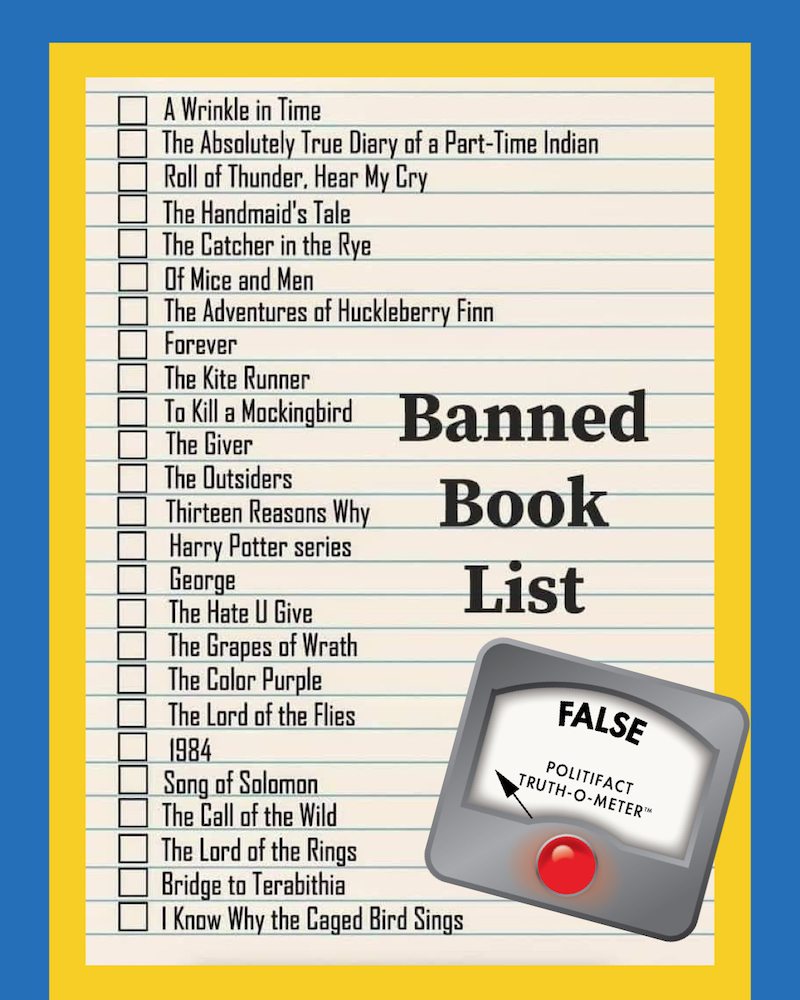
When someone on Twitter posted a list of 25 popular books that Florida Governor Ron DeSantis had supposedly banned from the state’s public schools, people went crazy. The list included Harper Lee’s “To Kill a Mockingbird,” Alice Walker’s “The Color Purple” and Madeleine L’Engle’s “A Wrinkle in Time.”

Below is a screenshot of the list. How many of these books have you read? Have your children read most of them? What on earth is going on in Florida?

People familiar with DeSantis’s efforts to restrict classroom discussion of controversial topics had no trouble believing that he would try to prevent young people from reading controversial or challenging books. If DeSantis did draw up a list, these books might well be on it.

But the list is a fake, a clever satire.

Many people were fooled, including teacher union President Randi Weingarten and “Star Wars” actor Mark Hamill. Hamill’s screenshot of the list amassed more than 100,000 likes and 24,000 retweets.

(Add my name to the list of those who were taken in.)

Like all good satire, that fake list of banned books is rooted in truth, because book banning is real and growing. Florida school districts have banned around 200 books, according to a report published by PEN America, a nonprofit that tracks book banning in the U.S. Pen America ranks Florida third among US states for banning books, trailing only Texas and Pennsylvania.

We are in the midst of a pandemic of book banning, so it’s hard to imagine any title that would never be banned by some zealous or timid school board or ignorant legislator.

One way to stop this outbreak of censorship is to get active, vote, attend school board meetings, run for school board. Passivity and complaining is a losing strategy.

Time to turn back the rising tide of incipient fascism.

Filippa Mannerheim is a Swedish high school teacher and a critic of Sweden’s experiment in school privatization.

She writes.

Dear Sweden, let me tell you what a school is.

A school educates and dares and can demand effort. Sweden has forgotten what a school is. High school teacher Filippa Mannerheim gives a lesson to a country that has lost its grip.

Dear Sweden, since you seem to have completely lost your composure, here is a short, educational guide to help you along in your confused state.

Sweden, let me tell you what school is: A school is an academic place for knowledge and learning. A school is the nation’s most important educational institution with the aim of equipping the country’s young citizens with knowledge and abilities, so that they can develop into free and independent individuals, protect the country’s democratic foundations and with knowledge and skills contribute to the country’s continued prosperity – in times of peace as well as in troubled times .

A school is not a joint-stock company with profit as the main incentive. A school is a joint community building. A school has educated, subject-knowledgeable, qualified teachers with high status, good working conditions and great professional freedom. These teachers teach the country’s children in the country’s language.

A school has employed – not hired – resource staff: special teachers, school nurse, study and vocational guidance counselors, IT staff, janitors. A school does not have non-qualified persons behind the chair.

A school gives children who are falling behind extra support from trained special teachers. A school does not hand out digital tools or ineffective adaptations as substandard substitutes for extra support, just because it is cheaper.

A school has appropriate premises: adequately sized classrooms, an auditorium, a sports hall, a music hall, a home economics room with a kitchenette, crafts and lab rooms. A school has adequate equipment for theoretical and practical teaching, such as musical instruments, craft tools, laboratory equipment, teaching aids, working IT equipment and large amounts of fiction in class sets.

A school has a school library with trained librarians who keep an eye on the world, buy books, hold book talks and contribute with unique expertise in fiction and non-fiction, information search and source criticism. A school does not have a repository of some randomly selected books donated by parents and call this a “school library”. A school library is not “access to a public library”.

A school has a large school yard where children can jump rope, jump fence, play football, play marbles, play ghost ball, King and run around. A school yard is not a paved patch outside an apartment building.

A school is an architectural building – a proud landmark – adapted to a unique activity, namely teaching the country’s children. A school is not a bicycle cellar or an industrial premises where students get “theoretical skills” or a gym card at Sats, which is called “sports education” because it is cheaper.

A school is not a private playground for calculating corporate groups and corrupt ex-politicians who want to make a career in business. If you think so, you have seriously misunderstood what school is.

A school sells nothing because knowledge cannot be sold or bought. A school has a canteen that serves a well-planned lunch based on the Swedish Food Agency’s guidelines for a good and nutritious meal. A school does not send teenagers out to buy their daily lunch at a hamburger chain using a food stamp.

A school does not compete with other schools for school fees or easily taught students. A school has no incentive to set satisfaction ratings, as rating is a pressure-free exercise of authority – not a means of competition and a way to fish for new school customers.

A school educates and dares and can demand effort. A school is a community foundation, not a sandwich board for demanding parental customers. A school has an obvious consensus on what knowledge is and how it is taught using methods that rest on a scientific basis.

A school has teachers who conduct well-planned teaching, not teachers who send students home with work that parents are expected to help with in order for the school’s profit to be greater. A school has teachers who see themselves as academics and public servants, not marketers and influencers who hawk vacuum cleaners with the help of their students via Instagram accounts.

A school is an area where politicians strive for cooperation, long-termism, stability and the best interests of the citizens. A school is not allowed to become a bat in national political debates about cap issues or grades from year 4. The word “school” and “lobbyism” are never used in the same sense. A school system without a market is not a “communist government”.

We live in a country that has lost all understanding of what school is. We live in a country where the politicians have let go of the country’s own school system and are selling it off, piece by piece, to international companies.

We live in a country where students and parents get an image that school can be anything, however, anywhere and an image of themselves as school customers instead of parents and students. This is dangerous for the individual but even more dangerous for the nation at large.

Sweden, now you know what school is. What do you do with that knowledge?

By Filippa Mannerheim

Filippa Mannerheim is a high school teacher in Swedish and history, as well as a school debater. She attracted a lot of attention in the winter of 2020 with her open letter to Sweden’s Riksdag politicians on Expressen’s culture page, “Swedish school is a shame – you politicians have failed”.

Jennifer Hall Lee is a trustee of the public schools of the Pasadena Unified School District. She explains here why public schools are the foundation stone of democracy. All of us pay taxes for public schools even if we have no children; even if our children are no longer school-age; even if our children attend private or religious schools. Supporting public schools is a civic responsibility. Paying for other people’s private choices is not.

In the Superintendent’s Enrollment Committee for the Pasadena Unified School District, a group of us are reading and discussing a book entitled American Public Education and the Responsibility of its Citizens by Sarah Stitzlein.

The book is compelling because it explains why public schools are indispensable to our democracy and how we the people are part and parcel of its success.

I chose the book for the enrollment committee because we live in a time when the importance of public schools is being lost in the trends of privatizing education. Public schools have a dynamic history that seems to keep getting lost.

Why Public Schools

So why are public schools important? Here is my answer: Every child has a seat in a public school. It sounds simple but it is quite profound. No matter who the child is or from where they came, they belong here.

Public education has had its struggles in the United States to be sure. Now we fight the hyper capitalistic phenomenon of privatization (vouchers) in order to preserve the uniquely American institution of public education. At every turn, it seems there is a private company marketing to us to let us know that our child might be better off somewhere else besides a public school.

We live in a time when we are seeing ourselves as consumers rather than citizens.

It’s hard to wrap our heads around the complexity in the world today. The political theorist Benjamin Barber in 2017 suggested that we shift our thinking about the world from seeing nations and instead see our cities, where the majority of people live. It is in the cities, he said, “where we announce ourselves as citizens and participants as people with a right to write our own narratives.”

I understand his point as we are closest to the functions of government in our local communities. We are more apt to know who our city council members are and our librarians, our school board trustees, our mayors, and our county supervisors.

I would extend Barber’s idea to our public schools.

Personally, I think of myself as an Altadenan resident and a member of the PUSD.

For me, it’s easy to support and love my local school district. Simply standing in any one of our schools is a humbling experience because our schools have been through so much history — segregation, integration, and then, unfortunately, resegregation, and now privatization, low birth rates, and high housing costs.

Throughout it all, we succeed.

The PUSD is thought of as a leader throughout the state of California. Our ideas are followed by others in the state in terms of our graduate defense and our graduate profile. We have had many successes and here are just a few:

• We are competitive. In our community, we have the largest number of private schools per capita, yet we are competitive with private schools because of our teachers, principals, signature programs, curriculum, and our diverse student body. There are private school students who choose to come to our district.

• Our graduates attend Yale, Harvard, Vanderbilt, UCLA, Pasadena City College, Howard, Occidental, USC, UC Berkeley, Tulane, UC San Diego, Brown, UC Merced, and more.

• We have been entrusted with back-to-back federal magnet grants because we have shown success.

• We are successfully achieving socio-economic integration through open enrollment.

Public and Publics

When I say public school, I emphasize public.

Please open the link and read the rest of the article.

Allison Fine wrote a passionate column in defense of reproductive rights in which she quoted the civil rights icon Fannie Lou Hamer: “Nobody’s Free Until Everybody Is Free.”

No one is free in America today because millions of people have lost the national guarantee of the power to control if and when they have children.

But the barbaric treatment of pregnant people, and the ongoing harassment and death threats against clinicians, isn’t the end of our story, it is the beginning of a new chapter. Our job is to keep getting up, and to keep showing up, just like Fannie Lou.

Fine describes a growing ecosystem that is growing up to provide help to women who seek abortion services, including take health consultations and abortion pills by mail.

She writes that the nation is in a state of “legal chaos” as a result of the Supreme Court decision that overturned Roe V. Wade, reversing a Court-guaranteed right for the first time in US history.

I am raising this issue to emphasize that we are in a totally chaotic period legally right now. It is actually a really profound moment for our country in terms of national versus states’ rights. Can I mail abortion pills to Mississippi, a banned state, today? No one knows the answer. The State of Mississippi says no, but BioGenPro, one of the two U.S. manufacturers of mifepristone, the abortion medication, with the force of the FDA and national postal service behind it, says yes, and they brought suit against MississippI to force them to allow it. We need to watch how this suit unfolds very closely over the next few months.

Please remember that just because states are passing crazy-ass laws doesn’t mean those laws will stand. They will all be challenged in court.

Sadly, the Supreme Court is sure to overturn any laws that conflict with their Dobbs’ decision.

But think about reality. Can a state actually ban the mailing of abortion pills? Will they open every package delivered to every woman in their state? How can Mississippi or Texas or any other state stop women from receiving the pills?

William J. Mathis, Ph.D., has served as a school superintendent and vice-president of the Vermont state school board. He also served as Managing Director of the National Education Policy Center and is the president-elect of the Horace Mann League of America.


In the beginning, Kansas irregulars attacked Missouri. Missouri replied in kind. It was an unneighborly kind of war. Little mercy was asked and little was given. The Osceola raid, it was said,counted but one survivor. But with the rush of hot-blood, truth is often the victim. The partisans vowed righteous vengeance on each other, heated their rhetoric and twisted their courage for the oncoming civil war. It left 215,000 laying on the ground.

We fumble through our historical rolodex for comprehensible parallels to the insurrection ofJanuary 6; looking for something that explains, something that restores, something that fills the emptiness.

Such conflicts are not innocent unexpected surprises by play-pretend soldiers. Aggressive words lead to aggressive actions. People die.

Then, as now, crises were foreshadowed. Jayhawkers and Harper’s Ferry were not accidents. Our Constitution neglected the humanity of 4 million enslaved African Americans. Chief Justice Roger Taney, author of the Dred Scott decision, concluded that Blacks could not be citizens because they were not. Ranked the worst Supreme Court decision in history, this judicial miscarriage was influenced by President Buchanan who, until our times, was widely criticized as the nation’s worst president.Alienating both North and South, he could have prevented the Civil War – but he didn’t.

We have great accomplishments but we also have great fiascos. Benedict Arnold sold out when his ego was not stroked. Vice President Aaron Burr killed Alexander Hamilton in a duel and launched a “filibuster” or invasion of Mexico. Acerbic Andrew Johnson got impeached and U. S. Grant’s administration is known for corruption. But Grant’sreal sin was the wink and nod he gave to the oppression of native Americans. After teaming up with red-baiting Senator Joe McCarthy, PresidentRichard Nixon resigned in disgrace.

These shames pale in comparison to Donald Trump’s behavior. What the former president has in common with this rogue’s gallery is a selfish disregard of people and an enormous regard for himself. His minions flatter their Emperor and compliment his new clothes while ignoring his buck nakedness. It took a 26 year-old woman’scourage to say the Emperor was dressed a little light for the weather.

Meanwhile, black-robed justices summoned older spirits, “’tis time! ‘tis time! Double, double toil and trouble.” In one infamous week of opinions they overturned laws on women’s health, religion in the schools, scuttled environmental protections and approved carrying a gun in a society suffering thesickness of repeated mass murders.

Compounding these benighted events, the worst inflation in forty years placed the greatest burdenon people of limited means. The more affluent saw their investment portfolios crash faster than their travel plans. Hit with covid, a cautious population isolated itself while Russia weaponizedoil. The blockade of Ukrainian food threatens the world food supply.

Will the Center hold? – We have survived many crises and in turn, been strengthened by them. But the past is not always the predictor of the future. Rather, the turn of the tale lies in our ability to cohere as a nation and as a society.

We speak of the “United States.” Is it? The East and West coasts are solidly blue while the South and the mid-West are red. The economic and migration patterns increase and sharpen the inflection points. Will we see “Bloody Kansas” again? What is this beast that slaughters people claiming protection of a Constitutional right?

The “greatest generation,” those who came of age in World War II, and gave us the baby boom are coming to the end of their lives. We see the fading of the institutions that for one small flash made the American Dream a reality for some. We promised equality and access to opportunities.Instead, the wealth and educational gaps are increasing while politicians gerrymander voting districts to freeze political power to their advantage. School privatization claims “freedom of choice’ but the least reflection shows the reality is segregation and inequalities. At the same time, the exploding costs of elite higher educationinstitutions, make them inaccessible to children on the wrong side of the wealth gap. People advantaged by this system want to keep it that way.

We have survived the litany of our devils and prospered by the actions of our saints. Yet, the purpose of a democratic society is to build and sustain a fair and just society. It is endangered. We face an election that will likely tell the tale. Our obligation is to select leaders based not on the thin chaff of election season but on the principles and wisdom by which the candidates havegoverned, their commitment to the strengtheningof the commonwealth, and their manifest compassion to embrace all citizens.

Will the center hold?