Archives for category: Charter Schools

Maurice Cunningham is a professor of political science at the University of Massachusetts who specializes in unmasking the influence of billionaires’ dark money. “Dark money” is money that is contributed with the expectation that the donors’ name will not be disclosed. I wrote about the role of Cunningham in exposing the dark money behind the 2016 effort to pass a referendum to expand the number of charter schools in Massachusetts; his exposes alerted voters to the vast sums spent by out-of-state billionaires like the Waltons and Michael Bloomberg to buy education policy in Massachusetts.

As he demonstrates in this article, the Waltons–who cumulatively are worth about $200 billion–are still funding pro-charter, anti-union groups in Massachusetts, still pushing their anti-public school agenda. The Waltons’ vehicle of choice is the “Massachusetts Parents United” group, which claims to be just a lot of concerned moms while collecting millions each year from the Waltons and other oligarchs.

The leader of the Walton-funded parent group is collecting, according to tax records, nearly $400,000 a year. Not a bad gig.

Cunningham reviews a story in Commonwealth Magazine that compares funding for Massachusetts Parents United with funding for the state’s teachers union.

But there are crucial differences, Cunningham writes:

Stories like this tend to equate spending on organizations like MPU with the unions. They’re not comparable. Union funding comes from members’ dues. The unions are democratically organized. My local voted out an incumbent last year, as have other teachers’ unions. MTA term limits its president (a good thing, as Barbara Madeloni was far tougher than her surrender-prone predecessor Paul Toner). There is no democracy to MPU. The Waltons are from Arkansas and probably couldn’t find Chicopee or Tewksbury on a map; never mind getting Alice Walton to pronounce Worcester or Gloucester. The Waltons just write checks and measure ROI–return on investment. MTA and Massachusetts Federation of Teachers members live here. Want to hold the Waltons accountable for the vast changes to Massachusetts education policy they seek through MPU? Good luck with that.

If you’ve gotten this far let me say a few words about why I care about this stuff. We simply do not have a functioning democracy when the vast wealth of a few oligarchs sets the policy agenda and gains influence by showering money on upbeat sounding fronts like Families for Excellent Schools and Massachusetts Parents United. Nor do we have a functioning democracy when the true power—the men and women behind the curtain—remain unknown to the public and uncovered by the media. In Dark Money, Jane Mayer talks about “weaponizing philanthropy.” In Just Giving, Rob Reich points out the “plutocratic bias” enjoyed by the foundations. (Hey, did I mention all these public policy altering contributions by oligarchs are a valuable tax deduction to them? Yes, you’re subsidizing them to change your state’s policy. Never give a sucker an even break). Huge investments in policy change and hidden money threaten rule by the people.

And that’s what MPU is—a tax deductible front for oligarchs weaponizing their philanthropy in a campaign to privatize public goods. The Waltons, Koch, and other oligarchs don’t want us to peek behind the curtain. It is our democratic obligation to tear that curtain down.

In 2018, voters in Palm Beach County, Florida, were asked to decide on a referendum to raise property taxes for the “operational needs of district non-charter schools.” That is, for public schools, not charter schools. After the measure passed, two charter schools in the district sued for their “share” of the revenues. The case went to an appeals court which ruled 2-1 against the charters. Then it went to the full court of appeals, which ruled 7-4 that the charter schools were entitled to a share of the money.

The opinion also said that the wording in the ballot measure that prevented charter schools from receiving money was “severable” — essentially meaning that it can be disregarded — and that the rest of the referendum could remain in “full force and effect.”“Severing and striking the ‘non-charter’ limitation from the 2018 referendum still accomplishes the 2018 referendum’s intent to generate additional revenue ‘to fund school safety equipment, hire additional school police and mental health professionals, fund arts, music, physical education, career and choice program teachers, and improve teacher pay.’ The only difference is that a portion of those funds must be shared with charter schools,” said the 17-page majority opinion shared by Chief Judge Spencer Levine and Judges Dorian Damoorgian, Burton Conner, Alan Forst, Mark Klingensmith, Jeffrey Kuntz and Edward Artau.

But dissenting judges lambasted the majority for deciding that the referendum could remain in effect and for deciding to take up the case en banc.They argued, in part, that allowing the referendum to remain in effect violates the will of voters, who thought they were casting ballots on a measure that would exclude funding for charter schools. Judge Robert Gross described it as an act of “judicial hocus pocus.”

“Rather than taking that principled approach and acknowledging the only proper remedy is the referendum’s invalidation, the majority has instead rewritten the referendum and pulled a bait-and-switch upon the voters of Palm Beach County,” Gross wrote in a dissent joined by Judges Martha Warner and Melanie May. “By judicial fiat, the majority has imposed a levy for the benefit of charter schools that the voters never approved ‘by local referendum or in a general election’ as required (by a section of state law).”

In a separate dissent, Judge Cory Ciklin pointed to the majority “ignoring the will of 528,089 Palm Beach County voters who participated in a countywide election. Not this court nor the School Board nor the charter schools can legally agree to severing and striking the non-charter limitation from the 2018 referendum as if the sanctity of voter intent is of no concern and one that can be blithely cast aside as nothing more than an unimportant annoyance.”

The voters thought that the ballot explicitly excluded the charter schools from the taxes they were willing to increase. The court decided otherwise.

As Judge Gross said in his dissent, this is a classic case of “bait and switch.”

Thirty-one years ago, I was invited by Secretary of Education Lamar Alexander to join him at the U.S. Department of Education as Assistant Secretary of Education in Charge of Research and Improvement. Before he invited me, he learned a lot about my work and my views. It was a big jump for me because I had never planned to work in government and was surprised to be invited. After I was confirmed by the Senate, I selected the person I wanted as my Deputy Assistant Secretary of Education. It was Francie Alexander, who had been Deputy Superintendent of Curriculum and Assessment in the State of California. I had gotten to know her when I worked on the California history-social science framework in the late 1980s.

Given this brief personal history, I am puzzled that the Biden administration is staffing up the key jobs in the U.S. Department of Education before any of the top officials (Secretary of Education, Deputy Secretary of Education, Undersecretary of Education) have been confirmed. The next layer of officials–the Assistant Secretaries–have not even been named.

Yet the administration continues to roll out lists of people who will be deputies to Assistant Secretaries who are as yet unknown; “chief of staff” to an official who has not been confirmed; “confidential assistant” to a high official. Most of these appointments have one of two things in common: 1) they worked on the Biden-Harris campaign; or 2) they worked in the Obama administration.

It is likely, highly likely, that Secretary-designate Miguel Cardona and his Deputy Secretary-designate Cindy Marten have never met or even heard of any of these people who will be their closest associates. They will not pick their team; when they take office, their team will be in place, chosen by someone else. Who? Arne Duncan? John King?

The important job of Deputy Chief of Staff for Policy and Programs in the Office of the Secretary went to Scott Sargrad, who was until recently vice-president for K-12 education at the Center for American Progress. CAP, as is well known, is pro-testing and pro-charter schools.

Will the Biden administration revive Race to the Top but call it something else?

Asking for a few million friends.

Jan Resseger is one of our wisest commentators of issues of education, equity, and social justice. She devoted her professional life to these issues. In her latest blog post, she is critical of Eve Ewing for ignoring the “economic catastrophe” that charter schools impose on public schools. She has seen it up close and personal in Cleveland and other cities in Ohio, where public schools suffer as charter schools expand, and most of the state’s charter schools are rated as “low-performing” by the state.

She begins:

I am a great fan of Eve Ewing’s book, Ghosts in the Schoolyard.  I have read the book twice, visited in Chicago some of the sites she describes, given the book to friends as a gift and blogged about it.  In that book, Ewing documents the community grief across Chicago’s South Side, where the now three decades old Renaissance 2010 “portfolio school plan” pits neighborhood public schools and charter schools in competition and closes the so-called “failing” neighborhood public schools when too many families opt for a charter school.

In a column published in Monday’s NY Times, Eve Ewing wants to make peace with charter schools.  She writes that we should allow families to choose and ensure that neighborhood schools and charter schools can all be well resourced and thriving. Ewing grasps for a third way—some sort of amicable compromise in a very polarized situation.

Ewing is a University of Chicago sociologist, and, in her column she examines many of the factors by which neighborhood public schools and charter schools have been compared and rated. She points out that academic quality is a mixed bag with neighborhood and charter schools sometimes besting each other in terms of student achievement. Then she wonders, “What would it look like if we built an education policy agenda dedicated to ensuring… resources for all students?

The problem in Ewing’s column this week is that she never identifies or addresses the matter of public funding for education. I assume she wants to equalize school funding across both sectors. But when charter schools compete for students with public schools, there are now two separate education sectors to split what has proven to be a fixed pot of money.  In every single place I know about where charter schools have been allowed to open up, this is a zero sum game.  A sufficient and growing body of research demonstrates that there is no way to split the funding both ways without cutting the funding that most states and local school districts have been budgeting for their public schools.

Bruce Baker, the school finance expert at Rutgers University, explains that one must consider more than the comparative test scores and students’ experiences in neighborhood schools and charters, and instead examine the impact of adding new charter schools into what he calls the entire educational ecosystem of the school district: “If we consider a specific geographic space, like a major urban center, operating under the reality of finite available resources (local, state, and federal revenues), the goal is to provide the best possible system for all children citywide….  Chartering, school choice, or market competition are not policy objectives in-and-of-themselves. They are merely policy alternatives—courses of policy action—toward achieving these broader goals and must be evaluated in this light. To the extent that charter expansion or any policy alternative increases inequity, introduces inefficiencies and redundancies, compromises financial stability, or introduces other objectionable distortions to the system, those costs must be weighed against expected benefits.” “In this report, the focus is on the host district, the loss of enrollments to charter schools, the loss of revenues to charter schools, and the response of districts as seen through patterns of overhead expenditures.”  In his report, Baker calls charter schools “parasites.”

One issue is that charter schools tend to serve fewer English language learners and fewer students with extremely severe disabilities, leaving behind in the neighborhood public schools the children whose needs are most expensive to serve.  Research by Mark Weber and Julia Sass Rubin at Rutgers University demonstrates, for example, that: “New Jersey charter schools continue to enroll proportionally fewer special education and Limited English Proficient students than their sending district public schools. The special education students enrolled in charter schools tend to have less costly disabilities compared to special education students in the district public schools…  (D)ata…  show that many charter schools continue to enroll fewer at-risk students than their sending district public schools.”

In Pennsylvania, the state funds special education in charter schools at a flat rate of $40,000 per student no matter whether the child is autistic, blind, a victim of severe multiple handicaps or impaired by a speech impediment.  Peter Greene reports that in Chester Upland, where a charter school is sucking up a mass of special education funding, in a court decision, Judge Chad Kenney declared: “The Charter Schools serving Chester Upland special education students reported in 2013-14… that they did not have any special education students costing them anything outside the zero to twenty-five thousand dollar range, and yet, this is remarkable considering they receive forty thousand dollars for each one of these special education students under a legislatively mandated formula.”

The biggest financial loss caused by the introduction of a charter sector into a school district is that it is not possible for the school district to recover the stranded costs when children exit to  charter schools.  In a groundbreaking 2018 report, the Oregon political economist, Gordon Lafer demonstrates that California’s Oakland Unified School District loses $57.3 million every year to charter schools.  Here’s how: “To the casual observer, it may not be obvious why charter schools should create any net costs at all for their home districts. To grasp why they do, it is necessary to understand the structural differences between the challenge of operating a single school—or even a local chain of schools—and that of a district-wide system operating tens or hundreds of schools and charged with the legal responsibility to serve all students in the community. When a new charter school opens, it typically fills its classrooms by drawing students away from existing schools in the district…  If, for instance, a given school loses five percent of its student body—and that loss is spread across multiple grade levels, the school may be unable to lay off even a single teacher… Plus, the costs of maintaining school buildings cannot be reduced…. Unless the enrollment falloff is so steep as to force school closures, the expense of heating and cooling schools, running cafeterias, maintaining digital and wireless technologies, and paving parking lots—all of this is unchanged by modest declines in enrollment. In addition, both individual schools and school districts bear significant administrative responsibilities that cannot be cut in response to falling enrollment. These include planning bus routes and operating transportation systems; developing and auditing budgets; managing teacher training and employee benefits; applying for grants and certifying compliance with federal and state regulations; and the everyday work of principals, librarians and guidance counselors.”

Lafer concludes: “If a school district anywhere in the country—in the absence of charter schools—announced that it wanted to create a second system-within-a-system, with a new set of schools whose number, size, specialization, budget, and geographic locations would not be coordinated with the existing school system, we would regard this as the poster child of government inefficiency and a waste of tax dollars. But this is indeed how the charter school system functions.”  In the same report, Lafer adds that in 2016-17, the San Diego Unified School District lost $65.9 million to charter schools.

In a subsequent report, Lafer explains: “Public school students in California’s West Contra Costa Unified School District are paying dearly for privately managed charter schools they don’t attend… Charter schools add $27.9 million a year to WCCUSD’s costs of running its own schools… That’s a net loss, after accounting for all savings realized by no longer educating the charter school students.”

Please continue reading her excellent post.
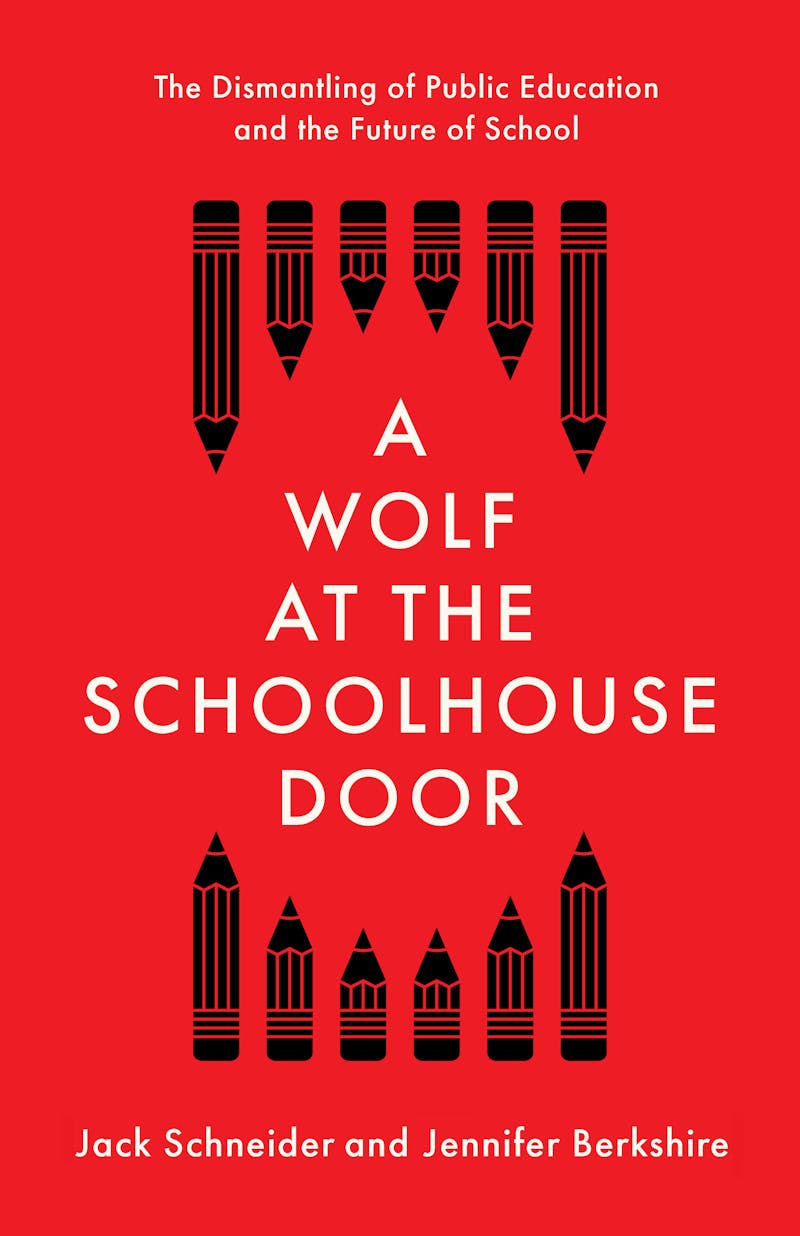
I reviewed A Wolf at the Schoolhouse Door in The New Republic. It is an important book that pulls together all the threads of the privatization movement and shows that their agenda is not to improve education or to advance equity but to destroy public education. The review is here.

Tonight, I will join the authors at a town hall Zoom meeting in Seattle at 9 p.m. EST, 6 p.m. PST. Please join us!

It begins like this:

Two years ago, Margaret Spellings, George W. Bush’s secretary of education, and Arne Duncan, Barack Obama’s secretary of education, wrote an opinion article in The Washington Post lamenting the decline of public support for the bipartisan consensus about education policy that began under Ronald Reagan. Elected officials strongly supported a regime of testing, accountability, and school choice, they wrote, but public enthusiasm was waning due to a lack of “courage” and “political will.”

A Wolf at the Schoolhouse Door: The Dismantling of Public Education and the Future of Schoolby Jack Schneider and Jennifer BerkshireBuy on BookshopThe New Press, 256 pp., $26.99

They were right. Elected officials, educators, and parents were rapidly losing faith in the bipartisan consensus. For a decade, it had failed to produce any improvement on national tests. Parents were opting their children out of the annual testing mandated by federal law; in New York, 20 percent of eligible students refused to take them. Teachers went to court to fight the test-based evaluation methods imposed by Duncan’s Race to the Top. Communities from Los Angeles to Philadelphia were complaining about the growth of charter schools, which diverted funds away from public schools. A year after Spellings and Duncan’s essay appeared, teachers across the nation, from West Virginia to California, went on strike to protest low wages, low funding, and large class sizes, issues that were ignored during the era of bipartisan consensus.

What went wrong? Why did the bipartisan consensus that Spellings and Duncan praised fall apart? In their new book, historian Jack Schneider and journalist Jennifer Berkshire provide a valuable guide to the history and the politics of the rise and fall of the bipartisan consensus. Theirs is indeed a cautionary tale, because they show how Republicans and Democrats joined to support failed policies whose ultimate goal was to eliminate public education and replace it with a free-market approach to schooling. Betsy DeVos was publicly reviled for her contemptuous attitudes toward public schools, but she was not an exception to the bipartisan consensus: She was its ultimate embodiment. She was the personification of the wolf at the schoolhouse door. 

Schneider and Berkshire write that they began the book to answer “a puzzling question: Why had conservative policy ideas, hatched decades ago and once languishing due to a lack of public and political support, suddenly roared back to life in the last five or so years?” Their prime example was private school vouchers, an idea first promoted by Ronald Reagan in the early 1980s and rejected at that time by Congress. Private school vouchers were not the only policy prescription that was recycled from the ashcan of failed ideas. There was also “market-based school choice, for-profit schools, virtual schools,” and deregulation. These ideas were repackaged as innovative while their history and their conservative ideological origins were obscured. True believers, intent on eliminating public schools, built donor networks, cultivated political alliances, and churned out ready-made legislation. A key element in this network-building was the enlistment of billionaires who were enamored of free-market solutions and who opened their wallets to persuade national and state elected officials to inject competition and private-sector solutions into the public education system. 

This is a book you will want to read. Give it to your local school board members and your legislators.

Eve Ewing is a writer and scholar whose work I very much admire. When her book Ghosts in the Schoolyard: Racism and School Closings on Chicago’s South Side was published in 2018, I called it the best book of the year. Today, however, she published an article in the New York Times about charter schools that completely misses the point about the damage that charter schools do to public schools.

Basically, she says we should be happy whenever any school–whether public or charter–provides a good education. That is what I believed when I was an advocate for charter schools from the late 1980s until about 2007. It was then that I realized that charter schools were not producing better outcomes than public schools and were diverting money and the students they wanted from public schools. The more I learned about charter operators, their billionaire benefactors, their drive for money and power, and the corruption associated with their lack of accountability, the more I realized that this nation needs a strongly resourced, equitable, and excellent public school system. After thirty years of directing funding to charter schools, we have seen no systemic change of the kind that both Eve and I want.

The overwhelming majority of children in the United States attend public schools (only 6% attend charter schools). Public schools in many states are underfunded and have been since at least 2008–and some for even longer. When states authorize charter schools, they do not increase education funding. The funding pie does not grow. It is divided.

Some districts are in danger of being obliterated by charter operators: think New Orleans, which no longer has any public schools. New Orleans is supposedly the North Star of the charter lobby, but New Orleans today is as segregated and stratified as it was before Hurricane Katrina, and its academic performance is below the state average in one of the nation’s lowest performing states on NAEP.

Eve’s is the first article I have ever seen that celebrated the CREDO finding that only 19% of charter schools get higher test scores than public schools. She says, “Good for the 19%!” But what about the 81% of charter schools receiving public funds that are worse or no better than public schools? Those children and their parents were lured by false promises.

Her article does not acknowledge that many of the most “successful” charter schools are notorious for their disproportionately low numbers of students who are English language learners or have special needs. Nor does it note the high attrition rates or entry standards that winnow out the hardest-to-educate students, like the BASIS schools in Arizona and Texas, which regularly top lists of “best high schools” in the nation. BASIS requires its students to pass multiple AP exams in order to graduate and has high numbers of white and Asian-American students in a state with large numbers of Hispanic and Native American students. When Carol Burris reviewed the BASIS charters in Arizona in 2017, she found that the students at its 18 schools were 83% white and Asian in a state where those groups were 42% of the students in the state.

Eve completely ignores the recent explosion of voucher legislation in Red states. In the 2020 election, Republicans strengthened their control of state legislatures, which have now prioritized creating or expanding vouchers to pay for private and religious schools, for-profit schools, homeschooling, and whatever else parents want to spend public money on. Charters encourage consumerism, making schools a consumer choice rather than a civic good that we are all responsible to fund equitably. Charters pave the way for school choice, including vouchers.

Vouchers in Florida are subsidizing religious schools to the tune of $1 billion a year; voucher schools are completely unaccountable and they are allowed to discriminate against gay students and families and any other group they don’t like. Their textbooks teach creationism, racism, and religious dogma.

The photograph that accompanies her article–for which she is not responsible–features a KIPP school and says that KIPP runs more than 250 schools. Do we really want our public schools to be run by private corporations? Should parents who are unhappy with their school be satisfied to be told “leave and choose a different school”?

As I said at the outset, Eve today is expressing the same views I held 20-30 years ago, so I understand where she is coming from. She wants every school to be a great school. So do I.

She writes that parents:

want their kid to learn a language, study the arts, have a clean building, and books in the library.

What would it look like if we built an education policy agenda dedicated to ensuring those resources for all students? Not just the students who win a lottery, but the students who lose, or who never get to enter because they’re homeless or their families are dealing with substance abuse, and the adults in their lives don’t have the information or resources to participate in a school choice “market?” What if our system was built not to reward innovation for the few, but rights for the many?

What if we insisted that all our schools, for all our children, should be safe and encouraging places? What if our new secretary of education, Miguel Cardona, focused on a plan as audacious as the New Deal, as well-funded as the war on drugs, dedicated to an all-hands-on-deck effort to guarantee every child an effective learning environment? What if we as a society pursued the dream of great schools not through punishment (as in No Child Left Behind), and not through competition (as with Race to the Top) but through the provision of essential resources?

Are we likely to reach those goals if states are funding charter schools, voucher schools, home schooling, for-profit corporations, virtual charter schools, and education entrepreneurs? That in fact is where the current drive for more choice is heading. Multiple state legislatures are solely focused on school choice, not funding. Red states in particular start with charters, then move on to some form of public subsidy for religious and private schools. The U.S. Supreme Court is poised to approve the public funding of religious schools and to obliterate the “wall of separation between church and state.” Will the states increase their funding to account for the funding of all students now attending non-public schools?

Eve Ewing has a powerful voice. I wish she would rethink her message and acknowledge that the only way to achieve her vision is by funding and improving the only schools that admit all children and that are subject to civil rights laws and public accountability: Our democratically governed public schools.

Our brilliant reader Laura Chapman, retired educator, decided to dig deep into the politics of education reform in Minnesota in response to a post about a dubious constitutional amendment sponsored by the Federal Reserve Bank.

Chapman, who lives in Ohio, writes:

I am not from Minnesota, but this post sent me deep into some policies there. The idea is to frame education as a fundamental right to “quality schools” as “measured against uniform achievement standards set forth by the state.”

No. This law is written as if the standard-setting process is a business-as usual-review of existing standards and benchmarks for learning, with periodic revisions. It is not.

Right now, there is a huge controversy over the social studies standards. The battle is about whose histories count and whether conservatives should settle for anything other than patriotism as the major purpose of teaching American history. https://patch.com/minnesota/across-mn/controversy-over-mn-s-social-studies-standards-explained

Students Learning English (ELLs), are unlikely to pass the absurd requirements being proposed by the Federal Reserve (why bankers?) and as a constitutional amendment (why bankers?).

Minnesota has NO academic tests except those in English. According to a 2020 report from the Migration Policy Institute, and the 2015 American Community Survey, at least 193,600 Minnesota residents have children still learning English. All are in harm’s way. The largest foreign-born groups in Minnesota are from Mexico (67,300), Somalia (31,400), India (30,500), Laos including Hmong (23,300), Vietnam (20,200), China excluding Hong Kong and Taiwan (c), Ethiopia (19,300), and Thailand including Hmong (16,800). One of the fastest growing immigrant groups in Minnesota is the Karen people, an ethnic minority in conflict with the government in Myanmar. Most of the estimated 5,000 Karen in Minnesota came from refugee camps in Thailand. Ojibwe and Dakota are the indigenous languages of Minnesota.

Many of Minnesota’s charter schools are devoted to segregating and strengthening the identities of linguistic/ethnic groups. There are three dual language Spanish-English schools. Eight charter schools are devoted to immersion in these languages/cultures: Chinese, French, German, Korean, Mandarin Chinese, Russian, and Spanish. There are at least five Hmong immersion charter schools, and two for Ojibwe immersion. Two charter schools offer ELL education for East African families and one offers education using American Sign Language/English bilingual approach.

Recent reports also show how charter schools are racially segregated. In St Paul, one hundred percent of students at Higher Ground Academy are black or African-American. This percentage is about the same for Minneapolis’s Friendship Academy. In both cities the overall population of black or African-American residents is below twenty percent. By design, many charter schools in Minnesota are segregated schools. Will these schools be subjected to the wishes of the bankers or not?

In 2021, the Minnesota Federal Reserve, having no expertise in education, called in “experts” to make suggestions on a fix for so-called achievement gaps, meaning differences in scores on standardized tests. This “we-can-fix it” program was sponsored by all 12 of the nation’s District Banks in the Federal Reserve System. In other words, what happens in Minnesota may not be limited to Minnesota but extend to the orbit of District Banks in Atlanta, Boston, Chicago, Cleveland, Dallas, Kansas City, New York City, Philadelphia, Richmond (VA), San Francisco, and St Louis,

Among the highly visible “experts” called in for this multi-state program were Geoffrey Canada, president of the well-endowed Harlem Children’s Zone (endowment about $148 million, and sponsor of Promise Academy brand of K-12 charter schools), and CEO Salman Khan, founder of online Khan Academy, and Kahn Academy for Kids. The papers for this program also featured the post-Katrina takeover of New Orleans schools as if exemplary. https://www.minneapolisfed.org/article/2021/feds-racism-and-the-economy-series-explores-racial-inequity-in-the-education-system.

Bankers are clueless about education but they have an agenda certain to harm thousands of students in Minnesota, especially ELL students, and if applicable to charter schools, the many students ill prepared to take a test only available in English.

The last thing we need to have are the nation’s clueless bankers making permanent changes in education based on proposed Minnesota’s model of “quality.”

The Education Law Center has developed an excellent presentation on the shortchanging of public education in the years since 20008. The great majority of states did not keep up with the costs of educating their children. Only a handful did: Wyoming, Alaska, Illinois, Connecticut. The rest saw a sharp drop in their effort to fund the education of their children.

The two absolutely worst states, as judged by their failed effort to fund their schools, were Arizona and Florida, followed by Michigan. It is not coincidence that these are states that have put their efforts into choice, as a substitute for funding.

The report from ELC begins:

In the decade following the Great Recession, students across the U.S. lost nearly $600 billion from the states’ disinvestment in their public schools. Data from 2008-2018 show that, if states had simply maintained their fiscal effort in PK-12 education at pre-Recession levels, public schools would have had over half a trillion dollars more in state and local revenue to provide teachers, support staff and other resources essential for student achievement. Further, that lost revenue could have significantly improved opportunity and outcomes for students, especially in the nation’s poorest districts.

The states dramatically reduced their investment in public education in response to the 2007 Great Recession. Yet as economies rebounded, states failed to restore those investments. As our analysis shows, while states’ economic activity — measured as Gross Domestic Product (GDP) — recovered, state and local revenues for public schools lagged far behind in many states.

This “lost decade” of state disinvestment has put public schools in an extremely vulnerable position as the nation confronts the coronavirus pandemic. Once again, state budgets are strained by declining revenues. And once again, school districts across the country are bracing for state aid cuts and the potential for reduced local support.

This report builds on our Making the Grade analysis of the condition of public school funding in the 50 states and the District of Columbia. Instead of a one-year snapshot, this report provides a longitudinal analysis of the effort made by states from 2008 to 2018 to fund their public education systems. We measure that effort using an index that calculates elementary and secondary education revenue as a percentage of each state’s economic activity or GDP.

A key goal of this report is to give advocates data and information to use in their efforts to press governors and state legislatures not to make another round of devastating “pandemic cuts” to already underfunded public schools.

Open the report to see where YOUR state ranks in its effort to educate its students.

Arizona and Florida are the two most shameful states in their neglect of the future of their children.

William Gumbert has been reviewing the rapid expansion of charter schools in Texas with concern. In previous posts, he has demonstrated that they are likely to underperform the public schools with which they compete. And, worse, they take funding away from the districts in which they are located. Texas is now being flooded by corporate charter chains, replacing community-based public schools. His attached report explains why community-based schools and school districts deserve the support of all Texans.

Jim Swanson and John Graham, both CEOs in Arizona, wrote a stern warning against the legislature’s proposed voucher expansion, which would make almost all students in the state eligible for public funding to spend in a private or religious school. One of the authors is on the Arizona State Board for Charter Schools. Arizona is a state that likes low taxes; it does not fund its public schools adequately or equitably. Under the leadership of Governor Doug Ducey (who promised the Koch brothers a few years ago that he would drive taxes down as low as he could), the state is offering choice instead of adequate funding to its schools. Arizona has consistently underfunded its public schools and pretends to “reform” them by offering charters and vouchers.

They wrote:

The current, aggressive push to expand Empowerment Scholarship Accounts (ESAs) does nothing to address the systemic education challenges we face in Arizona.

It is a dangerous attack on our public education systems and our state’s economic future. As a business community, our priority is to ensure that all students have access to a top-quality school that meets students’ needs and interests.

Arizona leaders should focus on effectively funding public education and supporting innovative programs that improve academic outcomes.

The time is now. Public education is the single most powerful economic development tool we have as a state.

ESAs were originally designed to serve a small population of students – they were never meant to replace public education or to serve all students.

A full expansion of ESAs is nothing more than a boutique scheme to address a non-existent need for private school subsidies.

While being marketed as a solution for low-income students and students of color – the students whom data tells us need the most wide-scale, institutional support – SB1452 is the most offensive of the private school voucher bills proposed this session. The bill would make roughly 700,000 Arizona students eligible for ESAs – a 280% increase in a single move. This is nothing more than a bold attempt to privatize education.

There’s a lot wrong with this bill, but the worst is the fact that rather than focus on supporting low-income students of color, many of whom are already eligible, SB1452 will make many more middle- and high-income white students eligible for taxpayer-subsidized vouchers, exploiting the impoverished communities in favor of further subsidizing the tiny fraction (as few as approximately 5%) of Arizona families choosing to home-school, private and parochial schools.

Greater Phoenix Leadership, Southern Arizona Leadership Council and Northern Arizona Leadership Alliance, representing more than 200 CEOs across Arizona, have made it clear that they are against the expansion of vouchers in Arizona and have voiced support for our public education systems, from early childhood to higher education. Business leaders and voters are like-minded – we have consistently come together for public education with a focus on equity and access. Instead of proposing unsustainable ways to make 70% of students eligible for private school vouchers, we need to make the public schools better, stronger and more successful.

What our state needs is crystal clear – an equitable, fully funded, high-quality public education system that serves all students across Arizona, no matter the zip code or income level. We have fallen too far behind and the only way we catch up – the only way we move the needle and bring Arizona to a competitive, robust and morally conscionable state – is to focus on the public education funding formula. Programs like private school vouchers have a long history of excluding and segregating our communities rather than including and supporting them. ESAs don’t get us where we need to be.

We need to put our heads together – across the business, education and political realms – and finally execute big changes to the funding formula and other mechanisms that have proven inefficient and worse, inequitable. Now is the time to focus on what moves all our students forward – working together to properly fund the schools serving 95% of Arizona students.

Question: Will the legislature listen to Arizona business leaders or to Charles Koch and Betsy DeVos?