Andy Spears, veteran journalist based in Tennessee, writes about “reformers” plan to undermine and disrupt public schools in Indianapolis.
Indianapolis appears to be the latest front in the ongoing battle to “disrupt” public education so much that it doesn’t exist anymore.
WFYI reports on a new governing body created to “bridge” the provision of services between Indianapolis Public Schools (IPS) and the city’s charter school sector.
In an 8-1 decision Wednesday evening, the Indianapolis Local Education Alliance recommended establishing the nine-member corporation. If approved by state lawmakers, this new agency called the Indianapolis Public Education Corporation, would act as a logistical bridge between the district and charter schools, managing unified busing, enrollment, and facility use.
While the IPS School Board will remain intact, the new agency will have significant authority to manage interactions between the Board and charter schools.
Some see this as the beginning of creating an unaccountable agency to further advance school privatization in the district.
During public comment, many spoke out against taking any power away from the IPS Board. Some suggested the board should oversee the transportation needs of charter schools. And others painted the ILEA members’ process as undemocratic.
WFYI explains how charter schools work in Indiana:
Charter schools are tuition-free public schools managed privately by nonprofit boards rather than elected officials. These boards operate under contracts granted by one of several authorizers in the state.
A parent representative on the group that reviewed proposals and recommended the new governing agency expressed skepticism:
The recommendation also drew sharp criticism for lacking specifics. Tina Ahlgren, the appointee representing district-managed school parents, cast the sole vote against it.
“I find my biggest reason to vote no is the level of ambiguity in the plan,” Ahlgren said. “I find these recommendations falling into this bizarre zone of simultaneously feeling both too much and not enough, bold in some areas but overly timid in others, with vague promises that the ecosystem will sort itself out.”
The proposal must now be approved by the Indiana General Assembly.
The Indianapolis move comes at a time when national forces are seeking full privatization of public schools, with some in the Trump Administration’s education leadership suggesting public education should all but end within 5-6 years.
In states like Tennessee, advocacy groups are launching efforts to disrupt public education so much it is effectively a thing of the past.
·And, Indiana is not without its own challenges in maintaining a functioning system of public schools alongside a range of private options.
Indiana’s Choice Scholarship Programallows families to use state dollars that would have followed their child to a traditional public school to instead pay for a private, parochial or nonreligious school.
The state releases this report annually, and for the 2024-25 school year, it showed that the state spent around $497 million on the program, which is an increase of just over $58 million from the previous school year.
Just a few years ago – in 2017 – the Indiana school voucher scheme cost the state $54 million. Now, the year-over-year increase in voucher expenses exceeds what the entire program cost just 8 years ago.
Garry Rayno, veteran journalist in New Hampshire, understands the war on public education. He knows that privatization is meant to diminish public education. He knows that it is sold by its propagandists as a way to help the neediest students. He knows this is a lie intended to fool people. He knows that the children who are hurt most by the war on public education are the most vulnerable students.
You might rightly conclude that the war on public education is a clever hoax.
Rayno writes:
“The true measure of any society can be found in how it treats its most vulnerable members.”
The quote is often attributed to Mahatma Gandhi, but is also similar to words from British UN Ambassador Matthew Rycroft.
What better measure of treating the most vulnerable than the public education system open to all, not just those with the resources to send their children to private or religious schools.
Public education is often called the great equalizer providing the same learning opportunities to a community’s poorest children to the richest in stark contrast with today’s political climate driven by culture wars and fear of diversity, equality and inclusion.
Public education has provided an educated citizenry for businesses, government and political decision making for several hundred years.
Public education is the embodiment of “the public good,” as it provides a foundation for a well-lived life that is both rewarding and useful to others.
But for the last few decades there has been a war on public education driven by propaganda, ideology and greed.
While the war has intensified in the last decade, it began with the US Supreme Court’s landmark Brown vs. the Board of Education of Topeka decision in 1954 declaring racial segregation in public schools a violation of the 14th Amendment’s equal protection clause.
The decision overturned the court’s earlier Plessy vs. Ferguson decision which established the separate-but-equal provision for public education.
The Brown decision required the desegregation of public schools sending a tidal wave through the south reaching north to Boston.
The southern oligarchs who never really believed the South lost the Civil War soon colluded with others like them to develop a system to bypass their obligation to pay to educate black kids. Instead they established “segregation academies” where their children could learn in a homogeneous setting.
The system was created with the help of libertarian economist James Buchanan who touted the belief that the most efficient government is one run by the wealthy and educated (the oligarchs) because the regular folks are driven by self interest which makes government inefficient, and most importantly, costly through higher taxes.
This philosophy continues today as libertarians and other far right ideologues want to privatize public education because it takes too much of their money in taxes, and a humanities-based public education induces children to develop beliefs different from their parents, which once was the norm for American families.
It is not by happenstance we see parental bills of rights, opt outs, open enrollment and greater and greater restrictions on what may be taught, along with increased administrative work loads piled onto public education by politicians in Concord as they double down on refusing to do the one simple thing the state Supreme Court told them to do 30 years ago, provide each child with an adequate education and pay for it.
Instead they have pushed a voucher system costing state taxpayers well over $100 million this biennium, with 90 percent of it paying for private and religious school tuition and homeschooling for kids who were not in public schools when their parents applied for grants if they ever were in public schools.
Most of the voucher system expansion occurred under the Chris Sununu administration with his back-room-deal appointed Education Commissioner Frank Edelblut.
Edelblut nearly beat Sununu in the 2016 Republican primary for governor for those with short memories.
Sununu sent his children to private schools while he was governor and Edelblut homeschooled his children.
Public education during the eight years of the Sununu administration was not a priority although 90 percent of the state’s children attend public schools.
And it is not coincidence that after the Republican House resurrected House Bill 675 which would impose a statewide school budget cap, that Gov. Kelly Ayotte’s small DOGE team — led by two “successful businessmen” — issued its long awaited report and one category targeted schools following the legislature’s Free State agenda of greater transparency and efficiencies, seeking Medicaid and insurance reimbursements and reforming school audit requirements.
HB 675 failed to find enough support last session because it violates the once sacred “local control ideal” often touted for local government.
House Majority Leader Jason Osborne, R-Auburn, issued a press release linking the report and the bill.
“HB 675 applies the findings of the report where they matter most. When dollars are committed and taxpayers are on the hook, HB 675 puts power back into the hands of the voter by requiring a higher threshold of consent,” he said.
Yes a higher threshold which means the will of the majority is nullified by a minority.
State lawmakers fail to acknowledge they provide the least state aid to public education of any state in the country. Instead local property taxpayers pay 70 percent of public education costs and should be able to set their school budget and various other realms usurped by state lawmakers without a “higher threshold of consent.”
The battlefield in the war on public education shifts over time. It began with religious and political ideology; moved into gender and sexual identification; parental rights, including who decides whether school materials and books are appropriate; school choice such as open enrollment, which will exacerbate the already great divide between property poor and wealthy school districts; and is now positioned to impact the most vulnerable of public school children, those with disabilities.
Last week special education administrators gathered for their annual meeting and to celebrate 50 years of the Individuals with Disabilities Education Act (IDEA) to improve access to education and to integrate classrooms to include those with disabilities.
Today’s special education services and supports are lights overcoming the darkness of institutionalization or stay-at-home kids separated from their peers in public schools.
Many children with disabilities were told to stay home and not to attend school as there were no specialized services or therapies for them.
But services are expensive as federal lawmakers knew they would be, promising to pay 40 percent of the cost, but reneging on that promise and paying only about 13 percent.
In New Hampshire, most of the remainder is paid by local property taxpayers.
The state pays little until a student’s costs reach three-and-a-half times the state’s per-pupil average or about $70,000.
But state lawmakers have also failed to live up to their obligation to pay their state of the catastrophic costs, so local school districts are reimbursed at less than 100 percent.
Last session lawmakers approved an 80 percent threshold as the low end of the reimbursement scale.
Special education costs are difficult to predict and a budget can be blown quickly if a couple students needing costly special education services move into a district.
The federal government is potentially moving the Office of Special Education from the Department of Education to the Department of Health and Human Services which local special education administrators said would change the goal from education to a health model which would imply there is a remedy or an illness.
And they said it is the first step back down the road they began traveling 50 years ago when students with disabilities were institutionalized or warehoused in one facility.
Several bills to come before the legislature this session will explore going back to centralized facilities to provide services and supports and explore if the private sector can better provide the services, which is consistent with the libertarian ideal of private education.
Great strides have been made in the last 50 years allowing people with disabilities to lead productive and rewarding lives independently, but that could change as lawmakers focus on costs and greater efficiencies, and the political climate seeks a homogenous environment without minorities, disabilities or vulnerable people.
Distant Dome by veteran journalist Garry Rayno explores a broader perspective on the State House and state happenings for InDepthNH.org. Over his three-decade career, Rayno covered the NH State House for the New Hampshire Union Leader and Foster’s Daily Democrat. During his career, his coverage spanned the news spectrum, from local planning, school and select boards, to national issues such as electric industry deregulation and Presidential primaries. Rayno lives with his wife Carolyn in New London.
Jeff Yass is one of the richest people in the world. He is the richest person in Pennsylvania. He is #25 or #27 on Bloomberg’s Billionaires’ Index, depending on which day you check. His net worth is about $65 billion. He co-founded the Susquehanna International Group, which is based in Pennsylvania. He is also a major investor in TikTok and is widely believed to have persuaded Trump not to ban it. In the last decade, he has given hundreds of millions to political campaigns, including the 2024 Trump campaign.
Yass was recently interviewed by The Washington Post, where he talked about his passion: Vouchers. The writers of the article were Laura Meckler, Beth Reinhard, and Clara Ence Morse.
Yass thinks the public should pay for students to go wherever their parents want them to go: to private schools, religious schools, charter schools, any kind of school, including public schools. He thinks all students should get vouchers, regardless of family income.
He believes the public schools are failing and that universal vouchers will turn American education into a great success.
Yass provided $6 million to Texas Governor Greg Abbott to run pro-voucher Republicans against moderate Republicans who supported public schools. Abbott ran a campaign of lies against the moderate Republicans, asserting that they opposed more funding for public schools and that they supported open borders.
With Yass’s money and Abbott’s lies, they managed to knock off enough moderate Republicans to finally pass a voucher bill. The voucher program is currently costing nearly $1 billion, and most of the voucher money pays the tuition of students previously enrolled in private and religious schools.
The strange part of Yass’s devotion to charter schools and vouchers for religious and private schools is that Jeff is a graduate of the New York City public schools. He graduated from Bayside High School in Queens. He then attended Binghamton University in New York, where he spent most of his time playing poker, betting on horse races, and honing a keen ability to calculate the odds and winning.
As a young man, he read Milton Friedan’s Capitalism and Freedom and became a Friedman devotee. He met Friedman several times; when he asked the great conservative economist which philanthropy he should support, Friedman said “school vouchers.”
Yass jumped in to support school choice. His ideological commitment to them is so strong that he ignores that show that most vouchers are taken by kids already enrolled in non-public schools. He thinks all students should get vouchers, including those whose families are wealthy.
Yass confidently told The Post that studies of voucher programs show “overwhelmingly” positive results. Several early studies of targeted voucher programs have indeed shown positive results on standardized tests, and some research shows positive impacts on other metrics such as college enrollment.
But most research over the past decade or so shows either no effect or a negative impact on test scores for larger-scale programs. Some charter schools struggle with low test scores just like traditional public schools do. That’s at least partly because educating children with many needs and few advantages is a challenging task
Yass maintains that these programs help children. But he also says he doesn’t really care what the studies say or how children perform on tests. He takes the libertarian point of view that all parents should be empowered to choose the school — public or private — that they want for their children, no matter what.
“If the mother or the parent wants the kid to go from one school to another, who the hell is anyone to tell them not to?” he told The Post. “I don’t care what the studies say.”
Yass has spent many millions in his home state of Pennsylvania, but thus far has failed to get sweeping voucher legislation passed.
He has a a starry-eyed and warped view of the U.S. economy.
In a 2021 conversation sponsored by the Adam Smith Society, part of a free-market think tank, he said that the U.S. is almost to the point where “no one” is hungry, cold or lacks basic health insurance.
“What’s the difference between a billionaire and a guy who’s making $100,000 a year? They’re both at home watching Netflix. And they’re both on their iPhones,” he said then. “The disparity between how rich people live and how poor people live in America has never been smaller.”
Government data shows that in 2024, there were 27 million uninsured Americans and in 2023, 18 million households were uncertain if they would have enough food. Wealth inequality has been rising for decades, with the richest families increasing their wealth at a faster rate than everyone else.
Despite Yass’s multi-million dollar contributions to candidates in Pennsylvania, his candidates have frequently lost. Yass has been singled out by protest groups who resent his efforts to buy elections and determine the future of the state.
Critics say his giving represents an absurd amount of influence for one person, who can press his political agenda simply because he is rich….
“Hey hey! Ho ho! Billionaires have got to go!” chanted about 50 protesters marching to Susquehanna’s front door. The group outside Yass’s office in late September wasn’t an unusual sight. All Eyes on Yass, a coalition of education, labor and civil rights groups, has worked to turn Yass into the state’s prime villain, creating an online “Yass tracker” that allows voters to look up whether their state elected officials have received money from Yass-funded PACs.
The protestors organized in response to Yass’s efforts to change the composition of the State Supreme Court.
In the last election, he supported three Republican candidates trying to defeat three Democratic judges on the State Supreme Court. All three of his candidates lost.
It was the 12th demonstration since 2022 organized by All Eyes on Yass. In a year when Musk’s role at the White House prompted intense criticism of billionaires in politics, this group stands out in its singular and persistent focus on Pennsylvania’s richest man.
“We’re here with a simple message: Billionaires like Jeff Yass can’t steal our elections,” said Raquel Jackson-Stone, 32, who works for a civil rights group called One Pennsylvania. “They don’t care about the same things we care about, like housing affordability and making our public schools better…”
Yass rarely if ever interacts with people he disagrees with on this subject. He volunteered to The Post that in business, he advises his employees to seek out alternative points of view. “I always say, ‘Go find the smartest person who disagrees with you,’” he said.
But he said he has never had a personal conversation with a public education advocate to try to understand their point of view. “I would love to do that,” he said….
In the interview with The Post, Yass stood by his comments. He said the divide in America is not about money but about how much satisfaction people get from their work. “That’s the inequality. Wealthy, educated people enjoy their jobs. Lower-income people don’t enjoy their jobs.”
His confidence feeds his opponents but also his conviction to keep spending. If the criticism bothers him, he doesn’t let it show. He sees no problem with one man using money made on Wall Street to press a personal agenda. And he compares his influence not against that of other individuals but to teachers unions and other large interest groups that represent thousands of people each.
As Yass sees it, he’s the one fighting for the underdog — a billionaire speaking up for those who don’t have billions.
“It’s David versus Goliath,” he said. “I represent David.”
So Jeff Yass has never talked to a public education advocate to test his views. I volunteer.
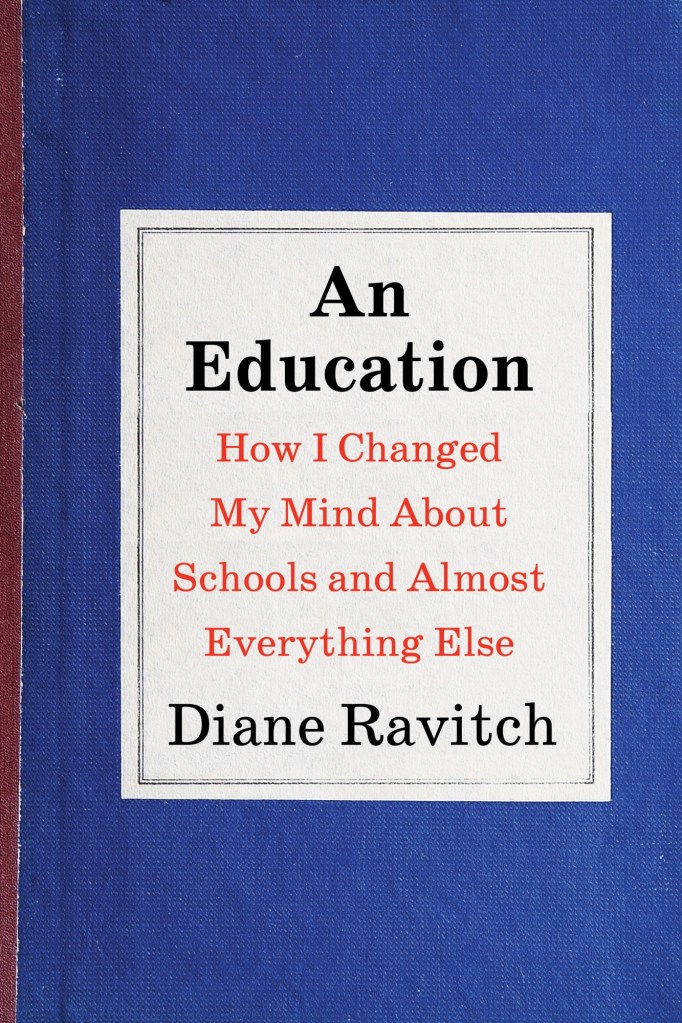
The Network for Public Education sponsored a conversation between me and Carol Burris about my new book: AN EDUCATION: HOW I CHANGED MY MIND ABOUT SCHOOLS AND ALMOST EVERYTHING ELSE.
You knew that when the U.S. Supreme Court turned down a request from Oklahoma to approve a religious charter school, there would be more requests in the pipeline. Oklahoma was rejected by a 4-4 vote only because Justice Amy Coney Barrett recused herself, because of her friendship with one of the lawyers for the online Catholic school.
Recently, as I reported, Oklahoma returned with a proposal for an online Jewish charter school, a Ben Gamla charter. The entire state of Oklahoma has a population of only 9,000 Jews. They are not requesting a Jewish school, but an entrepreneur connected to a Florida for-profit charter chain is.
Religious charter schools are a big problem for the national charter lobby. They say that charter schools are “public” schools. The advocates for religious charter schools say they are not public schools. They are specifically religious schools.
When the U.S. Supreme Court deadlocked this year in a case over whether charter schools can be religious, experts said it wouldn’t take long for the question to re-emerge in another lawsuit.
They were right.
In Tennessee, the nonprofit Wilberforce Academy is suing the Knox County Schools in federal court because the district refuses to allow a Christian charter school. Attorney General Jonathan Skrmetti is on the school’s side. He issued an opinion last month that the state’s ban on religious charter schools likely violates the First Amendment.
“Tennessee’s public charter schools are not government entities for constitutional purposes and may assert free exercise rights,” he wrote to Rep. Michele Carringer, the Knoxville Republican who requested the opinion.
The legal challenge in Tennessee comes as a Florida-based charter school network prepares to submit an application to the Oklahoma Charter School Board for a Jewish virtual charter high school. Peter Deutsch, the former Democratic congressman who founded the Ben Gamla charter schools, began working on the idea long before the case over St. Isidore of Seville Catholic Virtual School even went to court. The 4-4 tie in May means that an Oklahoma Supreme Court decision blocking the school from receiving state funds still stands.
The National Ben Gamla Jewish Charter School Foundation runs a network of Hebrew language charter schools in Florida. Now it wants to open a virtual religious charter school in Oklahoma. (Ben Gamla)
“The prior decision shows that there’s an open question here that needs to be resolved,” said Eric Baxter, vice president and senior counsel at Becket Fund for Religious Liberty, a law firm representing the National Ben Gamla Jewish Charter School Foundation. “We hope the court will get it right this time. We hope the federal courts get it right without having to go to the Supreme Court.”
Deutsch, Skrmetti and other supporters of faith-based charter schools base their argument on three earlier Supreme Court rulings allowing public funds to support sectarian schools. They say that excluding religious organizations from operating faith-based charter schools is discrimination and violates the Constitution. But leaders of the charter sector and public school advocates argue that classifying charter schools as private would threaten funding and civil rights protections for 3.7 million students nationwide…
To Oklahoma Attorney General Gentner Drummond, the debate is settled, for now. In November, he said his office would “oppose any attempts to undermine the rule of law.”
Americans United, which advocates for maintaining church-state separation, has also issued a warning over the new school. The organization represented parents and advocates in a separate case over the school.
“Religious extremists once again are trying to undermine our country’s promise of church-state separation by forcing Oklahoma taxpayers to fund a religious public school. Not on our watch,” Rachel Laser, president and CEO, said in a press release….
The demand for a Jewish charter school would be much higher in Florida, which has an estimated Jewish population of nearly 762,000, compared with about 9,000 in Oklahoma.
Please open the link to continue reading the article.
I was present in the very beginnings of the charter school movement. I advocated on their behalf. I and many others said that charter schools would be better than public schools because they would be more successful (because they would be free of bureaucracy), they would be more accountable (because their charter would be revoked if they weren’t successful), they would “save” the neediest students, and they would save money (because they wouldn’t have all that administrative bloat).
That was the mid-1980s. Now, more than 35 years later, we know that none of those promises were kept. The charter lobby has fought to avoid accountability; charters pay their administrators more than public schools; charters demand the same funding as public schools; the most successful charters avoid the neediest students; and–aside from charters that choose their students with care–charters are not more successful than public schools, and many are far worse. Charters open and close like day lilies.
This week, the National Center of Charter School Accountability, a project of NPE, published Charter School Reckoning: Part II Disillusionment, written by Carol Burris. This is the second part in a three-part comprehensive report on charter schools entitled Charter School Reckoning: Decline, Dissolution, and Cost.
Its central argument is that a once-promising idea—charter schools as laboratories of innovation—has been steadily weakened by state laws that prioritize rapid expansion and less regulation over school quality and necessary oversight. Those policy and legislative shifts have produced predictable results: fraud, mismanagement, profiteering, abrupt closures, and significant charter churn. The report connects the above instances with the weaknesses in state charter laws and regulations that enable both bad practices and criminal activity.
As part of the investigation, the NPE team scanned news reports and government investigative audits published between September 2023 and September 2025 and identified $858,000,000 in tax dollars lost due to theft, fraud, and/or gross mismanagement.
The report contrasts the original aspirations of the charter movement with today’s reality, shaped in large part by the intense lobbying of powerful corporate charter chains and trade organizations. It also examines areas that have received far too little attention, including the role of authorizers and the structure and accountability of charter-school governing boards.
It concludes with ten recommendations that, taken together, would bring democratic governance to the schools, open schools based on need and community input, and restore the founding vision of charter schools as nimble, community-driven, teacher-led laboratories grounded in equity and public purpose.
Florida Education Commissioner Anastasios Kamoutsas told school board members and superintendents from around the state on Thursday to get over their complaints about Schools of Hope seeking to co-locate in underused district buildings.
Then he suggested the state could look at shutting down “failing” school districts.
That’s when the boos started flying.
Kamoutsas’ lunchtime remarks riled attendees of the Florida School Boards Association’s winter conference in Tampa, the latest escalation of tension between the state’s top education official and local district leaders.
Kamoutsas — who had been invited to the conference but not confirmed as a speaker until Thursday — touted the strong student results of New York-based Success Academy, Florida’s latest Schools of Hope-approved charter school operator, and argued that local districts should want the same kind of outcome.
“That proven success is why Florida has committed to expanding the Schools of Hope model,” Kamoutsas said. “Let’s not forget Schools of Hope are subject to the same assessment program and grading system as the traditional public school. But these schools operate under a performance-based agreement with their sponsor, so if they fail to meet standards, they will be closed.”
Then came the boo line: “There’s not a school district in this state that could be shut down for failing to meet performance standards, though maybe we can talk about that with the Legislature this session.”
The crowd — who had previously heard the commissioner say some of them lacked leadership and conviction — erupted in anger, leaving the commissioner to repeatedly ask them to let him finish. A couple of attendees walked out of the Grand Hyatt Tampa Bay ballroom where the meal was taking place.
After about 20 seconds, the group quieted down. Then Kamoutsas doubled down, telling them that he was not asking, but rather expecting them to innovate in any way possible to make the model succeed. Florida’s students don’t deserve failing public schools, he said.
“This is not the moment to protect the way things work,” Kamoutsas said. “This is the moment to put students first. We have a responsibility, a moral obligation to ensure that every child in Florida has access to a world-class education, not someday, not when it’s convenient, not after the funding gets negotiated. Now.”
I was interviewed by Brian Lehrer of WNYC, public radio about my latest book, probably my last. He is a great interviewer. He asks good questions, followed by people who called in to disagree with me.
It’s an excellent interview.
I apologize if I’m browbeating you with stuff about my book, but the book is really good; I worked on it for two years; the mainstream media has ignored it; and I think you will enjoy reading it.
In case you haven’t noticed, the title is:
An Education: How I Changed My Mind About Schools And Almost Everything Else (Columbia University Press). You can buy it from Columbia University Press, your local independent bookstore, or Amazon.
The mainstream media typically ignores charter school scandals, but CBS picked up on this one. Erika Donalds is building a for-profit charter school chain. She is the wife of Byron Donalds, who is running for Governor of Florida with Donald Trump’s blessing.
Byron Donalds has been a staunch supporter of Trump. Donalds is African American. Frankly, I don’t understand how he can be part of a political movement that seeks to eliminate Black history, dismantle studies of race and gender, and disparage any efforts to rectify historic racial injustices. I hope reporters ask him about these questions on the campaign trail.
Peter Greene saw the segment on CBS and posted the video. In his piece, he refers to Erika Donalds as “Florida’s leading school choice grifter.”
CBS reporters wrote:
Kathleen Cetola believed she had found the perfect fit for her 9-year-old grandson Landon when Optima Classical Academy broke ground in 2023 near her home in Fort Myers, Florida. As the primary caregiver for Landon, Cetola was drawn to the smaller class sizes and more traditional curriculum, which she felt would be “less woke” than the public school he was currently attending.
“Regarding gender and race, I want him to be able to make up his own mind,” Cetola told CBS News. “They were selling the fact that they were focused on the education and the classical type of teaching. I thought that was going to be a great opportunity for Landon.”
The Optima school in Fort Myers was founded by Erika Donalds, a leading voice in the school choice movement and the wife of Congressman Byron Donalds, the Republican frontrunner in next year’s Florida governor’s race. It was poised to be Erika Donalds’ fifth classical charter school and part of a flourishing trend.
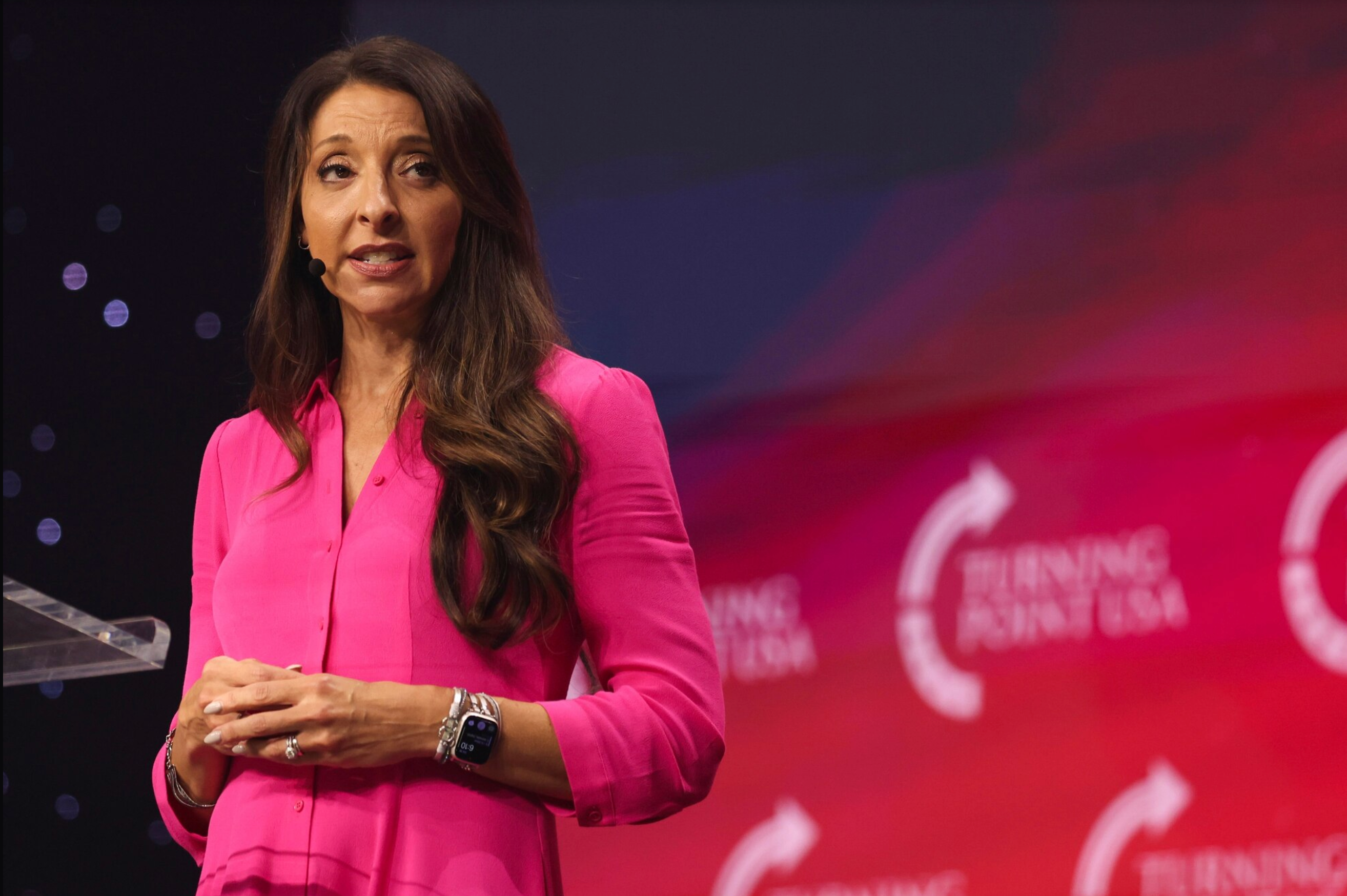
Erika Donalds speaks on stage during day one of the Turning Point USA Student Action Summit on Friday, July 11, 2025, in Tampa. Luis Santana / Tampa Bay Times via AP
Classical charter schools offer a curriculum with a Eurocentric focus that stresses traditional values and introduces primary source documents like the U.S. Constitution at an early age. In the last five years, more than 250 classical schools have opened across the country. Many conservative politicians argue these schools are needed to reject what they see as a pervasive woke agenda in American public education.
Donalds has been a face of the classical charter movement, touring the country to tout their value. In an October speech to a group of conservative college women, she spoke about her decision to start her own schools. She said it was born out of her own experience trying to educate her children.
“I knew there were so many families out there that were desperate for this option,” she said.
Yet, after enrolling hundreds of students and hiring teachers, the Fort Myers school failed to open, leaving parents scrambling to find a school for their children.
“I feel cheated,” said Cetola, who was one of a half dozen parents who told CBS News they had signed up their kids to attend. “These kids were cheated, and it’s heartbreaking….”
The confusion the parents faced, according to experts, is not unique within a charter school industry that often operates with less transparency than traditional public schools.
Donalds declined to be interviewed for this story. In a statement, her spokesperson said she is “an accomplished businesswoman with a strong record of starting successful charter schools and providing thousands of students with an excellent education.”
Taxpayer-funded charter schools paid outside firms
Classical schools are one slice of a charter industry that GOP leaders have tapped to remake America’s public education system. Recent moves by both the federal government and local officials in Florida have freed up hundreds of millions of dollars in new funding. In September, the Trump administration announced it was investing half a billion dollars in grant programs that support charter schools.
The announcement came as Florida passed a law — at the urging of hedge fund manager and Republican megadonor Ken Griffin — to allow charter schools to operate inside traditional public school buildings.
CBS News reviewed state education data, financial documents, independent audits and faculty comments at four schools Donalds had helped launch. State data shows when it came to academic performance, one of the schools quickly excelled. But the records also raise questions about how public money was being spent by the schools.
Tax filings reviewed by CBS News show, between 2020 and 2023, the schools spent roughly 30% of the government funding they received — totaling about $35 million — on outside firms with ties to Erika Donalds. A source familiar with these arrangements said they landed the schools a good price on payroll expenses, IT and other back-office services.
In August, Byron Donalds filed an amended House financial disclosure for 2023, reporting that Erika Donalds held a stake in two of those firms each worth between $1 million and $5 million. His most recent disclosure, for 2024, again listed her stakes in those companies.
The amended disclosure was first reported by the Florida Bulldog…
Of course, parents in Fort Meyers who signed up for Donalds’ school were disappointed when it didn’t open as promised.
They had been promised that the school would open in the fall of 2024. Erika Donalds told them that financial challenges and the lingering effects of Hurricane Ian required her to delay the opening. Parents eagerly anticipated the opening in the fall of 2025, but it was again announced that the opening would be delayed, this time to 2026.
Prior to the school in Fort Myers, Donalds helped launch four other classical charter schools operated by Optima across Florida: two in Jacksonville, one in Stuart and one in Naples.https://datawrapper.dwcdn.net/y9D5j/
Baker, the charter school expert at the University of Miami, said the practice reflected in Optima’s tax filings — of non-profit schools paying money to for-profit companies with overlapping stakeholders — occurs across the charter school industry. He said in the absence of meaningful governmental regulation, accountability comes from “how well they do for students.”
On that measure, students at those four Optima schools performed below average, according to Baker, who looked at math and reading test scores.
“Florida’s charter sector is not strong, and Optima schools, at least the four schools that seem to be in that affiliated mix, perform even less well,” Baker said.
The learning curve when it comes to implementing the classical curriculum can be steep, according to Janine Swearingin, who served as Treasure Coast Classical’s first principal from 2019 to 2022 and would later go on to work directly with Donalds at Optima. She praised Donalds and the company’s role in launching the school, which she said consistently earned top marks from the state when it came to academic performance when she was there.
In January 2023, after Swearingin left the school, the board of Treasure Coast Classical Academy commissioned an independent “performance audit” which was intended to draw attention to areas of concern. The resulting report said that while there were “commendable” aspects of the school’s performance, it also raised questions. Class sizes were so large, it said, that they appeared to violate state law and it noted a lack of structure in the classroom, all findings that Optima disputed.
The auditor praised Treasure Coast Classical’s “outstanding” financial health. But, some faculty complained Optima operated more like a “franchising corporation” and was “dedicated to profit sometimes to the detriment of the school itself.”
“It’s quite an undertaking since teachers don’t generally receive an education in teaching a classical curriculum,” said Swearingin, who noted that in a classical curriculum, first graders are studying the American Revolution at a time when their public school counterparts are learning about community helpers and basic geography. “The training is vastly different.”
As part of its response, Optima said it was working with the auditor “to build trust, address remaining concerns, and correct misinformation or misunderstandings.” A month later, the school’s board moved to terminate its contract with Optima. Treasure Coast Classical later sued Optima, alleging numerous instances of breach of its contract with the school. A county judge dismissed the lawsuit ruling because it had been filed in the wrong venue, and Treasure Coast Classical has appealed.
According to meeting minutes of the schools’ boards as well as county officials and school administrators contacted by CBS News, all four schools that had opened have since cut ties with Optima. The schools still offer a classical curriculum, but under different management. A source close to Donalds told CBS News that Optima’s plan all along was to assist with the start-up and then move on, once the schools reached “full stability.”
Donalds’ spokesperson noted that the schools’ academic performance eventually improved. “These schools show how a supportive environment, committed teachers, and high expectations can help children thrive,” she said.
The school in Fort Myers that had planned to open as Optima Academy is no longer associated with Donalds or her company. According to county records obtained by CBS News, Donalds in August sought to transfer ownership of the building to another charter operator. In October, the county school board approved the transfer and the new operator plans to open the school next fall.
“They just dropped the ball and ran,” Cetola said. “How can you do something like this and sell this to parents who really want to stay involved with their children and then just walk away?”
This story has been updated.
Credits
Reporting by Michael Kaplan, Mark Strassman and Emma Nicholson. Production by Michael Kaplan, Emma Nicholson and Alyssa Spady. Photos and videography by Ryan Jackson. Video editing by Greg Hotsenpiller. Graphics, design and development by Taylor Johnston. Editing by Ellen Uchimiya and Matthew Mosk.
Dr. Edward Johnson is a brilliant systems analyst in Atlanta. He has been a close observer of the Atlanta public schools and their misgovernment as the Board of Education has latched onto the latest reform fad.
He points out that the public school system of the past no longer exists. Some people think that’s a food thing. He does not.
He wrote this observation.
By leading with his “One District …” slogan, and with Atlanta Board of Education meekly following along, APS Superintendent Dr. Johnson contends it is in the best interests of APS to be fragmented, to lack full transparency, to lack efficient and effective accountability, and to disparage the democratic principle that public education should be a public good.
In Georgia, we often hear the terms “school district” and “school system” used interchangeably.
But in the age of charter schools, this linguistic shortcut obscures a deeper truth: the public school system as a public good is no longer a unified system at all.
Before the proliferation of charter schools, an entity like Atlanta Public Schools (APS) governed all public-serving schools within its geographic boundaries. The terms “APS district” and “APS system” used interchangeably made sense—each described the same coherent, interrelated network of schools sharing the same governance, policy, administration, and purpose. Today, that coherence does not exist—it has been fragmented.
For example, by choice of Atlanta Board of Education, APS is now a “Charter System,” operating under a performance contract with the state that explicitly excludes independent charter schools. These schools, though publicly funded, are governed separately and are not subject to APS’s policies, leadership, administration, or community-based governance structures. They are public in funding, but private in autonomy.
This shift has compressed the expanse of APS as a public school system and as a public good. APS no longer encompasses all public-serving schools in Atlanta. And yet, we continue to refer to APS as both a “district” and a “system,” as if nothing has changed. Well, something has changed.
A system, by definition, implies interrelated parts. For public school systems, it implies shared accountability, common purpose, and public stewardship. When schools within a geographic area operate independently—without shared governance or policy—they are not part of the same system. They may be public-serving, but they are not part of the public school system.
This distinction matters. It matters for transparency, for accountability, and for the democratic principle that public education should be a public good—not a fragmented marketplace of loosely affiliated or wholly independent entities.
Yet, by going along with APS Superintendent Dr. Bryan Johnson’s “One District, with One Goal, for All Students,” board members violate the Oath of Office each of them swore—”In all things pertaining to my said office, I will be governed by the public good and the interests of said [APS] school system.”
Certainly, clearly, it is reasonable to recognize it is not in APS’s best interests that Dr. Bryan Johnson should be its Superintendent.
The Superintendent’s Comprehensive Long Range Facilities Master Plan, given the glossy name APS Forward 2040, Reshaping the Future of Education, will, short-range, compress the expanse of APS even more so, from its current 68 percent being a public school system to about 60 percent.
Then, compounding that long-range, the Superintendent’s Strategic Plan will efficiently and effectively turn APS into a workforce development entity to the exclusion of virtually all possibilities of APS ever becoming a high-quality public school system, where high-quality teaching and learning that readies children for professions and careers from A to Z happens, especially for “Black” children.
Georgia’s legal framework treats each local- and state-authorized charter school as its own “school system.” This semantic sleight of hand allows policymakers to claim that public education is expanding, even as its coherence erodes. But the public deserves clarity. We must stop conflating geographic proximity with systemic unity.
If we are to preserve the integrity of public education, we must reclaim the meaning of “system.” A public school system should be more than a collection of facilities—it should be a community of schools, governed together, accountable together, and committed together to the public good.



 Diane Ravitch's blog