Stephen Dyer, a former legislator, keeps count. His blog is called 10th Period:
Ohio’s charter schools have underperformed for years, as compared to district public schools, but Republican legislators and state officials don’t care. Charter schools open, fail, close, and are replaced by more charter schools. Public money sustains them regardless of their poor performance.
Dyer wrote:
So if you’re paying $1.6 billion a year for an education sector whose graduates make 20% less upon graduation than public school graduates, can we really call that an option? Or is it just a waste of money. 30 years. $20 billion. And THIS is what we get in return? Outrageous.
I have now written this post in one form or another for 20 years.
Ohio Charter Schools get smoked on state report cards by Ohio School Districts.
I know, Charter School honks, you only want your performance to be compared with the Big 8 urban districts — Akron, Canton, Cincinnati, Cleveland, Columbus, Dayton, Toledo and Youngstown.
See, here’s the problem: 53% of the kids in Ohio charter schools come from those 8 districts.
That means 47% do not.
You can’t take $1.5 billion in state aid from kids attending all but a handful of school districts and then demand your performance be compared with 8 of those 607 districts — the 8 that are typically among the state’s lowest performing¹.
Here’s what this piss-poor Charter School performance looks like in charts:
The second chart kind of says it all.
Even though Charters received less than 1 in 4 of all the stars given, they received 2 out of every 3 1 Stars (F), all of the 1.5 Stars (D-) and about 2 out of every 3 2.5 Stars (C-).
Meanwhile, districts outperformed their overall grade share in every A, B and C category. Just a horrific performance by Charter Schools, considering they’ve had 30 years, $20 billion, just a fraction of the government oversight and incredible legislative and gubernatorial protection to achieve these gawd awful results.
In only 3 categories are more than 40% of Charter School grades C or higher: Overall (53%), Gap Closing (52.2%) and Progress (79%).
On the District side, the only categories where less than 86% of their grades are C or higher are Early Literacy (66%) and Progress (58%). That’s right. In all categories, the vast majority of School District grades are C or higher.
Take it easy, Charter Honk.
Just because Charters do better on the Progress rating² does not mean they’re better schools. Why can I say that with confidence?
Because Charters do so fantastically worse on the 6 other measures, including a stunning 58% 1 Star ratings on College, Career, Work and Military Readiness!
That CCWMR rating seems to be keeping in line with my post from this morning outlining how Charter School graduates make 20% less over their lifetimes than traditional public school graduates, which costs them hundreds of thousands of dollars.
Look, guys. All I can do is keep pointing all this out and hope that elected officials in Columbus stop drinking the Charter School Kool-Aid at some point.
To recap, here’s all we’ve found out over the last couple weeks about these things:
They receive 2 out of every 3 of failing grades on the most recent state report card
More than 1 in 3 are on the state’s lowest-performing building list.
More than 9 in 10 “Dropout Recovery” charters are on the list.
About 1 in 5 charters have been on the list since 2018.
More than 1 in 2 charter schools that have ever opened in Ohio are now closed.
They received more than 1/2 of all F grades ever given to schools on Ohio’s Report Card, despite representing about 10% of all Ohio school buildings.
They spend almost double the share of their funding on non-instructional administrators that Ohio’s traditional public schools spend.
They receive more than double the state funding that a traditional Ohio public school student receives.
They spend more, on average, per pupil than a traditional Ohio Public School District, even though charters can’t collect local revenue (except for a handful in Cleveland).
They produced the single largest taxpayer ripoff scam in Ohio history, largely enabled by Sen. Jon Husted, and are constantly being busted for fraud and other corrupt practices.
Charter School students are about 7 percent of the state’s school population, but receive 12 percent of the state’s funding for schools.
That funding (along with EdChoice vouchers) is preventing the state from fully funding its own formula to provide resources to the state’s 1.5 million traditional public school students.
More than 1 in 10 Ohio charter schools are on the state’s suspected test cheating list and 7 out of every 10 schools suspected of cheating on their state tests are charter schools.
More than 1 in 4 of the state’s “high performing” charter schools are on the state’s suspected test cheating list.
They have cost charter school graduates between $247 million and $321 million since 2018 and will cost them between $1.8 billion and $6.7 billion over their collective lifetimes.
Will any of this finally break through?
I guess we’ll find out in a couple months.
1.
I also don’t compare public school building performance with charters because the money for charters comes out of the same money pot meant for kids in districts. So the money comes out of the state aid to every building in a district — the lowest-performing and highest-performing ones. That’s why I’ve always only compared performance between districts and charters. Because if charters are going to be a worthwhile public policy endeavor, then they have to be worth taking state money away from kids in the state’s highest-performing buildings, not just the ones in the lowest-performing ones. I would argue that taking any state money from any public school kids, regardless of report card rating, to fund charters and unconstitutional private school tuition subsidies is public policy disaster. But that’s another argument for another day.
2.
About 43% of school district grades that are C or higher are Cs. Nearly 1/2 of all charter grades that are C or higher in Progress are Cs.
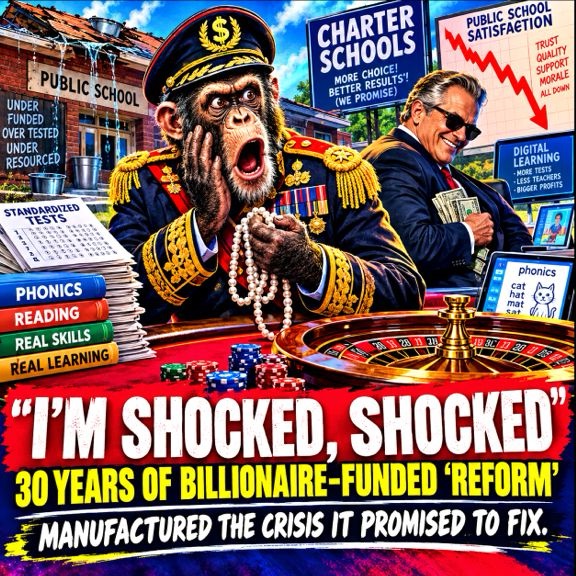
Mike Simpson, known on Twitter as “Big Education Ape,” is known for his brilliant memes and editorial cartoons. Typically, they expose the latest fads and lies that defame teachers and public schools. Every once in a while, he publishes a great post, like this one.
I’M SHOCKED, SHOCKED — HOW 30 YEARS OF BILLIONAIRE-FUNDED “REFORM” MANUFACTURED THE EDUCATION CRISIS IT PROMISED TO FIX
There’s a famous scene in Casablanca where Captain Renault declares he is “shocked, shocked” to find gambling going on — right before a croupier hands him his winnings. That’s essentially the posture of the billionaire reform industrial complex today, clutching its pearls over a Gallup poll showing public satisfaction with American schools has cratered to 32% — an 11-point nosedive in just two years — while quietly pocketing the profits of the crisis they spent three decades engineering.
Shocked. Absolutely shocked.
The Architecture of a Manufactured Crisis
Let’s be precise about the timeline, because precision matters when someone is picking your pocket.
For roughly 30 years, a well-funded constellation of think tanks, philanthropic foundations, hedge fund managers, and tech oligarchs pumped billions of dollars into a single, relentless narrative: public schools are failing. Not “underfunded.” Not “systematically neglected.” Failing — as in, inherently broken, irredeemably incompetent, populated by bad teachers protected by evil unions, and salvageable only by the heroic intervention of the private market.
The messaging was surgical. The money was real. And — surprise! — it worked.
Starve public schools of adequate funding. Declare them “failing.” Ride in on a white charter bus to “rescue” the children.
The chronic underfunding wasn’t fiscal negligence. In many states, it was a feature, not a bug. Squeeze hard enough, the theory went, and disruption would force innovation. What it actually forced was deferred maintenance, teacher shortages, and a generation of kids learning to read in buildings where the roof leaks and the textbooks predate the iPhone.
Now the poll numbers confirm the narrative took hold — and the reformers are citing those same poll numbers as proof they were right all along. The audacity is, genuinely, breathtaking.
The Numbers That Tell Two Very Different Stories
Here’s what the data actually shows — and what it doesn’t show:
Metric: The Headline. What It Actually Means Gallup Public Satisfaction 32% — record low 30 years of “failing schools” messaging worked exactly as intended.
Parent Satisfaction with Their Own School Historically ~2x the national figure People trust what they experience; they fear what they’re told
Math & Reading Scores Declining, especially bottom quartile Tracks directly with funding inequity and screen-time explosion
Top-tier U.S. Student Performance Still globally competitive. The “crisis” is concentrated where disinvestment is concentrated
The gap between how Americans rate schools in general versus their own child’s school is the smoking gun. It has always been the smoking gun. People who actually walk into a public school building — who meet the teachers, see the classrooms, watch their kids come home — consistently rate those schools dramatically higher than the national “failing” narrative suggests.
That gap is the manufactured crisis. It lives entirely in the space between lived experience and media-amplified fear.
$1.8 Billion Worth of Snake Oil, Served Fresh
And just when you thought the reform carousel might slow down, along comes the Science of Reading — the latest Next Big Thing™ in a long line of Next Big Things™ that have collectively cost American taxpayers tens of billions of dollars and produced reading scores that went, as the Big Education Ape’s withering analysis puts it, precisely nowhere.
Remember Common Core? $15.8 billion. A decade of standardized testing theater. Reading scores: unmoved.
Now we have the Science of Reading, $1.8 billion deep and climbing, with the same cast of vendors, the same philanthropic networks, and the same conspicuous absence of a money-back guarantee.
To be scrupulously fair: phonics works. Explicit decoding instruction works. The underlying research on structured literacy is legitimate. But here’s the thing about legitimate research — it doesn’t require a $1.8 billion vendor ecosystem, mandatory state legislation in 40+ states, and the systematic deskilling of teachers who are told to stop thinking and start following the script. When real science gets packaged into proprietary curricula, sold to districts under legislative mandate, and deployed without the trained human educators needed to implement it well, you don’t get science. You get very expensive phonics worksheets.
The question nobody in the reform complex wants to answer remains the same one it’s always been: Where is the money-back guarantee?
The Other Hand: How Tech Bros Broke Kids’ Brains While Selling the Cure
Here is the part of the story that deserves its own criminal investigation — or at minimum, a very uncomfortable congressional hearing.
The same Silicon Valley billionaires who spent decades pushing EdTech into classrooms as the revolutionary equalizer — screens for every student! –are the identical billionaires whose social media platforms have:
Collapsed long-form reading among adolescents at a rate researchers describe as one of the steepest drops in PISA history
Engineered algorithmic doom-scrolling that neurologically rewires 15-year-olds away from the sustained attention that math and reading comprehension require
Distracted over a quarter of students internationally during core academic instruction, by their own PISA survey data
They sold the disease and the cure. They pushed the screens that fragmented attention spans, then sold the adaptive software to remediate the fragmented attention spans, then pointed at the test scores and said: See? Public schools are failing.
None of this is inevitable. None of this is permanent. The No Kings Coalition — the sprawling, nonpartisan civic movement that flooded the streets in March — is now flooding the polls, with a Vote Early Day of Action on October 17 aimed squarely at the November 3, 2026 midterms.
The math is straightforward, even if the billionaires prefer we can’t do it:
Elect candidates who will defend public education funding, not divert it into voucher schemes that enrich private operators at public expense
Overturn the Supreme Court rulings — from Citizens United forward — that transformed American democracy into a billionaire auction
Restore the principle that public money follows public children into public schools, not into the portfolios of private equity firms with a “reform” logo.
The manufactured crisis has a manufactured solution: more billionaire intervention, more privatization, more EdTech, more testing, more disruption. The actual solution is considerably less glamorous and considerably more effective — fund schools equitably, pay teachers competitively, put phones away, and stop letting people who profit from public school failure write public school policy.
The Bottom Line
The 32% satisfaction number is not evidence that public schools have failed. It is evidence that a 30-year, billion-dollar propaganda campaign succeeded. The same people who manufactured the crisis are now selling the cure — at $1.8 billion a pop, no refunds, no guarantees, no accountability.
Meanwhile, the teachers who showed up every day through a pandemic, through chronic underfunding, through a staffing crisis, through the algorithmic dismantling of their students’ attention spans — those people are still in the classroom at 7 AM, doing the work that no EdTech platform, no voucher program, and no think tank white paper has ever actually replaced.
The casino is rigged. Captain Renault is shocked. And the November ballot is the one lever the house can’t control.
Vote like a public school depends on it. Because one does.
All links verified active as of September 9, 2026. Primary polling data sourced from Gallup/Walton Family Foundation. PISA data sourced from NCES/OECD 2025 release.
Bruce Baker is an expert on school finance and a professor at the Graduate School of Education at Rutgers University.
In this post, he explains the difference between public schools and charter schools in terms of where public money goes. This is one of the biggest differences between the two sectors. Whether you are a journalist, an auditor, or a taxpayer, you should be informed.
Baker writes:
Following public dollars through a traditional school district is, by comparison, straightforward. District budgets are public record. Board meetings are open. Every dollar of state and local revenue flows into a single governmental entity that files public financial statements, undergoes independent audits, and answers to elected or appointed boards bound by open-meetings and public-records law. You can follow the money because the law requires the money to be followable.
Charter school finance doesn’t work that way — not because it’s illegal, but because it’s structured differently from the ground up. A single public funding stream can pass through a nonprofit school corporation, a for-profit management company, a related real-estate entity, and a tax-exempt bond issuance — and at almost every hop, the entity receiving the money is under no obligation to disclose anything to the public. Some links in that chain file a Form 990. Some don’t file anything at all. The paper trail doesn’t disappear, but it moves from one regulatory regime to another — nonprofit tax filings, corporate registries, county property records, municipal bond disclosures — each with its own rules, its own audience, and its own blind spots. Tracing it means knowing which of several unrelated public filing systems to check at each step, and accepting that at some steps, no public filing exists at all.
Open the link to learn how to follow the charter school money trail.
The Center for Research on Education Outcomes (CREDO) has positioned itself as the think tank that writes trustworthy evaluations of charter schools. In a sense, this is strange because CREDO’s leadership and its funding are not neutral on the subject of charter schools; they are decidedly pro-charter.
Freddie DeBoer argues on his blog that CREDO has consistently reported that charter schools find no gains for charter schools as compared to public schools. But it’s 2023 report was widely reported as the year of the Big Charter Breakthrough. He believes they are honorable in reporting their findings, but they pulled a fast one on the media and public by inventing a new metric that cannot be compared to other measures: “days of learning.”
DeBoer shows how the CREDO metric magnifies charter school results, which are actually small enough to be counted as “no effect.”
DeBoer begins:
In 2023 the Center for Research on Education Outcomes, known as CREDO, released its third national study of charter schools. The research covered 1.8 million students across twenty-nine states plus Washington D.C. and New York City. CREDO’s study purported to offer the most definitive evidence yet about the relative school quality of charter schools as compared to traditional public schools. Certainly our media, political establishment, and the nonprofit sector have acted as though what CREDO has to say is definitive; the 2023 study is, I believe, the most-cited piece of charter research in existence. Every pro-charter politician reaches for it, your Jonathan Chait neoliberal “reform” types treat its findings with near-mythic reverence, people who otherwise have no exposure to educational research wave at it as the final word on the subject. When the average person talks loosely as though there’s some sort of generic charter advantage, they’re usually referencing CREDO research, even if they don’t know they are.
This is all rather surprising, given that CREDO has not produced robust evidence in favor of charter schools, not in the 2023 study or its precursors. As we shall see, even if we assume that CREDO has solved the problem of the fundamentally non-random samples inherent to the task of comparing charter to public – which we should not, because they have not – the evidence supplied by CREDO in the favor of charter schools is so marginal and so noisy as to be meaningless from a policy perspective. And yet the message that the media took and shared from that report – the good news!, the vindication!, the headlines in Education Week and the New York Post!, the press releases from the National Alliance for Public Charter Schools! – was that the typical charter student was the beneficiary of a meaningful learning boost compared to their traditional public school counterpart. Why did this message spread so widely and resonate so loudly, if I’m right that even CREDO’s own numbers show very modest differences? Because of a remarkably savvy bit of marketing in how CREDO’s numbers were presented. The report did not show its findings in terms of effect size differences between charter and public, which would be the field’s standard way of sharing results. Rather, the outcome that was shared again and again was that a typical charter school student in the dataset had gained sixteen additional “days of learning” per year in reading and six in math. For a few months there you couldn’t read educational media without running into those numbers: sixteen additional days of learning in reading per year, six in math. It became a bit of holy writ in the endless quest to make bad students good with ACCOUNTABILITY and market reforms.
Now, me, I immediately gravitate to that last bit: what on Earth is a “day of learning,” and since when is that a statistical measure? “Days of Learning”: A Jury-Rigged Metric Invented for the Purpose of Inflating the Effect If you share my confusion over that metric, don’t blame yourself. “Days of learning” is not merely an unusual measure of student performance; it’s a boutique metric that CREDO invented themselves for their charter studies. It’s like YouTube changing how views are counted so the numbers look bigger.
This should raise a number of red flags, most importantly when it comes to comparison with other research. We have standardized metrics in social science research for a reason. One core reason among them is mutual interpretability, the ability to compare outcomes involving different interventions that are measured with different instruments and in different units. That’s why effect size exists, and various expressions of effect size have served as the dominant measure of interest in all manner of human research for decades precisely because effect size enables ease of comparison. If you want to compare the influence of the same intervention when one study uses grades as the DV and another used test scores, effect size enables you to do that. If you want to compare two different types of intervention, effect size enables you to do that too. There are some caveats, as there always are, but the basic, elegant logic of effect size makes the measure remarkably flexible and portable: effect size tells us how a given intervention moves average outcomes along the distribution of outcomes. If you want to know more there are plenty of simple explainers of effect size out there; here’s mine. There are some fields where effect size is used less often (economics, for example) but the interpretability and flexibility of effect size metrics like Cohen’s d are powerful advantages. Not surprisingly, then, it’s the dominant reported measure in education research.
So if effect size is both useful and common, and is in fact the dominant measure of interest in the relevant field, why would CREDO come up with its own boutique measure? Why invite the potential for confusion with such consequential research? Occam’s razor suggests a simple answer: because CREDO is a pro-charter organization that’s intent on convincing stakeholders that charters have meaningfully superior outcomes when compared to traditional public schools… and their own research demonstrates the opposite. Their own numbers, in fact, suggest that the returns on charter schools are meager even if we ignore the selection problems that continue to plague charter advocacy.
This is a much longer post about the inadequacy of research on charter schools. It’s well-written and thoughtful. Please open the link and finish reading.
Jeff Bryant, prolific education journalist, writes in The Progressive about the efforts by educators to fight back against the failed and punitive policies of No Child Left Behind and Race to the Top. It’s a valuable summary of the past 15 years. Teachers rallied. Teachers sounded alarms about the bipartisan attack is on teachers, teaching and public schools.
Did it make a difference?
Now, 15 years later, there are thousands of charters, and they are no better than the public schools, contrary to their promises. Now, most states have vouchers, and the public is funding religious schools, which was unthinkable in 2011.
But we can’t give up! At last, there are candidates running to fight for public schools. Gina Hinojosa is the most prominent of them. If she defeats Greg Abbott in Texas, expect major changes.
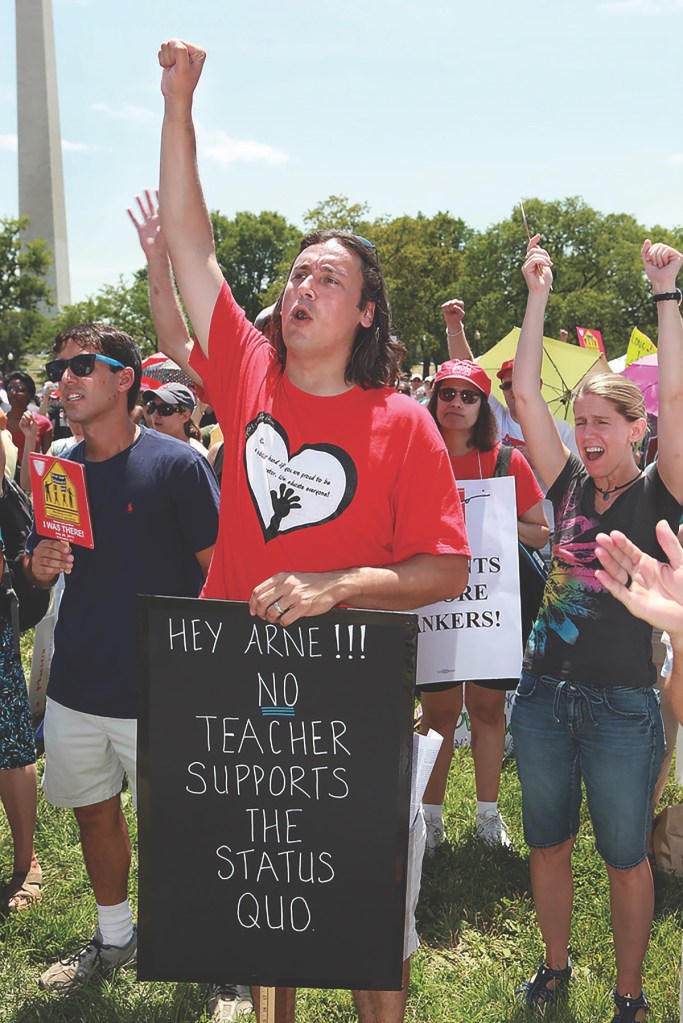
It was a sunny July day in Washington, D.C., the temperature was forecasted to hit 97 degrees Fahrenheit, and when I arrived at the Ellipse on the National Mall for the Save Our Schools march I realized I would need a hat. Among the vendors that lined Constitution Avenue, the least expensive hat I could find was a gaudy, red-white-and-blue affair with an embossed rendering of fireworks going off over the Lincoln Memorial and Washington Monument. “Some hat,” Anne Thompson, my videographer for the day, said when she arrived…
At the time, I was working on a project, partnered with the National Education Association, called “Starving America’s Schools: How Budget Cuts and Policy Mandates Are Hurting Our Nation’s Students.” The project documented how state governments, following the Great Recession, cut funding for schools and rolled out efforts to privatize them with charter schools and voucher programs.
I had read multiple analyses by the Center on Budget and Policy Priorities (CBPP) that found at least thirty-seven states responded to the economic downturn that started in 2007 and extended into 2009 by slashing their education budgets back to pre-recession levels. My Starving America’s Schools project would examine how the cuts caused districts to fire teachers, cancel art and music programs, close libraries and science labs, and cut extracurriculars like athletic programs, field trips, and drama performances.
Teachers turned out to denounce high-stakes testing, NCLB, Race to the Top, budget cuts, privatization, and the attacks on their profession, funded by Bill Gates, Eli Broad, and other billionaires.
….The estimated crowd of 3,000 to 5,000 roared in approval at an array of speakers that included the actor Matt Damon (whose mother is a professor of education), Ravitch, best-selling author Jonathan Kozol, renowned educator Deborah Meier, and policy experts Linda Darling-Hammond and Pedro Noguera. When the speeches were over and we marched to the White House, the line of people stretched for blocks and blocks…
The range of themes the speakers addressed included lack of pay and respect for teachers; the harms caused by poverty and privatization; the continuing racial discrimination and segregation in schools and glaring inequities in their funding; the unbearable class sizes teachers endure, and the injustices that result from using test scores to sanction schools and evaluate teachers.
What also animated the crowd, Anthony Cody tells The Progressive in a text message, was a sense of betrayal on education by the Democratic Party’s leadership. Cody, a fulltime classroom teacher at the time—he’s now retired—was one of the principal organizers of the march. “The great majority of teachers supported the election of Barack Obama in 2008,” he says. “[But] RTTT reinforced the worst elements of NCLB by encouraging states to link teacher pay and evaluations to standardized test scores.”
“A theme that ran through the rally was ‘how could a Democratic administration be so hostile to public schools?’ ” says Ravitch in an email to The Progressive.
“The speakers, me included, hated RTTT and saw it for what it was: encouragement for charters, high-stakes standardized testing, teacher evaluation based on student test scores, and other dreadful policies,” Ravitch continues. “We predicted [the policies] would fail, and they did.”
A particular target for invective at the rally was Obama’s Secretary of Education, Arne Duncan, Ravitch recalls. “He regularly assailed public schools as failing. He attacked public school teachers. He constantly praised charter schools, and whenever national test scores came out, he gleefully pointed to results and made them sound worse than they were.”
“Duncan could have fit in a Republican cabinet,” Ravitch adds.
Fifteen years later, did that outpouring in July 2011 matter?…
The sad truth is that the grievances that motivated people to board buses and gather on the Mall on a hot July day in 2011 continue to dominate the K-12 school landscape today.
For instance, one of NPE’s reports that Cody references, published in 2026, found that states that have been the most aggressive about redirecting public funds for schools to private education operators have been the most neglectful of funding and supporting their public schools.
Although No Child Left Behind was repealed in 2015, it was replaced that year by the Every Student Succeeds Act that still enforces standardized testing. And the legacy of the funding cuts enacted during the Great Recession continues to harm schools.
“In the decade following the Great Recession, students across the United States lost nearly $600 billion from the states’ disinvestment in their public schools,” an analysis by the Education Law Center reported in 2021. Calling the time, from 2008 to 2018, a “lost decade,” the organization noted that while states’ economic activity as measured by gross domestic product increased by 17 percent, state and local revenues for public schools lagged, increasing by only 6 percent.
A 2025 Education Law Center report, “Making the Grade,” assessed states on how they fund public schools and found that not a single state earned an A grade on three crucial measures of funding: whether state and local revenues are adequate, whether funding is fairly distributed, and whether funding lags a state’s economic capacity.
In the meantime, the charter school industry continues to expand, with thirty-nine out of forty-three states experiencing growth in charters in 2025, according to charter industry data. And voucher programs also continue to grow, as fifteen states now operate twenty-three programs, and the Trump Administration is set to roll out a nationwide federal voucher program in 2027. As the right wing’s “long game” to end public education continues apace, prominent centrist Democrats call for a return to the education policies of the Bush and Obama years.
“Democrats [have] walked away from standards and accountability [for schools], and our kids are falling through the cracks,” former Chicago mayor and Obama’s Chief of Staff Rahm Emanuel is telling anyone who will listen. And Arne Duncan is back in the media spotlight, encouraging Democratic governors to embrace the Trump Administration’s voucher program. That the politics of education in 2026 seem so similar to those of 2011 is evidence that a left-right binary over education policy doesn’t really exist.
As I observed all those years ago on the cusp of the march in D.C., there was no middle ground in education debates. Factions on the right wanted to get rid of public schools. Business interests represented by testing companies, charter schools, and tech firms wanted to make money off schools. And a “reform” community led by wealthy foundations and technocrats wanted to mold public schools to their ideological, and often political, agendas.
As I wrote at the time, “Faced with this array of antagonists toward public education, where does the ‘middle ground’ lie? When people openly admit they want to get rid of you, where should the bargaining start? When people have shown you they are more apt to use you for their own profit, and then walk away when the ‘market changes,’ why should you trust them? And when people say they are willing to align with your cause but only when you say and do things how they want you to do them—even when your ideals inform you to do otherwise—why should you simply bend to their will?”
Those questions are still relevant today. They will remain so until a progressive left faction adopts a robust message on education and articulates it repeatedly in advocacy documents and political stump speeches.
“Our battle for public schools is steeper now than it was when the Save Our Schools rally was held,” Ravitch says. “It will be a battle for many years to come.”
But in 2011, for at least a day, it seemed that public school advocates had the power to, as Ravitch put it in her email, “push back and give people a modicum of hope.”
The battle continues, and it’s not over. America needs a strong public school system, not a hodge-podge of pop-up schools.
We need well-prepared teachers who can knowledgeably teach history, science, mathematics, literature, and foreign languages. We need well-funded schools and respected, well-paid professionals. We need equality of opportunity for all children, and we need excellence.
We need the strong public schools that built the Aunited States into a great nation. We need education for democracy, where children are judged by the content of their character, not the color of their skin.
We need an education system that produces engineers, scientists, artists, musicians, athletes, mechanics, lawyers, doctors, pharmacists, teachers, social workers, idealists, scholars, young people eager to use their hands, their brains, and their hearts to make our society better for everyone.
We are now in a period of disruption and dissolution. That way lies disaster. It is the road to elitism, segregation, indoctrination, and decay.
We need to raise our sights and build better public schools that offer a goood education for all children.
David Sirota’s The Lever posted an important article about a hedge fund billionaire who hopes to redefine the Democratic Party. I thought I had heard of all the billionaires who were trying to remodel education to their own specifications, but I had never come across Steve Mandel.
Like many other billionaires, Mandel’s great passion is charter schools. He has poured millions of dollars into political campaigns, trying to elect candidates who share his values. His great hope appears to be to block candidates who are progressives and who are pro-union.
The article, by Katya Schwerin and Luke Goldstein, traces Mandel’s rise, from his elite schooling at
Indiana once took pride in its public schools. Not any more. Since the Republican Party took charge of state government, public schools have been neglected and underfunded.
Sixteen years ago, Republicans assumed full control of Indiana’s state government, holding the governor’s office and winning majorities in the House and the Senate. Since achieving this trifecta, the Republican supermajority has systematically cut funding and programs that made this state work for the people who live here.
Nowhere has this been more apparent than the state’s complete neglect of public schools for nearly two decades. Since taking power, the Republican supermajority has done everything in its power to undermine public education, and Indiana’s children are worse off for it.
Let me explain where years of Republican education policy have gotten us. Last month, the Network for Public Education released a report revealing Indiana ranks 45th out of 50 states in support of public education. Last year, only 31.2% of students showed proficiency on both the math and ELA sections of the ILEARN test. More than half of fourth graders can’t read proficiently, and nearly seven-in-ten eighth graders aren’t proficient in math.
A record number of school districts across the state — nearly 40 — have turned to ballot referenda to secure the money they need this year because the state won’t properly fund them and has cut their local funding sources. These are the results of Republicans chipping away at Indiana’s public school funding for years.
Consider where their priorities lie. More than 87% of Hoosier children attend traditional public schools. Yet year after year, the supermajority pours its energy and political capital into expanding charter schools and private school vouchers for the children of families who were, in most cases, never going to need the state’s help in the first place. The legislature has made it clear: they have no issue abandoning working-class Hoosiers in favor of giving an extra leg up to the most fortunate among us.
When Indiana first opened the door to charter schools and voucher programs, lawmakers sold it as a lifeline for children of color and children in poverty whose assigned schools were failing them. But once the door was propped open, my Republican colleagues expanded it year after year, extending vouchers to families making well over six figures. If this were truly about rescuing kids who’d been failed by the system, it would have stayed targeted at the kids who needed rescuing. Instead, it grew into a subsidy for everyone but the working-class families the program was designed to serve.
None of this is by accident. The supermajority was warned by Democrats, education professionals and concerned Hoosiers of the consequences that their policies would inflict on our schools. It is the direct, foreseeable and self-inflicted result of almost two decades of choices made by men and women who have mistaken their own supermajority for a mandate to neglect the children they were elected to serve.
Districts across the state are being forced to ask voters to approve referenda to raise their own local property taxes just so schools can keep the lights on and pay their teachers. Let’s not pretend this educational belt-tightening is born of necessity. Indiana has nearly $4 billion in surplus and reserve funds, which is more than enough to return to our previous, robust support of public education. Our schools and the children attending them are being asked to make do with less while the state sits on more money than it knows what to do with.
null
I do not say this lightly, and I do not say it out of partisan loyalty. I say it as a man who spent nearly 20 years as a school principal and six years as a teacher before I ever spent a day in the Statehouse. I have seen firsthand what happens when a school has what it needs, and I have seen what happens when it doesn’t.
I am telling you, plainly: Indiana’s Republican supermajority has had 16 years to prove it knows the difference too. It does not. If it did, we would not rank 45th in the nation for public school support. We would not be watching our children fall further behind their peers in other states while the people entrusted with fixing it offer nothing but superficial, special-interest-backed policies that don’t address the underlying issues.
This is where years of unchecked Republican domination have gotten us: two decades of failure and of backs turned on the generation that makes up the future of this state, this nation and the world beyond.
For 16 years, they have stood before us and promised that this would finally be the year public education in Indiana gets fixed. And for 16 years, they have failed to deliver on that promise. The only question left is how much longer Hoosiers are willing to take their word for it and allow more children to fail academically
I posted the link to Carol Burris’s terrific article about school choice yesterday but was unable to copy the text. Carol sent the text to me.
Here it is:
Advocates of a rightwing, billionaire-funded campaign to replace public education with a privatized education marketplace have been candid about their goals and disciplined in pursuing them. A new reportfrom the organization I lead, the Network for Public Education, provides an accounting of how far state lawmakers across the nation, in both red and blue states, have advanced this campaign and have put at grave risk access to the current system of education that is free and available to all families.
For nearly a decade, the Network for Public Education has issued statehouse-by-statehouse report cards holding legislators accountable for how they treat public schools and the children who depend on them. And over the years, we have seen a ramp up in school privatization and continuous neglect of public school students and teachers.
This 2026 Report Card is our most expansive to date, evaluating all fifty states and the District of Columbia across four categories: privatization of public education, protections for homeschooled students, school funding, and conditions for teaching and learning based on thirty-nine factors. Some of those factors include charter school expansion, discrimination, and student-to-teacher ratio.
In 2022, when we issued our second report card, ten states achieved 80 percent or more of a possible 102 points. By 2024, the number of states achieving 80 percent of all possible points had dropped to four. Two years later, only two states, Nebraska and Vermont, hit the 80 percent mark.
Over the past four years, privatization efforts have seen heightened success across the country. Voucher programs (which began in the mid-1990s) have expanded from twenty-seven programs in 2022 to seventy-three programs in thirty-four states as of 2026, with multiple programs in several states. Vouchers pay for tuition at both secular and religious schools, and in some states, the purchase of goods and services by homeschoolers and microschoolers. Schools accepting vouchers also typically face little of the academic, financial, or civil rights accountability required of public schools, and many can reject or expel students based on disability, religion, sexual orientation, or academic record. And because voucher amounts frequently fall short of full private school tuition, the benefits flow disproportionately to families who could already afford private school without public dollars.
Charter schools, which began in 1992 as experimental schools controlled by school districts, have been privatized to include large chains of schools, some of which span across multiple states. Nearly one in five charter school students attends a charter run by a for-profit corporation. It is an unstable sector of schooling, with more than one in four closing by year five.
Only Nebraska and Kentucky are now the only remaining states free of both charter schools and state voucher programs. But the 2026 report card reveals a troubling and consistent pattern beyond the expansion of school privatization. The states most aggressively redirecting public funds toward private alternatives—charter schools, voucher programs, and home schools—are the same states that fund privatization at the direct expense of investment in public schools.
In fact, our analysis found a strong and statistically significant negative relationship between the expansion of privatization and other indicators of public school support. Privatization and public school disinvestment, it turns out, go hand in hand.
Seventeen states earned a grade of F, meaning they failed to meet even 40 percent of the thirty-nine standards we set for responsible stewardship of public schools. Standards that included equitable school funding, teacher satisfaction, protections for homeschooled students, and class size. Florida ranked dead last, scoring just fourteen out of 102 possible points, with Arizona following closely behind. These are not struggling states making hard choices with thin budgets. They are states that have made deliberate decisions to defund neighborhood schools while directing public money toward private alternatives with minimal oversight, weak accountability, and documented records of fraud and mismanagement.
The appeal of “school choice,” in which families are permitted to use state funds that would’ve been otherwise spent on public education on non-traditional programs like charter or private schools, is easy to understand. The promise of options and tailored education sounds reasonable in the abstract. But in practice, choice works best for families with the time, information, and flexibility to navigate it, and whose children the private school is willing to choose. For a family in rural Florida or a child with complex disabilities whose needs most private schools won’t accommodate, the marketplace of options is theoretical. The public school is the only institution legally required to educate every child who walks through the door. When it is weakened through funding cuts, the diversion of students and dollars, or a hollowed-out teaching workforce, the consequences fall hardest on the children least able to find alternatives.
Meanwhile, many of these states that have expanded privatization are the same states that fail to uphold school policies that support teaching and learning.
You cannot systematically eliminate teachers’ job protections, freeze wages, and inject heavy political pressure into classrooms, then be surprised when talented people leave the profession. States like Arizona and Florida, which we rank at the bottom for teacher working conditions, are the same states reporting severe shortages of teachers and the highest rates of underqualified instructors. That is a direct consequence of policy choices, not a demographic inevitability.
The top of the rankings offers a useful counterpoint. States like Nebraska and Vermont demonstrate that it is possible to adequately fund public schools, support teachers as professionals, and resist privatization pressure. The distance between them and the bottom-ranked states reflects not differences in wealth or circumstance, but differences in political priorities.
None of this means public school systems are beyond criticism. They have real failures and persistent inequities worth addressing. But the solution is not to defund the institution and redirect money to private alternatives that face no equivalent accountability. Charter schools limit enrollment. Voucher schools can turn away students. Education savings accounts, which give taxpayer funds to parents to buy private services in lieu of public schooling, can be misused with little consequence. Public schools cannot do any of these things—and that constraint is precisely what makes them worth protecting.
What happens next depends on whether parents, teachers, and the communities built around our public schools engage with the same urgency as forces on the right wing who work to dismantle them.
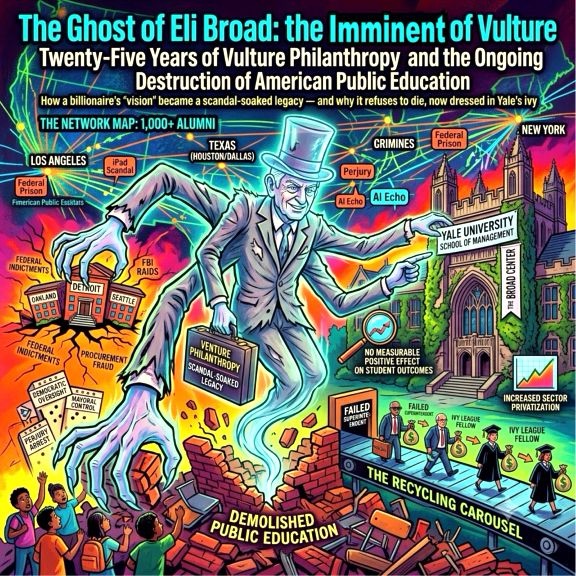
Mike Simpson posts amazing memes on Twitter and BlueSky. He calls himself “Big Education Ape.” He makes the point with his illustrations.
Here is one of his best: THE GHOST OF ELI BROAD: TWENTY-FIVE YEARS OF VULTURE PHILANTHROPY AND THE ONGOING DESTRUCTION OF AMERICAN PUBLIC EDUCATION.
I wasn’t able to copy some tables and graphics. Please open the link to read the post in full.
Eli Broad was one of the billionaires who was eager to tear apart public education and remake it. I referred to him, the Waltons, and the Gates Foundation as “the Billionaires Boys Club,” which was chapter 10 of my book The Death and Life of the Great American School System: How Testing and Choice Are Undermining Education.
Eli Broad’s distinctive contribution to the corporate reform movement was his Broad Academy, where aspiring superintendents were “trained” with his ideas. All expenses were paid, and trainees got to hobnob with others. They also had the Academy’s help in job placement; many “graduates” of the Broad Academy were placed as superintendents in big-city districts, imbued with the ideology that schooling was a business, that low-performing schools should be closed and replaced by charter schools. Eli and his wife Edythe were both graduates of the Detroit Public Schools, but they were not grateful for what they learned.
In 2009, when I was writing the book, I was not aware that the Billionaire Boys Club had many more members and that some were women. There was Alice Walton, Betsy DeVos, the Koch brothers, John Arnold, Joel Greenberg, Daniel Loeb, Jeff Yass, and many more. I posted a far longer list of the super-rich underwriting the privatization of public money in my book Slaying Goliath.
I once was invited by Eli Broad to meet at his gorgeous apartment in New York City, overlooking Central Park. He wanted to know why I was critical of his efforts. He told me that he knew nothing about teaching or curriculum, but he knew a lot about business management and organization. His belief was that public schools could improve by better management.
Mike Simpson performs a public service here by updating the legacy of Eli Broad.
He writes:
How a billionaire’s “vision” became a scandal-soaked legacy — and why it refuses to die, now dressed in Yale’s ivy
There’s a particular kind of audacity required to spend a quarter-century systematically dismantling public education, leave a trail of federal indictments, billion-dollar procurement disasters, and devastated communities in your wake — and then get your name engraved on a building at Yale University. That, in essence, is the story of Eli Broad, the Broad Academy, and its reincarnation as The Broad Center at Yale School of Management. If you were hoping the death of Eli Broad in 2021 would finally close this chapter of American education history, well — ghosts don’t follow rules. And this one has a $100 million endowment.
Part I: Venture Philanthropy — When Billionaires Play School
Let’s start with the concept that makes all of this possible: “venture philanthropy.” It sounds benign — even noble. In practice, it means a billionaire who made his fortune in housing construction (KB Home) and insurance (SunAmerica) decided he understood public education better than educators, parents, communities, or — heaven forbid — children.
Eli Broad’s core thesis, launched formally in 2002 with the Broad Superintendents Academy (BSA), was elegantly simple and catastrophically wrong: public school systems are just badly managed corporations, and what they need is corporate managers.
Not teachers. Not child psychologists. Not community leaders. Corporate managers. Preferably ones with MBAs, military command experience, or backgrounds in supply-chain logistics. Because nothing says “I understand the developmental needs of a seven-year-old” quite like a background in restructuring defense procurement contracts.
The curriculum reflected this philosophy with almost comedic precision:
10% — Actual education: pedagogy, curriculum, child development
90% — Corporate operational reform: fiscal optimization, data-driven accountability, labor relations, and what the Academy euphemistically called “reform accelerators” — which, translated from the original MBA-speak, meant privatization strategies
The program was free to participants — tuition, travel, lodging, all covered. Because when you’re deploying an ideological army, you don’t charge the soldiers.
Part II: Yale Said “Yes” — And Charged It to Prestige
In 2019, the Eli and Edythe Broad Foundation committed $100 million to Yale University to transform the independent, unaccredited Los Angeles operation into The Broad Center at Yale School of Management. The transition was completed in 2020, and the unaccredited LA entity was quietly sunsetted — like a getaway car abandoned after the heist.
The rebranding was masterful. Suddenly, the same ideological pipeline that had produced federal convicts, FBI raid subjects, and a generation of “disruptors” who disrupted primarily the educational lives of low-income children of color was now operating under the imprimatur of one of the world’s most prestigious universities.
The center today operates two flagship tracks, both tuition-free:
The 2026–27 MMS cohort is already being assembled, per the center’s own Instagram, described as “leaders committed to reimagining” public education — which, given the network’s history, should be read as a threat as much as a promise.
Beyond the programs themselves, the center has launched an aggressive data aggregation initiative — a centralized repository hosted on GitHub tracking superintendents across more than 10,000 of the nation’s 13,000 public school districts, aggregating over 180,000 data points across 23 states. The stated goal is academic research. The unstated goal, critics argue, is mapping the vacancy pipeline for the next generation of Broad placements.
Part III: The Damage Ledger — Twenty-Five Years of “Disruption”
Let’s be precise about what the word “disruption” meant in practice. A landmark 2022 longitudinal study published in Educational Evaluation and Policy Analysis tracked two full decades of Broad Academy graduates and delivered findings that would be devastating — if anyone in the venture philanthropy world were capable of embarrassment:
No statistically significant positive effects on district spending, student completion rates, or test scores
Broad-trained superintendents had 18% shorter tenures than non-Broad peers in equivalent districts
The only statistically significant footprint left behind? A sustained, measurable trend toward increased charter school enrollment and sector privatization
In other words, after 25 years and hundreds of millions of philanthropic dollars, the Broad Academy’s measurable legacy in public education was: more charter schools and shorter superintendent tenures. That’s it. That’s the product.
The Human Cost
The abstract numbers become concrete when you look at specific communities:
Oakland & Detroit saw aggressive charter expansion and centralized fiscal management that critics argued deepened structural deficits and fractured community trust for generations.
Chicago experienced the largest single wave of school closures in modern U.S. history — 50 neighborhood schools shuttered in 2013 under Broad-network-affiliated Barbara Byrd-Bennett — triggering federal civil rights complaints alleging the closures disproportionately harmed low-income students of color.
Seattle watched Broad graduate Maria Goodloe-Johnson (BSA Class of 2003) get fired in 2011 following a state audit revealing $1.8 million in public funds funneled into a contracting program that provided little to no actual services — with investigators concluding she exercised a “severe lack of oversight” despite early warnings.
Part IV: The Scandal Hall of Fame — From Procurement Fraud to Federal Prison
Here is where the story transitions from ideologically troubling to criminally spectacular.
John Deasy — The iPad That Broke LAUSD
Deasy (BSA Class of 2006) championed a $1.3 billion initiative to put Apple iPads loaded with Pearson software into the hands of every LAUSD student. The rollout failed within days — students bypassed security filters almost immediately — but the procurement scandal was far worse than the technical failure.
Internal records revealed that Deasy and his deputies had close personal and professional ties to Apple and Pearson executives prior to the bidding process, raising serious allegations of a rigged procurement cycle. The FBI seized boxes of district records. Deasy resigned in 2014. The district eventually abandoned the program and settled for millions in refunds.
His post-resignation career? He was immediately hired by the Broad Center as a Superintendent-in-Residence — coaching the next generation of urban leaders. Because in this ecosystem, failure is a credential.
Barbara Byrd-Bennett — The Federal Prison Graduate
Byrd-Bennett’s career arc is the Broad model in miniature: leave Cleveland in fiscal distress, leave Detroit in structural chaos, get hired as a “turnaround expert” in Chicago, execute the largest school closure wave in American history, then get indicted on 20 counts of federal mail and wire fraud.
Federal investigators proved she steered $23 million in no-bid contracts to SUPES Academy and Synesi Associates — the very consulting firms she had worked for immediately before taking the CPS helm. Internal emails laid bare her motive with a candor that would be almost admirable if it weren’t so brazen: she needed the money because she had “tuitions to pay and casinos to visit.”
In exchange, she was promised a 10% kickback disguised as future consulting fees funneled into trust funds for her twin grandsons. She pleaded guilty and was sentenced to four and a half years in federal prison.
Robert Runcie — The Perjury Arrest
Runcie (BSA Class of 2009) took over Broward County Public Schools — the nation’s sixth-largest district — and oversaw a culture of severe administrative bid-rigging around an $800 million capital bond program, with independent investigations revealing contracts steered to pre-selected corporate entities.
Following the 2018 Parkland school shooting, which exposed deep systemic lapses in district safety infrastructure, a statewide grand jury investigation led to Runcie’s arrest by the Florida Department of Law Enforcement on felony perjury charges in April 2021 — prosecutors proving he lied under oath about communications regarding procurement contracts.
He resigned in exchange for a $743,000 separation agreement. Paid by taxpayers.
Alberto Carvalho — The AI Echo of the iPad Disaster
If the Deasy iPad scandal was the defining Broad-era procurement catastrophe of the 2010s, Alberto Carvalho’s LAUSD tenure became its 2020s technological sequel — almost as if the universe decided one billion-dollar tech procurement disaster per decade wasn’t sufficient.
Carvalho, a celebrated figure on the corporate-reform speaking circuit who regularly headlined Broad Center leadership panels, aggressively championed a contract with “AllHere,” a tech startup contracted to build a multi-million dollar AI student-chatbot tool for LAUSD. The project collapsed into total insolvency. The startup’s founder was indicted for fraud. Federal investigators traced systemic steering of contracts that bypassed traditional public bidding protections.
In early 2026, FBI agents raided Carvalho’s personal residence and district offices. He was placed on paid administrative leave and subsequently resigned — a modern, tech-era echo of the Deasy iPad scandal, separated by exactly one decade and approximately zero lessons learned.
Part V: The Carousel — How Failed Superintendents Get Recycled
One of the most structurally revealing features of the Broad model is what happens after a superintendent fails. In a normal accountability framework, catastrophic failure — federal indictment, FBI raids, mass community protests, historic labor strikes — would end careers.
In the Broad ecosystem, it typically accelerates them.
The recycling mechanism operates in three predictable stages:
Stage 1 — The Soft Landing: Departing executives are caught by the philanthropic safety net. Foundations like Broad, Walton, or Gates place them into well-funded “fellow,” “executive coach,” or “senior advisor” roles at charter management organizations or policy think tanks. The local political dust settles. The national network maintains their status.
Stage 2 — The Headhunter Buffer: National executive search firms — operating with screening frameworks that prioritize corporate operational metrics over community approval or longevity — present the executive to a new school board in another state as a “courageous, battle-tested change agent.” The fact that the “battle” was largely against the parents and teachers of the previous district is presented as a résumé enhancement.
Stage 3 — The Next Major District: Re-hired at a higher salary, with stronger contractual protections, and a golden parachute clause ensuring that the next failure will also be financially comfortable.
Mike Miles left Dallas ISD under multiple internal investigations and extreme executive turnover, founded a charter network, and was then directly appointed by the Texas Education Agency — which had dissolved Houston ISD’s elected school board — to run the entire Houston district with even fewer democratic constraints than before.
Jean-Claude Brizard left Rochester under a 95% teacher vote of no confidence, was immediately recruited to lead Chicago Public Schools (the nation’s third-largest system), triggered the historic 2012 Chicago Teachers Strike within 17 months, was pushed out with a $250,000 buyout, and transitioned smoothly into senior advisory roles at national education foundations.
The pattern is not a bug. It is the feature.
Part VI: Buying the Boardroom — How Venture Philanthropy Captured School Governance
The Broad playbook cannot function under genuine democratic oversight. A superintendent who closes 50 neighborhood schools, eliminates teacher tenure protections, and converts public schools into privately managed charter networks will be fired by an elected school board that answers to the community — unless that school board has been pre-selected to not do that.
The solution was elegant and corrosive: buy the school board elections.
Because local school board races historically required minimal campaign capital, the injection of billionaire wealth fundamentally altered the political landscape. The money flows not directly to candidates (which faces statutory limits) but through Independent Expenditure Committees and Super PACs — allowing unlimited spending on sophisticated polling, negative television ads, and targeted digital saturation.
In Los Angeles, Eli Broad, the Walton family, and allied donors regularly poured $5 million to $10 million per election cycle into LAUSD board races — specifically to achieve a “pro-reform majority” that would protect executives like John Deasy and later Austin Beutner (a former investment banker with no education background whatsoever) from community accountability.
In Oakland, independent groups funded by the California Charter Schools Association outspent local parent-teacher associations 10-to-1, successfully seating board members who routinely approved charter petitions and fiscal consolidation plans drafted by Broad Residency staff embedded in the central office.
When even this proved insufficient — when local civic resistance made winning democratic elections too expensive or unpredictable — the network pivoted to eliminating the elections entirely:
Chicago: Mayoral control legislation allowed Mayor Rahm Emanuel to single-handedly install Broad executives without board confirmation.
Houston: The Texas Education Agency dissolved the elected school board entirely and replaced it with a state-appointed body, allowing direct installation of Mike Miles.
Detroit: The short-lived Education Achievement Authority bypassed the traditional school board to implement a centralized, non-unionized reform experiment under Broad graduate John Covington.
The structural message is unambiguous: the corporate management model and democratic accountability are incompatible. When democracy gets in the way, the solution is to remove democracy.
Part VII: The Network Map — 1,000 Alumni and Counting
The Broad Network now comprises more than 1,000 alumni spanning major urban school districts, charter management organizations, state education agencies, and venture philanthropy foundations — with its heaviest concentrations precisely where the playbook finds the most fertile ground:
California remains the densest hub, with alumni embedded throughout LAUSD, Oakland Unified, and San Diego Unified central offices, as well as major CMOs like KIPP SoCal, Aspire Public Schools, and Green Dot.
Texas has become the fastest-growing hub, with Houston ISD under state-appointed Miles serving as the current flagship experiment, alongside significant placement within Dallas ISD, Fort Worth ISD, the Texas Education Agency, and massive charter entities like KIPP Texas and IDEA Public Schools.
New York serves as the “soft landing” capital of the network — hundreds of alumni operating within Wall Street-adjacent education foundations, charter advocacy groups, and elite national search firms headquartered in Manhattan.
Illinois and Pennsylvania — Chicago and Philadelphia specifically — remain high-density environments where teams of Broad Residents are embedded in central operations managing financial stabilization, facilities restructuring, and school assignment data systems.
Meanwhile, the network has largely migrated out of direct superintendencies — where the political friction is high and the tenure is short — and into the broader ecosystem where influence is durable and accountability is minimal: senior director roles at the Gates Foundation, the Walton Family Foundation, and the Chan Zuckerberg Initiative; high-level education consultancies like Watershed Advisors and Instruction Partners; and, of course, The Broad Center at Yale SOM itself, where the current MMS cohort is being trained to carry the philosophy forward.
Part VIII: Yale — Laundering a Legacy in Ivy
Let us be direct about what the Yale partnership accomplishes that the standalone Los Angeles operation never could: institutional legitimacy laundering.
The Broad Academy, operating independently, was unaccredited, ideologically transparent, and easy to critique. Its graduates were called “Broadies” — a term used by both allies and critics — and the pipeline was visible enough that parent groups, teachers’ unions, and education researchers could track, document, and organize against it.
The Broad Center at Yale SOM is something different. It is now embedded within one of the world’s most prestigious academic institutions, granting an Ivy League master’s degree, hosting fellows in New Haven, and publishing peer-reviewed research. The same corporate management philosophy that produced federal convictions and FBI raids now arrives in urban school districts wearing a Yale credential.
The center’s new data aggregation initiative — tracking superintendents across more than 10,000 districts, aggregating 180,000+ data points — is framed as academic research. Critics see it as something more operational: a comprehensive national vacancy map for the next generation of Broad placements, now with the algorithmic sophistication that the original Los Angeles operation could only dream of.
The 2025-26 Fellowship cohort of 17 fellows is already gathering in New Haven for weeklong modules at Yale SOM. The 2026-27 MMS cohort is being assembled. The pipeline flows.
The Synthesis: What Twenty-Five Years Actually Taught Us
Here is what a quarter-century of Broad-style education reform has empirically demonstrated:
The Promise: The Reality
Corporate management improves district outcomes/No measurable positive effect on test scores, graduation rates, or spending efficiency”
Disruptors” bring needed change/18% shorter tenures; accelerated community fracture
Charter expansion improves options/Statistically significant increase in privatization; no demonstrated academic gains
Data-driven accountability improves teaching/Curriculum narrowing; teaching to the test
Free consulting support helps districts/Permanent embedding of private ideology on public payroll
School board reform improves governance/Systematic dismantling of democratic accountability
The most damning verdict is not the federal indictments — though those are damning. It is not the FBI raids — though those are spectacular. It is not even the $23 million in no-bid kickback contracts or the billion-dollar iPad disasters.
It is this: after 25 years, hundreds of millions in philanthropic investment, and the placement of Broad-trained executives in over 160 school systems, there is no credible empirical evidence that any of it helped a single child learn to read better.
What it did produce — measurably, statistically, reproducibly — was more charter schools, shorter superintendent tenures, and a revolving door of well-compensated executives cycling between urban districts, consulting firms, and Ivy League fellowship programs while the communities they “disrupted” rebuilt themselves from the wreckage.
Epilogue: The Ghost That Won’t Be Exorcised
Eli Broad died in April 2021. His foundation subsequently announced it would spend down its assets and close. The Los Angeles operation was already gone, folded into Yale two years prior.
And yet — the ghost persists. It persists in the 2026-27 MMS cohort assembling in New Haven. It persists in the 180,000 data points tracking superintendent vacancies across 10,000 districts. It persists in the career of Mike Miles, currently running Houston ISD under state protection from democratic accountability. It persists in the aftermath of Alberto Carvalho’s FBI-raided departure from LAUSD — a scandal so structurally identical to the Deasy iPad disaster of 2014 that it reads less like history repeating and more like history plagiarizing itself.
The Broad Center at Yale SOM is not a reformed version of the Broad Academy. It is the Broad Academy with better branding, an Ivy League address, and a GitHub repository. The philosophy is identical. The network is intact. The pipeline flows.
The only thing that has genuinely changed is the zip code — from Los Angeles to New Haven — and the price tag of the credential being handed to the next generation of disruptors preparing to be deployed into the public schools of America.
Eli Broad may be gone. But his ghost has tenure.
And unlike the superintendents he trained, it shows no signs of an early exit.
Sources:
: The Broad Center institutional history, curriculum breakdowns, alumni scandal documentation, EEPA 2022 longitudinal study findings, and school board funding mechanics — as documented in comprehensive public education policy research and investigative reporting compiled in the source brief above.
: EdSource — “FBI raid of Los Angeles Superintendent Carvalho’s home, office may be linked to student AI chatbot” (2026) — edsource.org
: Los Angeles Times — “How probe into failed startup led to LAUSD superintendent investigation” (March 1, 2026) — latimes.com
: Yale School of Management — “The Broad Center Announces 2025-26 Cohort of the Fellowship for Public Education Leadership” — som.yale.edu
Master Source List: The Ghost of Eli Broad & The Broad Center at Yale
🏛️ The Broad Center at Yale SOM — Official Sources
$CITETitleSourceLinkThe Case of Broad Superintendents— Full EEPA Longitudinal Study (2022) Educational Evaluation and Policy Analysis / Tom Dee tom-dee.github.io — EEPA-Broad.pdf New Study: Broad Supes Made No Difference, Other Than Increasing Charter Schools Diane Ravitch’s Blogdianeravitch.net
🗞️ Investigative Journalism & Policy Criticism
$CITETitleSourceLink Critics Target Growing Army of Broad Leaders Education Week edweek.org The Broad Foundation’s Impact on Public Schools Facebook — Oakland Parent Sharon Higgins Analysis facebook.com — Broad Foundation Analysis
⚖️ Barbara Byrd-Bennett — Federal Conviction (Chicago)
$CITETitleSourceLink Former Chief Executive of Chicago Public Schools Sentenced to More Than Four Years in Prison U.S. Department of Justice — Official Press Release justice.govBarbara Byrd-Bennett — Full Coverage Archive WTTW Chicago Public Media news.wttw.com Barbara Byrd-Bennett — Wikipedia Overview Wikipediaen.wikipedia.org
⚖️ Robert Runcie — Broward County Perjury Arrest
$CITETitleSourceLinkFDLE Arrests Broward County Schools Superintendent Robert Runcie for Perjury Florida Department of Law Enforcement — Official Release fdle.state.fl.us Former Broward Superintendent Robert Runcie Avoids Trial — Perjury Charge Dropped CBS News Miami cbsnews.com/miami State Drops Perjury Charge Against Former Broward Schools Superintendent Miami Herald miamiherald.comPerjury Charge Dropped Against Ex-Broward Schools Superintendent NBC Miami nbcmiami.com
🤖 Alberto Carvalho — LAUSD FBI Raid & AllHere AI Scandal
$CITETitleSourceLinkFBI Raid of Los Angeles Superintendent Carvalho’s Home and Office May Be Linked to Student AI ChatbotEdSource edsource.org How Probe Into Failed Startup Led to LAUSD Superintendent Investigation Los Angeles Times latimes.com
📌 Quick Citation Reference Guide
For the article sections, citations map as follows:
Broad Center Yale programs → , , ,
EEPA 2022 empirical study → ,
General Broad criticism & history → ,
Byrd-Bennett federal conviction → , ,
Runcie perjury arrest → , , ,
Carvalho FBI raid / AllHere AI → ,
⚠️ Research Note: Several additional primary sources — including the original EEPA journal publication, the Jeffrey Hubbard California Supreme Court ruling, the Maria Goodloe-Johnson state audit, and the Jean-Claude Brizard Chicago strike documentation — are recommended for deeper verification. Additional searches can be run to surface those specific primary documents on request.
It is a well-established fact that the school choice movement was created in the South in the 1950s to protect segregation. After the Brown decision of 1954, whites resisted desegregation with e Rey strategy they could dream of. One such was to offer vouchers to every student to attend the school of their choice. The predictable result was to protect segregated schools.
In this century, voucher promoters sell them as parental choice, “saving poor kids from failing public schools,” etc.
But unless an effort is made to enrcuage racial integration, choice will lead to segregation.
Halley Potter of The Century Foundationwrote this report. I urge you to open the link and read it in full.
Potter wrote:
In rural Northampton, North Carolina, a private Christian school called Northeast Academy is 99 percent White in a county that’s 40 percent White. It receives about half of its tuition from taxpayers, through the state’s private school voucher program. Northeast is one of a number of private schools known as “segregation academies,” because they were founded during desegregation so that White parents could avoid having their children educated in an integrated setting.
Segregation academies ought to be a thing of the past, but they could experience a resurgence—paid for with taxpayer dollars—under the new federal private school voucher scheme enacted as part of the One Big Beautiful Bill Act (OBBA). Bringing back segregation academies using taxpayer dollars is part of the Trump administration’s radical two-pronged approach to undermine public education. The first tactic in the Trump administration’s plan to undercut public school systems is to dramatically reduce the federal role in education by dismantling federal programs, reducing oversight, attempting to cut federal funding for K–12 schools, and working to close the U.S. Department of Education. The second tactic is actively working toward privatization through an unprecedented federal private school voucher program.
How the Voucher Plan Would Work . . .
In July 2025, OBBA established a new federal tax credit—known as the Education Freedom Tax Credit—that, in effect, serves as a private school voucher program. The program allows individuals, beginning January 1, 2027, to contribute up to $1,700 per year toward private entities known as scholarship granting organizations (SGOs) and receive a dollar-for-dollar return of their money in the form of a federal tax credit. SGOs then would then be able to decide how to distribute the funds as scholarships to applicant students for them to spend on education. There is no cap on the size of such scholarships, and no limit on the number of individuals that can claim the tax credit. While recipient students may be able to use scholarship funds to pay for some things like tutoring or activity fees at public schools, because public schools are essentially free, it is anticipated that the vast majority of these funds will go toward private school enrollment.
There are very few requirements of SGOs in the statute, and it appears that any organization in a participating state that meets the criteria will be allowed to participate. SGOs must give scholarships to ten or more students who do not all attend the same school, must spend at least 90 percent of the income on scholarships, must give priority to students who received scholarships the previous year and to siblings, cannot earmark funds for a particular student, and must ensure that students come from families earning no more than 300 percent of the area median gross income. Essentially everything else will likely be up to the SGO, as the program’s regulations are not expected to add additional guardrails. It appears an SGO could, for example, be set up to fund scholarships to Christian schools only. Because private schools are not subject to all of the same civil rights laws as public schools, SGOs could also likely discriminate against students based on disability or sexual orientation.
While starting the process with individual donations gives the program the veneer of a charity operation, this is a ruse. All this does is mask who is truly bearing the cost of the program. In actuality, the donors to SGOs bear no cost, as they are later fully reimbursed by the federal government through the dollar-for-dollar tax credit. The federal government—using taxpayer dollars sent to the supposed donors—bears the entire cost of the program. Estimates of the cost to taxpayers range from around $4 billion to over $50 billion annually.
Moreover, the U.S. Department of the Treasury’s language regarding the tax credit program is very misleading. Their fact sheet states: “A recent report estimates that the Education Freedom Tax Credit will generate an additional $24 billion in education funding annually.” That makes it sound like this is a revenue-creating program rather than one that bears a huge federal cost.
States and the District of Columbia have to decide annually whether or not to opt out of or into the voucher program. As of July 6, 2026, twenty-nine states had indicated that they plan to opt in for the first year of the program. However, federal regulations guiding the program are not expected until September. Further complicating matters, at least eighteen states will have new governors and the District of Columbia will have a new mayor when the program launches in 2027 because of term limits, and that number could be as high as thirty-six after this fall’s elections.
. . . To Increase Segregation and Undermine Public Education
Diverse learning environments that bring students of different racial and socioeconomic backgrounds together are one of the most powerful educational tools we have. Integrated schools help encourage critical thinking, boost academic achievement, and build the skills for working across lines of difference that are essential for our democracy. The growth of private school voucher programs threatens to roll back progress on integration, limit educational opportunity, and further fracture the educational landscape by race and class.
As state leaders and advocates weigh whether or not to opt into the federal voucher program, they should consider the evidence on how the program could deepen inequality and further racial and socioeconomic divides. New analysis in this piece shows that in some metro areas in states that are still deciding whether to opt out of or into the federal voucher program, private schools already drive more than 40 percent of the racial segregation in schools.
The Segregationist History of Private School Vouchers
Private school enrollment nationwide is disproportionately White and wealthy. As of 2021, 9 percent of American schoolchildren attended private schools. Sixty-five percent of private school students are White, compared to 45 percent of public school students. Private school students are about twice as likely as public school students to come from higher-income households, and private school attendance is concentrated among the highest earners.
Private school voucher programs were started by segregationists across the South in the 1950s and 1960s as part of efforts by Southern leaders engaged in “massive resistance” to avoid integrating their schools in the wake of the 1954 Brown v. Board of Education ruling. Many communities opened all-White private schools, which became known as segregation academies. Local governments slashed public school funding and instead created public subsidies for these private schools—including voucher programs to reimburse tuition as well as tax credits.
The courts eventually struck down many of those voucher programs tied to segregation academies, but current voucher programs still show troubling patterns of segregation. Roughly 300 private schoolsthat were founded as segregation academies still receive money from publicly funded voucher programs. Most voucher money goes to students who are already attending private schools, and data has shown that private schools tend to raise their tuition after the introduction of voucher programs. For example, when Iowa started a new voucher program in 2023–24, two-thirds of vouchers went to students who were already attending private schools. By 2026, tuition at some of the state’s largest private high schools had grown by as much as 50 percent. It is important to note that vouchers typically do not cover the full cost of tuition, making private schools still out of reach for most low-income families, and so the voucher programs tend to function mostly as cost-reducing schemes for wealthier families sending their children to private schools. In Arizona, for example, half of all voucher recipients come from the wealthiest quartile of zip codes.
There are some private school voucher programs that target low- to middle-income students and enroll mostly students of color, such as the Milwaukee Parental Choice Program, the oldest operating school voucher program in the United States. However, research shows that even students in these programs, which arguably have the highest potential for integration, by and large did not give students greater access to integrated schools.
Furthermore, some voucher programs that started out serving mostly students of color have now seen an increase in White students in recent years. When North Carolina’s private school voucher program launched in 2014, for example, a majority of students receiving vouchers were Black, and just 27 percent were White; however, as the program expanded incrementally from one serving only low-income students to one with no income limits, the percentage of vouchers going to White students grew to 73 percent, in a state where only 51 percent of school-aged children are White. A 2024 investigation by ProPublica into North Carolina’s private school voucher program found thirty-nine schools that fit the profile of segregation academies that were receiving public money through voucher programs.
The new federal private school voucher program specifies that participation is open to families earning up to 300 percent of area median gross income, which means it would be open to roughly 90 percent of students nationwide. With near universal eligibility, the federal program could easily be susceptible to similar patterns of segregation, disproportionately benefiting White students and furthering segregation between public and private schools.