Archives for category: Charter Schools

I was invited by KPFT, a Pacifica station in Houston, to discuss the state takeover of the Houston Independent School District.

This is a better link.

The host of the show is Paul Castro, who has taught in HISD and in an open enrollment charter school.

It was a good exchange. We talked about The state-appointed superintendent Mike Miles, about charter schools, and about Governor Abbott’s determination to get a voucher bill passed by the next legislature. I explained what a voucher program would mean and what has been learned from the experience of other states.

You have to search the website to find the program. It aired April 26 at 9 am.

“Amplified Houston” Friday

Host:Paul Castro

Guest:Diane Ravitch 

Topic

Public school reform and HISD Takeover

Amplified Houston for Fri., April 26, 2024, focuses on public school reform and the HISD takeover. Dr Diane Ravitch, Founder and President of the Network for Public Education (NPE) will guest. NPE is the single largest organization of parents and teachers and other citizens working to stop the privatization of public education and the misuse of standardized testing.Diane Ravitch’s Blog is dianeravitch.net. Her two most recent books are EdSpeak and DoubleTalk:A Glossary to Decipher Hypocrisy and Save Public Schooling and The Death and Life of the Great American School System.

Friday, April 26, 2024 9:00 am30:07

The founding myth of the corporate reform movement is the rebirth and transformation of the public schools of New Orleans after Hurricane Katrina in 2005. Most of the city’s public schools suffered physical damage because of the horrendous storm. Large numbers of the students and teachers were scattered after the storm. The state of Louisiana moved in aggressively: it lowered the bar at which a school was deemed to be failing. It took control of most of the public schools and turned them over to charter operators. It fired all of the teachers, most of whom were African-American, disbanding the teachers’ union. The charter operators hired large numbers of Teach for America recruits. The media hailed the experiment in privatization as a success story. Numerous states followed the lead of New Orleans, turning over their lowest-performing schools to charter operators. Michigan created the Education Achievement Authority. Tennessee created the Achievement School District. North Carolina and Nevada launched similar but smaller experimental districts. All of them failed.

Now comes a report that the nearly all-charter New Orleans district did not live up to its hype.

Dr. Barbara Ferguson 
Research on Reforms, Inc. 

April 2024

Following Hurricane Katrina, a newly enacted state law identified schools that scored below the state average as failing and subject to take-over. The state then took-over 107 of New Orleans’ 120 public schools and turned them into charter schools. Last year’s scores showed that 56 of New Orleans’ 68 public schools had scores below the state average.*

Thus, after nearly twenty years, over 80% of New Orleans schools are still below the state average. This charter school experiment has been a failure.

Of the five worst performing high schools taken-over, only one now scores above the state average. Two are still below the state average. Another was closed and then reopened as a campus to expand the Willow selective admission charter school. The status of the other, Walter Cohen, is unclear. Recall that the New Orleans College Prep Charter took-over Cohen High School, operating its selective charter school on one floor, while leaving the failing Cohen students on the other floors. Thus, we learned that the take-over of a failing school simply meant taking-over the building, not the failing students in the building.

Of the five highest performing high schools taken-over, they continue to be the highest performing except for one, McDonogh #35, which is now below the state average. These schools, except for McDonogh #35, collectively received over $5 million in Charter School Grant Funds. The five worst performing high schools received nothing in Charter School Grant Funds following the takeover.The Louisiana law, which termed charter schools “an experiment,” also stated that they were to “serve the best interests of at-risk” children and youth.

But the legislative auditor found in 2022 that for the past six years, more than 1 in 5 charter schools failed to meet requirements on enrollment of children from low-income families.

Louisiana’s “state takeover” law required schools below the state average to be taken-over. Thus, half of the schools should have been taken-over because half are below the state average and half are above. Yet, only the New Orleans’ schools below the state average were taken-over. Targeting New Orleans seems to again be popular with our new governor.

Research on Reforms, Inc. consistently reported on the status of the state-takeover through its website and a published book, “Outcomes of the State Takeover of the New Orleans Schools.” This will be the final of its outreach, which ends with hope that our legislature will one day enact laws that provide equity and excellence in education for our New Orleans children and youth.

Barbara Ferguson, Attorney and Co-founder 
Charles Hatfield, Co-founder 
Research on Reforms, Inc.

Comments to 

bferguson@researchonreforms.org

Research On Reforms Website

Indiana has plunged headlong into privatization of its-once-beloved public schools.

Fortunately, there is a knowledgeable candidate for Governor who has promised to stop the destruction of public education.

Jennifer McCormick is a career educator who began as a special education teacher, then became a language arts teacher, a principal and a district superintendent.

She was elected Indiana State Superintendent of Public Instruction in 2016; she ran as a Republican. She served out her four-year term and switched parties in 2021.

McCormick wrote on Twitter:

Indiana GOP’s school privatization efforts have diverted 1.6B of tax dollars away from public schools, and the majority of communities do not have families and/or private schools participating. As governor, I will champion for Indiana to pause funding school privatization.

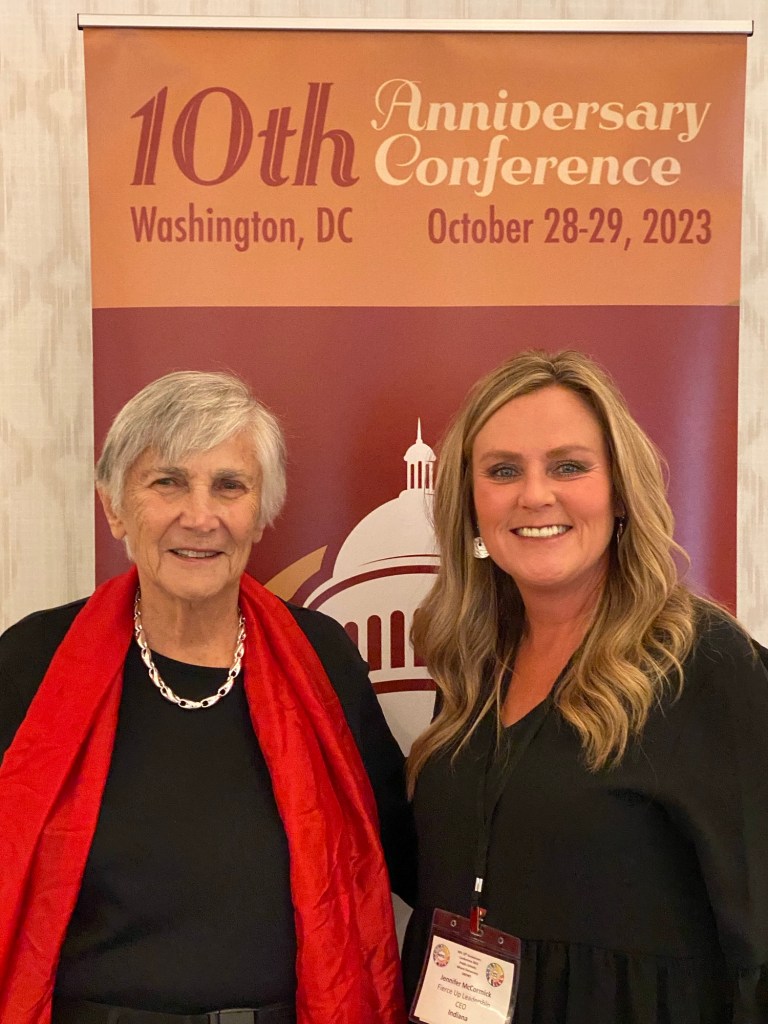
At the NPE conference in D.C. in 2023, JenniferMcCormick and me.

Eva Moskowitz runs the most successful (when measured by test scores) and the most controversial charter chain in New York State. Controversial because her schools are highly regimented, “no excuses” schools where student behavior and dress are tightly monitored. Controversial because her schools have a high attrition rate and a high teacher turnover rate. Outspoken parents complain that their children were “counseled out” or pushed out due to their behavior, their test scores, or their special needs.

Eva expected to expand to 100 schools in New York City but she constantly must fight parents and community schools who oppose her methods. So long as Michael Bloomberg was mayor and Joel was chancellor of the schools, Eva got whatever she wanted. But when they left office a decade ago, Eva had to fight off her critics without the certainty that City Hall. Backed her.

Funding has never been a problem for Success Academy. The chain is a favorite of Wall Street billionaires. Eva is said to have a salary and bonuses that are nearly $1 million. She has purchased properties and leases space to her schools.

Now, Chalkbeat reports, it appears that Eva is pondering open Success Academy schools in Florida, where charter schools are booming.

Alex Zimmerman writes:

Success Academy, New York City’s largest charter operator, is considering an expansion to Florida, a major shift in strategy for the network.

Success founder and CEO Eva Moskowitz said Wednesday she is in search of friendlier terrain for expansion.

New York has been “a rather hostile political environment” for charter schools, Moskowitz testified at a Florida State Board of Education meeting Wednesday morning. She later added: “I want to be in a place that’s high-growth, that’s high-innovation, that is welcoming to parental choice.”

The network’s decision to contemplate expanding beyond New York is a notable shift, as Success has operated schools exclusively within the five boroughs since launching in 2006.

Moskowitz previously outlined aggressive plans to expand to 100 schools locally, roughly double the number that the network currently operates. But Moskowitz and other leaders have faced strong headwinds. Charter schools have fallen out of favor with many Democrats and the sector faces a strict cap on the number of schools that are allowed to operate in the state. The legislature recently allowed 14 new charters to open in New York City, but have not signaled any plans to allow dramatically more than that.

Plus, the city’s charter networks have struggled with declining enrollment in recent years, including Success, though preliminary state figures show the network now enrolls about 21,000 students, erasing pandemic-era enrollment losses. Success is currently looking to open six new schools, according to the SUNY Charter Schools Institute, which oversees Success.

Florida officials, meanwhile, are rolling out the red carpet. The State Board of Education voted Wednesday to designate Success as a “School of Hope” operator, a program designed to attract high-performing charters to the state, offering funding for construction and other startup costs.

Enrollment in Florida’s charter sector has steadily grown in recent years, educating nearly 14% of students, or roughly 400,000 children, state data show. Charters are publicly funded, but privately operated schools.

In her testimony, Moskowitz emphasized that the network’s students are overwhelmingly low-income children of color and their test scores far outpace the city’s district schools — and even affluent suburbs. She also highlighted the network’s track record of preparing students to attend competitive colleges.

“This is exactly what we were envisioning: To have a charter school network to be able to come in and really serve those populations that are in need of this kind of academic rigor, of this performance,” State Education Commissioner Manny Diaz, Jr. said at the Wednesday hearing.

But Success has also been dogged by persistent allegations that school officials push out children who are more difficult to serve, including suspending them or dialing 911when students are experiencing behavioral problems or emotional distress. In 2015, the New York Times reported that one of its Brooklyn campuses had created a “Got to Go” list of troublesome students. Success officials said the list was a mistake and have disputedthat they systematically push children out.

It’s not clear how quickly Success might move to open schools in Florida or even if they will ultimately move forward with plans to do so. A Success Academy spokesperson did not elaborate.

Open the link to continue reading.

Tim Slekar is a fearless warrior for public schools, teachers, and students. I will be talking to him about Slaying Goliath and the struggle to protect public schools from the depredations of billionaires and zealots.

This Thursday on Civic Media: Dive Back into “Slaying Goliath” with Diane Ravitch

Grab your pencils—BustEDpencils is gearing up for a no-holds-barred revival of Diane Ravitch’s game-changing book, *Slaying Goliath*, live this Thursday on Civic Media. 

Launched into a world on the brink of a pandemic, *Slaying Goliath* hit the shelves with a mission: to arm the defenders of public education against the Goliaths of privatization. But then, COVID-19 overshadowed everything. Despite that, the battles Diane described haven’t paused—they’ve intensified. And this Thursday, we’re bringing these crucial discussions back to the forefront with Diane herself.

This Thursday at 7pm EST on BustEDpencils, we’re not just revisiting a book; we’re reigniting a movement. Diane will dissect the current threats to public education and highlight how *Slaying Goliath* still maps the path to victory for our schools. This isn’t just about reflection—it’s about action.

**It’s time to get real. It’s time to get loud. It’s time to tune in this Thursday at 7 PM EST on Civic Media.**

If you believe that without a robust public education system our democracy is in jeopardy, then join us. Listen in, call in (855-752-4842), and let’s get fired up. We’ve got a fight to win, and Diane Ravitch is leading the charge.

Mark your calendars and fire up Civic Media this Thursday at 7pm Central. 

Dr. Julian Vasquez Heilig is a noted scholar of charter schools, with experience as a parent of a charter school student and board member of a charter school. He is Provost and Vice-President for Academic Affairs at Western Michigan University. And, he is a founding board member of the Network for public Education!

Recently, Dr. Heilig testified before the House Committee on Education and the Workforce. He explained that the research on charters shows that they are no more successful than public schools, they close frequently, they have high teacher turnover, and they promote segregation. In addition, they exacerbate the problems of the public schools by choosing the students they want and diverting resources.

Dr. Heilig called for more accountability for charters and the need for democratic oversight.

The Republican majority of the Committee called three witnesses. The Democrats were allowed only one, and they chose Dr. Heilig.

They chose well. His testimony is succinct and excellent.

Indiana blogger Steve Hinnefeld writes about what happens when charter schools go shopping for an authorizer. He tells the story of a charter school that has been dropped by a series of authorizers, but picked up by a new one each time. Why would a new authorizer step in to take responsibility for a charter school that has been dropped by others? I’m not sure about how it works in Indiana, but in most states the authorizer gets a set percentage—typically 3%— of state tuition for each student. That adds up to a lot of money.

Hinnefeld writes:

Trine University came to the rescue eight years ago when Thea Bowman Leadership Academy was in danger of losing its charter and being shut down.

Now Trine has revoked the Gary, Indiana, school’s charter, citing academic and governance issues. But another private institution, Calumet College of St. Joseph, has stepped up.

“It’s funny how things have come full circle,” said Lindsay Omlor, executive director of Education One, Trine’s charter-school-authorizing office.

Today’s topic is authorizer shopping, what happens when charter schools jump from one authorizer to another to stay open or find a better deal. Thea Bowman looks to be taking the practice to a new level. It now has its third authorizer in less than a decade.

Back in 2016, the school’s original authorizer, Ball State University, declined to renew its charter, citing management and fiscal issues. The school turned first to the Indiana Charter School Board, which said no. But it found a willing partner in Trine University.

Now Trine has decided it’s done with the school. Its Education One board voted in December to revoke Thea Bowman’s charter. But school officials, perhaps expecting trouble, had already approached Calumet College. The board of CCSJ Charter Authority, the Calumet authorizing entity, approved a new charter in January.

Under a 2015 law intended to discourage authorizer-shopping, the new charter had to be approved by the State Board of Education. That happened Wednesday.

Thea Bowman is an established school that once served over 1,200 students in grades K-12. It now enrolls 840: Over 90% are Black and 75% qualify for free or reduced-price meals. Its proficiency rates on ILEARN, Indiana’s math and English/language arts test, are well below state averages. A 2022-23 review by Education One found it met standards for fiscal matters and school climate but not for academic and organizational performance.

The state board vote followed a hearing at which the executive directors of Education One and CCSJ Charter presented their findings. Two young women, both committed to school choice, charter schools and their view of high-quality authorizing, described Thea Bowman Leadership Academy in starkly different terms.

CCSJ’s Carrie Hutton took issue with Trine’s conclusion that the school was deficient in academics. Its test scores are improving, she said, and they are as good as or better than those at nearby charter schools and the Gary Community Schools district. She said the college will work with school staff to improve curriculum and add internships and college credit opportunities for students.

Her strongest point may have been that the charter school and the college are part of the same northwestern Indiana urban community. Calumet is in Hammond, next door to Gary, while Trine is in Angola, a two-hour drive to the east.

“They are our neighbors, and their graduates are our co-workers and students in our college,” Hutton said.

But Education One’s Omlor said the school has failed to meet performance targets, and governance issues have persisted. “I can confidently say that the school board lacks the capacity to govern a high-quality school that meets our standards,” she said.

She said the school has a 40% teacher turnover rate, and half its teachers are not fully licensed. She also took aim at CCSJ Charter, saying the authority “made many missteps” and failed to communicate and share information.

Open the link to see what happened.

Governor Ron DeSantis signed a bill limiting the ability of non-parents to initiate book bans. That’s a step forward since any crank was free to challenge any book under previous law. But, the same law made it easier to close public schools and hand them over to the charter industry.

TALLAHASSEE — After more than 1,200 objections were filed to library books and other materials last school year, Gov. Ron DeSantis on Tuesday signed a bill to limit challenges by nonparents or guardians.

The wide-ranging bill (HB 1285) also includes changes designed to ease the process of charter schools taking over operations at traditional public schools that are failing.

The part of the measure dealing with book challenges came after the Republican-controlled Legislature and DeSantis approved measures that ramped up scrutiny of library books and classroom materials, leading to highly publicized disputes.

More than half of the 1,218 book objections during the 2022-2023 school year occurred in two counties, Clay and Escambia, according to a Senate staff analysis. The objections resulted in the removal of 186 books in the two counties.

The bill will require that any “resident of the county who is not the parent or guardian of a student with access to school district materials may not object to more than one material per month.”

During an event Monday, DeSantis said that some people who filed mass objections to books made a “mockery” of the process.

“The idea that someone can use the parents’ rights and the curriculum transparency to start objecting to every single book, to try to make a mockery of this, is wrong. And you had examples where books were put under review that are just normal books that have been in education for many, many years,” DeSantis said.

Meanwhile, parts of the bill related to underperforming public schools would “add some oomph” to the state’s process of allowing charter schools to take over operations, DeSantis said.

Under state law, if a school receives consecutive D or F grades based on various performance criteria, the school is given two years to improve to a C under what’s known as a “turnaround plan.” If the school’s grade doesn’t make such an improvement, one option is for the school to close and reopen as a charter school.

The bill signed Tuesday will speed up converting traditional public schools to charter schools under such circumstances, by giving districts a deadline to execute charter contracts. For schools reopening as charters, districts would have to execute contracts by Oct. 1 of the following school year, and charter organizations would assume “full operational control” by July.

Ed Johnson is a systems thinker and consultant in Atlanta. He cares passionately about the public schools of his city and keeps watch over the actions of the Atlanta Public School Board. Johnson is an adherent of the work of W. Edwards Deming; he believes in thinking of about how to change systems, not in quick fixes or the panacea of the day. In this letter to the Atlanta Public School Board, he takes them to task for their commitment to 50CAN, a school privatization group that was started in Connecticut as ConnCAN and funded largely by the Sackler family.

Ed Johnson writes:

“Join GeorgiaCAN for an informative session on the vision of Atlanta Public Schools!  Gain insights from APS Board member [Dr.] Ken Zeff as he shares his perspective and engages in a parent discussion regarding APS’s vision.  Let’s unite as a community to ensure that our children and the APS community have the resources and support necessary to pave the way for a brighter future.”

—GeorgiaCAN

 We now know GeorgiaCAN is a state-level affiliate of 50CAN, do we not?

 We now know 50CAN stands for 50-State Campaign for Achievement Now, do we not?

 We now know GeorgiaCAN, as a 50CAN affiliate, pushes destroying public education and public schools with school choice, charter schools, and vouchers, do we not?

 We now know, in December 2019, we had AJC parroting and giving prominent voice to GeorgiaCAN spouting free market school choice ideology, do we not?

 We now know, in August 2023, we had Atlanta school board members Katie Howard, District 1, and Erika Mitchell, District 5 and current school board chair, involved with GeorgiaCAN, do we not?

 And we now know, in September 2023, we had The King Center giving the 50CAN CEO a platform for some inscrutable reason, do we not?

 So, let’s consider Ken Zeff in the way The King Center was considered last September:

 50CAN evolved from ConnCAN (Connecticut CAN).  ConnCAN was funded pretty much wholly by Sackler Family fortunes earned as ill-gotten profits from over-prescribed sales of Oxycontin by the family’s Purdue Pharma.  Because of such greed for profits, hundreds of thousands of people in the U.S. and worldwide have died, and continue to die, from opioid addiction.

 As with similar other organizations and their local operatives—for example, The City Fund and its local operatives, Ed Chang leading reformED Atlanta—it is fairly well-known that 50CAN and its state-level operatives aim to dismantle hence destroy public education as the common good that is foundational to sustaining democracy, so as to transform destroyed public schools into privatized and commodified schools composing competitive education marketplaces.  Think Milton Friedman and the “invisible hand of the market.”

 It is also fairly well-known that 50CAN, like similar other organizations, has advanced its aim to destroy public education by expressly targeting and catalyzing Black communities to demand school choice and charter schools that will magically deliver “achievement now.”

 In effect, 50CAN and such others “politrick” Black communities into facilitating their own destruction and that of their own children.  Again, while “It takes a village to raise a child,” it also takes a village to destroy a child.

 The usual assumption is that charter schools transformed from destroyed public schools are inherently better than “failing public schools.”  This is a lie, plain and simple.  It is impossible for charter schools to be inherently better or worse than “failing public schools.”  Because entropy is a fact of life, our public schools need improvement, have always needed improvement, and always will need improvement.  Reality offers charter schools no grace from the entropy fact of life.

 To assert that charter schools are inherently better than “failing public schools” is like asserting members of a certain group of human beings are inherently superior to members of other groups of human beings, based solely on expressions of variation in some few arbitrarily-chosen human physical features said to signify “race,” which is another lie.

 Charter schools do, however, appeal to certain retributive justice, behaviorally emulative, and selfish consumerist mindsets for which improvement-thinking has always been meaningless, at worst, and theoretical, at best.  50CAN knows this, and so uses it to catalyze Black communities to demand “achievement now.”  “Instant pudding,” the late, great systems thinker W. Edwards Deming (1900-1993) might say.

 Consequently, “Our children can’t wait!” has been a decades-long handy refrain that has always begged easy, quick, learningless change but never improvement with knowledge, which requires learning and unlearning.

 Unfortunately, systems thinking teaches through a nonviolence lens that the more often easy, quick, learningless change happens, the less improvement becomes possible; then, the less improvement becomes possible, the less sustainable democracy becomes; then, the less sustainable democracy becomes, the more societal dysfunctions develop and emerge, after a time, in Black communities and elsewhere; then, the more societal dysfunctions show up, the more the refrain, “Our children can’t wait!”

 It is all a destructively vicious, self-reinforcing feedback loop that 50CAN and similar other destroyers of public education are happy to catalyze in Black communities, in particular, and to support its playing out, if only continually, but continuously, ideally.

 With systems thinking, it really is not hard to understand why some out-of-control-for-the-worse aspects of violent crime in City of Atlanta involving ever more “Black” teenaged children and younger other persons in Black communities has become such a challenge.

 Currently, Atlanta’s culture predictably produces a homicide every 2.3 +/- 4.0 days, while predictably producing an aggravated assault every 3.7 +/- 10.7 hours.

 These are realities Atlanta Police Department data reveal when viewed through a Deming kind of systems thinking lens instead of through a financial accounting-style lens that invariably creates an incomplete or false narrative that the media and others then report as fact.

 Although some are quite capable to look below the performative surface, or show stage, of the proverbial iceberg and down into its greater depths to see and know Dr. Martin Luther King, Jr., was also a profound systems thinker, systems thinking seems generally absent in Black culture; certainly, children labeled “Black” seem never to learn about this deeper and critically important aspect of Dr. King.

 All too often the children learn to conserve racism and so-called white supremacy rather than learn to help humanity relieve itself of these scourges.  The children learn and internalize racial categorization, the false narrative at the heart of racial violence.  It seems the children never learn to internalize an understanding of human variation, the truth at the heart of nonracial nonviolence.

 It is quite puzzling that some fight and rail against racism, all the while conserving it and the “race” lie racism needs in order to exist, in truth.

 Therefore, a question for The King Center must be, why is The King Center giving a platform to 50CAN?

 50CAN and GeorgiaCAN, private organizations known to be about making “Beloved Community” a virtual impossibility, in all respects.

 Given this, we now know Dr. Ken Zeff lied when he swore, in taking the Oath of Office the Charter of the Atlanta Independent School System requires, “I will be governed by the public good and the interests of said school system,” do we not?

 Being involved with GeorgiaCAN necessarily and unavoidably means Dr. Ken Zeff exercises, well, the “choice” to be governed by a private goodand the interests of GeorgiaCAN, hence 50CAN.

 In a discussion during this month’s regularly scheduled school board meeting, Dr. Ken Zeff voluntarily professed quite enthusiastically to being a school choice proponent.

 Well, he was at least honest about it—something we might appreciate, when some other Atlanta Board of Education members have shown they are not so honest about their being in the school choice camp.


Ed Johnson

Advocate for Quality in Public Education

Atlanta GA | (404) 505-8176 | edwjohnson@aol.com

Carol Burris writes here about a charter scandal in South Carolina. Carol is the executive director of the Network for Public Education.

She writes:

Last week, an excellent investigative report on a for-profit-run charter chain appeared in South Carolina’s Post and Courier. Entitled How a Florida principal with a controversial history became a SC charter school kingpin, it was written by Hillary Flynn and Maura Turcotte. These reporters put extraordinary care and diligent research into the piece.  I know because, over the course of a year, Flynn would call me from time to time for insight into the for-profit charter world. There is no transparency in South Carolina. You need FOIAs to determine which schools in the state are even run by for-profits. Here is a summary of what they found. 


Pinnacle, a Florida for-profit corporation, has three charter schools in South Carolina. 

Its creator and owner, Michael D’Angelo, is a former Florida charter school principal who was fired from a for-profit chain. He then moved to another charter, where he wrote himself reimbursement checks with no invoices and got fired again.


Undeterred by his previous failures, D’Angelo tried to open several charter schools in Florida. Despite being told he did “not have the competency to operate a charter school,” he found an accountant, created a for-profit charter management company, and headed to South Carolina to open Gray Collegiate Academy.


When Pinnacle’s school got into trouble with the South Carolina Public Charter School District for noncompliance, Pinnacle went shopping for a new authorizer for its charter school. A Christian college, Erskine College, stepped in. It later accused Pinnacle of fraud. Then, two Pinnacle Schools moved to another Christian College, Limestone College, for authorization. Authorizers receive substantial fees from the schools, a bonanza for cash-strapped colleges. 


The process of authorizer shopping, a common practice in states like Ohio and Michigan with large for-profit sectors, is a glaring loophole in the system. The authorizer, who stands to gain substantial fees from the schools, can provide a new lease of life to a shady charter school. A South Carolina Senate bill aims to curb this practice, but it faces fierce opposition from the charter lobby. The National Alliance of Public Charter Schools even lobbied to ensure that states with multiple authorizers are privileged when getting big CSP grants, further exacerbating the issue of authorizer shopping.


Meanwhile, Pinnacle plans to open two more schools, serving as additional cash cows for D’Angelo and his friends.


You can read the excellent investigative reporting on Pinnacle here. While you must register with the paper to see it, it is not behind a paywall. Kudos to Flynn and Turcotte.