Archives for category: Charter Schools

Kentucky’s outgoing Republican Governor Matt Bevin made clear that he wanted funding for charter schools, but he lost the recent election to Democrat Andy Beshear. The new governor made clear that one of his top priorities was supporting public schools.

However, the State Board of Education and the State Commissioner were appointed by Bevin, and they seem to be holding on until their terms expire.

The Bevin-appointed State Board met to announce its priorities for the 2020 legislative session, which begins in early January. Its list did not include funding for charter schools, which was one of Bevin’s demands. Bevin was a close ally of Betsy DeVos, who visited the state earlier this year to promote school choice.

Even though the board was appointed by Bevin, the members’ priorities show that they heard the voters’ message.

Kentucky Board of Education members unanimously approved a legislative agenda Wednesday that they may not be able to see through. 

Education officials plan to push for full-day kindergarten, reading interventions for the youngest learners and more flexibility for schools in Kentucky’s 2020 legislative session, according to documents made public Wednesday morning. 

And they’ll ask lawmakers to solidify Gov. Matt Bevin’s reorganization of an education board through executive order — the very power Gov.-elect Andy Beshear said he will use to disband the Board of Education.  

School choice initiatives, including funding for charter schools, are missing from the proposed list. Citing waning appetite for charters, Lewis said he only wanted to include legislation that had “some chance of passing.” 

It’s a shift toward the education priorities of Kentucky’s superintendents and its largest school district after more than a year of disconnect between educators and their leaders….

Beshear, who takes office in less than a week, vowed to replace the education boardon “day one.” The new board, he has suggested, would then oust Education Commissioner Wayne Lewis. 

Beshear ran on an education-fueled platform, and said his board replacements would value public education more than “a for-profit charter school company.”

It is possible a new board will elect to push for different education bills in 2020. 

Lewis’ contract allows the board to fire him without cause but requires a 90-day notice. He told reporters Tuesday night he would stay for those 90 days — which would last most of the legislative session. 

The 2020 legislative session begins on Jan. 7.

KDE’s legislative wish list for 2020 signals a slight shift from 2019’s agenda, which focused on school choice measures and increasing flexibility for districts….

Unlike last year, KDE does not specifically ask for a third grade retention law, a controversial measure that holds back third graders until they read at grade level. 

A retention law filed last session was ultimately gutted before failing to make it to a vote. 

This article about charter real estate dealings was written by Professors Preston Green III, Bruce Baker, and Derek W. Black.

They argue that lax state laws allow charter operators to reap profits while maintaining an ostensibly “nonprofit” status.

While critics charge that charter schools are siphoning money away from public schools, a more fundamental issue frequently flies under the radar: the questionable business practices that allow people who own and run charter schools to make large profits.

Charter school supporters are reluctant to acknowledge, much less stop, these practices.

Given that charter schools are growing rapidly – from 1 million students in 2006 to more than 3.1 million students attending approximately 7,000 charter schoolsnow – shining a light on these practices can’t come too soon. The first challenge, however, is simply understanding the complex space in which charters operate – somewhere between public and private.

Unregulated competition

Charters were founded on the theory that market forces and competition would benefit public education. But policy reports and local government studiesincreasingly reveal that the charter school industry is engaging in the type of business practices that have led to the downfall of other huge industries and companies.

Charter schools regularly sign contracts with little oversight, shuffle money between subsidiaries and cut corners that would never fly in the real world of business or traditional public schools – at least not if the business wanted to stay out of bankruptcy and school officials out of jail. The problem has gotten so bad that a nationwide assessment by the U.S. Department of Education warned in a 2016 audit report that the charter school operations pose a serious “risk of waste, fraud and abuse” and lack “accountability.”

Self-dealing

The biggest problem in charter school operations involves facility leases and land purchases. Like any other business, charters need to pay for space. But unlike other businesses, charters too often pay unreasonably high rates – rates that no one else in the community would pay.

One of the latest examples can be found in a January 2019 report from the Ohio auditor-general, which revealed that in 2016 a Cincinnati charter school paid $867,000 to lease its facilities. This was far more than the going rate for comparable facilities in the area. The year before, a Cleveland charter was paying half a million above market rate, according to the same report.

Why would a charter school do this? Most states require charter schools to be nonprofit. To make money, some of them have simply entered into contracts with separate for-profit companies that they also own. These companies do make money off students.

In other words, some “nonprofit” charter schools take public money and pay their owners with it. When this happens, it creates an enormous incentive to overpay for facilities and supplies and underpay for things like teachers and student services.

Many millions of dollars of public funds that were intended to educate children are squandered, they say.

It is called “legal graft.”


New Hampshire has divided government. The governor is a Republican, who chooses the State Commissioner. But in the last election in 2018, Democrats won control of the legislature.

The State Commissioner is a home-schooling parent who is hostile to public schools. He comes from the Betsy  DeVos mold.

Speaking of DeVos, she gave New Hampshire $46 million from the federal Charter Schools Program, which is her own $440 million slush fund to promote charters.

If spent, this money would double the number of charters in the state, a dramatic expansion.

But the Legislature used its powers to hold up the grant. They want answers to their questions about how the state’s public schools would be affected, and how the charter expansion would affect the state’s finances.

The pending charter expansion grant – the largest earmarked for any state – aims to double the number of charter schools in New Hampshire over the next five years. It is currently on hold, after Democrats on the Joint Legislative Fiscal Committee cited concerns that building more charter schools would lead to unanticipated costs for the state and harm existing, non-charter public schools. 

Governor Chris Sununu criticized the hold, calling the money a “game-changing grant [that] would have cost New Hampshire taxpayers nothing.”

But an analysis by the public education non-profit Reaching Higher estimated that, because charter schools are typically funded by the state rather than local districts, the state’s plan to expand charters with this grant money could cost the state over $100 million in the next ten years.

Is this a pig in a poke?


On November 26, the New York Times published an article that had this headline: ‘Minority Voters Chafe As Democratic Candidates Abandon Charter Schools.’

The point of the article was that many black and Latino families are very disappointed that all the Democratic candidates have turned their backs on charter schools, excepting Cory Booker, currently polling around 1-2%. The article was especially critical of Senators Bernie Sanders and Elizabeth Warren, who have, as the article put it, “vowed to curb charter school growth.”

The article implied that the shift was due to the candidates’ pursuit of the support of the teachers’ unions, and charter schools are mostly non-union. Thus, if you want the union vote, you oppose non-union charters. (In my experience, neither the AFT nor the NEA is anti-charter, since they seek to organize charters to join their unions and have had some modest success; still, about 90% of charters are non-union.)

The article was prompted by an organized disruption of a speech in Atlanta by Elizabeth Warren, who was talking about a washerwomen’s strike in Atlanta in 1881, led by black women. The disruption was led by Howard Fuller, who, as the article notes, has received many millions from rightwing foundations, not only the Waltons but the Bradley Foundation in Milwaukee, to sell vouchers and charters to black families.

Not until paragraph 25 does the article mention that the national NAACP, the nation’s largest organization representing black families, called for a charter moratorium in 2016. That fact alone should raise the question of how representative the protestors are.

I wrote this post about the article. The gist of my complaint was that the Times’ article gave the impression that black and Latino families are clamoring for more charters, when in reality there are many cities in which black and Hispanic families are protesting the destruction of their public schools and the loss of democratic control of their schools.

I questioned why the article relied on a five-year-old press release from the National Alliance for Public Charter Schools as evidence for its claim that the “wait list” for charter schools was in the “hundreds of thousands.” Actually, the 2014 press release from the charter advocacy group said the “wait list” topped one million students. My comment was that “wait lists” have never been audited or verified and that a claim by a lobbying group is not evidence.

I added to my post a commentary by Robert Kuttner, the editor of the American Prospect,  who was also critical of the article.

Both Kuttner and I heard from a reporter from the New York Times. In the response posted below, he acknowledges he made an error in citing poll data in the article, without reading the underlying poll.

I heard from one of the writers of the Times article. She said my post had many inaccuracies. I invited her to write a response and promised I would post it in full. I pleaded with her to identify any inaccuracies in my post and said I would issue a correction. She did not send a response that I could post nor a list of my “inaccuracies.”

The Times posted an article last July about the growing backlash against charter schools. But I do not think the Times has exhausted the question of why the charter “movement” is in decline.  It would surely be interesting if the Times wrote a story about why the NAACP took a strong stand against charter expansion, despite the funding behind charters. Or why Black Lives Matter opposes privatization and supports democratic control of schools. Or why black families in Little Rock, Chicago, Houston, and other cities are fighting charter expansion. None of those families are funded by the Waltons, Bill Gates, Eli Broad, Charles Koch, or Michael Bloomberg, so they don’t organize buses to take hundreds or thousands of people to demonstrations.

The Times should take note of the fact that white Southern Republicans have made the charter issue their own, and they are using it to recreate segregated schools. Indeed, the Republican party has made charter schools and vouchers the centerpiece of their education agenda, and Democrats in most state legislatures have resisted that agenda and support public schools. There is also the fact that DeVos and Trump are pushing charters and school choice even as they dismantle civil rights protections.

I wish the Times had noticed a court decision in Mississippi a few months ago that upheld the right of the state to take tax money away from the predominantly black public schools of Jackson, Mississippi (which are 96-97% black), and give it to charter schools authorized by the state, not the district. They might note that the sole black justice on the Mississippi Supreme Court, Justice Leslie King, dissented from that decision. The district, under black leadership, fought that decision and lost. The black parents of Jackson, Mississippi, are fighting for adequate funding of their public schools, while the white Republicans in state government are imposing charter schools.

In Justice Leslie King’s dissenting opinion, which Justice James Kitchens joined, he wrote “This Court should not be a rubber stamp for Legislative policies it agrees with when those policies are unconstitutional.”

Public school districts in Mississippi receive local funding from ad valorem tax receipts. When a student enrolls in a charter school, which is a free public school, money that would have gone to the district follows the student to the charter school instead.

My view is that we need a great public school in every neighborhood, with experienced teachers, a full curriculum, a vibrant arts program, a nurse, and all the resources they need for the students they enroll. I think that charter schools should be authorized by districts to meet their needs and supervised by district officials to be sure that there is full transparency and accountability for the academic program, the discipline policies, and the finances. Charter schools should complement public schools, not compete with them or supplant them.

Here is Robert Kuttner’s second commentary on the article:

americanprospect


DECEMBER 2, 2019

Kuttner on TAP

Charter Schools and the Times: a Correction and Further Reflections. I made an error in my On Tap post last week on the New York Times feature piece on black public opinion and charter schools.

My post criticized the Times for publishing a page-one story with an exaggerated headline, “Minority Voters Feel Betrayed Over Schools.”

The Times piece cited a poll showing black support for charter schools at 47 percent. My mistake was to infer from this figure that black support and opposition were about equally divided. As one of the story’s authors pointed out in an email, the actual poll showed support at 47 percent, opposition at 29 percent, and no opinion or similar for the rest.

That 29 percent opposed figure was not mentioned in the Times piece. Nonetheless, I should have pursued the underlying poll and reported it, and not just made assumptions. I regret the error.

That said, polling results vary widely depending on the wording and framing of the question, the sponsor of the poll, and the context. For instance, a poll by the Public Policy Institute of California, in a state that has more charters than any other, reverses the finding of the Education Next poll cited by the Times. In California, blacks, with just 36 percent support, were far less likely to support charters than whites.

One of the two polls that the Times linked to used the phrase “public charter schools.” Most charter schools are public only in their taxpayer funding; their actual accountability to public systems varies widely. Many are for-profit, or nominally nonprofit but managed by for-profit management companies.

Another poll, which my post cited, by Peter Hart Associates (for the American Federation of Teachers), finds that black parents are strongly opposed to the idea of reducing funds for public schools and redirecting them to charters, which is often the practical impact of increased spending on charters. As this study shows, the practical effect of charters, in a climate of fiscal scarcity, is often precisely to divert funds from public schools.

I owe our readers a much deeper look at the charter school controversy, as well as error-free reading of polls. Both will be forthcoming. ~ ROBERT KUTTNER

Robert Kuttners new book is The Stakes: 2020 and the Survival of American Democracy.

Follow Robert Kuttner on Twitter

Indiana legislators have rewritten state laws to favor privatization of public assets. If a public school is considered unutilized, a charter operator can claim it for only $1. When the West Lafayette school district sued to challenge the law, a judge sided with the legislators. Give the public school away to a private operator, even though it belongs to the public who paid for it!

Karen Francisco, the brilliant editor of the Fort Wayne Journal Gazette, writes here that the state’s political leadership is conspiring against the public interest by giving away public property to entrepreneurs. More than once, the  public has been fleeced by shady charter operators in search of profit.

The “real estate racket” that the legislature endorsed on behalf of charter entrepreneurs is draining millions of dollars away from taxpayers in Indiana and other states.

It would take an accountant to disentangle the tangled web of real estate deals that allow charter operators to rip off the public.

Francisco tries to explain it here:

A decade ago, The Journal Gazette reported a local charter school, Imagine MASTer Academy, was using state tax dollars to pay a for-profit landowner nearly triple in rent what it could have paid to own its building outright.

No one – not the governor, attorney general or any lawmaker – stepped up to protect taxpayers from that poor deal. None showed interest in the growing number of national headlines about charter school real estate scams. In announcing last week it was getting out of the charter school business, the former property owner of Imagine MASTer Academy illustrated why West Lafayette and other public school districts must challenge Indiana law.

Admittedly, the complex shell game is tough to follow, but no one should doubt who is prospering when an out-of-state real estate investment company boasts of 10.5% returns on a charter school portfolio that just sold for $454 million. Is it any wonder Indiana teacher salaries weren’t growing?

EPR Properties of Kansas City, Missouri, bought Imagine’s North Wells Street campus in 2008 from Schoolhouse Finance, the real estate arm of Imagine Schools Inc., a management group hired by businessman Don Willis and other area residents to operate the local charter school. The sales price was $5.5 million. Two years earlier, Schoolhouse had bought the campus from the YWCA. EPR, a real estate investment trust, sold it back to Schoolhouse eight years later for nearly $7.4 million. Just two years later, it was sold to Wallen Baptist Church for $3.25 million.

In the interim, Indiana taxpayers made rent payments of nearly $2 million in a three-year period alone. Under a triple net lease, the public was also on the hook for the for-profit company’s property taxes, insurance and maintenance. When the charter school faced closure because of poor academic performance in 2013, Imagine was converted to Horizon Christian School. State officials, under another charter-friendly law, forgave $3.6 million in loans to Imagine.

We don’t know how much Horizon Christian School paid in rent during its six years at the Wells Street site.Although the school, now at3301 E. Coliseum Blvd., is supported almost entirely by taxpayer-funded vouchers, its financial affairs are not subject to public access laws.

The entrepreneurs are betting that the public won’t be able to follow the trail of bread crumbs that transfers millions of dollars from taxpayers to the bank accounts of private corporations.

The celebrated Boston charter City on a Hill is closing one of its schools and imposing budget cuts at another due to falling enrollments.

Once a shining star in the Boston charter school world, City on a Hill Charter School is facing a massive financial crisis, prompting trustees on Monday to enact a series of dramatic budget cuts: It will lay off 23 teachers, administrators, and other staffers at its Roxbury and New Bedford campuses and will close the New Bedford campus in June.

This is a really difficult decision and we don’t take it lightly,” said Cara Stillings-Candal, chair of the trustees in an interview following their Monday morning board meeting. “We wouldn’t have made these decisions if it wasn’t in the best interest of families and students.”

The sweeping budget cuts represent the latest turbulent turn for the nearly 25-year-old charter school, which has been struggling with high leadership turnover, lackluster academic performance, and financial woes. Earlier this year, state officials placed the New Bedford campus on probation, and a year earlier teachers at all three sites unionized, a rarity for independent charter schools, which place a premium on operational autonomy.

The severity of this fall’s financial crisis emerged after headcounts at the three campuses revealed enrollment had dropped for a second year in a row. That, in turn, will lead to a loss of hundreds of thousands of dollars in per-student aid from the state and federal governments. The three campuses operate as independent schools overseen by a single board of trustees and an executive team.

Just 570 students are currently enrolled in grades 9-12 across City on a Hill’s three campuses, leaving 270 seats empty. The Boston campuses receive about $20,000 per student in state aid and the New Bedford site gets about $15,000 per student. Last year’s enrollment drop resulted in an $842,000 loss in state and federal aid.

The decline in charter enrollments mirrors a trend seen in a few states, like Michigan, where charters have lost their luster.

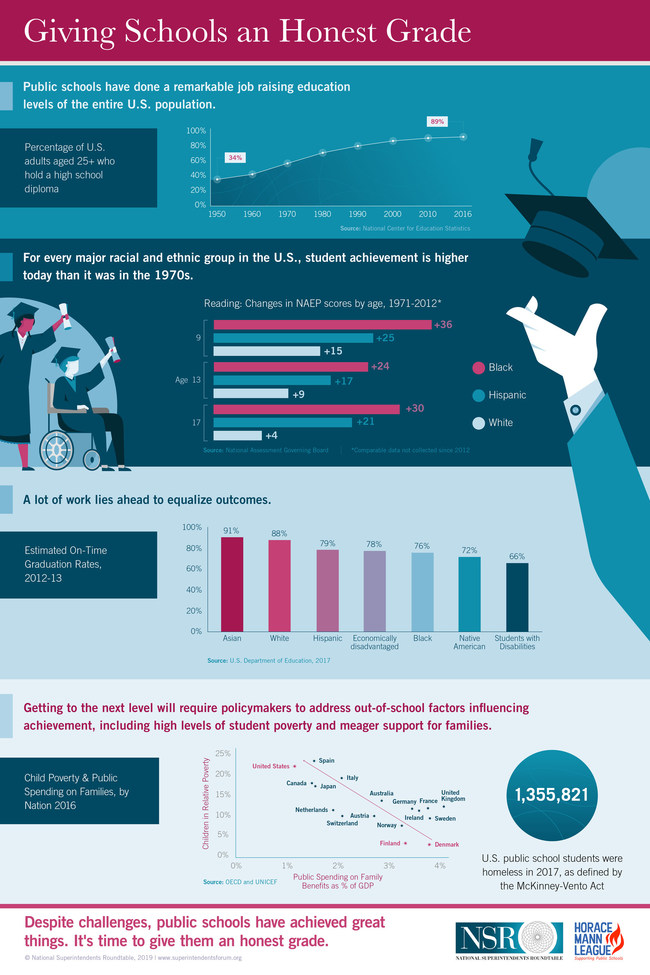
The National Superintendents Roundtable has a message for the public: be fair when judging our public schools. Schools today are far better than they were 40 or 50 years ago, by all conventional measures. what they might have added was that schools made steady progress until about 2007 or so, when No Child Left Behind took hold, then things were made worse by Race to the Top and Common Core. The proliferation of choice has flattened the progress made from 1970 to 2007.

Helen Ladd is one of our nation’s most distinguished economists. She has written extensively about education and poverty, as well as school choice.

Dr. Ladd informed me that she has written some new scholarly articles about charter schools.

I read them and was impressed.

I asked if she would let me post them here. She said that they are on a website that has limited access.

However, she said, the articles are now available and accessible to individuals who download them.

You can find the links on her web site:

https://sanford.duke.edu/people/faculty/ladd-helen-f

Or You may go directly to the links to the articles on the web site.

https://sanford.duke.edu/sites/sanford.duke.edu/files/images/Ladd-2019-Journal_Policy_Analysis_and_Management_Charter%20Schools.pdf

https://sanford.duke.edu/sites/sanford.duke.edu/files/images/Ladd-2019-Journal%20Policy%20Analysis%20%26%20Management%20Experimentation.pdf

Dr. Ladd asked me to point out that she was invited to write as part of a Point-Counterpoint discussion in the Journal of Policy Analysis and Management.  The author of the pro-charter paper and response, which are not posted here,  was  Philip Gleason from Mathematica.

I do not have access to links for the Gleason part of the exchange.


Many people have written to me to complain about an article that appeared Wednesday on the front page of the New York Times, saying it was pro-charter propaganda. The article claims that black and brown parents are offended that the Democratic candidates (with the exception of Cory Booker, now polling at 1%) have turned their backs on charter schools.

This is not true. Black parents in Little Rock, Arkansas, are fighting at this very moment to stop the Walton-controlled state government from controlling their district and re-segregating it with charter schools. Jitu Brown and his allies fought to keep Rahm Emanuel from closing Walter Dyett High School, the last open enrollment public high school on the South Side of Chicago; they launched a 34-day hunger strike, and Rahm backed down. Jitu Brown’s Journey for Justice Alliance has organized black parents in 25 cities to fight to improve their neighborhood public schools rather than let them be taken over by corporate charter chains. Black parents in many other districts–think  Detroit–are disillusioned with the failed promises of charter schools. Eve Ewing wrote a terrific book (Ghosts in the Schoolyard: Racism and School Closings on Chicago’s South Side) about resistance by parents, grandparents, students, and teachers in the black community to Rahm Emanuel’s mass closings of public schools to make way for charter schools; Ewing called their response “institutional mourning.” When Puerto Rico teetered on the verge of bankruptcy, parents, teachers, and students rallied against efforts to turn the Island’s public schools over to charter chains.

The article’s claim that “hundreds of thousands” of students are on “waiting lists” to enroll in charters links to a five-year-old press release by a charter advocacy group, the National Alliance for Charter Schools. In fact, there has never been verification of any “wait list” for charters. Although there are surely charters that do have wait lists, just as there are public schools that have long wait lists, there is no evidence that hundreds of thousands of students are clamoring to gain admission to charters. That claim appears to be a marketing ploy. Earlier this year, a member of the Los Angeles school board revealed that 80% of the charters in that city have empty seats. Just this past week, a well-established Boston charter announced that it was closing one campus and consolidating its other two because of declining enrollments. Four of Bill Gates’ charter schools in Washington State have closed due to low enrollments. The only effort to verify the claim of “waiting lists” was carried out by Isaiah Thompson, a public radio reporter in Boston; his review showed that the list contained many duplications, even triplications, since many students applied to more than one school, and the same lists held the names of students who had already enrolled in a charter school or a public school.

Perhaps the Times will now interview Dr./Rev. Anika Whitfield in Little Rock to learn about the struggles of Grassroots Arkansas to block the Walton campaign to destroy their public schools. Perhaps its reporters will interview Jitu Brown to hear from a genuine civil rights leader who is not funded by the Waltons or the Bradley Foundation or Betsy DeVos. Perhaps they will dig into the data in Ohio, where 2/3 of the state’s charter schools were rated either D or F by the state in 2018, and where the state’s biggest cyber charter went into bankruptcy earlier this year after draining away over $1 billion from public schools’ coffers. Perhaps they will cover the news from New Orleans, the only all-charter district in the nation, where the state just posted its school scores and reported that 49% of the charters in New Orleans are rated either D or F. Perhaps they will cover the numerous real estate scandals that have enabled unscrupulous charter operators to fleece taxpayers.

Fairness requires that the New York Times take a closer look at this issue, not by interviewing advocates for the charter industry but by trying to understand why so many Democrats, especially progressives, have abandoned the charter crusade. Why, as the Times asked in July, have charter schools lost their luster?  (I asked the same question last April.) [Editor’s note: I added these two links to refer to use of the term “lost their luster.”] Why have the number of new charters plummeted nationally despite the expenditure of $440 million a year by the federal government and even more by foundations like Gates, Broad, DeVos, Bloomberg, Koch, and Walton. Maybe it was disappointment in their lackluster, often very poor, academic performance. Or maybe it was the almost daily revelations of waste, fraud, and abuse that occurs when public money is handed to entrepreneurs without any accountability of oversight.

The question that must be answered is whether it is just and sensible to create two publicly funded school systems, instead of appropriately funding the public schools that enroll 47 million students, almost 90% of all students. It serves the interests of billionaires to keep people fighting about governance and structure, but it serves the interest of our society to invest in great public schools for everyone.


ON TAP Today from the American Prospect

NOVEMBER 27, 2019

Kuttner on TAP

The Times: In the Tank on Charter Schools. The Times ran an overwrought and overwritten front-page story Wednesday under the breathless headline, “Minority Voters Feel Betrayed Over Schools.” Betrayed? The headline on the jump page where the story continues is even more exaggerated: “Minority Voters Chafe as Democrats’ Charter School Support Wanes.”

The piece reads as if it were dictated by the charter school lobby. Read the story very carefully, if you bother to read to the end, and you will learn that some black and Hispanic voters see charters as a good alternative to public schools, while others are concerned that charters, which serve only a fraction of minority kids, drain resources from the larger number of kids in public schools, as the Prospecthas documented.

And if you read all the way to paragraph 38 (!), you will learn that according to a poll by Education Next, a journal that supports charters, black opinion on charter schools is in fact evenly divided, 47 percent supportive to 47 percent opposed. But that kind of nuance doesn’t get your story on the front page, while quoting fervent charter school activists and making unsupported generalizations does.

Other 2017 polling by Peter Hart Associates showed that large majorities of voters, black and white, oppose shifting funds from public schools to charters. Black parents were opposed, 64 to 36. Hart’s Guy Molyneux says there’s no evidence that these views have changed.

Does the Times have fact-checkers? Editors? Do they hold writers accountable?

Back to school!

Robert Kuttner’s new book is The Stakes: 2020 and the Survival of American Democracy.

Happy Thanksgiving!

Today is a day when we pause and give thanks to whatever deity we worship (or not) for the blessings we enjoy: our freedom, our family, our friends, and our good fortune to live in a democracy where we are all responsible for making it better for our brothers and sisters.

I want to share with you a profound speech delivered by our good friend Rev. Dr. Charles Foster Johnson about religious liberty and the public schools and the future of our democracy.

Charlie Johnson is the founder and leader of Pastors for Texas Children. PTC has led the fight against vouchers in Texas and has helped like-minded religious leaders in other states form their own organizations to support religious liberty and public schools. I never expected, at this late chapter in my life, to discover that I have a dear friend who is a Baptist minister in my home state of Texas. I admire his courage, his intellect, and his passion for the common good. Needless to say, he is on the honor roll of this blog, and I name him as a hero of the Resistance in my forthcoming book Slaying Goliath. I can’t think of a better way for you to spend a few free minutes on this day than to read this wonderful speech.

This is the only post you will receive today. Enjoy the day. Read this speech.


J.M. Dawson Lecture on Religious Liberty

“Religious Liberty, the Public School, and the Soul of America”

Baylor University

October 7, 2019


     I am deeply honored to deliver the J.M. Dawson Lecture on the Separation of Church and State, and I am humbled to offer a few remarks in the name and legacy of this remarkable Baptist leader and great American on the bedrock principle of religious liberty and its practical corollary, the separation of the church and the state in public affairs.


     When I spoke recently with my oldest granddaughter Corley, who is age 10, she asked me what I was doing. I told her I was preparing a sermon for my friends at Baylor University on “Religious Liberty, the Public School, and the Soul of America.” She said, “Papa Charlie, you always use the biggest words… what does all that mean?”


     I learned a long time ago that if the preacher can’t explain a concept to a child, then he or she doesn’t quite get it either. So, I drew a breath and said something like this, “Sweetie, God made us free people. No one can make you love God. No one can prevent you from loving God. It is our choice. All faith in God is voluntary. It is your decision. No one can make that decision for you. Not your parents, not your friends, not the president or the police or the law or the government. Only you.”


     Then this granddaughter of two Baptist preachers on her mama and her daddy’s side (she doesn’t have a chance) said, “I know, Papa Charlie! We talked about that at church. And, we talked about that at school too.”


Religious Liberty


     Throughout our lives, we have had a sustained theological critique of the Enlightenment and its emphasis on the individual. This project of correction, as I understand it, notes that the philosophical framework through which the modern sensibility has been shaped places undue importance on the autonomy of the individual and gives inadequate attention to the influence of community. There has been something of a robust debate about this dialectic between the individual and the community, about the historically baptist and catholic understandings of authority and epistemology, and the cultural, moral, and theological implications of these respective worldviews. This university has been a key participant in this debate. Some of you here today have contributed significantly to it.


     It certainly makes sense to me. As a pastor for over 40 years, I have abundantly observed folks who believe all reality begins and ends with themselves, and who exercise little submission to anyone or anything but themselves. We have this psychological and spiritual dysfunction on vivid display in our highest leaders today. We have certainly paid a high price for this narcissism. We like the immortal figure of Greek mythology, fixate on ourselves, and die in the process.


     But, we do not have to fall for the myth of autonomous individualism to affirm the irreducible and inviolate freedom of the human conscience. In this day of mass society, where corporate conglomerates monitor our every thought, news networks disseminate state propaganda, media machines determine our daily consumption, and pastors become mouthpieces for Caesar, that we need a recovery of individual freedom. Isn’t it the day and time for us to reaffirm the power and freedom of the individual, and to call for a new assertion of individual rights and responsibilities, and to inculcate all over again in our students and congregants an individual and personal decision-making power?


     Forgive the patriarchal references, but I remember Will Campbell saying at Mississippi College in 1978 something to this effect: “I am less free than my daddy, my daddy was less free than my granddaddy, and my granddaddy was less free than my great-granddaddy.” I had no clue then what on earth he meant by such a cryptic remark. But I do now. And so do you.


     We today are like the Grand Inquisitor of Dostoevsky’s famous story who has Christ arrested for cursing humanity with freedom. The Inquisitor concluded that Christ made a strategic error in not turning stones to bread, not casting himself off the pinnacle of the Temple, not ruling over the kingdoms of this world, for these things would have sealed his leadership and people would have followed him. But instead, Christ remained free, and gave us the burden of freedom. The Grand Inquisitor says, “anyone who can appease a man’s conscience can take his freedom away from him.” No kidding. We see it every day.


     God has created human freedom as a reflection of God’s own freedom, God’s own non-contingency, as the theologians would put it. The individual liberty accorded every person is a work of God in Creation, and an integral feature of human worth and dignity.


      A core component of this freedom is at work in the realm of religion. Religious liberty and is the right and choice of the human—the “inalienable” right, as Jefferson immortally put it—to worship God according to the compulsion of his or her own individual conscience, or not to worship God at all.


     To say the term “religious freedom” is to speak a paradox of immense power and implication. The very impulse of religion is submission to a power outside oneself, to cast oneself in categorical terms upon God in a posture of what Schleiermacher called “absolute dependence.” The project of any religious concern is the relinquishment of one’s own autonomy to the hegemony of God.  


     In a sinful world, full of idols that vie for our submission, the individual made in the image of God is the only entity competent to make this decision. Christ quoted the Psalmist in his reply to Satan in the temptation in the wilderness, “You shall worship the Lord your God, and him only shall you serve.” This is the great baptist understanding. There is no other legitimate and competent authority other than the individual to make a religious decision. This is what we mean when we speak of “soul competency,” as E.Y. Mullins put it:

     “Religious liberty excludes the imposition of religious creeds by ecclesiastical authority. Confessions of faith by individuals or groups of men [and woman], voluntarily framed and set forth as containing the essentials of what men [or women] believe to be the Gospel are all right. They are merely one way of witnessing to the truth. But when they are laid upon men’s [or women’s] consciences by ecclesiastical command, or by a form of human authority, they become a shadow between the soul and God, an intolerable yoke, impertinence, and a tyranny.” (“The Baptist Conception of Religious Liberty,” 1923)

     Therefore, all religious activity must be strictly voluntary on the part of the individual. There can be no coercion in these matters, and certainly no collusion with the state in them. In fact, no institution whether the church or the state, possesses any competency to make any religious decision on behalf of an individual. Virginia baptist preacher John Leland put it this way:


“Let every man speak freely without fear, maintain the principles that he believes, worship according to his own faith, either on God, three Gods, no God, or twenty Gods; and let government protect him in so doing, i.e., see that he meets with no personal abuse, or loss of property, from his religious opinions.”


     The corollary to this God-given religious liberty is the principle of the strict separation of the church from the state. In our work in Pastors for Texas Children, we refer to religious liberty as a gift from God to all people, and note that James Madison did not make it up. God did. Madison took an eternal spiritual truth that God authored and wrote it down in an extraordinary sentence that comprises the First Amendment to the Constitution of the United States: “Congress shall make no law respecting an establishment of religion, or prohibiting the free exercise thereof.”


     Leland’s influence over James Madison is well-known by everyone in this room today. When Madison learned that Leland might challenge him for his seat in the House of Representatives, Madison forged a compromise with Leland that resulted in the popular baptist preacher standing down from his electoral challenge in exchange for Madison’s championing of the principle of church/state separation. And the rest, as we say, is history.


     It is not an overstatement to say that religious liberty is the principle upon which our nation was founded. A free church in a free state. And long before America came along the first pastor of the church told his congregation at Galatia, “For freedom Christ has set us free. Stand fast, therefore, and do not submit to a yoke of slavery.”


     Corley, my ten year old granddaughter, knows this. She learned it at church. And she learned it at school.


The Public School


     The public school is the building block of American democracy. It is the cornerstone of our national life. It was determined at the outset of our Republic that the American experiment might have a chance of succeeding if we educated all our children in a public trust—not just those fortunate enough by reason of their class and station to receive an education.


     In 1785 John Adams said, 


“The whole people must take upon themselves the education of the whole people and be willing to bear the expenses of it. There should not be a district of one mile square without a school in it, not founded by a charitable individual, but maintained at the public expense of the people themselves.”


Clearly, this founding father of our Republic saw public education as central to our social contract and fundamental to the provision of the common good.


     Universal education is a moral mandate rooted in the faith tradition. In the creation story itself, God brought all of creation to the human to see what the human would name it. This “naming” impulse is education. It is central to the first charge God gives to the human, “to be fruitful and multiply, replenish the earth, and subdue it.”   


     The first schools in America were founded by faith communities.  Shortly thereafter, at the dawn of our Republic, people of faith realized that an educated populace was essential for the preservation of democracy and self-governance.  Therefore, public education for all children in America was birthed out of a moral sensibility. That conviction was encoded in constitutions of the respective states as our nation expanded westward. Virtually every state constitution has a mandate for public education.  Our own Texas State Constitution in Article 7, Section 1, says this: 

“A general diffusion of knowledge being essential to the preservation of the liberties and rights of the people, it shall be the duty of the Legislature of the State to establish and make suitable provision for the support and maintenance of an efficient system of public free schools.”

     For these reasons of profound moral and religious motivation, public school educators often are faith leaders themselves. They serve as pastors, ministers, elders, deacons, Sunday school teachers, youth and children’s leaders, committee chairpersons, mission and music directors, accompanists, and many other ministry positions in the life of the church.


     It is axiomatic among congregational pastors that the persons we turn to for religious instruction of our children are our public school teachers. Furthermore, it is common for a local church pastor’s spouse to teach in the nearby public school.  This has been a time-honored clergy couple vocational package for decades.  Our sons and daughters are employed in the public schools as coaches, bus drivers, cafeteria workers, and custodians.


     Public schools are filled with many people of faith. These teachers, principals, and school staff bow their heads in our houses of worship with us, serve and fellowship alongside us, and model their faith in schools and classrooms, following the spirit of 1 Peter 4:10, “Each of you should use whatever gift you have received to serve others, as faithful stewards of God’s grace in its various forms.”


     This is why an affirmation of universal and public education can be found in the denominational documents of all faiths.  It is a universal human right accorded every child be virtue of being on God’s planet.


     Schools and churches remain inextricably bound together in every community. 90% of our children in our churches attend public schools. The rest attend all the other models of education, whether private, online, and home schools. We appropriately affirm all these models of education.  Indeed, our congregations are comprised of leaders in all these diverse school models.


     We see the local public school and its classroom as a center of God’s love.  Education is a gift from Almighty God accorded to every human being regardless of race, religion, economic status, and special need.  The public school, unlike the private school, receives and accepts every single child that shows up on its steps, and meets that child’s needs as sensitively and lovingly as possible. 


     Our loved ones and fellow church members do not leave God at the door of the school house as they go about their daily duties.  They carry the love and grace of God with them every hour of every day.  Indeed, they show love, unconditional acceptance, and physical assistance to children who have special needs, come from emotionally deprived circumstances, and suffer the ill-effects of crushing poverty. It’s what a teacher does.  It’s a calling before God.


     My own daughter-in-law, who is a public school educator, did not get the memo that God has been taken out of our schools.  She takes the longsuffering love that she showers on our grandchildren into the classroom with her, and pours it out on children from the community all day long. Corley is not the only recipient of it. All the children in her classroom receive it.


     Our neighborhood and community public schools are the primary vehicles for perpetuating civil society, promoting human equality, strengthening our economy, and ensuring continued democratic reform in our nation and world. 


     The public school is the proving ground for religious liberty and the principle of church/state separation. Here our children witness firsthand that their own religious experience is not given preference over anyone else’s. Here they see early on the tremendous power of voluntary and personal faith, that faith is something expressed and brokered by them—not by some official institutional leader. To use a familiar term, they discover their own individual priesthood.


     Public education advances moral and civic values through early investments to give every student a fair shot and the tools needed to pursue a more prosperous, self-sufficient future. These investments reap significant long-term economic dividends and savings generated from fewer societal problems, benefiting all of us.


     By investing in public education, we invest in the future of 50 million American schoolchildren. This basic investment is the key to a child’s future economic mobility, the financial stability of families, and our long-term economic prosperity. We know, because it is well-documented, the direct correlation between education achievement and economic viability.


     As we have noted, our spouses and church members routinely teach in our public schools. Often in our towns, the public school district is the chief employer and economic generator of our communities.  As goes the financial health of our public schools, goes the financial health of our churches.  The school is the center of vitality and meaningful, life-enriching activity for our people.  One only need look at the importance of Friday Night Football for folks to see this.


     It is the public schools that serve all children. Not just those of economic means, or whose parents are engaged, or who are from stable homes, or who perform well academically. But, all.


     Over 60 percent of Texas schoolchildren are economically disadvantaged. Public schools cannot be expected to overcome the challenges created by rising poverty, and especially when they are educating more students with less money. The last thing these poor neighborhoods need is to be stripped of their remaining vitality.  


     Texas ranks near the bottom in per-pupil spending nationwide. Bear with a brief history of Texas education policy. In 2011, devastating funding cuts forced school districts to lay off teachers, increase class sizes, and reduce pre-kindergarten programs. In 2013, Texas legislators restored only a portion of the cuts — about 60 percent —leaving a gaping deficit in education funding. In 2015, schools also had to accommodate for student growth, totaling 300,000 more students than in 2011. In 2017, House Education Chairman Jimmie Don Aycock’s proposal to infuse $3 billion new dollars into the public education system was pulled from the floor by that good man because he didn’t have the votes to pass it. Only in this year’s session did we finally get $6.5 billion new dollars for our children’s public education—and only after Texas voters retired some key legislators who oppose public education in the 2018 elections.


     These are profound moral, Biblical, constitutional, and economic reasons for universal education paid for by the public. The case for quality public education is overwhelming.


     So, we wonder what the real agenda is in our legislative assault on public schools? We have witnessed firsthand the cruel attack on our public education system as a “monstrosity.” We are more than a little outraged to hear from some of our elected officials that our public schools are “Godless.”  We have heard with our own ears loose talk of our schools as “failed” and our teachers as “incompetent.” Then, when our own Texas legislature began churning out bills designed specifically to demoralize teachers—vouchers, unlimited charter school expansion, opportunity school districts, tuition tax credits, A-F school rating, parent trigger—our good faith pastoral nature to give benefit of the doubt began to cave to the unpleasant conclusion of something more insidious unfolding before our eyes:  the intentional dismantling of the Constitutionally mandated public trust of universal education.


     The privatization of the public trust of universal education is a thinly veiled disguise to turn the local public school into a profit center for the personal financial gain of a few. State legislatures all over our country are being pressured by rich interests to divert already stretched dollars from our public schools to fund private and charter schools.  We know that the private schools are not asking for this support; they do not want government interference and intrusion into their private assemblies. That is the reason they established the private school in the first place.


     We are deeply troubled by the government expansion and entitlement programs undergirding privatization policies.  Private school vouchers and so-called “school choice” initiatives are nothing but government giveaway programs with no accountability or oversight.  Absent are the myriad stewardship measures the public schools must submit to give account for how state dollars are being spent.  We hear about these overwrought accountability rules from our family and church members all the time.


     We decry the expansion of unlimited charter schools as a replacement for our traditional community and neighborhood public schools, the avalanche of burdensome assessment measures our teachers and students are subjected to, and the de-professionalization of teaching through low wages and bad conditions.


     We must prioritize the adequate funding of our institutions of public education for the benefit of all Texans. Up until the 86th Legislative session, the previous Texas legislatures have seen contentious fights over public education policy and the dramatic cuts to public school funding. This must stop now.


The Soul of America


     There are two competing visions for the soul of our nation: one weakens the public and one strengthens it. On one side, there is a drive to de-fund public education, de-professionalize teaching, misuse test scores to declare schools as failing, and institute paths to privatize schools in the name of school reform. These privatization schemes take the form of private school vouchers, for-profit virtual schools, and corporate chain charter schools that do not serve all students equally.


     The other vision is to provide adequate funding for all schools, implement high quality and full day pre-kindergarten instructional programs that start our youngest learners on their path to educational success, raise the bar with higher standards and more respect for the teaching profession, focus on a rich instructional program instead of a narrow overemphasis on testing, and engage community partners in support for neighborhood schools and the children and families they serve.


     Those advocating the privatization of public schools have attacked the public education system and falsely labeled neighborhood schools as failures. This arbitrary judgment has been exposed as a cynical strategy to divert public education monies for private purposes, and has brought advocates like Pastors for Children to the fight against privatization and in support of initiatives that tell the true story about the value of our public schools.


     The “choice” that corporate chain charters claim to offer parents and students is illusory. It is really these private operators who exercise their own freedom to choose which students they will recruit and retain and which students they will exclude or filter out. And the latter group disproportionately includes Hispanics, African-Americans, English Language Learners, students with disabilities, and students who are at risk because of disciplinary or academic difficulties.  These children are our neighbors too.


     The private school voucher, regardless of the euphemism by which it is falsely named, will not begin to cover the cost of a private education that even approximates the quality of the education that poor child receives in the traditional public school.  Quality private education costs far more than what the voucher covers.  Furthermore, there is no transportation allotment attached to the voucher. One surely notices that private schools are not located in poor neighborhoods.  How would the poor child get to the private school even with a voucher?


     As we have said, the poorest children among us attend public schools.  They are the places these children are taught, fed, affirmed, and loved.  62% of the 5.4 million schoolchildren in Texas attend public schools.  Private schools do not exist to care for poor children in this way, nor do they intend to accept the influx of poor children into their schools through vouchers. That is the very reason private schools are private in the first place.  It is as morally wrong for the State of Texas to divert already stretched public dollars for underwriting the religious mission of private church and parochial schools, as it is for the state to require intrusive accountability measures for the private schools that receive that public money. Let private schools remain private, public schools remain public.


     The chief objection we have to vouchers is the inherent religious liberty violations of them. The Bill of Rights of the Constitution of the State of Texas, Article 1, Section 6 and 7 states this:  “No man shall be compelled to attend, erect or support any place of worship, or to maintain any ministry against his consent. No money shall be appropriated, or drawn from the Treasury for the benefit of any sect, or religious society, theological or religious seminary; nor shall property belonging to the State be appropriated for any such purposes.”  Clearly, using tax dollars for religious private schools violates this principle. 


     Do Texas Christians really want their tax money to fund Muslim private schools?  By last count, we have eleven madrassas in the state of Texas.  Do Muslim folks want their money underwriting Baptist church schools? Do Texas Baptists really want their tax money to fund Roman Catholic schools that teach the infallibility of the Pope?  Do Texas Catholics really want their tax money funding Baptist schools that teach children the priesthood of all believers?


     Let us rededicate ourselves to these children in our public education system. Rather than again fixating on controversial, unproven policies that further impair our public schools, let us reclaim our collective will to pursue proposals that give our schools the support they need to prepare our children for the economy they will inherit, and create.


     Pastors for Children are mobilizing congregational leaders to do precisely this. We have three objectives in our work:  1) Get the congregation involved in assistance ministries in your local neighborhood school, always under the authority of the school principal and in deference to God’s gift of church/state separation; 2.) Get congregational leaders engaged in public education advocacy by bringing your influence to bear on state legislators who shape education policy for our children; and 3.) Engage in electoral races not to endorse candidates, but to endorse the justice provision of quality public education for all children.


     We are now in six states: Texas, Oklahoma, Kentucky, Tennessee, Mississippi, and Florida. We have held meetings and conversations with faith leaders in a dozen other states where we will soon plant our work.


     Let’s provide our children the education that our community provided us. Their future, and ours, depends on it. Let us rededicate ourselves to these children in our public education system. We have an absolute and total obligation to our children. Not just the few. Not just the privileged. Not just our own. All children. 


   The great equalizer in American life is the neighborhood public school. It is the laboratory for our democracy. It is the teller of our national history and story. It is the training ground for citizenship in this great land. It is the discovery zone where our children uncover their own God-given talent, realize their own significance, understand the power of their own individuality, and locate their own place within the larger world of their community. It is the social and communal context where the values of our faith are incarnated. It is the meeting place for the widening diversity of our American life. The public school is the shared space where we nurture civic virtue, cultivate mutual respect, practice tolerance across racial, class, gender, political, and religious lines, and preserve and protect God’s Common Good.