Archives for category: Budget Cuts

Steve Berch is a member of the Idaho House of Representatives, one of only 11 Democrats in a body with 70 members. He is serving his third term. His analysis of the attack on public education in Idaho and other states is brilliantly cogent. He understands that privatization is all about the money. This article appeared in the nonprofit IdahoEdNews.org.

Berch describes the playbook of the privatization movement.

Berch writes:

Idaho will spend $2.3 billion on K-12 public education in 2024. There are powerful out-of-state forces who want to get their hands on that money. Some are driven by profit, others by political ideology, religious beliefs, or a combination of interests. They all share one common goal: shift your public schools dollars to the private sector. Here are some of the dots to connect in the “privatizing public education” playbook:

  1. Make public schools look worse than other school choices. The legislature does this by continually underfunding public education. Schools can’t meet parental expectations, accommodate growth, or hire/retain experienced teachers when salaries are not competitive and buildings are falling apart. Idaho has a backlog of over $1 billion in K-12 school building maintenance and we’re still at or near the bottom in per-student investment, even after having a $2.1 billion surplus and a recent budget increase. This makes other school choices look more attractive by comparison.
  2. Undermine confidence in public schools. Propaganda campaigns incite fear and anger against local schools. Parents are bombarded with false claims about porn in libraries, groomers in classrooms, and student indoctrination. Non-stop postings on social media perpetuate these inflammatory accusations. Self-proclaimed “think tanks” funded by third-parties produce official looking reports that create a false perception of legitimacy to these manufactured fears.
  1. Hide the facts. Legislative leaders tried to kill the Office of Performance Evaluations (OPE) – which provides factual, in-depth, unbiased research and analysis to the legislature. The public wouldn’t know about the billion dollar backlog in school building maintenance if OPE didn’t exist. The OPE report that revealed this new information angered political leaders trying to tell a different story. Without facts, false narratives go unchallenged.
  2. Legislative intimidation. New laws are making classrooms a hostile workplace. This includes bills that threaten to sue educators, imprison librarians, fine school districts, muzzle teachers, and empower the Attorney General to aggressively prosecute the targets of these punitive laws. No wonder teachers are leaving Idaho.
  1. Promote “school choice” and “education freedom.” This is clever rhetoric, but it is meaningless since Idahoans already have a myriad of education choices – none of which are going away. It’s not about having choice, but rather having you pay for someone else’s choice. A recent in-depth investigationrevealed a vast network of powerful forces funneling money into Idaho to promote and sell their alternative education choices to the public.
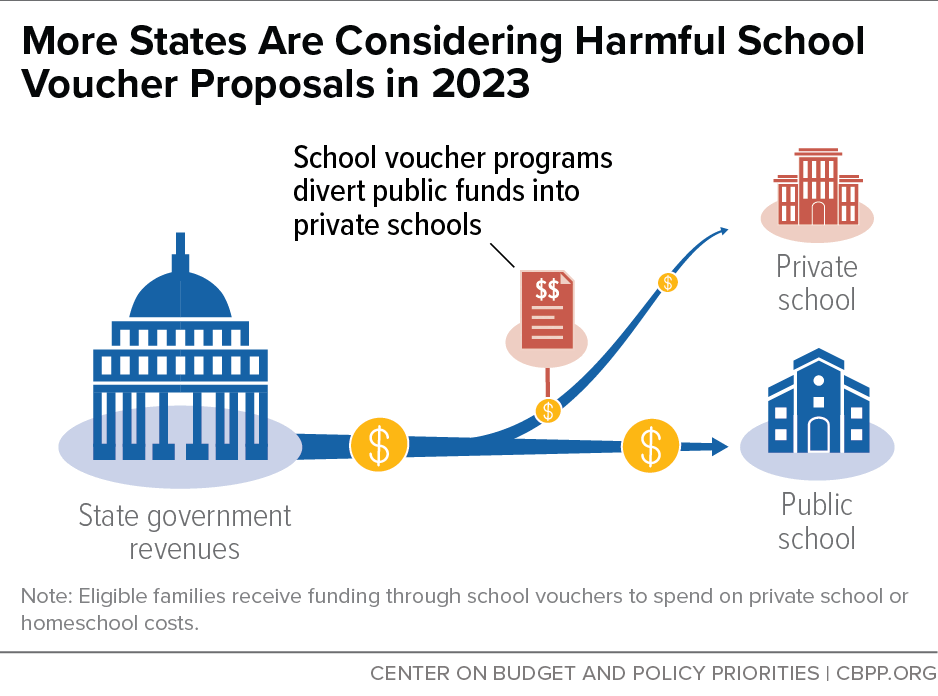
  2. Kill public education with vouchers (deceptively called Education Savings Accounts, or ESAs). An attempt was made earlier this year to convert most of the $2.3 billion public education budget into checks sent to parents to spend however they want – without accountability. This would starve Idaho public schools into oblivion.

The 2023 bill tried to hit a home run and failed. However, the lobbyists behind privatizing public education will be back, fronted by their legislative allies. Expect to see legislation next year that allows public tax dollars to pay for private and religious school tuition in limited amounts and isolated situations.

This is fool’s gold – there is no room for compromise. If the legislature allows just a small amount of public tax dollars to be spent on tuition for any private school, your tax dollars must be made available to all types of private schools and religious schools. Once one bill passes, the flood gates open up to flow your public education dollars to the bottom line profits of private sector businesses.

Your public education tax dollars belong in your public schools, not in their pockets.

The following is a press release from Democrats on the House Appropriations Committee, reacting to deep cuts in the funding bill proposed by House Republicans for federal programs in education, health, labor, and human services. The Title I funding program, which supports schools serving low-income students, is subject to a draconian cut which could lead to layoffs of 220,000 teachers. Every other program sustains cuts. Though not mentioned here, the federal Charter Schools Program received additional funding, one of the few to escape the Tepunlican axe.,

From: House Appropriations Democrats <DemApprops.Press@mail.house.gov>
Sent: Thursday, July 13, 2023 10:04 AM
Subject: House Republican Funding Bill Kicks Teachers Out of Classrooms, Takes Away Job Opportunities, and Harms Women and Children

FOR IMMEDIATE RELEASE

July 13, 2023

Contact:

Katelynn Thorpe, 202-225-1599


House Republican Funding Bill Kicks Teachers Out of Classrooms, Takes Away Job Opportunities, and Harms Women and Children


In the midst of a teacher shortage, Republicans are kicking more than 220,000 teachers from classrooms.

WASHINGTON — House Appropriations Committee Republicans today released the draft fiscal year 2024 Labor, Health and Human Services, Education, and Related Agencies funding bill, which will be considered in subcommittee tomorrow. The legislation is an assault on education and job training, decimates research funding, and abandons ongoing public health crises.


For 2024, the bill provides $163.0 billion, a cut of $63.8 billion – 28 percent – below 2023. This year’s Republican allocation was the lowest for the Labor, Health and Human Services, Education, and Related Agencies bill since 2008. The legislation:


  • Decimates support for children in K-12 elementary schools and early childhood education.
  • Abandons college students and low-income workers trying to improve their lives through higher education or job training.
  • Stifles lifesaving biomedical innovation by cutting funding for cancer research, mental health research, and neurological research, and by slashing funding for advanced research projects intended to develop new cures and therapies.
  • Surrenders to ongoing public health crises in mental health, opioid use, HIV/AIDS, and health disparities.
  • Harms women’s health by cutting programs that support maternal and child health, eliminating programs that provide access to health services and contraception, and adding numerous partisan and poison pill riders related to abortion and reproductive health.


“When 161 House Republicans voted earlier this year to eliminate all K-12 funding at the Department of Education, I was horrified, but that was just the beginning. Now, in the midst of a teacher shortage, they have introduced a bill that would kick 220,000 teachers from classrooms. We are witnessing a widespread attack on public education that should horrify all of us” Appropriations Committee Ranking Member Rosa DeLauro (D-CT-03) said. “Regardless of age or stage in life, this bill means you cannot count on government for any help.  It limits women’s access to abortion while stripping maternal health services and making diapers more expensive. It decimates access to preschool, education, and job training. People can only hope they do not get cancer or need mental health services—you will not find support from House Republicans. These awful cuts will make it very hard for people and should not even be considered by this committee.”

Key provisions included in the draft fiscal year 2024 Labor, Health and Human Services, Education, and Related Agencies bill are below. The text of the draft bill is here. The subcommittee markup will be webcast live and linked on the House Committee on Appropriationswebsite.

The 2024 funding bill:

Department of Education (ED) – The bill includes a total of $57.1 billion in discretionary appropriations for ED, a cut of $22.5 billion – 28 percent – below the FY 2023 enacted level. Of this amount:

  • The bill includes $3.7 billion for Title I Grants to Local Educational Agencies, a cut of $14.7 billion below the FY 2023 enacted level. This cut could force a nationwide reduction of 220,000 teachers from classrooms serving low-income students.
  • The bill eliminates funding for English Language Acquisition, a cut of $890 million that would remove vital academic support for 5 million English learners nationwide.
  • The bill eliminates funding for Title II-A (Supporting Effective Instruction State Grants), a cut of $2.2 billion below the enacted level.
  • The bill eliminates funding for Promise Neighborhoods, a cut of $91 million below the enacted level.
  • The bill eliminates funding for Social and Emotional Learning (SEL) grants within the Education Innovation and Research program, a cut of $87 million below the enacted level.
  • The bill eliminates funding for Magnet Schools, a cut of $139 million below the enacted level.
  • The bill includes $100 million forFull-Service Community Schools, a cut of $50 million below the enacted level.
  • The bill fails to provide an increase for the maximum Pell Grant award for the first time since 2012.
  • The bill eliminates funding for Federal Work Study, a cut of $1.2 billion that would eliminate work-based assistance to 660,000 students nationwide
  • The bill eliminates funding for Federal Supplemental Educational Opportunity Grants, a cut of $910 million that would eliminate need-based financial aid for 1.7 million students nationwide
  • The bill includes $1.8 billion for Student Aid Administration, a cut of $265 million below the enacted level.
  • The bill eliminates funding for Teacher Quality Partnerships, a cut of $70 million below the enacted level.
  • The bill eliminates funding for Child Care Access Means Parents in School, a cut of $75 million below the enacted level.
  • The bill eliminates funding for Hawkins Centers of Excellence, a cut of $15 million below the enacted level.
  • The bill eliminates funding for HBCU, TCU, and MSI Research and Development Infrastructure Grants, a cut of $50 million below the enacted level.
  • The bill includes $105 million for theOffice for Civil Rights, a cut of $35 million below the enacted level.


Department of Labor (DOL) – The bill includes a total of $9.1 billion in discretionary appropriations for DOL, a cut of $4.7 billion – 34 percent – below the FY 2023 enacted level. Of this amount:

  • The bill eliminates funding for WIOA Adult Job Training state grants, a cut of $886 million that would eliminate job training and employment services for 300,000 adults who face barriers to employment.
  • The bill eliminates funding for WIOA Youth Job Training state grants, a cut of $948 million that would eliminate job training and employment services for 128,000 youth who face barriers to employment.
  • The bill eliminates funding for Job Corps, a cut of $1.8 billion that would eliminate job training and employment services for 50,000 youth who face barriers to employment.
  • The bill eliminates funding for the Senior Community Service Employment Program, a cut of $405 million that would eliminate community service positions for more than 40,000 low-wage seniors.
  • The bill includes $1.4 billion for theWorker Protection Agencies at the Department of Labor, a cut of $313 million below the enacted level, including—
    • $153 million for the Employee Benefits Security Administration, a cut of $38 million below the enacted level
    • $185 million for the Wage and Hour Division, a cut of $75 million below the enacted level
    • $537 million for theOccupational Safety and Health Administration, a cut of $95 million below the enacted level
  • The bill includes $98 million for theOffice of the Solicitor, a cut of $33 million below the enacted level.
  • The bill eliminates funding for theBureau of International Labor Affairs (ILAB), a cut of $116 million below the enacted level.
  • The bill eliminates funding for theWomen’s Bureau, a cut of $23 million below the enacted level (including elimination of the Women in Apprenticeship & Nontraditional Occupations program).

Department of Health and Human Services (HHS) – The bill includes a total of $103.7 billion for HHS, a cut of $17.4 billion – 14 percent – below the FY 2023 enacted level. Of this amount:

  • National Institutes of Health (NIH) – The bill includes a total of $44.6 billion for NIH, a cut of $2.8 billion below enacted level, including:
    • $7.1 billion for the National Cancer Institute (NCI), a cut of $216 million below the enacted level
    • $2.7 billion for the National Institute of Neurological Disorders and Stroke (NINDS), a cut of $139 million below the enacted level
    • $2.2 billion for the National Institute of Mental Health(NIMH), a cut of $139 million below the enacted level
    • $5.1 billion for the National Institute of Allergy and Infectious Diseases (NIAID), a cut of $1.5 billion below the enacted level


  • Advanced Research Projects Agency for Health (ARPA-H) – The bill includes $500 million for ARPA-H, a cut of $1 billion below the enacted level.
  • Centers for Disease Control and Prevention (CDC) – The bill includes a total of $7.6 billion for CDC, a cut of 1.6 billion below the enacted level.
    • The bill eliminates funding for Firearm Injury and Mortality Prevention Research, a cut of $12.5 million below the enacted level
    • The bill eliminates funding for Tobacco Prevention and Control, a cut of $247 million below the enacted level
    • The bill eliminates funding for the Ending the HIV Epidemic initiative, a cut of $220 million below the enacted level
    • The bill includes $100 million forPublic Health Infrastructure and Capacity, a cut of $250 million below the enacted level
    • The bill includes $75 million forPublic Health Data Modernization, a cut of $100 million below the enacted level
    • The bill includes $371 million forGlobal Health, a cut of $322 million below the enacted level
    • The bill eliminates funding for the Climate and Health program, a cut of $10 million below the enacted level
    • The bill eliminates funding for the Center for Forecasting and Analytics, a cut of $50 million below the enacted level


  • Substance Abuse and Mental Health Services Administration (SAMHSA) – The bill funds SAMHSA at $7.1 billion, a cut of $234 million below the enacted level. 
     
  • Health Resources and Services Administration (HRSA) – The bill includes $7.3 billion for HRSA, a cut of more than $700 million below the enacted level. (The comparison does not include Community Project Funding included in the FY 2023 enacted bill.)
    • The bill eliminates funding for Title X Family Planning, a cut of $286 million below the enacted level
    • The bill includes $781 million for the Maternal and Child Health Block Grant, a cut of $35 million below the enacted level
    • The bill eliminates funding for Healthy Start, a cut of $145 million below the enacted level
    • The bill eliminates funding for the Ending HIV Epidemic initiative, a cut of $220 million below the enacted level
    • The bill eliminates funding for multiple programs to support diversity in the healthcare workforce, including—
      • Health Careers Opportunity Program($16 million)
      • Centers of Excellence($28 million)
      • Nursing Workforce Diversity ($24 million)


  • Agency for Healthcare Research and Quality (AHRQ) – The billeliminates funding for AHRQ, a cut of $374 million below the enacted level.
  • Centers for Medicare & Medicaid Services (CMS) – The bill includes a total of $3.3 billion for CMS administrative expenses, a cut of $798 million below the enacted level.
  • Administration for Children and Families (ACF) – The bill provides $28.3 billion for ACF, a cut of $4.8 billion below the enacted level.
    • The bill includes a total of $11.2 billion for Head Start, a cut of $750 million below the enacted level. This cut would result in more than 50,000 children losing access to Head Start programs.
    • The bill eliminates funding for Preschool Development Grants, a cut of $315 million below the enacted level
    • The bill includes $457 million for refugee programs, includingTransitional and Medical Services and Refugee Support Services, a cut of $414 million below the enacted level
    • The bill includes $2.25 billion for the Unaccompanied Children program, a cut of $3.3 billion below the enacted level.


  • Administration for Community Living (ACL) – The bill includes $2.5 billion for ACL, a cut of $22 million below the enacted level.


  • Office of the Secretary—General Departmental Management – The bill includes $344 million for GDM, a cut of $258 million below the enacted level.
    • The bill eliminates funding for the Teen Pregnancy Prevention Program, a cut of $108 million below the enacted level
    • The bill includes $26 million for the Office of Minority Health, a cut of $49 million below the enacted level.
    • The bill includes $28 million for the Minority HIV/AIDS Initiative, a cut of $24 million below the enacted level.
    • The bill includes $20 million for the Office on Women’s Health, a cut of $49 million below the enacted level.


Related Agencies –

  • The bill eliminates funding for theCorporation for Public Broadcasting, a cut of $595 million below the enacted level.
  • The bill includes $661 million for theCorporation for National and Community Service, a cut of $652 million below the enacted level.


  • The bill includes $200 million for theNational Labor Relations Board, a cut of $99 million below the enacted level.
  • The bill includes $13.8 billion for theSocial Security Administration, a cut of $183 million below the enacted level.

Policy Riders –


  • The bill includes multiple policy riders to block the Department of Labor from implementing regulatory changes that would improve working conditions for workers in various industries.
  • The bill includes a prohibition on funding to conduct or support research using fetal tissue.
  • The bill includes a prohibition on funding for Planned Parenthood health centers.
  • The bill includes multiple policy riders to block access to abortion services or reproductive healthcare services.
  • The bill includes multiple policy riders to block the Biden Administration’s policies to ensure nondiscrimination on the basis of gender identity or sexual orientation.
  • The bill includes a rider to amend the Public Health Service Act to create a right to monetary damages in a civil action for a violation of the Weldon amendment (which allows health care providers to discriminate against patients by refusing to provide, pay for, cover, or refer for abortion).
  • The bill includes a rider to block the Department of Education from issuing a final rule to prevent sex discrimination and sex-based harassment at schools or a final rule to clarify how all students can participate in athletics.
  • The bill includes multiple riders to block the Department of Education from implementing regulations related to student loans and income-driven repayment.
  • The bill includes a rider to prevent the NLRB from implementing a rule related to Joint Employer status.
  • The bill includes a rider to block funding related to Critical Race Theory.
  • The bill includes multiple riders to prevent policies or programs intended to promote diversity, equity, or inclusion.
  • The bill includes a rider to block funding to take action against a person who opposes marriage equality.
  • The bill includes a rider to limit which flags can be flown over a federal facility.


###

Paul Bowers, who covered education for the Charleston Post and Courier, writes on his blog Brutal South about deteriorating working conditions for the state’s teachers. Class sizes are rising, and the state has chosen to divert funding from the public schools.

Compared to 15 years ago, South Carolina public school teachers are doing more work, administering more tests with higher stakes, for wages that increasingly get eaten by inflation, under intensifying scrutiny from aggrieved political actors — and in many cases, they’re doing it with more students than ever.

The last time I looked into the growth of K-12 classroom sizes in my state was 2019, and the picture was bleak. While state regulations1 set strict limits on student-teacher ratios in most types of classrooms, the state legislature had started granting waivers to those caps during the Great Recession and had not resumed enforcement.

Predictably, median classroom size soared as the state stopped funding its obligations to school districts, teachers’ promised pay increases were frozen, and teachers quit the profession faster than the colleges of education could graduate new ones. When I wrote about the trend for The Post and Courier in 2019, classroom sizes had begun to shrink but were still significantly larger than they were in the 2007-08 academic year…

I’m a graduate of South Carolina public schools who sends his kids to South Carolina public schools, and despite the bad headlines and flagging test scores, I’ve seen firsthand how our education system can change people’s lives for the better. I’m certainly better for it, and my own kids are flourishing.

But after a decade-and-a-half of austerity and a century-and-a-half of backlash to the universal public good of education in South Carolina, I’m left wondering how many more hits the system can take….

South Carolina Gov. Mark Sanford and the Republican-controlled legislature kneecapped school funding in 2006 with a tax handout to homeowners (Act 388) that routinely wrecks school revenues during economic downturns. As metropolitan school districts have grown thanks in part to an influx of workers for manufacturing concerns like Boeing, Volvo, and BMW, county governments have handed those employers massive tax incentives that cheated schools out of $2.2 billion in the last 5 years alone. And the legislature has not funded its own legally mandated Base Student Cost to districts since 2009, flagrantly violating the law every time it passes a budget — with outsize effects in our poorest rural districts.

Clearly, the leaders of the state don’t understand that their penuriousness towards the schools will hurt the next generation and the future of the state. They think in the moment. They forget about the future. They can attract corporations with a low-wage, non-union workforce, but they can’t build a thriving state unless they educate all the children.

Joe Holley, a columnist for The Houston Chronicle writes here about why rural Republicans in Texas vote against vouchers. The public schools in their home districts are in deep financial trouble. They can’t pay enough to attract teachers. They lack the funding for physical improvements. The public schools are the heart of their communities. Most rural districts don’t have any private schools. Those that do don’t want to lose their funding to pay for kids to go to private schools.

Holley writes:

MARATHON – One afternoon not long after Laura and I bought The Wee House, our home away from home in this small, unincorporated community west of the Pecos, I decided to go run the bleachers at the high school football field a block up the street. I didn’t know it at the time, but the long-abandoned field, dry grass giving way to patches of hard dirt and scraggly weeds, had been home in years past to arguably the most formidable six-man football dynasty in Texas history.

Between 1967 and 1976, the Mustangs compiled a record of 100-6, including a 42-game winning streak that stretched from October 1968 until November 1971. Fans from all over the trans-Pecos made the long drive to Marathon on Friday nights to watch the mighty Mustangs beat up on both six- and 11-man teams. The Mustangs were twice state champions.

It quickly became obvious that my ambitious exercise regimen was foolhardy. The spindly-looking bleachers were only eight rows high, the rows so far apart I almost had to climb from one to the next. I decided instead to investigate the rusted sheet-metal press box perched on the top row, so small that maybe three Howard Cosell-wannabes, no more, could squeeze in. I thought I might find an old program, a yellowed memento from the Mustangs’ glory days. Opening the squeaky door into the dark interior, I set off a clamorous tumult. Then came a whoosh. Powerful wings grazed the top of my head and almost sent me tumbling backward down the steps. I had disturbed a great horned owl.

Marathon’s Friday-night lights were extinguished in 2007, but as in every small Texas town I know, the school remains the heart of the community. The school is where town kids and ranch kids get to know each other. It’s where the well-off and the not-so-well-off mix and mingle; where Hispanic kids and Black kids and white kids work out their differences and discover their similarities; where members of the Parent Teacher Organization man the concession stand for basketball games in the venerable gym.

Money is a perennial problem. With a total K-12 enrollment of 53 in the school year that just ended, consolidation with nearby Alpine or Fort Stockton is always a possibility. If that happened, though — if the stately rust-colored brick high school and the low-slung elementary school across the street were left to the great horned owls — Marathon would not be Marathon.

That fact of small-town Texas life is something Gov. Greg Abbott, Lt. Gov. Dan Patrick and voucher-peddling legislators either don’t understand or refuse to admit. This legislative session, while they toyed like Scrooge McDuck with a mountainous pile of cash — an unprecedented $33 billion budget surplus — they left rural school districts across the state to grapple with ever-increasing operating costs, deteriorating facilities, teacher shortages, and an unfair funding system. New requirements for security upgrades are only partially funded.

HB 100, the Legislature’s primary education bill, would have raised the state’s basic allotment, but even a modest increase — not to mention the $900 needed to match inflation — was held hostage to getting vouchers passed. The governor promises that education will be the focus of another special session later this summer, but so far, rural schools have received next to nothing. Meanwhile, administrators for schools large and small are trying to craft a budget for the coming school year without knowing what the Legislature has in store.

Instead of dipping into that enormous budget surplus to ease the hardships of small-town schools, Abbott, Patrick and friends are distracted by a different mountain of money. They covet an Everest of campaign cash from a trio of West Texas oil and fracking billionaires — people who had just as soon put public schools out of business in favor of private schools funded, at least in part, by taxpayer money.

Because Texas public schools get by on a complicated system of local tax revenue and state dollars — with state money distributed on a per-student basis — private-school vouchers are a threat to already precarious districts such as Marathon’s. If local students take their vouchers and leave, those districts would lose funds. (Some voucher plans would compensate rural districts for these lost students, but only temporarily.) Despite Abbott’s and Patrick’s assurances, one way or another, state funds could be diverted to cover private and home-schooling expenses. That would leave less per-student funding for every district, large or small.

Small-town Texans, most of whom cannot even imagine voting for a Democrat, know that vouchers are a threat. That’s why their lawmakers, even the most conservative, have fought the voucher ambitions of the GOP leadership with the ferocity of yesteryear’s Marathon Mustangs. Marathon, Alpine, Fort Davis and Marfa — the little West Texas towns I know best — need every resource the state can provide, as do their counterparts across Texas. Rural lawmakers beat back Abbott and vouchers yet again during the regular session, but the governor, like a wily old boxer, keeps probing round after round for weak spots….

Alpine is 30 miles west of Marathon. Home to Sul Ross State University, the attractive little town is much larger than Marathon, but not so big that it manages to avoid lawmaker neglect. The Legislature’s inaction during the regular session was “a dereliction of duties,” Michelle Rinehart, superintendent of Alpine ISD, told the Big Bend Sentinel.

This year, Rinehart told me a few days ago, should have been our chance to boost Texas education funding — to move the state from 42nd in per-pupil spending to something like the national average. “We were expecting at least modest pay raises for teachers,” she said.

New teachers in oil-blessed Midland start at $60,500, while her new teachers start at $33,000. But instead of helping Alpine with salaries, maintenance and other basic needs, the state’s arcane and inequitable funding formulas end up taking money away. Rinehart has to finish her budget for the next school year by July 1. Unless the Legislature changes something in the special session, the deficit will grow from $300,000 to $1 million….

Rinehart has ample reason to be frustrated. Public education spending is lower now than when Abbott took office in 2015. Given a $321.3 billion budget, our lawmakers — so far, anyway — are starving one of the basic building blocks of a self-governing nation.

Abbott doesn’t listen to educators or the people in rural districts. He listens to the billionaires who fund him.

Abbott listens to the likes of oilmen Tim Dunn and the Wilks brothers, Farris and Dan, who insist that government and education should be guided by fundamentalist Christian principles.

Dunn, a lay preacher at the Midland mega-church he and his family attend, has given more than $18 million to Abbott, Patrick, all 18 GOP state senators, now-suspended Attorney General Ken Paxton, U.S. Sen. Ted Cruz and assorted ultra-conservative political action committees. He also serves on the board of the Texas Public Policy Foundation, a powerful voucher champion.

Farris Wilks, a native of Cisco, near Abilene, has given more than $11 million to GOP candidates and officeholders. He’s also a minister with the Cisco church his father founded, the Assembly of Yahweh 7th Day.

The superintendent of the Marathon public schools is Ivonne Durant. Holley interviewed her. She was upset that the state hasn’t increased teacher pay.

As superintendent of a rural school, Durant is constantly in touch with parents about their children’s well-being, in touch as only a small-school educator can be. They sit together at church, run into each other at the grocery store in Alpine. She teaches the Spanish class and tutors kids on Saturday morning. (One in particular: If that girl fails a class, the five-person junior high basketball team will have to disband.) Durant makes sure her seniors have definite plans — college, the military or a good job — before they graduate.

“I love my children,” she said. “They know, and their parents know, that everybody here cares. They know we’re going to be there for them.”

If only Greg Abbott and the Texas Legislature could say the same.

Jeff Bryant writes often about education. He lives in North Carolina. In this article, he tries to solve the mystery of why Democratic state legislator Tricia Cotham switched sides and joined the Republican Party, giving them a supermajority in both houses of the General Assembly?

Cotham was a Democrat who had campaigned in promises to oppose school vouchers; to defend LGBT rights; and support abortion rights.

Once she gave the Republicans the decisive vote in the lower house, the Republicans had a veto-proof majority and were in a position to override any veto by Democratic Governor Roy Cooper.

Cotham, the new Republican, reversed her vote on everything she campaigned for or against. She supported Republicans’ efforts to reduce abortion rights; she endorsed school vouchers; and she sided with Republicans in their attack on trans youth.

In other words, she betrayed the people who voted for her and cast her lot with the hard-right Republicans who have aligned themselves with anti-progressive, anti-liberal, anti-Democrat policies.

Why? She said the Democrats were mean to her. She said they ignored her. She said she didn’t get the committee assignments she wanted. Are these good reasons to join forces with a party that has sought to destroy public education, demoralize teachers, and gerrymander the state to protect its advantages?

None of this made sense. A person doesn’t change their fundamental values because of hurt feelings.

Jeff investigated and determined that her decision was transactional. What did she get in exchange for double-crossing her constituents and her colleagues? Read his article to find out.

If you read only one article today, read this one. It’s powerful and poignant. The article was written by Forrest Wilder and appears in the Texas Monthly, a terrific publication.

To understand why Republican legislators from rural districts helped to defeat vouchers in Texas, read this article about the schools of Fort Davis in Jeff Davis County in rural West Texas. The superintendent is a bedrock conservative who is dead set against vouchers. His schools are on the verge of bankruptcy due to the state’s Byzantine school-finance system. The state government doesn’t care. At the end, you will understand Governor Abbott’s long-term goal: to eliminate property taxes and completely privatize education.

Texas doesn’t have a mile-high city, but Fort Davis comes close at 4,892 feet. The tiny unincorporated town is nestled in the foothills of the Davis Mountains, where bears and mountain lions and elk stalk among pine-forested sky islands. Fort Davis is the seat of Jeff Davis County, whose population of 1,900 is spread among 2,265 square miles, 50 percent bigger than Rhode Island. The sparsely populated desert country of Mongolia has nearly seven times the population density of Jeff Davis County. Odessa, the nearest city to Fort Davis, is two and a half hours away. The state Capitol is six and a half.

For Graydon Hicks III, the far-flunged-ness of Fort Davis is part of its appeal. He likes the high and lonesome feel of his hometown—the “prettiest in Texas,” he says. But these days, it has never felt further from the state’s political center of gravity.

For years, Hicks, the superintendent of Fort Davis ISD, has been watching, helplessly, as a slow-motion disaster has unfolded, the result of a flawed and resource-starved public-school finance system. Over the last decade, funding for his little district, which serves just 184 K–12 students, has sagged even as costs, driven by inflation and ever-increasing state mandates, have soared. The math is stark. His austere budget has hovered around $3.1 million a year for the past six years. But the state’s notoriously complex school finance system only allows him to bring in about $2.5 million a year through property taxes.

Hicks has hacked away at all but the most essential elements of his budget. More than three-quarters of Fort Davis’s costs come in the form of payroll, and the starting salary for teachers is the state minimum, just $33,660 a year. There are no signing bonuses or stipends for additional teacher certifications. Fort Davis has no art teacher. No cafeteria. No librarian. No bus routes. The track team doesn’t have a track to train on.

But Hicks can’t cut his way out of this financial crisis. This school year, Fort Davis ISD has a $622,000 funding gap. To make up the difference, Hicks is tapping into savings. Doug Karr, a Lubbock school-finance consultant who reviewed the district’s finances, said Fort Davis ISD was “wore down to the nub and the nub’s all gone. And that pretty much describes small school districts.”

“I am squeezing every nickel and dime out of every budget item,” Hicks said. “I don’t have excess of anything.” When I joked that it sounded like he was holding things together with duct tape and baling wire, he didn’t laugh. He said: “I literally have baling wire holding some fences up, holding some doors up.”

The district’s crisis comes at a time when the state is flush with an unprecedented $33 billion budget surplus. Hicks is a self-described conservative, but he thinks the far right is trying to destroy public education. For years, the state has starved public schools of funding: Texas ranks forty-second in per-pupil spending. And yet Governor Greg Abbott is spending enormous political capital on promoting a school voucher plan, which would divert taxpayer funds to private schools. Public education, Abbott has repeatedly said, will remain “fully funded,” though public-education spending is lower now than when he took office in 2015, and the Legislature recently passed a $321.3 billion budget with no pay raise for teachers and very little new funding for schools. Unable to get his voucher plan through the regular legislative session, Abbott is threatening to call lawmakers back to Austin until he gets his way.

Lieutenant Governor Dan Patrick, long a champion of vouchers, is backing legislation that would attempt to appease rural Republican legislators—a bloc long wary of vouchers—by offering $10,000 to districts that lose students to private schools. Hicks can barely contain his anger when he hears such talk. He has been lobbying state leaders for years to fix the crippling financial shortages that plague districts like his. “Take your assurances and shove ’em up your ass,” he says, before softening a bit. “I’m so tired. I’m so frustrated. We have tried. I have fought and fought and fought.”

With each passing month, his rural district inches closer to financial ruin. If nothing changes by next summer or fall, Fort Davis will have depleted its savings. He doesn’t know the exact day that his school district will go broke, but he can see it coming.

It’s easy enough to grasp the basic problem in Fort Davis. But what’s going on beneath the surface is another story.

During my twenty years of reporting on Texas politics, I’ve often heard that only a handful of people in the state understand the school-finance system, with its complicated formulas, allotments, maximum compressed tax rates, guaranteed yields, and “golden pennies.” A former colleague of mine, who once spent months trying to make sense of the topic, warned me against writing about it. Karr, the school finance consultant, compares the process of making sense of our public education funding to encountering a fire at a roadside cotton gin on some lonely West Texas highway. “You drive off into that smoke and you might never drive out,” he said. “You might end up getting killed.”

A thorough explanation of the system is the stuff of graduate theses, but the broad strokes are straightforward enough. How a school district is funded begins with two key questions: How much money is the district eligible for? And who pays for it?

Here it’s helpful to use a venerable school finance analogy: buckets of water. The size of a school district’s bucket—how much money it’s entitled to—is largely determined by the number of students in attendance. Every district receives at least $6,160 per pupil, an amount known as the basic allotment, an arbitrary number dreamed up by the Legislature and changed according to lawmakers’ whims.

At this point in the article, Wilder goes into the intricacies of school finance in Texas. Very few people understand it. All you need to know is that some districts are lavishly funded while others, like Fort Davis, are barely scraping by and may go bankrupt.

Hicks is not alone in thinking the opaqueness is intentional. “They make it just as complicated as they can,” he said of state officials. “Because how do you explain something so complicated to the average voter?” In other words, if constituents can’t easily grasp the perplexing and unnecessarily knotty framework, it’s tougher to hold officials accountable for budget decisions.

Though the spreadsheets may be head-spinning, they tell a story. In a state where some wealthy suburban communities build $80 million high school football stadiums, Fort Davis ISD is one of many rural communities literally struggling to keep the lights on.

I first heard from Hicks in March 2021, when he emailed state officials and journalists with a dire message: “What, exactly, does the state expect us to do? What more can we do? What more do our children need to be deprived of? At what point does our community break?” Hicks has received few answers, even as his situation has grown more desperate.

When I visited him in April, we met in his office, where he keeps a book on Texas gun laws, a photo of his West Point 1986 graduating class (which included Donald Trump’s secretary of state Mike Pompeo), and a list of quotes from General George Patton (“Genius comes from the ability to pay attention to the smallest details”). Hicks, who’s stout and serious and talks in a sort of shout-twang because of partial hearing loss, wore a cross decorated in the colors of the American flag. He was eager to show me the fine line he walks between fiscal prudence and dilapidation. The first lesson came as he stood from his desk and I noticed the holstered handgun on his hip. The district, he explained, can’t afford to hire a school security officer, so he and eleven other district employees carry firearms.

His family has been in the area since the 1870s, when federal soldiers still pursued Comanche and Apache from the town’s namesake garrison. His great uncle was one of the first superintendents of Fort Davis ISD. (At one point, Hicks showed me a copy of his great-uncle’s 1942 master’s thesis, “The Early Ranch Schools of the Fort Davis Area.”) Later, as we were walking around campus, Hicks’s ten-year-old grandson, a thin fourth-grader wearing blue-rimmed glasses and blue jeans tucked into a pair of cowboy boots, ran up to Hicks and gave him a hug.

Fort-Davis-Superintendent-Graydon-Hicks-grandson-Dirks-Anderson-Elementary-School-BW
Superintendent Hicks hugs his grandson in the hallway at Dirks-Anderson Elementary School in Fort Davis.Photograph by Maisie Crow

Both the elementary school and the high school—where Hicks graduated in 1982—were built in 1929, Hicks explained. Walking through their timeworn hallways is to step back in time. In places, the plaster is flaking off the original adobe walls. The elementary school gym floor is bubbling up because of a leak under the foundation. The wooden seats in the high school auditorium have never been replaced. The urinals in the elementary school are original too. The newest instructional facility, a science lab, was built in 1973. In the summer, Hicks mows the football field, the same one he played on five decades ago. “Every bit helps,” he said.

The funding challenges create all manner of ripple effects. Hicks has trouble recruiting and retaining teachers, and some students drift away from school without extracurriculars to hold their interest. “You lose teachers, then you start losing kids, and then your funding gets worse,” he said. “It’s a circle-the-drain kinda thing. And it’s really speeding up for Fort Davis.”

The first problem is the size of the district’s bucket. For the last decade, TEA has calculated that Fort Davis’s Tier I annual allotment is between $2 million and $2.5 million, well short of its already spartan $3.1 million budget.

And then there’s the matter of how that bucket is filled. In the 2011–2012 school year, the state covered two-thirds of Fort Davis’ entitlement, about $2.1 million. Today, it chips in about $150,000, a 93 percent decrease. How to explain that change?…

In June 2019, the Big Three figures in state government—Abbott, Patrick, and then–House Speaker Dennis Bonnen—gathered at an elementary school in Austin for an almost giddy bill-signing ceremony. As a bipartisan group of lawmakers watched, Abbott signed into law House Bill 3, an $11.6 billion package of property tax cuts and education funding that had received near-unanimous support in both the House and Senate, a rarity in the highly polarized Legislature. “This one law does more to advance education in the state of Texas than any law that I have seen in my adult lifetime,” said Abbott.

For almost a year, an appointed commission of experts had met to discuss how to overhaul the school-finance system, issuing a report in December 2018 that called on the Lege to “redesign the entirety of our state’s funding system to reflect the needs of the 21st century.” HB 3 was the by-product of that prompt. Lawmakers rejiggered many of the system’s outdated formulas, offered pay raises to teachers, fixed some of the most glaring inequities, and reduced the amount of money recaptured by the state from property-wealthy districts. Most important, HB 3 represented a much-needed infusion of cash for struggling schools. The basic allotment was raised from $5,140 to $6,120 per student.

But HB 3 also exacerbated disparities among property-wealthy and property-poor districts. Because of changes to the way Tier II enrichment funding works, some communities were able to cut tax rates and generate significant new revenues from their tax base. For others, a minority of districts, HB 3 actually created new problems. Around 10 percent of districts saw a decrease in formula funding. This year, Alpine has $220,000 less than it would have had under the old system, even as some of the richest districts in the state—tiny West Texas communities with lots of oil wealth—saw their funding explode. Rinehart contrasts Alpine, which has almost no mineral wealth, with Rankin ISD, 130 miles northeast in the Permian Basin oil patch. While Alpine’s funding went down 2 percent, Rankin’s went up 339 percent. Even though Rankin is projected to return close to $100 million in recapture payments to the state this year, the district is fabulously wealthy. “Alpine’s budget is $10 million,” Rinehart points out. “Rankin’s is $14 million. We educate a thousand kids and they educate three hundred kids. So they are a third of our size and have a budget 40 percent larger than ours.”

Rinehart doesn’t begrudge Rankin’s wealth—she recently served as assistant superintendent there—but uses the Alpine–Rankin comparison as a “wild” example of how HB 3 exacerbated inequities, making the rich richer and the poor poorer.

Hicks, too, has noticed. “Rankin just built a whole new school,” he told me. “They got a new fieldhouse, a new gym. Two new science labs. A turf practice field, a turf game field. A new track, a new stadium. And my buildings were built in 1929.” Rankin is planning to build ten new “teacherages”—district-funded housing for teachers, important to attracting and retaining talent in areas with scant or affordable residences.

Jeff Davis County, on the other hand, has no oil and gas and very little industry; any school debt would thus be borne by homeowners through bonds. Hicks’s district has never issued a bond, in part because it would be unlikely to pass; the voters wouldn’t support a tax increase. The school’s ag barn was built in 2019 with local donations. The band program, suspended for nine years as a cost-saving measure, was only revived in 2023 after a philanthropist left his estate to the school.

To be sure, Alpine and Fort Davis are outliers. Most districts saw an immediate boost to their finances from HB 3, and advocates celebrated a meaningful investment in public education after $5.4 billion in devastating cuts in 2013. But even for those districts, the sugar rush from HB 3 didn’t last long. According to Chandra Villanueva, the director of policy and advocacy at the progressive nonprofit Every Texan, the $1,000 increase in the basic allotment was “roughly enough to cover one year of inflation….”

The property tax system and the school finance system are inextricably linked, Rube Goldberg–style. Twist a dial here and a light will come on over there. Slip a gear here and spring a leak there. As state lawmakers have prioritized tax cuts over public education funding, the trade-offs have grown clearer. This year represents a potential turning point. But rather than trying to solve the problem using the $33 billion budget surplus—a generational bonanza—Abbott and Patrick have overwhelmingly focused their attention on property tax cuts and a school-voucher plan loathed by almost everyone in public education, in part because it would threaten to strip even more funding from school districts.

The just-completed regular session was a bloodbath. The 88th Legislature began in January with the governor and lieutenant governor promising to pass a transformative voucher program and a record-setting $17 billion in property-tax cuts. Funding for public education, often a banner issue, was scarcely discussed. Even the House, the friendlier chamber toward public education, only proposed raising the basic allotment by $140, from $6,160 to $6,300 per student—far less than the $1,500 increase needed to keep up with inflation since 2019, according to the Texas American Federation of Teachers. But in the end, teachers and public schools got virtually nothing.

Teachers and administrators were stunned. Zeph Capo, the president of Texas AFT, called it a “joke.” HD Chambers, the executive director of the Texas School Alliance, accused Patrick and Abbott of playing a “hostage game” with Texas’s teachers and public school students by tying education funding to vouchers. “It’s pretty simple. The governor and Senate says, ‘If you don’t give us the kind of vouchers we want, we’re not giving you any money.’” The House refused to budge, and the regular session concluded without a deal on property tax relief, vouchers, and other GOP priorities.

Now, the governor has promised to convene multiple special sessions to take up the unresolved issues. The first special session began three hours after the regular one ended, and effectively wrapped up less than 24 hours later, with the House rejecting the Senate property-tax plan, passing its own program consisting solely of property-tax compression, and then abruptly adjourning. Abbott threw his support behind the House plan. The message to the Senate was clear: take it or leave it. If the Senate yields, the House version would push some school districts down to as low as $0.60 per $100, with no new source of revenue to backfill for the reduced funding in case of a bad economy.

Abbott has said his goal is to completely eliminate the main school property tax. In such a scenario, Texas’s thousand-plus school districts would be at the mercy of the Legislature for funding—a troubling scenario, says Villanueva. She suspects vouchers would then become inevitable. “At that point, it’s like, ‘You know what, we don’t have the money to fund schools. Everyone take five thousand bucks, figure it out for yourselves.’”

That day, if it ever comes, may still be far off. But the education system is in crisis right now, and unlike previous hard times, the state is flush with cash. The pain, Chambers says, is being intentionally inflicted by Abbott and Patrick. “Because of this one pet project that the governor has”—vouchers—“they are purposely creating a financial environment where every school district in Texas is being set up to fail.”

The result is that Texas schools, already operating on “shoestring budgets,” will have a harder time attracting and retaining educators, said Josh Sanderson, the deputy executive director of the Equity Center, a nonprofit that represents six hundred Texas school districts. They will run up deficits. They may have to cut extracurriculars and athletic programs. Some, like Fort Davis, may become insolvent and be forced to consolidate with another district, an often painful process.

As we were sitting in his red pickup with the engine idling outside his office, Hicks told me that he’d given up on lobbying the Legislature. He mentioned again that Patrick and other GOP lawmakers are trying to destroy public education by using vouchers to privatize schools, and he said that most other politicians “don’t give a shit about West Texas.” But for the time being he was still fighting: writing op-eds, firing off plaintive missives, asking concerned citizens to contact their legislators.

Toward the end of our visit, I asked Hicks what’s going to happen to his schools. “I don’t know,” he said. “I’m not patient enough to spend time with assholes in Austin, and I’m not rich enough to buy any votes.” TEA has suggested consolidating with another district—most likely nearby Valentine ISD—but Hicks said this would harm both Fort Davis and the other district.

He seemed resigned to his role as a Cassandra warning of impending doom, destined to be ignored. He reminded me that his grandson goes to school here, and that the painful road ahead feels both personal and existential. “If you don’t have a school,” he said, “you don’t have a community.”

Two months later, Hicks called me with some news. He’d decided to resign this summer, joining the mass exodus of school leaders that have fled the profession in the past few years. To anyone who closely follows public education in Texas, his reasoning was tragically familiar: He said he was too tired to fight anymore.

Lizette Alvarez, a journalist in Miami, wrote an opinion piece for The Washington Post, explaining the outrageousness of Florida’s universal voucher program.

What I find outrageous is that this story is not being covered by the Washington Post, the New York Times, or any of the other major media outlets. Nor is it reported as news by any of the network or cable stations.

Why are these stories not in the news every day?

CONSERVATIVE REPUBLICANS ARE WIPING OUT THE LONG-HONORED TRADITION OF SEPARATION OF CHURCH AND STATE!!

CONSERVATIVE REPUBLICANS IN EVERY RED STATE ARE DESTROYING THEIR PUBLIC SCHOOLS DESPITE PUBLIC OPPOSITION!!

Well, at least, the Washington Post printed an opinion piece telling of the greatest theft of the public good in our lifetimes:

Florida public schools are having an awful year. Record numbers of teachers have left their jobs, and those who remain face a minefield of ambiguous culture-war dictates about what they can say and how they teach.

And it’s about to get worse for Florida’s beleaguered public schools.

Florida Gov. Ron DeSantis (R) recently signed legislation that might radically undermine the state’s education system by making Florida’s already robust school voucher program the largest and most expensive in the country.

Beginning in July, the state will make it possible for every Florida K-12 student to receive a taxpayer-funded voucher or savings account worth $8,648. And for the first time in Florida, the vouchers will be available to children from wealthy families, even those who are home-schooled or who already attend private or religious schools. The money can go to tuition and educational expenses.

At least five other states have passed so-called universal choice programs — Arizona, Arkansas, Iowa, Utah and West Virginia — but Florida’s is, by far, the biggest. Other Republican-led states are considering similar bills.

The new policy is a revolutionary (and expensive) expansion. The original state voucher program, which began in 1999, was designed exclusively for a small number of children in F-rated, or failing, public schools and, later, special-needs students. The program grew to more than 177,000 students, from households earning up to $100,000.

About 2,300 private schools in Florida accept vouchers; 69 percent of them are unaccredited, 58 percent are religious and 30 percent are for-profit, according to the Hechinger Report.
In a state infamous as a magnet for schemers and grifters, there’s plenty of reason to worry as millions of dollars in new spending will soon pour into schools that have little accountability. When DeSantis celebrated passage of his vouchers-for-all gambit as a victory for school choice, he was no doubt being cheered on by those with no ideology other than diving into any trough freshly filled with public money.

But, as of July 1, even the child of a private-jet-flying tycoon will be eligible for a voucher. As state Rep. Marie Woodson (D) said, “This bill is an $8,000 gift card to the millionaires and billionaires who are being gifted with a state-sponsored coupon for something they can already afford.” The rich might not need it, but who passes up free money?

Estimates of the cost range from $209 million to $4 billion a year. About 2,300 private schools in Florida accept vouchers; 69 percent of them are unaccredited, 58 percent are religious and 30 percent are for-profit, according to the Hechinger Report….

In a state infamous as a magnet for schemers and grifters, there’s plenty of reason to worry as millions of dollars in new spending will soon pour into schools that have little accountability.

When DeSantis celebrated passage of his vouchers-for-all gambit as a victory for school choice, he was no doubt being cheered on by those with no ideology other than diving into any trough freshly filled with public money.

Alexandra Olson of AP wrote about a strike by journalists who work for Gannett newspapers. A vibrant free press is essential to democracy. Talking heads reading from a script on television are not a good substitute for local journalism that holds power to account. The death of community and local newspapers narrows our sources of information and strengthens the handful of barons who own the networks.

NEW YORK (AP) — Journalists at two dozen local newspapers across the U.S. walked off the job Monday to demand an end to painful cost-cutting measures and a change of leadership at Gannett, the country’s biggest newspaper chain.

The strike involves hundreds of journalists at newspapers in eight states, including the Arizona Republic, the Austin American-Statesman, the Bergen Record, the Rochester Democrat & Chronicle, and the Palm Beach Post, according to the NewsGuild, which represents workers at more than 50 Gannett newsrooms. Gannett has said there would be no disruption to its news coverage during the strike, which will last for two days at two of the newspapers and one day for the rest.

The walkouts coincided with Gannett’s annual shareholder meeting, during which the company’s board was duly elected despite the NewsGuild-CWA union urging shareholders to withhold their votes from CEO and board chairman Mike Reed as an expression of no confidence in his leadership. Reed has overseen the company since its 2019 merger with GateHouse Media, a tumultuous period that has included layoffs and the shuttering of newsrooms. Gannett shares have dropped more than 60% since the deal closed.

Susan DeCarava, president of the The NewsGuild of New York, called the shareholder meeting “a slap in the face to the hundreds of Gannett journalists who are on strike today.”

“Gannett CEO Mike Reed didn’t have a word to say to the scores of journalists whose livelihoods he’s destroyed, nor to the communities who have lost their primary news source thanks to his mismanagement,” DeCarava said in a statement.

In legal filing, the NewsGuild said Gannett’s leadership has gutted newsrooms and cut back on coverage to service a massive debt load. Cost-cutting has also included forced furloughs and suspension of 401-K contributions….

Among the contract demands are a base annual salary of $60,000. The median pay for Gannett employee in 2022 was $51,035, according to the company’s proxy filing. Reed’s total annual compensation was valued at nearly $3.4 million, down from $7.7 million in 2021.

At the shareholder meeting, NewsGuild-CWA President Jon Schleuss said the union proposed lowering Gannett’s median CEO-to-employee ratio from 66:1 to 20:1. But Schleuss said the meeting lasted just eight minutes and Reed didn’t address any questions. In a series of tweets, Schleuss called the meeting a “complete joke…”

Gannett, which owns USA Today and more than 200 other daily U.S. newspapers with print editions, announced last August that it would lay off newsroom staff to lower costs as it struggles with declining revenue amid a downturn in ad sales and customer subscriptions.

The newspaper industry has struggled for years with such challenges, as advertising shifts from print to digital, and readers abandon local newspapers for online sources of information and entertainment. Major newspapers such as The New York Times, The Wall Street Journal and The Washington Post have gained substantial digital audiences for coverage of broad topics, but regional and local papers have struggled to replicate that success in narrower markets…

According to the NewsGuild, Gannett’s workforce has shrunk 47% in the last three years due to layoffs and attrition. At some newspapers, the union said the headcount has fallen by as much as 90%.

The Arizona Republic, for example, has gone from 140 newsroom employees in 2018 to 89 this year, the NewsGuild said. The Austin American-Statesman’s newsroom shrunk during that period from 110 employees in 2018 to 41 this year.

Elahe Izadi of the Washington Post wrote this about the strike:

Gannett merged with the GateHouse chain in 2019, a deal that executives promised would lead to dramatic cost savings while critics warned of job cuts and leaner newsrooms. While the resulting company included 261 daily newspapers and 302 weeklies, those numbers had shrunk by the end of last year to 217 dailies and 175 weeklies, after some papers were shuttered or sold.

Rochester Democrat and Chronicle education reporter Justin Murphy said Monday’s protest represents a “desperation and fear that not only is our workplace and our employer going astray, but the consequences for our communities will be truly devastating.”

Gannett last summer froze hundreds of positions and laid off 400 employees — some of whom were the last remaining reporters at their newspapers — after a dismal financial quarter. Gannett has also offered voluntary buyouts and in December laid off 6 percent of its roughly 3,400-person news staff.

A year before he joined the paper in 2012, Murphy said the Rochester Democrat and Chronicle had a newsroom with 86 union members — a count that excludes editors and other managers — but that the number is now down to 23.

“Those of us who are left are kind of local journalism sickos who just can’t stop doing this,” he said. “As we’ve had cutbacks and cutbacks and they’ve asked us to do more and more, we’ve done it because we think it’s important that the work get done, and that’s just how we’re wired. But it’s one thing to do that when you have 86 people going to 80 or 73, but to 23? It doesn’t make sense anymore.”

Sportswriter Rob Aitken grew up reading the newspaper where he now works, the Record in northern New Jersey. “It was the best thing in the world to see your name in this paper,” he recalled. “It meant you were something.”

But now he says some high school sports are rarely written about, as staffers are stretched too thin. “You want to try to be everywhere and cover every great story. It makes you wonder how many great stories are not being told,” he said. “When we can tell a story about a kid and give them enough attention that maybe they get a college scholarship — you wonder how many kids aren’t getting that opportunity now.”

After the cutbacks, Gannett ended the year with a quarterly profit of $32.77 million, and $1.27 billion in outstanding debt.

The walkout also follows the departure of several top Gannett executives in recent months, as well as editors at some of the chain’s largest newspapers.

In a May earnings call, Reed said “2023 is off to a great start,” noting that the cuts and other “cost management initiatives” had boosted Gannett’s net income to $10.3 million, compared with a loss of $3 million during the first quarter of 2022. Digital subscriptions also grew by about 15 percent from the same time frame the previous year, totaling around 2 million paid subscribers.

Reed has also said he’s open to selling more Gannett newspapers.

“We would entertain bids on any of our markets, any of our products, that are at or above fair-market value,” he said in February. “We’re hopeful that we’ll have an opportunity this year to do that. But it’s not anything that’s in our plans.”

Edward B. Fiske was the education editor of the New York Times and editor of the Fiske Guide to Colleges. Helen F. Ladd is a nationally prominent economist of education and professor emeritus at Duke University. They are married, a power couple of American education. This article appeared on the website of WRAL in North Carolina.

Forty years ago this spring a national commission charged with evaluating the quality of American education issued a blistering report entitled “A Nation at Risk.” It cited a “rising tide of mediocrity” in the country’s schools and declared that the country’s failure to provide high quality education “threatens our very future as a Nation and a people.”

North Carolina leaders took this warning to heart. They began investing heavily in public education and even became a model for other states in areas such as early childhood education. Significantly, the state was making progress toward fulfilling its obligation under the North Carolina Constitution to provide a sound, basic education for all students.

The situation started to change, however, in 2012 when Republicans came to power and began an assault on public education that continues to this day.

When it comes to public education, North Carolina is now “A State at Risk.”

The Republican assault has taken multiple forms, starting with inadequate funding. North Carolina now ranks 50th in the country in school funding effort and 48th in overall funding. Despite widespread teacher shortages, the Republicans have kept teacher salaries low — $12,000 below the national average – and they have failed to provide adequate funding for the additional support staff that schools need.

In addition, they have permitted significant growth in the number of charter schools. Such schools divert much-needed funds from traditional public schools and make it difficult for local boards of education to operate coherent education systems.

The Republican-controlled Legislature is currently working hard to weaken public education by politicizing the process. Pending legislation would regulate how history and racism are taught, give a commission appointed mainly by lawmakers the job of recommending standards in K-12 subjects, and transfer authority to create new charter schools from the State Board of Education to a board appointed by the General Assembly.

The problem is about to get even worse. The Legislature is now poised to expand the earlier Opportunity Scholarship program, which had provided public funds for low income children to attend private schools, into a much larger universal voucher program that would make all children eligible regardless of family income – at an estimated cost of more than $2 billion over the next 10 years.

Given that private schools are operated by private entities typically with no public oversight and no obligation to serve all children, why in the world would it ever make sense to use taxpayer dollars to support private schools?

A common argument has been that voucher systems raise achievement levels of the children who used them. While some early studies of small scale means-tested voucher programs in places like Milwaukee showed small achievement gains in some cases, recent studies of larger voucher programs in places such as Ohio, Louisiana and Indiana consistently show large declines in average achievement — often because of the low quality of the private schools that accept vouchers.

Supporters also argue that vouchers provide more schooling options for children and that having more choices is a good thing. But in the context of education policy that need not be the case. Americans support public education – and make schooling mandatory – not only for the benefits it generates for individual children but also for collective benefits such as the creation of capable workers and informed citizens. What matters is the quality of education for all the state’s children.

An expanded voucher program would lead to a substantial outflow of funds from traditional public schools to privately operated schools, with the potential for a significant loss in the quality of our public schools, and subsequent vitality in the state’s economy.

A strong public education system – from elementary and secondary schools to the nation’s first public university, the University of North Carolina – has long been pivotal to our state’s cultural, political and economic success. We must stop the current assaults on public education and reaffirm our commitment to one of North Carolina’s great strengths.

Back in 1983 when the education system of the nation was “at risk,” President Ronald Reagan – who had earlier been lukewarm in his support of public education — took the warning seriously and began touring the country to talk about the problem. His successors from both parties then took up the cause and continued to make the case that a strong public education system is essential for a vibrant economy, and importantly, to make the policy changes needed to strengthen it.

Let’s hope that our current Republican leaders in this state can muster the wisdom and courage to follow the example of President Reagan and other leaders from both parties in pushing for strong public education. In the absence of such wisdom, we will indeed continue to be “A State at Risk.”

There is a growing awareness that Biden managed to outsmart Kevin McCarthy in the debt negotiations. Robert Hubbell thinks so. Biden is a lot smarter than he gets credit for. Fifty years in Congress counts for something.

Hubbell writes:

A key part of the Republican mythology heading into 2024 is that Joe Biden is addled to the point of incoherence and incompetence. So, on the eve of the House vote on the debt ceiling legislation, Republicans are struggling with the reality that Biden bested them in a high-stakes negotiation in which they were holding a nuclear bomb they were willing to detonate. 

As Rep. Lauren Boebert admitted on Twitter, “We got absolutely destroyed in this negotiation.” Or, as former-adult-in-the-room GOP Rep. Nancy Mace tweeted, “Republicans got outsmarted by a President who can’t find his pants.” [See my criticism of Rep. Mace in Concluding Thoughts.]

          As Charlie Sykes aptly noted, Republicans are experiencing “cognitive dissonance” as they struggle to digest their defeat. In the Orwellian logic of the GOP, Kevin McCarthy is declaring “total victory” for negotiating a deal that has ignited calls for his removal as Speaker. As Freedom Caucus member GOP Rep. Chip Roy said,

I want to be very clear: Not one Republican should vote for this deal. Not one. It is a bad deal. No one sent us here to borrow an additional $4 trillion to get absolutely nothing in return. . . . [The deal is] a complete and total sellout . . . and a betrayal of the House power-sharing arrangement.

          While McCarthy is attempting to convince his caucus that the sow’s ear compromise bill is a silk purse for Republicans, Biden is being praised in the political press for his Ninja-like negotiating skills. See Jennifer Rubin in Washington PostOpinion | The debt ceiling shows Biden’s underrated deal-making prowess. Or, as Josh Marshall of Talking Points Memo put it, How the “F” Did Joe Biden Do That? For a comprehensive analysis of Biden’s negotiating strategy, see Daily KosThe many levels of genius in Pres. Biden’s negotiating strategy.

          It may take a few days for Republicans to understand what just happened to them, but here is an example. One of McCarthy’s proudest achievements is that he imposed new work requirements for SNAP food assistance for recipients between 50 and 54 years old. But Biden negotiated “carve-outs” to that expanded work requirement that will actually increase the amount of SNAP funding by expanding the pool of eligible recipients. Per the NYTimes,

[The Congressional Business Office] said a series of changes in work requirements for food stamp eligibility — tightening them for some adults, but loosening them for others including veterans — would actually increase federal spending on the program by $2 billion.

While Republicans demanded stricter work requirements be a part of the compromise, the White House bargained to lessen the impact, and the budget office estimated that overall, the deal would increase the ranks of the program, making an additional 78,000 people eligible for nutrition assistance.

          Got that? The signature achievement of Republicans designed to kick people off SNAP will instead increase funding for the program (by $1.8 billion) and expand the number of eligible recipients. As Josh Marshall said, “How the “F” did Biden to that?” Democrats should help pass the bill through Congress before more such details emerge.

         The “good” news is that a floor vote in the House will likely occur on Wednesday—five days before the US will not have sufficient cash to pay all of its bills.  Late on Tuesday evening, the legislation cleared a key hurdle in the House, passing out of the House Rules Committee. As a result, the bill will be put to a vote on Wednesday. See NYTimesDebt Ceiling Deal Moves Toward House Vote Despite GOP Revolt.

          But . . . many Democrats are unhappy with compromises made by Biden to avoid default. Two of the leading criticisms involve the age-based increased work requirements for SNAP recipients and changes to the permitting process for energy projects.

          As to SNAP, Biden agreed to increase the existing work requirements to include beneficiaries 50 to 54 years old. But as noted above, carve-outs to those increased work requirements have the effect of increasing the total number of Americans eligible for SNAP benefits. Still, the precedent of using a debt-ceiling negotiation to target the poorest and most vulnerable Americans is a bad one. See Michael Hiltzik, Los Angeles TimesHiltzik: Debt ceiling deal is all about punishing the poor.

          A corollary to the GOP’s effort to punish the poor is their effort to protect the rich. By reducing funding for the IRS and leaving tax rates untouched, the two groups unaffected by the debt-ceiling compromise are ultra-wealthy Americans and large corporations. See Raw StoryProgressives condemn Biden-GOP debt ceiling deal as ‘cruel and shortsighted’.

A second major point of criticism is the concession to “fast track” future energy projects, thereby limiting environmental review. And the deal expressly grants special consideration for the Mountain Valley Pipeline, a Joe Manchin pet project. See The Guardian, ‘An egregious act’: debt ceiling deal imperils the environment, critics say | Environment.

Per The Guardian,

Environmental groups, already angered by Biden’s ongoing embrace of large fossil fuel projects, such as the recently approved Willow oil drilling operation in Alaska, said these provisions mean that Democrats should block the debt deal when it is voted upon in Congress this week.

“President Biden made a colossal error in negotiating a deal that sacrifices the climate and working families,” said Jean Su, energy justice program director at the Center for Biological Diversity. “Congress should reject these poison pills and pass a clean debt ceiling bill.”

          But apart from the permitting concessions, Biden managed to protect the massive investments in climate and clean energy achieved in the infrastructure bill and Inflation Reduction Act passed during the last session of Congress. The Inflation Reduction Act alone invested $369 billion in climate protection and clean energy—the largest investment in protecting the environment by an order of magnitude. That investment will reduce carbon emissions by 40% by 2030. See CNBC, Inflation Reduction Act: Climate change provisions.

          The criticisms over cruelty targeting the poor and special accommodations for a pipeline that will make Joe Manchin richer are well-taken. But as the director of the Office of Management and Budget, Shalanda Young, said in defense of the bill:

We are in divided government. This is what happens in divided government. They get to have an opinion and we get to have an opinion, and all things equal, I think this compromise agreement is reasonable for both sides.

And we must remember that as we evaluate the provisions of the bill, the implied question is always, “Compared to what?” Here, the relevant comparison is to a national default that would have injured hundreds of millions of Americans and millions of American businesses. Retirement savings would have been decimated, and monthly benefit checks would have been diminished or halted. It is legitimate and reasonable to evaluate (and criticize) the proposed bill, but to do so without recognizing the alternative outcome is an incomplete analysis.

*****************************************

Hubbell goes on to chastise former moderate Nancy Mace of South Carolina, who has gone full-MAGA in her cruel taunts aimed at Biden, who apparently negotiated the pants off McCarthy.