Archives for category: Bigotry

Peter Greene writes about the contradiction at the heart of Trump’s education goals. On the one hand, Trump says he will eliminate the Department of Education and turn federal funding over to the states, to use as they wish. At the same time, he says that he will punish schools if they persist in teaching liberal ideas that Trump dislikes, like diversity, equity and inclusion, or if they are insufficiently patriotic.

How will he punish schools if the federal funding has been relinquished to the states?

Greene writes:

It has been on the conservative To Do list for decades, and the incoming administration keeps insisting that this time it’s really going to happen. But will it? Over the weekend, Trump’s Ten Principles for Education video from Agenda 47 was circulating on line as a new “announcement” or “confirmation” of his education policy, despite the fact that the video was posted in September of 2023.

The list of goals may or may not be current, but it underlines a basic contradiction at the heart of Trump’s education plans. The various goals can be boiled down to two overall objectives:

1) To end all federal involvement and oversight of local schools.

2) To exert tight federal control over local schools

Trump has promised that schools will not teach “political indoctrination,” that they will teach students to “love their country,” that there will be school prayer, that students will “have access to” project-based learning, and that schools will expel students who harm teachers or other students. 

He has also proposed stripping money from colleges and universities that indoctrinate students and using the money to set up a free of charge “world class education” system.

Above all, he has promised that he “will be closing up” the Department of Education. Of course, he said that in 2016 with control of both houses of Congress and it did not happen.

Are there obstacles? The Department of Education distributes over $18 billion to help support schools that educate high-poverty populations, providing benefits like extra staff to supplement reading instruction. The Project 2025 plan is to turn this into a block grant to be given to the states to use as they wish, then zeroed out. Every state in the country would feel that pinch; states that decide to use the money for some other purpose entirely, such as funding school vouchers, will feel the pinch much sooner. The department also handles over $15 billion in Individuals with Disabilities Education Act (IDEA) funding, which helps cover the costs of special education; Project 2025 also calls for turning it into an unregulated block grant to states with no strings attached, meaning that parents would have to lobby their state government for special ed funding.

Cuts and repurposing of these funds will be felt immediately in classrooms across the country, particularly those that serve poor students and students with special needs. That kind of readily felt, easily understood impact is likely to fuel pushback in Congress, and it’s Congress that has the actual power to eliminate the department.

Beyond the resistance to changing major funding for states and the challenge of trying to move the trillion-plus-dollar funding system for higher education, the Trump administration would also face the question of how to exert control over school districts without a federal lever to push.

Previous administrations have used Title I funding as leverage to coax compliance from school districts. In 2013, Obama’s education secretary Arne Duncan threatened to withhold Title I funds if a California failed to adopt an “acceptable” standardized testing program. In 2020, Trump himself threatened to cut off funding to schools that did not re-open their buildings. And on the campaign trail this year, Trump vowed that he would defund schools that require vaccines. That will be hard to do if the federal government has given all control of funds to the states.

The Department of Education has limited power, but the temptation to use it seems hard to resist. Nobody wanted the department gone more than Trump’s education secretary Betsy DeVos, who was notably reluctant to use any power of her office. But by 2018, frustrated with Congressional inaction on the Higher Education Act, DeVos announced a plan to impose regulations on her own. In 2020, she imitated Duncan by requiring states to compete for relief money by implementing some of her preferred policies.

Too many folks on the Trump team have ideas about policies they want to enforce on American schools, and without a Department of Education that has control of a major funding stream, they’d have little hope of achieving their goals. Perhaps those who dream of dismantling the department will prevail, but they will still have to get past Congress. No matter how things fall out, some of Team Trump’s goals for education will not be realized.

The Texas Monthly contacted 100 Republican office holders to get their view of Trump’s plans for deporting millions of immigrants. Only two responded. In Texas, one in 20 residents is an undocumented immigrant. Their absence will have a big economic impact, as will the visuals of rounding up and detaining large numbers of people.

Michael Hardy wrote:

Shortly after he is sworn into office, on January 20, President-elect Donald Trump plans to launch a massive deportation operation targeting the estimated 11.5 million immigrants living illegally in the United States. Texas, with its 1,254-mile southern border and pro-Trump leaders, will play a central role in any such deportations. Stephen Miller, the chief architect of Trump’s immigration policies, has vowed that the administration will build “vast holding facilities that would function as staging centers,” likely on “open land in Texas near the border.” State land commissioner Dawn Buckingham recently offered the administration 1,400 acres in Starr County about 35 miles west of McAllen to build “deportation facilities.” 

In their eagerness to help Trump conduct sweeping roundups of undocumented Texas workers and their families, state leaders who vociferously supported Trump’s candidacy have mostly avoided reckoning with the likely economic consequences of such roundups—including the impact on inflation, a major issue in the presidential campaign. 

Earlier this month, Governor Greg Abbott said he expected the president-elect to begin by deporting immigrants who have committed crimes in the United States, but he would not say who he thinks should be expelled next under the far-reaching plan. “President Trump has made perfectly clear that this is a process and you have to have a priority list,” he said. “You begin with . . . the criminals.” 

But Texas is home to some 1.6 million undocumented immigrants—around one in every twenty residents—and the vast majority are not criminals. In fact, undocumented immigrants in our state commit crimes at a significantly lower rate than legal residents, according to a National Institute of Justice analysis of Texas Department of Public Safety data. Many among these 1.6 million power the state’s construction, farming, and meatpacking industries and work as housekeepers, landscape gardeners, and restaurant workers. 

Deporting every immigrant who is in the U.S. illegally—or even half of them—would cripple the economy. And Texas would be hit harder than most states. A recent report by the left-leaning American Immigration Council estimated that a mass-deportation campaign would reduce the national GDP by 4.2 percent to 6.8 percent—a similar hit to the one the nation took during the Great Recession. The price of groceries would skyrocket. A gallon of milk, for instance, would cost twice as much without immigrant labor, according to a 2015 estimate from Texas A&M University’s AgriLife Extension Service. Mass deportations would also punch a hole in the state budget, because undocumented Texans pay an estimated $4.9 billion in sales and payroll taxes every year, including for retirement benefits they are ineligible to collect. 

Trump has argued that deporting undocumented immigrants would open up jobs for American citizens. But the percentage of citizens willing to work in industries such as landscaping and construction has declined, and economic studies suggest that immigration, both legal and illegal, is a net benefit to the economy. Reducing illegal immigration likely would, over time, result in higher wages for legal workers in industries such as construction, assuming the supply of labor were to fall faster than demand. But suddenly removing a significant percentage of undocumented workers (one recent estimate found that 23 percent of construction workers nationally don’t have legal documents) would likely cause hundreds of building projects to stall, crops to go unharvested, and cattle to stack up in feedlots.

Trump’s program would also impose social costs on communities across Texas. According to the Pew Research Center, around 70 percent of undocumented immigrants in the country live in mixed-status households with at least one family member who is here legally. Expelling these migrants would separate families and decimate communities across the state. “The social, family, and economic impact would be very deep,” said Rice University political scientist Tony Payan. “It doesn’t make sense from any perspective. It would be madness for the U.S. to do that.” 

Some Texas officials, including Senator Ted Cruz, have long supported mass deportation as a campaign platform while remaining vague about how such an operation would be executed and what the consequences might be for the Texas economy. In an attempt to get more specifics, Texas Monthly reached out to top Texas officials and every Republican state legislator to ask about the incoming president’s mass-deportation plan. We posed four questions:

  • Do you support President Trump’s plan to deport all immigrants in the country illegally?
  • How would you like the deportations to be carried out?
  • Are you concerned about the potential economic damage to the Texas construction, farming, and restaurant industries from deporting undocumented immigrants? If so, how would you remedy that damage?
  • Are you concerned about the family separations that will occur if all undocumented Texas are deported?

Two legislators responded. Ninety-eight did not.

A loud silence.

This is a beautiful essay on December 7, Pearl Harbor Day, and its meaning for us today. Please read it.

On the sunny Sunday morning of December 7, 1941, Messman Doris Miller had served breakfast aboard the USS West Virginia, stationed in Pearl Harbor, Hawaii, and was collecting laundry when the first of nine Japanese torpedoes hit the ship.

In the deadly confusion, Miller reported to an officer, who told him to help move the ship’s mortally wounded captain off the bridge. Unable to move him far, Miller pulled the captain to shelter. Then another officer ordered Miller to pass ammunition to him as he started up one of the two abandoned anti-aircraft guns in front of the conning tower.

Miller had not been trained to use the weapons because, as a Black man in the U.S. Navy, he was assigned to serve the white officers. But while the officer was distracted, Miller began to fire one of the guns. He fired it until he ran out of ammunition. Then he helped to move injured sailors to safety before he and the other survivors abandoned the West Virginia, which sank to the bottom of Pearl Harbor.

That night, the United States declared war on Japan. Japan declared war on America the next day, and four days later, on December 11, 1941, both Italy and Germany declared war on America. “The powers of the steel pact, Fascist Italy and National Socialist Germany, ever closely linked, participate from today on the side of heroic Japan against the United States of America,” Italian leader Benito Mussolini said. “We shall win.” Of course they would. Mussolini and Germany’s leader, Adolf Hitler, believed the Americans had been corrupted by Jews and Black Americans and could never conquer their own organized military machine.

The steel pact, as Mussolini called it, was the vanguard of his new political ideology. That ideology was called fascism, and he and Hitler thought it would destroy democracy once and for all.

Mussolini had been a socialist as a young man and had grown terribly frustrated at how hard it was to organize people. No matter how hard socialists tried, they seemed unable to convince ordinary people that they must rise up and take over the country’s means of production.

The efficiency of World War I inspired Mussolini. He gave up on socialism and developed a new political theory that rejected the equality that defined democracy. He came to believe that a few leaders must take a nation toward progress by directing the actions of the rest. These men must organize the people as they had been organized during wartime, ruthlessly suppressing all opposition and directing the economy so that businessmen and politicians worked together. And, logically, that select group of leaders would elevate a single man, who would become an all-powerful dictator. To weld their followers into an efficient machine, they demonized opponents into an “other” that their followers could hate.

Italy adopted fascism, and Mussolini inspired others, notably Germany’s Hitler. Those leaders came to believe that their system was the ideology of the future, and they set out to destroy the messy, inefficient democracy that stood in their way.

America fought World War II to defend democracy from fascism. And while fascism preserved hierarchies in society, democracy called on all men as equals. Of the more than 16 million Americans who served in the war, more than 1.2 million were African American men and women, 500,000 were Latinos, and more than 550,000 Jews were part of the military. Among the many ethnic groups who fought, Native Americans served at a higher percentage than any other ethnic group—more than a third of able-bodied men between the ages of 18 and 50 joined the service—and among those 25,000 soldiers were the men who developed the famous “Code Talk,” based in tribal languages, that codebreakers never cracked.

The American president at the time, Democrat Franklin Delano Roosevelt, hammered home that the war was about the survival of democracy. Fascists insisted that they were moving their country forward fast and efficiently—claiming the trains ran on time, for example, although in reality they didn’t—but FDR constantly noted that the people in Italy and Germany were begging for food and shelter from the soldiers of democratic countries.

Ultimately, the struggle between fascism and democracy was the question of equality. Were all men really created equal as the Declaration of Independence said, or were some born to lead the rest, whom they held subservient to their will?

Democracy, FDR reminded Americans again and again, was the best possible government. Thanks to armies made up of men and women from all races and ethnicities, the Allies won the war against fascism, and it seemed that democracy would dominate the world forever.

But as the impulse of WWII pushed Americans toward a more just and inclusive society after it, those determined not to share power warned their supporters that including people of color and women as equals in society would threaten their own liberty. Those reactionary leaders rode that fear into control of our government, and gradually they chipped away the laws that protected equality. Now, once again, democracy is under attack by those who believe some people are better than others.

Donald Trump and his cronies have vowed to replace the nonpartisan civil service with loyalists and to weaponize the Department of Justice and the military against those they perceive as enemies. They have promised to incarcerate and deport millions of immigrants, send federal troops into Democratic cities, silence LGBTQ+ Americans, prosecute journalists and their political opponents, and end abortion across the country. They want to put in place an autocracy in which a powerful leader and his chosen loyalists make the rules under which the rest of us must live.

Will we permit the destruction of American democracy on our watch?

When America came under attack before, people like Doris Miller refused to let that happen. For all that American democracy still discriminated against him, it gave him room to stand up for the concept of human equality—and he laid down his life for it. Promoted to cook after the Navy sent him on a publicity tour, Miller was assigned to a new ship, the USS Liscome Bay, which was struck by a Japanese torpedo on November 24, 1943. It sank within minutes, taking two thirds of the crew, including Miller, with it.

I hear a lot these days about how American democracy is doomed and the reactionaries will win. Maybe. But the beauty of our system is that it gives us people like Doris Miller.

Even better, it makes us people like Doris Miller.

Timothy Snyder is an expert on European history and on tyranny (the title of one of his books is On Tyranny). He writes here about the creeping authoritarianism of the coming Trump regime.

Snyder writes:

We should be wary of shock, which excuses inaction. Who could have known? What could I have done? If there is a plan, shock is part of the plan. We have to get through the surprise and the shock to see the design and the risk. We don’t have much time. Nor is outrage the point.

Of course we are outraged. But our own reactions can distract is from the larger pattern.
The newspapers address the surprise and the shock by investigating each proposed appointment individually. And we need this. With detail comes leverage and power. But clarity must also come, and quickly. Each appointment is part of a larger picture. Taken together, Trump’s candidates constitute an attempt to wreck the American government.

In historical context we can see this. There is a history of the modern democratic state. There is also a history of engineered regime change and deliberate state destruction. In both histories, five key zones are health, law, administration, defense, and intelligence. These people, with power over these areas of life, can make America impossible to sustain.

The foundation of the modern democratic state is a healthy, long-lived population. We lived longer in the twentieth century because of hygiene and vaccinations, pioneered by scientists and physicians and then institutionalized by governments. We treat one another better when we know we have longer lives to lose. Health is not only the central human good; it enables the peaceful interactions we associate with the rule of law and democracy. Robert F. Kennedy, Jr., the proposed secretary of the Department of Health and Human Services, would undo all of this. On his watch, were his ideas implemented, millions of us would die. Knowing that our lives will be shorter, we become nasty and brutish.

A modern democratic state depends upon the rule of law. Before anything else is possible, we have to endorse the principle that we are all governed by law, and that our institutions are grounded in law. This enables a functional government of a specific sort, in which leaders can be regularly replaced by elections. It allows us to live as free individuals, within a set of rules that we can alter together. The rule of law depends on people who believe in the spirit of law. Matt Gaetz, Trump’s first proposed attorney general, is the opposite of such a person. It is not just that he flouts law himself, spectacularly and disgustingly. It is that he embodies lawlessness, and can be counted upon to abuse law to pursue Trump’s political opponents. The end of the rule of law is an essential component of a regime change. He has been replaced by Pam Bondi, who will evade the sex-crime allegations that seem to have brought Gaetz down. But Bondi is someone who dropped an investigation against Trump when he made an illegal donation to one of her foundations. She also led “lock her up” chants against Hillary Clinton, who had committed no crime. And she participated in a central injustice of contemporary American history, Donald Trump’s Big Lie that he won the election of 2020. She can be expected to lead prosecutions based upon alternative reality.

In a class by himself is Kash Patel, whom Trump would like to see as director of the FBI. This, of course, requires Trump to fire Christopher Wray, whom he himself appointed, and who has three years left to serve. Firing Wray for no reason would be unprecedented and would itself have been an outrage in a more sane time. Giving Patel authority over the national police force is nothing less than a promise of authoritarian rule.

Patel is a narcissitic zealot with zero qualification for such a post, as even hard-right Trump insiders such as Bill Barr have said (“over my dead body” were his words when Trump proposed Patel for a lesser position of authority in 2020). Patel got Trump’s attention for his efforts to denounce the entirely correct proposition that Trump was supported by Russia in 2016. Patel was then one of the most active and outspoken participants in Trump’s coup attempt of 2020-2021. Patel has since become a pitchman for a clothing line as well as pills that, he claims, will detox your body from the harmful effects of vaccinations. Patel said both that he would shut down the FBI and that he would use it to prosecute journalists and people who deny the untrue conspiracy theories in which he believes, and to prosecute people who say true things, such as that Russia supports Donald Trump when he runs for office. Russian trolls have been, understandably, very excited in their support of Patel.

A pattern is emerging: the federal government is to be used only as an instrument of revenge, which means that the law will be subverted as such. Laws that were passed to improve the lives of citizens, meanwhile, will simply not be implemented.

The United States of America exists not only because laws are passed, but because we can expect that these laws will be implemented by civil servants. We might find bureaucracy annoying; its absence, though, is deadly. We cannot take the pollution out of the air ourselves, or build the highways ourselves, or write our Social Security checks ourselves. Without a civil service, the law becomes mere paper, and all that works is the personal connection to the government, which the oligarchs will have, and which the rest of us will not. This is the engineered helplessness promised by Elon Musk and Vivek Ramaswamy, who are to head a black hole named after a cryptocurrency. There are already oversight instruments in government. DOGE is something entirely different: an agency of destruction, run by people who believe that government should exist for the wealthy or not at all.

The understandable jokes are that DOGE just adds unelected bureaucrats when it is supposed to replace them, and that DOGE is itself a model of inefficiency, since it has two incompetent directors. But the humor distracts from the basic truth: DOGE is there to make the government fail, and then to divide the profitable bits among regime-proximate oligarchs.

DOGE = Den of Oligarchs Gets Everything.

In a modern democratic state, the armed forces are meant to preserve a healthy, long-lived people from external threats. This principal has been much abused in American practice. But never before Donald Trump have we had a president who has presented the purpose of the armed forces as the oppression of Americans. Trump says that Russia and China are less of a threat than “internal enemies.” In American tradition, members of the armed forces swear an oath to the Constitution. Trump has indicated that he would prefer “Hitler’s generals,” which means a personal oath to himself. Pete Hegseth, Trump’s proposed secretary of defense, defends war criminals and displays tattoos associated with white nationalism and Christian nationalism. He is a fundraiser and television personality, with a complicated sexual past and zero experience running an organization. Like Trump, he has no coherent account of how foreign powers might threaten America; if anything, he praises them for sharing his misogyny. His own obsessions with gender lead him to believe that American high officers should be politically purged — a proposition that America’s actual enemies would of course welcome. Hegseth makes perfect sense as the person who would direct American armed forces against American citizens.

In a world of hostile powers, an intelligence service is indispensable. Intelligence can be abused, and certainly has been abused. Yet it is necessary to consider military threats: consider the Biden administration’s correct call the Russia was about to invade Ukraine. It is also necessary to counter the attempts by foreign intelligence agencies, which are constant, to harm American society. This often involves disinformation. Tulsi Gabbard, insofar as she is known at all, is known as a spreader of Syrian and Russian disinformation. She visited Syria, where her remarks could only be understood as an endorsement of the atrocities of Assad. She suggested to burn victims that they had not suffered because of Assad and his ally Russia, which was in fact the case. Gabbard has no relevant experience. Were she to become director of national intelligence, as Trump proposes, we would lose the trust of our allies, and lose contact with much of what is happening in the world — just for starters. We would be vulnerable to all of those who wish to cause us harm. Unsurprisingly, Gabbard is regarded in Russia as “girlfriend,” “superwoman” and a “Putin’s agent.”

In the Soviet theory of regime change, one crucial aspect was control of the power ministries: those associated with defense, the police, and intelligence. Patel, Gabbard, and Hegseth are such shocking suggestions as custodians of American power and law that it is easy to overlook Kristi Noem as Trump’s proposed director of Homeland Security. Noem is regarded positively in Trump’s circles because of a publicity stunt in which she, as governor of South Dakota, effectively privatized her states’s National Guard by accepting a big private donation to send a few of its members to the border with Mexico. The border is, of course, a serious matter, Noem’s combination of spectacle, privatization, and incompetence is more than concerning.

Imagine that you are a foreign leader who wishes to destroy the United States. How could you do so? The easiest way would be to get Americans to do the work themselves, to somehow induce Americans to undo their own health, law, administration, defense, and intelligence. From this perspective, Trump’s proposed appointments — Kennedy, Jr.; Bondi; Musk; Ramaswamy; Hegseth; Gabbard; Noem — are perfect instruments. They combine narcissism, incompetence, corruption, sexual incontinence, personal vulnerability, dangerous convictions, and foreign influence as no group before them has done. These proposed appointments look like a decapitation strike: destroying the American government from the top, leaving the body politic to rot, and the rest of us to suffer.

I do not defend the status quo. I have no doubt whatsoever that the Department of Defense and the Food and Drug Administration require reform. But such a reform, of these or other agencies, would have to be guided by people with knowledge and experience, who cared about their country, and who had a vision of improvement. That is simply not what is happening here. We are confronted instead with a group of people who, were they to hold the positions they have been assigned, could bring an end to the United States of America.

It is a mistake to think of these people as flawed. It is not they will do a bad job in their assigned posts. It is that they will do a good job using those assigned posts to destroy our country.

However and by whomever this was organized, the intention of these appointments is clear: to create American horror. Elected officials should see this for what it is. Senators, regardless of party, should understand that the United States Senate will not outlast the United States, insist on voting, and vote accordingly. The Supreme Court of the United States will likely be called upon. Although it is a faint hope, one must venture it anyway: that its justices will understand that the Constitution was not in fact written as the cover story for state destruction. The Supreme Court will also not outlast the United States.

And citizens, regardless of how they voted, need now to check their attitudes. This is no longer a post-electoral moment. It is a pre-catastrophic moment. Trump voters are caught in the notion that Trump must be doing the right thing if Harris voters are upset. But Harris voters are upset now because they love their country. And Harris voters will have to get past the idea that Trump voters should reap what they have sown. Yes, some of them did vote to burn it all down. But if it all burns down, we burn too. It is not easy to speak right now; but if some Republicans wish to, please listen

Both inside and outside Congress, there will have to be simple defiance, joined with a rhetoric of a better America. And, at moments at least, there will also have to be alliances among Americans who, though they differ on other matters, would like to see their country endure.

Jan Resseger read the proposals of the Heritage Foundation’s Project 2025 and the America First Policy Institute to divine the likely shape of Linda McMahon’s plans if she is confirmed as Secretary of Education. McMahon was chair of the board of the America First Policy Institute so its goals are inportant.

It’s not as if these two groups are far apart: they are both closely aligned with Trump and his determination to expand public funding of private schools and sow chaos.

Please open the link, as I am posting only the first half of Jan’s post.

She writes:

Linda McMahon formerly served as an executive of World Wrestling Entertainment; led the Small Business Administration during Trump’s first term; and took a job in 2919 leading the America First Action PAC to support Trump’s candidacy for President. Beginning in 2009, McMahon served part of a term on Connecticut’s state board of education, and once upon a time, after majoring in French in college, the now 76-year-old McMahon secured a teaching certificate in her home state of North Carolina. Currently she chairs the board of the America First Policy Institute, a think tank competitor to the Heritage Foundation and its Project 2025. Both think tanks have been drawing up a policy agenda to drive Trump’s second term.

There is some agreement that McMahon is not as likely to shut down the U.S. Department of Education as many feared Trump’s appointment would be charged to do. The National Education Policy Center’s Kevin Welner believes the complexity of the history and needs served by that federal department would make its closure unlikely: “By the time Congress established the department in 1979, the federal government was already an established player in education policy and funding. For instance, the Higher Education Act of 1965 began the federal student loan program. In 1972, Congress created the basic Educational Opportunity Grant, the predecessor program to today’s Pell Grants. The G.I Bill of 1944, which, among other things, funded higher education for World War II veterans, preceded them both. At the K-12 level, federal involvement in vocational education began with the Smith-Hughes Act of 1917. Federal attention to math, science and foreign language education began in 1958 with the National Defense Education Act. Two laws passed during the Lyndon Johnson administration then gave the federal government its modern foothold in education: the Civil Rights Act of 1964 and the Elementary and Secondary Education Act of 1965. The 1964 law provided antidiscrimination protections enforced by the Education Department’s Office for Civil Rights. The 1965 law… includes Title I, which sends extra funding to schools with high populations of low-income students. In 1975, Congress added the law currently known as the Individuals with Disabilities in Education Act, or IDEA… To dissolve the Education department, both houses of Congress would have to agree, which is unlikely.”

Assuming the U.S. Department of Education will survive a second Trump administration, it is worth comparing the policy agendas both think tanks—the Heritage Foundation with its Project 2025, and the America First Policy Institute (AFPI) where Linda McMahon has been chair of the board—have prepared for the incoming Trump administration’s Department of Education.

The Heritage Foundation’s Project 2025 suggests systematically dismantling or relocating to other departments the institutions that were originally pulled together in 1979 to be managed by one federal agency. According to a concise report in August from the Brookings Brown Center on Education Policy, the Heritage Foundation’s Project 2025 prescribes tearing apart the Department’s structure and functions: “dismantle the U.S. Department of Education; eliminate the Head Start program for young children in poverty; discontinue the Title I program that provides federal funding to schools serving low-income children; rescind federal civil rights protections for LGBTQ+ students; undercut federal capacity to enforce civil rights law; reduce federal funding for students with disabilities and remove guardrails designed to ensure these children are adequately served by schools; promote universal private school choice; and privatize the federal student loan portfolio.”  Project 2025 would, first, end or reduce specific federal funding streams enacted by Congress to serve vulnerable groups of students, and second, disrupt or undermine the specific agency prepared to enforce laws and regulations that protect the civil rights of groups which have experienced discrimination and unequal access to opportunity in the past.

The America First Policy Institute’s agenda is far more focused on what have been called culture war issues, while both think tanks do make universal school choice—the diversion of public dollars for school privatization—a priority.  The agenda of the America First Policy Institute (AFPI) features four pillars, each one described in a two page brief:

First — “Give Parents Control by Allowing Them to Select the School Their Child Attends.” AFPI’s brief on school privatization is piece of classic pro-privatization ideology. Ignoring the fact that two weeks ago in three states, voters rejected ballot measures which would have expanded tuition vouchers for private schools and further, that every single time voters have been presented with voucher initiatives in previous years, voters have flatly rejected school vouchers, the America First Policy Institute (AFPI) tells a lie: “Just 18% of Americans are opposed to school choice. Support for school choice in America has increased from 64% to 72% since April 2020.” And despite Josh Cowen’s research that demonstrates lower academic achievement when students use vouchers at private schools, AFPI declares: “Standardized test scores significantly improve for students who exercised school choice.”  AFPI endorses charter schools and criticizes the Biden administration’s efforts to strengthen regulation of the federal Charter Schools Program, which the Network for Public Education has repeatedly shown suffers from poor oversight.  AFPI writes: “(R)egulations would severely limit the types of schools that could apply for funding and would restrict any potential expansion of charter school programs.”  AFPI concludes mistakenly: “Educational freedom is a tool that has a proven record of putting students and families first, and parents need to be given the power to choose the best educational opportunities for their children.”

Education Week‘s Brooke Shultz directly quotes Linda McMahon in 2016 strongly supporting charter schools : “One of the issues most important to me is the question of school choice.” Shultz also quotes McMahon in 2015: “I don’t believe charter schools take anything away from traditional public schools; rather I think they can be centers for innovation and models for best practices.”

Second —“Give Every Parent the Right to See All Curriculum Materials in Every Class their Child Attends.”  AFPI endorses parents’ individualist right to insulate and shield their children from programs and ideas that the parents consider offensive. However dangerous it may be for a school district to privilege individual parents with the power to set the curriculum according to the biases of the most powerful parents, and however impractical it may be for parents to review and debate each classroom’s lessons in advance, that is the policy AFPI endorses: “The formal authority to approve curriculum for public schools rests with states and local school boards. However, the authority for educating children rests with parents. As such, they should be involved early in the approval process in determining what qualifies as appropriate content for curriculum and lesson plans.”  The bias here is clear: “Many children are being taught to see white supremacy everywhere, indoctrinated to believe America’s foundation was built on racism, talked to about sex and gender identity in developmentally inappropriate ways, and presented with other questionable curriculum…  Officials that have the authority to make and approve curriculum do so as stewards of the public’s trust. The taxpayers and parents who schools ultimately answer to deserve to know what schools are teaching and how tax dollars are being spent.”

Again, please open the link to read this excellent post in full.

Justin Parmentier, an NBCT-certified high school teacher in North Carolina, has been scrutinizing the nonpublic schools that receive voucher money from the state. he found that nearly 90% are religious schools where discrimination and indoctrination are commonplace.

Parmenter remembers when now-disgraced Lt. Governor Mark Robinson opened a search for public schools that indoctrinate and came up with nothing.

Public funds in NC support religious schools that openly and egregiously indoctrinate students. Not a peep from the culture warriors. It wasn’t indoctrination they objected to; it was public schools.

Parmenter wrote the following in March 2024, before Robinson was disgraced by the CNN report on his history of posting on pornography websites. To call Robinson a hypocrite would be an understatement:

With billions of dollars now on tap for North Carolina’s private schools, and 88.2% of those dollars going to religious schools, scrutiny is rising over exactly what our taxes are supporting.

Private schools are legally able to discriminate against children, and many of North Carolina’s Christian schools deny admissions to students based on religious beliefs, sexual orientation, or learning disabilities.

For example, Fayetteville Christian School, which pocketed nearly $2 million in voucher dollars this school year, expressly bans students who practice specific religions like Islam and Buddhism, and they also bar LGBTQ+ students–whom they brand “perverted”–from attending.

North Raleigh Christian Academy won’t accept children with IQs below 90 and will not serve students who require IEPs (a document which outlines how a school will provide support to children with disabilities).

If this public funding of widespread discriminatory school practices rubs you the wrong way, I have bad news for you.

It gets worse.

That harmful indoctrination Mark Robinson was howling about a couple years ago in his disingenuous attempt to generate political momentum?  Turns out it’s real.  It just isn’t happening in the traditional public schools Robinson was targeting.

The Daniel Christian Academy is a private school in Concord, NC.  This school has received public dollars through school vouchers every year since Republicans launched the controversial Opportunity Scholarship voucher program in 2014-15 for a grand total of $585,776.

Daniel Academy’s mission is to “raise the next generation of leaders who will transform the heart of our nation” by equipping students “to enter the Seven Mountains of Influence.”

The Seven Mountains of Influence (also referred to as the Seven Mountains of Dominion or the Seven Mountains Mandate) refers to seven areas of society:  religion, family, education, government, media, arts & entertainment, and business.  Dominionists who follow this doctrine believe that they are mandated by God to control all seven of society’s “mountains,” and that doing so will trigger the end times.

The Seven Mountains philosophy has been around since the 70s, but it came to prominence about ten years ago with the publication of Lance Wallnau’s book Invading Babylon:  The Seven Mountains Mandate.  Wallnau touts himself as a consultant who “inspires visions of tomorrow with the clarity of today—connecting ideas to action,” and his book teaches that dominionists must “understand [their] role in society” and “release God’s will in [their] sphere of influence.”

Wallnau does caution his followers that messaging about taking control over all seven areas of society on behalf of God might freak out non dominionists, saying in 2011 that “If you’re talking to a secular audience, you don’t talk about having dominion over them. This … language of takeover, it doesn’t actually help…”

So why should North Carolinians care that their tax dollars are subsidizing this sort of indoctrination of children through private school vouchers?

I posed that question to Frederick Clarkson, a research analyst who has studied the confluence of politics and religion for more than three decades and lately has been focusing on the violent underbelly of Christian nationalists who want to achieve Christian dominion of the United States at all costs.  Here’s what Clarkson said:

North Carolina taxpayers should be concerned that they are helping to underwrite an academy for training children to become  warriors against not only the rights of others, but against democracy and its institutions.  The idea of the Seven Mountain Mandate is for Christians of the right sort to take dominion — which is to say power and influence — over the most important sectors of society. It is theocratic in orientation and its vision is forever. 

This is not something that is about liberals and conservatives . Most Christians including most evangelicals, Catholics, and mainline Protestants are deemed not just insufficiently Christian, but may be viewed as infested with demons, and standing in the way of the advancement of the Kingdom of God on Earth. And they will need to be dealt with.

Pete Hegseth, the FOX talk show host selected by Trump as Secretary of Defense, has a problem with women.

He has been accused of rape by a California woman, with whom he reached a financial settlement in exchange for her silence. But since no charges weee filed by the police, that incident won’t get in the way of confirmation.

His record of fidelity to his wife is blemished, to say the least.

The New York Times wrote:

Mr. Hegseth married Meredith Schwarz, his high school sweetheart, in 2004, one year after they both graduated from college. Ms. Schwarz sued for divorce less than five years after their wedding. The 2009 court judgment cited Mr. Hegseth’s infidelity as the reason for the breakdown of the marriage.

The following year, Mr. Hegseth married Samantha. Within five years, they had three boys.

Mr. Hegseth has repeatedly said he is a Christian who adheres to conservative family values. In a short-lived bid for the Republican nomination for a Minnesota seat in the U.S. Senate in 2012, he credited his parents for instilling those values in him, saying, “I didn’t learn conservatism out of a book.”

In an essay that same year, he acknowledged that he had erred by fathering a child “out of wedlock” with Samantha, who had been his co-worker at a nonprofit group called Vets for Freedom, after his first marriage ended…

By late 2016, Mr. Hegseth, a Fox News contributor and aspiring anchor, was having an affair with Jennifer Rauchet, an executive producer at Fox News. He was named as the weekend anchor of Fox & Friends in early 2017 — a post he held until earlier this month, when Mr. Trump announced he wanted him to head the Defense Department.

Ms. Rauchet, who has three other children, delivered a baby girl in August 2017, one month before Samantha Hegseth filed for divorce. Mr. Hegseth married Ms. Rauchet in 2019 at a ceremony at Trump National Golf Club Colts Neck in New Jersey.

Thus far, Pete has had three marriages and two children born “out-of-wedlock” to his future wives.

Pete’s mother was outraged by his adulterous behavior, the Times reported.

The mother of Pete Hegseth, President-elect Donald J. Trump’s pick for secretary of defense, wrote him an email in 2018 saying he had routinely mistreated women for years and displayed a lack of character.

“On behalf of all the women (and I know it’s many) you have abused in some way, I say … get some help and take an honest look at yourself,” Penelope Hegseth wrote, stating that she still loved him.

She also wrote: “I have no respect for any man that belittles, lies, cheats, sleeps around and uses women for his own power and ego. You are that man (and have been for years) and as your mother, it pains me and embarrasses me to say that, but it is the sad, sad truth.”

Mrs. Hegseth, in a phone interview with The New York Times on Friday, said that she had sent her son an immediate follow-up email at the time apologizing for what she had written. She said she had fired off the original email “in anger, with emotion” at a time when he and his wife were going through a very difficult divorce…

Hegspeth wears his Christian nationalism on his body, literally, with tattoos. What kind of devout Christian repeatedly commits adultery. It would not be tolerated in the military, where it is treated as a crime. Should the Secretary be held to different standards than the members of the military?

Hegseth has been outspoken in his opposition to women serving in combat. He has not said yet what he plans to do with women who are now serving in the Green Berets and Navy Seals, who passed rigorous tests to earn their badges.

Repeat after me: The school choice movement began in response to the Brown Decision of 1954.

School choice was a euphemism for using public dollars to fund segregation academies for whites, to enable them to escape anticipated desegregated schools.

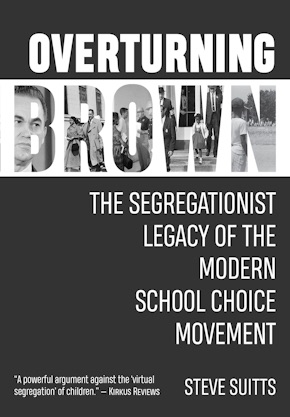
Steve Suitts wrote an excellent book about the history of school choice, called Overturning Brown: The Segregationist Legacy of the Modern School Chhoice Movement.

I reviewed the book in The New York Review of Books. The review was titled “The Dark History of School Choice.”

Now, ProPublica reports, southern states are using voucher money to fund the same segregation academies founded in the 1950s and 1960s.

The latest ProPublica report begins:

On May 14, the final day for submitting new bills in the Mississippi Legislature, a bold new package of them landed on the desks of Mississippi lawmakers. The plans called for the creation of a voucher program that paid for students to attend private schools.

A few weeks later, in the heat of mid-June, the governor urged lawmakers to support the $40 million program, promising it “will bear the sound fruit of progress for a hundred years after this generation is gone.” Public school support would continue, he assured. But vouchers would “strengthen the total educational effort” by giving children “the right to choose the educational environment they desire.”

It was 1964.

Key backers of the move included a group of white segregationists that had formed after the U.S. Supreme Court ruled state-mandated public school segregation unconstitutional.

Across the South, courts had already rejected or limited similar voucher plans in Alabama, Louisiana, Virginia and Arkansas. But Mississippi lawmakers plowed forward anyway and adopted the program. For several years, the state funneled money to white families eager for their children to attend new private academies opening as the first Black children arrived in previously all-white public schools.

Now, 60 years later, ProPublica has found that many of these private schools, known as “segregation academies,” still operate across the South — and many are once again benefiting from public dollars. Earlier this week, ProPublica reported that in North Carolina alone, 39 of them have received tens of millions in voucher money. In Mississippi, we identified 20 schools that likely opened as segregation academies and have received almost $10 million over the past six years from the state’s tax credit donation program.

At least eight of the 20 schools opened with an early boost from vouchers in the 1960s.

“The origins of private schools receiving public funds were with the segregation academies,” said Steve Suitts, a historian and the author of “Overturning Brown: The Segregationist Legacy of the Modern School Choice Movement.”

Most private schools receiving money from the voucher-style programs exploding across the country aren’t segregation academies. But where the academies operate, especially in rural areas, they often foster racial separation in schools and, as a result, across entire communities.

Despite the passage of decades, most segregation academies across Mississippi remain vastly white — far more so than the counties where they operate, federal private school surveys show. Mississippi is the state with the highest percentage of Black residents.

At 15 of the 20 academies benefiting from the tax credit program, student bodies were at least 85% white as of the last federal private school survey, for the 2021-22 school year. And among the 20, enrollments at five were more than 60 percentage points whiter than their communities. Another 11 were at least 30 percentage points whiter.

In 1964, the White Citizens’ Council was among those pushing for the voucher plan. The pro-segregation group was founded in the Mississippi Delta town of Indianola in the 1950s by Robert “Tut” Patterson, who sought to “save our schools if possible” from integration and “if that failed, to develop a system of private schools for our children.”

For Patterson, it was personal. His family, including a young daughter who would start school that fall, lived on what he called a “plantation” with 35 Black families. As he later told an interviewer, “We took care of them. We practically lived with them. We loved them. We tended to them, but I didn’t want to mingle my children with them.”

Vouchers. This is the education idea that Republicans have been pushing for 30 years. This is the policy that is now universal in half a dozen red states. This is the main policy idea of the next Trump regime.

Segregation returns, funded by the taxpayers.

Delaware elected Sarah McBride to Congress. Representative McBride is transgender. Republican women are going nuts for fear that Rep. McBride might use the women’s bathroom. Or the women’s gym.

Rep. Nancy Mace of South Carolina has introduced a resolution to bar Rep. McBride from using the women’s facilities. Rep. Marjorie Taylor Greene is aghast and insists on calling Rep. McBride “he” and “him.”

The New York Times reported:

“Sarah McBride doesn’t get a say,” [Nancy Mace] told reporters on Monday night. “I mean, this is a biological man.” She said that Ms. McBride “does not belong in women’s spaces, women’s bathrooms, locker rooms, changing rooms — period, full stop.”

The move by Ms. Mace, one of the more attention-seeking members of the House, was straight out of the political playbook Republicans have long employed on transgender issues, which they see as an effective wedge to divide Democrats….

…with Ms. McBride’s arrival in Washington, House Republicans for the first time have a transgender colleague to target in their own workplace…

House Majority Leader Mike Johnson was flummoxed. He said:

“A man is a man, and a woman is a woman. And a man cannot become a woman,” Mr. Johnson said. “That said, I also believe that we treat everyone with dignity. We can do and believe all of those things at the same time.”

McBride posted a comment on social media:

“Every day Americans go to work with people who have life journeys different than their own and engage with them respectfully, I hope members of Congress can muster that same kindness,” she wrote. “This is a blatant attempt from far right-wing extremists to distract from the fact that they have no real solutions to what Americans are facing…”

Marjory Taylor Greene was outraged:

“He’s a man,” Ms. Greene told reporters bluntly on Monday night. “He’s a biological male. So he is not allowed to use our women’s restrooms, our women’s gym, our locker rooms. He’s a biological male. He has plenty of places he can go.”

Ms. Greene said she was “fed up with the left shoving their sick trans ideology down our throats and invading our spaces and women’s sports.”

The Democrats defended their new colleague.

Who will stop her from using the women’s bathroom?

Having used many women’s bathrooms myself, I would like to point out that there are no open stalls. No one is naked. Privacy is certain.

What’s the deal?

Peter Greene reminds us of an important anniversary that we should have commemorated: the arrival of 6-year-old Ruby Bridges at the William Frantz Elementary School in New Orleans, where she was the first Black child. She had to walk through crowds of screaming whites, mostly women, who didn’t want her to integrate the school. She integrated the school, but the white children were gone. She was the only child in her class, and she developed a close relationship with her kind teacher.

He writes:

Things got busy here at the Institute this week, so I missed posting about this anniversary on Thursday. But I don’t want to overlook it for another year.

On November 14, Ruby Bridges was six years old, three months younger than the Supreme Court’s Brown v. Board of Education. Six years old.

She had attended a segregated kindergarten in New Orleans. The district gave Black children a test to see if they would be allowed to attend the all-white William Frantz Elementary School. Six passed. Two decided not to go through with it. The three other girls were sent to a different all-white school; Ruby Bridges would be the only Black student desegregating William Frantz.

Her father was not sure he wanted to put her through that. Her mother argued it had to be done for her daughter and “for all African-American children.”

This was three years after the Little Rock Nine were escorted into school by the National Guard. Conditions in the South had not improved. A crowd came out to hurl insults and threaten a six year old child. 

“What really protected me is the innocence of a child,” Bridges said at an event last Thursday.“Because even though you all saw that and I saw what you saw, my 6-year-old mind didn’t tell me that I needed to be afraid. Like why would I be afraid of a crowd? I see that all the time.”

But it is still shocking to see pictures of the protests. They made a picture of a coffin, with a Black baby in it, and paraded it around the school. Along with a cross. Bridges was the only child in her class– white parents pulled their children out, and many teachers refused to teach. The boycott was eventually broken by a Methodist minister, but Bridges still was shunned, her father fired, her family barred from some local businesses. 

It’s Ruby Bridges portrayed in the Norman Rockwell painting “The Problem We All Live With.” one of his first works after he left The Saturday Evening Post. It earned him sackfulls of angry mail, calling him, among other things, a “race traitor.”

This week, many schools celebrated a Ruby Bridges Walk To School Day in schools all around the country.  

There is a common narrative, that in the sixties we pretty much settled all the racial issues in this country and that demands for equity ever since have just been a political ploy to grab undeserved goodies. “We fixed that stuff,” the argument goes, “so we shouldn’t need to be talking about it now. You sure you don’t have some other reason for bringing it up?” It’s the narrative that brings us to a President-elect who claims that since we fixed racism in the sixties, it’s white folks who have been the victims, and who need reparations.

But here’s what I want to underline– Ruby Bridges is alive. Not even old lady alive, but just 70. Presumably most of the children gathered around that coffin and cross are also alive, probably a few of those adults as well (Bridges’s mother died in 2020). 

This is not some episode from the distant past. It’s not about some form of schooling that belongs to some dead-and-gone generation. The anniversary is a reminder to do better, to be better, a reminder that it really wasn’t very long ago that a whole lot of people thought it was okay to threaten a six year old child with abuse and violence. White folks don’t need to hang their heads in shame and embarrassment, but neither should they say, “That was people from another time, long ago and far away,” as a way to feel better about the whole business. It can happen here. It just happened here. Pay attention and do the work to make sure it isn’t happening tomorrow.