The extended shutdown of the Federal government was caused by the Democrats’ efforts to save the Affordable Care Act, known as Obamacare. Unless Republicans agree, the price of subsidies for these policies will soar. Many who can’t afford the health insurance are likely to drop their policy and have none at all.
Republicans have wanted to kill Obamacare for years. Not because it doesn’t work, but because it does. They want to eliminate any Democratic successes. Trump hates Obama and always has. First, because Obama was more popular than Trump, and second, because Obama is Black and more popular even now than Trump.
Oklahoma legislators are debating whether to follow the lead of Mississippi by adopting a phonics-based reading curriculum and requiring the retention of 3rd graders who can’t pass the reading test. Mississippi has been hailed for the dramatic rise in its 4th grade reading scores, which was initiated by the Barksdale Foundation in 1999 with a gift to the state of $100 million to improve reading.
The dominant Republicans in the Oklahoma legislature are taking advice from Jeb Bush’s ExcelinEd group, which enthusiastically supports school choice, privatization, high-stakes accountability, and holding back 3rd graders who don’t pass the state reading test.
The key to instant success in the Mississippi model (it worked in Florida too) is holding back 3rd graders who can’t pass the test. If the low-scoring students are retained, 4th grade scores are certain to rise. That’s inevitable. Is the improvement sustainable? Look at 8th grade scores on NAEP. Sooner or later, those kids who “flunked” 3rd grade either improve or drop out.
Many years ago, I attended a conference of school psychologists. While waiting my turn to speak, the president of the organization said that the latest research showed children’s three worst fears:
The death of their parents
Going blind.
The humiliation of being left back in school
Let’s not lose sight of the pain of those left back and think about alternative ways to help these children .
John Thompson, historian and retired teacher in Oklahoma, urges the legislators to think again before enacting a punitive retention policy.
Thompson writes:
The appointments of Lindel Fields as Oklahoma State Superintendent (replacing Ryan Walters), and Dr. Daniel Hamlin as Secretary of Education, create great opportunities for improving our state’s schools. In numerous conversations with a variety of advocates and experts, I’ve felt the hope I experienced during bipartisan MAPS for Kids coalition which saved the Oklahoma City Public School System, and working with the experts serving in the administrations of Sandy Garrett and Joy Hofmeister.
On the other hand, we still face threats from ideology-driven politicians and lobbyists who spread falsehoods about the simplistic programs they push.
Just one example is a legislative committee meeting on the “Science of Reading.” Although I admit to being slow to acknowledge the need for more phonics instruction, and “high-dose tutoring,” as long it is not a part of a culture of teach-to-the test, I remain skeptical of simple solutions for complex, interconnected, problems. So, I am more open to positive programs, like those that enhance the background knowledge that students need to read for comprehension, as opposed to increasing test scores.
But I’m especially worried Oklahoma could focus on the punitive part of the so-called “Mississippi Miracle,” which requires the retention of 3rd graders who don’t meet accountability-driven metrics.
For instance, when Rep. Jacob Rosecrants, a former inner-city teacher who took over my classroom when I retired, expressed concern that their “highly structured teaching and testing approach … might actually discourage reading,” his reservations were “largely dismissed.” Instead, Rep. Rob Hall, who asked for the meeting, said, “What we’ve learned from other states is that wide-spread illiteracy is a policy choice.”
In fact, it is unclear whether Rep. Hall’s policy choice has produced long-term improvements in reading comprehension.
Based on my experiences in edu-politics, and the judgements of local experts, who saw how our 2012 high-stakes testing disaster unfolded, I’d be especially worried by how the Oklahoma School Testing Program could be used to hold back kids, and the reward-and-punish culture it could produce. The same persons pushing accountability for 3rd graders also seem to believe the lie that NAEP “proficiency” is “grade level,” and that setting impossible data-driven targets will improve student outcomes.
If these regulations were used to determine whether 3rd graders are retained, the damage that would be done would likely be unthinkable. It is my understanding that 50% to 75% of the students in high-challenge schools might not be eligible for promotion. And like the latest expert who briefed me about 3rd grade testing, I’ve witnessed the humiliation that retention imposed on children as Oklahoma experimented on high-stakes End-of-Instruction tests, which undermined learning cultures, even when they were just a pilot program.
I would urge legislators to read this study by Devon Brenner and Aaron Pallas in the Hechinger Report on 3rd grade retention. Brenner and Pallas concluded, “We are not persuaded that the third grade retention policy has been a magic bullet; retention effects vary across contexts. Even in Mississippi, the evidence that retention boosts achievement is ambiguous.”
By coincidence, another reputable study of the “Mississippi Miracle” was recently published. Chalkbeat’s Matt Barnum evaluated the “Southern Surge” in reading programs in Mississippi, Louisiana, Tennessee, and Alabama. And, yes, “Mississippi’s ascent has been particularly meteoric and long-running. Since 1998, the share of fourth graders reading at a basic level on NAEP has increased from 47 to 65%.” And, Louisiana’s 4th graders made progress.
But, eighth graders’ results “have been less impressive for these Southern exemplars.” Alabama’s eighth grade reading scores have been falling and are among the lowest in the country. Louisiana’s eight grade reading scores remain at the 2002 level. And, Mississippi’s eighth grade reading scores are about the same as they were in 1998.
Barnum noted, “a number of studies have found that retention does improve test scores.” But:
The long-run effects of holding back struggling readers remain up for significant debate. A recent Texas study found that retaining students in third grade reduced their chances of graduating high school and decreased their earnings as young adults. A paper from Louisiana found that retention led more students to drop out. (Some studiesfind no long run effect on high school completion, though.)
I would also add that Tennessee’s huge School Improvement Grant, which was focused on test score gains, “did not have an impact on the use of practices promoted by the program or on student outcomes (including math or reading test scores, high school graduation, or college enrollment).”
Moreover, as the Tulsa World reported, Mississippi “spent two years and $20 million preparing for the rollout of the program.” It provided far more counselors and more intensive teacher training and student interventions. But it cites data suggesting “students who received intensive literacy instruction in third grade made only temporary gains, briefly besting their national peers in fourth grade but falling back behind in subsequent years.”
Even the most enthusiastic supporters of the “Mississippi Miracle”, like The 74, agree that it required “universal screenings to identify students with reading deficiencies early and to communicate those results to parents.”
And Mississippi’s success required the prioritization of “proactive communications and stakeholder engagement strategies around early literacy;” “building connections and coherence with other agency efforts across the birth through third grade continuum, especially pre-K;” and anticipating a “multi-year timeline to see changes in third grade outcomes, and invest in monitoring and evaluation strategies that can track leading indicators of progress and identify areas for improvement.”
What are the chances that Oklahoma would adequately fund such programs?
So, what will Superintendent Fields conclude after studying evidence from both sides of the debate?
The Tulsa World recently quoted Fields saying “that literacy is the building block. … So until we get that right, everything else is just going to be hard.” I’m impressed that he then added, “I’m learning about it myself.”
He then said:
What’s important to note about that is the Mississippi Miracle was not an overnight thing. It was more than a decade in the works. And I think if we were to model that and replicate it, you have to do the whole thing — we can’t walk around the block today and run a marathon tomorrow. I think replicating that and setting the tone for the next 8 or 10 years, we can expect to see the same kind of results. I think that’s an excellent example to look to.
Fields wants more than a “program.” He wisely stated:
We might disagree on how we actually get there, but I haven’t found anybody that disagrees that we have to get reading right before the other things.
He then called for “systemic, long-term dedication” to “a multi-faceted approach.” He also emphasized investments in teacher training, and the need to improve teachers’ morale.
In other words, it sounds like our new Superintendent is open to humane, evidence-based, inter-connected, and well-funded efforts that draw on the best of the “Mississippi Miracle,” but not simplistic, politicized, quick fixes, that ignore the damage that those ideology-driven programs can do to children. And I suspect he would think twice before holding back third graders before studying the harm it can do to so many students.
So, if I had just one recommendation to offer, I would urge a balanced effort that combines win-win interventions, not programs that can do unknown amounts of harm, especially to high-poverty children who have suffered multiple traumas. That would require a culture that uses test scores for diagnostic purposes, not for making metrics look better.
Mary Trump is the daughter of Donald Trump’s older brother Fred Trump Jr. Mary is a trained psychologist. If you haven’t read her first book about Donald and his dysfunctional family, you should. It’s called: Too Much and Never Enough: How My Family Created the World’s Most Dangerous Man.
To date, Donald has murdered over 79 people using the US military as a weapon in a way that is extralegal, unconstitutional, and a contravention of global law. Nobody seems to care. He’s also abusing the presidential pardon power, another thing we desperately need to reform in this country. One person he pardoned was involved in Donald’s insurrection on January 6th, 2021, and has since been revealed to be a pedophile. He pardoned or commuted the sentences of every single person involved on January 6th, even the most violent among them. Some of those people were supposed to serve jail sentences as long as 18 years, but because they were committing horrific acts of violence on his behalf, that was just fine with him. Recently, he pardoned people like Rudolph Giuliani, Jeff Eastman, Jenna Ellis, Sidney Powell, and others who were involved in the fake elector scheme to overturn the valid results of the 2020 election, the free and fair election that Joe Biden won by almost 8 million votes.
We know that Ghislaine Maxwell was Jeffrey Epstein’s co-conspirator in the crimes of rape and sex trafficking of girls and young women. She has been transferred to a minimum-security prison, where she is reportedly receiving preferential treatment. Maxwell was sentenced to 20 years of prison, and Donald will likely pardon her as well. Now, we are facing the very strong possibility that Donald will pardon her as well.
Why would somebody who cares about the rule of law or cares about justice pardon such people? Why would anybody want to be associated with such people? It looks like pretty much every single person Donald has pardoned, give or take, is some kind of criminal who has shown no remorse for his or her crimes. What does that mean? What does that tell us about him? Anybody willing to pardon Maxwell or any sex trafficker, any sexual abuser of women, men, or children, anybody willing to pardon someone who participated in the violent overturning of the American government is somebody who is just as bad, if not worse than they are. Instead of using his power to protect the American people from criminals like that, he sides with the criminals, unleashing them onto us.
Who is the last person on the planet who should be commemorating Veterans Day? Yes, that’s right– a five-time draft Dodger, coward, and traitor to America–Donald Trump. He marked today’s Veterans’ Day with an appearance at Arlington National Cemetery, one of the many things lately that makes my blood boil–the fact that scum has the right to step foot on the grounds of Arlington National Cemetery. Everything about the event was, as we should expect at this point, devoid of the respect and gratitude our veterans deserve.
Donald also went on about changing the name of the holiday at the ceremony.
I was recently at an event, and I saw France was celebrating Victory Day, but we didn’t, and I saw France was celebrating another victory day for World War II and other countries were celebrating. They were all celebrated, we’re the ones who won the wars. And I said, from now on, we’re going to say Victory Day for World War I and World War II, and we could do for plenty of other wars, but we’ll start with those two. Maybe someday somebody else will add a couple more because we won a lot of good ones.
Today is not about any wars we won. It is about the sacrifices of our veterans, those who gave some or those who gave all to protect the American people. It is also about the American ideals of democracy and freedom. It’s not about victory. It is about honor and sacrifice, two things about which Donald Trump knows absolutely nothing. Next, in an essentially bizarre and meaningless rant, he bragged about firing people.
And the other thing is, we fired thousands of people who didn’t take care of our great veterans. They were sadists, they were sick people, they were thieves, they were everything you want to name. And we got rid of over 9,000 of them. And then when Biden came in, he hired them back, many of them, but we got rid of them, and I think we got rid of them permanently. We replaced them with people who love our veterans, not people who are sick people.
Every accusation is an admission. It is unspeakable that that man is allowed anywhere near a ceremony commemorating our veterans. There was another moment that captured Donald’s audacity–when he lectured troops about making the ultimate sacrifice, or at least he tried to do that. Here is what he said.
We ask only this, that if we die, we must die. And we as men would die without complaining, without pleading, and safe in the feeling that we have done our best for what we believed was right. We must do what is right. Colonel Wolverton died for us so bravely in battle today; we remember.
Donald has no right to speak about the sacrifices our veterans have made. He has no right to characterize the sacrifices that our veterans have made and continue to make. A man who doesn’t understand what the military does, what it should be used for, who has put this country in unspeakable danger because of his vast shortcomings. This draft dodger has called veterans suckers and losers. On a personal note, my dad was a second lieutenant in the National Guard, and he was treated like a sucker and a loser.
Thousands of veterans across the country spent the day protesting Donald’s use of the military to enforce his cruel, illegal, and unconstitutional immigration policies. Fox 32 Chicago spoke to US Army veteran Arti Walker Peddakotla in the lead-up to the protest, and here’s what she had to say.
Given the fact that ICE is occupying our communities in some communities, we have military and National Guard members occupying our communities that veterans really needed to stand together with working-class people and speak out against this administration.
Vets say rallies are planned for here in Chicago, as well as cities across the country, to stand against not only the use of the military and immigration actions, but also the tactics of ICE agents and border patrol on immigrants and citizens alike.
As veterans, we sign up to really protect everyone, and no one is being protected by this administration’s tactics. No one is being made safer. In fact, our communities are being made more unsafe by what ICE is doing and what the military is doing on our streets.
Air Force veteran Judson Wager rallied with over 500 other veterans in Washington, DC. He told independent military outlet Stars and Stripes that, quote,
We’re in the middle of an authoritarian takeover of our government.” Even as I’m honoring my fellow veterans, I’m also sounding the alarm for all Americans. Our democracy is in peril, and it will take all of us to protect it.
Donald is continuing to alienate our country’s closest allies. CNN reports that the United Kingdom has partially halted intelligence sharing with the us. They did this after finding that the Trump regime’s lethal strikes on suspected drug trafficking violate international law. CNN’s national security correspondent Natasha Bertrand shared additional details on this development.
Previously, the UK had been happy to help the United States locate and interdict vessels that were transiting the Caribbean that appeared to be trafficking drugs. But the key difference, of course, is that it was helping the Coast Guard intercept those vessels, arrest those on board, seize the drugs, and allow these individuals to have some semblance of due process. But now the US, of course, has started striking these boats unilaterally with military force, killing everyone on board. The total now for a number of people killed is around 76, and we’re told that the UK is deeply uncomfortable with that, and they believe that it is pretty blatantly illegal. Now, it is unclear exactly how long this intelligent sharing suspension is going to last, but we’re told that it has been going on for well over a month now, essentially since the US began its bombing campaign. And it really underscores the continued questions surrounding the legality of this US military campaign, which, of course, the US government, the Trump administration, has insisted is part of an armed conflict that is waging against cartel members and criminal organizations. But much of the international community, as well as legal experts inside the US, do not see it that way.
Let’s get back to our veterans. Yesterday, a flight filled with veterans and their families landed in Washington, DC, and was greeted by an unexpected guest. Please remember all our veterans, those still with us and those who aren’t.
Veteran: This honor flight is to honor all the veterans of World War II, the Korean War, Vietnam. It’s all free for them, but we show them all their monuments and explain what their monuments are about. We just try to treat them with dignity that some of them didn’t get when they came home from the war.
President Obama: Hello, everybody. As we approach Veterans Day, I wanted to stop by and just say thank you for your extraordinary service to you, your family. The sacrifices that all of you made to protect our country is something that will always be honored, and we are very grateful. And we also happen to welcome you with a 70-degree day in DC, which doesn’t always happen around here.
Veteran: That’s the first time I’ve seen a president, former or current, greet an honor flight, and that is absolutely amazing. A commander-in-chief, a leader who’s going to show up and tell you that your service was worth something. I think that’s the important part. So I think it was a great thing to have.
Veteran: The last time I got to see a president it was Gerald Ford.
Thank you, Barack Obama, for demonstrating what a real leader looks like.
The program was sold, as it always is, as a way to save low-income children from low-performing schools. Actually, that claim is simply a hoax. By now, we know that vouchers mostly subsidize students who were already in private and religious schools. That’s the case in every state with vouchers. In New Hampshire, 80% of the students who take vouchers never were enrolled in public schools. In Arkansas, it’s 88%. The state is subsidizing their tuition, which was previously paid by their parents.
Garry Rayno writes:
CONCORD — Information released by the Department of Education this month shows the Education Freedom Account program has 10,510 students enrolled this school year.
The figure is based on average daily membership as of Oct. 1.
The program is capped at 10,000 students with exemptions for continuing students, students in the same family and students from households below 350 percent of the federal poverty level, or $74,025 for a two-member family and $112,525 for a four-member family.
According to the DOE information, the program with the current enrollment level will cost the state $51.6 million, while the program is budgeted for $39.3 million, or $12.3 million over budget this fiscal year.
Because the program hit the 10,000 cap this year, the cap will be increased to 12,500 next school year, which with similar distributions of children from lower income households, special education needs and English as a second language students, would project to be $61.4 million while $47 million is budgeted for fiscal year 2027, or $14.4 million over budget.
The total cost of the EFA program for the biennium would project to be $113 million, or $26.7 million over budget for the biennium.
The average grant under the program for this school year is $4,911, which is down from last school year when it was $5,204 when the program cost $28 million and served 5,321 students.
The percentage of low-income students who qualify for free and reduced lunch and receive additional money of $2,393 per student has fallen with the expansion of the program this school year to any student qualified to attend school in the state regardless of family earnings.
The percentage of students for low-income families dropped from 37 percent last school year to 19 percent this school year, while the percentage of students needing special education services increased from 7 to 9 percent, while English language learners totaled 20 this school year while there were only two students the year before.
Students qualifying for special education services receive an additional $2,185, and English language learners receive an additional $832 per student.
The base adequacy grant every EFA student receives is the same as public school students $4,266, which goes to the school district.
At the Joint Legislative Performance Audit Oversight Committee meeting Friday, the Legislative Budget Assistant’s Office said the audit of the EFA program is expected to be presented to the Joint Legislative Fiscal Committee by next summer.
Christine Young, director of the LBA’s Audit Division, said her agency is currently doing field analysis and reviewing observations, which are concerns raised about practices or following statutes or rules.
The performance audit is required by law, but the LBA was unable to access program data because the DOE and the Attorney General’s Office said that information belongs to the administrator of the program, Children’s Scholarship Fund NH, which the state hired.
The LBA sought the information from the company, but was denied under the advice of former Department of Education Commissioner Frank Edleblut and told the committee the audit would have to focus on the DOE’s oversight of the program.
Young told the committee to date 40 observations have been noted with 15 finalized, most dealing with eligibility.
She said another 20 observations are being drafted.
A compliance report done by the DOE several years ago of the first two years of the program found about 25 percent of the applications to the program and for additional money for services were approved without the required documentation by the Children’s Scholarship Fund NH.
The organization may retain up to 10 percent for administering the program, which would be over $10 million this biennium.
The program was touted as an opportunity for low-income parents to find alternative educational programs for their children if they do not do well in the public school environment.
But as is the case in other states with similar programs, the vast majority — or about 80 percent — of the students enrolled in the program were not attending public schools, but attended religious and other private schools, or homeschooled when they joined the program.
With the expansion this year, many families whose children attend religious and private schools or homeschools, receive what is essentially a state tax paid subsidy.
The cost of the program when it was expanded to all eligible students in Arizona nearly bankrupted the state, and similar problems occurred in Ohio and North Carolina.
In the only vendor listing published by the Children’s Scholarship Fund NH, was for the first year of the program and is no longer on the Children’s Scholarship Fund’s website, the vast majority of grants went to religious and private schools.
Critics of the program have long claimed it lacks guardrails and accountability, but program supporters say parents are the best judge whether their child is receiving a good education.
This documentary is fascinating. It shows young Bobby’s idyllic childhood at the family’s sprawling, luxurious compound in Virginia. He grew up in a world of joy, fun, and privilege.
You can see how deeply he was scarred by the murder of his father, with whom he was very close. This was an experience no child should endure.
He is sent away to a boarding school, where he is soon kicked out. Then another, then Harvard, which was a given, in light of his name. At Harvard, he becomes addicted to drugs and a drug dealer. Pot, cocaine, heroin.
He goes to law school, flunks the bar exam, but eventually passes. He marries an eligible young woman, has children, divorces her. Still a drug addict. Meets a beautiful Catholic girl, marries her, has four children. He begins to find his niche as an environmental lawyer. Life is looking up. But he’s a sex addict and he keeps a record of his conquests–at least 37. His wife finds the record and hangs herself.
He believes he is destined for greatness. He is a Kennedy so he keeps looking for the vehicle that will catapult him to fame. He discovers angry mothers who are looking for the cause of their children’s autism. He latches on to the issue and becomes their champion. He also becomes a prominent anti-Vaxxer and conspiracy theorist.
He briefly runs for president in 2024 but soon realizes that his prospects are nil. Trump offers a big job if he joins his campaign. Bobby accepts his offer, to the dismay of his family.
Bobby speaks to large, adoring crowds. He loves it.
Trump appoints him to lead the government’s public health agency–Health and Human Services. His family is appalled. They know he is unqualified. They know he has no respect for science. He promises the Senate committee that he won’t stop vaccines, despite his long history as a critic of them. He wins approval.
He begins to fire prominent scientists and thousands of experienced employees. He throws the agency into turmoil.
Jan Resseger recently read Arne Duncan’s cheerful hopes for the Trump education agenda and encouraged the public to look at the bright side. Then Jan remembered Arne’s disastrous Race to the Top, which even the U.S. Department of Education rated as a waste of money, and Jan looked elsewhere for advice. She found Kevin Welner’s sage thoughts.
My view is that Trump, his budget director Russell Vought, and Secretary of Education Linda McMahon ultimately hope to turn all federal funding into block grants to the states, no strings attached. No money dedicated to students with disabilities, no money for schools enrolling large numbers of low-income students. Federal regulations drafted by hard-hearted zealots of the Trump administration will be directed to vouchers, charters, cyber schooling and home schooling.
Don’t be fooled: The Trump administration wants to destroy public schools.
In a recent column in the Washington Post, Arne Duncan suggested that even Democrat-led states can opt into the One Big Beautiful Bill’s tax credit school voucher program and redirect the funds into public schools or at least into programs that support achievement in public schools as a way to replace COVID American Rescue Plan funds that have run out. “This solution is a no-brainer,” he declares.
Here is Arne’s prescription: “The new federal tax credit scholarship program, passed as part of the One Big Beautiful Bill Act, allows taxpayers to claim a dollar-for-dollar federal tax credit for donations to scholarship-granting organizations, or SGOs. These SGOs can fund a range of services already embraced by blue-state leaders, such as tutoring, transportation, special education services and learning technology. For both current governors and gubernatorial candidates, it’s a chance to show voters that they’re willing to do what it takes to deliver for students and families, no matter where the ideas originate. By opting in, a governor unlocks these resources for students in their state. Some Democratic leaders have hesitated, however, worried that the program could be seen as undermining public schools, since private scholarships are also eligible. But that misses the point.”
Remember that Arne Duncan launched Race to the Top, which brought No Child Left Behind’s test-and-punish regime into the Obama years by offering gigantic federal grants as a bribe for states to turn around their lowest scoring 5% of public schools with rigid improvement plans—with the schools that failed to improve being closed or charterized—and with the teachers being held accountable and punished if they couldn’t quickly raise test scores. Because none of Arne’s programs worked out, I am hesitant to take Arne Duncan’s advice.
Welner explains that the One Big Beautiful Bill requires the governors of the states to opt into the federal tax credit vouchers (or choose to opt out). As Welner lists how the money can be used, it is clear that the federal dollars can be spent on private education but that, in addition, some programs supporting public schools themselves or their students could qualify: “Under the OBBB, nonprofit Scholarship Granting Organizations (SGOs) in states opting into the program are authorized to pool the donated money and then hand out “scholarships” for students’ ‘qualified elementary or secondary education expense[s].’ This is limited to the expenses allowed for Coverdell Savings Accounts,¹ which are tied to school-related needs, such as tuition, fees, and academic tutoring; special needs services in the case of a special needs beneficiary; books, supplies and other equipment; computer technology, equipment, and Internet access for the use of the beneficiary; and, in some cases, room and board, uniforms, transportation, and extended day (after-school) programs.”
Welner continues: “This idea of ensuring that each state could implement the program in ways that allow all flexibility is consistent with the Trump administration’s vociferous embrace of “returning education quite simply back to the states where it belongs.” Welner, however, remains skeptical that the Trump administration really plans to return control of federal dollars back to the states:
“Unfortunately, the U.S. Treasury Department rulemaking is likely to deny states the promised flexibility, notwithstanding the administration’s rhetoric about ‘returning education to the states.’ While the law’s ardent supporters may want Democratic governors to participate, they don’t want to give them the flexibility permitted by the law itself… (T)he key issues for state leaders, particularly the governors who will make the opt-out or opt-in decision in most states, involve whether they can shape the program as it is implemented in their states.” Welner lists key concerns for governors and for those of us who have watched the damage done by the voucher programs now established by many state legislatures. “Governors will want to know… if they can:
“Place requirements on SGOs involving reporting, governance, transparency, access, non-discrimination, profiteering, and prioritization of students with greater need;
“Require that schools and other vendors… be accessible to students and not engage in discrimination against protected groups of students, including members of the LGBTQ+ community;
“Put quality-control policies in place to weed out the lowest-quality of these vendors;
“Limit the program to just one or two of the Coverdell categories, ideally research-based options such as high-impact tutoring and after-school programs.”
Welner warns, however, that powerful advocates at the federal level are “pushing hard for regulations that slam the door on any approach that does not further the growth of largely unregulated voucher programs.”
He recounts many of the problems with state level private school tuition vouchers: Josh Cowen’s research documenting low academic achievement in voucher programs in Louisiana, Indiana and Ohio; the failure of voucher programs to protect students’ civil rights; “free-exercise” justification for public dollars diverted to religious schools; failure to provide programs for disabled students; diversion of massive state dollars to support private school tuition for wealthy students; and states’ failure to regulate teacher qualifications, curriculum, equal access, and oversight of tax dollars.
Welner thinks governors might do well to wait to make the decision about opting in until they can review the formal guidance which will eventually be provided by the U.S. Treasury Department. “(F)or state leaders who are tempted to opt in, that decision could be publicly announced as conditional on the Treasury regulations allowing the state the flexibility to include specified access, quality, and non-discrimination protections for the state’s students. “
He concludes: “In sum, the federal scholarship tax credit may look to some state leaders like an opportunity to secure additional resources for students, but the risks are profound. The structure of the law, coupled with the likely direction of Treasury rulemaking, points toward a program designed not to empower states but to constrain them—pushing states into a rigid, federally controlled voucher system that undermines educational equity and quality and presents long-run threats to the fiscal stability of public schools.”
If you have ever wondered why I am crazy about Peter Greene, wonder no more. Just read this post that appeared on his blog. Peter is consistently smart, funny, wise, and insightful. He has a way with words. He is unerring in spotting phonies. He is fearless. Let me say it out loud: I love Peter Greene!
He wrote about the article that exposed Duncan’s true views. Until now, some of us had only inferred who he is. Now we know. Duncan”political advice” to Democrats–adopt Republican policies– is hilarious in light of Tuesday’s election results: across the nation, Democrats won school board races, and every Moms for Liberty candidate lost.
Peter Greene writes:
Mind you, on education, Duncan was always the kind of Democrat largely indistinguishable from a Republican, but with his latest print outburst (in the Washington Post, because of course it was), he further reduces the distance between himself and his successor as Secretary of Education, Betsy DeVos.
It’s yet another example of reformsters popping up to argue that what’s really needed in education is a return to all the failed reform policies of fifteen years ago. I don’t know what has sparked this nostalgia– have they forgotten, or do they just think we have forgotten, or do they still just not understand how badly test-and-punish flopped, how useless the Common Core was, and how school choice has had to abandon claims that choice will make education better in this country.
But here come Duncan and Elorza with variations on the same old baloney.
First up– chicken littling over NAEP scores. They’re dipping! They’re low! And they’ve been dipping ever since 2010s. Whatever shall we do?
Who do Duncan and Elorza think holds the solution? Why, none other than Donald Trump.
Seriously. They are here to pimp for the federal tax credit voucher program, carefully using the language that allows them to pretend that these vouchers aren’t vouchers or tax shelters.
The new federal tax credit scholarship program, passed as part of the One Big Beautiful Bill Act, allows taxpayers to claim a dollar-for-dollar federal tax credit for donations to scholarship-granting organizations, or SGOs. These SGOs can fund a range of services already embraced by blue-state leaders, such as tutoring, transportation, special-education services and learning technology. For both current and incoming governors, it’s a chance to show voters that they’re willing to do what it takes to deliver for students and families, no matter where the ideas originate.
The encourage governors to “unlock these resources” as if these are magic dollars stored in a lockbox somewhere and not dollars that are going to be redirected from the United States treasury to land instead in some private school’s bank account.
Democratic governors are reluctant to get into a program that “could be seen as undermining public schools.” But hey– taking these vouchers “doesn’t take a single dollar from state education budgets” says Duncan, sounding exactly like DeVos when she was pushing the same damned thing. And this line of bullshit:
It simply opens the door to new, private donations, at no cost to taxpayers, that can support students in public and nonpublic settings alike.
“At no cost to taxpayers” is absolute baloney. Every dollar is a tax dollar not paid to the government, so the only possible result must be either reduction in services, reduction in subsidies, or increase in the deficit. I guess believing in Free Federal Money is a Democrat thing.
The “support students in public and nonpublic settings” is carefully crafted baloney language as well. Federal voucher fans keep pushing the public school aspect, but then carefully shading it as money spent on tutors or uniforms or transportation and not actual schools. And they are just guessing that any of that will be acceptable because the rules for these federal vouchers aren’t written yet.
Duncan and Elorza want to claim that this money will, “in essence,” replace the disappearing money from the American Rescue Plan Act. “In essence” is doing Atlas-scale lifting here because, no, it will not. The voucher money will be spent in different ways by different people on different stuff. They are not arguing that this money will help fund public schools– just that it might fund some stuff that is sort of public education adjacent.
But how about some “analysis” from Education Reform Now, which claims that the potential scale is significant.” They claim that “the federal tax credit scholarship program could generate $3.1 billion in California, nearly $986 million in Illinois and nearly $86 million in Rhode Island each year,” drifting ever closer to “flat out lie” territory, because the federal vouchers won’t “generate” a damned cent. Pretending these numbers are real, that’s $3.1 billion in tax dollars that will go to SGOs in the state instead of the federal government. It’s redirected tax revenue, not new money. Will the feds just eat that $3.1 billion shortfall, or cut, say, education funding to California? Next time I get a flat tire, will I generate a new tire from the trunk? I think not.
In classic Duncan, he would like you to know that not following his idea makes you a Bad Person. Saying no to the federal vouchers is a “moral failure.”
Next up: Political advice.
Over the past decade, Democrats have watched our party’s historical advantage on education vanish.
Yeah, Arne, it’s more than a decade, and it has happened because you and folks like you have decided that attacking and denigrating the public education system would be a great idea. You and your ilk launched and supported policies based on the assumption that all problems in school were the sole treatable cause of economic and social inequity in this country, and that those problems were the result of really bad teachers, so a program of tests followed by punishment would make things better in schools (and erase poverty, too).
But now the GOP states are getting higher NAEP scores, so that means… something?
This is Democrats’ chance to regain the educational and moral high ground. To remind the country that Democrats fight to give every child a fair shot and that we’ll do whatever it takes to help kids catch up, especially those left behind for too long.
Yes, Democrats– you can beat the Republicans by supporting Republican policies. And that “we’ll do whatever it takes to help kids catch up” thing? You had a chance to do that, and you totally blew it. Defund, dismantle and privatize public schools was a lousy approach. It’s still a lousy approach.
Opting in to the federal tax credit scholarship program isn’t about abandoning Democratic values — it’s about fulfilling them.
When it comes to public education, it’s not particularly clear what Democratic values even are these days, and my tolerance for party politics is at an all time low. But I am quite sure that the interests of students, families, teachers, and public education are not served by having the GOP offer a shit sandwich and the Democrats countering with, “We will also offer a shit sandwich, but we will say nice things about it and draw a D on it with mayonnaise.”
We have always heard that Arne Duncan is a nice guy, and I have no reason to believe that’s not true. But what would really be nice would be for him to go away and never talk about education ever again. Just go have a nice food truck lunch with Betsy DeVos.
She read the full transcript of the recent interview of Trump by Norah O’Donnell of “60 Minutes.” The final interview was heavily edited, which is standard practice. The actual interview lasts for about an hour, but only 20 minutes is aired. If you recall, Trump sued CBS for $10 billion for airing an edited version of the “60 Minutes” interview with Kamala Harris. He claimed that the interview was intended to hurt his candidacy, a totally meritless claim, since editing is routine and he suffered no injury. Rather than fight for its most prestigious news team, CBS caved and paid Trump $16 million. The corporation paid off Trump so that its merger with Paramount would be okayed by the FCC, which is the hands of a Trump flunkie.
Not mentioned by HRC was that O’Donnell asked Trump if he pressured Pam Bondi to prosecute James Comey and Letitia James. He denied it. She let it pass instead of showing the tweet in which he directed her to prosecute them. She should have asked why he did it, not whether he did it. The evidence was public.
HRC wrote:
At the end of her interview with President Donald J. Trump, recorded on October 31 at Mar-a-Lago and aired last night, heavily edited, on 60 Minutes, Norah O’Donnell of CBS News asked if she could ask two more questions. Trump suggested previous questions had been precleared when he mused aloud that if he said yes, “That means they’ll treat me more fairly if I do—I want to get—It’s very nice, yeah. Now is good. Okay. Uh, oh. These might be the ones I didn’t want. I don’t know. Okay, go ahead.”
O’Donnell noted that the Trump family has thrown itself into cryptocurrency ventures, forming World Liberty Financial with the family of Steve Witkoff, Trump’s special envoy to the Middle East. In that context, she asked about billionaire Changpeng Zhao, the co-founder and former chief executive officer of Binance. Zhao is cryptocurrency’s richest man. He pleaded guilty in 2023 to money laundering, resigned from Binance, paid a $50 million fine, and was sentenced to four months in prison.
Trump pardoned him on October 23.
O’Donnell noted that the U.S. government said Zhao “had caused ‘significant harm to U.S. national security,’ essentially by allowing terrorist groups like Hamas to move millions of dollars around.” She asked the president, “Why did you pardon him?”
“Okay, are you ready?” Trump answered. “I don’t know who he is. I know he got a four-month sentence or something like that. And I heard it was a Biden witch hunt. And what I wanna do is see crypto, ‘cause if we don’t do it it’s gonna go to China, it’s gonna go to—this is no different to me than AI.
“My sons are involved in crypto much more than I—me. I—I know very little about it, other than one thing. It’s a huge industry. And if we’re not gonna be the head of it, China, Japan, or someplace else is. So I am behind it 100%. This man was, in my opinion, from what I was told, this is, you know, a four-month sentence.”
After he went on with complaints about the Biden administration—he would mention Biden 42 times in the released transcript—O’Donnell noted, “Binance helped facilitate a $2 billion purchase of the Trump family’s World Liberty Financial’s stablecoin. And then you pardoned [Zhao].” She asked him: “How do you address the appearance of pay for play?”
Trump answered: “Well, here’s the thing. I know nothing about it because I’m too busy doing the other….” O’Donnell interrupted: “But he got a pardon….” Trump responded: “I can only tell you this. My sons are into it. I’m glad they are, because it’s probably a great industry, crypto. I think it’s good. You know, they’re running a business, they’re not in government. And they’re good—my one son is a number one bestseller now.
“My wife just had a number one bestseller. I’m proud of them for doing that. I’m focused on this. I know nothing about the guy, other than I hear he was a victim of weaponization by government. When you say the government, you’re talking about the Biden government.” And then he was off again, complaining about the former president and boasting that he would “make crypto great for America.”
“So not concerned about the appearance of corruption with this?” O’Donnell asked.
Trump answered: “I can’t say, because—I can’t say—I’m not concerned. I don’t—I’d rather not have you ask the question. But I let you ask it. You just came to me and you said, ‘Can I ask another question?’ And I said, yeah. This is the question….”
“And you answered…” O’Donnell put in.
“I don’t mind,” Trump said. “Did I let you do it? I coulda walked away. I didn’t have to answer this question. I’m proud to answer the question. You know why? We’ve taken crypto….” After another string of complaints about Biden, he said: “We are number one in crypto and that’s the only thing I care about.”
If, among all the disinformation and repetition Trump spouted in that interview, he did not know who he was pardoning, who’s running the Oval Office?
It appears House speaker Mike Johnson (R-LA) doesn’t want to know. At a news conference today, journalist Manu Raju noted: “Last week…you were very critical of Joe Biden’s use of the autopen…[you said] he didn’t even know who he was pardoning. Last night, on 60 Minutes…Trump admitted not knowing he pardoned a crypto billionaire who pleaded guilty to money laundering. Is that also concerning?”
Johnson answered: “I don’t know anything about that. I didn’t see the interview. You have to ask the president about that. I’m not sure.”
Pleading ignorance of an outrage or that a question is “out of his lane” has become so frequent for Johnson that journalist Aaron Rupar of Public Notice, who is very well informed about the news indeed, suggested today that journalists should consider asking Johnson: “Do you ever read the news, and do you agree it’s problematic for the Speaker to be so woefully uninformed?”
Johnson continues to keep the House from conducting business as the government shutdown hit its 34th day today. Tomorrow the shutdown will tie the 35-day shutdown record set during Trump’s first term. Representative Adelita Grijalva (D-AZ), whom voters elected on September 23, is still not sworn in. She has said she will be the 218th—and final—vote on a discharge petition to force a vote requiring the Department of Justice to release the Epstein files.
Trump and Johnson continue to try to jam Democratic senators into signing on to the Republicans’ continuing resolution without addressing the end of premium tax credits that is sending healthcare premiums on the Affordable Healthcare Act marketplace soaring. They continue to refuse to negotiate with Democrats, although negotiations have always been the key to ending shutdowns.
To increase pressure, they are hurting the American people.
The shutdown meant that funding for Supplemental Nutrition Assistance Program (SNAP) benefits on which 42 million Americans depend to put food on the table ran out on October 31. Although previous administrations—including Trump’s—have always turned to contingency funds Congress set aside to make sure people can eat, and although the Trump administration initially said it would do so this time as usual, it abruptly announced in October that it did not believe tapping into that reserve was legal. SNAP benefits would not go out.
On Friday, U.S. District Judge John McConnell of the District of Rhode Island ordered the administration to fund payments for SNAP benefits using the reserve Congress set up for emergencies. Since that money—$4.65 billion—will not be enough to fund the entire $8 billion required for November payments, McConnell suggested the administration could make the full payments by tapping into money from the Child Nutrition Program and other funds, but he left discretion up to the administration.
Today the administration announced it would tap only the first reserve, funding just 50% of SNAP benefits. It added that those payments will be delayed for “a few weeks to up to several months.” The disbursement of the reserve, it continued, “means that no funds will remain for new SNAP applicants certified in November, disaster assistance, or as a cushion against the potential catastrophic consequences of shutting down SNAP entirely.”
“Big ‘you can’t make me’ energy,” Talking Points Memo’s Josh Marshall noted. It’s also an astonishing act of cruelty, especially as grocery prices are going up—Trump lied that they are stable in the 60 Minutes interview—hiring has slowed, and the nation is about to celebrate Thanksgiving.
The shutdown also threatens the $4.1 billion Low-Income Home Energy Assistance Program (LIHEAP) that helps families cover the cost of utilities or heating oil. Susan Haigh and Marc Levy of the Associated Press note that this program started in 1981 and has enjoyed bipartisan support in Congress ever since. Trump’s budget proposal for next year calls for cutting the program altogether, but states expected to have funding for this winter. Almost 6 million households use the program, and as cold weather sets in, the government has not funded it.
When the Republicans shredded the nation’s social safety net in their budget reconciliation bill of July, the one they call the “One Big Beautiful Bill Act,” they timed most of the cuts to take effect after the 2026 midterm elections. But the shutdown is making clear now, rather than after the midterms, what the nation will look like without that safety net.
In the 60 Minutes interview, O’Donnell noted an aspect of Trump’s America that is getting funded during the shutdown. She said, “Americans have been watching videos of ICE tackling a young mother, tear gas being used in a Chicago residential neighborhood, and the smashing of car windows. Have some of these raids gone too far?”
“No,” Trump answered. “I think they haven’t gone far enough because we’ve been held back by the—by the judges, the liberal judges that were put in by Biden and by Obama.” (In fact, a review by Kyle Cheney of Politico on Friday showed that more than 100 federal judges have ruled at least 200 times against Trump administration immigration policies. Those judges were appointed by every president since Ronald Reagan, and 12 were appointed by Trump himself.)
It appears that the administration did indeed ignore today’s deadline for congressional approval of the ongoing strikes against Venezuela, required under the 1973 War Powers Act. It is taking the position that no approval is necessary since, in its formulation, U.S. military personnel are not at risk in the strikes that have, so far, killed 65 people.
If you have been following this blog for a long time, you know that in my estimation one of the best (actually the best) education bloggers is Peter Greene. Peter taught high school students for 39 years in Pennsylvania. He knows more about teaching than all the experts at the elite universities.
Best of all, he has a keen eye for flimflammery and a great sense of humor. His is one of the few blogs that makes me laugh out loud. He pierces through BS and shysters with ease. And he’s more prolific than anyone I know. Some years back, I devoted every post on one day to Peter’s writings. I consider him to be one of my teachers.
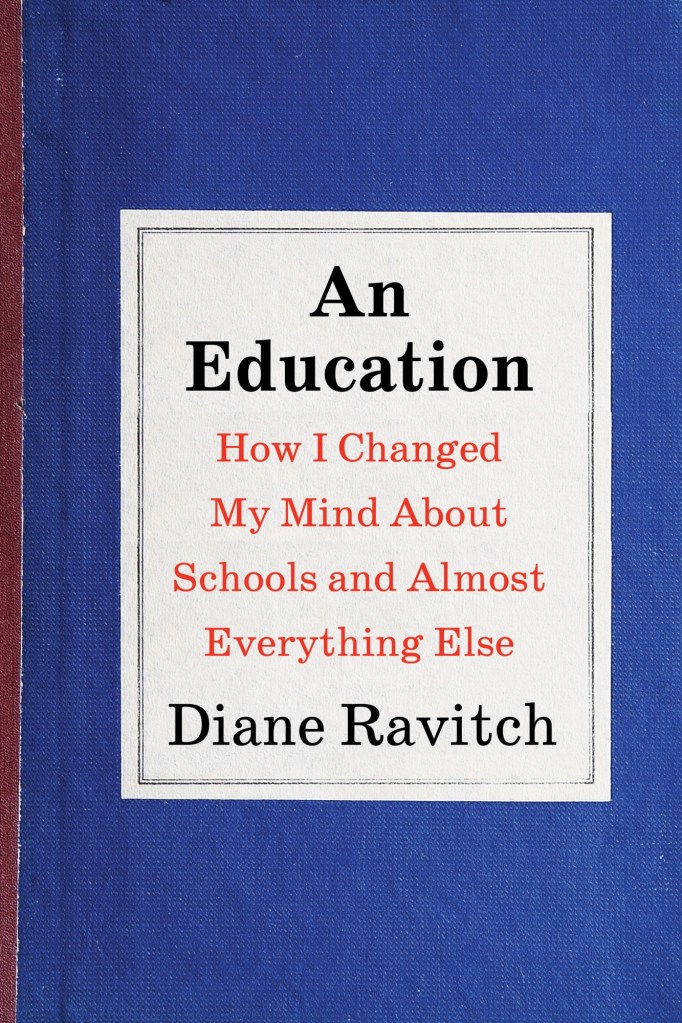
So I was immensely grateful when I discovered that he reviewed my memoirs in both Forbes and, in a different voice, on his blog Curmudgacation.
Most folks know the basic outline of the Ravitch career, that she was a recognized and successful part of the conservative ed reform establishment who then turned away from the Dark Side and joined the Resistance–hell, basically co-founded the Resistance.
I have never heard her talk or write much about what that change cost her, and she doesn’t really talk about it in those terms in this book, but the early chapters show just how in that world she was. Connected to all the right people, welcome at all the right gatherings, in demand as a speaker, and the people–the names just keep coming. Ravitch was in the Room Where It Happens, and not just in it, but close friends with some of the folks in it with her. And she walked away from all that.
I don’t point to that to say we should feel sad for what she gave up, but as a sign of just how tough she is. She looked at the reality on the ground and concluded that she had to change some core beliefs, and having changed them, she had to act on them. If there was more of that kind of intellectual and ethical toughness in the world, the world would be a better place. It’s unusual enough that folks on the privatizer side have often assumed that someone must be paying her off, and a handful of people on the public school side were reluctant to fully trust her.
There are other details in the book that attest to her guts and hard work. Her first book, The Great School Wars, was a history of the New York City public school system– a massive research project that Ravitch in her mid-thirties just assigned to herself, a project so thorough and well-constructed that she could use it as her PhD thesis.
There are lots of fun details in the book– imagine the young Diane Ravitch swinging on a rope ladder outside a Wellesley dorm room where a formal dinner was in progress.
The book tells the story of how she got there, how she concluded that the policies that she had believed in were simply not so. And again– many another person would have at that point either kept going through the motions, or retreated to a quiet cave, but Diane instead became an outspoken critic of the very policies, organizations, and people who had been her professional world.
Back in the early 2010s, I was a high school English teacher in a quiet rural and small town corner of Pennsylvania. I knew things were happening in education that just felt really wrong, and I went searching for answers. What I found was Diane Ravitch’s blog, which was like a gathering place for many voices of advocacy for public school. It was where I found many writers who could help me make sense of things like Common Core and NCLB’s undermining of public education.
There are several people who were responsible for my finding an audience (or the audience finding me) but it was Diane’s blog that got me my earliest connections to audiences. I didn’t know any of these folks, didn’t have any of the connections that hold together movements. At my first NPE conference, the most common question I got was some version of “Who the heck are you and where did you come from?” Diane’s network had made it possible for me to find my connections with a larger movement.
I’m just one example of how Diane’s extraordinary generosity in sharing her platform allowed all sorts of supporters of public education from all across the country to connect and support each other. It’s a notably different approach to leadership than, say, making a movement all about yourself in an attempt to collect personal power on the backs of followers instead of lifting everyone up to be a leader and activist in their own little corner of the world.
The book provides part of answer to where a person like Diane comes from, where that kind of intellectual and ethical courage and diligence come from. And it also provides a clear, compact explaining of where modern ed reform has gone wrong, from the toxic test-and-punish approach of NCLB to the billionaire-driven privatization push to the culture panic debates currently raging. If you want to hand someone a quick simple explainer of what has gone wrong, you can do worse than the last few chapters of this book.
At 223 pages, this is a brisk read but an illuminating one. I highly recommend it
Yesterday I wrote that President Donald J. Trump’s celebration of his new marble bathroom in the White House was so tone deaf at a time when federal employees are working without pay, furloughed workers are taking out bank loans to pay their bills, healthcare premiums are skyrocketing, and Supplemental Nutrition Assistance Program benefits are at risk, that it seemed likely to make the history books as a symbol of this administration.
But that image got overtaken just hours later by pictures from a Great Gatsby–themed party Trump threw at Mar-a-Lago last night hours before SNAP benefits ended. F. Scott Fitzgerald’s 1925 novel The Great Gatsby skewered the immoral and meaningless lives of the very wealthy during the Jazz Age who spent their time throwing extravagant parties and laying waste to the lives of the people around them.
Although two federal judges yesterday found that the administration’s refusal to use reserves Congress provided to fund SNAP in an emergency was likely illegal and one ordered the government to use that money, the administration did not immediately do as the judge ordered.
Trump posted on social media that “[o]ur Government lawyers do not think we have the legal authority to pay SNAP,” so he has “instructed our lawyers to ask the Court to clarify how we can legally fund SNAP as soon as possible.” Blaming the Democrats for the shutdown, Trump added that “even if we get immediate guidance, it will unfortunately be delayed while States get the money out.” His post provided the phone number for Senate minority leader Chuck Schumer’s office, telling people: “If you use SNAP benefits, call the Senate Democrats, and tell them to reopen the Government, NOW!”
“They were careless people,” Fitzgerald wrote, “they smashed up things and creatures and then retreated back into their money or their vast carelessness or whatever it was that kept them together, and let other people clean up the mess they had made.”
This afternoon, Ellen Nakashima and Noah Robertson of the Washington Post reported that the administration is claiming it does not have to consult Congress to continue its attacks on Venezuela. The 1973 War Powers Act says it does.
In 1973, after President Richard M. Nixon ordered secret bombings of Cambodia during the Vietnam War, Congress passed the War Powers Resolution to reassert its power over foreign wars. “It is the purpose of this joint resolution to fulfill the intent of the framers of the Constitution of the United States and insure that the collective judgment of both the Congress and the President will apply to the introduction of United States Armed Forces into hostilities, or into situations where imminent involvement in hostilities is clearly indicated by the circumstances, and to the continued use of such forces in hostilities or in such situations,” it read.
On September 4, 2025, Trump notified Congress of a strike against a vessel in the Caribbean that he said “was assessed to be affiliated with a designated terrorist organization and to be engaged in illicit drug trafficking activities.” The letter added: “I am providing this report as part of my efforts to keep the Congress fully informed, consistent with the War Powers Resolution.”
Monday will mark 60 days from that announcement, but the administration does not appear to be planning to ask for Congress’s approval. It has been reluctant to share information about the strikes, first excluding senior Senate Democrats from a Senate briefing, then offering House members a briefing that did not include lawyers and failed to answer basic questions. The top two leaders of the Senate Armed Services Committee, Roger Wicker (R-MS) and Jack Reed (D-RI), have both said the administration has not produced documents, attack orders, and a list of targets required by law.
Representative Gregory W. Meeks (D-NY), the top Democrat on the House Foreign Affairs Committee, told Nakashima and Robertson: “The administration is, I believe, doing an illegal act and anything that it can to avoid Congress.”
T. Elliot Gaiser, who leads the Office of Legal Counsel under Trump, told a group of lawmakers this week that the administration is taking the position that the strikes on unnamed people in small boats do not meet the definition of hostilities because they are not putting U.S. military personnel in harm’s way. It says the strikes, which have killed more than 60 people, have been conducted primarily by drones launched off naval vessels.
Brian Finucane, who was the War Powers Resolution lawyer at the State Department under President Barack Obama and during Trump’s first term, explained: “What they’re saying is anytime the president uses drones or any standoff weapon against someone who cannot shoot back, it’s not hostilities. It’s a wild claim of executive authority.”
If the administration proceeds without acknowledging the Monday deadline for congressional approval, Finucane said, “it is usurping Congress’s authority over the use of military force.”