Archives for category: Accountability

Bill Phillis is a retired state deputy commissioner of education who is dedicated to the preservation and improvement of public schools in Ohio. He has dedicated his retirement years to publicizing the harm that vouchers and charters do to public schools. He founded the Ohio Coalition for Equity and Adequacy. The Ohio State Constitution guarantees a uniform system of public schools, a commitment that the Republicans who control the state have repeatedly violated with impunity.

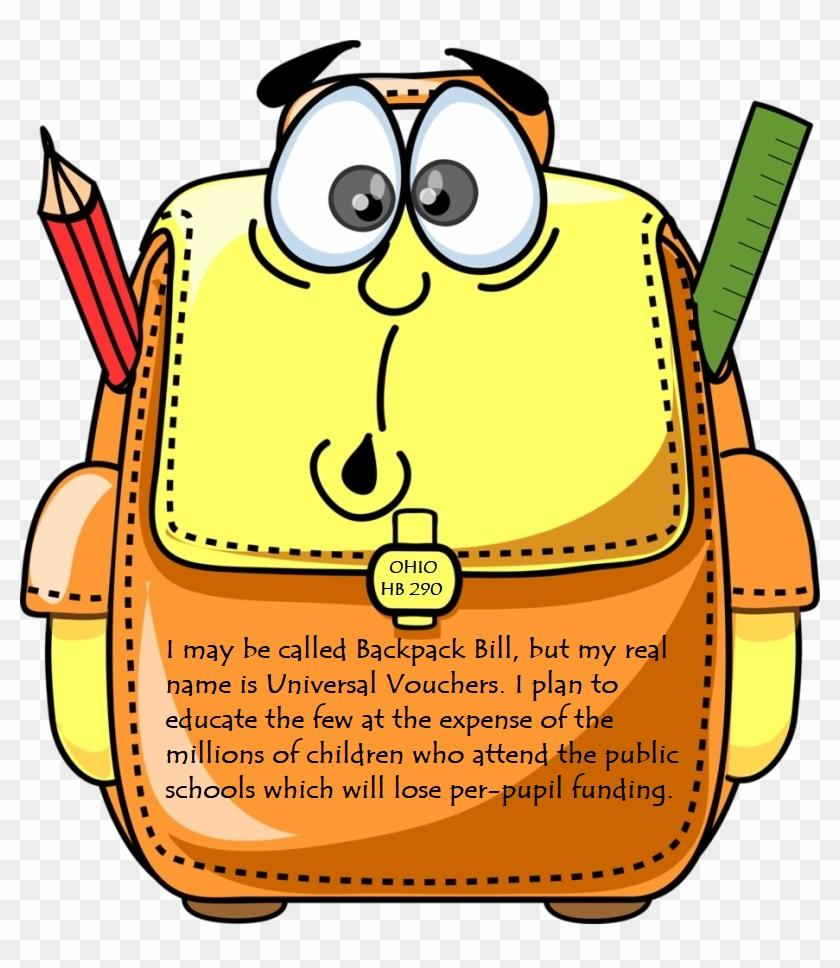
The latest gambit from the Republican privatizers called “the backpack bill,” symbolizing the idea that each child has a “backpack full of cash” to spend in any way their family chooses. They really need to see the wonderful documentary “Backpack Full of Cash.” You can rent the documentary and show it in your community.

Phillis writes:

THE OHIO UNIVERSAL VOUCHER CAMPAIGNERS USE CRITICAL RACE THEORY TO ENTICE FOLKS TO SUPPORT HB290 (UNIVERSAL VOUCHERS) IN A SLICK MAILER


The HB290 crusaders have produced and sent a fundraising mailer signed by one Aaron Baer to an undisclosed list of folks. The seven-page letter warns recipients that public schools are indoctrinating our children into radical anti-Christian ideology, “Critical Race Theory, and trans advocacy”. “They are being trained to hate America”, the letter says. They evidently combed through the classrooms of Ohio and found 4 students whose teachers were doing something that hinted at support for CRT or other controversial issues. They didn’t mention the 100,000 plus public school educators that are working selflessly to grow upstanding citizens.
The author of the letter makes such revealing statements as:

  • “…many of Ohio’s public schools have been failing our students for more than a generation.”
  • “…I initiated the Backpack Bill (HB290)…” (A couple legislators who sponsored the bill indicate they initiated the bill.)
  • “…The Backpack Bill ensures every Ohio student can have access to high quality education…”
  • The P.S. to the letter includes the statement, “Ohio students are trapped in failing public schools…”

The Backpack voucher campaigners are perpetuating the myth of the “failing public school monopoly” as a key plank in their campaign platform.

Public school advocates, who believe HB290 is too extreme to pass, need to wake up.

Follow the link to read the 8 Lies About Private School Vouchershttps://vouchershurtohio.com/8-lies-about-private-school-vouchers/

Like us on Facebook: https://www.facebook.com/OhioEandA


Photo Credit: Jeanne Melvin


The No Child Left Behind Act Has Put The Nation At RiskVouchers Hurt Ohio

William L. Phillis | Ohio Coalition for Equity & Adequacy of School Funding | 614.228.6540 |ohioeanda@sbcglobal.net| http://ohiocoalition.orgSign up for our newsletter!

A regular commenter on the blog, known as Chiara, reports the composition of West Virginia’s new board for authorizing charter schools. The legislature endorsed new charter schools in a state that has never had them. Several of them will be for-profits. Two will be virtual charters. There are three other entities that can authorize the privately run schools that are publicly funded.

Chiara wrote:

Here’s the oversight of West Virginia’s new charter sector: “Appointees are: former Greater Beckley Christian School head boys basketball coach Brian Helton; John Waltz, the vice president for enrollment management at West Virginia Wesleyan College Upshur County; Dewayne Duncan, a real estate developer in Kanawha County and former Republican candidate for Kanawha County Commission; Karen Bailey-Chapman, owner of public relations firm KB Advocacy in Jefferson County and a board member of the libertarian Cardinal Institute for West Virginia Policy; and Adam Kissel, a senior fellow at the Cardinal Institute. Kissel, a former deputy assistant secretary for higher education programs at the U.S. Department of Education for 16 months under former president Donald Trump, said he was excited to get to work on the new board.” Not a single person from a public school, nor anyone who supports public schools. Rigorously screened – only true believer ideological ed reformers are hired. These are the governance systems national ed reformers design and lobby for, so this must be how they envision the privatized systems they’re creating. Packed with fellow ed reform echo chambers, no dissent or different views permitted, and deliberate exclusion of anyone who comes out of a public school.

Naftuli Moster is the Founder and Executive Director of YAFFED, a nonprofit organization focused on improving secular education in ultra-Orthodox yeshivas. He is a graduate of a New York yeshiva, and he became convinced after he finished that he had been denied a full education. He blames officials in New York City and New York State for ignoring the needs of Yeshiva students to avoid offending politically powerful orthodox Jewish communities.

Moster writes:

Students in many ultra-Orthodox yeshivas face educational neglect. NYSED must stop the delays.

It may sound shocking in this day and age, but many ultra-Orthodox schools in New York are actively violating state law by providing little to no secular instruction in topics like English, math, science, and history—and New York officials have stalled and stymied action to address this educational neglect at every turn.

What started as an allegation by a small group of grassroots activists has since been confirmed by the New York City Department of Education, which found that 26 of the 28 yeshivas they investigated did not meet the minimum standards. Hasidic boys in elementary and middle school receive a maximum of 90 minutes of secular education a day, and in high school they receive none whatsoever. (Girls in these same communities tend to receive more secular education because they are barred from studying Talmud and because they are groomed to be the breadwinner, so their husbands can continue studying Torah.)

After years of considering a proposal to increase oversight of New York’s nonpublic schools—the first real chance at reform since this issue came to the fore in 2015 —the New York State Education Department (NYSED) balked. In May 2021, after intense pressure from private school entities, NYSED quietly disclosed to the Board of Regents that they would be scrapping proposed regulations, which had been under consideration since 2019 and would have increased oversight of the state’s nonpublic schools, ensuring that they provide students with a basic education. New regulations are supposed to be developed this fall, but since they were not discussed in the October Board of Regents monthly meeting, the timeline seems to be delayed once again.

This development is unacceptable. Since the alarm was first sounded about the lack of secular studies in Hasidic yeshivas, leaders of these same schools have taken every opportunity they can to smear advocates and spread misinformation about what really goes on in their institutions. Their tactics have contributed to the years of stalling of any meaningful reforms, leaving students to suffer the consequences of no real secular education, and limited college and career prospects.

And, this student population is on the rise. Our report shows how the Hasidic population only continues to grow, and with that, so does the impact of this issue. Hasidic students already make up 20.5 percent of the nonpublic school students in New York, with over 90,000 students enrolled in Hasidic schools in 2018-2019. In Brooklyn, it is projected that by 2030, 23 to 37 percent of all school-age children will be Hasidic.

This means that each passing year, more students will miss out on a basic education. Many finish their schooling with about the equivalent of a third or fourth-grade education and never learn even basic sciences or history. Where is the equity in that?

Of course, NYSED should follow through and develop meaningful regulations that would enforce subject matter requirements and time allotment standards. But NYSED cannot act as if, in the absence of new regulations, they are powerless to enforce any kind of educational standards. There are long-standing regulations about how to deal with complaints against nonpublic schools in New York. NYSED must use its existing authority to ensure that children attending ultra-Orthodox yeshivas are getting the education to which they are entitled under the New York State Constitution. A new school year is already underway, and there is no time to waste.

It is shameful that NYSED is failing to live up to its self-proclaimed vision to “provide leadership for a system that yields the best educated people in the world” out of fear they might upset private school leadership. The students themselves—the very people that NYSED is supposed to support—are bearing the brunt of this crisis. NYSED must step up to do the job they are entrusted to do, and that taxpayers pay them to do.

Betty Rosa, Commissioner of NYSED, has an opportunity to be a real leader here and ensure strong regulations are adopted. And, while policies are being crafted and revised, she must use NYSED’s existing authority to take any corrective actions necessary against schools that are failing their students. She can leave an indelible mark on New York State education policy, finally putting an end to the injustice ultra-Orthodox students have faced for generations.

After months of negotiations among Democrats over the fate of President Biden’s historic $3.5 trillion proposal, a compromise seems to have been reached (although nothing is certain). At the insistence of Democratic Senators Manchin and Sinema, the size of the ambitious plan has been cut in half. Many of its parts were cut away, including two years of free community college and 12 weeks of paid family leave for medical reasons (the U.S. is the only major nation that doesn’t provide it). Three Democratic members of the House killed the provision to lower prescription drugs. And of course the Republicans opposed everything.

This is how Harold Meyerson of The American Prospect described it.

World’s Biggest Half-Full, Half-Empty Glass

Biden’s bill is historically great and bitterly disappointing.


Well—had we not anticipated, had it never seemed, that the Democrats, having won control of Congress and the White House, would proceed to enact paid family leave, expansions of Medicare, a permanent Child Tax Credit, disincentives to fossil fuel use, the ability to negotiate down drug prices, and such—had we not counted on that, then today would be a day of unmitigated celebration. Instead, celebration of the groundbreaking social provisions that actually are in the bill President Biden outlined today—universal pre-K, child care subsidies, incentives for clean energy, commonsense tax reforms that will compel corporations to pay some taxes, and the like—has to be mitigated by the fate of the even more commonsense provisions that now lie on the cutting-room floor.

For me, the most absurd relegation to that floor has been killing the proposal to give Medicare the ability to bring down drug prices. Seldom is a serious change to social and economic policy backed by more than three-fourths of the public, but this one surely was. Reportedly, President Biden has persuaded Kyrsten Sinema to accept a deal so preposterously weak—one that enables Medicare to negotiate down the price of drugs whose patents have expired (that is, after the big drug companies have wrung out the lion’s share of profits on those drugs, and which simply incentivizes those companies to extend their patents)—that few Democrats on the Hill seem inclined to vote for it. (Its merits are so nonexistent that the provision was omitted from Biden’s bill.)

By opposing giving Medicare the capacity to stop Big Pharma from charging Americans vastly more for their medications than they charge the citizens of any other nation, Sinema and three House Democrats effectively killed the one provision of the proposed $3.5 trillion package that would have most reduced the cost of living, significantly slowed the pace of inflation, and quite possibly moved more swing votes into the Democrats’ column than any other.

Leading the resistance to this measure in the House was Scott Peters, the California Democrat whose North San Diego County district includes many of the biotech companies that reap fortunes from high drug prices. While Sinema and the two other House Democrats who joined with Peters can likely be successfully primaried, the economy of Peters’s district is so dependent on high drug prices that he might well survive such a challenge…

One provision of the PRO Act—which, taken as a whole, would have been a new Magna Carta for American workers—has made it into Biden’s bill. The provision requires employers to pay fines ranging from $50,000 to $100,000 when they commit unfair labor practices, such as firing employees for their pro-union activities. Under current law, there are effectively no penalties assessed on employers when they’re found guilty of such practices. By excluding the more fundamental provisions of the PRO Act from Biden’s bill, chiefly because they don’t fit under rules of reconciliation, the employer-employee playing field remains steeply tilted toward employers, but if these fines pass muster with the Senate parliamentarian (an open question), they do reduce that tilt by a decidedly modest margin.

As befits a half-empty, if also half-full, glass.


~ HAROLD MEYERSON

Anand Giridharadas interviewed Senator Ron Wyden of Oregon, who is sponsoring a ”billionaires’ tax,” which would tax assets, not just income. This tax on the growth in their assets would affect between 600-700 billionaires. The revenue from the billionaires’ tax would pay for a large part of President Biden’s proposed budget plan. Two members of the Democratic Party—Senator Joe Manchin of West Virginia and Senator Kyrsten Sinema of Arizona—have blocked the bill, objecting to its cost and to raising taxes to pay for it. Republicans will unanimously oppose it, so Biden can’t afford to lose even one vote. The discussion has gone on for months, and the Republicans hope to stall and stall, then win enough seats a year from now to destroy Biden’s plans and his presidency.

In another interview, Anand talks with Berkeley economist Gabriel Zucman, who explains how the wealth tax would work. In a fascinating overview, he says the tax would affect fewer than 1,000 people: it’s the most progressive tax possible, targeted at the tippy top. It’s also technically different from a wealth tax in that it does not tax wealth itself, but the increase in wealth — what economists call unrealized capital gains.

To get an idea of who will pay the tax, scan Bloomberg’s Billionaires Index. Elon Musk is #1, with more than $200 billion. Jeff Bezos is #2.

If The.Ink interviews are behind a paywall, you should subscribe. Anand is consistently interesting.

ANAND: Is the wealth tax on? Is this in the final package? Is this thing happening?

SENATOR WYDEN: We’re pulling out all the stops. Tonight we’re going to start talking about it in more detail. I have been unable to see even one senator getting up and actually saying, “Gee, I think it’s OK that billionaires are not paying any taxes for years on end.”

What the opponents are trying to do, because they aren’t willing to get up and actually act like they’re sympathetic to billionaires, they’re running the old FUD strategy — fear, uncertainty and doubt. If you can just throw enough FUD at it, then senators say, “Oh, gee, I really don’t know.”

ANAND: I’m hearing from a lot of people that Senators Joe Manchin and Kyrsten Sinema, who have resisted even modest tax increases on corporations and rich people, that they’re with you on this. I’m curious: How did they get behind an unprecedented and historic wealth tax instead of relatively more modest ideas?

SENATOR WYDEN: Well, first of all, we’re calling this the “billionaires’ income tax,” so that people know that billionaires should pay taxes every year, just the way nurses and firefighters are.

All of the members are still making up their minds and saying we want to know more information about this and that, but around here, everything is always impossible until 15 minutes before it comes together — and particularly when you’re taking on such enormous, concentrated power. Billionaires know lots and lots of United States senators.

Editor’s Note (me): After Anand published this interview, and after Senator Wyden released his bill, Senator Manchin said he was not likely to support it because it targets such a small and specific number of people. It’s “divisive,” he said, to single out billionaires. When you don’t want to do something (like tax billionaires), any excuse will do.

Jack Schneider and Jennifer Berkshire are co-authors of A Wolf at the Schoolhouse Door: The Dismantling of Public Education and the Future of School. It is a book that everyone should read. They recently wrote an article that was posted in Valerie Strauss’s “Answer Sheet” blog at the Washington Post.

They write:

In their search for issues that will deliver Congress in 2022, conservatives have begun to circle around the cause of “parents’ rights.” In Indiana, Republican Attorney General Todd Rokita recently introduced a Parents Bill of Rights, which asserts that “education policy and curriculum should accurately reflect the values of Indiana families.” In Florida, the legislature passed an even more comprehensive bill, assuring that the state and its public schools cannot infringe on the “fundamental rights” of parents. A growing number of states are allowing parents to sue districts that teach banned concepts. And in Virginia, Republican Glenn Youngkin has made parents’ rights a centerpiece of his campaign for governor, staging “parents matter” rallies and declaring, “I believe parents should be in charge of their kids’ education.”

Given this frenzy, one might reasonably conclude that radicals are out to curtail the established rights that Americans have over the educational sphere. Yet what’s actually radical here is the assertion of parental powers that have never previously existed. This is not to say that parents should have no influence over how their children are taught. But common law and case law in the United States have long supported the idea that education should prepare young people to think for themselves, even if that runs counter to the wishes of parents. In the words of legal scholar Jeff Shulman, “This effort may well divide child from parent, not because socialist educators want to indoctrinate children, but because learning to think for oneself is what children do.”

When do the interests of parents and children diverge? Generally, it occurs when a parent’s desire to inculcate a particular worldview denies the child exposure to other ideas and values that an independent young person might wish to embrace or at least entertain. To turn over all decisions to parents, then, would risk inhibiting the ability of young people to think independently. As the political scientist Rob Reich has argued, “Minimal autonomy requires, especially for its civic importance, that a child be able to examine his or her own political values and beliefs, and those of others, with a critical eye.” If we value that end, “the structure of schooling cannot simply replicate in every particularity the values and beliefs of a child’s home.”

The law has long reflected this. Consider home schooling. Although it is legal across the country, states still regulate its practice. Such regulations often aren’t enforced, but they are certainly on the books. Home-schooling parents can be required to establish minimal academic qualifications, to submit examples of student work to school district administrators or even to adopt a state-approved curriculum. As the Supreme Court noted in Wisconsin v. Yoder, a case that granted Amish parents the widest possible exemption from state control, “There is no doubt as to the power of a State, having a high responsibility for education of its citizens, to impose reasonable regulations for the control and duration of basic education.” And, as the court made clear in an earlier case, Pierce v. Society of Sisters, the state concerns itself not just with the well-being of the child but also with what the justices broadly called “the public welfare.”

The sudden push for parental rights, then, isn’t a response to substantive changes in education or the law. It’s a political tactic.

Writing in the 1960s, historian Richard Hofstadter observed that conservatives felt that the country had been “taken away from them and their kind” and that timeworn American virtues had been “eaten away by cosmopolitans and intellectuals.” In response, they took up what he called the “paranoid style” — an approach to politics characterized by “heated exaggeration, suspiciousness, and conspiratorial fantasy.” Published more than half a century ago, his essay could have been penned yesterday.

The “paranoid style” of politics is particularly useful as a mechanism for organizing opposition. And the Republicans employing it right now have two particular targets in mind. The first is the public education system, which hard-liners have long sought to undermine. At an annual cost of nearly three-quarters of a trillion dollars, tuition-free, open-enrollment education represents one of the nation’s most substantial commitments to the public good. But well before Ronald Reagan’s failed effort to introduce vouchers in the 1980s, conservatives were making the case for a privatized system — one in which families, not taxpayers, would bear the cost of education, and governance would happen through the free market rather than democratic politics. In recent years, this vision has come roaring back. Conservative legislatures across the United States have introduced bills creating education savings accounts, private-school tuition tax credits and other forms of neo-vouchers that package old ideological wine in new bottles.

But this play is much bigger than education. For years, the Republican Party has understood that the demographic tide is against it. Knowing that every vote matters, the GOP has increasingly relied on a strategy of voter suppression. Simultaneously, Republicans have worked to ensure that their base turns out in force by stoking White racial grievance. The recent firestorm over critical race theory is a perfect case in point. Never mind that this concept from legal scholarship isn’t actually taught in K-12 schools or that it isn’t what most protesters believe it to be. Republicans gain an electoral advantage by convincing their base that White children are being taught to hate themselves, their families and their country. Whether this supposed attack on the American way of life is being coordinated by Black Lives Matter activists, Marxist educators or antifa operatives, the point, as Hofstadter observed, is to generate an enemy “thought of as being totally evil and totally unappeasable.”

Courts have found that parents have great authority when it comes to deciding how to raise and educate their children. This right, however, does not mean that public schools must cater to parents’ individual ideas about education. Parents can opt out of the public system if they wish, and pay to send their children to private or religious schools. But even there, parental rights remain subject to state regulation and override.

In framing our public schools as extremist organizations that undermine the prerogatives of families, conservatives are bringing napalm to the fight. That may rally the base and tilt a few elections in their favor. But as with any scorched-earth campaign, the costs of this conflict will be borne long after the fighting stops. Parents may end up with a new set of “rights” only to discover that they have lost something even more fundamental in the process. Turned against their schools and their democracy, they may wake from their conspiratorial fantasies to find a pile of rubble and a heap of ashes.

The Wall Street Journal, owned by billionaire RupertMurdoch (who also owns Fox News), runs a steady diet of anti-public school editorials. Sometimes they bash public schools. Sometimes they praise charter schools and vouchers. Sometimes they do all of this in the same editorial. While an opinion piece that expresses a dissenting opinion occasionally gets published, it’s fair to say that the WSJ does not like public schools. In my last book, Slaying Goliath, I praised retired Austin librarian Sara Stevenson for responding to every WSJ vilification of public schools.

Peter Greene responded to the opinion piece by law professor Philip Hamburger, who claimed that public schools are not “constitutional” because they suppress parents’ freedom of speech, that is, their ability to ensure that their children hear, read, and learn only what their parents want them to learn.

Greene begins:

Last Friday, the Wall Street Journal (Fox News’ upscale sibling) published an op-ed from Philip Hamburger, a Columbia law professor and head of the New Civil Liberties Alliance, a Koch-funded pro bono firm that takes cases primarily to defend against the “administrative state.” It’s a hit job on public education with some pretty bold arguments, some of which are pretty insulting. But he sure says a lot of the quiet part out loud, and that makes this worth a look. Let me walk you through this. (Warning–it’s a little rambly, and you can skip to the last section if you want to get the basic layout)

Hamburger signals where he’s headed with the very first paragraph: The public school system weighs on parents. It burdens them not simply with poor teaching and discipline, but with political bias, hostility toward religion, and now even sexual and racial indoctrination. Schools often seek openly to shape the very identity of children. What can parents do about it?

Hamburger offers no particular evidence for any of this catalog of arguable points. Various surveys repeatedly show that the majority of parents approve of their child’s public school. The rest is a litany of conservative complaints with no particular evidence, but Hamburger needs the premise to power the rest of his argument.

So here comes Hamburger’s bold assertion:

Education is mostly speech, and parents have a constitutional right to choose the speech with which their children will be educated. They therefore cannot constitutionally be compelled, or even pressured, to make their children a captive audience for government indoctrination. Conservative talking points about public education routinely assert and assume that public education is a service provided to parents, rather than to the students or society at large. It’s case I’ve never seen them successfully make. At the same time, society’s stake in educated members is clear and the entire rationale behind having non-parent taxpayers help pay the cost of public education. In any other instance where the taxpayers subsidize a private individual’s purchase of goods or service (e.g. food stamps, housing), some conservatives say the social safety net is a Bad Thing, so it’s uncharacteristic for them to champion public education as, basically, a welfare program for parents when they want to dramatically reduce all other such programs to bathtub-drowning size (spoiler alert: they’d like to do that with public education, too).

But Hamburger has taken another step here, arguing that speech to children somehow belongs to their parents. It’s a bold notion–do parents somehow have a First Amendment right to control every sound that enters their children’s ears? Where are the children’s rights in this? Or does Hamburger’s argument (as some angry Twitter respondents claim) reduce children to chattel?

Hamburger follows his assertion with some arguments that don’t help. He argues that public education has always attempted to “homogenize and mold the identity of children,” which is a huge claim and, like much of his argument, assumes that schools somehow have the power to overwrite or erase everything that parents have inculcated at home. But then, for the whole argument currently raging, it’s necessary to paint public schools as huge threat in order to justify taking dramatic major action against them….

But “education is speech” is not the really bold part of his argument. That really bold part is where he goes on to say “therefor, parents should have total control over it.” I have so many questions. Should parents have total control over all speech directed at or in the vicinity of their children, including books, and so would I be violating a parent’s First Amendment rights if I gave their child an book for Christmas? And where are the child’s rights in this? Would this mean that a parent is allowed to lock their child in the basement in order to protect that parent’s First Amendment right to control what the child is exposed to?

Hamburger’s argument has implications that he doesn’t get into in his rush to get to “do away with them and give everyone vouchers.” The biggest perhaps is that he has made an argument that non-parent taxpayers should not have to subsidize an education system. I’m betting he’s not unaware of that.

Please open the link and read the rest of the article.

Jeff Bryant reports on a frightening phenomenon: the notorious and violent Proud Boys are targeting public schools.

He begins:

When violent insurrectionists stormed the U.S. Capitol on January 6 to attempt to overturn the result of the 2020 presidential election, some of the rioters were members of the Proud Boys, a far-right group prone to street brawling and pro-Western, anti-Muslim, and misogynistic rhetoric.

The insurrectionists were thwarted, but now extremist groups—including the Proud Boys—are aiming their threats and violence at a new target: public schools.

In Orange County, North Carolina, the Proud Boys and other white nationalist groups have begun showing up at high school football games and school board meetings, “protesting the district’s COVID-19 and LGBTQ+ policies.” Their intimidating language, apparel, and physical gestures prompted officials to hire extra security and pass a resolution opposing “incidents of hostile and racist behavior,” according to a report in the News and Observer.

The resolution charged that the rightwing agitators had “shouted racist and homophobic slurs at students” and included “emails from teachers and students who describe how unsafe they feel being around the Proud Boys.”

A local radio station quoted Orange County board chairwoman Hillary MacKenzie describing a recent meeting of the board where “there were two men in Proud Boys shirts and hats . . . one wore a stocking over his face . . . the other one told our board during public comment that someone should tie rocks around our necks, and we should throw ourselves in a river.”

Similar occurrences from around the country seem to indicate that the Proud Boys’ targeting of public schools is a coordinated, nationwide effort, suggesting a direct line from the group’s involvement in the January 6 insurrection to its current participation in the wave of protests at public schools and school board meetings.

Jim Sleeper is a journalist and alumnus of Yale, as well as a lecturer there. He published an enlightening article about the role of Yale University in forging the Grand Strategy, a strategy of American imperial power to safeguard the world (and American interests). For those of us who came of age in the 1950s, it seemed like the American Colossus was invincible and profoundly moral. But since the debacles in Vietnam and Afghanistan, the Grand Strategy no longer looks so grand, and America’s role as the “world’s policeman” appears to be a fruitless enterprise. To understand the Grand Strategy and Yale’s role in shaping it, read Sleeper’s article.

Sleeper urged me to post a larger portion of his excellent essay. Here it is.

When a new leader of the Grand Strategy program tied to change its focus, she was forced out.

Sleeper begins:

Yale history professor Beverly Gage has been praised widely for defending academic freedom from donors’ meddling by announcing her resignation (effective in December) from the directorship of Yale University’s Brady-Johnson Program in Grand Strategy, which she took over in 2017 from Cold War historian John Lewis Gaddis. But there are more politically urgent, and arguably profound, questions at issue here beyond professors’ right to design their courses free of outside interference.

Since the program’s inception more than two decades ago, Grand Strategy’s intensive seminars have engaged undergraduate as well as graduate students with close readings of classical works on strategy, stressful crisis decision-making simulations, and meetings with accomplished policymakers. In 2010, David Petraeus, at the time the four-star Army general commanding U.S. military operations in the Middle East (and later to become director of the CIA), visited the seminar, as did former U.S. Secretary of State Henry Kissinger, observers from the CIA, and U.S. Military Academy cadets.

That the program, prior to Gage’s arrival, nudged students toward embracing the U.S. military and national security state was hardly a secret. “A Yale Class Seeks to Change the World … Before Graduation,” read a headline on a Columbia News Service report in 2004, when Grand Strategy was directed by Gaddis. “We are looking for leaders,” the late Charles Hill, a program co-founder, career Foreign Service officer, and Yale’s diplomat-in-residence, told the reporter. “This course gives us a great opportunity to get our hooks into them early. We are not … looking for the kind of person who would be protesting the [World Trade Organization] at Davos,” the World Economic Forum.

But Gage wanted students to scrutinize foreign-policy elites, not elevate them. She welcomed social movement activists in civil rights, environmental, and other domestic causes, expanding Grand Strategy’s horizons to include people who challenge the dominant world arrangements that other visitors defend. Soon she was “second guessed and undermined,” as she put it, by the Yale administration’s failure to resist a demand for a conservative board of program overseers made by Grand Strategy’s benefactors: former Treasury Secretary Nicholas Brady, a former director of the Mitre Corporation and manager of federally funded research and development projects for the Defense Department; and Brady’s billionaire business associate Charles B. Johnson, an overseer of the conservative Hoover Institution on War, Revolution, and Peace. The two had endowed Grand Strategy with $17.5 million in 2006.

In an essay for the recently published anthology Rethinking American Grand Strategy, Gage writes that “as a citizen, I have, for better or worse, been as likely to be a protester as a policy maker,” and she urges anyone drawn to the latter “to pay more attention to voices bubbling up from below.” To Grand Strategy’s emphasis on foreign-policy decision-making, she added “the art of … channeling collective grievances into effective action.”

Gaddis, Hill, and other original faculty had sided generally with the powerful. “We hauled the entire Grand Strategy class down to New York to meet Henry Kissinger and hear about his sense of the great deficit that exists in grand-strategic thinking,” Gaddis told a large assembly of Yale alumni (including me) at a reunion in 2004. “A student was outraged by Christopher Hitchens’s book accusing Henry of war crimes. So I said, ‘Why not do a senior essay on Kissinger’s ethics?’ I saw a draft, called Henry, and he said ‘Bring him in.’ He hired him on the spot, … to fact check Christopher Hitchens.”

Many alumni swooned, not least over Gaddis’s exhibition of first-name familiarity with the famous and powerful. This was how things had been done at Yale in their time, and by God, Gaddis was bringing back the old elan! But nobody stopped to ask how that fits with a college education for undergrads, or whether intermingling national security professionalism with liberal education prematurely narrows their intellectual and moral development.

Yale College has often been a crucible of U.S. national statesmanship and espionage: Nathan Hale, class of 1773, was hanged for spying on British-colonial troop movements; the CIA was founded at Yale during World War II; and the State Department and its diplomatic corps have been instructed and advised by Yale professors for decades. Yale’s president from 1951 to 1963, A. Whitney Griswold, a descendant of colonial Connecticut governors and an “establishment” figure par excellence, abolished Yale’s Institute for International Studies, which had been funneling students into murky foreign missions with help from conservative alumni, but even then the university continued to serve as a recruitment grounds for the foreign-policy establishment.
Trump is a sore loser. Will we ever see the last of him?

It seems he’ll be with us forever, his legacy revealed by the stories that his former aides tell about what they saw during his four madcap years.

The latest is contained in a story in The New York Times. It seems that the famous xenophobe Stephen Miller cooked up a campaign season plan to close the border by stationing 250,000 troops there. Trump loved the idea. It would show that he’s a tough guy and would achieve his goal of ending immigration on our southern border.

But Defense Secretary Mark Esper shot down the idea. He thought it was “outrageous.” A quarter million troops was “more than half the active U.S. Army, and a sixth of all American forces — to the southern border in what would have been the largest use of the military inside the United States since the Civil War.”

The idea was batted around but Secretary Esper was adamantly opposed. Trump and his minions also considered a proposal to send troops into Mexico to hunt down members of drug cartels, but backed when they became persuaded that it would be considered an act of war to send our military across the border of another country, uninvited.

After a brief but contentious confrontation with Mr. Miller in the Oval Office, Mr. Esper ended consideration of the idea at the Pentagon.

Mr. Trump’s obsession with the southern border was already well known by that time. He had demanded a wall with flesh-piercing spikes, repeatedly mused about a moat filled with alligators, and asked about shooting migrants in the leg as they crossed the border. His aides considered a heat-ray that would make migrants’ skin feel hot.

Around the same time that officials considered the huge deployment to the American side of the border with Mexico, Mr. Trump also pressed his top aides to send forces into Mexico itself to hunt drug cartels, much like American commandos have tracked and killed terrorists in Afghanistan or Pakistan, the officials said.

Mr. Trump hesitated only after aides suggested that to most of the world, military raids inside Mexico could look like the United States was committing an act of war against one of its closest allies, which is also its biggest trading partner, the officials said…

But taken together, the ideas under discussion that spring underscore the Trump administration’s view of the armed forces as a tool of the presidency that could be wielded on behalf of Mr. Trump’s domestic political agenda in an election year…

Wiser heads than Trump or Miller recognized how unhinged these proposals were:

If Mr. Trump had gone through with the troop deployment, it would have represented a force two and a half times the size of the 100,000 American troops in Afghanistan at the height of the 20-year war in that country. It would have also dwarfed the American presence in Iraq during the war there: The maximum number of troops in Iraq at any time was about 170,000.

It is unclear how the Defense Department could have managed such a deployment. The U.S. Army has about 481,000 active-duty soldiers, but many are already deployed around the world, as are thousands of Marines, airmen and other troops. Sending 250,000 troops to the border — much of which crosses difficult, undeveloped lands — would also have required an enormous logistical effort to house and feed the troops.

In the original version of this post, i said that Nixon told the press when he resigbed, ”You wont have Nixon to kick around anymore.” Tom Ultican caught my error. Nixon said this when he lost the California governor’s race in 1962.