Archives for category: Accountability

Fort Worth Independent School District mounted a campaign to pass a $1.2 billion bond issue, the largest in the nation, and it passed by 57 votes, out of nearly 25,000 cast.

The successful campaign reflected the needs of the public schools and the hard work of parents and the chair of the campaign, Dr. Charles Foster Johnson of Pastors for Texas Children.

a The new money will be used to renovate the district’s middle schools, some built 70 years ago, to build a new elementary school, and to renovate others.

Dr. Johnson and his fellow clergy worked closely with parents to win support for the bond issue, as this article by Dr. Johnson shows.

Dr. Johnson wrote:

As the pandemic worsened, teachers went the extra mile, checking on the health and safety of children and often providing for students’ needs out of their own pockets. Fort Worth professional educators served as angels of mercy, especially for our poorest, most vulnerable children. Eighty-six percent of students in the district are economically disadvantaged. For many, their lifeline is their neighborhood public school.…

The package is the result of years of detailed planning and careful community input. An advisory committee of educators, parents and business leaders spent more than five years assessing our facility needs. Our elected school board held thoughtful, thorough deliberations.

This thorough due diligence is one reason why the Fort Worth Chamber of Commerce, Fort Worth Hispanic Chamber of Commerce, and Fort Worth Metropolitan Black Chamber of Commerce all endorse this bond.

Why now? With bond rates at historic lows, Fort Worth can save millions of dollars by improving our children’s neighborhood schools now instead of waiting. Furthermore, this bond will not result in a property tax rate increase for homeowners and businesses. It is imperative that we provide our educators with the tools and facilities they need to best prepare the next generation of community leaders. The bond package will help our hard-working teachers across the district continue to provide quality programs at every grade level. This includes improving every part of the district with additional classroom space, renovations to aging middle schools, and a new elementary school.

The improvements funded by the bond issue will help the public schools fend off the aggressive invasion of new charter schools, which are favored by Governor Gregg Abbott.

Read more at: https://www.star-telegram.com/opinion/opn-columns-blogs/other-voices/article255103397.html#storylink=cpy

Bill Phillis, retired deputy commissioner of education in Ohio, is a staunch advocate for the state system of common schools, which is guaranteed in the state constitution. He founded the Ohio Coalition for Equity and Adequacy. The question in Ohio, as in many other states, is why Ohio legislators continue to fund failure.

He writes:

STATE REPORT CARD: CHARTER SCHOOLS NOT EVEN A CLOSE SECOND TO REAL PUBLIC SCHOOLS

The original promise of charter and voucher advocates: Charters will out-place school districts.

The data show a different outcome.

There is no data available from private schools to make a comparison.


Scott DiMauro, President of the Ohio Education Association, in a November 3 commentary in the Ohio Capital Journal shared a comparison of charter school report card results with real public schools. The results show that charter school kids are the real losers.


Do state officials care? Apparently not.

State Report Cards Should Be A Wakeup Call For Ohio’s Charter, Voucher Hawks

Scott DiMauro

I remember taking home my report cards when I was in school. I was a pretty good student; my grades always reflected my passion for subjects I loved, and more importantly, provided some real-time feedback on areas where improvement was needed — Time management, for example, was a skill I had to learn over time. During my years as a high school social studies teacher, I strived to give that same kind of useful assessment to my students when I was putting report cards together for them.

The state puts report cards together for school buildings and districts, too. In spirit, at least, they have the same mission, quantitatively assessing where our publicly funded institutions across the state are succeeding and where there is room for growth. And not surprisingly, after a year and a half of serious challenges brought on by the COVID-19 pandemic, the latest round of state report cards shows there’s some extra room for improvement, with about a 10% drop in Performance Index (PI) scores for Ohio’s traditional public schools from the 2018-2019 school year to the 2020-2021 one. Chronic absenteeism also climbed to 17%, up from 7.5%, during that time.

But, over that same period, charter schools in the state saw a 25% drop in PI scores – a 2.5 times greater loss than traditional public schools. And chronic absenteeism in those institutions soared from 22% up to 45%, meaning nearly half of all charter school students in Ohio missed a big chunk of the last school year.

While the Ohio Education Association applauds the change in state law that removed letter grades from the state report card system, it is clear Ohio’s charter schools are not making the grade. As a teacher, I’d give them a D-minus at best.
This should be seriously alarming to Ohio’s taxpayers, who see their money taken from their local public schools to fund these poorer performing alternatives. The PI drop for KIPP, a charter school in Columbus, was 66% — more than double the decline seen in Columbus City Schools.

The seven biggest PI drops in Ohio charter schools were Breakthrough Schools in the Cleveland area, which are often touted by charter advocates as shining examples of success, with PI scores plummeting 77% to 84%. Charter advocates often complain about comparing all school districts’ performance with charters, but last year, 606 out of 612 public school districts in the state lost scarce resources to charter schools.

Recent test score data on Ohio’s private, mostly religious schools — which receive millions in taxpayer funded vouchers — is not available to make a comparison, since those schools are not subject to any of the same accountability standards as public districts.

Now, if some lawmakers get their way, the situation will get exponentially worse for the 90% of Ohio’s kids who rely on public education. House Bill 290 — known as the “Backpack Bill” — would create so-called “Education Savings Accounts” that are just universal vouchers with even less accountability. Even with these vouchers, most families still couldn’t afford tuition at the private schools in their communities, and for those that do go to the private schools, Ohio taxpayers who foot the bill don’t get much bang for their buck. The Cincinnati Enquirer revealed last year that nearly 90% of all voucher students do worse on state tests than students in traditional public schools in the same zip codes.

The data paint a troubling picture. Vouchers and charters take critical resources and weaken the public schools that serve the vast majority of Ohio’s children while delivering worse educational outcomes for our kids. What’s worse is that now we have a school funding system worth investing in — the Fair School Funding Plan. Failing to fully fund that system while pouring more resources into the worse-performing charter and voucher system is wasting an extraordinary opportunity to once and for all fix the way Ohio funds education for the 90% of students and families who attend Ohio’s public schools.

Ohioans need to tell their lawmakers to oppose House Bill 290 and focus on their constitutional responsibility to fund Ohio’s public schools to ensure a high-quality education for all of Ohio’s kids.

State report cards should be a wakeup call for Ohio’s charter, voucher hawks – Ohio Capital Journal

Follow the link to read the 8 Lies About Private School Vouchers https://vouchershurtohio.com/8-lies-about-private-school-vouchers/Like us on Facebook: https://www.facebook.com/OhioEandA
Dan Greenberg is a teacher in Ohio and a member of the board of the Network for Public Education. He teaches high school English in Sylvania, in the northwest of the state.

Here he writes about the power of teachers, who are trusted by parents and the community to refute slanders about their schools.

He writes:

About a week before the November 2nd election, a colleague of mine sent me a picture of a campaign literature piece supporting candidates for school board in my community.

“Kids and Taxpayers FIRST! Keep ‘Woke’ politics out of our classrooms.”

The postcard was paid for by the NW Ohio Coalition for Public School Excellence, a group that was not only supporting conservative candidates in my community, but a neighboring community, with the exact same yard signs just different names.

Not to be outdone, the Northwest Ohio Conservative Coalition blanketed voters in my school district with robo-call messages telling voters to support the conservative candidates and “…keep woke politics out of the classroom.” The calls seem to go out indiscriminately; even the President of Democratic Club in my community received one.

These campaign tactics, filled with lies about schools teaching Critical Race Theory, had an interesting impact. I don’t know how much they motivated conservatives to head to the polls, but the group I saw them motivate most was the teachers. At a time when teachers are emotionally and physically exhausted, when they seem to be focused on making it through one day at a time, these campaign lies seemed to tap some reserve of strength and energy teachers did not know they had. Teachers started posting to social media, pushing back on the CRT lies. They started posting images of the four teacher union-endorsed candidates on their Facebook pages. They sent text messages to friends and family with the names of the teacher-endorsed candidates. One teacher even wrote a message across the entire back window of her van (in excellent teacher handwriting) telling community members to support teachers by voting for our endorsed candidates.

On November 2nd, as results came in the teacher-supported candidates were leading, and in the end, the four candidates in the two districts who were coming to the school boards with a priority of taking on “Woke politics” and Critical Race Theory lost.

The campaign money, the campaign literature, the yard signs, the robo calls… they could not beat the voice of teachers and the voice of truth.

This article by Ed Montini in the Arizona Republic explains the childish behavior of Republican leaders, who engage in taunts instead of reasoned discourse about their agenda. They don’t want to expand Medicare. They don’t want universal pre-K. They don’t support efforts to combat climate change. They oppose paid family leave for families in need after surgery or childhood. They are against a federal guarantee of two years tuition-free community college. They oppose higher taxes on billionaires. They don’t care about voting rights. They don’t want to expand opportunity. They don’t want to reduce inequality. They don’t invest in the future.

What are they for? Tax breaks for the rich.

Since they have no agenda, their goal is to make sure Biden can’t succeed. After blocking everything he proposes (with the help of Senator Manchin of West Virginia and Senator Krysten Sinema), they have nothing to offer other than the schoolyard chant.

Ed Mancini was walking his dog early one morning, and he saw two other dog owners engage in conversation, a man and a woman. As they part ways, the man says to the woman, “Let’s go, Brandon!” then turning away.

The woman is puzzled and asks Montini if he knows what that phrase means.

So, first thing in the morning I am called upon to explain this recent cultural phenomenon to one of the few American grown-ups who has managed to remain a fully functioning adult, while most of the rest of us have been transformed by social media into crude, smart-alecky 8-year-olds.

There’s that Southwest Airlines pilot

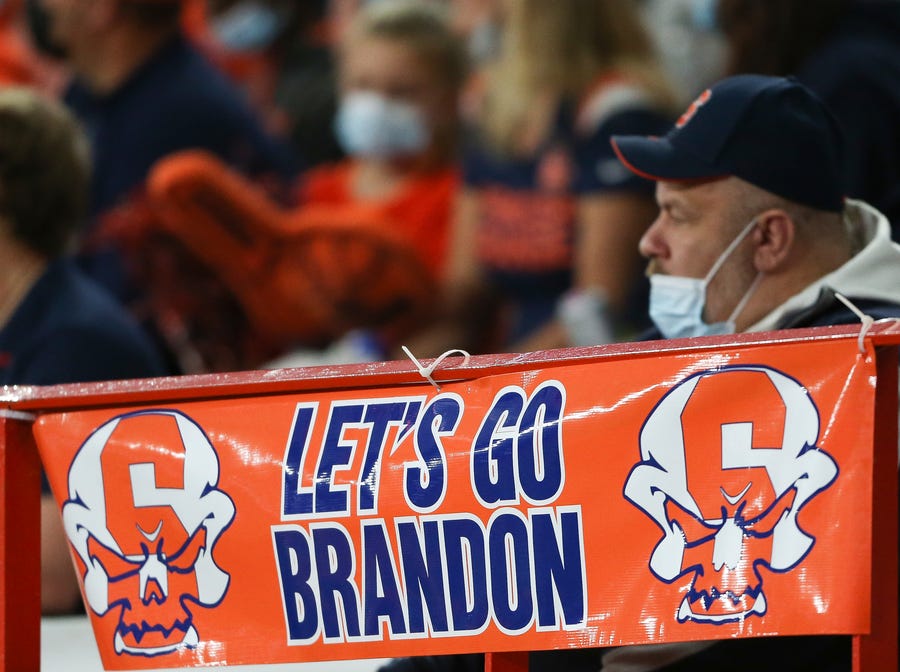
This particular sign was a the Boston College-Syracuse football game Oct. 30. A fan’s juvenile jab at President Joe Biden.Joshua Bessex

For instance, the woman had not heard about the Southwest Airlines pilot who recently signed off on a flight, telling passengers, “Let’s go, Brandon.”

Or about how the whole thing began when a race car driver named Brandon Brown won a NASCAR race and, while being interviewed on TV, the crowd started chanting, “F–k Joe Biden.” The flummoxed interviewer suggested they might be saying, “Let’s go, Brandon.”

After that, the phrase became a way for grown-up 8-year-olds to say the f-word about Biden without actually using it.

Really.

Elected Republican politicians in Washington, D.C., started using the phrase.

Donald Trump began selling “Let’s go Brandon” T-shirts through his Save America PAC for $45, and grown-up 8-year-olds in America actually purchased them.

$45.

There are adults who channel their 8-year-old selves by bringing signs saying, “Let’s go, Brandon” to public events, as well as some who scribble the message in paint on the rear window of their automobiles….

How to answer someone who says such a thing

Of course, we all learned as children that infantile behavior tends to draw some type of backlash….

After I explain the whole “Let’s go, Brandon” thing to the woman who’d been walking her dog she says, “That seems incredibly childish. How are you supposed to answer someone who says such a thing?”

I tell her that, as a grown-up, she would be best served simply ignoring it.

As for the rest of us, suffering as we do from social-media-induced age regression, I’d respond, “I’m rubber and you’re glue …”

Reach Montini at ed.montini@arizonarepublic.com.

Problem viewing email? View in browser

Many of the nation’s public schools are in poor physical condition. Since the Great Recession of 2008, states stopped or cut the funding necessary repairs and upgrades. President Biden’s infrastructure plan included $100 billion to upgrade the physical conditions of America’s schools. In the last hours of haggling before the bill was passed, this provision was cut, then eliminated.

In a major blow that left educators, school leaders and advocates stunned, Democrats pared back – and then eliminated – $100 billion that Joe Biden earmarked for school modernization in his spending bill.

The story details the woeful conditions of Philadelphia’s schools. Helen Gym, an education activist who was elected to the city council, has been outspoken about the need to invest in rebuilding obsolete schools.

“Our children deal with lead, asbestos and mold,” Gym says of the School District of Philadelphia, where schools are on average 70 years old. “We had to start school weeks later than schools in the suburbs because we don’t have air conditioning and classrooms can reach 90 degrees or higher on our hottest days, which are becoming more and more frequent.”

Gym, a potential 2023 mayoral contender and longtime education activist, had been arrested weeks prior to the rally for banging on the doors of the Senate gallery inside the state Capitol in Harrisburg to protest the way the state funds the city’s public school system – a longstanding issue that goes on trial in the commonwealth court next week.

“We have windows that don’t open fully,” she says. “Even now we struggle with the basics of functioning cafeterias, bathrooms that don’t flood and roofs that don’t cave in.”

Five years ago, when Philadelphia performed a cursory assessment of its buildings, it estimated that basic repairs to bring schools up to code would cost roughly $4.5 billion, to say nothing of long-standing larger renovation needs or modernizing its K-12 system top-to-bottom. In 2019, the school district took out a $500 million bond for routine capital projects to begin facilities improvements.

States need federal aid to upgrade their schools. We put our money into those things we care most about. Providing healthy and attractive buildings where children learn is not at the top of the list.

Harold Meyerson, one of my favorite commentators on current events, says that we should stop calling Joe Manchin and Kyrsten Sinema “moderates.” How can one man and one woman block every proposal that would help improve the lives of millions of Americans, including their constituents? Nor should we use that term to describe the handful of Democrats in the House who are blocking reasonable and popular programs, like lowering drug prices. I note that I allow Meyerson to use a word that is not permitted on this blog…but he wrote it.

He writes:

Memo to Media: Stop Calling Manchin et al. ‘Moderates’
Being more swayed by big-money contributions and an anti-mother bias are far better descriptors. 
“Moderates Hinder Efforts to Negotiate Drug Prices,” says a front-page headline in today’s Washington Post. Certain Democrats are indeed blocking those efforts, but is the media right to characterize them as moderates? How much of the fight between the overwhelming majority of both the House and Senate Democratic caucuses and the Manchin-Sinema-Gottheimer-Peters gang can accurately be described as left-vs.-center or liberal-vs.-moderate, which are the autopilot descriptions that the media applies to them?

Consider, for instance, that a number of these battles are being waged over policies that would win over swing voters and, indeed, are popular across the political spectrum. In a recent Kaiser Family Foundation poll, fully 83 percent of Americans, including 76 percent of Republicans, favored allowing the federal government to negotiate with drug companies to bring down the prescription drug prices for Medicare recipients and people with private insurance. Which is why, on Sunday, 15 House Democrats in frontline districts—genuine moderates—signed a letter to the congressional leaders saying that bringing down drug prices was key to their survival in next year’s midterm elections (and, by extension, to the Democrats’ ability to hold a majority in the next Congress).

There are similar majorities in support of other initiatives that the so-called moderates have blocked, like paid sick leave (73 percent in a recent CBS News poll) and extending Medicare coverage to vision and dental care (84 percent in the same poll).

So, is “moderate” an accurate characterization of the Manchin Gang? Is it moderation that dictates their stances?

Even a cursory look at the campaign contributions to those gang members suggests other factors besides “moderation” are in play. In the House, two of the three Democrats who blocked the relatively comprehensive drug price negotiation provision—California’s Scott Peters and Oregon’s Kurt Schrader—are among the largest recipients of drug company campaign contributions. The nay-saying duo of Schrader and Peters have received a combined $1.5 million in pharma contributions in the course of their congressional careers. The one Democrat who blocked that provision in the Senate, Arizona’s Kyrsten Sinema, raised a record $1.1 million from July through September, as her opposition to reducing drug prices became clear. A good chunk came directly from Big Pharma executives, even as a paltry 10 percent came from actual Arizonans. With ratios like that, it would not be a stretch to conclude that Sinema, who’s not up for re-election until 2024, may be more motivated by a high-paying job in a high-paying industry than she is by winning the votes of her constituents, moderate and otherwise, should she seek re-election.

We should note that the other Democratic senator from Arizona—former astronaut Mark Kelly—met with fellow moderate Amy Klobuchar and genuine leftists Bernie Sanders and Elizabeth Warren last Thursday to discuss how to get a drug price reduction into the reconciliation bill. Does that make Kelly a liberal and Sinema a moderate? I think not.

So, what do we call these non-moderate moderates who for reasons of their own have broken ranks with their fellow Democrats and President Biden? How about OMT Democrats—Only Money Talks Democrats?

That works for most of them; I’m not sure it does justice, though, to Joe Manchin, who increasingly seems a character of Dostoevskian perversity. With each passing (or blocking) day, Manchin comes across as a creature of steadily mounting rage against fellow legislators who don’t pay him sufficient obeisance, who fail to recognize that this is really all about him. On one issue—paid family leave—he has positioned himself as the sole but sufficient bulwark against making sure that Americans in need, most particularly mothers of newborns and sick children, must choose between work and parenting.

There’s a term for this that is far more accurate than “moderate.” The mot juste for Manchin is “motherfucker.” 

Boston has had mayoral control of the schools since 1992. On November 2, the voters went to the polls and overwhelmingly supported the return of an elected school board. Mayoral control was sold as a “reform” panacea that would lead to higher achievement. It didn’t. Boston joins Chicago as cities where the public wants to abandon autocratic rule of the schools. The vote in Boston to restore an elected board went 4-1 in favor.

The newly elected mayor, Michelle Wu, said before the election that she would be open to a board in which a majority of members were elected, and some were appointed by the mayor.

The Boston Globe wrote:

The Question 3 ballot measure, which passed with 78.7 percent of the vote, was nonbinding, meaning it doesn’t carry legal weight. But councilors say it will prompt them to push for changes that will democratize school decision-making and empower communities of colorwho have long felt ignored by the appointed committee.

The media focused its attention on Virginia, where the gubernatorial race was centered on education issues, especially whether parents had a right to control what their children read. A parent led a crusade against Toni Morrison’s Pulitzer Prize winning Beloved for years. The Republican winner, Glenn Youngkin, featured Mrs. Murphy’s decade-old campaign against Beloved in a TV ad. So, many journalists see the Virginia election as a repudiation of “critical race theory” or teaching the horrible facts about human enslavement.

But the North Carolina-based News & Observer published a story that went national via the Associated Press with a different slant. And according to some of the readers here, the anti-CRT, anti-masking folks lost in their districts.

Groups that oppose face masks and vaccines frequently lost. No clear national trend has emerged so far, but parents who want safe schools without censorship of high-quality literature have to organize to keep their schools boards free of extremism and bigotry.

Here is an excerpt:

In Wisconsin, four members of the Mequon-Thiensville School Board held off a recall challenge that cost anti-critical race theory backers nearly $50,000.

In Minnesota, three conservative candidates failed to win a seat on the board in Wayzata. They ran on a “Vote for Three!” platform that denounces “harmful ideologies like CRT,” political indoctrination and “controversial medical mandates.”

In Connecticut, a slate of five five candidates opposed to critical race theory lost the board of education race in the Guilford school system, where a racial reckoning began years ago, first with an episode in which a student wore blackface to a home football game, followed by a fraught debate over the elimination of its mascot, the Indians. Parents for Guilford Students, which backed the losing candidates, posted on Facebook: “Our five republican candidates lost the BOE election.” But, the post said, “those that lost the most are the dear children of Guilford.”

In Colorado, early results showed anti-mask candidate Schumé Navarro trailing in her bid for a seat on the Cherry Creek School District. The mother of three went to court last month to win the right to attend a district candidate event without a face mask, arguing that she cannot wear one because of abuse she suffered as a child. “The environment and the culture that it’s creating is just stealing from our kids,” she said of masks.

However, the fight against diversity education resonated in the school board race in the Carroll Independent School District in Southlake, Texas, where Andrew Yeager won on Tuesday night. He was backed by a political action committee that opposes a diversity and equality plan created after a video of students chanting a racial slur began circulating online three years ago. A temporary restraining order has blocked the plan.

1776 Action, a group inspired by former President Donald Trump’s now-disbanded 1776 Commission that played down America’s role in slavery, urged candidates to sign a pledge calling for the restoration of “honest, patriotic education.” At least 300 candidates and elected officials did so, said Adam Waldeck, the group’s president. Waldeck said his group also sent out mailers and targeted text messages in races in Johnston, Iowa, where three candidates have signed the pledge, and in West Chester, Pennsylvania, where law enforcement was called to investigate threats against school board President Chris McCune. The backlash stems from his ordering the removal from a July meeting of a parent who kept demanding information about critical race theory after her two-minute time limit had ended. McCune, who is on track to retain his seat, wrote in a letter to the Daily Local News newspaper in Pennsylvania that it is his duty to “maintain order” and insisted that the district doesn’t even teach critical race theory.

Read more at: https://www.newsobserver.com/news/article255471366.html#storylink=cpy

Bruce Lesley, child advocate, explains in this article in Medium why a democratic society needs public schools. It’s an excellent article and it reviews the current attacks on public schools and even their right to exist. Did you know that one candidate for U.S. Senate has called for the abolition of public schools; he thinks every child should attend a religious school. Does every parent want their child enrolled in a religious school? Are there enough religious schools to admit 50 million children? A generation ago, a proposal this absurd would have turned him into a laughing-stock.
But these days, ridiculous ideas are in the mainstream, polluting civic discourse.

Lesley’s article returns the discussion of education to reason, a rare quality in these troubled times.

Lesley explains why individual parents should not control what happens in school:

For example, imagine an elementary school of 450 students where 15 parents oppose the teaching of evolution, 19 parents believe the earth is flat, 28 are Holocaust deniers, 22 oppose white children learning about slavery, 7 believe in racial segregation, 21 believe in the concept of a school without walls, 49 demand the use of corporal punishment, 18 want to ban Harry Potter books from the school library, 26 want to ban any books that mention the Trail of Tears, 62 believe that parents should be allowed to overrule a physician’s decision that a child with a concussion should refrain from participating in sports, 87 oppose keeping their kids out of school when they have the flu, 9 believe that a child with cancer might be contagious, 29 believe that kids who are vaccinated should be the ones who quarantine, 72 support “tracking” in all subject areas, 32 believe students should not be taught how to spell the word “isolation” and “quarantine”because they are too “scary of words,” 104 don’t like the school neighborhood boundaries, 38 don’t like the bus routes, 71 parents want a vegan-only lunchroom, 4 demand same-sex classrooms, 5 oppose textbooks and want their children only reading from the Bible, and it can go on and on. The vast majority of parents do not agree with any of these things, and yet, parental rights extremists would insist schools must accommodate them, even if they are completely false, undermine the purpose of education, threaten the safety of children, or promote discrimination.

How can a school operate if every parent can decide every aspect of the education of their child, as some are demanding? It cannot.

The parents who want control of every aspect of their child’s education are homeschoolers.

Alternet recapitulates a Boston Globe investigation of a new phenomen: drivers who use their car as a weapon to drive into protestors.

Three Republican-led states have passed laws to protect the drivers who ran into protestors: Iowa, Oklahoma, and Florida.

On Monday, the Boston Globe reported on a “Back the Blue Act” signed by Iowa’s Republican governor, Kim Reynolds. The bill took the side of drivers who run over protesters. In June of 2020, the driver of Reynold’s state-issued Chevrolet Suburban struck a Des Moines Black Liberation Movement protester who was urging the governor to restore voting rights.

Thirteen other states are considering “hit and kill” legislation.

You can read the Boston Globe investigation here, but be advised that it is probably behind a pay wall.