As we head toward the November election, Policy Matters Ohio’s Bailey Williams exposes recent history that has been little reported. In The Great Ohio Tax Shift, Williams explores simply and clearly the data showing that Ohio’s new billion dollar private school tuition voucher expansion is not the only factor that has threatened public school funding. For two decades now, legislators have been cutting taxes and reducing investment in public services, including public schools. And Ohio’s legislature has increased the tax burden on Ohio’s poorest citizens and made life easier for our state’s wealthiest citizens.
Even though Ohioans have watched the legislature toss a tax cut into budget after budget instead of funding needed services, the cumulative effects Baily presents in the new report are astounding:
“Ohio families with the least resources—those making less than $24,000—pay more annual taxes on average today than they did before 2005.
The average household among the top 1 of Ohio earners, with incomes above $647,000, now contribute over $52,000 per year less than they once did.
The result is a loss of about $12.8 billion a year in revenue….
Ohioans of color are significantly more likely to pay a higher share of their incomes in taxes… while white Ohioans are more likely to have benefited….
71% of the total value of personal income tax cuts has gone to the richest 20% of households….
Changes to sales taxes, excise taxes, and business taxes have, on average, increased taxes for the bottom 99% of Ohio’s households.
Changes to sales taxes, excise taxes, and business taxes have, on average, allowed the richest 1% of Ohio tax filers to pay nearly $600 per year less than they did before 2005.”
Bailey reminds us why we pay taxes and explains what has been sacrificed in Ohio: “Through the state tax system, Ohio can ensure every child gets a world-class education, every community is vibrant and healthy, and every Ohioan, of every race and gender, has a secure economic foundation on which to build our futures. But for a generation, lawmakers have instead used tax policy to create loopholes for the wealthy and influential, and provide special treatment for powerful corporations… The politicians who write state tax policy often justify their decisions with promises that when billionaires’ pockets overflow with profits, the benefits will trickle down to working families. Year after year—now decade after decade—the consequences have been clear: The people with the lowest incomes are paying a little more, the wealthy are paying much less, and Ohio has too few resources to serve its purpose: creating a state where everyone has what they need to live a good life.”
Ohio’s legislature has reduced progressive taxation as it has reduced dependence on income taxes and increased regressive sales, excise and business taxes: “Ohio policymakers have made significant changes to personal income taxes over the two decades, lowering rates and making our tax structure more regressive. Since 2005, almost every biennial budget passed by the Ohio state general assembly has included some form of reduction to the personal income tax, generally through broad tax rate cuts and elimination of top tax brackets. Some changes have benefited low-paid Ohioans: Increasing the threshold at which households begin to pay taxes means households with income below $26,050 don’t pay state income tax…. The creation of a 30% Earned Income Tax Credit has helped low-paid Ohioans.” However, “Other regressive changes in the tax code have completely erased the meager benefits of income tax cuts for the lowest-paid Ohioans. In fact, the lowest-income 20% now pay more on average in taxes than they did before the legislature began its tax cutting spree in 2005. Sales, excise, and business taxes now cost that group more each year on average—more than cancelling out the annual average $122 in income tax cuts this group benefits from….”
Most Ohioans are not prepared to gather and analyze this kind of technical information. Thanks to Bailey Williams and Policy Matters Ohio for this technical analysis. We have spent this year learning about the fiscal implications of the Legislature’s voucher expansion in the current biennial budget; now we are better prepared to understand why, in addition to perpetual voucher expansion, it has been such a struggle to press the Legislature to enact Ohio’s new public school funding formula, the Fair School Funding Plan, to rectify years of inadequate and inequitably distributed public school funding. Legislators have insisted on a slow, three-budget phase-in of the new formula and even now have been unwilling to commit to completing the full launch of the new plan in the budget they will begin negotiating in January. Many of us have realized that the Fair School Funding Plan’s delayed rollout has derived from perennial tax cutting in addition to the enactment of what’s turning out to be an annual billion dollar voucher explosion. Williams’ analysis, released last week, provides information essential to our grasping the complex fiscal realities that will be part of the upcoming state budget debate.
Please open the link to get the full picture of the tax-cutting that has helped the richest Ohioans, hurt the poorest, and undermined public services.
We need to be talking more, not less, about the threat Donald Trump poses to our democracy. The former president and his understudy, JD Vance, have been trying to convince voters, with no evidence and a head-spinning level of hypocrisy, that violence against the former president was caused by rhetoric from Democrats.
Trump has upended the political script, saying, “[The Democrats’] rhetoric is causing me to be shot at, when I am the one who is going to save the country.” Followed closely by JD Vance’s incendiary quip: “The big difference between conservatives and liberals is that no one has tried to kill Kamala Harris in the last couple of months, and two people now have tried to kill Donald Trump in the last couple of months. I’d say that’s pretty strong evidence. The left needs to tone down the rhetoric. It needs to cut this crap out.”
And if you believe that, I’ve got a bridge to sell you.
Among the media and the campaigns, the “threat to democracy” line has apparently become old hat. When he was running for reelection, President Joe Biden often used it in an effort to differentiate himself. Unfortunately, this idea apparently doesn’t poll all that well. While it is true and terrifying, it is also a bit abstract — and for some, hard to believe. Lowering the price of milk is concrete and plausible.
So the Harris campaign hasn’t been talking about democracy much, instead concentrating on tangible policies to help the middle class. While this makes sense politically — and I hope it works — I’m here to say we cannot lose sight of the fact that a second Trump presidency would threaten our way of government and our way of life.
Trump’s term as president was just a precursor to what we can expect the second time around, but it bears repeating to remind us what he is capable of. In case anyone has forgotten, here is a partial list of how he has jeopardized democracy:
Attempted to overturn a free and fair election, a number of times in a number of ways.
Tried to block the peaceful transfer of power by inciting a mob to attack the United States Capitol.
Undermined the independence of the Justice Department, while claiming our legal system was rigged.
Botched the federal government’s response to the pandemic, resulting in a massive loss of life, because he doesn’t believe in inconvenient truths.
Cozied up to dictators and autocrats, even asking one to investigate a baseless claim against his political rival.
Selected Supreme Court justices who curtailed reproductive rights, to the point where women are being denied care and dying.
Lied. All the time. The leader of the free world must be credible.
Is sowing seeds of doubt that the 2024 election will be legitimate.
There is every indication that a second Trump trip to the White House would be even more harmful than the first.
This time around he is angrier and thirstier for vengeful retribution. He has said he will weaponize the Justice Department against his enemies. Full stop.
His loyal cronies have had more time to plan. We know they are vetting and training a legion of sycophants to displace career bureaucrats across the executive branch. The guardrails we had last time, whistleblowers and “adults in the room,” will be gone.
After nine years of Trump at the top of the Republican Party, his cult-like reach has created an army of MAGA-elected officials at the state and local levels who are more than happy to do his bidding, even if it’s illegal.
He is more gullible than ever — wanting, needing to believe his own hype. Believing his own bluster has had dangerous consequences. See: January 6, 2021. He spends his time searching social media for confirmation of his over-inflated self-importance. He surrounds himself with yes-men and women falling all over themselves to prove their fealty. No one will tell him the truth, for fear of retribution. It is a modern spin on the children’s fable “The Emperor’s New Clothes” — only this horror story would be titled, “The Politician’s Stupefying Greatness.”
The coup de grace is that Trump has carte blanche to do whatever he wants. That terrifying reality is brought to you by none other than the Supreme Court with its ruling in Trump v. United States. In a letter to the Senate Judiciary Committee following that decision, representatives from 75 legal organizations said it “poses a significant threat to our democracy by effectively providing the president with sweeping legal immunity for criminal acts.”
We tend to memorialize significant dates in our nation’s history. In my lifetime, there was Pearl Harbor, December 7, 1941. More recently, September 11, 2001, and January 6, 2021, have been etched into our psyche. But I would argue November 5, 2024, could be as or even more significant. It will test the strength of our country’s democratic infrastructure. That infrastructure and the American voter can save democracy by sending Kamala Harris to the Oval Office.
Let’s be clear about one thing: JD Vance lied about every important issue during his debate with Tim Walz. He lied about Obamacare (Trump did not save it, he repeatedly tried to kill it). He lied about Trump’s refusal to acknowledge he lost the 2020 election. He lied about January 6. And he lied about abortion, expressing his sorrow that Amber Thurman died of a botched abortion in Georgia because the state ban made it impossible for her to get the care she needed. I tweeted this yesterday: “JD Vance is sorry that Amber Thurman died but happy that Roe v. Wade was overturned, which led to Georgia’s ban on abortion care, which caused Amber’s death.” So much for contrition.
During the vice presidential debate Tuesday night, former President Trump tried to bail his running mate out of an abortion question with a series of half-truths and lies. “EVERYONE KNOWS I WOULD NOT SUPPORT A FEDERAL ABORTION BAN, UNDER ANY CIRCUMSTANCES, AND WOULD, IN FACT, VETO IT,” Trump posted to social media, “BECAUSE IT IS UP TO THE STATES TO DECIDE BASED ON THE WILL OF THEIR VOTERS (THE WILL OF THE PEOPLE!).”
This is a nonsensical sentence for many reasons. Among them: No one is saying that Congress would pass a new federal ban and hand it Trump to sign or veto. What Trump might do—what his allies want him to do—is enact a ban by enforcing the 1873 Comstock Act, which can’t be vetoed since it’s already on the books. Trump’s misdirection distracts from his consistent anti-abortion record while in office, what the Republican Party platform states, and the very public plans of his former staffers detailed in Project 2025, which Trump also pretends he has nothing to do with. That is part of the Trump-Vance campaign’s plan on abortion: to do whatever they can not to talk about that plan, or at least to confuse the public about what that plan is.
The questions moderators posed to vice presidential candidates Governor Tim Walz and Senator JD Vance on Tuesday night did little to clear matters up. They were not about abortion or abortion rights; they were questions about whether the candidates were lying about abortion.
The question one moderator asked Walz reinforced anti-abortion misinformation spread by Trump. “After Roe v. Wade was overturned, you signed a bill into law that made Minnesota one of the least restrictive states in the nation when it comes to abortion. Former President Trump said in the last debate that you believe abortion ‘in the ninth month is absolutely fine.’ Yes or no? Is that what you support?” asked Norah O’Donnell of CBS News. “I’ll give you two minutes.”
O’Donnell’s own news organization debunked this same “ninth month abortion” point after the last debate. “Former President Donald Trump falsely claimed during Tuesday night’s presidential debate that Vice President Kamala Harris’ running mate, Minnesota Gov. Tim Walz, supports the ‘execution’ of babies after they are born, repeating earlier false assertions that Democrats support killing babies,” CBS News fact-checker Laura Doan wrote way back on September 11.
Walz answered the question posed to him about Minnesota’s abortion law very, very briefly—“That’s not what the bill says”—before pointing out the simple truth that, via his appointments of Neil Gorsuch, Brett Kavanaugh, and Amy Coney Barrett, Donald Trump helped end the federal right to an abortion in this country. “He brags about how great it was that he put the judges in and overturned Roe v. Wade, 52 years of personal autonomy.”
Trump typically responds to this kind of argument by talking about “the will of the people,” as he did in his all-caps post. But when voters have been asked directly about abortion through ballot measures, they affirm the right to abortion. Trump is going to have his say as one of these voters: As a Florida resident, he will be able to vote on the Florida ballot measure that would repeal Florida’s post-Dobbs six-week abortion ban. He has said he would vote “no.” The Republican Party’s platform advances the idea that a fetus is a legal person with rights under the Fourteenth Amendment—which, should the courts agree, would effectively make abortion a crime in every state. Failing that, Trump’s former head of Health and Human Services, Roger Severino, argues that a national abortion ban alreadyexists, in his section of Project 2025’s “Mandate for Leadership.” This argument that the Comstock Act of 1873 could be enforced today to ban abortion is legally dubious at best, but it enjoys the support of 145 Republican members of Congress and has already been entertained at the Supreme Court by Justices Thomas and Alito.
The first abortion question moderators posed JD Vance was about whether he and Trump would create a federal pregnancy monitoring agency. “No, Norah, certainly we won’t,” he said, before launching into a lengthy digression about how the Republican Party needs to win back Americans’ trust on “this issue.” But having affirmed the importance of trust, in subsequent questions, he went on to lie spectacularly on two fronts: First, by saying “I never supported a national ban” (in 2022 he said he “would like abortion to be illegal nationally” and backed Lindsey Graham’s proposal for a federal abortion ban after 15 weeks), and later, by making an utterly bizarre claim about Minnesota abortion law. “The Minnesota law that you signed into law, the statute that you signed into law,” Vance said to Walz, “it says that a doctor who presides over an abortion where the baby survives, the doctor is under no obligation to provide lifesaving care to a baby who survives a botched late-term abortion.”
“The idea of abortion being performed after birth is sometimes used to stigmatize abortion care received later in pregnancy,” as the American College of Obstetricians and Gynecologists write in a fact sheet responding to such misinformation. Talking points like Trump’s also distort perinatal palliative care, ACOG points out, which is given to reduce the discomfort of sick or disabled newborns whose conditions cause them to die shortly after birth. “At no point in the course of delivering a newborn with life-limiting conditions and subsequently providing palliative care does the obstetrician–gynecologist end the life of the newborn receiving palliative care.”
Walz tried to push back again, to say this isn’t what the law said. Vance adopted a know-it-all debate club stance: “What was I wrong about? Governor, please tell me. What was I wrong about?”
In this way, the debate became more about competing claims of what the other person said than about clarifying the candidates’ actual positions. If this sounds tedious to you and impossible to follow, well, you’re not alone. The meta-debate about abortion is boring and exhausting. But you can see why Trump and Vance would prefer to stay there, in the meta-debate. So long as the campaign sows confusion and rewrites reality around a policy position that is wildly unpopular—restricting abortion access—it helps Trump.
Democrats should take every opportunity to argue for what they want and reassert reality, as Walz tried to do. But there’s still a lot further to go: According to a May 2024 Times/Siena poll, around 17 percent of registered voters in swing states said that Biden is more responsible “for the Supreme Court ending the constitutional right to abortion” than Trump. Twelve percent of Democrats in those states said the same thing. What more proof do Democrats need that they have more and better storytelling to do?
Yes. However, I would say that Democrats need more truth-telling to their voters. Leave the storytelling to JD.
The world of education is continually susceptible to hoaxes, frauds, and panaceas. The media pounces on miracle schools, miraculous teachers, and methods that turn every student into a genius.
Tom Ultican, retired teacher of physics and advanced math in California, cannot tolerate scams and overblown claims.
His latest commentary is about “the science of learning,” which comes with the usual fanfare.
He writes:
On September 24, The 74 headline read, “What Happens When a 48K-Student District Commits to the ‘Science of Learning’ – In Frederick County, Maryland, test scores rose, achievement gaps shrank and even veteran educators slowly embraced the decidedly not-faddish fix.” This statement is mostly baloney used to sell the “science of learning.”
The article opens with a new first grade teacher discussing her next day’s math lesson with the school’s principal, Tracy Poquette. The third paragraph says,
“Poquette recommended the whiteboards. ‘You’re going to ask them to hold them up,’ Poquette coached Able, miming holding a whiteboard in the air. Then you can see their answers, and how they got to that. Every student is responding.”’
This seems fine but it is hardly innovative. This technique comes from the 20th century or maybe even the 19th century. The next paragraph states, “The sessions are meant to accelerate student learning and take some of the guesswork out of becoming an effective teacher, part of a larger district plan to incorporate research from the fields of neuroscience, educational psychology and cognitive science — often referred together broadly as the ‘science of learning.’”
They are selling baseless malarkey. Neuroscience and cognitive science still do not provide much usable insight into how students learn or what the best teaching methods are.
The claim of rising test scores is deliberately misleading. The scores may have risen a little but this is a case in which the cause is pretty clear. In statistics, the r-value correlation has a value between o and 1 for determining the effects of different inputs on education testing results. An r = 0 means there in no relationship and an r = 1 means the input is 100% determinative. Inputs like teacher, curriculum design, class size, etc. can be evaluated. The only input ever found with more than o.3 r-value is family wealth at a 0.9 r-value. Between 2021 and 2022, Frederick County, Maryland had “the largest net positive change in total income in the state.” As indicated by statistical analysis, of course test scores raised some.
These fraudulent claims about the “science of learning” are being financed by wealthy people wanting to implement competency based education (CBE). With its concentration on developing mastery of small discrete information bites, CBE makes kids learning at screens more possible. Since 2010, the annual GSV+ASU conference, which is a big deal with tech billionaires, has been striving toward this goal. At their 2023 conference in San Diego, Carnegie and ETS announced a new partnership to create functional testing for competency based education (CBE).
GSV appears to have convinced Tim Knowles and the Carnegie Foundation to abandon the Carnegie Unit to open the way for CBE based testing and badges.
The Claims and Propaganda
Trish Jha, a research fellow at the Center for Independent Studies in Australia, just published a more than 15,000 word essay explaining why the “science of learning” is needed. She claims:
The proponents of the “science of learning” claim that Pestalozzi, Herbart and Dewey, the fathers of progressive education, were wrong. They tell us that “problem based education” is counterproductive and that discovery approaches are harming children. They claim that direct instruction and drilling small bits of information to mastery are what children need.
“Australian education needs to position the science of learning as the foundation for policy and practice.”
“Unfortunately, key pillars of Australian education policy do not reflect the science of learning, due to the far-reaching impacts of progressive educational beliefs dating back to the 18th century.
These beliefs include that:
Students learn best when they themselves guide their learning and it aligns with their interest;
Rote learning is harmful;
Learning should be based on projects or experiences, and that doing this will result in critical and creative thinkers.
But these beliefs are contradicted by the science of learning.”
Ms. Jha asserts, “The teaching approach best supported by the evidence is explicit instruction of a well-sequenced, knowledge-focused curriculum.” She sites E. D. Hirsh as one of her experts supporting this thinking.
It is part of a worldwide effort by wealthy people to digitized education under the cover of “science of learning”. In 2018, the Center for American Progress (CAP) wrote:
“This brief builds on the growing momentum for both the science of learning and school redesign. Last month, for instance, the XQ Institute released a policy guide for states on how best to redesign their schools. The document argued, among other things, that students should be able to learn at their own pace, progressing as they demonstrate mastery of key concepts.
And CAP went on to quote XQ:
“[Competency-based education] isn’t about replacing what goes on in the classroom with less-demanding experiences outside of it. This is about integrating innovative approaches to teaching in the classroom with opportunities for students to develop practical, concrete skills in real world settings. And it’s about awarding credit for learning—demonstrated learning—no matter where or when the learning takes place.”
The XQ institute is the creation of noted anti-public school and teacher-disparaging billionaire, Laurene Powell Jobs.
For 50 years, mastery-based education now called CBE has been a major flop. Established on the mind-numbing drill and skill approach, CBE undermines authentic learning. It has never worked.
Teach for America (TFA) is viewed by many people as the billionaires’ army for school privatization and the New Schools Venture Fund (NSVF) is the Swiss army knife of public school privatization. Deans for Impact (DFI) was created in 2015 with personnel from TFA and NSVF.
DFI founder, Benjamin Riley, was a policy director at NSVF. Riley stepped down as executive director of DFI in August 2022 and was replaced by another NSVF alumnus, Valarie Sakimura. Francesca Forzani, the current board president, spent 4 years as a TFA teacher in Greenville, Mississippi. The list of people from public school privatization promoting organizations who have served on the DFI board of directors is extensive:
Supporters of DFI have been very generous since the founding in 2015. The last year for which tax records are available was 2022. Federal tax forms 990-PF show:
Bill and Melinda Gates Foundation (TIN: 56-2618866) $3,482,504
Charles and Lynn Schusterman Family Foundation (TIN: 73-1312965) $2,135,000
Michael & Susan Dell Foundation (TIN: 36-4336415) $2,375,000
The Joyce Foundation (TIN: 36-6079185) $2,400,000
Carnegie Corporation of New York (TIN: 13-1628151) $875,000
These are huge sums of money but not for billionaires.
“DFI believes all teacher-candidates should know the cognitive-science principles explored in The Science of Learning. And all educators, including new teachers, should be able to connect those principles to their practical implications for the classroom.”
Of course cognitive scientists do not agree on these principles and the neuroscience pitch is fantasy, but DFI is coming through with its deliverables.
Deans for Impact is just one small example of the many organizations billionaires have created to do their bidding.
At the recent Vice-Presidential debate, JD Vance engaged in sanewashing and normalizing Trump, falsely claiming that Trump tried to improve or salvage Obamacare. He lied, as LA Times’ Pulitzer-Prize winning columnist Michael Hiltzik shows. In fact, Trump and most other Republicans tried to kill Obamacare. Trump was also responsible for incompetent management of the federal response to COVID, which increased the death toll.
Every newspaper should either have its own Michael Hiltzik or repost his columns.
I love it more today than ever, because it applies so perfectly to how we must respond to the campaign claims of Donald Trump and JD Vance. Especially Trump’s assertions about his role — heroic, in his vision — in “saving” the Affordable Care Act and fighting the COVID pandemic.
I’ve written before about the firehouse of fabrication and grift emanating from the Trump campaign like a political miasma. On these topics, he has moved beyond his habit of merely concocting a false reality about, say, immigration and crime to deliberately concocting a false reality about himself.
Donald Trump could have destroyed [Obamacare]. Instead, he worked in a bipartisan way to ensure that Americans had access to affordable care.
— JD Vance, flagrantly lying about Trump’s management of the Affordable Care Act
To start by summarizing: Trump did everything in his power to destroy the Affordable Care Act, starting on the very first day of his term in 2017. On COVID, he did everything in his power to make America defenseless against the spreading pandemic.
Let’s take them in order.
Here’s what Trump said about the Affordable Care Act during his Sept. 10 debate with Kamala Harris: “I had a choice to make when I was president, do I save it and make it as good as it can be? Never going to be great. Or do I let it rot? … And I saved it. I did the right thing.”
This was the prelude to his head-scratching assertion that he has “concepts of a plan” to reform healthcare in the U.S. I examined what that might mean in a recent column, in which I explained that it would turn the U.S. healthcare system to the deadly dark ages when people with preexisting medical conditions would be either denied coverage or charged monstrous markups.
“Donald Trump has said that if we allow states to experiment a little bit on how to cover both the chronically ill, but the non-chronically ill … He actually implemented some of these regulations when he was president of the United States. And I think you can make a really good argument that it salvaged Obamacare. … Donald Trump could have destroyed the program. Instead, he worked in a bipartisan way to ensure that Americans had access to affordable care.”
Here’s what Trump actually did to the Affordable Care Act during his presidency. He had made repealing the ACA a core promise of his 2016 presidential campaign, stating on his website, “On day one of the Trump Administration, we will ask Congress to immediately deliver a full repeal of Obamacare.” (Thanks are due to the indispensable Jonathan Cohn of Huffpost for excavating the quote.)
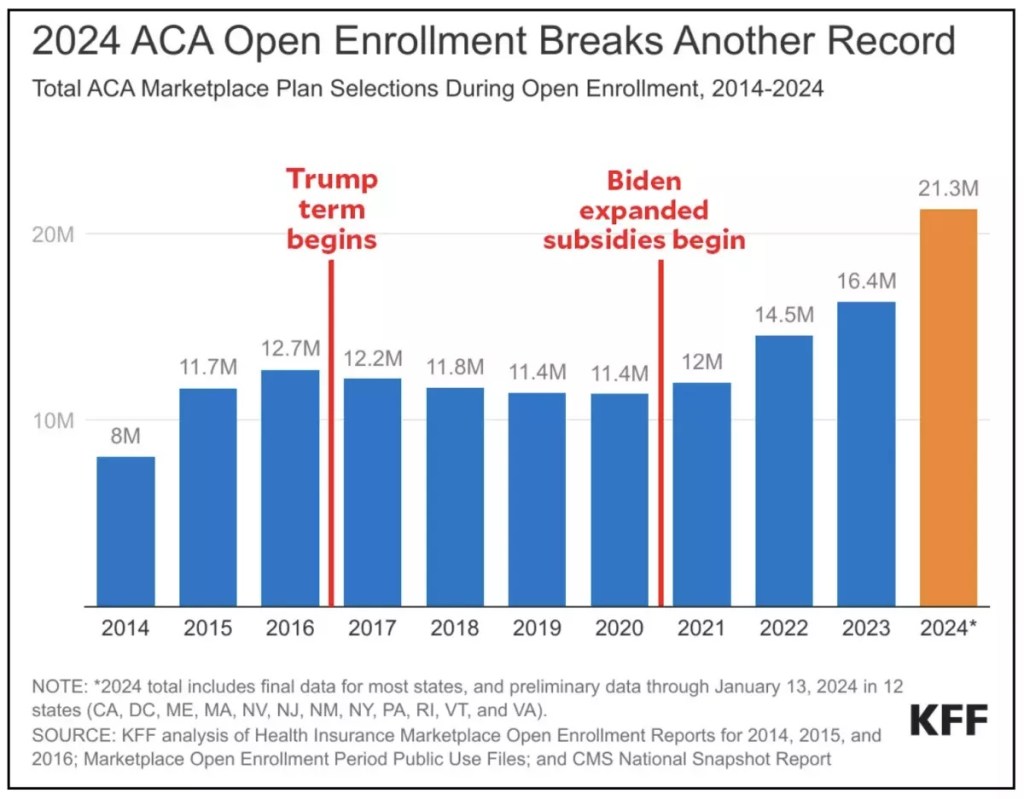
Trump drove down Obamacare enrollment every year he was in office; when Biden removed Trump’s obstacles, enrollment soared.
(KFF / Kevin Drum)
On Inauguration Day, Trump issued an executive order instructing the entire executive branch to find ways to “waive, defer, grant exemptions from, or delay the implementation of any provision or requirement” of the ACA.
During his presidency, he never abandoned the Republican dream of repealing Obamacare, even after July 28, 2017, when the late Sen. John McCain (R-Ariz.) strode to the Senate well and delivered a thumbs-down coup de grace to a GOP repeal bill.
Trump never ceased slandering the ACA as a “disaster.” He returned to the theme during last month’s debate: “Obamacare was lousy healthcare,” he said. “Always was. It’s not very good today.” As president, he threatened to make it “implode,” and used every tool he could get his fingers on to do so.
In September 2017 he slashed the advertising budget for the upcoming open enrollment period for individual insurance policies by a stunning 90%, to $10 million from the previous year’s $100 million. He also cut funds for nonprofit groups that employ “navigators,” those who help people in the individual market understand their options and sign up, by roughly 40%, to $36.8 million from $62.5 million.
Just after taking office, he abruptly canceled the customary last-minute advertising blitz to encourage enrollments in Obamacare plans before open enrollment ended on Jan. 31. The last minute surge in enrollments, which had occurred every previous year, vanished. The drop-off was particularly devastating because it was concentrated among the healthiest potential enrollees — those who often wait until the last minute to sign up and whose premiums generally subsidize older, less healthy patients.
The impact these policies had on enrollment was inescapable. In the three years before Trump took office, ACA marketplace plans experienced annual enrollment increases, to 12.7 million enrollees in 2016 from 8 million in 2014. During every year of the Trump administration, enrollment declined, falling to 11.4 million in 2020.
Every year since Joseph Biden took office, enrollment has increased, reaching a record 21.3 million this year — an 86% increase over Trump’s last year.
As for Vance’s fatuous claim that Trump “worked in a bipartisan way to ensure that Americans had access to affordable care,” you have the right to ask what Vance has been smoking.
The only bipartisanship on the ACA during the Trump years, Cohn observes, were the actions of GOP senators such as McCain and Lisa Murkowski of Alaska to cooperate with Democrats to stave off their fellow Republicans’ anti-ACA vandalism.
Now onto Trump’s fantasy vision of his role in fighting the COVID pandemic. Speaking in a low-energy, exhausted monotone at a speech Tuesday in Milwaukee and reading at times from a binder, he praised himself for instituting Operation Warp Speed, which funded COVID vaccine development in record time and got them rolled out in January 2021.
“We did a great job with the pandemic. Never got the credit we deserved,” he said. He then veered into blaming China for the pandemic, a familiar topic. He said bluntly that the pandemic was “caused by the Wuhan lab. I said that from the beginning, came from Wuhan. And the Wuhan lab, it wasn’t from bats in a cave that was 2,000 miles away. … It’s really the China virus.”
As for the rest of his COVID performance, he said this: “We did a great job with the ventilators, the masks and the gowns and everything. … When we got here the cupboards, our cupboards, I used to say our cupboards were bare. … No president put anything in for a pandemic.” Then he segued into praising himself for a big tax cut, and COVID was forgotten.
A few points about this spiel:
Trump is correct that Operation Warp Speed was a significant achievement. But he didn’t follow up by advocating for its product, the COVID vaccine. Instead, he has thrown in his lot with fanatical anti-vaccine agitators such as Robert F. Kennedy. He has repeated an anti-vax mantra, promising, “I will not give one penny to any school that has a vaccine mandate or a mask mandate.” This is a formula for exposing children to vaccine-preventable diseases such as measles and even polio.
Trump’s reference to the Wuhan Institute of Virology as the source of SARS-CoV-2, the virus that causes COVID, underscores how closely the so-called lab-leak theory of COVID’s origins is tied to right-wing partisan politics. The theory originated with Trump acolytes at the State Department, who saw the accusation as a convenient weapon in Trump’s economic war with China.
To this day, not a speck of evidence has been produced to validate this claim; scientists versed in the relevant disciplines of virology and epidemiology say the evidence overwhelmingly supports the hypothesis that the virus reached humans via the wildlife trade, and that its journey may well have started with bats thousands of miles from Wuhan, China.
Trump is lying when he says his predecessors in the White House left him without resources. The truth is that Trump himself hobbled pandemic response from the start.
In 2016, in the wake of the Ebola epidemic in Africa, President Obama had established the the Directorate for Global Health Security and Biodefense at the National Security Council “to prepare for and, if possible, prevent the next outbreak from becoming an epidemic or pandemic,” in the words of its senior director, Beth Campbell. Trump dissolved it in 2018.
Due to these steps, the U.S. was fated to sleepwalk into the pandemic. The COVID death toll in the U.S. stands at more than 1.2 million, and its reported death rate from COVID of 341.1 per 100,000 population is the highest in the developed world.
Ventilators, masks and gowns? Trump placed the procurement of this essential personal protective equipment in the hands of his son-in-law, Jared Kushner, who handled the task incompetently. Kushner turned away urgent appeals from state and local officials for those supplies.
“The notion of the federal stockpile was it’s supposed to be our stockpile, it’s not supposed to be states’ stockpiles that they then use,” Kushner said at a briefing.
Following his remarks, the website of the government’s national strategic stockpile of medicines and supplies was changed from asserting that its purpose was to “support” the emergency efforts of state, local and tribal authorities by ensuring that “the right medicines and supplies get to those who need them most.” The new language redefined the stockpile’s role as “to supplement state and local supplies … as a short-term stopgap.”
Supplies of ventilators, masks and gowns remained scarce through the first months of the pandemic. A procurement official at a Massachusetts hospital system told me of having had to cut a deal with a shadowy broker offering 250,000 Chinese-made masks at an inflated price, completing the transaction for $1 million at a darkened warehouse five hours from home.
Trump made anti-science incompetence and disregard for the welfare of Americans part of our history. The same thing, or worse, looms on the horizon in a second Trump term.
My comment: who can forget that dramatic moment in 2017 when the late Senator John McCain strode down to the well of the Senate to cast the deciding vote not to repeal Obamacare by dramatically extending his good arm and showing a thumb’s down gesture? Trump forgot.
As to COVID, why didn’t Trump take credit for the vaccines produced by Iperatuon Warp Speed? If the scientists had called it “the TRUMP vaccine, he probably would have boasted about it. Instead, he threw his support to the anti-VAXX conspiracy theorists, which surely contributed to the death toll.
Veteran journalist James Fallows put up a post today on his blog comparing the front page of the New York Times on October 29, 2016 to the front page of the same newspaper on October 3, 2024.
I recommend that you open the link and see what he was comparing.
For those of us who take the law seriously, Trump’s successful evasion of accountability for the failed coup on January 6, 2021, is outrageous. Trump has used delay as his primary strategy for avoiding accountability, as well as his partisan ties to federal judges like Aileen Cannon, whom he appointed, and the rightwing majority on the Supreme Court. Judge Cannon tossed out the documents case. The only viable case right now is Special Prosecutor Jack Smith’s indictment of Trump for launching the events of that day. That case will be heard by Judge Tanya Chutman, who was appointed by Obama. It’s a sad day when the ability to get justice depends on which judge is assigned to the case.
Jordan Rubin writes about Jack Smith’s latest filing here. Smith had to rewrite his brief to acknowledge the U.S. Supreme Court’s ruling that the President has absolute immunity for any “official acts.” Should planning to overthrow the Constitution, to subvert the election, and to send a mob to storm the Capitol be considered “official acts”?
Special counsel Jack Smith’s big immunity brief is here. The 165-page (somewhat redacted) motion lays out why, in the government’s view, the Supreme Court’s immunity ruling doesn’t stop Donald Trump from standing trial in his federal election interference case.
As an example of what the motion seeks to accomplish, consider the discussion of the alleged evidence related to former Vice President Mike Pence, whom Trump pressured to subvert the 2020 presidential election.
As an example of what the motion seeks to accomplish, consider the discussion of the alleged evidence related to former Vice President Mike Pence.
To understand the Pence analysis, recall that Chief Justice John Roberts’ July 1 ruling in Trump v. United States granted absolute immunity for “core” presidential acts, presumptive immunity for all other official acts, and no immunity for unofficial acts. While the high court’s Republican-appointed majority said that it’s up to U.S. District Judge Tanya Chutkan to perform the immunity analysis in the first instance, the justices gave the Washington judge a head start in some parts, including with Pence. They said that whenever Trump and Pence discussed “their official responsibilities” — namely regarding Pence’s certification of Electoral College votes on Jan. 6, 2021 — they had engaged in “official conduct.”
That means Trump would have presumptive immunity for those alleged actions, which Smith would need to rebut. Roberts’ opinion (rather vaguely) said that can be done by showing that the prosecution wouldn’t “pose any dangers of intrusion on the authority and functions of the Executive Branch.” So that’s why Smith wrote in the motion that because that branch “has no role in the certification proceeding — and indeed, the President was purposely excluded from it by design — prosecuting the defendant for his corrupt efforts regarding Pence poses no danger to the Executive Branch’s authority or functioning.” (The vice president is involved in certification via the office’s role as president of the Senate.)
The special counsel further wrote that Trump “sought to encroach on powers specifically assigned by the Constitution to other branches, to advance his own self-interest and perpetuate himself in power, contrary to the will of the people.” Therefore, Smith wrote, prosecuting Trump wouldn’t “pose any danger of intrusion on the authority and functions of the Executive Branch; rather, it would advance the Constitution’s structural design to prevent one Branch from usurping or impairing the performance of the constitutional responsibilities of another Branch.”
Smith’s team also made clear in the filing that prosecutors intend to introduce more evidence at trial related to Pence, who is not accused of any wrongdoing. For instance, they want to introduce evidence of what they call unofficial communications that Trump had with Pence in their capacity as candidates (not as president and vice president), including when Pence “tried to encourage” Trump “as a friend” when news networks began to call the 2020 race for Joe Biden, and later when Pence suggested that Trump should recognize the process was over and run again in 2024. Even if those communications were deemed “official,” Smith wrote, the immunity presumption would be rebutted there too, he argued.
To be sure, the Pence evidence is only part of the case that Smith wants to bring against Trump, who has pleaded not guilty.
To be sure, the Pence evidence is only part of the case that Smith wants to bring against Trump, who has pleaded not guilty. And if the former president wins next month’s presidential election, he’ll be empowered to dismiss the case entirely.
But if Trump loses, then Chutkan would have a heavy task ahead in weighing the voluminous allegations and evidence Smith presents in the monster filing and deciding whether it passes the high court’s (again, rather vague) immunity test. Ultimately, whatever the judge rules will be subject to review again by the justices before any trial can go forward. That won’t happen before the election.
The case will either be killed soon by way of a Trump victory or will linger on for months, if not years, to first determine whether the Supreme Court will even let Trump stand trial over any of these allegations.
Rachel Maddow often manages to come up with a very different take on the news as compared to other talk show hosts. She is fascinated with history, so she often takes her viewers down new paths.
When she was trying to figure out JD Vance, she discovered two of the men who influenced his views. One is a podcaster named “Jack Murphy,” whose real name is John Goldman. He is known for racism, misogyny, and his association with the alt-right. He is very big on the idea of women’s submission to men. He even wrote a book about it.
The other is a man named Curtis Yarvin, a podcaster who is known for his anti-democratic, anti-egalitarian views.
Mother Jones published an excellent article by Reverend Rob Schenck about how he became a leader of the Christian nationalist movement and why he decided to leave it. He recalls when real estate developer and playboy Donald Trump was first introduced to the world of evangelicals. And he describes his own role in connecting rich donors to Republican Supreme Court justices.
Reverend Schenck begins:
In 2014, at an elegant gala inside the Supreme Court’s gilded Great Hall, a tuxedoed Justice Clarence Thomas turned to me and voiced his approval for my work. I glanced over to where Chief Justice John Roberts and his wife, Jane, were entertaining two of my associates, trustees of the Supreme Court Historical Society, a private, nongovernmental entity for which Roberts served as honorary chair. At that moment, I knew the secretive operation I had run, aimed at emboldening Thomas and his conservative colleagues to render the strongest possible decisions in favor of our right-wing Christian agenda, had succeeded.
My organization, Faith and Action in the Nation’s Capital, had created an initiative we called “Operation Higher Court” that trained wealthy couples as “stealth missionaries,” befriending Thomas and his wife, Ginni; Samuel and Martha-Ann Alito; and Antonin and Maureen Scalia—lavishing them with meals at high-end restaurants and invitations to luxurious vacation properties. Alongside these amenities, our ministry offered prayers, gift Bibles, and the assurance that millions of believers thanked God for the decisions this trio of justices rendered on abortion, health care, marriage, and gun ownership….
But Reverend Schenck began to understand that his activities and beliefs were toxic to democracy. What triggered his change? Perhaps it was his late-in-life doctoral studies, when he read about the German Christian movement in the 1930s, which supported the Nazi party. He wrote: One of the most respected Bible scholars of that period, Paul Althaus, declared Hitler’s ascent to the chancellorship to be a “gift and miracle from God.”
He was shaken by his research. He began to change his views. He wondered whether Christian evangelicals in the U.S. were on the same dangerous path.
Following the insurrection of January 6, when Christian banners, Bibles, and prayers in Jesus’ name appeared in the assault on the Capitol, I felt even greater urgency in warning my fellow evangelicals of the grave danger Trump and his MAGA cult posed to Christianity and US democracy.
My change of course so late in life has been painful, disorienting, and costly. Besides losing decades-long friendships and enduring menacing threats, my wife and I have faced a significantly reduced income. I’ve even driven Uber to cover household expenses. One night, I picked up an organizer of the National Prayer Breakfast, an event in which I had once played a significant role. I was wearing a mask and said little, but then, with trepidation, I realized I would be dropping him at the home of a congressman I had worked with closely for more than 20 years. When my passenger got out, I was relieved to have gone unrecognized. Still, I’ve never questioned the decisions that brought me to that moment.
In my third conversion, I realized that when religion is placed at the service of a political party, it corrupts both. To claim that one political figure uniquely represents God’s will for the body politic is a form of anti-Christian idolatry. To elevate one set of spiritual beliefs above another and do it by force of law removes a nonnegotiable tenet of evangelical faith—free will. We are born again when we choose to believe in the Lord Jesus Christ, not when we’re forced to do so.
Because it is immoral, I believe Christian nationalism is inevitably doomed. But in the meantime, the pain, suffering, and injury it will inflict will be enormous—just consider women facing difficult pregnancies, trans children seeking care, librarians attacked for certain books. “We want to fill our culture again with the Christian spirit. We want to burn out all the recent immoral developments in literature, in the theater, and in the press—in short, we want to burn out the poison of immorality, which has entered into our whole life and culture as a result of liberal excess.” This may sound familiar—maybe some overheated Republican talking points. In fact, it’s what Adolf Hitler promised the German people in 1933.
John Thompson is a historian and retired teacher in Oklahoma. He remembers the time before George W. Bush’s “No Child Left Behind” took control of the schools away from educators. Data-driven accountability, he writes, polluted the culture of learning. After more than two decades of failure, educators and students need a better way forward.
When I first walked into John Marshall High School in 1992, I was stunned by the exceptional quality of so many teachers.
It had never occurred to me that such great teaching and learning was being done in high schools. Yes, there were problems, but each year, our school would make incremental improvements.
Then, the Oklahoma City Public Schools system (OKCPS) would bow to pressure and implement disastrous policies that would wipe out those gains — or worse.
I remember when OKCPS was first forced into policies that were later dubbed “corporate school reform.”
The No Child Left Behind Act, which was signed into law in 2002 by former Republican President George W. Bush, increased the federal government’s influence in holding schools accountable for student performance.
During the first years after the passage, local and state leaders often had some success in minimizing the damage done by school “choice” and high stakes testing. But, as in the rest of the nation, that resistance angered market-driven reformers who then doubled-down on harsher, more punitive policies.
They ordered everyone to “be on the same page,” and even today press educators to “teach to the test.”
I quickly discovered that this one-size-fits-all philosophy was disastrous for schools, teachers and students. And decades later, it still remains so.
It doesn’t take into account the difference between situational and generational poverty. It ignores that some students are seriously emotionally disturbed and/or burdened by multiple traumatic experiences, now known as Adverse Childhood Experiences (ACEs). And, it fails to factor in that children, who may have reading or math disabilities, have the potential to become student leaders.
The tipping point for me was when school staffing became driven by a primitive statistical model that could not distinguish between low income students and children of situational poverty receiving free and reduced price lunches as opposed to children living in extreme poverty with multiple ACEs.
Because of the additional costs of providing services for the most emotionally disturbed students, teachers in “regular” classrooms were assigned up to 250 students.
School segregation by choice combined with test-driven accountability creates a culture of competition, winners and losers, and simplistic policies that ignore poverty and Adverse Childhood Experiences.
As these quick fixes failed — just like educators and social scientists predicted they would — the “blame game” took off, fueling an exodus of teachers and driving out the joy of teaching and learning. The change in culture particularly affected the poorest children of color.
In order to improve our learning environment and our children’s outcomes, we must first get back to building on our strengths rather than weaknesses.
For instance, if we agree on a culture where we use tests for diagnostic purposes, rather than determining winners and losers, we could go back to the time when our curriculum committees included teachers, assistant principals, and parents.
Those meetings frequently ended in compromises that brought out the best in all sides and made our schools a desired place to learn and work.

 Diane Ravitch's blog