Archives for the month of: October, 2024

The legendary Jackie Goldberg is retiring from the Los Angeles school board, which means there is an open seat. Carl J. Petersen, an LAUSD parent, sent questions to both candidates for the seat, but only one answered.
Petersen writes:

Karla Griego

LAUSD Board District 5 covers Northeast Los Angeles from East Hollywood to Eagle Rock and extends through Koreatown and Pico-Union to include much of Southeast L.A. (“SELA”) from Vernon to South Gate and also part of South LA. With its representative, Jackie Goldberg, taking a well-deserved retirement, a rare open-seat election is occurring in November.

As voters begin receiving their ballots, the two remaining candidates, Karla Griego and Graciela Ortiz, have been given one last opportunity to answer questions about issues facing the Los Angeles Unified School District (LAUSD). Throughout the campaign, Ortiz has failed to answer questions sent to her as part of the LAUSD Candidate Forum series and this last set of questions were no different. Griego continued to participate and her answers to the first half of the questions can be found below:

  • According to the District, charter schools currently owe $3,003,768 in delinquent overallocation fees, some of this debt is several years old. How would you force the District to ensure that these debts are paid?

Charter Corporations should not be allowed to continue expanding while carrying outstanding debt to our district and our students. I would propose specific limits to their expansion and contract renewals until such debts are paid off.

  • After telling the LAUSD School Board for years that state law required the District to classify classrooms used to provide Special Education services as “empty” and are, therefore, available to be given away when providing space under PROP-39, the Director of the Charter School Division admitted this year that it was, instead, the policy of the district. As a result, some of our most vulnerable children were receiving these services in closets and stairwells. How should Jose Cole-Guitierez, Director of the Charter School Division, be held accountable for misleading the Board?

It is unconscionable that Charter corporations have deceived our districts’ decision-makers and that LAUSD has not yet held Charter companies accountable. In conjunction with the community schools model, schools should have the decision-making power to use their facilities to best benefit their students, and not be at risk of space being taken to expand or co-locate charters.

  • The LAUSD is required to have a Homeless Liaison for each school per the McKinney Vento Homeless Assistance Act. What are the candidate’s positions on LAUSD partnering with the Department of Neighborhood Empowerment Homelessness Liaisons in Neighborhood Councils to notify our constituents about homeless services for students and their parents at their schools?

LAUSD should at the very least have a homeless liaison in each school, and be in communication with existing partners so that our students and their families are aware of homeless services available to them. But we need to do more. With rising housing costs in Los Angeles, LAUSD has the responsibility– and the ability–to address homelessness in creative ways that offer vital services to our students. This includes using vacant lots to build housing for our students and their families and partnering with community based organizations, city and county offices to address the homelessness crisis.

  • What statement(s) from the opposing campaign team would like to address?

My opponent claims that it is not her place to evaluate the Superintendent, her boss. I disagree. I believe that as an educator, and as a School Board member, it will be my responsibility to hold the Superintendent accountable to the students we serve and to the many qualified employees of the District. We need to focus on funding services for our students, not new digital platforms that no one asked for. We need to focus on serving our special education population, not overtesting our kids. We need to focus on providing enrichment, arts education, and mental health services to our students, not selling our kids out to more privately-run charters. We need to evaluate his decisions every step of the way, and demand better.

  • Given the rhetoric around cutting wasteful spending, please provide one specific part of the budget where you believe waste exists and how would you make cuts that would not affect the classroom?

It seems that there are too many high paid administrators at the District and Local District levels as well as contracts with outside consultants, marketing and testing companies. One of those contracts, the recent AI Bot named Ed, whose company filed for bankruptcy, is an example of expenditures that were made at the top level without stakeholder input.

  • One of the basic jobs of a School Board Member is to hire and fire the Superintendent. How should a Superintendent be evaluated?

Evaluation should be based on progress towards goals which are predetermined by the school board. These goals should be informed by stakeholder input and priorities. Beyond progress toward academic achievement, graduation and attendance, goals should include school climate and culture, safety, wellness and progress toward improving the overall educational experience of all of our students. Data toward these goals should be collected throughout the Superintendent’s tenure, to provide guidance and opportunities to make changes and improvements on actions designated to achieve these goals.

  • Nurses need equipment and the proper size office to care for students. Have all school Administrators established a HIPAA compliant Health Office where the nurse has confidential work space to talk with students, parents, staff members, and doctors regarding students health needs, reporting abuse or neglect? Do they have a private area to do procedures, other than in a bathroom which is not appropriate to do give a Insulin Injection, or to do a Gastronomy Tube feeding or to put the tube back into a student in a space large enough and as sterile or clean as possible?

I support equipping our nurses with the resources and facilities necessary at all schools to provide safe and secure health services to our students.

  • Do Special Education Centers and special day classes have a place in the District’s continuum of services. If not, why? If yes, what will you do to ensure that families have an ability to choose them during the IEP process?

Special Ed Centers and Special Day Classes should have a place in the District’s continuum of services. Although it is part of the IEP meeting discussion, it is not necessarily one that is delved into deeply. Sometimes parents do not understand the difference between programs and placements. An action step toward making this conversation meaningful and collaborative with the whole IEP team, is to provide information to help parents be aware of their rights. They must also be encouraged and empowered to participate in the meetings. An accountability piece is adding space in the IEP document that records the conversation; holding local regional meetings at least 4 times a year that informs and supports parents’/caregivers’ understanding of the IEP process, their rights and engagement in the process. Furthermore, this meeting would also inform families and students what various Special Education Programs are offered in the LAUSD.

  • There is a wide consensus that the IEP process has become increasingly adversarial. How will you ensure that parents are equal partners in guiding special education services?

Some of the first steps of action to remedy this, is to ensure that case carriers/teachers’ caseloads/class size is honored and respected. This way, teachers and case carriers can meet with family members to review the IEP process and meeting. Building relationships and respecting families/caregivers and approaching the IEP meeting from a place of compassion and understanding while centering the child’s needs, is critical to build trust. Meetings should include norms of collaboration that are agreed upon by the IEP team, which explicitly states that everyone on the team is an equal partner (although these norms exist, they are not always reviewed at IEP meetings.)

Additional responses from either candidate will be published as they are received. Griego’s previous participation in the LAUSD Candidate Forum Series can be found in the following articles: Special EducationPROP-39 Co-LocationsStudent SafetyThe BudgetInclusion and Diversity, and Charter School Accountability.
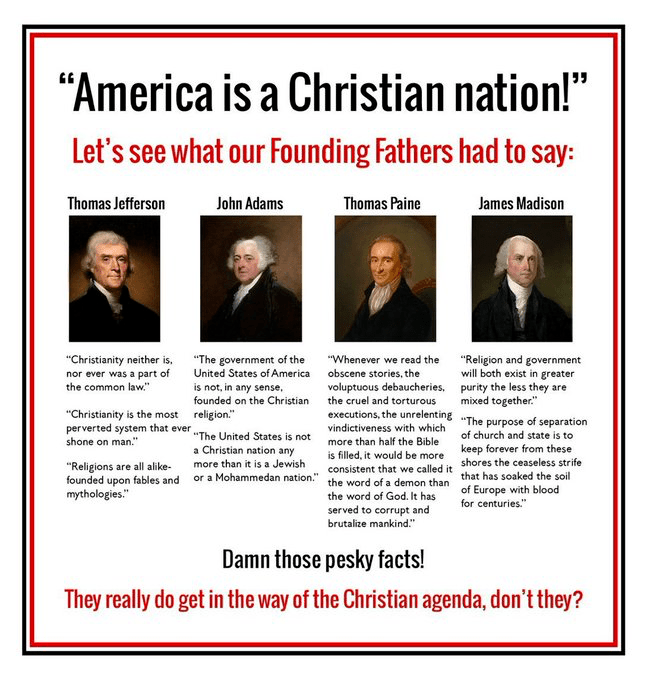
The Founding Fathers went to great lengths to separate church and state. They knew the history of religious wars in Europe, and they wanted the new nation to be free of such rivalries. They inserted into the Constitution the clear mandate that there would be no religious test to hold office. They added in the First Amendment to the institution that Congress was not allowed to establish a state religion and guaranteed freedom to practice one’s own religion.

Someone created this handy compilation of quotes from some of our most prominent men of the Founding era:

Peter Greene provides an overview of the three states that will be voting on vouchers on November 5. Vouchers have been on state ballots nearly two dozen times. They have never won. They are usually defeated overwhelmingly. Voucher advocates know this, and they usually try to kill state referenda because they know they will lose.

Of the three states that will conduct voucher referenda, Colorado has the trickiest ballot. It currently has charter schools but voucher advocates want the state constitution to go further. They are using bland, deceptive language to make vouchers legal, without actually using the word “vouchers.”

In a few weeks, Colorado, Kentucky, and Nebraska are giving voters a chance to vote on taxpayer-funded school vouchers.

Colorado

Colorado voters will have the chance to amend the state constitution to enshrine school choice. The proposed amendment is short and sweet, asserting that “parents have the right to direct the education of the children” and “each K-12 child has the right to school choice.”

Colorado is no stranger to school choice. Students can travel across district boundaries to other school districts, and in 1993, Colorado became the third state to pass a charter school law.

Advance Colorado, a conservative anti-tax group, pushed the amendment. Supporters insist that the intention is simply to preserve the thirty-year-old charter program. But the wide-open language of the proposal, which specifies that ”school choice includes neighborhood, charter, private, and home schools, open enrollment options, and future innovations in education,” clearly covers more than just the charter school program.

In fact, in addition to opening the door to school vouchers, the proposal seems to open up some other possibilities. If a student is denied admission to a private school for any reason, can the student’s family demand their constitutional right to school choice? If a parent disagrees with any element of a school’s curriculum, can the parent demand their constitutional right to “direct the education” of their child? Kevin Welner of the Colorado-based National Education Policy Center calls the proposal “a ‘full employment for lawyers'” act.

Kentucky

In 2022, Kentucky voucher supporters suffered a major setback when the state supreme court ruled the voucher funding mechanism violated the state constitution. Supporters had set up a tax credit scholarship program in which folks could donate to a voucher scholarship program and get a dollar for dollar tax credit.

Proponents argue (as Betsy DeVos did when she proposed a federal version of this system) that this does not constitute spending taxpayer funds on private or religious schools because the money is never actually in the government’s hands, despite the fact that the government will then face a revenue shortfall.

Section 184 of the Kentucky constitution has some straightforward language about funding education, including:

No sum shall be raised or collected for education other than in common schools until the question of taxation is submitted to the legal voters, and the majority of the votes cast at said election shall be in favor of such taxation.

Kentucky’s Attorney General, arguing for the voucher plan, tried to assert a reading of the law that allowed for tax credit scholarships. The court replied, “We respectfully decline to construe the Constitution in a way that would avoid its plain meaning.”

Then in 2023, Franklin County Circuit Court Judge Phillip Shepherd ruled against the law set up to fund charter schools in the state.

So in January of this year, HB 2 was proposed, a constitutional amendment that would expand all that restrictive public school language and free lawmakers to fund charter schools and vouchers. With one sentence, vouchers would become constitutional in Kentucky:

The General Assembly may provide financial support for the education of students outside the system of common schools.

Nebraska

In May of 2023, Nebraska Governor Jim Pillen signed into law LB 753, creating tax credit vouchers for subsidizing private schools, called “Opportunity Scholarships.”. Opponents circulated a petition to challenge the law by putting it on the ballot. They needed 60,000 signatures to force the issue onto the ballot. At the end of August, 2023, they had 117,000, and the measure was headed for the November 2024 ballot.

In April of 2024, voucher supporters tried an end run around the petition. LB 1402 repealed the Opportunity Scholarship Act and launched a new school voucher program. The new bill came from Senator Lou Ann Linehan, who also authored the Opportunity Scholarships Act. Governor Jim Pillen approved the bill on April 25.

Arguing that the repeal of Opportunity Scholarships rendered the November vote on the program pointless, Nebraska Secretary of State Bob Evman pulled the ballot issue. Voters can’t repeal a law that has already been repealed.

In 67 days, the coalition of opponents gathered the necessary signatures—again. A lawsuit and a threat by Evman to pull the measure from the ballot were struck down by the Nebraska Supreme Court in a 7-0 decision. Nebraskans will vote on vouchers for their state.

These are three different approaches to the question of taxpayer-funded school vouchers, but they share the unusual feature of putting voucher programs to a public vote. All school voucher programs in the U. S. were passed into law by legislatures, sometimes over strong objections of the taxpayers. No taxpayer-funded school voucher program has ever survived a public vote.

Andy Borowitz used to be the humorist for The New Yorker. A joke a day. Then he created his own blog. The following is no joke. I didn’t post it all because I’m not a subscriber. Here is an opener:

When Did the New York Times Fall in Love with Trump?

Photo by David Smooke on Unsplash

Just hours after the first presidential debate of 2024, the New York Times editorial board, citing Joe Biden’s cognitive decline, urged him to quit the race. They issued no such directive to Donald Trump, whose only moments of coherence during the 90-minute contest came in the form of lies.

The Times’s love affair with Trump is reprehensible—but it’s not new. In fact, it goes back decades. 

How did this sick romance begin? And how will it end?

The first evidence of the Times’s infatuation with Trump appeared on November 1, 1976: a profile so gushing that he could have written it himself, except for its use of complete sentences.

“He is tall, lean and blond, with dazzling white teeth, and he looks ever so much like Robert Redford,” wrote Judy Klemesrud, who needed either new eyewear or a stint in rehab.

Klemesrud’s journalistic atrocity yields too many howlers to mention, but here’s an especially gobsmacking one: “Mr. Trump, who says he is publicity shy, allowed a reporter to accompany him on what he described as a typical work day.” (What rare access, Judy!)

Amazed that he is to receive an award from a Jewish group, the publicity-shy Trump notes, “I’m not even Jewish, I’m Swedish.” (He’s neither.) The article also states that he was “a student at the Wharton School of Finance at the University of Pennsylvania, from which he graduated first in his class in 1968.” A 1984 Times story belatedly corrected this whopper: “Although the school refused comment, the commencement program from 1968 does not list him as graduating with honors of any kind.”

That’s right—it took the Times eight years to (partially) correct an article as riddled with falsehoods as Melania’s book. The “paper of record” had already established its lax approach to holding Trump accountable.

Was the Times going easy on Donald because it had discovered what the New York tabloids had already figured out—that Trump stories sold papers?

The Times would surely deny that its pampering of Trump—then and now—has been driven by a thirst for profits. Money, however, clearly motivated one of the darkest chapters in the Times’s codependent relationship with him

I like to criticize the Times because I think its owner and editors pay attention. If too many influencers complain that the Times’ coverage doesn’t tell the whole truth about Trump, that they fail to report his latest outrage (was it his story about Arnold Palmer’s penis or his fake appearance as a worker in a McDonald’s, where the “customers” were carefully selected Trump partisans?)

The CBS News program “60 Minutes” has interviewed every major-party candidate in Presidential elections since 1968. Not this year. Trump rejected the invitation. After Kamala’s interview appeared, Trump said repeatedly that her interview had been edited to show her more favorably. He complained to the FCC and demanded that CBS lose its license.

Trump loves to play the victim and the martyr, which helps him connect to his base. Playing the victim enables his base to forget that he is a billionaire, who lives in splendor, and a draft-dodger who belittles the military.

CBS doesn’t usually respond to complaints, but they did this time. They also invited him to appear at a time of his choosing. Trump prefers friendly interviewers.

The Los Angeles Times reported:

In a rare rebuke, the CBS news magazine “60 Minutes” denied charges by former President Trump that the program doctored an answer in Vice President Kamala Harris’ recent interview to make her look better to viewers.

CBS ran an excerpt of the Democratic presidential candidate’s interview on “Face the Nation” the day before it ran in a special edition of “60 Minutes” that aired Oct. 7. The answer to a query about the Biden’s administration’s handling of the Israel-Gaza war was different from the one that aired on the program.

In speeches and appearances on his favorite conservative media outlets, Trump, the Republican presidential nominee, insists CBS was deceiving the public by editing the answer for the program as a way to put Harris in a more favorable light.

“This is false,” the program said in a statement posted Sunday on X. “’60 Minutes’ gave an excerpt of our interview to ‘Face the Nation’ that used a longer section of her answer than that on ’60 Minutes.’ Same question. Same answer but a different portion of the response.”

The portion used on “60 Minutes” was “more succinct, which allows time for other subjects in a wide ranging 21 minute long segment.”
Harris’ entire answer appears in a transcript on the CBS News website.

The DeSantis regime threatened to prosecute television stations that aired ads supporting Amendment 4, the one that repeals the state ban on abortion. The order was blocked by the courts. When the lawyer for the state Department of Health was directed to sign a second letter reiterating the threat, he resigned.

The Miami Herald reported:

Gov. Ron DeSantis’ top deputies directed a Florida Health Department lawyer to threaten Florida television stations with criminal prosecution for running political advertisements that support enshrining abortion rights in the state’s Constitution, according to new court records.

Florida Department of Health General Counsel John Wilson said he was given pre-written letters from one of DeSantis’ lawyers on Oct. 3 and told to send them under his own name, he wrote in a sworn affidavit Monday.

Although he had never participated in any discussions about the letters, Wilson sent them anyway, he wrote, setting off a firestorm that led to a federal judge last week granting a temporary restraining order against the state.

Wilson abruptly quit on Oct. 10, writing in his resignation letter that “A man is nothing without his conscience.” The letter, first reported by the Herald/Times, did not explicitly say he was resigning over the controversy.

But in his affidavit, Wilson said the decision was made to avoid sending out more letters. “I resigned from my position as general counsel in lieu of complying with directives from [DeSantis General Counsel Ryan] Newman and [Deputy General Counsel Jed] Doty to send out further correspondence to media outlets,” he wrote.

Read more at: https://www.miamiherald.com/news/politics-government/state-politics/article294143314.html#storylink=cpy

I have learned so much about what’s happening in Oklahoma from John Thompson, retired teacher and historian. Recently I asked John if he could explain the question that is the title of this post. John responded with the following post. Thank you, John!

When Kevin Stitt was elected governor in 2018, Oklahomans knew he was an extreme conservative and a true believer in the “Free Market,” as THE solution to our problems. Stitt had been the CEO of Gateway Mortgage, which had a questionable reputation. And he knew little or nothing about how government operated; The Tulsa World reported that Stitt apparently hadn’t even voted for governor before he was elected.  Even so, the World explained, “Stitt wants the Legislature and the voters of Oklahoma to give him authority no previous governor has ever had — the power to hire and fire all state agency heads and boards.”

The first bill Gov. Stitt signed into law allowed individuals to carry firearms without a permit or training and then he  “expanded the number of public spaces where guns could be carried.”

Even more disturbing, as Oklahoma Watch explained, “In his first State of the State speech, Stitt said healthcare depends on personal responsibility.” And later, he opposed Medicaid expansion.

On the other hand, in 2019, I was active in the Justice for Julius campaign, which was fighting for the life of my former student who had been sentenced to death for murder, despite the lack of evidence against him, and the evidence that Julius Jones had been framed. We were told that Stitt’s religious beliefs were sincere. Stitt saved Julius from execution, but denied and banned any future efforts for parole or clemency.

Stitt also began his administration by listening to bipartisan efforts to curtail Oklahoma’s mass incarceration; our state had one of the world’s largest incarceration rates. But, a rightwing dark money group invested $160,000 on ads that said Stitt was soft on crime. Afterwards, the Oklahomanexplained, Stitt rejected Pardon and Parole Board recommendations, and replaced several board members. Moreover, “Oklahoma has executed 14 men during Stitt’s administration, second most among U.S. states. All but one were people of color or poor, or a combination thereof.”

Stitt ignored the Pardon and Parole recommendations when executing four of them.

Also, as Oklahoma Watch explains, Stitt’s belief that healthcare was a personal responsibility  “became his tagline throughout the (COVID) pandemic.” As the Washington Post reported, in the first few days of the pandemic,  Stitt was maskless when “he attracted national attention for tweeting a photo with his family at a ‘packed’ Oklahoma City restaurant,”  and saying “he would continue to dine out ‘without living in fear, and encourages Oklahomans to do the same.’”

Stitt soon caught COVID, and he also attended, without a mask, “Trump’s rally in Tulsa — the president’s first since the pandemic set in … Local health officials warned the indoor event at a 19,000-person arena could cause a dangerous spread of the virus in a county that was already seeing a spike.” That week, Oklahoma’s  weekly COVID deaths increased by more than 40%. Republican Herman Cain caught COVID after attending the rally maskless and died afterwards.

The Washington Post also reported how Stitt resisted the federal vaccination mandate for the Oklahoma National Guard, and fired the Guard’s adjutant general for supporting vaccinations.

The Frontier also reported that Stitt ordered $2 million of hydroxychloroquine, which President Trump touted. And as NPR reported, in 2020, Stitt refused to publish Oklahoma infection and death rates. 

So, it’s hard to estimate how many thousands of deaths were attributable to Stitt, but in 2022, Oklahoma’s death rate was 5th highest in the U.S.  In 2023, it was 2nd highest in the nation.

And Stitt continued to undermine governmental and legal institutions. After he ramped up attacks on established legal compacts with Oklahoma’s tribes, and invested $600,000 in state money in compacts  which the Oklahoma Supreme Court ruled were illegal, the conservative Republican Attorney General, Gentner Drummond, said he was compelled to take “extraordinary action to put an end to the governor’s betrayal of his duty … [and] ‘cause the laws of the state to be faithfully executed.’” 

As the New York Times reported, Stitt also advocated for and signed a bill that “bans nearly all abortions starting at fertilization. The new law … is the most restrictive abortion ban in the country.”

And Stitt took the lead in campaigning against Critical Race Theory which was falsely said to be undermining public education. The Oklahoman reported: 

Stitt signed House Bill 1775 that would prohibit public schoolteachers from teaching that “one race or sex is inherently superior to another,” and that “an individual, by virtue of his or her race or sex, is inherently racist, sexist or oppressive.” 

Proponents of the bill say the measure is designed to prevent the teaching of critical race theory

Also, the Washington Post reported: 

Gov. Kevin Stitt signed a bill prohibiting nonbinary gender markers on birth certificates for people who don’t identify as male or female — the first law of its kind in the United States, according to legal experts. 

… Republican backers describe the new rules as reflecting their religious beliefs, arguing that gender is binary and immutable. “I believe that people are created by God to be male or female,” Stitt said when he issued the executive order. “There is no such thing as nonbinary sex.” 

The governor’s press release said: 

I am taking decisive executive action to ensure the true definition of the word woman, meaning a biological woman, is what guides the state as we reaffirm our commitment to ensuring the safety, dignity, and sanctity of women across Oklahoma. As long as I’m governor, we will continue to protect women and ensure women-only spaces are reserved solely for biological women.

By the way, my House Representative, Mauree Turner, was the nation’s first Black, Muslim, nonbinary state legislator; As the Washington Post explained, Rep. Turner suffered through terrible abuse by Republican politicos. Their behavior was illustrative of a new norm where MAGAs seemed to compete over the ability to be cruel, and push out their colleagues who showed respect for their opponents.

Eventually, the extremism of Stitt et. al sowed division among Republicans. OpenSecrets.org was unable to locate the source of the money used by Stitt to fund primary candidates who opposed Republican incumbents who weren’t reactionary and confrontational enough, but it did “match up” expenditure from 46 Forward Inc. that funded 46 Action and Stitt’s “endorsements in the Republican state Senate primaries.”  

During Stitt’s second term, his ideology-driven policies continued to get weirder. For instance, the Oklahoma Voice reports, “Gov. Kevin Stitt has approved a controversial set of rules from the Oklahoma State Department of Education, as expected after the Legislature declined to take action on the regulations.” This gives Walters’ rules that expand test-driven accountability. The regulations also add “new ‘foundational values’ for the state Education Department that make multiple references to ‘the Creator.’” 

Other rules include potential punishment for schools that continue to employ educators under investigation for wrongdoing (as defined by the ideology-driven board), and permission to fire teachers who engage in acts that “promote sexuality” within view of a minor.

And, after the voters passed a state question calling for a vote on an increase in the minimum wage from $7.25 to $15.00 per hour, Stitt ordered the election be delayed until 2026.   

But the most noteworthy characteristics of Stitt’s recent policies have been their cruelty.

As the Oklahoman reported in 2024:

For the second year in a row, Republican Gov. Kevin Stitt has rejected a federal program that would have provided additional funding for families to feed their children next summer.

The U.S. Department of Agriculture’s Summer EBT program … would earmark about $40 per child per month on a card that families could then use at local grocery stores.

Oklahoma ranks fifth in the nation for child food insecurity.

The Washington Post added:

A new food program would have kicked in this summer, had Oklahoma Gov. Kevin Stitt not turned down $48 million from a $2.5 billion initiative that the Biden administration calls “a giant step forward” in ending childhood hunger in the country. Though Oklahoma is one of the most food-insecure states, with surveys finding that more than 200,000 children are hungry at some point during a year, Stitt suggested the administration was “trying to push certain agenda items on kids.”

And as the Oklahoman reports, a new consent decree seeks to provide mental health services for  “scores of presumed-innocent Oklahomans who experience severe mental illness [and] are languishing in county jails awaiting competency restoration treatment for prolonged periods that far exceed constitutional limits.” But “Gov. Kevin Stitt, House Speaker Charles McCall and a top state mental health official are pushing back on a proposal.” 

Stitt sounds like he is resisting the funding that would be required, but I wonder if he’s also opposing the agreement because it is supported by his opponent, A.G. Gentner Drummond, who doesn’t want this injustice, which has “plagued” the criminal justice system to continue to “drag on for months or years.” 

By the way, A.G. Drummond was not at that meeting; he was arguing before the U.S. Supreme Court against the execution of Richard Glossip arguing that prosecutorial misconduct prevented him from receiving a fair trial.

And that brings us back to Stitt’s original intention to hire and fire all state agency heads and boards. During his second term, Stitt, rightwingers’, and their dark money donors have doubled down on a campaign to politicize the Oklahoma Supreme Court. I doubt Stitt knew much about the Court’s history, but it used to be the most corrupt Supreme Court in America. But a bipartisan team created the Judicial Nomination Commission which was often seen as the institution that started the process of making Oklahoma a real democracy. 

A rightwing dark money group is funding an effort to remove three justices who voted for abortion and voting rights, tribal contracts, and against the creation of a Catholic charter school. So, whether he knows what he is doing or not, Stitt is helping to lead an effort to dismantle the Nominating Commission, take control over the nomination process, and likely turn back the clock to the corruption of the 1950’s and before.

And that leads to the question as to whether Stitt is primarily motivated by a simplistic “Survival of the Fittest” ideology, and merely follows the lead of Big Money? Or are his policies simply born out of his ignorance and their propaganda? Or has he fully embraced the most disgusting components of Trumpism, and thus devoted himself to brutality? Fundamentally, is he now seeking a reputation for embracing the cruelty that the MAGAs admire? 

ProPublica published a story about which families benefit from Arizona’s universal voucher program. It is not low-income families.

The state’s so-called Education Savings Accounts (or Empowerment Scholarship Accounts) were enacted by the Legislature in 2011. Whatever they are called, they are vouchers, which violate Arizona’s Constitutional ban on public funds for religious schools. They initially contained restrictions as to which students qualified to receive a voucher. The usual claim for vouchers was that they would “save poor kids from failing public schools.” However, that never happened.

From the start, the Republicans in control wanted vouchers for all students, not just those from low-income families. Even though there was a state referendum in which voters overwhelmingly rejected voucher expansion in 2018, the Legislature ignored the vote and passed universal vouchers in 2022. Any student, whatever their family income, is entitled to use public money for tuition in a private or religious school or for home schooling.

The result: few students from low-income families use vouchers.

The article in ProPublica explains why.

Vouchers don’t cover the cost of most private schools.

Most private schools are not located in low-income neighborhoods.

Low-income families can’t afford the cost of transportation to and from private schools.

In Arizona, as in other states, most students who take vouchers were already enrolled in no public schools. Their parents can afford to pay the tuition. Now the state subsidizes them. And in many cases, the schools raise their tuition in response to the state subsidy.

Barack Obama is a skilled orator, probably the best of our time. In this 3-minute clip, he asks the quintessential question. Trump says to Kamala, “You were there for four years, why didn’t you solve the border problem?” Obama asks of Trump, “Dude, you were there for four years, why didn’t you solve the problem?”

We have never seen anything like it: A candidate for President who tells interviewers that he won’t participate unless they agree not to fact check his assertions.

The Washington Post wrote about Trump’s adamant insistence that he must not be fact checked. Vance now says the same. They do not want to be held accountable for lying.

The Post has a regular fact-checker, Glen Kessler, who reports on claims by politicians. He says that Trump made 30,573 false or misleading statements during his four year term in office. That’s an average of 21 lies a day.

What do you say to political candidates who think it is unfair to correct them if they lie?

Donald Trump and his campaign have waged an aggressive campaign against fact-checking in recent months, pushing TV networks, journalism organizations and others to abandon the practice if they hope to interact with Trump.

Trump nearly backed out of an August interview with a group of Black journalists after learning they planned to fact-check his claims. The following month, he and his allies repeatedly complained about the fact-checking that occurred during his debate with Vice President Kamala Harris, berating journalists and news executives in the middle of the televised debate.

And this month, Trump declined to sit down for an interview with CBS’s “60 Minutes” because he objected to the show’s practice of fact-checking, according to the show.

Campaign advisers also expressly asked CBS News to forgo fact checking in its vice-presidential debate with Trump’s running mate, Ohio Sen. JD Vance — who then complained on air when a moderator corrected him.

The moves are the latest example of Trump’s long-held resistance to being called to account for his falsehoods, which have formed the bedrock of his political message for years. Just in recent weeks, for example, Trump has seized on fabricated tales of migrants eating pets and Venezuelan gangs overtaking cities in pushing his anti-immigration message as he seeks a second term in office…

In August, Trump had agreed to appear at a National Association of Black Journalists gathering, where three of the group’s members would interview him. But upon realizing that he would be fact-checked in real time, Trump’s team said he would not be taking the stage

NABJ president Ken Lemon described a tense scene backstage as Trump’s team objected to any fact-checking of the interview, with the discussions lasting more than an hour. “If you guys are going to fact check, he’s not going to take the stage,” Lemon said a Trump aide told him. “They were just totally insistent that he was not going to take the stage if we fact-checked.”

Lemon said he spoke with three Trump aides — who at one point called to confer with someone not at the event — about their objections to fact-checking as the audience waited.

At one point, Lemon said he became convinced Trump was ultimately going to back out of the interview over his fact-checking concerns, so Lemon prepared remarks to go out and explain the cancellation to the crowd. But in the end, Trump took part in the interview, making headlines by falsely suggesting that Vice President Kamala Harris had only recently decided to identify as Black.

“It was a very revealing moment where we got to hear him answer questions, and we were shocked at what some of the answers were,” Lemon said.
Trump officials blamed the delay in taking the stage on technical audio issues.

“Here’s the truth: President Trump initially couldn’t take the stage because there were audio issues. Once the audio issues were resolved, President Trump took the stage and participated in the discussion, and the fact-checks still occurred,” Karoline Leavitt, a Trump spokeswoman, said in a statement.

Harris, too, has taken a cautious approach to interviews, largely eschewing rigorous policy questioners for lower-stakes venues and having her advisers, at times, try to prescreen questions. Her blitz this week of unscripted media settings hewed to friendly questioners, including Howard Stern of Sirius XM, CBS’s “Late Night with Stephen Colbert” and the popular “Call Her Daddy” podcast. During Harris’s NABJ forum, the interviewers pressed less contentiously than they did Trump, and during the ABC presidential debate with Trump, the moderators did not fact check her in the same manner.

One Trump adviser, speaking on the condition of anonymity to describe the campaign’s thinking, argued that Trump is treated more harshly than others. “Every candidate is opposed to fact checking on some degree, but if you’re Trump, you know they are always going to go after you harder,” the adviser said.

But Harris does not misstate the truth regularly, as Trump does, and she has also not protested being fact-checked. And unlike Trump, she sat down for a wide-ranging interview with “60 Minutes” that aired last week.

As part of Harris’s interview, the show took the extraordinary step of explaining why it was not airing a similar segment with Trump, who had initially agreed to an interview before changing his mind.

“A week ago, Trump backed out,” CBS correspondent Scott Pelley explained. “The campaign offered shifting explanations. First, it complained that we would fact-check the interview. We fact-check every story. Later, Trump said he needed an apology for his interview in 2020.”

Pelley went on to explain that the 2020 incident for which Trump requested an apology had never occurred….

During the debate between Trump and Biden, CNN publicly stated in advance that the moderators would not fact-check, instead leaving that to the candidates.

Before the second debate, Jason Miller, a spokesman for the Trump campaign, said the team was told by an ABC journalist that similar to the CNN debate, there would be no fact checks from the moderators. However, a copy of the ABC News debate rules, obtained by The Post, did not put any limitations on fact checking.

Nonetheless, Trump and his allies were furious with ABC for pointedly fact-checking Trump live during his debate with Harris. At one point, after Trump falsely claimed that some Democrats support executing babies after birth, moderator Linsey Davis noted, “There is no state in this country where it is legal to kill a baby after it’s born.”

At another point — after Trump repeated the false and baseless claim that Haitian immigrants in Springfield, Ohio, were abducting and eating their neighbors’ cats and dogs — moderator David Muir interjected to say that ABC News had reached out to the city manager, who “told us there have been no credible reports of specific claims of pets being harmed, injured or abused by individuals within the immigrant community.”

Trump’s advisers — including Chris LaCivita and Miller — erupted at ABC executives and journalists in the middle of the debate, according to the people familiar with the situation. They implored the network to stop fact-checking for the rest of the event and said it had breached its promise, and a call was even lodged to the president of ABC News by Susie Wiles, the campaign’s top aide. At least one Trump adviser demanded to talk to the moderators during the debate.

The network declined to comment.

“Everyone who watched the ABC debate agreed that it was a 3-on-1 fight with 2 moderators who wrongly ‘fact-checked’ President Trump multiple times, but did not fact check Kamala Harris ONCE, even though she spewed multiple lies on the debate stage,” Leavitt said in her statement. “The ABC debate was widely viewed as one of the worst moderated debates in history, yet President Trump still won.”

Harris spokesman Kevin Munoz responded: “You have to lie to be fact-checked, and only one person on that stage was telling lie after lie.”