Archives for the month of: June, 2024

I have written it again and again: The war in Gaza is complicated. There is no simple “right side” and “wrong side.” The war should end as soon as possible. Both sides have committed terrible atrocities and crimes against humanity. The only way out is through negotiation. All the hostages must be returned, alive and dead. The end result must include plans for a Palestinian state.

Nicholas Kristof said it best in yesterday’s New York Times:

I’ve been on a book tour for the last few weeks, speaking around the country, and one of the questions I get asked most often isn’t about my book at all but along the lines of: What should I think of the war in Gaza?

The toxic public debate is dominated by people with passionate views on both sides, but most people I meet are torn and unsure how to process the tragedy that is unfolding. That makes sense to me given how exquisitely complex real-world ethics are, as much as we may yearn for black-and-white morality tales.

With that in mind, I’d like to offer this highly personal road map for thinking about the war. Here’s a set of morally complicated, sometimes contradictory principles for a nuanced approach to sort out the issues.

1. We think of moral issues as involving conflicts between right and wrong, but this is a collision of right versus right. Israelis have built a remarkable economy and society and should have the right to raise their children without fear of terror attacks, while Palestinians should enjoy the same freedoms and be able to raise their children safely in their own state.

2. All lives have equal value, and all children must be presumed innocent. So while there is no moral equivalence between Hamas and Israel, there is a moral equivalence between Israeli civilians and Palestinian civilians. If you champion the human rights of onlyIsraelis or only Palestinians, you don’t actually care about human rights.

3. Good for President Biden for pushing a proposal on Friday for a temporary cease-fire that could lead to a permanent end to the war and a release of hostages; as he said, “It’s time for this war to end.” Let’s hope he uses his leverage to achieve that end. It’s also true that Biden’s failure to apply enough leverage over the last seven months has made the United States complicit in human rights abuses in Gaza, because it has provided weapons used in the mass killing of civilians, and because it has gone too far in protecting Israel at the United Nations.

4. We can identify as pro-Israeli or pro-Palestinian, but priority should go to being anti-massacre, anti-starvation and anti-rape.

5. Hamas is an oppressive, misogynistic and homophobic organization whose misrule has hurt Palestinians and Israelis alike. But not all Palestinians are members of Hamas, and civilians should not be subject to collective punishment. In the words of a 16-year-old Gaza girl: “It’s like we are overpaying the price for a sin we didn’t commit.”

6. There was no excuse for Hamas attacking Israel on Oct. 7 and murdering, torturing and raping Israeli civilians. And there is no excuse for Israel’s reckless use of 2,000-pound bombs and other munitions that have destroyed entire city blocks and killed vast numbers of innocent people, including more than 200 aid workers.

7. When Israel began military operations after Oct. 7, it was a just war.

8. What starts as a just war can be waged unjustly.

9. Israel was entitled to strike Gaza after the Oct. 7 attack, but not to do whatever it wanted. In particular, there should be no argument about Israel’s practice of throttling food aid. Using starvation as a weapon of waragainst civilians, as the prosecutor of the International Criminal Court alleges Israel has done, is a violation of the laws of war.

10. Each side justifies its own brutality by pointing to earlier cruelty by the other side. Israelis see Oct. 7. Palestinians see the “open-air prison” imposed on Gaza before that. This goes all the way back to the displacement of Palestinians at Israel’s founding in 1948, the 1929 massacre of Jews at Hebron, and so on. Enough obsession with the past! Let’s focus instead on saving lives in the coming months and years.

11. Hamas’s brutality toward Israeli hostages, such as credible reports of sexual assault and starvation, is unconscionable. So is Israeli brutality toward Palestinian prisoners, such as CNN accounts that some Palestinians have had limbs amputated because of constant handcuffing.

12. War nurtures dehumanization that produces more war. I’ve heard too many Palestinians dehumanize Jews and too many Jews dehumanize Palestinians. When we dehumanize others, we lose our own humanity.

13. Zionism is not a form of racism. And criticism of Israel is not antisemitism. Both sides are too quick to fire such epithets.

14. Each side sees itself as a victim, which is true — but each side is also a perpetrator.

15. “Apartheid” isn’t the right word for Israel today, where Palestinians are treated like second-class citizens but can still vote, serve in the Knesset and enjoy more political freedoms than in most of the Arab world. But “apartheid” is a rough approximation of Israeli rule in the West Bank, where Arabs have long been oppressed under a system that is separate and unequal.

16. “From the river to the sea” refers to the dream of a single state from the Jordan River to the Mediterranean Sea, encompassing what is now Israel and the Palestinian territories. The slogan as used by protesters can mean many different things, some peaceful and some the militaristic vision of the Hamas charter, while a parallel vision is in the original platform of Prime Minister Benjamin Netanyahu’s Likud party. Hamas imagines a Palestinian state with no room for Israel, and Netanyahu wants perpetual Israeli sovereignty from the river to the sea to deny a place for a Palestinian state. I think that instead of either version of a one-state solution, a two-state solution is infinitely preferable.

17. Pro-Palestinian demonstrations have too often tolerated strains of antisemitism, which in recent months has shown itself to be stronger than many imagined. How can a movement that claims the moral high ground make excuses for any kind of bigotry?

18. Campus protesters would do more good raising money for suffering Gazans rather than using it to buy tents for themselves.

19. We probably know what an eventual Israeli-Palestinian peace deal would look like. The plan was outlined in the Clinton parameters of 2000 and in the Geneva Accord of 2003. The only question is how many innocent people on both sides will die before we get there.

20. To establish peace, both Israel and the Palestinian Authority will need new leaders with vision and courage. This won’t be achieved tomorrow. But there are peacemakers on each side. To understand how a path toward peace may emerge, consider the words of the Chinese writer Lu Xun more than a century ago: “Hope is like a path in the countryside. Originally, there is nothing — but as people walk this way again and again, a path appears.”

A wise Palestinian from Jenin, Mohamed Abu Jafar, whose 16-year-old brother had been shot dead by Israeli forces, told me last year: “They can’t kill us all, and we can’t kill them all.” That leaves, he said, one practical option for all of us: working for peace.

Let’s get to it.

The Center for Budget and Policy Priorities is a nonpartisan, nonprofit research organization in D.C. Its reports are widely respected. Earlier this week it released a scathing report about the damage that vouchers do to American education. Vouchers subsidize the tuition of 10% or less of students, mostly in religious schools, while defunding the schools that enroll nearly 90% of all students.

Joanna Lefebvre wrote for the Center:

During this year’s legislative sessions, at least one in three states are considering or have enacted school voucher expansions alongside broad, untargeted property tax cuts. Over half of states have already enacted deep personal and corporate income tax cuts in the last three years. These policies will result in under-resourced public schools, worse student outcomes, and, over time, weaker communities.

Research suggests property tax cuts result in disproportionately less funding for districts serving large numbers of students of color and that school funding matters more for these students’ life outcomes because of historical and systemic racial discrimination. States wishing to ensure a quality education for all children should instead invest in public schools, reject K-12 voucher programs, and pursue only targeted property tax relief.

Property tax cuts reduce funding for public education at its source. Revenue from local property taxes accounted for over 36 percent of public education funding in the 2020-2021 school year, the most recent year for which national data are available. States have a long history of weaponizing this policy design, using their property tax codes to limit education funding for Black and brown students. For example, California’s infamous 1978 Proposition 13, which limited property taxes to 1 percent of a home’s purchase price, passed with primary support from white property owners amid a campaign of thinly veiled racism and xenophobia about paying for “other” people’s children to go to school.

Vouchers Divert Money from Public Schools and Get Worse Academic Outcomes

K-12 vouchers also siphon funding away from public schools. Voucher programs can take many forms, but all use public dollars to subsidize private school tuition. Some voucher programs defund public education directly by siphoning off funding that otherwise would have gone to public schools. Others do so indirectly by reducing revenue available for all public services, including education.

Modern school vouchers have their roots in similar programs created after Brown v. Board of Education to perpetuate segregation and exacerbate inequities. This vision can be seen in today’s programs, where most vouchers go to families with high incomes. Although data on the race and ethnicity of voucher recipients themselves is scarce, white students make up 65 percent of private school enrollment in the U.S. but only 45 percent of public school enrollment. Defunding public schools through vouchers and property tax cuts exacerbates inequities in educational outcomes, which often fall along lines of race and class due to the persisting effects of slavery and segregation.

A trend has emerged of states proposing or enacting school voucher programs while simultaneously cutting, limiting, or proposing to eliminate property taxes.Florida, Texas, and Idaho are leading examples of this trend.

  • Florida: This year, a Republican representative introduced a bill to study eliminating Florida’s property tax system. Property taxes generated $14 billion in the 2020-2021 school year (the most recent for which data are available), equivalent to almost 40 percent of Florida’s K-12 education funding. Meanwhile, the legislature passed a budget in early March that includes about $4 billion for private school vouchers, a significant portion of the $29 billion appropriated for K-12 education.
  • Texas: Last year, Governor Greg Abbott called two special legislative sessions and spent seven months lobbying lawmakers to pass a school voucher system without success. The voucher proposal would have cost Texas school districts up to $2.28 billion. However, the legislature approved over $18 billion worth of property tax cuts, with 66 percent of benefits accruing to families making more than $100,000, putting pressure on future education budgets.
  • Idaho: Last year, Idaho’s legislature passed property tax cuts totaling $355 million, equivalent to over half of property tax revenue for schools. Although some of this funding was replaced with general fund revenue to repair the state’s abysmal school facilities, the overall reduction in revenue jeopardizes the state’s long-term ability to fund education. Meanwhile, this year, the legislature tried and failed to pass a school voucher bill that would have cost the state over $170 million.

Other states where both school vouchers and property tax cuts are being considered this year include AlabamaColoradoGeorgiaIllinoisIndianaKansasKentuckyLouisianaMichiganMissouriNebraskaOhioOregonSouth DakotaTennessee, and Wyoming.

Broad property tax cuts and caps will not address housing affordability. Property values have risen by about 37 percent since the beginning of the COVID-19 pandemic, and some proponents of property tax cuts argue they will help make housing more affordable. However, most of the proposals being debated would do little to help while stripping resources from public education. Instead of broad property tax cuts or caps, states should adopt “circuit breaker” policies that respond to residents’ ability to pay without limiting revenue-raising capacity.

States should raise revenue equitably and invest in robust public schools. Research suggests the education attainment gap between children from low-income families and those from higher-income families can be eliminated with increased funding for public schools. Raising revenue to invest in public education and resisting calls to dismantle it through school vouchers and property tax cuts is critical to enabling thriving communities with broadly shared opportunity.

States are defunding public education by reducing revenue available for schools through property taxes and by diverting public dollars to private schools.

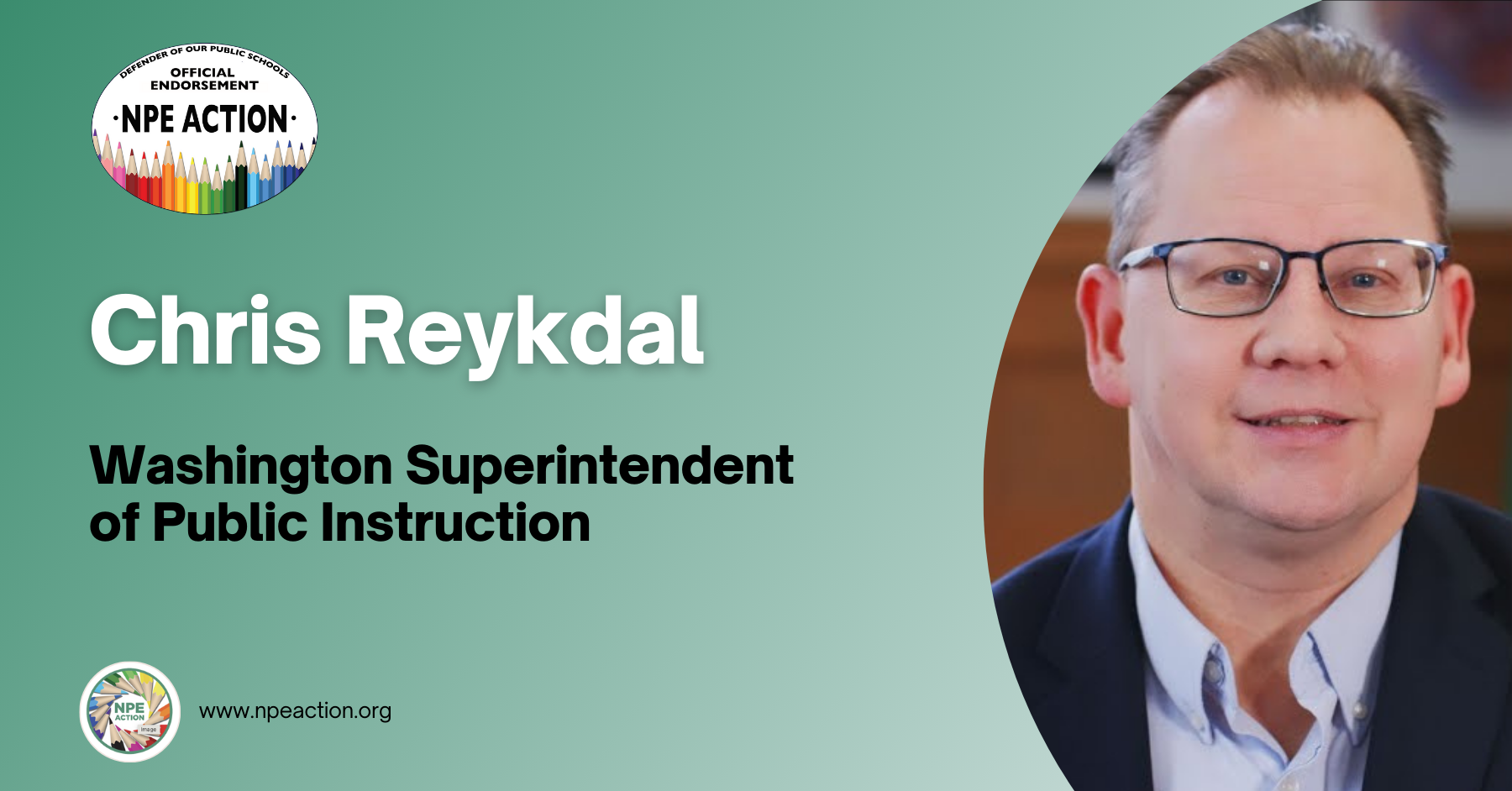
At last, a state superintendent who is a passionate advocate for public schools! Chris Reykdal is running for re-election, and he richly deserves it.

Chris is a graduate of public schools and wants every child in Washington to have the opportunities he had.

He has been an amazingly effective leader and advocate for the state’s public schools. While other states are squandering money on choice, which subsidizes religious schools and wealthy parents’ tuition payments, Washington has focused on improving its public schools, whose doors are open to all. You can read about the progress made in recent years in the endorsement of Chris by NPE Action.

I am happy to add my personal endorsement of Chris Reykdal. It’s thrilling to know that he is working every day to improve the public schools, which enroll 90% of the state’s children.

Chris is a leader with knowledge, experience, wisdom, and vision. Washington’s students and teachers need him.

NPE Action is proud to endorse Chris Reykdal for Washington Superintendent of Public Instruction. Chris began his professional career as a public school teacher. He served on a local school board, spent fourteen years as an executive in Washington’s public community and technical college system, served six years in the Legislature, and for the last seven years as Washington State School Superintendent. Chris has experienced education in Washington from nearly every perspective. Chris strongly believes that public education is the great equalizer. He will not yield to those who attack Washington’s  public schools for their personal gain.

In the six years that Chris has been the Washington Superintendent for Public Instruction, the state has seen several major achievements. Graduation rates are at an all-time high and the state college remediation rates are at an all-time low. Chris has fought hard to make sure more children have free school meals and as a result free school meals are given to over 300,000 additional students. During his tenure, Washington has increased funding to support students with disabilities and Washington has the highest number of students with disabilities learning in general education classrooms.

Chris has goals for the next four years that are centered around children and he will ensure that Washington public schools remain public. Chris believes that there is no greater fight in Washington’s public education system than to ensure schools are publicly funded, publicly operated, and publicly accountable. Chris will lead the state to maintain focus in all policy and budget matters to focus on closing opportunity gaps. 

Chris Reykdal is the benefactor of a state and a community that was committed to giving him opportunity, and he wants that for every child in Washington state. NPE Action urges public education supporters in Washington to get out the vote for Chris Reykdal in the primary election on August 6th. 


Not authorized by any candidate or candidate committee. Authorized and paid for by Network for Public Education Action, PO Box 227. New York, NY 10156. 646-678-4477

InDepthNH.com seems like a funny place to get a first-hand report from Eagle Pass, Texas, the epicenter of the border crisis that we hear about every day. But Arnie Alpert, a veteran journalist from New Hampshire, traveled to Eagle Pass to see for himself. What he discovered was that the locals were not too happy with the focus on their town. Several locals told him there were more military in their town than migrants.

The bottom line is that Governor Abbott and the GOP have manufactured a crisis. No one wants open borders. Our immigration system is broken. When Republicans and Democrats in the Senate agreed on a bill to fix it, Trump sent a message to his allies in the House to reject the bipartisan bill so he could use the issue in his campaign. Governor Abbott will continue to demagogue the issue for his own political benefit.

Alpert begins:

EAGLE PASS, Texas—The border between Eagle Pass, Texas, and Piedras Negras in the Mexican state of Coahuila used to be open, like the one between Derby Line, Vermont and Stanstead, Quebec.  “We used to just go back and forth all the time,” recalls Amerika Garcia Grewal, who grew up in the small city by the Rio Grande. “The same way we drove downtown to get tacos, years ago, we might have driven into Piedras to get tacos and come back.”

Now the border is fortified.  First, there’s the infamous wall, built over several administrations to keep out migrants.  In Eagle Pass, it’s an expanse of fencing with closely spaced vertical metal bars, stretching for miles near the Rio Grande.  But in recent years, the wall has been supplemented with lines of shipping containers and concertina wire along the riverbank.  Armed soldiers are stationed on top of the containers. Fan boats operated by several state and federal agencies speed up and down the river, perhaps looking for or perhaps trying to scare migrants who might wade across the river to ask for asylum in the land of the free.  

Customs and Border Protection (CBP), the division of the Department of Homeland Security generally just called the Border Patrol, has responsibility under federal law for enforcing laws controlling travel into the United States.  But in 2021, the state of Texas launched Operation Lone Star, dramatically escalating its own involvement in border enforcement.  Under Lone Star, thousands of Texas National Guard members and state police have been stationed at the border.  Texas’ Republican governor, Greg Abbott, Lone Star’s initiator and chief publicist, has labeled the influx of migrants an “invasion.”   

The operation is centered at Shelby Park, a 47-acre expanse lying between the river and the city’s downtown business district, underneath one of the bridges to Piedras Negras.  For years it’s been the place where local residents gathered for picnics, golf, community events, fishing, and watersports. 

Having already declared a State of Emergency due to unauthorized immigration, Abbott booted the Border Patrol out of the park on January 11 and surrounded it with more fencing.  Now, the residents of Eagle Pass have no access to most of their own park, which has become the stage for Abbott’s political performance art.

Recent visitors to Shelby Park have included Speaker of the House Mike Johnson with 64 GOP members of Congress on January 3, and Donald Trump on February 29.  Twelve GOP governors, including Chris Sununu, were there with Abbott on February 4.  “Texas Governor Greg Abbott was clear – they need our help,” Sununu reported afterward. 

Nine days after his Texas trip, Sununu asked the Legislative Fiscal Committee for $850,000 to send fifteen members of the NH National Guard to Texas to join Operation Lone Star, which he said would support “security activities at the southern United States border to protect New Hampshire citizens from harm.” 

“Fentanyl is pouring in, human trafficking is occurring unabated, and individuals on the terrorist watch list are coming in unchecked,” the governor told the legislators, who granted his request on February 16. 

Fifteen New Hampshire soldiers, all volunteers, are in Texas now, winding up a two-month deployment.  According to Lt. Col. Greg Heilshorn, the New Hampshire Guard’s Public Affairs Officer, they are based at Camp Alpha, upriver from Eagle Pass in Del Rio. 

When I told Lt. Col. Heilshorn that I’d be traveling to Eagle Pass and would like to see what our Guard members would be doing, he said I’d need to get permission from Todd Lyman, a Public Affairs Officer at the Texas Military Department.  After a few calls and messages, I received an email saying, “We are not able to accommodate your request at this time.”

I arrived in Eagle Pass on May 19 and approached the guarded gate at Shelby Park the next morning.  There, I asked if I could walk to the boat ramp to take some photos.  A courteous soldier told me I would have to call Sgt. Allen. 

Sgt. Allen said I would have to talk to his superior, Major Perry.  Sgt. Allen also said a request to speak with members of the NH National Guard would be handled by Major Perry’s superior, Todd Lyman.  He suggested I speak to the NH Guard’s public affairs officer.    

Major Perry did not return my phone call. 

The following day I drove with another photojournalist to the site of Camp Eagle, an 80-acre military base under construction on the outskirts of Eagle Pass.  A man from a company that rents construction equipment directed us to a white trailer, where I met Chuck Downie of Team Housing Solutions.  After telling me about his family’s place on Moultonborough Neck, Downie told us we could not be there without permission from the Texas Military Department.  One of his colleagues escorted us from the property.

We were also escorted by a Border Patrol agent from a farm adjacent to the Rio Grande where we were photographing fan boats and the buoys which Gov. Abbott had installed as a river barricade.  For the record, I thought we had permission to be there. 

“If there’s an invasion, it’s from the military,” says Jessie Fuentes, a retired communications professor who runs a canoe and kayak rental business. “There’s more military in our community than there are migrants, thousands and thousands of military from 13 different states.”

“How would you feel if all of a sudden, your community was locked up with soldiers and you couldn’t go into your favorite park? Because it has concertina wire around it or shipping containers or armed guards or you can’t access your own river and your green space?” asked Fuentes, a member of the Eagle Pass Border Coalition, a grassroots organization.  “So yeah, the only invasion we got here is from the military and the Texas governor.”

Texas has already spent more than $11 billion on Lone Star, and that money’s going somewhere.  Camp Eagle is being built by Team Housing, which has a $117 million contract.  Storm Services LLC has its logo on Camp Charlie, located next to Maverick County Airport, where Texas National Guard members are based.  Camp Alpha, where the NH Guard members are staying, is according to tax records owned by Basecamp Solutions LLC.  An article in a Del Rio paper from the time the property was purchased, though, said the owner was Team Housing.  Both LLCs are owned by Mandy Cavanaugh, from New Braunfels, so maybe it doesn’t matter.  

The local immigrant detention prison is owned by the GEO Group, which according to a February 20 Newsweek article “reported one of its most profitable years amid the growing demand for immigration detention facilities.”  GEO operates 11 facilities in Texas.

The $11B doesn’t count the money being spent by other states to send troops to Texas.  Missouri has just approved $2.2 million for a deployment.  Louisiana is sending its third rotation of soldiers. There’s “a lot of money being spent,” said Steve Fischer, who I met while he was walking his dog near the gated and guarded entrance to Shelby Park. 

Fischer, who has served as a county attorney and owns a home 2000 feet from the Mexican border in El Paso, came to Eagle Pass to run a public defender program representing people charged with crimes under Operation Lone Star. 

When I told him about Gov. Sununu getting $850,000 for the two-month New Hampshire deployment, Fischer said, “He’s wasting that money.”

As of two weeks ago, Fischer said, “Lone Star has not gotten one single fentanyl case.”  All Lone Star is doing, he said, is charging people with felonies for driving undocumented immigrants to work sites. 

Amrutha Jindal, who runs the larger Lone Star Defenders office, confirmed that most of the Lone Star felony charges are for people pulled over for driving undocumented migrants.  There are very few drug cases, she said.  Most arrests are for criminal trespass, including many cases where migrants seeking asylum were misdirected by law enforcement officers onto property where they could be arrested.    

Jindal said migrants who post bonds to be released from jail and are then deported forfeit the funds, as much as $3000, when they are unable to appear in court for hearings because they are barred from re-entry into the United States.  The money, presumably, is kept by the counties. 

Please open the link to finish reading the article.

John Thompson laments the barrage of attacks on the public schools of Oklahoma City; over the past four decades, the assaults on teachers and public schools have only grown worse. He urges educators to resist and reclaim their profession.

He writes:

During the 1980s, President Ronald Reagan’s deregulation and Supply Side economics wiped out high-quality blue collar jobs and prompted the collapse of banks and Savings and Loans, as the Housing and Urban Development scandal left hundreds of abandoned houses in our part of Oklahoma City. This resulted in crack houses on every block, and it looked like the world was coming to an end. I grew close to the kids growing up in drug houses and became a mentor and then a teacher. 

In the early 1990s, when I started teaching in the inner city, those crises combined with the legacy of the Oklahoma City Public School System’s (OKCPS) obedience to the Reagan administration’s “A Nation at Risk” high-stakes testing, which contributed to a mass exodus of students. So many times, along with other overwhelmed teachers, we’d pause from trying to control the interlocking crises, and ask whether the chaos in the hallways was real, or whether we were just sharing a nightmare.

Today, I wonder if the OKCPS is facing even greater risks. Since No Child Left Behind, test-and-punish, competition-driven corporate reforms have undermined meaningful teaching and learning. Moreover, the lack of funding, as in many other states, made it impossible to tackle the inter-connected obstacles to improving schools that serve extreme concentrations of children from generational poverty who have endured multiple traumas. 

Then came Covid. Now, rightwingers like Gov. Kevin Stitt and State Superintendent Ryan Walters are going for the kill.  As Education Week reports, all of these challenges lead:

To a vicious cycle of sorts: Low pay, coupled with the heavy scrutiny of teachers and their teaching practices, [which] causes the teacher pipeline to contract. There’s a scramble to fill vacant positions. Certification standards are lowered to get more bodies into classrooms. As the new teachers come in, many others leave.

During this era, enrollment in Oklahoma’s teacher-preparation programs “plummeted” by 80 percent from 2010 to 2018. And by 2022-2023 “Oklahoma’s teacher turnover rate was 24 percent, the highest in a decade.” And today, EdWeek reports, “Even first-year teachers are often asked to mentor emergency certified teachers, teacher-educators and union leaders say.” And it quotes a teacher who dared to say the obvious, “The disrespect and the unfunded mandates just keep coming.” 

As is true across the nation, our schools are facing a surge of mental health crises. As KOSU reports, Oklahoma “has had limited mental and behavioral health services available for youth for decades.” But, “Over the past five years, Oklahoma has sent a growing number of children out of state for mental or behavioral health treatment. It’s often a last resort after families have searched for months or years for effective in-state help.” So, “communities rely on public schools to provide significant on-site services to kids,” even though their “special education programs are often short-staffed and under-funded.”

Even worse, federal Covid funds that helped schools address trauma and mental illness are about to run out. As the Frontier now reports, “A crisis team that helps schools around Oklahoma address emergencies like student deaths and natural disasters lost federal funding under State Superintendent Ryan Walters.” This follows the resignation of Terri Grissom who “wrote grants that have guaranteed Oklahoma about $106 million, but only if all of the work is completed.” She protested:

Without access to department documentation, she estimated that between $35 million and $40 million of that money is unspent, and she said that if those grant programs are not fully completed, some federal agencies likely will demand repayment of the grants in full.

Now, due to Walters’ refusal to apply for “federal grants that run counter to “Oklahoma values,’” concerns are being raised that Oklahoma could lose much more of its 800 million a year federal dollars. Moreover, Gov. Stitt has pressured the State Senate to drop its modest $100 million request for additional school spending to $25 million for an education system that already underserves its 700,000 students.

And the loss of those funds is one reason why the OKCPS will have to increase class sizes. For instance, “Pre-K class sizes are projected to increase from 20 to 22 students,” while “High school teachers are projected to take on 155 students, an increase of 10.”

And who knows what will happen if the next stage of Ryan Walters’ assault on public education survives in court? As the Oklahoman reports: 

In February, the State Board of Education passed a slew of proposed rules regarding school accreditation, prayer in schools, teacher behavior, training of local school board members, and diversity, equity and inclusion (DEI) procedures in Oklahoma schools, among other topics. 

And schools will be challenged by a new rubric for reviewing K-12 school textbooks which “asks whether learning materials ‘degrade traditional roles of men and women,’ promote ‘illegal lifestyles’ or neglect the importance of religion in preserving American liberties.”

Apparently drawing upon the tactics of the Houston Superintendent Mike Miles, Walters’ plan is to takeover districts where the number of students scoring “Basic” doesn’t quickly rise to 50%. Since 63% of OKCPS students score Below Basic, it could be facing an existential threat.

While it seems to be common sense that schools need transparent, evidence-informed public discussions, in my experience, top administrators in Oklahoma tend to keep their heads down and try to obey top-down mandates. Schools love to issue public relations statements about the endless number of “transformational” changes they are introducing, while pretending they can handle an impossibly long to-do list of projects, while focusing on accountability metrics. So, I feel bad about urging the schools I know best to adopt a new priority.

Even as educators face greater and greater assaults by rightwingers, they first need an open discussion of the 21st century paths that they must follow. Do teachers, students, or patrons want schools to continue to comply with teach-to-the-test mandates? Or do they want educators to reclaim the autonomy necessary for holistic, meaningful instruction? Do they want teachers to receive the clear message that their job is to join a team effort to teach Standards of Instruction in a culturally meaningful way, as opposed to teaching to the standardized tests?  Does the public want children to be treated like numbers, future workers, or as full human beings? Should our kids be subject to worksheet-driven, skin-deep “basics,” or should they be taught how to “learn how to learn?”

I understand colleagues who will protest that their hands are already full, trying to fend off the Ryan Walters. But I’d urge a different mindset. The decline of student learning due to test-driven, charter- and voucher-driven reforms weakens our institutions, making them more vulnerable to the politics of destruction.  So, if the educational culture of compliance continues, and threats to learning grow, will ideology-driven assaults on public education become more unstoppable?

I understand why many education leaders, who are intimidated by accountability-driven, competition-driven mandates, believe they are protecting children when they avoid battles with the “Billionaires Boys Club” or, worse, anti-democratic MAGAs. But they need to take inventory of the 21stcentury mandates which have undermined the joy of teaching and learning. They should openly discuss what is really needed to tackle mental health challenges and chronic absenteeism; and to build trusting, loving relationships. Unless we can reclaim those principles, how can we protect our schools from assaults that are getting crueler and crueler, and more overwhelming?  

The Boston Globe reported on Harvard’s decision to ban mandatory diversity statements. In recent years, many universities required applicants to the faculty to write a statement demonstrating their fealty to diversity, equity and inclusion. One of Harvard’s most prominent African-American professors—Randall Kennedy of the Harvard Law School—wrote an opinion piece in the campus newspaper opposing the requirement as a breach of academic freedom. Other universities, including MIT and the University of North Carolina, have already dropped the diversity pledge, likening it to a loyalty oath.

Less than five years ago, Harvard University’s Faculty of Arts and Sciences followed a trend that was then sweeping across American higher education. It instituted a requirement that professors who wished to work at Harvard submit an essay explaining how they would advance “diversity, inclusion, and belonging” in their work.

On Monday, the university’s largest division announced it had reversed course, eliminating the requirement after receiving “feedback from numerous faculty members” who were concerned about the mandatory statements.

A seemingly routine part of academic hiring, diversity statements have become the focus of intense scrutiny as universities grapple with the question of whether well-intentioned efforts to diversify the elite ranks of American institutions have sometimes collided with other core values of academia.

“By requiring academics to profess — and flaunt — faith in DEI, the proliferation of diversity statements poses a profound challenge to academic freedom,” Randall Kennedy, a scholar of race and civil rights at Harvard Law School, wrote in an April op-ed in the Harvard Crimson, the student newspaper.

That essay was widely read in academic circles. It was also cited approvingly in a recent Washington Post editorial that criticized mandatory diversity statements and praised the recent decision by the Massachusetts Institute of Technology to ban their use…

In an announcement Monday, dean of faculty affairs Nina Zipser, said that going forward candidates for tenure-track positions would be required to provide a more broadly focused “service statement,” instead of a statement focused specifically on “diversity, inclusion, and belonging.” A service statement could include a candidate’s efforts to promote diversity and inclusion, but is not required to focus on those topics….

Ryan Enos, a Harvard political scientist and director of the Center for American Political Studies, said he generally pays little attention to diversity statements when vetting candidates. “You got the impression that they reflected more about candidates knowing the right things to say rather than an actual commitment to improving the department on diversity and other matters,” he said.

Of course, critics of the decision complained that universities were backing down from their commitment to diversity due to political harassment by rightwing politicians who object to diversity. But where values are deeply embedded, they are unlikely to disappear.

Since the beginning of the COVID pandemic in early 2020, there has been intense interest in how the pandemic started. Was it started by a leak of the virus from a dirty seafood market stall in China? Did it begin because the virus leaked from a research laboratory in Wuhan, China?

Republican elected officials in Washington became convinced that it began because the virus escaped from a lab in Wuhan, China, that researching dangerous viruses; that the lab was involved in gain-of-function research; that the research was funded by the United States; and that Dr. Anthony Fauci knew and must be held accountable.

In other words, a worldwide pandemic that caused millions of deaths was Dr. Fauci’s fault. They launched hearings yesterday at which Dr. Fauci was grilled.

Dr. Paul Offit is an infectious diseases specialist. He blogs at “Beyond the Noise” and recently wrote a book about COVID. He wrote the following post to explain what scientists know about these issues.

He wrote:

On February 13, 2024, National Geographic published a book I wrote called, TELL ME WHEN IT’S OVER: AN INSIDER’S GUIDE TO DECIPHERING COVID MYTHS AND NAVIGATING OUR POST-PANDEMIC WORLD. For the past few months, I have been writing about various issues discussed in that book.


In the wake of some emails that recently came to light, the question of whether the United States government knowingly funded gain-of-function research at the Wuhan Institute of Virology has resurfaced. Does this new information prove the lab-leak theory?

First, what is “gain-of-function” research? Second, did gain-of-function research give birth to SARS-CoV-2 virus? One way to understand gain-of-function research is through the prism of rabies virus. People get rabies when they are bitten by a rabid animal. Once under the skin, the virus travels up the nerves and enters the brain, where it causes delirium, seizures, coma, and invariably death. Rabies is without question the deadliest infection of humans.

Now, imagine that a scientist engineers rabies virus so that, instead of being transmitted by animal bites, it is transmitted by small droplets from the nose and mouth, like the common cold. This new virus would be highly contagious and uniformly fatal. In the absence of an effective vaccine, it could eliminate humans from the face of the earth. The good news is that no one has tried to make rabies virus more contagious. But that doesn’t mean that it’s not possible or that no one would be willing to try. Indeed, in 2011, one experiment so frightened U.S. public health officials that within two years federal regulators made gain-of-function research illegal.

The worrisome experiment took place at the University of Wisconsin, Madison. Researchers took a strain of influenza virus found in birds and altered it to grow in ferrets (which, like humans, are mammals). In other words, these researchers had taken a strain of influenza virus that was limited to birds—to which no one in the world had immunity—and altered it so that it might cause disease in people. They had created a potential pandemic virus.

In 2016, three years before SARS-CoV-2 virus entered the human population, the lead researcher studying coronaviruses at the Wuhan Institute of Virology was Dr. Zheng-Li Shi. Her studies were funded in part by the United States government through EcoHealth. Dr. Shi was studying a coronavirus strain called WIV1 (Wuhan Institute of Virology-1): a bat coronavirus that could grow in monkey cells in the laboratory but didn’t cause disease in people. The WIV1 strain bears no resemblance to SARS-CoV-2. Dr. Shi wanted to see what would happen if she combined WIV1 with each of eight different bat coronaviruses that had been found in caves in and around Wuhan. None of the combination viruses that she created, however, were more dangerous than the strain she had started with (WIV1). None of them, like WIV1, could cause disease in people. Although Dr. Shi had performed gain-of-function studies that would have been illegal in the United States, she didn’t create a coronavirus strain that was dangerous to people.

So, while it was true that the United States government funded gain-of-function research at the Wuhan Institute of Virology, no function was gained. The recent seemingly endless posting of hidden emails and secret communications by government officials—all breathlessly claiming conspiracy and coverup—has, in the final analysis, been much to do about nothing.

Indeed, overwhelming evidence continues to support an animal-to-human spillover event that occurred in the western section of the Huanan Wholesale Seafood Market at the end of 2019. This is consistent with many other animal-to-human spillover events in history. Influenza virus (birds), human immunodeficiency virus (chimps), Ebola virus (bats), mpox (rodents), and the coronaviruses SARS-1 (bats) and MERS (bats) were all originally animal viruses. Indeed, about 60 percent of human viruses and bacteria have their origins in animals.

For a lengthy but complete discussion about why it is now clear that SARS-CoV-2 was an animal-to-human spillover event, you might want to check out a podcast called Decoding the Guruswhich features evolutionary biologists Michael Worobey, Kristian Anderson, and Eddie Holmes.

Stephen Dyer, former state legislator in Ohio, wrote in his blog “Tenth Period” that the 85% of Ohio’s children who attend public schools are being shortchanged by the state. First the state went overboard for charter schools, including for-profit charters and virtual charters and experienced a long list of money-wasting scandals. Then the state Republicans began expanding vouchers, despite a major evaluation showing that low-income students lost ground academically by using vouchers. As the state lowered the restrictions on access to vouchers, they turned into a subsidy for private school tuition.

He writes:

Since 1975, the percentage of the state budget going to Ohio’s public school students has dropped from 40% to barely 20% this year — a record low.

This is stunning, stunning data. But the Ohio General Assembly and Gov. Mike DeWine today are committing the smallest share of the state’s budget to educate Ohio’s public school kids in the last 50 years. And it’s not really close.

What’s going on here?

Simple: Ohio’s leaders have spent the last 3+ decades investing more and more money into privately run charter schools and, especially recently, have exploded their commitment to subsidize wealthy Ohioans’ private school tuitions. This has come at the expense of the 85% of Ohio students who attend the state’s public school districts. 

Look at this school year, for example. In the budget, the state commits a little more than $11 billion to primary and secondary education. That represents 26.6% of the state’s $41.5 billion annual expenditure. However, this year, charter schools are expected to be paid $1.3 billion and private school tuition subsidies will soar to $1.02 billion (to give you an idea of what kind of explosion this has been, when I left the Ohio House in 2010, Ohio spent about $75 million on these tuition subsidies). So if you subtract that combined $2.32 billion that’s no longer going to kids in public school districts, now Ohio’s committing $8.7 billion to educate the 1.6 million kids in Ohio’s public school districts. That’s a 21.1% commitment of the state’s budget. 

Some perspective:

  • That $8.7 billion is about what the state was sending to kids in public school districts in 1997, adjusted for inflation.
  • The 21.1% commitment currently being sent to kids in public school districts is by far the lowest commitment the state has ever made to its public school students — about 7% lower than the previous record (last year’s 22.2%) and 20% lower than the previous record for low spending in the pre-privatization era. 
  • The voucher expenditure alone now drops state commitment to public school kids by nearly 10%.
  • The commitment to all students, including vouchers and charters, represents the fifth-lowest commitment since 1975. Only four years surrounding the initial filing of the state’s school funding lawsuit in 1991 were lower. The lowest commitment ever on record was 1992 at 25.2% of the state budget. Don’t worry, though. Next year, the projected commitment to all Ohio students will be 25.3% of the state budget.
  • What is clear now is that every single new dollar (plus a few more) that’s been spent on K-12 education since 1997 has gone to fund privately run charter schools and subsidize private school tuitions mostly for parents whose kids already attend private school. 

What’s even more amazing is that even if charters and vouchers never existed and all that revenue was going to fund the educations of only Ohio’s public school students, the state is still spending a smaller percentage of its budget on K-12 education than at any but 4 out of the last 50 years. And next year it’s less than all but 1 of those last 50 years.

Ohio’s current leaders have essentially divested from Ohio’s greatest resource — its children and future — for the last 30 years.

Please open the link and finish reading the post. Ohio has also slashed funding for public higher education.

Does this disinvestment in children and higher education make any sense? Who benefits?

Stephen Colbert is a very funny guy. In his deadpan style, he cracks some good jokes about the conviction of Trump on 34 counts. Trump’s blaming the outcome on Joe Biden, but the decision to convict him was made by a dozen jurors, a jury of his peers. All the jurors were approved by Trump’s legal team.

Please watch and enjoy.

I thought it was a joke when I read a comment on the blog saying that Trump denied saying “Lock her up” during the 2016 campaign. That’s good one, I thought. Like saying that Trump denied saying that Mexico would pay for a border wall. No, he wouldn’t do that.

But it’s true. CNN’s fact-checker Daniel Dale wrote about the latest mammoth lie.