Archives for the month of: March, 2024

Chris Tomlinson is a regular opinion writer for The Houston Chronicle. I tuned in to a zoom with him yesterday and learned that he is known for his fierce independence. I signed up for his column and discovered his thoughts about “the immigration crisis,” which Americans tell pollsters these days is the most serious problem facing the nation. Tomlinson thinks both parties have failed to tell the truth, so he did. Trump, in particular, has demagogued the issue with his fear-mongering.

Tomlinson writes:

The two-ring presidential circus performed along Texas’ border on Thursday, injecting cash into the local economy but adding little to the national debate over one of the year’s most consequential issues. 

President Joe Biden met with local officials in Brownsville and blamed Republicans in Congress for blocking new border security spending for political advantage. He correctly stated the broken asylum system encourages desperate people to gamble their life savings for a chance to live in the United States.

“If they get by the first day, they’ve got another five, seven, eight years before they have to do anything because they know (the immigration courts) cannot handle the caseloads quickly, and they’ll be able to stay in this country,” Biden said.

“With the new policies in this bill and the addition of 4,300 additional asylum officers, we’ll be able to reduce that process to less than six months,” he added.

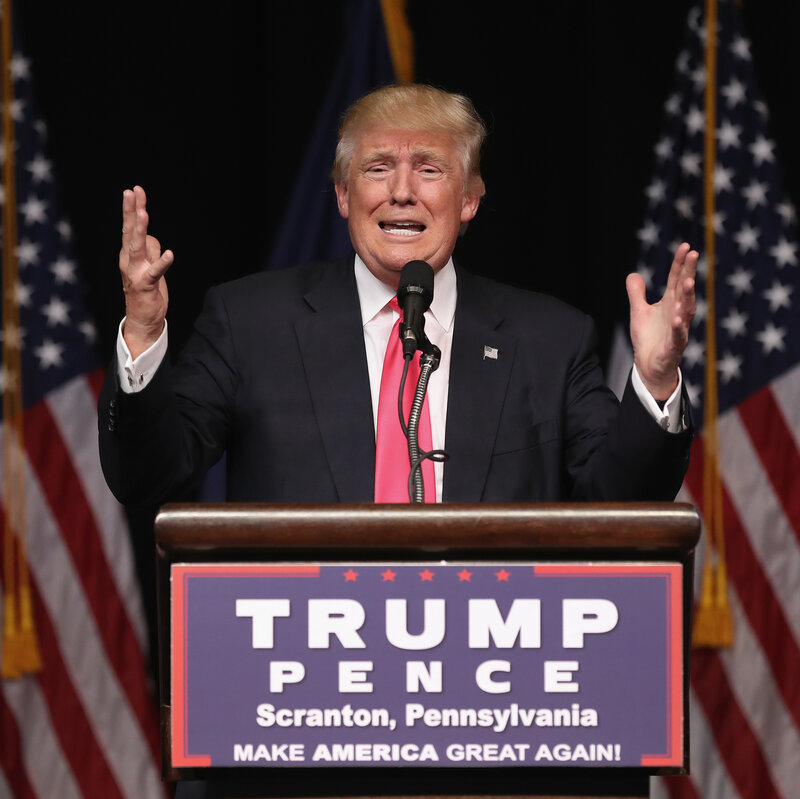
Former President Donald Trump paraded before U.S. flags and uniformed National Guard troops in Eagle Pass. He renewed themes popularized by the Ku Klux Klan a century ago, sowing fear of foreigners and painting his opponent as a friend of dark-skinned criminals.

“They’re coming from jails, and they’re coming from prisons, and they’re coming from mental institutions and they’re coming from insane asylums. And they’re terrorists. They’re being let into our, our country,” Trump said in a rambling, bigoted speech. “It’s not just South America. It’s all over the world. The Congo, very big population coming in from jails from the Congo.”

Immigration is the most critical problem facing the nation, Americans told a recent Gallup poll. The issue was top of mind for 57% of Republicans, 22% of independents and 10% of Democrats.

“A separate question in the survey finds a record-high 55% of U.S. adults, up eight points from last year, saying that ‘large numbers of immigrants entering the United States illegally’ is a critical threat to U.S. vital interests,” Gallup added.

Most voters believe Trump would do a better job on border security, while only 28% of Americans approve of Biden’s immigration policies. Biden is in deep trouble, with only a 38% approval rating and a base already angry over his Middle East policies.

Anyone who’s spent time along the border will tell you most Americans don’t understand what goes on there. For example, asylum seekers are not invading the country; they turn themselves in as quickly as possible. Most of the $29 billion worth of drugs smuggled into the United States crosses at commercial entry points, which are the arterial roads keeping our economy going.

Migrants, documented or not, are critical for our workforce and society. I know people like to draw distinctions between documented and undocumented migrants, but both contribute more to the United States economy than they take. Most undocumented workers would happily pay a fine to get right with the government.

In Houston, immigrants make up almost a quarter of the population and 31% of the workforce, U.S. census data analyzed by the American Immigration Council, the Texas Association of Business and the Center for Houston’s Future found. Immigrants in the Houston statistical area earned $66.5 billion and paid $11.1 billion in federal taxes.

If Trump rounded these people up and deported them, as he promised, the construction, hospitality and hospital services would collapse.

Houston is home to more than 572,000 undocumented migrants whose households earned $13 billion in 2021. Most have fake documents and paid $794.8 million in federal taxes and $595.6 million in state and local taxes, the U.S. Congressional Budget Office reported.

Meanwhile, Biden must come up with a new approach to processing asylum seekers after Congress made it clear they will not help. But he must overcome opposition from within his party and federal courts.

Federal and international law requires the United States to grant asylum to anyone with a well-founded fear of persecution. However, establishing which claims meet that high standard under current policies can take years.

Opinions differ on what he can do without new laws. Seventy-seven Democratic lawmakers sent Biden a letter in January objecting to the deal he offered Republicans. A federal judge in San Diego has forbidden authorities from separating families at the border, and an earlier ruling limits how long Immigration and Customs Enforcement can detain families with children.

Trump’s speech on Thursday was craven but likely effective. Biden’s blame-shifting onto Republicans in Congress is disingenuous and ineffective.

While the campaigns play political games, though, people suffer, something too many overlook.

Award-winning opinion writer Chris Tomlinson writes commentary about money, politics and life in Texas. Sign up for his “Tomlinson’s Take” newsletter at houstonhchronicle.com/tomlinsonnewsletter or expressnews.com/tomlinsonnewsletter.

[Note from Diane: I added the bold emphasis.]

The New York Times reported on Trump’s agenda to limit, exclude, and expel immigrants if he is re-elected. Of course, he would revive his ban on immigration from Muslim-majority nations. And he would create massive detention centers. Millions of undocumented immigrants would be deported. The headline sums it up: “Sweeping Raids, Giant Camps, and Mass Deportations.

The story, written by Charlie Savage, Mafmggir Haberman, and Jonathan Swan, is chilling. Forget that poem on the base of the Statue of Liberty. Forget the “golden door.” The door will be closed.

Former President Donald J. Trump is planning an extreme expansion of his first-term crackdown on immigration if he returns to power in 2025 — including preparing to round up undocumented people already in the United States on a vast scale and detain them in sprawling camps while they wait to be expelled.

The plans would sharply restrict both legal and illegal immigration in a multitude of ways.

Mr. Trump wants to revive his first-term border policies, including banning entry by people from certain Muslim-majority nations and reimposing a Covid 19-era policy of refusing asylum claims — though this time he would base that refusal on assertions that migrants carry other infectious diseases like tuberculosis.

He plans to scour the country for unauthorized immigrants and deport people by the millions per year.

To help speed mass deportations, Mr. Trump is preparing an enormous expansion of a form of removal that does not require due process hearings. To help Immigration and Customs Enforcement carry out sweeping raids, he plans to reassign other federal agents and deputize local police officers and National Guard soldiers voluntarily contributed by Republican-run states.

To ease the strain on ICE detention facilities, Mr. Trump wants to build huge camps to detain people while their cases are processed and they await deportation flights. And to get around any refusal by Congress to appropriate the necessary funds, Mr. Trump would redirect money in the military budget, as he did in his first term to spend more on a border wall than Congress had authorized.

In a public reference to his plans, Mr. Trump told a crowd in Iowa in September: “Following the Eisenhower model, we will carry out the largest domestic deportation operation in American history.” The reference was to a 1954 campaign to round up and expel Mexican immigrants that was named for an ethnic slur — “Operation Wetback.”

The constellation of Mr. Trump’s 2025 plans amounts to an assault on immigration on a scale unseen in modern American history. Millions of undocumented immigrants would be barred from the country or uprooted from it years or even decades after settling here.

And here is a policy that should get the attention of Arab-Americans who are thinking of voting for Trump because of Biden’s support for Israel:

In a second Trump presidency, the visas of foreign students who participated in anti-Israel or pro-Palestinian protests would be canceled. U.S. consular officials abroad will be directed to expand ideological screening of visa applicants to block people the Trump administration considers to have undesirable attitudes…

Similarly, numerous people who have been allowed to live in the country temporarily for humanitarian reasons would also lose that status and be kicked out, including tens of thousands of the Afghans who were evacuated amid the 2021 Taliban takeover and allowed to enter the United States. Afghans holding special visas granted to people who helped U.S. forces would be revetted to see if they really did.

Trump’s chief advisor on immigration policy is Stephen Miller, who endorses draconian policies to ban and oust immigrants.

Miller told the Times:

“Any activists who doubt President Trump’s resolve in the slightest are making a drastic error: Trump will unleash the vast arsenal of federal powers to implement the most spectacular migration crackdown,” Mr. Miller said, adding, “The immigration legal activists won’t know what’s happening.”

I received

Earlier this week, Donald Trump swept through the Republican Super Tuesday presidential primaries (with the exception of Vermont). His one major opponent has dropped out, putting the most dangerous president in American history one step closer to returning to the White House.

The primary is over. This is it. The election will once again be between Joe Biden and Donald Trump. And, frighteningly, at this point most polls have Trump in the lead.

The question we now face is a simple one. How do we defeat Trump and his right-wing extremist allies in the House and Senate? How do we elect more Progressives to Congress?

And, frankly, the answer is complicated by the reality that the Democratic establishment is ill-prepared to do that. They have relatively little support within the working class. Their support among the Latino community is declining. And they are even seeing a drop In support from the Black community – historically the Democrats strongest base of support. Their support among young people is declining. The Democrats are also weak in terms of generating grass-roots activism or excitement. 

We have to do things differently. 

While most Democrats will focus their attention on Trump’s indictments, his insults and outrages, our job is to be laser-focused in reminding people of the fraud and pathological liar for working people we all know Trump to be.

For instance: 

This is a president, Donald Trump, who said he was going to provide health care to everyone, yet tried to throw 32 million people off of health care and has pledged to continue to try and accomplish that goal. 

This is a president who said he was going to stand up for working families and who promised to pass tax reform legislation designed to help the middle class, yet 83 percent of his tax benefits go to the top 1 percent.

This is a president who promised to take on the pharmaceutical companies. He said they were “getting away with murder.” Yet, drug prices continue to soar and he appointed a drug company executive as the Secretary of Health and Human Services.

This is a president who promised to take on the greed of Wall Street, but then proceeded to appoint more Wall Street titans to high positions than any president in history.

This is a president who appointed vehemently anti-labor members to the National Labor Relations Board (NLRB). 

This is a president who believes climate change is a “hoax”, and appointed agency leaders and judges who consistently undermined our ability to move toward sustainable energy and protect the environment.

This is a president who said he would do “everything in my power to protect our LGBT citizens,” yet went out of his way to attempt to deny them from getting the health care they need and allow discrimination against them in the workplace.

This is a president who brags about his role in overturning Roe v. Wade and denying reproductive rights to millions of women across the country.

This is a president who said that if he won that America would be respected again around the world, yet as a result of his anti-democratic and incompetent policies has succeeded in significantly lowering the respect that people all over the planet have for the United States, all while embracing right-wing authoritarian rulers around the world. 

This is a president who not only rejected his own defeat and attempted to incite an insurrection to stop Congress from certifying the election, but worked overtime to make it harder for people to vote and easier for billionaires to buy the outcomes of elections. I happen to believe that if Trump is elected once again this November, the 250 year old experiment of modern democracy in this country may very well come to end. 

The truth is, Donald Trump sold out the working families of this country once, and if he wins again all of the anti-worker, anti-democratic policies he pursued during his first term will only be magnified. He is a menace to working people whose rejection of climate science threatens the future of this planet. We have to appreciate how unbelievably severe the current moment is.

This is not the message most Democrats trying to defeat Trump will communicate, but it one we must relentlessly remind the working people of this country about ahead of November’s elections.

So there it is. A lot of important work ahead of us.

Thom Hartmann has written a new book titled The Hidden History of Monopolies: How Big Business Destroyed the American Dream. He has decided to offer it for free, a chapter at a time, on his blog.

He writes:

Because the Founders set up America to be resistant to the coercive and corruptive influence of monopoly and vested interest, the monopolists didn’t have any direct means of taking over the American government. So, two processes were necessary.

First, they knew that they’d have to take over the government. A large part of that involved the explicit capture of the third branch of government, the federal judiciary (and particularly the Supreme Court), which meant taking and holding the presidency (because the president appoints judges) at all costs, even if it required breaking the law; colluding with foreign governments, monopolies, and oligarchs; and engaging in massive election fraud, all issues addressed in previous Hidden History books.

Second, they knew that if they were going to succeed for any longer than a short time, they’d need popular support. This required two steps: build a monopoly-friendly intellectual and media infrastructure, and then use it to persuade people to distrust the US government.

Lewis Powell’s 1971 memo kicked off the process.

Just a few months before he was nominated by President Richard Nixon to the US Supreme Court, Powell had written a memo to his good friend Eugene Sydnor Jr., the director of the US Chamber of Commerce at the time.32 Powell’s most indelible mark on the nation was not to be his 15-year tenure as a Supreme Court justice but instead that memo, which served as a declaration of war against both democracy and what he saw as an overgrown middle class. It would be a final war, a bellum omnium contra omnes, against everything FDR’s New Deal and LBJ’s Great Society had accomplished.

It wasn’t until September 1972, 10 months after the Senate confirmed Powell, that the public first found out about the Powell memo (the actual written document had the word “Confidential” at the top—a sign that Powell himself hoped it would never see daylight outside of the rarified circles of his rich friends). By then, however, it had already found its way to the desks of CEOs all across the nation and was, with millions in corporate and billionaire money, already being turned into real actions, policies, and institutions.

During its investigation into Powell as part of the nomination process, the FBI never found the memo, but investigative journalist Jack Anderson did, and he exposed it in a September 28, 1972, column in the Washington Post titled, “Powell’s Lesson to Business Aired.” Anderson wrote, “Shortly before his appointment to the Supreme Court, Justice Lewis F. Powell Jr. urged business leaders in a confidential memo to use the courts as a ‘social, economic, and political’ instrument.”33

Pointing out that the memo hadn’t been discovered until after Powell was confirmed by the Senate, Anderson wrote, “Senators . . . never got a chance to ask Powell whether he might use his position on the Supreme Court to put his ideas into practice and to influence the court in behalf of business interests.”34

This was an explosive charge being leveled at the nation’s rookie Supreme Court justice, a man entrusted with interpreting the nation’s laws with complete impartiality. But Anderson was a true investigative journalist and no stranger to taking on American authority or to the consequences of his journalism. He’d exposed scandals from the Truman, Eisenhower, Johnson, Nixon, and Reagan administrations. In his report on the memo, Anderson wrote, “[Powell] recommended a militant political action program, ranging from the courts to the campuses.”35

Powell’s memo was both a direct response to Franklin Roosevelt’s battle cry decades earlier and a response to the tumult of the 1960s. He wrote, “No thoughtful person can question that the American economic system is under broad attack.”36

When Sydnor and the Chamber received the Powell memo, corporations were growing tired of their second-class status in America. The previous 40 years had been a time of great growth and strength for the American economy and America’s middle-class workers—and a time of sure and steady increases of profits for corporations—but CEOs wanted more.

If only they could find a way to wiggle back into the minds of the people (who were just beginning to forget the monopolists’ previous exploits of the 1920s), then they could get their tax cuts back; they could trash the “burdensome” regulations that were keeping the air we breathe, the water we drink, and the food we eat safe; and the banksters among them could inflate another massive economic bubble to make themselves all mind-bogglingly rich. It could, if done right, be a return to the Roaring Twenties.

But how could they do this? How could they persuade Americans to take another shot at what was widely considered a dangerous “free market” ideology and economic framework that had crashed the economy in 1929?

Lewis Powell had an answer, and he reached out to the Chamber of Commerce—the hub of corporate power in America—with a strategy. As Powell wrote, “Strength lies in organization, in careful long-range planning and implementation, in consistency of action over an indefinite period of years, in the scale of financing available only through joint effort, and in the political power available only through united action and national organizations.” Thus, Powell said, “the role of the National Chamber of Commerce is therefore vital.”37

In the nearly 6,000-word memo, Powell called on corporate leaders to launch an economic and ideological assault on college and high school campuses, the media, the courts, and Capitol Hill. The objective was simple: the revival of the royalist-controlled “free market” system. As Powell put it, “[T]he ultimate issue . . . [is the] survival of what we call the free enterprise system, and all that this means for the strength and prosperity of America and the freedom of our people.”

The first front that Powell encouraged the Chamber to focus on was the education system. “[A] priority task of business—and organizations such as the Chamber—is to address the campus origin of this hostility [to big business],” Powell wrote.38

What worried Powell was the new generation of young Americans growing up to resent corporate culture. He believed colleges were filled with “Marxist professors” and that the pro-business agenda of Harding, Coolidge, and Hoover had fallen into disrepute since the Great Depression. He knew that winning this war of economic ideology in America required spoon-feeding the next generation of leaders the doctrines of a free-market theology, from high school all the way through graduate and business school.

At the time, college campuses were rallying points for the progressive activism sweeping the nation as young people demonstrated against poverty, the Vietnam War, and in support of civil rights. Powell proposed a list of ways the Chamber could retake the higher-education system. First, create an army of corporate-friendly think tanks that could influence education. “The Chamber should consider establishing a staff of highly qualified scholars in the social sciences who do believe in the system,” he wrote.39

Then, go after the textbooks. “The staff of scholars,” Powell wrote, “should evaluate social science textbooks, especially in economics, political science and sociology. . . . This would include assurance of fair and factual treatment of our system of government and our enterprise system, its accomplishments, its basic relationship to individual rights and freedoms, and comparisons with the systems of socialism, fascism and communism.”

Powell argued that the civil rights movement and the labor movement were already in the process of rewriting textbooks. “We have seen the civil rights movement insist on re-writing many of the textbooks in our universities and schools. The labor unions likewise insist that textbooks be fair to the viewpoints of organized labor.”41 Powell was concerned that the Chamber of Commerce was not doing enough to stop this growing progressive influence and replace it with a pro-plutocratic perspective.

“Perhaps the most fundamental problem is the imbalance of many faculties,” Powell pointed out. “Correcting this is indeed a long-range and difficult project. Yet, it should be undertaken as a part of an overall program. This would mean the urging of the need for faculty balance upon university administrators and boards of trustees.” As in, the Chamber needed to infiltrate university boards in charge of hiring faculty to make sure that only corporate-friendly professors were hired.

Powell’s recommendations targeted high schools as well. “While the first priority should be at the college level, the trends mentioned above are increasingly evidenced in the high schools. Action programs, tailored to the high schools and similar to those mentioned, should be considered,” he urged.

Next, Powell turned to the media, instructing that “[r]eaching the campus and the secondary schools is vital for the long-term. Reaching the public generally may be more important for the shorter term.” Powell added, “It will . . . be essential to have staff personnel who are thoroughly familiar with the media, and how most effectively to communicate with the public.” He advocated that the same system “applies not merely to so-called educational programs . . . but to the daily ‘news analysis’ which so often includes the most insidious type of criticism of the enterprise system.”

Following Powell’s lead, in 1987 Reagan suspended the Fairness Doctrine (which required radio and TV stations to “program in the public interest,” a phrase that was interpreted by the FCC to mean hourly genuine news on radio and quality prime-time news on TV, plus a chance for “opposing points of view” rebuttals when station owners offered on-air editorials), and then in 1996 President Bill Clinton signed the Telecommunications Act of 1996, which eliminated most media-monopoly ownership rules. That same year, billionaire Rupert Murdoch started Fox News, an enterprise that would lose hundreds of millions in its first few years but would grow into a powerhouse on behalf of the monopolists.

From Reagan’s inauguration speech in 1981 to this day, the single and consistent message heard, read, and seen on conservative media, from magazines to talk radio to Fox, is that government is the cause of our problems, not the solution. “Big government” is consistently—more consistently than any other meme or theme—said to be the very worst thing that could happen to America or its people, and after a few decades, many Americans came to believe it. Reagan scare-mongered from a presidential podium in 1986 that “the nine most terrifying words in the English language are: I’m from the government and I’m here to help.”

Once the bond between people and their government was broken, the next steps were straightforward: Reconfigure the economy to work largely for the corporate and rich, reconfigure the criminal justice system to give white-collar criminals a break while hyper-punishing working-class people of all backgrounds, and reconfigure the electoral systems to ensure that conservatives get reelected.

Then use all of that to push deregulation so that they can quickly consolidate into monopolies or oligopolies.

Michael Podhorzer is a political analyst who has worked for the AFL-CIO. His is a widely respected voice thanks to the depth of his knowledge and wisdom. He maintains here that the MAGA movement is more aligned with the Confederacy than most people realize. He posted this piece soon after the U.S. Supreme Court ruled that states could not remove Trump from their ballots even though he participated in an insurrection.

I am posting it in part. Open the link to read it all.

Podhorzer writes:

Note: A version of this piece was published at The Washington Monthly 

The Supreme Court rejected Colorado’s decision to keep Trump off the ballot. Ahead of the ruling, many constitutional scholars and historians made strong legal arguments that Section 3 of the 14th Amendment disqualifies Trump from holding public office again. Others argued that if the Supreme Court upheld a Colorado high court ruling it would compromise the legitimacy of our democratic process. 

Here, I want to use this episode to show how the debate itself was really about the legitimacy of America itself. 

Since the January 6, 2021, insurrection, there has been speculation about whether America might break apart as it did in 1861. Some even fear that removing Trump from the ballot will ignite a new civil war. But when we describe what happened in the 19th century and what we fear coming now as a “Civil War,” we undermine the legitimacy of the American nation. We put the secessionists then—and the MAGA movement now—on an equal footing with the legitimate American government. By doing so, we not only mislabel the threats that Trump and MAGA represent, but also underestimate their dangers.

The original designation of the military engagement from 1861 through 1865 was the “War of Rebellion.” This wasn’t just the Union’s perspective; the Confederate States understood themselves to be seceding to form an independent “slaveholding republic.” They called themselves “rebels.” It was not a civil war in which combatants fought to control one nation. 

The leaders of what I call the Red Nation, which has 10 of the 11 Confederate states at its core, consistently reveal that they do not recognize the legitimacy of the United States. (See the Appendix of my post on “The Two Nations of America” for more on how I define Red Nation.) They continue to be in the same relationship with America today as the Confederate states were before the War of Rebellion—unwilling to acceptthe legitimacy of the federal government, even if, in most periods, they have acquiesced to its superior force.

When the 14th Amendment was ratified in 1868, it was obvious why Section 3 was included. When a nation cannot disqualify from public office those who have sought to destroy it, it casts doubt on its own legitimacy. That is especially true of the unrepentant Trump. Even Confederate generals admitted they lost by swearing allegiance to the United States. Trump still insists that he didn’t lose. Meanwhile, most Republicans dodge whether President Joe Biden won the election legitimately by grudgingly acknowledging that Biden is president. 

The MAGA faction is not “conservative,” and even calling it “extremist” misses the point dangerously. Those advocating for conservative and even extreme policies should be welcome in a democratic polity. But those acting in ways that reject legitimately constituted authority are neither conservative nor extreme. They are criminal. Thus, if we hope to be a single America, then we must acknowledge that those who claim that the 2020 election was stolen, decry the prosecution of Trump as a crime, call those convicted for their January 6 crimes “political hostages,” and claim that the Rio Grande is Texas’s to defend and not the federal government’s, do not recognize the legitimacy of the United States. They, like their Confederate ancestors, are not patriots. 

When the Constitution was ratified in 1788, the free states saw it as most of us do today—enshrining a government for a unified nation. To the enslaving states, however, the Constitution did not create a single nation. Rather, as Texas Governor Gregg Abbott and two dozen other Red States say, it is merely a “compact” among the states. Due to the gravity of threats from abroad (Britain, France, Spain) and at home (Native Americans and enslaved people), the enslaving states agreed to a mutual defense pact (the Constitution) only insofar as they were confident that it protected their “peculiar institution.” 

At Appomattox, Virginia, in 1865, the Confederates did not surrender so much as acknowledge that their best hope to preserve their “way of life” was not on the battlefield where they were badly outmatched but in a campaign of terror against Reconstruction. Once the South had made Reconstruction too costly to continue, it enacted Jim Crow Constitutions and updated its forced labor economy. This is a well-told story, for example, in Heather Cox Richardson’s How the South Won the Civil War. 

Our devotion to an “America” that strives to be a “government of the people, by the people, for the people” has never been accepted by the Confederate faction, which has always been (and remains) committed to theocracy. We believe that the warrant for government is “the consent of the governed”; they believe its legitimacy is God-given….

Cutting the Branches, Leaving the Roots

Consider Germany, which is rightly credited for taking responsibility for the Holocaust. Last summer, I visited Berlin and saw how robust these efforts have been. For example, the sidewalks in residential neighborhoods have been broken up by Stolpersteine—stumble blocks—which call attention to the homes the Nazis stole from Jews and, where known, the fate of those Jews. But it’s not as if there aren’t similar landmarks commemorating our past, including the Legacy Museum/Lynching Memorialin Montgomery, Alabama, the National Center for Civil and Human Rights in Atlanta, Georgia, and the National Museum of African American History and Culture in Washington, D.C. 

No, the real difference is exactly the difference between conceptualizing today’s toxic politics as “civil war” or “polarization” instead of a rebellion. In Germany, the idea that there would be monuments or streets named after Adolf Hitler or his generals is unthinkable. No popular culture there valorizes those who fought for the Führer or waxes nostalgic for a lost way of life. There’s no bawdy comedy, The Dukes of Bavaria

Please open the link to read this provocative article in full.

State legislatures these days tthjnkbthat they should pass laws telling teachers how to teach reading and what to teach in social studies. The latest example comes from Ohio, where the far-right legislature is in the midst of mandating a course on capitalism.

Denis Smith, retired educator, writes:

In case anyone hasn’t noticed, our republic is on fire. And that’s not being hyperbolic.

Incendiary language is now the norm in Congress and across the nation, further fanning the flames of overheated rhetoric in an election year. Indictments pile up against a former president, along with criminal trials looming in multiple jurisdictions. Perhaps even more ominous, jurors, judges, and election workers are being threatened with harm by extremists across our land.

But that’s only the short version of a narrative about a country at the brink, where democracy is threatened by the specter of authoritarianism.

Meanwhile, back in Ohio, the legislature has examined the state of the state and determined that in today’s volatile world, there is a pressing need to modify public school curriculum by teaching … capitalism.

That’s right. Ohio Republicans have decided that teaching about capitalism is more important in troubled times than strengthening student learning opportunities about democracy. Yes, learning about capitalism is more important for Ohio students than the critical need for media literacy and increased research and critical thinking skills in an age of artificial intelligence and fake news.

Add to that the importance of teaching about character and caring about others, a key cornerstone of character education. 

To Republicans, whose former House Speaker and former state party chair are now serving prison sentences, along with their twice-impeached presidential front runner facing 91 felony criminal counts, there appears to be no pressing need for young people to learn more about personal ethics, citizenship, and the importance of character. 

But we probably should know that when it comes to Republicans, caring about the needs of others might be tantamount to socialism.

After the passage of Ohio Senate Bill 17 by a margin of 64-26 on Feb. 7, a measure which calls for the addition of teaching about capitalism in high school financial literacy standards, one Democratic legislator told the Cincinnati Enquirer/USA Today Network that adding capitalism to carefully crafted financial literacy classes only dilutes the amount of content students can learn in this important course of study designed to prepare students for assuming adult roles and functions. 

This bill is one part partisan message, one part ideological warfare and one part a poor fix’ to Ohio’s financial literacy class requirement, said Rep. Joe Miller, D-Lorain, a former social studies teacher who instructed students on the principles of capitalism.

The educator and legislator, now serving his third term in the Ohio House, is quite savvy in knowing the usual lockstep behavior of Republicans, none of whom voted against the bill. An additional observation by Miller might have also been influenced by knowing the tired rhetoric of one of the bill’s co-sponsors in the Ohio Senate, Andrew Brenner, who famously said in 2014 that public education was “socialism” and should be privatized. 

The Enquirer piece continued, saying Miller worried opponents of the bill would be labeled socialists in future campaigns.

With Brenner and Senate President Matt (“we can kind of do what we want”) Huffman, it’s only a matter of time before they use the words socialism and socialist, along with other Republicans, as tired descriptors for the noun Democrat. 

Come to think of it, if the titular head of the Republican Party is constantly complaining about witch hunts, what if we soon find out that the latest supply chain issue generated by the GOP might result in a shortage of witches?  If they do run out of witches, look for socialist hunts in this election year.

In a little-noticed maneuver in the 2016 Presidential campaign, the Trump team watered down the Republican Party’s platform on military aid to Ukraine. Trump’s campaign director, Paul Manafort, had previously earned millions of dollars as a political consultant to the pro-Russian president of Ukraine and as an advisor to one of Putin’s oligarchs, Oleg Deripaska.

Let it be noted too that the Obama administration sat on its hands when Russia invaded Crimea in 2014 and seized control of a large chunk of Ukraine.

NPR reported in 2016:

One of the questions raised over the course of this year’s presidential race is about how a President Trump would deal with Russian president Vladimir Putin.

One reason to wonder: the Republican Party platform’s new language on policy towards Ukraine.

When Republican Party leaders drafted the platform prior to their convention in Cleveland last month, they had relatively little input from the campaign of then-presumptive nominee Donald Trump on most issues — except when it came to a future Republican administration’s stance on Ukraine.

It started when platform committee member Diana Denman tried to insert language calling for the U.S. to provide lethal defensive weapons to the Ukrainian government, which is fighting a separatist insurrection backed by Russia. Denman says she had no idea she was “going into a fire fight,” calling it “an interesting exchange, to say the least.”

Denman is a long time GOP activist from Texas. When she presented her proposal during a platform subcommittee meeting last month, “two gentleman,” whom Denman said were part of the Trump campaign, came over, looked at the language, and asked that it be set aside for further review.

Why Would Vladimir Putin Want To Leak The DNC Emails?

She says after further discussion the pair “had to make some calls and clear it.” She says they found the language was still too strong.

Trump Says He Was Being 'Sarcastic' In Asking Russia To 'Find' Clinton's Emails

POLITICS 

Trump Says He Was Being ‘Sarcastic’ In Asking Russia To ‘Find’ Clinton’s Emails

The Trump campaign convinced the platform committee to change Denman’s proposal. It went from calling on the U.S. to provide Ukraine “lethal defensive weapons” to the more benign phrase “appropriate assistance.”

It’s more than semantics. Many Republicans have been demanding the Obama administration provide a more robust response to Russia’s incursions in Ukraine.

Denman “was steam rolled,” said Melinda Haring of the Atlantic Council, a Washington, DC, think tank, who believes the language the Trump campaign approved is weaker. And she says “it’s anyone’s guess” what Trump would do regarding Ukraine and Russia, and that perhaps he might not even back “appropriate assistance.”

Haring was referring to Trumps appearance on ABC’s This Week with George Stephanopoulos last month, when Trump said Vladimir Putin is “not going to go into Ukraine, OK? Just so you understand, he’s not going to go into Ukraine.”

The adoption of voucher programs has been a boon for religious schools. Schools that were financially troubled are now thriving with public subsidies for their students as well as an influx of new students.

This article by reporter Holly Meyer on the Associated Press newswire describes the good fortune of religious schools but does not mention the copious research demonstrating the failure of vouchers.

The Miami Archdiocese’s superintendent of schools says Catholic education is increasingly in demand in South Florida, now that all K-12 students regardless of income are allowed to use taxpayer-funded programs to pay for private school tuition.

Against the backdrop of favorable decisions by the conservative-majority U.S. Supreme Court, Florida was among nine states that expanded school voucher programs last year. So many families have signed up for the taxpayer-funded tuition reimbursements, some states are already exceeding their budgets….

The movement gained momentum amid fallout from pandemic-era school restrictions, debates on how transgender students should participate in school life, and wars over books and curriculum related to race and LGBTQ+ issues….

Some long-running religious schools are now planning for a fuller future after the wave of policy wins for the so-called school choice movement. Others hope voucher expansion comes to their state.

“We are moving into growth mode,” said Jim Rigg, superintendent of the Miami Archdiocese’s 64 schools. Accelerated by the state’s private school scholarship program, enrollment has risen for the last four years, reaching its highest peak in over a decade, he said….

Nearly 80% of private school families choose religious ones, according to P. George Tryfiates, public policy and legal affairs vice president for the Association of Christian Schools International. The association represents about 2,200 U.S. schools.

In a statement, he said Christian schools are, among other things, “a refuge from the cultural wars over sexuality.”

Voucher programs do not include accountability measures nor do they ban discrimination. Religious Scholls are not required to comply with federal laws so they may ban students with disabilities and students of religions different from the sponsor.

Most vouchers are used by students already enrolled in religious schools.

The voucher movement is a not subtle way of gutting civil rights protections.

IDEA, the largest charter chain in Texas, was just placed under conservatorship by the state education agency because of ongoing financial transgressions, self-dealing and conflicts of interest.

The state of Texas gave more than $800 million last year to IDEA. The federal Charter Schools Program—which is rank with waste, fraud, and abuse—has gifted IDEA with $300 million. It was a favorite of Secretary of Education Betsy DeVos.

For years, both the state and the U.S. Department of Education have been aware of IDEA’s profligate spending. This is the charter chain that wanted to lease a 6-passenger private jet for $15 million for its executives. This is the chain that bought luxury box seats for the San Antonio Spurs basketball games. This is the chain that gave its founder a golden parachute of $900,000 when financial abuses forced him out.

When there is so much that is fraudulent in the chain’s spending, can you trust its reports about enrollment, grades, test scores, and graduation rates? Business leaders in San Antonio saw IDEA as a great replacement for public schools. They were hoodwinked.

The Texas Tribune reported:

Texas’ largest charter school network has been placed under conservatorship by the Texas Education Agency after a years-long investigation into improper spending within the system of 143 schools.

The arrangement, announced Wednesday, is part of a settlement agreement between IDEA Public Schools and the TEA. IDEA had been under investigation since 2021 following numerous allegations of financial and operational misconduct.

It was revealed that IDEA officials used public dollars to purchase luxury driver services as well as $15 million to lease a private jet, just two weeks after promising TEA it would be “strictly enforcing” new fiscal responsibility policies put in place in response to ongoing investigations, as reported by San Antonio Express-News.

The revelations led the district to conduct an internal investigation, resulting in the firing of JoAnn Gama, former superintendent and co-founder of IDEA. Gama later filed a lawsuit against IDEA claiming wrongful termination. IDEA came to a $475,000 settlement with Gama in January. This followed co-founder and CEO Tom Torkelson’s departure in 2020; he was given a $900,000 severance package.

The charter school district serves about 80,000 students in K-12. The schools are independently run but publicly funded with state dollars, having received about $821 million in state funding in 2023-2024 school year.

Under conservatorship, the conservators will have the authority to oversee and direct any action of the district, facilitate a needs assessment, conduct onsite inspections and support the creation of a plan to address corrective action concerns. They will also report back to the agency regarding the district’s progress in completing necessary corrective activities.

The conservators will not fully take over the governance of the district. But if the district doesn’t make the necessary corrective measures that the conservators outline for them, a takeover could be possible in the future…

The news follows the TEA takeover of Houston Independent School District in June following years of poor academic performance at a single campus within the district, among other factors.

Glenn Rogers is a veterinarian and a rancher who lives in Graford, Texas. In addition to his duties as a vet and a rancher, he served on the school board of the Graham Independent School District. He was elected to represent District 60 in the Texas Legislature in 2021. He is a conservative, and he tries to represent his rural constituents faithfully. They don’t want vouchers. They want more funding for their local public schools and higher salaries for their teachers. People know their teachers. The teachers know their students and their families. The public schools are important for the local economy. The tradition of Friday night high school football games unifies the community; it’s known as “Friday night lights.”

When Representative Rogers voted against vouchers along with other rural Republicans, Governor Abbott unleashed an advertising blitz against them. The ads accused them of being “weak on security,” which was a lie. Money from billionaires poured into the district to smear Rep. Rogers. He lost.

Rep. Rogers released this statement, which was published in The Weatherford Democrat:

“I’ll Wear No Man’s Collar”

-Davy Crockett

First, I want to thank my supporters, those who voted for me and those who supported me prayerfully, financially, and in so many other ways. It has been the greatest honor to serve this district.

The corruption that exists at the highest level of Texas state government would have made Governor “Pa” Ferguson blush.

Governor Greg Abbott has defiled the Office of Governor by creating and repeating blatant lies about me and my House colleagues, those who took a stand for our public schools. I stood by the Governor on all his legislative priorities but just one, school vouchers. For just one disagreement, and for a $6 million check from Jeff Yass, a Pennsylvanian TikTok investor, and voucher vendor, Abbott went scorched earth against rural Texas and the Representatives who did their jobs-representing their districts.

My tenure in the Texas House included two general sessions, seven special sessions, redistricting, Covid, winter storm Uri, a Democrat quorum break, expulsion of a House member and the impeachment of Ken Paxton. It also includes a litany of conservative victories that made Texas safer, reigned in out-of-control government bureaucracy, lessened what had become a crushing tax burden on our families and businesses, and fostered economic growth.

I am not a good politician. I am just a Texas rancher who wanted to make a difference in my community. Who knew this simple mission would have resulted in three brutal campaigns?

Throughout my three campaigns, because of my unwillingness to be compliant with the two billionaire, “Christian” Nationalist, power brokers that run this state, I have been unmercifully slandered through the politics of unwarranted personal destruction on social media, radio, post mail, streaming sites, and cable television.

In my first race the opposition was the Wilks, Tim Dunn, Empower Texans, and the entire enterprise of dozens of PACs and “non-profits” they financed. The race ended in a hard fought Covid-delayed runoff victory against Farris Wilks’ son-in-law.

In my second race, my opposition was Wilks and Dunn, Empower Texans (rebranded to Defend Texas Liberty), and the Voucher Lobby, including the American Federation for Children and the School Freedom Fund (based in Virginia). In that race, we dealt with a runoff and an expensive, unnecessary recount.

In my third race the opposition was all the above, but now included a rebranded Defend Texas Liberty (Texans United for a Conservative Majority), vastly greater money from the Voucher Lobby, and Governor Greg Abbott.

This time the millions of dollars spent spreading lies about my record and the non-stop false impugning of my integrity were just too much to overcome. The real losers in this race are:

1) Texas public schools;

2) Rural Texas; and

3) Representative Government.

This morning, I have no regrets. I believe in the words of Sam Houston, “Do right and risk the consequences.”

History will prove Ken Paxton is a corrupt, sophisticated criminal. History will prove vouchers are simply an expensive entitlement program for the wealthy and a get rich scheme for voucher vendors. History will prove Governor Greg Abbott is a liar.

History will prove that our current state government is the most corrupt ever and is “bought” by a few radical dominionist billionaires seeking to destroy public education, privatize our public schools and create a Theocracy that is both un-American and un-Texan.

May God save Texas!

[Editors Note: the Wilks brothers and Tim Dunn are oil-and-gas billionaires who are evangelical Christians; they want vouchers, and they use their money to control state government. Ken Paxton is the State Attorney General who was impeached by the Texas House of Teprrsentatibes on multiple charges of corruption, based on whistleblower reports from his own staff. After Paxton’s billionaire friends came to the rescue, giving a campaign contribution of $2 million to Lt. Gov. Dan Patrick, who conducted the trial in the Srnate, Paxton was acquitted. In this week’s election, Attorney General Paxton and his wealthy friends ousted legislators and judges who tried to hold him accountable.]